Indigenous young people experience significant educational disadvantage (Australian Government, 2013, 2014b; MCEETYA, 2008). Literature on Indigenous Education is heavily focused on developing an understanding of what is causing Indigenous young people to disengage from education and how to improve educational outcomes (Lonsdale, Reference Lonsdale2013; Rahman, Reference Rahman2010; Schwab, Reference Schwab2012; Walsh & De Campo, Reference Walsh and De Campo2010). The majority of this literature is focused on conventional schooling contexts, with only a limited focus on non-conventional schooling (Armstrong & Buckley, Reference Armstrong and Buckley2011; Gunstone, Reference Gunstone2012; Helme & Lamb, Reference Helme and Lamb2011). The results presented in this article are from a study that focused on flexi school contexts in Queensland. There is varying language used to describe this non-conventional schooling context, including ‘alternative education’, ‘flexi schools’ and ‘learning choices’. All of these terms describe a model of education outside of conventional schooling that aims to provide young people the opportunity to remain engaged in education (te Riele, Reference te Riele2012). There are some concerns about the use of terms such as ‘at risk’ and ‘disengaged’ to describe young people who are involved in alternative education (Morgan, Pendergast, Brown, & Heck, Reference Morgan, Pendergast, Brown and Heck2014). Use of these terms posits young people as being problematic because of the failure of mainstream schools to engage them in learning. ‘Flexi school’ is the preferred term use throughout this article to avoid the focus on the deficit stereotypes connected with the term ‘alternative education’.
The level of participation of Indigenous young people in flexi schools is scarcely mentioned in the literature on flexi schools in Australia. This article will discuss some of the findings from a qualitative research project that explored the connections between flexi schools and Indigenous education. A survey of school leaders from flexi schools in Queensland revealed that there are disproportionately high numbers of Indigenous young people engaging in this schooling context, in addition to the high number of Indigenous staff working at the schools. A synthesis of the literature about engagement and learning for Indigenous young people will be articulated and connected to the literature on flexi schooling. The article then reports on participation rates of Indigenous young people and staff, providing evidence for the need to explore this schooling context further in relation to Indigenous learners.
The implications of these findings are twofold. First, the current Indigenous education policy environment is focused heavily on ‘Closing the Gap’ (Australian Government, 2013, 2014b), emphasising the need for significant improvement of educational outcomes for Indigenous young people. The findings from this study propose that flexi schools have high participation rates of Indigenous young people and staff, suggesting an urgent need to explore this context through research. Further research will assist in understanding the culture of the flexi school context and why a high number of Indigenous young people and staff appear to be engaged in this educational context. It will also provide an opportunity to consider how elements of the flexi schooling context could influence the micro and macro environment within conventional schools.
Background
Improving retention rates of young people in education has become a national priority in Australia (McKeown, Reference McKeown2011). McGregor and Mills (Reference McGregor and Mills2012) summarise the factors affecting early school leaving as including ‘social/economic status; family circumstances; language and/or cultural barriers; Indigenous background; poor achievement and a wide range of school based factors’ (p. 844). Disengagement of young people from education results in significant short-term and long-term disadvantage (Wilson, Stemp, & McGinty, Reference Wilson, Stemp and McGinty2011). Disconnection from school results in lessening the likelihood for young people to participate in further education and training, thus increasing the chances of reliance on government assistance of those non-completers and the chances of them earning significantly less than those who complete Year 12 or equivalent qualifications (Polidano, Tabasso, & Tseng, Reference Polidano, Tabasso and Tseng2012; Wilson et al., Reference Wilson, Stemp and McGinty2011). Furthermore, consequences of reliance on government assistance and lower income ranges can result in social dislocation and poorer health outcomes. The social and economic effects of disengagement are concentrated on those who already experience disadvantage, such as Indigenous people (Wilson et al., Reference Wilson, Stemp and McGinty2011).
Alternative education has been providing many young people who have previously disengaged from conventional schooling the vital opportunity to re-engage in education. The term ‘alternative education’ in the international literature describes all educational programs that would be considered outside the conventional or traditional educational system (Aron, Reference Aron2006). Te Riele (Reference te Riele2007) discusses the problematic nature of defining the term ‘alternative education’. She suggests the term is unclear due to its sudden emergence and the ‘bewildering array’ (p. 54) of programs aimed at assisting young people to remain engaged in education. In Australia, this emerging model of education is referred to using terms such as ‘flexi schools’, ‘alternative education’ or ‘learning choices’ (te Riele, Reference te Riele2014).
In an analysis of ‘more than 20 purposely selected programs’, it was articulated that alternative education programs differ from conventional schooling contexts in a variety of ways (te Riele, Reference te Riele2014, p. 12). Te Riele (Reference te Riele2014) identifies that alternative education programs are ‘engage[d] in specific actions, informed by their implicit or explicit principles’ (p. 12); these principles prioritise ‘building caring and genuine relationships’, ‘practical living support’, engage[ment] with community and ‘commitment to both well being and learning’ (p. 13). While there are elements of these values that may be found in conventional schools, a clear difference with alternative programs is the commitment and immediacy of these values that are given to the actions and practices with alternative education programs. Due to the emerging nature of this approach to learning, the Dusseldorp Forum, a non-partisan foundation focused on improving educational and life opportunities for young people in Australia, established a ‘Learning Choices’ online database. The purpose of the website was to create a centralised space for anyone involved in flexi schooling in Australia to identify their programs (Dusseldorp Forum, 2013). The Learning Choices website describes flexi schools or Learning Choices programs as ‘offering vital pathways to enable young people to remain in school or to return to complete their education in an inclusive, innovative and flexible setting’ (Dusseldorp Forum, 2013). The database of programs available on the website is significant because without its existence there would be a whole range of diverse programs working in silos and relying on a referral system for young people and their families to even know of their existence. Further, it provides a level of transparency and accountability of these alternative education programs in ensuring there are multiple ways of gaining access to them.
Te Riele (Reference te Riele2007) proposed a typology of the range of alternative education options in Australia that was significant in defining the schools that were selected to participate in this study. Te Riele outlined the variation of programs on offer, ranging from short-term to long-term opportunities, with emphases on either changing the young person (e.g., behaviour modification programs) or changing the provision of delivery of education. The schools selected for this study were selected because they identified characteristics that are distinguished in the te Riele (Reference te Riele2007) typology as being long-term opportunities that are changing the provision of education. These characteristics include that it is an ‘established school or unit that offers young people an education experience that: connects with the young person's interests; meets the young person's needs and provides access to educational credentials’ (p. 59). The reason for this choice is because the interest was primarily with how flexi schools are supporting Indigenous young people to remain engaged in education, thus exploring a new dimension and approach in relation to the possible ways to engage Indigenous learners. A large number of these Indigenous young people will have previously disengaged from conventional schooling. The study did not focus on education programs that are short-term opportunities with the aim of changing the young person to reintegrate into conventional learning. These programs were excluded because they reinforce young people as the problem, and not the provision of education as a focus for change.
The Australian Government has identified the statistics on educational attainment of young people as a matter of concern, and in 2009 the Council of Australian Governments (COAG) set ambitious goals (COAG, 2009, 2013). One goal was increasing educational attainment of young people to 90% by 2015 through a partnership agreement with the states and mandating full-time education, training or employment until the age of 17 years (COAG, 2009). The COAG Education Reform specifically targets outcomes for disadvantaged young people, including Indigenous students. Explicit goals in the agreement support the ‘Close the Gap’ policy, aimed at halving the gap for Indigenous student outcomes in direct comparison to non-Indigenous student outcomes (COAG, 2009). The Australian Government (2014b) recently released the Closing the Gap Progress Report. Despite the positive rhetoric about the new direction of Indigenous policy, the report presented some alarming findings in relation to education. The report acknowledged that ‘In too many areas, people's lives are not improving fast enough’ (Australian Government, 2014b, p. 4). The Close the Gap policy is the most ambitious policy to improve educational (and health) outcomes for Indigenous Australians, yet the report stated that there have been no significant improvements in literacy and numeracy outcomes for Indigenous young people. Further, the goal to ‘halve the gap’ of Indigenous young people attaining Year 12 or equivalent qualifications reported it was on track. However, there is little stated about how this Year 12 qualification is measured. It is entirely possible for a young person to complete Year 12 with poor attendance, poor self-efficacy and self-worth, few employability skills, and poor literacy skills. Government focus over the past couple of decades on improving retention rates has resulted in an increase in alternative education, including flexi school programs supporting young people to remain engaged in education (te Riele, Reference te Riele2007). Notwithstanding this, the link between educational disparity of Indigenous and non-Indigenous young people and the role flexi schools are playing in providing re-engagement opportunities has been given little attention in policy and research.
Empirical research on alternative education in Australia is limited. The majority of small studies exploring flexi school contexts, although varied in nature, all report similar positive messages about the role flexi schools are playing in supporting young people to remain engaged in education (Deed, Reference Deed2008; McGregor & Mills, Reference McGregor and Mills2012; McKeown, Reference McKeown2011; Mills & McGregor, Reference Mills and McGregor2010; te Riele, Reference te Riele2007). This research contributes a thematic analysis of available literature that describes the essential features of alternative education environments. The three features of the literature on alternative schooling include an emphasis on relationships (Lohmann, Reference Lohmann2009; McGregor & Mills, Reference McGregor and Mills2012; McKeown, Reference McKeown2011; Mills & McGregor, Reference Mills and McGregor2010; Morgan, Brown, Heck, Pendergast, & Kanasa, Reference Morgan, Brown, Heck, Pendergast and Kanasa2013; Wilson et al., Reference Wilson, Stemp and McGinty2011), a feeling of community and belonging to the school community (Lohmann, Reference Lohmann2009; McKeown, Reference McKeown2011; Mills & McGregor, Reference Mills and McGregor2010; Wilson et al., Reference Wilson, Stemp and McGinty2011), and student voice and inclusion in decision-making (McGregor & Mills, Reference McGregor and Mills2012; Mills & McGregor, Reference Mills and McGregor2010; Richardson & Griffin, Reference Richardson and Griffin1994; Wilson et al., Reference Wilson, Stemp and McGinty2011).
It is evident through the literature that relationships are a significant feature of flexi schools. Though the research is sporadic in nature, the flexi schools featured in the diverse studies all emphasise the prevalence of relationships as a core feature in the success of supporting young people to remain engaged in education in flexi school settings (Lohmann, Reference Lohmann2009; McGregor & Mills, Reference McGregor and Mills2012; McKeown, Reference McKeown2011; Mills & McGregor, Reference Mills and McGregor2010). Further, Wilson et al. (Reference Wilson, Stemp and McGinty2011) concluded that an emphasis on relationships should be the focus of an idealised flexi school, after their review of the literature summarising best practice in flexi school settings.
The second key theme that emerged from the literature was the feeling of community and belonging to the flexi school. This theme supports the first theme and emphasises again the importance and centrality of relationships. Relationships between young people and staff are a focus of the community and the school. However, the relationships are then extended to create a community and a sense of belonging (Lohmann, Reference Lohmann2009; McKeown, Reference McKeown2011). Lohmann (Reference Lohmann2009) evaluated the notion of community and sense of belonging in flexi school spaces as young people feeling a sense of identity through the school space and curriculum. Further, Mills and McGregor (Reference Mills and McGregor2010) proposed that the emphasis on relationships strongly demonstrates that young people feel a sense of belonging and community and describe this as a key feature of their school. Mills and McGregor reported young people identifying ‘a sense of common purpose and community as significant elements of their alternative school environment’ (p. 29). Additionally, McKeown (Reference McKeown2011) reported the ‘concept of being part of a community as resonating’ (p. 74) strongly with the young people in her study. These diverse studies provide a common message that flexi schools incorporate the concept of community and belonging. The final theme emerging from the literature was student voice and inclusion in decision-making. This theme is also clearly interlinked with relationship and sense of community and belonging. The distinctness of this theme sits within the democratic style described by young people within flexi school settings as empowering their involvement in critical decision-making affecting them (Richardson & Griffin, Reference Richardson and Griffin1994).
Alternative education is playing a critical role in the educational landscape (Blackley, Reference Blackley2012; McGregor & Mills, Reference McGregor and Mills2012; McKeown, Reference McKeown2011; Mills & McGregor, Reference Mills and McGregor2010; Polidano et al., Reference Polidano, Tabasso and Tseng2012). There are serious consequences for young people who disengage from education, especially those who are already marginalised in society; a well-known reality for many Indigenous young people. This research provided some initial data on the level of participation of Indigenous young people from a sample of flexi schools in Queensland.
Indigenous Education Context and Flexi Schools
Nationally, Indigenous Australian young people fare much worse educationally than non-Indigenous young people (Australian Government, 2013, 2014b). The reasons for Indigenous disengagement from conventional school contexts are well documented (Purdie & Buckley, Reference Purdie and Buckley2010). Indigenous young people, parents and communities are operating in contexts where schools fail to recognise and value Indigenous Australian cultures and histories, and they are unable to engage parents, carers and community fully (Luke et al., Reference Luke, Cazden, Coopes, Klenowski, Ladwid, Lester and Woods2013). This lack of recognition occurs in addition to the ongoing disadvantage Indigenous people face daily as a result of the history and colonisation of Australia (Gunstone, Reference Gunstone2012). Sarra (Reference Sarra2011a) argues that Indigenous and White perceptions about Aboriginal identity are distinctly implicated in how educators and schools work to engage Indigenous learners. He further outlines that while White perceptions of Aboriginal identity remain centred in deficit discourses, Indigenous young people will continue to be the recipients of poor education in a cycle that will be almost impossible to break. Sarra's (Reference Sarra2011a) research is focused in conventional school settings where it is known through the Close the Gap data that Indigenous young people are disengaging from conventional schooling at greater rates than their non-Indigenous peers. The earlier discussion of flexi schooling contexts suggests that flexi schools operate differently to conventional schools. Therefore, further exploration about Indigenous young people and flexi schools may provide new opportunities in discussions to improve educational outcomes for Indigenous young people in flexi schools and conventional schooling.
Six key themes were identified as practices that support Indigenous learners to remain engaged in conventional school settings.
Theme 1: Schools nurturing cultural identity of students. This theme highlights the active role of cultural identity and how it relates to school success. It is essential for Indigenous young people to be in an environment that nurtures, strengthens and supports their cultural identity as Indigenous people (Armstrong & Buckley, Reference Armstrong and Buckley2011; Kickett-Tucker; Purdie & Buckley, Reference Purdie and Buckley2010; Purdie, Tripcony, Boulton-Lewis, Fanshawe, & Gunstone, Reference Purdie, Tripcony, Boulton-Lewis, Fanshawe and Gunstone2000; Rahman, Reference Rahman2010; Russell, Reference Russell1999).
Theme 2: Awareness and cultural competence of educators. This theme emerged through identification of the need for educators, educational leaders and school staff to be ‘culturally competent’, for staff to have the cultural knowledge and skills to interact appropriately and support Indigenous students effectively. It is thought that if teachers were more culturally competent, they would be more likely to create environments supportive of Indigenous students and develop their ability to embed Indigenous perspectives into the curriculum (Burton, Reference Burton2012; Goodwin, Reference Goodwin2012; Radich, Reference Radich2012; Wanganeen & Sinclair, Reference Wanganeen and Sinclair2012).
Theme 3: Engagement with Indigenous families and communities. This includes developing meaningful, authentic relationships and partnerships with Indigenous families and communities. Relationships are necessary because historically and politically, Indigenous people have been subject to paternalistic policies in Australia, and developing authentic relationships are key to supporting Indigenous involvement and decision-making (Blackley, Reference Blackley2012; Buckskin, Reference Buckskin and Price2012; Burton, Reference Burton2012; Dockett, Mason, & Perry, Reference Dockett, Mason and Perry2006; Grace & Trudgett, Reference Grace and Trudgett2012; Sarra, Reference Sarra2007a).
Theme 4: Presence of Indigenous cultures in schools. This includes spaces such as outdoor learning spaces or yarning circles, bush-tucker gardens, visual Indigenous art work and display of Indigenous flags; and also Indigenous knowledges and perspectives embedded throughout the curriculum (Dockett et al., Reference Dockett, Mason and Perry2006; Goodwin, Reference Goodwin2012; Helme & Lamb, Reference Helme and Lamb2011; Sarra, Reference Sarra2011b).
Theme 5: Employment and presence of Indigenous peoples in schools. This links employment of Indigenous staff and student engagement (Howard, Reference Howard2004). For example, a national project called the ‘More Aboriginal and Torres Strait Islander Teachers Initiative’ (MATSITI, 2012) highlights the critical shortage of Indigenous teachers and aims to address the shortage through a range of initiatives. It is imperative that Indigenous people be included in employment opportunities available in schools so Indigenous students know Indigenous staff are employed, as well as having Indigenous perspectives included through the presence of Indigenous people (Buckskin, Reference Buckskin and Price2012; Grace & Trudgett, Reference Grace and Trudgett2012; Malin, Reference Malin1994; Rahman, Reference Rahman2010; Winkler, Reference Winkler2010, Reference Winkler2012). Grace and Trudgett (Reference Grace and Trudgett2012) acknowledge on this point though that reliance on this strategy alone must be met with caution. This caution is in recognition that Aboriginal people have reported difficulties in engaging with Aboriginal families despite their Aboriginality. A further caution is to ensure that non-Indigenous people are included and remain central to this work and that employment as an Indigenous educator does not mean shouldering all the responsibility.
Theme 6: The role leadership plays in outcomes for Indigenous students. This highlights that school leaders (principals, lead teachers, heads of campus) have authority over the provision of better outcomes for Indigenous students (Sarra, Reference Sarra2007b). Many scholars agree that leadership impacts on engagement of Indigenous young people in schools through leading the overall culture and climate for Indigenous students (Blackley, Reference Blackley2012; Hughes et al., Reference Hughes, Khan and Matthews2007; Jorgensen et al., Reference Jorgensen, Sullivan and Grootenboer2013; Mason, Reference Mason2009; Sarra, Reference Sarra2007b; Winkler, Reference Winkler2010).
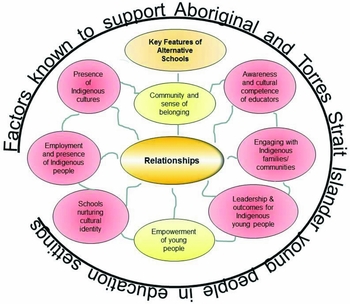
Rahman (Reference Rahman2010) discusses the notion that there is no one-size-fits-all approach to engaging Indigenous young people, for two reasons. First, Indigenous peoples are not a homogenised group, so there are different cultural practices and approaches in each community. Second, much of the research that is available is localised and small scale for a particular group of Indigenous students (Purdie & Buckley, Reference Purdie and Buckley2010). Therefore, what has been identified in the research is not generalisable to all Indigenous communities. However, it is imperative to note that the themes drawn out of the literature are based on empirical research or experienced practitioners reporting higher levels of engagement of Indigenous young people in education settings. Figure 1 shows the relationship between what is known to support engagement of Indigenous learners, with the three key characteristics emerging from the flexi schools literature.
Alternative schools and Aboriginal and Torres Strait Islander learners (Shay, Reference Shay2013).

There is currently no substantial literature that explicitly discusses the links between alternative education contexts and engagement of Indigenous learners. Figure 1 was developed by connecting the literature on engagement of Indigenous learners with alternative education. Relationships are central in Indigenous cultures: relationship with country, relationship with kin and relationship with the community are cultural values that many Indigenous Australian share. It appears through the literature that relationships are also a central feature in alternative education settings. In essence, it is proposed that the theme of relationships be the core element that requires exploration in the link between Indigenous young people and flexi school settings.
Though it is currently unknown if flexi schools are enacting the six practices outlined from the literature that support Indigenous learners, these practices provide a framework for developing an understanding within this research project and for future research. It also demonstrates that there is a clear relationship between what has been proposed in the literature to support the engagement of Indigenous young people and the description from the literature about the features of flexi schools. The focus of this article was to explore the participation of Indigenous learners and staff in alternative schools settings in Queensland. The results discussed highlight the importance of the demographic data, as evidenced by the lack of literature on the relationship between flexi schools and Indigenous young people.
Methodology
A qualitative survey methodology was used for this research, using a web-based questionnaire as a method for data collection. This small research project was undertaken from July to November 2013. There were several advantages in utilising the survey methodology in this timeframe (Mertler, Reference Mertler2002). While the survey was qualitative, there were questions on demographics of the flexi schools to provide context for each respondent. The survey resulted in some quantitative data on the size of flexi school sites, Indigenous enrolment data, non-Indigenous and Indigenous staff data, and socioeconomic status of the site location. Theoretically, critical race theory has underpinned the design of the survey. Critical race theory is by nature concerned with the emancipation of minority groups (such as Indigenous Australians) through acknowledging racialised privilege and uncovering the role of racism in structures such as schools (Hylton, Reference Hylton2012; Parker & Lynn, Reference Parker and Lynn2002). Because this article is only reporting on elements of the demographic data, critical race theory will not be discussed in depth. However, the study as a whole deliberately asked a predominantly non-Indigenous educator leader workforce to report on what they know about Indigenous young people and what their practices are, utilising critical race theory in the design and analysis to uncover aspects of covert and overt individual and structural racism.
Instrument and Participants
An electronic survey was used to collect data for this research project. The survey consisted of 15 questions with both demographic and open-ended questions. The data reported in this article is directly related to the demographic questions in the survey. Purposeful sampling was used to identify the group targeted for this study: principals or lead teachers of flexi schools in Queensland. Homogenous sampling was used in this project, as the sampling involved focusing on two characteristics in the selection of participants: being a principal or lead teacher and being in a flexi school context in Queensland (Creswell, Reference Creswell2008). Participants were selected based on the te Riele (Reference te Riele2007) typology that the schools were stable units that were focused on changing the provision of education to meet the needs of young people in programs available for more than one year. Participants were identified through the national Learning Choices database (Dusseldorp Forum, 2013). A total of 19 schools were identified as meeting this criterion and were invited to participate; one incomplete and eight completed surveys were returned. The schools were located in diverse community contexts, including remote, regional and urban settings. This response rate is considered higher than the average for an electronic survey response rate (Mertler, Reference Mertler2002). Invitations were sent via email and completion of the survey represented participants' consent.
Results
This section will report on the data provided by flexi school leaders about the support provided for Indigenous young people to remain engaged in education. It includes an overview of the number of Indigenous enrolments in this study, the size of staff, and ratio of Indigenous staff within this sample. This overview identifies the level of connection between Indigenous learners and flexi schools.
This data identified Indigenous enrolment statistical population percentage for each flexi school. The statistical enrolment percentage for each flexi school ranged from 3.8% to 93.3%. The average percentage of Indigenous young people enrolled in flexi schools in this study is 31.3%. The data collected on staff included the total number of staff, how many of those staff members were Indigenous, the positions Indigenous staff held, and whether staff members held formal qualifications. Total staff numbers from each school were collected as well as the number of staff who identify as Indigenous people. The data on Indigenous staff was calculated using the data report on total staff numbers and Indigenous staff numbers in each flexi school. The data generated identified that 44.4% of schools surveyed have a qualified Indigenous teacher on staff. The data also revealed that 61.3% of the Indigenous staff workforce did not hold any formal qualifications. The ratio of Indigenous staff to non-Indigenous staff in this sample was 1:2.4, with an average of 29.56% of the total workforce in these flexi schools identifying as Indigenous.
Discussion
Three key findings related to the context of the flexi school sites were identified. Key finding 1: there was a high percentage of Indigenous young people enrolled in the flexi schools surveyed; key finding 2: there was a high percentage of Indigenous staff employed in the flexi schools; key finding 3: the majority of the schools were located in low socio-economic areas.
The study provides evidence of the milieu of some Indigenous young people and their interactions with flexi schooling in a Queensland context. As this data was unable to be located in the literature and the sample size does not represent the total population, the discussion of this demographic data emphasises that this data is not generalisable. However, the schools included in the sample do represent a wide range of contexts, including remote, regional and urban settings. The role of population data is important, though it needs to be emphasised that it only represents the population that is surveyed (O'Leary, Reference O'Leary2014). The strength in collecting this data is that it provides some knowledge of a sample of the total population of flexi schools in Queensland and provides direction for further research.
Key finding 1 was the high enrolment of Indigenous young people. The highest enrolment percentage was 93.3% and the lowest, 3.8%. The lowest enrolment percentage was still higher proportionately to the wider national Indigenous population, as this particular school indicated they were not in a location that had a population of Indigenous people of 3% or higher. The average percentage of Indigenous young people enrolled in the flexi schools in this sample is 31.3%. There are no other samples in the literature to compare this figure. This data represents the breadth of diversity of flexi schools, based on factors such as location, socio economic status and the local Indigenous population.
The 2011 Australian Census data indicated that 4.2% of the population in Queensland identified themselves as Indigenous people, and an estimated average of 3% of the national population identified as Indigenous (Australian Bureau of Statistics, 2011). The percentage of Indigenous young people enrolled in secondary schooling options in Queensland is 8.7% of students in Education Queensland Schools (Department of Education, Training and Employment, 2014) and 3.4% of the enrolment of Queensland Independent Schools (Independent Schools Queensland, 2013). These figures were calculated using the data reported on whole student enrolment numbers and Indigenous student enrolment numbers in secondary schools in Queensland. It is acknowledged that these data sets are not comparable to the small sample collected for this project. However, what this data does present is an accurate representation of actual enrolments in state government and independent schools in Queensland. On initial observation, the data set in this study indicates that the overall enrolments could be significantly higher than both the state and independent school enrolments. The sample collected for this project indicates that there would be a significant benefit in undertaking a study of all flexi schools in Queensland, as well as nationally, to provide a more accurate understanding of the level of Indigenous student participation and engagement.
While there is considerable caution taken in making claims beyond this study, the data from this sample indicates a high level of participation, and supports the need for further exploration of this phenomenon through research. Much of the literature on Indigenous education remains centred in deficit discourses focused on non-participation rates and the need to ‘close the gap’ (Armstrong & Buckley, Reference Armstrong and Buckley2011; Helme & Lamb, Reference Helme and Lamb2011; Schwab, Reference Schwab2012). Therefore, there is value in exploring a model of education that appears to be providing opportunities for significant numbers of Indigenous young people to engage in education. It would be useful to explore further the synergies suggested in Figure 1 between what is already known about engaging Indigenous learners and the key features of flexi schooling.
Key finding 2 was the significant number of Indigenous staff employed. The data captured allowed for an analysis of how many Indigenous staff were employed in proportion to non-Indigenous staff, a percentage of 29.5%. This percentage encapsulated staff across all roles, including qualified teaching staff and qualified and unqualified youth workers. The data also uncovered that 50% of the sample had an equal representation of Indigenous staff to Indigenous young people. Additionally, 50% of the sample had at least one Indigenous qualified teacher employed on site. These figures compare very favourably to the current percentage of Indigenous teachers in the workforce nationally, which currently stands at 1.2% (Australian Government, 2014a).
The employment of Indigenous staff, in particular teachers, is vital in supporting outcomes for Indigenous students in conventional settings (Malin & Maidment, Reference Malin and Maidment2003; Reid, Santoro, Crawford, & Simpson, Reference Reid, Santoro, Crawford and Simpson2009; Santoro, Reid, Crawford, & Simpson, Reference Santoro, Reid, Crawford and Simpson2011). A national project called the ‘More Aboriginal and Torres Strait Islander Teacher Initiative’ was launched in 2012 to address the critical shortage of Indigenous teachers in Australia (Patton, Lee Hong, Lampert, Burnett, & Anderson, Reference Patton, Hong, Lampert, Burnett and Anderson2012). Lampert and Burnett (Reference Lampert and Burnett2012) reported that Indigenous teachers represent fewer than 1% of the teacher population in schools nationally. This figure has recently been reported to have increased to 1.2% (Australian Government, 2014a). Despite this trend, the small sample of schools in the study reported here revealed the Indigenous teacher population was 3.5% of the total teacher workforce. Although it is unknown if this is linked to the higher participation rates of Indigenous young people in this study, the data provides evidence of the benefits of employment of Indigenous staff. High participation rates provide support for future research to explore the association between the employment of Indigenous staff and engagement of Indigenous young people in flexi school settings.
Furthermore, the data from this sample indicated that 63% of the Indigenous staff across all of the sites surveyed did not hold any formal qualifications. The role of Indigenous educators is dynamic and diverse; yet the person is often without qualifications and not provided adequate opportunities for growth and development (Winkler, Reference Winkler2012). Flexi schools can be incredibly complex spaces to work. Without further contextual information regarding this finding, it is difficult to know whether there are development opportunities available for Indigenous staff in flexi schools. However, this finding also provides evidence of the need to explore this phenomenon in flexi school contexts through further research.
Key finding 3 was that seven out of eight respondents indicated they were located in low socioeconomic areas. This finding is supported by a recent government report that suggests Indigenous teachers are more likely to work in low socioeconomic school settings (Australian Government, 2014a). Flexi schools are reported to be providing vital pathways for young people to remain engaged in education (Deed, Reference Deed2008; McGregor & Mills, Reference McGregor and Mills2012; Mills & McGregor, Reference Mills and McGregor2010; te Riele, Reference te Riele2007). These are young people who have previously disengaged from conventional school settings (McGregor & Mills, Reference McGregor and Mills2012). Therefore, the finding is consistent with the research that links poverty as a key indicator that impacts on educational attainment in young people (McGregor & Mills, Reference McGregor and Mills2012).
In summary, the three key findings of flexi school contexts in this study were the high number of Indigenous young people enrolled, the high number of Indigenous staff employed within the flexi school sites, and the high number of flexi school sites located in low socio-economic areas. The student and staff data provided a small empirical insight into the level of Indigenous participation in flexi schools in Queensland. Further, it provides some justification of the need to look outside the current literature on Indigenous education to an educational context provided in flexi schools that appears to be providing educational opportunities for significant numbers of Indigenous young people. Flexi schools are also an environment where there is also a significant number of Indigenous staff, a factor known to support the engagement of Indigenous young people.
Conclusion
The results reported on the sample researched for this article provide empirical evidence that a disproportionately high numbers of Indigenous young people and staff are engaging in flexi schools. A synthesis of the literature on flexi schools and engaging Indigenous learners in conventional settings identified a possible connection between the high numbers of Indigenous people in flexi schooling contexts. In a policy climate where there is a significant focus on ‘closing the gap’ and it is well documented that Indigenous people experience unique disadvantage as a direct result of colonisation, the time has come to bring new ideas to the table. Flexi schools are attracting both staff and students in high numbers; therefore, research should explore this phenomenon and the possibilities for application of findings in conventional school settings. Further research needs to focus on ways to change the system rather than the traditional focus on changing the learner, including exploring ways to shift the focus from the views of teachers to those of Indigenous learners.
About the Authors
Marnee Shay is a descendent from Wagiman country, Northern Territory. Marnee is an experienced educator in flexi school settings and is currently an Associate Lecturer at Queensland University of Technology. Her research interests centre on challenging dominant discourses that surround Indigenous education policy, practices and alternative schooling.
Deborah Heck is an Associate Professor in the School of Education at the University of the Sunshine Coast. Her research interests are in the broad field of participation in education. This includes work that explores maintaining Aboriginal and Torres Strait Islander teachers and pre-service teachers in the workforce.