Mimbres pottery from the U.S. Southwest, especially its spectacular painted designs, is the subject of numerous American Antiquity articles and other publications. Mimbres designs sometimes depict animals in realistic detail, such as scarlet macaws and female pronghorn (Creel and McKusick Reference Creel and McKusick1994; Russell et al. Reference Russell, Klassen and Salazar2018), and transformational creatures such as birds with fish tails (Trask and Russell Reference Trask, Russell and Landreth2011). They also depict humans of recognizable sex and gender engaged in various activities (Munson Reference Munson2000), as well as Mesoamerican iconography (Gilman et al. Reference Gilman, Thompson and Wyckoff2014; Shafer Reference Shafer, Nelson and Hegmon2010). The pottery's aesthetic appeal has been analyzed (Brody Reference Brody2004; Munson Reference Munson2011). We know a great deal about what was depicted and the likely cosmological meanings of some depictions. There is also a considerable body of research on Mimbres society (Gilman and LeBlanc Reference Gilman and LeBlanc2017; Gilman and Powell-Martí Reference Gilman, Powell-Martí, Powell-Martí and Gilman2006; Hegmon Reference Hegmon, Nelson and Hegmon2010), drawing mostly on analyses of architecture and burials. However, we know very little about the roles of this special pottery in Mimbres society, which in turn might help us understand the spectacular designs.
The goal of this article is to help rectify this situation by investigating the social significance of Mimbres painted pottery. Archaeological literature on style, informed by later work on identity and material culture, points to three concepts used to study and understand Mimbres pottery: boundaries, multiple dimensions of variation, and historical context. Detailed analyses of the pottery show that its distribution is strongly bounded, artists developed recognizable individual styles, it was not used to make social distinctions within the region, and it was meaning-charged. Consideration of the historical context, including how the pottery developed and was used in the land tenure system, provides insights into its social significance and meaning and why it is so beautiful.
This article draws data and insights from multiple sources, including general understandings of Mimbres archaeology, summaries of published analyses, and new analyses with data presented here and in referenced archives and supplemental materials. The results synthesize much of what is known about Mimbres painted pottery and how it can be interpreted in its social context. They also provide a framework for investigating the social significance of other materials, setting the stage for comparative analyses. Because this article summarizes numerous analyses, data sources and analytical details for many are provided in Supplemental Text 1.
Mimbres Chronology and Pottery
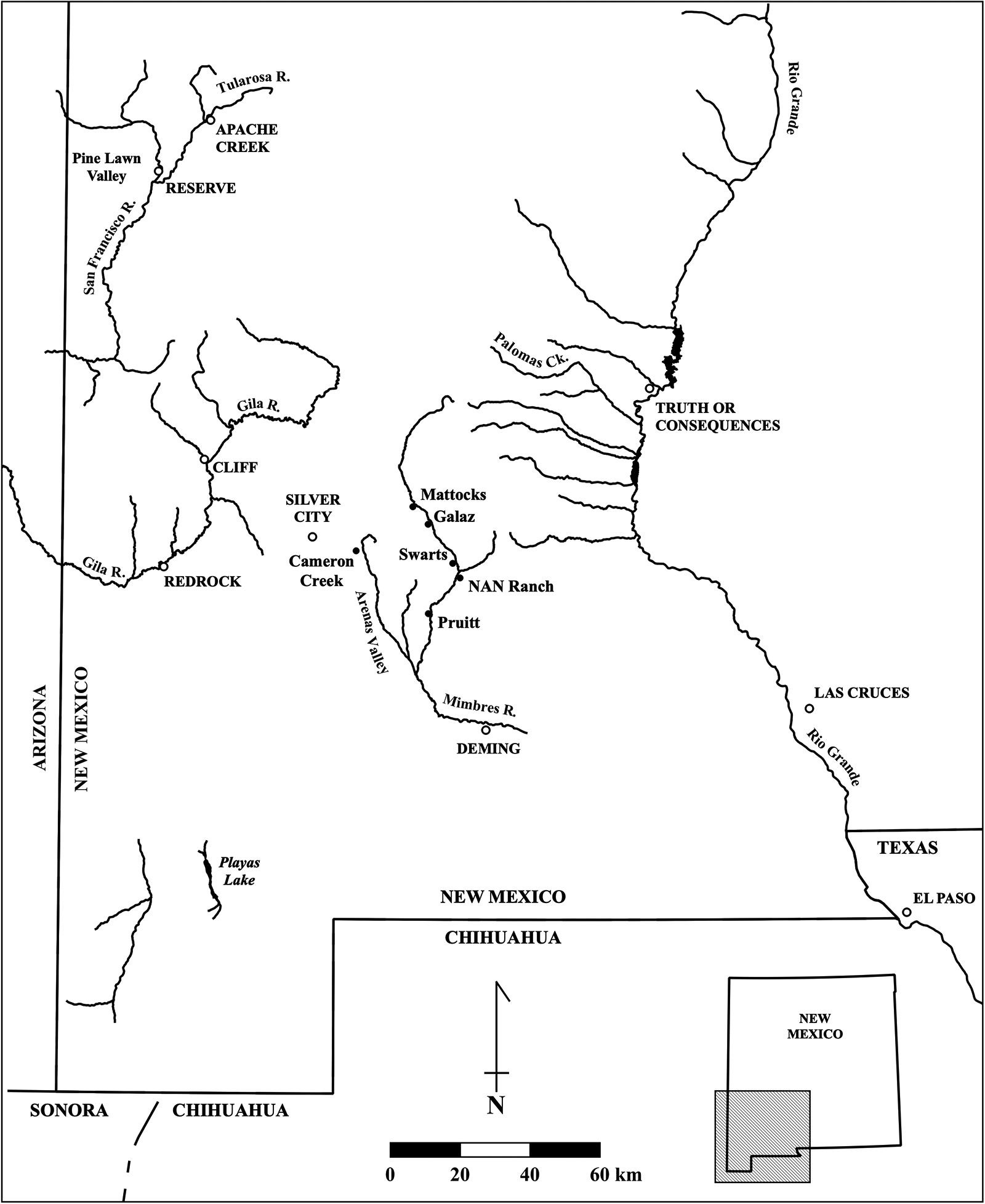
The Mimbres region is centered on the Mimbres River in southwestern New Mexico and extends into the surrounding states of Arizona, Chihuahua, and Sonora (Figure 1). Mimbres is considered part of the larger Mogollon area and shares the Mogollon brown paste pottery tradition.
Map showing the Mimbres region and the sites discussed in the text. Black dots are archaeological sites; open circles are contemporary towns and cities (prepared by Grant Snitker).

The Mimbres chronology was established decades ago (Anyon et al. Reference Anyon, Gilman and LeBlanc1981) but has recently been revised (Anyon et al. Reference Anyon, Creel, Gilman, LeBlanc, Miller, Nash, Nelson, Putsavage, Roth, Schollmeyer, Sedig and Turnbow2017). Here we summarize the current understanding of dates and thereafter use period names. The Late Pithouse period (Georgetown, San Francisco, and Three Circle phases) was dated to AD 550–1000, and the Classic Mimbres period to AD 1000–1130. Revisions date the Late Pithouse-to-Classic transition to AD 1010–1020 and the end of the Classic Mimbres period to AD 1125, 1150, or 1170, depending on the materials analyzed (Anyon et al. Reference Anyon, Creel, Gilman, LeBlanc, Miller, Nash, Nelson, Putsavage, Roth, Schollmeyer, Sedig and Turnbow2017:336).
By the Late Pithouse period, people were living on or near arable floodplains in clusters of pithouses, often with great kivas. Near the end of the period the great kivas were collapsed and burned, interpreted as ritual destruction of both the architecture and associated social practices (Creel and Anyon Reference Creel and Anyon2003; Creel et al. Reference Creel, Anyon and Roth2015). The transition to the Classic Mimbres period, some decades later, took various forms across the region (Lekson Reference Lekson1988; Sedig et al. Reference Sedig, Lekson, Roth, Roth, Gilman and Anyon2018). Population increased, and by Classic times most people lived in aboveground pueblo rooms with small kivas, special rooms, and plazas, rather than great kivas. Classic sites range in size from a few rooms to hundreds of rooms, with the largest along the arable floodplains of the Upper Gila and Mimbres Rivers. Many Classic sites overlie earlier pithouses, and some are also overlain by later architecture. Many of these sites were used more or less continuously for centuries and thus can be understood as persistent places located in resource-rich areas (Roth Reference Roth, Sullivan and Olszewski2016). Most contemporary populations elsewhere in the Southwest practiced much greater residential mobility, with the exception of the irrigation-dependent Hohokam (Craig and Woodson Reference Craig, Woodson, Mills and Fowles2017). The end of the Classic Mimbres period was abrupt and is still not well understood. Population declined, the large sites were mostly depopulated, and in what is known as the Reorganization phase in the mid-twelfth century, some people moved to smaller dispersed hamlets across the region (Nelson et al. Reference Nelson, Hegmon, Kulow and Schollmeyer2006).
Mimbres painted pottery, made with a white slip on brown paste, has antecedents in the earlier types Mogollon Red-on-brown and Three Circle Red-on-white. The earliest black-on-white type, known as Style I, emerged in the Late Pithouse period, followed by the more elaborate Style II. Style III pottery, generally associated with the Classic Mimbres period, is the culmination of this trajectory; it has elaborate geometric and representational designs in black and sometimes red or polychrome. The end of the Mimbres pottery tradition coincides with the end of the Classic Mimbres period.
Data on Mimbres pottery are available in the Mimbres Pottery Images Digital Database (MimPIDD; https://core.tdar.org/collection/22070/mimbres-ceramic-database), which contains images, descriptive data, and contextual information on more than 8,600 Mimbres painted vessels. Here we provide some background, drawing data from the careful excavations of three well-preserved sites, Swarts (Cosgrove and Cosgrove Reference Cosgrove and Cosgrove1932), NAN Ranch (Shafer Reference Shafer2003), and Mattocks (Gilman and LeBlanc Reference Gilman and LeBlanc2017)—what we call the “representative sample.” Material from these three sites is particularly useful for analyses that consider the proportions of vessels with certain characteristics, because the collections are derived from controlled excavations and thus unbiased by collection practices. Importantly, they include considerable material from both nonburial and burial contexts: 11.5% of vessels in the representative sample are from nonburial contexts, in contrast to only 4.9% of vessels from MimPIDD as a whole (Supplemental Text 1, Part B). Severe looting skewed samples from sites such as Galaz (Anyon and LeBlanc Reference Anyon and LeBlanc1984); only 0.6% of the Galaz vessels are from nonburial contexts. Other collections are often not representative of the archaeological record, because they were derived from multiple sources that often favored attractive or representational designs (Hegmon et al. Reference Hegmon, McGrath and Munson2017). Sadly, there are also an unknown number of fake designs, usually painted on authentic Mimbres vessels (Hegmon et al. Reference Hegmon, McGrath and Munson2017).
Mimbres painted pottery was made in numerous locations across the region. Production was specialized at a small scale, and people mostly obtained pottery from proximate sources (Creel and Speakman Reference Creel, Speakman, Roth, Gilman and Anyon2018). The gender of the painters is not known and has been subject to some debate. Although there is some evidence that women made the pottery, including the burial of a female with pottery-making tools (Shafer Reference Shafer1985), it is possible that men, or both men and women, did the painting (Hegmon and Trevathan Reference Hegmon and Trevathan1996).
Bowls are the most common form of Mimbres painted vessels, comprising 94% (1226/1304) of whole vessels in the representative sample (Supplemental Text 1, Part C). Less than 10% of painted sherds at Mattocks are from jars (Gilman and LeBlanc Reference Gilman and LeBlanc2017:238). Most bowls are roughly hemispherical, with rim diameters up to 34 cm; vessels in this size range would have been useful for eating and serving. Wear indicates that the bowls were used in various contexts (Bray Reference Bray1982), although highly visible exterior designs recognized on feasting bowls in other areas (Mills Reference Mills2007) are rare on Mimbres bowls. Less than 1% of bowls have exterior designs, and most of those designs are quite simple (Supplemental Text 1, Part D). Ultimately, many of the bowls had “kill holes” carefully ground or punched through their bases, and many were deposited in burials, often inverted over the skull. However, not all killed bowls were interred, and not all interred bowls were killed (Bartlett Reference Bartlett2013).
Mimbres vessels have long been divided into those with geometric designs and those with representational designs that depict animals, humans, and other beings (Cosgrove and Cosgrove Reference Cosgrove and Cosgrove1932); representational designs are sometimes called “figurative” or “naturalistic.” Although they were sometimes painted on Style I pottery, representational designs become more common later in the trajectory. The distinction between geometric and representational designs is generally clear, although some “geometric” designs include stylized elements such as flowers and feathers (see Brody Reference Brody2004:Figures 120 and 121) and nearly all representational depictions include geometric embellishments, such as checkerboard fill on animals’ bodies. Vessels with geometric and representational designs are not distinguished in typologies, which implicitly assume they are two variants of the same type. To consider this assumption, we present a brief analysis of their distribution using the representative sample (Table 1). Overall, bowls with geometric designs are nearly twice as common as those with representational designs (65% vs. 35%). The two categories were used in burials and killed in roughly the same proportions, and there are only minor differences across the three sites. These results indicate that, although it might be useful to distinguish between the two categories of designs in some analyses, they were used in quite similar ways in the Mimbres past.
Distribution and Deposition of Style III Bowls with Representational and Geometric Designs.

Note: Data sources explained in Supplemental Text 1, Part E.
From Style to Identity and Back
Pottery has long been central to archaeologists’ study of society, including extensive literatures on style and later on identity and material culture. The style literature developed important ideas linking stylistic variation to social processes, often with clear archaeological implications (Hegmon Reference Hegmon1992). However, those straightforward linkages sometimes relied on static conceptions of style as something that communicated predefined meanings (see Wallis Reference Wallis2013). Thus, interest shifted to more dynamic concepts of identity and material culture that consider how meanings emerge relationally and in practice (e.g., Diaz-Andreu et al. Reference Diaz-Andreu, Lucy, Babic and Edwards2005; Meskell and Preucel Reference Meskell, Preucel, Meskell and Preucel2007; Pierce et al. Reference Pierce, Russell, Maldonado and Campbell2016). In turn, this literature's focus on creativity sometimes made it difficult to apply (Robb Reference Robb2015). Although material meanings are always—and ultimately—social constructs, they sometimes crystallize and take on a degree of permanence, structuring the world in which people act and underlying material agency (Van Oyen Reference Van Oyen2018). As a result, some recent work focuses on what Van Oyen (Reference Van Oyen2016) calls “relational constellations” and their material representations. Consideration of their historical context can bring together the strengths of these approaches. That is, the earlier style literature was mostly about the crystallized meanings, so viewing dynamic processes in historical context provides insights into how they are created.
Boundaries, both social and spatial, are key points of articulation for social and material processes. They take on a solidity as they persist over time, but they are created—and crossed— through myriad social and material processes (Hodder Reference Hodder1982). These ideas are further developed in recent work on “boundary objects,” things and practices that cross social boundaries. Mills explores pottery as a boundary object in the Mogollon Rim area of Arizona, where women who relocated upon marriage retained some techniques of their original home but “tweaked” them to create new kinds of vessels (Reference Mills2018:1073). In other cases, people retained their natal styles when they moved, sometimes resulting in the expression of multiple identities, such as at Chaco Canyon (Wills Reference Wills2009). However, there are also examples of people switching styles when they cross boundaries, including a case in northern New Mexico noted by Mills (Reference Mills2018). Such style switching is documented in Bowser's (Reference Bowser2000) ethnoarchaeological work in the Amazon, where she studied two spatially discrete factions—Achuar and Quichua—that carry ethnic labels, although they are actually ethnically mixed. Women born into one faction often marry and move into the other, adopting the pottery style of the faction in which they come to reside. Bowser's interviews revealed that, in doing so, the women are signaling a shift in their political alliance, although they retain the ethnicity of their natal faction.
Style and identity are multidimensional, layered, and associated with various social processes and scales (Casella and Fowler Reference Casella and Fowler2005; Plog Reference Plog, Conkey and Hastorf1990). The social significance of material culture can be discerned, at least in part, by considering the context of use and deposition (Mattson Reference Mattson2016), as well as the nature of the material's variation (Hegmon Reference Hegmon1992). Mattson argued that objects used in “horizontal social relations” will have a widespread distribution and that those used in “large scale social relationships” such as political identity will be common and found in many contexts (Reference Mattson2016:127); both are true of Mimbres pottery. Wiessner (Reference Wiessner1983) developed the concepts “assertive” and “emblemic” styles that are actively and consciously used to mark one's identity as an individual and a member of a group. Then Plog (Reference Plog, Conkey and Hastorf1990:62) drew a distinction, important for our analysis of Mimbres pottery, between these active uses, which he called “symbolic variation” and “iconological variation.” Iconological variation conveys clear purposeful messages and is more structured and less variable than symbolic variation. DeBoer (Reference DeBoer and Longacre1991) found that meaning-charged styles (such as iconological variation) are often “pervasive,” that is, applied to multiple media. The meanings of iconological variation and pervasive style often involve ideological concepts and worldviews that simultaneously have social significance as shared belief systems.
These kinds of styles may become especially recognizable at certain times and places, a process best understood by considering historical context. Some people, by dint of their talent or status, invent new things or traditions, which become innovations as they spread and are adopted by others (sensu Van der Leeuw and Torrence Reference Van der Leeuw and Torrence1989). For example, in the late nineteenth century, Hopi-Tewa artist Nampeyo revived the prehispanic Sikyatki pottery style, which was then adopted by other potters (Kramer Reference Kramer1996). In the case of Mimbres pottery, a period of innovation led to a consolidation of the highly recognizable and less variable style associated with the Classic period (Hegmon and Kulow Reference Hegmon and Kulow2005).
These three concepts—boundaries, multiple dimensions, and historical context—structure our approach to understanding Mimbres painted pottery. The next two sections present detailed analyses of the pottery, focusing on boundaries and multiple dimensions. The results hint at the kinds of meanings conveyed by the pottery and its articulation with social processes. The third analytic section then explores the social significance of the pottery from a dynamic perspective that places it in the larger historical context.
Boundaries
The literature on boundaries and boundary objects makes clear that boundaries are dynamic contexts that may be crossed and maintained in myriad ways. In this section, we investigate the boundedness of the Mimbres region, its nature, and whether and how its boundaries were crossed.
Mimbres painted pottery, particularly Style III, was highly distinctive in its time (ca. AD 1000–1150). Representational designs were rare on other kinds of pottery, and none had the vast array of creative artistry. The technology—designs painted on a white slip applied over a brown paste—was also unique. A few other roughly contemporaneous or slightly later pottery types display some of the same design elements; their description serves to highlight the distinctiveness of Mimbres pottery. El Paso Polychrome (ca. AD 1150–1400), a brown ware with black and red designs found in an area southeast of the Mimbres region, displays some of the same iconography, including birds with serrated wings (Miller and Thompson Reference Miller and Thompson2015). Types associated with Casas Grandes to the south, including Ramos Polychrome (ca. AD 1150–1450), buff-colored with black and red designs (Searcy Reference Searcy, Villalpando and McGuire2014), also display some Mimbres-style motifs, including macaws. Some Mimbres geometric designs are similar to those on Reserve Black-on-white (ca. AD 1000–1200) made in areas to the north and on Chupadero Black-on-white (AD 1050–1550) made in areas to the east. Jars are the predominant form in all four of these types, whereas most Mimbres painted vessels are bowls.
The distinctiveness of Mimbres pottery becomes clearer when considered over time and across space. The earliest Mimbres representational designs on Style I are similar to those on Hohokam pottery from Arizona; both depict waterbirds and horned toads with the same stylistic conventions (Brody Reference Brody2004:81–86). The shared motifs become less common over time, even as the Hohokam system expanded eastward toward the Mimbres region (Brody Reference Brody2004:85; Hegmon and Nelson Reference Hegmon, Nelson, Sullivan and Bayman2007). An earlier analysis concluded that the decline in Hohokam-like designs “represents a strategy—possibly a conscious strategy—on the part of residents of the Mimbres region to distance themselves from developments to the west and . . . the emergence of a new more bounded Mimbres identity” (Hegmon and Nelson Reference Hegmon, Nelson, Sullivan and Bayman2007:95–96). There are indications that Mimbres use of Hohokam-like palettes and censors also declined in the Classic period (Anyon and LeBlanc Reference Anyon and LeBlanc1984:269; de Quevado Reference De Quevado2004).
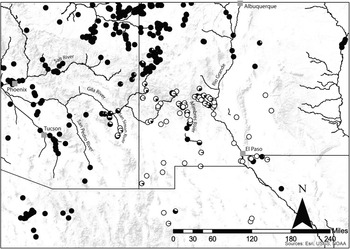
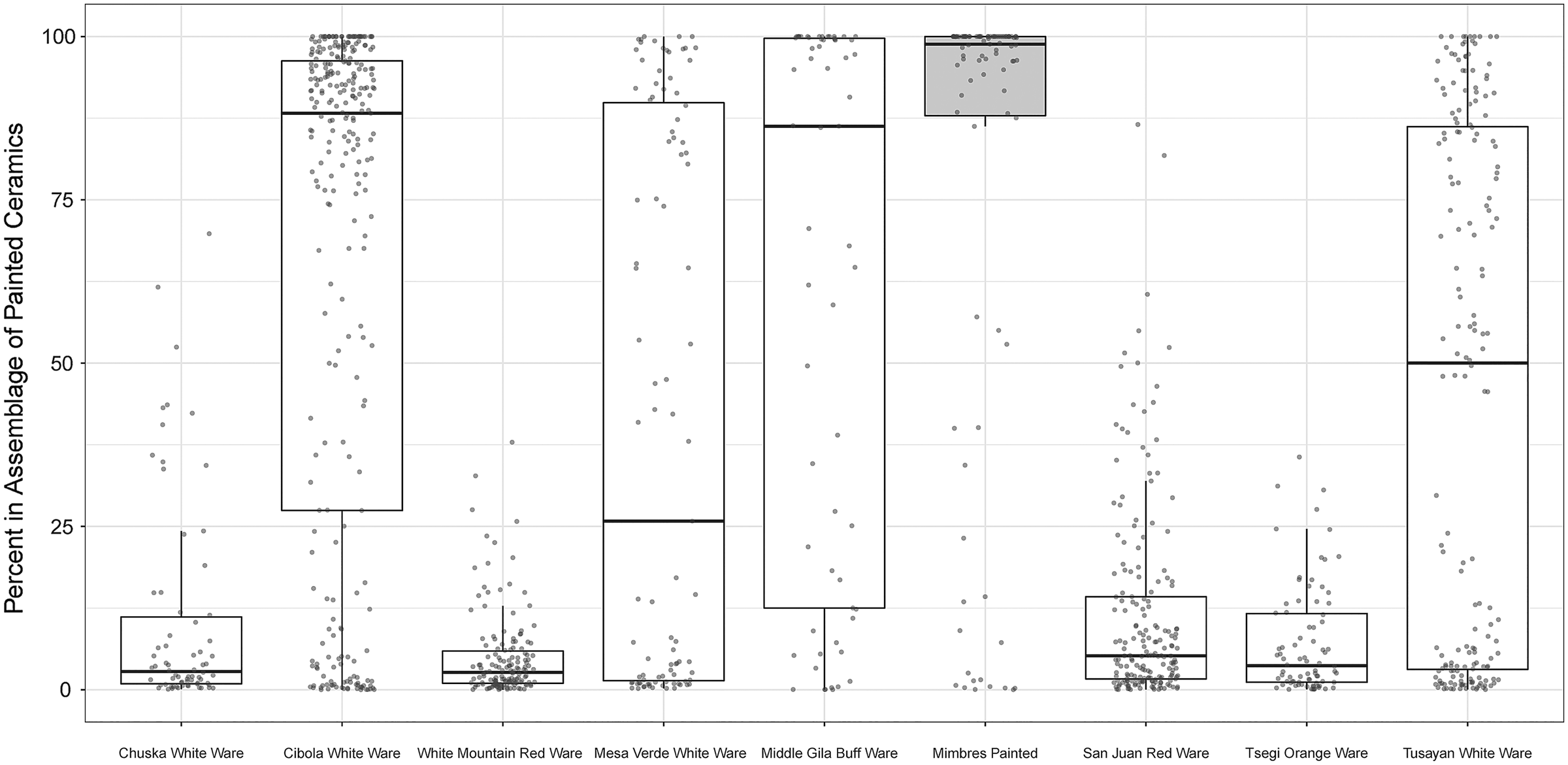
Those conclusions, speculative at the time, led to new quantitative analyses summarized here for the first time. The cyberSW project (https://cyberSW.org) has collected data on the frequency of pottery types and other materials at thousands of sites. These data are used to map the distribution of Mimbres painted pottery in relation to other painted decorated wares for the AD 1000–1100 interval (Figure 2; Supplemental Table 1). The map in Figure 2 shows the proportion of Mimbres painted pottery on each site as a pie chart: solid white indicates all Mimbres pottery, and solid black indicates no Mimbres. Details on the other kinds of pottery are available in Supplemental Figure 1. These results can be interpreted both spatially and quantitatively. The map shows the distribution of Mimbres pottery, which is almost all found in what is recognized as the Mimbres region. The pie charts show that most sites have either little or no Mimbres, or nearly all Mimbres. More specifically, of the 166 sites with Mimbres painted pottery, 73% have either less than 10% or more than 90% (Supplemental Table 1), and the median percent of Mimbres painted pottery for sites that have at least one sherd is 95.5%. This all-or-nothing distribution of Mimbres painted pottery is highly unusual in the Southwest, as demonstrated quantitatively in Figure 3. Most other kinds of pottery are found in moderate proportions in many assemblages.
Map showing the proportion of Mimbres painted pottery at each site for the AD 1000–1100 interval. In the pie charts Mimbres pottery is shown as white, and all other painted pottery as black. A color version that identifies the other wares is available as Supplemental Figure 1.

Boxplots showing the distribution of sites by percent of ware for the most commonly occurring ceramic wares in the AD 1000–1050 interval (data from https://cyberSW.org; ceramic types and wares listed here are from http://www.southwestsocialnetworks.net/data.html).

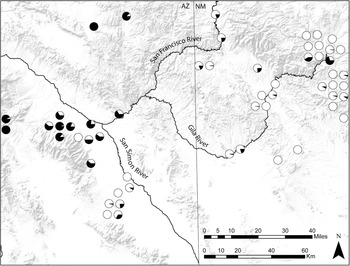
There are two exceptions to these conclusions. First, the all-or-nothing distribution is not seen in the San Simon drainage to the west, where some sites have moderate amounts of Mimbres (see Gilman Reference Gilman, Harry and Herr2018). This is shown in the close-up map in Figure 4, and the San Simon drainage is discussed later in the section on the historical context. Second, although nearly all sites in the Mimbres region have AD 1000–1100 assemblages dominated by Mimbres painted pottery, in the southern Mimbres Valley the Kipp site has 47% Mimbres, and three other sites (Montoya, Walsh, and LA 19094) are dominated by non-Mimbres types. These four sites bear more investigation, but we believe they may have been incorrectly assigned to the AD 1000–1100 interval. Specifically, in the cyberSW database they are listed as having considerable quantities of El Paso Bichrome, which dates to AD 1000–1100, but it is likely that the El Paso Bichrome should be reclassified as El Paso Polychrome, which postdates AD 1150.
Close-up of the area in Figure 2 showing the proportion of Mimbres painted pottery at each site for the AD 1000–1100 interval. In the pie charts, Mimbres pottery is shown as white and all other painted pottery as black. Site locations were jittered slightly so that charts do not overlap.

Finally, the end of the Mimbres pottery tradition constitutes a temporal boundary. After the end of the Classic period, Mimbres pottery declined rapidly. It was used in small quantities on Reorganization phase sites (Nelson et al. Reference Nelson, Hegmon, Kulow and Schollmeyer2006), but it disappears from the record by AD 1200. This marks an end to the tradition of making white-slipped brown-paste pottery decorated with representational designs, what Brody called the disappearance of the Mimbres “visual identity” (Reference Brody2004:175).
In summary, Mimbres pottery is bounded in at least three dimensions. Mimbres designs and technology are highly distinctive. The pottery dominates assemblages within the region and is rare outside of it. Finally, the tradition ends abruptly at about the time the population declines and people leave the large Classic sites.
Dimensions of Variation in Mimbres Pottery
Designs on Mimbres pottery can be understood by considering their variation in multiple dimensions involving different kinds of attributes, spatial scales, and social processes. In this section we focus on discerning the nature of that variation, primarily in the highly structured corpus from the Classic period, to gain insights into the range of associated meanings. The following section then explores the social significance of those dimensions and the pottery as a whole by placing the developments in their historical context.
Individual
Several studies have documented that the “hands” of individual artists—or groups of closely cooperating artists—can be recognized in Mimbres painting (e.g., LeBlanc Reference LeBlanc, Nelson and Hegmon2010; Russell and Hegmon Reference Russell and Hegmon2015). It is also sometimes possible to recognize long-lasting styles produced by a multigenerational group of potters. One example is the creation of figures in the negative by painting a black background from which white rabbits and other animals emerge in relief (LeBlanc Reference LeBlanc, Nelson and Hegmon2010:76; Russell and Hegmon Reference Russell and Hegmon2015:362).
Mimbres pottery is unusual, and perhaps unique, in this respect. Other studies have not been able to recognize distinctive individuals’ styles in any other prehispanic Southwestern pottery tradition, although in a few cases there are possible makers’ marks (LeBlanc and Henderson Reference LeBlanc and Henderson2009) or discernible schools (Van Keuren Reference Van Keuren2001). In her study of childhood learning and pottery making in the Mimbres and Hohokam traditions, Crown (Reference Crown2001) concluded that the Mimbres tradition evidences more emphasis on self-expression.
Intraregional
There is no obvious or easily interpretable pattern in the distribution of Mimbres pottery with different motifs, such as rabbits at one site and birds at another. Instead, different animals and other motifs co-occur on sites and sometimes even in burials (Brody Reference Brody2004:167). Thus, recent work has considered more subtle distinctions in analyzing the designs’ spatial distribution.
Several researchers have noted the existence of fairly stable differences among the subregions of the larger Mimbres region. Focusing on the early types Mogollon Red-on-brown and Style I, Powell (Reference Powell1996) and Gruber (Reference Gruber2007) found differences between the subregions, and Powell's unpublished work (cited by Gilman Reference Gilman, Harry and Herr2018:285) documented continuing differences in later types. Gilman (Reference Gilman, Harry and Herr2018) also showed that the subregions have different ritual architecture and that representational designs, as well as motifs such as the Hero Twins, are most common in the Mimbres Valley. Studies have also found that different groups of producers painted designs with different representational (Powell Reference Powell2000) and geometric motifs (Gruber Reference Gruber2015).
Focusing on the Mimbres Valley and its tributaries, Hegmon and others (Reference Hegmon, McGrath, Michael O'Hara, Russell, Roth, Gilman and Anyon2018) studied the distribution of animal motifs at 10 sites, in distinct room blocks within a site and in association with burials of different ages and sexes. They considered various ways of classifying the animals, including by habitat and spiritual significance, as well as by species. In all cases, the distributions were strongly homogeneous: no kind of motif was preferentially associated with any particular place or kind of person.
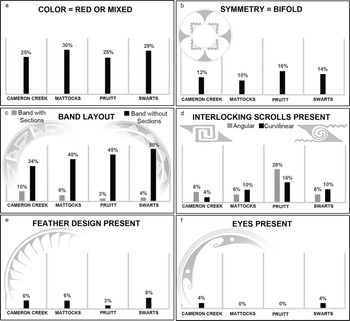
Here we consider the same issues with geometric designs (Supplemental Text 1, Part F). The analysis uses data from Swarts, Pruitt, Cameron Creek, and Mattocks, a subset of the 10 sites used in the analysis of animal motifs selected to represent different parts of the Mimbres Valley and its tributaries. The sample consists of 37 vessels from Pruitt and 50 each (selected randomly) from the other three sites. Attributes were selected to represent notable components of Mimbres designs and different levels of variation. They include the overall layout and symmetry, design fill and use of hachure, the presence of special elements such as feather and eye-like motifs, and color. Some vessels were intentionally oxidized, producing red-on-white designs, although Livesay (Reference Livesay2013) found that vessels with red designs and those with black designs were otherwise similar.
Like the animal motifs, the geometric attributes were distributed homogeneously across the four sites (Figure 5). The proportion of red designs is almost identical across the sites (Figure 5a). Rotational symmetry is common in the Southwest including in Mimbres designs, but some designs on all four sites also have bifold symmetry (Figure 5b). The use of a band layout, with and without sections, is also common across the sites, although with a greater range of differences (Figure 5c). The biggest difference we found was the use of interlocking scrolls, which were present on all four sites but were most common at Pruitt (Figure 5d). Special elements were also found across the sites. Although feather designs were not common, present on only 5% of bowls, they were found at all four sites (Figure 5e). Only rare designs such as eyes, present on only 2% of bowls, were found at some sites but not others (Figure 5f).
Distribution of geometric designs on Style III bowls from Cameron Creek, Mattocks, Pruitt, and Swarts.

Together, the cited studies and analysis of geometric designs reveal slight differences between subregions but no clear differences across sites or parts of the Mimbres River drainage. Instead, even though different designs were produced in different places, they were then distributed so that every site came to have the same general suite of designs. The earlier analysis concluded that the homogeneity “was created, possibly deliberately, through people's actions” (Hegmon et al. Reference Hegmon, McGrath, Michael O'Hara, Russell, Roth, Gilman and Anyon2018:164). Analyses further indicate that the designs were not used to make distinctions across social groups within the region.
Pan-Regional
The analysis of boundaries shows that Mimbres painted pottery dominates assemblages within the region and is rare beyond the region. In this subsection we begin investigating the social significance of the pottery and its bounded distribution. Emblemic style is actively used in marking group identity, and the boundedness of Mimbres pottery suggests that it did so, to at least some extent, at the regional level. Here we probe more deeply, asking whether the pottery also displays iconological variation and pervasive style. Iconological variation references important cosmological concepts and has relatively invariant designs (Plog Reference Plog, Conkey and Hastorf1990:62). Pervasive style also references important cosmological meanings and is applied to multiple media (DeBoer Reference DeBoer and Longacre1991).
Cosmological Referents
As many have noted, some representational Mimbres designs have clear cosmological referents (see Brody Reference Brody2004:164–175). Imagery of the Hero Twins, common in New World cosmologies, is found on Mimbres pottery, and a series of depictions appear to show the Twins’ birth, adventures, death, and resurrection (Thompson et al. Reference Thompson, Gilman and Wyckoff2014). Building on this, Gilman and colleagues (Reference Gilman, Thompson and Wyckoff2014) documented depictions of the Hero Twins and macaws that they link to changes in the Mimbres ritual economy around the time the great kivas were ritually destroyed. Some Mimbres depictions of birds have serrated wings, referred to as the Knife-wing motif, which appears as early as Style I but becomes more common over time. Thompson and colleagues (Reference Thompson, Gilman and Wyckoff2015) suggest that the Knife-wing is derived from Mesoamerican cosmology and is associated with death and warfare.
Invariance
Several lines of evidence point to the overall style of Mimbres designs being relatively invariant. The designs display a limited number of regularly used layouts that were identified by Brody (Reference Brody2004:128) and confirmed through later analysis (Hegmon and Kulow Reference Hegmon and Kulow2005). The designs change over time in a highly regular manner recognized in chronologically significant styles and microstyles (Shafer and Brewington Reference Shafer and Brewington1995). Analysis of the invention and acceptance of new designs revealed more invention early in the sequence and a more highly structured corpus with less innovation later in the sequence, during the time of Style III in the Classic period (Hegmon and Kulow Reference Hegmon and Kulow2005).
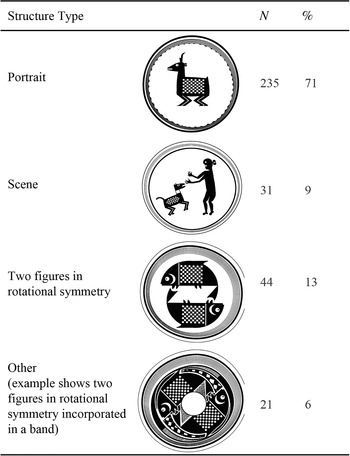
Examination of the representative sample from Swarts, Mattocks, and NAN Ranch confirms the existence of consistently used rules of design, in two respects (Supplemental Text 1, Part G). First, of the 331 Style III bowls with representational designs that have analyzable design structures, 310 (94%) fit into three categories: portrait, scene, and two figures in rotational symmetry (Figure 6). Most of the 21 remaining bowls are some variant of these three categories, such as two slightly different (rather than identical) or four (rather than two) figures in rotational symmetry.
Frequency of design structure types on Style III bowls with representational designs (N = 361) from Swarts, Mattocks, and NAN Ranch.

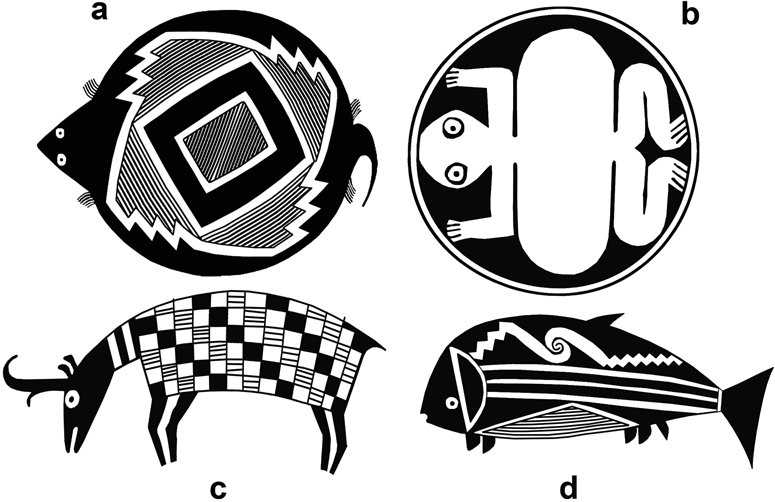
Second, animals are usually depicted in profile in Mimbres designs (Brody Reference Brody2004:153). Detailed examination of depictions from the representative sample confirms this observation and, more importantly, shows that exceptions to this rule are themselves quite predictable (Figure 7; Supplemental Table 2). Nearly all nonhuman mammals (122/123) and all fish (N = 56) are depicted in profile, with just one eye showing. Reptiles and amphibians, in contrast, are shown with two eyes (N = 48). The only depictions that do not follow either rule consistently are humans, insects, and birds. It is possible that some of these conventions are determined by the subject matter—it is difficult to depict a fish except in profile view—but not all Mimbres conventions can be explained this way. For example, Smith (Reference Smith, Chippindale and Tacon1998) noted that, in rock art generally, large mammals are often depicted with a side view of their body but a front view of the head or face; however, this is not true in the Mimbres tradition in which nearly all mammals are shown in profile. Similarly, turtles can easily be drawn in profile (https://www.wedrawanimals.com/how-to-draw-a-turtle-for-kids/), but they are always depicted top down with two eyes in Mimbres paintings.
Examples of animals depicted not in profile (a–b) and in profile (c– d). (a) MimPIDD 4583, Eby site, University of Arkansas Museum # 47-125-24; (b) MimPIDD 9557; (c) MimPIDD 2625; (d) MimPIDD 2703. (a, c, d) are from the Swarts site, Peabody Museum of Archaeology and Ethnology at Harvard University, #25-11-10/94793, 24-15-10/94432, 25-11-10/94826 (used with permission).

Pervasive Designs
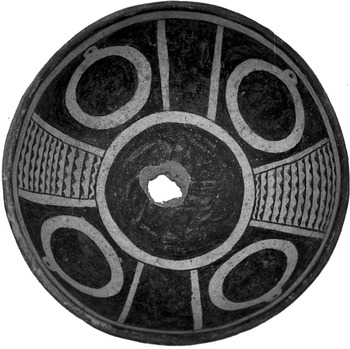
Mimbres representational designs are “pervasive” (cf. DeBoer Reference DeBoer and Longacre1991) in at least two respects. Designs known from pottery are also observed in jewelry, woodwork, ground stone, and rock art (Brody Reference Brody2004:101; Creel Reference Creel1989a; Shafer Reference Shafer, Nelson and Hegmon2010; Stewart et al. Reference Stewart, Matousek and Kelley1990). In addition, some designs depict other types of artifacts, such as shell bracelets (Figure 8), rabbit sticks, ceremonial staffs, and burden baskets, demonstrating a different kind of cross-media representation. Studies of symbolic redundancy suggest that visual repetition, within and across media, lends credibility to the message of symbols, what Steiner describes as “a self-referential discourse of cultural reality that generates and internal measure of truth-value” (Reference Steiner, Phillips and Steiner1999:95).
Shell bracelets depicted on a Mimbres bowl from the Pruitt site. Rim diameter is about 34 cm. MimPIDD 110 is in the collections of the Arizona State Museum, GP04933 (photo by the Mimbres Foundation), used with permission.

Summary
Mimbres pottery designs vary in several dimensions. Some artists developed recognizable individual styles, which is unusual in the Southwest. However, there is no detectable regular variation at either intra- or intersite levels and only subtle differences across the region. Instead, the Mimbres style, including the overall structure and the way motifs are depicted, is quite regular: particular motifs are distributed homogeneously. Thus, the overall Mimbres style fits definitions of “iconological” and “pervasive” styles (Plog Reference Plog, Conkey and Hastorf1990; DeBoer Reference DeBoer and Longacre1991) that convey important meanings, both ideological and social. The distribution of the pottery is strongly bounded, suggesting it was also emblemic, marking group identity at the regional level. These theoretical concepts point to the conclusion that Mimbres painted pottery is socially significant. By developing a dynamic and historical perspective, the final analytical section asks more specifically about the nature of that significance.
Mimbres Pottery in Social and Historical Context
The earliest decorated predecessor of Mimbres painted pottery is an unremarkable type known as Mogollon Red-on-brown, found across the broad area of the Mogollon Highlands around AD 650–750. Beginning by the tenth century, Mimbres pottery developed into the elaborate, bounded phenomenon described in the previous two sections. Here we attempt to understand these developments by focusing on the social significance of the pottery as it unfolded over time. In doing so, we are able to approach two important but difficult questions: What do the designs mean, and why is the pottery so beautiful? In more theoretical terms, this section asks how historical social practices resulted in the crystallized and highly structured style we recognize as Mimbres.
In his work on identifying Mimbres artists, LeBlanc offers one answer:
I believe that one reason Mimbres painting is so stunning is that a unique set of social circumstances allowed people with artistic talent to express themselves freely, to innovate, and to reach their full potential. Many people have artistic talent, but often the constraints of tradition hamper their ability to develop it. Something in Mimbres culture enabled and encouraged artistic expression and innovation for several generations, and this is one reason we have the Mimbres art we enjoy so much today [Reference LeBlanc, Nelson and Hegmon2010:75].
We explore this “unique set of social circumstances” by tracing the development and social significance of the pottery in its historical context. Many pieces of the scenario—talented artists, population growth and movement, limited desirable land, and land tenure systems—are seen across the Southwest. What is special about the Mimbres case is how those pieces fit together and came to reinforce one another.
Compared to much of the Southwest, the Mimbres region was a particularly good place to farm, with small-scale irrigation from permanent rivers, good arable land along the major watercourses, and some farmable areas in the uplands. A model of agricultural suitability was developed in Hegmon (Reference Hegmon and Hegmon2017), and Supplemental Figure 2 provides a map of suitability ratings. Resource-rich areas often become attractive persistent places (Roth Reference Roth, Sullivan and Olszewski2016), resulting in decreasing resource-to-population ratios and increasing competition; a similar process in the Mesa Verde region is described by Schwindt and colleagues (Reference Schwindt, Kyle Bocinsky, Ortman, Glowacki, Varien and Kohler2016). In the Mimbres region, population grew considerably, indicated by increases in the number and size of settlements. Shafer estimates that the population at NAN Ranch increased threefold from the Late Pithouse to the peak of the Classic period (Reference Shafer2003:133). Earlier work concluded that the region-wide increases could be simply a result of internal growth (Blake et al. Reference Blake, LeBlanc and Minnis1986:454), although later work concluded that the growth rate was 2.0%–2.5%, indicating substantial in-migration (Cordell et al. Reference Cordell, Doyel, Kintigh and Gumerman1994:127; see summary in Hegmon et al. Reference Hegmon, Nelson, Schollmeyer and Hegmon2016:61–63). Migration is suggested by pockets of nonlocal practices such as Hohokam-like floor support posts at Swarts (Cosgrove and Cosgrove Reference Cosgrove and Cosgrove1932:49–50) and Old Town (Creel Reference Creel2006), cremation burials (Creel Reference Creel1989b), and a diversity of architectural forms (Hegmon et al. Reference Hegmon, Brady, Nelson, Powell-Martí and Gilman2006).
People in the Mimbres region responded to the growth by developing land tenure systems linked to subtle but pervasive forms of inequality that gave some people stronger claims to better land (Stokes Reference Stokes and Stokes2019). Land tenure and inequality are documented in a number of locations across the region, including the western edge (Schriever Reference Schriever2012) and at several sites in and around the Mimbres Valley (Russell Reference Russell2016). Using tree-ring data, Shafer (Reference Shafer2003:133) argues that at NAN Ranch there was a core population of corporate households that had strong claims to land, and others with weaker claims who moved in and out depending on resource availability. Architecture and burial traditions were part of this land tenure system. Classic room blocks were built by accretion, and in many cases the earliest core rooms came to be used for burial, eventually coming to resemble mausolea. Three such rooms are known at Galaz, each coming to have more than 20 subfloor burials (Anyon and LeBlanc Reference Anyon and LeBlanc1984:Appendix II). These burial practices are widely interpreted as marking and reinforcing the land tenure system by demonstrating ancestral claims to a place (Roth and Baustian Reference Roth and Baustian2015; Russell Reference Russell2016; Schriever Reference Schriever2012; Shafer Reference Shafer2003:50).
Mimbres painted pottery, interred with many burials, was an important part of these practices, beginning as early as the ninth century. The destruction of great kivas in the tenth century may signal a dissolution of older traditions, setting the stage for stylistic and ideological innovations. Over time, the design tradition developed and became more structured and invariant (Hegmon and Kulow Reference Hegmon and Kulow2005). The styles of individual artists emerged, and designs with clear iconographic meaning became more common, culminating in the distinctive Style III associated with the Classic period and indicating an established ideology. We suggest at least three interrelated connections between the social practices and the pottery. In all three, the relationships are probably recursive, rather than cause and effect.
First, as the pottery came to be used in burials, including those marking ancestral claims to land, it would have become increasingly important socially, economically, and ideologically. These developments shed light on the florescence of the pottery's iconographic nature, including designs that depict religiously significant scenes, as well as on its invariant designs.
Second, resources in the Mimbres region were limited, and farming would have been part of an increasingly complex social and cultural milieu, ordered in part by the land tenure system and given meaning by the pottery. This helps explain the boundedness of the pottery distribution, the consistency in its decoration, its ultimate deposition, and the differences between Mimbres pottery and contemporary types. Natives of and newcomers to the Mimbres region adopted and used the meaning-charged pottery and rarely possessed any other painted types. The pottery thus became a symbol of belonging associated with life in the Mimbres region during the Classic Mimbres period: “I belong here. I accept and am part of the Mimbres way of life.” It conveyed an identity linking people and place. The rarity of Mimbres pottery outside the region suggests the identity was not retained if and when people left.
According to this perspective, Mimbres pottery conveyed important messages in at least two interrelated respects, developed over generations. People signaled their acceptance of the ways of life, including the land tenure system, by their use of the pottery. The pottery, however, was mostly made by small-scale specialists carrying on a tradition developed over generations. Most people did not make their own pottery but obtained it through gifting or exchange, the very mechanisms that contributed to the homogeneous distribution of designs. Thus, people could obtain the pottery only if they were accepted as part of Mimbres society. This sense of belonging was both inclusive and exclusive and conveyed in multiple dimensions, including designs inside individual eating bowls and in the region-wide style.
The western edge of the Mimbres region is less clearly bounded than other parts, indicated by Figure 4 and by Gilman's (Reference Gilman, Harry and Herr2018) work. This area, especially the San Simon watershed of eastern Arizona, is also less resource rich than the core of the Mimbres region. As the Mimbres and Hohokam traditions grew increasingly distinct, that intermediate area came to have a mix of Mimbres and Hohokam characteristics, perhaps suggesting a less structured social order and a more permeable cultural boundary (for recent examinations of the Mimbres–Hohokam borderlands, see Wallace Reference Wallace2014).
Archaeologists still do not understand exactly what changed at the end of the Classic Mimbres period, but we do know that population declined, the land tenure system ended, some people left the region, and others reorganized as they moved to dispersed hamlets (Nelson et al. Reference Nelson, Hegmon, Kulow and Schollmeyer2006). Drawing on the perspective developed here, it appears that life after the end of the Classic period was different enough that it was no longer symbolized by Mimbres pottery.
Third, the importance of Mimbres painted pottery would have been felt by the people who made it and especially by those who painted it. In this case, a tradition of elaborate designs depicting various figures was established fairly early on. As the pottery became more meaning-charged, the tradition became more structured in many ways (Hegmon and Kulow Reference Hegmon and Kulow2005). LeBlanc (Reference LeBlanc, Nelson and Hegmon2010) argued that the pottery is so beautiful because artists were encouraged to develop and perfect their own styles. We further suggest that such encouragement was tied to the social significance of the pottery for signaling inclusion, which in turn reinforced the recognition of talent and the pursuit of perfection in objects that would traverse the boundary between the worlds of the living and the dead. No less important was the understanding that innovation, elaboration, and creativity were nevertheless bounded by social constraints.
This exploration of how Mimbres painted pottery developed in its historical context provides answers to the questions that opened this section. Although some individual designs have cosmological referents, the designs in general are better understood as part of a material tradition that says, “I belong here.” It was part of an identity linking people and place. The development of that tradition, including the artists who helped make that statement, also helps explain why the pottery is so beautiful.
Conclusions: Toward a Comparative Perspective
This article has been almost entirely about Mimbres painted pottery, a type that is in many ways unusual and even unique in the Southwest. At the same time, the lenses—boundaries, dimensions of variation, and historical context—that we used to consider Mimbres pottery may be useful for comparative studies.
We found that the distribution of Mimbres pottery and designs is highly bounded. The social, material, and ideological significance of boundaries has long been debated in the archaeological literature. Data now available through the cyberSW, the basis of Figures 2–4, make possible a comparative study of the relative boundedness of numerous pottery types and wares that could be used to assess these debates systematically, building on the comparisons presented in Figure 3. Such comparisons would also benefit from analyses of the similarities and differences between types and wares, a staple of early stylistic analyses (e.g., Plog Reference Plog1978) not often done today. Similar studies could also compare the ends of pottery traditions, the extent to which they are abrupt and thus bounded in time, and how these patterns relate to social changes.
Mimbres pottery, probably like many kinds of material culture, varies in many dimensions. We found evidence that at least some individual artists developed distinctive styles, but we discerned little intraregional variation. Instead, in the Mimbres case, the bounded pan-regional style was meaning-charged in multiple ways, which we related to the concepts of emblemic and pervasive styles and iconological variation. These kinds of findings could be the basis of comparative work in at least two ways. First, methods could be developed to assess patterns of variation in various pottery traditions in a way analogous to that shown in Figure 3, leading to better understandings both of typologies and their association with social processes. Second, the association between spatial and social scales likely varies across cases, and understanding that association could lead to more insights about the social significance of style in general.
Finally, in recent decades, North American archaeology has found a middle ground between the search for general laws and interest in cultural particulars. The scenario we propose for the development of Mimbres pottery is part of that middle ground. This article is about the elaboration of local tradition (painted pottery) as a process that reinforces and is reinforced by social processes. The beauty, structure, and boundedness of Mimbres Style III developed as a way to speak to the land tenure that emerged with growing population size and density. The particular results are unique, but the process of elaboration to reinforce social relations is not. Our scenario establishes a basis for considering similar processes in other parts of the Southwest and beyond.
Acknowledgments
We thank the following for help with permissions: Suzanne Eckert and Jannelle Weakly, Arizona State Museum; Eric Kaldahl, Amerind Foundation; Mary Suter, University of Arkansas Museum; and Cynthia Mackey, Peabody Museum of Archaeology and Ethnology, Harvard University. Robert Hard and Mary Whisenhunt provided insights on the York Duncan Valley. The Office of Archaeological Studies Pottery Typology Project (http://ceramics.nmarchaeology.org/index) is an invaluable resource for any research on Southwestern pottery. Grant Snitker prepared Figure 1. Peggy Nelson, Kostalena Michelaki Swartz, Lynn Gamble, and anonymous reviewers provided many helpful comments.
Data Availability Statement
All of the data for this article are derived from the Mimbres Pottery Images Digital Database (MimPIDD) at https://core.tdar.org/collection/22070/mimbres-pottery-images-digital-database-with-search. Sources and specific analyses are explained in Supplemental Text 1.
Supplemental Materials
For supplemental material accompanying this article, visit https://doi.org/10.1017/aaq.2020.63.
Supplemental Text 1. Data sources and analytical detail.
Supplemental Figure 1. Distribution of Mimbres Black-on-white in relation to other painted decorated pottery for the AD 1000–1100 interval.
Supplemental Figure 2. Modeled agricultural suitability for the Mimbres region. For model details, see Hegmon (Reference Hegmon and Hegmon2017:157). 1 = Saige McFarland, 2 = Woodrow, 3 = Cameron Creek, 4 = Mattocks, 5 = Galaz, 6 = Old Town and Pruitt, 7 = Swarts, 8 = NAN Ranch (analysis and map by Grant Snitker).
Supplemental Table 1. Sites for which Mimbres Painted Pottery Is Present during the AD 1000–1100 Interval.
Supplemental Table 2. Depictions of Humans and Other Animals on Style III Bowls from Swarts, NAN Ranch, and Mattocks, Indicating Profile (One Eye) or Other View (Two Eyes).