Introduction
Traumatic brain injury (TBI) is characterised by an external injury to the head that results in damage to the brain (Harrison, Helps, & Henley, Reference Harrison, Helps and Henley2008). In Australia, TBI resulted in over 26,000 episodes of inpatient care in 2004–05 (Harrison et al., Reference Harrison, Helps and Henley2008). TBI can result in a range of impairments in cognitive, physical and psychosocial functioning, with social support and specialised services often required for life (Jamieson, Harrison, & Berry, Reference Jamieson, Harrison and Berry2008). The most common causes of TBI in Australia during 2004–05 were falls (42%), transport accidents (29%) and assault (14%) (Harrison et al., Reference Harrison, Helps and Henley2008).
According to Australia's National Disability Strategy, ‘the rate of disability among Indigenous Australians is almost twice as high as that among non-Indigenous people’ (Council of Australian Governments, 2011, p. 14). However, there is limited evidence available regarding TBI in Indigenous Australians, although data suggest that rates of injury are higher and the causes of injury may be different. For example, Indigenous children and young people are twice as likely to be admitted to Australian hospitals due to injury (Pointer, Reference Pointer2016). Brain trauma accounts for 30% of injuries requiring hospitalisation for Indigenous Australians (Helps & Harrison, Reference Helps and Harrison2006) compared to 18% in the general Australian population (Australian Institute of Health and Welfare, 2012). Jamieson et al. (Reference Jamieson, Harrison and Berry2008) found that between 2005 and 2008, Indigenous Australians were 21 times more likely to suffer a brain injury due to assault than their non-Indigenous counterparts. Similarly, in a study of TBI in the Northern Territory (NT), Indigenous Australians were 4.8 times more likely to have presented with TBI due to assault compared to non-Indigenous Australians (Gowing, McDermott, Ward, & Martin, Reference Gowing, McDermott, Ward and Martin2015).
Australian studies on outcomes after TBI report primarily on metropolitan-dwelling, non-Indigenous populations (Draper, Ponsford, & Schönberger, Reference Draper, Ponsford and Schönberger2007; Fleming, Tooth, Hassell, & Chan, Reference Fleming, Tooth, Hassell and Chan1999; Tate et al., Reference Tate, Harris, Cameron, Myles, Winstanley, Hodgkinson and Harradine2006). There is currently no published data regarding outcomes of Indigenous Australians following TBI although a Western Australian study is currently underway exploring this area (Armstrong et al., Reference Armstrong, Hersh, Katzenellenbogen, Coffin, Thompson, Ciccone and Woods2015; Katzenellenbogen et al., Reference Katzenellenbogen, Atkins, Thompson, Hersh, Coffin, Flicker and Armstrong2016). Given the higher rates of brain trauma in the Indigenous Australian population, research addressing outcomes after TBI are much needed for the future development of evidence-based programmes to support Indigenous Australians following TBI.
The six-month period following discharge from hospital (transition period) is a distinct critical rehabilitation phase adjoining acute hospital and community care (Kripalani, Jackson, Schnipper, & Coleman, Reference Kripalani, Jackson, Schnipper and Coleman2007). Research in the non-Indigenous population demonstrates that the transition period is typically when difficulties such as fitting back into the community, re-forming and maintaining social roles and relationships, gaining independence and securing employment begin (Conneeley, Reference Conneeley2002; Doig, Fleming & Tooth, Reference Doig, Fleming and Tooth2001; Nalder, Fleming, Cornwell, & Foster, Reference Nalder, Fleming, Cornwell and Foster2012a; Nalder, Fleming, Cornwell, Shields, & Foster, Reference Nalder, Fleming, Cornwell, Shields and Foster2013; Turner, Fleming, Cornwell, Haines, & Ownsworth, Reference Turner, Fleming, Cornwell, Haines and Ownsworth2009a; Turner, Ownsworth, Cornwell, & Fleming, Reference Turner, Ownsworth, Cornwell and Fleming2009b). Returning home can be associated with shock, frustration and grief, and a lack of support during this time can contribute to greater feelings of pressure and stress leading to poor outcomes. Multidisciplinary rehabilitation and support is important for a person's successful re-integration into home, community and work life (Turner-Stokes, Disler, Nair, & Wade, Reference Turner-Stokes, Disler, Nair and Wade2005). Despite this, rehabilitation and specialist support services are typically a limited resource, with many people with TBI receiving little or no rehabilitation (Foster, Fleming, Tilse, & Rosenman, Reference Foster, Fleming, Tilse and Rosenman2000). Factors such as geographical isolation, limited financial resources, constraints on capacities for family advocacy and cultural background may impact on rehabilitation access and the effectiveness of rehabilitation for individuals (Foster et al., Reference Foster, Fleming, Tilse and Rosenman2000). Despite the lack of data for Indigenous Australians, it is possible that sentinel events experienced during transition are different for Indigenous Australians following TBI. Understanding sentinel events experienced during this critical period by Indigenous Australians is important in understanding what leads to good and poor outcomes in this population. While the factors just described are relevant for the general TBI population, it is possible that there may be different patterns of events and experiences for Indigenous Australians when compared to non-Indigenous Australians. This is especially likely given the context of the limited services that are available in many remote areas to support people with complex disabilities (Productivity Commission, 2011).
This study will investigate key sentinel events during the six-month transition period following TBI in the first longitudinal study with Indigenous Australians who have suffered a TBI. Key sentinel events are defined as events, positive or negative, which arise during this transition period and that may influence health and/or wellbeing (Nalder et al., Reference Nalder, Fleming, Cornwell, Foster, Ownsworth, Shields and Haines2012c). Examples of positive sentinel events are returning to work and returning to driving, while examples of negative sentinel events are relationship breakdown and financial strain. Investigating the occurrence and predictors of these key sentinel events is critical to understanding what events lead to positive and negative outcomes following TBI, and to development of evidence-based transition services and strategies. This study will provide the first systematic evidence regarding what is needed to support Indigenous Australians to successfully transition back into their community following TBI. Areas of unmet needs and barriers to successful transition will also be highlighted, which may be targeted in the future development of services and supports for this population. A research translation strategy will be specifically designed and deployed to ensure the research leads to changes in both practice and policy.
Study Objectives
This study aims to document the occurrence, predictors and outcomes of key sentinel events during the transition period for Indigenous Australians with TBI. Specifically, the study aims to
1. examine the pre- and peri-injury predictors of these events, and investigate their influence on health, wellbeing, community integration and the experience of transition.
2. calculate and compare the annual rates of brain injury (per 100,000 population) for Indigenous and non-Indigenous Australians admitted to the participating hospital in Northern Queensland and the NT with diagnosis of TBI using de-identified data compiled from relevant routinely available hospital administrative data sets.
Method
This longitudinal study will use a mixed methods approach with qualitative and quantitative data collected concurrently (Creswell & Clark, Reference Creswell and Plano Clark2007). Participants with TBI and their nominated care givers will complete self-report questionnaires to document outcomes at three time points (discharge, three months and six months post-discharge). Discharge is defined as the point at which an individual's inpatient hospital care ends, when they are no longer an admitted patient and ongoing care is transferred to other primary, community or domestic environments. To understand the lived experience, the questionnaires will be accompanied by an in-depth, semi-structured interview for participants with TBI at six months post-discharge, while care givers will complete a semi-structured interview at all three time points. Participants with a TBI will also complete a cognitive assessment at all three time points.
The study design replicates previous transition research conducted in a metropolitan setting (Nalder et al., Reference Nalder, Fleming, Cornwell and Foster2012a; Nalder, Fleming, Cornwell, Foster, & Haines, Reference Nalder, Fleming, Cornwell, Foster and Haines2012b) with data collection methods adapted to be more culturally appropriate for research with Indigenous Australians.
Indigenous Framework for the Research
Indigenous Standpoint Theory (IST) has been developed to ensure that research is culturally appropriate (Gilroy, Reference Gilroy2012; Gilroy, Donelly, Colmar, & Parmenter, Reference Gilroy, Donelly, Colmar and Parmenter2013). IST forms part of the research methodology to ensure the research is planned, owned and controlled by Indigenous people and ensures that Indigenous people are intimately involved with all aspects of the research (Gilroy, Reference Gilroy2012; Gilroy et al., Reference Gilroy, Donelly, Colmar and Parmenter2013). Research methods grounded in IST build the capacity of Indigenous people to engage with, direct and translate research (Gilroy, Reference Gilroy2012; Gilroy et al., Reference Gilroy, Donelly, Colmar and Parmenter2013). Key Indigenous Australians with Indigenous disability research and advocacy experience, community-based service provision, research translation and policy development expertise have agreed to be part of a reference group for the study. This reference group will provide guidance on community engagement strategies, data collection and interpretation, and research translation.
Study Setting
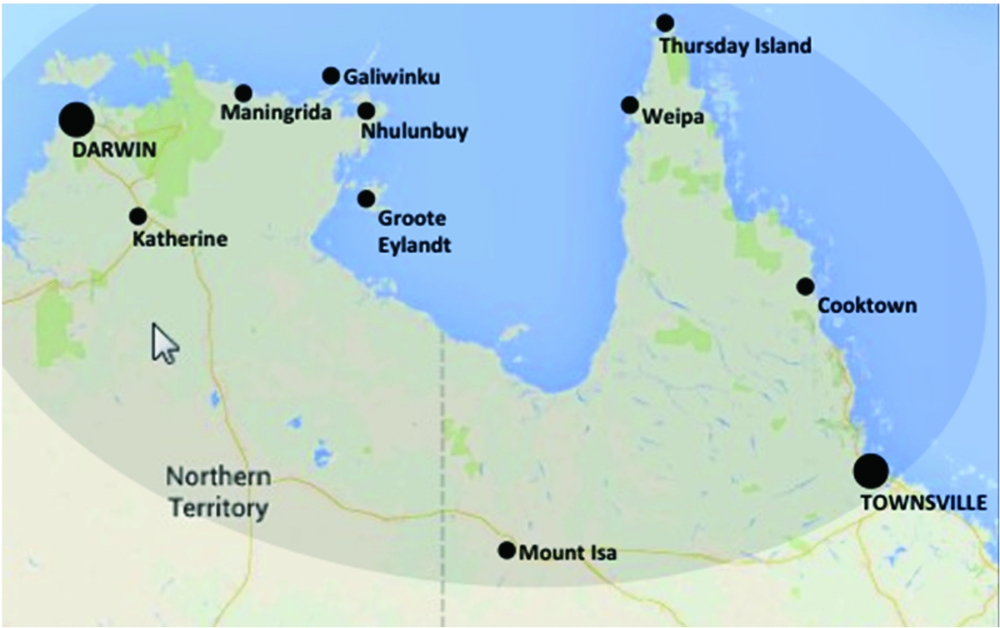
This study will focus on northern Australia, including the NT's ‘Top End’ as well as north and northwest Queensland (see Figure 1). Three major trauma hospitals in northern Australia will be involved in the study. The National Critical Care and Trauma Response Centre (NCCTRC) is a trauma service at the Royal Darwin Hospital. The NCCTRC services primarily individuals from the ‘Top End’ region of the NT surrounding Darwin, south to Katherine and stretching north and east to the Gove peninsular and Groote Eylandt. The Townsville Hospital (TH) and the Cairns Hospital (CH) service mainly individuals from the region of Queensland surrounding Townsville (including Palm Island), stretching northwest to Mount Isa, and north to Cooktown, Weipa, Bamaga and the Torres Strait Islands. All moderate to severe patients with TBI are transported to the TH neurosurgical ward from smaller hospitals in these areas.
Locations where the research will be conducted.

Consultation
The current study followed on from extensive community consultation undertaken by Bohanna in 2013 as well as more recent community consultation in 2016. In 2013, author Bohanna led the first nationally focused research on acquired brain injury (ABI) in Indigenous Australians, to inform the National Disability Insurance Scheme (Bohanna et al., Reference Bohanna, Stephens, Wargent, Catherall, Timms, Graham and Clough2013). The aims of the study were toinvestigate how Indigenous Australians with acquired brain injuries are assessed and supported in urban and remote communities; to develop guidelines on engagement and assessment; and to identify gaps in support and evidence. This study consulted with key informants from Queensland, the NT, New South Wales and the Torres Strait Islands, including psychologists, allied health practitioners, disability services staff, cultural advisors, individuals with brain injury, care givers and community members, 40% of whom were Aboriginal and/or Torres Strait Islander (Bohanna et al., Reference Bohanna, Stephens, Wargent, Catherall, Timms, Graham and Clough2013). Key gaps that were identified involved transition support, a lack of culturally appropriate strategies to encourage successful transition, and the need for in-depth research to quantitatively examine key sentinel events during transition for Indigenous Australians following TBI.
In 2016 and related specifically to the current study, project consultation trips were conducted as part of the implementation phase of the project in accordance with national standard guidelines (NHMRC, 2015), with clinics and community-based services providers working in areas outlined in the study setting. The trips acted as a two-way learning exercise, providing these initial steps to develop and inform project outcomes that would be beneficial to improving clinic- and service-related processes and practices when working with individuals with TBI while providing a clearer understanding of the current discharge processes for someone with a TBI between tertiary health institutions and community-based service providers. Information about existing community-level support for community residents with a TBI and their families was also captured.
In combination, workshops with North Queensland health service staff were facilitated by project staff to develop an assessment schedule that was culturally appropriate and suitable. Feedback and comment was also sought from the Indigenous reference group regarding all the tools. Based on responses and feedback, the assessment schedule was amended, with some surveys included and others removed from the final version. The recommended minor language changes to the data collection instruments were either made directly to the instrument or compiled into a protocol that will be used as additional prompts. Where possible, assessments were selected that have been used with or validated for use with Indigenous Australians. Due to the paucity of such validated instruments, focus groups were also held in two locations (Cairns and Townsville) with Indigenous and non-Indigenous staff from North Queensland health services, with the aim of examining the cultural acceptability of the assessments. Feedback and comment on the assessments was also sought from the Indigenous reference group regarding all the tools. Based on responses and feedback, the assessment schedule was amended, with some surveys included and others removed from the final version. The recommended minor language changes to the data collection instruments were either made directly to the instrument or compiled into a protocol that will be used as additional prompts.
Participants
Two participant groups will be recruited. Eligible Group 1 participants will be Indigenous Australians, male or female, aged between 18 and 65 years, recruited from the participating hospitals, who satisfy additional eligibility criteria as follows: (1) sustained a TBI, (2) admitted for longer than 24 hours, (3) adequate communication skills to participate in the research, (4) experienced a loss of consciousness (of any duration), and/or a period of post-traumatic amnesia (PTA) greater than 24 hours as measured by the Westmead PTA scale (Shores, Marosszeky, Sandanam, & Batchelor, Reference Shores, Marosszeky, Sandanam and Batchelor1986), and/or injury to the brain verified by Computed Tomography or Magnetic Resonance Imaging and (5) emerged from PTA (if applicable). Researchers will be guided by the treating clinical team with regard to determining if an individual has adequate communication skills to participate in the research. In consultation with the clinical team, the research team will endeavour to do all possible to enable consenting participants with communication barriers to take part in the project, incorporating alternative communication methods as appropriate, determined in consultation with clinicians, interpreters, care givers and cultural liaison officers. As the project is recruiting participants where English is often spoken as an additional language or where aphasia-related symptoms are experienced, specific care will be taken to ensure communication is not a barrier for participation. Where English is the participant's second language, arrangement of an interpreter for the assessment will be offered so the English-based survey tools can be translated into an appropriate language.
Group 1 participants will be asked to nominate a care giver or significant other with these individuals comprising Group 2 participants. Group 1 participants will be given the opportunity to confirm the same care giver or change their nominated care giver at subsequent time points 2 and 3. All care givers will provide informed consent prior to participating. Group 1 participants will still be able to participate, even if they do not nominate a care giver or significant at any time point.
Procedures for Recruitment
Approximately 200 participants with TBI and their care givers will be recruited. Patients meeting the eligibility criteria, and have emerged from PTA, will be referred to the study through occupational therapy clinicians at each site. The clinicians will make a judgement regarding a potential participant's capacity to voluntarily consent to participate in the research (in association with a carer giver or family member if necessary). For potential participants meeting the eligibility criteria, a researcher will then (with the assistance of the hospital's Indigenous Liaison Officer, where necessary) approach the interested participant to explain the study and provide the project information statement. Potential participants will be informed that there is no financial gain from their participation, and that they will not receive any extra service, preferential treatment or incentives for participating. They will be informed that they can withdraw from the research at any time without affecting their treatment/engagement with the health service or any disability/health agency. Informed consent will be obtained. It is at this point that potential participants will be asked to nominate a care giver who will be approached to participate in the study. Where a potential participant is under a short-term guardianship order, consent by proxy for the patient to be participating will also be sought from the guardian.
Data Collection
Data will be collected directly from participant Groups 1 and 2 in a re-identifiable form using an iPad (or pen and paper if the participant prefers). All surveys will be administered by a project team member, with the assistance of an interpreter if required. Data will be collected at three time points: at hospital discharge (TP1) and again at approximately three (TP2) and six months (TP3) following discharge from hospital. Recruitment and data collection for TP1 will occur within the hospital setting, or if this is not possible, in the community within one week of discharge. Data collection at TP2 and TP3 will occur in the participants’ communities, at a location of their choice (e.g., own home, community centre). Participants are encouraged to nominate a support person who can be present during the assessment to ensure their cultural security and safety, including a family or community member, Indigenous hospital liaison officer or Indigenous health or support worker.
Along with demographic information, the following will be collected from medical records and self- or significant-other report.
Injury and hospitalisation information: Details of health facility use and transfer following injury; discharge summary details; radiology results at initial intake (including X-ray, CT and MRI scans); loss of consciousness and duration; length of PTA; previous admissions to hospital and admissions within the study period; Glasgow Coma Scale (GCS) score.
Brain injury risk factor information: Previous brain injuries, losses of consciousness, substance use history and psychiatric diagnoses will be collected from Group 1 participants only.
The Sentinel Events Questionnaire (SEQ) collects information on the occurrence and timing of eight key sentinel events including financial strain, relationship breakdown, moving to a more restricted living situation, having difficulty accessing therapy services, returning to work, returning to independent use of transportation, regaining independence in the home, and returning to driving during the transition period (Nalder et al. Reference Nalder, Fleming, Cornwell, Foster and Haines2012b; Nalder et al., Reference Nalder, Fleming, Cornwell, Foster, Ownsworth, Shields and Haines2012c). Responses are binary (i.e., yes or no as to whether a sentinel event had occurred) and time-specific (i.e., on approximately which date did an event occur e.g., seeking financial assistance), and supplemented with a brief qualitative description pertaining to the experience of each event. The SEQ has been shown to have high participant-proxy agreement based on kappa scores for five items (return to work, return to driving, regaining independence at home, returning to independent use of transport and moving to a more restricted living situation). The remaining three items had fair (relationship breakdown) or moderate agreement (difficulty accessing therapy services and financial strain) based on kappa analyses (Nalder et al., Reference Nalder, Fleming, Cornwell, Foster, Ownsworth, Shields and Haines2012c).
The Negative Life Events Scale (NLES) has been validated for use with Indigenous Australians (Kowal, Gunthorpe, & Bailie, Reference Kowal, Gunthorpe and Bailie2007). The NLES was developed to measure stress in the national Indigenous population after consultation with Indigenous representatives. The NLES requires yes/no response for 16 potentially stressful events (ABS, 2004).
Generalised Anxiety Disorder Assessment (GAD-7) a seven-item, self-report questionnaire for screening and severity measuring of generalised anxiety disorder (Spitzer et al., Reference Spitzer, Kroenke, Williams and Löwe2006). The instrument has seven items, which measure severity of various signs of generalised anxiety disorder according to reported response categories with assigned points.
Adapted Patient Health Questionnaire (PHQ-9) is a brief instrument, consisting of nine questions, for screening, diagnosing, monitoring and measuring the severity of depression symptoms (Brown et al., Reference Brown, Mentha, Rowley, Skinner, Davy and O'Dea2013). The adapted version uses a four point Likert scale (none, a little bit, most of the time and some of the time) and has been validated for use with Indigenous Australians.
The Strong Living Scale (SLS) was designed by the researchers to assess ABI with Indigenous Australians and measures personal satisfaction with areas of life often affected by ABI. The SLS is an easy to use, strengths-based scale, focusing on personal satisfaction, not deficits; however, it has not undergone formal validation. The SLS is based on the World Health Organization International Classification of Functioning, Disability and Health Core Sets for TBI (Bernabeu et al., Reference Bernabeu, Laxe, Lopez, Stucki, Ward, Barnes and Zasler2009) supplemented with additional domains important to Indigenous Australians in understanding the impacts of ABI on people's lives, based on previous qualitative inquiries (Bohanna et al., Reference Bohanna, Stephens, Wargent, Catherall, Timms, Graham and Clough2013). The SLS has 26 items integrated into nine areas, relationships, yarning, getting around, everyday activities, keeping healthy, culture and community, work, study, training, thinking, feeling and behaving.
Cogstate cognitive assessment consists of computerised cognitive tasks, administered using an iPad. The tests measure cognitive domains relevant to TBI including psychomotor function, visual attention, working memory, executive function verbal learning and memory and social cognition (Maruff et al., Reference Maruff, Thomas, Cysique, Brew, Collie, Snyder and Pietrzak2009). The CogState tests were developed specifically for use in Australian Indigenous people and have been shown to have a high level of acceptability, usability and validity in this group as well as an established sensitivity to brain disorders, diseases and injuries in non-Indigenous population including TBI (Maruff et al., Reference Maruff, Thomas, Cysique, Brew, Collie, Snyder and Pietrzak2009). Only Group 1 participants will complete the Cogstate assessment.
Qualitative data: Consistent with the Aboriginal Health and Medical Research Council of New South Wales Ethics Committee (AHMRCEC) Guidelines for Research into Aboriginal Health (2013), the experience of Aboriginal people will be the focus of qualitative inquiry. The exploration of individual and collective experiences of participants’ engagement with formal services, their communities and families will be explored through in-depth semi-structured interviews. These interviews will cover participants’ experiences during the hospital period, life since returning home, experience of key sentinel events, engagement with services and hopes for the future. The proactive engagement of patients and families and the wisdom shared will inform any recommendations to grow out of this study. The primacy of Indigenous voices in the research project encourages the co-creation of knowledge that values the wisdom of Indigenous experiences to inform knowledge about the provision of service that is culturally appropriate and relevant to the population group.
Interviews follow a semi-structured question guide, draw on ‘research yarning’ theory to allow participants to explore what is important to them, as opposed to what is important to the researcher. Questions will include the following:
1. How has life been for you (and your family) since you left hospital?
2. How has your life changed since you came home from hospital?
3. What has helped you or made it easier since you went home?
4. What has been unhelpful or made it more difficult since you went home from hospital?
The knowledge and wisdom that is shared will complement the quantitative measures employed throughout the research project. Data will be collected face-to-face where possible, requiring the development of trust and rapport between the researcher and participant, which is consistent with best practice when working with Indigenous Australians with brain injury. Interviews will be audiotaped with consent and transcribed. The transcribed data will be entered into Nvivo 11, to assist with analysing and coding the text-based data according to qualitative thematic analysis (Braun & Clarke, Reference Braun and Clarke2006).
The researchers conducting the interviews have a variety of background experience including occupational therapy, social work, psychology and criminology. Between them, they hold many person-years of experience working with and engaging Indigenous people in a range of research projects including follow-up on illicit substance misuse including cannabis and behaviours largely contributing to TBI such as drink driving. In all these projects, refusal rates have been low as the researchers have worked closely with Indigenous community members, families and cultural brokers.
Participant Follow-Up Strategies
Locating participants to conduct follow-up interviews across large distances can be challenging due to high mobility in the population, poor telephone and Internet access, seasonal weather variation, and cross-cultural communication issues (Clough et al., Reference Clough, Bailie, Burns, Guyula, Wunungmurra and Wanybarrnga2002; Clough, Cairney, Parker, et al., Reference Clough, Cairney, D'abbs, Parker, Maruff, Gray and O'reilly2004; Lee et al., Reference Lee, Conigrave, Clough, Dobbins, Jaragba and Patton2009). Using innovative techniques, follow-up rates can be boosted form 50%–60% to over 80% (Clough et al., Reference Clough, Bailie, Burns, Guyula, Wunungmurra and Wanybarrnga2002; Clough, Cairney, Parker, et al., Reference Clough, Cairney, D'abbs, Parker, Maruff, Gray and O'reilly2004; Lee et al., Reference Lee, Conigrave, Clough, Dobbins, Jaragba and Patton2009). These techniques have also assisted successful follow-up of a unique cohort of former petrol sniffers (Cairney, O'Connor, Dingwall, et al., Reference Cairney, O'Connor, Dingwall, Maruff, Shafiq-Antonacci, Currie and Currie2013).
This study will use the following established techniques to reduce attrition and enhance follow up:
• Facilitation by an Indigenous researcher: this is an effective and culturally appropriate strategy for conducting research with Indigenous Australians, including those with brain injury (Bohanna et al., Reference Bohanna, Stephens, Wargent, Catherall, Timms, Graham and Clough2013).
• Rapport building in hospital: The researcher will meet with participants at least twice to build rapport prior to assessment, as per best practice. (Bohanna et al., Reference Bohanna, Stephens, Wargent, Catherall, Timms, Graham and Clough2013).
• Face-to-face assessment: In-person assessment enables the sharing of stories and establishment of trust, consistent with ‘research yarning’, a method endorsed for research with Indigenous Australians (Bohanna et al., Reference Bohanna, Stephens, Wargent, Catherall, Timms, Graham and Clough2013).
• Local contacts: Engaging knowledgeable local contacts in each community is useful for locating participants and seeking guidance regarding cultural protocols and community approvals (Bohanna et al., Reference Bohanna, Stephens, Wargent, Catherall, Timms, Graham and Clough2013).
• Collection of multiple contact detail information: Attrition often relates to inability to locate participants, rather than their unwillingness to contribute data (Hunter & Smith, Reference Hunter and Smith2002), thus multiple alternative contact details will be obtained.
• Monthly follow-up calls to care givers: This will help maintain rapport and allow care givers to inform researchers about planned departures from the community that may affect data collection.
Data Analysis
The relationship between (a) demographic and other factors and key sentinel events, and (b) sentinel transition events and health, wellbeing, community integration and empowerment outcomes will be examined using a range of regression models appropriate for the type of dependent variable and whether or not repeated measures are involved. In general, they fall within the class of generalised linear mixed effects models. These have the advantage of imputing missing data in repeated measures situations. We will also, if appropriate, undertake exploratory Structural Equation Modelling (SEM) in attempt to understand causal pathways (Rabe-Hesketh, Skrondal, & Pickles, Reference Rabe-Hesketh, Skrondal and Pickles2004). Multiple imputations will be used for the SEM. All analyses will be undertaken in Stata 14.
Data from the individual interviews will be analysed using situational analysis (Clarke, Reference Clarke2005). Situational analysis is a grounded theory approach to explore and describe the key human and discursive elements and factors that lead to the situations and key sentinel events during the participants’ transitions. As such, we will identify and examine the symbolic meanings and social interactions that lead to the issues that arise during the transition period. Situational analysis goes further than the grounded theory analytic tools into exploring and describing the most important human and non-human elements in the situation of concern and mapping what these situations mean. This approach maintains the strength of the participants’ voices in telling their experiences of the transition from hospital to their communities.
Linked Hospital Admission Data on Brain Injury for Northern Australia
Using data for tertiary hospital facilities in the study region for the period 2005–15, the project will estimate annual rates of brain injury (per 100,000 population) for patients admitted to the participating hospitals with a diagnosis of TBI.
Hospital separations and emergency department presentations for persons aged 15 years to 65 years with the principal or other diagnosis fields ICD 10 (S01, S02.0, S02.1, S02.3, S02.7, S02.8, S02.9, S04.0, S06, S07, S09.7, S09.8, S09.9, T01.0, T02.0, T04.0, T06.0, T90.1, T90.2, T90.4, T90.5, T90.8, T90.9) will be extracted. To distinguish patients with multiple episodes of care from those with just one episode, data will be linked to a unique project code.
To calculate rates and to examine trends, population denominators estimated by the Queensland Government Statistician based on 2006 and 2011 Census data will be used. Rates will be age-standardised for males and females for comparisons between the NT and Queensland and between Indigenous and non-Indigenous Australians. Prevalence of any TBI in the population at different time points will be assessed using counts of unique patients and correlated with patient characteristics where appropriate.
Knowledge to Action Plan
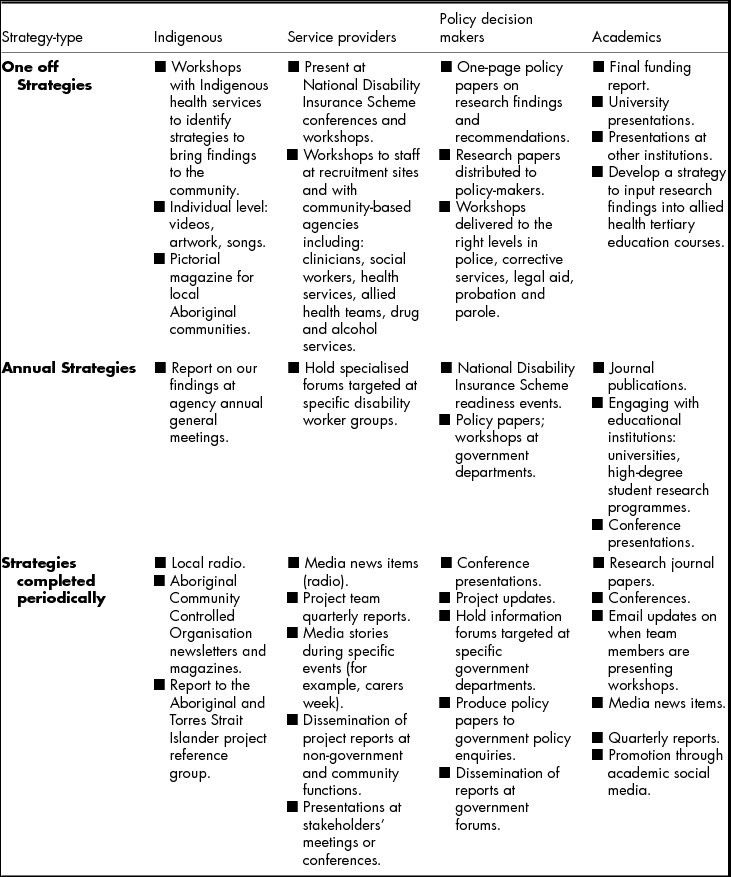
An integrated knowledge-to-action plan (Graham et al., Reference Graham, Logan, Harrison, Straus, Tetroe, Caswell and Robinson2006) has been developed (Table 1) as a way of ensuring timely input in disability and Indigenous policy and practice. Key stakeholders and research participants will be engaged in both the research process and dissemination of findings over the course of the project. The knowledge-to-action plan ensures that research and dissemination activities are controlled by Indigenous peoples, their families and other stakeholders and that results are delivered in the most appropriate format. Stakeholders include research participants, local government and non-government service providers in the disability, health and social service sectors, State/Territory and Federal policy-makers and the academic community. This diverse approach to communicating research findings to the diversity of stakeholders will ensure the research findings inform practice and policy through multiple avenues. Research translation workshops will also be undertaken to ensure research dissemination, knowledge exchange and application to practice. Research translation workshops will target services that, as their core business, assist Indigenous Australians with brain injuries. Community controlled health services and community members will be invited to participate.
Summary of the Intended Knowledge-to-Action Plan Activities for Each Audience

Discussion
To date, Australian studies on outcomes after TBI explore the experiences of primarily metropolitan-dwelling, non-Indigenous populations (Draper et al., Reference Draper, Ponsford and Schönberger2007; Fleming et al., Reference Fleming, Tooth, Hassell and Chan1999; Tate et al., Reference Tate, Harris, Cameron, Myles, Winstanley, Hodgkinson and Harradine2006). With limited attention offered to the Indigenous experience, it is unclear if life events that occur with the transition home for their mainstream counterparts would be the same for Indigenous Australians with TBI. The severe dearth of research into this area is likely to impact the suitability and relevancy of processes and supports offered to the Indigenous Australians with TBI during this period. This is the first study to explore Indigenous Australians’ experience transitioning from hospital to home as a result of a TBI using a prospective longitudinal design, and is one of the first to address this issue nationally. Understanding what experiences occur for Indigenous Australians and how these events shape the first six months after returning home from hospital will inform what is needed to support individuals, families and communities during this critical period. The learnings will also assist in development of appropriate rehabilitation services, which are currently non-existent in many rural and remote areas.
Exploration of admission and emergency presentation data from tertiary hospitals to identify the extent of TBI across northern Australia as reflected in the diagnostic codes will provide the first quantitative information available on the extent of TBI among Indigenous people. As the data reports on the characteristics related to both the person at the point of injury (i.e., age) as well as the injury and outcome, this component of the study will assist to inform where rehabilitation and disability services may be most appropriate in northern Australia and how these services can accommodate Indigenous people living with TBI. In combination with the qualitative investigation of people transitioning from hospital to home, the presentation data would also identify sub-groups that may require additional services or targeted intervention.
Finally, the study results and methods will be timely to inform various policies and programmes across Australia. For instance, the National Disability Insurance Scheme (COAG, 2011) is a major policy innovation and represents a new way of delivering services to people with disability. The NDIS aims to deliver long-term, person-centred care and support to people living with ongoing disability (NDIS, 2013). As part of managing their NDIS funds, participants will be able to spend their allocated funds on services they nominate to provide the necessary supports listed in their plan, thus providing both individual choice and flexible support (NDIS, 2013). The NDIS is currently being phased in across Australia, with implementation across the country due for completion in mid-2019. Without the evidence from this study, it is likely that the services offered from this potentially life-changing scheme will not meet the needs of Indigenous people living with TBI in regional and remote Australia or their families who care for them.
Acknowledgements
IB identified the research question, designed the study, secured funding and is the primary investigator in this study. All authors contributed to the writing of the manuscript and gave final approval.
Financial Support
The study is funded by National Health and Medical Research Council Project Grant 1081947.
Conflict of Interest
The authors report no conflict of interest. The authors alone are responsible for the content and writing of the paper.
Ethical Standards
The authors assert that all procedures contributing to this work comply with the ethical standards of the relevant national and institutional committees on human experimentation and with the Helsinki Declaration of 1975, as revised in 2008. Ethics approval for the project was provided by the Human Research Ethics Committee of the Townsville Hospital and Health Services District (HREC/15/QTHS/220), the Human Research Ethics Committee of the Northern Territory Department of Health and Menzies School of Health Research (HREC-2015-2491), James Cook University (Approval no.. H6489) and the University of Queensland Behavioural and Social Sciences Ethical Review Committee (Approval no. 2015001591).