





A policy in search of a user
In little more than a decade, the idea that industrial food processing carries health risks beyond nutrient content has moved from research hypothesis to a fixture of national dietary guidance(Reference Monteiro, Cannon and Levy1,Reference Monteiro, Levy and Claro2) . Brazil(3), Canada(4,Reference Moubarac, Batal and Louzada5) and others now advise their populations to limit ultra-processed foods (UPF)(Reference Cámara, Giner and González-Fandos6,Reference Herforth, Arimond and Álvarez-Sánchez7) , and mandatory front-of-pack identification is under discussion in several jurisdictions(Reference Monteiro, Cannon and Moubarac8). The advice rests on consistent cohort evidence linking high Nova Group 4 intake to obesity, CVD, cognitive health, type 2 diabetes and premature mortality(Reference Kim, Cho and Kim9–Reference Smith, Watson and Gallacher11).
One question has gone curiously unattended. The guidance asks people to act on a category, yet we have little assurance they can recognise it in the supermarket. The scholarly debate over Nova has centred on whether the classification is scientifically sound: whether processing predicts health independently of nutrients, whether coders apply it reliably and whether its boundaries hold(Reference Braesco, Souchon and Sauvant12–Reference Louie14). Those questions remain unsettled, but they are not the one a shopper faces, which is simpler: which products am I being told to avoid? This commentary argues that the question belongs at the centre of nutrition policy, not its periphery.
What happens when people try to apply Nova
The available evidence is not encouraging. Surveys across multiple countries suggest that consumers have limited and often inaccurate understanding of the Nova classification system and the concept of UPF, frequently interpreting it in terms of nutrient content (e.g. sugar, fat or additives) rather than the industrial formulation criteria that Nova uses(Reference Sarmiento-Santos, Souza and Araujo15,Reference Tucker, Martinez Steele and Barquera-Guevara16) . A recent study in the UK indicates substantial confusion around category boundaries, particularly between processed and UPF, with many individuals struggling to distinguish between these groups in practice(Reference Essman, Parnham and Chang17). Errors tend to occur in a consistent direction: foods perceived as nutritious, such as wholegrain products or yogurt, are often judged to be less processed regardless of their additive content, reflecting reliance on healthfulness cues rather than formal classification rules(Reference Tucker, Martinez Steele and Barquera-Guevara16).
Qualitative research across diverse settings reinforces this pattern, showing that people hold coherent and confident beliefs about food processing, but that these beliefs are shaped by visual appearance, perceived naturalness and familiar nutritional heuristics rather than Nova’s criteria(Reference Essman, Parnham and Chang17,Reference Rose and Kolodinsky18) .
It would be easy to read this as low nutrition literacy, with better education the remedy. That reading is too quick. People are not failing to think about processing; they think about it carefully, using rules that happen not to match Nova’s(Reference Machín, Antúnez and Curutchet19,Reference Turk, Ozcan and Hattat20) . Why those rules persist is why education has limited prospects(Reference Chen and Antonelli21,Reference Walker, Chambers and Veling22) .
Three reasons the problem is built into the instrument
Nova was built for a legitimate purpose: to code foods in dietary surveys so researchers could study processing as a population exposure(Reference Monteiro, Cannon and Levy1). For that, it performs well. The difficulty arises when the same instrument must guide individual purchases, where three features become decisive obstacles.
The first is what Nova measures. Group 4 membership turns on additives serving cosmetic or functional roles, such as emulsifiers, modified starches and artificial flavours(Reference Monteiro, Cannon and Levy1). These are invisible on inspection, and recognising them requires additive fluency few consumers possess. Asked to reason aloud through ingredient lists, adults routinely mistook emulsifiers and stabilisers for natural components(Reference Cox, Sandall and Smith23,Reference Yen, Barrett and Coyle24) . Qualitative and observational research shows that ingredient lists are frequently experienced as opaque, with unfamiliar chemical names and codes discouraging meaningful interpretation and leading consumers to rely on heuristics instead(Reference Kraemer, Fernandes and Chaddad25,Reference Vishwakarma, Singh and Daniel26) . The defining criterion is, for most people, illegible(Reference Kraemer, Fernandes and Chaddad25,Reference Vishwakarma, Singh and Daniel26) .
The second is where the key boundary sits. The distinction guidance depends on is between Group 3, which it permits, and Group 4, which it targets, yet that line is drawn on an additive’s purpose rather than its amount, a judgement about industrial intent that even experts make by convention(Reference Louie27). Inferring intent from a label in the two seconds shoppers spend on a package is not the kind of analysis the situation permits(Reference Graham, Orquin and Visschers28).
The third is consistency across products people meet. Because Group 4 status depends on formulation, the same food shifts between groups from one brand to the next(Reference Louie14): a bread loaf may be Group 3 or 4 depending on an emulsifier, and a yogurt Group 1, 3 or 4 depending on its flavourings(Reference Kahleova, Himmelfarb and Barnard13,Reference Louie14,Reference Louie27) . Someone who learns one product’s classification cannot carry it to the next purchase and gets no signal when the inference quietly fails. At the population level, these variations average out; at the individual decision level, where guidance operates, the instability is disabling.
Why more education is the wrong lever
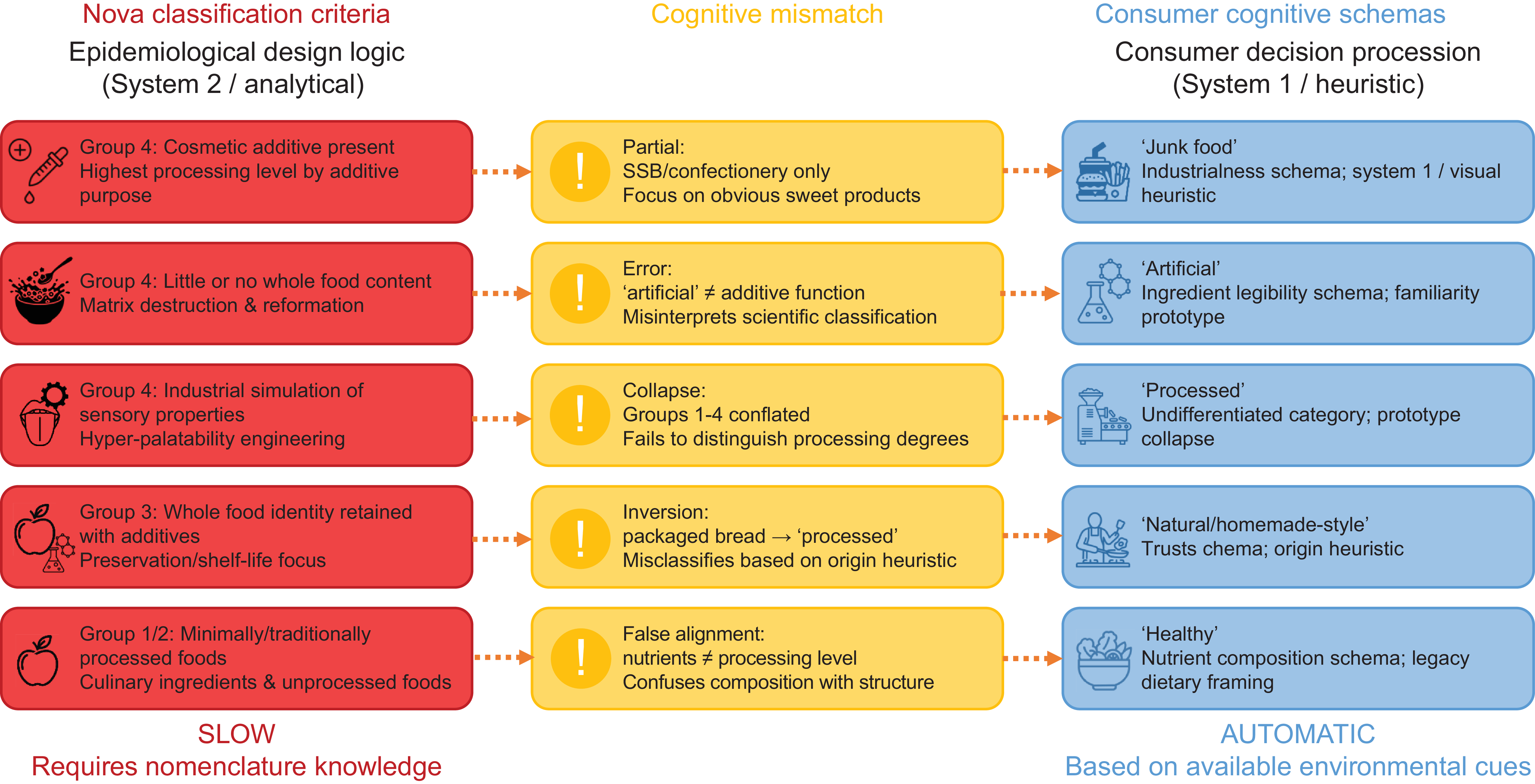
If people simply lacked information, supplying it would help. The deeper obstacle is that they already have well-developed ways of categorising food, doing exactly what cognition should under time pressure. Fast, automatic judgement dominates decisions made with limited attention(Reference Kahneman29), and food shopping is the textbook case. Three habitual schemas recur in the literature; Figure 1 sets them against the Nova criteria they approximate.
Where Nova classification criteria diverge from the cognitive schemas consumers use to judge food. SSB, sugar-sweetened beverage.

People judge processing by industrial origin, treating factory packaging as the signal and artisanal presentation as its absence(Reference Simonetti, Mehlhose and Klink-Lehmann30). They judge it by ingredient legibility, reading familiar names as wholesome and unfamiliar ones as suspect, a strategy that misfires on clean-label reformulations and on traditional foods with long ingredient lists alike(Reference Kahneman29). Above all, they judge it by nutritional content, the dimension four decades of guidance has trained them to read, so a fortified cereal reads as wholesome and a high-protein processed meat as benign(Reference Machín, Antúnez and Curutchet19,Reference Chan and Zhang31) . Each schema is sensible, and each diverges from Nova in its own predictable way. None is a deficit a leaflet can repair, because the schemas operate beneath awareness and are reinforced by the food environment itself(Reference Kahneman29,Reference Simonetti, Mehlhose and Klink-Lehmann30) . Layering Nova over them, without changing what the label shows, leaves the machinery untouched.
Four cognitive validity criteria
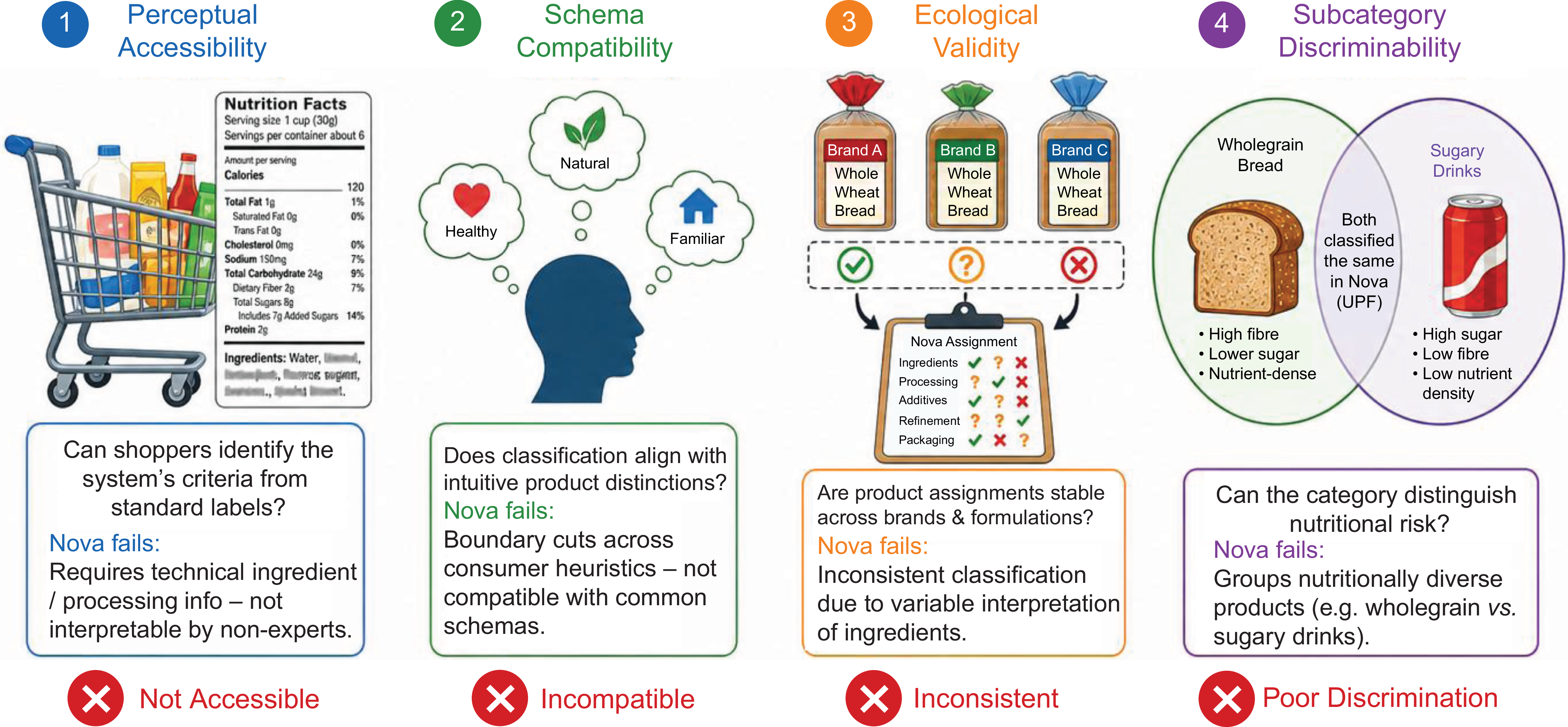
If a research instrument has been deployed for guidance without testing its fitness, the constructive response is to specify what such a test involves. Nutrition validates dietary assessment and screening tools before fielding them(Reference Louie32); consumer-facing classification deserves the same discipline. I propose four criteria (Figure 2), each tied to a failure above and answerable by a feasible study.
Four key criteria for evaluating food classification system and how Nova fails to achieve all of them.

Perceptual accessibility asks whether the defining criterion can be identified from information routinely present on the product, without specialist knowledge. It can be tested by asking untrained shoppers to classify products from the label alone and comparing their assignments with those of trained coders. Evidence from food‑labelling research shows that even comparatively simple nutrition information depends critically on readability and comprehension and becomes unreliable when information is opaque or technically framed(Reference Martini and Menozzi33).
Schema compatibility asks whether the classification boundary maps onto distinctions people can already draw, or whether it cuts across them. It can be tested by analysing the structure of consumer errors to see whether they are random or systematically inverted. Work on food perception consistently shows that consumers apply stable heuristic schemas based on cues such as naturalness, familiarity and perceived healthiness that structure judgements in systematic rather than random ways(Reference Machín, Antúnez and Curutchet19,Reference Chan and Zhang31) .
Ecological validity asks whether the system yields stable assignments across the branded variants of a food that a shopper meets in practice. It can be tested by re‑classifying matched products from the same category across brands and measuring agreement. Evidence on Nova indicates that classification can vary depending on interpretation of ingredients, formulation and context, leading to inconsistent assignment and risk of misclassification across studies(Reference Gifford34,Reference O’Connor, Herrick and Papier35) .
Subcategory discriminability asks whether a guidance category groups together products of materially different nutritional risk, and if so whether it offers any basis for telling them apart. It can be tested by examining whether the category supports nutritionally sensible substitution or forces shoppers to treat wholegrain bread and sugary drinks as equivalent. A large body of evidence shows substantial nutritional heterogeneity within UPF, with some subgroups (e.g. sugar‑sweetened beverages) consistently associated with harm, while others (e.g. wholegrain cereals and breads) show neutral or even beneficial associations(Reference Kim, Cho and Kim9,Reference Price, Kissock and Barrett36) .
Applied to Nova, the criteria converge. The system fails perceptual accessibility because its criterion is illegible on the label, schema compatibility because its boundary is orthogonal to the schemas people use, ecological validity because formulation varies by brand and subcategory discriminability because Group 4 spans the trivial and the important alike(Reference Kahleova, Himmelfarb and Barnard13,Reference Louie14,Reference Gifford34) . This is no reason to discard what Nova has taught us about diet and health, but every reason to stop assuming a research variable can serve unmodified as a shopping aid.
Implications for nutrition policy
Three consequences follow. First, the policy lever is being pulled in the wrong place: resources spent teaching the public to recognise UPF will yield little while the obstacle is structural. The productive levers are reforming labelling so the relevant information becomes visible, or adopting criteria people can apply, such as the nutrient-threshold warning labels that shifted purchasing in Chile and Mexico using cues shoppers can read(Reference Taillie, Reyes and Colchero37,Reference Basto-Abreu, Carnalla and Reyes-Sánchez38) .
Second, heterogeneity within Group 4 is an equity issue. Fortified breads, plant-based milks and infant formulas sit alongside confectionery and soft drinks(Reference Louie14,Reference Martini and Menozzi33) , yet for households on tight budgets they are affordable sources of fibre, Ca and micronutrients that are hard to replace(Reference Hess, Comeau and Casperson39,Reference Messina, Sievenpiper and Williamson40) . Undifferentiated avoidance advice asks most of those least able to absorb the cost, on the basis of a category they are least equipped to apply(Reference Louie27,Reference Koios, Machado and Lacy-Nichols41) . Guidance that ignores this risks widening the very inequalities(Reference Louie42) public health nutrition exists to narrow.
Third, the cultural reach of Nova guidance deserves scrutiny. The domestic–industrial boundary it encodes reflects one food culture, and many non-Western staples, from commercial tortillas to packaged fermented soya products, fall into Group 4 through additives absent from the products that motivated the category(Reference Louie14,Reference Messina, Sievenpiper and Williamson40) . More broadly, reviews note that Nova’s classification can fail to account for cultural food traditions, leading to inconsistent categorisation across different dietary contexts and populations(Reference Louie14). Exported without adaptation, the guidance may be culturally misdirected as well as confusing.
Conclusion
The case for caution about UPF does not depend on consumers being able to classify them, but the case for telling them to avoid these foods certainly does. We are issuing instructions in a vocabulary the audience does not share and then attributing the confusion to a literacy problem on their side rather than a design problem on ours. The four criteria offer a way to test that judgement rather than assert it and to hold any future system to a standard of consumer fitness before deployment. Until a system meets it, public health nutrition would do better to base consumer guidance on cues people can see and apply and to reserve Nova for the research role it was built to perform. Whether people can use the tools we give them is the point at which the science either reaches the public or fails to.
Acknowledgement
Not applicable.
Financial support
No funding was provided for the completion of this Commentary.
Competing interests
The author declares no financial relationships with food, beverage or food ingredient manufacturers and no industry funding for this work.
Ethics of human subject participation
Not applicable.
Use of generative AI: During the preparation of this work, the author used Claude Sonnet 4.6 (https://claude.ai) in June 2026 in order to improve the grammar and clarity of the text he drafted. After using this tool/service, the corresponding author reviewed and edited the content as needed and takes full responsibility for the content of the publication.

 Open access

