From mud
The sediment bottoms of many marine environments are great repositories in which dead creatures such as phytoplankton that inhabit overlying water settle. The resulting accumulation of organic matter supports a diversity of sedimentary microorganisms. These microbes metabolize a portion of the organic matter to acquire energy and in doing so deplete sedimentary oxidants, which are less abundant. In such sediments, a curious phenomenon occurs in which the oxidants, supplied by diffusion from overlying water, are utilized by microorganisms in a depth dependent manner in order of oxidation potential.Reference Froelich, Klinkhammer, Bender, Luedtke, Heath, Cullen, Dauphin, Hammond, Hartman and Maynard1 So oxygen, a potent oxidant that liberates a high amount of energy when used by microorganisms, is preferentially consumed by microbes at the topmost sediment layer (typically millimeters to a centimeter thick depending on location) as it diffuses into sediment from overlying water, rendering the underlying sediment anoxic (oxygen depleted). However, sulfate, a weak oxidant that liberates one-ninth as much energy when used by microorganisms, is unused in the topmost sediment layer. Instead, it diffuses deeper into sediment (a few centimeters or so depending on location), where it is eventually utilized by microbes as moderately potent oxidants, such as nitrate, are utilized by microbes in the intervening sediment. Since sulfate is a weak oxidant, the by-product of microbial sulfate respiration, sulfide, is a potent reductant. As a result of this phenomenon, many marine sediments transition from being oxidizing to reducing over the top few millimeters to centimeters depth due to microbial activity, and when an inert electrode is stepwise inserted into such sediments from overlying (oxygenated) water, its open circuit potential will shift by as much as –0.8 V.Reference Schindler and Honick2
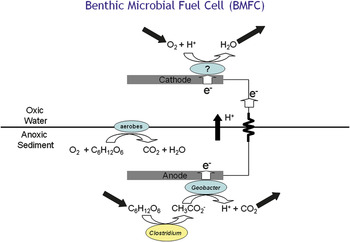
With little more than this knowledge, Reimers et al.Reference Reimers, Tender, Fertig and Wang3 set out to create a battery for powering oceanographic sensors by embedding one electrode into marine sediment and placing the other in overlying water (Figure 1). It was hypothesized that the sediment-embedded electrode would act as an anode owing to its lower potential, whereas the electrode in the overlying water would act as a cathode owing to its higher potential. The first experiments involved bench-top shoebox-sized aquaria of marine sediments and seawater and platinum electrodes, which generated miniscule current across resistive loads.Reference Reimers, Tender, Fertig and Wang3, Reference Alberte, Bright, Reimers and Tender4 The notion at the time was that the anode was oxidizing microbial-generated reductants in sediment, and the cathode was reducing oxygen in the overlying water. Indeed, non-corrosive electrodes made of graphite in seawater have been used for decades as oxygen-reducing cathodes for galvanic seawater batteries.Reference Rao, San Giacomo, Kobasz, Hosom, Weller and Hinton5, Reference William, Wilcock and Kauffman6 Since the net reaction proposed at the time by Reimers et al. is thermodynamically favorable (electron transfer from a reductant to an oxidant), power could be expended across a resistive load connecting the electrodes across which the electrons flowed as long as oxygen was replenished at the cathode (the aquaria were open to the environment to keep the seawater oxygenated) and mass transport (assumed to be diffusion) supplied the anode reactants and removed the anode products. Most interesting was the observation that current increased over time to a steady-state level that then could not be explained.Reference Reimers, Tender, Fertig and Wang3
Schematic representation of the benthic microbial fuel cell (BMFC) also referred to as the sediment microbial fuel cell. Here, sedimentary organic matter is depicted as glucose, which is fermented to acetate by other organisms in sediment (depicted as Clostridia). This, in turn, is oxidized by a microbial biofilm that spontaneously grows at the anode surface enriched in dissimilatory metal-reducing bacteria naturally residing in sediment (represented as Geobacter). At the cathode, a different biofilm catalyzes reduction of oxygen in overlying water. The resulting electric current flows through the external circuit connecting the electrodes where power can be utilized to operate an oceanographic sensor. The protons generated at the anode diffuse to the cathode for charge balance, while aerobic microorganisms residing in the topmost sediment layer keep oxygen from the cathode, which would electrochemically short circuit the fuel cell.

To microbial catalysts
These results were followed upon immediately with experiments conducted by Bond et al.,Reference Bond, Holmes, Tender and Lovley7 in which graphite electrodes were used for both the anode and cathode and resulted in a significantly higher current density. After generating power for some time across a resistor, the anode was removed from sediment and examined, revealing that a biofilm coating comprised of a community of microorganisms from the sediment had adhered to the anode surface. A genetics-based community analysis of microorganisms comprising the biofilm was performed and, as a control, an identical experimental setup was used in which the anode and cathode were not electrically connected by a resistor (i.e., left at open circuit) that did not generate power. The results indicatedReference Bond, Holmes, Tender and Lovley7 that the biofilm that grew on the surface of the power-generating anode had a significantly higher abundance of Deltaproteobacteria, a group of bacteria sharing common traits that includes Geobacter spp., than the biofilm that grew on the nonpower-generating anode.
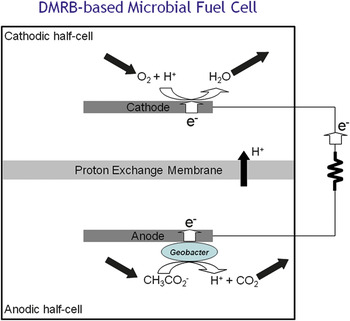
The microorganism available in pure culture most similar to the organism most enriched on the power-generating anode was Desulfuromonas acetoxidans (D. acetoxidans), a DMRB closely related to Geobacter spp. prevalent in marine sediment that couples oxidation of sedimentary acetate with reduction of insoluble iron oxide mineral deposits. A bench-top two-chamber proton exchange membrane (PEM) fuel cell was then assembled, which generated power that increased over time to a steady-state value following addition of D. acetoxidans to the anodic half-cell (Figure 2). Here, instead of sediment, an acetate-containing aqueous solution was used in the anodic half-cell. In the PEM fuel cell, a D. acetoxidans biofilm spontaneously formed on the anode surface that metabolized acetate, passing the acquired electrons (eight per equivalent of acetate oxidized) to the underlying anode. In doing so, D. acetoxidans was catalyzing the anode half reaction of the fuel cell, resulting in power generation. In essence, D. acetoxidans thought the anode of the PEM fuel cell was an insoluble oxidant. Unlike in the natural environment, however, where insoluble oxidants are quickly depleted, requiring the microbes to constantly seek out fresh ones (the microbes are mobile), the anode of the PEM fuel cell is never exhausted owing to its electrical connection to the oxygenated cathode. This induced the microbes to colonize the anode, to stay put, and to proliferate (form a biofilm on the anode surface), hence the increase in current as the number of microbes utilizing the anode as a metabolic electron acceptor increased.
Schematic representation of dissimilatory metal-reducing bacteria (DMRB)-based microbial fuel cell. Here, a DMRB biofilm will spontaneously grow on the anode surface and catalyze the anode half reaction depicted here as acetate oxidation. A proton exchange membrane is used to allow protons generated at the cathode to diffuse to the anode while isolating oxygen in the anodic half-cell from the cathode.

Using the anode as an oxidant, D. acetoxidans can acquire approximately 0.1 V for each electron passing through to satisfy its energy requirement, which is small but adequate. (This can be determined by taking the difference in redox potential of the oxidation of acetate to carbon dioxide minus the minimum anode potential for which D. acetoxidans can still utilize the anode as an electron acceptor determined by cyclic voltammetry.) The majority of the available energy, as much as 0.7 V for each electron, was left for use in the external circuit, depending upon the current resulting in the observed power generation. During growth of the biofilm, it was determined that approximately 20% of the acetate was used to generate biomass (carbon for proteins and membranes, comprising new microbes), which tapered off to approximately 1% for cell maintenance once the biofilm achieved its self-determined thickness (more on this later in text).
The same story can be told for the power-generating anode embedded in sediment. In this case, D. acetoxidans observed in the biofilm naturally resided in the sediment. Since it is able to utilize insoluble oxidants, among which are electrodes, it had an advantage over other microorganisms present in sediment that could not benefit metabolically from the anode, hence its higher abundance in the biofilm of the power-generating anode. This also explains the higher current density observed in sediment when using a graphite anode, since graphite tends to have better kinetics for electron transfer reactions with biologicals such as redox proteins, which are thought to play a pivotal role in the extracellular electron transfer capability of DMRB.
In these first experiments, Reimers et al.Reference Reimers, Tender, Fertig and Wang3 and Bond et al.Reference Bond, Holmes, Tender and Lovley7 rediscovered the microbial fuel cell (MFC), which utilizes microbes to catalyze anode oxidation of biological fuels (such as acetate and glucose). Biological fuels are relatively high in energy (a five pound sack of sugar if oxidized with atmospheric oxygen has more than 10 times the potential energy compared to a five pound sack of lithium batteries) for which traditional, abiotic, anode catalysts often do not exist in order to utilize them electrochemically. PotterReference Potter8 established the underlying concept, the transduction of microbial metabolism to an electrical current, 100 years ago, and Cohen demonstrated the MFC as a power-generating device in 1931.Reference Cohen9 This and subsequently demonstrated MFCsReference Karube, Matasunga, Suzuki and Tsuru10–Reference Allen and Bennetto12 utilized non-DMRB microorganisms that are very adept at oxidizing organic matter but are unable to directly transfer electrons to anodes. In order to generate current, such MFCs require exogenous electron transfer mediators such as thionine and methyl viologen to accept electrons from the microbes (which tend to stay in solution), diffuse to the anode, transfer the electrons to the anode, and then diffuse back to the microbes to accept more electrons. The use of electron transfer mediators limits current density because diffusion is inherently a slow process, and as the anodic half-cell is flushed to replenish fuel and remove by-products, a new mediator needs to be added and an old mediator (typically toxic) dealt with. In contrast, Reimers et al. and Bond et al. demonstrated MFCs, first in marine sediment but now termed sediment or benthic microbial fuel cells (SMFCs or BMFCs), and subsequently on the bench-top sans sediment, utilized DMRB. This obviated the need for exogenous electron transfer mediators, greatly simplifying implantation and enabling higher anode current densities by orders of magnitude than previously possible.Reference Yi, Nevin, Kim, Franks, Klimes, Tender and Lovley13
Following these experiments, the first BMFC field experiments were performed, which included a BMFC generating power at a coastal site in New Jersey continuously for nine months without indication of depletion in power before the experiment was terminated.Reference Tender, Reimers, Stecher, Holmes, Bond, Lowy, Pilobello, Fertig and Lovley14 This and subsequent longer-term experiments since performed by researchers involving BMFCs and DMRB-based bench-top MFCs revealed an important attribute of microbial anode catalysts: as living entities metabolically benefiting from the reaction they catalyze, they self-maintain themselves and therefore do not degrade over time, as long as their environment is kept hospitable. In this way, they can maintain catalytic activity indefinitely, unlike abiotic or enzyme-based anode catalysts which, while great for short-term applications, ultimately degrade.Reference Heller and Feldman15 A genetics-based community analysis of the anode biofilm of the New Jersey BMFC indicated enrichment of D. acetoxidans, but also enrichment of microorganisms in the Desulfobulbus or Desulfocapsa genera that possess the ability to oxidize and disproportionate sulfur. In sulfide-enriched sediment (resulting from high rate of microbial sulfate reduction) such as the New Jersey site, a graphite anode can directly oxidize sulfide to sulfur without a catalyst, forming a passivating sulfur precipitate on the anode surface that can shut down current.Reference Reimers, Stecher, Girguis, Tender, Ryckelynck and Whaling16 It is thought that these microorganisms act to clear electrode-generated sulfur from the anode surface, forming sulfate and sulfite, both soluble. The enrichment of these microorganisms therefore suggests that a portion of the current generated at a BMFC anode can, in fact, result from direct oxidation of microbial-generated sedimentary reductant, as first postulated by Reimers et al.Reference Reimers, Tender, Fertig and Wang3 One interesting aspect of the BMFC is the lack of a proton exchange membrane (PEM) used in microbial and non-microbial fuel cells alike to isolate the oxidant from the anode while allowing charge-compensating protons to flow between the anodic and cathodic half-cells required for electrons to flow through the external circuit. In the case of the BMFC, the top aerobic (oxygen utilizing) layer of marine sediment serves this purpose. At this juncture, research in the field of microbial catalyzed electrode reactions took off in many directions.
Oceanographic power supplies
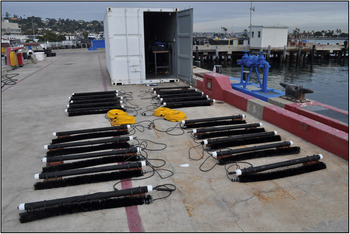
A number of researchers are working to develop BMFCs into power supplies for oceanographic sensors that are straightforward to deploy.Reference Tender, Gray, Groveman, Lowy, Kauffman, Melhado, Tyce, Flynn, Petrecca and Dobarro17–Reference Wotawa-Bergen, Chadwick, Richter, Tender, Reimers and Gong19 There are thousands of battery-powered sensors deployed each year that provide valuable scientific information about marine environments. The prospect of using BMFCs to power them indefinitely, or at least far longer than practical with batteries (on the order of months), is enticing for many reasons, including the ability to acquire long-term uninterrupted data and the reduction of the cost and logistics burden of keeping sensors running (research vessels are too expensive to be used routinely to replace sensor batteries).Reference DeLong and Chandler20 In one present form, the BMFC consists of a 60-inch long graphite bottle brush anode housed within a rigid but permeable 1-inch diameter tube shallowly embedded horizontally into sediment configured with a matching graphite bottle brush cathode floating in overlying water (Figure 3). Such a BMFC can sustain approximately 0.015 W in the San Diego Bay, California, which is equivalent to a power density of 0.02 W/L. By comparison, commonly employed oceanographic alkaline battery packs have an energy density of approximately 100 Wh/L. This specific BMFC can therefore indefinitely sustain as much power as a comparably sized alkaline battery pack that would last approximately only 5000 hours (30 weeks) before it depletes (0.02 W/L × 5000 h = 100 Wh/L).Reference Tender21 Presently, there are 40 such BMFCs now deployed in San Diego Bay, where design variations are being evaluated with respect to ease of deployment, power density, and net power output. One very interesting BMFC variant utilizes rhizodeposition (the secretion of organic matter into sediment by vegetation such as rice plants) to augment mass transport of organic matter to the anode, resulting in substantially higher power densities than otherwise possible.Reference de Schamphelaire, van den Bossche, Dang, Hofte, Boon, Rabaey and Verstraete22
Benthic microbial fuel cells (BMFCs) prior to deployment in San Diego Bay, CA. Twenty BMFCs are shown, each comprised of a graphite bottle brush cathode and a matching graphite bottle brush anode housed in a slotted PVC tube. The anode of each BMFC was subsequently embedded a few inches beneath the sediment surface by divers while the cathode was rigged to float just above the anode in overlying water (floats not shown in photograph). The BMFCs were configured into four circuits containing five BMFCs connected in parallel.

Power supplies
A number of researchers are working to develop DMRB-based MFCs into power supplies for a wide range of applications.Reference Logan, Hamelers, Rozendal, Schröder, Keller, Freguia, Aelterman and Verstraete23–Reference Rabaey and Verstraete25 Here, the enticement is the potential for high energy density without the risk of explosion. Although the use of DMRB enables higher anode current densities by orders of magnitude than possible with non DMRB, it has not translated directly into overall higher power density MFCs. One reason appears to be low ionic conductivity of ion exchange membranes, such as Nafion as typically used in hydrogen/oxygen (non-microbial) fuel cells, in complex ionic media inherent to MFCs.Reference Rozendal, Hamelers and Buisman26, Reference Rae, Shaoan, Sang-Eun and Logan27 Another appears to be low catalytic activity of MFC cathodes at neutral pH also inherent to MFCs.Reference Zhao, Harnisch, Schröder, Scholz, Bogdanoff and Herrmann28 Overcoming these limitations is a highly worthwhile materials research objective.
Bioelectrochemical systems
A number of researchers are working to develop microbial catalyzed electrode reactions into processes in which high value microbial oxidation or reduction reactions are accelerated. Such processes are termed bioelectrochemical systems (BESs),Reference Rozendal, Hamelers, Rabaey, Keller and Buisman29 which encompass BMFCs and MFCs, as well as microbial electrolytic cells (MECs) in which external power is applied to drive such processes that are not thermodynamically favorable or at rates faster than spontaneously possible by MFCs. For example, many researchers are focusing on the use of BESs to treat wastewater.Reference Liu, Ramnarayanan and Logan30–Reference Aelterman, Rabaey, Clauwaert and Verstraete33 Wastewater treatment principally comprises oxidation of the organic matter content accomplished traditionally using aerobic microorganisms–provided oxygen by mechanical aeration that is very power intensive. The use of DMRB catalyzed anode oxidation of wastewater may enable more efficient wastewater treatment when configured as MECs by enabling more efficient delivery of oxidizing equivalents to the microbes and ultimately lead to power generating wastewater treating MFCs if power densities improve. DMRBs have also been shown to reduce graphene oxide to graphene,Reference Salas, Luttge and Tour34 and when implemented as a BES, such a process may lead to interesting graphene structures, such as large continuous sheets on scales not yet possible by other methods.
DMRBs have also been shown to catalyze cathode reactions as well in which the microorganisms acquire electrons from the cathode. In many subsurface environments, DMRBs naturally reduce potent groundwater contaminants such as tetrachlorethene and hexavalent uranium into tractable products (i.e., bioremediationReference Lovley35) at rates limited by the availability of electron donors. In such circumstances, MEC cathodes can act as inexhaustible sources of electrons, greatly accelerating these processes.Reference Strycharz, Woodard, Johnson, Nevin, Sanford, Löffler and Lovley36, Reference Gregory and Lovley37 Microbial catalyzed cathode reactions also show promise for electrosynthesis of fuels from carbon dioxide.Reference Kelly, Hensley, Franks, Summers, Ou, Woodard, Snoeyenbos-West and Lovley38 First demonstrations of this capability utilized select non-DMRBs, indicating that cathode catalyzing phenotypes may be more widespread than previously thought.
Microbial solar cells
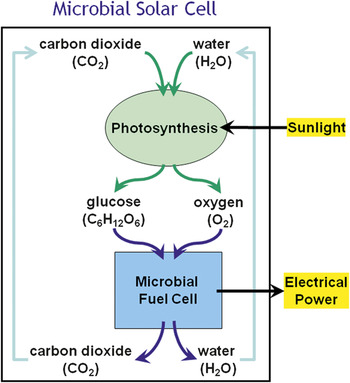
Examination of Figure 1 reveals that the products of MFCs (carbon dioxide and water) are the reactants of photosynthesis, whereas the products of photosynthesis (organic matter and oxygen) are the reactants of MFCs. Based on this observation, Malik et al.Reference Malik, Drott, Grisdela, Lee, Lee and Tender39 demonstrated a simple bench-top BMFC-based microbial solar cell (MSC) in which photosynthetic organisms enabled power generation from sunlight in a closed system (Figure 4) for more than 8000 hours without indication of depletion in power. In their MSC, power was correlated with sunlight intensity due to regeneration of the MFC products from the MFC reactants. The understanding and optimization of MSCs represent an exciting research challenge and potential solution to the conundrum of storing solar energy, since the photosynthetically generated reactants can accumulate internally within the MSC until power is required.Reference Timmers, Helder and Steinbusch40–Reference Yongjin, John, Blake and Ilia43
Schematic representation of a microbial solar cell in which photosynthetic microorganisms are utilized to regenerate microbial fuel-cell products from the reactants. The net result is solar power with internal energy storage, since the fuel-cell reactants can accumulate until power is demanded.

To conductive nanomaterials
Aside from their potential applications, DMRB biofilms that catalyze electrode reactions are fascinating as materials in their own right owing to their conductive properties. In the case of Geobacter spp., which appear to have the highest catalytic activity (highest current density) among all known DMRB, anode biofilms can grow more than 20 cell lengths thick (approximately 20 microns). This requires that the biofilm be conductive in order to enable cells at the biofilm outer surface to transfer their respired electrons through the biofilm to the underlying electrode.Reference Marsili, Sun and Bond44 Biofilms are ubiquitous in nature, yet it appears that only those of Geobacter spp. and other closely related DMRB are sufficiently conductive to form thick, electrode catalytically active biofilms. A defining feature of DMRB is the abundance of electron-transfer proteins (e.g., multiheme c-type cytochromes)Reference Liu, Kim, Franklin and Bond45 on their surfaces, along secreted nanometer-diameter, micron-long filaments extending from their surfaces (“nanowires”),Reference Leang, Qian, Mester and Lovley46 and throughout the extracellular matrix between individual microbes.Reference Inoue, Leang, Franks, Woodard, Nevin and Lovley47 Conductivity measurements made ex vivo across the diameter of a single filament sheared from Geobacter sulfurreducens Reference Reguera, McCarthy, Mehta, Nicoll, Tuominen and Lovley48 and from Shewanella oneidensis MR-1Reference El-Naggar, Gorby, Xia and Nealson49 (a DMRB unable to form thick biofilms) and along the length of a single MR-1 filamentReference Gorby, Yanina, McLean, Rosso, Moyles, Dohnalkova, Beveridge, Chang, Kim and Kim50 indicate that they are conductive (hence the term “nanowire”). As such, microbial secreted filaments may represent a new class of conductive nanomaterials that might eventually be custom tailored through synthetic biology.
The measurements described previously have led to the supposition that microbial nanowires confer conductivity to biofilms, creating a conductive mesh as they extend from cells to the underlying electrode surface. The current-voltage dependencies resulting from these measurements have been modeled based on the hypothesis that filament conductivity results from electron super exchange (aka “electron hopping,” “thermal hopping,” or phonon-assisted tunneling)Reference Strycharz-Glaven, Snider, Guiseppi-Elie and Tender51 among electron-transfer proteins aligned along the filaments based on theory first applied by Murray and colleagues to describe the conductive properties of redox polymers.Reference Dalton, Surridge, Jernigan, Wilbourn, Facci and Murray52 In essence, it is hypothesized that electrons hop from electron-transfer protein to electron-transfer protein along the filaments in a bucket brigade manner between the source and drain electrodes used to make the measurements. This same mode of conductivity was invoked to model cyclic voltammetry of a Geobacter biofilm modified anode that was actively catalyzing acetate oxidation.Reference Richter, Nevin, Jia, Lowy, Lovley and Tender53, Reference Strycharz, Malanoski, Snider, Yi, Lovley and Tender54 In this model, the microbes themselves act as electron sources distributed throughout the biofilm; the underlying anode acts as the drain; and electron transfer proteins aligned along the filaments, on the cell surfaces, and/or within the extracellular matrix confer biofilm conductivity. One aspect of this model is that it predicts a finite biofilm thickness, as experimentally observed due to the decreasing contribution to the flux of electrons to the electrode surface by microbes, with increasing distance they occupy from the electrode surface. This same model has also been applied to describe in situ conductivity measurements made across a Geobacter biofilm spanning two electrodes basedReference Strycharz-Glaven, Snider, Guiseppi-Elie and Tender51 on a technique developed by processes in which microorganisms catalyze electrode reactions. Malvankar and colleagues,Reference Malvankar, Vargas, Nevin, Franks, Leang, Kim, Inoue, Mester, Covalla, Johnson, Rotello, Tuominen and Lovley55 however, provide compelling evidence that filaments are themselves intrinsically conductive, wherein they contain electronically delocalized domains that conduct electrons much like conducting polymers. This hypothesis is a very provocative, stimulating significant debate, and, if it holds true, would represent a new paradigm in electrical conduction in biological systems.
Conclusion
The study of the mechanism of power generation by benthic microbial fuel cells led to the serendipitous discovery that dissimilatory metal-reducing bacteria possess a superior ability to catalyze electrode reactions. As a result, the field of bioelectrochemical systems, processes in which microorganisms catalyze electrode reactions, has emerged in the past decade as a major area of research. Potential applications include remote power generation in marine environments, wastewater treatment, generation of electrical power from sunlight with integrated energy storage, materials synthesis, and environmental decontamination. The best may yet to come as the mechanism by which these microbes conduct electrons is further resolved with new results, indicating the possibility that they conduct in a manner unlike that of any other biolgogical system.
Acknowledgments
L.T. is grateful for support from DARPA (Robert Nowak, program manager) and continued support from ONR (Harold Bright and Linda Chrisey, program managers) and the Naval Research Laboratory.
Leonard M. Tender Center for Bio/Molecular Science and Engineering, Naval Research Laboratory, Washington, DC 20375, USA; tel. 202-404-6029; and e-mail tender@nrl.mil.
Tender earned a BS degree in chemistry from the Massachusetts Institute of Technology, where he worked in the laboratory of Professor Mark Wrighton. He subsequently earned his PhD degree in analytical chemistry at the University of North Carolina under Professor Royce Murray studying modified electrodes, which after all, are what microbial biofilm coated electrodes are.