1. Introduction
An inflectional paradigm groups together word forms specified for a range of values, across a number of dimensions, relevant to a particular word class. In the search for general principles of paradigm structure, significant questions concern language-particular categories: whether they are primitive or can be broken down into features, whether they are purely formal or have semantic content, how directly morphological contrasts match semantic oppositions. In what follows, I ask these questions about Irish verb inflection. I propose, firstly, a featural analysis of finite verb morphology; secondly, a semantic characterization for the tenses defined in this system; thirdly, and most importantly, a constructional syntactic account that relates the two in a principled way, and unifies the explanation for the paradigmatic structure of the system and for the syntagmatic effects on verb forms when they appear in certain contexts. This connects a long tradition of studies on the structure of Irish verbal inflection (Wagner Reference Wagner1959; Wigger Reference Wigger1972; Ó Siadhail & Wigger Reference Ó Siadhail and Arndt1983; Ó Siadhail Reference Ó Siadhail1989; Ó Sé Reference Ó Sé1991, Reference Ó Sé, Ó Catháin and Ruairí2001) to a significant body of research on Irish syntax as an instantiation of universal grammar. The goal is a unified analysis of an intricate nexus of syntactic, morphological, and semantic facts. The analytic tools of Minimalist syntax and Distributed Morphology are deployed in an account where syntax constructs paradigmatic space and determines key aspects of tense semantics, while morphology manipulates and interprets a syntactic output imposing its own categorizations and language-particular constraints. The purpose is not to dissolve morphological and semantic categories in syntax, but to put forward an explicit theory of how the three interact in a given empirical domain. The article outlines the general properties of Irish conjugation in Sections 2 and 3, then lays out the theoretical context and the constructional approach guiding the analysis (Section 4), and derives the morphological and semantic properties of the contrasting classes from three features: [Future] in Section 5, [Past] in Section 6, and, after a closer analysis of the semantics of Irish tenses (Section 7), [Completive] in Section 8.
2. Overview of the system
2.1 Agreement and pronominal endings
Irish verbs have pronominal endings keyed to the features of the subject argument, so that every finite paradigm (except the imperative) consists of the familiar six person–number combinations, plus an impersonal form (for example, Óltar ‘One drinks/People drink’). However, only a few combinations, including all impersonal forms, have a dedicated inflected form, like D’óltá ‘You used to drink’ (past habitual, 2sg). In contrast with these synthetic forms, most forms are analytic: they do not express person/number, but only tense/mood, while the subject appears separately as a personal pronoun or a full DP; for example, D’ól mé, D’ól tú, D’ól sé ‘I/You/He drank’ (simple past). A characteristic trait of this system is that there is no concord between subjects and pronominal endings, but complementarity. This means that, if the subject argument is pronominal, it is obligatorily realized through the ending of a synthetic form, if one is available, and only through it; otherwise an analytic form is used (see McCloskey & Hale Reference McCloskey and Hale1984, Doyle Reference Doyle2002). Significant dialectal variation affects the distribution of synthetic and analytic forms over paradigms, and, as Doyle (Reference Doyle2001: 41) points out, the official standard is in fact a conventional compromise which ‘does not correspond to the usage of any one dialect’.Footnote 2 It will be used here to illustrate morphological and semantic properties which are claimed to generalize across the dialectal spectrum, with explicit mention of dialectal phenomena when they impinge on the overall analysis.
2.2 Lenition, nasalization, and preverbal particles
Irish finite clauses are uniformly VSO, whether root or embedded. Arguments and adverbs may be fronted before the verb, without effect on verbal morphology. By contrast, clause-initial particles proclitic to a verb affect its left edge according to the two patterns of initial mutation traditionally called lenition (séimhiú) and nasalization (úrú). For example, the initial stop of the stem buail- [buəlˊ] ‘to hit’ is realized as [w] when lenited by the past question particle ar in Ar bhuail tú [ər ˊwuəlˊ tu] ‘Did you hit?’; and it surfaces as [m] after the nasalizing present question particle an in the sequence an mbualann tú [ə muələn tu] ‘Do you hit?’ (in phonetic and phonemic transcriptions, the symbol ˊ marks palatalization on a preceding consonant). While the relation between verbs and particles is a central concern of this paper, the phonological reflexes of embedding verbs into a verbal complex are irrelevant for an account of Irish conjugation, and will therefore be ignored here.
2.3 The array of tenses and moods
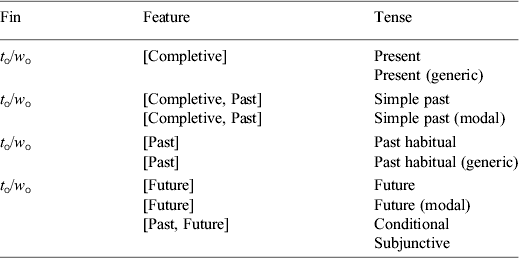
Traditional descriptions distinguish three moods (indicative, conditional, imperative) and four tenses (past, habitual past, present, future). In addition, a subjunctive mood exists, which is moribund today except in optative set phrases. Only the indicative distinguishes the full array of tenses, and imperative and conditional have no tense distinctions at all. The result is a heavily imbalanced system, where tense oppositions are marginal or absent in moods other than the indicative, as schematized in (1).Footnote 3
(1) Present indicative Conditional Imperative (Present subjunctive)
Simple past indicative (Past subjunctive)
Past habitual indicative
Future indicative
As tense and mood oppositions do not in fact cross-classify, in what follows I will refer to each category in (1) as a tense, and drop the label ‘indicative’.Footnote 4 As a first illustration, consider the analytic form of bris ‘to break’ in each tense, with the orthographic form followed by a broad transcription based on the Western Connacht dialect:Footnote 5
(2) Present briseann /bˊrˊiʃəɴ/
Simple past bhris /vˊrˊiʃ/
Past habitual bhriseadh /bˊrˊiʃəx/
Future brisfidh /bˊrˊiʃhə/
Subjunctive brise /bˊrˊiʃə/
Conditional bhrisfeadh /vˊrˊiʃhə/
Imperative bris /bˊrˊiʃ/
The forms beginning with orthographic bh- display lenition of the initial consonant, in this case turning /b/ into /v/ (the initial br- cluster is palatal; for a non-palatal /b/, the outcome of lenition would be /w/). With vowel-initial stems, a prefix d- appears instead:
(3) ól ‘to drink’ bris ‘to break’
Present indicative ólann briseann
Past indicative d’ól bhris
Past habitual indicative d’óladh bhriseadh
Conditional d’ólfadh bhrisfeadh
Historically, the marker was uniformly do, which triggered lenition on a following consonant: ól- → d’ól, bris- → do bhris (a state of affairs preserved until recently in conservative dialects and registers). As lenited f- reduces to zero, f-initial verb stems display both lenition and do-prefixation: fág- ‘leave’ → d'fhág ‘left’ (see Section 6.2 below). The functional equivalence of lenition and do-prefixation suggests viewing them as contextually determined allomorphs of the same morpheme, which I will notate DO from now on.
The orthographic -f- of future and conditional similarly stands for a variety of dialectal realizations, ranging from zero to /f/ (Ó Sé Reference Ó Sé1991: 68–75). In addition, beside /f/ and its realizations, a large class of verbs displays a sharply different future suffix /oː/:
(4) class 1 class 2
fág ‘to leave’ inis ‘to tell’
Future fágfaidh /fɑ:khɪ/ inseóidh /inʃoːɪ/
Conditional d'fhágfadh /dɑ:khəx/ d'inseódh /dˊinʃoːx/
The two patterns are traditionally called ‘conjugations’, which is slightly misleading because they only differ in the realization of the future stem (in the future and conditional); but this term captures the lexically governed nature of this alternation. The first conjugation groups together verbs whose root has a CVC phonological structure, like mol, while the second usually characterizes verbs with CVC(V)C roots like ceangail ‘to bind’, inis ‘to tell’, seachain ‘to avoid’. More precisely, to anticipate the discussion in Section 5, verbs in the second conjugation regularly give rise to (at least) bisyllabic forms. This happens either through insertion of a supporting schwa to break an illicit final -CC cluster when no ending follows (2sg imperative bare root seachain /ʃaxənˊ/, CVCəC), or through a distinctive long vowel between root and ending, which is generally palatal (as in the present indicative seachn-aí-onn /ʃaxn-iː-ɴ/) but is /oː/ in the future stem (e.g. conditional sheachn-ódh /ʃaxn-oː-x/). Regardless of whether this alternation is entirely analysable phonologically, as argued by Ó Siadhail (Reference Ó Siadhail1989: 170), it shows that the choice of future suffix locally depends on the shape of the verb stem, a point to which I will return in Sections 5.1 and 5.2.
2.4 Nominal verb forms and periphrases
Irish verbs also have two non-finite forms, the verbal noun (e.g. léamh ‘to read, reading’, from léigh) and the verbal adjective (e.g. léite ‘read’). They do not inflect for tense or mood, and are classified as nominal because their morphology and their case-marking properties match those of nouns and participial adjectives (partially, since direct objects of verbal nouns are no longer genitive in colloquial speech). The verbal noun is widely used with an infinitive-like function to express complement and adverbial clauses, as illustrated in (5).
(5) Tá áthas orm tú a bheith ag foghlaim Gaeilge.
is joy on.1sg 2sg prt be.vn at learn.vn Irish
‘I am glad that you are learning Irish.’
The verbal adjective is a participial form with widespread use in periphrases like the perfective Tá an leabhar léite ag Eoin ‘Eoin has read the book’, lit.: ‘the book is read at Eoin’. Another periphrasis, with progressive value, is the phrase ag foghlaim ‘at learning’ in (5). This illustrates the use of both nominal forms in progressive, perfective, and prospective aspectual periphrases with the existential verb, in tandem with prepositions, or more limitedly with light verbs like déan ‘to do’ and cuir ‘to put’ (for more details, see Ó Siadhail Reference Ó Siadhail1989: 294–302; Doyle Reference Doyle2001: 68–75). Although aspectual periphrases contribute essentially to the range of temporal-aspectual categories in the system, I will not consider them in what follows, as the focus of this investigation is the inflectional morphology of finite verb forms.Footnote 6
2.5 Two verbs ‘to be’
The existential verb bí patterns like every other lexical verb in its morphology and syntax, except for being the only verb with a distinct habitual form in the present. A second verb translating the English ‘to be’, traditionally called the copula, is quite different. It expresses only individual-level predications, where the truth is not evaluated relative to a time interval; more importantly for present purposes, it lies outside the system of verb morphology. Instead of the tenses and moods in (1), the copula shows a single opposition between a present form and a non-present one interpreted as past or conditional.Footnote 7 Besides, it lacks personal endings (including the autonomous form) and non-finite forms. Finally, in subordinate contexts it is fused with complementizers. Unsurprisingly, it is generally viewed as a spellout of Tense/Aspect features rather than as a lexical verb (Carnie Reference Carnie1995, Duffield Reference Duffield1995, Doherty Reference Doherty1996).
2.6 Recapitulation and explananda
We can schematize as follows the structure of the tense stems of lexical verbs, letting DO stand for lenition and/or do-prefixation, and F for the realizations of the future suffix:Footnote 8
(6) Present briseann root – ending
Simple past bhris DO – root
Past habitual bhriseadh DO – root – ending
Future brisfidh root – F – ending
(Subjunctive) brise root – ending
Conditional bhrisfeadh DO – root – F – ending
Imperative (2sg) bris root
Imperative (2pl) brisigí root – ending
There are several reasons why a list like (6) is only the point of departure, and cannot truly represent all that speakers know about the organization of the Irish verb system.
First, tense markers distribute across tenses. For example, in the conditional, the stem suffixes are those of the future; the personal endings are instead shared with the past habitual and the past subjunctive; and the prefixal past DO aligns the conditional with the indicative past and past habitual, as well as the past subjunctive where this is still present. Second, preverbal particles are also marked for tense, and their patterns of co-occurrence with verb morphology provide another source of paradigmatic alignments. Conditional, past, habitual past, and past subjunctive have all the past prefix DO; but after a preverbal particle, as we will see (Section 8.6), only the simple past replaces DO with a suffix -r enclitic on the particle (e.g. d'ith – gu-r ith ‘ate’ – ‘that ate’). Third, (6) above says nothing about how the various tenses and markers relate to meaning. Two questions arise in this respect: What semantic value or range of values can be attributed to tenses? and What is the semantic contribution of individual morphemes? For example, the ‘past’ element of the conditional cannot mean just ‘anterior to utterance time’, as it co-occurs with a future marker and selects the non-past form on a preceding particle. Fourth, the copula has an extremely reduced inflection. If the features defining the various tenses are hosted in a Tense head, and the copula realizes the same head, its defective paradigm is accidental and unrelated to any other property of inflectional system. Finally, as we will see in the next section, the paradigms of irregular verbs respect systematic generalizations. If these occur even with verbs with unpredictable forms, it is likely that they derive from deeper organizational principles.
3. Root allomorphy and suppletion
3.1 Tense root allomorphs
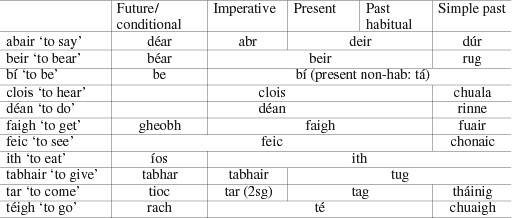
A small class of irregular verbs have unpredictable root allomorphy keyed to the choice of tense/mood (never person/number). The allomorphs can differ from the regular base as little as íos from ith for ‘to eat’ (/iːs/ – /ɪ/) or as much as rach from té for ‘to go’ (/rax/ – /teː/). Table 1 presents the distribution of allomorphs across tenses in the standard variety.
Distribution of root allomorphs by tense in the standard dialect.
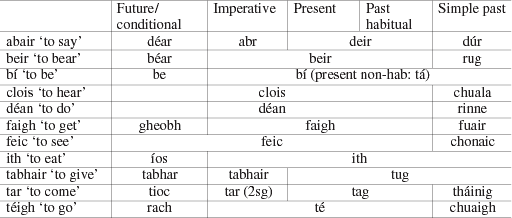
As can be seen, each verb associates root allomorphs and tenses in a different way. However, there are some clear distributional tendencies, the most obvious being that future and conditional always share the same form. A closer view reveals the following generalizations:
- (7)
(a) If a root form expresses past, it is used for the simple past and for no other tenses.
(b) The root form used for the conditional always coincides with the root used for the future plus the regular past marker; it is never the past root plus a regular future marker, nor a specific conditional form different from both past and future ones.
(c) No verb has a special root form for the past habitual.
The formulation in (7a) states that root allomorphs like chonaic ‘saw’ are not generically past, but express specifically the simple past tense and not the conditional or the past habitual, even though these involve past morphology. In other words, either a root is not limited to tenses marked by past morphology or it specifically expresses the simple past.
The generalization in (7b) is only in part a consequence of (7a). The conditional has both past and future marking; when it is irregular, its constituency is always [DO [future–root]], never *[[past–root] future]. This is expected, given that there is no [past–root] outside of the simple past tense; but (7b) also rules out a special conditional root distinct both from the one used in the simple past and from that used in the future. There is, then, no specifically conditional root form nor a specifically future one distinct from the conditional.
Finally, (7c) states that there appear to be no specifically past habitual roots. This does not follow from (7a), which would be compatible with a past habitual root distinct from a simple past one. The generalization is not that the past habitual is always regular, as Ulster varieties suggest it may not be (see Hughes Reference Hughes1994: 647–654; Ó Baoill Reference Ó Baoill1996: 36–55), but that it never uses a stem specific to that tense and to no other one.
3.2 Syntactically dependent root allomorphs
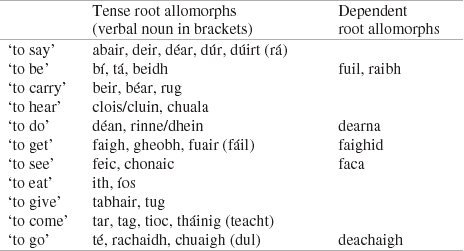
Some irregular verbs select root allomorphs in a specific set of syntactic contexts. Traditionally, these are called dependent forms, since they appear after subordinators (declarative, relative, negative, or interrogative particles). An example is the verb ‘to do’; (8a) below shows that its present forms are all built on the (default) root déan-, regardless of their syntactic context, while the past tense, in (8b), distinguishes an independent form rinne and a dependent dearna, which shows the initial mutations induced by the subordinating particles.
- (8)
(a) déan- Déanann sé ‘He does.’
go ndéanann sé ‘that he does’
An ndéanann sé? ‘Does he do?’
(b) rinne Rinne sé ‘He did.’
dearna An ndearna sé? ‘Did he do?’
Ní dhearna sé ‘He didn't do.’
Sílim go ndearna sé ‘I think that he did.’
Table 2 lists the dependent forms of in the standard dialect; note that they are always preceded by mutation-inducing particles. The highly idiosyncratic verb ‘to be’ also has a negative non-past form níl, where the negative particle ní and a stem fuil coalesce.
Irregular verbs with a special root allomorph for dependent contexts.
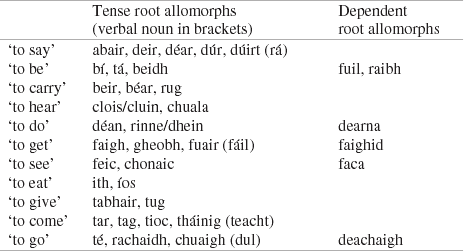
The most obvious fact emerging from Table 2 is that the verbs with a dependent root allomorph are a subset of those with a Tense allomorph. This is true, as far as I know, of all varieties of Modern Irish. Note that this does not mean that, circularly, verbs with a dependent root are irregular, but that one type of allomorphy is conditional on the other. Although the pedagogical habit of presenting dependent forms as special cases of irregular verbs gives the impression that dependent allomorphy is an extreme form of irregularity, verbs with dependent allomorphs are not necessarily the most irregular ones: in the standard, the verb feic has one tense-specific root and one dependent one, while abair has no fewer than four different tense-specific root (déar, abr, deir, dúr) yet it lacks a dependent one.Footnote 9
Not all syntactically dependent contexts trigger root allomorphy and replace DO-prefixation in the past with a special simple past allomorph. Remarkably, the same subordinating contexts (má ‘if’, the so-called direct relative particle a, the causal conjunctions ó, arae and mar ‘because’, and ó in the temporal sense of ‘since’) fail to behave as dependent for both phenomena. This familiar correlation is evidently a regularity that must be captured as a property of Irish grammar.
In sum, dependent allomorphy exhibits the following generalizations:
- (9)
(a) Only verbs with Tense root allomorphs have dependent root allomorphs.
(b) The same subordinators fail to define a dependent context for the purposes of root allomorphy and of the exponence of the simple past.
A satisfactory analysis of Irish verbal inflection should derive the generalizations in (7) and (9) by the same set of assumptions and hypotheses needed to model the system of tenses in (1) in terms of a set of morphological and semantic features; it should also cover the difference between lexical verbs and the copula, and the role of preverbal particles in the morphology of verb stems. This is the goal of the following sections.
4. Theoretical assumptions
4.1 The syntactic construction of tenses
The approach I will explore is constructional in two ways. Firstly, on the paradigmatic axis, it treats a tense (as a paradigmatic category, like ‘conditional’ or ‘past habitual’) as a construction arising from grammatical morphemes specified for Tense (as a grammatical category represented in syntax). Secondly, on the syntagmatic axis, the interpretation of a tense arises not just from the morphemes it contains, but also from the way they are combined; specifically, from their syntactic arrangement in the clause. This agrees with the intuition that the temporal interpretation defined by a tense like future or past habitual is a property of a clause and not of a verbal form, and fits naturally with the observation that Tense morphemes are semantically underspecified but not meaningless. Iatridou (Reference Iatridou2000: 245) programmatically illustrates this perspective in her analysis of ‘past’ morphemes:
In other words, what we call the ‘past tense morpheme’ has a meaning σ such that in certain environments E1, σ receives a temporal past interpretation and in certain other environments E2 it receives a different one. Under this approach the meaning of temporal past is not a primitive but derives from σ in combination with other interpretive elements of E1.
Thus, to understand the values of individual Irish tenses, their semantic and morphological constituency, and their mutual relations, we must understand how Tense is expressed in general and in the Irish clause in particular.
Following Demirdache & Uribe-Etxebarria (Reference Demirdache, Uribe-Etxebarria, Martin, Michaels and Uriagereka2000), Stowell (Reference Stowell2007), and Mezhevich (Reference Mezhevich2008), I view Tense and Aspect as syntactic heads (T(ense) and Asp(ect)) interpreted as two-place relations between temporal arguments. The two elements are distinguished by the arguments they apply to and not by the relation itself, which in both cases specifies whether the two arguments overlap. This gives a syntactic execution to an approach extensively argued for in previous literature (see especially Smith Reference Smith1991, Klein Reference Klein1995, Iatridou Reference Iatridou2000), which focuses on the topological property of coincidence between intervals as the linchpin of manifold interpretive phenomena. Aspect is what we call the relation between the Event Time (the interval occupied by the event denoted by the verbal predicate) and the Assertion Time, understood as the interval about which the clause makes an assertion (cf. the notion of ‘event frame’ in Chung & Timberlake Reference Chung, Timberlake and Shopen1985, and Binnick Reference Binnick1991: 211–212 for its relation to the Reichenbachian Reference Time). For example, in the imperfective Anna was walking, the Assertion Time is properly included in the Event Time (the duration of the walking event), while the two do not overlap in the perfect Anna has walked.Footnote 10 On the other hand, Tense relates the Assertion Time to the Utterance Time and so locates the event in time by qualifying the overlap, if any, between the time about which the assertion is made and the deictic ‘now’ provided by the Utterance Time. Aspect qualifies the viewpoint on the event, and Tense its relation with the time of utterance, but both express the coincidence or lack of coincidence between two temporally extended regions.
The approach adopted here models the structure just outlined in syntactic terms: Tense and Aspect are heads, projecting a Tense Phrase (TP) and an Aspect Phrase (AspP), nested into one another as part of a larger clausal structure. As in Demirdache & Uribe-Etxebarria (Reference Demirdache, Uribe-Etxebarria, Martin, Michaels and Uriagereka2000) and Mezhevich (Reference Mezhevich2008), the model followed here is the Minimalist framework, outlined in Chomsky (Reference Chomsky1995, Reference Chomsky and Kenstowicz2001) and articulated in much later work. Specifically, three sets of assumptions guide the analysis: about the Irish clausal structure, about grammatical features in this structure, and about the relation between syntax and morphology. Let us consider them in turn.
4.2 The syntax of the Irish clause
For our purposes, a finite Irish clause with a lexical verb has the structure in (10), with Asp included for completeness even though, as we will see, it is morphologically irrelevant:
(10)

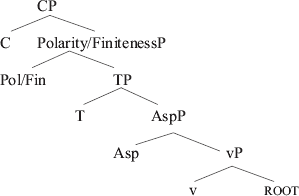
No one head corresponds to the verb: I will replace the redundant notation v–V (for a grammatical and a lexical verbal head) with v–root, making explicit that being a verb means for a lexical root to occur in a verbal environment, in particular one with the key properties identified by the formal object notated as v (Marantz Reference Marantz, Dimitriadis, Siegel, Surek-Clark and Williams1997, Borer Reference Borer2005).
The relational approach I follow on Tense and Aspect, as well as cross-linguistic evidence, suggests locating Aspect just above vP. This is also the likely location of preposition-like particles involved in aspectual periphrases, like ag in the progressive (McCloskey Reference McCloskey1996, 2007: 847–851; Doyle Reference Doyle2002; Ó Donnchadha Reference Ó Donnchadha2010 views this as the locus of Voice). The syntactic projection of a head Asp does not entail that such a head has a role in verbal morphology, however. While there is evidence for at least one head between T and v (see McCloskey Reference McCloskey2009), there is no evidence for a morpheme corresponding to Asp in the make-up of inflected verbal forms.Footnote 11 In particular, we will see in Section 8 that an aspectual characterization cannot be the content of ‘habitual’ morphology. The idea that Irish verbal inflection lacks an aspect morpheme also makes it easier to understand why this category finds a periphrastic expression. I will therefore ignore Asp in what follows, bearing in mind that the head is probably there in syntax, but it has no role in shaping the form of finite verbs.
Going up the tree in (10), T and Pol(arity)/Fin(iteness) articulate the expression of Tense and Polarity across two heads. Justification for this split is not immediately evident, and cannot rest on considerations of word order and clitic placement, given the clustering of bound morphemes into a single verb complex in Irish. However, arguments for distinct heads below C have emerged repeatedly in the literature (Guilfoyle Reference Guilfoyle1990, Reference Guilfoyle, Carnie and Guilfoyle2000; Duffield Reference Duffield1995; Doherty Reference Doherty1996; McCloskey Reference McCloskey1996; Doyle Reference Doyle2002). In particular, McCloskey (Reference McCloskey2010) has shown that sentences like the attested (11) make a strong case for locating negation and C on distinct heads, despite their morphological fusion into negative particles like ní or mura:
(11) Mur dtéighinn agus iad cailleadh, mhuirbhfeadh siad mé.
if.neg go.condit.1sg and 3pl lose.vn kill.condit 3pl 1sg
‘If I were not to go and they were to lose, they would kill me.’
Negation here is expressed on the subordinating conjunction mur which takes both conjuncts in its scope; however, what is negated is the first conjunct only, ‘if [it were not the case that I go] and [it were the case that they lose]’.Footnote 12 This suggests that negation is interpreted on the first conjunct, but gets morphologically realized on the complementizer on its left, as mur:
(12)
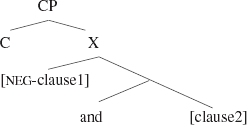
Accordingly, McCloskey (Reference McCloskey2010) concludes that negation originates and is interpreted in a Pol head between C and T; the conjuncts joined by and in (12) are Polarity Phrases, the first of which is negative. Crucially, this means that a complete finite clause is not a TP, but a PolP, and that the finite verb raises not just up to T but to Pol. McCloskey (Reference McCloskey2010) also shows that negation in this syntactic locus characterizes non-finite environments too. In finite clauses, however, this head encodes negation and hosts the finite verb; it is plausible to relate it (or to identify it, more dubitatively) with the head Finiteness, which Rizzi (Reference Rizzi and Haegeman1997) posited as higher than T but lower than C, at the lower end of the left periphery (see Ó Donnchadha Reference Ó Donnchadha2010). As for this latter area, I will follow McCloskey (Reference McCloskey1996, Reference McCloskey2001) in assuming C as a unique syntactic position for clause-initial particles (contrast Duffield Reference Duffield1995: 73). Particles in C may be further embedded under a preposition-like element, as in cé go ‘although that’, sul-a ‘before’, dialectally also sul-má (McCloskey Reference McCloskey2001: 84).
4.3 Tense features in the clause
The expression of negation (and Tense) on C illustrates our second set of theoretical assumptions, concerning the representation of grammatical features. A form like nach, the negative version of the declarative non-past subordinator go, expresses negation on C, but as we have seen, the locus of negation is arguably below C. Of course nach, like go, also expresses finiteness; and if finiteness has a dedicated syntactic locus below C, it is another example of grammatical information being expressed on one head in syntax but manifested on a higher head. Thus, grammatical features have distinct syntactic loci, one relevant for semantic interpretation, the other for morphological realization (see McCloskey (Reference McCloskey1996: 86–96) for arguments that negation actually includes in its scope adjoined phrases above its position as a proclitic to the verbal complex). The framework adopted here models this mismatch in terms of feature interpretability on heads: in the case at hand, we will say that negation is a feature of Pol, where it is semantically interpreted, but it is also a feature of the higher head C. On C, however, negation is a purely formal feature, defined in terms of grammar alone and uninterpretable outside of the formal system that we call syntax – and of its morphological realization. In other cases the mismatch is reversed: assuming that Tense is interpreted on T, a Tense marker that arguably originates on the verb stem itself will appear on a head in vP as an uninterpretable feature, but will be interpreted on T. Two heads in this kind of relation must then agree in a feature, in the precise sense that both are formally marked for it and the value specified on one of the heads is copied on the other, in the feature unification relation formally defined as Agree (Chomsky Reference Chomsky and Kenstowicz2001). Much subsequent work is based on this way to interpret the basic relation between syntactic objects. Roberts (Reference Roberts2010), in particular, analyses many phenomena in terms of syntactic head movement. I will instead focus on feature displacement that is defined over syntax but concerns morphology, as the discussion of negation above illustrates (McCloskey notes that the relation between negation and C in (12) must be left-conjunct agreement and not movement, since it is not generally possible to move an element from inside one conjunct only). If feature agreement between heads is less constrained than head movement, it has a broader (but still explanatory) empirical application. Apart from cases like (11), it accounts for cases where the same form licenses the interpretation of two categories on distinct heads, as where perfect morphology expresses perfect Aspect and past Tense: in such cases, as Mezhevich (Reference Mezhevich2008) argues for Russian, the values for the features [Perfective] and [Past] are both associated with perfective morphology on the verb, and they are copied (valued) on the heads Asp and T in turn.
4.4 Syntax and morphology
A third set of assumptions concerns morphology as a grammatical subsystem. I follow a model of the architecture of grammar which includes morphology as a post-syntactic component distinct from both from syntax and from phonology. As in the item-and-arrangement approach known as Distributed Morphology (Halle & Marantz Reference Halle, Marantz, Hale and Keyser1993, Marantz Reference Marantz, Dimitriadis, Siegel, Surek-Clark and Williams1997, Embick & Marantz Reference Embick and Alec2008), what is called morphology here is a map from abstract syntactic structures to phonologically interpreted strings, which may change syntactic constituency under (more or less strict) constraints but as a default case respects it. The map to phonology takes place via Vocabulary Insertion, which realizes an input grammatical content as an output phonological exponent. Importantly, the post-syntactic operations that prepare the map to phonology constitute a grammatical component, rather than a series of readjustments. In particular, I envisage purely morphological entities like DO, which define more than one spellout but are referenced by morphological rules as single grammatical entities (Embick Reference Embick2010: 90–91 introduces a similar element in his analysis of French determiners, realizing the same [masculine definite] morpheme as different vocalic endings in du and des).
One of the most obvious deviations from syntactic constituency, and the most relevant here, is Fusion, whereby two syntactic terminals are realized as a single position of exponence. Halle & Marantz (Reference Halle, Marantz, Hale and Keyser1993: 136) exemplify Fusion with the widely attested coalescence of person and number, adding that it applies to sister nodes, turning them into a single position of exponence. I analyse Irish tense-sensitive root allomorphs as fused morphemes realizing a lexical root along with some grammatical specification: verbality, a Tense marker, and, for dependent allomorphs, a contextual restriction. But Fusion, to be a serviceable analytic tool, cannot affect just any two features anywhere in the syntactic tree; it must be local. My claim is that, if Tense markers occupy certain syntactic positions, the locality of Fusion explains why only certain root allomorphs exist and not others.
5. [Future]
5.1 The structural representation of [Future]
Irish future and past markers differ in a number of ways:
• While the realization of the past marker DO is uniformly determined for all verbs on phonological bases, the realization of the future marker F partitions verbs into two classes, characterized by an /f/ or /oː/ suffix (the former variously realized).
• There exist suppletive roots for the tenses marked by [Future] (future and conditional), but not for the tenses marked by [Past], that is, for all forms so marked and not just for the simple past; recall the generalizations in (7) above.
• Past morphology is prefixal, future morphology is suffixal.
• Future marking only applies to lexical verbs, while the past/non-past opposition extends to the copula as well.
We can account for these asymmetries in a unified way by hypothesizing different structural representations for the features [Future] and [Past]. Instead of taking verbal forms to enter syntax already equipped with morphological features, our analysis follows the guiding idea that inflected forms spell out structures where features are properties of grammatical heads. Specifically, if verbs consist of a root in a verbal environment, [Future] can be attributed to v, where the suffixal pattern of [Future] exponence reflects the raising of the root to v:
(13)
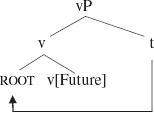
Being the lowest grammatical head, v is immediately local to the root when this raises. In the complex head that results, the exponence of [Future] on v can then depend on the root, linearly and structurally adjacent, as a normal instance of contextual allomorphy. If [Past] originates on a higher head, instead of being another possible value of v, the four differences summarized above can be traced back to the fact that [Future] is closer to the root:
• The exponence of future can depend on the root because [Future] is adjacent to the root; past morphology is more peripheral.
• Past morphology can be fused with a root in simple past root allomorphs, but locality (see discussion in Sections 6.4 and 8.4) prevents Fusion from applying to a root, a feature on a node X, and a second feature on a higher node Y; this rules out a specifically conditional root allomorph (which would be [Past [Future root]]).
• A different structural position for [Past] and [Future] does not make it necessary that they differ in affixal status, but it makes it possible, and more plausible than if they were alternative markings of the same head.
• The consensus analysis views the copula as a grammatical morpheme realizing Tense, not as a lexical verb; if [Future] is a feature of v, and v only appears with lexical verbs, the absence of this feature from the paradigm of the copula is not accidental. [Past] must then appear on a higher head.Footnote 13
The order [Past [Future root]], then, is at the very least compatible with the data. It also coincides with the order shown by French and Romance conditionals (Iatridou Reference Iatridou2000: 267 n. 41), where the exponent of future occurs inside the word-edge past endings: attend-r-ions ‘we would wait’. If the order of morphemes reflects the order of the syntactic heads where they originate, this is what one would expect.
5.2 The exponence of [Future]
As Wigger (Reference Wigger1972: 206–207) recognized, the traditional two conjugations are not different verbal paradigms, but rather correspond to a lexical opposition in the shape of stems, which conditions the choice of future suffixes (see Ó Sé Reference Ó Sé1991: 77). As anticipated in Section 2, first-conjugation verbs have a CVC root, suffixed in the future by /f/ (shorthand for various realizations), while in second-conjugation verbs a palatal suffix intervenes between the root and all inflectional endings; in the future, this suffix is replaced by /oː/. To illustrate the variation in stem shape in the second conjugation, consider that the root extension appears as /iː/ in the present ceangl-aí-onn /kˊanglˊ-iː-ən/ ‘binds’, but as /oː/ in the future ceangl-ó-idh /kˊangl-oː-j/ ‘will bind’ (and in the conditional cheangl-ó-dh /kˊangl-oː-x/), in contrast to the /f/ of first-conjugation verbs like mol-f-idh ‘will praise’ (Ó Siadhail & Wigger Reference Ó Siadhail and Arndt1983: 53–55; Ó Siadhail Reference Ó Siadhail1989: 170–173).Footnote 14
Membership in the second conjugation is phonologically motivated, since a root longer than CVC will necessarily belong here (for instance, ceangail ‘bind’, CVCCəC). However, many second-conjugation verbs have a simple CVC root, like bail- ‘gather’, present bailíonn. In particular, verbalizations of ‘short’ words regularly belong to the second conjugation, since they add a palatal suffix to a monosyllabic root, like ard (verbal noun ardaigh) ‘to raise’, transparently derived from the adjective ard ‘high’. As Ó Sé (Reference Ó Sé1991: 65) notes, facts like this show that the split between the two classes is prosodic in nature, and takes place at the level of stem, not of root: the purpose of second-conjugation root extension ‘seems to be the fulfilment of a constraint that the shortest occurring 2nd Conj. form be at least two syllables long’. This means that it is not the phonological form of the root which deterministically decides the conjugation of a verb; on the contrary, belonging to the second conjugation is a lexical property, which takes the form of a prosodic constraint on output forms.Footnote 15 This lexical marking has an obvious phonological motivation, as most second-conjugation verbs have a root longer than CVC, and so it is not totally arbitrary; but the shape of the root by itself is not decisive. Verbs like bail ‘to gather’ regularly belong here despite their CVC root. More strikingly, some verbs display oscillation between the two conjugations, most notably the very common labhair /lawrˊ/ ‘to speak’ which appears both as Labhraíonn sé and Labhrann sé ‘he speaks’ (see De Bhaldraithe Reference De Bhaldraithe1977 [1953]: 176, n. 1; Ó Siadhail Reference Ó Siadhail1989: 173–174; Ó Sé Reference Ó Sé2000: 270–271). And when a verb is derived by extending a CVC root which exists independently as a lexical word, it will fall into the same conjugation because of the shape of the verbal stem, not of the root.
In sum, over and above the phonological variation of the second-conjugation root extension, verbs of the two classes have the following structure (ignoring the 2sg imperative, realized as root+extension /iː/ for verbs like bail and as a bare root elsewhere):
- (14)
(a) First conjugation: root – /f/ – endings (future)
root – endings (all other tenses)
(b) Second conjugation: root – /oː/ – endings (future)
root – /iː/ – endings (all other tenses)
The question that arises is how the morphological structures in (14) derive from the syntactic structure in (13). Given that the second-conjugation root extensions /iː/ and /oː/ never co-occur, it seems natural to think of them as alternative realizations of the same position of exponence, which (10) and (13) suggest may be v. In one case, this position of exponence co-occurs with a separate future morpheme: this happens in the impersonal, as illustrated by the future ceangl-ó-f-ar ‘one will bind’ and the conditional cheangl-ó-f-aí ‘one would bind’. Apart from occurring alongside the future marker /oː/, this impersonal -f- morpheme is normally realized as /f/, in contrast with the variable realizations of the future marker of first-conjugation forms like molfaidh ‘will praise’ (see Section 2.3 above), so it is clearly a distinct exponent. This seems to suggest a greater internal complexity for second-conjugation verbs.Footnote 16
A previous version of this paper hypothesized that second-conjugation verbs have a complex root, extended by an augment normally realized as the suffix /iː/ and obligatorily fused with a [Future] v head, which would then be spelled out as /oː/.Footnote 17 But that solution does not account for suffixless imperatives like ceangail; in addition, the posited Fusion of the root augment and v [Future] (necessarily involving lowering of v) has no independent motivation, and in any case would require additional assumptions about the impersonal forms in -ó-f-ar as well as the Donegal cases mentioned in footnote 16 (because in neither case do the two future suffixes appear as /iː/ and /f/). Above all, a complex root structure for second conjugation would fail to capture the output constraint which is operative on all second-conjugation verb forms.
A more promising approach places this constraint at the heart of the analysis. What must be at least two syllables long is in any case a verbal form, whether it is a bare root like ceangail or a complex one like bail-igh, that is, /balˊ + iː/. Suppose, then, that the locus for this constraint is also the locus of verbality, namely v. This head constrains the output of the category it derives, very much like the prosodic templates of Semitic binyanim, which Arad (Reference Arad2005) likewise treats as encoded on v.Footnote 18 Let us notate a v head with this value ‘v-σσ’. This move gives us an independent basis for distinguishing two types of v, which can receive different realizations. In the (default) first conjugation, v defines no spellout. Roots associated with ‘v-σσ’, on the other hand, correspond to verbal structure lexically marked as subject to the two-syllables constraint of Ó Sé (Reference Ó Sé1991) (see Section 5.2. above). The standard assumption that realization proceeds from the deepest element outwards gives the right result, namely that the spellout of v depends on that of the root. Specifically, v-σσ will appear as zero if the root is already bisyllabic (or better, if it has a CVCC structure with an appropriate coda cluster), and as /iː/ elsewhere:
- (15)
(a) v-σσ ↔ Ø / root σσ______
(b) v-σσ ↔ /iː/
We can now analyse the future suffix /oː/ as a grammatically conditioned alternant realization of the same head, contrasting with the /f/ which spells out the default v:
- (16)
(a) v-σσ [Future] ↔ /oː/
(b) v [Future] ↔ /f/ (realized as /f/ or /h/)
As noted, the /f/ of impersonal forms cannot be equated with the default future marker, both because of its form (always /f/) and its distribution (both conjugations). In Section 8 we will see that the /f/ of ceannó-f-ar actually belongs with other pre-endings, a fact that would be obscured if we were to treat it as an extra future suffix.
In conclusion, future and conditional involve a feature [Future] associated with a grammatical head in vP, occurring above a lexical root (hence, absent in the copula), and structurally lower than the head expressing [Past]. This paves the way for an analysis of inherently future stems as the spellout of roots fused with [Future]. Before implementing this idea, we must make explicit the structural representation of [Past].
6. [Past]
6.1 Featural and notional past
Being ‘past’ means three distinct things in Irish verb inflection. First, notionally, past forms signal that a predication holds before the speech time. This covers events proper, habits, and states; in particular, individual-level predications expressed by the copula, which attribute a permanent property to the subject. As Doherty (Reference Doherty1996) showed, in a past example like (17), this means that the subject has left the universe of discourse, not that he is no longer a doctor:
(17) ba dhochtúir Seán (Doherty Reference Doherty1996: 39)
cop.pst doctor Seán
‘Seán was a doctor.’
In this sense, ‘past’ is a property of clausal predications.
Secondly, verbal forms are morphologically past if they involve a certain marking, namely in the simple past, past habitual, and conditional. While past vs. non-past is just one of the oppositions in the paradigm of lexical verbs, it is the only one for the copula, which distinguishes a present is from a past ba with past or counterfactual value. Importantly, this formal opposition extends to preverbal particles. In this sense, ‘past’ is a morphosyntactic category, defined by an opposition in form with different interpretive correlates.
Thirdly, the simple past tense is ‘past’ in a way that other DO-prefixed tenses are not, as it is the only tense that triggers past particle alternants, like ní-or in (18b):Footnote 19
- (18)
(a) D'fhan sí. (simple past, affirmative)
pst.wait 3sg.fem
‘She waited.’
(b) Ní-or fhan sí. (simple past, negative)
neg-pst wait 3sg.fem
‘She did not wait.’
- (19)
(a) D'fhan-adh sí. (past habitual, affirmative)
pst.wait-hab 3sg.fem
‘She used to wait.’
(b) Ní fhan-adh sí. (past habitual, negative)
neg wait-hab 3sg.fem
‘She used not to wait.’
- (20)
(a) D'fhan-f-adh sí. (conditional, affirmative)
pst.wait-F-hab 3sg.fem
‘She would wait.’
(b) Ní fhan-f-adh sí. (conditional, negative)
neg wait-F-hab 3sg.fem
‘She would not wait.’
This point bears emphasizing, because the usual convention of glossing both d- and -r as ‘past’ (a convention I have just followed) may give the impression that these forms are suffixed by -r wherever the independent verb has DO. It is not so: as (19) and (20) above illustrate, past habitual and conditional have DO on the verb but no -r on particles. Only in the simple past do the two appear as complementary alternants of one morpheme. If we want to call this morpheme ‘past’, we should distinguish a third sense of this category as a property of a specific tense.Footnote 20
Having cleared up potential ambiguities, we can now use a feature [Past] to model the property of being past in the second of the three senses just distinguished. The other two, namely the ‘before-now’ interpretation and the content of the simple past tense, will be explicated in terms of how [Past] is interpreted in the context of a whole clause.
For the reasons outlined in the preceding sections, [Past] should originate in a position higher than that of [Future], that is, higher than vP, so that it applies to the copula as well as to lexical verbs. The head T suggests itself as the obvious location, defined by its structural position and by its content. Structurally, T is the second-highest functional head in root clauses; C, when present, is the second head above T, as in the diagram in (10) above. Suppose, then, that T hosts the feature [Tense], with two possible values: [Past], requiring explicit marking, and [Non-Past], an unmarked value filled in automatically in the absence of [Past]. This is the content of T in a formal sense, as grammatical information encapsulated in it. What this marking amounts to for semantic interpretation will be made clearer in Section 7. Before that, it is necessary to clarify how morphology interprets a [Past] marking on T.
Recall (from Section 4 above) that grammatical features can be interpreted on one head but spelled out on another, like negation on C. Given the evidence for at least two heads between the inflected verb and the head of vP (McCloskey Reference McCloskey1996, Reference McCloskey2001, Reference McCloskey2009; Ó Donnchadha Reference Ó Donnchadha2010), I take tensed verbs to be spelled out not in T but in Pol(arity)/Fin(iteness), one level up:
(21)
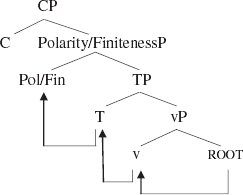
This means that the head Pol/Fin is also marked for the Tense feature. The value of this feature is copied from T, where it is semantically interpreted. The realization of [Past] thus takes place entirely above vP, which accounts for its salient properties: the category is relevant for lexical verbs but also for the copula; and its exponence (unlike for [Future]) is not sensitive to the choice of root, but can be sensitive to the immediately superior head C.
6.2 The exponence of [Past]: DO
Pol/Fin is the head where the inflected verb is spelled out. This means, I assume, that it hosts the raised complex made up of T, v, and the root. The outcome of syntactic head-raising is shown in (22); from now on, I will represent Pol/Fin as Fin for simplicity:
(22)
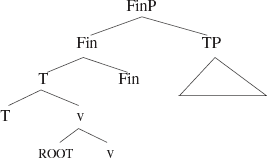
The terminals of this representation are understood as abstract elements in the computational system which we call syntax, not as morphological pieces; a head does not ‘raise to pick up affixes’ (see Roberts Reference Roberts2010 for discussion). Besides, syntactic terminals are not directly mapped to phonology, but to elements with morphological properties like being a prefix, or determining a range of phonologically-chosen alternants. In this mapping, Fusion and other operations may alter the one-to-one relation between terminals and positions of exponence. Thus, the structure in (22) maps to the linearized morphological representation in (23):
(23)
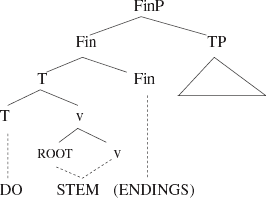
Syntax determines the peripheral position of endings in the verbal complex because they realize the head Fin to which the other heads are adjoined. These endings spell out the person and number values of a subject argument if this does not have a separate realization. Placing endings under Fin accounts for the fact that their realization depends on tenses (like conditional), not just on features (like [Future]). This is possible because Fin is a sister of the complex head T, and ‘sees’ all the information it contains. On the other hand, that endings are not only peripheral but also suffixal, is a property of the actual morphemes.
In at least one case, the content of Fin blocks the insertion of DO under T. As McCloskey (Reference McCloskey2007) argues, impersonal endings are best analysed as the reflex of a feature [Arb] (for ‘arbitrary reference’), an independently established category that accounts for the semantic range of Irish impersonal forms. Like person/number features, [Arb] is an uninterpretable feature on Fin, copied from the argument in subject position. The fact of interest is that in the simple past, the impersonal form is incompatible with an overt realization for DO, either as lenition or as prevocalic d-:Footnote 21
- (24)
(a) D’-fhan sé. (simple past, 3sg)
DO-wait 3sg
‘He waited.’
(b) Fan-adh. (simple past, impersonal)
wait-impers
‘One waited.’
The structural analysis in (23) makes it possible to treat this as a case of contextual allomorphy: the marking of [Arb] on Fin inhibits the insertion of DO under T. Note that v's adjunction to T does not destroy the sisterhood relation between T and Fin as two syntactic nodes, as distinct from positions of exponence.
A more obvious case in which the realization of T does not involve DO is that of the copula. Recall that the copula has no endings, personal or impersonal. I assume that it realizes T but none of the lower heads: aspect, person/number, and future are not categories for it. Unlike in the previous case, then, here the lack of DO depends not on the content of Fin but on the lack of a lexical root or a root-related v. Under current syntactic assumptions, the adjunction of v to T is triggered by the presence of a v-feature on T. We then have a clear way to tell apart T-as-copula from T as part of a lexical verb: only the latter has the uninterpretable feature [v], which triggers raising of v (and what has attached to it). T is morphologically interpreted as DO only when it is [Tense: Past] and [v]:
(25) T [v, Tense: Past]↔ DO
Adding a requirement that T must be marked for pronominal features, but not [Arb], would derive the lack of DO on past impersonal forms. Past copula forms realize instead a [Past] T as the orthographic b(a) or bh’, phonologically /bə /, /b/, or /v/, globally notated BA here:
(26) T [Tense: Past] ↔ BA
Let us finally concentrate on the exponence of DO. As we have seen, this has two ingredients: initial lenition, for consonant-initial stems (as in bhris /vˊrˊiʃ/ ‘broke’), and d-prefixation, for vowel-initial ones (as in d’ól /doːl/ ‘drank’). The fact that lenited /f/ becomes zero has non-trivial consequences. First, as noted, the lenition of a stem like fan in (24) above results in a vowel-initial stem, which is then prefixed by d-. Besides, a stem like freagair ‘to answer’ also undergoes both deletion of /f/ and d-prefixation, even though the outcome of lenition is not vowel-initial: d'fhreagair ‘answered’. This indicates that lenition and d-prefixation are distinct phenomena and can apply in sequence. Of the two, lenition seems to be a primary exponent, while the context-dependent distribution of d- suggests a phonologically triggered augment (see Ó Sé Reference Ó Sé1991: 62). That d- is subordinate to lenition is plain in the dialect of West Kerry, where the lenited dh- is prefixed to vowel-initial verbal stems after all leniting particles, ‘becoming in effect the lenition of vowels’ (Ó Sé Reference Ó Sé1991: 62; see also Ó Sé Reference Ó Sé2000: 324–330). In addition, lenition appears alone cross-dialectally on suppletive simple past allomorphs like tháinig ‘came’ or chonaic ‘saw’. There are significant open questions about the phonology of this use of lenition (see Armstrong Reference Armstrong1975), but for the purposes of this analysis I will conclude that DO is a morpheme which expresses T marked [Past], realized by a two-step process which involves lenition of stem-initial consonants, and a prefixation which establishes a d- or dr- syllable onset.Footnote 22
6.3 The exponence of [Past]: Preverbal particles
The last main factor determining the exponence of DO is the fact that some preverbal particles block d-prefixation (not lenition). This is illustrated in the (b) examples in (18)–(20) above, which also clarify that d-prefixation is blocked whenever the verb has the feature [Past] in our analysis (that is, for simple past, past habitual, and conditional), even though the particles in question carry a distinctive -r morpheme only in the simple past. However, as anticipated in Section 3.2 above, a few particles do not block d-prefixation, namely a (leniting relative particle, so-called ‘direct’), ó ‘since‘Footnote 23 and má ‘if’ (which contrasts with the counterfactual dá); to those, listed in Ó Siadhail (Reference Ó Siadhail1989: 177), a JL referee adds arae and mar ‘because’. The situation can then be summarized as follows, where C stands for ‘complementizer’:Footnote 24
(27) For [Past] verbs not preceded by a preverbal particle:
d- – [Lenition] – stem,
where [Lenition] applies to consonant-initial stems, and d- is prefixed to stems that begin by vowel (inherently or as a result of lenition).
(28) For [Past] verbs preceded by a preverbal particle X:
(a) if X is a (direct relative particle), má ‘if’, or ó ‘because’: same as (27)
(b) if X is any other particle:
X – [Lenition] – stem, where X is a leniting particle
X – [Nasalization] – stem, where X is nasalizing particle
- (29)
(a) C → C [Lenition] for C = ní (negation, non-past), má ‘if’,
a (direct relative)
(b) C → C [Nasalization] for C = go (complementizer, non-past),
nach (negative complementizer, non-past), dá ‘if’, a (indirect
relative), a (interrogative, non-past), …
The examples in (30) and (31) illustrate (27) and (28), respectively (see also (18)–(20) above). To exemplify (28b), (31b) shows the negative particle níor (leniting) followed by a simple past, and (31b′) shows the question particle an (nasalizing) followed by a conditional. For clarity, the morpheme glosses include [L] and [N] for lenition and nasalization on verbs:
(30) D'fhan sí liom.
DO.[L]wait 3sg.fem with.1sg
‘She waited for me.’
- (31)
(a) An bhean a d'fhan liom. (direct relative, leniting a)
def woman prt DO.[L]wait with.1sg
‘the woman that waited for me’
(b) Níor fhan sí liom. (negative níor, simple past)
neg.pst [L]wait 3sg.fem with.1sg
‘She did not wait for me.’
(b′) An bhfanfadh sí liom? (interrogative an, conditional)
Q [N]wait.cond 3sg.fem with.1sg
‘Would she wait for me?’
It is as if the particles listed in (28a) were simply not there. After the analyses of Duffield (Reference Duffield1995), McCloskey (Reference McCloskey2001), and Oda (Reference Oda and Carnie2011), the property which singles them out is not difficult to pinpoint: they are the only particles that have no negative and no past alternant. Consider the ‘direct’ relative particle a. Its form and the mutation it triggers are the same for all tenses of the verb, including the past, as in (31a). Other particles, by contrast, morphologically express Tense oppositions. The ‘indirect’ relativizing particle, which differs from the ‘direct’ one in that the relativization site is filled by a resumptive pronoun, opposes a non-past form a followed by nasalization, to a past ar (for simple past) followed by lenition. It also has negative versions for each of its tense alternants: nach, nasalizing, and nár, leniting. To negate a direct relative construction, one must use the indirect forms, nach and nár; in other words, there is no negative version specific to the direct relative particle. The same applies to má: its negative past and non-past versions are those of the counterfactual dá, namely mura (non-past, nasalizing) and murar (past, leniting).
Duffield (Reference Duffield1995) derived this pattern from a structural asymmetry between lenition-inducing T (the highest head below C in his assumptions) and nasalization-inducing C, on the assumption that negation always involves C. Given the lack of direct morphosyntactic evidence for distinct positions for, say, direct and indirect relative a (see especially the sustained critique in McCloskey Reference McCloskey2001), I will instead relate the difference to the presence of [Tense] marking on C. As we saw in Section 4.2, this is related to the expression of negation: both types of marking appear on C as uninterpretable features, as a morphosyntactic fact about the particles occupying C.Footnote 25 However, and this is the key hypothesis, not all particles are marked for [Tense]. More precisely, suppose that particles with a past/non-past alternation are all and only those marked for [Tense]. It is no accident that these are also the particles with negative alternants: when it is not the non-finite gan, identical to the preposition ‘without’, Irish negation is always attached to a Tense-inflecting morpheme.Footnote 26 In this way, the basis for attributing a [Tense] feature to C is paradigmatic, not syntagmatic: a particle may well carry a [Tense] feature although it has no such morpheme, provided that it has a Tense-based opposition. For instance, the declarative subordinator go has no discrete Tense morpheme, but it is formally marked [Tense] because it contrasts with the past gur. A zero non-past exponent, by itself, is unremarkable for a default value.
In sum, d-prefixation for [Past] is blocked if and only if there are independent reasons to attribute [Tense] marking to a preverbal particle. In addition, with the simple past, particles are suffixed by -r. As we will see in Section 8, this is only one of the respects in which the simple past stands out among other tenses, a circumstance which will justify a distinct [Completive] feature for it. To a first approximation, to be refined in Section 6.4, the exponence of T marked [Past] can be formally interpreted as follows:Footnote 27
- (32)
(a) T [v, Tense: Past, Completive] ↔ /-r/ + [Lenition] / C [Tense] _____
(b) T [v, Tense: Past] ↔ Ø + [Lenition] / C [Tense] _____
(c) T [v, Tense: Past] ↔ DO
In the context of a Tense-marked C particle, the rule spelling out T [Past, Completive] bleeds the less specific one spelling out T [Past]; DO realizes T [Past] elsewhere. Direct a, arae, má, and ó are C-particles which lack [Tense], and so fall into the latter case. As is natural for an elsewhere case, (32c) defines a heterogeneous context of application, when the verb is preceded by particles (non-tensed), and when it is not.
6.4 The exponence of [Past]: C-sensitive verbal forms
It cannot be an accident that the same morphosyntactic context blocking d-prefixation also triggers the appearance of the dependent root allomorphs presented in Section 3.2 above. We now see that both generalizations in (9) concern the marking of Tense on C, because a, arae, má, and ó correspond to Tenseless instances of C. The natural conclusion to draw is that dependent allomorphs are contextually licensed by C [Tense], as in (32a–b). There is no [Dependent] feature, which would restate a syntactic property, and whose distributional dependence on Tense allomorphy would be synchronically accidental.Footnote 28
Concretely, the proposal is articulated along the following points:
• C [Tense] consists of C fused with the linearly adjacent T. This makes precise the intuition that all particles cliticize onto the verbal complex (see McCloskey Reference McCloskey1996: 55), but those with a Tense opposition are more tightly associated with T.
• The simple past has the featural content [Past, Completive]. Root allomorphs specific to this tense spell out the Fusion of a root and a v [Completive]. Of these fused roots, some are marked as having to occur in the context of T [Past], others are marked [Past] themselves.
• Dependent root allomorphs for the simple past are marked [Past] (beside [Completive]) and must occur in the context of C [Tense].
• The characteristic -r of C expresses the feature complex [Completive, Past]; its absence in front of dependent root allomorphs reflects a superficial rule banning two adjacent morphological realizations of Tense, on C and on the verbal stem.
The hypothesis that Tense oppositions on C derive from the Fusion of C and T accounts naturally for the interrelation between the exponence of C and of T. To recapitulate, with the feature [Past], T is realized as DO (on regular verbs); in the presence of C, only lenition appears (recall (32b) above). When the verbal complex has the featural content that identifies the simple past tense, C is suffixed by -r, as in (32a) (with one systematic set of exceptions, which will be addressed directly). Another major area of contact between the morphology of verbs and the C system concerns Tense-specific allomorphs. As detailed in Sections 3.1 and 3.2, some of these present one form for a given tense (or an array of tenses), while others distinguish between a syntactically independent and a dependent form. For example, the simple past of feic ‘to see’ is chonaic, while that of déan ‘to do’ is rinne (independent) or dearna (dependent). Let us review how the proposals listed above account for these data.
For tenses marked [Future], we have seen that forms like rach- in rachaidh ‘will go’ realize the Fusion of a root with a v marked [Future]. Section 8 will deploy the same logic to claim that [Completive] is another possible marking on v. However, the simple past is not just [Completive], but [Past, Completive]; and [Past], by hypothesis, originates on T, above v. Our approach hinges on this circumstance to explain why precisely in the simple past the spellout of the verbal complex involves the interplay of C, Tense-specific and dependent verbal forms. Allomorphs like chonaic realize a root (notated √SEE) fused with a [Completive] v, but only in the context of a T marked [Past]:Footnote 29
(33) √SEE + v [Completive] ↔ chonaic / T [Tense: Past] _____
Note that (33) does not prevent a separate realization of T as DO; but this is the correct result, because a simple past root allomorph may or may not co-occur with the regular affix of T, as is often the case with forms ‘lexically’ marked on the root (compare the English plurals men, with no plural suffix, and childr-en, which has the ending of ox-en). Most such forms are consonant-initial and regularly display lenition, as chonaic ‘saw’ or chuala ‘heard’. In all dialects, however, fuair ‘got’ does not, and déir ‘to say’ has the unlenited simple past allomorph dúirt in most dialects, but this is analysed as DO + úirt in Connacht and Ulster (d’úirt sé ‘he said’, níor úirt ‘didn't say’; see Hughes Reference Hughes1994: 650; Ó hUiginn Reference Ó hUiginn and McCone1994: 590).
Verbs which distinguish dependent and independent forms require a slightly different analysis. Suppose that the independent form rinne ‘did’ is inherently marked [Past]. Because, by hypothesis, v does not bear this feature, the allomorph will spell out the content of the fused root + v nodes, plus an inherent feature specification for T:
(34) √DO + v [Completive], [Tense: Past] ↔ rinne
Its dependent allomorph dearna is a positional alternant in the context of C+T:Footnote 30
(35) √DO + v [Completive], [Tense: Past] ↔ dearna / C [Tense: Past] _____
Apart from allowing a straightforward statement of the dependent/independent contrast as a case of contextual allomorphy entirely parallel to (32), this formulation sheds light on a final puzzling aspect of the morphology of the simple past: the non-past form of C particles in front of dependent simple past verbs. This means that, in the standard as well as across dialects, we systematically have ní raibh or an bhfaca? (‘was not’, ‘did hear?’) and not *níor raibh or *ar fhaca, which we would expect on the basis of (32a). It would appear, then, that the pattern to explain is the complementary distribution between dependent simple past allomorphs and -r on C. The dialectal data suggest a different interpretation, however. It is true that, in the simple past, the particles preceding dependent allomorphs lack -r, but this also happens with non-dependent allomorphs. Oscillations in the use of -r are amply recorded, especially in the West Kerry dialect (recall footnote 21 above and see Ó Sé Reference Ó Sé2000: 327, 332), but it is particularly noteworthy that even in the Connacht variety described by De Bhaldraithe (Reference De Bhaldraithe1977 [1953]: 235), irregular verbs without a dependent form should allow both constructions, with and without -r (for example, An gcuala? and Ar chuala? ‘Did [you] hear?’). Such oscillations strongly suggest that the lack of -r is a ‘surfacy’ effect, systematically triggered by dependent simple past allomorphs, but also possible in other cases. Since the lack of -r always results in a morphologically non-past form, and cannot therefore be just a phonological phenomenon, I hypothesize that a tensed C loses its Tense features just before its realization, when it is linearly adjacent to a verbal form inherently marked [Tense]. Dependent allomorphs, as in (35) above, always conform to this description; but also forms for which Tense is a conditioning context, as in (33), may trigger this phenomenon, which effectively amounts to the avoidance of two adjacent [Tense] exponents. A distinction between allomorphs conditional on a local [Past] feature, as in (33), and expressing the same feature by themselves, as in (34)–(35) above, is a subtle one, but that is precisely what the data suggest.
In sum, then, -r does not strictly speaking realize T, as in (32a), but is an augment on a C particle marked [Past, Completive]. A particle simply marked [Past] triggers just lenition instead, which explains the lack of -r with the conditional and past habitual.
- (36)
(a) C + T [Tense: Past, Completive] ↔ C-r + [Len]
(b) C + T [v, Tense: Past] ↔ [Len]
In addition, a tensed C node undergoes Impoverishment of T features in front of a linearly adjacent verbal form already marked [Completive].
(37) C [Tense] → C / ______ [Completive]
Note that not all -r on C have this function: the declarative complementizer go takes the form gur when it incorporates the present copula:
(38) Deir-tear gur maith an ceoltóir é.
say-impers that.cop good def musician 3sg.m
‘They say he's a good musician.’
Besides, the negative alternant of go is nár when the complementizer has an optative function, followed by the subjunctive: Nár fhille sí ‘may she not return’ (GGBC: 214, 20.11). Despite their common origin (in the prospective function of the particle ro-, see McCone Reference McCone1987: 114–118), these two uses are best treated synchronically as different morphemes from the augment in (36a) above, not only because of their content, but also because -r in these functions is much less stable dialectally than in the simple past.Footnote 31
In conclusion, T [v, Tense: Past] is spelled out by the complex of lenition and d-prefixation notated DO, in root contexts and when preceded by Tenseless particles. Instead, when preceded by Tensed particles T is no longer a distinct position of exponence, but triggers the adjustments in (36)–(37) above, along with the mutations triggered by specific choices of particles. This concludes our analysis of [Past] and [Future] as the key ingredients of Irish verb morphology. Before turning to the third feature to be proposed, it is necessary to consider how the categories introduced so far relate to the semantic value of tenses.
7. Grammatical features and the meaning of tenses
7.1 Basic values of [Past] and [Future]
[Past] and [Future] do not mean ‘past’ or ‘future’ in the sense these words have in English. As outlined in Section 4 above, they have a more abstract function, which in the context of an interpreted clausal structure results in the semantic value of tenses. Now that we have spelled out in some detail how these two features relate to syntax and morphology, we can turn to how they determine the emergence of Irish tense semantics.
I follow Iatridou (Reference Iatridou2000) in viewing the meaning of past tense morphology as a relation of non-overlap between two arguments. [Past], then, means primarily ‘Exclusion’, both in the temporal value of ‘before-now’ and in the modal counterfactual value, according to the schema in (39) (Iatridou Reference Iatridou2000: 246):
(39) T(x) excludes C(x) x = time or world
T = ‘the x that we are talking about’ (Topic x)
C = ‘the x that for all we know is the x of the speaker’ (Utterance x)
When the variable ranges over times, the schema results in a notional past interpretation: exclusion between two temporal intervals evaluated at the same possible world. Since only what is happening and what has happened can be factually true, a relation of exclusion between the Utterance Time and the Assertion Time (the relevant part of the Event Time, corresponding to Iatridou's Topic Time) can only mean that the event described by the predicate took place before the Utterance Time; what will occur after ‘now’ may be more or less certain, but it is not treated by natural language semantics as true as a matter of fact. When the variable ranges over possible worlds, a counterfactual interpretation arises: the set of worlds in which the asserted part of the event occurs does not include the speaker's actual world. What triggers the modal interpretation is, for Iatridou, future morphology; here, more precisely, [Future]. As a first characterization of the semantics of Irish tenses, the combinations of [Past] and [Future] then give rise to the following oppositions:
- (40)
(a) [Past] notional past (simple past, past habitual)
(b) [Past], [Future] counterfactual (conditional)
(c) [Future] modal non-past (future)
(d) neither non-past, non-modal (present)
7.2 [Future], modality, and a deictic index
Suppose, then, that the presence of [Future] on the verbal chain licenses a reading of the head Fin as a modal operator, relativizing the interpretation of the predicate to possible worlds. Note that I am not proposing a morphosyntactic feature [Modal] distinct from [Future], for which there would be no evidence, but a reading for the whole clausal predication licensed by [Future] and interpreted at the top of the verb chain. The counterfactual reading of the conditional follows from the interaction of modality and exclusion, as noted. The future tense is instead a modalized present, which unlike the conditional does not convey exclusion between the actual world and the world at which the event occurs. There is no need to argue for the intrinsic modality of statements framed in the future, asserted to occur at a not-yet-realized world resulting from the current one at a temporally later stage (see Stowell Reference Stowell2007: 454 and literature cited there). A head above Tense also seems the most plausible location for this type of information, corresponding to what has been proposed for the Greek tha (see Philippaki-Warburton Reference Philippaki-Warburton1998; Iatridou Reference Iatridou2000: 233). There is also independent evidence for the potentially modal value of the future in Irish, after Ó Corráin (Reference Ó Corráin1992) documented the modern survival, and possibly the extension, of modal functions already prominent in Old Irish (where the future developed out of the subjunctive, see McQuillan Reference McQuillan2002). The attestations cover various types of obligation, as in (41), ability, as in (42), and habituality, as in (43):Footnote 32
(41) Ólfaidh tú ceann eile! (Ó Corráin Reference Ó Corráin1992: 7, 10)
drink.fut 2sg one other
‘Drink another one!’
(42) Tífid tú lorg na gcos. (Ó Corráin Reference Ó Corráin1992: 10)
see.fut 2sg trace def.gen.pl foot.pl
‘You can see the footprints.’
(43) Oibeóra mé an lá … agus nuair a thiocfas an oidhche
work.fut 1sg def day and when prt come.fut def night
codlóidh mé go sámh (Ó Corráin Reference Ó Corráin1992: 13)
sleep.fut 1sg prt sound
‘I work during the day … and when the night comes I sleep soundly.’
While not common, these uses clearly show the synchronic connection between future tense and modality. It may also be noted that the future of the lexical verb caith ‘to cast, spend’, is grammaticalized as a deontic or epistemic light verb (Caitfidh sé a bheith fuar ‘it must be cold’, Caitfidh mé imeacht ‘I must leave’), showing that this tense allows for a purely modal reading once it is decoupled from a lexical verb. Hypothesizing that future morphology licenses an interpretation with access to alternative worlds naturally subsumes these readings.
Still, the future tense is not the subjunctive: it is modal and non-past, but the discussion so far does not specifically explain the ‘after-now’ interpretation. For that, we need a distinct ingredient. This is a deictic time/world index, which characterizes the Utterance Time as the speaker's ‘here-and-now’. I will view this index as an argument encapsulated on Fin, the deictic centre of the clause. Not all clauses, however, express such a deictic centre, and the opposition between those that do and those that do not, in tandem with the values of ‘exclusion’ for [Past] and ‘access to possible worlds’ for [Future], provide the ingredients for the contrast between realis and irrealis in Irish.
To see this, consider more closely the idea of Tense as a relation between two arguments. The internal argument corresponds to a relevant part of the event expressed by the verbal predicate, either the interval corresponding to the Assertion Time, or the worlds at which the event is true. Among the syntactic implementations of this approach, that of Stowell (Reference Stowell2007: 443–444) stands out for addressing the relation between time-denoting expressions and the event argument associated with lexical verbs. Stowell argues that the internal argument of the Tense relation is a time-denoting phrase which incorporates an event position, identified by the verb as one of its arguments and structurally realized in a specifier. The interpretation of the time t is related to that of the event e according to the scheme ‘the time t such that the event e happened at t’ (ignoring for simplicity the distinction between Assertion Time and Event Time, as Stowell notes). In other words, the internal argument for Tense is not (a projection denoting) the event itself, but (a projection denoting) the time interval in which the event occurs. What is of interest in this approach is how the external argument is syntactically expressed. The external argument ‘denotes a time that functions as the reference point of the tense (its reference time, RT); in a simple mono-clausal sentence, this generally corresponds to the actual Utterance Time (UT)’ (Stowell Reference Stowell2007: 438).Footnote 33 Stowell places this covert argument in the specifier of TP, not in a higher projection as I have suggested. But we can reconcile Stowell's position with the idea of Utterance Time being in Fin by suggesting that Fin hosts a time/world index which binds a variable in the specifier of TP. It is this variable, notated x in the diagram in (44), which acts as the external argument of Tense.
(44)
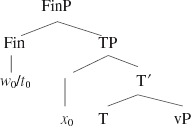
The claim, now, is that not all clauses express such a ‘here-and-now’ index under Fin. When the index is present, the value of Tense is relative to a well-defined instant and world localized as those of the utterance. When it is absent, the value of Tense is not computed relative to such a deictic present, but to an external temporal argument which is not characterized as ‘now’. It may express a timeless (individual-level) predication, or an eventuality (event or state) more generically localized in a current or non-current frame of reference, where this coarser temporal localization is not computed relative to the actual Utterance Time. Such is the ‘present’ sense of generic statements like Bears hibernate, which differs from the ‘past’ Dinosaurs ate kelp but does not depend for its truth on what happens at the Utterance Time (it is true if uttered in mid-August when no bear hibernates, as Iatridou (Reference Iatridou2000: 262) reminds us). A deictic time/world index which may be missing, then, represents in syntactic terms the semantic insight that clauses can be framed in a present or past time reference without this being based on the truth of the predicate at the Utterance Time.
7.3 The emergence of realis
The contrast between clauses with and without a deictic index is not equivalent to the opposition between modal and non-modal interpretation, but cross-classifies with it. The realis reading of the future, as the expression of an event asserted to take place in a world that is the temporal continuation of the actual world under minimal changes, corresponds to a characterization of Fin as modal (interpretation having access to alternative worlds) but encapsulating the w 0/t 0 index. This is the usual value of future tense predications; we can now characterize the more strongly modal readings noted above in (41)–(43) as lacking the deictic index on Fin. This amounts to claiming that the interpretive contrast between a ‘proper’ future and a more strongly modalized one is grammatically represented, but does not map directly to a morphological opposition. The difference does not lie in the value of the [Future] feature itself, but in the presence or absence of a w 0/t 0 argument under Fin.
Because the expression of a deictic index is dissociated from the modal value of the clause, and the modal value in turn has a morphological reflex (in the feature [Future]), we are introducing a grammatical opposition with no direct visible correlate: a heavy assumption, but much less arbitrary than what would appear at first sight. First, it is not completely true that the hypothesized opposition on Fin lacks all morphological expression. It seems plausible that subjunctive forms, which occur in subordinate or in root optative contexts, and always signal a modal or downright counterfactual interpretation, are only compatible with a clausal context that does not anchor its predication in the actual world and time. The subjunctive, then, directly correlates with one of the values hypothesized on Fin, namely the lack of a deictic time/world index. Secondly, it is a fact of Irish verb morphology that one and the same form may have two quite distinct functions, one deictically interpreted relative to the actual Utterance Time and another more loosely characterized in temporal terms, if at all. Modal readings are attested not only for the future, but also for the simple past, which is overwhelmingly realis and generally incompatible with counterfactual uses like if the earth was round or I wish it was true. Quin's (Reference Quin1974: 47) historical overview of this use ascribes the following examples to ‘the modern spoken language’:Footnote 34
- (45)
(a) Dá dtuiteadh sé bhí sé marbh.
if nas.fall.hab 3sg.m be.pst 3sg.m dead
‘If he had fallen he would be dead.’
(b) Bliain is a’ lá aniuv do bách mo mháthair, is dá
year and a day today prt die.pst my mother and if
ngeódh suí tímpal, is fudó bhí sí sa bhaile.
nas.go.cond aroundis cop long be.pst 3sg.fem in.def home
‘It is a year and a day today that my mother died, and if she had gone around [i.e. taking a longer way on land] she would be at home for a long time.’
This is not a common value of the Irish simple past, but it is possible. A realis, non-modal reading, then, is not an intrinsic component of what the verb form means, but a clause-level characterization which typically accompanies the simple past. What speakers learn as part of the meaning of this tense is that it generally correlates with a realis value encoded elsewhere.
There is a final reason for positing a deictic index as a privative feature on Fin. Recall that the paradigm of the copula only distinguishes a present and a non-present form, and that the non-present ba can have a past or a counterfactual reading. This means that the semantic opposition [±Realis] does not coincide with the morphological opposition [±Past], since the past ba can have either [±Realis] value. It seems better to view the counterfactual reading of ba as arising from [Past] appearing without a deictic value on Fin, while the past reading obtains when [Past] is coupled to a deictic Fin. Recall that copular constructions, lacking a lexical v, cannot be marked by [Future], which characterizes v. They cannot, then, express a counterfactual reading made up of ‘exclusion’ (from [Past]) and ‘access to alternative worlds’ (from [Future]). Instead, the presence or absence of a deictic index under Fin determines whether the predication is assessed only with respect to the utterance world or not. Since the copula expresses an individual-level predication, holding of an individual regardless of time, a past-in-this-world copular predication must refer to an individual that was part of a past universe of discourse (as in (17) above). Without an anchoring ‘now’, an individual-level predication marked as ‘exclusion’ cannot refer to the past, but it still applies to individuals seen as temporally indivisible; they are then asserted not to be part of the actual world.Footnote 35
In sum, [Past] has always an abstract value of ‘Exclusion’, and the anchoring of the clausal predication in the actual world and in Utterance Time depends on the presence of a deictic index. Because this index sits in Fin, it is compatible both with the copula and with lexical verbs. Because it has no direct morphological expression, no verb form (except for the subjunctive) directly correlates with its presence or absence. With lexical verbs, a Fin encapsulating this deictic index enters in the expression of statements about the existence of an event going on here-and-now (present), still to happen in a world that is the continuation of here-and-now (future), or located at a time defined as past by its exclusion with the Utterance Time. Of all these tenses, only the simple past and the future regularly co-occur with a deictic index, with the readings ‘it will be the case that p’ and ‘it was the case that p’; but even for them alternative modal readings are possible. As for the copula, present and past forms with a deictic index express predications about the present and the past universe of discourse; without a deictic index they express a generic, atemporal statement, or one that is not asserted to be true in the actual world. Globally, a semantic opposition emerges between realis and irrealis, even though it does not correspond to the value of one grammatical feature, but describes the reading which emerges from a complex construction.
8. Habitual and [Completive]
8.1 Habitual does not reduce to frequentative or imperfective
In the habitual past, and for the lexeme bí also in the present, habituality is a morphological category defined by a series of endings (and, for impersonal forms, pre-endings) and by a particular semantic value. However, the same endings also characterize the conditional, without any semantic correlate. Wigger (Reference Wigger1972: 176–177), Ó Siadhail & Wigger (Reference Ó Siadhail and Arndt1983: 57) and Ó Siadhail (Reference Ó Siadhail1989: 177–178) therefore hypothesize that ‘habitual’ is a formal feature which has a semantic value (aspectual) only in the present and in the past, while it takes part in forming the conditional as a purely grammatical feature. I propose an alternative analysis, where what is positively marked are the non-habitual forms. This, as we will see, accords with the morphological and the semantic evidence that the simple past is ‘completive’.
The examples in (46), from Ó Sé (Reference Ó Sé, Ó Catháin and Ruairí2001: 142), illustrate for the verb siúil ‘walk’ the core semantic contrast between the simple past shiúlaíos and the past habitual shiúlaínn (forms of the Kerry dialect):
- (46)
(a) Nuair a bhí conaí orm i Maigh Nuad shiúlaíos go dtí
when prt be.pst home on.1sg in Maigh Nuad walk.pst.1sg to place
mo chuid oibre uair amháin/cúpla uair ach
poss.1sg share work.gen time one/some times but
b’ fhada liom é.
cop.long with.1sg it
‘When I lived in Maynooth I walked to work once/a few times but it was too long.’(simple past)
(b) Nuair a bhí conaí orm i Maigh Nuad shiúlaínn
when prt be.pst home on.1sg in Maigh Nuad walk.pst.hab
mo go dtí chuid oibre.
to place my share work.gen
‘When I lived in Maynooth I used to walk/walked to work.’ (past habitual)
In this frequentative reading (Van Geenhoven Reference Van Geenhoven2004), the verb denotes an unspecified plurality of temporally non-adjacent events, where the complex event stands to the simplex walking event in the relation of a bare plural to a singular noun. The present can have the same value, which does not have a special set of endings except for the existential verb: so, Siulaíonn mé ‘I walk’, in principle, is compatible both with a frequentative and a non-frequentative reading, even though a periphrasis is greatly preferred for a progressive interpretation (‘I am walking right now’). As Ó Sé (Reference Ó Sé, Ó Catháin and Ruairí2001: 124) notes, statements of cyclic repetition induce a generic interpretation which borders on the atemporal, as in (47):
(47) San oirthear a éiríonn an ghrian. (Ó Sé Reference Ó Sé, Ó Catháin and Ruairí2001: 124)
in.def east prt rise.pres def sun
‘The sun rises in the east.’
The sentence is true in the present, not because the sun is rising now, but because it keeps rising as a property that is permanent in the world as it is now. Substituting ‘state’ for ‘permanent property’ results in the view that such predicates name not an event but a state, which holds at the time of utterance (this is the line taken by Mezhevich Reference Mezhevich2008). The problem is that a state is not the same as a permanent property. Simplifying the nuanced discussion by Bertinetto (Reference Bertinetto1994), confusing a truly aspectual notion like habituality with an Aktionsart like stativity ignores important empirical differences. Even when construed as habituals, predicates like wash the dishes or bring a present to someone describe events, and the habit induced by a regular repetition of these events differs from a genuine state (not constructed out of events) in a number of respects.Footnote 36 If anything, statives resemble a particular subclass of habitual predicates, which Bertinetto (Reference Bertinetto1994: 410) calls attitudinals, ‘characterized by the fact that the (more or less) regular occurrence of a certain event is turned into a permanent property of a given individual’. It is not the repetition per se, but its regular cyclic nature that makes rising in the east in (47) an intrinsic property. The attested example in (48) (reproduced in the phonetic transcription in which it appears in LASID), with a habitual present bíonn, conclusively shows that repetition is not necessary for habitual interpretation, since ‘being out at night’ is not something that a path stops doing:
(48) taxtərə bˊjog ,o: ‘hax gə tˊax, ogəs bi:n ʃe mwi ,sən i:hə
messenger little from house to house and is 3sg.m out def.in night
‘A little messenger from house to house and it is out at night.’ (the path)
(LASID vol. 3, point 28, p. 36, text)
Likewise, a proverb like Bíonn an fhirinne searbh ‘Truth is bitter’ does not so much express a regularly repeated state of affairs comparable to ‘I used to walk’, as much as a generalization.
If the habitual does not turn an event into a state, it does not mark imperfectivity either: note that, in (46), the simple past bhí of the temporal clause is unambiguously imperfective. Apart from the existential verb, other stative verbs (among the few such expressions that Irish has) show that the simple past can have an imperfective value, as in the following examples:
- (49)
(a) Nuair a bhí mé i mo pháiste, thaitin siocláid liom go mór.
‘When I was a child, I liked chocolate a lot.’
(b) Is cuimhin liom a chluinstin fá seanfhear a chónaigh leis féin agus a fuair bás go tobann.
(republicannews.org/archive/2000/June29/29gaei.html)
‘I remember I heard about an old man who lived alone and died suddenly.’
(c) … áiteanna cosúil le Cúl Aodha, áit ar chónaigh sé ag am a dhealraigh an náisiún a oidhreacht shaibhir a aimsiú
(www.whatsonni.com/more_info.php?id=7770)
‘Places like Cúl Aodha, where he lived at a time when the nation seemed to discover its rich heritage.’
‘Habitual’ verbal forms, then, cannot be equated with imperfective ones.
8.2 Habituality as nomic imperfectivity
The semantic value of habituality corresponds to what Lenci & Bertinetto (Reference Lenci, Bertinetto, Higginbotham, Pianesi and Varzi2000, Reference Lenci and Bertinetto2010) call ‘nomic’ modality: the verbal predicate is asserted to be true in all worlds qualified as normal according to some pragmatic parameter. The exceptions notoriously admitted by constructions like I used to go to bed early, and which distinguish the habitual-frequentative reading from a universal quantification like I always went to bed early, are tolerated as far as they are not part of the set of law-like occurrences which form the modal base. This distinguishes I used to go to bed early, but on that night I didn't, where the exceptional event explicitly contrasts with the normal conditions, from the deviant #I used to go to bed early except on March 15, 1951, where the PP expressing the exception lies in the scope of the habitual predicate. In addition, events which are stated to be indefinitely many do not admit explicit quantification, even vague (many times), and so differ from iteratives, which simply assert the repetition of an event, as in I walked to work 100 times/every day:
(50) … Shiúlainn go dtí mo chuid oibre #céad uaire/#ach amháin ar an lá sin.
‘I used to walk to work #a hundred times/#except on that day.’
As we saw with (49), statives show that the habitual is not necessary in order to describe an eventuality as holding for an indefinite interval. But even statives take on the habitual form if the predicate generalizes over the participants in the event:
(51) Fadó, fadó agus is fada fíorach an lá ó shin é bhíodh a fhios ag gach uile dhuine cén uair a gheobhadh sé bás.
(comhaltas.ie/education/comhra/scealta)
‘A long, long time ago, everybody knew when they would die.’
(lit.: ‘there was knowledge at everybody’)
A sentence like (52) refers both to generically many events and to generally many participants, and correspondingly uses the past habitual in the highlighted forms:
(52) Cheapaidís na fir gur saint chun an airgid do bhí air, trá's go mbíodh sé ag obair chómh dian. Agus ansan do bhíodh iongnadh ortha a rádh go sgaradh sé chómh bog leis.
(P. Ua Laoghaire, Séadhna, BÁC, 1904, p. 50)
‘The men thought that it was greed for money that moved him, seeing that h used to work so hard. But then they would wonder that he used to part with it so easily.’
(Shiana, transl. 1915, p. 45)Footnote 37
As Lenci & Bertinetto (Reference Lenci and Bertinetto2010: 40–41) clarify, generic habituals arise at the conjunction of two properties, iterativity and nomic modality. As iterative predications are possible without having the law-like force of habituals, law-like generalizations can occur without iteration, in generic statements like Two plus two equals four, or in individual-level predications like John is intelligent, or in attitudinal predications like This machine crushes oranges. In Irish, atemporal generalizations (especially existential statements) routinely employ the non-habitual present, contrasting with generic predications like (48) (‘[the path] is out at night’) which name an eventuality holding true in space and time and use the habitual instead:Footnote 38
(53) Tá trí shaghas comhaimsirí ann, aimsirí leanúnacha, aimsirí foirfe agus aimsirí timchainteacha.(GGBC: 139, 14.10)
‘There are three types of compound tenses, progressive tenses, perfect tenses, and periphrastic tenses.’
Like a mathematical statement, this classification is not asserted to hold at a time or another; but the existential format Tá X ann ‘There is X’ defines a so-called thetic judgement, that is, a statement about a situation (here atemporal), which is the topic of the sentence. By contrast, a categorical judgment like Is dochtúir é ‘He is a doctor’ is a statement about the subject of predication, which is the topic of the sentence.
In sum, the semantic value of habitual past (and present bíonn) is best characterized in modal terms, as the habitual variety of nomic imperfectivity. However, this type of modality differs from that triggered by the feature [Future]. In particular, the exclusion expressed by [Past] on habitual past verbs does not range over non-actual worlds as with counterfactuals, but is still interpreted as referring to times (so used to walk denotes the set of normal worlds where walking occurs previous to now). This strongly suggests that [Habitual] is not a feature on v, like [Future] is. Instead, the semantic value of habitual sentences is a generic operator higher than T, at clause-level; Fin suggests itself as a likely location.
8.3 Habitual as ‘not [Completive]’
All we have said so far concerns habituality as a semantic value of the past habitual and present tenses (whether or not it has morphological exponence in the latter). Recall, however, that habituality has nothing to do with the semantics of the conditional, even though the past habitual and the conditional share the same endings. By itself, this circumstance suggests that habituality is not the content of a morphological feature, since it appears in the absence of morphological marking (on the present of verbs other than bí) and it does not appear in the presence of morphological marking (conditional). As a further piece of evidence pointing in this direction, consider that the present, and more specifically the habitual form bíonn for the existential verb, appears systematically after the realis conditional conjunction má with future interpretation, while morphologically future forms are generally excluded. Whatever the precise reason for the avoidance of future, it shows once more the habitual form occurring without the generic force of nomic-modal habituals.Footnote 39
Bearing in mind that even the nomic-modal interpretation in fact gathers together several different readings (frequentative in (46b), non-eventive in (48), generic in (51)–(52)), it is hard not to agree with McQuillan's (Reference McQuillan2002: 194) characterization of the habitual as the default form for a temporally present reading. A view of habitual forms as underspecified would in fact make it easier to understand the strong tendency for the conditional to be used in the function of past habitual and conversely (see Hughes Reference Hughes1994: 645; Ó hUiginn Reference Ó hUiginn and McCone1994: 579; the two tenses coalesced in Scottish Gaelic and in Manx), a drift which would not be obvious if its only cause were formal similarity enhanced by phonetic erosion (Ó Sé Reference Ó Sé, Ó Catháin and Ruairí2001: 138). Similar considerations apply to the merger of past habitual and past subjunctive (Ó hUiginn Reference Ó hUiginn and McCone1994: 578; LASID vol. 2, point 734). What I suggest, then, is not just that the ‘habitual’ morphology shared by past habitual and conditional is a purely formal marker with no direct semantic import, as already Wigger (Reference Wigger1972: 168, 176) proposed, but that there is no [Habitual] feature at all, not only semantically but also in morphology.
Semantically, the habitual interpretation does not arise from a positive marking, whether morphologically realized or not, but from the lack of a contrary characterization. In fact, formally habitual verbs may receive various interpretations, not only those as habitual or generic proper but also as ‘default’ present, or in the function of a conditional; but there is one reading that a habitual form never has, namely one denoting a single, atomic, specific event. In a word, habituals are never episodic.Footnote 40 ‘Episodic’ is instead a fitting characterization for the simple past and the present tá, which denote single complete events (possibly repeated, of course, if in the scope of adverbials like a few times). This comes close to an aspectual characterization as ‘bounded’; and indeed, the simple past morphemes DO and -r historically derive from a marker ro-, whose telic value became grammaticalized as a resultative or potential marker in Old Irish and subsequently lost its perfect value (see McCone Reference McCone1987: 97–98, 119–136; McManus Reference McCone, Damian, Cathal, Nicholas and Liam1994: 408–409). But ‘bounded’ suggests a perfect value, and as we have seen the non-habitual forms are not definitionally perfect (recall (49) above). The traditional term preterite for the simple past is more appropriate, although it does not describe the difference with the past habitual. The characterization I propose is that the Assertion Time (the relevant interval about which an assertion is made) entirely coincides with the Event Time (the interval at which the verb event takes place). As Binnick (Reference Binnick1991: 210, 296–297) mentions, this is the value of the category that Johnson (Reference Johnson1977) called [Completive] in her analysis of Kikuyu.
The simple past, then, is [Past, Completive], where the second feature entails that the Assertion Time coincides with Event Time. This rules out frequentative readings as in I used to run: the verb predicate run denotes a single running event, while the habitual macro-event identified by the Assertion Time is made up of generically many, temporally disjoint running events. There is then no coincidence between the interval about which an assertion is made (the duration of the habit), and the interval at which the verb predicate is true.Footnote 41 On the other hand, this condition can be met if the event is conceptualized as lacking natural boundaries. All that is required is that, even when the predicate does not denote an intrinsically bounded action, it is conceptualized in its entirety. Mostly, the coincidence between Assertion and Event Time results in properly episodic aoristic readings like that of shiúlaíos in (46a) above: ‘I walked (once)’, where the interval on which the assertion is based coincides with the walking event, neither being properly included in it, nor coming after its completion (as in the perfect I have/had walked). But, as we have seen, the simple past bhí in the same sentence has imperfective value. This only happens with verbs like ‘to be’, or in principle with other stative verbs (except that Irish expresses notions like ‘to love’ or ‘to know’ via periphrases). Likewise, tá ‘is’ is [Completive] in cases like Tá mé i mo chónaí anseo ‘I live here’ not because the event of living is characterized as perfective, but because the interval in which it holds corresponds to the interval about which an assertion is made.Footnote 42 It suffices to take activity verbs like siúil ‘to walk’ or fan ‘to wait’, even though they are durative and atelic, to see that the simple past enforces an episodic reading: ‘he walked’ or ‘he waited’ as a single event. What the two readings have in common is that the predicate is conceptualized as a single, unitary occurrence, either as an action (‘it occurred once that x’) or as a state (‘it was the case that x). In the past, both are compatible with perfect construals like Ar léigh tú an leabhair seo ariamh? ‘Did you ever read this book?’, as in the American (and Irish) use of the English preterite (see GGBC: 161, 15.14). In the present, a classificatory statement like Tá trí shaghas comhaimsirí ann ‘There are three types of compound tenses’ describes a state of affairs as uniformly true for as long as the assertion is relevant – in this case, timelessly.
8.4 [Completive] in morphology: Why the simple past is different
Morphology provides substantive evidence for a feature singling out the simple past. We have already seen that this tense stands out among others in some respects:
• It is the only tense where the impersonal form lacks the characteristic exponents of past, do and/or lenition: D’ól mé ‘I drank’, but Óladh ‘One drank’ (Section 6.2 above).
• It is the only ‘past’ tense with a dedicated root allomorph (Section 3.1 above).
• It is the only tense in which the prefix do is replaced by -r when the verb occurs after a subordinating particle: D’ól mé but negative Níor ól mé (Sections 6.1 and 6.4 above).
In addition, two more observations about the simple past show that morphological rules are specifically sensitive to this tense, rather than to the features [Past] or [Future]:
• It has a separate paradigm of personal endings: Ø, -mar (1pl), impersonal /-əx/, /-əg/, or /-u/; dialectally (Ó Siadhail Reference Ó Siadhail1989: 181) /-s/ (1sg, 2sg), /-wər/ (2pl), /-dər/ (3pl).
• It is the only tense without a discrete morpheme before the impersonal ending.
Having a tense-specific set of endings, by itself, would not justify any significant conclusion; after all, the same is true of the present. What suggests a special marking is that the simple past necessarily shares the [Past] feature with the past habitual and the conditional, because of its notionally past interpretation (recall Section 6). Yet, in all dialects, these two tenses share the same endings and the simple past stands by itself, as illustrated in (54) with the paradigms of the verb mol ‘to praise’, as they appear in the official standard (CO 2001 [1958]: 47–48).
(54) conditional past habitual simple past
1sg mhol-f-ainn mhol-ainn mhol mé
2sg mhol-f-á mhol-t-á mhol tú
3sg mhol-f-adh sé mhol-adh sé mhol sé
1pl mhol-f-aimis mhol-aimis mhol-amar
2pl mhol-f-adh sibh mhol-adh sibh mhol sibh
3pl mhol-f-aidís mhol-aidís mhol siad
impers. mhol-f-aí mhol-t-aí mol-adh
The initial -a of endings like -ainn is purely orthographical; with bris ‘to break’, the corresponding form would be bhris-inn, the ending being /-ənˊ/ in both cases. The phonological endings are then /-ənˊ/, /-ɑː/, /-əx/, /-əmiʃ/, /-əx/, /-ədiːʃ/, /-iː/; the further assumption that the schwa is due to a phonological process of syllabic readjustment (Ó Siadhail Reference Ó Siadhail1989) simplifies them to /-nˊ/, /-ɑː/, /-x/, /-miʃ/, /-x/, /-diːʃ/, /-iː/. Only two of those are underlyingly vocalic, the second person singular /-ɑː/ and the impersonal /-iː/. These are precisely the cells with a ‘pre-ending’ consonant (see Section 5.2), another property shared by conditional and habitual against the simple past. In fact, the insertion of a pre-ending before a vowel-initial ending is general:
- (55)
(a) Impersonal forms across tenses
mol-t-ar present, subjunctive
mol-f-ar future
mhol-f-aí conditional
mhol-t-aí past habitual
mol-adh past
(b) Impersonal endings
/-ər/ present, subjunctive, future (non-[Past] tenses)
/-i:/ past habitual, conditional ([Past] tenses minus simple past)
/-əx/, /-əg/, /-u/ simple past
(c) Impersonal pre-endings
/-t-/ present, subjunctive, past habitual (non-[Future] tenses)
/-f-/ conditional, future ([Future] tenses minus simple past)
Ø simple past
The hypothesis that /-ər/ is underlyingly vowel-initial subsumes all these pre-endings under a single rubric: they are morphophonological adjustments, inserted in front of endings that are vowel-initial before the effect of syllabic readjustment, and realized as -f- (phonological /f/, not /h/) in tenses that involve [Future], otherwise as -t-. This is expressed in (56), where ‘VX [Fin]’ stands for a vowel-initial affix that is an exponent of Finiteness (see below):
- (56)
(a) stem–VX [Fin] → stem – f – VX [Fin] / [Future] ______
(b) stem–VX [Fin] → stem – t – VX [Fin]
This readjustment does not concern the present, whose only ending -(e)ann is underlyingly /-n/ (Ó Siadhail Reference Ó Siadhail1989: 178). More importantly, it does not concern the simple past either, where the only endings are underlyingly consonant-initial, including the impersonal -adh, phonologically /-x,/ or /-u/; see Ó Siadhail (Reference Ó Siadhail1989: 180–181) for details about the dialectal past endings /-s/, /-wər/, and /-dər/, as well as the future ones, all likewise consonant-initial. It seems natural, therefore, to hypothesize that the realization rules for these endings apply to the simple past alone, something which we can do by assuming a positive marking [Completive] that singles out the simple past from the other [Past] tenses.
Since the simple past has special root allomorphs, I locate [Completive] on v, local to the root like [Future] (Section 5.1), thus predicting the lack of a simple past on the copula (predicting, that is, that the ‘past’ has only one form there, without an opposition in habituality). This, then, explains why the simple past has dedicated root allomorphs but the past habitual does not: the former involves a structure where a [Completive] v can fuse with a root, while the latter involves [Past] on T, too distant from the root to allow for Fusion:
(57)

The two values of v must be regarded as mutually complementary, as a JL referee observes. As a lexical exception, the form tá of the existential verb spells out v [Completive] fused with the root of the existential verb in the context of [Non-past] T:
(58) √BE, v [Completive] ↔ tá / T [Tense: Non-past] _____
As mentioned in Section 8.3, there are reasons to believe that, apart from this exception, present tense morphology has a ‘habitual’ reading as a default, which would explain the use of progressive periphrases even for stative verbs (Ó Sé Reference Ó Sé, Ó Catháin and Ruairí2001: 132). However, it can also have a punctual deictic interpretation, as in Cloisim anois é ‘I hear it now’ (Ó Sé Reference Ó Sé, Ó Catháin and Ruairí2001: 130) (a JL referee also mentions the use of present with this value in running commentaries of sport events). I conclude that [Completive] can appear on v both when T is marked [Past] and when it is not, resulting respectively in the simple past and in a non-habitual reading of the present.
8.5 [Completive] in morphology: Endings
Pronominal endings realize person–number combinations under Fin, which is also marked for Tense. As the realization of endings is sensitive also to features on v, it depends globally on the whole content of the inflected verb. A value [Past, Completive] on Fin defines the simple past paradigm. As shown in (54) above, the standard variety has only one personal ending for this tense, all other forms being analytic, plus the impersonal, here marked [Arb]. The analytic ending applies if there are no more specific rules:
(59) Endings of simple past: spellout of Fin marked [Past, Completive]
Fin: [Past, Completive], 1pl ↔ /-mar/
Fin: [Past, Completive], [Arb] ↔ /-x/
Fin: [Past, Completive] ↔ Ø
Fin marked [Past] but not [Completive] realizes the endings of conditional and past habitual:
(60) Endings of conditional and past habitual: spellout of Fin marked [Past]
Fin: [Past], 1sg ↔ /-nˊ/
Fin: [Past], 2sg ↔ /-ɑ:/
Fin: [Past], 1pl ↔ /-mˊiʃ/
Fin: [Past], 3pl ↔ /-dˊi:ʃ/
Fin: [Past], [Arb] ↔ /-i:/
Fin: [Past] ↔ /-x/
Neither set of rules applies to the present, which lacks the feature [Past] and so does not morphologize the semantically observable [±Completive] opposition.
9. Conclusion
This study has been above all an attempt at a synthesis: of syntactic, morphological, and semantic explanation, of syntagmatic and paradigmatic phenomena, and of different strands of research. The guiding idea that syntax generates paradigm space allowed us to derive several regularities from independently justifiable assumptions about the structure of Irish clauses. In tandem with a constructional approach to Tense, this has led to a featural analysis of each tense, along with further subdivisions for the different readings related to a deictic index (t 0/w 0) under Fin. Table 3 summarizes its results.
Featural decomposition of Irish verbal tenses.
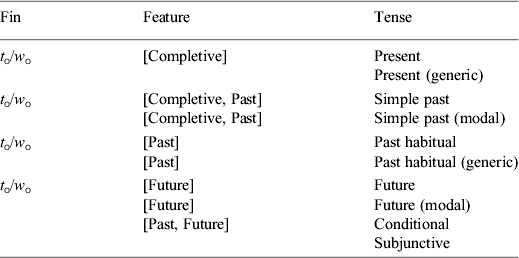
Several novel claims accompany this interpretation: that second-conjugation verbs are (usually) morphologically complex because they must obey a templatic constraint encoded on v; that habitual morphology and semantics represents an unmarked value, contrasting with [Completive]; that the distribution of irregular root allomorphs across tenses follows from their nature as fused [root–v] morphemes; that morphemes on C are marked for [Tense] even in the absence of overt past markers -r (except for three particles that consistently prove invisible), and that positional allomorphy conditioned by C (both for root allomorphs and DO realization) is in fact triggered by C's [Tense] feature, without the need for a [Dependent] feature. I have tried to be as explicit as possible about the theoretical premises for these conclusions, which are all empirically falsifiable. I am confident that dialectologically informed research on this fascinating language will show just how falsifiable they are.