






1 Introduction
Let
 $b\geq 2$
be a positive integer. Every real number x has a base b expansion
 $x=\lfloor x\rfloor +\sum _{n=0}^\infty \frac {c_n}{b^{n+1}}$
, and this expansion is unique if we adopt the convention that a tail of the coefficients
 $c_n$
cannot be equal to
 $b-1$
. Recall x is b-normal if for every
 $B=(i_0,\dots ,i_{\ell -1})\in b^{<\omega }$
we have that
 $\lim _{N \to \infty } \frac {1}{N} |I(x,B,N)| =\frac {1}{b^\ell }$
, where
 $I(x,B,N)=\{ i<N \colon (c_i,c_{i+1},\dots ,c_{i+\ell -1})=B\}$
. For a real number r, define real functions,
 $\pi _r$
and
 $\sigma _r,$
by
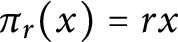 $\pi _r(x)=rx$
and
 $\sigma _r(x)=r+x$
. We let
 $\mathcal {N}(b)$
denote the set of reals
 $x,$
which are normal to base b. We let
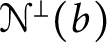
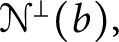
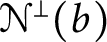
 $$ \begin{align*}{\mathcal{N}}^\perp(b) = \{ y \colon \forall x \in \mathcal{N}(b)\ (x+y)\in \mathcal{N}(b)\}. \end{align*} $$
1.1 Normality preserving functions
Let f be a function from
 $\mathbb {R}$
to
 $\mathbb {R}$
. We say that f preserves b-normality if
 $f(\mathcal {N}(b)) \subseteq \mathcal {N}(b))$
. We can make a similar definition for preserving normality with respect to the regular continued fraction expansion,
 $\beta $
-expansions, Cantor series expansions, the Lüroth series expansion, etc.
Several authors have studied b-normality preserving functions. They naturally arise in H. Furstenberg’s work on disjointness in ergodic theory [Reference Furstenberg14]. Agafonov [Reference Agafonov1], Kamae [Reference Kamae16], Kamae and Weiss [Reference Kamae and Weiss17], and Merkle and Reimann [Reference Merkle and Reimann22] studied b-normality, preserving selection rules. The situation for continued fractions is very different. Let
 $[a_1,a_2,a_3,\ldots ]$
be normal with respect to the continued fraction expansion. Heersink and Vandehey [Reference Heersink and Vandehey15] recently proved that for any integers
 $m \geq 2, k \geq 1$
, the continued fraction
 $[a_k,a_{m+k},a_{2m+k},a_{3m+k},\ldots ]$
is never normal with respect to the continued fraction expansion.
In 1949, Wall proved in his Ph.D. thesis [Reference Wall25] that for nonzero rational r the function
 $\pi _r$
is b-normality preserving for all b and that the function
 $\sigma _r$
is b-normality preserving for all b whenever r is rational. These results were also independently proved by Chang in 1976 [Reference Chang11]. Wall’s method relies on the well-known characterization that a real number x is normal in base b if and only if the sequence
 $(b^nx)$
is uniformly distributed mod
 $1$
[Reference Kuipers and Niederreiter20].
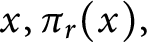
Doty, Lutz, and Nandakumar took a substantially different approach from Wall and strengthened his result. They proved in [Reference Doty, Lutz and Nandakumar13] that for every real number x and every nonzero rational number
 $r,$
the b-ary expansions of
 $x, \pi _r(x),$
and
 $\sigma _r(x)$
all have the same finite-state dimension and the same finite-state strong dimension. It follows that
 $\pi _r$
and
 $\sigma _r$
preserve b-normality. It should be noted that their proof uses different methods from those used by Wall and is unlikely to be proven using similar machinery.
Aistleitner generalized Wall’s result on
 $\sigma _r$
in [Reference Aistleitner6]. Suppose that q is a rational number and that the digits of the b-ary expansion of z are nonzero on a set of indices of density zero. He proved that the function
 $\sigma _{qz}$
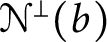
is b-normality preserving. Rauzy obtained a complete characterization of
 ${\mathcal {N}}^\perp (b)$
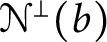
in [Reference Rauzy23]. Bernay used this characterization to prove that
 ${\mathcal {N}}^\perp (b)$
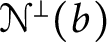
has zero Hausdorff dimension [Reference Bernay9]. One of the main results of this paper, stated in Corollary 1.3, is to obtain an exact determination of the descriptive set theoretic complexity of
 ${\mathcal {N}}^\perp (b)$
. A significance of this is explained at the end of Section 1.3 below.
Mendés France asked in [Reference Mauduit21] if the function
 $\pi _r$
preserves simple normality with respect to the regular continued fraction for every nonzero rational r. This was recently settled by Vandehey [Reference Vandehey24] who showed that
 $\frac {ax+b} {cx+d}$
is normal with respect to the continued fraction when x is normal with respect to the continued fraction expansion and integers
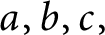 $a, b, c, $
and d satisfy
 $ad-bc \neq 0$
. The work was also done on the normality preserving properties of the functions
 $\pi _r$
and
 $\sigma _r$
for the Cantor series expansions by the first and third authors in [Reference Airey and Mance4] and additionally with Vandehey in [Reference Airey, Mance and Vandehey5]. However, these functions are not well understood in this context.
1.2 Descriptive complexity
In any topological space X, the collection of Borel sets
 $\mathcal {B}(X)$
is the smallest
 $\sigma $
-algebra containing the open sets. They are stratified into levels, the Borel hierarchy, by defining
 $\boldsymbol {\Sigma }^0_1=$
the open sets,
 $\boldsymbol {\Pi }^0_1= \neg \boldsymbol {\Sigma }^0_1= \{ X-A\colon A \in \boldsymbol {\Sigma }^0_1\}=$
the closed sets, and for
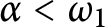 $\alpha <\omega _1$
we let
 $\boldsymbol {\Sigma }^0_\alpha $
be the collection of countable unions
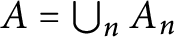 $A=\bigcup _n A_n$
where each
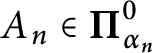 $A_n \in \boldsymbol {\Pi }^0_{\alpha _n}$
for some
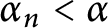 $\alpha _n<\alpha $
. We also let
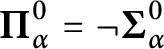 $\boldsymbol {\Pi }^0_\alpha =\neg \boldsymbol {\Sigma }^0_\alpha $
. Alternatively,
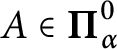 $A\in \boldsymbol {\Pi }^0_\alpha $
if
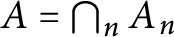 $A=\bigcap _n A_n$
where
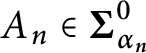 $A_n\in \boldsymbol {\Sigma }^0_{\alpha _n}$
where each
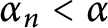 $\alpha _n<\alpha $
. We also set
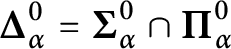 $\boldsymbol {\Delta }^0_\alpha = \boldsymbol {\Sigma }^0_\alpha \cap \boldsymbol {\Pi }^0_\alpha $
, in particular
 $\boldsymbol {\Delta }^0_1$
is the collection of clopen sets. For any topological space,
 $\mathcal {B}(X)=\bigcup _{\alpha <\omega _1} \boldsymbol {\Sigma }^0_\alpha = \bigcup _{\alpha <\omega _1}\boldsymbol {\Pi }^0_\alpha $
. All of the collections
 $\boldsymbol {\Delta }^0_\alpha $
,
 $\boldsymbol {\Sigma }^0_\alpha $
,
 $\boldsymbol {\Pi }^0_\alpha $
are pointclasses, that is, they are closed under inverse images of continuous functions. A basic fact (see [Reference Kechris18]) is that for any uncountable Polish space X, there is no collapse in the levels of the Borel hierarchy, that is, all the various pointclasses
 $\boldsymbol {\Delta }^0_\alpha $
,
 $\boldsymbol {\Sigma }^0_\alpha $
,
 $\boldsymbol {\Pi }^0_\alpha $
, for
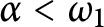 $\alpha <\omega _1$
, are all distinct. Thus, these levels of the Borel hierarchy can be used to calibrate the descriptive complexity of a set. We say a set
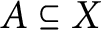 $A\subseteq X$
is
 $\boldsymbol {\Sigma }^0_\alpha $
(resp.
 $\boldsymbol {\Pi }^0_\alpha $
) hard if
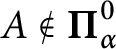 $A \notin \boldsymbol {\Pi }^0_\alpha $
(resp.
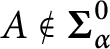 $A\notin \boldsymbol {\Sigma }^0_\alpha $
). This says A is “no simpler” than a
 $\boldsymbol {\Sigma }^0_\alpha $
set. We say A is
 $\boldsymbol {\Sigma }^0_\alpha $
-complete if
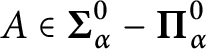 $A\in \boldsymbol {\Sigma }^0_\alpha -\boldsymbol {\Pi }^0_\alpha $
, that is,
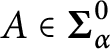 $A \in \boldsymbol {\Sigma }^0_\alpha $
and A is
 $\boldsymbol {\Sigma }^0_\alpha $
hard. This says A is exactly at the complexity level
 $\boldsymbol {\Sigma }^0_\alpha $
. Likewise, A is
 $\boldsymbol {\Pi }^0_\alpha $
-complete if
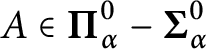 $A\in \boldsymbol {\Pi }^0_\alpha -\boldsymbol {\Sigma }^0_\alpha $
.
A fundamental result of Suslin (see [Reference Kechris18]) says that in any Polish space
 $\mathcal {B}(X)=\boldsymbol {\Delta }^1_1=\boldsymbol {\Sigma }^1_1 \cap \boldsymbol {\Pi }^1_1$
, where
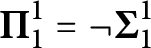 $\boldsymbol {\Pi }^1_1=\neg \boldsymbol {\Sigma }^1_1$
, and
 $\boldsymbol {\Sigma }^1_1$
is the pointclass of continuous images of Borel sets. Equivalently,
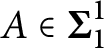 $A \in \boldsymbol {\Sigma }^1_1$
iff A can be written as
 $x \in A \leftrightarrow \exists y\ (x,y)\in B$
where
 $B \subseteq X\times Y$
is Borel (for some Polish space Y). Similarly,
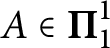 $A\in \boldsymbol {\Pi }^1_1$
iff it is of the form
 $x\in A \leftrightarrow \forall y\ (x,y)\in B$
for a Borel B. The
 $\boldsymbol {\Sigma }^1_1$
sets are also called the analytic sets, and
 $\boldsymbol {\Pi }^1_1$
the coanalytic sets. We also have
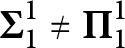 $\boldsymbol {\Sigma }^1_1\neq \boldsymbol {\Pi }^1_1$
for any uncountable Polish space.
Ki and Linton [Reference Ki and Linton19] proved that the set
 $\mathcal {N}(b)$
is
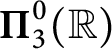 $\boldsymbol {\Pi }^0_3(\mathbb {R})$
-complete. Further work was done by Becher, Heiber, and Slaman [Reference Becher, Heiber and Slaman7] who settled a conjecture of Kechris, by showing that the set of absolutely normal numbers is
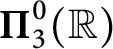 $\boldsymbol {\Pi }^0_3(\mathbb {R})$
-complete. Furthermore, Becher and Slaman [Reference Becher and Slaman8] proved that the set of numbers normal in at least one base is
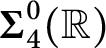 $\boldsymbol {\Sigma }^0_4(\mathbb {R})$
-complete. In another direction, the current authors with Kwietniak [Reference Airey, Jackson, Kwietniak and Mance2], [Reference Airey, Jackson, Kwietniak and Mance3] showed that for any dynamical system with a weak form of the specification property, the set of generic points for the system is
 $\boldsymbol {\Pi }^0_3$
-complete. This result generalizes the Ki–Linton result to many numeration systems other than the standard base b one.
K. Beros considered sets involving normal numbers in the difference hierarchy in [Reference Beros10]. Let
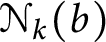 $\mathcal {N}_k(b)$
be the set of numbers normal of order k in base b. He proved that for
 $b\geq 2$
and
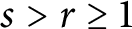 $s>r\geq 1$
, the set
 $\mathcal {N}_r(b) \backslash \mathcal {N}_s(b)$
is
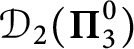 $\mathcal {D}_2(\boldsymbol {\Pi }_3^0)$
-complete (see Section 22.E of [Reference Kechris18] for a definition of the difference hierarchy). In addition, the set
 $\bigcup _k \mathcal {N}_{2k+1}(2) \backslash \mathcal {N}_{2k+2}(2)$
is shown to be
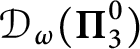 $\mathcal {D}_\omega (\boldsymbol {\Pi }_3^0)$
-complete.
1.3 Results of this paper
We are interested in determining the exact descriptive set theoretic complexity of
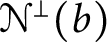 ${\mathcal {N}}^\perp (b)$
and some related sets. The definition of
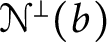 ${\mathcal {N}}^\perp (b)$
shows that
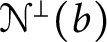 ${\mathcal {N}}^\perp (b)$
is
 $\boldsymbol {\Pi }^1_1$
, since it involves a universal quantification. It is not immediately clear if
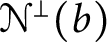 ${\mathcal {N}}^\perp (b)$
is a Borel set, but this in fact follows from a result of Rauzy. Specifically, Rauzy [Reference Rauzy23] characterized
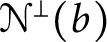 ${\mathcal {N}}^\perp (b)$
in terms of an entropy-like condition called the noise. We recall this condition and associated notation from [Reference Rauzy23]. For any positive integer length
 $\ell $
, let
 $\mathcal {E}_\ell $
denote the set of functions from
 $b^\ell $
to b, and we let
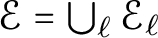 $\mathcal {E}=\bigcup _\ell \mathcal {E}_\ell $
. We call an
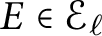 $E\in \mathcal {E}_\ell $
a block function of width
 $\ell $
. As in [Reference Rauzy23] we set, for
 $x \in \mathbb {R}$
,
 $$ \begin{align*} \beta_\ell(x,N)= \inf\limits_{E\in \mathcal{E}_\ell} \frac{1}{N} \sum\limits_{n<N} \inf \{ 1, |c_n-E(c_{n+1},\dots,c_{n+\ell})|\}, \end{align*} $$
where
 $c_0,c_1,\dots $
is the (fractional part) of the base b expansion of x.
We also let for
 $E\in \mathcal {E}$
 $$ \begin{align*} \beta_E(x,N)= \frac{1}{N} \sum\limits_{n<N} \inf \{ 1, |c_n-E(c_{n+1},\dots,c_{n+\ell})|\}. \end{align*} $$
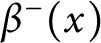
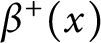
We then define the lower and upper noises
 ${\beta }^{-}(x)$
,
 ${\beta }^{+}(x)$
of x by:
 $$ \begin{align*}{\beta}^{-}(x)=\lim\limits_{\ell \to \infty} {\beta}^{-}_\ell(x),\end{align*} $$
where
 $$ \begin{align*}{\beta}^{-}_\ell(x)=\liminf\limits_{N\to \infty} \beta_\ell(x,N).\end{align*} $$
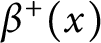
The upper noise
 ${\beta }^{+}(x)$
is defined similarly using
 $$ \begin{align*}{\beta}^{+}(x)=\lim\limits_{\ell\to \infty} {\beta}^{+}_\ell(x),\end{align*} $$
where
 $$ \begin{align*}{\beta}^{+}_\ell(x)=\limsup\limits_{N\to \infty} \beta_\ell (x,N).\end{align*} $$
If
 ${\beta }^{-}(x)={\beta }^{+}(x)$
, we set
 $\beta (x)$
to be the common value. For a fixed
 $E\in \mathcal {E}$
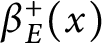
we also let
 $$ \begin{align*}{\beta}^{-}_E(x)=\liminf\limits_{N\to \infty} \beta_E(x,N),\end{align*} $$
and similarly for
 ${\beta }^{+}_E(x)$
.
Rauzy showed that
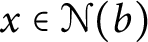 $x\in \mathcal {N}(b)$
iff it has the maximal possible noise in that
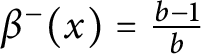 ${\beta }^{-}(x)=\frac {b-1}{b}$
. Furthermore,
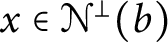 $x \in {\mathcal {N}}^\perp (b)$
iff it has minimal possible noise in that
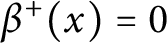 ${\beta }^{+}(x)=0$
.
It is, therefore, natural to ask for any
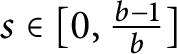 $s\in [0,\frac {b-1}{b}]$
, what are the complexities of the lower and upper noise sets associated with s. Specifically, we introduce the following four sets.
Definition 1.1 Let
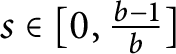 $s \in [0,\frac {b-1}{b}]$
. Let
 $$ \begin{align} A_1(s)&= \{ x \colon {\beta}^{-}(x) \leq s\},\quad A_2(s)=\{ x \colon {\beta}^{-}(x) \geq s\} \nonumber\\ A_3(s)&=\{x \colon {\beta}^{+}(x) \leq s\},\quad A_4(s)=\{ x \colon {\beta}^{+}(x) \geq s\}. \end{align} $$
Finally, we let
 $$ \begin{align*} L(s)&=A_1(s)\cap A_2(s)= \{ x \colon {\beta}^{-}(x) =s\}\\ U(s)&= A_3(s)\cap A_4(s)=\{ x \colon {\beta}^{+}(x)=s\}. \end{align*} $$
Thus,
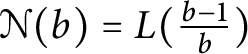 $\mathcal {N}(b)= L(\frac {b-1}{b})$
, and
 ${\mathcal {N}}^\perp (b)=U(0)$
. The Ki–Linton result shows that
 $\mathcal {N}(b)$
, and thus
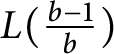 $L(\frac {b-1}{b})$
is
 $\boldsymbol {\Pi }^0_3$
-complete for any base b. Recall also the Becher–Slaman result, which shows that the set of reals that are normal to some base b forms a
 $\boldsymbol {\Sigma }^0_4$
-complete set.
We have the following complexity results.
Theorem 1.2 For any
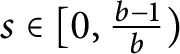 $s \in [0,\frac {b-1}{b})$
, the set
 $A_1(s)$
is
 $\boldsymbol {\Pi }^0_4$
-complete and the set
 $A_3(s)$
is
 $\boldsymbol {\Pi }^0_3$
-complete. For any
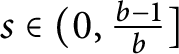 $s \in (0,\frac {b-1}{b} ]$
, the set
 $A_2(s)$
is
 $\boldsymbol {\Pi }^0_3$
-complete, and the set
 $A_4(s)$
is
 $\boldsymbol {\Pi }^0_2$
-complete. For
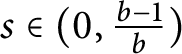 $s\in (0,\frac {b-1}{b})$
, the set
 $L(s)$
is
 $\boldsymbol {\Pi }^0_4$
-complete, and the set
 $U(s)$
is
 $\boldsymbol {\Pi }^0_3$
-complete.
As a corollary, we obtain the Ki–Linton result as well as the determination of the exact complexity of
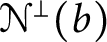 ${\mathcal {N}}^\perp (b)$
.
Corollary 1.3 The sets
 $\mathcal {N}(b)$
and
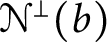 ${\mathcal {N}}^\perp (b)$
are both
 $\boldsymbol {\Pi }^0_3$
-complete.
Proof We have
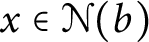 $x \in \mathcal {N}(b)$
iff
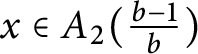 $x \in A_2(\frac {b-1}{b})$
, and
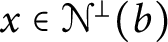 $x \in {\mathcal {N}}^\perp (b)$
iff
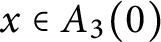 $x \in A_3(0)$
, so the result follows immediately from Theorem 1.2. ▪
Remark 1.4 In defining the noise, we can also use the variation
 $$ \begin{align*} \beta_E(x,N)= \frac{1}{N} \sum\limits_{\ell<n<N} \inf \{ 1, |c_n-\varphi(c_{n-\ell},\dots,c_{n-1})|\}, \end{align*} $$
that is, the block function predicts the next digit rather than the previous digit. In this case, we must start the sum at
 $\ell +1$
rather than
 $1$
, but this does not affect any of the limits used in defining
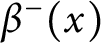 ${\beta }^{-}(x)$
or
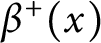 ${\beta }^{+}(x)$
. The results of this paper hold with either variation of the definition, although we most frequently use this alternate version.
Remark 1.5 In proving Theorem 1.2, we will work with x in the sequence space
 $X=b^\omega \cap G$
where G is the set of
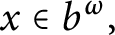 $x \in b^\omega ,$
which do not end in a tail of
 $b-1$
’s. This is a Polish space as
 $b^\omega $
is a compact Polish space (with the usual product of discrete topologies on
 $\{0,1,\dots ,b-1\}$
) and G is a
 $G_\delta $
(that is,
 $\boldsymbol {\Pi }^0_2$
) subset of
 $b^\omega $
. This is permissible as the map
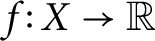 $f \colon X \to \mathbb {R}$
given by
 $f(c_0,c_1,\dots )=\sum \frac {c_n}{b^n}$
is continuous. So, for example, given that
 $B_3(s)$
is
 $\boldsymbol {\Pi }^0_3$
-complete, where
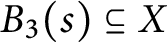 $B_3(s)\subseteq X$
is defined as
 $A_3(s)$
, except we consider directly
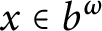 $x \in b^\omega $
, then it follows that
 $A_3(s)$
is
 $\boldsymbol {\Pi }^0_3$
-complete. If
 $A_3(s)$
were in
 $\boldsymbol {\Sigma }^0_3$
, then so would be
 $B_3(s)$
since
 $x \in B_3(s)\leftrightarrow f(x)\in A_3(s)$
, that is,
 $B_3(s)=f^{-1} (A_3(s))$
.
We remark on the significance of complexity classifications, such as Theorem 1.2. Aside from the intrinsic interest to descriptive set theory, the results of this form can be viewed as ruling out the existence of further theorems that would reduce the complexity of the sets. For example, Rauzy’s theorem reduces the complexity of
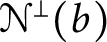 ${\mathcal {N}}^\perp (b)$
from
 $\boldsymbol {\Pi }^1_1$
to
 $\boldsymbol {\Pi }^0_3$
. The fact that
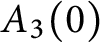 $A_3(0)$
is
 $\boldsymbol {\Pi }^0_3$
-complete tells us that there cannot be other theorems that result in a yet simpler characterization of
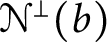 ${\mathcal {N}}^\perp (b)$
.
Lastly, we wish to approximate the Hausdorff dimension of the sets
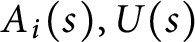 $A_i(s), U(s)$
, and
 $L(s)$
. Put
 $H(s) = -s\log s - (1-s) \log (1-s)$
.
Theorem 1.6 For
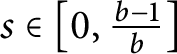 $s \in \left [ 0,\frac {b-1}{b} \right ]$
, we have
 $$ \begin{align*} \frac{1}{\log b} H(s) + \frac{\log(b-1)}{\log b} s \leq &\dim_H(A_1(s)) \leq \frac{1}{\log b} H(s) + s \\ &\dim_H(A_2(s)) = 1 \\ \frac{1}{\log b} H(s) + \frac{\log(b-1)}{\log b} s \leq &\dim_H(A_3(s)) \leq \frac{1}{\log b} H(s) + s \\ &\dim_H(A_4(s)) = 1. \end{align*} $$
Furthermore,
 $$ \begin{align*} \frac{1}{\log b} H(s) + \frac{\log(b-1)}{\log b} s \leq &\dim_H(U(s)) \leq \frac{1}{\log b} H(s) + s \\ \frac{1}{\log b} H(s) + \frac{\log(b-1)}{\log b} s \leq &\dim_H(L(s))\leq \frac{1}{\log b} H(s) + s. \end{align*} $$
2 A property of noise
Before proving the main theorem in Section 4, we show a property of the noise, which shows that one must be careful when attempting to construct reals with a desired lower-bound for the noise. If we have a set
 $A \subseteq \omega $
with density d, then for almost all
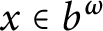 $x \in b^\omega $
, if
 $x_A$
is the result of copying x to the set A and taking value
 $0$
off of A, then we easily have that
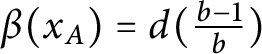 $\beta (x_A)=d(\frac {b-1}{b})$
. The next lemma shows that it might be possible to lower the noise by taking nonzero values off of A.
Theorem 2.1 There is a periodic set
 $A \subseteq \omega $
, say with period p and density
 $\frac {d}{p}$
, such that if
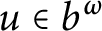 $u\in b^\omega $
satisfies
 $u\restriction (\omega -A)=0$
and
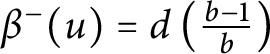 ${\beta }^{-}(u)=d \left ( \frac {b-1}{b}\right )$
, then there is a
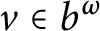 $v \in b^\omega $
with
 $v\restriction A=u\restriction A$
and
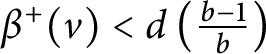 ${\beta }^{+}(v)< d \left ( \frac {b-1}{b}\right )$
.
Proof Fix a positive integer k, and let
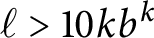 $\ell> 10 k b^k$
. Let A be the set with period
 $\ell +k$
with
 $A\cap [0, \ell +k-1)=\{ \ell ,\ell +1,\dots ,\ell +k-1\}$
. Suppose
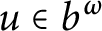 $u \in b^\omega $
with
 $ u \restriction (\omega -A)=0$
and
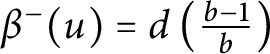 ${\beta }^{-}(u)= d\left ( \frac {b-1}{b}\right )$
, where
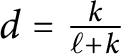 $d= \frac {k}{\ell +k}$
is the density of A. We show that there is a
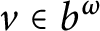 $v \in b^\omega $
with
 $v \restriction A= u\restriction A$
with
 ${\beta }^{+}(v) <{\beta }^{-}(u)$
.
Consider the nth block
 $B_n$
of digits of length
 $\ell +k$
, that is
 $B_n=[ n(\ell +k), (n+1)(\ell +k) )$
. Let
 $B^{\prime }_n=[ n(\ell +k)+\ell , (n+1)(\ell +k) )$
be the last k digits of the block
 $B_n$
. The idea of the following argument is simply to code
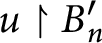 $u \restriction B^{\prime }_n$
via the position of a single digit in
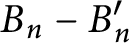 $B_n-B^{\prime }_n$
. If
 $s \in b^k$
, let
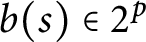 $b(s)\in 2^p$
, where
 $p={\lceil k \log _2(b) \rceil +1}$
be the binary representation of the integer represented by the base b expansion s, where we put the least significant digits first. Let
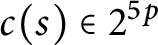 $c(s)\in 2^{5p}$
be the result of translating the digits of
 $b(s)$
according to
 $0 \mapsto 11001$
,
 $1 \mapsto 11011$
. Note that
 $c(s)$
will never have more than four consecutive
 $1$
’s.
Let
 $w=2(5p+k+8)$
. We will describe a particular block function
 $E \colon b^w\to b$
and
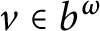 $v \in b^\omega $
as above. We describe
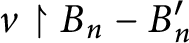 $v \restriction B_n-B^{\prime }_n$
, which only depends on
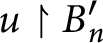 $u \restriction B^{\prime }_n$
. We say a sequence
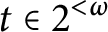 $t \in 2^{<\omega }$
is canonical if it is a subsequence of a sequence of the form
 $t_0{\kern-1pt}^{\smallfrown } t_1{\kern-1pt}^{\smallfrown } \cdots{\kern-1pt}^{\smallfrown } t_r,$
where
 $t_i= a_i{\kern-1pt}^{\smallfrown } 0{\kern-1pt}^{\smallfrown } b_i{\kern-1pt}^{\smallfrown } 0^{\smallfrown } 11111; a_i=c(b_i);$
and
 $b_i$
is the k-digit base b expansion of i (with least significant digit first). We assume here that
 $r \leq b^k$
. Thus, a canonical sequence is a way of “counting” from
 $0$
to r.
The block function E operates as follows. If
 $s \in b^w$
is the constant
 $0$
sequence, then
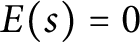 $E(s)=0$
. Suppose the first nonzero digit (reading from the left) in s occurs at position p (with
 $p=0$
being the start of s). E then checks to see if s is consistent with being an interval of the form
 $s= t\restriction [a, a+w-1]$
where t is a canonical sequence, or consistent with being of the form
 $s=t' \restriction [a, a+w-1]$
where
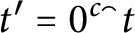 $t'= 0^c{\kern-1pt}^{\smallfrown } t$
for some canonical sequence t, and integer
 $c \geq 0$
. It is easy to see that these two cases are disjoint, and the value of t, or of
 $t'$
, is uniquely determined (we use here the fact that
 $w/2$
is greater than the distance between consecutive occurrences of
 $11111$
in a canonical sequence). In either case, the value
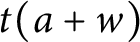 $t(a+w)$
or
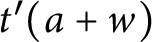 $t'(a+w)$
is uniquely determined. In either of these cases, we let
 $E(s)$
be the corresponding value
 $E(s)=t(a+w)$
or
 $E(s)=t'(a+w)$
. If s is not of one of these forms, we set
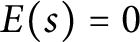 $E(s)=0$
. This completes the definition of E.
We now define
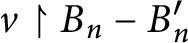 $v \restriction B_n-B^{\prime }_n$
. This consists of a canonical sequence t starting at the unique position
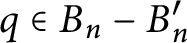 $q \in B_n-B^{\prime }_n$
so that the k digits in
 $B^{\prime }_n$
correspond to the substring
 $b_i$
of some
 $t_i$
in t. This completes the definition of v.
We claim that for each
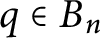 $q \in B_n$
, if we let
 $v_q= v \restriction [q-w,q-1]$
, then
 $$ \begin{align*} | \{ q \in B_n\colon E(v_q)\neq v(q) \}| \leq 2. \end{align*} $$
To see this, first note that E will predict a
 $0$
at the start of the block
 $B_n$
(corresponding to the
 $0$
after a
 $b_i$
), which is the correct value, and then predict a
 $1$
(corresponding to the start of a
 $11111$
sequence) at the next position, which is incorrect; note that
 $B_n$
is large enough so that the first
 $1$
in it is far to the right of the start of the block. Given the two initial
 $0$
’s in
 $B_n$
, E will continue to predict
 $0$
until E reaches the point
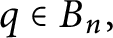 $q \in B_n,$
which is the first
 $1$
. At position q, E will also predict a
 $0$
, which is incorrect. After position q, E will make correct predictions through the end of
 $B^{\prime }_n$
, as
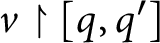 $v \restriction [q, q']$
is canonical, where
 $q'=(n+1)(\ell +k)-1$
is the last position of
 $B^{\prime }_n$
.
Thus,
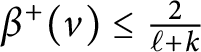 ${\beta }^{+}(v)\leq \frac {2}{\ell +k}$
, while
 ${\beta }^{-}(u) = d\left (\frac {b-1}{b}\right ) = \frac {k}{l+k} \frac {b-1}{b}$
. So, for
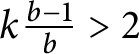 $k \frac {b-1}{b}>2$
, we may choose
 $\ell $
large enough so that the above construction of v works, and we then have
 ${\beta }^{+}(v) < {\beta }^{-}(u)$
.▪
3 Lemmas on noise
The following lemmas give lower-bounds on the upper-noise for sequences obtained by a certain construction. These lemmas will be used several times in the proofs of the statements in Theorem 1.2.
Lemma 3.1 Let
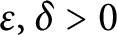 $\epsilon , \delta>0$
. Then, there is a
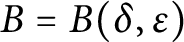 $B=B(\delta ,\epsilon )$
such that if
 $a<a'\leq a''\in \mathbb {N}$
and
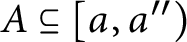 $A\subseteq [a,a'')$
with
 $|A \cap [a,a')| \geq B$
, then for any
 $E\in \mathcal {E}$
,
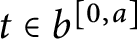 $t\in b^{[0,a]}$
, and
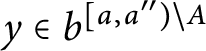 $y \in b^{[a,a'')\setminus A}$
, we have
 $$ \begin{align*} \frac{1}{b^{|A|}} \Bigg| \Bigg\{ s \in b^{|A|} & \colon \forall c\in [a',a'']\ \Big| \Big\{ i <|A\cap [a,c]| \colon E(t ^{\smallfrown} s' \restriction [p_i-k,p_i-1])\neq s(p_i) \Big\} \Big| \\ & \geq |A \cap [a,c]| \left( \frac{b-1}{b} -\delta\right) \Bigg\} \Bigg| \geq 1-\epsilon, \end{align*} $$
where
 $p_i$
denotes the ith element of A,
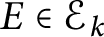 $E\in \mathcal {E}_k$
, and
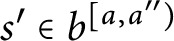 $s'\in b^{[a,a'')}$
is defined by
 $$ \begin{align*} s'(n)=\begin{cases} s(i) &\text{if } n \text{ is the }i\text{th element of } A \\ y(n) & \text{if } n \in [a,a'')\setminus A . \end{cases} \end{align*} $$
We assume here that
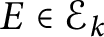 $E\in \mathcal {E}_k$
where
 $k \leq a$
so that
 $E(t{\kern-1pt}^{\smallfrown } s' \restriction [p_i-k,p_i-1])$
makes sense.
Proof We let
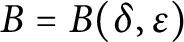 $B=B(\delta ,\epsilon )$
be large enough so that for any
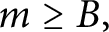 $m \geq B,$
we have
 $$ \begin{align*} \frac{1}{b^m} \Bigg| \Bigg\{ s \in b^m\colon \forall r \in [B,m]\ \Big| \Big\{ i<r \colon s(i)\neq 0 \Big\} \Big| \geq r\left(\frac{b-1}{b}-\delta\right) \Bigg\} \Bigg| \geq (1-\epsilon). \end{align*} $$
This is possible by the strong law of large numbers.
Fix
 $a<a'\leq a''$
and
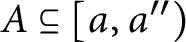 $A\subseteq [a,a'')$
, with
 $|A\cap [a,a')| \geq B$
. Let
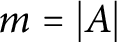 $m=|A|$
. Fix
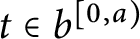 $t \in b^{[0,a)}$
and
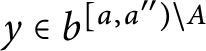 $y \in b^{[a,a'')\setminus A}$
. For any
 $s \in b^A$
, we let
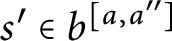 $s' \in b^{[a,a'']}$
be as in the statement of the lemma. Let
 $\tau \colon b^m\to b^m$
be given by:
 $$ \begin{align*} \tau(s)(i)=E(t^{\smallfrown} s'\restriction[ p_i-k, p_i-1])-s'(p_i) \mod b, \end{align*} $$
where again
 $p_i$
denotes the ith element of A. Clearly,
 $\tau $
is a bijection from
 $b^{m}$
to
 $b^{m}$
. So, the number of
 $s\in b^A$
such that
 $$ \begin{align*} \forall c \geq p_B\ \Big| \Big\{ i < | A\cap [a,c]| & \colon E(t ^{\smallfrown} s' \restriction [p_i-k,p_i-1])\neq s(p_i) \Big\} \Big| \\ & \geq |A \cap [a,c]| \left( \frac{b-1}{b} -\delta\right) \end{align*} $$
is equal to the number of
 $s \in b^m$
such that
 $$ \begin{align*} \forall r \in [B,m]\ \Big| \Big\{ i<r \colon s(i)\neq 0 \Big\} \Big| \geq r(\frac{b-1}{b}-\delta). \end{align*} $$
From the choice of B, the number of such s is at least
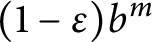 $(1-\epsilon )b^m$
. Since the set of
 $s\in b^A$
having the property as in the statement of the lemma is a superset of this set, the result follows. ▪
As an immediate consequence of Lemma 3.1, we have the following.
Lemma 3.2 Let
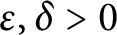 $\epsilon , \delta>0$
. Then, for any integer
 $\ell $
there is a
 $B=B(\delta ,\epsilon ,\ell )$
such that if
 $a<a'\leq a''$
,
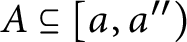 $A\subseteq [a,a'')$
, and
 $|A| \cap [a, a')|\geq B(\delta ,\epsilon , \ell )$
, and
 $y_1,\dots ,y_\ell \in b^{[a,a'')\setminus A}$
, then
 $$ \begin{align*} \frac{1}{b^{|A|}} & \Bigg| \Bigg\{ s \in b^{|A|} \colon \forall t \in b^{[0,a)}\ \forall k\leq \ell\ \forall E\in \mathcal{E}_k \ \forall j \leq \ell\ \forall c \in [a',a'']\ \Big| \Big\{ i <|A\cap [a,c]|\colon \\ & E(t ^{\smallfrown} s^{\prime}_j \restriction [p_i-k,p_i-1])\neq s(p_i) \Big\} \Big| \geq |A\cap [a,c]| \left( \frac{b-1}{b} -\delta\right) \Bigg\} \Bigg| \geq 1-\epsilon, \end{align*} $$
where
 $p_i$
denotes the ith element of A, and
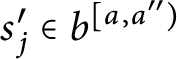 $s^{\prime }_j\in b^{[a,a'')}$
is defined by
 $$ \begin{align*} s^{\prime}_j(n)=\begin{cases} s(i) &\text{if } n \text{ is the }i\text{th element of } A \\ y_j(n) & \text{if } n \in [a,a'')\setminus A . \end{cases} \end{align*} $$
We assume here that
 $k \leq a$
so that
 $E(t{\kern-1pt}^{\smallfrown } s' \restriction [p_i-k,p_i-1])$
makes sense.
Proof There are at most
 $\ell \cdot b^{b^\ell }$
many
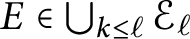 $E\in \bigcup _{k \leq \ell } \mathcal {E}_\ell $
. There are also
 $\ell $
many of the
 $y_j$
to consider, and
 $b^{\ell }$
many possible t (it is only the last
 $\ell $
many digits of t that are relevant). We apply Lemma 3.1 using
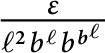 $\frac {\epsilon }{\ell ^2 b^\ell b^{b^\ell }}$
in place of the
 $\epsilon $
there. The resulting
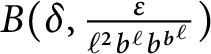 $B(\delta , \frac {\epsilon }{\ell ^2b^\ell b^{b^\ell }})$
works as the value of
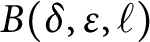 $B(\delta ,\epsilon ,\ell )$
for Lemma 3.2. ▪
By applying the Borel–Cantelli Lemma to Lemma 3.2, we obtain the following version for infinite
 $A\subseteq \omega $
.
Lemma 3.3 Let
 $A \subseteq \omega $
be an infinite set, and
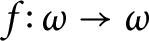 $f\colon \omega \to \omega $
. Suppose
 $b_0<b_1<\cdots $
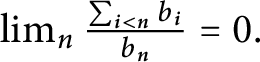
is a sequence satisfying:
-
(1)
 $\lim _n \frac {\sum _{i<n}b_i}{b_n}= 0.$
-
(2) For all large enough j we have
$|A\cap [b_{j-1},b_j)|\geq B(j)=B(\delta _j,\frac {1}{j^2},f(j))$
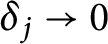
where
$\delta _j \to 0$
, where B is as in Lemma 3.2.

Suppose that for each j we have sequences
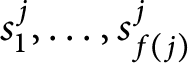 $s^j_1,\dots , s^j_{f(j)}$
in
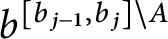 $b^{[b_{j-1},b_j] \setminus A}$
. Then, for almost all
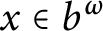 $x \in b^\omega $
we have that for all large enough j that
 $$ \begin{align*} \forall t \in & b^{[0,b_{j-1})}\ \forall E\in \bigcup_{j'\leq j} \mathcal{E}_{j'}\ \forall k \leq f(j)\ \forall c \in [b_{j-1},b_j) \text{ with } |A\cap [b_{j-1},c]| \geq B(j)\\ & \text{we have: } \Big| \Big\{ i\in [b_{j-1},c] \colon E(t ^{\smallfrown} s_{j,k} \restriction [p_i-j',p_i-1])\neq s_{j,k}(p_i) \Big\} \Big| \\ &\quad \qquad \geq | A\cap [b_{j-1},c]| \left( \frac{b-1}{b} - \delta_j \right), \end{align*} $$
where
 $p_i$
denotes the ith element of A,
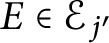 $E\in \mathcal {E}_{j'}$
, and
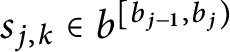 $s_{j,k}\in b^{[b_{j-1},b_j)}$
is defined by
 $$ \begin{align*} s_{j,k}(n)=\begin{cases} x(i) &\text{if } n \text{ is the }i\text{th element of } A \\ s^j_k(n) & \text{if } n \in [b_{j-1},b_j)\setminus A . \end{cases} \end{align*} $$
Proof Applying Lemma 3.2 with
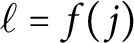 $\ell =f(j)$
,
 $\delta =\delta _j$
, and
 $\epsilon =\frac {1}{j^2}$
, we get
 $B(j)=B(\delta _j,\frac {1}{j^2},f(j))$
. Then, from Lemma 3.2 we have:
 $$ \begin{align*} &\frac{1}{b^m} \Bigg| \bigg\{ s \in b^m \colon \forall t \in b^{[0,b_{j-1})}\ \forall E\in \bigcup_{j'\leq j} \mathcal{E}_{j'}\ \forall k \leq f(j)\ \forall c \in [b_{j-1},b_j] \text{ with }\\ & |A\cap [b_{j-1},c]| \geq B(j)\ \text{ we have: } \Big| \Big\{ i\in [b_{j-1},c] \colon E(t ^{\smallfrown} s_{j,k} \restriction [p_i-j',p_i-1])\neq s_{j,k}(p_i) \Big\} \Big| \\ & \qquad \geq |A\cap [b_{j-1},c]| \left( \frac{b-1}{b} - \delta_j \right) \Bigg\} \Bigg| \geq 1-\frac{1}{j^2}, \end{align*} $$
where
 $m=|A\cap [b_{j-1},b_j)|$
,
 $p_i$
and
 $s_{j,k}$
are as above, and
 $$ \begin{align*} s_{j,k}(n)=\begin{cases} s(i) &\text{if } n \text{ is the }i\text{th element of } A\cap [b_{j-1},b_j) \\ s^j_k(n) & \text{if } n \in [b_{j-1},b_j)\setminus A . \end{cases} \end{align*} $$
Since
 $\sum \frac {1}{j^2}$
converges, the result now follows from Borel–Cantelli. ▪
As an immediate corollary of Lemma 3.3 we have the following.
Corollary 3.4 Let
 $A \subseteq \omega $
be an infinite set with upper density d, and let
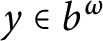 $y \in b^\omega $
. Then, for almost all (with respect to Bernoulli measure on
 $b^\omega $
)
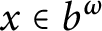 $x \in b^\omega $
, if
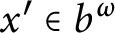 $x' \in b^\omega $
is defined by
 $$ \begin{align*} x'(n)=\begin{cases} x(k) &\text{if } n \text{ is the }k\text{th element of } A \\ y(k) & \text{if } n \text{ is the }k\text{th element of } \omega-A \end{cases}, \end{align*} $$
then
 ${\beta }^{+}(x')\geq d \left ( \frac {b-1}{b}\right )$
.
The reader should contrast Corollary 3.4 with Theorem 2.1. For a given x, we may be able to find a y so that (in the notation of Corollary 3.4)
 $\beta ^+(x') < d \left ( \frac {b-1}{b} \right )$
, but for a given y we have that for almost all x this won’t happen according to Corollary 3.4.
4 Proof of Theorem 1.2
The upper bounds for the complexities of the sets of Theorem 1.2 all follow by straightforward computations from the definitions of these sets. For example, consider
 $A_1(s)$
. We have
 $$ \begin{align*} x \in A_1(s)& \leftrightarrow \forall \epsilon \in \mathbb{Q}^+\ \exists m\ \forall \ell \geq m\ {\beta}^{-}_\ell(x)\leq s+\epsilon\\ &\leftrightarrow \forall \epsilon \in \mathbb{Q}^+\ \exists m\ \forall \ell \geq m\ \forall k\ \exists N \geq k\ (\beta_\ell(x,N)\leq s+\epsilon) \end{align*} $$
Since for fixed
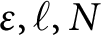 $\epsilon , \ell , N$
the set
 $\{ x\colon \beta _\ell (x,N)\leq \epsilon \}$
is clopen, this shows that
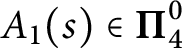 $A_1(s)\in \boldsymbol {\Pi }^0_4$
.
We next turn to the lower-bounds for the complexities of the sets in Theorem 1.2. We first present the easiest argument that
 $A_4(s)$
is
 $\boldsymbol {\Pi }^0_2$
-hard, then show that sets
 $A_2(s)$
and
 $A_3(s)$
are
 $\boldsymbol {\Pi }^0_3$
-hard, and then finally show that
 $A_2(s)$
is
 $\boldsymbol {\Pi }^0_4$
-hard. As we progress through the sets, we comment on what the new difficulties are and the method for overcoming them.
4.1 Lower bound for
$A_4(s)$

Lemma 4.1 For any
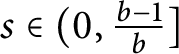 $s \in (0,\frac {b-1}{b}]$
, the set
 $A_4(s)$
is
 $\boldsymbol {\Pi }^0_2$
-complete.
Proof Let
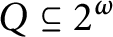 $Q \subseteq 2^\omega $
be the set
 $Q=\{ z \colon \forall i\ \exists j \geq i\ z(j)=1\}$
. It is easy to see that Q is
 $\boldsymbol {\Pi }^0_2$
-complete (see, for example, Section 23.A of [Reference Kechris18]). Let
 $A \subseteq \omega $
be a set of density
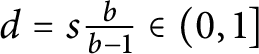 $d=s \frac {b}{b-1}\in (0,1]$
. From Lemma 3.3 (using, say, y to be the constant
 $0$
sequence), let
 $b_0<b_1<\cdots $
be as in the lemma, let
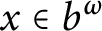 $x\in b^\omega $
be in the measure one set as in the statement of the lemma, and let
 $x'$
be also as in the statement of the lemma. Let
 $B_j=[b_{j-1},b_j).$
Define
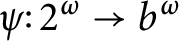 $\psi \colon 2^\omega \to b^\omega $
by:
 $$ \begin{align*} \psi(z)(k)= \begin{cases} x'(k) &\text{ if } \exists j\ (k\in B_j \wedge z(j)=1)\\ 0 & \text{ otherwise. } \end{cases} \end{align*} $$
If
 $z \in Q$
, then there are infinitely many j such that
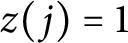 $z(j)=1$
and thus
 $\psi (z)\restriction B_j=x'\restriction B_j$
. From the properties of
 $x'$
from Lemma 3.3, for any
 $\epsilon>0$
there is a tail of these j for which
 $$ \begin{align*} \forall E \in \mathcal{E}_j\ \frac{1}{|B_j|}| \{ k \in B_j \colon E(\psi(z)(k-j), \dots, \psi(z)(k-1)) \neq \psi(z)(k) \}| \geq s-\epsilon. \end{align*} $$
Thus, for any
 $E \in \mathcal {E},$
we have that
 $$ \begin{align*} \limsup\limits_j \frac{1}{|B_j|}| \{ k \in B_j \colon E(\psi(z)(k-j), \dots, \psi(z)(k-1)) \neq \psi(z)(k) \}| \geq s. \end{align*} $$
Since
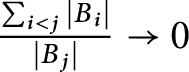 $\frac {\sum _{i <j}|B_i|}{|B_j|} \to 0$
with j, it follows that
 ${\beta }^{+} (\psi (z))\geq s$
, so
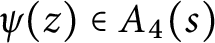 $\psi (z) \in A_4(s)$
.
If
 $z \notin Q$
, then
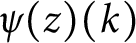 $\psi (z)(k)$
is
 $0$
for all large enough k. This gives that
 ${\beta }^{+}(\psi (z))=0 <s$
, and so
 $\psi (z) \notin A_4(s)$
.▪
4.2 Lower bound for
$A_3(s)$

The next lemma suffices to show that
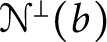 ${\mathcal {N}}^\perp (b)$
is
 $\boldsymbol {\Pi }^0_3$
-complete. We give an alternate, somewhat simpler, proof of the lemma after the current proof. However, the first proof more resembles the proofs of the other parts of Theorem 1.2 to follow.
Lemma 4.2 For any
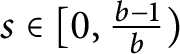 $s \in [0,\frac {b-1}{b})$
,
 $A_3(s)$
is
 $\boldsymbol {\Pi }^0_3$
-hard.
Proof For
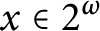 $x \in 2^\omega $
, we view x as coding the sequence
 $x_0,x_1,\dots $
in
 $2^\omega $
where
 $x_i(j)=x(\langle i,j \rangle )$
. Here
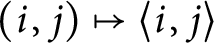 $(i,j)\mapsto \langle i,j\rangle $
is a bijection between
 $\omega \times \omega $
and
 $\omega $
. We let
 $P=\{ x \colon \forall i\ \exists j_0\ \forall j \geq j_0\ x_i(j)=0\}$
. It is well-known that P is
 $\boldsymbol {\Pi }^0_3$
-complete (see Section 23.A of [Reference Kechris18], specifically the set
 $P_3$
on p. 179).
We define a partition of
 $\omega $
into disjoint arithmetical sequences as follows. Let
 $I_0=\{ n\colon n \equiv 0 \mod 2\}$
, be the set of even integers, and, in general, let
 $I_n=\{ \ell \colon \ell \equiv 2^n -1 \mod 2^{n+1}\}$
. The
 $\{ I_n\}$
are pairwise disjoint arithmetic progressions, and
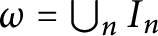 $\omega =\bigcup _n I_n$
. Note that
 $\omega -\bigcup _{k \leq m}I_k= \{ \ell \colon \ell \equiv 2^{m+1}-1 \mod 2^{m+1}\}$
. Each
 $I_n$
is a periodic set with density
 $\frac {1}{2^{n+1}}$
.
Fix an infinite set
 $J\subseteq \omega $
such that
 $\frac {b-1}{b}\left (1-\sum _{i \in J} \frac {1}{2^{i+1}}\right )=s$
(this corresponds to picking a base-2 expansion for
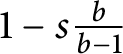 $1-s\frac {b}{b-1}$
that has infinitely many 1s). Let
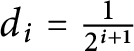 $d_i=\frac {1}{2^{i+1}}$
be the density of
 $I_i$
. Let
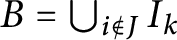 $B=\bigcup _{i \notin J}I_k$
and let
 $d_B=1-\sum _{i \in J}\frac {1}{2^{k+1}}=s\frac {b}{b-1}$
be the density of B.
We will take two fast-growing sequences
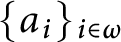 $\{ a_i\}_{i \in \omega }$
and
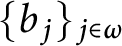 $\{ b_j\}_{j \in \omega }$
of natural numbers (the
 $a_i$
will grow faster than the
 $b_j$
). We will then set
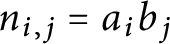 $n_{i,j}=a_ib_j$
. Moreover, let
 $B_{i,j}=[n_{i,j-1},n_{i,j})$
and
 $m_{i,j}=|B_{i,j} \cap I_i|$
. Note that
 $\left |m_{i,j}-\frac {1}{2^{i+1}}(n_{i,j}-n_{i,j-1})\right | \leq 1$
.
We first define the
 $b_j$
. Fix any sequence
 $\delta _j$
tending to
 $0$
. Let
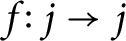 $f \colon j\to j$
be given by
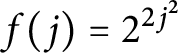 $f(j)=2^{2j^2}$
. Assume
 $b_0<b_1<\cdots <b_{j-1}$
have been defined. Let
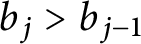 $b_j>b_{j-1}$
be large enough so that:
-
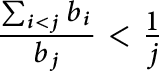
(1)
$\frac {\sum _{i<j} b_i}{b_j} <\frac {1}{j}$
. -
(2)
$b_j-b_{j-1}> 2 B(\delta _j, \frac {1}{j^2},f(j)),$

where
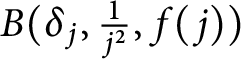 $B(\delta _j, \frac {1}{j^2},f(j))$
is as in Lemma 3.2. Note that if
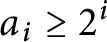 $a_i \geq 2^i$
, then
 $$ \begin{align} |I_i \cap [a_i b_{j-1},a_i b_j)| \geq | I_0 \cap [b_{j-1},b_j)|\geq B(\delta_j, \frac{1}{j^2},f(j)). \end{align} $$
We next define the sequence
 $a_0<a_1<\cdots $
, which will be sufficiently fast growing with respect to the
 $\{b_j\}$
. Namely, let
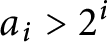 $a_i>2^i$
be such that for any
 $j>i$
we have
 $|\{ i'\colon a_{i'} \leq a_ib_j\} | \leq j$
. We could, for example, take
 $a_i=\prod _{i'\leq i}b_{i'}$
. Set
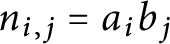 $n_{i,j}=a_ib_j$
and let
 $B_{i,j}=[n_{i,j-1},n_{i,j})$
.
Claim 4.3 For any
 $i < j$
we have
 $| \{ (i',j')\colon B_{i',j'}\cap B_{i,j} \neq \emptyset \} | \leq j^2+ (i a_i) j$
.
Proof For fixed
 $i' \geq i$
, the number of
 $j'$
such that
 $B_{i',j'}\cap B_{i,j} \neq \emptyset $
has size at most j, since
 $B_{i,j}=[a_ib_{j-1},a_ib_j)$
,
 $B_{i',j+1}=[a_{i'}b_j,a_{i'}b_{j+1})$
, and
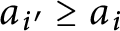 $a_{i'}\geq a_i$
. Moreover, the number of
 $i'\geq i$
such that
 $B_{i',j'}\cap B_{i,j}\neq \emptyset $
for some
 $j'>0$
is at most j. This is because
 $n_{i',j'-1}=a_{i'}b_{j'-1}$
, and if
 $n_{i',j'-1}\leq n_{i,j}$
then we must have
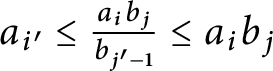 $a_{i'} \leq \frac {a_ib_j}{b_{j'-1}}\leq a_ib_j$
. From the choice of the
 $a_i$
, this set has size at most j. So, there are at most
 $j^2$
many pairs
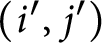 $(i',j')$
with
 $i' \geq i$
such that
 $B_{i',j'}\cap B_{i,j} \neq \emptyset $
. For each
 $i'<i,$
there are clearly at most
 $a_i j$
many
 $j'$
such that
 $B_{i',j'}\cap B_{i,j} \neq \emptyset $
, which gives the result. ▪
Let
 $W_{i,j}=\{ (i',j')\colon B_{i',j'}\cap B_{i,j}\neq \emptyset \}$
. Let
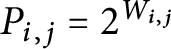 $P_{i,j}=2^{W_{i,j}}$
, which we call the set of
 $(i,j)$
patterns. Suppose for the moment
 $i\in \omega $
and
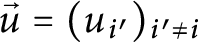 $\vec u=(u_{i'})_{i'\neq i}$
are given where
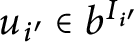 $u_{i'} \in b^{I_{i'}}$
. For every j and for every pattern
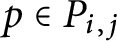 $p \in P_{i,j}$
, we define the sequence
 $s_{i,j}(\vec u, p)\in b^{B_{i,j} \setminus I_{i}}$
by
 $s_{i,j}(\vec u, p)(n)=u_{i'}(n)$
if for the unique
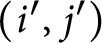 $(i',j')$
such that
 $n \in I_{i'} \cap B_{i', j'}$
we have that
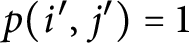 $p(i',j')=1$
, and
 $0$
otherwise. The idea is that the pattern p is predicting whether the values
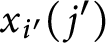 $x_{i'}(j')$
are equal to
 $0$
or
 $1$
, and in the case of
 $1$
we are copying the relevant part of
 $u_{i'}$
(that is,
 $u_{i'} \restriction B_{i,j}\cap B_{i',j'} \cap I_{i'}$
) to
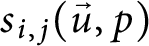 $s_{i,j}(\vec u, p)$
and otherwise copying
 $0$
to
 $B_{i,j}\cap B_{i',j'} \cap I_{i'}$
. If we are given also
 $z \in b^{I_i}$
, then we let
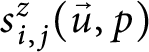 $s^z_{i,j}(\vec u,p)$
agree with
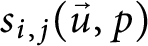 $s_{i,j}(\vec u,p)$
on
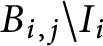 $B_{i,j}\setminus I_i$
, and agree with z on
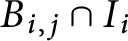 $B_{i,j}\cap I_i$
.
From Claim 4.3, we have that
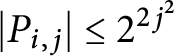 $|P_{i,j}| \leq 2^{2 j^2}$
for large enough j. Since we used
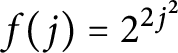 $f(j)=2^{2 j^2}$
in the definition of the
 $b_j$
, it follows from equation (2) and Lemma 3.3 (where the A of Lemma 3.3 is the set
 $I_i$
) that for every
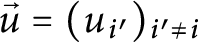 $\vec u=(u_{i'})_{i'\neq i}$
we have that for almost all
 $z \in b^{I_i}$
and all
 $E\in \mathcal {E}$
(say
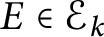 $E\in \mathcal {E}_k$
) that for all large enough j that
 $$ \begin{align} \forall p \in P_{i,j}\ & \forall t \in b^{[0, n_{i,j-1})}\ \Big| \Big\{ \ell \in I_i\cap B_{i,j} \colon \nonumber\\ & E(t ^{\smallfrown} s^z_{i,j}(\vec u, p)) \restriction [\ell-k,\ell-1])\neq s^z_{i,j}(\vec u,p)(\ell) \Big\} \Big| \geq |I_i\cap B_{i,j}| \left( \frac{b-1}{b} - \delta_j \right). \end{align} $$
From Fubini’s theorem, it follows that there is a measure one set
 $M_i$
of
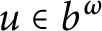 $u \in b^\omega $
(which we identify with a sequence
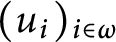 $(u_i)_{i \in \omega }$
, where
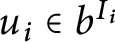 $u_i \in b^{I_i}$
) such that for all
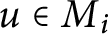 $u \in M_i$
equation (3) holds with
 $z=u_i$
.
Let
 $M=\bigcap _i M_i$
. Let
 $u \in M$
, and we again identify u with the sequence
 $(u_i)_i$
where
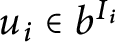 $u_i \in b^{I_i}$
. We may also assume each
 $u_i$
is normal. The
 $u_i$
are now fixed for the remainder of the argument.
We now define the continuous map
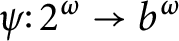 $\psi \colon 2^\omega \to b^\omega $
, which will be the reduction from P to
 $A_3(s)$
. Let
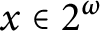 $x \in 2^\omega $
code the
 $x_i$
, where
 $x_i(j)=x(\langle i,j\rangle )$
. We define
 $\psi (x)$
, which we identify with the sequence
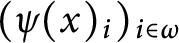 $(\psi (x)_i)_{i\in \omega }$
, where
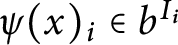 $\psi (x)_i \in b^{I_i}$
, by:
 $$ \begin{align*} \psi(x)_i(k)=\begin{cases} u_i(k) & \text{ if } k \in I_i\ \text{ and } i \notin J \\ u_i(k) & \text{ if } k\in I_i,\ k \in B_{i,j},\ \text{ and }x_{i^{-}}(j)=1, \text{ where }i\text{ is the}\\ & \quad i^{-}\text{th element of }J\\ 0 & \text{ otherwise. } \end{cases} \end{align*} $$
The map
 $\psi $
is clearly continuous. We show that
 $x \in P$
iff
 ${\beta }^{+}(\psi (x))\leq s$
. Suppose first that
 $x \in P$
, so
 $\forall i\ \exists j_0\ \forall j \geq j_0\ x_i(j)=0$
. Then, for all
 $i \in J$
we have that for large enough
 $k \in I_i$
that
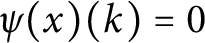 $\psi (x)(k)=0$
. The
 $E \in \mathcal {E}$
(of width
 $1$
), which constantly outputs
 $0,$
will then correctly compute
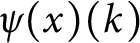 $\psi (x)(k)$
for all sufficiently large
 $k \in I_i$
whenever
 $i \in J$
. For
 $i \notin J$
, we have that
 $\lim _{n\to \infty } \frac {1}{n} |\{ k <n \colon (k \in I_i) \wedge E(\psi (x) \restriction [k-1,k-1])\neq \psi (x)(k)\}|= \frac {1}{2^{i+1}}\frac {b-1}{b}$
. From this, it follows that
 $\lim _{n \to \infty } \frac {1}{n} |\{ k <n \colon E(\psi (x)\restriction [k-1,k-1])\neq \psi (x)(k)\}|= \frac {b-1}{b}\sum _{i \notin J} \frac {1}{2^{i+1}}=s$
. So,
 ${\beta }^{+}(\psi (x)) \leq s$
and so
 $\psi (x)\in A_3(s)$
.
Suppose next that
 $x \notin P$
. Let
 $i_0$
be least such that there are infinitely many j such that
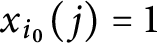 $x_{i_0}(j)=1$
. Let
 $E\in \mathcal {E}$
, say
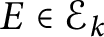 $E\in \mathcal {E}_k$
. If
 $i \notin J$
, then for
 $\ell \in I_i$
we have
 $\psi (x)_i(\ell )=u_i(\ell )$
. Since
 $u\in M \subseteq M_i,$
we have from equation (3) that for large enough j that
 $$ \begin{align} \Big| \Big\{ \ell \in I_i \cap B_{i,j} \colon E(\psi(x) \restriction [\ell-k,\ell-1])\neq \psi(x)(\ell) \Big\} \Big| \geq |I_i \cap B_{i,j}| \left( \frac{b-1}{b} - \delta_j \right). \end{align} $$
We use here the fact that for each j there is a
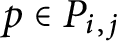 $p\in P_{i,j}$
such that
 $s_{i,j}(\vec u,p)= \psi (x)\restriction B_{i,j}\setminus I_i$
. Thus,
 $$ \begin{align*} \lim\limits_{n\to \infty} \frac{1}{n} |\{ \ell \in [0,n)\cap I_i \colon E(\psi(x) \restriction [\ell-k,\ell-1])\neq \psi(x)(\ell)\}|\geq \frac{1}{2^{i+1}} \frac{b-1}{b}. \end{align*} $$
Let
 $i^+_0$
be the
 $i_0$
th element of J. For large enough j such that
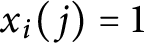 $x_i(j)=1$
we likewise have equation (4) for
 $i=i_0^+$
. Thus, along the subsequence of j with
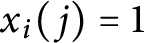 $x_{i}(j)=1$
we have that
 $$ \begin{align*} \lim\limits_{n\to \infty} \frac{1}{n} |\{ \ell \in [0,n) \colon E(\psi(x) \restriction [\ell-k,\ell-1])\neq \psi(x)(\ell)\}|\geq (\sum\limits_{i \notin J}\frac{1}{2^{i+1}}+ \frac{1}{2^{i_0^++1}}) \frac{b-1}{b}. \end{align*} $$
Since
 $(\sum _{i \notin J}\frac {1}{2^{i+1}})\frac {b-1}{b}=s$
we have that
 $\beta ^+(\psi (x))>s$
, so
 $\psi (x)\notin A_3(s)$
.
4.3 Alternate proof of lower bound for
$A_3(s)$

We now present the alternate simpler proof of Lemma 4.2.
Proof Let
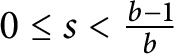 $0 \leq s < \frac {b-1}{b}$
. For each
 $i\in \mathbb {N}$
pick a probability vector
 $(p_{i,0}, \ldots , p_{i,b-1})$
such that
 $1 - \max _d p_{i,d} = 1 - p_{i,0} = s+ \frac {1- s-1/b}{i}$
and construct real numbers
 $u_i$
such that for any k and
 $b_1,\dots , b_k\in b^k$
 $$ \begin{align*}\lim\limits_n \frac{I(u_i,b_1 \cdots b_k,n)}{n} = \prod\limits_{j=1}^k p_{i,b_j}, \end{align*} $$
where
 $I(u_i, b_1 \dots b_k,n)$
is the number of
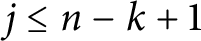 $j\leq n-k+1$
such that
 $u_i\restriction [j,j+k-1]=b_1\cdots b_k$
. In fact, almost all
 $u_i$
with respect to the probability measure
 $\mu _i$
on
 $b^\omega $
determined by
 $(p_{i,0}, \ldots , p_{i,b-1})$
satisfy this condition. Then,
 $\beta _{\ell }(u_i) = s + \frac {1-s-1/b}{i}$
for every
 $\ell $
and the constant
 $0$
block function
 $E_0$
is the minimizer of
 $\inf _{E\in \mathcal {E}_\ell } \limsup _N \beta _E(u_i,N)$
. Let
 $(a_j)$
be a sufficiently quickly growing sequence of integers with
 $a_1 = 1$
such that for
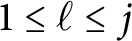 $1 \leq \ell \leq j$
,
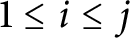 $1 \leq i \leq j$
, and for all
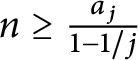 $n \geq \frac {a_j}{1-1/j}$
we have
 $$ \begin{align*} &\left | \beta_{E_0}(u_i,n) - \beta_\ell(u_i) \right | = \left | \beta_{\ell}(u_i,n) - \beta_\ell(u_i) \right | < \frac{1}{j} \end{align*} $$
and
 $$ \begin{align*} &\frac{a_{j+1}}{a_j}> j^2. \end{align*} $$
Put
 $B_j = [a_j, a_{j+1})$
.
We view
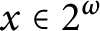 $x \in 2^\omega $
as coding the sequence
 $x_0, x_1, \ldots $
in
 $2^\omega $
where
 $x_i(j) = x(\langle i,j\rangle )$
. Let P be as in Lemma 4.2. Given
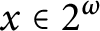 $x \in 2^\omega $
, define
 $m(j) = \min \{j, \min \{i \colon x_i(j) = 1 \} \}$
. Thus, if
 $x \in P$
then
 $\lim _j m(j)=\infty $
, and if
 $x \notin P$
then
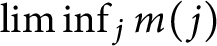 $\liminf _j m(j)$
is finite.
Define
 $\psi (x)$
by
 $$ \begin{align*}\psi(x)_{{}| B_j}(k)= u_{m(j)}(k - a_j). \end{align*} $$
The map
 $\psi $
is continuous. We show that
 $\psi $
is a reduction from P to
 $A_3(s)$
. Suppose
 $x \in P$
, so
 $\lim _{j} m(j) = \infty $
. We have
 $$ \begin{align*} & \limsup\limits_{N} \frac{1}{N} |\left \{ k \leq N \colon \psi(x)(k) \neq E_0(\psi(x)(k)) \right \} |\\ & = \limsup\limits_N \frac{1}{N} | \left \{ k \leq N \colon \psi(x)(k) \neq 0 \right \} |\\ & = \limsup\limits_j \sup\limits_{N \in B_j} \sum\limits_{k=1}^{j-1} \frac{1}{N} | \left \{ v \leq | B_k| \colon u_{m(k)}(v) \neq 0 \right \}| + \frac{1}{N} | \left \{ 0 \leq v \leq N-a_j \colon u_{m(j)}(v) \neq 0 \right \}|. \end{align*} $$
Now, for
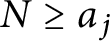 $N \geq a_j$
and
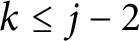 $k \leq j-2$
 $$ \begin{align*} \frac{1}{N} | \{1 \leq v \leq | B_k| \colon u_{m(k)}(v) \neq 0\} | & \leq \frac{a_{k+1} - a_k}{a_j} \leq \frac{a_{j-1}}{a_j} < \frac{1}{(j-1)^2} \end{align*} $$
and
 $$ \begin{align*} \frac{1}{N} | \{1 \leq v \leq |B_{j-1}| : u_{m(j-1)}(v) \neq 0\}| & \leq \frac{a_{j}-a_{j-1}}{N} \left ( \beta_\ell(u_{m(j-1)}) + \frac{1}{j-1} \right ) \\ & \leq \frac{a_j}{N} \left ( \beta_\ell(u_{m(j-1)}) + \frac{1}{j-1} \right ). \end{align*} $$
For
 $a_j \leq N \leq \frac {a_j}{1-1/j} \leq a_{j+1,} $
we have
 $$ \begin{align*} \frac{1}{N} | \left \{ 0 \leq v \leq N-a_j : u_{m(j)}(v) \neq 0 \right \}| \leq \frac{N-a_j}{N} \leq \frac{\frac{a_j}{1-1/j} - a_j}{a_j} = \frac{1}{j-1}. \end{align*} $$
On the other hand, for
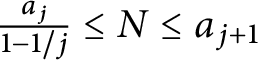 $\frac {a_j}{1-1/j} \leq N \leq a_{j+1}$
 $$ \begin{align*} \frac{1}{N} | \left \{ 0\leq v \leq N-a_j : u_{m(j)}(v) \neq 0 \right \}| &= \frac{N - a_j}{N} \beta_\ell(u_{m(j)},N-a_j)\\ &\leq \frac{N-a_j}{N} \left ( \beta_\ell(u_{m(j)}) + \frac{1}{j} \right ). \end{align*} $$
Thus,
 $$ \begin{align*} \lim\limits_\ell \beta^+_\ell(\psi(x)) &\leq \lim\limits_\ell \limsup\limits_j \sup \{t \beta_\ell(u_{m(j-1)}) + (1-t) \beta_\ell(u_{m(j)}) : t \in [0,1]\} \\ & \qquad + \frac{j-1}{(j-1)^2} + \frac{2}{j-1} + \frac{1}{j}\\ & = \lim\limits_\ell \left( s + \limsup\limits_j \max\left \{ \frac{1-s-1/b}{m(j-1)}, \frac{1-s-1/b}{m(j)} \right \}\right) = s. \end{align*} $$
Now, suppose
 $x \notin P$
. Then,
 $\liminf _n m(n) = M < \infty $
. Fix
 $\ell $
and note
 $$ \begin{align*} &\inf\limits_{E \in \mathcal{E}_\ell} \limsup\limits_{N} \frac{1}{N} |\left \{ k \leq N : \psi(x)(k) \neq E(\psi(x)(k+1), \ldots, \psi(x)(k+\ell)) \right \}|\\ & = \limsup\limits_j \sup\limits_{N \in B_j} \sum\limits_{k=1}^{j-1} \frac{|B_k|}{N} \beta_\ell(u_{m(k)}, | B_k|) + \frac{N-a_j}{N} \beta_\ell(u_{m(j)}, N-a_j) \\ & \geq \limsup\limits_j \frac{a_{j+1}-a_j}{a_{j+1}} \beta_\ell(u_{m(j)}, a_{j+1} - a_j), \end{align*} $$
which implies
 $$ \begin{align*}\lim\limits_\ell \beta^+_{\ell}(\psi(x)) \geq s + \frac{1-s-1/b}{M}> s. \end{align*} $$
▪
4.4 Lower bound for
$A_2(s)$

We next show the lower bound for
 $A_2(s)$
. The proof is similar to that for
 $A_3(s)$
, and we use the terminology from that lemma.
Lemma 4.4 For any
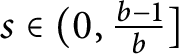 $s \in (0,\frac {b-1}{b}]$
the set
 $A_2(s)$
is
 $\boldsymbol {\Pi }^0_3$
-complete.
Proof We reduce the set
 $P=\{ x \in 2^\omega \colon \forall i\ \exists j_0\ \forall j\geq j_0\ x_i(j)=0\}$
to
 $A_2(s)$
. Let
 $J\subseteq \omega $
be such that
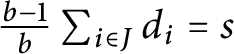 $\frac {b-1}{b}\sum _{i\in J} d_i=s$
, where we recall
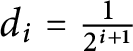 $d_i=\frac {1}{2^{i+1}}$
is the density of
 $I_i$
. We let the sequences
 $\{ a_i\}$
,
 $\{ b_j\}$
be as in Lemma 4.2, except that we impose an additional requirement on
 $b_j$
:
-
(3)
$b_j> (j+1)^2 2^{j+1} B(\delta _{j+1}, \frac {1}{(j+1)^2}, f(j+1)),$

where we recall
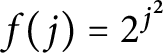 $f(j)=2^{j^2}$
, and B is as in Lemma 3.2. As in Lemma 4.2, we then let
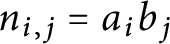 $n_{i,j}=a_i b_j$
,
 $B_{i,j}=[n_{i,j-1},n_{i,j})$
. We use also the notion of pattern defined in the proof of Lemma 4.2, and specifically the sets
 $W_{i,j}$
and
 $P_{i,j}$
.
As in Lemma 4.2, for each
 $i \in \omega $
there is a
 $\mu $
measure one set
 $M_i$
of
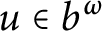 $u \in b^\omega $
such that for cofinitely many j, all
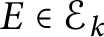 $E\in \mathcal {E}_k$
, where
 $k \leq j$
, all
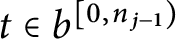 $t \in b^{[0,n_{j-1})}$
, and all patterns
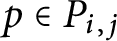 $p \in P_{i,j}$
, if we define
 $s(i,j,p,u)\in b^{B_{i,j}}$
by
 $$ \begin{align*} s(i,j,p,u)(k)= \begin{cases} u(k) & \text{ if } \exists i', j' \in W_{i,j}\ (P(i',j')=1 \wedge k \in (I_{i'}\cap B_{i,j}\cap B_{i',j'})) \\ 0 & \text{ otherwise,} \end{cases} \end{align*} $$
then if
 $s'=t{\kern-1pt}^{\smallfrown } s(i,j,p,u),$
we have that for all
 $c \in [n_{i,j-1},n_{i,j})$
with
 $|I_i \cap [n_{i,j-1},c) \geq B(\delta _j,\frac {1}{j^2}, f(j))$
that
 $$ \begin{align} | \{ \ell \in [n_{i,j-1},c) \cap I_{i}& \colon E(s'(\ell-k),\dots,s'(\ell-1))\neq s'(\ell) \}| \nonumber\\ & \geq |I_i\cap [n_{i,j-1},c) | \left( \frac{b-1}{b} -\delta_j\right). \end{align} $$
We fix
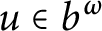 $u \in b^\omega $
in all of the measure one sets
 $M_i$
. We define
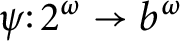 $\psi \colon 2^\omega \to b^\omega $
by:
 $$ \begin{align*} \psi(x)(k)=\begin{cases} u(k) & \text{ if } \exists i,j\ (i \in J \wedge j>0 \wedge k \in (B_{i,j} \cap I_i) \wedge x_{i^{-}}(j)=0) \text{ where }\\ & \quad i\text{ is the }i^{-}\text{th element of }J\\ 0 & \text{ otherwise. } \end{cases} \end{align*} $$
We show
 $\psi $
is a reduction from P to
 $A_2(s)$
. We again identify
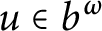 $u \in b^\omega $
with a sequence
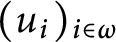 $(u_i)_{i\in \omega }$
where
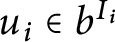 $u_i \in b^{I_i}$
and likewise identify
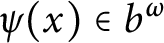 $\psi (x)\in b^\omega $
with a sequence
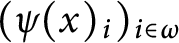 $(\psi (x)_i)_{i \in \omega }$
.
If
 $x \notin P$
, then there is an
 $i_0$
such that for infinitely many j we have
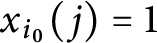 $x_{i_0}(j)=1$
. Let
 $i_0^+$
be the
 $i_0$
th element of J. We may assume that u is such that for every i that
 $\lim _{n \to \infty } \frac {1}{n} |\{ \ell \in I_i\cap [0,n) \colon u(\ell )=0 \} | =\frac {d_i}{b}$
and
 $\lim _{n \to \infty } \frac {1}{n} |\{ \ell \in [0,n) \colon u(\ell )=0 \} | =\frac {1}{b}$
. Note that since
 $\psi (x)_i$
is obtained from
 $u_i,$
by changing certain digits to a
 $0$
, the constant
 $0$
block function
 $E_0$
will have no more errors along
 $I_i$
for
 $\psi (x)_i$
than for
 $u_i$
. It follows that
 $$ \begin{align*} \lim\limits_{n} \frac{1}{n} |\{ \ell \in [0,n) \setminus I_{i^+_0} \colon E_0([\ell-1,\ell-1]) \neq \psi(x)(\ell) \} \leq \left(\frac{b-1}{b} \right) \sum\limits_{\substack{i\in J\\ i\neq i^+_0}} d_i. \end{align*} $$
On the other hand, for any j such that
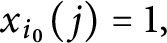 $x_{i_0}(j)=1,$
we have that
 $E_0$
has no errors in
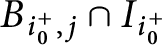 $B_{i^+_0,j}\cap I_{i^+_0}$
, and so
 $$ \begin{align*} \liminf\limits_{n} \frac{1}{n} |\{ \ell \in [0,n) \cap I_{i^+_0} \colon E_0([\ell-1,\ell-1]) \neq \psi(x)(\ell) \}| =0. \end{align*} $$
From these two facts it follows that
 $$ \begin{align*} {\beta}^{-}(\psi(x)) \leq \sum\limits_{\substack{i\neq i^+_0\\ i \in J}}d_i \frac{b-1}{b}< \sum\limits_{i\in J} d_i\frac{b-1}{b}=s. \end{align*} $$
Thus,
 $\psi (x) \notin A_2(s)$
.
Suppose next that
 $x \in P$
. Let
 $E\in \mathcal {E}$
, say
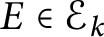 $E\in \mathcal {E}_k$
. Let
 $i \in J$
. Then, from equation (5) and the fact that
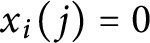 $x_i(j)=0$
for all large enough j, and any
 $c\in [n_{i,j-1},n_j)$
with
 $|I_i \cap [n_{i,j-1},c)| \geq B(\delta _j,\frac {1}{j^2},f(j))$
that
 $$ \begin{align} | \{ \ell \in I_i \cap [n_{i,j-1},c) \colon E(\psi(x)\restriction [\ell-k,\ell-1]) &\neq \psi(x)(\ell) \}|\nonumber\\& \geq |I_i \cap [n_{i,j-1},c)| \left( \frac{b-1}{b}-\delta_{j} \right) . \end{align} $$
In particular, for large enough
 $j,$
we have
 $$ \begin{align*} | \{ \ell \in I_i \cap [n_{i,j-2},n_{j-1}) & \colon E(\psi(x)\restriction [\ell-k,\ell-1]) \neq \psi(x)(\ell) \} \\ & \geq |I_i \cap [n_{i,j-2},n_{i,j-1})|\left( \frac{b-1}{b}-\delta_{j-1} \right) . \end{align*} $$
Suppose now that j is sufficiently large (in particular
 $i<j$
) and
 $c \in [n_{i,j-1},n_{i,j})$
. Let
 $$ \begin{align*} e=| \{ \ell \in I_i \cap [n_{i,j-2},n_{i,j-1}) \colon E(\psi(x)\restriction [\ell-k,\ell-1]) \neq \psi(x)(\ell) \}| \end{align*} $$
and
 $$ \begin{align*} e_c=| \{ \ell \in I_i \cap [n_{i,j-1},c) \colon E(\psi(x)\restriction [\ell-k,\ell-1]) \neq \psi(x)(\ell) \}|. \end{align*} $$
If
 $c < n_{i,j-1}+2^j B(\delta _j,\frac {1}{j^2},\delta _j)$
, then from Assumption 3 for
 $b_{j-1}$
we have that
 $$ \begin{align*} \frac{c-n_{i,j-1}}{e}\leq \frac{2^j B(\delta_j,\frac{1}{j^2},\delta_j)} {\frac{1}{2^i}(n_{i,j-1}-n_{i,j-2})\frac{b-1}{2b}} \leq 2^{i+2}\frac{b}{b-1} \frac{2^j B(\delta_j,\frac{1}{j^2},\delta_j)}{b_{j-1}} \leq 2^{i+2}\frac{b}{b-1} \frac{1}{j^2}, \end{align*} $$
which tends to
 $0$
with j. It follows that
 $$ \begin{align} | \{ \ell \in I_i \cap [0,c) & \colon E(\psi(x)\restriction [\ell-k,\ell-1]) \neq \psi(x)(\ell) \}| \nonumber\\ & \geq \frac{c}{2^i} \left( \frac{b-1}{b}-\delta_{j}- 2^{i+2}\frac{b}{b-1} \frac{1}{j^2}\right) . \end{align} $$
Note here that we can ignore the contribution from
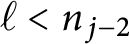 $\ell <n_{j-2}$
by the growth assumption on the
 $b_j$
.
Suppose next that
 $c \geq n_{i,j-1}+2^j B(\delta _j,\frac {1}{j^2},\delta _j)$
. Then,
 $$ \begin{align*} |I_i \cap [n_{i,j-1},c)|\geq \frac{1}{2^i} 2^j B(\delta_j,\frac{1}{j^2},\delta_j) \geq B(\delta_j,\frac{1}{j^2},\delta_j). \end{align*} $$
Thus, equation (6) applies. So,
 $e_c \geq |I_i \cap [n_{i,j-1},c)| \left ( \frac {b-1}{b}-\delta _{j} \right ) $
. Since we also have
 $e \geq |I_i \cap [n_{i,j-2},n_{i,j-1})|\left ( \frac {b-1}{b}-\delta _{j-1} \right )$
, we have that
 $$ \begin{align} | \{ \ell \in I_i\cap [n_{i,j-2},c) & \colon E(\psi(x)\restriction [\ell-k,\ell-1]) \neq \psi(x)(\ell) \}| \nonumber\\ & \geq \frac{c-n_{i,j-2}}{2^i} \left( \frac{b-1}{b} -\max\{ \delta_{j-1},\delta_j\} \right). \end{align} $$
In either case, from equations (7) and (8), we have that
 $$ \begin{align*} | \{ \ell \in I_i\cap [0,c) \colon E(\psi(x)\restriction [\ell-k,\ell-1]) \neq \psi(x)(\ell) \}| \geq \frac{1}{2^i} \left( \frac{b-1}{b} -\eta_j \right). \end{align*} $$
for large enough c, where
 $\eta _j$
tends to
 $0$
.
This gives that
 ${\beta }^{-}(\psi (x)) \geq (\sum _{i \in J} d_i) (\frac {b-1}{b})=s$
, and so
 $\psi (x) \in A_2(s)$
.▪
4.5 Lower bound for
$A_1(s)$

We next show the lower-bound for
 $A_1(s)$
.
Lemma 4.5 For
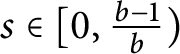 $s \in [0,\frac {b-1}{b})$
, the set
 $A_1(s)$
is
 $\boldsymbol {\Pi }^0_4$
-hard.
Proof Fix
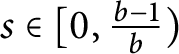 $s \in [0,\frac {b-1}{b})$
. Let
 $R=\{ x \in (2^\omega )^3 \colon \forall i\ \exists j_0\ \forall j \geq j_0\ \exists k\ x(i,j,k)=0\}$
. R is a
 $\boldsymbol {\Pi }^0_4$
-complete set (see Exercises 23.2 and 23.3 on p. 180 of [Reference Kechris18]). Therefore, it suffices to reduce R to
 $A_1(s)$
. Let
 $J\subseteq \omega $
be such that
 $s=\frac {b-1}{b} \left (1-\sum _{i \in J}\frac {1}{2^{i+1}}\right )$
. Let the
 $I_i$
partition
 $\omega $
as before, so
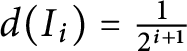 $d(I_i)=\frac {1}{2^{i+1}}$
.
We will define a fast-growing sequence
 $b_0<b_1<\cdots $
, and we will also let
 $B_n=[b_n,b_{n+1})$
. Each n codes a triple
 $n=\langle i_n,j_n,t_n\rangle $
, where
 $i_n,j_n,t_n\leq n$
. We will also define a certain sufficiently fast-growing function
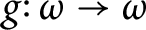 $g \colon \omega \to \omega $
(this will be the map
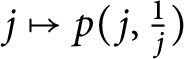 $j \mapsto p(j,\frac {1}{j})$
of Claim 4.7). Also as in the proof of Lemma 4.2, we will fix a particular
 $u \in 2^\omega $
from a certain
 $\mu $
measure one set, which will guide the construction of the reduction map
 $\psi $
. The construction will be similar to that of Lemma 4.2, the main difference being that, at some points of the construction, instead of copying
 $0$
s to parts of the block
 $B_n$
we will copy a portion of u repeated with period
 $g(j_n)$
. In the following claims, the set A is where we intend to copy u, and the set B is where we intend to copy the periodic truncation of u (this is defined right before Claim 4.7). The idea is that if
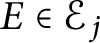 $E\in \mathcal {E}_j$
and if p is the period of the sequence copied to B, then if p is large compared to
 $j,$
the noise with respect to E will increase as if we copied random bits to B, while if p is small compared to j, the noise will not increase (at least this will be the behavior for almost all
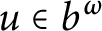 $u\in b^\omega $
). This will give us the freedom we need to construct the reduction map. The following claims make these statements precise.
Our first claim, Claim 4.6, says that copying a periodic sequence to the B part will not increase the upper noise
 $\beta ^+$
(for almost all u).
Claim 4.6 Let
 $\omega =A\cup B \cup C$
, a disjoint union, and assume A, B, C have period p (that is,
 $\chi _A$
,
 $\chi _B$
,
 $\chi _C$
have period p). Let A, B, C have densities
 $d_A$
,
 $d_B$
,
 $d_C,$
respectively. Then, for
 $\mu ,$
almost all
 $u \in 2^\omega $
(in fact, if u is normal in base b), we have the following. There is an
 $E\in \mathcal {E}$
such that for any
 $\bar {u}$
with
 $\bar {u}\restriction A= u\restriction A$
and
 $\bar {u}\restriction B$
of period p, we have that
 ${\beta }^{+}_E(\bar {u})\leq d_A \frac {b-1}{b} +d_C$
. ▪
Proof Let u be normal in base b. Let
 $\epsilon>0$
. Consider sequences
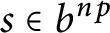 $s \in b^{np}$
for some integer n. For large enough n, the probability that a sequence
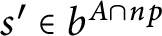 $s' \in b^{A\cap np}$
will have the property that
 $A'=\{ i \in A \cap np\colon s'(i)=s'(i-p)\}$
has size at least
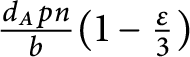 $\frac {d_Apn}{b}(1-\frac {\epsilon }{3})$
is at least
 $1-\frac {\epsilon }{3}$
. This is because, as in the proof of Lemma 3.1, this set is in bijection with the set of
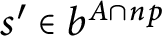 $s' \in b^{A\cap np}$
such that
 $\{ i \in A \cap np\colon s'(i)=0\}$
has size at least
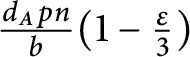 $\frac {d_Apn}{b}(1-\frac {\epsilon }{3})$
. We call such an
 $s'$
good. Since u is normal in base
 $b^{d_Apn}$
, it follows that for large enough N that the number of
 $k \leq N$
such that
 $u \restriction (A\cap [kpn,(k+1)pn) )$
is good is at least
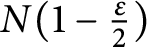 $N(1-\frac {\epsilon }{2})$
. For such N we have that
 $$ \begin{align*} | \{ i \in A\cap p n N & \colon u(i)=u(i-p)\}| \geq N\left(1-\frac{\epsilon}{2}\right)\left(\frac{d_Apn}{b}\right)\left(1-\frac{\epsilon}{3}\right) \\ & \geq \left(\frac{d_ApnN}{b}\right) (1-\epsilon). \end{align*} $$
Let
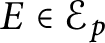 $E\in \mathcal {E}_{p}$
be the block function such that
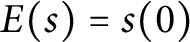 $E(s)=s(0)$
, so E is simply guessing that
 $x(n)$
will be
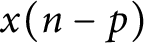 $x(n-p)$
. It follows that if
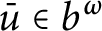 $\bar {u} \in b^\omega $
is normal, then for large enough N we have that
 $$ \begin{align*} | \{ i \leq pnN \colon \bar{u}(i) = E(\bar{u}(i-p),\dots, \bar{u}(i-1)) \} | & \geq \left(\frac{d_ApnN}{b}\right) (1-\epsilon) + d_B pn N \\ & =pnN \left(\frac{d_A}{b}(1-\epsilon)+d_B\right). \end{align*} $$
Thus,
 ${\beta }^{+}_E(\bar {u})\leq 1-\left (\frac {d_A}{b}(1-\epsilon )+d_B\right )= d_A\frac {b-1}{b}+d_C +\epsilon \frac {d_A}{b}$
. Since
 $\epsilon $
was arbitrary,
 ${\beta }^{+}_E(\bar {u})\leq d_A \frac {b-1}{b} +d_C$
. ▪
For
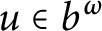 $u \in b^\omega $
and
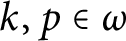 $k,p\in \omega $
, we define
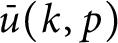 $\bar {u}(k,p)$
by
 $\bar {u}(k,p)(m)= u(m)$
for
 $m <k$
, and for
 $m \geq k$
we set
 $\bar {u}(k,p)(m)=u(m-k \mod p)$
. Thus, after the first k digits of u, we repeat the digits of u periodically with period p. In particular,
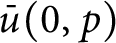 $\bar {u}(0,p)$
is the periodic truncation of u to period p.
The next claim states that when the period p is sufficiently large compared to the width
 $j_0$
of the block function E (that is,
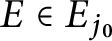 $E\in E_{j_0}$
), then using the periodic truncation with period p on B will not have much effect as compared to copying u there.
Claim 4.7 Let
 $j_0\in \omega $
,
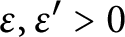 $\epsilon ,\epsilon '> 0$
. Then, there is a
 $p=p(j_0,\epsilon ) \in \omega ,$
which is a power of
 $2$
and an
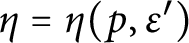 $\eta =\eta (p,\epsilon ')$
such that if
 $A, B, C \subseteq \omega $
are disjoint and of period p with densities
 $d_A$
,
 $d_B$
,
 $d_C,$
respectively, and with
 $\omega =A\cup B \cup C$
, then for any
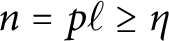 $n=p\ell \geq \eta $
, we have that
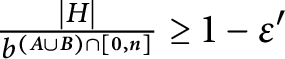 $\frac {|H|}{b^{(A\cup B)\cap [0,n]}} \geq 1-\epsilon '$
, where H is the set of
 $u \in b^{(A\cup b)\cap [0,n)}$
such that for any
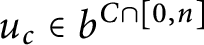 $u_c \in b^{C\cap [0, n]}$
if
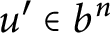 $u' \in b^n$
is defined by
 $$ \begin{align*} u'(i) =\begin{cases} u(i) & \text{ if } i \in A \\ \bar{u}(0,p) & \text{ if } i \in B \\ u_c(i) & \text{ if } i \in C \end{cases} \end{align*} $$
then for any
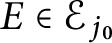 $E\in \mathcal {E}_{j_0}$
, we have
 $$ \begin{align*} \forall k \in [\eta,n]\ \, \Big [ \frac{1}{k} |\{ i \leq k & \colon E(u'(i-j_0),\dots,u'(i-1)) \neq u'(i)\}| \\ & \geq (d_A+d_B)\frac{b-1}{b}(1 -\epsilon)-j_0 d_C \Big ]. \end{align*} $$
Furthermore, this holds for all
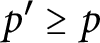 $p' \geq p$
.
Proof Fix
 $j_0$
,
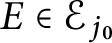 $E\in \mathcal {E}_{j_0}$
,
 $\epsilon>0$
. It suffices to show that for large enough
 $p \in \omega $
, and
 $\omega =A \cup B \cup C$
, a disjoint union with
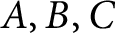 $A,B,C$
having period p, and
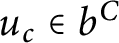 $u_c\in b^C$
, that the probability a
 $u \in b^{(A\cup B)\cap [0,n]}$
satisfies
 $(*)$
tends to
 $1$
with n.
Given
 $u \in b^{(A\cup B)\cap [0,n]}$
, let
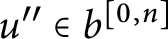 $u''\in b^{[0,n]}$
be defined as
 $u'$
above except we put
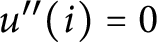 $u''(i)=0$
for
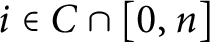 $i\in C \cap [0,n]$
. The counting argument of Lemma 3.1 shows that as p grows, with probability approaching
 $1$
in choosing
 $u \restriction ((A\cup B) \cap [0,p])$
we have that
 $$ \begin{align*} \frac{1}{p} | \{ i \leq p \colon E(u''(i-j_0),\dots,u''(i-1)) \neq u''(i)\} | \geq (d_A+d_B)\frac{b-1}{b}\left(1-\frac{\epsilon}{2}\right). \end{align*} $$
From the finite version of Fubini, it follows that for any
 $\delta>0$
that for large enough
 $p;$
that with probability at least
 $1-\delta $
in choosing
 $u_b=u\restriction (B\cap [0,p]);$
that for probability of at least
 $1-\delta $
in choosing
 $u_a=u\restriction (A\cap [0,p]),$
we have that if
 $u''$
is defined from
 $u_a$
and
 $u_b$
, then
 $(**)$
holds.
Choose
 $u_b$
in this set of measure at least
 $1-\delta $
. Let G be the set of
 $u_a=u\restriction (A\cap [0,p])$
such that if
 $u''=u_a \cup u_b\cup u_c$
(with
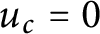 $u_c=0$
) then u satisfies
 $(**)$
. Therefore, G has measure at least
 $1-\delta $
. From the law of large numbers, we have the probability that a
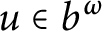 $u \in b^\omega $
has the property that for all
 $k\geq 1$
 $$ \begin{align*} | \{k' \leq k \colon u \restriction (A\cap [k'p ,(k'+1)p)) \in G\} | \geq k\left(1-\frac{\epsilon}{2}\right) \end{align*} $$
is at least
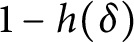 $1-h(\delta )$
, where
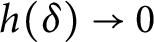 $h(\delta )\to 0$
as
 $\delta \to 0$
. We choose
 $\delta < \frac {\epsilon }{2}$
small enough so that
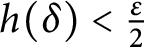 $h(\delta )< \frac {\epsilon }{2}$
. It follows that for all
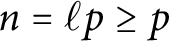 $n=\ell p \geq p$
that with probability at least
 $1-\delta $
,
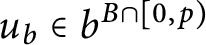 $u_b \in b^{B\cap [0,p)}$
has the property that with probability at least
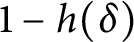 $1-h(\delta )$
,
 $u_a=u\restriction (A\cap [0,n)$
has the property that if
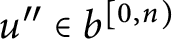 $u''\in b^{[0,n)}$
is formed from
 $u_a$
,
 $u_b$
,
 $u_c=0$
as above, then for all
 $k'\leq \ell $
 $$ \begin{align} | \{ i \leq k'p\colon & E(u''(i-j_0),\dots,u''(i-1)) \neq u''(i)\}| \nonumber\\ & \geq k'p \left(1-\frac{\epsilon}{2}\right)(d_A+d_B)\left( \frac{b-1}{b}\right) \left( 1-\frac{\epsilon}{2}\right) \nonumber\\ & \geq k'p (d_A+d_B)\left( \frac{b-1}{b}\right) (1-\epsilon). \end{align} $$
Since
 $\delta , h(\delta )<\frac {\epsilon }{2}$
it follows that for any
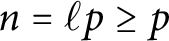 $n=\ell p \geq p$
that with probability at least
 $1-\epsilon $
,
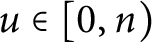 $u \in [0,n)$
has the property that if
 $u''$
is obtained from u and
 $u_c$
as above, then for all
 $k'\leq \ell $
we have that equation (9) holds. If we set
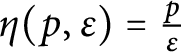 $\eta (p,\epsilon )=\frac {p}{\epsilon }$
, then we get the inequality of equation (9) where we replace
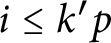 $i\leq k'p$
with
 $i\leq k$
, for any
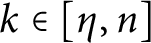 $k \in [\eta ,n]$
(and replacing
 $\epsilon $
with
 $2\epsilon $
).
Consider then
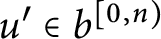 $u' \in b^{[0,n)}$
, which is defined as
 $u''$
except we use the given
 $u_c$
instead of the
 $0$
function. We have that
 $E(u''(i-j_0),\dots ,u''(i-1))$
and
 $E(u'(i-j_0),\dots ,u'(i-1))$
can only disagree if
 $C\cap [i-j_0,i) \neq \emptyset $
. Thus, there can be at most
 $d_C n j_0$
many
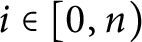 $i \in [0,n)$
where such a disagreement occurs. The inequality of the claim then follows. ▪
The next claim handles the general case where we do not necessarily have that the width of E is small compared to the period p.
Claim 4.8 For every
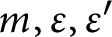 $m, \epsilon , \epsilon '$
there is an
 $\eta =\eta (m,\epsilon ,\epsilon ')$
such that for any
 $i_0, j_0, m_0\leq m$
, and any
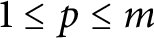 $1\leq p \leq m$
, for all large enough n we have that if
 $ A=\bigcup _{\substack {i \notin J\\ i \leq m_0}}I_i \cup \bigcup _{\substack {i> i_0\\ i \leq m_0}} I_i$
,
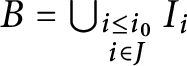 $ B=\bigcup _{\substack {i\leq i_0\\ i \in J}}I_i$
, and
 $C=\omega \setminus (A\cup B)$
, then
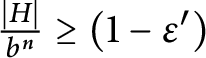 $\frac {|H|}{b^n} \geq (1-\epsilon ')$
, where H is the set of
 $u \in b^n$
such that if
 $$ \begin{align*} u'(i) =\begin{cases} u(i) & \text{ if } i \in A\cup C \\ \bar{u}(0,p) & \text{ if } i \in B \end{cases} \end{align*} $$
then for any
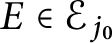 $E\in \mathcal {E}_{j_0}$
we have
 $$ \begin{align*} \forall k \in [\eta,n]\ \, \Big [ \frac{1}{k} |\{ i \leq k & \colon E(u'(i-j_0),\dots,u'(i-1)) \neq u'(i)\}| \\ & \geq d_A\left(\frac{b-1}{b}\right)(1 -\epsilon) \Big ]. \end{align*} $$
Proof It is enough to fix
 $i_0$
,
 $j_0$
,
 $m_0$
,
 $\epsilon $
,
 $\epsilon '$
, and
 $p,$
and we show that for large enough n the stated property holds. Note that there are at most
 $b^p$
many choices for
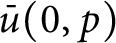 $\bar {u}(0,p)$
. There are at most
 $2^m$
many choices for the set A and also for the set B. Therefore, it is enough to fix a choice for
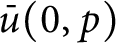 $\bar {u}(0,p)$
and the sets
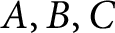 $A, B, C$
and show that for large enough n the property holds. This, however, follows immediately from Lemma 3.1. ▪
Putting Claims 4.7 and 4.8 together gives the following claim. Let
 $b_0<b_1<\cdots <b_n <\cdots $
be a sufficiently fast-growing sequence of powers of
 $2$
(exactly how fast the sequence needs to grow will be specified below).
Claim 4.9 For almost all
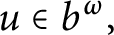 $u \in b^\omega ,$
we have the following. For any
 $j_0$
and
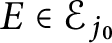 $E\in \mathcal {E}_{j_0}$
, for all large enough n we have that if
 $[b_n,b_{n+1})=A\cup B$
, a disjoint union of sets of period
 $\leq 2^n$
, where
 $ A=[b_n, b_{n+1}) \cap (\bigcup _{i \notin J} I_i \cup \bigcup _{i> i_0} I_i)$
and
 $ B=[b_n\cap b_{n+1}) \cap (\bigcup _{\substack {i\leq i_0\\ i \in J}}I_i)$
for some
 $i_0\leq n$
, and if
 $j \leq n$
and
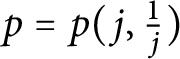 $p=p(j,\frac {1}{j})$
,
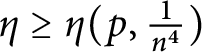 $\eta \geq \eta (p,\frac {1}{n^4})$
are as in Claim 4.7, and
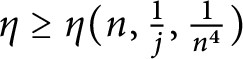 $\eta \geq \eta (n,\frac {1}{j},\frac {1}{n^4})$
as in Claim 4.8, then if
 $u'$
is defined as in Claim 4.8, then we have:
(1) (large j case) If
 $j \geq j_0$
then
 $$ \begin{align*} \forall k \in [b_n+\eta,b_{n+1}]\ \, \Big [ \frac{1}{k-b_n} \, | \{ i \in [b_n,k) & \colon E(u'(i-j_0),\dots,u'(i-1)) \neq u'(i)\} | \\ & \geq (d_A+d_B)\left(\frac{b-1}{b}\right)\left(1-\frac{1}{j}\right) - \frac{j}{2^n} \Big ]. \end{align*} $$
(2) (general case)
 $$ \begin{align*} \forall k \in [b_n+\eta,b_{n+1}] \ \, \Big [ \frac{1}{k-b_n} |\{ i \in [b_n,k) & \colon E(u'(i-j_0),\dots,u'(i-1)) \neq u'(i)\} | \\ & \geq d_A\left(\frac{b-1}{b}\right)\left(1-\frac{1}{n}\right) \Big ]. \end{align*} $$
where
 $d_A$
,
 $d_B$
are the densities of A, B in
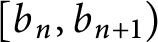 $[b_n,b_{n+1})$
.
Proof It is enough to fix
 $j_0$
,
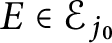 $E \in \mathcal {E}_{j_0}$
, and show that almost all u have the desired property for these values. By Borel–Cantelli, it is enough to show that the probability that
 $u \restriction [b_n,b_{n+1})$
satisfies the conclusion of the claim at least
 $1-\frac {1}{n^2}$
. Fix
 $b_n$
, and we show, assuming
 $b_{n+1}$
is sufficiently large compared to
 $b_n$
, that the interval
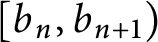 $[b_n,b_{n+1})$
has this property. There are at most n many partitions
 $[b_n,b_{n+1})=A\cup B$
of the type stated in the claim (since the choice of
 $A,B$
is determined by
 $i_0\leq n$
), so it is enough to fix
 $A,B$
and show that with probability at least
 $1-\frac {1}{n^3}$
in choosing
 $u\restriction [b_n,b_{n+1})$
the statement of the claim holds. Note that the j in the claim satisfy
 $j\leq n$
, so there is a bound
 $\eta _n$
depending only on n, such that if
 $j \leq n$
,
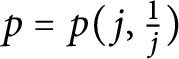 $p=p(j,\frac {1}{j})$
, then
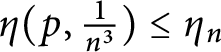 $\eta (p, \frac {1}{n^3})\leq \eta _n$
. We will assume that
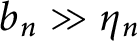 $b_n \gg \eta _n$
for all n, and, in particular, we will choose
 $b_{n+1}$
so that
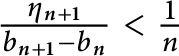 $\frac {\eta _{n+1}}{b_{n+1}-b_n} <\frac {1}{n}$
. This is possible as
 $\eta _{n+1}$
depends only on
 $n+1$
and not the value of
 $b_{n+1}$
. Similarly, we may fix
 $j \leq n$
and show that with probability at least
 $1-\frac {1}{n^4}$
in choosing
 $u \restriction [b_n,b_{n+1})$
we satisfy the claim. In case (1), that is,
 $j\geq j_0$
, the conclusion follows immediately from Claim 4.7, assuming that
 $b_{n+1}> b_n+\eta _n$
. In applying Claim 4.7, we use
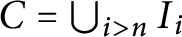 $C=\bigcup _{i>n}I_i$
. In case (2), the conclusion follows immediately from Claim 4.8, assuming again that
 $b_{n+1}$
is sufficiently large compared to
 $b_n$
(the interval
 $[0,n)$
of Claim 4.8 becomes
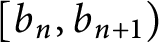 $[b_n,b_{n+1})$
here). ▪
We now fix
 $u \in 2^\omega $
in the measure one set described in Claim 4.9, and in the measure one sets of Claim 4.6 for all possible choices of
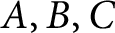 $A,B,C$
(there are countably many choices for these sets). We also fix the fast-growing sequence
 $b_0<b_1<\cdots <b_n<b_{n+1}<\cdots $
. As we said in Claim 4.9, we take
 $b_{n+1}>b_n+\eta _n$
, where
 $\eta _n$
is the maximum of
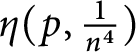 $\eta (p,\frac {1}{n^4})$
, where
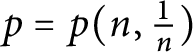 $p=p(n,\frac {1}{n})$
, from Claim 4.7 and
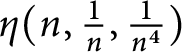 $\eta (n, \frac {1}{n},\frac {1}{n^4})$
from Claim 4.8.
Claim 4.9 then gives the following property of u and the
 $b_n$
.
 $(\dagger )$
: For any
 $j_0$
,
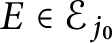 $E\in \mathcal {E}_{j_0}$
, for all large enough n if
 $[b_n,b_{n+1})=A\cup B$
where
 $A=[b_n,b_{n+1}) \cap (\bigcup _{i \notin J} I_i \bigcup _{\substack {i\in J\\ i>i_0}} I_i)$
,
 $B=[b_n,b_{n+1})\cap (\bigcup _{\substack {i \in J\\ i \leq i_0}} I_i)$
where
 $i_0 \leq n$
, then for any
 $j \leq n$
if
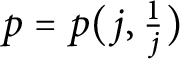 $p=p(j,\frac {1}{j})$
(as in Claim 4.7) and
 $u'$
is defined from u and p as in Claim 4.8, then if we set
 $$ \begin{align*} d=\frac{1}{k-b_n} |\{ i \in [b_n,k) \colon E(u'(i-j_0),\dots,u'(i-1)) \neq u'(i)\} | \end{align*} $$
then for
 $b_n+\eta _n\leq k \leq b_{n+1,}$
we have:
-
(1) If
$j \geq j_0$
then
$d\geq (d_A+d_B)\left (\frac {b-1}{b}\right )\left (1-\frac {1}{j}\right )- \frac {j}{2^n}$
. -
(2)
$d\geq d_A\left (\frac {b-1}{b}\right )\left (1-\frac {1}{n}\right )$
.



We now return to the proof of Lemma 4.5.
Given
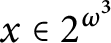 $x \in 2^{\omega ^3}$
, we define a function
 $h(x)\colon \omega ^3 \to \omega ^3$
as follows. We let
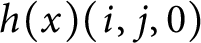 $h(x)(i,j,0)$
be
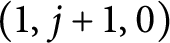 $(1,j+1,0)$
if
 $x(i',j,0)=0$
for all
 $i' \leq i$
. Otherwise, set
 $h(x)(i,j,0)=(0,j,1)$
. In general, we define (in the following,
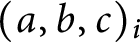 $(a,b,c)_i$
denotes the ith element of the tuple, so
 $(a,b,c)_0=a$
, etc.)
 $$ \begin{align*} h(x)(i,j,t)= \begin{cases} (1, (h(x)(i,j,t-1)))_1+1,0) & \text{ if } \\ {} \qquad {} \forall i'\leq i\ \exists t' \leq t\ x(i',(h(x)(i,j,t-1))_1,t')=0 & \\ (0, (h(x)(i,j,t-1))_1,(h(x)(i,j,t-1))_2+1) & \text{ otherwise.} \end{cases} \end{align*} $$
The function h does the following. The input i sets the “width” of the search, that is, it will search over
 $(x)_{i'}$
for
 $i' \leq i$
. The input j sets the initial start of the search, in that the search will begin by considering the values
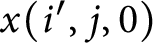 $x(i',j,0)$
, for
 $i'\leq i$
. The search checks to see if all of these are equal to
 $0$
. If so, it will output
 $(h(x)(i,j,0))_0=1$
, denoting a successful search, and then replace j with
 $j+1$
and begin a new search at the values
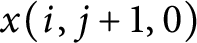 $x(i,j+1,0)$
. The output
 $(h(x)(i,j,0))_1$
records the new value
 $j+1$
, and the output
 $(h(x)(i,j,0))_2$
records the new “height” of the search, which will, in this case, is set back to
 $0$
. If not all the values
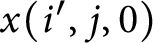 $x(i',j,0)$
are
 $0$
, then the j value remains the same and we increment the height of the search. This means we will search the values of
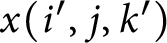 $x(i',j,k')$
where
 $i'\leq i$
, j is the current value of
 $(h(x)(i,j,t))_1$
, and
 $k'\leq (h(x)(i,j,t))_2$
, which is the current height. For a given j, we keep incrementing the height k and see if
 $\forall i'\leq i\ \exists k'\leq k\ x(i',j,k')=0$
. If so, the search is successful, and we then increment j to
 $j+1$
and reset the height k to
 $0$
. Otherwise, we continue to increment the height k and continue the search.
The search is attempting to verify, step by step, that
 $$ \begin{align*} \forall i'\leq i\ \forall j' \geq j\ \exists k'\ x(i',j',k')=0. \end{align*} $$
If this condition holds for some
 $i,j$
, then
 $(h(x)(i,j,t))_1$
will tend to
 $\infty $
with t. If this condition fails for
 $i,j$
, then for
 $j'$
the least integer
 $\geq j$
such that
 $\neg \forall i' \leq i\ \exists k\ x(i',j',k)=0$
we have that
 $(h(x)(i,j,t))_1$
will be equal to
 $j'$
for all large enough t (the search will “get stuck” at
 $j'$
).
Recall that
 $\{ b_n\}$
is a sufficiently fast-growing sequence, so that u and the
 $\{ b_n\}$
satisfy Claims 4.6 and 4.9. As before, we let
 $B_n=[b_n,b_{n+1})$
. We view n as coding a triple of integers, which we write as
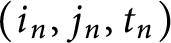 $(i_n,j_n,t_n)$
, and we assume this coding is reasonable in that
 $i_n,j_n,t_n \leq n$
for all n. We define the map
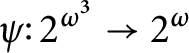 $\psi \colon 2^{\omega ^3} \to 2^\omega $
as follows. Let
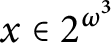 $x \in 2^{\omega ^3}$
. Recall
 $I_i$
are the pairwise disjoint arithmetical sequences of Lemma 4.2, so
 $I_i$
has density
 $\frac {1}{2^{i+1}}$
. Moreover,
 $J \subseteq \omega $
is such that
 $\frac {b-1}{b}(1-\sum _{i \in J} \frac {1}{2^{i+1}})=s$
. For
 $i \notin J$
, we will just copy u to
 $I_i$
. It remains to specify
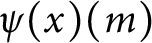 $\psi (x)(m)$
for
 $m \in I_i$
where
 $i\in J$
.
Definition 4.10 For
 $m \in B_n \cap I_i,$
we define
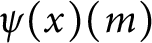 $\psi (x)(m)$
through the following cases (the definition of
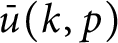 $\bar {u}(k,p)$
is given right before Claim 4.7).
-
(1) If
$i \notin J$
, we set
$\psi (x)(m)=u(m)$
. -
(2) If
$i \in J,$
we set
$\psi (x)(m)=u(m)$
if
$i>i_n$
. -
(3) If
$i\in J$
and
$i\leq i_n$
, then if
$(h(x)(i_n,j_n,t_n))_0 =0$
(unsuccessful search at step
$t_n$
for
$(i_n,j_n)$
) we set
$\psi (x)(m)=u(m)$
. -
(4) If
$i\in J$
,
$i \leq i_n$
, and
$(h(x)(i_n,j_n,t_n))_0 =1$
(successful search at step
$t_n$
), we set
$\psi (x)(m)=\bar {u} (b_n,p(j_n,\frac {1}{j_n}))(m)$
, where
$p(j_n,\frac {1}{j_n})$
is defined in Claim 4.7.








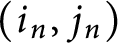






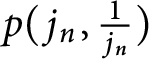
We show that
 $\psi $
is a reduction from the
 $\boldsymbol {\Pi }^0_4$
set R to the set
 $$ \begin{align*} A_1(s)=\{ z \in b^\omega \colon {\beta}^{-}(z) \leq s\}. \end{align*} $$
First assume that
 $x \in R$
. Fix
 $\epsilon>0$
. Let
 $i_0$
be large enough so that
 $$ \begin{align*} \frac{b-1}{b} (\sum\limits_{\substack{i \notin J\\ i\leq i_0}} d_n)+ \sum\limits_{i>i_0}d_n <s+\frac{\epsilon}{2}, \end{align*} $$
where
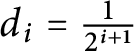 $d_i=\frac {1}{2^{i+1}}$
is the density of
 $I_i$
. Let
 $j_0$
be large enough so that
 $\forall i\leq i_0\ \forall j \geq j_0\ \exists k\ x(i,j,k)=0$
. We can do this as
 $x \in R$
. Let
 $S \subseteq \omega $
be given by
 $$ \begin{align*} n \in S \Leftrightarrow (i_n=i_0 \wedge j_n=j_0) \wedge ( (h(x)(i_n,j_n,t_n))_0=1), \end{align*} $$
that is, the
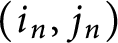 $(i_n,j_n)$
search at step
 $t_n$
is successful, and
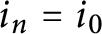 $i_n=i_0$
,
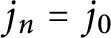 $j_n=j_0$
. From the definition of
 $j_0$
and the properties of
 $h(x),$
we have that S is infinite (that is, there are infinitely many t such that
 $(h(x)(i_0,j_0,t))_0=1$
). For any
 $n \in S$
,
 $i \leq i_0$
in J, and
 $m \in B_n \cap I_i$
, we have that
 $\psi (x)(m)=\bar {u}(b_n, p(j_0, \frac {1}{j_0}))$
. It follows from Claim 4.6, and the fact that the
 $b_n$
grow sufficiently fast, that there is an
 $E\in \mathcal {E}$
(with say
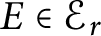 $E\in \mathcal {E}_r$
) such that for all large enough
 $n \in S$
we have that
 $$ \begin{align*} & \frac{1}{|B_n|} |\{ m \in B_n \colon E(\psi(x)(m-r),\dots,\psi(x)(m-1))\neq \psi(x)(m) \} | \\ & \qquad\leq \frac{b-1}{b}(1-\sum\limits_{\substack{i\in J\\ i \leq i_0}} d_n)+ \frac{\epsilon}{2} <s+\epsilon. \end{align*} $$
Since
 $\epsilon>0$
was arbitrary, we have that
 ${\beta }^{-}(\psi (x)) \leq s$
, that is,
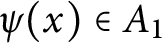 $\psi (x)\in A_1$
.
Assume next that
 $x \notin R$
. Let
 $i^*$
be least so that
 $\forall j\ \exists j' \geq j\ \forall k\ x(i^*,j',k)=1$
. So, for any j,
 $(h(x)(i^*,j,t))_1$
has a limiting value
 $j' \geq j$
as t goes to infinity (i.e., the width
 $i^*$
search starting at j will always gets stuck). Note that if
 $i>i^*$
, then
 $(h(x)(i,j,t))_1$
will reach its limiting value at or before when
 $(h(x)(i^*,j,t))_1$
does, that is, the
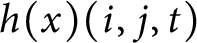 $h(x)(i,j,t)$
search will get stuck at or before when
 $h(x)(i^*,j,t)$
gets stuck. So, for all j we have that for all sufficiently large n with
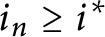 $i_n \geq i^*$
and
 $j_n=j$
, that
 $(h(x)(i_n,j_n,t_n))_0=0$
(unsuccessful search at step
 $t_n$
).
Consider
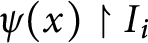 $\psi (x)\restriction I_i$
where
 $i\geq i^*$
. Therefore, for each
 $j,$
we have that for all large enough n with
 $j_n=j$
that either
 $i_n < i$
, in which case
 $\psi (x)\restriction (B_n \cap I_i)= u\restriction (B_n \cap I_{i})$
, or else
 $i_n \geq i$
, in which case (since
 $(h(i_n,j,t_n))_0=0$
) we also have that
 $\psi (x)\restriction (B_n \cap I_{i})=u\restriction (B_n \cap I_{i})$
. Thus, for any j we have that for large enough n that
 $\psi (x)\restriction (B_n \cap I_{i})$
is either of the form
 $u\restriction (B_n \cap I_{i})$
or else of the form
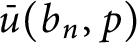 $\bar {u}(b_n,p)$
where
 $p>j$
. That is, the periods p used in truncating u in the block
 $B_n$
go to infinity with n.
It follows from
 $(\dagger )$
(where the
 $i_0$
there is the current
 $i_n$
) that for any
 $\epsilon>0$
and any
 $E\in \mathcal {E}$
(with, say
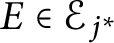 $E\in \mathcal {E}_{j^*}$
) that for all large enough n that in either case,
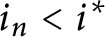 $i_n <i^*$
or
 $i_n \geq i^*$
(in which case
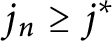 $j_n \geq j^*$
for large enough n), we have that for all k with
 $b_n+\eta _n \leq k \leq b_{n+1}$
that if
 $$ \begin{align*} d=\frac{1}{k-b_n} |\{ m \in [b_n,k) \colon E(\psi(x)(m-j^*),\dots,\psi(x)(m-1)) \neq \psi(x)(m)\} | \end{align*} $$
then
 $$ \begin{align*} d & \geq \left( \frac{b-1}{b} \right) \min \left\{ \left(1-\frac{1}{j}-\frac{j}{2^n}\right), \left(1-\frac{1}{n}\right)\left(\sum\limits_{i\notin J} \frac{1}{2^{i+1}} +\sum\limits_{\substack{i \in J\\ i>i^*}} \frac{1}{2^{i+1}}\right) \right\} \end{align*} $$
for any j and all large enough n. For any
 $\epsilon>0,$
we have for all large enough n that
 $$ \begin{align*}d \geq \left( \frac{b-1}{b}\right) \left(\sum\limits_{i\notin J} \frac{1}{2^{i+1}} +\sum\limits_{\substack{i \in J\\ i>i^*}} \frac{1}{2^{i+1}}\right)-\epsilon \geq (s-\epsilon)+ \left(\frac{b-1}{b}\right)\sum\limits_{\substack{i \in J\\ i>i^*}} \frac{1}{2^{i+1}}.\end{align*} $$
We may assume also that the
 $b_n$
grows sufficiently fast so that
 $\frac {\sum _{m<n} b_m}{b_n} \to 0$
as
 $n \to \infty $
. Recall that we also have that
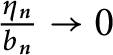 $\frac {\eta _n}{b_n}\to 0$
. It follows that for large enough n we have that the above inequality for d holds also for
 $d'$
where
 $$ \begin{align*} d'=\frac{1}{k} |\{ m \in [0,k) \colon E(\psi(x)(m-j^*),\dots,\psi(x)(m-1)) \neq \psi(x)(m)\} | \end{align*} $$
for all large enough k. Thus,
 ${\beta }^{-}(\psi (x)) \geq s+ (\frac {b-1}{b})(\sum _{\substack {i \in J\\ i>i^*}} \frac {1}{2^{i+1}})$
, and so
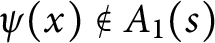 $\psi (x) \notin A_1(s)$
.
5 Hausdorff dimension of real numbers with noise s
For each
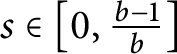 $s \in \left [ 0,\frac {b-1}{b} \right ]$
, we know that
 $\mathcal {N}(b) \subseteq A_2(s)$
and
 $\mathcal {N}(b) \subseteq A_4(s),$
which implies
 $\dim _H(A_2(s)) = \dim _H(A_4(s)) = 1$
. Since
 $A_1(s)$
and
 $A_3(s)$
do not contain
 $\mathcal {N}(b),$
we must introduce the following machinery to compute the Hausdorff dimension of these sets. It is convenient to work in the shift space
 $b^\omega $
rather than
 $[0,1)$
. We identify
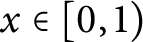 $x \in [0,1)$
with its base-b decimal expansion. This is unique off of a countable set, which has Hausdorff dimension
 $0$
and so does not affect any of the following arguments. Under this identification, a basic open set in
 $b^\omega $
determined by a sequence of length n corresponds to a basic open set in
 $[0,1)$
of diameter
 $\frac {1}{b^n}$
.
For
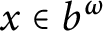 $x \in b^\omega $
let
 $M(x)$
be the set of weak-
 $*$
limit points of the sequence of measures
 $\mu _{x,n} = \frac {1}{n} \sum _{k=1}^{n} \delta _{T^k x}$
where
 $T(d_1 d_2 d_3 \cdots ) = d_2 d_3 \cdots $
is the shift map on
 $b^\omega $
. This is a closed connected subset of the shift-invariant probability measures on
 $b^\omega $
which we denote by
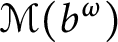 $\mathcal {M}(b^\omega )$
. We say a point
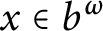 $x \in b^\omega $
is generic for a measure
 $\mu $
if
 $M(x) = \{\mu \}$
. For a closed connected subset
 $M \subseteq \mathcal {M}(b^\omega )$
define
 $\mathcal {G}(M)$
to be the set of
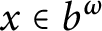 $x \in b^\omega $
such that
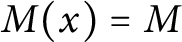 $M(x) = M$
. Note
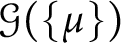 $\mathcal {G}(\{\mu \})$
is the set of generic points for
 $\mu $
. Recall the measure-theoretic entropy of a shift-invariant measure
 $\mu $
on
 $b^\omega $
is
 $$ \begin{align*} h(\mu) & = \lim\limits_{N \to \infty} \frac{1}{N} \sum\limits_{B \in b^N} -\mu[B] \log \mu[B]. \end{align*} $$
Colebrook proved the following result in [Reference Colebrook12].
Theorem 5.1 The Hausdorff dimension of
 $\mathcal {G}(M)$
is
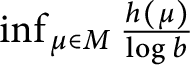 $\inf _{\mu \in M} \frac {h(\mu )}{\log b}$
.
In an analogous way to real numbers, we can define the noise of a measure
 $\mu $
as
 $$ \begin{align*} \beta(\mu) = 1 - \lim\limits_{\ell \to \infty}\sum\limits_{B \in b^\ell} \mu[B] \max_{0 \leq d \leq b-1} \frac{\mu[d ^{\smallfrown} B]}{\mu[B]}. \end{align*} $$
It is clear that the upper and lower noise of each element in
 $\mathcal {G}(M)$
is
 $\beta ^+(M) : = \sup _{\mu \in M} \beta (\mu )$
and
 $\beta ^-(M): = \inf _{\mu \in M} \beta (\mu ),$
respectively. In general
 $$ \begin{align*} \beta^+(x) &\geq \beta^+(M(x)) \\ \beta^-(x) & \leq \beta^-(M(x)). \end{align*} $$
To see the first of these, let
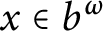 $x\in b^\omega $
and given
 $\epsilon>0$
fix a measure
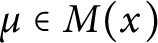 $\mu \in M(x)$
such that
 $| \beta (\mu ) -\beta ^+(M(x))|<\epsilon $
. Fix a sequence
 $a_0<a_1<\cdots $
of integers such that the measures
 $\mu _{a_n}=\frac {1}{a_n} \sum _{k=1}^{a_n} \delta _{T^kx}$
weak-
 $*$
converge to
 $\mu $
. Consider any
 $E\in \mathcal {E}$
, say
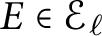 $E\in \mathcal {E}_\ell $
. Then
 $\beta ^+_E(x)\geq \lim _n \beta _E(x,a_n) \geq 1 - \sum _{B \in b^\ell } \mu [B] \max _{0 \leq d \leq b-1} \frac {\mu [d{\kern-1pt}^{\smallfrown } B]}{\mu [B]} \geq \beta (\mu ) \geq \beta ^+(M(x))-\epsilon $
. This shows that
 $\beta ^+(x)\geq \beta ^+(M(x))$
. The second inequality is shown similarly.
From the definitions it follows that:
 $$ \begin{align*} A_1(s) &= \bigcup_{\substack{M \subseteq \mathcal{M}(b^\omega) \\ M\text{ is closed and connected} \\ \beta^{-}(M) \leq s }} \mathcal{G}(M) \ \ \ \ \ \ \ \ A_2(s)= \bigcup_{\substack{M \subseteq \mathcal{M}(b^\omega) \\ M\text{ is closed and connected} \\ \beta^{-}(M) \geq s }} \mathcal{G}(M) \\ A_3(s) &= \bigcup_{\substack{M \subseteq \mathcal{M}(b^\omega) \\ M\text{ is closed and connected} \\ \beta^+(M) \leq s }} \mathcal{G}(M) \ \ \ \ \ \ \ \ A_4(s) = \bigcup_{\substack{M \subseteq \mathcal{M}(b^\omega) \\ M\text{ is closed and connected} \\ \beta^+(M) \geq s }} \mathcal{G}(M). \end{align*} $$
Furthermore,
 $$ \begin{align*} U(s) & = \bigcup_{\substack{M \subseteq \mathcal{M}(b^\omega) \\ M\text{ is closed and connected} \\ \beta^{+}(M) = s }} \mathcal{G}(M) \ \ \ \ \ \ \ \ L(s) = \bigcup_{\substack{M \subseteq \mathcal{M}(b^\omega) \\ M\text{ is closed connected} \\ \beta^{-}(M) = s }} \mathcal{G}(M). \end{align*} $$
If we have a measure
 $\mu $
such that
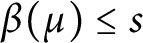 $\beta (\mu )\leq s$
, then by applying the above equations to
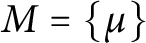 $M=\{ \mu \}$
we have that
 $A_3(s)\supseteq \mathcal {G}(\{ \mu \})$
. This gives
 $$ \begin{align*}\dim_H A_3(s) \geq \frac{1}{\log b} \sup\limits_{\mu \colon \beta(\mu) \leq s} h(\mu). \end{align*} $$
Note the same lower bound holds for
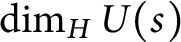 $\dim _H U(s)$
since
 $$ \begin{align*}\dim_H U(s) \geq \frac{1}{\log b} \sup\limits_{\mu \colon \beta(\mu) = s} h(\mu) \geq \frac{1}{\log b} \sup\limits_{\mu \colon \beta(\mu) \leq s} h(\mu). \end{align*} $$
This second inequality follows since if
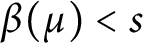 $\beta (\mu ) < s$
we can find
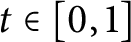 $t \in [0,1]$
such that
 $\beta (t\mu +(1-t)\lambda ) = s$
where
 $\lambda $
is the uniform measure on
 $b^\omega $
and
 $h(t\mu + (1-t) \lambda ) \geq h(\mu )$
since
 $\lambda $
is the measure of maximal entropy. We have that
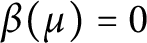 $\beta (\mu ) = 0$
is equivalent to
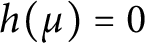 $h(\mu ) = 0$
and
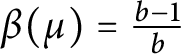 $\beta (\mu ) = \frac {b-1}{b}$
is equivalent to
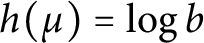 $h(\mu ) = \log b$
but we do not have a general expression for
 $$ \begin{align*} \sup\limits_{\mu : \beta(\mu) \leq s} h(\mu). \end{align*} $$
One approach to finding this supremum is to restrict our attention to measures, which are k-step Markov, that is measures of the form
 $$ \begin{align*} \mu[b_1, b_2, \cdots, b_{\ell}] & = \rho(b_1, \cdots, b_k) \prod\limits_{i=1}^{\ell - k} P_{b_i \cdots b_{i+k-1}, b_{i+1} \cdots b_{i+k}}, \end{align*} $$
where
 $\rho $
is a probability distribution on
 $b^k$
(which we view as a
 $1 \times b^k$
matrix) and P is a
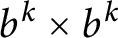 $b^k \times b^k$
matrix of non-negative real numbers such that
 $$ \begin{align*} &\sum\limits_{B' \in b^k} P_{B,B'} = 1 \text{ for all } B \in b^k\\ &\rho P = \rho \\ & P_{B,B'}>0 \Rightarrow B_i = B^{\prime}_{i-1} \text{ for } 2 \leq i \leq k. \end{align*} $$
A k-step Markov chain
 $\mu $
with stationary distribution
 $\rho $
and transition matrix P has entropy
 $$ \begin{align*} h(\mu) := h_k(\rho,P) = \sum\limits_{B \in b^k} \rho(B) \sum\limits_{B' \in b^k} - P_{B,B'} \log P_{B,B'} \end{align*} $$
and noise
 $$ \begin{align*} \beta(\mu) := \beta_k(\rho,P) &= 1 - \sum\limits_{B \in b^k} \mu[B] \max_{0 \leq d \leq b-1} \frac{\mu[d ^{\smallfrown} B]}{\mu[B]} \\ &= 1 - \sum\limits_{B \in b^k} \mu[B] \max_{0 \leq d \leq b-1} P_{d b_1 \cdots b_{k-1}, b_1 b_2 \cdots b_k}. \end{align*} $$
Thus,
 $\sup _{(\rho , P) \colon \beta _k(\rho ,P) \leq s} h_k(\rho ,P) \leq \sup _{\mu \colon \beta ^+(\mu ) \leq s} h(\mu )$
. If we can compute this supremum over all stochastic matrices P with steady state
 $\rho $
we have improved lower bounds on
 $\dim _H(U(s))$
. Problems of this type are unfortunately quite difficult in general. This problem is tractable for small k however, and we now consider an easy special case.
Lemma 5.2 For
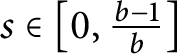 $s \in \left [ 0, \frac {b-1}{b} \right ]$
 $$ \begin{align*} \dim_H(A_3(s)) \geq \frac{1}{\log b} H(s) + s \frac{\log(b-1)}{\log b}, \end{align*} $$
where
 $H(s) = -s\log s - (1-s) \log (1-s)$
.
Proof For
 $k=1$
and P with identical rows (so we now write
 $P_j$
instead of
 $P_{i,j}$
) we have the associated Markov measure
 $\mu $
is Bernoulli, which implies
 $$ \begin{align*} h(\mu) &= - \sum\limits_{d =0}^{b-1} P_d \log P_d \\ \beta(\mu) &= 1 - \max_{0 \leq d \leq b-1} P_d. \end{align*} $$
Now if
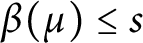 $\beta (\mu ) \leq s$
then
 $\max _{0 \leq d \leq b-1} P_d \geq 1 - s$
and we can, without of loss of generality take this maximum to be at
 $d=0$
. Therefore,
 $$ \begin{align*} \dim_H A_3(s) &\geq \sup\limits_{\substack{P: P_0 \geq 1-s \\P_d \leq P_0 \forall 0 \leq d \leq b-1 \\ \sum_d P_d =1}} - \sum\limits_{d=0}^{b-1} P_d \log P_d. \end{align*} $$
Clearly, this supremum is attained when
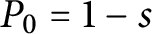 $P_0 = 1-s$
since
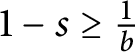 $1 - s \geq \frac {1}{b}$
. Thus, we must maximize
 $- \sum _{d =0 }^{b-1} P_d \log P_d$
subject to the constraints
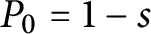 $P_0 = 1-s$
,
 $0 \leq P_d \leq 1-s$
and
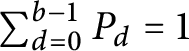 $\sum _{d=0}^{b-1} P_d = 1$
, which is equivalent to maximizing
 $- \sum _{d=1}^{b-1} P_d \log P_d$
subject to the constraints
 $0 \leq P_d \leq 1-s$
and
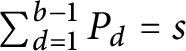 $\sum _{d=1}^{b-1} P_d = s$
. The maximizer of
 $-\sum _{d=1}^{b-1} P_d \log P_d$
subject to the constraint
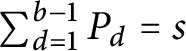 $\sum _{d=1}^{b-1} P_d = s$
occurs when
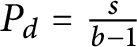 $P_d = \frac {s}{b-1}$
. Since
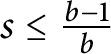 $s \leq \frac {b-1}{b}$
we have
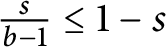 $\frac {s}{b-1} \leq 1- s$
, so for each
 $1 \leq d \leq b-1$
we have
 $0 \leq P_d \leq 1-s$
. Thus, we have
 $$ \begin{align*} \dim_H(A_3(s)) &\geq \frac{1}{\log b} \left ( -(1-s) \log (1-s) - \sum\limits_{d=1}^{b-1} \frac{s}{b-1} \log \frac{s}{b-1} \right )\\ &= \frac{1}{\log b}\left ( - (1-s)\log(1-s) - s \log \frac{s}{b-1} \right )\\ & = \frac{1}{\log b} H(s) + s \frac{\log (b-1)}{\log b}. \end{align*} $$
▪
The lower-bound for
 $A_1(s)$
is obtained similarly. By again considering
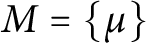 $M=\{ \mu \}$
for
 $\mu $
with
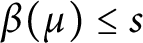 $\beta (\mu )\leq s$
we have
 $$ \begin{align*} \dim(A_1(s))\geq \frac{1}{\log(b)} \sup\limits_{\mu\colon \beta(\mu)\leq s} h(\mu), \end{align*} $$
and thus we have the same lower-bound as for
 $A_3(s)$
.
In order to obtain an upper bound on
 $\dim _H(A_3(s)),$
we use the argument of M. Bernay [Reference Bernay9] which showed
 $\dim _H \mathcal {N}^\perp (b) = 0$
. To do this, define the sets
 $$ \begin{align*} A(N_0,\ell,s,\epsilon) =\!\!\!\bigcup_{E \in \mathcal{E}_\ell} \bigcap_{N \geq N_0} \left \{\! x \in b^\omega \colon \sum\limits_{n<N} \inf \{1, |x(n) - E(x\!\restriction\! [n-\ell,n-1])|\} \leq N(s+\epsilon) \!\right \} \end{align*} $$
and note
 $$ \begin{align*} A_3(s) = \bigcap_{\epsilon> 0} \bigcup_{\ell = 1}^\infty \bigcup_{N_0 = 1}^\infty A(N_0,\ell,s,\epsilon). \end{align*} $$
Bernay proved the following lemma (in fact, it was shown in [Reference Bernay9] that the following upper-bound holds for the set
 $A'(N_0,\ell ,s,\epsilon ),$
which is defined as
 $A(N_0,\ell ,s,\epsilon )$
except reversing the order of the union and intersection).
Lemma 5.3 For
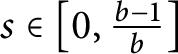 $s \in \left [ 0,\frac {b-1}{b} \right ]$
 $$ \begin{align*}\dim_H A(N_0,\ell,s,\epsilon) \leq \frac{1}{\log b} H(s+\epsilon) + s+\epsilon. \end{align*} $$
This implies the following upper bound on
 $\dim _H(A_3(s))$
.
Lemma 5.4 For
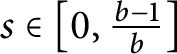 $s \in \left [ 0,\frac {b-1}{b} \right ]$
 $$ \begin{align*}\dim_H A_3(s) \leq \frac{1}{\log b} H(s) + s. \end{align*} $$
The upper-bound for
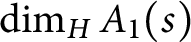 $\dim _H A_1(s)$
follows from a modification of Bernay’s argument. Namely, consider any
 $\gamma> s+\frac {1}{\log (b)}H(s)$
. We show that the
 $\gamma $
-dimensional Hausdorff measure
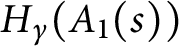 $H_\gamma (A_1(s))$
of
 $A_1(s)$
is
 $0$
. We have
 $$ \begin{align*} A_1(s) = \bigcap_{\epsilon> 0} \bigcup_{\ell = 1}^\infty \bigcap_{N_0 = 1}^\infty B(N_0,\ell,s,\epsilon), \end{align*} $$
where
 $$ \begin{align*} B(N_0,\ell,s,\epsilon) =\!\!\!\bigcup_{E \in \mathcal{E}_\ell} \bigcup_{N \geq N_0} \left \{\! x\in b^\omega \colon\! \sum\limits_{n<N} \inf \{1, |x(n) - E(x\! \restriction\! [n-\ell,n-1])|\} {\,\leq\,} N(s+\epsilon) \!\right \}. \end{align*} $$
It suffices to fix
 $\epsilon>0$
with
 $s+\frac {1}{\log (b)} H(s+\epsilon )+\epsilon <\gamma $
, and fix
 $\ell>0$
and show that the
 $\gamma $
-dimensional measure of
 $\bigcap _{N_0 = 1}^\infty B(N_0,\ell ,s,\epsilon )$
is
 $0$
. For this, it suffices to show that
 $\lim _{N_0\to \infty } H_\gamma (B(N_0,\ell , s, \epsilon ))=0$
. Now,
 $B(N_0,\ell ,s,\epsilon )=\bigcup _{N \geq N_0} C(N,\ell ,s,\epsilon )$
, where
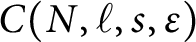 $C(N,\ell ,s,\epsilon )$
is defined as
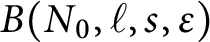 $B(N_0,\ell ,s,\epsilon )$
except without the union over
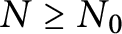 $N\geq N_0$
. Therefore,
 $H_\gamma (B(N_0,\ell , s, \epsilon ))\leq \sum _{N\geq N_0} H_\gamma (C(N,\ell ,s,\epsilon ))$
. Bernay [Reference Bernay9] shows that
 $$ \begin{align*} H_\gamma(C(N,\ell,s,\epsilon))\leq C \left( \frac{b^{s+\epsilon-\gamma}}{(s+\epsilon)^{s+\epsilon} (1-(s+\epsilon))^{1-(s+\epsilon)}}\right)^N \end{align*} $$
for some constant
 $C,$
which is independent of N. Since
 $\gamma>s+\frac {1}{\log (b)}H(s+\epsilon )+\epsilon $
, the fraction in the above expression is less than
 $1$
, so the sum
 $\sum _{N} H_\gamma (C(N,\ell ,s,\epsilon ))$
is bounded by a convegent geometric series and so
 $$ \begin{align*} \lim\limits_{N_0\to \infty} \sum\limits_{N\geq N_0} H_\gamma(C(N,\ell,s,\epsilon))=0. \end{align*} $$
This completes the proof of Theorem 1.6.


