Introduction
In recent years there has been growing research interest in the short- and long-term effects of being bullied in childhood (Sourander et al. Reference Sourander, Jensen, Rönning, Niemelä, Helenius, Sillanmäki, Kumpulainen, Piha, Tamminen, Moilanen and Almqvist2007; Gini & Pozzoli, Reference Gini and Pozzoli2009; Stapinski et al. Reference Stapinski, Bowes, Wolke, Pearson, Mahedy, Button, Lewis and Araya2014; Lereya et al. Reference Lereya, Copeland, Costello and Wolke2015). One area of particular interest has been the examination of possible linkages between bullying victimization and the development of psychotic symptoms or psychotic illness (van Dam et al. Reference van Dam, van der Ven, Velthorst, Selten, Morgan and de Haan2012; Cunningham et al. Reference Cunningham, Hoy and Shannon2015). Several studies have shown links between bullying victimization and psychosis. For example, Kelleher et al. (Reference Kelleher, Keeley, Corcoran, Ramsay, Wasserman, Carli, Sarchiapone, Hoven, Wasserman and Cannon2013), using data from a prospective cohort study of adolescents, found a significant dose–response association between exposure to bullying and psychotic experiences during the period 13–16 years. Also, Arseneault et al. (Reference Arseneault, Cannon, Fisher, Polanczyk, Moffitt and Caspi2011), in a study using prospective cohort data, found that children who reported bullying victimization in childhood reported higher levels of psychotic symptoms at age 12 years. In addition, other studies using adolescent samples have also found persistent linkages between bullying victimization and psychotic symptoms (Mackie et al. Reference Mackie, Castellanos-Ryan and Conrod2011, Reference Mackie, O'Leary-Barrett, Al-Khudhairy, Castellanos-Ryan, Struve, Topper and Conrod2013). Two recent meta-analyses and reviews of studies by van Dam et al. (Reference van Dam, van der Ven, Velthorst, Selten, Morgan and de Haan2012), and by Cunningham et al. (Reference Cunningham, Hoy and Shannon2015) concluded that while there was evidence that bullying victimization was associated with later development of psychotic symptoms, there were still several issues arising from the literature.
One key issue arising from the literature is the need for prospective measures of bullying victimization and psychotic symptoms. Cunningham et al. (Reference Cunningham, Hoy and Shannon2015) pointed out that much of the prior research in this area has relied on retrospective measures of bullying victimization, which may be contaminated by the mental state of the respondent at the time of assessment (i.e. those with higher levels of symptomatology may display biased recall of victimization). One way to extend the existing research in this area would be to use prospective measures of bullying and psychotic symptomatology, which would not be subject to recall bias.
A second issue is the extent to which prior studies have controlled for sources of confounding and covariation. Cunningham et al. (Reference Cunningham, Hoy and Shannon2015) questioned the extent to which the linkages between bullying victimization and later psychotic symptoms were causal, or instead represented the effects of other behavioural or environmental factors that are linked to both increased risk of bullying victimization, and later psychotic symptomatology. One way to address this issue is to use prospective measures of childhood behaviour and early psychotic symptomatology to control for possible confounding in the linkages between bullying victimization and psychotic symptoms. In general, previous studies have controlled for only a limited range of potential confounding factors, and only one has controlled for baseline symptoms of psychosis (Kelleher et al. Reference Kelleher, Keeley, Corcoran, Ramsay, Wasserman, Carli, Sarchiapone, Hoven, Wasserman and Cannon2013). A study by De Loore et al. (Reference De Loore, Drukker, Gunther, Feron, Deboutte, Sabbe, Mengelers, Van Os and Myin-Germeys2007), however, found that controlling for possible confounding reduced the association between bullying victimization and psychotic symptoms to statistical non-significance.
A third issue arising from the literature is the extent to which bullying victimization may be linked to psychotic symptoms over the life course. A further issue identified by Cunningham et al. (Reference Cunningham, Hoy and Shannon2015) was that most studies of the linkages between bullying victimization and psychotic symptoms have examined relatively short-term outcomes, when a longer span of time would better reflect variations in the development of psychotic symptoms. Given a relatively high level of variability over the life course in psychotic symptomatology, and in particular age of onset of symptoms (Dutta et al. Reference Dutta, Greene, Addington, McKenzie, Phillips and Murray2007), the use of a longer span of time may allow a more comprehensive examination of the linkages between bullying victimization and psychotic symptomatology.
Against this background this article examines the associations between bullying victimization in adolescence and psychotic symptomatology in adulthood, using data gathered over a 35-year longitudinal study (the Christchurch Health and Development Study; CHDS). The aims of this article were to examine the linkages between bullying victimization and later psychotic symptoms, and in particular to examine the possibility that these linkages may be explained by the influence of covariates, including childhood behavioural problems and early symptoms of psychosis.
Method
Participants
Data were gathered from the CHDS, a longitudinal study of a birth cohort of 1265 individuals born in Christchurch, New Zealand in 1977 and followed to the age of 35 years (Fergusson et al. Reference Fergusson, Horwood, Shannon and Lawton1989; Fergusson & Horwood, Reference Fergusson and Horwood2001). Study participants were assessed at annual intervals from birth to age 16 years, then at ages 18, 21, 25, 30 and 35 years, using a combination of semi-structured interviews, standardized testing and teacher questionnaires. All phases of the study were subject to ethical approval and all information was collected on the basis of signed consent from study participants.
Bullying victimization (ages 13–16 years)
When participants were aged 13 to 16 years, parents and cohort members were asked a series of custom-written questions concerning the school and social experiences of the cohort member. As part of this questioning, both parents (at ages 13–15 years) and cohort members (at ages 14–16 years) were asked to indicate the extent to which the cohort member reported being bullied by others, resulting in up to six possible responses in total over the period 13–16 years. Responses to these questions were obtained using a three-level Likert scale, ranging from ‘not at all’ to ‘definitely’.
In order to obtain a single measure of bullying victimization for each cohort member, the parent and cohort member responses to these items were tabulated, and each cohort member was then assigned to a bullying victimization classification based on the highest numbered response to any of the completed items, at any age, by either the parent or cohort member. These classifications were: ‘not exposed’ (parents and cohort members answered ‘1’ for each item); ‘moderate exposure’ (there was at least one ‘2’ response to an item, but no ‘3’ responses); and ‘high exposure’ (there was at least one ‘3’ response to an item).
Psychotic symptomatology (ages 18, 21, 25, 30 and 35 years)
At each assessment from age 18 to age 35 years, cohort members were administered a comprehensive mental health interview designed to assess a number of aspects of the individual's mental health and psychosocial adjustment. As part of this interview, participants were questioned regarding psychotic symptomatology. For ages 18, 21 and 25 years, cohort members were asked to report on their symptoms over the past 1 month. At ages 30 and 35 years, participants were asked to report on their symptoms since the previous assessment (the difference in time-frames was corrected in the statistical analyses; see below). At ages 18, 21 and 25 years these questions were derived from the Symptom Checklist 90 (SCL-90; Derogatis et al. Reference Derogatis, Lipman and Covi1973), while at ages 30 and 35 years questions were derived from the Diagnostic Interview Schedule (Robins et al. Reference Robins, Cottler, Bucholz and Compton1995). These items spanned a range of symptom areas, including: hallucinations and delusions; paranoid ideation; and related symptoms. Confirmatory factor analysis of this item set has shown previously that the items formed a unidimensional scale reflecting the extent of psychotic symptomatology (Fergusson et al. Reference Fergusson, Horwood and Swain-Campbell2003). These measures were used to generate a count of the number of symptoms of psychosis experienced by each participant during each assessment period. The reliability of the scale at each age was moderate (coefficient α ranged from 0.71 to 0.75).
Covariate factors
A series of covariate factors was obtained from the study database, on the basis of being: (a) similar to covariates used in previous studies of the association between bullying victimization and psychotic symptoms; and (b) being known to be associated with both bullying victimization and psychotic symptoms. Listed below are those covariates that had been chosen on these bases, and had been found to be significantly (p < 0.05) associated with bullying victimization (ages 13–16 years).
Gender
Gender was determined at birth.
Socio-economic status (SES) at birth
Family SES at the time of the child's birth was assessed using the Elley & Irving (Reference Elley and Irving1976) Scale of Socio-Economic Status for New Zealand. This scale classifies families into six levels on the basis of paternal occupation, ranging from 1 = professional to 6 = unskilled.
Child cognitive ability
At ages 8 and 9 years cohort members were assessed using the revised version of the Wechsler Intelligence Scale for Children (Wechsler, Reference Wechsler1974) modified for New Zealand conditions. At each age performance intelligence quotient (IQ), verbal IQ and total IQ scores were computed using the method described in the test manual. The reliabilities of these measures were assessed by using split-half methods and ranged from 0.87 to 0.95. The full scale score was used in these analyses and this score was found to have good reliability (α = 0.93).
Childhood behaviour problems (anxiety/withdrawal; attention problems; ages 7–9 years)
At ages 7–9 years maternal and teacher reports of: (a) the extent to which the child displayed shy, anxious or withdrawn behaviour; and (b) the child's tendencies to inattentive, restless or hyperactive behaviours were obtained using an instrument which combined the Rutter et al. (Reference Rutter, Tizard and Whitmore1970) and Conners (Reference Conners1969, Reference Conners1970) parent and teacher questionnaires. The items from these questionnaires spanned a range of behaviours relating to: shyness, anxiety, withdrawal; and inattentive behaviour, lack of concentration, distractibility, restlessness and hyperactivity (Fergusson et al. Reference Fergusson, Horwood and Lloyd1991; Fergusson & Horwood, Reference Fergusson and Horwood1993) with each item being scored on a three-point scale ranging from ‘not at all’ to ‘a great deal’. A pair of scale scores representing the extent to which the child was described as exhibiting anxious/withdrawn behaviour and attention problems was created by summing parental and teacher item scores for each child. The resulting scales were of moderate to good reliability, having a coefficient α value of 0.87 and 0.93, respectively.
Exposure to childhood sexual abuse (ages 0–16 years)
Retrospective reports of exposure to childhood sexual abuse and physical abuse prior to the age of 16 years were obtained from cohort members at ages 18 and 21 years. At each assessment, participants were asked whether, before the age of 16 years, anyone had ever attempted to involve them in any of a series of 15 sexual activities when they did not want this to happen. Sample members who reported an incident of abuse were then questioned in depth about the context of abuse (Fergusson et al. Reference Fergusson, Horwood and Lynskey1996a , Reference Fergusson, Lynskey and Horwood b ). Using the check and narrative data gathered at each age (18, 21 years), participants were classified into one of four exposure groups reflecting the extent/severity of sexual abuse reports: no sexual abuse (85.9% of the sample); non-contact sexual abuse only (2.7% of the sample); contact sexual abuse not involving attempted or completed sexual penetration (5.1% of the sample); attempted or completed sexual penetration including vaginal, oral and anal intercourse (6.3% of the sample). In the present analysis, respondents were classified as belonging to the group corresponding to the most severe form of abuse reported at either age 18 or 21 years.
Early symptoms of psychosis and paranoid ideation (ages 14–16 years)
At the assessments at ages 15 and 16 years, parents and cohort members were questioned regarding a range of psychological symptoms experienced by the cohort member during the previous 12 months, using the SCL-90. On the basis of this questioning, measures of parent-reported and child-reported symptoms of psychosis (as noted above) were obtained at age 15 and age 16 years, as well as measures of parent-reported and child-reported symptoms of paranoid ideation. Symptoms spanned such issues as: feeling watched or talked about; not trusting others; and blaming others for troubles. The parent and child reports for each age were combined to create two symptom count measures for: (a) psychotic symptoms; and (b) symptoms of paranoid ideation; during the period 14–16 years. The reliability of each scale was α = 0.72 and α = 0.70, respectively.
Statistical analyses
In the first step of the analyses, the bivariate associations between bullying victimization (ages 13–16 years) and psychotic symptomatology (at ages 18, 21, 25, 30 and 35 years) were modelled using generalized estimating equation (GEE) models (Liang & Zeger, Reference Liang and Zeger1986; Zeger & Liang, Reference Zeger and Liang1986). Because the outcome measures were in the form of symptom counts, a Poisson model was fitted to the data. This model was of the form:
 $${\rm Log}\left( {Yit} \right) = {\rm B}0 + {\rm B}1\,{\rm X}1 + eit,$$
where log(Yit) was the logarithm of the rate of psychotic symptoms for the ith participant at time t, X1 was the measure of bullying victimization, and eit was the error or disturbance term for the model. In this model the coefficient B1 represented the effect of bullying victimization on the outcome, pooled over the five observation periods. Dummy variables (not shown) were used for the measure of time t in the model, in order to correct for the differing time-frames in which psychotic symptoms were assessed (current symptoms at ages 18, 21 and 25 years; symptoms since the previous assessment at ages 30 and 35 years). The test of significance of the association was given by a Wald χ2 test of the hypothesis that B1 = 0. Because of the large number of zero scores on the measure of symptoms, robust standard errors were used to correct for possible overdispersion (Hougaard et al. Reference Hougaard, Lee and Whitmore1997). All models were fitted using Stata 12 (StataCorp, 2011). Estimates of the incidence rate ratio (IRR) and 95% confidence interval (CI) were obtained by exponentiation (eb). It should be noted that no evidence was found of significant non-linearity in the association between bullying victimization and psychotic symptomatology.
In the next step of the analysis, the associations between bullying victimization and psychotic symptomatology were adjusted for the effects of the covariate factors, using a series of models. In the first step, the model shown in equation 1 (above) was extended to include the following covariate factors: gender; family SES at birth; and IQ (ages 8–9 years). In the second step, childhood attention problems and anxious withdrawn behaviour were added to the model. In the third step, the model was extended by adding exposure to sexual abuse in childhood. In the final step, adolescent symptoms of psychosis and paranoid ideation were added to the model. At each step of the modelling process, statistically non-significant (p > 0.05) covariate factors were removed from each successive step. These models were of the form:
 $${\rm Log}\left( {Yit} \right) = {\rm B}0 + {\rm B}1\,{\rm X}1 + \sum BjZij + eit,$$
where Zij was the set of covariate factors for individual i, and the remaining terms were as described previously. In this analysis, all covariate factors were entered into the models in their original metrics (the measure of sexual abuse was dichotomized for the display purposes in the Results section below). These models also included a term representing age × bullying victimization interaction (not shown), which was found to be statistically non-significant (p > 0.30).
Sample size and sample bias
The present analyses were based on the 1018 (81% of the original cohort) individuals for whom information was available on bullying victimization during ages 13–16 years. To examine the effects of sample losses on the representativeness of the sample, the obtained samples with complete data at each age were compared with the remaining sample members on a series of sociodemographic measures collected at birth. This analysis suggested that there were statistically significant (p < 0.01) tendencies for the obtained samples to under-represent individuals from socially disadvantaged backgrounds characterized by low parental education, low SES and single parenthood. To address this issue, the data weighting methods described by Carlin et al. (Reference Carlin, Wolfe, Coffey and Patton1999) were used to examine the possible implications of selection effects arising from the pattern of missing data. These analyses produced essentially the same pattern of results to those reported here, suggesting that the conclusions of this study were unlikely to have been influenced by selection bias.
Ethical standards
All procedures contributing to this work comply with the ethical standards of New Zealand committees on human experimentation and with the Helsinki Declaration of 1975, as revised in 2008.
Results
Associations between bullying victimization (ages 13–16 years) and psychotic symptoms (ages 18, 21, 25, 30 and 35 years)
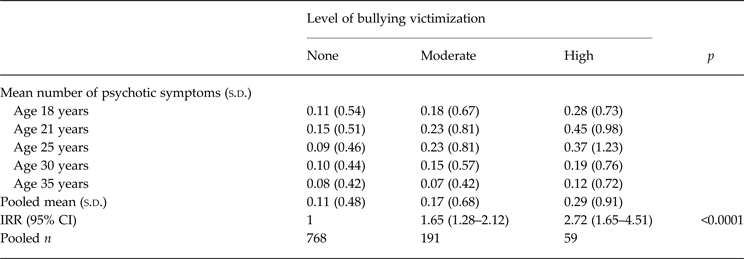
Table 1 shows the cohort classified into three groups based on their exposure to bullying victimization during the period 13–16 years. For each level of bullying victimization, the Table shows the mean score on the measure of psychotic symptoms obtained at each assessment of the cohort in adulthood (ages 18, 21, 25, 30 and 35 years). The Table summarizes these data over the period 18 to 35 years, showing the pooled mean for each level of bullying victimization, and an estimate of the IRR and 95% CI, derived from GEE models (see Method). The Table shows:
-
1. At each assessment, increasing severity of bullying victimization was associated with increased rates of symptoms of psychosis. Those who were in the ‘high’ exposure group had rates of symptoms that ranged from 1.5 to 3 times higher than those who were not exposed to bullying.
-
2. Inspection of the means pooled across assessment periods shows a statistically significant (p < 0.0001) association between bullying victimization and symptoms of psychosis. Those in the ‘high’ exposure group had pooled rates of symptoms that were 2.72 (95% CI 1.65–4.51) times higher than those not exposed to bullying.
Associations between bullying victimization (ages 13–16 years) and psychotic symptoms (ages 18, 21, 25, 30 and 35 years) a

s.d., Standard deviation; IRR, incidence rate ratio; CI, confidence interval.
a n at each assessment ranged from 1025 (age 18 years) to 962 (age 35 years).
In addition, the bivariate analyses showed that there was also a statistically significant (p < 0.0001) effect for age, with rates of symptoms of psychosis generally decreasing over time. There was no evidence of a statistically significant interaction between age and bullying victimization, suggesting that the strength of association between bullying victimization and psychotic symptoms did not vary over time.
Associations between covariate factors and bullying victimization, ages 13–16 years
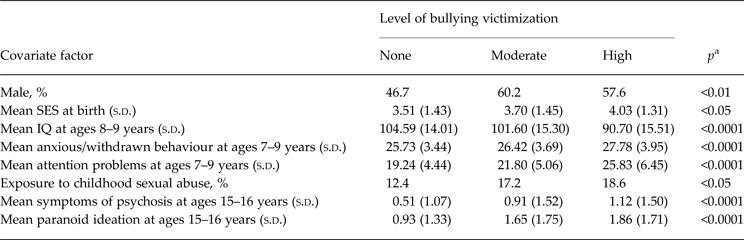
One explanation for the associations depicted in Table 1 is that the associations between bullying victimization in adolescence and later psychotic symptomatology may be explained by the influence of covariate factors that increased the risk of both childhood bullying and adult psychotic symptomatology. In order to examine this issue, the second step of the analysis examined the associations between the measure of bullying victimization during the period 13–16 years and several covariate factors, including: gender; a measure of family SES at birth; child IQ; two measures of childhood behaviour problems (anxious/withdrawn behaviour; attention problems at ages 7–9 years); exposure to sexual abuse during childhood (this measure was dichotomized for display purposes); two measures of early psychotic symptoms obtained contemporaneously with the measure of bullying victimization (symptoms of psychosis and paranoid ideation symptoms; ages 14–16 years). The results of these analyses are shown in Table 2, which shows the mean score for each measure for each level of bullying victimization, as well as a test of significance obtained from the Mantel–Haenszel χ2 test, or one-way analysis of variance. The Table shows that increasing levels of bullying victimization were significantly associated with: male gender (p < 0.01); lower family SES at birth (p < 0.05); lower child IQ (p < 0.0001); increased scores on the measures of anxious/withdrawn behaviour and attention problems (p < 0.0001); higher risk of having been exposed to sexual abuse in childhood (p < 0.05); and higher scores on the measures of adolescent psychotic symptoms and paranoid ideation (p < 0.0001).
Associations between covariate factors (childhood behaviour, individual factors and early symptoms of psychosis and paranoid ideation) and bullying victimization (ages 13–16 years)

SES, Socio-economic status; s.d., standard deviation; IQ, intelligence quotient.
a Mantel–Haenszel χ2 test of independence for dichotomous measures, one-way analysis of variance for means.
Associations between bullying victimization (ages 13–16 years) and psychotic symptoms (ages 18, 21, 25, 30 and 35 years), after adjustment for covariate factors
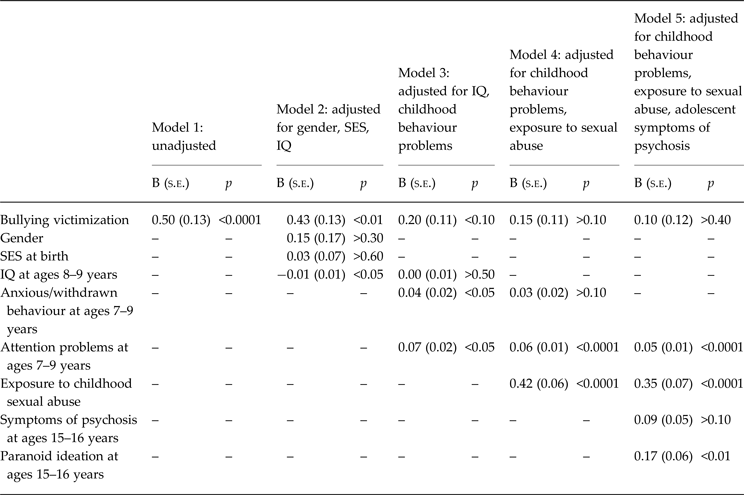
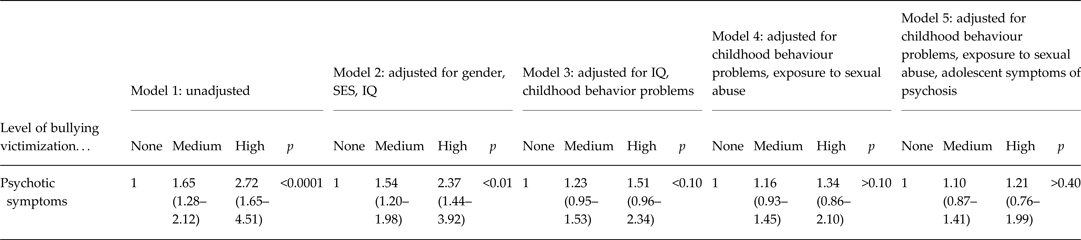
In order to adjust the associations between bullying victimization in adolescence and symptoms of psychosis in adulthood for potential confounding, the covariate factors depicted in Table 2 were entered into the GEE models depicted in Table 1 (see Method) over a series of four steps, in their original metrics. The results of this analysis are shown in Tables 3 and 4, which depict parameter estimates (Table 3) and estimates of the IRR for each level of the bullying victimization classification (Table 4), for five different models. The tables show:
-
1. Adjustment for gender, family SES at birth and childhood IQ reduced the strength of the association between bullying victimization and psychotic symptomatology, but it remained statistically significant (p < 0.01). Of the three covariate factors only IQ was significantly associated with psychotic symptomatology (p < 0.05).
-
2. A model adjusting for IQ and childhood disruptive behaviour (attention problems; anxious/withdrawn behaviour) reduced the association between bullying victimization and psychotic symptomatology to marginal significance (p < 0.10). In this model, IQ was no longer a statistically significant predictor of psychotic symptomatology (p > 0.80).
-
3. Adjustment for childhood disruptive behaviour and exposure to childhood sexual abuse reduced the association between bullying victimization and psychotic symptomatology to statistical non-significance (p > 0.10). In this model, anxious/withdrawn behaviour was no longer a statistically significant predictor of psychotic symptomatology (p > 0.10).
-
4. The addition of adolescent symptoms of psychosis and paranoid ideation further reduced the magnitude of the association between bullying victimization and psychotic symptomatology.
Parameter estimates for the associations between bullying victimization (ages 13–16 years) and psychotic symptoms (ages 18–35 years) across several models adjusting for covariate factors

SES, Socio-economic status; IQ, intelligence quotient; s.e., standard error.
Incidence rate ratios and 95% confidence internals for the associations between bullying victimization (ages 13–16 years) and psychotic symptoms (ages 18–35 years) across several models adjusting for covariate factors

SES, Socio-economic status; IQ, intelligence quotient.
Discussion
The present study has used data from a 35-year study of a longitudinal birth cohort (the CHDS) to examine the linkages between bullying victimization in adolescence and psychotic symptomatology in adulthood, using repeated-measures GEE models. The results of these analyses led to the following general conclusions.
First, examination of the bivariate associations between bullying victimization in adolescence (ages 13–16 years) and psychotic symptoms in adulthood (ages 18–35 years) shows evidence of a moderate association between exposure to bullying and the experience of psychotic symptomatology. This finding is in general agreement with a number of studies that have observed that individuals who have been bullied during childhood and adolescence are at increased risk of experiencing later psychotic symptoms (Arseneault et al. Reference Arseneault, Cannon, Fisher, Polanczyk, Moffitt and Caspi2011; |Mackie et al. Reference Mackie, Castellanos-Ryan and Conrod2011, Reference Mackie, O'Leary-Barrett, Al-Khudhairy, Castellanos-Ryan, Struve, Topper and Conrod2013; Kelleher et al. Reference Kelleher, Keeley, Corcoran, Ramsay, Wasserman, Carli, Sarchiapone, Hoven, Wasserman and Cannon2013).
The CHDS data also showed, however, that those cohort members who were bullied were more likely to have been exposed to childhood sexual abuse, were male, had lower levels of cognitive ability, and were more likely to have been exposed to adverse socio-economic conditions in childhood. The analyses also showed that cohort members who were bullied in adolescence had displayed significantly higher levels of anxious/withdrawn behaviour and attention problems during middle childhood (ages 7–9 years). Similarly, the analyses showed that higher levels of bullying were also significantly associated with higher levels of psychotic symptoms and paranoid ideation (measured contemporaneously). Collectively, these findings suggest the possibility that the linkages between bullying victimization and later psychotic symptomatology may reflect the fact that individuals who had been bullied in adolescence had been exposed to greater adversity, and had a developmental history of unusual behaviour and symptoms, all of which have been shown to be associated with increased risk of bullying victimization (Sourander et al. Reference Sourander, Jensen, Rönning, Niemelä, Helenius, Sillanmäki, Kumpulainen, Piha, Tamminen, Moilanen and Almqvist2007; Gini & Pozzoli, Reference Gini and Pozzoli2009; Stapinski et al. Reference Stapinski, Bowes, Wolke, Pearson, Mahedy, Button, Lewis and Araya2014; Lereya et al. Reference Lereya, Copeland, Costello and Wolke2015). It could be argued that the increased rates of psychotic symptoms in adulthood amongst those who were bulled as adolescents could reflect the cumulative effect of adversity and behaviour problems in childhood and adolescence, rather than direct causal effects of bullying (Cunningham et al. Reference Cunningham, Hoy and Shannon2015).
This issue was examined in the final analyses of the data, which extended the bivariate models over a series of steps to include measures of individual and family factors, abuse exposure, childhood behaviour and early symptoms of psychosis and paranoid ideation. The results of these analyses showed that, after controlling for possible confounding, the association between bullying victimization and adult symptoms of psychosis was greatly reduced in magnitude, and was no longer statistically significant. In addition, the results of successively fitted models suggested that the key predictors that explained the association between childhood bullying victimization and adult psychotic symptomatology were childhood disruptive behaviours (attention problems; anxious/withdrawn behaviour), and to a lesser extent exposure to childhood sexual abuse. Inclusion of terms relating to adolescent psychotic symptomatology made a similar impact to sexual abuse exposure on the magnitude of the association between bullying victimization and psychotic symptomatology.
The results of this analysis suggest that the apparent associations between bullying exposure in adolescence and later symptoms of psychosis were largely explained by childhood behaviour problems, with a smaller contribution made by abuse exposure and early symptoms of psychosis. These results are in general agreement with studies that have shown that the linkages between bullying and psychotic symptomatology are unlikely to be causal in nature (De Loore et al. Reference De Loore, Drukker, Gunther, Feron, Deboutte, Sabbe, Mengelers, Van Os and Myin-Germeys2007; Bratlien et al. Reference Bratlien, Øie, Haug, Møller, Andreassen, Lien and Melle2014), but instead reflect a continuity of disordered behaviour across childhood in adolescence, and the fact that individuals who display such behaviour are more likely to become the targets of bullies. The results are also consistent with studies suggesting linkages between abuse exposure in childhood and later psychotic symptoms (Glod, Reference Glod1993; Sacco & Farber, Reference Sacco and Farber1999; Young et al. Reference Young, Harford, Kinder and Savell2007).
Although the present results suggest that bullying may not play a direct causal role in later psychotic symptomatology, it is important to note that bullying victimization remains a risk indicator for later psychotic symptomatology. This information may be of assistance in helping clinicians to identify individuals who may be at greater risk of developing psychotic symptoms. Similarly, it is important to note that while bullying may not be a direct cause of psychotic symptomatology, it remains well established that bullying increases the risk of suicidal behaviour and other indicators of poor social adjustment (Sourander et al. Reference Sourander, Jensen, Rönning, Niemelä, Helenius, Sillanmäki, Kumpulainen, Piha, Tamminen, Moilanen and Almqvist2007; Gini & Pozzoli, Reference Gini and Pozzoli2009; Stapinski et al. Reference Stapinski, Bowes, Wolke, Pearson, Mahedy, Button, Lewis and Araya2014; Lereya et al. Reference Lereya, Copeland, Costello and Wolke2015). Identification of children who may be at greater risk of bullying due to their individual and behavioural issues may help to relieve other adverse psychosocial outcomes that stem from bullying victimization.
One possible limitation of the present study is the fact that symptoms of early psychosis used in the final model were measured contemporaneously with bullying victimization. The consequence of this issue is that it is not possible to determine whether symptoms of early psychosis are a confounding factor, or a mediating factor in the linkage between childhood bullying and adult symptoms of psychosis. One way of addressing this issue would be to use a matched case–control design examining children with very early signs of psychosis, and comparing these children with a matched control group on measures of current bullying victimization, and following these individuals into adulthood to measure symptoms of psychosis.
Further limitations of the present study include the fact that the measures of bullying and symptomatology were parent- and self-reported, which may be subject to the usual biases associated with self-report measures, including under-reporting and misreporting of symptoms, which is not uncommon in psychosis (Dutta et al. Reference Dutta, Greene, Addington, McKenzie, Phillips and Murray2007). Also, the data were obtained from a specific cohort at a specific time period. Social change, such as changes to school behaviour policies in recent years (Rigby & Slee, Reference Rigby and Slee2008) that have attempted to systematically address bullying, and the phenomenon of online bullying (Jones et al. Reference Jones, Mitchell and Finkelhor2013) that may generally increase young people's exposure to bullying, may alter the magnitude of the association between bullying victimization and later psychotic symptomatology from that observed in the present cohort. In addition, there was a relatively small number of individuals observed in the present cohort who were exposed to a ‘high’ level of bullying (n = 59), which may have reduced the precision of estimates of association.
The limitations of the present study notwithstanding, the results of these analyses suggest that bullying victimization in childhood does not play a causal role in the development of psychotic symptoms in adulthood, and that the apparent associations between bullying and psychotic symptomatology were largely explained by childhood disruptive behaviour and exposure to sexual abuse. While bullying victimization remains a risk marker for adult psychotic symptomatology, the results of the present study suggest that the development of interventions for children displaying attention problems, anxious/withdrawn behaviour, and those children who had been exposed to sexual abuse may help in reducing the incidence of psychotic symptomatology in adulthood.
Acknowledgements
The CHDS is funded by the Health Research Council of New Zealand (Programme grant 11/792). The study was previously funded by the Health Research Council of New Zealand, the National Child Health Research Foundation, the Canterbury Medical Research Foundation, and the New Zealand Lottery Grants Board.
Declaration of Interest
None.