Introduction
Employee innovative behavior, which describes developing, adopting, and implementing new ideas for products and work methods, is crucial for organizational effectiveness and competitive advantage (Van de Ven, Reference Van de Ven1986; Woodman, Sawyer, & Griffin, Reference Woodman, Sawyer and Griffin1993; Scott & Bruce, Reference Scott and Bruce1994; Janssen, Van de Vliert, & West, Reference Janssen, Van de Vliert and West2004; Yuan & Woodman, Reference Yuan and Woodman2010), especially in today’s dynamic business environment (Kanter, Reference Kanter1983; West & Farr, Reference West and Farr1990; Pieterse, Van Knippenberg, Schippers, & Stam, Reference Pieterse, van Knippenberg, Schippers and Stam2010). Innovation is characterized to be a subset of an even broader construct of organizational change (Woodman, Sawyer, & Griffin, Reference Woodman, Sawyer and Griffin1993), while innovative behavior is a narrow construct of organizational change and is defined as an employee’s intentional introduction or application of new ideas, products, processes, and procedures to his or her work role, work unit, or organization (West & Farr, Reference West and Farr1989; Yuan & Woodman, Reference Yuan and Woodman2010).
Managers and scholars alike have sought to seek a variety of factors that enable individuals to foster innovative behavior. For example, Scott and Bruce (Reference Scott and Bruce1994) integrated four interacting systems (i.e., individual, leader, work group, and climate for innovation) to develop and test antecedents of individual innovative behavior. More recently, Yuan and Woodman (Reference Yuan and Woodman2010) examined the different individual and contextual antecedents (i.e., perceived organization support for innovation, supervisor relationship quality, innovativeness as a job requirement, reputation as innovative, and individual dissatisfaction with the status quo) of innovative behavior based on West and Farr’s (Reference West and Farr1989) theoretical framework. The two studies focused on individual and situational antecedents of innovative behavior at the individual levels of analysis. Yet research evidence regarding the cross-level interaction between individual and situational factors that influence innovative behavior within organizations remains inconclusive and underdeveloped. Considering individual innovative behavior is often enacted in team context, their work did not examine how the team context influences the innovative behavior of individuals with different dispositions.
Although the creativity literature has started to pay attention to the importance of individual-contextual interactions and explored how team context influences the expression of individual differences related to creativity (e.g., Hirst, Van Knippenberg, & Zhou, Reference Hirst, Van Knippenberg and Zhou2009; Hirst, Van Knippenberg, Chen, & Sacramento, Reference Hirst, Van Knippenberg, Chen and Sacramento2011), evidence regarding the research how and why different individual and team context affect individual innovative behavior remains largely untested. Innovative behavior includes other behaviors (e.g., implementing ideas) in addition to creativity. For example, innovative behavior includes not only generating the novel and useful ideas by oneself (i.e., creativity) but also adopting others’ ideas that are new to one’s organization or work unit (Woodman, Sawyer, & Griffin, Reference Woodman, Sawyer and Griffin1993; Yuan & Woodman, Reference Yuan and Woodman2010). According to Amabile’s (Reference Amabile1996) componential theory of creativity, three building blocks necessary for individual creativity are identified: domain-relevant skills, creativity-relevant skills, and intrinsic task motivation. Learning-related factors may be expected to relate to both skill acquisition and intrinsic motivation. We argue that learning-related personal and situational factors may foster individual creativity. Since generating creative ideas is a component of innovative behavior, the learning-related personal and situational factors could also be useful in explaining employee innovative behavior. Furthermore, previous research has been shown that learning capabilities at the organizational, team, and individual levels of analysis were closely related to innovative behavior (e.g., Camisón & Villar-López, Reference Camisón and Villar-López2011; Sung & Choi, Reference Sung and Choi2012, Reference Sung and Choi2014).
Prior researchers believe that employee creativity will flourish when employees have a learning goal orientation (hereafter, LGO; Redmond, Mumford, & Teach, Reference Redmond, Mumford and Teach1993; Gong, Huang, & Farh, Reference Gong, Huang and Farh2009) and when organizations provide a learning-related situation such as low levels of team bureaucratic practices (one aspect of team structure) (Hirst et al., Reference Hirst, Van Knippenberg, Chen and Sacramento2011). However, to date no research considers the team structure as a contextual influence stimulating the expression of individual LGO that is conducive to innovation. Following prior research, LGO can be conceptualized as a relatively stable disposition (e.g., VandeWalle, Reference VandeWalle1997; Dierdorff & Ellington, Reference Dierdorff and Ellington2012). Drawing on trait activation theory (Deci & Ryan, Reference Deci and Ryan2000; Tett & Guterman, Reference Tett and Guterman2000; Tett & Burnett, Reference Tett and Burnett2003), we propose that team structure (mechanistic structures and organic structures) will moderate the relationship between LGO and employee innovative behavior.
As Hough (Reference Hough2003) noted, ‘the importance of both individual differences (especially personality variables) and situations is now recognized, and it is nowhere more apparent than in the study of teams – their composition and their effectiveness’ (p. 304). More recently, Schmidt, Ogunfowora and Bourdage (Reference Schmidt, Ogunfowora and Bourdage2012) pointed out a fruitful future research avenue for team composition is to explore how the team composition interacts with personality to influence individual behavior. Team LGO composition describes learning ‘mean dispositional goal orientation across a team’s members’ (Dierdorff & Ellington, Reference Dierdorff and Ellington2012: 662). Team LGO composition relies on the aggregation of self-descriptions of LGO to the team level (Schmidt, Ogunfowora & Bourdage, Reference Schmidt, Ogunfowora and Bourdage2012). The aggregated levels of LGO among team members may be relevant to the adaptation of teams, because a high composition of LGO members within a team is likely to create a climate that focuses on the development of competence and task mastery (Lepine, Reference LePine2005). Following the recommendation of both Dierdorff and Ellington (Reference Dierdorff and Ellington2012) and Porter (Reference Porter2008), we thus operationalized team LGO composition as a team’s mean level of LGO such as team mean LGO. There are two key differences between team LGO composition and team LGO. First, although team LGO composition represents a team-level variable, it is not a collective construct, with ‘team’ as referent (Dierdorff & Ellington, Reference Dierdorff and Ellington2012). In contrast, team LGO is a collective construct and is defined as a shared understanding of the extent to which a team emphasizes learning (Gong, Kim, Zhu, & Lee, Reference Gong, Kim, Zhu and Lee2013). Second, prior research used the VandeWalle’s (Reference VandeWalle1997) scale to measure team LGO composition, a sample item includes ‘I like challenging and difficult assignments that learn new things.’ However, previous studies used the adapted version of VandeWalle’s (Reference VandeWalle1997) scale to assess the team LGO by changing the referent from the individual to the team, a sample item includes ‘our team likes challenging and difficult assignments that teach new things.’ According to trait activation theory, personality traits require trait-relevant situations and cues for their expression. Team LGO composition is likely to create unique situational characteristics that encourage members to develop creative solutions to problems at work. Those situations provide cues for high LGO members to engage in innovative behavior. We also propose that team LGO composition will moderate the extent to which individual LGO is associated with innovative behavior. Recall that Hirst, Van Knippenberg and Zhou (Reference Hirst, Van Knippenberg and Zhou2009) used the trait activation theory to hypothesize and find the relationship between an individual’s LGO and creativity was contingent on team learning behavior, whereas we argue that team LGO composition differs from team leaning behavior-collective problem solving and reflection (Edmondson, Reference Edmondson1999)-because team learning behavior differs from ‘share learning orientation’ (Katz & Kahn, Reference Katz and Kahn1978). Furthermore, although there is a substantial amount of research investigating team personality composition and their effectiveness, little research has examined the moderating effects of team personality composition. One exception is a study by Dierdorff and Ellington (Reference Dierdorff and Ellington2012). The authors examined the effects of dispositional goal orientation on individual-level self-efficacy and metacognition, whereas we examined how the team LGO composition influences the innovation of individuals with different dispositions in LGO.
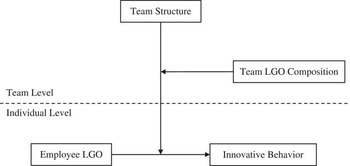
With the current investigation, we make two primary contributions to the literature. First, our study provides the first evidence of the value of a cross-level approach to understand individuals’ innovative behavior, demonstrating that how the learning-related team context (team structure and team LGO composition) influences the innovation of individuals with different dispositions in LGO, which has been highlighted as one of the most important avenues for future innovation research (Scott & Bruce, Reference Scott and Bruce1994). Second, from the trait activation theory perspective, this study sheds light on the importance of examining holistic situational characteristics, including both situation strength and situation trait relevance (Tett & Burnett, Reference Tett and Burnett2003; Tett & Christiansen, Reference Tett and Christiansen2007). Our research also responds to innovation scholars’ call for a multilevel approach to the precursors of individual innovative behavior (Abrahamson, Reference Abrahamson1991; Wolfe, Reference Wolfe1994) and further provides better understanding for trait activation theory. Figure 1 depicts the theoretical model in this study.
The theoretical model. LGO=learning goal orientation

Theory and Hypotheses
Trait activation theory
One particular theoretical lens that might provide insight into how personality traits and situational factors combine to predict behavior is trait activation theory (Kamdar & Van Dyne, Reference Kamdar and Van Dyne2007; Kacmar, Collins, Harris, & Judge, Reference Kacmar, Collins, Harris and Judge2009), emphasizing situation trait relevance as a moderator of trait–behavior relations (Tett & Guterman, Reference Tett and Guterman2000). According to the principle of trait activation, personality traits are expressed as responses to trait-relevant situational cues (Tett & Guterman, Reference Tett and Guterman2000). In other words, situation trait relevance exerts ‘press’ on individuals to behave in trait-related ways. To differentiate the intensity of trait activation, the situational strength should be weak to moderate (Tett & Guterman, Reference Tett and Guterman2000), because everyone is likely to behave in the same way regardless of their unique personalities in strong situations, whereas in weak situations one’s behavior is more likely to depend on his/her unique personality based on there are lack of enough situation cues (Mischel, Reference Mischel1977). Trait activation theory also suggests that the trait must be relevant to the situation (Kacmar et al., Reference Kacmar, Collins, Harris and Judge2009) and that ‘trait relevance supersedes strength in understanding the interaction between traits and situations’ (Tett & Burnett, Reference Tett and Burnett2003: 503). As such, the effect of trait relevant situations on behavior is fundamentally different from the effects of situation strength (Schmidt, Ogunfowora & Bourdage, Reference Schmidt, Ogunfowora and Bourdage2012). Situation strength refers to the power of situations to wash out individual behavioral dispositions of individual differences. Situation trait relevance, on the other hand, refers to how motivating the individual perceives the situation to be (Kacmar et al., Reference Kacmar, Collins, Harris and Judge2009).
Trait activation theory was almost used to consider how work situation might activate traits organized by the Big Five personality (Tett & Burnett, Reference Tett and Burnett2003). For example, Judge and Cable (Reference Judge and Cable1997) suggested that individual differences in the Big Five personality would like to work in cultures similar to their personality. Recently, Schmidt et al. (2012) found a conscientious individual would more likely to focus on task accomplishment in a group with many conscientious members (i.e., high group conscientiousness composition), and an extraverted individual would more likely to engage in counterproductive behaviors in a group with many extraverted members (i.e., high group extraversion composition). Therefore, we focused on both situation strength and situation trait relevance through the lens of trait activation theory to propose the moderating effects of team structure and team LGO composition in linking employee LGO-innovative behavior relationship.
Team structure as a learning-related moderator
Organizational structure is described as ‘sum total of the ways in which labour is divided into distinct tasks and coordination is achieved among them’ (Mintzberg, Reference Mintzberg1979: 2) and is thought to be one of the most ubiquitous aspects of organizations (Clegg & Hardy, Reference Clegg and Hardy1996). It includes the degree to which activities are structured, the concentration of authority, and line control of the workflow (Dragoni & Kuenzi, Reference Dragoni and Kuenzi2012). Mechanistic and organic structural forms are the most prevalent distinction for describing fundamental differences in organizational structure (Burns & Stalker, Reference Burns and Stalker1961). Whereas organic structures are characterized as flexible, loose, and decentralized, mechanistic structures are characterized as rigid, tight, and bureaucratic. Unlike other conceptualizations of structure, the mechanistic–organic structural forms represent ends of a continuum, not a dichotomy (Donaldson, Reference Donaldson2001). Although prior research pointed out that structure is typical organizational-level phenomenon, they acknowledged that structure may exist at the team, group, or unit level (e.g., Perrow, Reference Perrow1967). For example, Hollenbeck et al. have investigated the differential impact of centralizing (vs.) decentralizing team decision-making structures (e.g., Hollenbeck et al., Reference Hollenbeck, Moon, Ellis, West, Ilgen and Sheppard2002; Hollenbeck, Ellis, Humphrey, Garza, & Ilgen, Reference Hollenbeck, Ellis, Humphrey, Garza and Ilgen2011). Others have examined work group level or work unit level structure across various organizations (Ambrose & Schminke, Reference Ambrose and Schminke2003; Dimotakis, Davison, & Hollenbeck, Reference Dimotakis, Davison and Hollenbeck2012; Dragoni & Kuenzi, Reference Dragoni and Kuenzi2012). Therefore, we follow these team and work unit researchers to focus on the team level manifestations of organic and mechanistic structure.
Structure has been shown to influence a range of outcomes at the organizational team and individual levels of analysis. For example, organic structures have been associated with increased learning (Slevin & Covin, Reference Slevin and Covin1997), team innovation (Meadows, Reference Meadows1980), and organization-based self-esteem (Pierce, Gardner, Cummings, & Dunham, Reference Pierce, Gardner, Cummings and Dunham1989). Additionally, Ambrose, Schminke and Mayer (Reference Ambrose, Schminke and Mayer2013) found work group structure moderated the relationship between supervisor perceptions of interactional justice and their subordinates’ perceptions of interactional justice climate. Similarly, Dragoni and Kuenzi (Reference Dragoni and Kuenzi2012) found that work unite structure moderated the relationship between leader LGO and unite LGO.
Achievement goal theory and previous research suggest that employees’ innovative behavior depends on their LGO that may motivate individuals to seek out opportunities for learning and innovation (e.g., Janssen & Van Yperen, Reference Janssen and Van Yperen2004). Little is known about the conditions under which organizations can reap the benefits associated with employees’ learning-related personality trait (e.g., LGO) rather than be harmed by it for innovation. We expect the relationship between employee LGO and innovative behavior will be stronger when structure is more organic than when structure is more mechanistic.
Drawing from trait activation theory, situational factors may limit the scope for the expression of individual differences by creating ‘strong’ situations. As a result, strong situations are more likely to constrain or prescribe individual behavior regardless of their unique personalities. Weak situations, in contrast, generally have little influence on individual behavior, which is guided by their unique personalities. According to Burns and Stalker’s (Reference Burns and Stalker1961) work, mechanistic structures reduce opportunities for individuals to contribute initiative and limit their autonomy by centralizing high levels of formalization of rules and procedures, differentiation of task, and centralization of decision making. The other end of this continuum is organic structures that provide individuals latitude to afford freedom and opportunities to act according to their own inclination by centralizing low levels of formalization of rules and procedures, differentiation of task, and centralization of decision making. Therefore, mechanistic structures are strong situations, whereas organic structures are weak situations that increase more ambiguity for individuals (Dickson, Resick, & Hanges, Reference Dickson, Resick and Hanges2006). As trait activation theory suggests, mechanic structures (strong situations) suppress the scope for the expression of individual differences in LGO that may engender employee innovative behavior. In contrast, organic structures (weak situations) magnify the scope for the innovative expression of individual differences in LGO. Consistent with our expectation, Hirst et al. (Reference Hirst, Van Knippenberg, Chen and Sacramento2011) found centralization (one aspect of mechanistic structures) can suppress the expression of individual LGO that invites creativity. Thus, we propose:
Hypothesis 1: Team structure will moderate the positive relationship between employee LGO and innovative behavior such that the relationship will be stronger when the team structure is more organic.
Team LGO composition as a second learning-related moderator
Individuals with high LGO tend to seek challenges that provide them with learning opportunities so as to develop their competence, acquire new knowledge and skills, and learn from experience (Ames & Archer, Reference Ames and Archer1988; Brett & VandeWalle, Reference Brett and VandeWalle1999; Janssen & Van Yperen, Reference Janssen and Van Yperen2004). As such, a high composition of LGO members within a group is likely to result in a climate centered on the elaboration and development of new knowledge and skills, and deep processing strategies leading to effectiveness in complex and unfamiliar tasks. Schmidt, Ogunfowora and Bourdage (Reference Schmidt, Ogunfowora and Bourdage2012) suggests that the composition of personality traits within a group is likely to create unique situational characteristics. The principle of trait activation holds that personality traits require trait-relevant situations and cues for their expression (Tett & Guterman, Reference Tett and Guterman2000). According to trait activation theory, the relationship between employee LGO and innovative behavior may differ depending on team LGO composition (situational characteristic) because individual differences in LGO are elicited only under certain cues and team LGO composition provides such cues. For example, a LGO person in a work team with few LGO members, however, should be less motivated to express this trait because he or she may perceive that such a situation may constrain the innovative expression of this trait, given the reduced level of effort displayed by less LGO group members. In the following section, we discuss the four combinations of team structure and team LGO composition.
Organic structure and high team mean LGO
High learning-related situations (organic structure and high team mean LGO), according to trait activation theory, could appeal to learning-oriented employees, activating (Tett & Burnett, Reference Tett and Burnett2003) the innovative expression of employees’ LGO, because of an organic structure provides greater opportunities for employees to explore and learn different views and ideas and because of a high mean LGO team also promotes learning opportunities implicit in engaging with challenges facing their team.
Organic structure and low team mean LGO
The combination of employees who view their team structure as an organic structure, but share perceptions that team members are less motivated to focus on the development of competence and task mastery, may amplify the positive effect of employee LGO on innovative behavior. Although low mean LGO teams did not serve as a cue for employees to express their difference in LGO, consistent with trait activation theory, it is possible for high LGO employees in an organic structure to ‘pick up the slack’ and work harder, because of organic structure cues may constitute a ‘weak situation’ that makes individuals difference in LGO more salient and influential and because of learning-oriented employees tend to deal with obstacles and challenges by investing additional effort to develop and master new skills (VandeWalle, Cron, & Slocum, Reference VandeWalle, Cron and Slocum2001; Hirst, Van Knippenberg, & Zhou, Reference Hirst, Van Knippenberg and Zhou2009).
Mechanistic structure and high team mean LGO
When employees in a mechanistic team perceive their team as being high mean LGO team, this should weaken the positive LGO-innovative behavior relationship. A learning-oriented employee in a mechanistic team with more learning-orientated members, according to trait activation theory, should be more motivated to develop skills and knowledge only allowed by the formalization of rules and procedures, differentiation of task, and centralization of decision making. Therefore, the combination of mechanistic structure and high team mean LGO may demotivate and restrain engagement in the development of skills and knowledge.
Mechanistic structure and low team mean LGO
Low learning-related situations (Mechanistic structure and low team mean LGO), drawing from trait activation theory, inhibit the innovative expression of individuals’ difference in LGO. On the one hand, mechanistic structures limit the scope for the innovative expression of individual LGO by creating ‘strong’ situations that override dispositions (Mischel, Reference Mischel1977). On the other hand, low mean LGO teams, in terms of trait activation theory, would not only fail to cue or elicit innovation but also might actually inhibit individual innovation. Taken together, the combination of mechanistic structure and low team mean LGO may weaken the positive LGO-innovative behavior relationship as well.
Hypothesis 2: There will be a three-way interaction of employee LGO, team structure, and team LGO composition in predicting innovative behavior, such that the relationship between employee LGO and innovative behavior will be strongest when both the team structure is more organic and team mean LGO is higher.
Method
Sample and procedure
To increase the potential generalizability of the study results, we randomly selected one eastern province, one central province, and one western province. We collected data from 13 private companies across the three provinces in China. Each company comprised about 500 employees. The sample consisted of organizations operating in the manufacturing industry, which provides the advantage of controlling for potential organization-level confounding variables. To allow for generalization across jobs, our final sample included employees from a broad cross-section of jobs, including human resource, finance, marketing, administrative support, and customer support. Although prior research suggests that people typically associate creative work with scientists and artists, whose work requires substantial creativity in order to be effective, creative work is not defined or tied to a particular occupation (Mumford, Whetzel, & Reiter-Palmon, Reference Mumford, Whetzel and Reiter-Palmon1997; Gong, Huang, & Farh, Reference Gong, Huang and Farh2009). It is thus appropriate to study employee innovative behavior in a wide variety of jobs and organizations. Before the data were collected, we first explained the purpose and benefits of the research to the company’s top management team and human resource management department in order to achieve their support, and then asked each company’s human resource manager to provide a list of work teams with members’ names. At last, we used a code in place of a respondent name on the questionnaire to identify team membership so as to ensure the confidential nature of the survey. A contact person working full time within each organization was asked to hand-deliver survey packets to at least three employees in the same work team and the team’s supervisor, because prior research has been suggested that three employees is a sufficient number to aggregate measures to the team level (e.g., Tracey & Tews, Reference Tracey and Tews2005; Ambrose, Schminke, & Mayer, Reference Ambrose, Schminke and Mayer2013). It should be noted that the employees agreeing to participate in the study must be the subordinates of the supervisor who also agreed to participate in the study. The contact person within each organization returned the completed questionnaires to the researchers.
Matching questionnaires were distributed to 483 employees in 81 work teams. Six work teams were eliminated from the sample, because these work teams did not have either a supervisor or at least three employees. Thus, a total of 334 employees in 75 work teams responded to the survey representing approximately 69.2% of the respondents we surveyed, and their average response rate per team was 83.2%. To test whether the included respondents systematically differed from the excluded respondents with respect to their scores on LGO, team structure and innovative behavior, the results of the multivariate analysis of variance found no significant difference, minimizing concern about potential sampling bias. Among the employees, they were mostly males (51.5% of them were men), relatively young (3.3% for below 20 years, 64.4% for 20–30 years, 25.1% for 30–40 years, 6.3% for 40–50 years, 0.9% for above 50 years), fairly well educated (15.3% for graduate school, 43.4% for university, 29.9% for vocational school, 11.4% for below high school), and their company tenure were mostly short (40.1% for below 1 year, 27.8% for 2 years, 17.4% for 3 years, 6.6% for 4 years, 8.1% for above 5 years). Team size ranged from 3 to 12 members per team, their average team size was 4.45 (SD=1.98), and their average team tenure was 2.14 (SD=0.97).
Measures
Drawing on Brislin’s (Reference Brislin1980) translation-back translation procedure, the entire survey was first translated from English into Chinese and then back-translated into English by two independent bilingual individuals in order to ensure equivalency of meaning, who are both graduate student fluent in both English and Chinese. Unless otherwise indicated, all multi-item scales were measured on a 5-point Likert-type scale (ranging from 1=strongly disagree to 5=strongly agree).
Employee innovative behavior
We used a 6-item scale developed by Scott and Bruce (Reference Scott and Bruce1994) to measure employee innovative behavior, including both the generation and implementation of new ideas. Sample items are ‘generates creative ideas’ (generation of new ideas) and ‘develops adequate plans and schedules for the implementation of new ideas’ (implementation of new ideas). The internal consistency (Cronbach’s α) of the scale was 0.83.
Employee LGO and team LGO composition
Our original measurement of individual differences in LGO directly adopt the VandeWalle’s (Reference VandeWalle1997) scale. To verify the appropriateness and accuracy of translation of the survey items in Chinese context, this survey was distributed to several practitioners who focus on ruling out the ambiguities of the scales. Thus the final measurement of individual difference in LGO adapted version of VandeWalle (Reference VandeWalle1997)’s scale, but the basic meaning of the construct remains unchanged. We operationalized team LGO composition by aggregating the scores of the individuals in each work team (i.e., team mean LGO), reflecting an additive composition model of trait aggregation (Chan, Reference Chan1998). Drawing on Schmidt, Ogunfowora and Bourdage (Reference Schmidt, Ogunfowora and Bourdage2012), this conceptualization provides information about the types of behaviors that team members will tend to demonstrate, and thus it is most indicative of the trait relevance of the situation as suggested by previous research (Lepine, Reference LePine2005; Porter, Reference Porter2005; Dierdorff & Ellington, Reference Dierdorff and Ellington2012). A sample item includes ‘I like challenging and difficult assignments that learn new things.’ The internal consistency (Cronbach’s α) of the scale was 0.83. The results of confirmatory factor analyses showed that the single-factor of LGO fit the data well (χ2 (7)=14.07, p<.01; CFI=0.99, NFI=0.99, IFI=0.99, SRMR=0.03, RMSEA=0.06). All items loaded significantly on their corresponding latent constructs (minimum=0.56, maximum=0.79).
Team structure
As in with prior work (e.g., Dragoni & Kuenzi, Reference Dragoni and Kuenzi2012), we assessed team structure using a 7-item scale, which defined in terms of mechanistic or organic characteristics (Khandwalla, Reference Khandwalla1977). Following Slevin and Covin (Reference Slevin and Covin1997), items were reverse scored such that higher scores represent a more mechanistic structure. A sample item is ‘I feel highly structured channels of communication and highly restricted access to important operating information in my work team.’ A Chinese version of this scale has shown good psychometric properties (e.g., Aryee, Sun, Chen, & Debrah, Reference Aryee, Sun, Chen and Debrah2008). The internal consistency (Cronbach’s α) of the scale was 0.79.
Control variables
First, employees’ education level (4=‘graduate school,’ 3=‘university,’ 2=‘vocational school,’ 1=‘below high school’) and company tenure (1=‘below 1 year,’ 2=‘2 years,’ 3=‘3 years,’ 4=‘4 years,’ 5=‘above 5 years’) were controlled because previous research has been suggested to be important to innovation (Scott & Bruce, Reference Scott and Bruce1994; Mumford & Gustafson, Reference Mumford and Gustafson1988). Second, in accordance with prior research (e.g., Scott & Bruce, Reference Scott and Bruce1994; Janssen, Reference Janssen2004), we control for age (1=‘below 20 years,’ 2=‘20–30 years,’ 3=‘30–40 years,’ 4=‘40–50 years,’ 5=‘above 50 years’) that may influence employee innovative behavior. Third, although prior research showed that gender (1=‘male,’ 0=‘female’) was not related to innovative behavior (e.g., Pieterse et al., Reference Pieterse, van Knippenberg, Schippers and Stam2010), we examined it as a control variable to make sure this demographic variable did not affect our results. Fourth, we controlled for possible effects of team size on team-level variables (i.e., team LGO composition and team structure) and individual-level variables (i.e., employee LGO and innovative behavior). Last, team tenure has been found to distinguish employee creativity (e.g., Tierney & Farmer, Reference Tierney and Farmer2002) and is related to employee creativity (e.g., Hirst, van Knippenberg, & Zhou, Reference Hirst, Van Knippenberg and Zhou2009). Thus we also included team tenure as control variable and calculated team tenure as ‘the average time leaders and members had worked on their team’ (Hirst, van Knippenberg, & Zhou, Reference Hirst, Van Knippenberg and Zhou2009: 285).
Data analysis
First, using LISREL 8.80 software, we conducted confirmatory factor analysis to check the convergent and discriminant validity of the three self-reported scales (i.e., LGO, innovative behavior, and team structure). Second, to support of the aggregation of team structure ratings, we performed aggregation tests using multi-item within-team agreement (rwg (j)) and the intra-class correlations (ICCs). Finally, given the multilevel nature of the data, Hierarchical linear modeling (HLM) with HLM 6.08 (Raudenbush, Bryk, Cheong, & Congdon, Reference Raudenbush, Bryk, Cheong and Congdon2004) was used to test the hypothesized model.
Results
Assessment of common method variance
Harman’s one-factor test was used to examine whether common method bias may have augmented relationships. We performed a principal components factor analysis on items included in our theoretical model (i.e., LGO, innovative behavior, and team structure), extracting nine factors, with factor 1 accounting for only 19.65% of the variance. The eigenvalues of the first three factors were larger than 1 and the first factor did not account for the majority of the variance.
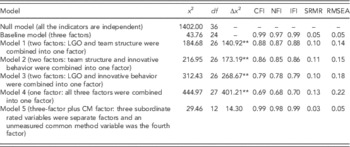
Furthermore, to examine whether a common method (CM) effect is present, Following Podsakoff, MacKenzie, Lee, and Podsakoff’s (Reference Podsakoff, MacKenzie, Lee and Podsakoff2003) procedure, we compared the measurement model with an unmeasured latent CM factor and the same measurement model without the CM factor. As shown in Table 1, the measurement model with an unmeasured latent CM factor (Baseline model: LGO, innovative behavior, and team structure were separate factors) reached a reasonable level of fit (χ2 (24)=43.76, p<.01; CFI=0.99, NFI=0.97, IFI=0.99, SRMR=0.05, RMSEA=0.05). The measurement model including the three subordinate-rated variables as three factors and a CM factor (Model 5) also fit the data well (χ2 (12)=29.46, p<.01; CFI=0.99, NFI=0.98, IFI=0.99, SRMR=0.03, RMSEA=0.05). However, the χ2 difference test suggested that the measurement model with a CM factor did not significantly better than the same measurement model without the CM factor (Δχ2 (12)=14.30, p>.25). Thus the results of this test provided evidence that common method variance was not a problem in this study.
Comparison of measurement models for main variables in the study

Note. N (teams)=75, n (employees)=334.
**p<.01.
Confirmatory factor analyses
Confirmatory factor analyses were conducted to examine the construct validity of the employees’ self-report measures. The results in Table 1 showed that the hypothesized three-factor model (i.e., LGO, innovative behavior, and team structure) fit the data well (χ2 (24)=43.76, p<.01; CFI=0.99, NFI=0.97, IFI=0.99, SRMR=0.05, RMSEA=0.05) and exhibited significantly better than more parsimonious alternative two-factor model 1 (Δχ2 (2)=140.92, p<.01), two-factor model 2 (Δχ2 (2)=173.19, p<.01), two-factor model 3 (Δχ2 (2)=268.67, p<.01), and one-factor model 4 (Δχ2 (3)=401.21, p<.01). Therefore, measures reported by employees captured distinctive constructs.
Aggregation tests
In support of aggregation, the results of the aggregation indicated that all teams had rwg (j) values greater than the value of 0.70 for team structure (Median rwg (7)=0.85, Mean rwg (7)=0.81, ranging from 0.78 to 1.00). Additional support for aggregating team structure (ICC (1)=0.19, ICC (2)=0.68) scores to the team level was provided by interrater reliability indices. As previous research indicated, ICC (1) generally ranges from 0 to 0.50 with a median of 0.12 (James, Reference James1982), while ICC (2) recommended for aggregation is 0.47 (Schneider, White, & Paul, Reference Schneider, White and Paul1998), and the traditional heuristic cut-off for rwg (j) recommended for aggregation is 0.70 (James, Demaree, & Wolf, Reference James, Demaree and Wolf1993). Therefore, the values obtained in our study are above these recommended values, indicating that significant between-group variances and within-group agreement existing values in team structure. In addition, one-way analysis of variance results showed that there were significant differences in team-level means of team structure (F(74, 259)=1.53, p<.01). Taken together, these lines of evidence supported the aggregation of the team structure ratings.
Preliminary analyses
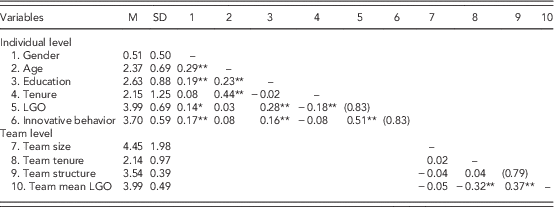
Means, standard deviations, and correlations among Variables are reported in Table 2. At the individual level, employee LGO was positively correlated with innovative behavior (r=0.51, p<.01). At the team level, when the team structure was more organic, team mean LGO was higher (r=0.37, p<.01). These findings provided preliminary support for the hypothesized relations. All variables were mean centered prior to analyses (Aiken & West, Reference Aiken and West1991). Specifically, we group-mean-centered all level 1 variables (i.e., age, education, tenure, and LGO) except for gender (1=‘male,’ 0=‘female’) and grand-mean centered all level 2 variables (i.e., team size, team tenure, team structure, and team mean LGO) to facilitate interpretation (Aiken & West, Reference Aiken and West1991). Bommer, Dierdorff and Rubin (2007) found that cross-level effects remained unchanged in both group-mean centering and grand-mean centering analyses. Thus, the results of grand-mean-centered all level 1 variables are not shown.
Means, standard deviations, and correlations among variablesFootnote a , Footnote b
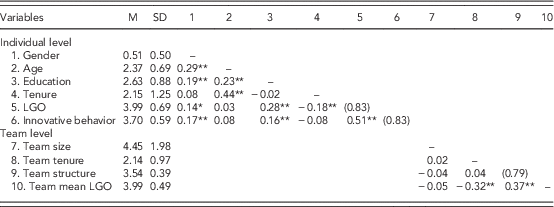
Notes a N (teams)=75, n (employees)=334.
b Cronbach’s α coefficients are in parentheses along the diagonal.
LGO=learning goal orientation.
*p<.05; **p<.01.
Hypotheses tests
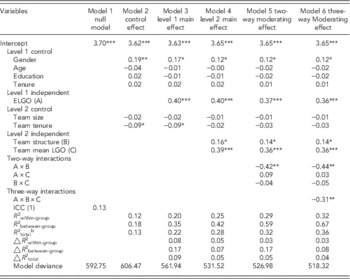
Before conducting hypotheses tests, to justify that HLM 2 was appropriate for analyzing our two-level data, we first ran null models with no predictors but innovative behavior as the dependent variable (Raudenbush et al., Reference Raudenbush, Bryk, Cheong and Congdon2004). The results showed that there was significant between team variance in innovative behavior (χ2 (74)=123.77, p<.01; ICC (1)=0.13), indicating 13% of variance residing in between teams. Therefore, these results provided clear evidence that HLM 2 should be applied to test our multilevel hypotheses.
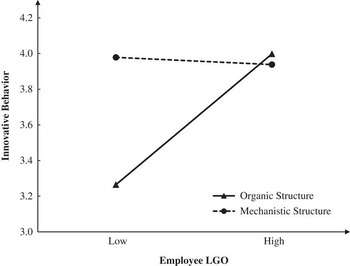
With regard to Hypothesis 1, the results of model 5 in Table 3 indicated that the interactive effect of employee LGO (level 1) and team structure (level 2) on innovative behavior (level 1) was significant (Model 5 of Table 3: γ=−0.42, p<.01). Slope tests (Aiken & West, Reference Aiken and West1991), as shown in Figure 2, demonstrated that employee LGO was more positively related to innovative behavior in organic structures (γ=0.37, p<.001) than in mechanistic structures (γ=−0.02, ns). Therefore, Hypothesis 1 was supported.
Moderating effects of team structure on the relationship between employee LGO and innovative behavior. LGO=learning goal orientation

Hierarchical linear modeling (HLM) resultsFootnote a

Notes a N (teams)=75, n (employees)=334.
b R 2 total =R 2 within-group ×[1-ICC (1)]+R 2 between-group ×ICC (1); ICC (1) indicates the proportion of variance in the outcome variable that resides between groups.
ICC1 for innovative behavior as the outcome is 0.13.
*p<.05; **p<.01; ***p<.001
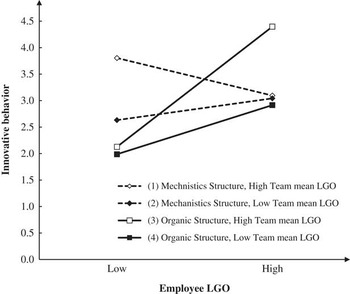
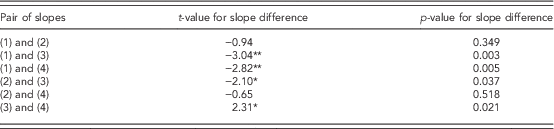
With respect to Hypothesis 2, as displayed the results of Model 6 in Table 3, the three-way interaction term for employee LGO (level 1), team structure (level 2), and team mean LGO (level 2) was a significant predictor of innovative behavior (level 1) (Model 6 of Table 3: γ=−0.31, p<.01). Following Dawson and Richter (Reference Dawson and Richter2006), we plotted simple slopes in order to further examine the form of this interaction. Specifically, as shown by Figure 3, the positive relationship between employee LGO and innovative behavior was strongest when both the team structure was more organic and team mean LGO was higher. To assess this inference empirically, we used Dawson and Richter’s slope difference tests, the results of Table 4 suggested that the slope for the relationship between employee LGO and innovative behavior when both the team structure was more organic and team mean LGO was higher differed significantly from each of the other three slopes (i.e., (1) and (3): t=−3.04, p<.01; (2) and (3): t=−2.10, p<.05; (3) and (4): t=2.31, p<.05). These findings supported Hypothesis 2, suggesting that the positive association between employee LGO and innovative behavior was significantly stronger than the other three circumstances when both the team structure was more organic and team mean LGO was higher.
Moderating effects of team structure and team LGO composition on the relationship between employee LGO and innovative behavior. LGO=learning goal orientation

Results of slope difference tests for three-way interactions
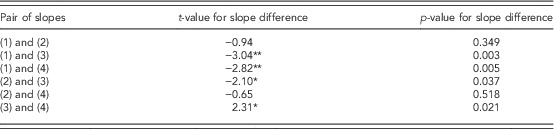
Notes. N (teams)=75, n (employees)=334; (1)=mechanistic structure, high team mean LGO; (2)=mechanistic structure, low team mean LGO; (3)=organic structure, high team mean LGO; (4)=organic structure, low team mean LGO.
*p<.05; **p<.01.
Discussion
Using trait activation theory as our primary theoretical lens, we examined how the learning-related team context (i.e., team structure and team LGO composition) influences the innovative expression of individual differences in LGO.
We found that the relationship between employee LGO and innovative behavior was contingent on team structure. Employee LGO was more strongly related to their innovative behavior for work teams with more organic structures. Relatedly, we discovered a somewhat interesting finding that employees perform more innovative behavior when the team structure was more mechanistic. One possible explanation is that mechanistic teams will strengthen their employees’ safety climates that are conducive to innovation by developing more mechanistic practices (Dickson, Resick, & Hanges, Reference Dickson, Resick and Hanges2006), because of employees know and agree on what the rules are and what other team members are expected to do in mechanistic structures (Burns & Stalker, Reference Burns and Stalker1961). Our results suggest that scholars need to consider not only contextual factors that invite creativity, but also contextual influences that may constrain it in future research.
To provide additional insights, we also examined team LGO composition as a second learning-related moderator of employee LGO-innovative behavior relationship. Surprisingly, the interaction between employee LGO and team mean LGO was nonsignificant, after controlling for the other interactions. The finding was unexpected as trait activation theory that led us to believe that learning-orientated individuals perform more innovative behavior when team mean LGO was higher. One possible explanation is that the interaction between team structure and employee LGO by creating both ‘weak situations’ (e.g., organic structures) and ‘strong situations’ (e.g., mechanistic structures) might suppress the effect of the interaction between team mean LGO and employee LGO. This possible explanation would suggest that the situational strength should be weak to moderate (Tett & Guterman, Reference Tett and Guterman2000) so as to differentiate the intensity of trait activation.
With regard to three-way interactions, as we hypothesized, learning-oriented employees would perform the highest level of innovative behavior when both the team structure was more organic and team mean LGO was higher. An explanation for the finding can be found in trait activation theory. On the one hand, according to the principle of situation strength, organic structures are ‘weak situation’ that amplify the scope for the innovative expression of individual differences in LGO. On the other hand, drawing on the principle of trait activation, the positive effect of employee LGO on innovative behavior was stronger in situations providing appropriate cues. Consistence with both Tett and Burnett’s (Reference Tett and Burnett2003) and Tett and Christiansen’s (Reference Tett and Christiansen2007) argument, our results found that both team structure (situation strength) and team LGO composition (trait relevance) jointly moderated the relationship between employee LGO and innovative behavior. These results are important in suggesting that future research should holistically examine situational characteristics, including both situation strength and trait relevance, in order to better understand the validity of personality in predicting behavior.
More importantly, although there is possibility that team structure may depend on team LGO composition or innovative behavior, we considered team structure as a moderating contextual factor in linking individual LGO with innovative behavior in this study. Specifically, from the theoretical perspective, we theorized team structure (a contextual factor) moderated the relationship between employee LGO (a relatively stable disposition) and innovative behavior (a behavior) through the lens of trait activation theory. We also considered team LGO composition as another contextual factor and thus it similar in nature (e.g., contextual factor) to team structure. From the empirical perspective, the participants of this study were drawn from a cross-organizational sample of 334 employees in 75 work teams that correspond to different tasks, and hence employees who have differences in LGO would feel different sense of team structure in each team. The results of this study indicated that the impact of individual difference in LGO on innovative behavior depended on individual perceptions of team structure. In addition, prior empirical research found that work unite structure not only moderated the relationship between leader LGO and unite LGO, but also moderated the relationship between unite LGO and leader’s perception of unit performance (Dragoni & Kuenzi, Reference Dragoni and Kuenzi2012).
Practical implications
In line with prior research (Janssen & Van Yperen, Reference Janssen and Van Yperen2004; Gong, Huang, & Farh, Reference Gong, Huang and Farh2009; Hirst, Van Knippenberg, & Zhou, Reference Hirst, Van Knippenberg and Zhou2009), a core view that espouses a learning-related personal or situational factor as a panacea for promoting individual innovation is clear. This implies that managers can reap the benefits of employee innovative behavior by selecting for or developing learning-related personal and situational factors in team context. First, our results suggest that a learning-related factor such as LGO can be expected to be an important motivational source for generating, promoting, and implementing innovative ideas. Therefore, to enhance employees’ innovative behavior, organizations might not only select employees with strong LGO for positions and roles, but also provide a development program that stimulates the expression of employees’ LGO.
Second, although an emphasis on employees’ LGO may enhance innovative behavior, they are not indifferent to team contextual factors (Van Yperen & Janssen, Reference Van Yperen and Janssen2002). Managers need to be mindful that selecting employees on the basis of their learning orientation alone will not guarantee innovation. Thus, organizations should pay close attention to the individual in his/her team context. Our results demonstrated that the positive relationship between employee LGO and innovative behavior was stronger when the team structure was more organic. Therefore, it is important to foster ‘appropriate’ behaviors by developing more organic practices, which the team context provides cues that may activate the innovative expression of individual traits in LGO.
Finally, to provide new insight, our study used holistic situational characteristics to examine the influence of both situation strength (team structure) and trait relevance (team LGO composition) on the innovative expression of individual dispositions in LGO. Accordingly, managers can be instrumental here in terms of creating a holistic learning-related team context characterized by both high levels of team mean LGO and more organic practices.
Limitations and directions for future research
Like all studies, this study has several limitations that point to avenues for future research. First, from a methodological perspective, a major limitation of this study is that we collected data from the same resource, which suffers from potential bias that may result from common method variance. Although the constraints within the team did not allow us to measure the current study variables at different times, we examined the factor structure of these measures in employees’ self-report surveys (i.e., confirmatory factor analyses) and confirmed that these measures (i.e., LGO, team structure, and innovative behavior) captured distinct constructs. Thus, the results of both Harman’s one-factor test and confirmatory factor analyses could do some extent alleviate this concern. Moreover, because our key hypotheses involved cross-level interactions (i.e., Hypothesis 1 and Hypothesis 2), it is unlikely that our findings were substantially affected by common method variance as suggested by Hofmann, Morgeson and Gerras (Reference Hofmann, Morgeson and Gerras2003). To further strengthen the conclusion of the current study, future studies might use a variety of information resources. For example, team leaders rated their employees’ innovative behavior or using objective measures of innovative behavior as an alternative to employee self-reports. There are also two theoretical reasons to support the direction of the relationships we found. On the one hand, previous research using both employee ratings of innovative behavior and team leader ratings of innovative behavior demonstrated a significant correlation between the two and a consistent pattern of results for each type of rating (Janssen, Reference Janssen2000). On the other hand, Scott and Bruce (Reference Scott and Bruce1994) found a significant correlation between a similar innovative behavior scale and an objective measure of invention disclosures. Taken together, results remained unchanged in using these analyses (i.e., employees’ self-reported innovative behavior, team leaders rated their employees’ innovative behavior, and objective measures of innovative behavior).
Second, the cross-sectional design of the present study we used, however, limited our ability to determine the direction of causality among the variables. For example, it is possible that the relationship between employee LGO and innovative behavior is vulnerable to opposite and bidirectional. Although theory and previous research have persuasively presented goal orientations are viewed as rather stable personality characteristics (Dweck, Reference Dweck1999) and found employee LGO as major causes of innovative behavior (Janssen & Van Yperen, Reference Janssen and Van Yperen2004; Gong, Huang, & Farh, Reference Gong, Huang and Farh2009), we strongly recommend future studies that use longitudinal or preferably field experimental research designs to explore the relationships posited in our model.
Third, we tested how individuals responded to learning-related team context, but did not test the mediating processes underpinning these relationships. Future research should explore potentially mediating processes in order to validate the current cross-level perspective on individual innovative behavior. For example, according to both Hirst, Van Knippenberg, and Zhou, (Reference Hirst, Van Knippenberg and Zhou2009) and Gong, Huang, and Farh (Reference Gong, Huang and Farh2009), we suggest that the acquisition of creativity-relevant skill and self-efficacy may act as mediators of the LGO-innovative behavior relationship. Further, managers and scholars have sought to interest in self-managing teams in contemporary work organizations (Langfred, Reference Langfred2007; Roberson & Williamson, Reference Roberson and Williamson2012). The characteristic of a self-managing team is the ability to monitor and control its activities and behavior (Goodman, Devadas, & Griffith-Hughson, Reference Goodman, Devadas and Griffith-Hughson1988). A self-managing team is recent one types of management innovation (Vaccaro, Reference Vaccaro2010; Vaccaro, Volberda, & Van Den Bosch, Reference Vaccaro, Volberda and Van Den Bosch2012), and therefore future research should extend this study by examining the antecedents of innovation in the context of self-managing teams, such as management consulting teams or project teams. Meanwhile, we called for more attention to the moderating role of team composition (Schmidt, Ogunfowora and Bourdage, Reference Schmidt, Ogunfowora and Bourdage2012), our research focused on the moderating effects of team LGO composition. According to trait activation theory, team LGO may also moderate the relationship between LGO and employee innovative behavior. Although Gong et al. (Reference Gong, Kim, Zhu and Lee2013) found a direct linear relationship between team LGO and employee creativity, future research should continue to explore the moderating effects of team LGO composition after controlling the moderating effects of team LGO.
Fourth, in accordance with previous research (e.g., Zhou, Reference Zhou2003; Shalley, Zhou, & Oldham, Reference Shalley, Zhou and Oldham2004; Yuan & Woodman, Reference Yuan and Woodman2010), we measured individual innovative behavior using Scott and Bruce’s (Reference Scott and Bruce1994) scale. Such a scale is believed to adequately represent the essential elements of individual innovative behavior – generation and implementation of new ideas. Management innovation refers to ‘the invention and implementation of a management practice, process, structure or technique that is new to the state of the art and is intended to further organizational goals’ (Mol & Birkinshaw, Reference Mol and Birkinshaw2006: 25; Birkinshaw, Hamel, & Mol, Reference Birkinshaw, Hamel and Mol2008: 825). Given the view that management innovation would lead to better theories of management (Mol & Birkinshaw, Reference Mol and Birkinshaw2014), future research should explore a finer-grained analysis of this construct from the long-term firm success’s perspective in the processes of management innovation (Birkinshaw, Hamel, & Mol, Reference Birkinshaw, Hamel and Mol2008; Damanpour, Walker, & Avellaneda, Reference Damanpour, Walker and Avellaneda2009).
Finally, the data were collected from employees working in China, a culture that has different from most Western countries. Therefore, specific Chinese cultural characteristics may limit the generalizability of our results. For example, employees in China may be more closely monitor and frequently evaluate their team leaders’ characteristics when they assess their work environment because of the high power distance orientations (Hofstede, Reference Hofstede1980; Zhang, Wang, & Shi, Reference Zhang, Wang and Shi2012). More recently, Hirst et al. (Reference Hirst, Van Knippenberg, Chen and Sacramento2011) pointed out that low power distance cultures are more likely to invite the creative expression of individual differences in LGO, compared with high power distance cultures. Also, several recent reviews have suggested the necessity of taking a cross-cultural perspective for understanding innovation and creativity (Anderson, De Dreu, & Nijstad, Reference Anderson, De Dreu and Nijstad2004; Shalley, Zhou, & Oldham, Reference Shalley, Zhou and Oldham2004). Although prior research employing samples from both East Asian (e.g., Taiwan) and European-American (e.g., Dutch) did not show significant country differences on the relationship between learning orientation and innovation (e.g., Janssen & Van Yperen, Reference Janssen and Van Yperen2004; Harrison, Neff, Schwall, & Zhao, Reference Harrison, Neff, Schwall and Zhao2006; Gong, Huang, & Farh, Reference Gong, Huang and Farh2009), future research need to determine whether our results are culture specific by comparing findings across different cultural and international contexts.
Conclusion
This study is the first attempt to directly theorize and test how the holistic situational characteristics including both situation strength and trait relevance – influence the innovative expression of individual differences in LGO by integrating insights from a cross-level learning-related perspective and trait activation theory. We hope that this study will stimulate the need to go beyond a single situational characteristic to holistically examine situational characteristics in order to better understand the validity of trait personality in predicting behavior.
Acknowledgments
This research was supported by the National Natural Science Foundation of China (71502141) and the Fundamental Research Funds for the Central Universities (JBK150109). We are grateful to our anonymous reviewers and associate editor Tui McKeown for their constructive comments.