Implications
In dairy farming practices, rumen development and its functional improvement in calves, play a key role on nutrient delivery, absorption and metabolism, and have an important impact on calf health and future production performance. Dietary isobutyrate could improve rumen development by increasing ruminal fermentation products, especially butyrate production. It was suggested that dietary isobutyrate has the potential ability to promote the growth of calves.
Introduction
In dairy farming practices, rumen development and its functional improvement, especially rumen epithelium, play a key role in nutrient delivery, absorption and metabolism, and have an important impact on calf health and future production performance (Bannink et al., Reference Bannink, France, Lopez, Gerrits, Kebreab, Tamminga and Dijkstra2008). With the developmental changes in morphology, metabolic function also changes, then the oxidation of glucose decreases are companied with the increased oxidation of volatile fatty acids (VFA) and the increased ketogenesis of rumen epithelium. Ruminal fermentation products, one of the important factors which affects the development of rumen epithelium, not only provide energy for the growth of epithelial tissue and muscle contraction, but also directly affects the proliferation and differentiation of epithelial cells (Martens et al., Reference Martens, Rabbani, Zanming, Stumpff and Deiner2012). It is well documented that butyrate and to a lesser extent acetate and propionate, are the primary chemical stimulators of rumen development (Mentschel et al., Reference Mentschel, Leiser, Mülling, Pfarrer and Claus2001; Górka et al., Reference Górka, Kowalski, Pietrzak, Kotunia, Jagusiak, Holst, Guilloteau and Zabielski2011; Plöger et al., Reference Plöger, Stumpff, Penner, Schulzke, Gäbel, Martens, Shen, Günzel and Aschenbach2012). It has been suggested that additives that produce more total VFA, especially butyrate, might be used to improve the development of rumen and growth performance (Górka et al., Reference Górka, Kowalski, Pietrzak, Kotunia, Jagusiak, Holst, Guilloteau and Zabielski2011; Plöger et al., Reference Plöger, Stumpff, Penner, Schulzke, Gäbel, Martens, Shen, Günzel and Aschenbach2012; Liu et al., Reference Liu, Wang, Zhang, Pei, Zhang, Li, Guo, Huo, Yang and Wang2016).
The inclusion of branched-chain volatile fatty acids (BCVFA) in ruminant diets, which includes isobutyric, isovaleric and 2-methyl butyric acids, have resulted in increased acetate and butyrate production and a reduction in propionate production (Liu et al., Reference Liu, Wang, Huang, Dong, Yang and Wang2008; Wang et al., Reference Wang, Liu, Pei, Li, Wang, Wang, Bai, Shi, Liu and Li2012; Zhang et al., Reference Zhang, Liu, Wang, Pei, Li, Wang, Yang, Bai, Shi and Liu2015). Supplementation of BCVFA to in vitro media increased microbial protein synthesis, fermentation of plant cell walls and dry matter (DM) digestion (Mir et al., Reference Mir, Mir and Robertson1986). In animal trials, BCVFA improved rumen fermentation (Liu et al., Reference Liu, Wang, Huang, Dong, Yang and Wang2008; Wang et al., Reference Wang, Liu, Pei, Li, Wang, Wang, Bai, Shi, Liu and Li2012; Zhang et al., Reference Zhang, Liu, Wang, Pei, Li, Wang, Yang, Bai, Shi and Liu2015), rumen microbial enzyme activities, the population of cellulolytic bacteria (Liu et al., Reference Liu, Wang, Yang, Zhang, Yang, He, Dong and Huang2014; Wang et al., Reference Wang, Liu, Zhang, Pei, Zhang, Wang, Yang, Bai, Shi and Liu2015; Zhang et al., Reference Zhang, Liu, Wang, Pei, Li, Wang, Yang, Bai, Shi and Liu2015) and nutrient digestibilities in steers (Misra and Thakur, Reference Misra and Thakur2001; Liu et al., Reference Liu, Wang, Huang, Dong, Yang, Zhang and Wang2009a). The milk yields increased by BCVFA supplementation (Liu et al., Reference Liu, Wang, Pei, Li, Wang, Zhang, Zhang, He, Wang, Yang, Bai, Shi and Liu2009b; Val Neto et al., Reference Val Neto, Lana, Val, Leão and Mâncio2010) in dairy cow. Moreover, our previous study reported that supplemental 2-methylbutyrate in pre- and post-weaned calf diets linearly increased rumen total VFA concentration, microbial enzyme activities of carboxymethyl cellulase (CMCase), cellobiase, xylanase, pectinase and amylase, and the relative quantity of Ruminococcus albus, Ruminococcus flavefaciens, Butyrivibrio fibrisolvens and Fibrobacter succinogenes (Li et al., Reference Li, Liu, Wang, Zhang, Pei, Wang, Guo, Huo, Zhang and Liu2015). The increased ruminal fermentation products, especially butyrate, would be used to promote the growth of calves by improving the development of the rumen.
To our knowledge, no literature exists was found regarding dietary isobutyrate and its effects on rumen development and growth performance of pre- and post-weaned dairy calves. Therefore, the aim of this work was to evaluate the effects of isobutyrate on growth performance, rumen development, blood metabolites and hormone secretion in pre- and post-weaned dairy calves.
Material and methods
Animals and experimental design
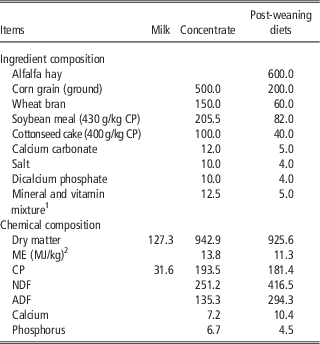
The experimental protocol was approved by the Animal Care and Use Committee of Shanxi Agriculture University. In total, 56 Chinese Holstein male calves with 30 days of age and 72.9±1.43 kg of BW, blocked by days of age and BW, were assigned to four groups in a randomized block design. The treatments were as follows: control (without isobutyrate), low-isobutyrate, moderate-isobutyrate and high-isobutyrate with 0.03, 0.06 and 0.09 g isobutyrate/kg BW per calf per day, respectively. The supplemental isobutyrate (analytical grade; 98.5% of isobutyrate) was purchased commercially and was hand-mixed into milk for pre-weaned calves and the concentrate portion of post-weaned calves. The study consisted of a 10 days of an adaptation period and a 50-day sampling period. Calves were weaned at 60 days of age. During the pre-weaned period, calves were offered whole milk (5% of BW) twice daily at 0800 and 1500 h and fed a commercial concentrate ad libitum. Milk was fed to the pre-weaning calves from day 30 to day 45 through a bucket to ensure isobutyrate enter the rumen. Post-weaned diets consisted of 60% alfalfa hay and 40% commercial concentrate (DM basis), and were available ad libitum. Chemical composition of the feed and diets are in Table 1. Calves were housed in individual pens (2.5×3 m) and fresh water was available throughout the experimental period. Seven calves were chosen from each treatment at random and slaughtered at 45 and 90 days of age.
Ingredient and chemical composition of the food and diet (in g/kg dry matter)

1 Contained 8 mg Co, 700 mg Cu, 4000 mg Fe, 2400 mg Mn, 2400 mg Zn, 240 mg I, 120 mg Se, 600 000 IU vitamin A, 100 000 IU vitamin D and 3000 mg vitamin E per kg premix.
2 ME=metabolic energy, calculated from National Research Council (Reference Nazari, Karkoodi and Alizadeh2001).
Data collection, sampling procedures and chemical analysis
The animals were weighed at 30, 45, 60 and 90 days of age. Milk, feed offered and refusals were recorded daily throughout the experimental period to calculate DM intake. Samples of milk, feed and refusals were collected once weekly for DM determination. Milk samples were preserved with 2-bromo-2-nitropropane-1, 3-diol and pooled for each group before chemical analysis. Feeds and refusals were dried in an oven at 55°C for 48 h, and ground to pass a 1-mm screen with a mill (FZ102; Shanghai Hong Ji instrument Co. Ltd, Shanghai, China) for chemical analysis. Blood samples were obtained on 43, 44 and 88, 89 days of age, 2 h after morning feeding, from the coccygeal vein to 7-ml vacuum tubes (Vacutainer®; Becton Dickinson, Rutherford, NJ, USA) containing potassium oxalate and 4 g/100 ml sodium fluoride for glucose analysis, and 10-ml vacuum tubes containing sodium heparin for analyses of β-hydroxybutyrate (BHBA) and acetoacetate, and 20-ml vacuum tubes for analyses of growth hormone (GH), insulin and IGF-1. Blood samples were immediately placed on ice and transported to the laboratory to separate plasma and serum from whole blood by centrifuging at 2000×g for 15 min at 4°C. All plasma and serum samples were stored frozen at −20°C until analyses. Calves (six per treatment) were slaughtered at 45 and 90 days of age, respectively. The entire digestive tract was removed and placed on ice. Rumen, reticulum, omasum and abomasum were separated, emptied, washed clean with normal saline and weighed. Ruminal tissue samples (overall area of about 8×8 cm) were obtained within 20 min of death and collected from the dorsal, anterior dorsal, anterior ventral, posterior dorsal and posterior ventral blind sacs. For morphometry, a 1×1 cm area of the rumen wall was retrieved. Three 1×1 cm samples were collected and stored at −80°C until for RNA isolation and analysis.
Milk samples were analyzed for fat, true protein and lactose using IR spectrophotometry (Foss 120 Milko-Scan; Foss Electric, Hillerød, Denmark) according to Association of Official Analytical Chemists (AOAC) (1997; method 975.16) procedures. DM content of oven-dried samples was determined by drying at 135°C for 3 h (AOAC, 1997; method 930.15). Organic matter content was calculated as the difference between DM and ash content, with ash determined by combustion at 550°C for 5 h. Contents of the NDF and ADF were determined using the methods described by Van Soest et al. (Reference Van Soest, Robertson and Lewis1991) with heat stable α-amylase and sodium sulfite used in the NDF procedure, and expressed inclusive of residual ash. Content of N in the samples was determined by the Kjeldahl method (AOAC, 1997; method 976.05). Concentration of glucose in plasma was determined using glucose oxidase (Sigma kit no. 315; Sigma Diagnostics, St. Louis, MO, USA) based on the method of Trinder (Reference Trinder1969). Concentration of BHBA was determined (Sigma kit 310-A; Sigma Diagnostics) following the method of Williamson et al. (Reference Williamson, Mellanby and Krebs1962). Concentration of acetoacetate was determined (Sigma Acetoacetate Colorimetric Assay Kit MAK199; Sigma Diagnostics) following the method of Williamson et al. (Reference Williamson, Mellanby and Krebs1962). Concentrations of GH, insulin and IGF-I were determined using an radioimmunoassay (RIA) (GH, insulin and IGF-I Assay Kit, Nanjing Jian Cheng institute of Bio-engineering, Nanjing, China) based on the method of Kasuya et al. (Reference Kasuya, Hodate, Matsumoto, Sakaguchi, Hashizume and Kanematsu1996).
Light microscopy and morphometry
Ruminal samples (1×1 cm surface) were fixed in 4% formalin solution. After rinsing with water, the rumen wall tissue was dehydrated in a graded series of ethanol (70%, 80%, 85%, 90%, 95% and absolute ethanol), cleared with xylene twice, saturated and embedded in paraffin. Serial sections were then cut at 4 μm thicknesses, 10 slices of each sample, deparaffinized in xylene, dehydrated and were stained with hematoxylin and eosin and observed under a light microscope. The length and width of 10 rumen papillae were determined by the computer operated Image C picture analysis system (Intronic GmbH, Berlin, Germany) and the IMES analysis program, using a color video camera (Sony 3 CCD, CCD; Sony Electronics Inc., Tokyo, Japan) and a light microscope (Axiolab, Carl Zeiss Jena, Germany).
Extraction of RNA and quantitative real-time PCR (qRT-PCR)
Total RNA was extracted from the rumen biopsies by using a total RNA isolation kit (Invitrogen, Carlsbad, CA, USA) according to the manufacturer’s protocol. The quality and concentration of the isolated RNA was determined by using a NanoDrop ND-1000 Spectrophotometer (NanoDrop Technologies, Rockland, DE, USA). The ratios of absorbance at 260 and 280 nm of all preparations were ~2.0. The integrity of RNA was checked by denaturing agarose gel electrophoresis and ethidium bromide staining. The iScriptTM cDNA Synthesis Kit (Bio-Rad Laboratories GmbH, Munich, Germany) was used to synthesize complementary DNA (cDNA) from 500 ng total RNA from each sample per 10-μl sample reaction according to the manufacturer’s instructions. Reaction conditions were 15 min at 37°C and 5 min at 85°C. Negative control reactions without reverse transcriptase, were performed on each sample to detect possible contamination with genomic or environmental DNA (Kuzinski et al., Reference Kuzinski, Zitnan, Viergutz, Legath and Schweige2011).
The abundance of messenger RNA (mRNA) for the growth hormone receptor (GHR) and 3-hydroxy-3-methylglutaryl-CoA synthase 1 (HMGCS1) was quantified by qRT-PCR using the iCycler and the iQ-SYBR green detection (Bio-Rad Laboratories, Hercules, CA, USA). The primers sets used for RT-PCR were forward primer (5’–3’) CAG ACA AAT CAC TCC ACC AA, reverse primer (5’–3’) GAA GGG CAC CAC CAG GAG T for 18s ribosomal RNA as reference gene, forward primer (5’–3’) AAA TTC ACC AAG TGC CGT TC, reverse primer (5’–3’) GGG GCA TTC TTT CCA TTC TT for GHR (GenBank No. NM176608, 141 bp), forward primer (5’–3’) CTC ACG CAG TTC TTT CAC CA, reverse primer (5’–3’) GGC AAC AAT TCC CAC ATC TT for HMGCS1 (GenBank No. BC102850, 82 bp). Subsequent qPCR was performed on a MxPro – Mx3000P multiplex quantitative PCR systems (Stratagene, La Jolla, CA, USA) at a minimum in triplicate. A reaction mixture (20 μl) consisted of 2 μl cDNA, 10 µl SYBR Premix TaqTM II (TaKaRa Biotechnology Co. Ltd., Dalian, China), 0.8 µl PCR Forward Primer, 0.8 µl PCR Reverse Primer, 0.4 µl ROX Reference Dye II and 6.0 µl dH2O. The PCR was performed under the following cycle conditions: one cycle of 95°C for 20 s, 45 cycles of 95°C for 20 s, and annealing temperature for 30 s and 62°C for 20 s, followed by a melting curve analysis (Denman and McSweeney, Reference Denman and McSweeney2006). Fluorescence detection was performed at the end of each denaturation and extension step.
Statistical analyses
Data was summarized by calf and then analyzed using the mixed model procedure of SAS (Proc Mixed; SAS, 2002) as a completely randomized block experiment with treatment as a fixed effect, calves within treatment and block as random effects. ANOVA was used to examine the effect of treatment on growth performance, rumen weight and morphology, the abundance of mRNA for GHR and HMGCS1, and blood metabolites. Linear and quadratic orthogonal contrasts were tested using the CONTRAST statement of SAS with coefficients estimated based on the isobutyrate application rates. Effects of the factors were declared significant at P<0.05 unless otherwise noted and trends are discussed at P<0.10.
Results
Dry matter intake, average daily gain and feed conversion ratio (FCR)
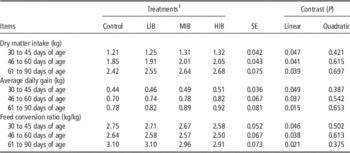
DM intake, average daily gain (ADG) and FCR are shown in Table 2. DM intake and ADG increased linearly (P<0.05), however, FCR decreased linearly (P<0.05) for pre- and post-weaned calves with increasing isobutyrate supplementation.
Effects of isobutyrate supplementation on dry matter intake and average daily gain in pre- and post-weaned dairy calves

1 Control, low-isobutyrate (LIB), moderate-isobutyrate (MIB) and high-isobutyrate (HIB) with 0, 0.03, 0.06 and 0.09 g isobutyrate/kg BW per calf per day, respectively.
Rumen development
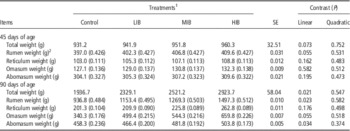
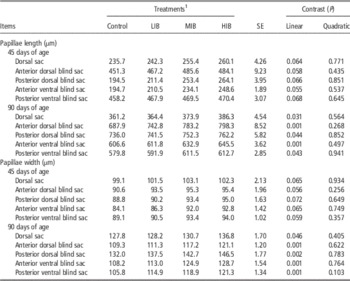
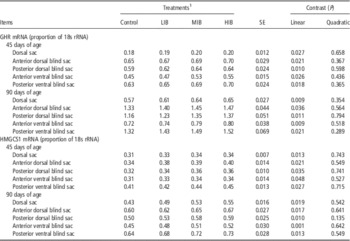
Total stomach weight and ratio of different stomach to total stomach weight are shown in Table 3. Total stomach weight and the ratio of rumen weight to total stomach weight tended to increase (P=0.073) for pre-weaned calves and increased linearly (P<0.05) for post-weaned calves, whereas the ratio of abomasum weight to total stomach weight was not affected for pre-weaned calves and decreased linearly (P<0.05) for post-weaned calves with increasing isobutyrate supplementation. The ratio of reticulum or omasum weight to total stomach weight for pre-weaned calves and post-weaned calves was not influenced significantly by isobutyrate supplementation. Both length and width of rumen papillae are shown in Table 4. For pre-weaned calves, both the length and width of rumen papillae tended to increase linearly, but increased linearly (P<0.03) for post-weaned calves with increasing isobutyrate supplementation. The relative expression of mRNA for GHR and HMGCS1 in rumen mucosa is shown in Table 5. The relative expression of mRNA for GHR and HMGCS1 in rumen mucosa increased linearly (P<0.05) for pre-and post-weaned calves with increasing isobutyrate supplementation.
Effects of isobutyrate supplementation on stomach weight and the ratio of different stomach to total weight in pre- and post-weaned dairy calves

1 Control, low-isobutyrate (LIB), moderate-isobutyrate (MIB) and high-isobutyrate (HIB) with 0, 0.03, 0.06 and 0.09 g isobutyrate/kg BW per calf per day, respectively.
2 The ratio of different compartment stomach weight to total weight data in parentheses.
Effects of isobutyrate supplementation on both length and width of rumen papillae in pre- and post-weaned dairy calves

1 Control, low-isobutyrate (LIB), moderate-isobutyrate (MIB) and high-isobutyrate (HIB) with 0, 0.03, 0.06 and 0.09 g isobutyrate/kg BW per calf per day, respectively.
Effects of isobutyrate supplementation on the relative expression of growth hormone receptor (GHR) messenger RNA (mRNA) and 3-hydroxy-3-methylglutaryl-CoA synthase 1 (HMGCS1) mRNA of rumen mucosa in dairy calves

rRNA=ribosomal RNA.
1 Control, low-isobutyrate (LIB), moderate-isobutyrate (MIB) and high-isobutyrate (HIB) with 0, 0.03, 0.06 and 0.09 g isobutyrate/kg BW per calf per day, respectively.
Blood metabolites
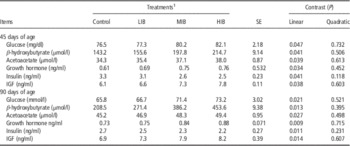
Blood concentrations of glucose, BHBA, GH, insulin and IGF-1 are shown in Table 6. Blood concentrations of glucose, acetoacetate, BHBA, GH and IGF-1 increased linearly (P<0.05) for pre- and post-weaned calves with increasing isobutyrate supplementation, but the concentration of insulin decreased linearly (P<0.05).
Effects of isobutyrate supplementation on blood parameters in pre- and post-weaned dairy calves

1 Control, low-isobutyrate (LIB), moderate-isobutyrate (MIB) and high-isobutyrate (HIB) with 0, 0.03, 0.06 and 0.09 g isobutyrate/kg BW per calf per day, respectively.
Discussion
Dry matter intake and average daily gain
Linear increase in DM intake of pre- and post-weaned calves with increasing isobutyrate supplementation suggested that isobutyrate had a major impact on feed intake. The result was attributed to the improved ruminal microbial enzyme activities, relative quantity of ruminal cellulolytic bacteria and ruminal fermentation. Li et al. (Reference Li, Liu, Wang, Zhang, Pei, Wang, Guo, Huo, Zhang and Liu2015) reported that rumen total VFA concentration, microbial enzyme activities of CMCase, cellobiase, xylanase, pectinase and amylase, and the relative quantity of R. albus, R. flavefaciens, B. fibrisolvens and F. succinogenes increased linearly for pre- and post-weaned calves with increasing 2-methylbutyrate supplementation. Wang et al. (Reference Wang, Liu, Zhang, Pei, Zhang, Wang, Yang, Bai, Shi and Liu2015) also found that ruminal enzyme activities of CMCase, xylanase and β-glucosidase, and cellulolytic bacteria populations linearly increased with increasing isobutyrate supplementation in the diet of Simmental steers. DM intake can be regulated by many factors, such as rumen pH, passage rate of digesta from the rumen and extent of feed digestion in the rumen. Although ruminal pH linearly reduced with increasing dosage of 2-methylbutyrate for pre- and post-weaned calves (Li et al., Reference Li, Liu, Wang, Zhang, Pei, Wang, Guo, Huo, Zhang and Liu2015) and isobutyrate for Simmental steers (Liu et al., Reference Liu, Wang, Huang, Dong, Yang and Wang2008; Wang et al., Reference Wang, Liu, Zhang, Pei, Zhang, Wang, Yang, Bai, Shi and Liu2015), ruminal pH was in the optimum level, and would not likely affect DM intake. Linear increase in ADG for pre- and post-weaned calves with increasing isobutyrate supplementation was the consequence of the increased DM intake. Linear decrease in FCR for pre- and post-weaned calves suggests that isobutyrate has a positive effect on feed utilization. These findings are agreement with Liu et al. (Reference Liu, Wang, Huang, Dong, Yang and Wang2008) and Wang et al. (Reference Wang, Liu, Zhang, Pei, Zhang, Wang, Yang, Bai, Shi and Liu2015) who found that in situ ruminal effective degradability of DM and NDF from corn stover linearly increased with increasing isobutyrate supplementation in Simmental steers diet.
Rumen development
For pre-weaned calves, the lack of effect of isobutyrate supplementation on the ratio of rumen weight to total stomach weight in our study is consistent with the unremarkable change in the length and width of rumen papillae. Linear increase in total stomach weight and the ratio of rumen weight to total stomach weight for post-weaned calves is due to the improved length and width of rumen papillae. The reason was that the increased DM intake resulted in higher rumen VFA production, especially butyrate production. It is well documented that ruminal fermentation products, especially butyrate, are the primary chemical stimulators of rumen development (Mentschel et al., Reference Mentschel, Leiser, Mülling, Pfarrer and Claus2001; Górka et al., Reference Górka, Kowalski, Pietrzak, Kotunia, Jagusiak, Holst, Guilloteau and Zabielski2011; Plöger et al., Reference Plöger, Stumpff, Penner, Schulzke, Gäbel, Martens, Shen, Günzel and Aschenbach2012). Our previous study found that total VFA and molar proportion of butyrate increased linearly with increasing isobutyrate supplementation in Simmental steers diet (Liu et al., Reference Liu, Wang, Huang, Dong, Yang and Wang2008; Wang et al., Reference Wang, Liu, Zhang, Pei, Zhang, Wang, Yang, Bai, Shi and Liu2015). Butyrate stimulates epithelial cell proliferation and rumen epithelium growth, consequently, both the length and width of rumen papillae increases (Heinrichs and Lesmeister, Reference Heinrichs and Lesmeister2005; Gorka et al., Reference Gorka, Kowalski, Pietrzak, Kotunia, Kiljanczyk, Flaga, Holst, Guilloteau and Zabielski2009; Górka et al., Reference Górka, Kowalski, Pietrzak, Kotunia, Jagusiak, Holst, Guilloteau and Zabielski2011). Supplemental sodium butyrate in the milk replacer, starter or liquid feed of calves increased DM intake, BW, total VFA, rumen papillae length and width, affected the development of rumen (Gorka et al., Reference Gorka, Kowalski, Pietrzak, Kotunia, Kiljanczyk, Flaga, Holst, Guilloteau and Zabielski2009; Górka et al., Reference Górka, Kowalski, Pietrzak, Kotunia, Jagusiak, Holst, Guilloteau and Zabielski2011). In fact, the increase in total stomach weight and the ratio of rumen weight to total stomach weight is also due to the development of rumen muscularity (Baldwin, Reference Baldwin2004). The results are produced by the physical stimulation of the feed from the increased DM intake. As the rumen matures, the ruminal epithelium is capable of producing ketone bodies from acetyl-CoA which derived from the mitochondrial oxidation of butyrate produced by the microbial fermentation of feed (Connor et al., Reference Connor, Li, Baldwin and Li2010). HMGCS1 is critical for ketogenesis in ruminants and is the rate-limiting step for ketogenesis in both non-ruminant and ruminant animals (Lane et al., Reference Lane, Baldwin and Jesse2002; Connor et al., Reference Connor, Li, Baldwin and Li2010; Penner et al., Reference Penner, Steele, Aschenbach and McBride2011). In the current study, the relative expression of mRNA for HMGCS1 in rumen mucosa increased linearly with increasing isobutyrate supplementation. The result suggested that supplementary isobutyrate could stimulate the development of rumen of post-weaned calves by improving the ketogenic ability of ruminal mucosa.
Blood metabolites
From pre-weaned period to post-weaned period, metabolic function of rumen changed with the developmental changes in morphology, then the oxidation of VFA increased and companied with the stepped-up ketogenesis of rumen epithelium (Bannink et al., Reference Bannink, France, Lopez, Gerrits, Kebreab, Tamminga and Dijkstra2008; Martens et al., Reference Martens, Rabbani, Zanming, Stumpff and Deiner2012). In current study, linear increase in blood concentration of acetoacetate and BHBA for pre- and post-weaned calves with increasing isobutyrate supplementation further confirmed that the supplemental isobutyrate could accelerate the development of rumen by improving the ketogenic ability of rumen epithelium. The result is also due to the increased DM intake which resulted in a higher rumen VFA production, especially butyrate production. Nazari et al.(2012) reported that the supplementation of milk replacer of calves with 3 g of coated calcium butyrate significantly increased serum concentration of BHBA. The result of increase in plasma glucose is agreement with the finding of Liu et al. (Reference Liu, Wang, Pei, Li, Wang, Zhang, Zhang, He, Wang, Yang, Bai, Shi and Liu2009b) who reported that supplementation of isobutyrate in dairy cows diets increased plasma glucose concentration. The result could be attributed to the increased DM intake and improved nutrients digestibilities with isobutyrate supplementation (Liu et al. Reference Liu, Wang, Huang, Dong, Yang and Wang2008; Wang et al., Reference Wang, Liu, Zhang, Pei, Zhang, Wang, Yang, Bai, Shi and Liu2015). The GH–IGF axis plays an important role in amino acids metabolism of calves. GH can promote amino acids from muscle tissues moving into cells and increase the synthesis of protein (Breier, Reference Brameld, Atkinson, Saunders, Pell, Buttery and Gilmour1999). IGF-1 can improve protein retention by reducing protein oxidation and increasing protein syntheses in body tissues. The secretion of IGF-1 is controlled by GH (Brameld et al., Reference Breier1996). Blood concentrations of GH and IGF-1 are affected by the nutrient level and then control growth performance. In the current study, blood concentrations of GH and IGF-1 increased linearly for pre- and post-weaned calves with increasing isobutyrate supplementation. This provided support for the conclusion that using an isobutyrate source could lead to positive responses in GH and IGF-1 concentration, rumen development and calf performance. These results agree with the finding of Hamamdzic (Reference Hamamdzic1989) who reported that the effect of BCVFA, mediated by receptors in the rumen and liver, is increased production of GH and reduced insulin level.
Conclusion
Increasing isobutyrate supplementation in pre-weaned dairy calves diets tended to improve total stomach weight, the ratio of rumen weight to total stomach weight, length and width of rumen papillae, and linearly increased DM intake, ADG, relative expression of mRNA for GHR and HMGCS1 of rumen mucosa and blood concentrations of glucose, BHBA, GH, insulin and IGF-1. For post-weaned dairy calves, DM intake, ADG, total stomach weight and the ratio of rumen weight to total stomach weight, length and width of rumen papillae, relative expression of mRNA for GHR and HMGCS1 of rumen mucosa, and blood concentrations of glucose, acetoacetate, BHBA, GH and IGF-1 increased linearly with increasing isobutyrate supplementation. These results suggested that isobutyrate supplementation promoted growth of calves by improving rumen development and its ketogenic ability in a dose-dependent manner.
Acknowledgments
This work was supported by a grant from Natural Science Funding projects of National Natural Science Foundation of China (31272471), Agricultural Science and Technology Research Projects of the Shanxi Science and Technology Department (20120311021-2), Shanxi Science and Technology Innovation Team project of the Shanxi Science and Technology Department (2013131024) and Academic Leader projects of Shanxi Agricultural University. The authors thank the staff of Shanxi Agriculture University beef unit for care of the animals.