Introduction
The Actinocrinitidae is an important family of Mississippian crinoids due to their considerable genus diversity and abundance of specimens. Actinocrinitids encompass a large degree of morphological disparity produced by the complex arrangements of their multi-plated calyxes. Because there are innumerable specimens in many Mississippian faunas and because we suspect that hybridization was a complicating factor as demonstrated in Eretmocrinus (Ausich and Meyer, Reference Ausich and Meyer1994), and suggested for the Batocrinidae (Ausich and Kammer, Reference Ausich and Kammer2010), this is a complex group. Both Wachsmuth and Springer (Reference Wachsmuth and Springer1897) and Bowsher (Reference Bowsher1955) worked to clarify generic definitions among North American actinocrinitids, but many issues still remain. First and most significant among these problems is that the generic concept for Actinocrinites, as typified by Actinocrinites triacontadactylus Miller, Reference Miller1821, the type species of the genus, has not been applied consistently to North American faunas.
Ausich and Sevastopulo (Reference Ausich and Sevastopulo2001) designated a neotype for Actinocrinites triacontadactylus; and with this definition re-established, Ausich and Sevastopulo (Reference Ausich and Sevastopulo2001) and Ausich and Kammer (Reference Ausich and Kammer2006) made generic reassignments to all actinocrinitids from Ireland, England, and Wales. Species-level systematics has only been completed for Ivorian faunas (Ausich and Sevastopulo, Reference Ausich and Sevastopulo2001). A total of six actinocrinitid genera are now recognized from Ireland, England, and Wales.
The primary source of confusion regarding the systematics of North American (and other) actinocrinitids is that genus-level diagnostic characters that define European actinocrinitids have been applied as species-level diagnostic characters among North American forms. For example, ray grouping and lobation helps to define European genera, but this has been used to differentiate North American species of Actinocrinites. Unfortunately, the solution for this is reassignment of many well-known North American species of “Actinocrinites” to other genera. Although nomenclaturally messy, this situation is not surprising given that many nineteenth century broadly defined genera have been subdivided into numerous new genera, such as Cyathocrinites, Phanocrinus, Platycrinites, and Poteriocrinites (see Webster, Reference Webster2003). Recognition of well-defined generic concepts is a prerequisite for a modern understanding of the phylogeny, paleobiogeography, and evolutionary paleoecology of these crinoids.
This study is a continuation of the efforts to redefine the generic concepts of monobathrid camerates (Ausich and Kammer, Reference Ausich and Kammer2008, Reference Ausich and Kammer2009, Reference Ausich and Kammer2010). Revising the camerates is an important step in compiling an accurate database to evaluate their evolutionary paleoecology of Mississippian crinoids, including an examination of the global, generic relationships among longevity, eurytopy, and evolutionary paleoecology (Ausich and Kammer, Reference Ausich and Kammer2010). The camerates are of particular interest because they reached their peak diversity during the Tournaisian and are one of the most diverse groups of crinoids during this time (Kammer and Ausich, Reference Kammer and Ausich2006; Sallan et al., Reference Sallan, Kammer, Ausich and Cook2011).
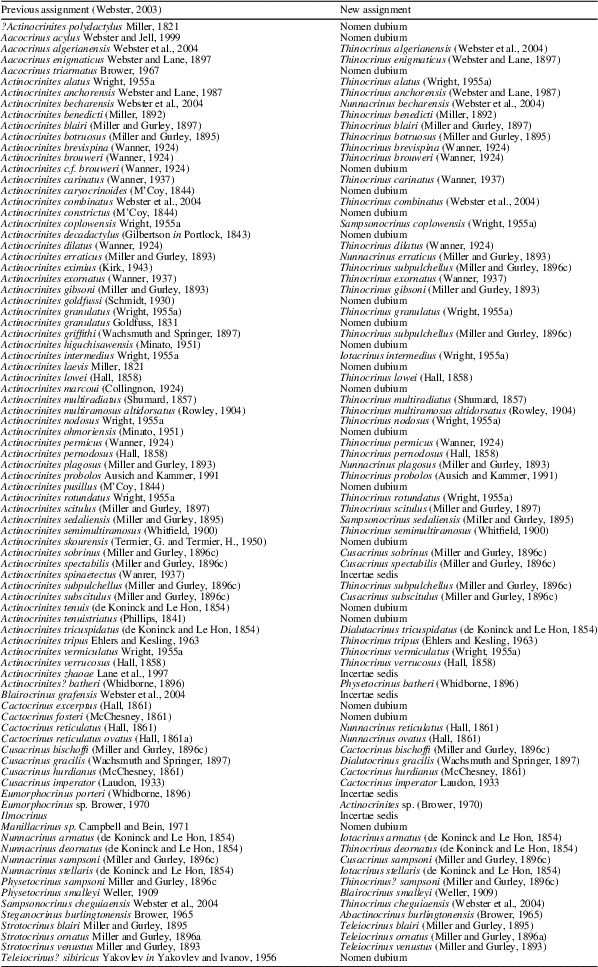
In this contribution, the goals are to define all Actinocrinitidae genera using objective characters and to assign all species to the correct genus. This study treated 206 species, with 57 species (and one species left in open nomenclature) reassigned to different genera (Table 1); 20 species were designated as nomina dubia; and three species and one genus were designated incertae sedis. This is only a first step for a full understanding of the Actinocrinitidae, but it does allow for evaluation of regional and global patterns of generic longevity, eurytopy, and evolutionary paleoecology. Significant evaluation of species-level systematics remains to be completed but is far beyond the scope of this study.
Listing of actinocrinitid species that have a revised generic assignment

Systematic paleontology
Where possible, all species were characterized using original descriptions and illustrations, subsequent descriptions and illustration of type specimens, and examination of type specimens. Complete synonymies are not provided as they are published in Webster (Reference Webster2003). Terminology follows Ubaghs (Reference Ubaghs1978a) with modifications from Ausich et al. (Reference Ausich, Brett, Hess and Simms1999) and open nomenclature that follows Matthews (Reference Matthews1973).
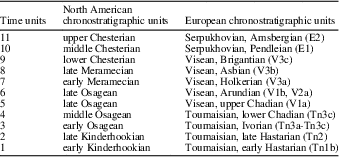
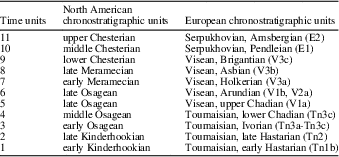
Carboniferous stratigraphy follows Heckel and Clayton (Reference Heckel and Clayton2005). Table 2 is the detailed chronostratigraphic scheme showing the correlations used in this paper following Ausich and Kammer (Reference Ausich and Kammer2008).
Class Crinoidea Miller, Reference Miller1821
Subclass Camerata Wachsmuth and Springer, 1885
Order Monobathrida Moore and Laudon, Reference Moore and Laudon1943
Suborder Compsocrinina Ubaghs, Reference Ubaghs1978b
Superfamiy Periechocrinacea Bronn, Reference Bronn1849
Family Actinocrinitidae Austin and Austin, Reference Austin and Austin1842
Chronostratigraphic correlation of time units between North America and Europe (from Ausich and Kammer, Reference Ausich and Kammer2008)
Diagnosis
The Actinocrinitidae differs from the other three families in the Periechocrinacea (Periechocrinidae, Amphoracrinidae, Paragaricocrinidae) in possessing a unique combination of characters that vary and in some cases overlap among the four families (Ausich and Kammer, Reference Ausich and Kammer2008, table 2). In general, actinocrinitids possess a typically conical calyx that is higher than found in the Amphoracrinidae and Paragaricocrinidae, but somewhat lower than those in the Periechocrinidae. The first primibrachial is typically hexagonal; there are few to no secundibrachials; there are only two plates above the hexagonal primanal; the anal tube is rarely absent; and the number of free arms ranges from 10–60, a greater range than in the other three families.
Remarks
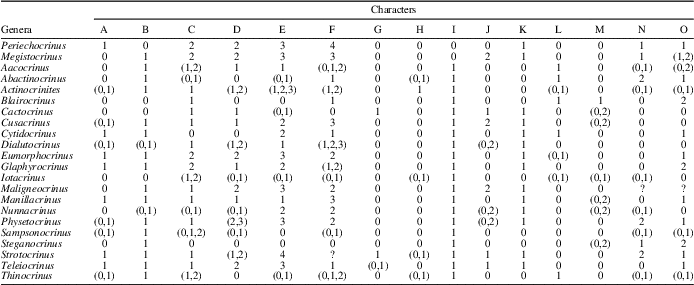
Bowsher and Ubaghs (Reference Bowsher and Ubaghs1978) subdivided the Actinocrinitidae into four subfamilies: Actinocrinitinae Austin and Austin, Reference Austin and Austin1842; Eumorphocrininae Ubaghs, Reference Ubaghs1978c; Cactocrininae Ubaghs, Reference Ubaghs1978d; and Physetocrininae Ubaghs, Reference Ubaghs1978e. A phylogenetic analysis of 20 genera from the four subfamilies (and two outgroup genera) was performed to investigate possible phylogenetic relationships and to test if the previously named subfamilies represented actual clades. Phylogenetic relationships are inferred using parsimony-based character analysis of genera using PAUP ©4.0b10 (Swofford, Reference Swofford2001). The actinocrinitid genera are defined using discrete, non-subjective characters that define basic and distinctive atrributes of the calyx and tegmen. Fifteen characters with 38 character states were used to analyze the genera (Appendices 1 and 2). These characters are unordered and unweighted; search methods were heuristic with random stepwise addition. The outgroup used for this analysis are two genera from the Periechocrinidae Bronn, Reference Bronn1849: Periechocrinus Morris, Reference Morris1843, a Silurian and Devonian genus and Megistocrinus Owen and Shumard, Reference Owen and Shumard1852, a Devonian and Mississippian genus. Characters that are used for the outgroup genera are based on their type species, but the character states used for the Actinocrinitidae are based on all known species for each of the genera. Thus, multiple character states are present for several characters in most of the genera.
The subfamilies of Bowsher and Ubaghs (Reference Bowsher and Ubaghs1978) were based on presence or absence of arm lobes, presence or absence of an anal tube, and how strongly the arms were grouped together. None of the subfamilies form a separate clade in the phylogenetic analysis (Fig. 1) completed herein. It might be argued that the genera of the subfamily Actinocrinitinae group together, along with Cactocrinus, but the grouping is a subset of the larger clade that includes genera from the Eumorphocrininae and Cactocrininae. As the subfamilies are scattered throughout the tree, the subfamily classification of the Treatise (Ubaghs, Reference Ubaghs1978b) does not recognize monophyletic clades and should be abandoned. These subfamilies were each defined on four or fewer characters (Ubaghs, Reference Ubaghs1978b), in contrast to the 15 characters used in this study (Appendix 1).
Strict consensus tree based on the phylogenetic analysis of the Actinocrinitidae from PAUP© 4.0b10; 22 taxa, 15 characters, 38 character states (Appendices 1 and 2), all characters were unordered and unweighted; search methods heuristic with random stepwise addition. There were seven most parsimonious trees of length 114. Consistency index of 0.81; retention index of 0.67; rescaled consistency index of 0.54; homoplasy index of 0.75. The synapomorphies plotted at 17 nodes are as follows (see Appendix 1 for key): 1, C2, D2, E3, G0, H0, I0, K1, L0, M0, N1, O1; 2, A1, B1, F3, J0, I1, N0; 3, F2; 4, C1, J1; 5, N2; 6, A0, J2; 7, D1, E2; 8, F1; 9, C1; 10, A0, O0; 11, F2; 12, E1; 13, K0; 14, B0; 15, O2; 16, L1; 17, O1. The polytomy is where the distribution of character states for characters E, F, and L cannot be resolved by parsimony analysis. Black boxes indicate known ranges, white indicates through ranges, and grey indicates ranges that cannot be narrowed down to a time unit in the Serpukhovian. The asterisk (*) indicates an unknown range inside the Visean for Sampsonocrinus. The open circle (○) is for the subfamily Actinocrinitinae of the Treatise, the open square (□) is for the subfamily Eumorphocrininae of the Treatise, the open diamond (◊) is for the subfamily Cactocrininae of the Treatise, and the closed circle (●) is for the subfamily Physetocrininae of the Treatise.
Wachsmuth and Springer (Reference Wachsmuth and Springer1897) subdivided the actinocrinitids into three primary groups that included: 1) genera with an anal tube, calyx lobed, and interradials in contact with the tegmen; 2) genera with an anal tube, calyx not lobed, and interradials not in contact with the tegmen; and 3) genera without an anal tube, regardless of other characters. Although these three groups are a good general way to subdivide the family, they do not reflect any phylogenetic relationship between genera. For example, Dialutocrinus lacks arm lobes but its other characters group it most closely with actinocrinitids that have arm lobes, or Eumorphocrinus with an anal tube relates more closely to two genera that lack an anal tube, Strotocrinus and Physetocrinus, than it does to the rest of its subfamily.
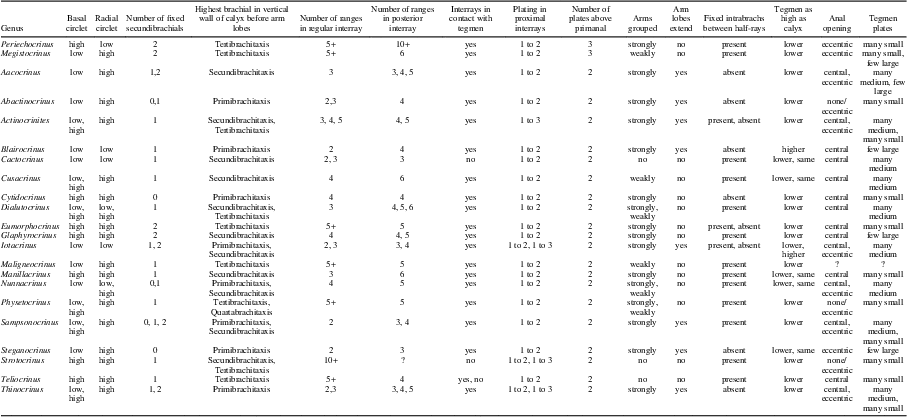
The generic-level diagnostic characters for genera within Actinocrinitidae are defined as follows (Table 3, Appendix 1): basal circlet height, radial circlet height, number of fixed secundibrachials, highest brachitaxis (e.g., tertibrachials) in the vertical wall of the calyx before arm lobes, number of ranges (rows of stacked plates) in the regular interrays, number of ranges in posterior interray, interrays in contact with tegmen, plating in the proximal interrays, number of plates above the primanal, arms grouped, arm lobes, presence or absence of fixed interbrachials between half-rays, tegmen height compared to calyx, number of tegmen plates, and position of anal tube.
Diagnostic characters of the calyx and tegmen of genera within Actinocrinitidae
One of the most distinctive characters that separate genera within the actinocrinitids is the presence or absence of arm lobes. Arm lobes are extensions of the theca (calyx and tegmen) away from the distal portion of the calyx, formed by fixed brachials proximally and tegmen plates distally. All actinocrinitids that have arm lobes have arms that are strongly grouped and interrays that are in contact with the tegmen. This was the condition that Bowsher and Ubaghs (Reference Bowsher and Ubaghs1978) used to distinguish the subfamily Actinocrinitinae; the same genera are most closely related to each other as shown in the phylogenetic tree (Fig. 1). Two other basic conditions exist among the actinocrinitids that lack arm trunks (i.e., where arms become free in a more-or-less circular pattern rather than being extended into arm lobes). Most actinocrinitids that lack arm lobes have arms that are either strongly or weakly grouped, allowing for the interrays to be in contact with the tegmen. In contrast, a few actinocrinitids have arm openings that are in continuous lateral contact, not allowing for interrays to connect with the tegmen. Examples of these conditions are: Actinocrinites has arm lobes, Eumorphocrinus lacks arm lobes, but has a strong grouping of arm openings, Cusacrinus lacks arm lobes and only has a slight grouping of arm openings, and Cactocrinus lacks arm lobes and all the arm facets are in lateral contact with one another.
The actinocrinitids that have arm lobes are Aacocrinus, Abactinocrinus, Actinocrinites, Blairocrinus, Iotacrinus, Sampsonocrinus, Steganocrinus, and Thinocrinus. The arm lobes, along with other shared characters, keep these genera close together in the strict consensus tree (Fig. 1, node 13).
Actinocrinites, Aacocrinus, Iotacrinus, and Thinocrinus are all very similar in appearance. To separate these genera the height of the radial circlet, the highest brachitaxis in the vertical wall of the calyx before the arm lobes, and the size and number of plating on the tegmen must be examined. Actinocrinites and Thinocrinus both have high radial plates, but the primibrachitaxis is the highest brachitaxis in the calyx for Thinocrinus whereas it is either the secundibrachitaxis or tertibrachitaxis for Actinocrinites. Iotacrinus has a low radial plate and Aacocrinus has a few large-sized plates on the tegmen interspersed with many small-sized plates.
Sampsonocrinus has only two ranges in the regular interrays but retains many medium-sized plates on the tegmen and fixed intrabrachials unlike the rest of the genera in the clade of actinocrinitids with arm lobes. Blairocrinus has a tegmen that is consistently higher than the calyx in all species (Iotacrinus has a single species with a higher tegmen, but this is rare in the genus). Steganocrinus and Abactinocrinus only have ten free arms with Steganocrinus lacking fixed secundabrachials and Abactinocrinus having no anal tube.
Other genera in the same clade containing those with arm lobes are Cactocrinus, Dialutocrinus, Nunnacrinus, Cusacrinus, and Manillacrinus. Cactocrinus shares several characters with Iotacrinus, including having low radials, but the lack of arm lobes and not having interrays connected to the tegmen differentiates it. Cactocrinus groups within the lobate actinocrinitids despite lacking arm lobes because the ranges in the interrays are lower than those genera without arm lobes. In the regular interrays Cactocrinus can have either two or three ranges, while those without arm lobes have no fewer than three. Similarly, in the posterior interray, Cactocrinus only has three ranges while the others have four or more. Dialutocrinus, which has less than four ranges in the regular interrays, has either the secundibrachitaxis or tertibrachitaxis as the highest brachitaxis in the vertical wall of the calyx. Nunnacrinus has either zero or one fixed secundibrachial and the secundibrachitaxis or lower as the highest in the vertical wall of the calyx. Nunnacrinus may have weakly grouped arms, but some species have strongly grouped arms whereas Cusacrinus only has weakly grouped arms. Cusacrinus also has more ranges in the interrays than Nunnacrinus. Manillacrinus only has three ranges in the regular interray, strongly grouped arms, and many small-sized plates on the tegmen.
Cytidocrinus and Glaphyrocrinus group together at the base of the larger clade by having four ranges in all interrays; the only actinocrinitids with this character. Both have strongly grouped arms, but Cytidocrinus has fixed intrabrachials between half rays and many small-sized tegmen plates. Glaphyrocrinus lacks intrabrachials and has few large-sized tegmen plates.
The smaller clade of actinocrinitids includes Maligneocrinus, Physetocrinus, Strotocrinus, Teleiocrinus, and Eumorphocrinus. Tegmen information for Maligneocrinus is not complete, but the calyx shares many features with Physetocrinus. However, it is unknown whether Maligneocrinus has an anal tube or not, and the size and number of tegmen plates is not known. Physetocrinus and Strotocrinus both lack anal tubes. Strotocrinus does not have interrays that connect to the tegmen, the arms are not grouped at all, and there are many more ranges in the interrays than there are in Physetocrinus. Similar to Strotocrinus, Teleiocrinus has many ranges in the interrays, arms that are not grouped, and mostly has interrays that are not in contact with the tegmen (rarely the posterior interray will connect with the tegmen), but it differs by having a prominent anal tube. Eumorphocrinus is judged the most plesiomorphic of the actinocrinitids, having various characters seen in most of the genera, but groups within this clade due to the synapomorphy of tertibrachitaxis as the highest brachitaxis in the vertical wall of the calyx, which is found only in this smaller clade and the outgroup.
With only seven most parsimonious trees, the phylogeny of the Actinocrinitidae is reasonably well resolved, although there is a large polytomy among the genera with arm lobes. This polytomy indicates considerable homoplasy within the Actinocrinitidae. Indeed, if the genera with lobate arms are removed, the remaining tree exhibits less homoplasy (H.I.=0.56 [vs. 0.75]) and retains its previous topology. As shown by the nearly simultaneous first appearances of genera in the Tournaisian (Fig. 1), there was rapid evolutionary diversification within the family, at the resolution available. This rapid diversification was likely associated with predatory release following the Hangenberg Extinction event of durophagous fishes, especially the placoderms (Sallan et al., Reference Sallan, Kammer, Ausich and Cook2011). Evolutionary experimentation with calyx construction may have produced similar calyx character states independently. Paradoxically, the oldest occurrences, in the Famennian, are for the highly-derived genera Abactinocrinus and Physetocrinus, rather than less-derived genera shown on the tree (Fig. 1). This suggests that the Actinocrinitidae may have had a more extensive evolutionary history in the Devonian than currently known (Lane et al., Reference Lane, Waters and Maples1997, Reference Lane, Maples and Waters2001; Waters et al., Reference Waters, Maples, Lane, Marcus, Liao, Liu, Hou and Wang2003), but it only became prominent in the Tournaisian when taxa became abundant after predatory release.
The two clades recognized by cladistic analysis do not justify naming two new subfamilies. Although mapping of synapomorphies indicates the smaller clade is characterized by five ranges of plates in the posterior interray (node 3), and the larger clade by secundibrachials as the highest brachitaxis in the vertical wall of the calyx and four ranges of plates in the regular interrays (node 7), the morphological differences are too subtle to recognize these clades as subfamilies within the Actinocrinitidae.
The Actinocrinitidae mostly existed within the Mississippian, although it originated during the Famennian and ranged at least through the Bashkirian. Geographically, the actinocrinitids are recognized in North America, Western Europe, North Africa, Russia, China, Japan, and Australia. There are also reports of this family (Actinocrinites and Thinocrinus) from the Permian of Indonesia and Australia, but with such a large time gap between the Bashkirian and Artinskian occurrences it is questionable how these few managed to survive. However, as the characters of the Permian actinocrinitids fit well within the diagnosis of the family, they are assumed to be holdovers. More work needs to be done on the young members of the family, but that is not within the scope of this paper.
Genus Actinocrinites Miller, Reference Miller1821
Type species
Actinocrinites triacontadactylus Miller, Reference Miller1821, by subsequent designation (Wachsmuth and Springer, 1881).
Other species
European species include: Actinocrinites adversus (Wright, 1955a); Actinocrinites anglicus (Wright, 1955a); Actinocrinites angustus (Wright, 1955a); Actinocrinites comptus Wright, 1955a; Actinocrinites depressus Wright, 1955a; Actinocrinites elongatus Wright, 1955a; Actinocrinites laevissimus (Austin and Austin, Reference Austin and Austin1843); Actinocrinites parkinsoni Wright, 1955a; Actinocrinites triplus Wright, 1955a; and Actinocrinites venustus (Wright, 1955a).
North American species include Actinocrinites grandissimus Van Sant, Reference Van Sant1965; Actinocrinites jugosus (Hall, Reference Hall1859); Actinocrinites lobatus (Hall, Reference Hall1859); Actinocrinites magnificus (Wachsmuth and Springer, Reference Wachsmuth and Springer1897); Actinocrinites monticuliferus (Miller and Gurley, Reference Miller and Gurley1894); Actinocrinites spergenensis (Miller and Gurley, Reference Miller and Gurley1896a); and Actinocrinites sp. (Brower, Reference Brower1969) [new combination].
Additionally, Actinocrinites timoricus (Wanner, Reference Wanner1924) is known from the Permian of Timor.
Diagnosis
Basal circlet low or high; radial circlet high; one fixed secundibrachial; secundibrachitaxis or tertibrachitaxis highest brachitaxis in vertical wall of calyx; three, four, or five ranges in regular interray; four or five ranges in posterior interray; interrays in contact with tegmen; plating in proximal interrays 1 to 3; fixed intrabrachials between half-rays present or absent; arms strongly grouped; arm lobes present and extend laterally; tegmen lower than or equal to calyx height; many medium-sized or many small-sized plates on tegmen; anal tube central or eccentric.
Occurrence
Mississippian (Tournaisian) through Permian (Artinskian) of Europe, North America, and Timor. In Europe Ivorian to early Chadian (time units 3 and 4) from Ireland and United Kingdom; in North America late Osagean to early Meramecian (Visean) (time units 6 and 7) from Illinois, Indiana, Iowa, Kentucky, and Missouri; in Timor Artinskian.
Remarks
Many species previously assigned to Actinocrinites now have revised generic assignments (Table 1). Brower (Reference Brower1969) tentatively assigned a specimen to the genus Eumorphocrinus, but the known characters of this specimen better fit the genus Actinocrinites. Actinocrinites sp. has a conical calyx, the half rays are separated by intrabrachials, and what is known of the tegmen indicates that it is a low cone. Eumorphocrinus does not have these characters, having a medium bowl shaped calyx, no fixed intrabrachials between half-rays, and a low inverted bowl shaped tegmen.
Genus Aacocrinus Bowsher, Reference Bowsher1955
Type species
Aacocrinus nododorsatus Bowsher, Reference Bowsher1955, by original designation.
Other species
North American species include Aacocrinus boonensis (Peck and Keyte, Reference Peck and Keyte1938); Aacocrinus chouteauensis (Miller, Reference Miller1892); Aacocrinus protuberoarmatus Brower, Reference Brower1967; Aacocrinus sampsoni (Miller and Gurley, Reference Miller and Gurley1895); Aacocrinus senectus (Miller and Gurley, Reference Miller and Gurley1897); Aacocrinus spinosulus (Miller and Gurley, Reference Miller and Gurley1893); and Aacocrinus tetradactylus Brower, Reference Brower1967.
Diagnosis
Basal circlet low; radial circlet high; one or two fixed secundibrachials; secundibrachitaxis highest brachitaxis in vertical wall of calyx; three ranges in regular interray; three, four, or five ranges in posterior interray; interrays in contact with tegmen; plating in proximal interrays 1 to 2; fixed intrabrachials between half-rays absent; arms strongly grouped; arm lobes present and extend laterally; tegmen lower than calyx; few large-sized and many medium-sized plates on tegmen; anal tube central or eccentric.
Occurrence
Mississippian (Tournaisian) of North America. Early Kinderhookian through middle Osagean (time units 1 to 4) of Missouri, Nevada, and New Mexico.
Remarks
Aacocrinus is known only from North America. Brower (Reference Brower1967) thoroughly described this genus, which will not be repeated here.
Genus Abactinocrinus Laudon and Severson, Reference Laudon and Severson1953
Type species
Abactinocrinus rossei Laudon and Severson, Reference Laudon and Severson1953, by original designation.
Other species
Abactinocrinus devonicus Waters et al., Reference Waters, Maples, Lane, Marcus, Liao, Liu, Hou and Wang2003 and Abactinocrinus burlingtonensis (Brower, Reference Brower1965) [new combination].
Diagnosis
Basal circlet low; radial circlet high; zero or one fixed secundibrachials; primibrachitaxis highest brachitaxis in vertical wall of calyx; two or three ranges in regular interray; four ranges in the posterior interray; interrays in contact with tegmen; plating in proximal interrays 1 to 2; fixed intrabrachials between half-rays absent; arms strongly grouped; arm lobes present and extend laterally; tegmen lower than calyx; many small-sized plates on tegmen; anal tube absent, opening central.
Occurrence
Devonian (Famennian) through Mississippian (Tournaisian) of China and North America. Famennian from China; late Kinderhookian (time unit 2) from Montana; middle Osagean (time unit 4) from Iowa.
Remarks
Abactinocrinus is the only actinocrinitid with arm lobes that lacks an anal tube, but has previously been described as having an anal tube. However, when available specimens were closely examined, there was no evidence of an anal tube. Abactinocrinus rossei has a small swelling at the anal opening while A. devonicus and A. burlingtonensis have an anal opening flush with the tegmen.
Genus Blairocrinus Miller, Reference Miller1891
Type species
Blairocrinus trijugis Miller, Reference Miller1891, by original designation.
Other species
North American species include Blairocrinus arrosus Miller, Reference Miller1892; Blairocrinus macurdai Rhenberg and Kammer, Reference Rhenberg and Kammer2013; Blairocrinus protuberus Lee et al., Reference Lee, Ausich and Kammer2005; and Blairocrinus smalleyi (Weller, Reference Weller1909) [new combination].
Diagnosis
Basal circlet low; radial circlet low; one fixed secundibrachial; primibrachitaxis highest brachitaxis in vertical wall of calyx; two ranges in regular interray; four ranges in posterior interray; interrays in contact with tegmen; plating in proximal interrays 1 to 2; fixed intrabrachials between half-rays absent; arms strongly grouped; arm lobes present and extend laterally; tegmen higher than calyx; few large-sized tegmen plates; anal tube central.
Occurrence
Mississippian (Tournaisian) of North America. Early Kinderhookian through middle Osagean (time units 1 to 4) of Kentucky, Montana, and New Mexico.
Remarks
Blairocrinus is the only actinocrinitid that has a tegmen that is consistently higher than the calyx, which makes it easy to distinguish from other actinocrinitids.
Physetocrinus smalleyi is reassigned to Blairocrinus based on the characters that link it to the latter genus. These characters are the tegmen being higher than the calyx and the arms that are strongly grouped and occur in short arm lobes. In Weller’s (Reference Weller1909) description, he stated that there was no anal tube, but his illustrations indicate that the beginning of one located centrally on the tegmen and broken off.
Blairocrinus arrosus is a species that is subject to much confusion, which arises from S. A. Miller assigning two actinocrinitids with the species name “arrosus”: Blairocrinus arrosus Miller, Reference Miller1892 and Actinocrinites arrosus Miller and Gurley, Reference Miller and Gurley1893. Without presenting a complete history of the taxonomic confusion, Bassler and Moodey (Reference Bassler and Moodey1943) assigned the 1892 species to Actinocrinites, and they left the 1893 species in Actinocrinites with a note stating that it probably belonged in Cactocrinus. Webster (Reference Webster2003) considered both species to be in Cactocrinus (with B. arrosus also considered in the genus Aacocrinus), and presumably, synonymous homonyms. However, B. arrosus was correctly assigned to Blairocrinus by Miller (Reference Miller1892), a view endorsed by Brower (Reference Brower1967) and Lee et al. (Reference Lee, Ausich and Kammer2005). Actinocrinus arrosus Miller and Gurley, Reference Miller and Gurley1893 was correctly assigned to Cactocrinus.
Genus Cactocrinus Wachsmuth and Springer, Reference Wachsmuth and Springer1897
Type species
Actinocrinus proboscidialis Hall, Reference Hall1858, by original designation.
Other species
Cactocrinus arrosus (Miller and Gurley, Reference Miller and Gurley1893); Cactocrinus bacatus Wood, Reference Wood1914; Cactocrinus bischoffi (Miller and Gurley, Reference Miller and Gurley1896c) [new combination]; Cactocrinus clarus (Hall, Reference Hall1861a); Cactocrinus extensus Wachsmuth and Springer, Reference Wachsmuth and Springer1897; Cactocrinus fossatus (Miller, Reference Miller1892); Cactocrinus glans (Hall, Reference Hall1859); Cactocrinus hurdianus (McChesney, Reference McChesney1861) [new combination]; Cactocrinus imperator (Laudon, Reference Laudon1933) [new combination]; Cactocrinus lucina (Hall, Reference Hall1861b); Cactocrinus magnidactylus Laudon and Severson, Reference Laudon and Severson1953; Cactocrinus multibrachiatus (Hall, Reference Hall1858); Cactocrinus obesus (Keyes, Reference Keyes1894); Cactocrinus opusculus (Hall, Reference Hall1859); Cactocrinus platybrachiatus (Wood, Reference Wood1914); Cactocrinus sexarmatus (Hall, Reference Hall1859); Cactocrinus springeri (Rowley, Reference Rowley1900); and Cactocrinus thalia (Hall, Reference Hall1861b).
Diagnosis
Basal circlet low; radial circlet low; one fixed secundibrachial; secundibrachitaxis highest brachitaxis in vertical wall of calyx; two or three ranges in regular interray; three ranges in posterior interray; interrays not in contact with tegmen; plating in proximal interrays 1 to 2; fixed intrabrachials between half-rays present; arms not grouped; arm lobes absent; tegmen lower than or same height as calyx; many medium-sized plates on tegmen; anal tube central.
Occurrence
Mississippian (Tournaisian) of North America. Early Kinderhookian through middle Osagean (time units 1 to 4) from Illinois, Iowa, Missouri, New Mexico, and Utah.
Remarks
Cusacrinus bischoffi, C. hurdianus, and C. imperator are reassigned to Cactocrinus because the arms are not grouped and the arm facets are connected to each other, not allowing the interrays to be in contact with the tegmen.
Genus Cusacrinus Bowsher, Reference Bowsher1955
Type species
Actinocrinites nodobrachiatus Wachsmuth and Springer in Miller, Reference Miller1889, by original designation.
Other species
Cusacrinus arnoldi (Wachsmuth and Springer in Miller, Reference Miller1889); Cusacrinus asperrimus (Meek and Worthen, Reference Meek and Worthen1870); Cusacrinus chloris (Hall, Reference Hall1861a); Cusacrinus coelatus (Hall, Reference Hall1858); Cusacrinus daphne (Hall, Reference Hall1863); Cusacrinus denticulatus (Wachsmuth and Springer, Reference Wachsmuth and Springer1897); Cusacrinus ectypus (Meek and Worthen, Reference Meek and Worthen1870); Cusacrinus kuenzii (Laudon et al., Reference Laudon, Parks and Spreng1952); Cusacrinus limabrachiatus (Hall, Reference Hall1861a); Cusacrinus longus (Meek and Worthen, Reference Meek and Worthen1870); Cusacrinus ornatissmus (Wachsmuth and Springer in Miller, Reference Miller1889); Cusacrinus penicillus (Meek and Worthen, Reference Meek and Worthen1870); Cusacrinus sampsoni (Miller and Gurley, Reference Miller and Gurley1896c) [new combination]; Cusacrinus sobrinus (Miller and Gurley, Reference Miller and Gurley1896c); Cusacrinus spectabilis (Miller and Gurley, Reference Miller and Gurley1896c) [new combination]; Cusacrinus spinotentaculus (Hall, Reference Hall1859); Cusacrinus subscitulus (Miller and Gurley, Reference Miller and Gurley1896c) [new combination]; Cusacrinus tenuisculptus (McChesney, Reference McChesney1861); Cusacrinus thetis (Hall, Reference Hall1861b); Cusacrinus tuberculosus (Wachsmuth and Springer, Reference Wachsmuth and Springer1897); Cusacrinus viaticus (White, Reference White1874).
Diagnosis
Basal circlet high or low; radial circlet high; one fixed secundibrachial; secundibrachitaxis highest brachitaxis in vertical wall of calyx; four ranges in regular interray; six ranges in posterior interray; interrays in contact with tegmen; plating in proximal interrays 1 to 2; fixed intrabrachials between half-rays present; arms weakly grouped; arm lobes absent; tegmen lower than or same height as calyx; many medium-sized plates on tegmen; anal tube central.
Occurrence
Mississippian (Tournaisian) of North America. Early Kinderhookian through middle Osagean (time units 1 to 4) of Iowa; Missouri; Montana; New Mexico; Nevada; Utah; and Alberta, Canada.
Remarks
Actinocrinites spectabilis, and A. subscitulus are reassigned to Cusacrinus due to the lack of arm lobes, arms that are weakly grouped, appropriate number of ranges in the regular interrays, and the tegmen plate sculpture. It is possible that these species are variations on one species that also includes C. sobrinus. They all occur in the Burlington Limestone, and the differences between them appear to be minor. Miller and Gurley (Reference Miller and Gurley1896c) even noted that they frequently found differences in the number of interradial plates among specimens of the same species, which was one of the characters they used to separate C. spectabilis [new comb.] and C. sobrinus. The other determining character between the two species is that the regular interrays are not in contact with the tegmen.
Cusacrinus arnoldi and C. ornatissimus were synonymized with C. nodobrachiatus in Webster’s Index (2003); however, there is no explanation as to why these three species should be considered the same. All three species are distinguishable from each other and should remain separate. Cusacrinus nodobrachiatus has steep-sided, medium-cone shaped calyx, low basals, and spinose plates on the tegmen, whereas C. arnoldi has a medium-cone shaped calyx, the sides are not so steep, the basals are higher, and the tegmen plates are smooth. Cusacrinus ornatissimus has a low-cone shaped calyx, making it different from the previous two and low basals; the tegmen is unknown.
Nunnacrinus sampsoni has been placed in Cusacrinus because the of the high basal circlet and the highest brachitax is in the calyx is the secundibrachitaxis. The highest brachitaxis in Nunnacrinus is usuallythe primibrachitaxis and only rarely the secundibrachitaxis. Nunnacrinus has a low basal circlet.
Genus Cytidocrinus Kirk, Reference Kirk1944
Type species
Actinocrinus sculptus Hall, Reference Hall1858, by original designation.
Diagnosis
Basal circlet high; radial circlet high; zero fixed secundibrachials; primibrachitaxis highest brachitaxis in vertical wall of calyx; four ranges in regular interray; four ranges in posterior interray; interrays in contact with tegmen; plating in proximal interrays 1 to 2; fixed intrabrachials between half-rays absent; arms strongly grouped; arm lobes absent; tegmen lower than calyx; many small-sized plates on tegmen; anal tube central.
Occurrence
Mississippian (Tournaisian) of North America. Early to middle Osagean (time units 3 to 4) of Iowa.
Remarks
The genus Cytidocrinus was fully described by Kirk (Reference Kirk1943, p. 263).
Genus Dialutocrinus Wright, 1955a
Type species
Dialutocrinus milleri Wright, 1955a.
Other species
European species include Dialutocrinus aculeatus (Austin and Austin, Reference Austin and Austin1843); Dialutocrinus austini Ausich and Sevastopulo, Reference Ausich and Sevastopulo2001; Dialutocrinus cataphractus (Austin and Austin, Reference Austin and Austin1843); Dialutocrinus icosidactylus (Portlock, Reference Portlock1843); Dialutocrinus mcoyi Ausich and Sevastopulo, Reference Ausich and Sevastopulo2001; Dialutocrinus polydactylus (Miller, Reference Miller1821); Dialutocrinus tessellatus (Phillips, Reference Phillips1836); and Dialutocrinus tricuspidatus (de Koninck and Le Hon, 1854) [new combination].
North American species include Dialutocrinus gracilis (Wachsmuth and Springer, Reference Wachsmuth and Springer1897) [new combination].
Diagnosis
Basal circlet high or low; radial circlet high or low; one fixed secundibrachial; secundibrachitaxis or tertibrachitaxis highest brachitaxis in vertical wall of calyx; three ranges in regular interrays; four, five, or six ranges in posterior interray; interrays in contact with tegmen; plating in proximal interrays 1 to 2; fixed intrabrachials between half-rays present; arms strongly or weakly grouped; arm lobes absent; tegmen lower than calyx; many medium-sized plates on tegmen; anal tube central.
Occurrence
Mississippian (Tournaisian) of Europe and North America. Ivorian and lower Chadian (time units 3–4) of Belgium, Ireland, England, and Wales; early Osagean (time unit 3) of Iowa.
Remarks
Cusacrinus gracilis is reassigned to Dialutocrinus because the calyx shape is a bowl and not a cone. Though the shape of the calyx is not a diagnostic character for the whole of the family, there are some genera that only have a particular shape for the calyx. Cusacrinus has a conical calyx while Dialutocrinus only has a bowl-shaped calyx. There are also only three ranges of plates in the regular interray, not four as in Cusacrinus. The reassignment of D. gracilis extends the range of Dialutocrinus to North America.
Actinocrinites tricuspidatus is also reassigned to Dialutocrinus. As with Dialutocrinus gracilis, it is the medium bowl-shaped calyx that makes it more closely related to Dialutocrinus because Actinocrinites is typically more conical; where it is bowl shaped, the bowl is very high.
Genus Eumorphocrinus Wright, 1955a
Type species
Eumorphocrinus erectus Wright, 1955a.
Other species
Eumorphocrinus elongatus Lindley, Reference Lindley1979; Eumorphocrinus excelsus Wright, 1955a; and Eumorphocrinus hibernicus Wright, 1955a.
Diagnosis
Basal circlet high; radial circlet high; two fixed secundibrachials; tertibrachitaxis highest brachitaxis in vertical wall of calyx; five or more ranges in regular interrays; five ranges in posterior interray; interrays in contact with tegmen; plating in proximal interrays 1 to 2; fixed intrabrachials between half-rays present or absent; arms strongly grouped; arm lobes absent; tegmen lower than calyx; many small-sized plates on tegmen; anal tube central.
Occurrence
Mississippian (Tournasian to Visean) of Europe and Australia. Late Tournaisian to Visean (time units 4 to 5) of England and Ireland; Late Tournaisian (time unit 4) from New South Wales.
Remarks
The genus is described by Wright (1955a, p. 232).
Genus Glaphyrocrinus Lindley, Reference Lindley1988
Type species
Glaphyrocrinus expansus Lindley, Reference Lindley1988.
Other species
Glaphyrocrinus minutus Lindley, Reference Lindley1988.
Diagnosis
Basal circlet high; radial circlet high; two fixed secundibrachials; secundibrachitaxis highest brachitaxis in vertical wall of calyx; four ranges in regular interray; four or five ranges in posterior interray; interrays in contact with tegmen; plating in proximal interrays 1 to 2; fixed intrabrachials between half-rays present; arms strongly grouped; arm lobes absent; tegmen lower than calyx; few large-sized plates on tegmen; anal tube central.
Occurrence
Mississippian (late Tournaisian, time unit 4) of Australia.
Genus Iotacrinus Ausich and Sevastopulo, Reference Ausich and Sevastopulo2001
Type species
Actinocrinus dorsatus (de Koninck and Le Hon, 1854), by original designation.
Other species
European species include: Iotacrinus armatus (de Koninck and Le Hon, 1894) [new combination]; Iotacrinus intermedius (Wright, 1955a) [new combination]; Iotacrinus moderatus (Wright, 1955a); and Iotacrinus stellaris (de Koninck and Le Hon, 1894) [new combination]. North American species include Iotacrinus novamexicanus Rhenberg and Kammer, Reference Rhenberg and Kammer2013.
Diagnosis
Basal circlet low; radial circlet low; one or two fixed secundibrachials; primabrachitaxis or secundabrachitaxis highest brachitaxis in vertical wall of calyx; two or three ranges in regular interrays; three or four ranges in posterior interray; interrays in contact with tegmen; plating in proximal interrays 1 to 2 or 1 to 3; fixed intrabrachials between half-rays present or absent; arms strongly grouped; arm lobes present and extend laterally; tegmen lower or higher than calyx; many medium-sized sized tegmen plates; anal tube central or eccentric.
Occurrence
Mississippian (Tournaisian) of Europe and North America. Ivorian to early Chadian (time units 3 and 4) from Belgium, Ireland, and England; early Osagean (time unit 3) from New Mexico.
Remarks
Until a recent review of the Lake Valley Formation crinoids (Rhenberg and Kammer, Reference Rhenberg and Kammer2013), Iotacrinus was only known in the “Mountain Limestone” of Belgium and in the Hook Head Formation of Ireland (Ausich and Sevastopulo, Reference Ausich and Sevastopulo2001). The North American species, Iotacrinus novamexicanus, is similar to the European species but has a tegmen that is much higher and is more distinctly lobed.
Actinocrinites rotundatus has been moved to Iotacrinus because it has a low radial circlet and two fixed secundibrachials in the calyx wall. Two species from Nunnacrinus have been moved to this genus. These are N. armatus and N. stellaris. These species have low radials which places them in Iotacrinus and not Thinocrinus and fewer ranges in the interrays than Nunnacrinus species have.
Genus Maligneocrinus Laudon, Parks, and Spreng, Reference Laudon, Parks and Spreng1952
Type species
Maligneocrinus medicinensis Laudon, Parks, and Spreng, Reference Laudon, Parks and Spreng1952.
Diagnosis
Basal circlet low; radial circlet high; one fixed secundibrachial; tertibrachitaxis highest brachitaxis in vertical wall of calyx; five or more ranges in regular interray; five ranges in posterior interray; interrays in contact with tegmen; plating in proximal interrays 1 to 2; fixed intrabrachials between half-ray present; arms weakly grouped; arm lobes absent; tegmen lower than calyx; tegmen plate size unknown; anal tube unknown.
Occurrence
Mississippian (Tournaisian) of North America. Early Osagean (time unit 3) of Alberta, Canada.
Remarks
Although this genus is known only from partial crowns, the calyx shows diagnostic characteristics of actinocrinitids, confirming its placement in the family. Maligneocrinus does not fit into other actinocrinitid genera due to its globe-shaped calyx. With little known about the tegmen, Maligneocrinus groups mostly closely with Physetocrinus, although additional specimens for study may change the interpretation of its relationships within the family.
Genus Manillacrinus Campbell and Bein, Reference Campbell and Bein1971
Type species
Cactocrinus? brownei Dun and Benson, Reference Dun and Benson1920, by original desgination.
Other species
Manillacrinus acanthus Webster and Jell, Reference Webster and Jell1999.
Diagnosis
Basal circlet high; radial circlet high; one fixed secundibrachial; secundibrachitaxis highest brachitaxis in vertical wall of calyx; three ranges in regular interray; six ranges in posterior interray; interrays in contact with tegmen; plating in proximal interrays 1 to 2; fixed intrabrachials between half-rays present; arms strongly grouped; arm lobes absent; tegmen lower than or same height as calyx; many small-sized plates on tegmen; anal tube central.
Occurrence
Mississippian (Tournaisian) of Australia. Late Tournaisian (time units 3 or 4) of New South Wales.
Remarks
It should be noted that Bowsher (in Moore and Teichert, Reference Moore and Teichert1978, p. T458) erroneously referred to this genus as Manillocrinus.
Genus Nunnacrinus Bowsher, Reference Bowsher1955
Type species
Nunnacrinus mammillatus Bowsher, Reference Bowsher1955, by original designation.
Other species
North American species include Nunnacrinus dalyanus (Miller, Reference Miller1881); Nunnacrinus erraticus (Miller and Gurley, Reference Miller and Gurley1893) [new combination]; Nunnacrinus foveatus (Miller and Gurley, Reference Miller and Gurley1895); Nunnacrinus locellus (Hall, Reference Hall1861b); Nunnacrinus olsoni Ausich, Reference Ausich2003; Nunnacrinus ovatus (Hall, Reference Hall1861b) [new combination]; Nunnacrinus pallubrum (Miller and Gurley, Reference Miller and Gurley1896b); Nunnacrinus pettisensis (Miller and Gurley, Reference Miller and Gurley1896c); Nunnacrinus plagosus (Miller and Gurley, Reference Miller and Gurley1893) [new combination]; Nunnacrinus puteatus (Rowley and Hare, Reference Rowley and Hare1891); Nunnacrinus reticulatus (Hall, Reference Hall1861a) [new combination]; and Nunnacrinus rubra (Weller, Reference Weller1909).
One North African species is included in Nunnacrinus, N. becharensis (Webster, et al., Reference Webster, Maples, Sevastopulo, Frest and Waters2004) [new combination] from Algeria.
Diagnosis
Basal circlet low; radial circlet low or high; zero or one fixed secundibrachial; primibrachitaxis or secundabrachitaxis highest brachitaxis in vertical wall of calyx; four ranges in regular interray; five ranges in posterior interray; interrays in contact with tegmen; plating in proximal interrays 1 to 2; fixed intrabrachials between half-rays present; arms strongly or weakly grouped; arm lobes absent; tegmen lower than or same height as calyx; many medium-sized plates on tegmen; anal tube central or eccentric.
Occurrence
Mississippian (Tournaisian to Serpukhovian) of North America and Africa. Late Kinderhookian to early Osagean (time units 2 and 3) of Iowa, Missouri, and New Mexico; Serpukhovian (time unit 10) of Algeria.
Remarks
When Bowsher (Reference Bowsher1955) named the genus Nunnacrinus, he designated N. mammillatus as the type species. This species is known only from the Nunn Member of the Lake Valley Formation. However, it is a junior synonym of a previously named Lake Valley Formation crinoid, N. dalyanus (Miller, Reference Miller1881). Bowsher (Reference Bowsher1955, p. 20) stated that the two species are distinguishable from each other most readily by the number of plates that separate the rays: two in N. mammillatus and one in N. dalyanus. This distinction is not valid as there is variation in plate number between rays in more than 700 Nunnacrinus specimens studied from the Lake Valley, including the types for N. mammillatus (see Rhenberg and Kammer, Reference Rhenberg and Kammer2013). Most of the specimens have both single and double plates between the rays and not just one or the other. The other characters that Bowsher used to separate N. mammillatus and N. dalyanus also have great variation among the specimens studied. These include N. mammillatus being smaller in size, having a less conical calyx and tegmen, weaker plate structure on the calyx, and great irregularity of size of tegmen plates. All of these features have been found to have the range of variability judged to be within a single species of crinoid. Because of this, N. mammillatus is a junior synonym of N. dalyanus.
Actinocrinus erraticus and A. plagosus are reassigned to Nunnacrinus because the arms are weakly grouped, do not form lobes, and have the appropriate number of ranges in the interrays. Although the tegmen is not known for N. plagosus, the calyx characters best fit Nunnacrinus.
Cactocrinus reticulatus and C. reticulatus ovatus are reassigned to Nunnacrinus because the interrays connect with the tegmen, which does not occur in Cactocrinus. Furthermore, N. ovatus is regarded as a separate species and is not a variation of N. reticulatus, as contended by Wachsmuth and Springer (Reference Wachsmuth and Springer1897). Both species have a medium cone-shaped calyx, but N. ovatus has a more rounded overall shapeand a nearly bowl-shaped calyx. Nunnacrinus reticulatus has a medium cone-shaped tegmen that is about the same height as the calyx with long spines on most of the tegmen plates, including the plates that form the base of the anal tube. Nunnacrinus ovatus has a low bowl-shaped tegmen with short spines on a few of the tegmen plates; the spines do not appear to continue on the anal tube.
Nunnacrinus jessieae is a problematic species of Nunnacrinus. In 1896, Miller and Gurley described several new camerate crinoids, and two were given the trivial name “jessieae”: Actinocrinites jessieae Miller and Gurley, Reference Miller and Gurley1896a and Amphoracrinus jessieae Miller and Gurley, Reference Miller and Gurley1896c. Webster (Reference Webster2003) synonymized both of these species as N. jessieae, although they are two distinct species. Bowsher (Reference Bowsher1955) correctly assigned Actinocrinites jessieae (Miller and Gurley, 1896a) to Nunnacrinus and Ausich and Kammer (Reference Ausich and Kammer2008) considered Amphoracrinus jessieae (Miller and Gurley, Reference Miller and Gurley1896c) to be a nomen dubium.
Reassignment, herein, of Actinocrinites becharensis Webster et al., Reference Webster, Maples, Sevastopulo, Frest and Waters2004 to Nunnacrinus extends both the geographic and stratigraphic range of the latter genus. Nunnacrinus becharensis is of early Serpukovian age of western Algeria. This Algerian species differs from Actinocrinites s.s. based on the European type species (Ausich and Sevastopulo, Reference Ausich and Sevastopulo2001; Rhenberg and Kammer, Reference Rhenberg and Kammer2013) because of the presence of a low basal circlet, two plates above the first interradial in regular interrays, and a tegmen approximately as high as the calyx.
Genus Physetocrinus Meek and Worthen, Reference Meek and Worthen1869
Type species
Actinocrinus ventricosus Hall, Reference Hall1858, by subsequent designation (Wachsmuth and Springer, 1881).
Other species
North American species include Physetocrinus asper (Meek and Worthen, Reference Meek and Worthen1870); Physetocrinus copei (Miller, Reference Miller1881); Physetocrinus dilatatus (Meek and Worthen, Reference Meek and Worthen1870); Physetocrinus lobatus Wachsmuth and Springer, Reference Wachsmuth and Springer1897; Physetocrinus majusculus Webster and Lane, Reference Webster and Lane1987; and Physetocrinus ornatus (Hall Reference Hall1858).
Non-North American species include Physetocrinus batheri (Whidbourne, Reference Whidborne1896) [new combination] and Physetocrinus brightoni Wright, 1955a.
Diagnosis
Basal circlet low or high; radial circlet high; one fixed secundibrachial; tertibrachitaxis or quartibrachitaxis highest brachitaxis in vertical wall of calyx; five or more ranges in regular interray; five ranges in posterior interray; interrays in contact with tegmen; plating in proximal interrays 1 to 2; fixed intrabrachials between half-rays present; arms strongly to weakly grouped; arm lobes absent; tegmen lower than calyx; many small-sized plates on tegmen; anal tube absent, opening eccentric.
Occurrence
Devonian (Famennian) through Mississippian (Tournaisian) of North America and Europe. Famennian of England; Ivorian (time unit 3) of Ireland; early to middle Osagean (time units 3–4) of Arizona, Illinois, Iowa, New Mexico, and Nevada.
Remarks
Physetocrinus is primarily known from North America, although P. brightoni occurs in the Hook Head Formation of Ireland and P. batheri occurs in the Marwood Beds of England.
Physetocrinus majusculus is tentatively maintained as a separate species from P. copei. The main difference cited by Webster and Lane (Reference Webster and Lane1987) between the two species is that P. majusculus has a more highly inflated tegmen than P. copei. A study of P. copei from the Lake Valley Formation indicates that there is a wide variation of tegmen inflation in that species (fig. 9 in Rhenberg and Kammer, Reference Rhenberg and Kammer2013). Otherwise, the differences between the two species are few. They include P. majusculus having a more conical calyx, a weak overhang at the base of the arms, fewer plates separating the ambulacral tracts between rays and half-rays, and more uniform tegmen plates. However, until a more detailed study of both species is undertaken, they are retained as separate species.
With the recognition of Physetocrinus batheri (Whidborne, Reference Whidborne1896) herein, the stratigraphic range of the genus is extended into the Famennian. Physetocrinus batheri is a relatively poorly preserved specimen. However, it belongs to the Actinocrinitidae, and the morphology of the tegmen (Whidborne, Reference Whidborne1898, Pl. 32, fig. 2a; Lane et al., Reference Lane, Maples and Waters2001, Pl. 3, fig. 2) aligns the species with Physetocrinus.
Genus Sampsonocrinus Miller and Gurley, Reference Miller and Gurley1895
Type species
Sampsonocrinus hemisphericus Miller and Gurley, Reference Miller and Gurley1895
Other species
North American species include Sampsonocrinus? globosus (Wachsmuth and Springer, Reference Wachsmuth and Springer1897); and Sampsonocrinus sedaliensis (Miller and Gurley, Reference Miller and Gurley1895) [new combination].
Non-North American species include Sampsonocrinus cannindahensis Webster and Jell, Reference Webster and Jell1999 and Sampsonocrinus coplowensis (Wright, 1955a) [new combination].
Diagnosis
Basal circlet high or low; radial circlet high; zero, one, or two fixed secundibrachials; primibrachitaxis or secundibrachitaxis highest brachitaxis in vertical wall of calyx; two ranges in regular interray; three or four ranges in posterior interray; interrays in contact with tegmen; plating in proximal interrays 1 to 2; fixed intrabrachials between half-rays present; arms strongly grouped; arm lobes present and extend laterally; tegmen lower than calyx; many small-sized or many medium-sized plates on tegmen; anal tube central or eccentric.
Occurrence
Mississippian (Tournaisian to Visean?) of Australia, Europe, and North America. Early Chadian (time unit 4) from United Kingdom; early Kinderhookian (time unit 1) from Missouri; Visean? from Australia.
Remarks
Actinocrinus sedaliensis and A. coplowensis are reassigned to the genus Sampsonocrinus because their characters fit the latter genus better. Actinocrinus sedaliensis has a low basal circlet, two ranges in the regular interrays, and an eccentric anal tube and A. coplowensis has two fixed secundibrachials, two ranges of plates in the regular interrays, and proximal plating of 1 to 2.
The species Sampsonocrinus? globosus is a problematic species that does not conform to any described crinoid genus. Brower (Reference Brower1965, pg. 789) discussed this issue, suggesting it may be a new genus of actinocrinitid. Because the species is known from a single specimen, he hesitated to name a new genus and concluded that it is most similar to Sampsonocrinus and questionably placed it within this genus. With no new information to add, we follow Brower’s suggestion and regard this species as S.? globosus.
Genus Steganocrinus Meek and Worthen, Reference Meek and Worthen1866a
Type species
Actinocrinites pentagonus Hall, Reference Hall1858, by original designation.
Other species
Steganocrinus altus Brower, Reference Brower1965; Steganocrinus concinnus (Shumard, Reference Shumard1855); Steganocrinus elongatus Kirk, Reference Kirk1943; Steganocrinus longus Brower, Reference Brower1965; Steganocrinus multistriatus Brower, Reference Brower1965; Steganocrinus planus Brower, Reference Brower1965; Steganocrinus robustus Brower, Reference Brower1965; and Steganocrinus validus (Meek and Worthen, Reference Meek and Worthen1860).
Diagnosis
Basal circlet low; radial circlet high; zero fixed secundibrachials; primibrachitaxis highest brachitaxis in vertical wall of calyx; two ranges in regular interray; three ranges in posterior interray; interrays in contact with tegmen; plating in proximal interrays 1 to 2; fixed interbrachials between half-rays absent; arms strongly grouped; arm lobes present and extend laterally; tegmen lower than or same height as calyx; few large-sized plates on tegmen; anal tube eccentric.
Occurrence
Mississippian (Tournaisian) of North America. Early to middle Osagean (time units 3 and 4) from Arizona, Iowa, Missouri, Nevada, and New Mexico.
Remarks
The species Steganocrinus altus and S. longus may be junior synonyms of S. pentagonus. The descriptions by Brower (Reference Brower1965) indicated that the tegmen features of all three species are the same, and that it is only minor differences in the calyx that separates them. The differences between S. altus and S. pentagonus are that the former has a more conical dorsal cup; however, when comparing S. pentagonus (plate 92, figure 29) and S. altus (plate 93, figure 7), it is difficult to tell the two apart. Steganocrinus longus differs from S. pentagonus by having low basals, highly tumid calyx plates, and very high ambulacral tracts. Geographically, S. altus and S. longus occur only in the Nunn Member of the Lake Valley Formation, is consistent with them being morphological variants of S. pentagonus. Because the review of the individual species is beyond the scope of this paper, they are retained as separate species.
Steganocrinus planus Brower, Reference Brower1965 is least like the other species in the genus in that all other species of Steganocrinus have few, large plates on the tegmen, but S. planus is covered with numerous smaller plates. Brower (Reference Brower1965) noted that the tegmen is very similar to Abactinocrinus, but all features of the calyx compare more closely with Steganocrinus. Therefore, we follow Brower and retain S. planus within this genus.
Genus Strotocrinus Meek and Worthen, Reference Meek and Worthen1866b
Type species
Actinocrinites perumbrosus Hall, Reference Hall1860, by subsequent designation (Meek and Worthen, Reference Meek and Worthen1866a).
Diagnosis
Basal circlet high; radial circlet high; one fixed secundibrachial; secundibrachitaxis or tertibrachitaxis highest brachitaxis in vertical wall of calyx; 10 or more ranges in regular interrays; number of ranges in posterior interray unknown; interrays not in contact with tegmen; plating in proximal interrays 1 to 2 or 1 to 3; fixed intrabrachials between half-rays present; arms not grouped; arm lobes absent; tegmen lower than calyx; many small-sized plates on tegmen; anal tube absent, opening eccentric.
Occurrence
Mississippian (Tournaisian) of North America. Middle Osagean (time unit 4) from Iowa and Missouri.
Discussion
Strotocrinus glyptus (Hall, Reference Hall1860), is the only recognized species in this genus. Macurda (Reference Macurda1974) synonymized all reported members of the genus into S. glyptus, including S. perumbrosus; stating that S. glyptus is the valid name due to page priority. Ausich and Kammer (Reference Ausich and Kammer1991b) also discussed nomenclatural history of S. glyptus; and therefore, it will not be repeated here.
Genus Teleiocrinus Wachsmuth and Springer, 1881
Type species
Actinocrinites umbrosus Hall, Reference Hall1858, by original designation.
Other species
Teleiocrinus adolescens Wachsmuth and Springer, Reference Wachsmuth and Springer1897; Teleiocrinus blairi (Miller and Gurley, Reference Miller and Gurley1895) [new combination]; Teleiocrinus liratus (Hall, Reference Hall1859); Teleiocrinus ornatus (Miller and Gurley, Reference Miller and Gurley1896a) [new combination]; and Teleiocrinus venustus (Miller and Gurley, Reference Miller and Gurley1893) [new combination].
Diagnosis
Basal circlet high; radial circlet high; one fixed secundibrachial; tertibrachitaxis highest brachitaxis in vertical wall of calyx; five or more ranges in regular interray; four ranges in posterior interray; interrays may or may not be in contact with tegmen; plating in proximal interrays 1 to 2; fixed intrabrachials between half-rays present; arms not grouped; arm lobes absent; tegmen lower than calyx; many small-sized plates on tegmen; anal tube central.
Occurrence
Mississippian (Tournaisian) of North America. Early to middle Osagean (time units 3 and 4) of Iowa, Missouri, Illinois, and New Mexico.
Remarks
Strotocrinus blairi and S. ornatus have been reassigned to Teleiocrinus because they have an anal tube, which is lacking in Strotocrinus. Strotocrinus venustus is reassigned to Teleiocrinus based on characters of the calyx (the tegmen is unknown; and therefore, it is unknown whether an anal tube exists). The calyx of T. venustus lacks distal flaring and has fewer ranges in the interray than Strotocrinus. Macurda (Reference Macurda1974) placed this species with Cusacrinus ectypus (Meek and Worthen, Reference Meek and Worthen1870), but the original description (Miller and Gurley, Reference Miller and Gurley1893, p. 27) and illustration (pl. 6, fig. 1) indicate that this taxon has at least 60 arm facets that separate the calyx from the tegmen, not allowing for the interrays to be in contact with the tegmen. This feature distinguishes this species from Cusacrinus, which has fewer arms and interrays that connect with the tegmen.
Genus Thinocrinus Ausich and Sevastopulo, Reference Ausich and Sevastopulo2001
Type species
Sampsonocrinus westheadi (Wright, Reference Wright1947), by original designation.
Other species
European species include Thinocrinus alatus (Wright, 1955a) [new combination]; Thinocrinus deornatus (de Koninck and Le Hon, 1854) [new combination]; Thinocrinus granulatus (Wright, 1955b) [new combination]; Thinocrinus loricatus (Schlotheim, Reference Schlotheim1820); Thinocrinus nodosus (Wright, 1955a) [new combination]; Thinocrinus rotundus (Wright, 1955a) [new combination]; Thinocrinus smythi Ausich and Sevastopulo, Reference Ausich and Sevastopulo2001; Thinocrinus vermiculatus (Wright, 1955a) [new combination]; and Thinocrinus wexfordensis Ausich and Sevastopulo.
North American species include Thinocrinus anchorensis (Webster and Lane, Reference Webster and Lane1987) [new combination]; Thinocrinus benedicti (Miller, Reference Miller1892) [new combination]; Thinocrinus blairi (Miller and Gurley, Reference Miller and Gurley1897) [new combination]; Thinocrinus botruosus (Miller and Gurley, Reference Miller and Gurley1895) [new combination]; Thinocrinus enigmatus (Webster and Lane, Reference Webster and Lane1987) [new combination]; Thinocrinus gibsoni (Miller and Gurley, Reference Miller and Gurley1893) [new combination]; Thinocrinus lowei (Hall, Reference Hall1858) [new combination]; Thinocrinus multiradiatus (Shumard, Reference Shumard1857) [new combination]; Thinocrinus multiramosus altidorsatus (Rowley, 1904) [new combination]; Thinocrinus pernodosus (Hall, Reference Hall1858) [new combination]; Thinocrinus probolos (Ausich and Kammer, Reference Ausich and Kammer1991a) [new combination]; Thinocrinus? sampsoni (Miller and Gurley, Reference Miller and Gurley1896c) [new combination]; Thinocrinus scitulus (Miller and Gurley, Reference Miller and Gurley1897) [new combination]; Thinocrinus semimultiramosus (Whitfield, Reference Whitfield1900) [new combination]; Thinocrinus subpulchellus (Miller and Gurley, Reference Miller and Gurley1896c) [new combination]; Thinocrinus tripus (Ehlers and Kesling, Reference Ehlers and Kesling1963) [new combination]; and Thinocrinus verrucosus (Hall, Reference Hall1858) [new combination].
Additionally, Thinocrinus algerianensis (Webster et al., Reference Webster, Maples, Sevastopulo, Frest and Waters2004) [new combination]; Thinocrinus cheguiaensis (Webster et al., Reference Webster, Maples, Sevastopulo, Frest and Waters2004) [new combination]; Thinocrinus combinatus (Webster, et al., Reference Webster, Maples, Sevastopulo, Frest and Waters2004) [new combination] from Algeria; and Thinocrinus brevispina (Wanner, Reference Wanner1924) [new combination]; Thinocrinus brouweri (Wanner, Reference Wanner1924) [new combination]; Thinocrinus carinatus (Wanner, Reference Wanner1937) [new combination]; Thinocrinus dilatus (Wanner, Reference Wanner1924) [new combination]; Thinocrinus exornatus (Wanner, Reference Wanner1937) [new combination]; and Thinocrinus permicus (Wanner, Reference Wanner1924) [new combination] from Timor.
Diagnosis
Basal circlet high or low; radial circlet high; one or two fixed secundibrachials; primibrachitaxis highest brachitaxis in vertical wall of calyx; two or three ranges in regular interray; three, four, or five ranges in posterior interray; interrays in contact with tegmen; plating in proximal interrays 1 to 2 or 1 to 3; fixed intrabrachials between half-rays present or absent; arms strongly grouped; arm lobes present and extend laterally; tegmen lower than or equal to calyx; many small-sized or many medium-sized on tegmen; anal tube central.
Occurrence
Mississippian (Tournaisian) through Permian (Artinskian) of Africa, Australia, Europe, and North America. Ivorian and early Chadian (time units 3 and 4) of Belgium, England, and Ireland; early Osagean to early Meramecian (time unit 3 to 7) of Illinois, Indiana, Iowa, Kentucky, Missouri, New Mexico, and Nevada; Serpukhovian to middle Bashkirian of Algeria; and Artinskian of Timor.
Remarks
The separation of actinocrinitid genera on the basis of the strict application of diagnostic characters has resulted in Thinocrinus being one of the most widespread actinocrinitids recognized.
Actinocrinites combinatus Webster et al., Reference Webster, Maples, Sevastopulo, Frest and Waters2004 is reassigned to Thinocrinus, making this the first late Mississippian (Serpukhovian) species recognized in Thinocrinus. Thinocrinus combinatus has only primibrachials as part of the vertical wall of the calyx, which distinguishes it from Actinocrinites that has either secundibrachials or higher brachitaxes fixed into the calyx wall. The same criteria result in the Pennsylvanian T. algerianensis and the six Actinocrinites species from Wanner (Reference Wanner1924, Reference Wanner1937) being reassigned to Thinocrinus, i.e. T. brevispina (Wanner, Reference Wanner1924), T. broweri (Wanner, Reference Wanner1924), T. carinatus (Wanner, Reference Wanner1937), T. dilatus (Wanner, Reference Wanner1924), T. exornatus (Wanner, Reference Wanner1937), and T. permicus (Wanner, Reference Wanner1924).
The holotype of Thinocrinus lowei has three plates above the primanal, which is not a characteristic of the actinocrinitids. However, Ausich and Kammer (Reference Ausich and Kammer1991a) state that all other specimens have two plates above the primanal. Because only the holotype has the aberrant character, T. lowei is retained in the family.
The calyx characters of Thinocrinus? sampsoni [new comb.] are three ranges in the regular interray, fixed intrabrachials between the half-rays absent, and arm lobes present. Physetocrinus has more ranges in the regular interrays, fixed intrabrachials between half-rays, and the arms do not form lobes. The feature that Thinocrinus? sampsoni shares with to Physetocrinus is the lack of an anal tube on the tegmen. Only three genera of actinocrinitids are known to lack an anal tube (Abactinocrinus, Physetocrinus, and Strotocrinus), but the other features of the species do not fit those genera. Thinocrinus? sampsoni is also similar to Abactinocrinus burlingtonensis in that both have arm lobes and lack an anal tube. However, they lack other similarities. The calyx shape, basal height, and interray ranges are all very different and it would not make sense to assign T.? sampsoni to the genus Abactinocrinus. Until more information can be found on this species, Thinocrinus? sampsoni will be retained with this genus.
There is some confusion with the species Actinocrinites scitulus. Kirk (Reference Kirk1943) stated that there is some question as to whether or not Actinocrinites sharonensis (Miller and Gurley, Reference Miller and Gurley1897) is a valid species but listed it as being synonymous with A. scitulus. Brower (1965) stated that A. sharonensis should be a separate species but listed A. scitulus in the synonymy list. On the same page, Brower listed A. scitulus as a separate species. Webster (Reference Webster2003) followed Brower’s first synonymy list, naming A. sharonensis as the valid name in the index and A. scitulus as a junior synonym. Herein, both species are considered variations of one species. Because A. scitulus has priority, the valid name for this species is Thinocrinus scitulus [new comb.].
Webster (Reference Webster2003) maintained Steganocrinus griffithi Miller and Gurley, Reference Miller and Gurley1897 (non Wachsmuth and Springer, Reference Wachsmuth and Springer1897) as a separate species, even though Kirk, (Reference Kirk1943) and Brower (Reference Brower1965) synonymized it with Actinocrinites scitulus. Herein, we follow Webster (Reference Webster2003) in considering it as a separate species from T. scitulus; however, it is with a junior synonym of T. subpulchellus.
Remarks
Kirk (Reference Kirk1943) resassigned Actinocrinites griffithi (Wachsmuth and Springer, Reference Wachsmuth and Springer1897) to A. eximius due to name priority. However, this was not a necessary action as Kirk had synonymized Steganocrinus griffithi with A. scitulus. In Kirk’s synonymy list for A. scitulus, he redesignated S. griffithi as A. griffithi, which was an unnecessary step. Due to this, A. eximius is considered a junior synonym to A. griffithi (Wachsmuth and Springer, Reference Wachsmuth and Springer1897, non Miller and Gurley, Reference Miller and Gurley1897).
Despite the confusion created by Kirk, both species Actinocrinites griffithi and Steganocrinus griffithi are the same species which are synonymized with A. subpulchellus, nowThinocrinus subpulchellus. All three nominal species occur in the same time unit (time unit 3) in the Burlington Limestone and the slight differences in size and ornamentation are not enough to justify three separate species.
Nomina dubia
Twenty-one species of actinocrinitids are considered to be nomina dubia because of poor illustrations or lack of information on the species. Most of these species are from the genus Actinocrinites.
Actinocrinites tenuistriatus (Phillips, Reference Phillips1841) is known only from the stem and, therefore, cannot be placed into a genus. Actinocrinites granulatus Goldfuss, 1831 is known from only non-descript calyx plates and at least two types of columnals. Because there is such little information on the specimens assigned to the name, we consider it to be nomen dubia. As noted above, Actinocrinites granulatus Wright, 1955b was transferred to Thinocrinus, keeping the name valid. Actinocrinites cf. A. brouweri (Wanner, Reference Wanner1924), A. laevis Miller, Reference Miller1821, and Teleiocrinus? sibircus (Yakovlev in Yakovlev and Ivanov, Reference Yakovlev and Ivanov1956) are known only by a few plates, which do not give enough information to assign them confidently to a genus.
Several species of actinocrinitids have more than just a few plates preserved, but lack enough information to assign them correctly anywhere, mostly due to the lack of any tegminal information. Actinocrinites pusillus (M’Coy, Reference M’Coy1844) has only a partial calyx that has been illustrated and described. The tegmen is missing and only one ray with partial interrays on either side are preserved.? Actinocrinites polydactylus Miller, Reference Miller1821 and Actinocrinites constrictus (M’Coy, Reference M’Coy1844) are nothing but internal molds of the calyx. Although individual plates can be seen in the molds, there is no information on whether or not there are arm lobes or any information on the tegmens; therefore, there is not enough information to assign them to a genus. Both Japanese species of Actinocrinitidae, A. higuchisawensis Minato, Reference Minato1951 and A. ohmoriensis Minato, Reference Minato1951, consist only of a calyx, which are generic enough that both could be placed into any number of actinocrinitid genera. Manillacrinus sp. Campbell and Bein, Reference Campbell and Bein1971, though in open nomenclature, only has a partial theca preserved that could be part of several different genera of actinocrinitids that lack arm lobes.
Actinocrinites caryocrinoides M’Coy, Reference M’Coy1844 is based on a specimen with only four basals, making it abnormal for an actinocrinitid. The characters that have been illustrated do not agree with a single genus of actinocrinitid. The arms are broken off above the second primibrachial (M’Coy, Reference M’Coy1844, pl. 26, fig. 5); therefore, it is unknown if arm lobes exist or how many secundibrachials may be fixed into the lobes and therefore the calyx. Unlike other actinocrinitids, there appears to be only one plate in the interrays. The type is missing, and there is no information on where the specimen was collected. Therefore, further study is unlikely to occur and this species should be considered nomen dubium.
The specimen associated with Actinocrinites goldfussi (Schmidt, Reference Schmidt1930) is a circular partial theca showing the CD interray and part of the tegmen. There is no information on the rays, the arms or most of the tegmen, which is why this species is placed into nomen dubium.
Actinocrinites marcoui Collignon, Reference Collignon1924 is considered a nomen dubium because the only illustration of it is a plate diagram. Although the plate diagram may be accurate, it does not illustrate specimens of the species; and therefore, it cannot be compared to other species within the genus. A. decadactylus (Gilbertson, Reference Portlock1843) is not figured, thus becoming nomen dubium.
Actinocrinites skourensis (Termier, G. and Termier, H., Reference Termier and Termier1950) is illustrated only as a line drawing of a partial theca with very little information on the crinoid. Unless more information can be discovered, this species will remain a nomen dubium.
Actinocrinites tenuis (de Koninck and Le Hon, 1854) is illustrated only as a part of the calyx. Based on the illustration, A. tenuis appears to belong in the genus Aryballocrinus due to the wide interrays and appearance of thin plates. However, without knowing what the posterior interray looks like or knowing that the plates are thin, this species is regarded as nomen dubium.
Aacocrinus triarmatus Brower, Reference Brower1967 was named for two specimens that are poorly preserved. One specimen is very small (only 4 mm), a possible juvenile, and lacks a tegmen, and the other is a set of isolated arms. The preservation of these two specimens is too poor to have been used as the basis of a new species and therefore A. triarmatus is designated as nomen dubium.
Aacocrinus acylus Webster and Jell, Reference Webster and Jell1999 is considered nomen dubium until the specimens can be examined. The illustrations do not show distinct plate outlines on the calyx. The illustration of the holotype (Webster and Jell, Reference Webster and Jell1999, fig. 4c) shows a crushed calyx with fractures that appear to follow the outline of a large calyx plate. If the facture indeed follows a plate, the holotype is more likely to belong to the family Platycrinitidae.
Cactocrinus excerptus (Hall, Reference Hall1861a) has neither been illustrated nor have any type specimens been located for study. Until type specimens are found, C. excerptus is regarded a nomen dubium. Cactocrinus fosteri (McChesney, Reference McChesney1861) is also considered a nomen dubium. This species name was assigned to a specimen that did not have a tegmen and the illustration is all that remains of the original type; the types were lost in the Chicago fire of 1871 (Wachsmuth and Springer, Reference Wachsmuth and Springer1897).
Incertae sedis
Actinocrinites spinaetectus (Wanner, Reference Wanner1937) from the Permian of Timor appears to be a beautiful specimen based on the illustration (Wanner, Reference Wanner1937, pl. 1, fig. 3–4) but assigning it to a genus is difficult. The calyx of A. spinaetectus fits the characters of Steganocrinus (e.g. the primibrachitaxis is highest in the vertical wall and there are no fixed secundibrachials) but the lack of an anal tube makes it more like Abactinocrinus. As neither Steganocrinus nor Abactinocrinus are known past the Tournaisian, it was decided to not force this species into a genus until the actual specimen can be examined.
Eumorphocrinus porteri (Whidborne, Reference Whidborne1896) is considered incertae sedis due to poor preservation. The illustrations of Whidborne (Reference Whidborne1898, pls. 30, fig. 8; 31, figs. 1,2, and 5) and Lane et al. (Reference Lane, Maples and Waters2001, pls. 1, fig. 6; 2, figs. 4 and 6; 4, fig. 1) are not clear enough to determine where this species fits within the Actinocrinitidae. Lane et al. (Reference Lane, Maples and Waters2001) diagnosed this species as having two secundibrachials in each half-ray, which is a character of the genus, but this does not match the illustrations. Where the plates can be distinguished on the calyx, there is only a single secundibrachial and not two. Therefore, more complete specimens are needed before this species can be assigned to a genus.
One species and one genus previously assigned to Actinocrinitidae have characters that do not occur in the family. Actinocrinites zhaoae (Lane et al., Reference Lane, Waters and Maples1997) was removed from Uperocrinus by Waters et al. (Reference Waters, Maples, Lane, Marcus, Liao, Liu, Hou and Wang2003) and placed into Actinocrinites based upon the hexagonal first primibrachials. However, they did not take into account that there are three plates following the primanal. The Actinocrinitidae only have two plates above the primanal. There is only one specimen of this species, thus it cannot be known if, like Thinocrinus lowei, three plates above the primanal is an aberrant feature or the norm. Until more specimens can be found, this species should be excluded from the Actinocrinitidae.
The genus Ilmocrinus has also been determined to be incertae sedis. The known specimens of I. dissymmetricus Solov’yeva, Reference Solov'Yeva1984 (Reference Solov'Yeva1985) are poorly preserved, but the shape of the calyx plates is preserved. Actinocrinitids have a hexagonal first primibrachial whereas Ilmocrinus has a quadrangular one. This feature removes Ilmocrinus from the Actinocrinitidae. Similarly, Blairocrinus grafensis Webster et al., Reference Webster, Maples, Sevastopulo, Frest and Waters2004, from the Bashkirian of Algeria, has a quadrangular first primibrachial.
Acknowledgments
For making specimens available for study, we thank K. Hollis, Smithsonian Institution, and D.B. Blake, University of Illinois. G.D. Sevastopulo and D.L. Meyer made important improvements to the final manuscript. This research was supported by the National Science Foundation (EAR-02059068 [to W.I.A.] and EAR-0206307 [to T.W.K.]).
Appendix 1. Diagnostic characters for genera of the Actinocrinitidae (see also Table 3)
A. Basal Circlet: 0, low; 1, high.
B. Radial Circlet: 0, low; 1, high.
C. Number of fixed secundibrachials: 0, 0; 1, 1; 2, 2; 3, 3.
D. Highest brachial in the vertical wall of the calyx before arm lobes: 0, Primibrachials; 1, Secundibrachials; 2, Tertibrachials; 3, Quartibrachials.
E. Number of ranges in regular interrays: 0, 2; 1, 3; 2, 4; 3, 5+; 4, 10+.
F. Number of ranges in posterior interray: 0, 3; 1, 4; 2, 5; 3, 6; 4, 10.
G. Interrays in contact with tegmen: 0, yes; 1, no.
H. Plating in proximal interrays: 0, 1 to 2; 1 to 3.
I. Number of plates above primanal: 0, 3; 1, 2.
J. Arms grouped: 0, strongly; 1, no; 2 weakly.
K. Arm lobes present: 0, yes; 1, no.
L. Fixed intrabrachials between half-rays: 0, present; 1, absent.
M. Tegmen as high as calyx: 0, lower; 1, higher; 2, same.
N. Anal tube: 0, central; 1, eccentric; 2, none.
O. Tegmen plates: 0, many medium; 1, many small; 2, few large.
Character states for phylogenetic analysis of the Actinocrinitidae