


Issues surrounding the taxonomy and interplay of musical genres have largely fuelled recent scholarship concerning the chanson and motet in the thirteenth century. The relation between these repertories has been explored many times, with various emphases, from modal theory in the chanson, to the sharing of poetic types, the sharing of notational practices and of sources.Footnote 1 More specifically, for the last two decades, the compositional processes by which songs and motets could intermingle have been given particular attention, notably through the sharing of materials and formal structures,Footnote 2 and have been especially addressed in theories of the genesis of the polyphonic chanson.Footnote 3 Logically, the repeated observation of multidimensional exchanges between chanson and motet has contributed to weakening the traditional taxonomies of these genres; new generic criticism, particularly that put forth by Mark Everist and by Ardis Butterfield, has replaced the view of tightly compartmentalised, static genres with a more open and dynamic conception, which notably highlights the interactions between the motet and the chanson or the romance with their related genres.Footnote 4 However, a potentially important aspect of the exchanges between chanson and motet has not been the focus of recent in-depth studies: the possibility of shared authorship bridging the two realms, which might enlighten such crossover activity. Yet, this link was suggested by Charles-Edmond-Henri de Coussemaker as early as 1865, in his discussion of the idea that the trouvères were composers of both chansons and polyphonic motets as well as conductus.Footnote 5 Ever since, even in studies broaching the ties between motets and songs, the question of possible trouvère authorship of motets is often passed over.Footnote 6 A few authors, however, have dealt more directly with the issue and allowed the possibility of the participation of the trouvères in the making of motets, but have limited their remarks to general hypotheses,Footnote 7 offered only passing observations,Footnote 8 or acknowledged trouvère involvement only sparingly.Footnote 9 Overall, the crossover activity between motet and chanson, although noted several times, remains somewhat disembodied before Adam de la Halle.Footnote 10 Still, the well-documented identification of trouvères working within both repertories would quite likely not only fill in the blanks of our knowledge of the context of creation and consumption of this genre,Footnote 11 but also provide an essential key to the understanding of generic fluidity between song and motet.
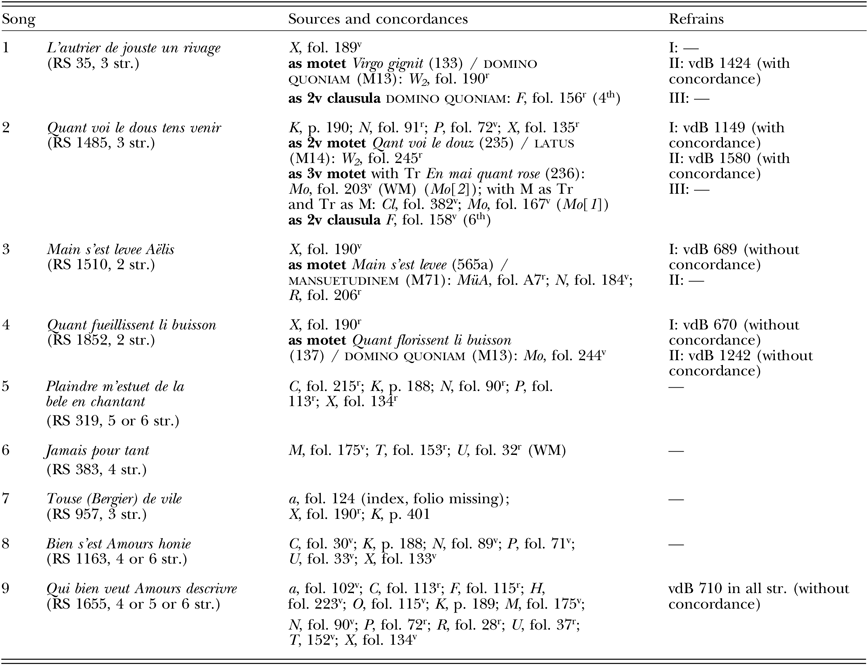
This article presents a study of four works that the sources attribute to the trouvère Robert de Reims, works situated at the very heart of the question of motet–chanson interaction in the thirteenth century. We have a total of nine songs by Robert de Reims, as listed in Table 1; they are attributed to ‘Robert de Rains’ or ‘La chievre de Rains’ depending on the manuscripts, and, although small quantitatively, the corpus enjoyed a wide and lasting reception in the sources throughout the century, with forty-seven occurrences of these nine pieces.Footnote 12 While very little is known about Robert,Footnote 13 the sources recording his work clearly place him amongst the first trouvères, somewhere around 1200,Footnote 14 and reveal a production at the nexus of monophonic song and polyphony. Indeed, of the nine strophic chansons attributed to him, no fewer than four have their first stanza enhanced by a liturgical tenor in a motet appearing anonymously in a polyphonic source (Table 1, nos. 1–4). Three of these motets keep the same music and same text as their chansons (nos. 2–4), while one (no. 1) retains the music but substitutes a sacred text in Latin. Finally, two of the works (nos. 1–2) are preserved as independent liturgical clausulae. Offering transgeneric reworkings relating motets to songs and clausulae, Latin to French, monophony to polyphony, and the secular to the sacred and the liturgical, Robert’s work is a textbook case for the examination of generic interplay and recastings right through the thirteenth century – from U at the very beginning of the century to a, O and R at the start of the fourteenth.Footnote 15 Robert’s corpus also constitutes an interesting case for investigating the compositional processes at work in the interplay of monody and polyphony, since the four works involve a complex act of recomposition from chanson to motet or from motet to chanson. Finally, this group of works constitutes an ideal case for the evaluation of the role of an identified trouvère in this tangle of works and genres. The four pieces are attributed only in the song versions of the chansonniers, while the motets and clausulae are recorded anonymously, as is normal in those repertories,Footnote 16 addressing the question of the actual role and authorship of Robert, beyond the surface of attribution habits, in this interplay of works and genres. Importantly, Robert’s production is representative of a group of pieces that offer the same characteristics and pose the same questions: Appendix II provides an updated enumeration of the polyphonic motets that show one voice entirely (A–B) or extensively (C) preserved as a chanson in a trouvère songbook (A and C) or in a literary work attributable to a trouvère (B).Footnote 17 In total, there are forty-six pieces that provide transgeneric reworkings between song and polyphonic motet in the same way as Robert’s pieces;Footnote 18 they also raise the same issue of attribution and authorship, since twenty-six works are ascribed to a trouvère in at least one monophonic source and reveal the names of fourteen authors (listed in Appendix II.D). Interestingly, seven of them are identified in more than one of these works; and with four pieces, Robert is the most recurring presence with Richart de Fournival.
The corpus of Robert de Reims

This article offers an examination of the issues of generic interplay, of compositional processes linking motets and chansons, and of authorship and trouvère involvement in this generic interaction, as raised by the four works tied to Robert. The first section examines the generic origin of these works, demonstrating that they are firmly grounded in the Parisian motet tradition. Section II analyses the mechanisms of recomposition of the motets as songs. Section III investigates the poetic involvement of Robert in the works and unravels the significance of the attribution in the songbooks, while section IV explores the purpose of the reworking and of the generic transfer. The last section focuses on the sequence of composition between motets and clausulae, and determines Robert’s exact role in the making of the motets.
I. COMPOSING MOTETS BY THE BOOK
An investigation into the works transmitted as both polyphonic motets and strophes of monophonic chansons, as exemplified by the four pieces associated with Robert de Reims, necessarily poses the question of their generic origin. The voices in question may either begin as trouvère chansons, or else originate as polyphonic motets and then be stripped of their tenor in a songbook. Different commentaries on the corpus of these transgeneric voices have presented contradictory opinions on the matter,Footnote 19 and logically so: the two scenarios appear in Appendix II,Footnote 20 and it is clear that an individual examination of each piece needs to replace any attempt at a generalised response. In the case of the four songs/motets by Robert, we note that the various hypotheses already advanced are contradictory.Footnote 21 Still, an examination of the fabric of these works not only lets the organic features of the motet easily become evident, but also, critically, reveals four motets firmly grounded in the Parisian polyphonic tradition. That examination, then, opens our investigation.
The Polyphonic Landscape
The transfer of a monophonic song to a polyphonic setting involves the delicate superimposition of two pre-existing elements – an upper voice and a plainchant tenor – which usually leaves quite visible traces in the resulting motet. The seams of the operation may be apparent in the tenor: the plainchant melody may be affected or its modal pattern be made irregular in order to accommodate the chanson; the chanson may also force the motet composer to find a tenor melisma that is untried in the polyphonic repertory – or even invent something quite new.Footnote 22 The four tenors of the songs/motets associated with Robert show the opposite: they make use of melismas developed quite early in the Parisian repertory. Two of the motets are based on the tenor domino quoniam (M13): Quant florissent li buison (Table 1, no. 4), copied in Mo, and Virgo gignit (no. 1), copied in W2, but also preserved as a three-stanza chanson with the text L’autrier de jouste un rivage in X – a concordance that has hitherto escaped notice. In the extant sources, there is no motet transmitting the French text of the initial strophe of this song. We start nevertheless with the assumption that this French version necessarily existed, and even before our inquiry goes on to demonstrate as much, we shall speak of the motet L’autrier de jouste un rivage / domino quoniam. This tenor comes from one of the most favoured pieces of plainchant in thirteenth-century polyphony, the gradual Hec dies ℣ Confitemini domino. The portion domino quoniam is itself the base of twenty-five polyphonic settings and represents the different states and stages of Parisian polyphony, including clausulae in the organum, independent clausulae, secular French motets and sacred Latin motets. The third piece, Qant voi le douz tens venir (Table 1, no. 2), preserved as a two-voice motet in W2 and as a double motet in Mo and Cl, makes use of the melisma (immo)latus (M14). Taken from the Alleluia ℣ Hodie Maria virgo, it is also a classic of Parisian polyphony, since it provides the tenor of twenty-seven settings, again representing the same wide range of clausula and motet types. While these tenors clearly belong to a firmly established Parisian polyphonic tradition, the fourth piece tied to Robert constitutes an exception. Main s’est levee Aëliz (Table 1, no. 3), copied in Noailles, MüA and Roi, is built on an unusual tenor. This tenor had never been reliably identified thus far, due to major inconstencies in both the melisma and the tenor word across the sources, but it actually matches the syllable ‘-nem’ of mansuetudinem, from the Alleluia ℣ Eripe me de inimicis (M71) for the Common of Virgins.Footnote 23 Only one other polyphonic work, the motet J’amaisse; mais je n’os (565), makes use of the same tenor, here again in the Noailles chansonnier.
The registers and poetic genres of the motetus voices could as readily come from the field of the chanson as that of the motet, presenting precisely the poetic types that circulated between the two repertories. L’autrier de jouste deploys pastourelle motifs, and Main s’est levee treats the Aelis theme. The two other pieces are instead of a high register: Qant voi is akin to a reverdie – a trouvère poetic type opening the song with a celebration of spring – and Quant florissent to a courtly love song. More than register, it is the versification of the pieces that provides a good indication of their origin, starting with the length of the texts.Footnote 24 The thirteen, fourteen and fifteen lines of, respectively, Qant voi, Quant florissent and L’autrier (see versifications in Appendix III.2, III.4 and III.1) are atypical for a chanson but rather normal for a motet.Footnote 25 Measured by line count as well as verse type and rhyme scheme, only Main s’est levee could constitute, with its twelve lines, three line lengths, and four different rhymes, as credible an instance of a lower-register song as of a motet (Appendix III.3). On the other hand, the variety of rhymes and line lengths in Qant voi and Quant florissent, with four rhymes (two of them unmatched) and five different line lengths in the first case,Footnote 26 and four rhymes (one unmatched) and six line lengths in the second (see versification in Appendix III.2 and III.4), is far more consonant with the motet than with the high-register chanson, as are the four lengths and five different rhymes (three unmatched) of L’autrier (III.1). In fact, the schemes of these four pieces are unique in the Mölk–Wolfzettel repertory of versification.Footnote 27 Finally, the melodic profiles of these voices match only slightly the morphology normal in the trouvère chanson. Indeed, only L’autrier (see the analysis of Appendix III.1) is built on a trouvère formal type, with its pedes et cauda form combining two A sections built on four heptasyllabic verse-phrases a1 and a2 with alternating rhymes, followed by a part B not based on structural repetition. The other three voices of the songs/motets are not constructed on any particular pattern. Qant voi and Quant florissent have closely conjoined melodies, enhanced by a few repeated or varied segments (see, for the first, in Appendix III.2 the sometimes-varied repetitions of segments 1 at perf. 5, 13 and 15, of segments 2 at perf. 23 and 27, segments 3 at perf. 17 and 39, and of segments 4 at perf. 35 and 43; and, for the second in III.4, of segments 1 at perf. 3 and 24, of segments 2 at perf. 7 and 34, of segments 3 at perf. 14, 40 and 43, of segments 4 at perf. 17 and 47, and of segments 5 at perf. 21 and 51), which are not necessarily incompatible with chanson style. Quite different is Main s’est levee, with its complex turns and its ill-conjoined profile together with its small ambitus and its isomelismatic segments reduced to a varied reiteration of the single motif 1 (III.3).
Verbatim Borrowings
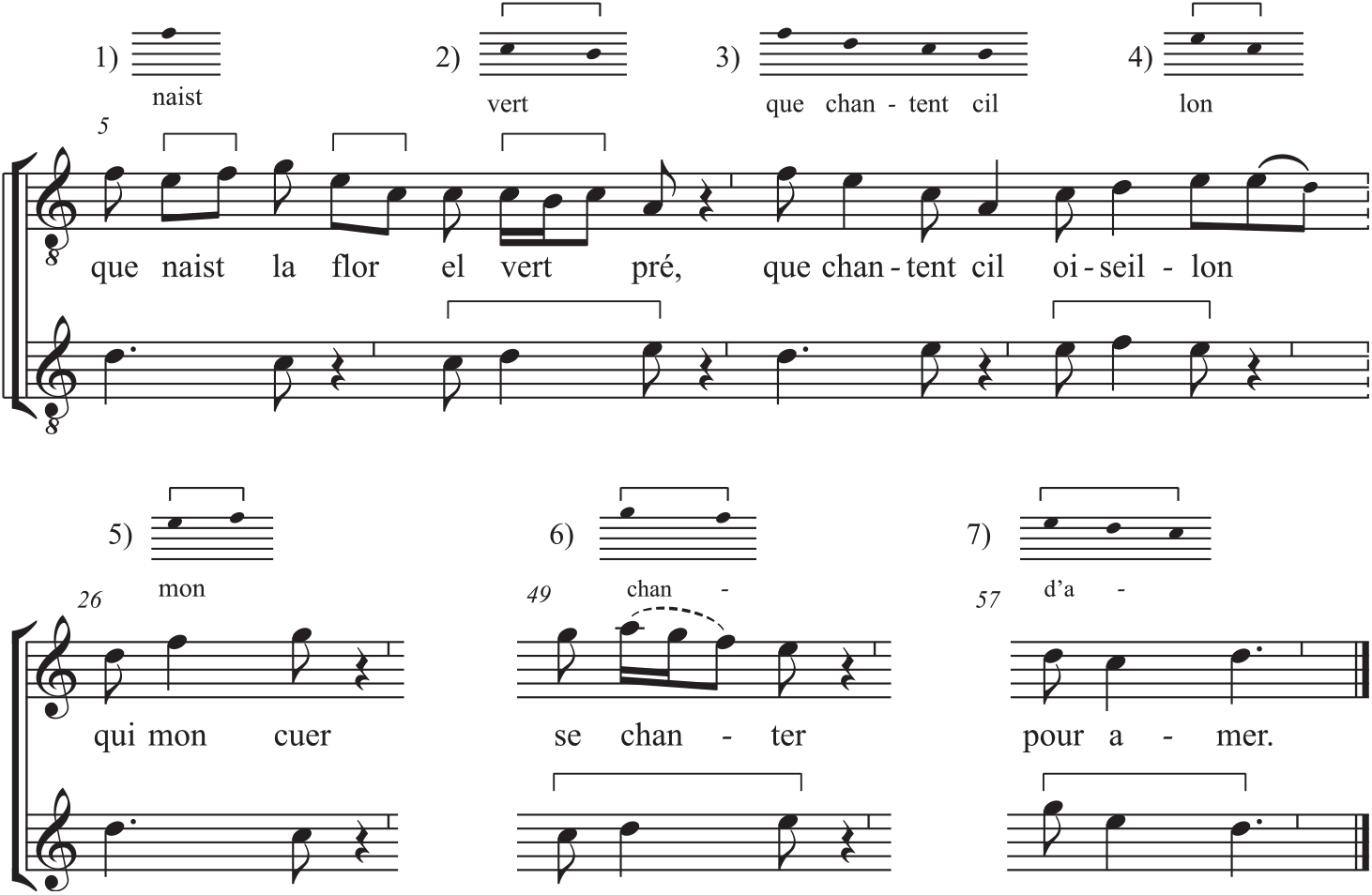
If the inclusion of an authentic monophonic song in a polyphonic setting almost always necessitates an arrangement of the motetus and/or the tenor, the four voices associated with Robert clearly argue against this notion. No significant variant is to be seen between the chanson version(s) and the motet version(s) of the upper voice. Example 1 offers a fine illustration: seven variants appear between the motet and chanson versions of Quant florissent, concerning only the most superficial ornamentation (instances 1, 2, 5 and 6), melodic variants or copying errors (instances 3 and 4), or, in the seventh instance, the addition of a ligature occasioned by one fewer syllable in the song version (‘d’amer’ for ‘pour amer’ in line 14). Such absence of rewriting is similarly evident in the tenors of the four motets. The melismas domino quoniam, latus and mansuetudinem conform melodically to the thirteenth-century sources of Parisian plainchant, as well as to other polyphonies based on the same tenors. Additionally, the modal patterns imprinted on them fall unmistakably within the polyphonic history of these melismas. Indeed, the domino quoniam tenors of our two motets exhibit the same structure, presenting two domino cursus, followed by a single quoniam cursus (Appendix III.1 and III.4; see Roman numbers under the tenor), which governs fully seven of the nine polyphonic ‘complexes’ – i.e., ruling out the concordances between motets and clausulae – of the complete portion domino quoniam. As for the tenor latus of Qant voi, it offers a sole cursus (Appendix III.2), in the manner of fourteen of the sixteen polyphonic complexes of this tenor and following the pattern present in eight of them. Finally, the tenor mansuetudinem of Main s’est levee presents two cursus (III.3) as in the sole other motet built on this tenor.
Musical variants between Quant florissent li buisson (137) / domino quoniam (M13) and its related song RS 1852 (in ossia)

The Influence of the Tenors and of the Parisian Polyphonic Tradition
The melodic morphology of the voices, while showing uneven resemblance to chanson style, reveals on the other hand clear marks of dependence on the tenor structuring of the motets. Several melodic repetitions in the upper voices are thus a faithful reflection of tenor potentialities. In Qant voi, the two tenor segments a trigger a similar counterpoint in the upper part (see the wavy lines in Appendix III.2, perf. 3–6 and perf. 11–14). In Quant florissent, the repetition of 1 (III.4, perf. 3–4 and 24–5) occurs on the same segment a of the two domino cursus. Finally, in L’autrier, the linkage of segments 2 and 3 of perf. 33–6 reappears in perf. 48–51 (see the wavy lines in III.1) at a moment when the tenor polarities are similar, and the same is true of the repetition of motif 1 (perf. 7–8, then 13–14). The same motet also indicates that the very phrasing of the motetus was conceived in line with the structuring of the tenor. Indeed, the transition from the first to the second domino cursus (labelled I and II in Appendix II.1) brings about a sudden reworking of the upper-voice structuring: above the first cursus, the motetus is structured in five phrases based on a hypermetrical count of seven syllables of text and four perfections of music (in III.1, the length of the musical phrases is noted by a number in parentheses at the end of each one). As soon as the second tenor cursus starts, the phrases abruptly shift to a new norm of seven perfections; in addition, the initial synchronisation of the tenor and motetus ordines becomes unsystematic throughout cursus II. It is finally with the iteration of the cursus Quoniam (labelled III) that the initial situation returns: the motetus shows two long phrases of eight perfections that are divisible, in accordance with the poetic lines, into two phrases of four perfections synchronised with the tenor ordines.
The structuring force of the tenors is also manifested intertextually, with a clear compliance of the upper voices with the thematic and lexical potentialities of the tenors, as well as with the polyphonic tradition of these melisma. L’autrier and Quant florissent present a quite typical picture of secular motets constructed on the M13 gradual. As demonstrated by Sylvia Huot,Footnote 28 such pieces often reveal a parodic secular repurposing of Psalm 117 provided by the text of the gradual: the theme of divine mercy gives way to a recasting in which the lover implores the mercy of the loved or desired woman, who in turn saves him through her amorous or erotic clemency. In L’autrier, the shepherdess is the one whose mercy is sought (Appendix IV.1; see the motet translations as first strophes of their related songs); in Quant florissent (see translation in Appendix IV.4), it is the lady, and the narrator uses the terms of the psalm to implore a secular sort of mercy (line 13). The M13 gradual, sung for Easter, also frequently offers a pretext for a springtime opening in a secular motet, and also from that point of view, L’autrier and Quant florissent belong to the tradition of the motets on domino quoniam as well.Footnote 29 The tenor latus is, again, a tenor for Easter, which Qant voi matches in the same way as the two preceding motets: after a similarly vernal introduction, the passion of Christ is repurposed to convey the suffering of the lover (see translation of Appendix IV.2). In the motet Main s’est levee, the textual relation between tenor and motetus is treated with particular care and reveals most clearly the original compatibility of the two parts. The Alleluia from which the tenor is taken was sung in the Common of the Virgins and perfectly suits the character of Aelis, offering a quite classic juxtaposition of the sacred and secular figurations of maidenhood, and the choice of the word mansuetudinem (‘gentleness’) could hardly be more appropriate for the delicate, intimate words of the motetus text (see translation in Appendix IV.3).
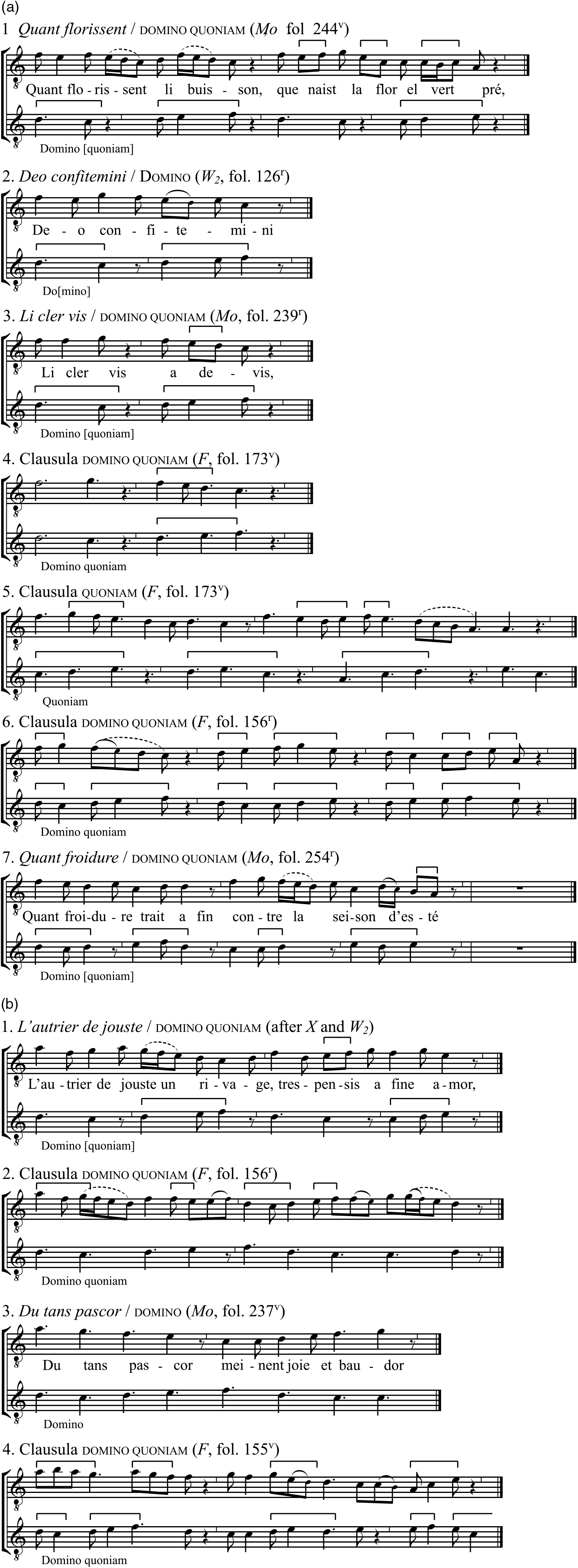
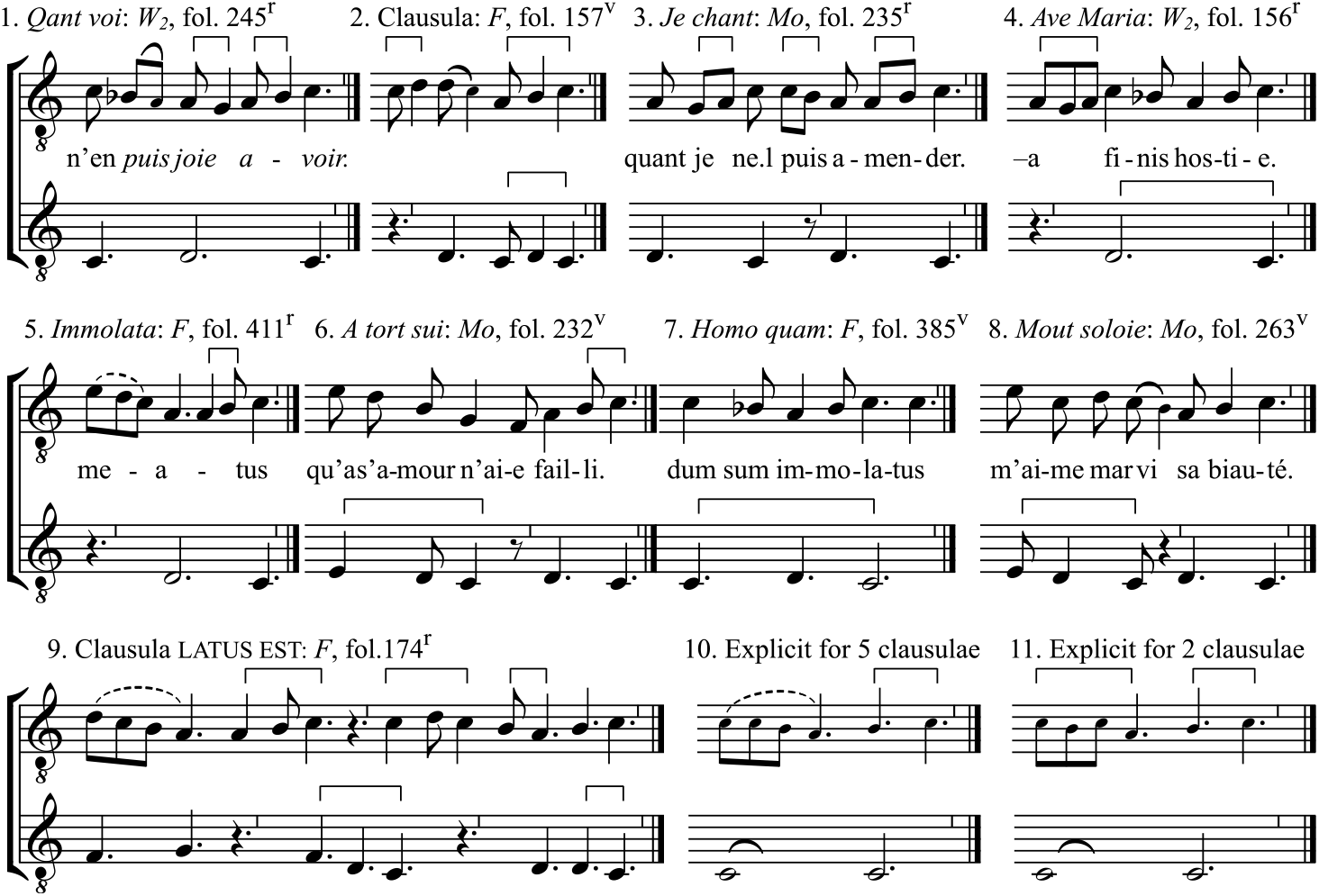
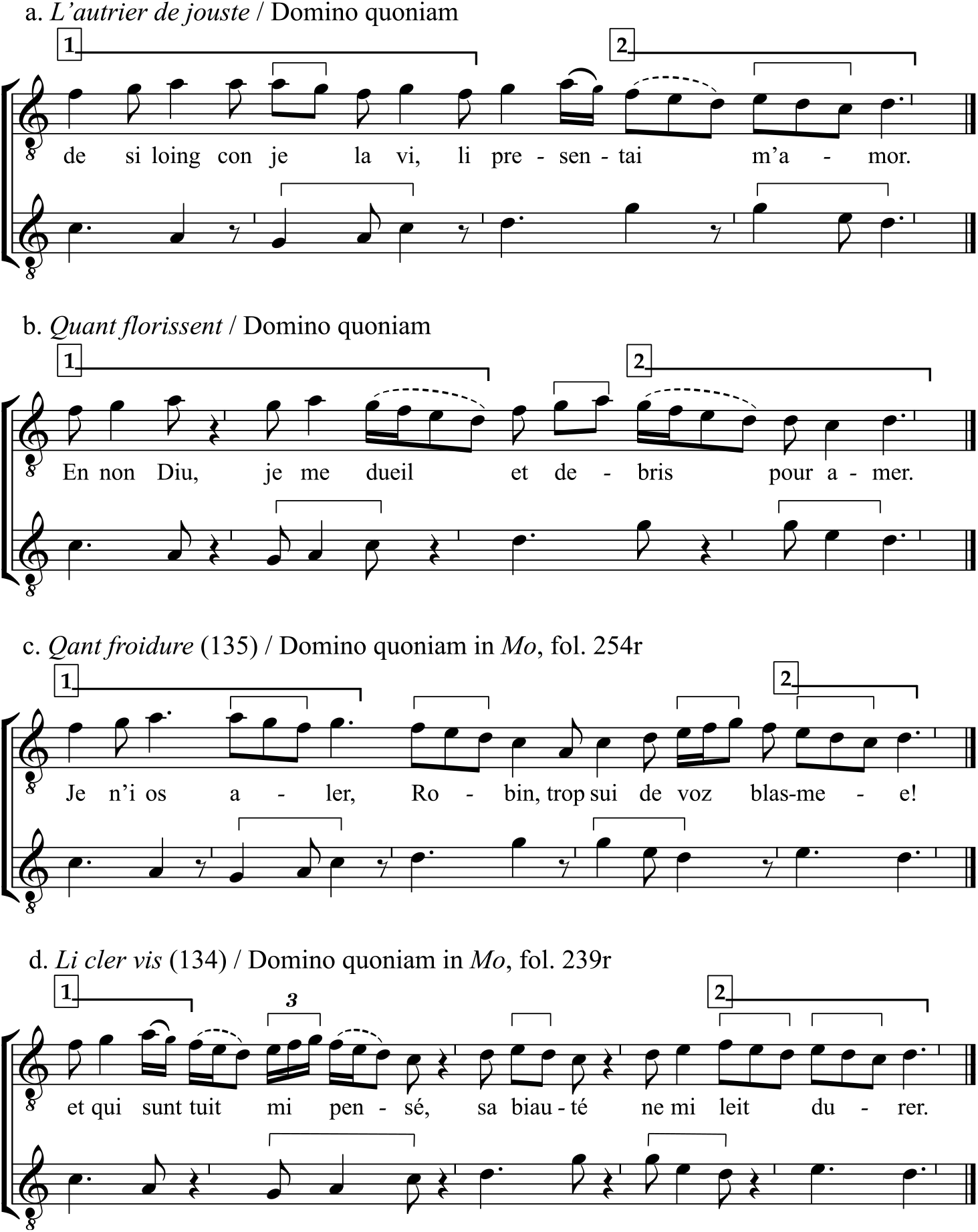
There is a final characteristic of the motets associated with Robert that confirms both their identity as motets and their origin in the Parisian polyphonic tradition. It is the presence of what may be called ‘polyphonic signatures’ – that is, stereotypical melodic motifs placed at the incipit and explicit of the upper voices of several polyphonic settings of a given tenor. This commonality of motifs peculiar to a given polyphonic family is not only linked to the contrapuntal contingencies imposed by the tenor. It also reveals a mode of creation and transmission of the polyphonic pieces that pick up, develop, and explore the same webs of melody and form, weaving them into one another, reinterpreting and reorganising the same material with ongoing variation. Thus, eleven of the sixteen polyphonic complexes on domino quoniam clearly use two different incipit signatures. Type 1 is shown in Example 2(a): it opens the upper voice with an initial phrase descending from f ′ to c′. To this type belongs Quant florissent (instance 1), even sharing with three other polyphonic complexes a second interpolation, in which the descending melody continues to a (nos. 5–7). These formulas are minimally dependent on contrapuntal requirements: the different pieces contain different tenor patterns – and therefore diverse contrapuntal situations when these formulae occur, and piece no. 5 has a different tenor, built only on the portion quoniam. The incipit of type 2 (Example 2(b)), offering an initial formula descending from a′, applies to our motet L’autrier. As for Qant voi, its incipit does not really match the incipit signatures of latus, but it does match the explicit signatures typical of the group. Example 3 shows that its members almost all conclude with variations on the same final formula. This formula is notably highlighted in Qant voi (instance 1), where it is prefigured in perf. 35–8 (Appendix III.2, phrases 4 and 4′). There, too, the concluding stereotype is not simply a product of consonance with the tenor: for example, instances 10 and 11 in Example 3 show that the formula invariably returns in the organum-like cadenzas of the clausulae at a time when the contrapuntal relation with the tenor is suspended. The incipit and explicit signatures thus constitute a sort of auctoritas, a measure by which the polyphonic settings of a given tenor affirm their status within a polyphonic tradition. Along with the polyphonic hallmarks previously seen, they indicate that the four works clearly came to be inscribed into a well-established genealogy of motets and clausulae going back to the earliest strata of Parisian polyphony, the conventions of which were obviously perfectly well known to the author(s) of our motets.
Polyphonic signatures of incipit in domino quoniam clausulae and motets: (a) type 1; (b) type 2

Polyphonic signatures of explicit in latus clausulae and motets

II. SINGING OFF-KEY
All four motets also appear as songs in chansonnier X and, in the case of Qant voi, in KNP as well. It is remarkable that the move from polyphonic collections to chansonniers required a complex process of recomposition, so that the original motet texts came to be enhanced with extra stanzas: to L’autrier and Qant voi were added two strophes each, and Main s’est levee and Quant florissent each received one (see these song versions in Appendix IV). The move from polyphony to monophony, then, involved something more than the mere copying of a motet text stripped of its tenor. In fact, an analysis of the compositional mechanisms at play in the reworking of the motets reveals that the songs constituted a quite distinct level of composition of the works, involving different authorship from that responsible for the motets.
Textual Dissonances
The mechanisms that allow supplementary strophes to be added to the original texts are, in terms of genre, register and versification, especially revealing of the process of recomposition of four of the works. With respect to genre and register, three of our works show, in their song versions, continuity between stanza 1 and those that follow. Quant florissent forms a coherent courtly chanson, in which several tropes of courtly love – prison, reward, service, love-engendered song – are spread through the two stanzas (Appendix IV.4).Footnote 30 The three stanzas of L’autrier (Appendix IV.1) constitute a conventional pastourelle, organised around the expected episodes of the encounter (stanza 1), the dialogue (stanzas 2 and 3) and its resolution (stanza 3). Finally, Qant voi (Appendix IV.2) offers in its three stanzas the undisturbed continuity of the springtime motifs of a reverdie, along with language of a courtly register. On the other hand, in Main s’est levee there is an obvious discontinuity between the two stanzas of the chanson version (Appendix IV.3). The initial strophe is centred on Aelis, an archetypal character recurrent in mostly popularising works from the twelfth century on – four rondets de carole interpolated in the romance Guillaume de Dole, two rondeaux, a song similar to a rondeau, a pastourelle, a chanson by Baude de la Quarrière and, finally, another polyphonic motet.Footnote 31 The songs that put Aelis on stage show the constraint of a high degree of formalism.Footnote 32 Beautiful, amorous and inclined to sing, she begins her day by rising early, dressing in delicate fabrics, then going out to pick flowers in an orchard or meet her lover. Symbolising feminine desire and sensuality, Aelis’s songs are, for Bec, a manifestation of the eroticism of popular songs, with their immutable motifs of waking early, entering into an orchard and gathering flowers.Footnote 33 The first stanza of Main s’est levee checks off all the archetypal features: early rising (line 1), the orchard (line 5), a bird’s song (line 6) (all motifs also present in Baude’s chanson), the leafy bough (line 9) – again in Baude and in two of the rondets in Guillaume de Dole.Footnote 34 Finally, the last distich of the strophe, a refrain with no known concordance, echoes refrain vdB 912 of the rondet C’est la gieus in Guillaume de Dole, ‘J’ai amors a ma volonté / teles con ge voel’ (lines 2795–6). Stanza 1 of our song – the text of the originating motet – was thus stitched together by someone perfectly familiar with the Aelis archetype, and in that respect stanza 2 is clearly dissonant. There, Aelis is not even mentioned, but replaced by an indeterminate ‘she’. In lieu of the typical Aelis motifs, we have a long, stereotypical physical description (lines 1–8), of the kind repeatedly occurring in the chanson and motet, but alien to any other work staging Aelis. Finally, in contrast with the initial strophe, stanza 2 obviously closes without a refrain; it leaves a significant hiatus, as all other Aelis songs include a refrain, a formal device stemming from the possible origin of the Aelis archetype in the rondet. In sum, unlike the first stanza so wholly true to type, the second resembles an all-purpose strophe ready-made for use in any motet or chanson, and here simply pasted into the space that follows the stanza drawn from the motet. We should note that, in our four works, stanzas 1 alone are self-sufficient and have no need of additional strophes to constitute functional poems;Footnote 35 in other words, whereas all four texts are satisfactory in the motet version, one of them becomes disparate in the multi-strophic song version.
Versification offers the best index of discontinuity between initial stanzas and those following in the chanson versions of our works. All, indeed, exhibit phonic and/or metrical discrepancies between the two strata and, since all additional strophes need to be sung to the same music as initial ones, problems of text/music relationship occur at several points in the new material. At the least problematic level, it is only the rhyme schemes that differ between stanzas, as in Quant florissent and Main s’est levee (see the versification in Appendix IV.4 and IV.3 respectively). The two songs are written in coblas singulars – each strophe thus using its own set of rhymes – and the added strophes also show a different rhyme scheme, even a different number of rhymes. While these disparities are not unusual in the trouvère chanson and pose no problem in the relation between music and text in the additional strophes, incoherencies are scattered through the other two pieces. Similarly composed in coblas singulars, the three stanzas of L’autrier (Appendix IV.1) also show divergent rhyme schemes and different numbers of rhymes. Yet more unusual is that some rhymes change gender, the feminine rhymes – those with an accent on the penultimate syllable – of stanza 1 becoming masculine, with an accent on the last syllable, in stanzas 2 and 3 (lines 1, 3, and 6). This mutation is not only inherently faulty in poetic terms; it is also destructive from the point of view of the text/music relation. Indeed, in stanza 1, heptasyllabic lines with a feminine rhyme take up the equivalent of eight notes in order to accommodate the unstressed final -e (Example 4), while in stanzas 2–3, with the change to masculine rhyming and the consequent effacement of unstressed final -e, there is no need for more than seven notes to accommodate the same heptasyllables; the final notes of these phrases thus remain unused. In order to compensate for the shrinkage of the space occupied by lines 1, 3 and 6, the author lengthens the lines that follow, 2, 4 and 7, by giving each an extra syllable. This procedure produces not only divergent patterns of length between strophes (see the versification pattern in Appendix IV.1), but also, especially, results in unbalancing the relation between text and music. Indeed, whereas the musical phrases (with the end marked by a tractus in the manuscript as shown in Example 4) matched the units of poetry in the initial stanza, the two are rendered out of phase with each other in stanzas 2–3. This work, then, presents a true lack of coherence between the first strophe and the two that follow. The case of Qant voi is comparable. The chanson version appears in coblas unissonans – according to which all the strophes use the same set of rhymes – that may well qualify as lame (see versification in Appendix IV.2), for the b′ rhymes are identical across the strophes, but the c rhymes are mere assonances; and though the a rhymes are full in stanzas 1 and 2, they show only assonance in stanza 3. The lines diverge also with respect to length: the lengths of lines 10 and 11, respectively heptasyllabic and tetrasyllabic in stanzas 1 and 3, are reversed in stanza 2. As shown in Example 5, such manipulation refashions there, too, the music/text structure of the passage: the new break between lines 10 and 11 in stanza 2 occurs at a point not corresponding to a pause in poetry or music in stanzas 1 and 3.Footnote 36
Song RS 35, lines 1–7 of strophes 1–3

Song RS 1485, lines 10–11 of strophes 1–3 (MS X)

Refrain Discontinuity
The treatment of refrains offers another instance of mismatch between initial strophes and additional ones. We have already approached the question in regard to Main s’est levee, where stanza 1 concludes with two lines identified as refrain vdB 689 (Appendix IV.3). Although it has no concordance, this distich does show the style typical of a refrain, and its identity as exogenous musical material is palpable in the motet version, where it occasions the only difficulty in the piece regarding the vertical relation of tenor to motetus, with a major second at the start of perf. 39 (Appendix III.3; see arrow). The presence of the distich seems to lead as well to a disruption in the versification of the piece, since the two rhymes in lines 11 and 12 are belatedly introduced in lines 9 and 10 (Appendix IV.3) as preparation for the final distich. In contrast, the final distich of stanza 2 does not obviously constitute a refrain: it is stylistically too remote, and syntactically it is tied to the preceding lines, with two lines moreover maintaining rhymes b′ and a of the rest of the stanza. L’autrier (Appendix IV.1) shows just the opposite, for in the initial strophe the last distich clearly does not constitute a refrain, whereas in the second it does, corresponding to refrain vdB 1424, which has three concordances in other works. As for stanza 3, its two final lines are not recorded in van den Boogaard’s catalogue and have no known concordance; however, their style and syntax both suggest that they might well constitute a refrain quotation. L’autrier thus shows, in its treatment of refrains as in its versification, a disparity between the initial strophe and subsequent ones.
The last song, Qant voi, is similarly heterogeneous in terms of refrain placement. Stanza 1 closes with refrain vdB 1149 (Appendix IV.2), also transmitted with music in chanson RS 73 in chansonniers MT. Stanza 2 of the chanson version also quotes a refrain, vdB 1580, which has one concordance with music in a motet in Mo. On the other hand, stanza 3 does not close with a known refrain, and there is little certainty that the two final lines, syntactically linked to what precedes, constitute one. In terms of refrains, only Quant florissent apparently shows continuity, as each of the two strophes seems to close with a refrain: vdB 670, followed by vdB 1242, neither of which has a concordance. Beyond their typical appearance, these distichs offer poetic variety in their respective stanzas by providing new line lengths and/or rhymes (Appendix IV.4). The refrain of the first stanza seems to be a textual quotation only. Indeed, Example 6 shows that the music of this last distich (6b) matches the same explicit signature domino quoniam as three other polyphonic complexes of the same tenor (6a, 6c and 6d); and the slowing of declamation on ‘dueil’ then ‘-bris’ might indicate the coupling of two pre-existing materials, namely, this musical signature and the text of a quoted refrain. As for the last distich in stanza 2, it evokes another refrain that does have concordances.Footnote 37 This apparent continuity in the refrain treatment of Quant florissent is, however, hindered by the masculine form of ‘ami’ in the refrain of stanza 2: it suggests an unexpected shift to the feminine voice at the closure of the song, a shift that casts a hint of inconsistency in the treatment of refrains and, as a result, over the work.
Polyphonic signatures of explicit in domino quoniam motets

The highly heterostrophic nature of our four songs is in itself rather out of keeping with the features of ‘classic’ trouvère song such as it appears in KNPX, and is rather found in later chansonniers and idiosyncratic collections of songs.Footnote 38 Associated with the discontinuity of the refrains and especially with the glaring inconsistencies and deficiencies of the added stanzas, they rather indicate that the additional strophes in the chanson versions certainly constitute exogenous additions, postdating the composition of the motet, and due to one or more authors different from those responsible for the polyphonic settings. It is now also evident that L’autrier, like the other three pieces, began as a French motet, since this work, even more so than the others, shows an obvious distinction between the first stanza and the two that follow – testimony to the earlier existence of a now-lost French motet.
III. ROBERT DE REIMS VS ‘ROBERT DE RAINS’
The process of rewriting motets as chansons is based on the technique of grafting: newly written strophes are planted onto a text composed earlier. And it is precisely over these composite works that our sources show the rubric ‘Robert de Rains’. What, then, is meant by this attribution, given the fact that two phases, two strata, of composition are pieced together in the chansons of KNPX? The reader’s natural inclination is to think that the ascriptions refer to the works that they label and thus that they designate the songs, pointing to the trouvère Robert de Reims as the individual responsible for the second stratum of composition. However, a stylistic analysis of Robert’s work, along with its distribution in the sources, argues against that understanding and instead suggests a split here between attribution and actual authorship.
The Question of Poetic Style
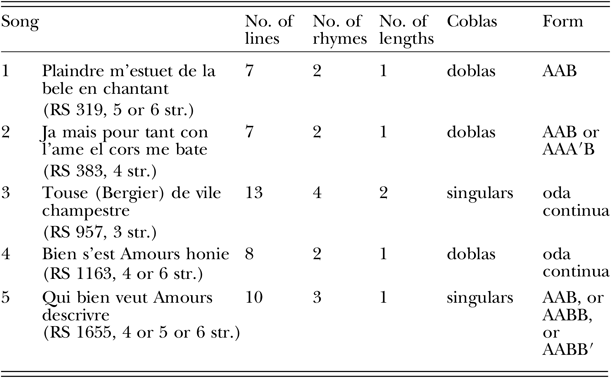
An initial elucidation of the significance of the attribution comes from a comparative analysis of the poetic style of Robert’s five ‘genuine’ chansons and the four songs/motets. The corpus of the true chansons (Table 1 above, nos. 5–9) shows an eclecticism as notable as that of the songs/motets: song RS 319 is a grand chant, and RS 1655 and RS 1163 are moralising poems on love in a high register; all three are thus comparable to Qant voi and Quant florissent. RS 957 is a pastourelle like L’autrier, even though its register – ‘la bonne vie’ – is not exactly the same as that of our more refined pastourelle/motet. Finally, there is RS 383, an iconoclastic sotte chanson in anti-courtly language. While Robert’s songs are marked by eclecticism of registers and also satirical spirit,Footnote 39 they are not distinguished by their forms, which are eminently conventional, in the number of stanzas (mostly between four and six) and in stanza length as well, with lines essentially between seven and ten in number, the only exception being the pastourelle (see versification data in Table 2). The number of rhymes and of line lengths per stanza is also within the norm, for, while the low register of the pastourelle produces four rhymes, the other songs show two or three; four of the songs are isosyllabic and, if we exclude its echo rhymes, the pastourelle RS 957 shows two types of length. In fact, according to Mölk and Wolfzettel’s Répertoire, none of the metrical schemes is unique, and those of RS 383 and 319 recur, respectively, in no fewer than nine and seven other songs.Footnote 40 In sum, the conformism of these songs fails to square with the addition of strophes in the songs/motets. To be sure, if Robert were responsible only for the supplementary stanzas, he could not be held accountable for the structurally constraining characteristics of the initial texts (number of lines, of rhymes and of line lengths), but strophic disparity, refrain discontinuity and incoherencies between text and music in the added stanzas are out of keeping with the well-mastered, classic formal shaping of the five chansons.
Versification patterns of Robert de Reims’s five ‘genuine’ songs
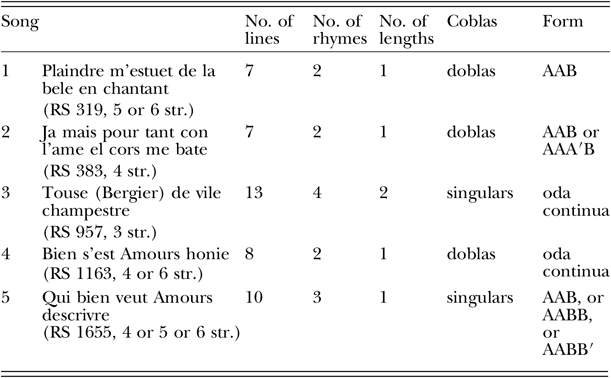
In general, the stylistic disjointedness of the song versions of the four motets contrasts with the great care for poetic continuity and flow from stanza to stanza in the ‘genuine’ chansons. Such continuity is in part produced by Robert’s chosen coblas, with three songs in coblas doblas, and two in coblas singulars with an identical versification scheme for all stanzas (see Table 2). Beyond these general patterns, Robert lavishes particular care on the acoustic harmony of the strophes through very elegant means. These include, for example, the use of coblas capfinidas to link stanzas 2 and 3 in RS 1163 (reprise of ‘pris’ in Appendix V.4);Footnote 41 the derived repetition in the transition from stanza 1 to 2 in RS 319 (‘bele’ and ‘belement’ in Appendix V.1); or, in RS 1655 (V.5), the annexed rhymes linking the final lines of stanzas 1/2 and the first lines of 2/3 (‘dolors’ and ‘Amors’ in both cases), the first lines of stanzas 2/3 also creating an anaphora with ‘Amors’. Robert ensures a true continuity with a series of strophes using different sets of rhymes. The rhymes in stanzas 5/6 of RS 1163 are thus linked by assonance to the rhymes in 1/2 (‘-ire’ assonating with ‘-ie’ and ‘-is’) and to those of strophes 3/4 (‘-er’ recalling ‘-es’). Similarly, stanzas 1 to 4 in RS 1655, although singulars, are artfully tied to a gradual phonetic change of a′ rhymes, ‘-ivre’ becoming ‘-ere’, then ‘-ure’, and finally ‘-eure’. In contrast, our four songs/motets have quite little to offer in terms of acoustic flow from strophe to strophe: only Qant voi (Appendix IV.2) ensures a certain continuity with the assonance ‘i’ (rhymes a), the assonance ‘o’ (rhymes c), and the rhyme ‘-ee’ (rhymes b′) in its three strophes. A few sonorities carry over here and there in L’autrier and Main s’est levee (Appendix IV.1 and IV.3), but Quant florissent shows no acoustic carry-over at the rhyme (IV.4).
As Grossel has noted, acoustic luxuriance and expertise in rhyming constitute the stylistic hallmark of the poetry of Robert:Footnote 42 rhymes of the sort called rich, leonine, derived, paronymic, equivocal, annexed, or echoing do indeed abound in his poetry, along with the other phonic patterns of alliteration and assonance. These traits are present not only in the five chansons, but also in the initial stanzas of our songs/motets. The pastourelle RS 957 and stanza 1 of Qant voi share an intensive use of echo rhymes (compare Appendix V.3 and Appendix IV.2, lines 6–9), a procedure identified very early by the pioneers of medieval studies as the signature of Robert.Footnote 43 They can hardly be faulted: in the corpus of trouvère song, the other poems making intensive use of echo rhymes are very few in number and come later; amongst them, a chanson by Gilles le Vinier is a contrafact of RS 957, thus identifying Robert as the master of this procedure.Footnote 44 The two poems attributed to Robert, then, are the first specimens of intensive echo rhyming. The first strophe of Qant voi uses many other phonic features as well (Appendix IV.2), notably with the leonine rhymes of lines 7, 8 and 9. Leonine rhyme is also a structural element in stanza 1 of Main s’est levee, involving no fewer than four such cases (Appendix IV.3): ‘chanté’ and ‘volenté’ (lines 10 and 12), then ‘Aëliz’ and ‘deliz’ (lines 1 and 2); it also structures stanza 1 of L’autrier (Appendix IV.1), with ‘amor’ and ‘m’amor’ (lines 2 and 15) on one hand, and ‘dolor’ and ‘color’ (lines 4 and 9) on the other. Such abundance of leonine rhymes is comparable to what we find in the five chansons; they are notably scattered throughout RS 319, for example in lines 1, 3, 5 and 6 of stanza 3 (‘vraiement’, ‘rapaiement’, ‘retraiement’, ‘paiement’: see Appendix V.1), stanza 4 (‘essaiement’, ‘essaiement’, ‘paiement’ ‘delaiement’), and stanza 5 (‘bonté’, ‘sormonté’, ‘raconté’, donté). In Qant voi, the leonine rhymes ‘sentir’ and ‘n’assentir’ also form derived rhymes (Appendix IV.2), and such forms also occur in stanza 1 of Quant florissent with ‘guerredon’ and ‘don’ (Appendix IV.4, lines 9 and 11), or in stanza 1 of L’autrier with ‘destor’, ‘ator’ and ‘tor’ (IV.1, lines 5, 7 and 11). Derived rhyme is also an identifiable constant in Robert’s songs, as shown in stanza 1 of RS 319 (Appendix V.1), with ‘chantant’ and ‘enchantant’ (lines 1 and 3) and ‘nouvele’ and ‘renouvele’ (lines 2 and 4); or in RS 1163, with ‘vis’ and ‘avis’ (Appendix V.4, lines 4 and 5). The use of assonance and alliteration is also common to the ‘genuine’ chansons and to the initial strophes of the songs/motets. In Quant florissent (Appendix IV.4) we find a noteworthy play of assonating words in ‘-on’, with fifteen such occurrences in the first stanza, and L’autrier (IV.1) shows assonance with ‘o’ eighteen times in its first stanza. These figures are comparable to the large-scale play of alliteration in RS 383: the sounds ‘k’ and ‘t’ occur twenty times in stanza 1, with ‘k’ returning nineteen times in stanza 2 (Appendix V.2), which is, besides, bestrewn with small-scale assonances: ‘o’ and ‘a’ in lines 1–2, ‘ou’ in line 5, ‘ai’ in line 6, then ‘o’ in line 7.
The marks of Robert’s style in his songs are present in stanza 1 of the songs/motets, and specifically in strophe 1 alone. They fade, sometimes almost totally, in the added strophes. Thus, in Main s’est levee (Appendix IV.3), where stanza 1 showed four leonine rhymes (see above), two rich rhymes (lines 6 and 7), two annexed rhymes (lines 2 and 3), and a play of alternating masculine and feminine forms of the same rhyme (‘-é’ and ‘-ee’ in lines 9–12), stanza 2 offers no more than two separated leonine rhymes in lines 4 and 11, and one alliteration with ‘t’ in line 2. Stylistic impoverishment is perhaps even more blatant in L’autrier (Appendix IV.1): in stanza 3, there is simply nothing left of the derived and leonine rhymes, or of the assonances observed earlier in stanza 1; there remain only the two paronymic rhymes ‘berchier’ and ‘chier’ (lines 5–6). The most striking stylistic enervation is that of the echo rhymes in Qant voi (Appendix IV.2), which are totally absent from stanza 2 and only partly present in stanza 3, reintroduced in the transition of lines 6–7 and 7–8, but not in lines 8–9. In contrast, these stylistic and phonic features are constant through the different strophes of Robert’s five ‘genuine’ chansons; just to mention the most evident examples, the three stanzas of RS 957 are all built around echo rhyming, and those of RS 319 around derived and leonine rhymes; and the text of RS 1655 is constructed entirely of antitheses and oxymora.
The Question of Chronology and Distribution
Consideration of the period of activity of Robert de Reims alongside the chronology and contents of the sources preserving his works reveals, as convincingly as poetic analysis, that Robert could not have been the author of the additional strophes in KNPX. The chronology has lent itself to contradictory discussions,Footnote 45 but now seems to have been firmly established through Robert Lug’s work on chansonnierU.Footnote 46 Three of Robert’s ‘genuine’ songs appear in the first stratum of U, which Lug calls a proto-chansonnier, copied at the beginning of the 1220s. This part contains the oldest works in the trouvère corpus, stemming from the years 1200–20. That allows us to locate the poetic activity of Robert between 1190 at the earliest and 1220 at the latest. Unlike the other compositions in the proto-chansonnier, Robert’s songs were copied again and again throughout the century; and from the point of view of their distribution in the manuscript sources, the five chansons and the four songs/motets experienced clearly different treatments. Indeed, three of the ‘genuine’ songs were copied in the proto-chansonnier U as early as 1220 or thereabouts, some of them recopied in H in the middle of the century or in MT sometime around 1260–70 (see Table 1, nos. 6, 8, 9). On the other hand, there is no trace of the songs/motets in these chansonniers. It is known, however, that these works already existed, for L’autrier, Qant voi and Main s’est levee were copied in the 1250s in their motet form in MüA or W2,Footnote 47 and as early as the 1240s as clausulae in F for the first two works. In fact, except for the group KNPX, the sources maintain a generic distinction between the chansons and the motets, the former transmitted in the songbooks and the latter in polyphonic collections. There are thirteen chansonniers that preserve the whole set of five chansons, but none, apart from KNPX, includes any of the four songs/motets, whether in the motet or the chanson version. It is then only in the ‘mega-compilation’ KNPX, apparently created from one and the same large anthology,Footnote 48 that the motets are presented in the form of songs, in the decades 1270/1280. In other words, our additional strophes are peculiar to KNPX and the years 1270/1280 and thus considerably past the time of Robert’s death. Robert was obviously active in the making of the four works, but clearly as the poet of the initial stanzas, and, consequently, of the motet texts. He was not the author of the supplementary stanzas in the chanson versions, which evidently spring from an anonymous author, hiding under Robert’s attribution. The songs appearing in the chansonniers are, therefore, apocryphal, and the ‘real’ Robert de Reims is not quite the ‘Robert de Rains’ of the chansonniers, offering a case where attribution does not exactly match authorship.
IV. TWISTING THE GENRE
The process whereby the four motets were rewritten as monophonic songs fits these pieces into a medieval tradition of composition through the reworking of a pre-existing work, customarily weaving the new work into its model’s tissue of associations and networks of meaning – the process Gérard Genette calls ‘transtextuality’, which he defines as ‘everything that constitutes a relationship, avowed or hidden, between a given text and others’.Footnote 49 The rewriting of the four motets raises the question of the relation established by the songbook rewriter between the pre-existing material and the newly composed. But also between the original genre and the new one – for therein lies the particular case of the four works linked to Robert: the process of rewriting entails the transformation of motet into chanson, throwing our works into the thirteenth century’s problematic complex of generic exchanges, notably suggesting their similarity to other corpora typical of the interpenetration of motet and chanson gradually occurring in the second half of the century.
Maintaining the Text
The question of the relation between a literary text and the form it assumes in a new setting has been richly discussed and conceptualised over the last fifty years in the field of literary criticism. Medieval musicology has particularly appropriated the concept of ‘intertextuality’, a term coined by Julia Kristeva,Footnote 50 in order to assess the phenomena of quotations and rewritings in the poetico-musical world of the Middle Ages, and the networks of meaning that they weave together amongst the works.Footnote 51 The concept of ‘hypertextuality’, forged by Genette, is, in contrast, more illuminating in the case of the reworkings of the works tied to Robert. For Genette, hypertextuality is one of the five categories of transtextuality, where it designates any relation joining a text B, called hypertext, to a prior text A, called hypotext, onto which it is grafted, not in the way of a commentary, but as a transformation.Footnote 52 Genette proposes two broad types of hypertextual relation: imitation of the hypotext and transformation of it, each capable of being effected in three different manners: the ludic, the satirical, the serious.Footnote 53 The reworking of our four motets as songs is clearly an instance of imitation in the serious manner; it is a type that Genette calls ‘forging’ – an imitation that can assume the appearance of a ‘continuation’ or of a ‘sequel’.Footnote 54 Whereas a ‘sequel’ is grafted onto a closed text and then reopens it with new episodes, a ‘continuation’ maintains an unfinished or open text, starting it anew at the very spot where the hypotext had stopped; it is thereby forced to retain the narrative, characters, chronology and form of the hypotext. The additional strophes in our four chansons are indeed examples of continuation. Robert’s four original pieces are open texts, as is the motet L’autrier and its pastourelle with suspended narrative, which the anonymous author starts anew at the point of suspension in the motet and then carries on in conventional fashion to its conclusion.Footnote 55 The four continuations are also bound by hypotext constraints in terms of register, number of verses, metre and rhyme options, and, very pointedly, in terms of style, as in the chanson Qant voi, the third stanza of which imitates the play of echo rhymes in the first stanza.Footnote 56 To be sure, in his effort at imitation the anonymous author of the chansons exhibits a very limited art, so clearly do discrepancies appear between initial stanzas and added ones. To judge by their quality, the four songs, then, are mediocre continuations – even if it takes meticulous study to detect any trickery – but to judge by their concept, they actually represent an ideal case, since these continuations are apocryphal, the continuator utterly obliterating himself under the attribution ‘Robert de Rains’. It is precisely on account of this self-effacement that the relation between motets and chansons here is an instance of hypertextuality rather than intertextuality, for the latter rests on a play of memory between author and receiver, which calls for the receiver to recall the original work in order for the new one to be intelligible.Footnote 57 There is nothing of the sort in the case of our four works: grafted onto a chanson, the opening strophe does not have the role of a quotation and is not meant to be identified in order for the new work, wholly autonomous, to make sense; the opening simply blends into the new composition, just as the continuator disappears under the attribution provided by the songbooks.
Transposing the Genre
Our four chansons belong to a medieval tradition particularly rich in continuations. That is true for the genre of the romance, with such thirteenth-century examples as the second Roman de la rose, the continuations of Perceval, or the anonymous continuation of Mahieu le Poirier’s Court d’Amours. It is no less true of the musical repertory: the phenomenon of anonymous reworking through later addition of strophes is found frequently in the conductus,Footnote 58 as well as in the trouvère song.Footnote 59 However, contrary to these examples, the four works tied to Robert go beyond the simple category of continuation: although continuing their hypotext, they convert its very genre, turning motets into chansons. Applying once again Genette’s concepts, the type of imitation – to which continuation belongs – becomes crossed with the type called transformation or, more exactly, transposition, i.e., transformation in the serious manner. And in the case of our compositions, generic transposition has a double sense: motets become chansons, and, perforce, polyphony becomes monody.Footnote 60
The generic transposition effected in the four chansons is not an isolated phenomenon in the musical corpus of the thirteenth century, with several instances affecting motets, conductus and organa.Footnote 61 More broadly, this process is part of a tendency, in the second half of the century, to multiply interactions between the chanson and motet repertories. Indeed, the change in organisation and content of songbooks reveals this gradual generic crossover, with the motet little by little taking root in the space of trouvère anthologies. Several chansonniers thus preserve a few motet voices amongst their collections of chansons, as is the case with our four works. Other collections, such as Noailles or Roi, grant them their own section, associating the genre with the art of the trouvères. The classification by rubrics in the songbooks of the early fourteenth century, such as a and I, establishes the genre even more solidly as a new category of secular lyric: the motets are copied there alongside jeux-partis, pastourelles or grands chants – and with equivalent status.Footnote 62
In addition, such generic fluidity appears in the very process of composing the works in the thirteenth century. From this point of view, the disruptive effect of the refrain, which makes it a powerful agent of generic mobility, was shown by Ardis Butterfield and others to be particularly important: not belonging to any genre, refrains could filter into various works, breaking down generic borders and bringing motets, songs or romances into a relationship with one another.Footnote 63 Refrains and, more broadly, quotation, may have a significant impact on the very composing of works: acting as the introduction of one work into another through grafting with exogenous matter, quotations sometimes engender hybrid structures. Thus, several ‘grafted’ corpora from the period 1250–1315 have been identified as breeding grounds for symbiotic organisms combining the characteristics of polyphony and chansonFootnote 64 – which has led them to be viewed on occasion as leaven for polyphonic song in the fourteenth century.Footnote 65 The ‘chansonisation’ of our four motets fits into this gradual fading of generic characteristics. Starting from the grafting of new material onto pre-existing material, the resulting chansons have a clearly idiosyncratic character – small number of stanzas and heterostrophism – that pushes them to the margins of the trouvère corpus and betrays their generic origin: as Christopher Page has explained, the increasing permeability of chanson and motet at the end of the thirteenth century was a crucial move in the denaturisation of trouvère song, by way of its occasional dilution of forms and codes, rhythmic notation or the contraction of its scenarios.Footnote 66 Our four songs may have been amongst the first specimens in the years 1270/80, here clearly under the influence of the motet, testifying to a twisting, a distortion of the chanson very evident in somewhat later collections such as O or V.Footnote 67
Although part of the generic blending of chanson and motet in the late thirteenth century, our compositions remain nonetheless respectful of certain traditional prerogatives of genre. In composing the additional strophes, the continuator could certainly not undo the variety of rhymes and lengths of his hypotext, and therefore the original features of the motet; still, he attempted to paper over that generic source as much as possible, by deleting the tenor of the original works, of course, but also by taking care to add new stanzas designed to turn the motets into organically true chansons. This organic fit means a generic fit: in ‘chansonising’ the motets, he could smooth their way into a collection of songs, carefully balancing genre, source and internal features of the works. We thus face a rare instance in the corpus of Appendix II.A–B,Footnote 68 which is quite different, for example, from the nine monophonic motets in chansonnier a (Appendix II.A, nos. 10–18), where the compilers were satisfied to summarily throw upper voices of motets into song collections without the addition of new stanzas; it is different, too, from the monophonic motets entés in PaN and the symbiosis achieved there between the motet and chanson.Footnote 69 These monodies represent true instances of hybridity, giving the compositions an ambiguous status in terms of genre; those linked to Robert are cases of adaptation which, though confirming the permeability of the two genres, nevertheless reaffirm their differences.
‘Authorisation’
The character of the four chansons in KNPX, their status as apocryphal works, the anonymity of their continuator, and, finally, their distribution in the sources do suggest a path towards understanding the project that underlies our continuations. Present only in these four sources of identical chronology and provenance, partly sharing identical personnel in the work of compiling the collections,Footnote 70 these additional stanzas appear closely tied to, and especially made for, the compilatory project of KNPX. It seems that someone working on this great compilation may have decided to complete the collection of Robert’s authentic songs with his polyphonic works, thinking to turn them into chansons. The anonymous continuator may have grasped the ‘chansonnesque’ potential – registers, narrative type, the form of L’autrier – in the motets of a poet who is also the writer of chansons, and decided to solidify Robert’s double identity by displaying the two dimensions of his work in a single anthology. The same tendency was at work and even consolidated thirty years later in the making of chansonnier a: with its motet voices copied as monophonic compositions at the end of different sections of attributed chansons, the copyists seem to have wanted to complement the monophonic work of several trouvères with their polyphonic work.Footnote 71 The process of ‘authorisation’ would be made very clear with Adam de la Halle, whose authorial persona was methodically constructed by means of self-citation throughout his work and the collection of his opera omnia in manuscript W.Footnote 72 The transposition of Robert’s motets and their copy alongside his genuine songs in KNPX may well be amongst the instances foreshadowing the authorial projects developing in late thirteenth and early fourteenth centuries.
V. THE TROUVÈRE AND THE MAKING OF MOTETS
The four works associated with Robert de Reims were originally motets with texts created by our trouvère; they were continued in the years 1270–80 by one or more anonymous hands and transposed into chansons possibly with the goal of gathering the entirety of the author’s eclectic body of work into a single anthology of songs. A few pieces, however, are still missing in the Robert de Reims puzzle. The first concerns the place occupied by the corpus’s two clausulae and its Latin motet, a piece missing from the overall picture of the transmission and recomposition of the four works. The second piece concerns the need for a definitive resolution of the enigma of attribution and authorship: was Robert, writer of the motet texts, also involved in the composition of the music, thereby offering us an example of trouvère participation in the making of the thirteenth-century motet? In truth, the two issues are intimately related. Indeed, the possibility that Robert also wrote the music was briefly raised by Yvonne Rokseth, who appears very doubtful on the issue owing to the fact that Qant voi and L’autrier are found in clausular form in F, and also as a Latin motet for the latter: within the framework of the traditional filiation of the genres,Footnote 73 which underlies Rokseth’s point of view, the clausulae and the Latin motet are necessarily pre-existent, and Robert can be seen as responsible only for the later French texts.Footnote 74 This unidirectionality of movement between clausulae and motets has been quite rightly questioned since Rokseth’s claim,Footnote 75 and the question of the antecedence of the two clausula versions, as well as that of the Latin motet in the case L’autrier, thus needs to be re-examined.
Sacred Recastings
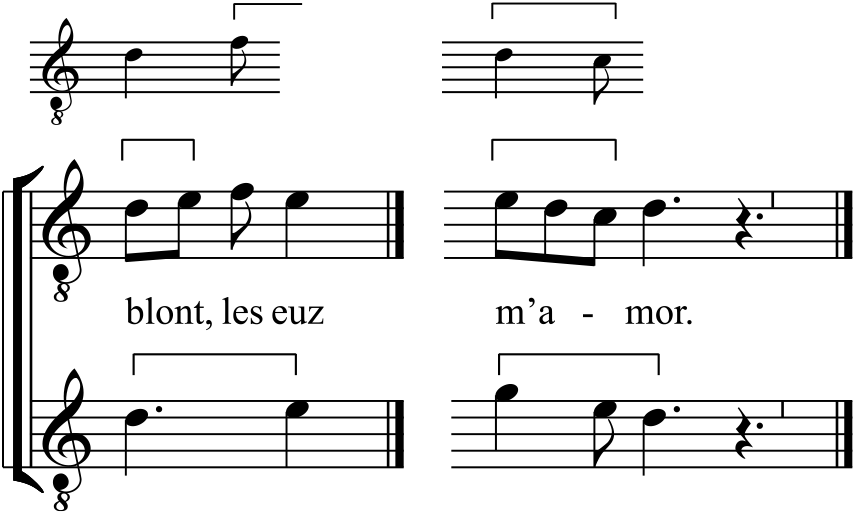
The clausular forms of Qant voi and L’autrier, both copied inside the fascicle of independent clausulae in F, are part of the very first group of clausulae suspected of actually coming from the motet. William Waite indeed classifies them amongst the twenty-one clausulae which, on the basis of their problematic notation, he regards as motet transcriptions.Footnote 76 This is also the opinion of Wolf Frobenius, who offers for each of the two pieces a series of arguments whose pertinence is nevertheless partly open to dispute.Footnote 77 Still, the conclusion of Waite and Frobenius seems undeniable for our two pieces. The first indication of their origin lies in the notable absence of significant variants between the motets and their clausula, as is evident in L’autrier, which shows only two ornamental variants (Example 7). Such absence of recomposition is readily understood in the framework of a transfer from motet to clausula, which demands no more change than the excision of the text of the upper voice; in the opposite conversion, the addition of a text on a melismatic duplum often requires a certain degree of recomposition, visible through significant variants between versions.Footnote 78 It is particularly notable that the two clausulae preserve the abundant ornamentation of their respective motets, as witnessed by the ornamentation in perf. 23–30 of the motet Qant voi (Appendix III.2). Typical of the motet, such embellishment is out of bounds in an original clausula, above all because it is impossible to render satisfactorily in modal notation. In the clausula of L’autrier, in addition to the various notational problems raised by Frobenius,Footnote 79 it is also notable that phrases 1 and 3 are respectively separated from 2 and 4 by a tractus, as in the corresponding motet (Appendix III.1, perf. 4 and 12); they are, however, irrelevant in the clausulae, since there they do not fulfil the normal functions of a measured rest or a point in the synchronisation of voices on a new text syllable. The two tractus are apparently copied mechanically from the motet version, where their function is, on the other hand, very clear: to distinguish and interrupt with a suspirio the two lines that constitute blocs A and A*.Footnote 80 The presence of typical chanson elements in these two pieces is another indication that the motets came first. In L’autrier, it is the pedes et cauda form that constitutes the chanson element, while in Qant voi it is the presence of refrain vdB 1149. In line with a possibility recently considered by Catherine A. Bradley, the presence of chanson materials in the two clausulae here results from having been initially quoted in a vernacular motet later converted into clausulae.Footnote 81 Lastly, the strategy of uniting text and music in Qant voi is a final indicator of the motet’s pre-existence. In perf. 21 and 26 (Appendix III.2), the musical device of hocket works in perfect tandem with the poetic device of echo rhyming. We might certainly suppose that Robert adapted his text to an existing musical hocket; however, since echo rhyming was part of Robert’s stylistic signature, it seems more likely that the rhyme resulted from a planned strategy of musico-textual unity than from poetic opportunism.
Musical variants between L’autrier de jouste un rivage (133a) / domino quoniam (M13) and its related clausula (in ossia)

The final vector of transmission concerns the motet L’autrier and its related Latin Marian motet Virgo gignit. Gordon A. Anderson believed that many Latin motets in W2 were contrafacta of French ones,Footnote 82 but this notion cannot be indisputably proven in this particular work: no significant variants separate either the melodic profiles or the metrical schemes of the two versions. Between the Latin text devoted to the figure of the Virgin and the French poem built around the shepherdess, the presumptions about transmission can only be indirect. In part, the form pedes et cauda betrays an influence more vernacular than Latin; in part, too, the intertextual pairing of a Latin Marian motetus and an Easter tenor suggests that this version has close ties to vernacular culture.Footnote 83 Finally, there is coherence in the supposition that the four songs/motets associated with Robert followed a single transmissional pattern. And the sequence is now clear: these four works were originally French motets; they were soon converted into a clausula in at least two instances and into a Latin motet in one case, before they were all arranged as strophic chansons in the great KNPX anthology.
Musical Twinship
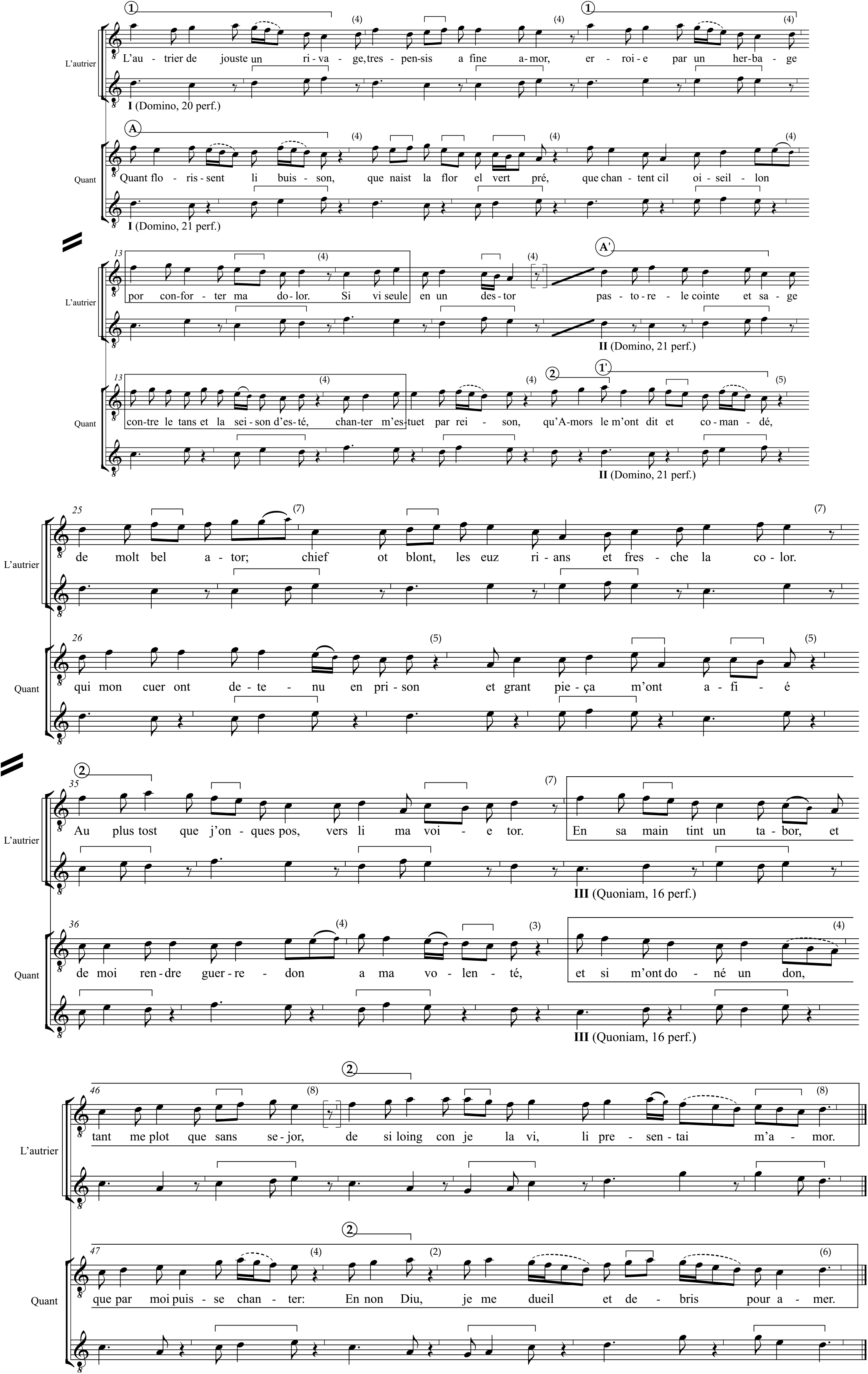
Robert de Reims was the writer of original texts for newly composed motets. At this point, we may already venture the hypothesis that he was also involved in the making of the music, either within a collective procedure or simply as the sole author of the music, exactly in the same way as was presumably Adam de la Halle – at the same time poet and composer of his monophonic and polyphonic works. If Robert created the texts for newly composed motets, he was certainly involved in the music as well; and the musical twinship revealed by two of our four motets even permits us to favour the view of a single composer, corroborating the evidence of a single poet. Indeed, Quant florissent and L’autrier share, as we have seen, the same tenor domino quoniam built according to the same modal pattern. The development of the cursus of their melisma is the same, with one small exception (see the comparative analysis in Example 8): L’autrier ends the first cursus Domino at the penultimate note of the melisma (perf. 20), before starting the second cursus, whereas Quant florissent prolongs the melisma up to the last note (perf. 21), thus reaching one more perfection than L’autrier. The structuring of the motetus of Quant florissent is dependent on the cursus of the tenor in exactly the same way, analysed above, as L’autrier.Footnote 84 Above cursus I of Domino, the motetus offers a hypermetry of five phrases of four perfections (see Example 8), rigorously synchronised with the ordines of the tenor. Above cursus II (perf. 22), the motetus diversifies its phrase lengths and loses its coordination with the tenor ordines. Then, again like L’autrier, cursus III Quoniam provides the place for a re-synchronisation of the two voices with, in the motetus, a long phrase of eight perfections divisible into two verse-phrases of four perfections (perf. 43–50), then a final long phrase of eight perfections, interrupted at perf. 52 by the rhetorical need to accommodate the exclamation ‘En non Diu’.
Synoptic view of L’autrier de jouste (above) and Quant florissent (below)

Beyond these common structural characteristics, the two motetus voices share a large part of their melodic material above the same portions of their tenors. The first passage boxed in Example 8 (perf. 13–18) shows the same melodic sequence in the two voices, differentiated only by the fractio modi of Quant florissent, needed to preserve the same melody as L’autrier despite a difference in line length – a decasyllable for the first, a heptasyllable for the second. The second boxed passage, starting with perf. 42(43), shows that the final thirds of the two motetus voices are the same, with only a few variations. In addition, certain phrases or motifs are shared between the two motetus voices at different moments in the development of the tenor. Between the beginning of cursus I and II of the portion Domino, the motetus voices invert their material: phrase labelled 1 from the beginning of the first cursus Domino of L’autrier (perf. 1–4) is given, slightly varied, at the beginning of the second cursus of Quant florissent (perf. 22–5); chiastically, phrase labelled A of Quant florissent (perf. 1–4) is heard, except for the first note, in L’autrier (perf. 21–4). Finally, motif 2, shared simultaneously by the two works at motetus close (perf. 50[51]), is announced at different moments in Quant florissent (perf. 21–2) and in L’autrier (perf. 35–6). Thus, almost half of the polyphonic total is essentially the same in the two motets.
The two motets Quant florissent and L’autrier spring from the same experiment in writing. Composed in parallel with each other, they offer two readings of the same concept and the same material. This mode of unitary musical composition corroborates the common attribution in the chansonniers: the name ‘Robert de Rains’, which designates the author of the first strophes and therefore of the text of newly composed motets, also provides the key to the musical twinship of the two pieces. The case of Robert de Reims bears witness to the participation of trouvères in the development of the motet repertory; beyond that, it identifies trouvère involvement as an important force in the generic fluidity of polyphony and the chanson in the thirteenth century.
VI. CONCLUSION
The involvement of Robert de Reims in four thirteenth-century motets is a determining factor both in the narrative of this genre and in our appreciation of the exchanges between polyphony and song throughout the century. The chronology of Robert’s activity indicates that the tie linking the motet with secular culture in the vernacular was remarkably early, occurring in this instance between 1190 and 1220 – in other words, at the very time when the motet is usually viewed as having emerged. It notably corroborates and amplifies certain of the conclusions that Bradley recently drew from her study of three motets in F, according to which certain clausulae copied in that manuscript in the 1240s are fairly obviously based on French models, thereby showing that the French motet tradition needs to be located earlier in the century than usually claimed.Footnote 85 This proposition alters the traditional history of the genre, said to have been born of the trope of liturgical clausula through Latin texts, a history of secularisation and vernacularisation constituting its further development.Footnote 86 From that perspective, Robert’s corpus upsets all expectations, for it offers a veritable synthesis of the different individual cases advanced in sundry recent studies that have aimed to undermine this traditional account:Footnote 87 it reveals four secular vernacular motets composed around 1200 – one of them built on the chanson model of the pastourelle and the pedes et cauda form and another quoting a song refrain, which are turned into a sacred Latin motet and two liturgical clausulae incorporating materials originating in the chanson, before being adapted, at last, as multi-strophic chansons for a songbook sometime around 1270/80. This serpentine trajectory, with its comings and goings between different genres and different types of sources, actually plays havoc with the chronology and the vectors of transmission customarily established in the interplay of motet, chanson and clausula, betrays the early and enduring porosity of song and polyphony, and finally reveals the artificiality of unilateral lines of transmission and stout borders between polyphony and chanson, and between sacred and secular genres. The case of Robert de Reims, moreover, shows the variety of compositional resources linking motets and songs throughout the century. Here, with the very composition of these four polyphonies, motets and chansons were already brought into relation with each other by means of language, register and narrative types, and through poetico-musical form or refrain quotation in some instances; then, a few decades later, the two were again brought into relation with each other by way of the sharing of one voice, the elimination of another, and the grafting of new materials. These are a few of the many processes shown in Appendix II whereby the interpenetration of chanson and motet could occur.Footnote 88
The case of Robert de Reims shows the figure of the trouvère appearing in the thirteenth-century polyphonic motet corpus almost a hundred years before Adam de la Halle. Robert and Adam are surely only the visible part of a group of trouvères who contributed to the repertory, starting with those represented by the motetus voices copied and ascribed in diverse songbooks (Appendix II). The cultural identity of several of these authors is especially significant: Adam de la Halle, Moine de Saint-Denis, Richart de Fournival, Moniot d’Arras, Gautier de Coinci or Guillaume le Vinier: all were clerics. Several studies of the education of the trouvères of Arras have brought to light a common experience that unified clergy, trouvères, jongleurs and bourgeois, all at home in the same clerical culture, and sharing the same social spaces of the city, as witnessed by the considerable number of trouvères who were also clerics and sometimes employees of the cathedral or the monastery.Footnote 89 The participation of the trouvères in the motet repertory is thus not especially surprising, for these trouvère-clerics were no doubt well acquainted with plainchant and liturgical polyphony.Footnote 90 In fact, the preliminary analysis of our four motets has proven to what extent, through the choice and adaptation of tenors, the exegesis of their scriptural sources or the use of polyphonic signatures, the trouvère from Reims could count on an intimate knowledge of the polyphonic tradition emanating from Notre-Dame. The involvement of the trouvères in the repertory of the motet broadens the geographic and cultural reach of the genre, taking it out of its enclave in Paris and Notre-Dame, and corroborates sundry documentary traces, various motet texts, and several sources such as Noailles, Roi and a – all of them Artesian – that establish its cultivation in Artois and Picardie.Footnote 91 The Noailles songbook in particular affirms not only that a collection of motets was copied in Artois, but also that a number of its specimens were local creations, and finally makes it clear that the motet was one of the genres composed, practised, and appreciated by the trouvères, clerics and burghers of the Confraternity of the Carité de Notre Dame des Ardents and its Puy.Footnote 92 In fact, Grossel observes that Robert’s style, his poetic relations and the play of contrafacta with other trouvères reveal a close tie to circles in Arras, and suggest that Robert was in communication with the courts of the North.Footnote 93 Whatever the case, practice of the motet by trouvères could readily furnish, along with those musico-literary societies and courts of the north of France, alternative contexts for motet practice and performance.
Finally, the case of Robert de Reims brings to light a spectacular illusion regarding attribution and authorship. It first puts on stage a person named as author but who is not responsible for the entirety of what the chansonniers attribute to him, then a second, unnamed author hiding under the attribution of the first and continuing his work, and, lastly, a compilatory project doing its own part in constructing the authorial persona in the late thirteenth century. In the end, the anonymity attached to the motet falls before the ascribed chanson, and the songbook’s ascription names the author of the anonymous motet. This imbroglio bears witness to the potentiality of conflict between attribution and authorship in the Middle Ages, and also to the complexity of the notion of composer in that period. It recalls in any case the importance of the role of composers in our understanding of repertories and genres: the identification of a trouvère as the author of both ‘true’ chansons and ‘true’ motets is key to understanding the generic interplay that takes place in our four works; and the study of the corpus of Robert, after that of Adam de la Halle and in anticipation of a thorough examination of the corpora of the other trouvères mentioned in this study, points to the figure of the trouvère as one of the important links in the exchanges amongst motet, clausula and chanson, between vernacular and Latin corpora, and between liturgical and secular genres in the thirteenth century. The mobility of the genres is also that of their authors.
APPENDIX I Manuscript Sigla and Abbreviations
Some manuscripts appear both as polyphonic sources and as song sources with, as is conventional, differentiated abbreviations. Within this article, the distinction is generally clear from the context; where it is not, the reference is made to the name given to the manuscript rather than its abbreviation.
Sigla of motet and clausula collections
- Ba
Bamberg, Staatsbibliothek, Msc. Lit. 115
- Bes
Besançon, Bibliothèque municipale, I 716
- Ca
Cambrai, Médiathèque municipale, A 410
- Ch
Châlons-en-Champagne (formerly Châlons-sur-Marne), Archives départementales de la Marne, 3. J. 250
- Cl
Paris, Bibliothèque nationale de France, fonds nouv. acq. fr. 13521 (‘La Clayette’)
- D
Oxford, Bodleian Library, Douce 308 (see also Song manuscripts)
- F
Florence, Biblioteca Medicea Laurenziana, Plut. 29.1
- Ha
Paris, Bibliothèque nationale de France, fonds fr. 25566
- Her
Leuven, Katholieke Universiteit Leuven, fragment Herenthals
- Hu
Burgos, Monasterio de Santa María la Real de las Huelgas, MS 9
- Mo
Montpellier, Bibliothèque interuniversitaire, Section de Médecine, H. 196 (‘Montpellier Codex’)
- MüA
Munich, Bayerische Staatsbibliothek, gallo-rom. 42
- N
Paris, Bibliothèque nationale de France, fonds fr. 12615 (‘Chansonnier de Noailles’; see also Song manuscripts)
- PaN
Paris, Bibliothèque nationale de France, fonds fr. 845 (see also Song manuscripts)
- R
Paris, Bibliothèque nationale de France, fonds fr. 844 (‘Chansonnier du Roi’; see also Song manuscripts)
- Reg
Rome, Biblioteca Apostolica Vaticana, Reg. lat. 1543
- St-V
Paris, Bibliothèque nationale de France, fonds lat. 15139 (‘Saint-Victor Manuscript’)
- Tu
Turin, Biblioteca Reale, Vari 42
- V
Rome, Biblioteca Apostolica Vaticana, Reg. lat. 1490 (‘Vatican Chansonnier’; see also Song manuscripts)
- W1
Wolfenbüttel, Herzog August Bibliothek, Cod. Guelf. 628 Helmst.
- W2
Wolfenbüttel, Herzog August Bibliothek, Cod. Guelf. 1099 Helmst.
Sigla of song manuscripts
- A
Arras, Médiathèque municipale, 657 (cat. 139)
- C
Bern, Burgerbibliothek, 389
- H
Modena, Biblioteca Estense, Alfa. R. 4. 4
- I
Oxford, Bodleian Library, Douce 308 (see also Motet and clausula collections)
- K
Paris, Bibliothèque de l’Arsenal 5198 (‘Chansonnier de l’Arsenal’)
- M
Paris, Bibliothèque nationale de France, fonds fr. 844 (‘Chansonnier du Roi’; see also Motet and clausula collections)
- N
Paris, Bibliothèque nationale de France, fonds fr. 845 (see also Motet and clausula collections)
- O
Paris, Bibliothèque nationale de France, fonds fr. 846 (‘Chansonnier Cangé’; see also Motet and clausula collections)
- P
Paris, Bibliothèque nationale de France, fonds fr. 847
- R
Paris, Bibliothèque nationale de France, fonds fr. 1591
- S
Paris, Bibliothèque nationale de France, fonds fr. 12581
- T
Paris, Bibliothèque nationale de France, fonds fr. 12615 (‘Chansonnier de Noailles’; see also Motet and clausula collections)
- U
Paris, Bibliothèque nationale de France, fonds fr. 20050 (‘Chansonnier de Saint-Germain-des-Prés’)
- V
Paris, Bibliothèque nationale de France, fonds fr. 24406
- X
Paris, Bibliothèque nationale de France, fonds nouv. acq. fr. 1050 (‘Chansonnier Clairambault’)
- a
Rome, Biblioteca Apostolica Vaticana, Reg. lat. 1490 (‘Vatican Chansonnier’; see also Motet and clausula collections)
- k
Paris, Bibliothèque nationale de France, fonds fr. 12786
Abbreviations
- Commens
Richart de Fournival, Le Commens d’Amours
- Guillaume de Dole
Jean Renart, Le roman de la rose ou de Guillaume de Dole
- M
mass text as catalogued in Ludwig, Repertorium
- Miracles
Gautier de Coinci, Miracles de Nostre-Dame
- Perf.
Perfection
- Robin et Marion
Adam de la Halle, Jeu de Robin et Marion
- Rond.
rondeaux as catalogued in Van den Boogaard’s Rondeaux et refrains
- RS
song text as catalogued in Spanke, G. Raynauds Bibliographie
- vdB
refrain text as catalogued in Van den Boogaard, Rondeaux et refrains
- Ten.
Tenor
The number following the incipit of a motet voice designates the rank of the voice in Ludwig, Repertorium.
APPENDIX II Works Bridging the Polyphonic Motet and the Trouvère Chanson

APPENDIX III Transcriptions and Analysis of the Motets
In the musical transcriptions of Nos. 1–4, corrections of the source manuscript are given under the music, as is the material used to emend the faulty passage(s). Variants are not specified unless they elucidate a problematic passage.
Both in music examples and textual transcriptions, italics are used only to signal documented quotations, i.e., a portion of text and/or music that is also found in another work.
1. Motet Lautrier de jouste un rivage (1331) / domino quoniam (M13)
Music and text of the motetus: X, fol. 189v; attr. Robert de Rains. Tenor: W 2, fol. 190r

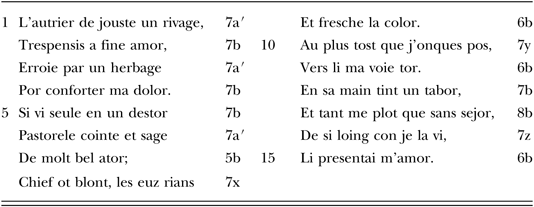
This transcription is the reconstruction of the lost French polyphonic motet version of this work. It accommodates text and music of the corresponding song RS 35 in X as Mot., with the Tenor of the Latin motet contrafactum of the song in W2.
Rhythmic mode after F. Motetus. Perf. 10: tractus misplaced after g′. Perf. 18: extra e′ after note. Tenor. Perf. 57: extra ordo e′ d′ follows.
2. Motet Qant voi le douz (235) / (immo)latus (M14)
W 2, fol. 245r


Rhythmic mode after ClFMo[1]Mo[2]. Motetus (Mo[2] missing). Perf. 16: e′ on ‘cele’; emended as in ClFMo[1]. Perf. 23: d′ on ‘sanz’; emended as in ClFMo[1]. Perf. 34: plicated c′ on ‘puis’ d′ on ‘por’; emended as in ClMo[1]. Perf. 40–1: d′–e′ on ‘qe’, f′ on ‘je’ then three currentes e′ d′ c′ on ‘de-’; emended after ClFMo[1]. Perf. 43: pitches notated a second higher; emended as in ClMo[1]. Perf. 44–5: a–g–a on ‘joie’; b on ‘a-’: emended after Mo[1].
3. Motet Main s’est levee (565a) / (mansuetudi)nem (M71)
N, fol. 184v


Motetus. Perf. 2: note 1 omitted: emended as in R (MüA missing); emended as in R (MüA missing). Perf. 15: d′ on ‘voi-’; emended as in MüA (X missing). Perf. 16: c′ on ‘lés’; emended as in MüA. Perf. 23: d′ on ‘ki’; emended as in MüA. Perf. 38: d′ as second pitch on ‘pen-’; emended as in MüA. Tenor. untexted melisma [Et tenuerunt] erroneously copied in N; replaced by the Tenor melisma in MüA.
4. Motet Quant florissent li buisson (137) / domino quoniam (M13)
Mo, fol. 244v


Motetus and tenor. Longa before every rest, except motetus at perf. 52. Motetus. Perf. 38: brevis on ‘-re-’.
APPENDIX IV Transcription and Analysis of the Attendant Songs
1. Song RS 35 L’autrier de jouste un rivage
X, fol. 189v; attribution: Robert de Rains

Rejected readings: 2.10 iaim (–1) — 3.8 ne le (+1) — 3.10 arriere (+1).
Versification: 3, coblas singulars

2. Song RS 1485 Quant voi le douz tens venir
X, fol. 135r; attribution: Robert de Rains

Rejected readings: 1.6 dont ie ne (+1) (reading from KNPClMo[1]W2) — 2.1 rega remainder of word barely legible — 2.7 Ha added (–1); dex — 2.10 ce] se (reading from KNP) — 3.5 missing (reading from KNP) — 3.6 missing (reading after P).
Versification: 3, coblas doblas

3. Song RS 1510 Main s’est levee Aëliz
X, fol. 190v; attribution: Robert de Rains

Rejected readings: 1.4 seule tint sa voie missing (–5) (reading from MüANR) — 1.5 les added (–1) (reading from NR) — 1.9 ele] cele (reading from MüANR) — 1.10 ot] en (reading from NR) — 1.12 i jut] muir (reading from NR) — 2.10 m. pensans (–1) (em. Simonds).
Versification: 2, coblas singulars

4. Song RS 1852 Quant fueillissent li buison
X, fol. 190r; attribution: Robert de Rains

Rejected readings: 1.9 moi] mon (reading from Mo) — 1.14 damer (reading from Mo) — 2.7 en cuit] ensint (em. Mann)
Versification: 2, coblas singulars

Note: In stanza 2, a* = rhyme a plus consonant; c• = rhyme c minus consonant.
APPENDIX V Excerpts from Robert de Reims’s Five ‘Genuine’ Songs
1. RS 319: strophe 1, strophe 2 line 1, strophe 3 (K, p. 188)

I: I must complain of my lady in song until she learns how love for her has my heart in thrall, for [my heart] doesn’t stop recounting its pains, yet never does it have misgivings; indeed, I always find it a pleasure to serve her; thus will my wait be more delightful. // II.1: With delight does he await satisfaction…. // III: So realize, lady, in all truth, that I am now in need of your aid, for never without you, despite any blunting, will the pain in my body be [sufficiently] blunted; I say this with no reservation at all, for it is much better to pay the price of death than to endure the delay of good love.
2. RS 383: strophe 2 (M, fol. 176r)

Like a Scotsman down at heel, wearing a patched and tattered cape, unshod, barefoot, rigged out in rags, I will search for her in foreign lands; under no roof of nails and slats (however elemental) shall I ever rest, until I have found the maid for whom I am so wan and pallid.
3. RS 957: strophe 1 (X, fol. 190r)

A village shepherd took his lambs out to pasture, accompanied only by a little dog of his at his right side. He would apparently have liked to be unseen while Robin was playing his flute; he heard the instrument, as it repeatedly produced the tune of a refrain.
4. RS 1163: strophe 1, strophe 2 line 8, strophe 3 line 1 (K, p. 188)

I.1–8: Love dishonoured itself by so betraying me that I have no lover to love as long as I live. I am dead, it seems to me, because I am without love. And never in my life will I be a true lover. // II.8: I will never be caught by it. // III.1: Why would I be caught…
5. RS 1655: strophe 1 line 10, strophe 2 lines 1 and 10, strophe 3 line 1 (K, p. 190)

I.10: life, death, joy and sadness. // II.1: Love is generous and miserly, // II.10: [life, death, joy and sadness.] // III.1: Love is ruled by chance,