Antisocial behavior (ASB; e.g., criminal behavior, substance use, and status offenses) has been widely studied (Moffitt, Reference Moffitt1993, Reference Moffitt and Thornberry1997; Patterson, DeBaryshe, & Ramsey, Reference Patterson, DeBaryshe and Ramsey1989; Widom, Reference Widom1989). It is not surprising that much of this work has focused on males, because most forms of ASB are more common in males than females (Snyder & Sickmund, Reference Snyder and Sickmund2006). However, girls make up a growing proportion of the juvenile offender population (Zahn, Hawkins, Chiancone & Whitworth, Reference Zahn, Hawkins, Chiancone and Whitworth2008). In 2007, 641,000 arrests, nearly one-third (29%) of all juvenile arrests, comprised females under the age of 18 (Puzzanchara, Reference Puzzanchara2009). This increase in the proportion of females in the justice system has underscored the need to better understand female ASB in order to create and implement successful prevention and intervention programs.
Despite some similarities, many gender differences exist in ASB and its associated risk factors. Girls demonstrate a later age of onset developmentally, initiating ASB around the ages of 14–15 years versus 9–12 for boys (Silverthorn & Frick, Reference Silverthorn and Frick1999; Silverthorn, Frick, & Reynolds, Reference Silverthorn, Frick and Reynolds2001). Mental health profiles associated with ASB also differ considerably across gender: in comparison to males, females in criminal justice settings demonstrate lower rates of diagnoses such as conduct disorder and antisocial personality disorder, which are common among males with ASB (Burnette & Newman, Reference Burnette and Newman2005). In contrast, girls demonstrate higher levels of most other forms of mental illness, particularly internalizing spectrum disorders such as depression, anxiety, and posttraumatic stress disorder (Sedlak & McPherson, Reference Sedlak and McPherson2010; Zahn et al., Reference Zahn, Agnew, Fishbein, Miller, Winn and Dakoff2010). Child maltreatment is often hypothesized to represent an important risk factor for the development of ASB among females, with some suggesting that it may be a gender-specific risk factor (Chesney-Lind, Reference Chesney-Lind1997; Zahn et al., Reference Zahn, Agnew, Fishbein, Miller, Winn and Dakoff2010). Although strong associations exist between child maltreatment and ASB, few studies have rigorously tested for potential gender differences in the pathways from child maltreatment to ASB.
The current work tests for gender moderation within a multidomain, developmental model of adolescent ASB within a large community sample of girls and boys. Building upon current knowledge and theories of ASB, we explicitly test for gender differences in the composition and relative influence of risk factors for ASB. We briefly summarize the literature on commonly studied risk factors for ASB. Alongside each risk factor, we have considered theory and existing literature that may support gender differences in the magnitude or mechanism by which each risk factor influences ASB.
Family Environment, ASB, and Gender
Child maltreatment (e.g., physical abuse, neglect, and sexual abuse) has profound consequences for child development, impacting several domains relevant to ASB, including attachment, affect regulation, peer relationships, and psychopathology (Belsky, Reference Belsky1980; Cicchetti & Toth, Reference Cicchetti and Toth1995; Egeland, Sroufe, & Erikson, Reference Egeland, Sroufe and Erikson1983). Some suggest that child maltreatment may be a gender-specific risk factor for ASB in females, noting the high rates of child maltreatment reported among girls in criminal justice settings (Chesney-Lind, Reference Chesney-Lind1997; Zahn et al., Reference Zahn, Agnew, Fishbein, Miller, Winn and Dakoff2010). In one recent survey of youth in detention, 42% of females reported a history of physical abuse and 35% reported a history of sexual abuse, compared to 22% and 8% of males, respectively (Sedlak & McPherson, Reference Sedlak and McPherson2010). Alternatively, these differences in rates of abuse may reflect gender differences in the reporting of abuse. Numerous studies demonstrate a strong association between child maltreatment and increased risk for ASB, such as aggression, substance use, and even prostitution, across gender (Burnette & Reppucci, Reference Burnette and Reppucci2009; Cicchetti & Lynch, Reference Cicchetti, Lynch, Cicchetti and Cohen1995; Cicchetti & Valentino, Reference Cicchetti, Valentino, Cicchetti and Cohen2006; Fergusson & Lynskey, Reference Fergusson and Lynskey1997; Widom, Reference Widom1989). We posit that differences may be due to gender moderation in the mechanisms by which childhood maltreatment influences subsequent ASB. In support of this, some studies of maltreated youth find a stronger association between child maltreatment and ASB among females versus males, particularly for violent behavior (Herrera & McCloskey, Reference Herrera and McCloskey2001; Widom, Reference Widom1989).
Within the spectrum of maltreatment, physically (e.g., corporal punishing, hitting, kicking, slapping) and emotionally coercive (e.g., insulting, threatening, belittling) discipline strategies have received much attention. Much of this work has centered on the debate regarding the direction of causality, that is, whether harsh parenting is a cause or consequence of children's ASB (Jaffee, Strait, & Odgers, Reference Jaffee, Strait and Odgers2012). Patterson's (Reference Patterson1982) coercion development model provides a conceptual framework for understanding the interaction between children and parents. According to this model, children with difficult temperaments may elicit harsher and more coercive responses by parents. This in turn serves to reward and train the child to engage in subsequent reactive coercive interactions, perpetuating the cycle. This conceptualization is supported by the broader literature including adoption studies, randomized clinical trials, and twin studies, all pointing toward reciprocal influences, in which harsh parenting may be exacerbated by children's ASB; but it also seems to influence risk for future ASB (Jaffee et al., Reference Jaffe, Caspi, Moffitt and Taylor2004; Jaffee, Strait, & Odgers, Reference Jaffee, Strait and Odgers2012).
Several theories attempt to explain gender differences in ASB; overall, these theories are consistent in suggesting that the relative importance of biological versus environmental risk factors, such as parenting, may differ across gender. The developmental literature points toward the impact of gender socialization, the process in which children identify with a gender role and internalize notions of which behaviors are gender congruent and incongruent. According to Chodorow (Reference Chodorow1978), differences in gender socialization happen early in childhood, when girls are encouraged to view their identity within the context of relationships, whereas boys are encouraged to individuate from others. Within such a context, ASB could be construed as being consistent with a male gender role (e.g., a means of asserting autonomy, independence) but inconsistent with a female gender role (e.g., inconsistent with close relationship formation). Therefore, ASB represents a departure from gender norms for females and may be associated with a more severe risk profile in females versus males. Similarly, Silverthorn and Frick (Reference Silverthorn and Frick1999) put forth the delayed onset pathway theory to explain gender differences in ASB. This theory acknowledges that the onset for female ASB is later than male ASB; but it posits that these girls share a severe pattern of neurobiological, genetic, and familial risk that is comparable to that seen among boys who initiate ASB early and continue this behavior into adulthood. Support for gender moderation exists in physiological studies examining correlates of ASB. Beauchaine, Hong, and Marsh (Reference Beauchaine, Hong and Marsh2008) found that males exhibiting early ASB demonstrated deficits in autonomic nervous system arousal, whereas girls did not show this pattern. They speculate that male ASB may have a stronger genetic or biological component, whereas female ASB may be more influenced by environmental and social factors. Finally, the evolutionary literature suggests that the emphasis on affiliative needs has developed because of the need for women to keep themselves and their children safe in times of stress (“tend and befriend”), which is a more adaptive response than the fight or flight system in some contexts (Taylor, Reference Taylor2002).
Consistent with this literature, we hypothesized that physically abusive or harsh parenting would serve as a potent environmental catalyst for ASB across gender but that it would be associated with divergent developmental pathways to ASB for males versus females. We were specifically interested in the role of familial, individual, and peer level risk factors for ASB, after accounting for the influence of other higher level contextual factors (e.g., poverty, race, and neighborhood socioeconomic status [SES]), because these targeted risk factors would hold the most promise for planning interventions for ASB. Harsh parenting was defined in this study as caregiver reports of the use of physical or emotional coercion and hence represented a familial level risk factor for ASB. We tested for gender moderation of individual (e.g., temperament, internalizing and externalizing psychopathology) and peer level influences (e.g., peer ASB).
Temperament: Disinhibition and Emotionality
Temperament is influenced by biologically based differences in emotional, motor, and attentional reactivity and self-regulation (Buckholtz et al., Reference Buchholtz, Callicott, Kolachana, Hariri, Goldberg and Genderson2008; Rothbart & Bates, Reference Rothbart, Bates, Damon and Eisenberg1998). As children develop, temperament may interact with other nonbiological, environmental factors, including parent and family characteristics, to influence the developing personality. For example, the pattern of emotional reactivity associated with borderline personality disorder has been linked to biological differences in the reactivity of the hypothalamic–pituitary–adrenal system (Crowell, Beauchaine, & Linehan, Reference Crowell, Beauchaine and Linehan2009). Many have conceptualized this disorder as a combination of several temperamental risk factors (e.g., high harm avoidance but also high novelty seeking; Ferraz et al., Reference Ferraz, Vállez, Navarro, Gelabert, Martín-Santos and Subirà2009), which interact with other familial level risk factors such as abusive parenting (Cole, Llera, & Pemberton, Reference Cole, Llera and Pemberton2009).
Temperament, particularly characteristics associated with a lack of behavioral or emotional control, can influence ASB directly by increasing the risk of engaging in novelty seeking or dangerous behavior or indirectly by influencing other risk factors, such as internalizing and externalizing disorders. Studies support both pathways. Low self-control is associated with ASB in adolescence (e.g., Pitzer, Esser, Schmidt, & Laucht, Reference Pitzer, Esser, Schmidt and Laucht2010; Zion & Jenvey, Reference Zion and Jenvey2011); and temperament characteristics, such as inhibition, may mediate risk factors for ASB, such as internalizing (e.g., Marakovitz et al., Reference Marakovitz, Wagmiller, Mian, Briggs-Gowan and Carter2011; Marakovitz, Wagmiller, Mian, Briggs-Gowan, & Carter, Reference Marakovitz, Wagmiller, Mian, Briggs-Gowan and Carter2011; Mian, Wainwright, Briggs-Gowan, & Carter, Reference Mian, Wainwright, Briggs-Gowan and Carter2011) and externalizing symptoms (e.g., Young Mun, Fitzgerald, Von Eye, Puttler, & Zucker, Reference Young Mun, Fitzgerald, Von Eye, Puttler and Zucker2001). In the present study, temperament was assessed at age 10, an age at which this construct likely represents a combination of biological and environmental risk factors. We focus on two aspects of temperament that are most implicated in the etiology of ASB: disinhibition and emotionality.
Disinhibition, a combination of low behavioral control and high sensation seeking, may influence ASB by making risky and illicit behaviors more appealing and reducing the ability to inhibit inappropriate behaviors. Disinhibition and impulsivity are neurobiologically linked to an increased sensitivity to rewards in the environment (Beauchaine, Reference Beauchaine2009; Gatzke-Kopp & Beauchaine, Reference Gatzke-Kopp, Beauchaine, Coch, Dawson and Fisher2007) as well as reduced sensitivity for aversive stimuli (Kambouropoulos & Staiger, Reference Kambouropoulos and Staiger2004). Several studies suggest that disinhibition is associated with ASB in both children and adolescents (Owens & Bergman, Reference Owens and Bergman2010; Pitzer et al., Reference Pitzer, Esser, Schmidt and Laucht2010; Young et al., Reference Young, Friedman, Miyaki, Willcutt, Corley and Haberstick2009). Impulsivity is also a risk factor for early ASB among male juvenile delinquents (Parker & Morton, Reference Parker and Morton2009). Conversely, studies show that adaptive levels of self-control, or a lack of disinhibition, may protect against early onset, persistent adolescent ASB in boys and girls. Gardner, Dishion, and Connell (Reference Gardner, Dishion and Connell2008) found that higher self-regulation predicted lower ASB among adolescents. Hudson, Dodd, and Bovopoulos (Reference Hudson, Dodd and Bovopoulos2011) found that lower disinhibition (i.e., greater inhibition) was also associated with a greater likelihood of meeting criteria for various anxiety disorders in early childhood.
Emotionality, or the inability to regulate emotional states, may influence ASB by increasing the likelihood that individuals engage in reactive violence or use substances or alcohol to cope with difficult emotions. Numerous studies show associations between difficult temperament in early childhood and behavior problems, delinquency, and aggression in adolescence (e.g., Bagley & Mallick, Reference Bagley and Mallick1997; Blackson, Tarter, Martin, & Moss, Reference Blackson, Tarter, Martin and Moss1994; Kingston & Prior, Reference Kingston and Prior1995; Webster-Stratton & Eyberg, Reference Webster-Stratton and Eyberg1982; Windle, Reference Windle1991, Reference Windle1992). One study (Giancola, Mezzich, & Tarter, Reference Giancola, Mezzich and Tarter1998) demonstrated that adolescent females with conduct disorder showed more difficult temperament than controls without conduct disorder. Another notable study by Henry, Caspi, Moffitt, and Silva (Reference Henry, Caspi, Moffitt and Silva1996) found predictive associations between difficult temperament in 3- to 5-year-old boys and violent offending at age 18.
Emotionality is also likely to increase the risk for developing psychopathology. In young children, emotionality has been associated with internalizing problems (Crawford, Schrock, & Woodruff-Borden, Reference Crawford, Schrock and Woodruff-Borden2011; Marakovitz et al., Reference Marakovitz, Wagmiller, Mian, Briggs-Gowan and Carter2011). In addition, there is some evidence that difficult temperament in early childhood increases the risk for maltreatment in late adolescence (Bagley & Mallick, Reference Bagley and Mallick2000; Brown, Cohen, Johnson, & Salzinger, Reference Brown, Cohen, Johnson and Salzinger1998). As noted above, the impact of temperament is likely to be influenced by the broader context of a child's environment. In a study by Boyce et al. (Reference Boyce, Essex, Alkon, Goldsmith, Kraemer and Kupfer2006), disinhibition in children predicted more mental health problems at 2-year follow-up, but these effects were context dependent in that they were limited to children whose fathers had had low levels of involvement in their lives. Finally, early childhood adversity may impact temperament. For instance, a large investigation of 7,500 children demonstrated that environmental and family stressors during the first 3 years of life predicted disinhibition at age 7 (Enoch, Steer, Newman, Gibson, & Goldman, Reference Enoch, Steer, Newman, Gibson and Goldman2010).
The majority of studies summarized above included males and females. Although some studies (e.g., Marakovitz et al., Reference Marakovitz, Wagmiller, Mian, Briggs-Gowan and Carter2011; Pitzer et al., Reference Pitzer, Esser, Schmidt and Laucht2010) reported gender differences, the findings are not consistent across studies. For example, Burk and colleagues (Reference Burk, Armstrong, Goldsmith, Klein, Strauman and Costanzo2011) found that girls with higher levels of disinhibition who were exposed to parental stress consumed more alcohol in adolescence. However, boys who consumed more alcohol were more likely to evince higher levels of negative emotionality, regardless of parental stress. We hypothesized that because of differences in socialization, girls who were maltreated would be more likely to exhibit high levels of emotionality, which influences risk for internalizing and externalizing disorders and ASB. In contrast, we hypothesized that harsh parenting in boys would be associated with disinhibition, and this would be a risk factor for externalizing disorders and ASB.
Externalizing and Internalizing
Internalizing and externalizing symptoms represent two broad dimensions of psychopathology related to anxiety and depression and rule violations and aggressive behaviors, respectively. Child physical abuse is associated with internalizing and externalizing psychopathology (Rogosch et al., Reference Rogosch, Oshri and Cicchetti2010), and both are implicated in the development of ASBs, particularly substance abuse (Low, Lee, Johnson, Williams, & Harris, Reference Low, Lee, Johnson, Williams and Harris2008; Oshri, Rogosch, Burnette, & Cicchetti, Reference Oshri, Rogosch, Burnette and Cicchetti2011). Several studies (Rogosch, Oshri, & Cicchetti, Reference Rogosch, Oshri and Cicchetti2010; Skeer, McCormick, Normand, Buka, & Gilman, Reference Skeer, McCormick, Normand, Buka and Gilman2009; Tarter, Kirisci, Ridenour, & Vanyukov, Reference Tarter, Kirisci, Ridenour and Vanyukov2008) compare internalizing and externalizing symptoms as competing mechanisms to explain substance use longitudinally. Tarter et al. (Reference Tarter, Kirisci, Ridenour and Vanyukov2008) studied boys over a period of 10–12 years, and they reported that externalizing but not internalizing behaviors in preadolescence predicted substance use in adulthood. However, Tarter et al. did not examine these processes in the context of harsh parenting. Oshri et al. (Reference Oshri, Rogosch, Burnette and Cicchetti2011) evaluated internalizing and externalizing pathways from child maltreatment to adolescent substance use problems from late childhood to late adolescence. Their findings suggest that more severe childhood maltreatment increased the risk of substance use problems during late adolescence by way of personality and externalizing problems in preadolescence, but not internalizing problems. It was notable that the study examined substance use outcomes and did not examine other forms of ASB. This literature suggests that externalizing problems are likely to influence subsequent ASB for boys and girls; however, the high rates of depression and anxiety among girls in the justice system suggests that internalizing disorders may also be important in understanding female ASB.
Peers
During adolescence, peers play a crucial role in the development of ASB (Ary et al., Reference Ary, Duncan, Biglan, Metzler, Noell and Smolkowski1999; Moffitt, Reference Moffitt1993). It is not surprising that adolescents who engage in ASB are far more likely to spend time with delinquent peers (Dishion, Spracklen, Andrews, & Patterson, Reference Dishion, Spracklen, Andrews and Patterson1996; Farrington, Reference Farrington1995; Patterson, Reid, & Dishion, Reference Patterson, Reid and Dishion1992; Snyder et al., Reference Snyder, McEachern, Schrepferman, Just, Jenkins and Roberts2010; Wiesner, Silbereisen, & Weichold, Reference Wiesner, Silbereisen and Weichold2008). Mounting evidence suggests that peers may make ASB seem more attractive. For example, studies suggest that youths who take more risks exhibit a stronger focus on the rewards versus costs of risky behavior when in the presence of a peer group (Gardner & Steinberg, Reference Gardner and Steinberg2005). Youths who are already engaged in ASB are also likely to seek out peers like themselves (e.g., personality characteristics, impulsivity, and other individual level risk factors), which may further increase their propensity for ASB (Gottfredson & Hirschi, Reference Gottfredson and Hirschi1990; Moffitt, Reference Moffitt1993, Reference Moffitt and Thornberry1997). Finally, antisocial peers may provide a working model for one's own ASB. In a phenomenon often referred to as deviancy training, antisocial peers may actually encourage nonantisocial youth to initiate ASB (Dishion et al., Reference Dishion, Spracklen, Andrews and Patterson1996; Thornberry, Reference Thornberry1991).
Much of the research on peers and ASB has focused on males (Dishion et al., Reference Dishion, Spracklen, Andrews and Patterson1996; Patterson et al., Reference Patterson, Reid and Dishion1992), with few studies examining gender differences in the influence of peers. One notable difference is that ASB is more common in males (Snyder & Sickmund, Reference Snyder and Sickmund2006), which means for females, far fewer of their same sex peers are likely to engage in ASB. Toro, Urberg, and Heinze (Reference Toro, Urberg and Heinze2004) examined the associations among ASB, peers, and gender in a sample of adolescents. Their findings suggest that for both males and females, the number of deviant peers was associated with increased ASB, with a stronger relationship for boys than girls. We hypothesized that peers would represent an important risk factor for females and that other individual level risk factors would be more important for understanding female versus male ASB. In contrast, the broader literature supports the notion that deviant peers would be a compelling risk factor for ASB, even after accounting for individual level risk factors.
Present Study
In sum, the present study tested a multidomain, longitudinal, gender-informed model of ASB among a large community sample of males and females. Given the speculation in the literature about the importance of harsh parenting in understanding female ASB, we examined the role of harsh parenting as a potentiating factor for ASB and examined the role of gender in moderating the impact of harsh parenting, temperament, psychopathology, and peers on ASB. Analyses were conducted after adjusting for additional contextual factors, including poverty, race, and neighborhood SES.
Method
Participants
This study used secondary data from the Longitudinal Cohort Study of the Project on Human Development in Chicago Neighborhoods (for more details, see Earls, Felton, Brooks-Gunn, Raudenbush, & Sampson, Reference Earls, Brooks-Gunn, Raudenbush and Sampson2007), a community-based, longitudinal study of child and adolescent development in racially, culturally, and economically diverse neighborhoods. The Longitudinal Cohort Study collected data from children and their primary caregivers (parents) from several cohorts (0–6 months and 3, 6, 9, 12, 15, and 18 years) and included three waves of data collection approximately 24 months apart. Stratified probability sampling based on SES and race/ethnicity yielded a representative sample from various neighborhoods in Chicago from different socioeconomic strata. The data used in the present analyses are from 1,639 youth enrolled in Cohorts 9 and 12 in order to allow an examination of risk factors influencing ASB from early to late adolescence.
Measures
Harsh parenting
Harsh parenting was assessed at Wave 1 using the Conflict Tactics Scale Parent–Child (Straus, Reference Straus1979), a 17-item primary-caregiver report of the frequency of types of discipline used by the primary caregiver, including verbal reasoning, verbal aggression, and minor and severe forms of physical aggression. Each behavior was assessed for frequency in the past year. For the purpose of our analyses, we modeled a latent construct of harsh parenting, indicated by three indicators: (a) verbal aggression, (b) minor physical aggression, and (c) severe physical aggression subscales.
Child temperament
Temperament was assessed at Wave 1 using the Emotionality, Activity, Sociability, and Impulsivity Temperament Survey (Buss & Plomin, Reference Buss and Plomin1984), a 40-item primary caregiver report of child temperament. Items assessed the child's emotional, social, and behavioral tendencies, which were rated on a 5-point Likert scale from 1 (uncharacteristic or not at all like your child) to 5 (characteristic or very much like your child). The Emotionality, Activity, Sociability, and Impulsivity Temperament Survey is based on a model of four temperament components: emotionality, activity, sociability, and impulsivity. For the current study we focused on emotionality (α = 0.740) and disinhibition (α = 0.642; Mathiesen & Tambs, Reference Mathiesen and Tambs1999).
Child mental health
Children's mental health was assessed at Wave 2 using the Child Behavior Checklist (Achenbach, Reference Achenbach1991), a 113-item primary caregiver report measure for children ages 4–18. The questionnaire assessed broad domain scales of internalizing (e.g., depressive and anxious) and externalizing (e.g., aggressive) problems characteristic of each subject. Items are rated on a 3-point Likert scale from 0 (not true) to 2 (very true).
Peer deviancy
Peer involvement in ASB was assessed at Wave 2 using the Deviance of Peers (Huizinga, Esbensen, & Weiher, Reference Huizinga, Esbensen and Weiher1991), a 36-item self-report interview completed by subjects about their peers' involvement in conventional (e.g., sports, extracurricular activities), delinquent (e.g., lied to teachers), and antisocial (e.g., theft, use of weapons) behaviors. Peer pressure to engage in drugs or alcohol use was also evaluated. We were able to model this into a latent construct, with factor loadings above 0.50.
ASB
ASB was assessed at Wave 3 using items from the Self Report of Offending (Huizinga et al., Reference Huizinga, Esbensen and Weiher1991; Loeber, Stouthamer-Loeber, Van Kammen, & Farrington, Reference Loeber, Stouthamer-Loeber, Van Kammen, Farrington and Klein1989), which is a 37-item self-report measure of engagement in ASBs including criminal (e.g., assault, burglary) and delinquent (e.g., running away) activities. First, we selected items that were endorsed by at least 1% of the sample at each wave. Second, these items were modeled as a one-factor latent construct of ASB within MPlus using the WLSMV estimator, with the categorical data specification to account for the binary nature of the data. The use of a latent measure enabled us to overcome the relatively low base rate of individual items while also modeling a construct that represented several types of ASB.
Demographics
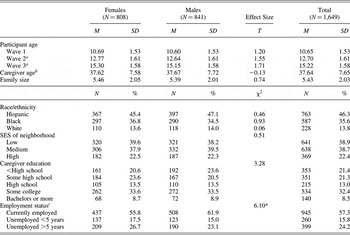
Demographic and Cultural Information is a primary caregiver interview of the subject's current and past residency and family constellation as well as the residency history, employment history, education, race, and marital status for the primary caregiver, the primarily caregiver's partner/spouse, and the subject's biological father and mother, if different. In addition to several individual indicators including family size and neighborhood SES (see Table 1), we also used a principal components derived measure of familial SES that was created by the Project on Human Development in Chicago Neighborhoods authors as covariates in our analyses.
Demographic characteristics of the sample by gender (N = 1,649)

Note: SES, socioeconomic status.
aDue to attrition, N = 1,437 at Wave 2 and N = 1,306 at Wave 3. All demographic variables collected at Wave 1.
bOf the primary caregivers, 82.2% were biological mothers, 8.9% were biological fathers, and 4.1% were grandmothers.
cPrimary caregiver and spouse.
*p < .05.
Results
Analytic plan
Analyses were performed with Mplus Version 6.00 (Muthén & Muthén, Reference Muthén and Muthén1998–2010), using the robust maximum likelihood, an estimator that uses a Huber–White algorithm to account for data nonnormality in the ASB and harsh parenting indicators. Indirect pathways were evaluated with the product coefficient approach, using bias-corrected bootstrap (5,000 replicates) confidence intervals (CIs; Preacher & Hayes, 2008; Shrout & Bolger, 2002). This method maximizes statistical power for detecting significant mediation effects and addresses data nonnormality, which is often present in the product coefficient estimate.
Measurement models were fit first, followed by structural models. Once model fit was optimized for the entire sample, we tested for measurement invariance, the main effects of gender, and gender moderation. Gender moderation was tested in two ways by testing the significance of interaction terms and using a multiple group framework to determine whether allowing these estimated pathways to vary by gender resulted in improved model fit. In multiple group models, hypothesized gender moderated pathways were tested one-by-one; each path was allowed to vary, and the fit of this “free” model was then compared to the fit of the baseline constrained model to evaluate whether differences were significant between the two groups. The two models were compared by computing a chi-square value from the log likelihood ratios in the models, using a formula provided in the MPlus user's manual (Muthén & Muthén, Reference Muthén and Muthén1998–2010).
The rates of the missing data were 1.5% in Wave 1, 25.6% in Wave 2, and 29.6% in Wave 3. Missing data were modeled under the missing at random (MAR) assumption (e.g., missingness was related to observed variables but unrelated to the missing values themselves; Schafer & Graham, Reference Schafer and Graham2002) and analyzed using all available data (Schafer & Graham, Reference Schafer and Graham2002). The MAR assumption was evaluated using SPSS version 19.0 missing value analyses. Examination of missing data patterns yielded several significant associations, and the Little missing completely at random test was significant at p < .001, supporting the assumption that data were MAR. A variety of global fit indices were used, including the traditional overall chi-square test of model fit and suggested criteria (McDonald & Ho, Reference McDonald and Ho2002) for the root mean square error of approximation (<0.08), test of close fit (p > .05), comparative fit index (>0.95), Tucker–Lewis index (>0.95), and average weight root mean square residual (≤1.00).
Descriptive analyses
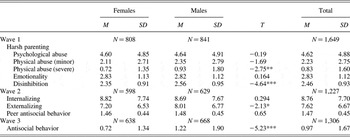
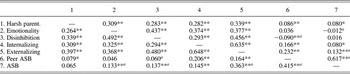
There were few demographic differences between males and females in the sample. Table 1 displays sample means and t values or chi-square statistics as appropriate. On variables of interest (see Table 2), boys reported higher levels of harsh parenting and more disinhibition than girls. Among youth endorsing any of the ASB indicators by Wave 3, the age of onset averaged 12.3 years (SD = 3.2) for girls (n = 160) and 11.9 years (SD = 3.1) for boys (n = 231); however, this difference was not significant (t = 1.15, p = .252). It was notable that, due to variation within each cohort, the ages at Wave 3 ranged from 11.7 to 18.6 years, meaning many youth were still below the mean age of onset at Wave 3. As shown in Table 3, the variables of interest were strongly associated with one another for males and females. Emotionality, disinhibition, and externalizing were more strongly correlated with ASB in females versus males, whereas the reverse was true of peer ASB.
Descriptive statistics for variables of interest by gender

Note: Higher scores denote lower levels of inhibitory control.
*p < .05. **p < .01.
Correlations by gender

Note: Females (N = 808) are presented below the diagonal, and males (N = 841) are presented above. ASB, antisocial behavior.
aSignificant difference between males and females (p < .05).
*p < .05. **p < .01.
Test of measurement model
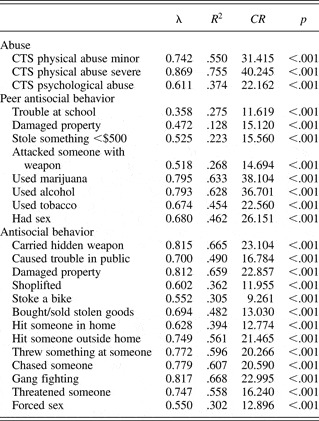
A model in which all latent variables were allowed to correlate with other latent variables was evaluated (Cole & Maxwell, Reference Cole and Maxwell2003). Traditional indices, using weighted least squares of global fit, suggested good fit between the data and the model tested (Tucker–Lewis index = 0.983, comparative fit index = 0.974, root mean square error of approximation = 0.022; close fit test p = 1.00; standardized weight root mean square residual = 1.05). The factor compositions of the latent variables are depicted in Table 4. Most standardized factor loadings were large (>.5), with only one loading in the moderate range (item asking about “Trouble at school” = 0.358). The measured variables' loadings on the latent variables were all statistically significant (p < .001), signifying that latent variables were adequately measured by their indicators. Manifest variables were related strictly to the latent variables that they represented, and associations between measurement error terms across time and measures were examined. As recommended by Preacher and Hayes (2008), among competing mediators (e.g., internalizing and externalizing latent constructs) within a structural model, residual covariances were allowed to improve the overall model fit.
Measurement model loadings and R2

Note: CR, critical ratio; CTS, Conflict Tactics Scale.
To test measurement invariance across gender, we ran a multiple indicator multiple causes model. When ASB was regressed on gender, constraining gender from predicting the factor indicators, a significant gender difference in the threshold for ASB was evident. Specifically, the threshold for the ASB latent variable was significantly higher among males versus females. Upon inspection of modification indices, four Self Report of Offending items differed by gender: shoplifting, buying stolen goods, hitting someone you live with, and threatening someone physically. Even after freeing the path from gender to the ASB indicators, the pathway from gender to the latent ASB remained statistically significant (>3.84). All subsequent models allowed these four items to be freely estimated by gender.
Evaluation of the structural model
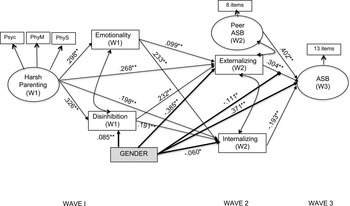
Our conceptual model is depicted in Figure 1. The model tested the link between harsh parenting reported at Wave 1 and ASB at Wave 3 via Wave 1 temperament (i.e., disinhibition and emotionality) and Wave 2 internalizing and externalizing problems, and peer ASB. The harsh parenting latent variable was an exogenous variable and was free to predict all of the examined endogenous variables in the model. This was done to allow us to test the indirect effects of harsh parenting on subsequent variables after accounting for variance related to parenting.
The gender-moderated model of antisocial behavior. Standardized estimates are shown from the model, adjusting for covariates (not shown): age, family socioeconomic status, family size, parental employment, and age of primary caregiver. *p < .05. **p < .01.

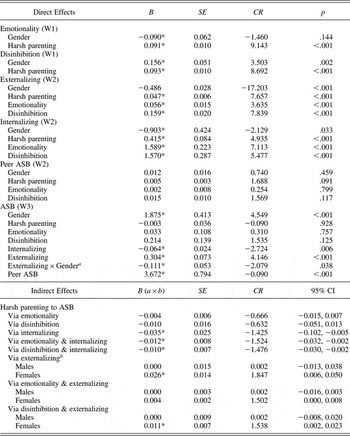
Unstandardized coefficients of the direct and indirect effects tested at 95% CIs are presented in Table 5. As shown, harsher parenting in childhood was associated with higher disinhibition and emotionality at Wave 1 and higher internalizing and externalizing at Wave 2. Emotionality and disinhibition were positively associated with internalizing and externalizing. Internalizing was negatively associated with ASB, whereas externalizing and peer ASB were positively associated with ASB at Wave 3. Note that no other variables were associated with peer ASB at Wave 2, after accounting for the strong within wave correlation between peer ASB and externalizing and the associations between other risk factors (see Table 3).
Unstandardized path estimates for developmental model of ASB

Note: The model was adjusted for covariates (not shown): age, socioeconomic status (SES), age of primary caregiver, employment status of primary caregiver, family size, race, and neighborhood SES and included correlations (not shown) for all within wave assessments (e.g., between emotionality and disinhibition, and among externalizing, internalizing, and peer antisocial behavior [ASB]).
aExternalizing by gender interaction was also tested in multiple group solution, which demonstrated a significant difference between males and females (males, B = 0.467, SE = 0.283, critical ratio [CR] = 0.165, p = .099; females, B = 1.177, SE = 0.361, CR = 3.257, p < .001; χ2 = 5.381, df = 1, p = .020).
bDue to a significant Gender × Externalizing interaction, indirect effects for externalizing were tested separately for males and females.
*p < .05.
Influence of gender
Male gender was positively associated with disinhibition and ASB but negatively associated with internalizing and externalizing at Wave 2. There was a significant negative Gender × Externalizing interaction in the prediction of ASB. Multiple group analyses provided further evidence of gender moderation, with a significant improvement in model fit when this pathway was allowed to vary by gender (χ2 = 5.381, df = 1, p = .020). Externalizing was positively associated with ASB in females (B = 1.177, SE = 0.361, critical ratio [CR] = 3.257, p < .001), but it was not associated with ASB in males (B = 0.467, SE = 0.283, CR = 0.165, p = .099).
Mediation
Estimates of indirect effects were obtained following 5,000 bootstrap replicates to obtain bias-corrected bootstrap CIs (MacKinnon et al., 2007; Preacher & Hayes, 2008). Mediation models tested causal relations among (a) harsh parenting severity, (b) the level of disinhibition and emotionality concurrently in children approximately 10 years of age (Wave 1), (c) internalizing and externalizing symptoms at approximately 12 years of age (Wave 2), and (d) ASB symptoms at approximately 15 years of age (Wave 3). Causal paths were defined from harsh parenting as an exogenous variable to each of the five endogenous variables. Because of the significant evidence of gender moderation with regard to externalizing and ASB, we tested the indirect effects for the externalizing pathways separately for males and females.
Internalizing symptoms at Wave 2 negatively mediated the relationship between harsher parenting and adolescent ASB at Wave 3, and indirect effects for this pathway were significant via both emotionality and disinhibition. Among females, a multiple mediation path confirmed a significant positive mediation between harsher parenting and ASB at adolescence via (a) disinhibition at childhood and (b) externalizing problems at preadolescence. There was no evidence of mediation through externalizing pathways for males.
Discussion
Multiple domains influence the etiology of ASB, yet there is much heterogeneity in the pathways by which youth come to exhibit ASB. Family functioning (harsh parenting), individual characteristics (temperament, psychopathology), and peer ASB behaviors are all important contextual risk factors for ASB, even after adjusting for the impact of poverty, race, and neighborhood SES. Our findings support the notion that some individual level risk factors, particularly pathways from harsh parenting to externalizing to ASB, may be stronger predictors of ASB for girls versus boys. This has theoretical importance for understanding how ASB develops in female populations, as well as practical implications for interventions.
Harsh parenting and temperament
Harsh, physically, and emotionally coercive parenting is an important risk factor in the etiology of ASB among males and females. This study suggests several potential mechanisms to explain this commonly found association among a community sample of youth. Specifically, this risk is best described as a potentiating one, in which harsh parenting may be associated with deficits in behavioral and emotional regulation, which in turn increases the risk of developing internalizing and externalizing problems and ultimately risk for ASB. This builds upon the existing literature, which demonstrates a similar process at play, in which child abuse may impact the etiology of sexual risk behaviors among high-risk youth (Oshri, Tubman, & Burnette, Reference Oshri, Tubman and Burnette2012), substance use among low-income maltreated and nonmaltreated youth (Oshri et al., Reference Oshri, Rogosch, Burnette and Cicchetti2011), and violent behavior among incarcerated girls (Burnette & Reppucci, Reference Burnette and Reppucci2009). The present study extends these findings to a large community samplem using harsh parenting as a predictor of ASB rather than maltreatment, and uses a broad definition of ASB.
Note that within this study, temperament and harsh parenting were assessed concurrently, making it impossible to evaluate directionality. As summarized earlier, the existing literature suggests that bidirectionality is likely the norm, and reductions in harsh parenting have been linked to improved behavioral regulation (Jaffee et al., Reference Jaffe, Caspi, Moffitt and Taylor2004, Reference Jaffee, Strait and Odgers2012; Patterson, Reference Patterson1982). Therefore, we made a theoretical decision to consider parenting as a predictor of temperament in the models, because it also seems to be a more intuitive focus for intervention research.
A growing body of neurobiological evidence suggests that adverse experiences, such as chronic exposure to violence and conflict, are associated with changes in physiological responses to stress and threats (Davies, Sturge-Apple, Cicchetti, & Cummings, Reference Davies, Sturge-Apple, Cicchetti and Cummings2007; Mead, Beauchaine, & Shannan, Reference Mead, Beauchaine and Shannon2010). These variations in reactions, which may include differences in brain functioning and neuroendocrine responses, may interact with or even change temperament and impair children's ability to regulate their behavior and emotions. Future research should examine the association among harsh parenting, neurobiological underpinnings, and temperament. We suggest that interventions for at-risk youth may need to focus not only on addressing harsh parenting but also on understanding how these neurobiological changes may impact the future trajectories of youth who may face environmental as well as biological challenges in regulating emotions and behavior. For example, understanding whether interventions aimed at increasing behavioral control and emotion regulation result in a reversal of any neurobiological correlates of harsh parenting.
Internalizing and ASB
It is interesting that our data also suggest that after accounting for other risk factors, internalizing symptoms were negatively associated with ASB across gender. Some prior studies have failed to find a significant association between internalizing symptoms and ASB, particularly substance use (Oshri et al., Reference Oshri, Rogosch, Burnette and Cicchetti2011; Skeer et al., Reference Skeer, McCormick, Normand, Buka and Gilman2009). However, our findings suggest that internalizing symptoms could have a protective function, even reducing the risk of subsequent ASB. We interpret this finding cautiously, as replication is necessary; however, at least one prior study replicated this finding among a high-risk sample (Rogosch et al., Reference Rogosch, Oshri and Cicchetti2010). Nonetheless, this should not be taken as evidence that internalizing symptoms represent a positive alternative to the externalizing pathway. Disinhibition and emotionality were both associated with increased risk of internalizing symptoms. However, we posit that internalizing symptoms may be accompanied by other characteristics, which may decrease the likelihood of ASB. For example, emerging data suggest that youth with depressive disorders may demonstrate increased sensitivity to punishments and reduced sensitivity to rewards, which can be seen in brain imaging and behavioral studies (Esher & Roiser, Reference Esher and Roiser2010). Therefore, youth who develop internalizing psychopathology following exposure to harsh parenting may not be at risk for ASB, but they are likely to continue to demonstrate a host of social and emotional impairments that require attention.
Peers
Despite having many significant risk factors in the model and adjusting for many demographic characteristics, associating with delinquent peers remained a strong predictor of ASB among boys and girls in our sample. We speculated that there might have been an association between peer ASB and temperament, but a significant pathway did not emerge. However, it seems highly probable that temperament and psychopathology do influence the choice of peers. We note that there may be other aspects of peer relationships (aside from whether peers are deviant or not) that may be more strongly associated with adolescent's individual and family level risk factors, some of which might include the quality of these relationships, and whether these comprise mainly same sex or opposite sex relationships. We strongly encourage future researchers to examine the factors that influence the choice of peers and to test whether existing theories to explain the influence of peers, such as deviancy training, apply to female friendships.
Gender and ASB
We found partial support for our hypothesis that individual level factors, specifically temperament and psychopathology, would be stronger predictors of ASB in girls versus boys. In bivariate correlations, those gender differences we did see in correlates of ASB followed the expected pattern (e.g., emotionality, disinhibition, and externalizing were more strongly associated with ASB in girls, whereas peers seemed stronger for males). The analyses suggested that externalizing was a significant predictor of ASB in girls but not boys, after adjusting for other factors. This difference merits replication, because the effect size was near significance for boys and may reflect a difference in magnitude rather than an absence of effect.
The stronger pathway between externalizing and ASB among girls versus boys highlights the specificity of early externalizing symptoms among adolescent girls. As we reviewed earlier, gender socialization theories, neurobiological data, and even evolutionary theory suggest that any ASB or externalizing spectrum behaviors would be highly gender atypical for girls (Beauchaine, Hong, & Marsh, Reference Beauchaine, Hong and Marsh2008; Chodorow, Reference Chodorow1978; Taylor, Reference Taylor2002). Our data suggest externalizing behavior may be a telling precursor for future ASB and that this behavior, although less common in girls, may develop in response to exposure to harsh, coercive parenting. Further research, targeted at understanding how girls who exhibit externalizing disorders may differ from their peers and delineating the steps by which this process unfolds, is essential in understanding how female ASB develops. Furthermore, this finding underscores the need to provide early, targeted interventions for girls exhibiting externalizing behaviors early in childhood.
Nevertheless, we were still somewhat surprised to not see more gender differences. We speculate that some of this may be attributab;e to the relatively youthful age of the sample. Many males and females who exhibited ASB in the current sample would be categorized as life-course persistent, exhibiting an early onset trajectory as opposed to the adolescence limited group (Moffitt, Reference Moffitt1993), because many had not reached late adolescence. Prior theories, such as those put forth by Moffitt (Reference Moffitt1993) and Beauchaine et al. (Reference Beauchaine, Hong and Marsh2008), suggest that early onset youth exhibit a severe pattern of biological risk. In addition, Silverthorn and Frick (Reference Silverthorn and Frick1999) hypothesized that girls may start their ASB later, but it may look highly similar to boys in the life-course persistent group. Future studies should examine the relative role of individual, family, and peer level risk factors among males and females over a longer period of time and among older samples of adolescents.
The present study also did not include an assessment of relational aggression. Relational aggression, defined as social forms of aggression such as spreading rumors or social exclusion, is hypothesized to be more salient for girls than for boys and is more gender typical with regard to gender norms (Crick, Reference Crick1996). The association between relational aggression and other forms of ASB is not fully understood. However, work by Cullerton-Sen, Cassidy, Murray-Close, Cicchetti, and Crick (Reference Cullerton-Sen, Cassidy, Murray-Close, Cicchetti and Crick2007) suggests that some aspects of family environment, such as maltreatment, may increase the risk of relational but not physical aggression toward others and that these associations may differ by gender. Work by Murray-Close, Han, Cicchetti, Crick, and Rogosch (Reference Murray-Close, Han, Cicchetti, Crick and Rogosch2007) suggests that although relational and physical aggression are highly correlated, the two may be associated with slightly different neurobiological pathways or profiles of risk. Future studies of gender and ASB should incorporate relational aggression, because they could help inform broader theories of ASB across gender, particularly if relational aggression itself is a risk factor for other forms of ASB.
Note that our analyses represent a rigorous test of gender moderation, becausee we were able to test the relative influence of all risk factors using a structural equation modeling framework, longitudinal data, and adjusting for multiple sociodemographic risk factors including poverty, family size, and neighborhood SES. Future research would benefit by employing such rigorous methods to assess the role of gender in the development of ASB. Working within such a framework, we can better understand whether gender differences in ASB are truly due to differences in risk exposure or differences in processes.
A noteworthy omission in the current study is the absence of a measure of childhood sexual abuse exposure. Given that girls in the justice system report much higher rates of exposure to sexual abuse than boys (Zahn et al., Reference Zahn, Agnew, Fishbein, Miller, Winn and Dakoff2010), it is important to test the impact of this form of abuse in future studies. Therefore, the current results should be interpreted cautiously and should not be taken as evidence that all forms of family adversity impact risk for ASB similarly. Instead our conclusions are limited to physical and psychological abuse exposure. Ultimately, future research on gender and ASB should continue to address potential developmental differences in the etiology of this behavior (e.g., age of onset, course, and severity of ASB) across gender and how risk profiles may differ accordingly.
We acknowledge several limitations that may impact the generalizability of our findings. The use of a community sample presents many advantages for the study of ASB, but it also limited our ability to examine some of the more fine-tuned aspects of ASB. Given the low base rate of ASB in community samples, we were unable to model a multifaceted construct of ASB in our study (e.g., one that included violent behavior, drug offenses, or status offenses as separate components of ASB). Therefore, it is important to point out that our model is a general model of ASB and findings may differ when applied to specific types of ASB such as violence or drug abuse. In addition, our measure of harsh parenting was based on a parental self-report of interactions between parents and children, and it may not adequately assess actual exposure to harsh parenting in the home.
Despite these limitations, the present study makes an important contribution to the literature on gender and ASB. We tested a gender moderated, multidomain model of ASB among a large community sample. Our findings suggested few gender differences in the processes that underlie the development of ASB. However, they suggested that for males and females, childhood physical and psychological abuse, behavioral and emotional dysregulation, externalizing symptoms, and antisocial peers are all important influences on the risk for ASB in late adolescence. Although further replication is warranted, our findings suggest that early interventions to address the negative consequences of harsh parenting, particularly those that target behavioral and emotional regulation, may also impact risk for ASB. As the justice system considers appropriate interventions for the growing population of female offenders, our data suggest that interventions targeting the mental health consequences of harsh parenting (including externalizing and internalizing symptoms) would be of great benefit to not only girls but also boys in the justice system. Finally, our work points toward the importance of identifying girls who exhibit an early pattern of externalizing behavior, because this group represents a distinct group of girls at high risk for ASB. Future studies should continue to infuse questions of gender within models of ASB in order to further our understanding of how ASB develops across gender. We would argue that questions regarding the applicability of male-based models of ASB, potential neurobiological differences in risk for ASB, and the relative influence of risk factors across multiple levels and domains would have great value in informing both theories of ASB and interventions to address the unique needs of girls who exhibit ASB.