Introduction
Inducing employees to go beyond the call of duty and perform at or near-optimal levels is an important concern of employers and an interesting topic for researchers. Optimum levels of performance are possible when employees willingly expend their work effort (Morris, Reference Morris2009). Because high levels of effort expenditure are associated with numerous benefits at both individual (Latham, Reference Latham2007) and organizational (Dubinsky & Skinner, Reference Dubinsky and Skinner2004) levels, an understanding of what ‘prompts’ and what ‘impedes’ effort is essential. Only few researchers (Lloyd, Reference Lloyd2008; Morris, Reference Morris2009; Kirkhaug, Reference Kirkhaug2010; Kmec & Gorman, Reference Kmec and Gorman2010; Frenkel, Restubog, & Bednall, Reference Frenkel, Restubog and Bednall2012; Sakurai & Jex, Reference Sakurai and Jex2012; Amundsen & Martinsen, Reference Amundsen and Martinsen2015; Türkmen, Doğan, & Karaeminoğulları, Reference Türkmen, Doğan and Karaeminoğulları2016) have so far endeavoured to answer this question. These studies, however, despite offering diverse perspectives, do not provide complete answers to the aforesaid question. We believe the answer to this question in general, and to its latter part in particular, is important because it is concerned with the discovery of potential impediments of work effort, which until and unless identified, cannot be dealt with. This underscores the need for more research.
Psychological work environment/climate – employees’ perceptions of their work environment – is one of the important predictors of employees’ attitudes and behaviour (Parker et al., Reference Parker, Baltes, Young, Huff, Altmann, Lacost and Roberts2003). A positive work climate (e.g., autonomy and leader's support) can increase employees’ work effort while a negative work environment (e.g., co-worker's shirking) can obstruct those (Morris, Reference Morris2009). Workplace ostracism, being a toxic social behaviour and an element of hostile work environment (Ferris, Brown, Berry, & Lian, Reference Ferris, Brown, Berry and Lian2008), can adversely affect important individual and organizational outcomes (Hitlan, Kelly, Schepman, Schneider, & Zárate, Reference Hitlan, Kelly, Schepman, Schneider and Zárate2006b; Ferris et al., Reference Ferris, Brown, Berry and Lian2008; Lustenberger & Jagacinski, Reference Lustenberger and Jagacinski2010; Leung, Wu, Chen, & Young, Reference Leung, Wu, Chen and Young2011; O'Reilly, Robinson, Berdahl, & Banki, Reference O'Reilly, Robinson, Berdahl and Banki2014; Ferris, Lian, Brown, & Morrison, Reference Ferris, Lian, Brown and Morrison2015; Fatima, Reference Fatima2016; Ferris, Yan, Lim, Chen, & Fatimah, Reference Ferris, Yan, Lim, Chen and Fatimah2016; Wu, Liu, Kwan, & Lee, Reference Wu, Liu, Kwan and Lee2016; Zheng, Yang, Ngo, Liu, & Jiao, Reference Zheng, Yang, Ngo, Liu and Jiao2016; Chung, Reference Chung2018), including work effort (Türkmen, Doğan, & Karaeminoğulları, Reference Türkmen, Doğan and Karaeminoğulları2016). However, a critical review of literature on ostracism reveals that no empirical investigation, to the best of our knowledge, has so far been conducted to ascertain ostracism's effects on work effort through mediating and moderating mechanisms of negative affect (NA) and workplace incivility, respectively. Given this, the main purpose of this study is to fill this lacunae in research.
This study advances the literature in following ways. First, drawing on affective events theory (AET) (Weiss & Cropanzano, Reference Weiss, Cropanzano, Staw and Cummings1996), this study explains the relationship between workplace ostracism and work effort. By doing so, it not only introduces a new theoretical perspective to expound ostracism's relationship with work effort, but also adds valuable insights to the antecedent and outcome lists of both variables. Second, emanating from the need to identify more underlying mechanisms via which ostracism may affect employee behaviour, this study introduces and tests the intermediary role of ‘NA’ to explain how employees’ work effort might decrease when they feel ostracized. Third, responding to the call to study ostracism and incivility together (Ferris, Chen, & Lim, Reference Ferris, Chen and Lim2017), this study combines both constructs in a single conditional process model to examine their effects’ interplay on employees’ emotions and work behaviour. A worth mentioning fact here is, ostracism and incivility, despite having certain commonalities: (i) low-intensity and ambiguous nature (Andersson & Pearson, Reference Andersson and Pearson1999; Ferris et al., Reference Ferris, Brown, Berry and Lian2008), (ii) detrimental outcomes (Robinson, O'Reilly, & Wang, Reference Robinson, O'Reilly and Wang2013; Schilpzand, De Pater, & Erez, Reference Schilpzand, De Pater and Erez2016), and (iii) commonplace phenomenon in workplaces (Andersson & Pearson, Reference Andersson and Pearson1999; Fox & Stallworth, Reference Fox and Stallworth2005; Williams, Reference Williams2007) have rarely been studied together. A unique combination of both constructs in the model studied here will definitely help researchers understand, compare, and contrast the nature and magnitude of their effects on employees’ emotional and behavioural responses. Fourth, building on incivility spiral (Andersson & Pearson, Reference Andersson and Pearson1999), this study investigates a never tested perspective of workplace incivility's moderating effects on ostracism's direct and indirect relationships with NA and work effort, respectively. By this, our study unveils ‘when’ uncivil behaviour results in unique outcomes, the rarely found instance in incivility and workplace aggression literature. Finally, keeping in view the need for more indigenous research on ostracism in Asian cultures (Mao, Liu, Jiang, & Zhang, Reference Mao, Liu, Jiang and Zhang2018), this study contributes to the scant but emerging body of research on ostracism in the Asia-Pacific Region with a very few instances from Pakistan (Fatima, Reference Fatima2016; Jahanzeb & Fatima, Reference Jahanzeb and Fatima2018; Khair & Fatima, Reference Khair and Fatima2017; Jahanzeb, Fatima, & Malik, Reference Jahanzeb, Fatima and Malik2018).
Theoretical Background and Hypotheses Development
Theoretical background
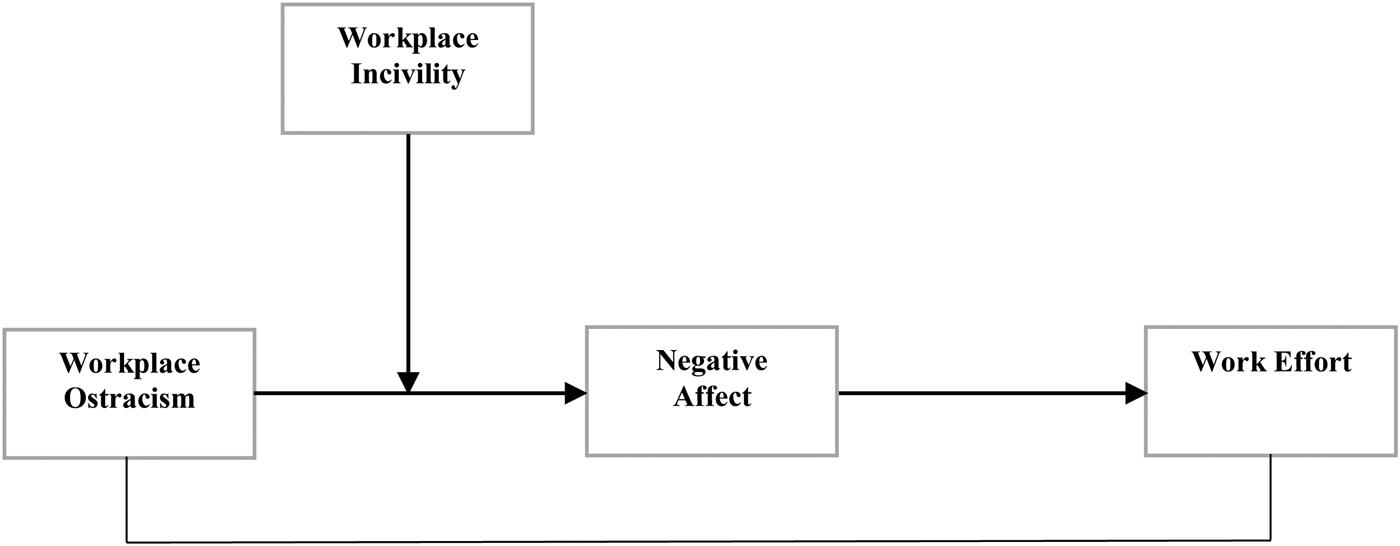
Drawing on the overarching models of AET (Weiss & Cropanzano, Reference Weiss, Cropanzano, Staw and Cummings1996) and workplace incivility spiral (Andersson & Pearson, Reference Andersson and Pearson1999), this study examines the connections between workplace ostracism, workplace incivility, NA, and work effort. Affective events (a wide range of positive and negative situations and experiences at workplaces), dispositions, and work behaviour are the main components in AET. It postulates that workplace events elicit affect, which then determines the nature and propensity of employees’ behaviour (Weiss & Cropanzano, Reference Weiss, Cropanzano, Staw and Cummings1996). Several studies attesting the interplay of AET's components exist, some of them (most relevant to this study's context) are summarized here. Scholars substantiate that interpersonal mistreatment at work (being a negative work event) devastates employees’ emotions, due to which, frustration, withdrawal, and job neglect behaviour occur (Van Yperen, Hagedoorn, Zweers, & Postma, Reference Van Yperen, Hagedoorn, Zweers and Postma2000; Barclay, Skarlicki, & Pugh, Reference Barclay, Skarlicki and Pugh2005). Likewise, the exposure to workplace bullying devastates employees’ emotional states, resulting into intentions to leave (Glasø, Vie, Holmdal, & Einarsen, Reference Glasø, Vie, Holmdal and Einarsen2010). Similarly, uncivil behaviour provoke negative emotions in employees, which in turn, adversely affect their work effort (Sakurai & Jex, Reference Sakurai and Jex2012). In sum, it may be asserted that workplace events can influence the proclivity of employees’ behavioural reactions because of their ability to affect emotions. In addition, based on the perspective that workplace incivility manifests into a social process that escalates negative emotional and behavioural responses (Andersson & Pearson, Reference Andersson and Pearson1999), we expect that workplace incivility will moderate ostracism's direct and indirect relationships with NA and work effort. The interplay of all constructs may be seen in Figure 1.
Research model

Workplace ostracism and work effort
Ostracism dates to ancient Greece, where the decision to banish a member of society considered ‘threat to the democracy’, was usually taken through a voting system where peer citizens cast their votes by writing down the name of ‘to be the exiled person’ on a piece of clay or pottery called ‘ostraca’. Votes were counted and for unfavourable results, the person was exiled from the city for a period of 10 years. This practice eventually gave rise to ‘ostracism’ (Williams, Reference Williams2001). Williams (Reference Williams2001) defined ostracism as, ‘the extent to which an individual perceives that he or she is ignored or excluded by others’ (as cited in Ferris et al., Reference Ferris, Brown, Berry and Lian2008: 1348). Neglecting others, shutting down conversations, and giving people a cold shoulder are some actions that reflect ostracism. Exclusion, abandonment, rejection, shunning, and being out of the loop are the other forms of ostracism (for full discussion see Robinson, O'Reilly, & Wang, Reference Robinson, O'Reilly and Wang2013). Ostracism is a commonly experienced phenomenon; results of a large survey conducted in the United States indicate that approximately 66% of the participants have experienced it (Fox and Stallworth, Reference Fox and Stallworth2005). However, contrary to other forms of interpersonal mistreatment at work, ostracism is passive (Hitlan, Cliffton, & DeSoto, Reference Hitlan, Cliffton and DeSoto2006a) and unique (Williams & Zadro, Reference Williams, Zadro and Leary2001) in nature. It may either be purposeful or nonpurposeful. Purposeful ostracism occurs when actors intentionally hurt others, while in nonpurposeful ostracism, actors unintentionally exhibit the actions that hurt others (Robinson, O'Reilly, & Wang, Reference Robinson, O'Reilly and Wang2013).
Despite its covert and subtle nature, ostracism has startling effects. At attitudinal level, ostracism adversely affects targets’: self-esteem (Ferris et al., Reference Ferris, Yan, Lim, Chen and Fatimah2016), emotions (Lustenberger & Jagacinski, Reference Lustenberger and Jagacinski2010; Williams & Nida, Reference Williams and Nida2011), well-being (Wu, Yim, Kwan, & Zhang, Reference Wu, Yim, Kwan and Zhang2012), commitment to the organization (Hitlan, Cliffton, & DeSoto, Reference Hitlan, Cliffton and DeSoto2006a, Hiltan et al. Reference Hitlan, Kelly, Schepman, Schneider and Zárate2006b; Ferris et al., Reference Ferris, Brown, Berry and Lian2008; O'Reilly et al., Reference O'Reilly, Robinson, Berdahl and Banki2014), turnover intentions (O'Reilly et al., Reference O'Reilly, Robinson, Berdahl and Banki2014), motivation (O'Reilly & Robinson, Reference O'Reilly and Robinson2009), and job satisfaction (Ferris et al., Reference Ferris, Brown, Berry and Lian2008; Fatima, Reference Fatima2016). While counterproductive work behaviour (Fatima, Reference Fatima2016; Ferris et al., Reference Ferris, Yan, Lim, Chen and Fatimah2016), aggression and uncooperativeness (Chow, Tiedens, & Govan, Reference Chow, Tiedens and Govan2008), withdrawal behaviour (O'Reilly & Robinson, Reference O'Reilly and Robinson2009; O'Reilly et al., Reference O'Reilly, Robinson, Berdahl and Banki2014), decreased job performance and extra-role behaviour (Ferris et al., Reference Ferris, Brown, Berry and Lian2008, Reference Ferris, Lian, Brown and Morrison2015; Lustenberger & Jagacinski, Reference Lustenberger and Jagacinski2010; Leung et al., Reference Leung, Wu, Chen and Young2011; Wu et al., Reference Wu, Liu, Kwan and Lee2016) are some adverse behavioural outcomes of ostracism.
Considering the extant evidence on outcomes of ostracism, one question that remains is, how being ostracized might affect work effort? Before proceeding to this discussion, let us first conceptualize ‘work effort’. As a construct, work effort has different conceptualizations across disciplines; however, from the perspective of I/O psychology, effort refers to ‘the constellation of attentional resources that people expend on their jobs’ (Yeo & Neal, Reference Yeo and Neal2004). These attentional resources are: direction, intensity, and persistence. Direction refers to ‘what a person does and with what frequency’, intensity denotes ‘how hard a person works’, while, persistence indicates ‘how long a person works’ (Kanfer, Reference Kanfer1990). Work effort, in contrast to in-role behaviour is purely discretionary, that is, going beyond the minimum and normal requirements of given roles (Morris, Reference Morris2009). This definition may confound work effort with the constructs like motivation and extra-role behaviour (organizational citizenship behaviour [OCB]). Therefore, it is necessary to distinguish this. Motivation is a psychological phenomenon that captures ‘employees’ willingness to expend efforts, while work effort is a ‘means’ through which motivation is translated into actions (Lloyd, Reference Lloyd2008). Hence, motivation is an attitude and work effort is a behaviour. Likewise, work effort also differs from OCB on the grounds that OCB embodies only those voluntary actions or tasks that are not part of one's job (Podsakoff, MacKenzie, Paine, & Bachrach, Reference Podsakoff, MacKenzie, Paine and Bachrach2000). Whereas, work effort may encompass characteristics of both the in-role (i.e., regular job tasks) and extra-role behaviour (Kmec & Gorman, Reference Kmec and Gorman2010: 5). In sum, work effort, in-role, and extra-role behaviour are different facets of a multidimensional construct called ‘performance’ (Lloyd, Reference Lloyd2008).
Given that ostracism negatively affects employees’ motivation (O'Reilly & Robinson, Reference O'Reilly and Robinson2009) and performance (Ferris et al., Reference Ferris, Brown, Berry and Lian2008, Reference Ferris, Lian, Brown and Morrison2015; Lustenberger & Jagacinski, Reference Lustenberger and Jagacinski2010; Leung et al., Reference Leung, Wu, Chen and Young2011; Wu et al., Reference Wu, Liu, Kwan and Lee2016), we expect a negative relationship between employees’ perceptions of being ostracized and their work effort, which as per De Cooman et al.'s (Reference De Cooman, De Gieter, Pepermans, Jegers and Van Acker2009) argument is situated between motivation (unobservable psychological phenomenon) and actual performance. In other words, motivation is translated into a measureable behaviour called effort that links it up with various work-related outcomes (e.g., performance). Keeping in view these connections and the facts that: (i) ostracism subverts motivation and that motivation determines work effort, and also that (ii) ostracism thwarts performance, it is logical to expect a negtaive relationship between ostracism and work effort. This negative relationship can also be based on AET's postulate that affective workplace events affect employee behaviour. The term affective workplace events in AET refers to a wide range of situations and experiences (both positive and negative) that employees may encounter in their respective workplaces. Positive events (e.g., supervisory support) follow positive outcomes (e.g., improved performance), while negative events yield the opposite (e.g., turnover) (Weiss & Cropanzano, Reference Weiss, Cropanzano, Staw and Cummings1996). Results of a recently conducted comparative study also confirm negative association between employees’ perceptions of being ostracized and work effort (Türkmen, Doğan, & Karaeminoğulları, Reference Türkmen, Doğan and Karaeminoğulları2016). Thus, it is plausible to expect that;
Hypothesis 1
Workplace ostracism will be negatively associated with work effort.
Workplace ostracism and NA
Neglect, exclusion, and cold treatments are common ‘practices’ across all social contexts, including work places (Fox & Stallworth, Reference Fox and Stallworth2005; Williams, Reference Williams2007). We intend to investigate how these feelings might affect dispositions and behaviour of academics and administrative staff at higher education institutions (HEIs). A common belief is that human beings are ‘emotional animals, which is why, they try to maintain quality relationships and avoid instances of exclusion and rejection’. The same notion was echoed by Weiss & Cropanzano (Reference Weiss, Cropanzano, Staw and Cummings1996) in AET, the foundation for several studies aimed at determining relationships between workplace events and employees’ emotions.
Before proceeding to developing arguments for the relationship between workplace ostracism and NA, let us conceptualize the latter. Affect, being an important variable of interest in the field of applied psychology and cross-cultural research (Diener, Oishi, and Lucas, Reference Diener, Oishi and Lucas2003), refers to a broad range of instinctual reactions (e.g., facial expressions, vocals, gestures) to some stimuli (Zajonc, Reference Zajonc1980). According to recent views, ‘affect’ is a psycho-physical construct comprising of three dimensions: (i) valence – the subjective evaluation of stimuli, (ii) arousal – a neurological function that stimulates response, and (iii) intensity of motivation – the impulsion to act (Harmon-Jones, Gable, & Price, Reference Harmon-Jones, Gable and Price2013). Universally, the structure of affect is divided into two broad categories of positive affect (PA) and NA (Almagor & Ben-Porath, Reference Almagor and Ben-Porath1989). PA captures one's subjective experiences of positive moods such as, happiness, joy, and contentment (Ashby, Isen, & Turken, Reference Ashby, Isen and Turken1999), whereas NA refers to one's aversive arousals or emotional states (Watson & Clark, Reference Watson and Clark1984). PA and NA are independent of each other. An individual can be high in both, low in one and high in the other, or low in both (Naragon-Gainey, Watson, & Markon, Reference Naragon-Gainey, Watson and Markon2009).
Drawing on AET's tenet that affective events induce affective responses (Weiss & Cropanzano, Reference Weiss, Cropanzano, Staw and Cummings1996), we expect that ostracism will induce NA. We assume this because ostracism being a painful, unsettling, and cognitively debilitating experience (Williams, Reference Williams2007; Robinson, O'Reilly, & Wang, Reference Robinson, O'Reilly and Wang2013) provokes a variety of negative emotional responses such as: anger (Chow, Tiedens, & Govan, Reference Chow, Tiedens and Govan2008; Dotan-Eliaz, Sommer, & Rubin, Reference Dotan-Eliaz, Sommer and Rubin2009), anxiety (Ferris et al., Reference Ferris, Yan, Lim, Chen and Fatimah2016), depression (O'Reilly & Robinson, Reference O'Reilly and Robinson2009), sadness (Buckley, Winkel, & Leary, Reference Buckley, Winkel and Leary2004), psychological distress (Wu et al., Reference Wu, Yim, Kwan and Zhang2012), emotional exhaustion (Jahanzeb & Fatima, Reference Jahanzeb and Fatima2017), and devastated moods (Gerber & Wheeler, Reference Gerber and Wheeler2009; Lustenberger & Jagacinski, Reference Lustenberger and Jagacinski2010; Williams & Nida, Reference Williams and Nida2011). A meta-analytic study based on a sample of 90 studies also reports positive correlations between negative events (e.g., mistreatment at work) and a wide array of negative emotions (anxiety and depression) (Bowling & Beehr, Reference Bowling and Beehr2006). Building on these conclusive evidences, we also expect that incidences of ostracism incite NA. Hence, we expect;
Hypothesis 2
Workplace ostracism will be positively associated with NA.
NA and work effort
Both dimensions of affect have been studied in various capacities (independent, dependent, mediating, moderating, and control variables) by previous researchers. This extant body of research concludes that affect governs attitudinal and behavioural responses of people towards their work. Since one of the aims of this study is to explore the relationship of NA and work effort, therefore we limit our discussion only to the relationship between NA and work effort. Scholars hold that negative emotions can increase one's disengagement from job duties (Van Yperen et al., Reference Van Yperen, Hagedoorn, Zweers and Postma2000), invoke withdrawal intentions (Brief & Weiss, Reference Brief and Weiss2002), and substantially reduce the levels of work effort (Sakurai & Jex, Reference Sakurai and Jex2012). Weiss and Cropanzano (Reference Weiss, Cropanzano, Staw and Cummings1996) in AET posit the same notion and note that ‘NA may deplete subjects’ attentional resources’ (e.g., energies). As already noted that work effort is a combination of attentional resources (Yeo & Neal, Reference Yeo and Neal2004) that negative emotions may deplete (Weiss & Cropanzano, Reference Weiss, Cropanzano, Staw and Cummings1996), therefore, expecting a negative association between negative affect and work effort is logical. Obviously, individuals under negative emotional states focus more on the issues underlying their negative affective states rather than their core tasks. Hence, we expect that;
Hypothesis 3
NA will be negatively associated with work effort.
NA as a mediator
Review of literature reveals dearth of research on how workplace ostracism takes its effects on other variables. Therefore, another question that this study addresses is, whether or not, NA serves as a mediating variable/mechanism in the relationship between workplace ostracism and work effort. Only few studies (Chow, Tiedens, & Govan, Reference Chow, Tiedens and Govan2008; DeWall, Twenge, Gitter, & Baumeister, Reference DeWall, Twenge, Gitter and Baumeister2009; Gerber & Wheeler, Reference Gerber and Wheeler2009; O'Reilly & Robinson, Reference O'Reilly and Robinson2009; Leung et al., Reference Leung, Wu, Chen and Young2011; Ferris et al., Reference Ferris, Lian, Brown and Morrison2015, Reference Ferris, Yan, Lim, Chen and Fatimah2016) have so far explored the underlying mechanisms to explicate the relationships between ostracism and its likely consequences. Building on AET's proposition that workplace events elicit emotions, which then determine the nature and propensity of employee behaviour (Weiss & Cropanzano, Reference Weiss, Cropanzano, Staw and Cummings1996), we expect NA to mediate the negative relationship of workplace ostracism and work effort. This assumption also receives support from the findings of previous research which states that: (i) affect is a significant determinant of work-related outcomes (Ng & Sorensen, Reference Ng and Sorensen2009), and that (ii) it serves as an underlying mechanism through which several variables take their effects on other variables (Barclay, Skarlicki, & Pugh, Reference Barclay, Skarlicki and Pugh2005; Miner, Glomb, & Hulin, Reference Miner, Glomb and Hulin2005; Glasø et al., Reference Glasø, Vie, Holmdal and Einarsen2010; Carlson, Kacmar, Zivnuska, Ferguson, & Whitten, Reference Carlson, Kacmar, Zivnuska, Ferguson and Whitten2011; Sakurai & Jex, Reference Sakurai and Jex2012). Based on the aforesaid theoretical and empirical findings, we postulate that being ostracized will make employees prone to negative dispositions that might encumber their contributions. Hence, we hypothesize;
Hypothesis 4
NA will mediate the negative relationship between workplace ostracism and work effort.
Workplace incivility as a moderator
Workplace incivility, being a form of mistreatment at work (Cortina, Magley, Williams, & Langhout, Reference Cortina, Magley, Williams and Langhout2001), has been defined as, ‘low-intensity deviant behavior with ambiguous intent to harm the target, in violation of workplace norms for mutual respect’ (Andersson & Pearson, Reference Andersson and Pearson1999: 457). Characteristically, uncivil behaviour are: (i) less intense, (ii) ambiguous in nature, and (iii) counter normative (Lim, Cortina, & Magley, Reference Lim, Cortina and Magley2008). Despite its low-intensity and ambiguous nature, incivility has noxious outcomes. For instance, it may decrease: job satisfaction and organizational commitment (Karim, Bibi, Rehman, & Khan, Reference Karim, Bibi, Rehman and Khan2015), work effort (Sakurai & Jex, Reference Sakurai and Jex2012), well-being (Pearson, Andersson, & Porath, Reference Pearson, Andersson, Porath, Fox and Spector2005), and productivity (Johnson & Indvik, Reference Johnson and Indvik2001), and may cause: job stress (Miner, Settles, Pratt-Hyatt, & Brady, Reference Miner, Settles, Pratt-Hyatt and Brady2012), turnover intentions (Lim, Cortina, & Magley, Reference Lim, Cortina and Magley2008), counterproductive work behaviour (Bibi, Karim, & Din, Reference Bibi, Karim and Din2013), and NA (Sakurai & Jex, Reference Sakurai and Jex2012).
Based on negative incivility spiral – the ability of uncivil behaviour to manifest as a social process spiraling into more intense negative emotional and behavioural responses (Andersson & Pearson, Reference Andersson and Pearson1999), we hypothesize that workplace incivility exacerbates ostracism's relationships with NA and work effort. Social process, in its literal meaning, refers to the general and recurrent social interactions between individuals. Such interactions (e.g., between co-workers, between subordinates and boss, and so on) are inescapable and complex phenomenon within organizations (Robinson, O'Reilly, & Wang, Reference Robinson, O'Reilly and Wang2013). Productive or positive social interactions symbolize a positive work environment (Reio & Wiswell, Reference Reio and Wiswell2000) where favourable job attitudes are fostered and performance is improved (Chiaburu & Harrison, Reference Chiaburu and Harrison2008). However, uncivil behaviour may intoxicate such environments (Pearson, Andersson, & Porath, Reference Pearson, Andersson, Porath, Fox and Spector2005). Therefore, incivility should not be taken as a minor issue because it can engender negative emotions and behaviour (Andersson & Pearson, Reference Andersson and Pearson1999), and reinforce the feelings of isolation (Vickers, Reference Vickers2006). Gillin Oore et al. (Reference Gilin Oore, Leblanc, Day, Leiter, Spence Laschinger, Price and Latimer2010) further this debate on deleterious effects of workplace incivility by testing the moderating effects of incivility in the stressors and strain relationships and conclude that incivility due to its pernicious attributes, accentuates the effects of work stressors on mental and physical health of targets. In the similar vein, we also expect the relationship of ostracism and NA to be stronger when incivility is high and vice versa. Therefore, we propose;
Hypothesis 5
Incivility will moderate the positive relationship between ostracism and NA such that this positive relationship will be stronger when incivility is high and weaker when incivility is low.
Having said that NA mediates the negative relationship between ostracism and work effort, and that workplace incivility moderates the positive relationship of ostracism and NA, we also expect workplace incivility to moderate the indirect relationship of ostracism and work effort. So, we posit,
Hypothesis 6
Incivility will moderate the indirect effects of ostracism and work effort such that the effects will be stronger when incivility is high and weaker when incivility is low.
Methods
Research context
Prior to discussing the details of our sample and procedure, it is important to explicate the context of this research. The population for the present study consisted of academics and administrative staff of three public sector HEIs in the capital city of Balochistan province in Pakistan. Despite the marked differences of job nature, tenure, and career paths between academics and administrative staff of HEIs, we considered including both in our sample on the following grounds. First, both perform their duties in the ‘same work system’ where all members hold common beliefs, values, and customs (organizational culture), and are hence part of a unique social and psychological environment similar for all organizational members regardless of their job nature and cadre. Second, we did not want to restrict the generalizability of this study's findings to merely one group, either academics or administrative staff. Hence, data were collected from both groups. Previous studies have also shown the academics and administrative staff of HEIs to be subjected to the experiences of ostracism (Zimmerman, Carter-Sowell, & Xu, Reference Zimmerman, Carter-Sowell and Xu2016; Jahanzeb & Fatima, Reference Jahanzeb and Fatima2018; Khair & Fatima, Reference Khair and Fatima2017) and workplace incivility (Bibi, Karim, & Din, Reference Bibi, Karim and Din2013; Karim et al., Reference Karim, Bibi, Rehman and Khan2015), hence justifying their suitability as study population.
Sample and procedure
Participants were approached at a single point of time (January to February, 2018) to complete a web-based survey distributed on their official and personal email addresses that we found on the websites/web portals of target HEIs. At present, five universities (four public sector and one private sector) operate in Quetta city. Out of four public sector universities, one is a subcampus of very small scale offering limited degree courses, and employs a few staff members whose details were not provided on the campus’ web portal. Given this information constraint, this subcampus was excluded from the list of target population. The only private sector university was also excluded from the list because of its organizational structure, work environment, work systems, profit orientation, and other dynamics (policies, workplace relationships, and scale) being entirely different from the large-scale public sector HEIs operating in the Quetta city. Remaining three large public sector universities were finalized as ‘target population’ for this study. The web portal of one of these universities was under construction and had limited information at the time of data collection; thus, determination of total number of target population, development of an accurate and exhaustive sample frame, and use of probability sampling method were all not possible. The available information was consolidated in the form of an email address list and was later used during the online survey.
After getting the face validity of our survey ascertained from senior professors (experts in the field), the competent authorities of selected universities were contacted and requested for necessary approvals and support. After the approvals, survey was administered. Our survey consisted of three sections: (i) introduction and informed consent, (ii) demographic variables, and (iii) the measurement scales. In section 1, all prospective respondents, along with an explanation on the purpose of this study, were instructed to rate survey items honestly. It was also explained in section 1 that there were no right or wrong answers, and that the respondents can rate all scale items to the best of their knowledge and abilities. These ex-antes were done to minimize the likelihood of common method, and social desirability biases (Podsakoff, MacKenzie, Lee, & Podsakoff, Reference Podsakoff, MacKenzie, Lee and Podsakoff2003). No additional information (respondents’ names, phone numbers, designations, name of the department and university, etc.) that could possibly reveal respondents’ identification was sought.
In total, 251 participants responded to our survey, satisfying the ‘sample size requirements’ for the use of confirmatory factor analysis (CFA), and structural equation modelling (SEM). The ‘n’ in this study being greater than the typical minimum (i.e., five cases per parameter, 5×37 = 185), and reasonably near to the ideal (10 cases per parameter) limits of commonly used ‘cases to parameters or N/K’ sample size criteria (Bentler, Reference Bentler1995), permitted us to run CFA. The ‘n’ in this study also adheres to the sample size guidelines for SEM as suggested by Hair, Black, Babin, and Anderson (Reference Hair, Black, Babin and Anderson2010). Based on the model complexity and basic measurement model characteristics, Hair et al. (Reference Hair, Black, Babin and Anderson2010) suggest a minimum sample of 100 for the models with: (i) five or fewer constructs, (ii) more than three measurement items of each construct, and (iii) high item communalities (≥.6).
Our sample comprised of 202 (80.5%) academics, and 49 (19.5%) administrative staff members. Out of 251, 175 (69.7%) were male, and 76 (30.3%) were female. Frequency distribution of age revealed that 28 (11.2%) participants were aged between 26 and 30 years, 94 (37.5%) were aged between 31 and 35 years, 84 (33.5%) were aged between 36 and 40 years, and 32 (12.7%) were aged between 41 and 45 years, while only 13 (5.2%) were in the age range of 46 years and above. Majority of the sample 120 (47.5%) had work experience of 6–10 years, followed by: 64 (25.5%), 47 (18.7%), 16 (6.4%), and 04 (1.6%) respondents in the work experience categories of 11–15, 5 and less, 16–20, and 21 and above years, respectively.
Multivariate test (MANOVA) indicated no significant differences in the perceptions of academics and administrative staff regarding workplace ostracism, workplace incivility, NA, and work effort (Pillai's Trace = .024, F (4, 246) = 1.524, p > .001, multivariate η2 = .196).
Measures
The constructs were measured using previously developed and validated scales that have already been used for research purposes in the cultural context of Pakistan (Fatima, Reference Fatima2016; Jahanzeb & Fatima, Reference Jahanzeb and Fatima2018; Khair & Fatima, Reference Khair and Fatima2017). Five response options followed all scale items except for the demographic variables (age, gender, job nature, and work experience).
Workplace ostracism
Respondents’ experiences of workplace ostracism were measured with a widely used 10-item scale developed and validated by Ferris et al. (Reference Ferris, Brown, Berry and Lian2008). The sample items included: ‘others ignored you at work’ and ‘others left the area when you entered’. The reliability coefficient for the 10 items was 0.95. CFA of workplace ostracism showed that all 10 items had an excellent fit with the unidimensional model (χ2 = 63.719, Degrees of Freedom [df] = 35, χ2/df = 1.821, Goodness of Fit Index [GFI] = .954, Normed Fit Index [NFI] = .971, Tucker–Lewis Index [TLI] = .983, Comparative Fit Index [CFI] = .987, Root Mean Square Error of Approximation [RMSEA] = .057) with factor loadings’ range of .742–.881. The range of items’ communalities was .60–.77.
Workplace incivility
The frequency with which respondents experienced incivility was measured with seven items Workplace Incivility Scale (WOS) (Cortina et al., Reference Cortina, Magley, Williams and Langhout2001). On a 5-point scale, respondents were asked to rate statements like, ‘Have you been in a situation where any of your co-workers/supervisors made demeaning or derogatory remarks about you?’ The reliability coefficient for the scale was .934. CFA of this scale revealed an excellent unidimensional model fit (χ2 = 27.039, df = 14, χ2/df = 1.931, GFI = .969, NFI = .979, TLI = .985, CFI = .990, RMSEA = .061), with factor loadings’ range of .791–.859. The communalities for the scale items ranged between .68 and .76.
Negative affect
Respondents’ propensity of NA was measured with the help of 10 items from the PANAS scale (Watson, Clark, & Tellegen, Reference Watson, Clark and Tellegen1988). These items consisted of adjectives (e.g., upset, distressed, jittery), which represented how respondents generally feel. The reliability coefficient of these items was .948. CFA of this scale showed an excellent unidimensional model fit (χ2 = 83.705, df = 35, χ2/df = 2.392, GFI = .935, NFI = .957, TLI = .967, CFI = .975, RMSEA = .075). The range of factor loadings and items’ communalities was .778–.843 and .80–.85, respectively.
Work effort
A multidimensional 10 items Work Effort Scale (WES) (De Cooman et al., Reference De Cooman, De Gieter, Pepermans, Jegers and Van Acker2009) was used to measure respondent's level of work effort. The subscales of WES were: persistence (three items), direction (three items), and intensity (four items). Respondents were asked to indicate the extent of their agreement/disagreement to the scale items such as, ‘I do my best to do what is expected of me’. Reliability coefficient of WES was .935. CFA of this scale showed a good model fit (χ2 = 85.996, df = 32, χ2/df = 2.687, GFI = .934, NFI = .961, TLI = .965, CFI = .975, RMSEA = .082), with factor loadings’ and items’ communalities range of .79–.94 and .63–.84, respectively.
Results
Measurement models
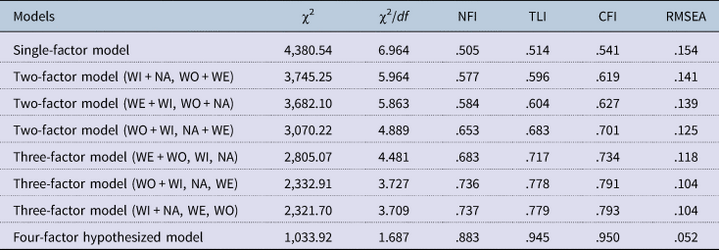
Before testing the hypotheses, series of confirmatory analyses were performed to assess, whether or not, the measures used were valid. Results of CFA revealed that the four factors hypothesized model best fitted the data when compared with seven alternate models, including a single-factor model where all variables were collapsed into one factor, three two-factor models where variables were collapsed into varying combinations of two factors, and the other models with different collapsing combinations of three factors (see Table 1).
Confirmatory factor analyses of the measures

WI, workplace incivility; NA, negative affect; WO, workplace ostracism; WE, work effort.
Descriptive statistics, validity, reliability, and common method bias
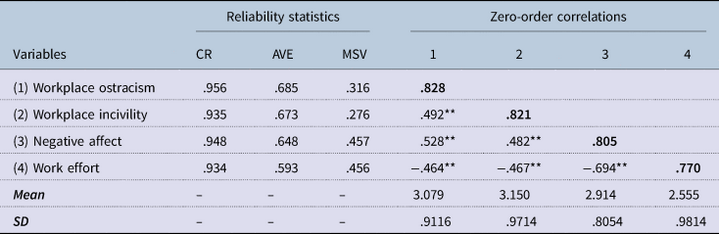
Table 2 presents descriptive statistics, validity, reliability, and correlation analyses. Composite reliability (CR) values of all constructs were >.70, indicating excellent internal consistency of scales used. Convergent and discriminant validity of scales were determined through Average Variance Extraction (AVE) and Maximum Shared Variance (MSV) methods, respectively. Commonly used rules of thumb to establish convergent and discriminant validity are: AVE >.50 and MSV <AVE, respectively. In our study, the AVE scores of all constructs were greater than the threshold value of 0.5, and all the MSV scores were also less than their corresponding AVE scores. Moreover, the interconstruct correlations were also smaller than the square root values of AVE (Table 2, values given diagonally in bold). These results sufficiently establish the convergent and discriminant validity of all constructs (Hair et al., Reference Hair, Black, Babin and Anderson2010).
Descriptive statistics, reliability, validity, and zero-order correlations

**p < .01.
Since the same measurement method (questionnaire) was used for all variables; therefore, the possibility of common method bias (CMB) cannot be ruled out. Exploratory factor analysis (EFA) and CFA were both run to detect CMB. The percentage of variance explained by a single factor was far less than the threshold value of 50% when all items were loaded onto a single factor during an unrotated single-factor solution in EFA. CFA results also indicated a poor model fit (χ2 = 4380.540, df = 629, χ2/df = 6.964, GFI = .330, NFI = .505, TLI = .514, CFI = .541, RMSEA = .154) when all items on the scale were forcedly loaded onto a single common factor (Harman's single-factor method, Podsakoff & Organ, Reference Podsakoff and Organ1986), implying that the interpretation of our results is not confounded by CMB. The bivariate correlations between focal constructs indicated positive relationships between: ostracism and NA (r = .528, p <.01), incivility and ostracism (r = .492, p < 0.01), NA and incivility (r = .482, p <.01), and negative relationships between: ostracism and work effort (r = −.464, p < .01), incivility and work effort (r = −.467, p < .01), and NA and work effort (r = −.694, p < .01).
Total, direct, indirect, and conditional indirect effects
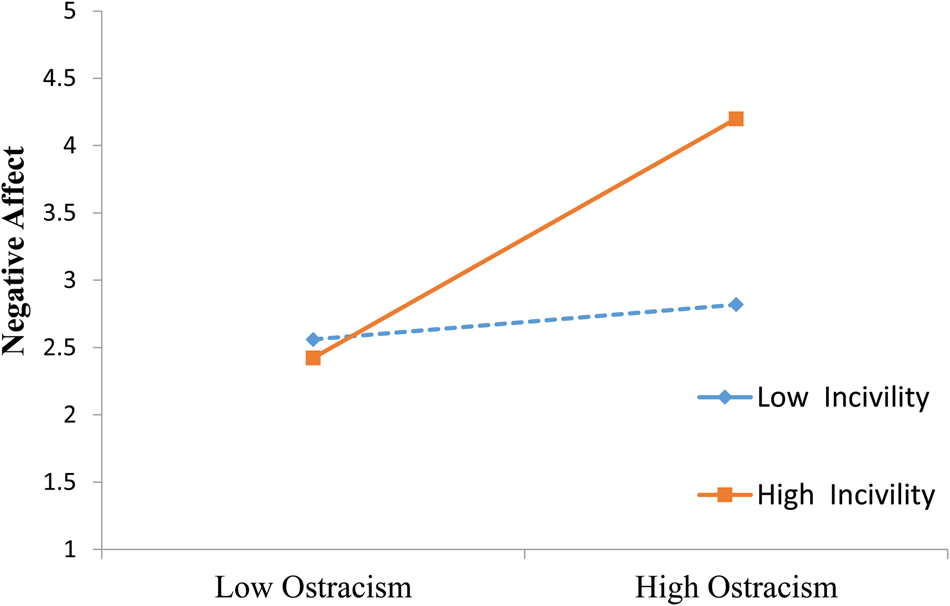
Hypotheses were tested via SEM technique. Total effects of ostracism on work effort (β = −.40, p < .001, LLCI = −.53, ULCI = −.255) and NA (β = .50, p < .001, LLCI = .377, ULCI = .637), in our structural model (χ2 = 1111.755, df = 646, χ2/df = 1.721, NFI = .88, TLI = .94, IFI = .94, CFI = .95, RMSEA = .054, PLOSE = .126) were significant, supporting Hypotheses 1 and 2. In line with Hypothesis 3, the direct effect of NA on work effort was also significant (β = −.63, p < .001, LLCI = −.748, ULCI = −.481). However, ostracism's direct effect on work effort (β = −.09, p > .05, LLCI = −.223, ULCI = .081), was insignificant, providing empirical support for the mediation hypothesis (Hypothesis 4). In Hypothesis 5, we posited about workplace incivility's possible moderating effect in the positive relationship between ostracism and NA. For this, both independent variables (i.e., ostracism and incivility) were mean centred and an interaction term was created (Cohen, Cohen, West, & Aiken, Reference Cohen, Cohen, West and Aiken2003). The effects of workplace incivility (β = .31, p < .001, LLCI = .160, ULCI = .448) and the interaction term (β = .38, p < .001, LLCI = .256, ULCI = .518) on NA were both significant, indicating significant moderating effect. Figure 2 elucidates this effect, showing that the positive effect of ostracism on NA was much stronger when incivility was high than when incivility was low, hence, supporting our claim (Hypothesis 5).
The moderating effect of workplace incivility on the relationship between workplace ostracism and negative affect

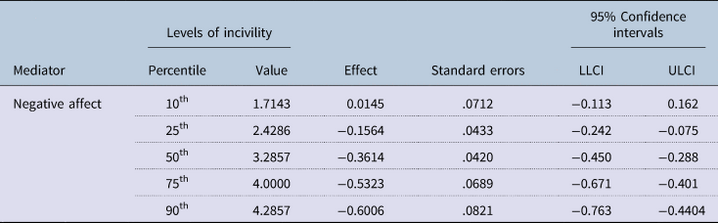
After establishing incivility's moderating effect, the conditional indirect effects of ostracism on work effort were tested via PROCESS MACRO (Hayes, Reference Hayes2013). Table 3 summarizes the conditional indirect effects of ostracism on work effort at different values (10th, 25th, 50th, 75th, and 90th percentiles) of incivility.
Conditional indirect effects of workplace ostracism on work effort at different levels of incivility

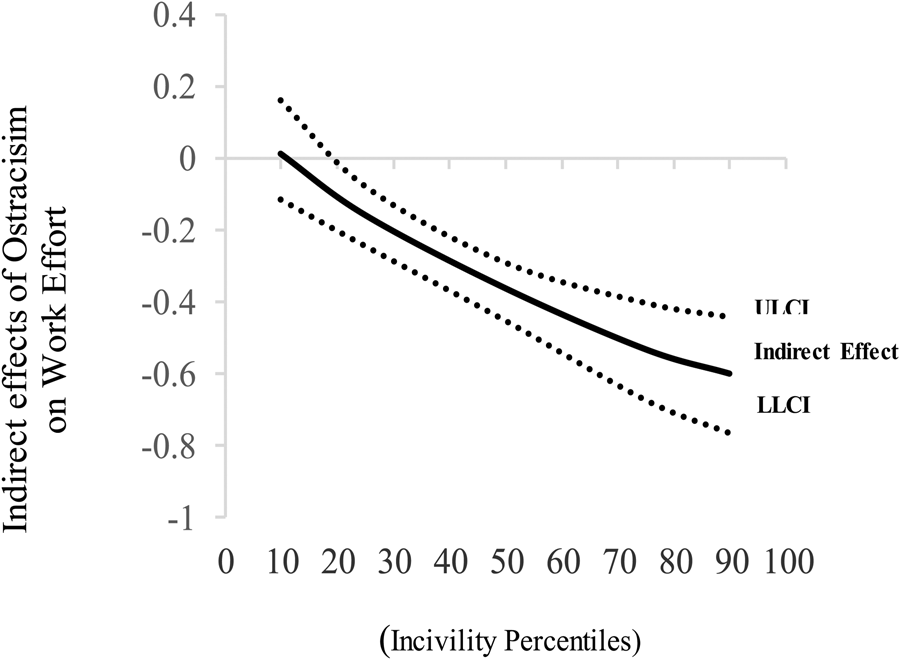
It is evident from the results (Table 3) that the indirect effects of ostracism on work effort are insignificant at a low level of the moderator (10th percentile), and significant at moderate and high levels of the moderator (25th, 50th, 75th, and 90th percentiles), demonstrating that ostracism's indirect effects on work effort via NA are contingent on high levels of workplace incivility. The graphical representation of these effects is shown in Figure 3. The index of moderated mediation was also statistically significant (Index = −.2392, SE = .0518) with nonzero confidence intervals (LLCI = −.345, ULCI = −.141), providing empirical support for Hypothesis 6.
Conditional indirect effects of workplace incivility; ULCI, upper level of 95% confidence interval; LLCI, lower level of 95% confidence interval

Discussion
Drawing on AET and negative incivility spiral, this study tested a conditional process model to demonstrate the interplay of workplace ostracism, workplace incivility, NA, and work effort. Results help us understand how work effort decreases when ostracism and incivility both prevail in the work places. Ostracism and incivility were both found negatively associated with work effort in this study. Although, incivility's negative relationship with work effort has been established previously (Sakurai & Jex, Reference Sakurai and Jex2012), but ostracism's negative association with work effort is worth discussing and a novel finding. Individuals spend a significant amount of time at work during which they frequently interact with other organizational members. Productive or positive social interactions at work symbolize a positive work environment (Reio & Wiswell, Reference Reio and Wiswell2000) where favourable job attitudes are fostered and performance is improved (Chiaburu & Harrison, Reference Chiaburu and Harrison2008). Whereas, poor interpersonal relationships at work (e.g., ostracism) can adversely affect both, the in-role and extra-role behaviour of employees (Chung, Reference Chung2015). We have already noted in the theoretical part of this article that in-role and extra-role behaviour and work effort share a lot in common (Lloyd, Reference Lloyd2008; De Cooman et al., Reference De Cooman, De Gieter, Pepermans, Jegers and Van Acker2009; Kmec & Gorman, Reference Kmec and Gorman2010), which is why, perhaps, the nature of association between ostracism and work effort is the same as of its association with in-role and extra-role behaviour.
Seemingly, all acts of ostracism appear small, but, in-fact, are emotionally and psychologically devastating experiences that could make employees feel run-down and depleted, the possible reasons of decreased work efforts. This finding is indeed similar to the results of previous studies that report negative associations between ostracism, employees’ attitudes, and behaviour (Hitlan et al., Reference Hitlan, Cliffton and DeSoto2006a, Reference Hitlan, Kelly, Schepman, Schneider and Zárate2006b; Ferris et al., Reference Ferris, Brown, Berry and Lian2008, Reference Ferris, Lian, Brown and Morrison2015, Reference Ferris, Yan, Lim, Chen and Fatimah2016; Lustenberger & Jagacinski, Reference Lustenberger and Jagacinski2010; Leung et al., Reference Leung, Wu, Chen and Young2011; O'Reilly et al., Reference O'Reilly, Robinson, Berdahl and Banki2014; Fatima, Reference Fatima2016; Wu et al., Reference Wu, Liu, Kwan and Lee2016), and is also congruent with AET's assumption that employees’ behavioural reactions are caused by the incidents that occur in workplaces (Weiss & Cropanzano, Reference Weiss, Cropanzano, Staw and Cummings1996). No substantial differences were found in the strength of relationships between ostracism and work effort (r = −.464), and incivility and work effort (r = −.467). The mean scores of both constructs being >3 on a 5-point scale is a clear indication of the unfortunate facts that both being commonplace phenomenon in HEIs – the supposedly cultured and friendly workplaces characterized by positive interactions, open communications, and a climate of mutual respect and trust – are not only affecting employees’ positive behaviour adversely, but also making the collectivist work culture of HEIs in Balochistan hostile.
We also hypothesized that one way that relates ostracism to work effort is through eliciting NA. In line with the findings of previous scholars (Gerber & Wheeler, Reference Gerber and Wheeler2009; Lustenberger & Jagacinski, Reference Lustenberger and Jagacinski2010; Williams & Nida, Reference Williams and Nida2011), a positive association was found between ostracism and NA, implying that negative events can cause negative emotions and poor self-concept. The strong negative association between NA and work effort (r = −.694) signifies the extent to which such aversive emotional states harm employees’ behaviour. The magnitude of NA's effects on employees’ work effort is even higher than the negative incidents at work (ostracism and incivility). Moreover, NA's complete intervention in the negative relationship between ostracism and work effort is another indicator of NA's ability to dominantly control the variations in employees’ behaviour caused by negative events. However, this finding is not very surprising because negative events have been found to be followed by negative emotions, an affective state that inhibits one's motivation towards subsequent tasks (Lustenberger & Jagacinski, Reference Lustenberger and Jagacinski2010). Hence, it is imperative for the sector managers to keep an eye on all the potential factors that provoke negative emotions among their staff. Our finding on mediating effects of NA is a significant addition to the body of research concerning the mechanisms through which ostracism takes its effects.
Another interesting and novel finding of this study is the moderating effect of workplace incivility. Studies addressing the question ‘when incivility results into unique outcomes’ are rare in the literature. To bridge this gap, we hypothesized that the direct and indirect relationships of workplace ostracism with NA and work effort, respectively, would be moderated by workplace incivility perceptions. Results supported this hypothesis and the aforementioned relationships were moderated by workplace incivility perceptions such that: (i) ostracism and NA's positive relationship was stronger when incivility was high and weaker when incivility was low, (ii) and that ostracism's indirect relationship with work effort via NA was also contingent on moderate and high levels of workplace incivility. More specifically, workplace incivility when coupled with ostracism exacerbates the emotional and behavioural reactions of the targets. Our findings regarding incivility's moderating effects affirm that uncivil behaviour spread and spiral into more severe behavioural outcomes, thereby constituting an incivility climate (Andersson & Pearson, Reference Andersson and Pearson1999).
Limitations and Future Research
Findings of this study should be interpreted in light of several limitations. First, despite appropriate theoretical ordering of our variables, the cross-sectional nature of our data limits the directionality and causality of proposed relationships. Longitudinal studies are therefore encouraged to: (i) support the direction of proposed relationships in this study, (ii) establish causality, and (iii) explore the change effects of study constructs over time. Second, though the theoretical tenets used in this study were applicable to our sample (Highhouse & Gillespie, Reference Highhouse, Gillespie, Lance and Vandenberg2009), yet our use of convenience sample may restrict the generalizability of findings of this study. Future researchers may address this issue by adopting more robust sampling techniques. Finally, in line with the recommendations of Podsakoff et al. (Reference Podsakoff, MacKenzie, Lee and Podsakoff2003), we took all precautionary measures, and performed necessary analyses (e.g., Harman's single-factor test) to rule out the possibility of CMB. Though, CMB was not found to be a serious methodological issue in our study, yet we recommend multisource and multitime data to preclude the likelihood of CMB.
Along with these limitations, this study offers several plausible directions for future research. ‘NA’ and ‘workplace incivility’ were the mediating and moderating variables in our research model, respectively, however, we recommend testing the same model with different mediating and moderating variables. Certain personality dispositions such as: self-compassion, self-efficacy, optimism, hope, and resilience (psychological capital) may be taken as potential moderators in the model. Self-compassion, being composed of three major components: self-kindness, common humanity, and mindfulness, enables individuals to subject oneself to self-pity during instances of inadequacy, hardship, and general suffering (Neff, Reference Neff2003). Self-compassionate individuals do not criticize or judge themselves mercilessly during painful experiences, instead, they tend to be gentle to themselves, and hence, cope with all such instances effectively (Neff, Reference Neff2003). To date, no prior research, to the best of our knowledge, has yet investigated the moderating role of self-compassion on ostracism and incivility's effects on negative outcomes. Likewise, research on how psychological capital – the constellation of four positive resources: self-efficacy, optimism, hope, and resilience (Luthans, Youssef, & Avolio, Reference Luthans, Youssef and Avolio2007) might moderate incivility's effects on the job/work-related attitudinal and behavioural outcomes is also scant. Psychological capital is a compensatory resource that helps mitigate the negative effects of the painful workplace experiences like ostracism (Zheng et al., Reference Zheng, Yang, Ngo, Liu and Jiao2016). However, how psychological capital buffers the negative effects of workplace incivility is still a missing part in both workplace incivility and psychological capital literature. Nevertheless, future researchers may explore these plausible research avenues. Keeping the attributes of both, self-compassion and psychological capital in view, we also recommend testing the buffering effects of these personal resources on mediator and outcome variables’ relationship (NA and work effort in our model). Such endeavours may add valuable insights to the framework of AET. Besides, we also recommend extending the scope of affective workplace events/experiences from negative to the positive. Effects of the variables like empowering leadership and perceived support on employees’ work effort, through the mediating mechanism of ‘affect’ may be ascertained in future studies. Though, the relationships of empowering leadership and perceived support with work effort have been established (Woo & Chelladurai, Reference Woo and Chelladurai2012; Amundsen & Martinsen, Reference Amundsen and Martinsen2015); however, the test of these relationships, through ‘affect’, still remains unexplored. We believe this interesting research avenue would produce useful insights for both the theory and practice. Cross-cultural studies are another logical avenue for future research. We drew our model on AET and incivility spiral (both developed in western context), and collected data from Pakistan (eastern context). More cross-cultural investigations can broaden the scope and applicability of both the models in culturally different contexts.
Implications for Practice
Incivility and ostracism are the growing problems in workplaces (Cortina et al., Reference Cortina, Magley, Williams and Langhout2001; Fox & Stallworth, Reference Fox and Stallworth2005; Williams, Reference Williams2007). Our findings show that both are costly for the HEIs. Failing to curtail the occurrence of uncivil behaviour at initial stages may disrupt work patterns, and cause other serious ramifications detrimental to workplace relationships, organizational climate, and repute of HEIs. The sector managers and leaders should therefore play active roles to curb the spread of such detrimental behaviour. Because, these behaviour, if left undealt, may embed into the stems of organizational culture and dominate it. Certain steps may, however, be taken to mitigate the effects of these behaviour. First and the foremost, we suggest that immediate supervisors of academics (departmental heads and deans), and administrative staff (directors for instance) at HEIs, should take time, energy, and sincere efforts to help their staff have positive interactions by modelling their own behaviour. Some basic pleasantries, such as answering the phone calls of subordinates pleasantly or greeting them with a smiling face on every encounter, can increase good feelings and improve workplace relationships. However, the company culture of ‘positive interactions’ may not solely be achieved through such pleasantries of immediate supervisors, but may require strategic thinking. The leaders and policy makers (vice chancellors in our context) should holistically look into, and examine the factors (policies, procedures, and even work structures) impeding the culture of positive interactions to prevail and take remedial actions accordingly. Developing and implementing a comprehensive policy on professional codes of conduct, work habits, and communication might help in this regard. Set policies of a similar kind, if any, may also be revisited and made more effective thereon. HRD professionals/practitioners in HEIs (e.g., director HRD) may also take part in this process and launch training programmes to improve: interpersonal communication, inclusiveness, and workplace relationships. Creating a supportive environment with a special focus on positive emotions and adaptation-related learning experiences (Reio & Ghosh, Reference Reio and Ghosh2009), launching diversity awareness training programmes (Pearson & Porath, Reference Pearson and Porath2005), and developing the social and political skills of employees (Ferris, Treadway, Perrewe, Brouer, Douglas, & Lux, Reference Ferris, Treadway, Perrewé, Brouer, Douglas and Lux2007) may also help mitigate incidents of incivility and ostracism.
Launching separate interventions for ostracism and incivility might appear troublesome for the policy makers and practitioners. However, they, by taking the advantage of certain similarities between both constructs (Ferris, Chen, & Lim, Reference Ferris, Chen and Lim2017), may deliberate overarching interventions to address both issues at the same time. As noted earlier that ostracism and incivility both violate organizational norm of ‘mutual respect’, therefore, training programmes on ‘mutual respect’ and ‘civil behaviours’ could be one of the best possible interventions. An intervention called ‘CREW’ – civility, respect, and engagement in the work force – has been found very effective in this regard (Leiter, Day, Oore, & Spence Laschinger, Reference Leiter, Day, Oore and Spence Laschinger2012). It is a 6-month long culture change initiative where facilitators hold regular meetings with selected work groups to encourage problem-solving behaviour and improve workplace relationships. The basic aim of such meetings is to help employees self-regulate their maladaptive tendencies through learning desirable attitudes (compassion, sensitivity, and honour) and behaviour (courtesy and consideration) to ensure an atmosphere of trust. Finally, sensitizing organizational members (faculty members and administrative staff) to the nature and severity of ostracism and incivility via conduct of organization wide briefing sessions is another possible intervention.
Conclusion
On the basis of these findings, this study concludes that workplace ostracism and workplace incivility carry serious repercussions for both the employees and the HEIs. We found that the occurrence of these subtle mistreatment behaviour in HEIs elicits negative emotions in employees, consequently, they feel run down and depleted, and hence, curtail their work effort. Both these situations may cause serious ramifications detrimental to HEIs. Negative emotional states of employees may make the work culture of HEIs hostile, and their tendency to expend less effort may affect the teaching, research, and administrative tasks. Hence, the occurrence and spread of such behaviour should be appropriately dealt so that a healthy and conducive work environment may prevail.
Author ORCIDs
Muhammad Adeel Anjum, 0000-0003-4668-5116; Ammarah Ahmed, 0000-0002-7160-9716.