Introduction
Indigenous crops from developing countries have at times moved rapidly from obscurity to become high-value exports to the USA and Europe. Some recent extraordinary cases include acai from Northeast Brazil, maca and quinoa from the high Andes, and shea from West Africa. Markets for these products have delivered higher incomes to producers, traders and processors in developing countries. Between 2005 and 2012, quinoa exports from Peru and Bolivia increased from 5000 to 40,256 MT in response to a sixfold increase in world quinoa prices (FAO, 2013), creating incentives for migrants, who had left the Andean region in search of better opportunities in major cities or the Amazon region, to return to quinoa farming (Effel, Reference Effel2012). Sustained high market prices for acai have motivated smallholders in Brazil to plant this palm on degraded forested lands and switch from timber harvesting to acai production (Fortini and Carter, Reference Fortini and Carter2014). In Peru, demand for maca, which had all but disappeared by the 1980s, skyrocketed during the mid-1990s, which led to windfall earnings for smallholders and the emergence of a local processing industry. The recent histories of acai, maca, quinoa and shea share two common elements: foreign buyers played a strong role in orienting the value chain toward high-value international markets and production and marketing was carried out locally long before the crop was sought by distant buyers and processors (Fold, Reference Fold2008; Colapinto, Reference Colapinto2011).
For each indigenous crop superstar, however, there are hundreds of wild or partially indigenous plants and trees that remain relatively unknown. An important development question is how to build value chains for lesser-known indigenous plants and trees that contribute to development goals in producing countries (e.g. strengthened rural livelihoods, improved health and nutrition, and economic growth). Throughout the Tropics, government agencies, NGOs and donors have implemented programs to support the production (e.g. tree domestication) and marketing (e.g. support to producer associations) of indigenous crops. Researchers have argued the potential income gains for rural households when wild plant and trees are domesticated and marketed (Leakey and Simons, Reference Leakey and Simons1998; Schreckenberg et al., Reference Schreckenberg, Awono, Degrande, Mbosso, Ndoye and Tchoundjeu2006). However, few studies have examined the building value chains for crops in the process of being domesticated and the implications of this effort for chain actors (e.g. smallholders and small-scale processors). There are reasons to be cautious about the ultimate impact of these interventions. The process of building value chains for lesser-known crops, including those in the process of being domesticated, must contend not only with bottlenecks in production and processing, and distribution but also with an especially challenging business environment, characterized by weak demand, limited private-sector investment, remoteness and chronic infrastructure deficiencies, non-tariff trade barriers and dispersed production.
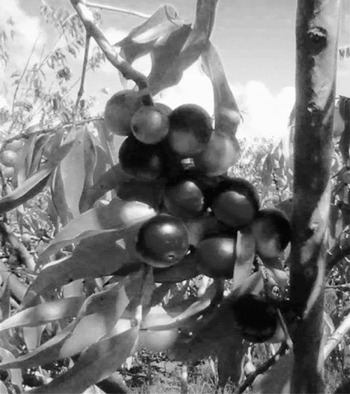
In this paper, we examine the opportunities and challenges that face chain actors and their supporters when trying to build a value chain from the bottom up for a fruit in the process of being domesticated. Our analysis involves the construction of a value chain by government actors, NGOs, businesses and producers for camu–camu (Myrciaria dubia: Myrtaceae) – a small tree fruit native to the western Amazon. It is grown mainly along the banks of the Napo, Nanay, Ucayali, Marañon and Tigre Rivers across the Loreto and Ucayali Departments (Fig. 1) (Dostert et al., Reference Dostert, Roque, Brokamp, Cano, La Torre and Weigend2009). The tree bears a fruit, diameter of 1–3 cm, which in its mature state has a reddish-brown to dark purple color and has a soft fleshy pulp covering 2–3 seeds (Fig. 2). The camu–camu pulp is the richest source of natural vitamin C among all known fruits (2780 mg of vitamin per 100 grams of pulp), 32 times higher than vitamin C levels found in lemons (Bradfield and Roca, Reference Bradfield and Roca1965; Justi et al., Reference Justi, Visentainer, de Souza and Matushita2000). It is also considered to possess strong antioxidative and anti-inflammatory properties (Inoue et al., Reference Inoue, Komoda, Uchida and Node2008; Chirinos et al., Reference Chirinos, Galarza, Betalleluz-Pallardel, Pedreschi and Campos2010). Researchers have mentioned camu-camu consumption for addressing influenza, rheumatism, diabetes mellitus and several other diseases, especially when ingested as fresh juice (Brack, Reference Brack1999; Pinedo and Armas, Reference Pinedo and Armas2007).
Map of Loreto and Ucayali Regions in Peru.

Camu-camu fruit.

Prior to the late 1990s, camu-camu could only be found in the wild, growing in dense strands along riverbanks, and human consumption was limited outside of Iquitos, the capital of Loreto Department. Over the past 15 years, local stakeholders have attempted to build the camu-camu value chain where none had existed before—from finding new market outlets and bringing wild camu-camu into smallholder production systems to acquiring the infrastructure needed for transportation, storage and processing. The private sector has invested an estimated USD 3.5M in the processing and marketing of camu-camu (UNEP, 2012). Camu-camu has the potential to become an indigenous fruit superstar—this paper looks at why this has not yet happened and the challenges ahead, even with dramatically improved market conditions.
Section ‘Research design’ presents the methods used in carrying out this research. The next three sections present results derived from secondary information sources and primary data in Peru: Section ‘Emergence of the camu-camu value chain’ discusses how government agencies and NGOs supported the building of the camu-camu value chain; Section ‘Processing and commercialization of the camu-camu’ examines the development of the camu-camu value chain from the perspective of buyers and processors; and Section ‘Camu-camu producing households’ looks at the camu-camu value chain from the perspective of rural households. Section ‘Camu-camu: a partial success story’ discusses the results and their implications for the design of future interventions to support the camu-camu value chain. The final section provides a summary of the lessons learned.
Research design
Our review of experiences in the organization and development of the camu-camu value chain draws heavily on the extensive gray literature by NGOs and government agencies working in Peru. The literature covers in some detail the interventions carried out to encourage smallholder production and local processing of camu-camu. While the existing literature includes some discussion of camu-camu grown in both Ucayali and Loreto Departments, it provides considerably more discussion on experiences in Loreto, despite Ucayali being the center of camu-camu production for sale outside of the Amazon region. But because high transportation costs between Loreto and the rest of Peru tend to limit consumption of its camu-camu beyond local markets, our study focuses mainly on camu-camu production in Ucayali.
Household-level data collection focused on smallholders in Ucayali and was carried out in two phases. The first phase sought to identify all camu-camu farming households from five of Ucayali's 15 main camu-camu producing villages. The villages were chosen along a gradient in terms of distance (close-far) to Pucallpa—the main collection point for camu-camu heading to Lima. A total of 184 farming households were identified in the selected villages. These households participated in a short survey that collected information on household characteristics, agronomic practices and production and marketing history.
Having identified the population of camu-camu farming households in the selected villages, 53 in-depth, structured interviews were carried out in a second phase of data collection. These interviews engaged the head of the household in single headed households or the principal adult couple in jointly headed households in September and October 2014 (8–12 households from each of the selected villages). The households were chosen to include men and women engaged in camu-camu production, different age groups, households with different farm sizes and livelihood strategies. The interviews covered production and agronomic practices, access to technical assistance and credit, participation in producer associations, market access, income sources, gender roles and perceptions about benefits of participating in the camu-camu value chain.
Key informant interviews completed the information gathered from rural households. Extensionists with the regional agricultural ministry and Pucallpa-based researchers, both of whom played a key role in the early promotion of camu-camu in Ucayali were also interviewed. Representatives from seven camu-camu processors were also interviewed: two from large national firms in Lima, another with processing facilities in Ucayali and commercial offices in Lima, plus four processors located in the Ucayali region.
Emergence of the camu-camu value chain
Interventions to expand camu-camu production
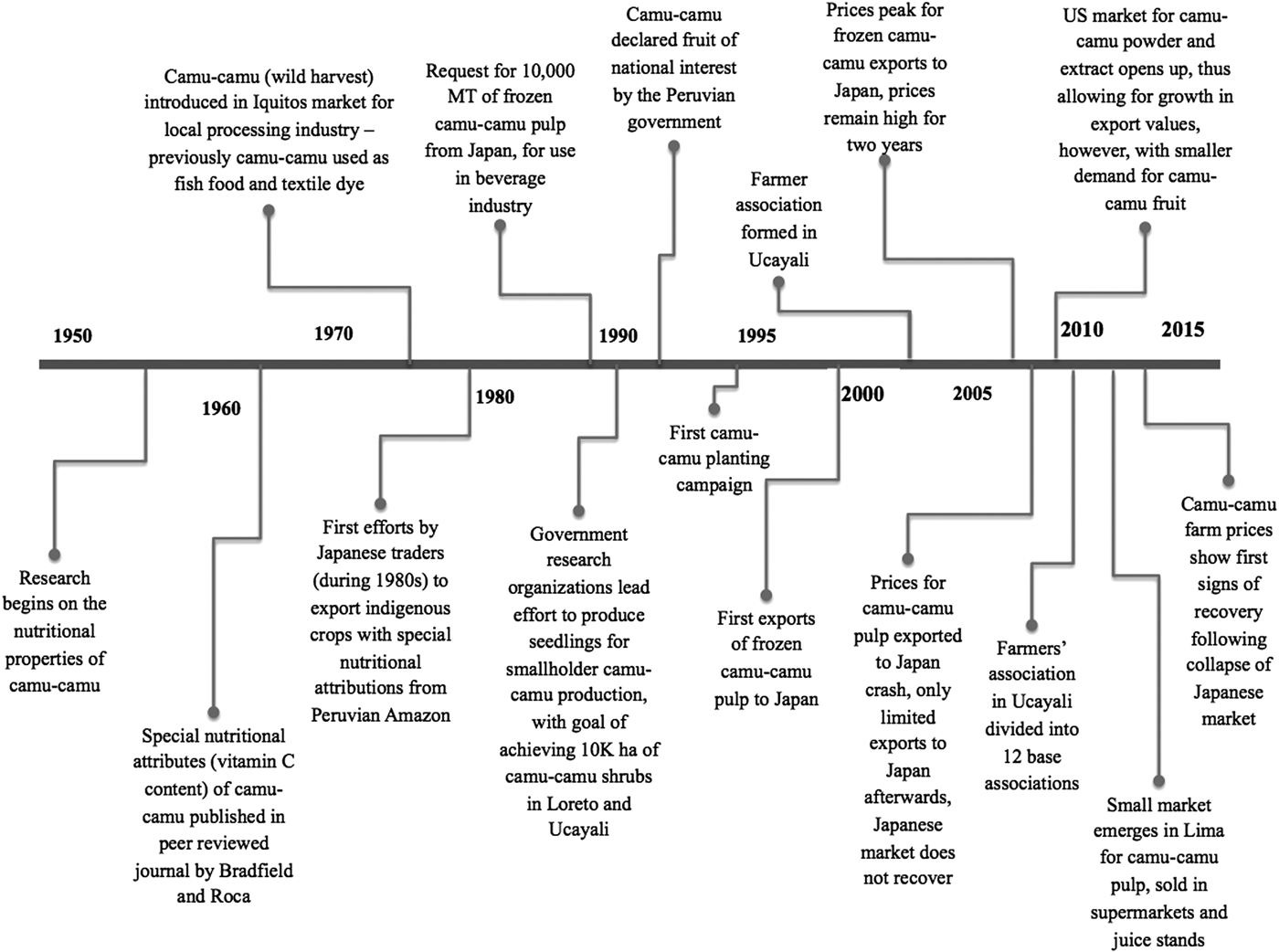
Figure 3 traces the history of camu-camu production and marketing in Peru and the related interventions to build the chains over the past 60 years. Initial interest in camu-camu by government research organizations and some private firms in Peru grew during the 1950s because of its extremely high concentration of vitamin C. In addition, camu-camu fruit has an acidic, citrus taste that blends well with various fruits. Prior to the 1970s, humans did not consume much camu-camu; the fruit was used mainly as fish food and a textile dye (Penn, Reference Penn2004). In the early 1970s, wild-harvest camu-camu from Loreto entered the nearby Iquitos market as an ingredient in locally consumed beverages, popsicles and sweets; however, consumption remained concentrated in Iquitos, with limited penetration of markets in other provincial cities or in Lima.
Key events in building the camu-camu value chain in Peru.

In the 1990s, two factors converged to carry camu-camu production and consumption beyond Loreto: the identification and development of a sizable market for Peruvian frozen camu-camu pulp in Japan (a result of government-based efforts to promote Peruvian agricultural products abroad) and a major Peruvian government program to promote camu-camu cultivation. In response to the new demand from Japan, government agencies developed an ambitious strategy for expanding camu-camu, the National Program on Camu-Camu. The program had the initial aim of establishing 10,000 ha of new camu-camu plantations, for which it provided incentives to the private sector (camu-camu concessions) and funding for NGOs (in collaboration with major bilateral donors such as GIZ and USAID) for expansion by smallholders (GTZ, 2000; MINAGRI, 2000). Underlying the program was the realization that wild sources of camu-camu were insufficient to meet the export volumes requested by Japanese buyers. Therefore, the most important component of the program was to produce camu-camu seedlings and provide technical assistance to producers for establishing and maintaining camu-camu plantations. The seeds for producing the seedlings were gathered from wild camu-camu stands. The mixing of seeds at processing plants and their redistribution to producers has probably ensured a high degree of variability and possibly higher resistance to pests and diseases, but no form of genetic selection was carried out (Penn, Reference Penn2006). As production and the market began to expand, camu-camu was perceived to provide a catalyst for local economic development; it was declared a fruit of national interest in 1999, providing official government policy emphasis to support production and marketing of the crop (IIAP, n. d.).
Beginning in the mid-1990s, government agencies and NGOs targeted smallholder riverine households, particularly in Ucayali, for camu-camu expansion. The riverine (ribereño) population is a mixed population of long-settled migrants with people of local indigenous origin. The floodplains where these households farm tend to have more fertile soils, as a result of occasional deposits of nutrient-rich sediments by flooding rivers during the rainy season. Agronomists have encouraged the development of agriculture along river margins, given that locally important crops (e.g. cereals and legumes) may grow better in riparian soils than on less-fertile upland soils (McClain and Cossio, Reference McClain and Cossio2003). Artisanal floodplain fisheries are an important safety net for poor households living along rivers in humid tropical environments: riverine households may turn more to the floodplain (to fish) than to the rain forest (to hunt or extract forest products) to cope with major shocks (Coomes et al., Reference Coomes, Takasaki, Abizaid and Barham2010). The expansion of camu-camu has offered an opportunity to exploit the arable properties of riparian areas while providing some of the benefits associated with riparian forests, such as preventing water contamination and providing habitat and resources for living resources in rivers.
Little is known about the impacts of camu-camu expansion on the environment or on rural livelihoods. In Loreto, Penn (Reference Penn2004) found that households who adopted camu-camu tended to depend heavily on on-farm income and planted camu-camu in hopes of increasing their earnings. Establishing camu-camu plantations required considerable investment in labor (e.g. periodic weeding and pruning), which probably constrained the ability of many households to effectively maintain camu-camu. Another factor that influenced its adoption was the distance from homes to fields. Camu-camu plantations were often far from homes; households with distant plantations faced greater difficulty in transporting the harvest and increased exposure to theft. Penn (Reference Penn2006) found that by 2004, only a small number of producers in Loreto were actually cultivating the fruit. This was attributed to the lack of extension support, high opportunity costs for use of riverine lands, high transportation costs and chronic shortages of local labor for weeding and pruning.
While on farm production of camu-camu has yet to take off in Loreto, many farmers in Ucayali have planted it. Although the exact number of producers is unknown, the Ministry of Agriculture estimates there were 369 producers who were members of camu-camu production associations in 2012, with many others who did not belong to an association. From a relatively unknown crop in the early 1990s, camu-camu is now produced on more than 700 ha, according to the regional agricultural ministry representatives in Ucayali, with an additional 300 ha either abandoned or recently planted (DRAU, 2012; Gonzalez, Reference Gonzalez2014). This regional difference stems from Ucayali's closer proximity to Lima and from governmental entities, processors, universities and NGOs in Ucayali that saw an opportunity and devoted more resources to camu-camu value chain development (VCD). With a viable market, households in Ucayali were more receptive to planting this crop than in Loreto.
In addition to promoting the planting of camu-camu, the regional government of Ucayali, in collaboration with the Ministry of Agriculture, played a protagonist role in establishing a large, second-tier camu-camu farmer association in 2002, which included all producers in Ucayali. During the camu-camu boom of the mid-2000s, producers were encouraged to establish 12 first-tier associations in the main camu-camu producing communities. Institutions involved in promoting camu-camu believed that the formation of strong producer associations would facilitate the work of extensionists and provide marketing leverage for producers with camu-camu buyers. The regional governmental support was also vital in organizing the camu-camu roundtable in 2007, which aimed to identify collaborative solutions to bottlenecks in the chain and coordinate efforts to increase camu-camu quality. However, it stopped meeting in 2012, as many roundtable members became discouraged by inconsistent attendance of government agencies, whose representatives had little decision-making authority in their institutions, and several years of relatively low camu-camu prices (Gonzalez, Reference Gonzalez2014).
Processing and commercialization of camu-camu
An estimated 51 camu-camu processors operate in Peru (EU-Peru, 2009). Most are based in Lima, where conditions allow for better control over quality aspects of processing and storage. The exact number of camu-camu processors in Lima is unknown, as many food processing business frequently enter and leave the camu-camu market depending on prices and demand for the products (Gonzalez, Reference Gonzalez2014). There are few processing plants in camu-camu production areas (nine small-scale plants in Ucayali and four similar plants in Loreto, two of which are operated by government agencies). The camu-camu processors produce two main products: frozen camu-camu pulp, originally for export and now mainly for domestic consumption, and camu-camu powder—a nutritional supplement, sold either as atomized powder or freeze-dried abstract. Despite the potential to process camu-camu into various types of drinks, sweets, and other processed products, the industry remains focused on these two semiprocessed products. In the early days of camu-camu exports, a major Peruvian-owned beer maker exported camu-camu juice to Japan. However, exports of juice only lasted a few years, perhaps because Japanese processors quickly learned to produce their own juice in accordance with local tastes.
Interviews highlighted two major concerns related to buyers’ relations with smallholder camu-camu growers. First was the lack of uniformity of the fruit, due to both genetic and non-genetic reasons. Government agencies that support camu-camu production have yet to develop uniform varieties of camu-camu. Regeneration by seed leads to genetic variability, so fruits have a variety of sizes and different chemical characteristics, especially in vitamin C levels. Only in 2010 did the National Institute of Agrarian Innovation (INIA, Spanish acronym) and the Peruvian Amazon Research Institute (IIAP, Spanish acronym)—the two Peruvian public institutions involved in agricultural and agro-industrial research in the Amazon region—succeed in developing improved camu-camu varieties with consistent fruit production (Perez, Reference Perez2014). In the view of many processors, the fruits would also be more uniform if smallholders would implement the recommended best practices in harvest and selection.
The second concern of processors was the high transaction costs of purchasing camu-camu from individual producers rather than from cooperatives and producer associations at a single purchasing point. Distances between camu-camu producers can be considerable, with many farms reachable only by river in the rainy season, during the largest harvest. However, as described in the previous section, households in communities producing camu-camu have shown limited social cohesion and trust and lack the external support needed to build strong cooperatives.
An additional challenge from the buyer/processor perspective is the lack of infrastructure to process the fruit. In particular, the lack of refrigeration capacity in Ucayali has limited the processors’ ability to store camu-camu and decrease exposure to price fluctuations (Baez, Reference Baez2014). Even in cases where camu-camu is processed into powders or other dry forms, it must first be transformed into frozen pulp, which has to be refrigerated until shipped or processed. Ideally, the processors would be able to store camu-camu pulp or fruit from peak harvest times in order to process the product throughout the year or for the producers to store the crop when harvest prices are low to sell for higher prices in the off season.
For many exporters, engagement with smallholders for access to a steady supply of quality camu-camu has been a challenge from the start. In a business environment where transaction costs are high, processors can be expected to seek options to vertically integrate their production (Williamson, Reference Williamson2005). In fact, there are signs that the camu-camu value chain in Peru is becoming more vertically integrated, which could have important negative consequences for smallholder producers. In 2014, a Japanese entrepreneur established a processing plant in Ucayali to control quality along the chain and meet the continued Japanese demand. This increased competition from Japanese firms has helped to raise prices in 2014 (Jun Reference Jun2014). Another large local camu-camu processor has begun to vertically integrate by growing camu-camu on its own private fields, permitting increased control over fruit quality and reduced transaction costs for obtaining raw material, but cutting smallholders out of the market (Gonzalez, Reference Gonzalez2014).
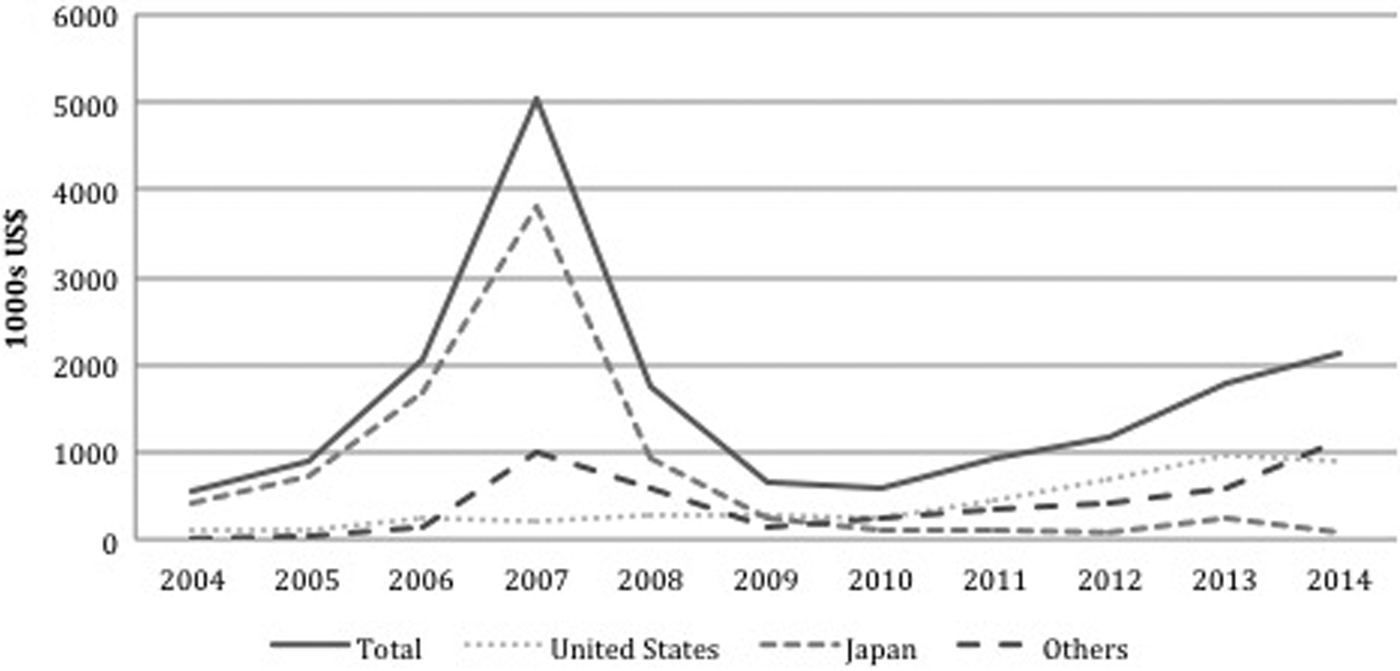
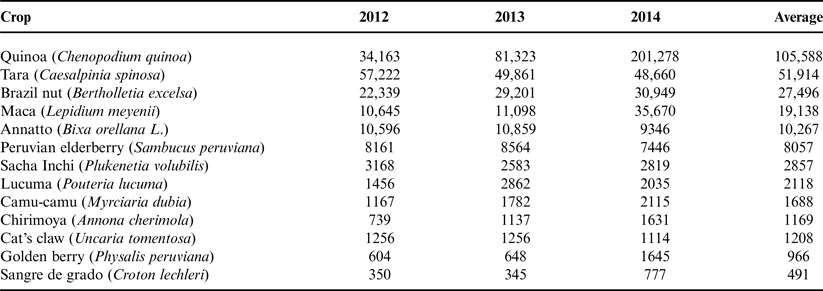
A major challenge facing Peru-based buyers and processors has been the rapidly changing consumer demand for products derived from camu-camu fruit. Figure 4 shows the value of camu-camu exports over time; the value increased rapidly between 2004 and 2007, reaching a high of USD 5.2M in 2007. During this period, frozen camu-camu pulp to Japan dominated camu-camu exports. Following 2007, however, the value of camu-camu exports fell precipitously—bottoming out at approximately USD 600,000 in 2010, only 11.4% of the value exported in 2007. Despite camu-camu having been declared a fruit of natural interest, its export values following the crash are surprisingly small relative to other indigenous crops in Peru (Table 1).
Camu-camu exports (1000s USD), 2004–2014, by destination. Source: PROMPERU 2015.

Little is known about the underlying reasons for the collapse of the Japanese market for frozen camu-camu pulp. Key informant interviews in Ucayali pointed to concerns of Japanese camu-camu importers about food safety and quality control: as the price for camu-camu skyrocketed in 2007–2008, producers and processors in Peru frantically tried to fill containers without proper attention to the strict requirements of Japanese importers. Processors, especially Peru-based processors, made false marketing claims, for example claiming a high natural vitamin C content when, in fact, the vitamin C was artificial (ascorbic acid). Vitamin C content is highly susceptibility to heat, time in storage, processing techniques and other factors, and since importers had strict requirements for vitamin C content, a strong incentive to cheat arose. Thus, some camu-camu that arrived in international markets was spoiled or otherwise did not meet stringent international standards (Baez, Reference Baez2014; Gonzalez, Reference Gonzalez2014, Jun, Reference Jun2014; Perez, Reference Perez2014).
However, other factors may also explain the sharp decline in the export market for camu-camu pulp. The global economic recession that began in 2008, combined with the challenges of building a sizable market for a new and exotic product, may have pushed Japanese firms away from camu-camu. The lack of discussion in the extensive gray literature about factors that led to the collapse of the Japanese market may be indicative of an overall lack of awareness of foreign camu-camu markets and the processes by which importers, processors and retailers work to build a market for a new product in highly competitive market segments. In addition, the price of camu-camu pulp in Japan and elsewhere may have been influenced not only by conditions within the camu-camu market but also by the price of other fruits with similar flavor profiles and high vitamin C content, such as acerola and sweetbriar rose (IIAP, 2001).
Peruvian exports of indigenous crops and NTFPs, 2012–2014 (1000s USD).

Source: Authors’ calculations, based on data from PROMPERU 2015.
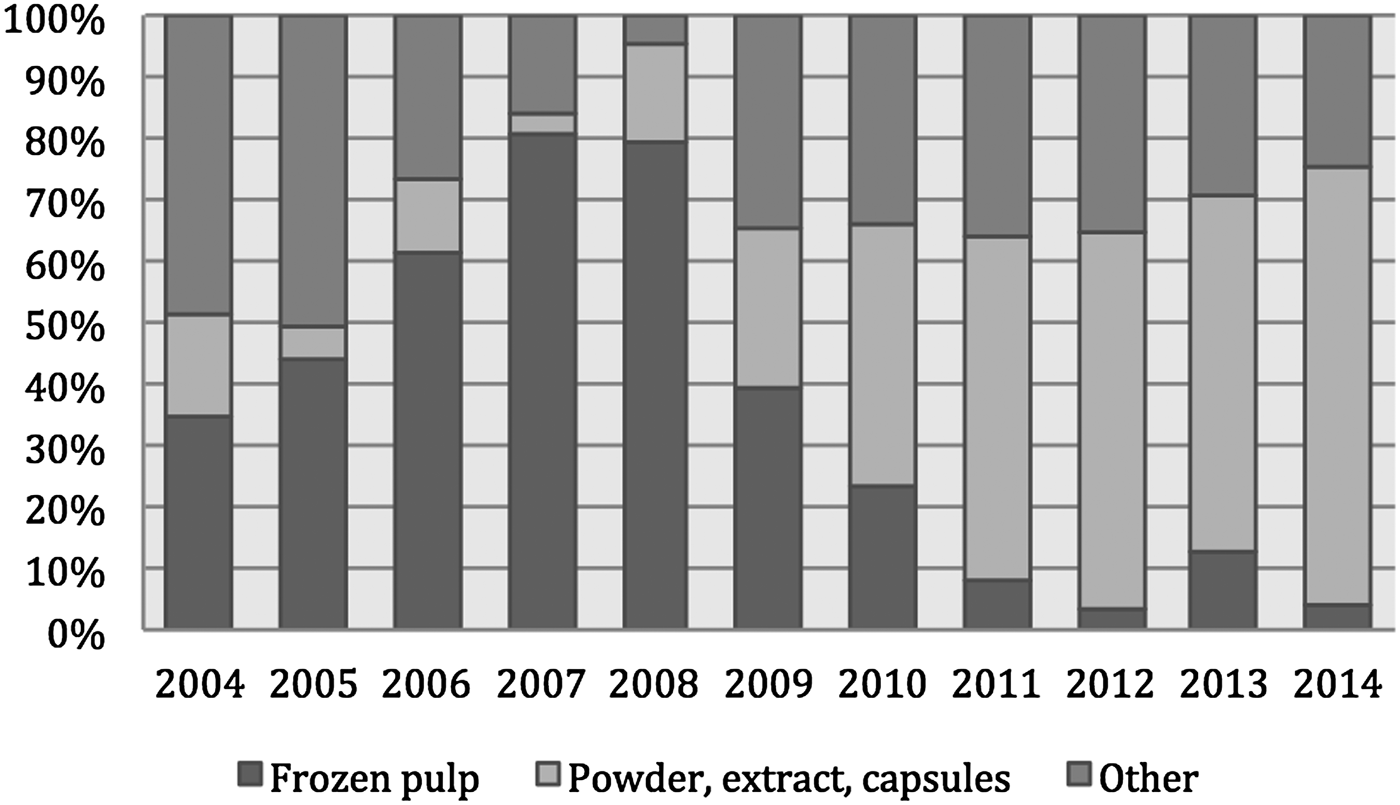
After 2007, with the loss of the Japanese market, frozen camu-camu pulp from Ucayali was sent to Lima, Peru, where demand for it was limited and concentrated among a few supermarkets and fresh juice stands (Paino and Donovan, Reference Paino and Donovan2012). As the export market for camu-camu pulp began to fade, however, a new market for camu-camu opened up. The expansion of the nutritional supplement market for camu-camu in the USA resuscitated the camu-camu sector in Peru (Fig. 5). In 2011, camu-camu exports partially rebounded in terms of value, reaching USD 2.1M in 2014 (PROMPERU, 2015). It is unclear what the shift from frozen pulp to powders for the nutritional supplement market means for the demand for camu-camu berries. The volume of fresh camu-camu berries required to produce 1 kg of powder and extract is significantly more than the volume needed to produce pulp. However, all the export data provided by the Peruvian government lists estimate for the value of camu-camu exports not volumes.
Peru has been unsuccessful in overcoming barriers to camu-camu entry into markets in the European Union (EU). Its Novel Food Regulation (NFR) (EC No 258/97) prohibits the importation of foods, like camu-camu, which do not have a proven safety record and that had not existed in the EU market before 1997. In general, the costs, complexity, length and uncertain outcomes of NFR procedures have led to uncertainties about the likelihood of successful applications and discouraged firms from filing applications (Hermann, Reference Hermann, Fanzo, Hunter, Borelli and Mattei2013). The costs associated with the documentation and studies needed to assess the safety of a product and comply with NFR procedures are high, perhaps as high as USD 400,000 (UNEP, Reference Coomes, Takasaki, Abizaid and Barham2012) or about 20% of the total value of camu-camu exports in 2014. Camu-camu has no chance to enter EU markets without extensive data that would allow a stringent food safety assessment. Government agencies in Peru have been unable to compile the available knowledge and identify gaps to facilitate compliance with NFP, either in collaboration with the private sector in Peru, with other producing countries, or with EU-based importers. Peru has argued before the WTO to allow camu-camu and other indigenous crops to enter the EU without the burden of having to prove that the product is safe (WTO, 2011). The EU is currently developing a new policy to ease the restriction on novel foods that have been consumed over an extended time in the country of origin (UNCTAD, 2014).
Share of the total export value by camu-camu product type, 2004–2015. Source: PROMPERU 2015.

Camu-camu producing households
Household characteristics
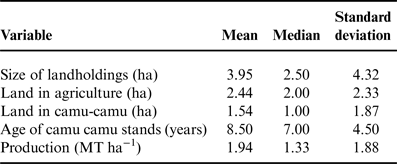
Data from phase 2 interviews reveal that most households had few productive assets and were relatively poor. Only 27% owned a refrigerator—a recognized mark of high income and social status in the region. Nearly all households owned a clapboard house, many with a thatched roof (34%) and a dirt floor (21%). Most of the adults in the households had a limited education: 33% had not obtained a primary education and <20% graduated from high school. The average farm size was 4.0 ha, but total landholdings were quite variable between households, with a standard deviation of 4.3 (Table 2). The households dedicated slightly more than 1.5 ha to camu-camu production, a little less than half of their landholdings and most of the area under agricultural production. The average camu-camu shrubs are about 8 years old and are in full production (camu-camu starts to bear fruit at 5 years).
Characteristics of camu-camu farms in Ucayali.

Importance for livelihoods
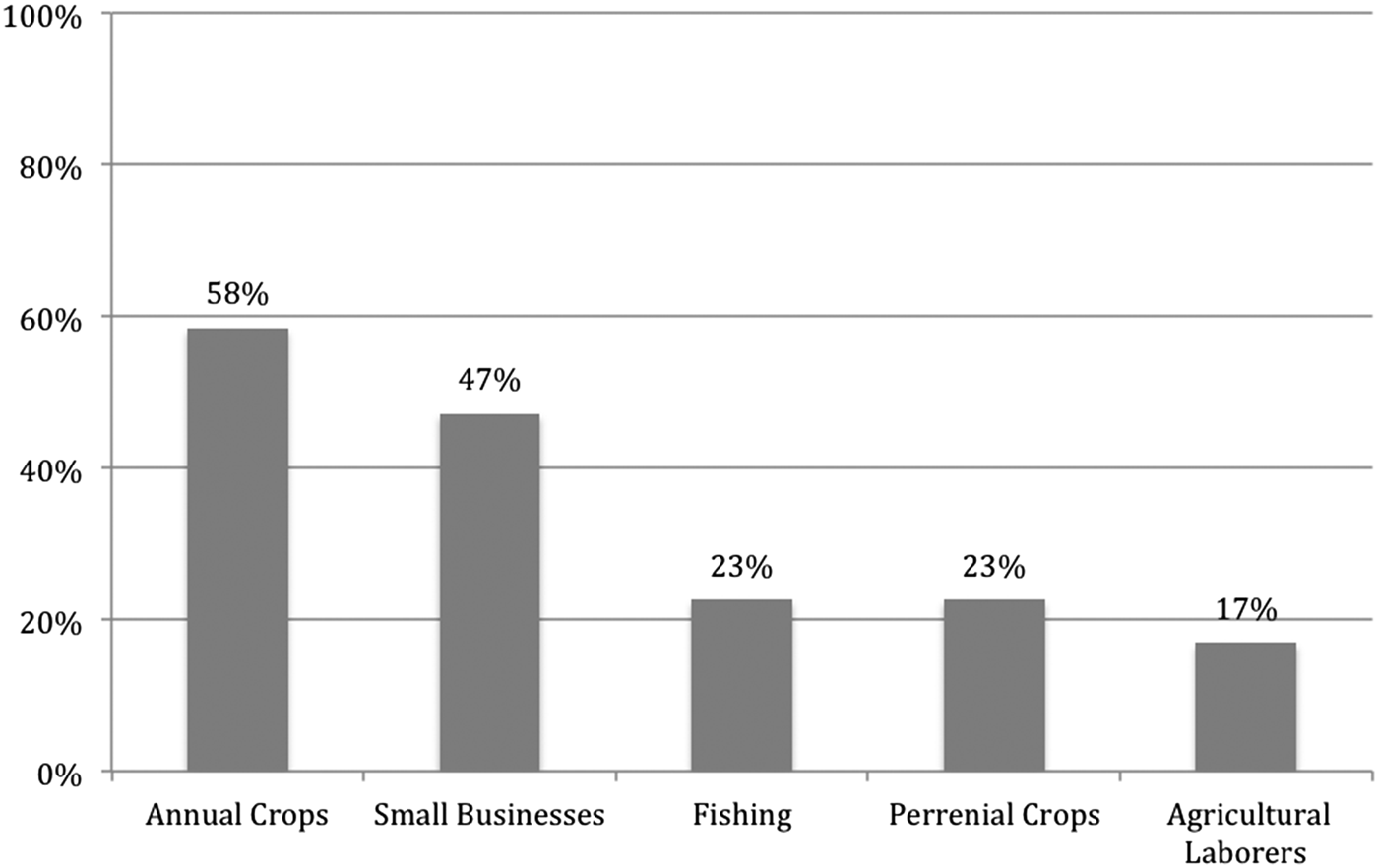
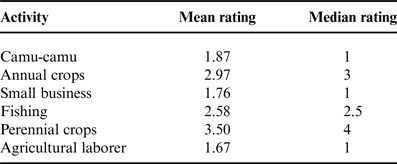
Households relied on a diversity of income sources. In addition to camu-camu, these included annual crops, particularly corn, beans, cassava, and vegetables, as well as small off-farm businesses (Fig. 6). The respondents stated that camu-camu was a more important income source than that provided by other agricultural products. They rated off-farm sources, such as small businesses and employment, as slightly more important than camu-camu (Table 3). The importance of off-farm income in our sample in Ucayali stands in contrast to studies in Loreto that have described livelihood strategies of floodplain producers to be firmly focused on agricultural production (Penn, Reference Penn2004). This difference probably stems from location and markets: several households that raise camu-camu in Ucayali are located close to a major city, Pucallpa.
Percentage of camu-camu producing households engaged in a given productive activity in 2014.

Rating of importance of a given productive activity to livelihood strategy 1 .

1 Each activity was rated on a scale of 1–5, where 1 indicates the highest importance.
Among the sampled households, 92% expressed satisfaction with their engagement in the camu-camu value chain. A common response was that it helped them send their children to school, improve their homes, and meet their daily needs. One farmer stated, ‘Camu-camu is my future, as it has provided many benefits for my family.’ These riverine households face a limited range of options for growing cash crops in and near floodplains, except for labor-intensive maize, beans, cassava and vegetables that do not always yield a crop. Therefore, the respondents saw camu-camu as providing cash that supports the household's other livelihood activities. While not providing them with riches, the crop has allowed the families to survive, often permitting modest improvements to homes or money for their children's education. Indeed many households expected export markets to open up for the fruit, leading to higher prices. Especially as market prices began to recover in late 2014, 75% of the producers stated that they would like to plant more camu-camu.
Low-intensity production
Even though the participants indicated the importance of camu-camu production for their livelihoods, few utilized the recommended agronomic practices to ensure optimal harvest levels. The average amount of camu-camu marketed by the smallholder households was 1.94 MT ha−1, much less than the 8 MT expected by the Ministry of Agriculture or the 15 MT ha−1 obtained in experiments run by INIA (Gonzalez, Reference Gonzalez2014). Harvest levels varied markedly among households, from 0.5 to 12 MT ha−1, only 13% of the plots harvested more than 1 MT ha−1 in 2013. Given that over recent years supply has outpaced demand, harvest levels may reflect differences in productive practices, as well as greater access to camu-camu buyers (recognizing that many producers in 2013 were unable to sell all of their production). Harvest levels also vary according to farm-gate prices for camu-camu. When camu-camu prices were very low (e.g. between 2009 and 2013), households tended to abstain from investing in hired agricultural labor to harvest the fruit, instead using household labor (Gonzalez, Reference Gonzalez2014).
A major challenge for producers is to know the best practices to employ, with extensionists learning along with the producers. During the height of the camu-camu boom, the domestication process was in its early years, with technologies for camu-camu evolving as growers established their plantations. For example, smallholders drew attention to how agronomists from Peru's agricultural research institutions first suggested that camu-camu be planted 2 m apart. However, both producers and agronomists later realized that the shrubs would crowd each other out over time, with major consequences for production. Now, agronomists recommend camu-camu be planted 4 m apart. Furthermore, government-sponsored agronomists have only recently begun to study how to control the pests that plague camu-camu.
This lack of knowledge of the best agronomical practices to employ combined with a belief that camu-camu is a forest crop that requires limited investments, a crop that was ‘provided for by nature,’ means households generally kept investments in their plantations at a minimum. Only 55% of the camu-camu parcels were pruned in 2014. Similarly pest management practices had been applied by only 11% even though nearly all producers complained about extensive insect damage to their plantations. Manual weeding in the camu-camu plantations was the only agronomic practice that nearly all producers regularly practiced.
Difficult camu-camu marketing environment
The boom and bust cycle of camu-camu has made it difficult for many smallholders to plan for the future. After the market crash in 2008, camu-camu farm-gate prices went from about USD 2–0.03 for a 25 kg crate of fresh fruit. Camu-camu producers have not only had to confront low prices but many have also been paid unfair prices because of the unscrupulous practices of buyers, who face little or no repercussions for their actions. Several interviewees described how some buyers promised a relatively high price, only to pay a lower price when they arrived to purchase the product. Others would take the camu-camu crates from producers and never return them. Some buyers would promise to pay later and never pay the producers. Non-local buyers could engage in such practices since they only visited the area once or just a few times; they were not dependent on long-term relationships with the producers. These marketing irregularities caused several producers to abandon their camu-camu fields or significantly reduce their expenses in camu-camu production (e.g. less hired labor for plantation maintenance and harvest). In 2013, 3% of the camu-camu fields were abandoned. However, since the price had begun to recover in 2014, several respondents said they were planning to bring these plots back into production.
Even as the prices went up, however, producers often did not have the capital to restore their camu-camu plantations to the levels of productivity prior to the downturn in prices. Producers lacked access to affordable credit and few had sufficient personal savings to invest in their plantations, to purchase proper equipment, or pay for labor to improve the fields. Only 10 of the 53 households (19%) obtained some form of credit to purchase land or for some other crop, especially annual crops, which permit rapid pay off of the loan. When the prices for camu-camu were high, some buyers actually provided producers with inputs and picked up camu-camu at the farm gate—an important service given the high costs of transporting it from farm to processor by river. Since then, the producers have had limited assistance from buyers or others (e.g. local governments and NGOs) in obtaining the products needed to use more intensive practices.
Gender roles in smallholder households
Although there was no evidence that strategies to develop the camu-camu value chain considered gender equity or made specific efforts to include women, camu-camu production has shown that women have prominent roles in management decisions, production activities, and the benefit distribution in these smallholder households. When asked about who owned or managed the camu-camu parcels, the respondents revealed that women solely or jointly owned just 69% of the camu-camu parcels. However, women had a role in managing 83% of the parcels, many more than they owned. They jointly managed 76% of the plots and 7% of the plots were managed only by women. Women were also extensively involved in caring for camu-camu parcels (planting, weeding, pruning, harvesting, etc.). Women participated in production activities in 98% of the fields. In 70% of the households, men and women jointly decided how to spend the income from camu-camu production, while in 15% of the households, women were sole decision makers and men in the other 15%. The ability of women to influence household decisions and distribute the benefits are key indicators of gender equity, of women's involvement and empowerment in the camu-camu value chain and in smallholder households.
These results of gender roles in camu-camu production contrast with other studies that have examined gender relations in the Amazon region. Much research has shown that Amazonian women have mostly been involved with the gathering of non-timber forest products (NTFPs) and with home gardens, while men controlled the more economically lucrative activities, especially timber and other export products (Bolaños and Schmink, Reference Bolaños, Schmink and Colfer2005; Campbell et al., Reference Campbell, Chicchón, Schmink, Piland and Colfer2005; Cronkleton, Reference Cronkleton and Colfer2005; Porro and Stone, Reference Porro, Stone and Colfer2005). Further research is necessary to understand the reason for the gender relations in the camu-camu value chain. They may be due to changing cultural norms allowing women to play a more prominent role in society, as pointed out by Schmink and Gomez-Garcia (Reference Schmink and Gomez-Garcia2014) or due to the fact that camu-camu was traditionally a NTFP, thus considered a product within women's sphere of influence.
Challenge in developing producers’ associations
The lack of organization in viable, business-oriented associations and cooperatives may have limited the ability of farmers to capture more value in the camu-camu market and improve access to important services and inputs needed for its production. Even though the regional government has made significant efforts to promote producers’ associations, there has been little participation by smallholders. In Ucayali, although there are 50 reported camu-camu producer associations, most of which were formed between 2009 and 2011, only 12 delivered camu-camu to processors in 2011 and only one was registered officially as a business in Peru (GRU, 2011). Only half of the households have at least one of its members participating in a farmer association, even though nearly all of the households sampled in the second phase of the study expressed a need for strong farmer associations to be able to negotiate for higher prices. Many respondents mentioned that the producers’ associations lacked agreement among members, had poor leadership, and provided few benefits. A common comment was, ‘Everyone wants to go his or her own way. No one can agree.’ The development of these associations requires new strategies and better access to the critical business and financial services. There has been little support for these associations outside of the region. The Ministry of Agriculture's Agroideas program, which provides financial support to cooperatives and producer associations, has not financed a single project related to camu-camu out of the 61 projects they financed between 2011 and 2014, many of them in the Amazonian region (Agroideas, 2015).
Camu-camu: a partial success story
The results of this study suggest that the emergence of the camu-camu value chain has led to meaningful changes in rural livelihoods among participating producing households. Despite the recent downturn in camu-camu prices, in 2014 camu-camu made up a significant percentage of total income for those households engaged in the camu-camu value chain. Camu-camu production, as practiced by the majority of sampled households, demonstrated relatively limited expenditure of time and cash: labor inputs were kept to a minimum, synthetic fertilizers were rarely applied, and production risks were relatively low. When camu-camu prices dropped below the point at which households could recover harvest costs, the fruit was left on the shrub. The low intensity of camu-camu production likely reflected weak incentives to intensify camu-camu production because of several years of depressed prices. The households were able to dedicate their limited labor supply to a diversity of livelihood options, particularly in off-farm income-generating activities, which provided greater returns when camu-camu prices were low. Despite the dramatic shifts in prices, smallholders have maintained their camu-camu production, suggesting that it is viewed as a long-term investment that provides a greater fit with existing livelihood strategies than other market-oriented productive activities in the floodplain (e.g. cassava production). Since the sudden fall in camu-camu farm-gate prices, camu-camu producers seem to be hanging on in hopes that the higher prices will return. In general, these findings support the premise that indigenous crops generate livelihood benefits when market conditions are relatively favorable and the bottlenecks that restrict supply are addressed—for example, through domestication and technical assistance (Leakey and Simons, Reference Leakey and Simons1998; Schreckenberg et al., Reference Schreckenberg, Awono, Degrande, Mbosso, Ndoye and Tchoundjeu2006; Belcher and Schreckenberg, Reference Belcher and Schreckenberg2007; Shanley et al., Reference Shanley, Luz and Swingland2012).
This study also highlights the importance of a healthy enabling environment with strong institutions and trust for building a value chain for lesser-known indigenous fruits. Many scholars have pointed out that for markets to work they need well-functioning institutions, including legal structures to grant respected land titles, to enact and enforce business and trade law and contracts, and to protect the rights of all actors all along the value chain (Richardson, Reference Richardson1972; Clague et al., Reference Clague, Keefer, Knack and Olson1999; Williamson, Reference Williamson2005). These institutions are often nonexistent or very weak in the countries where these value chains are being developed. Peru is no exception, with weak institutions for the marketing of agricultural and forest products. The lack of strong land titles inhibits producers from using their land as collateral to access credit. The fragile judicial system limits legal recourse to sanction the use of unfair market practices. In addition, there are few institutions to provide services for actors in the camu-camu value chain, including critical financial and technical information for production and marketing decisions and assistance in business and market development.
Even with weak institutions, markets can function well if trust exists between the actors (North, Reference North1994; Ostrom, Reference Ostrom1998). But given the newness of the camu-camu chain and the lack of an integrated effort to build the chain (i.e. focus the technical, business, and financial needs of chain actors), smallholders have had limited ability to build trust among themselves and with other chain actors. Local processors in particular have realized the importance of building strong relationships with producers to ensure a stable supply; and producers have discovered which processors plan to be in the region for the long term and have begun developing buying relationships with them.
The combination of strong interventions in building producer capacity, an engaged private sector willing to make risky bets on camu-camu producers and markets, and the strong interest from importers in Japan and later those in the USA provided an overall context conducive to VCD. The relatively poor floodplain producers in Ucayali responded with enthusiasm to new market opportunities for camu-camu. Buyers and processers have maintained their interest in camu-camu, although at varying levels of intensity (in contrast to other experience with the promotion of indigenous fruits in Peru, such as peach palm—see Clement et al. (Reference Clement, Weber, Van Leeuwen, Domian, Cole, Lopez and Argüello2004)). Producer associations, although still in the initial stage of business development, have been organized and, with time and support, have the potential to become important players in building smallholder capacity in the production and marketing of camu-camu. However, roughly 15 years after the start of the camu-camu boom, actors along the value chain and their external supporters are left to figure out how to expand and diversify the market, address the multiple sources of friction along the chain, and tackle growth-limiting obstacles linked to the political, legal and institutional context in which the camu-camu chain operates.
The numerous guides for designing value chain interventions stress the need for a strong market-oriented approach (Donovan et al., Reference Donovan, Franzel, Cunha, Gyau and Mithofer2015); however, in practice, development interventions often have a light touch with regard to their market engagement. In many cases, the focus on intervention rests on building smallholder capacity to meet buyer requirements rather than on addressing market development. However, in a context where supply is limited and demand conditions are weak, a more aggressive approach to VCD is needed. During the early years of camu-camu promotion, the focus on building a sizable supply from participating smallholders was important. However, as production took root, new interventions were needed to reduce risk and encourage investment by businesses and to stimulate market development at home and abroad. Also, the lackluster market for camu-camu in Lima and other parts of Peru has hindered camu-camu VCD. But now, given the sustained income growth in Peru over recent years, a new look at national markets is in order. Changes in the development discourse around camu-camu will likely take time, as government agencies or NGOs appear to lack a strong mandate to work outside of production issues around camu-camu. This article does not contradict the idea that ‘the lack of systematized information and management technologies for this Amazonian bio-diversity resource [camu-camu] represents an obstacle for advancing sustainable development goals’ (IIAP, 2010). The case of camu-camu demonstrates that interventions to promote the product both within Peru, to encourage private investment, and to address institutional barriers that limit the growth and development of the camu-camu value chain are also necessary.
Conclusions
Experiences in Peru with camu-camu show both the potential and limitations of building a value chain from the ground up in response to market opportunities, particularly those in distant markets. Interventions to encourage camu-camu supply had significant positive outcomes. Within a few years, camu-camu went from being a wild-harvested fruit to being cultivated by hundreds of smallholders. There have been major investments by businesses within Peru (e.g. processing facilitates) and outside of Peru (e.g. new product lines for camu-camu). Interventions played a key role in building smallholders’ capacity to produce camu-camu on farms and in facilitating early linkages with interested buyers in Japan. Export markets opened up, while a small market in Lima emerged. The challenges brought to light by this research include: quality issues and lack of food safety standards, inadequate infrastructure for fruit processing, restricted access to the EU market, weak farmer organizations that hinder negotiations with processors and provision of production technologies and inputs to growers, a limited demand in the national market and limited innovation in product diversity.
The development of camu-camu in Peru can be considered a partial success story, especially when compared with other products like acai, maca, quinoa and shea. A clear difference between camu-camu and these other crops is an effort to develop local markets and history of acceptance and demand within these markets. Secondly, the large investment in promoting these products in local and then international markets, particularly the strong role played by innovative processors and traders. In the context of VCD for indigenous fruits such as camu-camu, the question of how to achieve greater impact at scale in shorter time periods than the decades of investment for most crops that have obtained great international success is an important one that has received limited attention.
This case does provide insights about how to achieve more impactful VCD for these fruits. Firstly, it shows that processors, while quick to engage with smallholders and build links to interested buyers for camu-camu, has had limited capacity to build, expand and diversity camu-camu markets in Peru and abroad. Secondly, it highlights the need for interventions to support the diversification of market channels, with a nod to the possibilities of public–private partnerships. Finally, it suggests the need for greater collaboration among processors, smallholders and government agencies and NGOs for joint planning and learning to address current and future challenges facing the chain. Addressing the lack of collaboration and cooperation among smallholders and among chain actors will require a few champions (processors, producer associations) that are able to transform business practices and pressure others to follow suit, as well as a willingness on the part of national and regional governments to address the weak institutional environment for chain development.
Acknowledgements
We would like to thank Bruno Paino (formerly with ICRAF) and Jersson Gonzáles Saldaña (Ucayali regional government) for their valuable assistance with data collection. We also thank the editors and reviewers of Renewable Agriculture and Food Systems for their suggestions and insights. This study was undertaken as part of, and funded by, the CGIAR Research Program on Policies, Institutions and Markets (PIM) led by the International Food Policy Research Institute (IFPRI). The opinions expressed here belong to the authors and do not necessarily reflect those of PIM, IFPRI, ICRAF or CGIAR.