


Background
Population ageing and international migration are reshaping the demographic landscape globally, creating an urgent policy and practice change for inclusive and responsive health and social care systems. Access to care is a recognized human right, embedded in ethical, legal and international frameworks (Coomans Reference Coomans2011; World Health Organization 2015; McLeod Reference McLeod2018). Language barriers remain a persistent and well-documented obstacle to equitable access to care for older migrants from culturally and linguistically diverse (CALD) backgrounds (Pandey et al. Reference Pandey, Maina, Amoyaw, Li, Kamrul, Rocha Michaels and Maroof2021). Older migrants also face intersecting barriers beyond language, including unfamiliarity with complex health systems, limited health literacy and culturally incongruent care models (Khatri and Assefa Reference Khatri and Assefa2022; Vange et al. Reference Vange, Nielsen, Michaëlis and Smith Jervelund2024). While language is frequently cited as a key barrier (Pandey et al. Reference Pandey, Maina, Amoyaw, Li, Kamrul, Rocha Michaels and Maroof2021), its interaction with systemic, societal and cultural factors – and their cumulative impact on care access and outcomes – remains largely unexplored.
Studies on the experiences of older migrants from CALD backgrounds frequently identify language barriers as a central challenge (Arora et al. Reference Arora, Bergland, Straiton, Rechel and Debesay2018; Kobayashi and Khan Reference Kobayashi, Khan, Torres and Hunter2023). Evidence also shows that this population actively adopts strategies to mitigate these barriers, such as improving proficiency in the mainstream language (L2) or relying on ethnic community networks to access information in their first language (L1) (Pandey et al. Reference Pandey, Maina, Amoyaw, Li, Kamrul, Rocha Michaels and Maroof2021). Limited knowledge of the care system and the absence of linguistically tailored information often constrain their ability to access needed services, leading to poorer health outcomes and increased safety risks (Pandey et al. Reference Pandey, Maina, Amoyaw, Li, Kamrul, Rocha Michaels and Maroof2021). The lack of health information in preferred languages impedes health literacy and discourages proactive engagement with evidence-based self-care strategies (Pandey et al. Reference Pandey, Maina, Amoyaw, Li, Kamrul, Rocha Michaels and Maroof2021). In contrast, linguistically tailored communication has been shown to enhance autonomy, trust and care outcomes (Brijnath et al. Reference Brijnath, Antoniades and Cavuoto2023; Xiao et al. Reference Xiao, Chen, Han, Meyer, Müller, Low, Brijnath and Mohammadi2022). Digital technologies offer promising avenues for delivering culturally adapted, in-language support, but their effectiveness depends on users’ digital literacy, generational preferences and educational backgrounds.
Interpreter services are critical for bridging communication gaps; however, access remains inconsistent (Pandey et al. Reference Pandey, Maina, Amoyaw, Li, Kamrul, Rocha Michaels and Maroof2021; Khanal Reference Khanal2025). Older migrants, particularly those managing chronic conditions, frequently report unmet needs due to inadequate interpretation and culturally insensitive care (Hadziabdic and Hjelm Reference Hadziabdic and Hjelm2014; White et al. Reference White, Plompen, Tao, Micallef and Haines2019; Khanal Reference Khanal2025). These barriers contribute to delayed treatment, misdiagnoses and dissatisfaction with care.
Cross-cultural miscommunication, often rooted in stereotypes or limited cultural competence, further erodes trust. For example, older migrants may be perceived as overly agreeable (‘happy migrant’) or exaggerating symptoms (‘exaggerating migrant’) due to differing non-verbal cues (Gerber et al. Reference Gerber, Maharaj, Brijnath and Antoniades2020; Georgeou et al. Reference Georgeou, Schismenos, Wali, Mackay and Moraitakis2023). Cultural norms around family involvement, fatalism and end-of-life discussions may also conflict with Western individualistic care models, leading to discomfort and disengagement (Gerber et al. Reference Gerber, Maharaj, Brijnath and Antoniades2020; Georgeou et al. Reference Georgeou, Schismenos, Wali, Mackay and Moraitakis2023). These challenges reflect broader inequities in care access between migrant and non-migrant populations, with significant implications for health outcomes, quality of life and the uptake of preventive services (Kristiansen et al. Reference Kristiansen, Razum, Tezcan-Güntekin and Krasnik2016; Ma and Joshi Reference Ma and Joshi2021; Hanewald et al. Reference Hanewald, Berthold and Stingl2023).
Despite a growing body of qualitative studies, there remains a lack of systematic synthesis of qualitative evidence focused specifically on language barriers and its impact on access to care services among older migrants. A preliminary search of the Cochrane Database, CINAHL, PubMed and PROSPERO confirmed the absence of comprehensive qualitative reviews on this topic. While individual studies are abundant, few have integrated findings to inform policy and practice.
Theoretical frameworks
First, we applied the migration-systems framework (Castles and Miller Reference Castles and Miller2009), which conceptualizes language barriers in older migrants’ access to care not as individual ‘deficits’ but as socially constructed language determinants of health embedded within the migration system. From this perspective, language barriers constitute part of the broader social determinants of health and therefore require cross-sectoral collaboration in migrant-receiving countries. Addressing these health determinants requires responses that move beyond narrow language-barrier solutions towards whole-of-system policy interventions. Such interventions should reinforce rights-based care through rights-aware interpreter policies, plain-language standards and supports for navigating digital portals. It also requires investment in community-level infrastructure, including – though not limited to – peer learning initiatives, ethno-specific hubs and digital-literacy scaffolding. In addition, effective responses depend on cross-sectoral collaboration across health, aged care, settlement, interpreting and translation, and digital-inclusion sectors (Castles and Miller Reference Castles and Miller2009; De Haas et al. Reference De Haas, Castles and Miller2019).
We draw on migration-systems theory to situate older migrants’ communication within a dynamic macro–meso–micro social system. At the macro level, integration regimes and labour markets shape the institutional availability, organization and status of interpreting and translation services. At the meso level, migrant networks, community organizations and the ‘migration industry’ (e.g. brokers and service providers) mediate older migrants’ access to care services. At the micro level, clinical encounters and family roles may either enable or constrain interpretation and translation practices. This analytical lens requires researchers to examine how language barriers experienced by older migrants emerge from interactions among system-level, provider-level, societal and cultural factors, rather than from individual characteristics alone (Castles and Miller Reference Castles and Miller2009; De Haas et al. Reference De Haas, Castles and Miller2019).
We also applied the ecological framework (Elder et al. Reference Elder, Johnson, Crosnoe, Mortimer and Shanahan2003), which foregrounds a lifecourse perspective in analysing older migrants’ care needs and the suitability of services to meet those needs. This framework highlights four key dimensions relevant to understanding the care needs of older migrants. First, time and place call for analysis of the historical, institutional and policy contexts shaping migration experiences. Second, linked lives emphasize the interdependence of older migrants with family members, peers, interpreters and care providers involved in health and social care delivery. Third, timing draws attention to life stage, care-giving roles and illness trajectories that influence older migrants’ abilities to access and utilize care services. Fourth, agency requires consideration of the strategies, adaptations and trade-offs that older migrants – and often their care-givers – employ in navigating care systems.
Viewed through this lens, language barriers experienced by older migrants are understood as cumulative, context-embedded exposures that interact with ageing processes, migration histories, social relationships and coping strategies within specific social contexts. Consequently, addressing access to health and social care for older migrants with language barriers necessitates an individualized, holistic approach that accounts for both structural conditions and lived experiences.
Methods
Review question
This review addressed the question: what are the experiences of older migrants with language barriers in accessing and using care services?
Methodological approach
We conducted a qualitative systematic review using a meta-aggregation approach, following the Joanna Briggs Institute (JBI) Manual for Evidence Synthesis (Lockwood et al. Reference Lockwood, Porritt, Munn, Rittenmeyer, Salmond, Bjerrum, Loveday, Carrier, Stannard, Aromataris and Munn2020). Reporting adhered to the PRISMA 2020 guidelines (Page, McKenzie et al. Reference Page, McKenzie, Bossuyt, Boutron, Hoffmann, Mulrow, Shamseer, Tetzlaff, Akl, Brennan, Chou, Glanville, Grimshaw, Hróbjartsson, Lalu, Li, Loder, Mayo-Wilson, McDonald and Moher2021; Page, Moher et al. Reference Page, Moher, Bossuyt, Boutron, Hoffmann, Mulrow, Shamseer, Tetzlaff, Akl, Brennan, Chou, Glanville, Grimshaw, Hróbjartsson, Lalu, Li, Loder, Mayo-Wilson, McDonald and McKenzie2021). The protocol was registered with PROSPERO (CRD42023491183) and amended twice, with changes documented (Chudecka et al. Reference Chudecka, Xiao and Müller2023) (see Appendix 1).
Data sources
Using the PICO framework, we defined: population – older migrants with language barriers; phenomenon of interest – accessing and using care services; context – health and aged care systems; outcome – experiences of care access and use.
Eligibility criteria
The participants were community-dwelling older migrants experiencing language barriers. For the purposes of this review, an ‘older migrant’ refers to an older person from a CALD background. Due to the ambiguity of nomenclature, different phrases were considered, including but not limited to ‘older person’, ‘aged’, ‘from multicultural/CALD background’, ‘from a minority/ethnic/diverse/marginalized group’, ‘spoken language other than English (LoTE)’. We note that our migrant string may under-capture refugee and forced-migration populations. Implications for transferability are discussed in the limitations section.
Regarding inclusion criteria amendment in the registered protocol (Chudecka et al. Reference Chudecka, Xiao and Müller2023), the age limit was specified to include people 60 years old and older to align with the World Health Organization (WHO) definition of older people (WHO 2015). The phenomenon was experiences of accessing, navigating and using health, aged or community care services. The context was health and aged care systems in adopted countries. The study types included peer-reviewed qualitative studies in English. Mixed-methods studies were included if qualitative data specific to older migrants were extractable. The ‘non-extractable qualitative data’ referred to studies where qualitative findings specific to older migrants could have not been isolated or analysed independently.
Exclusion criteria
Excluded were studies focusing on migrants aged under 60 years, lacking language-related findings, targeting only professionals or carers, or without extractable qualitative data.
Search strategy
A comprehensive search strategy was developed in consultation with a medical sciences librarian and tailored to each database. The following databases were searched between November 2023 and March 2024: MEDLINE (PubMed), SciVerse Scopus (Elsevier), Cochrane Library (Wiley), the Cumulative Index to Nursing and Allied Health Literature CINAHL (EBSCO), EMBASE (Ovid), APA PsycINFO (EBSCO) and Web of Science (Clarivate). Our seven-database strategy targeted comprehensive coverage across medicine, nursing and allied health, public health, psychology and social sciences, appropriate for a cross-sectoral care-access question.
Search terms were structured using the PICO framework (see Appendix 2). An exemplary search query used in one of the searched databases is provided in Appendix 2 to support reproducibility. Inclusion criteria amendment in the registered protocol (Chudecka et al. Reference Chudecka, Xiao and Müller2023) was for the review to include articles published in the last 20 years (2004–2023). We delimit the review to 2004–2023 for the following reasons. First, the 2002 Madrid International Plan of Action on Ageing marked a rights-based care turn in aged care research and policy (United Nations 2002). Second, the mid-2000s marked the digitalization of health systems (e.g. electronic health records, portals, online forms) and might have affected migrants’ access to health (European Commission 2004; Office of the National Coordinator for Health Information Technology 2022; HIPAA Journal 2025). Third, migration and aged-care policy shifts in this period altered service configurations and language-support needs, including the effects of the 2004 EU enlargement on migration flows and cohorts, and ongoing reforms in Australia’s aged-care system (European Commission 2009; Kahanec and Zimmermann Reference Kahanec, Zimmermann, Nowotny, Mooslechner and Ritzberger-Grünwald2010; Love Reference Love2021).
Study selection
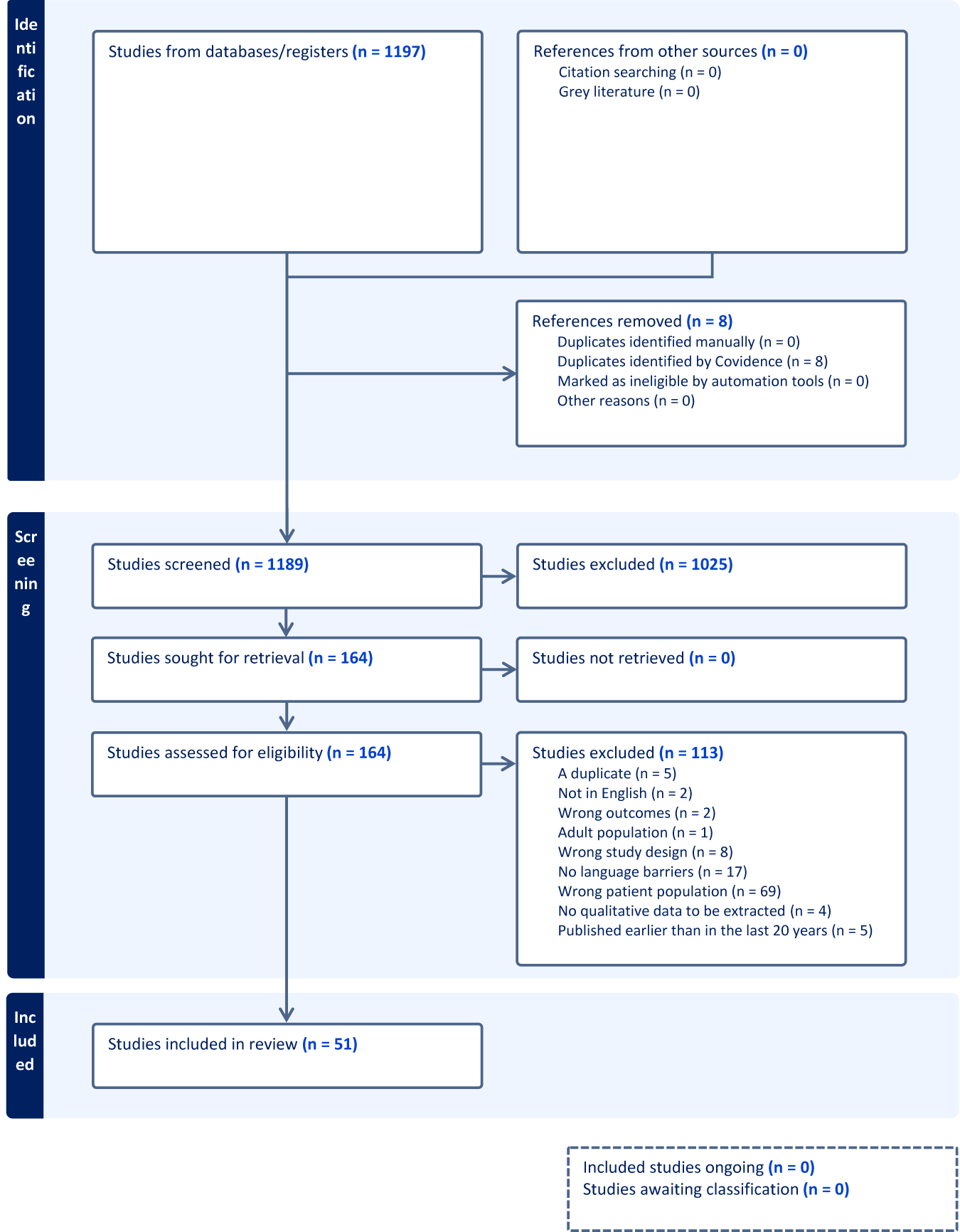
Search results were managed using EndNote 20.6 and screened in Covidence. After removing duplicates, 1,189 records were screened independently by two reviewers. Discrepancies were resolved through discussion or a third reviewer. A total of 164 full-text articles were assessed, and 51 studies met the inclusion criteria (see PRISMA flowchart, Figure 1).
Review flow diagram.

Figure 1 Long description
The flowchart illustrates the PRISMA process for selecting studies. It begins with the identification phase, where 1197 studies are sourced from databases and registers and no references are obtained from other sources. Eight references are removed due to duplication identified by Covidence. In the screening phase, 1189 studies are screened, with 1025 excluded. The next phase involves seeking retrieval for 164 studies, all of which are assessed for eligibility. During eligibility assessment, 113 studies are excluded for reasons such as duplication, language barriers, wrong study design and others. Finally, 51 studies are included in the review. There are no ongoing studies or studies awaiting classification.
Data extraction
Data were extracted using a customized Excel tool based on the JBI QARI Data Extraction Tool. Extracted data included study characteristics, participant demographics, context, methods, language-related findings and conclusions. All data were reviewed iteratively by the research team (see Table 1).
Older migrants’ perspectives on challenges and opportunities in accessing and using care services: a qualitative systematic review

Table 1 Long description
Rows summarise individual qualitative and mixed methods studies using columns for author and year with country, aim or objective, sample and setting, ethnicity or country of origin, methodology and methods, and summary of findings. Countries include Norway, Sweden, the United Kingdom, Australia, the United States, Canada, the Netherlands, Belgium, Finland, Denmark, Spain with the United Kingdom, New Zealand, and Hong Kong. Samples range from small interview studies such as 5 older adults in Finland and 6 participants in Denmark to larger studies such as 197 South Asian participants in Canada and 107 Chinese immigrant elders in a United States survey with 21 interviews; many studies include older adults plus family carers, professionals, or key informants. Ethnicity and language groups include Pakistani, South Asian, Chinese, Korean, Turkish, Greek, Filipino, Vietnamese, Russian, British retirees in Spain, Haitian, Afghan, Nepalese, and multiple culturally and linguistically diverse groups. Methods most often include semi structured or in depth interviews and focus groups, with some studies adding observation, workshops, Photovoice, or mixed methods designs. Findings across studies describe barriers and facilitators related to language and translation difficulties, health literacy and information needs, trust and cultural values, digital access and digital health literacy, transportation access, reliance on family and community organisations, and experiences with home care, rehabilitation, screening, telemedicine, and end of life care.
Note: Summary of studies included for the review.
Quality appraisal
Two reviewers independently assessed methodological quality using the JBI Critical Appraisal Checklist for Qualitative Research. Discrepancies were resolved by consensus or a third reviewer. Of the 51 included studies, 32 met all criteria, 11 met 9/10, and 8 met 8/10 (see Table 2).
Evaluation of qualitative studies included for the review

Table 2 Long description
Each row lists a study number and citation, followed by responses for Questions Q1 through Q10 using Y or a question mark. Most studies show Y for all ten questions, including Arora et al. 2019, Barenfeld et al. 2015 and 2017, Blake et al. 2017, Bruland et al. 2023, and many others. Question marks appear in specific cells: Butow et al. 2010 has a question mark in Q7; Cook 2010 has question marks in Q7 and Q9; Dabelko Schoeny et al. 2021 has a question mark in Q9; Hall et al. 2016 has a question mark in Q6; Hoeck et al. 2022 has question marks in Q6 and Q7; Hurley et al. 2013 has a question mark in Q1. Additional rows with question marks include Kelley et al. 2022, Koehn et al. 2016, Mao et al. 2022, Wilkinson et al. 2016, and Zhan et al. 2017 in Q7; Liu et al. 2017, Patel et al. 2006, Radermacher and Feldman 2015, Todd et al. 2011, and Suurmond et al. 2016 in Q6 and or Q7; and Pot et al. 2020 in Q9. Several studies show question marks in both Q7 and Q9, including McCaffrey 2008, Nguyen et al. 2008, and Liu et al. 2017. Q8 and Q10 are marked Y for every listed study.
Data synthesis
Of various methods (e.g. meta-aggregation, meta-ethnography, thematic synthesis) used to synthesize findings from qualitative studies, we chose JBI’s three-step meta-aggregation as it aligns with our review aim and enables us to provide a transparent and auditable synthesis that preserves authors’ findings while supporting policy and practice translation. We extracted findings and supporting illustrations, rated findings at three levels described as unequivocal, credible or unsupported. We only included findings rated as unequivocal or credible in the next stage of data synthesis. Then, we aggregated findings into thematic categories, synthesized the categories into synthesized themes. When appropriate, we also conducted an inductive analysis to explore the phenomenon of language reversion.
Ethical considerations
As this review involved secondary analysis of published data, ethics approval was not required.
Results
Characteristics of included studies
We summarized the characteristics of included studies in Table 1 which included detailed information on study and migrant countries of origin. This review included 51 high-quality qualitative studies published between 2004 and 2023 (seven in 2017, six in 2016, five in 2022). The studies were conducted across diverse geographical contexts: the United States (11), the United Kingdom (10), Australia (9), Canada (6), the Netherlands (4) and others including Norway, Spain, Sweden, Belgium, Denmark, Finland, Hong Kong and New Zealand. Participants represented a wide range of ethnic backgrounds, including Chinese, South Asian, Greek, Turkish, Arabic and African. Common first languages included Mandarin, Hindi, Arabic and Dari.
Data were primarily collected through semi-structured interviews or focus groups. Recruitment challenges were noted in several studies due to language barriers (nine), mistrust of research (three) or family gatekeeping. Engagement was notably higher when interpreters were involved (18) or when researchers shared participants’ cultural and linguistic backgrounds (40).
Synthesized themes
Consistent with our migration-systems and ecological lens, the findings aggregate across system, provider, societal and cultural layers that interact to shape access and communication. Four overarching themes were identified: system factors, care provider factors, societal factors and cultural factors, comprising hindering and enabling subthemes. We elaborate each theme with related subthemes in the following sections, illustrated by quotes to support the findings.
Theme 1: system factors
System factors refer to structural elements within health and aged care systems that either hinder or facilitate older migrants’ access to and use of services. These include the availability of linguistically appropriate information, digital access and support for language learning.
Subtheme 1.1: hindering factors
Older migrants frequently encountered difficulties accessing health information in their preferred language, limiting their ability to understand services and engage in self-care: ‘A person can only demand what he knows is provided. I don’t know … what is needed’ (Wilkinson et al. Reference Wilkinson, Randhawa, Brown, Da Silva Gane, Stoves, Warwick, Akhtar, Magee, Sharman and Farrington2016, 5). Some found that care systems, such as cancer services, were inaccessible without English proficiency: ‘You must still be able to speak English … Otherwise you don’t get through’ (Butow et al. Reference Butow, Sze, Dugal-Beri, Mikhail, Eisenbruch, Jefford, Schofield, Girgis, King and Goldstein2011, 286). Digital health platforms further excluded those with limited literacy or digital skills: ‘If you tell me go to [the] internet … I can’t read it so it will go in the garbage’ (Hyman et al. Reference Hyman, Stacy, Mohsin, Atkinson, Stewart, Novak Lauscher and Ho2022, 8). Online forms posed additional challenges: ‘You must use the language remotely … but you just don’t always succeed … you’re afraid to make a mistake’ (Kaihlanen et al. Reference Kaihlanen, Virtanen, Buchert, Safarov, Valkonen, Hietapakka, Hörhammer, Kujala, Kouvonen and Heponiemi2022, 6). These examples illustrate how digital-only approaches, without language support, disempowered older migrants and hindered access.
Several studies noted older migrants’ motivation to learn the mainstream language. However, care-giving responsibilities often prevented participation in language classes: ‘I really wanted to learn … but I wasn’t able to go out, I wasn’t able to leave him’ (Jowsey et al. Reference Jowsey, Gillespie and Aspin2011, 15). The lack of flexible accessible language learning options for older carers represents a critical gap in service provision.
Subtheme 1.2: enabling factors
Despite challenges, many older migrants expressed appreciation for the health-care systems in their adopted countries: ‘We respect the local council … like how parents provide for children’ (Yap et al. Reference Yap, Chen, Detering and Fraser2018, 3303). Even when needs were unmet, participants often reported satisfaction: ‘Except for some language problems … everything has been good’ (Garrett et al. Reference Garrett, Dickson, Young and Whelan2008, 102).
Facilitators included services that supported system navigation, flexible care options and opportunities to learn the mainstream language. These enhanced confidence, communication and participation in care: ‘Learning Norwegian is more important than activities … language is very important … it is good for the sense of belonging’ (Bruland et al. Reference Bruland, Malmedal and Blekken2023, 6). Language acquisition was linked to improved social integration, mental health and care outcomes.
Theme 2: care provider factors
Care provider factors refer to the attitudes, behaviours and competencies of health-care professionals that shaped older migrants’ experiences. These included the availability and quality of interpreter services, cultural competence and provider–patient communication.
Subtheme 2.1: hindering factors
Language barriers often led to disempowerment and miscommunication, reducing older migrants’ understanding of treatment and confidence in care: ‘I really wanted to know, I felt helpless … He [the doctor] “HOLD” the “POWER”. I could only listen …’ (Butow et al. Reference Butow, Sze, Dugal-Beri, Mikhail, Eisenbruch, Jefford, Schofield, Girgis, King and Goldstein2011, 5). Even those with some English proficiency struggled under stress or with complex health issues: ‘It has nothing to do with English … your mind is so confused … I had no choice’ (Butow et al. Reference Butow, Sze, Dugal-Beri, Mikhail, Eisenbruch, Jefford, Schofield, Girgis, King and Goldstein2011, 283).
Inadequate interpreter services frequently compromised care. Some interpreters were mismatched linguistically: ‘They found him a Vietnamese interpreter … we have Cantonese and Mandarin’ (Butow et al. Reference Butow, Sze, Dugal-Beri, Mikhail, Eisenbruch, Jefford, Schofield, Girgis, King and Goldstein2011, 287). Others translated inaccurately, leading to serious consequences: ‘The interpreter said I had a heart problem … I was hospitalized … I suffered so much’ (Chung et al. Reference Chung, Seo and Lee2018, 5). Time constraints further limited interpreter effectiveness: ‘There was only 15 min left … the hospital doesn’t have enough resources’ (Butow et al. Reference Butow, Sze, Dugal-Beri, Mikhail, Eisenbruch, Jefford, Schofield, Girgis, King and Goldstein2011, 287).
When professional interpreters were unavailable, reliance on family members created additional challenges: ‘They cannot rely on the children … sickness cannot wait till they are free’ (Kelley et al. Reference Kelley, Seponski and Lewis2022, 396). Family members often had competing responsibilities, and their involvement could compromise privacy and accuracy.
Subtheme 2.2: enabling factors
Shared language between provider and patient was a powerful enabler, fostering trust and understanding: ‘You can relate better … sometimes you grope for words…’ (Maneze et al. Reference Maneze, Ramjan, DiGiacomo, Everett, Davidson and Salamonson2018, 621). Older migrants valued respectful, culturally sensitive interactions and provider expertise: ‘I listen to doctors … they know best … they are here to save people’ (Yap et al. 2018, 3303). Tailored communication – such as translated letters or simplified materials – was highly appreciated: ‘They know our names … why don’t they put two lines in Greek?’ (Hurley et al. Reference Hurley, Panagiotopoulos, Tsianikas, Newman and Walker2013, 144). Face-to-face presentations in the preferred language enhanced comprehension and participation: ‘If a person comes to explain … then people would participate’ (Woudstra et al. Reference Woudstra, Dekker, Essink-Bot and Suurmond2016, 1319).
Older migrants also used strategies to overcome low health literacy, such as using dictionaries or seeking information in their native language: ‘I bought many illustrated books … I went through those books … over and over’ (Lambert et al. Reference Lambert, Loban, Li, Nghiem, Schaffler, Maheu, Dubois, Folch, Gélinas-Phaneuf and Laizner2021, 2433).
Even those fluent in the mainstream language struggled with medical terminology: ‘It’s as if they [doctors] are speaking another language … even if it’s in Italian’ (Lambert et al. Reference Lambert, Loban, Li, Nghiem, Schaffler, Maheu, Dubois, Folch, Gélinas-Phaneuf and Laizner2021, 2433).
These findings underscore the importance of culturally competent communication, adequate interpreter services and accessible health education to support older migrants’ engagement in care.
Theme 3: societal factors
Societal factors refer to the broader social and cultural dynamics that influence older migrants’ access to care. These include social isolation, discrimination and the role of community support networks.
Subtheme 3.1: hindering factors
Many older migrants experienced isolation, loneliness and limited social interaction, often due to language barriers. Those with limited proficiency in the mainstream language (L2) relied heavily on first-language (L1) networks, which, while supportive, increased dependence on others for navigating health care: ‘Without my daughter … I can only understand a bit … the nurse calls my daughter before coming’ (Hurley et al. Reference Hurley, Panagiotopoulos, Tsianikas, Newman and Walker2013, 146). This reliance often led to a loss of agency in care decisions: ‘They used to talk to my son … they didn’t ask me anything’ (Chauhan et al. Reference Chauhan, Baker, Lester and Edwards2010, 71). Some participants felt stereotyped or devalued: ‘The doctor sees if you can speak English … if not, you are a handicapped person’ (Butow et al. Reference Butow, Sze, Dugal-Beri, Mikhail, Eisenbruch, Jefford, Schofield, Girgis, King and Goldstein2011, 284). Others described a growing disconnect from younger generations: ‘We cannot understand our own children’ (Cook Reference Cook2010, 265).
While ethnic enclaves offered linguistic familiarity, they could also reinforce segregation and limit integration into broader society. Whether older migrants pursued or abandoned efforts to learn the mainstream language depended on their initial proficiency, available support and daily life context.
Subtheme 3.2: enabling factors
Community groups and peer networks played a vital role in facilitating access to care. Shared language and lived experience created trusted spaces for learning and support: ‘The senior group meetings … helped a lot with things I had no idea about … given me opportunities’ (Barenfeld et al. Reference Barenfeld, Gustafsson, Wallin and Dahlin-Ivanoff2015, 6). Peer discussions enabled understanding of health systems and rights, empowering informed decision-making. Culturally specific day centres fostered belonging and encouraged proactive engagement: ‘By coming here, you talk to people … I have learned that I should come outside and mingle’ (Koehn et al. Reference Koehn, Habib and Bukhari2016, 95). Even those with limited literacy benefited from peer-led information sharing: ‘We learn new things, even if we cannot read … we share in our homes’ (Koehn et al. Reference Koehn, Habib and Bukhari2016, 95). Peers often acted as cultural brokers, trusted more than formal providers, and helped dispel myths and stigma around care-seeking. These findings highlight the importance of investing in community infrastructure and peer-led education to support older migrants’ access to care.
Theme 4: cultural factors
Cultural factors shape values, beliefs and communication styles, significantly influencing older migrants’ engagement with care. Shared cultural backgrounds and culturally competent care facilitated mutual understanding, while cultural misalignment often hindered access and trust.
Subtheme 4.1: cultural beliefs as barriers
Some older migrants internalized a sense of being a ‘difficult group’, which discouraged them from voicing concerns: ‘We need a lot of care and we cannot express it very well … but that does not mean we should criticise too much’ (Carlsson Reference Carlsson2023, 1523). Stereotyping by health-care staff also affected communication: ‘They rarely talked to me … they were surprised I could understand English’ (Montayre et al. Reference Montayre, Neville and Holroyd2017, 4).
Cultural differences in non-verbal communication and expectations around family involvement often led to misunderstandings. In unfamiliar clinical settings, family members were relied upon for reassurance. For example, when no support was offered to communicate with health practitioners, older migrants required family members to get involved to explain the diagnosis and care plan: ‘I asked them to call my home … I could not communicate with the nurses … I felt unsafe’ (Harrison et al. Reference Harrison, Walton, Chitkara, Manias, Chauhan, Latanik and Leone2020, 165).
While some distrusted community-based interpreters due to confidentiality concerns, others preferred them for their perceived honesty: ‘The interpreter won’t hide the truth … they will tell you no matter what’ (Butow et al. Reference Butow, Sze, Dugal-Beri, Mikhail, Eisenbruch, Jefford, Schofield, Girgis, King and Goldstein2011, 286). However, expectations of interpreters as cultural advocates were often unmet: ‘If you didn’t ask, they won’t interpret it’ (Butow et al. Reference Butow, Sze, Dugal-Beri, Mikhail, Eisenbruch, Jefford, Schofield, Girgis, King and Goldstein2011, 287). These unmet expectations were exacerbated when providers lacked cultural competence, further eroding trust.
Subtheme 4.2: cultural values and communication norms
Some participants felt misunderstood when their communication styles did not align with provider expectations. One noted ‘having to put pressure on the doctor’ and exaggerate symptoms to be heard (Arora et al. Reference Arora, Straiton, Rechel, Bergland and Debesay2019, 5). Stereotypes like the ‘happy migrant’ or the ‘exaggerating migrant’ were reported to distort clinical judgement and undermine trust (Garrett et al. Reference Garrett, Dickson, Young and Whelan2008).
Cultural norms such as fatalism, modesty and gender roles often inhibited open dialogue. Some participants struggled to describe symptoms experienced and interpreted based on traditional Chinese medicine concepts (i.e. flow of energy chi, balance of yin and yang) in terms relevant to Western terms: ‘Sometimes I feel my body is groggy … I can’t express these clear feelings’ (Liu et al. Reference Liu, Cook and Cattan2017, 134). Others questioned the relevance of Western treatment advice (i.e. expecting a holistic treatment including lifestyle interventions: diet and physical activity): ‘If I eat like Western people, it won’t work’ (Lambert et al. Reference Lambert, Loban, Li, Nghiem, Schaffler, Maheu, Dubois, Folch, Gélinas-Phaneuf and Laizner2021, 2433).
Taboos around discussing sensitive topics (i.e. terminal illness, mental health issues, cervical cancer sample collection, colorectal cancer screening requiring collection of stool samples), especially in mixed-gender or family settings, further limited communication: ‘We are just ashamed … I’m even ashamed to tell you’ (Hoeck et al. Reference Hoeck, Van Roy and Willems2022, 39).
Family members sometimes acted as gatekeepers, filtering information to protect each other. Engaging an interpreter facilitated open discussions and disclosing experienced health issues to health practitioners: ‘I want to protect them from getting upset … it’s better if the children stay out of it’ (Butow et al. Reference Butow, Sze, Dugal-Beri, Mikhail, Eisenbruch, Jefford, Schofield, Girgis, King and Goldstein2011, 286).
Continuity of care and face-to-face communication with culturally competent providers helped mitigate these barriers and fostered trust.
Discussion
To the best of our knowledge, this is the first qualitative systematic review to synthesize findings from 51 studies across two decades, examining how language barriers intersect with other factors shaping older migrants’ experiences in accessing and using care services. While previous literature has acknowledged the challenges posed by language barriers (Khatri and Assefa Reference Khatri and Assefa2022; Xiao et al. Reference Xiao, Chen, Han, Meyer, Müller, Low, Brijnath and Mohammadi2022), this review extends that understanding by revealing the nuanced interplay between language and other structural and relational determinants of care. This review identified four interrelated themes – system, provider, societal and cultural factors – that either enable or impede care engagement. Older migrants reported both positive and negative experiences in navigating care systems, with implications for policy makers, care organizations and service providers seeking to create inclusive, migrant-friendly care environments.
Scope and transferability
Of the 51 studies synthesized in this review, most were conducted in English-speaking destination countries, with a smaller number originating from Northern and Western European countries. Although these countries share some broad characteristics as high-income, migrant-receiving contexts, they differ substantially in the organization of their health and aged care systems, the funding and accessibility of interpreter services, the range of languages supported, the operation of digital and administrative access points, and the ways in which integration policies position migrants and linguistic minorities. We therefore interpret the findings as context-specific evidence grounded in the experiences of older migrants, which may not be directly transferable to other national settings.
System-level barriers and co-design opportunities
At the macro level, integration regimes shape how language access is defined, funded and delivered. In Canada, a legislated multiculturalism framework assigns public bodies clear responsibilities to enable participation and remove barriers, with implications for interpreter and translation policy and practice (Government of Canada 1988). In the United Kingdom, the post-2001 ‘community cohesion’ policy stream prioritized contact between groups and a shared civic orientation; this framing influenced how interpreter provision was commissioned and how outreach to minoritized communities was structured (Home Office 2001).
At the system level, barriers such as inaccessible health information, digital exclusion and inflexible service delivery models significantly hindered older migrants’ ability to access timely and appropriate care. These findings align with prior research on the structural nature of language barriers and their impact on autonomy and health literacy (Khatri and Assefa Reference Khatri and Assefa2022; Vange et al. Reference Vange, Nielsen, Michaëlis and Smith Jervelund2024). However, this review adds new insights by showing how digitalization – intended to improve access – can exacerbate exclusion for those with limited literacy (i.e. unable to read on-screen instructions, follow a manual) or digital skills (i.e. do not know how to use computers).
To address the challenges identified in this review, system-level reforms must prioritize co-design and co-creation of services with older migrants. While Australia offers a compelling case study due to its multicultural demographic and policy frameworks, similar inclusive approaches have emerged internationally, reflecting a broader shift towards human-centred, rights-based care.
In the United States, initiatives such as the Money Follows the Person programme and the Ageing in Place Initiative promote ageing in community through person-centred care models that support autonomy and social inclusion (Spencer et al. Reference Spencer, Martin, Bourgeault and O’Shea2010). These programmes emphasize continuity, compensation, connection, contribution and challenge – principles that align with inclusive care.
In Canada, Ontario’s Aging with Confidence strategy embeds cultural and linguistic diversity into senior care planning, emphasizing community engagement and culturally competent service delivery (Spencer et al. Reference Spencer, Martin, Bourgeault and O’Shea2010). Migrant care workers play a vital role in bridging gaps in formal care systems, and policies increasingly recognize the need for fair employment conditions and ethical recruitment practices (Kumar et al. Reference Kumar, Dempster, O’Donnell and Zimmer2022).
In the Netherlands, municipalities such as Nijmegen and The Hague have implemented a mix of mainstreamed and ethno-specific aged care services under a diversity-mainstreaming framework. These include intercultural eldercare advisors and culturally tailored day- and home-care services. However, the framing of such services as temporary responses to current generations’ language needs risks undermining long-term investment in intercultural expertise (Carlsson and Pijpers Reference Carlsson and Pijpers2021).
The WHO advocates for diversity-sensitive health and long-term care policies across Europe, emphasizing the importance of skilled interpreters, culturally appropriate care and inclusive service design. Their policy brief highlights the need for participatory approaches that involve older migrants in shaping their care environments (World Health Organization 2018).
Across these contexts, several key principles of inclusive care emerge: (1) person-centred and rights-based approaches that reflect lived experiences; (2) cultural and linguistic responsiveness, including tailored communication and interpreter services; (3) community engagement and co-design, involving older migrants in service planning; (4) support for informal care-givers and investment in peer-led initiatives; (5) ethical recruitment and fair employment for migrant care workers; and (6) long-term commitment to intercultural competence, avoiding assimilationist framings. These international examples reinforce the need for aged care systems to move beyond generic models and embrace diversity as a core principle. Inclusive care is not only about access but about dignity, autonomy and meaningful participation in society.
In Australia, the inclusive approach is strongly supported by the Royal Commission into Aged Care Quality and Safety, which called for a shift towards person-centred, rights-based care that reflects the lived experiences of diverse older Australians (Royal Commission 2021). The new Aged Care Act 2024, effective from 1 November 2025, embeds this principle by mandating culturally safe assessments, inclusive planning and accessible complaints mechanisms (Department of Health and Aged Care 2024). Policy tools include the Aged Care Diversity Framework and its associated Action Plans that provide a roadmap for embedding inclusive practices across the sector. These documents emphasize the importance of tailored communication, cultural safety and workforce training to meet the needs of older people from CALD backgrounds (Department of Health 2017). The 2024 Multicultural Framework Review further reinforces the need to engage CALD communities in decision-making and co-produce services that reflect their values and aspirations (Department of Home Affairs 2024). In practice, this means involving older migrants in the design of health promotion materials, digital tools and service models. For example, the co-design of the Support at Home programme under the new Act involved extensive community consultation, including with CALD communities, to ensure that services are accessible, flexible and culturally appropriate (Department of Health and Aged Care 2024).
Despite the noted policy advances, our review highlights a persistent unmet demand for language learning opportunities, particularly among older carers supporting spouses. This gap is rarely addressed in service planning. Older people may have distinct preferences for how they wish to learn and use language in care contexts. Integrating these preferences into education and training programmes is essential to support their autonomy and engagement. Additionally, older migrants often feel disempowered to provide feedback or lodge complaints, even when they experience inappropriate care. This underscores the need for inclusive system designs that integrate language support with digital and health literacy initiatives and actively seek feedback from linguistically diverse populations.
In English-dominant systems where patient portals function as the primary point of entry to care, support for digital skills and clear navigation in an individual’s preferred language are essential. In the absence of such support, investments in interpreting services and translated materials are likely to underperform. Although not examined in detail in every included study, discrimination and racism shape whose concerns are recognized, who trusts services and who persists through complex administrative processes. Consequently, service and clinic design should explicitly acknowledge these patterns and incorporate mechanisms to mitigate their effects on communication and access.
Provider-level interactions and communication
Interactions with care providers emerged as a critical determinant of older migrants’ care experiences. Consistent with international research, this review confirms that inadequate interpreter services and culturally insensitive communication contribute to miscommunication, mistrust and disengagement (Hadziabdic and Hjelm Reference Hadziabdic and Hjelm2014; Khanal Reference Khanal2025). These issues are echoed in the Australian context, where studies have shown that older migrants often feel excluded from decision-making due to limited access to professional interpreters and a lack of cultural competence among health-care staff (White et al. Reference White, Plompen, Tao, Micallef and Haines2019; Das and Chatterjee Reference Das and Chatterjee2025).
Our findings extend this literature by highlighting the emotional toll of these interactions, including feelings of helplessness when patients are misunderstood or unable to express themselves. We also underscore the risks associated with poor-quality interpretation, such as misdiagnoses and inappropriate treatment, and the limitations of relying on family members – who may lack fluency in the older person’s first language or be unavailable due to competing responsibilities.
Our analysis cautions against treating ‘culture’ as a fixed attribute located in patients or as a checklist to be completed (Tervalon and Murray-García Reference Tervalon and Murray-García1998). Evidence from the studies – including the use of stereotypes such as the ‘happy migrant’ and the ‘exaggerating migrant’, expectations that interpreters act as cultural advocates, and misalignments around decision-making and symptom talk – shows why practice cannot be reduced to technical proficiency alone. We therefore emphasize cultural safety and structural competence, with explicit attention to power, bias and organizational constraints, and to how language is valued and rationed within care systems (Metzl and Hansen Reference Metzl and Hansen2014).
These insights reinforce the need for investment in high-quality, culturally competent interpreting services, flexible scheduling and sufficient time allocation during appointments. Furthermore, they support calls for mandatory cross-cultural communication training for care providers and the integration of cultural competence into staff performance evaluations and organizational accountability frameworks. Our findings have implications for enhancing routine access to trained interpreters with appointment structures that permit timely and needs-based access to qualified interpreters. Our findings also suggest the need to co-design training programmes for interpreters and health and aged care professionals to use a lifecourse approach to recognize diverse care needs and the most effective way to address the care needs of older migrants rather than a language barrier perspective. In English-dominant clinical environments, even L2-fluent older adults experience difficulties to understand medical terms in English. Therefore, interpreter services and translated medical information must use plain language and be tailored to the cultures of older migrants.
Social networks: dual roles in care access
Social networks played a dual role in shaping care access. On one hand, social isolation, dependence on family and experiences of ‘othering’ reduced agency and reinforced marginalization – findings consistent with prior research on the social determinants of migrant health (Kristiansen et al. Reference Kristiansen, Razum, Tezcan-Güntekin and Krasnik2016; Hanewald et al. Reference Hanewald, Berthold and Stingl2023). On the other hand, culturally specific peer networks and community-based learning emerged as powerful enablers of care engagement. Despite growing awareness, translating such evidence into policy and practice remains a global challenge (Rushmer et al. Reference Rushmer, Ward, Nguyen, Kuchenmüller, Verschuuren and Van Oers2019; Kelley et al. Reference Kelley, Seponski and Lewis2022). Sustained investment in community engagement, culturally safe spaces and peer-led initiatives is essential to bridge the gap between policy intent and lived experience.
This review contributes novel insights by positioning peer-led environments not as peripheral supports but as central mechanisms through which older migrants build confidence, learn about their rights and navigate care systems. These findings suggest that strengthening community infrastructure and peer education could be a cost-effective strategy to enhance care access and equity. For example, in Australia, community-based programmes such as the Partners in Culturally Appropriate Care (PICAC) have demonstrated success in supporting CALD communities through culturally tailored education and service navigation support.
Cultural norms and communication styles
Cultural beliefs and communication norms also significantly influenced care engagement. While previous studies have acknowledged the role of culture in shaping health behaviours (Gerber et al. Reference Gerber, Maharaj, Brijnath and Antoniades2020; Georgeou et al. Reference Georgeou, Schismenos, Wali, Mackay and Moraitakis2023), this review offers a more nuanced understanding of how cultural values intersect with language to affect communication.
Fatalism, modesty, family roles and gender norms often inhibited open dialogue, particularly around sensitive topics such as cancer screening or end-of-life care. For instance, older migrants from collectivist cultures may avoid discussing terminal illness to protect family harmony, which can conflict with Western models of individualized care planning. Cultural misalignment between patients and providers led to stereotyping and misinterpretation of symptoms, further eroding trust.
Our findings also highlight the complex expectations placed on interpreters, who were sometimes viewed as cultural advocates rather than neutral translators. When these expectations were unmet, older migrants felt misunderstood or unsupported. This underscores the need for culturally competent care models that go beyond language access to include respect for diverse values, communication styles and family dynamics.
Challenging stereotypes and addressing structural inequities
Importantly, this review contributes new knowledge by exploring how cultural stereotypes – such as the ‘happy migrant’ or the ‘exaggerating migrant’ – can distort provider perceptions and lead to diagnostic errors or disengagement. These stereotypes, often rooted in unconscious bias, can result in under-reporting of symptoms, misdiagnosis or dismissal of concerns. Such insights have received limited attention in previous syntheses and highlight the need for provider training that includes bias recognition and interpretation of non-verbal cues. For example, a study by Garrett et al. (Reference Garrett, Dickson, Young and Whelan2008) found that older migrants often refrained from expressing dissatisfaction due to cultural norms of deference, which was misinterpreted as contentment with care.
By focusing on language-related barriers, this review also highlights persistent inequities experienced by older migrants across diverse cultural and national contexts. These barriers affect both long-settled and recently arrived migrants – including skilled workers, refugees and family reunification migrants – and are compounded by social isolation and dependence on family members.
Our findings reinforce the need to move beyond language as a stand-alone issue and address the broader socio-cultural and structural contexts in which communication occurs. In Australia, a rights-based approach to healthy ageing, embedded in the Aged Care Act 2024 and the Royal Commission’s recommendations, requires that older migrants are not only heard but actively involved in shaping the services they use.
Implications for policy, practice and research
This review underscores the urgent need for health and aged care systems to adopt culturally and linguistically responsive models of care. While previous studies have called for improved interpreter services and translated materials, our findings suggest that these measures alone are insufficient. Language barriers intersect with digital exclusion, cultural norms and systemic design, compounding disadvantage and limiting older migrants’ ability to engage meaningfully with care. Policies must integrate language support with digital literacy, culturally tailored health education and flexible service delivery models co-designed with CALD older migrants.
Culturally specific peer networks and community-based learning emerged as powerful yet under-utilized enablers of care engagement. These informal structures foster trust, confidence and a sense of belonging. Investing in community-led initiatives and peer education programmes could bridge formal system gaps, particularly for those with limited literacy or distrust of institutional actors. Such approaches support a shift towards participatory, community-embedded care models and person-centred care promoted in aged care policy.
The review also highlights how cultural stereotypes – such as the ‘happy migrant’ or the ‘exaggerating migrant’ – can distort provider perceptions and lead to misdiagnoses or disengagement. These findings call for provider training that goes beyond cultural awareness to include practical skills in cross-cultural communication and bias recognition.
Finally, there is a notable gap in research on older migrants’ everyday language use and its impact on health literacy, service navigation and social integration. Future studies should explore the interplay between first (L1) and second (L2) language use across care contexts and migrant subgroups. Longitudinal and intersectional research could offer deeper insights into how language-related barriers evolve and interact with other social determinants of health. A rights-based approach to healthy ageing requires that language be addressed as a systemic determinant, not merely an individual challenge.
Limitations
This review has several limitations. First, we limited inclusion to English-language publications. Therefore, publication bias existed. Future systematic reviews need to include publications from multilingual syntheses of relevant research evidence. Second, over 71 per cent of the 51 included studies are from English-speaking destination countries, meaning that the views of non-English scholarship might be under-represented in this review. Third, all studies included in the review are from developed countries. Findings may not be transferred to developing countries. Considering the increasing South-to-South migrants (or migration between developed countries), future studies need to focus on older migrants and their access to health and social care services from developing countries. Fourth, many studies had small sample sizes and considerable heterogeneity in participants’ migration histories, socio-economic status and health conditions, limiting generalizability – particularly for recent migrants or those with no English proficiency. Our findings may not represent those from forced migration due to the database search limit. Thus, findings may not be transferable to those older population. Fifth, findings may be biased towards health-conscious individuals engaged in community networks. Finally, a time lapse between study selection and publication may have led to the omission of recent literature.
Conclusion
This review provides new insights into how system factors, provider factors, societal factors and cultural factors either enable or hinder older migrants’ access to care services, communication with providers, and health and wellbeing, primarily with evidence from high-income migrant-receiving settings. We provide a rights-aware, systems-level account of language barriers among older migrants while recognizing that these findings are conditioned by the policy, interpreter, service and community infrastructures of the settings studied.
Systemic issues such as inaccessible information and digital exclusion undermine autonomy, while provider-level gaps, including limited interpreter services and cultural insensitivity, erode trust and care quality. Social dynamics, including reliance on family and social isolation, further constrain agency, and cultural norms influence communication and help-seeking behaviours.
Importantly, this review identifies enabling strategies – such as culturally tailored information, peer support and language learning opportunities – that promote more inclusive and effective care. These findings support the development of rights-based, person-centred care models that address both structural and relational dimensions of language barriers. Central to this is the recognition that the right to communicate – including in one’s preferred language – is fundamental to realizing other human rights, such as access to health care, education and full participation in society. Implementing culturally and linguistically appropriate services and fostering community engagement are essential steps towards ensuring equitable, sustainable care systems that support older migrants to age in place with dignity and independence.
Supplementary material
The supplementary material for this article can be found at https://doi.org/10.1017/S0144686X26100993
Acknowledgements
The authors would like to acknowledge Ebi Gardeshi, Librarian at Flinders University, for assistance in refining the systematic search strategy for this review.
Author contributions
All authors developed the conception and design of the study. LX and AM supervised the process. ACh and LX conducted the systematic literature search. The study selection was conducted by ACh and LX with critical input from AM. The data were extracted by ACh and reviewed by LX and AM. ACh and LX were involved in the evaluation of the scientific evidence. ACh performed the data analysis, while all authors contributed to the process. Tables and figures were outlined by ACh and reviewed by all co-authors. ACh wrote the first draft of the manuscript. In an iterative process, all authors reviewed and provided intellectual input to the manuscript. All authors revised it critically for important intellectual content. All authors read and approved the final version of the manuscript to be submitted. All authors agreed to be accountable for all aspects of the work in ensuring that questions related to the accuracy or integrity of any part of the work are appropriately investigated and resolved.
Financial support
The authors received no financial support for the research, authorship and/or publication of this article.
Competing interests
The authors declare no competing interests with respect to the research, authorship and/or publication of this article.
Ethical standards
As this qualitative systematic review involved secondary analysis of published data, either the ethics approval or informed consent statements were not required. The datasets generated during and/or analysed during the current study are either included in this published article or available from the corresponding author on reasonable request. Requests for access to the data should be submitted via email to the corresponding author listed in the publication.


 Open access

