In the 1970s, a native-born British woman complained about her West Indian neighbours, telling an interviewer: ‘There’s too much noise with the foreigners … We just can’t go where we want any more. Why should they get National Health Service benefits?’Footnote 1 For this London resident, immigrants provoked both local concerns about neighbourhood life and national concerns about the distribution of benefits. Similar anti-immigrant sentiments were common in many parts of Britain during the 1970s, when immigration and integration were salient issues.Footnote 2 In recent years, these questions have reappeared on the British political agenda periodically, brought to the fore by riots, terrorist attacks, international events, migration within Europe and the political parties.Footnote 3
In several respects, the dynamics of immigration politics in the United States are similar. Both countries have experienced significant immigration in the last half-century, with Britain’s foreign-born population increasing to 8.3 per cent in 2001 and America’s foreign-born population reaching 12.5 per cent by 2000. Those figures have doubled since 1950.Footnote 4 In both countries, immigration is not a stable component of the political agenda. It dominates public attention at certain moments and all but disappears at others.Footnote 5 In 2006, the share of Americans indicating that immigration was the nation’s most important problem spiked from 3 per cent in January to 19 per cent three months later.Footnote 6 In a 2000 survey, ‘race/immigration’ ranked eleventh among British priorities. But by May and June of 2005, immediately following the general election campaign, it ranked first, with 31 per cent naming ‘immigration’ among the nation’s two most important issues.Footnote 7
Even the specific aspects of immigration that the British and Americans highlight can be quite similar. Compare the Londoner’s statement above with an anti-immigrant verse sent to a California official in the early 1990s: ‘everything is mucho good; soon we own the neighborhood; we have a hobby – it’s called breeding; welfare pay for baby feeding.’Footnote 8 The comments differ markedly in tone and timing, to say the least. But both demonstrate how anti-immigrant views blend local anxieties about neighbourhood takeover with national concerns about public spending and fairness.Footnote 9
The interplay between neighbourhood conditions and national politics captured in these comments is not coincidental. In fact, the interplay proves critical in answering this article’s research question: why does immigration emerge as a major concern in certain localities at certain moments in time? Construed broadly, research in the inter-group threat tradition explains concerns about immigrants by emphasizing objective conditions such as the size of local immigrant populations.Footnote 10 Another theoretical approach explains anti-immigrant attitudes chiefly through subjective perceptions about immigrants’ impact on identity or culture.Footnote 11 This article seeks a middle ground. It demonstrates that in Britain as well as the United States, local conditions shape attitudes in the presence of salient national rhetoric about immigration. National discussions of immigration can catalyse local political processes, calling people’s attention to the immigrants in their neighbourhoods. In this view, even local concerns about the impact of immigrants on the neighbourhood are partly national in origin. Certainly, local political leaders might highlight or downplay immigration as well, giving immigration politics a different flavour in different parts of the country. But national events and national rhetoric appear to play a catalysing role, as we do not see evidence of local differentiation in the absence of salient national rhetoric.
The process of politicization emphasized here addresses a weakness in existing contextual theories: it explains when local experiences are likely to shape people’s political views.Footnote 12 If objective conditions alone explained local anxieties about immigration, it is not obvious why we would observe the punctuated patterns of anti-immigrant mobilization that scholars frequently note.Footnote 13 At the same time, if subjective perceptions alone explained anxieties about immigration, concern about immigration would not be concentrated in specific localities. This theoretical approach can explain why anti-immigrant contention is clustered in time and space.
The next section integrates research on immigrant contexts in Britain and the United States, research that has developed in relative isolation. It contends that neither body of work explores the factors that moderate contextual effects. Put differently, past work typically focuses on whether or not contextual effects exist rather than investigating the conditions that dampen or strengthen such effects. At the beginning of the next section, I develop the article’s theoretical claims by outlining the role that salient rhetoric plays in making the local context politically relevant. The resulting hypothesis holds that the effects of local context – that is, living in heavily immigrant neighbourhoods, or rapidly changing ones – will hinge on the visibility of immigration as a national issue. For example, we should expect that Britons in heavily immigrant areas will be especially concerned about immigration when the issue is in the national headlines. The local context is not inherently political, but must be made so. The theoretical section also outlines mechanisms that could induce such changes. Salient rhetoric could influence perceptions of neighbouring immigrants or it could create common knowledge that others see the issue as important.
To make inferences about contextual influence, one must overcome formidable methodological challenges including measurement error and selection bias.Footnote 14 Given the specific hypotheses being tested, one must also be attentive to the possibility that salient rhetoric emerges from local inter-group contention, and is endogenous. The following section presents approaches to these recurrent problems, including the use of panel data where possible, the examination of demographic changes, the testing of different levels of aggregation, and the testing of hypotheses in different countries. Of the frequently cited articles on the influence of neighbourhood contexts, none has tested its claims in more than one country. If contextual effects do vary with national political conditions, studying different countries allows us to extend the observed variation in those conditions. And to the extent that the same hypothesis explains events in more than one country, we have strong evidence in its favour, as Katznelson’s Black Men, White Cities attests.
This section also presents empirical tests of these claims using the importance of immigration among nationally representative survey respondents as the dependent variable. In both countries, the goal is to identify whether concerns about immigration vary across local contexts as we would expect. These empirical examples were chosen both because the salient rhetoric at the time produces non-obvious predictions and because of the availability of geo-coded surveys including ‘most important problem’ questions. In both the United States and Britain, ethnic background and immigrant status are closely correlated, but the focus throughout this article is squarely on the influence of living near immigrants.
The first test employs surveys conducted by the Pew Research Center at two points in time. In 2001, when immigrant inflows to the United States were near their peak,Footnote 15 only four of the 785 respondents cited immigrants or immigration as the most important issue facing their community. This challenges theories that see responses to immigration as a straightforward function of demographic trends. However, in early 2006, growing immigrant concentrations had become a salient issue as well as an objective fact. The 2006 survey data demonstrate that Americans in communities with growing shares of immigrants were more likely to cite immigration as a serious local problem. While some of these claims have been established using panel data on other US examples,Footnote 16 the cross-sectional analysis presented here extends past work to explain immigration’s perceived importance.
We then turn to Britain. Britain represents a harder case for the hypothesis that national rhetoric shapes local responses to immigrants. As Messina and Dancygier demonstrate, the two dominant British parties tried to keep immigration off the national agenda as constituent pressure grew in the 1950s and 1960s.Footnote 17 Local events such as the 1958 riots and the 1964 Smethwick campaign forced immigration onto the national agenda rather than the reverse. In more recent times, there is still good reason to expect that concentrated immigrant populations will produce local contention in Britain irrespective of national politics. British local authorities manage a significant share of local housing, providing concrete stakes that could fuel local inter-group disputes. Perhaps for that reason, scholars studying Britain find threatened responses to immigrant groups more consistently than do scholars studying the United States.Footnote 18 Britain appears to be a strong case for traditional theories of inter-group threat and a challenging case for theories emphasizing the national origins of local contention.
Yet even in the British case, this article reports strong evidence that national politics shape local inter-group contention. Specifically, panel data from the 2005 British Election Study (BES) illustrate how local conditions interact with the information environment to produce concern about immigration. The 2005 campaign’s focus on immigration was an exogenous shock to local immigration politics, and the 2005 BES panel is uniquely suited to isolate the impacts of that shock. Panel data are valuable in identifying contextual effects because they allow us to compare the influence of local contexts at various points in time and to hold many selection biases constant. Selection bias is far less credible as an explanation of how a contextual effect would grow or shrink for the same people living in the same neighbourhood at different points in time. The 2005 BES also provides unusually comprehensive contextual information at various levels of aggregation. The second part of this section demonstrates that British people living in neighbourhoods heavily populated with immigrants grew concerned about immigration immediately after the 2005 general election campaign, a campaign that made immigration and asylum central issues. Here, too, we see the interactive effect of a changing information environment and local contexts.
To be sure, the role of immigration in British and American history differs markedly. Americans understand their country as a ‘nation of immigrants’, a self-conception that is not found in Britain. The immigrants now arriving in both countries differ as well, since many of the immigrants to Britain are Muslim or East European while few immigrants to the United States are either. The evidence outlined below also suggests that the critical aspects of the local context – high levels of immigration and rapid changes in the United States, but only high levels of immigration in Britain – differ across the two countries. Still, immigrants in both countries become a source of local political concern primarily when salient national rhetoric and events highlight their presence and connect them to politics. Despite the differences between the two countries, there is a fundamental similarity in the processes that lead immigration to become a prominent local concern.
Theories of contextual influence
In this article, ‘contextual effect’ means the influence of casual interactions and observations within a bounded space, a definition that draws on the work of Huckfeldt and Sprague.Footnote 19 ‘Threat’ is defined as negative political attitudes or behavior directed at a group that is viewed as distinctive in ascriptive terms, such as race or national origin. As used here, ‘anti-immigrant contention’ refers to the visible manifestations of threat directed against immigrants. Concern about immigrants’ political power, their impact on social spending, or about immigration levels are all potential precursors of threat and anti-immigrant contention. This section outlines contextual theories of the inter-group threat. It then details the limits of these theories, especially when applied to immigrants. In response, it offers a new theoretical approach contending that people politicize their local contexts only with the help of salient political rhetoric.
At least since V. O. Key published research on the American South in 1949, scholars have studied the influence of living near minority groups on political attitudes and behaviour.Footnote 20 Key’s work interpreted inter-group conflict as a product of competition for political power and other scarce resources. It predicted that as the share of a minority group in an area rises, and especially as it nears a threshold enabling it to contend for political power, inter-group conflict would rise as well. In Britain, anti-immigrant politician Enoch Powell advanced a similar argument, saying: ‘numbers are of the essence: the significance and consequences of an alien element introduced into a country or population are profoundly different according to whether that element is 1 per cent or 10 per cent.’Footnote 21 Threat might apply in Britain as well as the United States, and to immigrants as well as African Americans.
Subsequent research has found variants of threat in Britain,Footnote 22 the United StatesFootnote 23 and elsewhere in Europe.Footnote 24 Related approaches argue that inter-group contention stems from economic competitionFootnote 25 or from a combination of economic motives and out-group animus.Footnote 26 Although not identical, these theories locate the origins of inter-group contention in objective conditions such as demographics or labour-market conditions. The specific contextual unit varies from theory to theory, but these theories commonly predict variation in inter-group contention across localities.
Challenges to Inter-Group Threat
Still, the American case also offers considerable dissenting evidence. Several studies have failed to find threatened responses to immigrants or Hispanics.Footnote 27 These non-findings are not necessarily empirical failures: there are strong theoretical reasons why immigrants might not produce threatened responses. In the United States, significant proportions of immigrants are not naturalized citizens and cannot vote, reducing the political threat they pose. In both the United States and Britain, some immigrants’ plans to return to their native countries might further limit their political mobilization,Footnote 28 again reducing the threat they pose. In addition, the specific contextual unit varies from theory to theory, but most predict variation in inter-group contention across localities. Immigrant populations are often residentially segregated, limiting housing market competition and casual, day-to-day encounters.Footnote 29 Inter-group threat might be a less consistent response to immigrant groups than is commonly assumed.
A further challenge to inter-group threat comes from its underlying assumptions. To feel threatened by an immigrant group, one must first know that the group is present in the locality and know its relative size. Put differently, theories of inter-group threat assume reasonably accurate local perceptions. Yet citizens’ knowledge of local demographics is surprisingly weak, leading some scholars to question the mechanisms underpinning theories of inter-group threat.Footnote 30 In the United States, one study finds that the correlation between actual and perceived neighbourhood racial composition is just 0.17.Footnote 31 A survey of 113 respondents conducted in February 2008 found that Americans’ guesses about the share of immigrants in their postal (ZIP) code area correlated at only 0.23 with the correct figure.Footnote 32 Theories of inter-group threat assume that demographics are a salient feature of the local context, but the survey evidence disagrees.
The third challenge in applying inter-group threat to immigrant populations stems from the possibility that anti-immigrant animus is rooted primarily in identity rather than interests. In this view, anti-immigrant attitudes come from subjective perceptions about immigration’s impact on the community or the nation. If this is correct, fears about immigration are primarily about the threat it poses to national identity and cultural cohesion.Footnote 33
Scholars find considerable evidence for this claim both in the United StatesFootnote 34 and in Europe.Footnote 35 As Sides and Citrin note in describing Europe, ‘attitudes towards immigrants have become increasingly divorced from social reality; that is, people’s perceptions of immigration and immigrants come to rely more on vivid events … and messages from politicians and media’.Footnote 36 Here, the geographic frame of reference is itself subjective: cultural threat could operate locally, regionally or nationally depending on how people conceive of the threat posed by immigrants. This alternative, culturally rooted view of anti-immigrant contention was given voice in Britain by Margaret Thatcher among others. She told an interviewer that the British were ‘afraid that this country might be rather swamped by people with a different culture’.Footnote 37 From an academic viewpoint, Huntington made a similar argument in the United States.Footnote 38
The cultural threat approach raises new questions that have yet to be answered. If perceptions of immigration’s cultural impact dominate concerns about economic or political impacts, what leads long-time residents to deem immigrants a threat at some moments but not others? Put differently, what explains the sudden punctuations in attention to immigration as an issue? One might speculate that whether immigrants are perceived as a threat to the nation will hinge on the attention they receive in national political discourse and on how their impact is framed in that discourse.Footnote 39 If politicians and journalists are ignoring the issue of immigration, it is harder for established residents to conceive of immigration as a threat to the nation.Footnote 40
Positing an Interaction
At first glance, the two major bodies of theorizing appear to differ sharply in their assumptions as well as their predictions. Theories of inter-group threat emphasize the role of objective conditions – usually local – in generating political contention between groups. Theories based on culture highlight subjective perceptions of immigration’s impact on identity and culture instead. The theories also fall short in different ways. Theories of inter-group threat fail to acknowledge that many people do not perceive their local contexts accurately, while theories of cultural threat do not explain the sources of threats or why threat perception varies. Yet elements of the two approaches can be synthesized into a theory that addresses both these defects – and that is capable of explaining both cross-sectional and longitudinal variation.
The updated theory, dubbed the theory of politicized places, contends that local inter-group contention is the product of two factors operating at different geographic scales. As theories of inter-group threat suggest, the first is the local demographic context, meaning either significant proportions of immigrants or increasing proportions of immigrants.Footnote 41 Established residents might fear a large out-group population because of concerns about resource competition, while they might fear sudden changes because of their impact on home valuesFootnote 42 or concerns about the neighbourhood’s future.Footnote 43 But since people only pay close attention to their local environments occasionally, the updated theory also requires a politicizing agent which encourages people to connect their day-to-day observations to politics. That is where salient political rhetoric comes in. It calls attention to certain aspects of people’s contexts or day-to-day lives, leading them to update their political views in the light of local experiences.Footnote 44 This is an information-based approach, and therefore the relevant geographic unit is the neighbourhood in which people observe immigrants or have casual encounters with them.
The process of politicization might work through two mechanisms. The first is psychological. People are exposed to thousands of pieces of information in their everyday lives which might be politically relevant, from the cost of milk to signs in foreign languages. Salient political rhetoric could serve a priming role,Footnote 45 indicating which of those thousands of observations should influence one’s opinions. At the same time, salient political rhetoric might play a sociological role by promoting common knowledge and encouraging conversations and political mobilization on specific issues.Footnote 46 After being exposed to anti-immigration political rhetoric, people might be more willing to discuss the issue with neighbours or might have additional confidence in expressing their views. Such social reinforcement could be especially important on sensitive issues of ethnicity or race, where people initially fear social sanctions for introducing a difficult topic.Footnote 47 As a theoretical starting point, this article does not differentiate between political rhetoric that is salient because of journalists’ attention and rhetoric that is salient because of the political elites themselves, although that distinction could prove valuable in future work.
Both mechanisms lead to the prediction that people will respond to the same contextual experiences in very different ways, depending on the issues that are salient in national politics.Footnote 48 In this view, inter-group threat is one potential response to the presence of a significant immigrant community, but it is not a necessary response. At times when immigration issues are politically salient, established residents might indeed feel competition with neighbouring immigrants.Footnote 49 They might connect their immigrant neighbours with their difficulties in finding a job. But when immigration is not a major issue, people might not draw political conclusions from the presence of immigrants next door. In short, the influence of local contexts is moderated by national information environments.
Clearly, attention to immigration does not always move from national politics to local politics. In the American case, one might point to the mid-1990s as a counter-example, since immigration’s salience in California helped place it on the national agenda. Money argues that in Britain, immigration became salient nationally precisely because of the rising anti-immigrant sentiment in swing constituencies.Footnote 50 Similarly, Solomos and Back contend that the politics of race in Birmingham were influenced both by national developments and by local political developments as well.Footnote 51 These findings make Britain an especially informative test of the politicized places approach. The theory of politicized places does not rule out these channels of local influence on national politics, but it does emphasize the reverse: that national rhetoric helps focus people’s attention on certain aspects of day-to-day life. The next section details the research design, and pays particular attention to designs that can sort between these alternative approaches.
Testing the national–local interaction
The national–local interaction posited above could shape a variety of opinions about immigrants and immigration policy. But it is not always clear in what direction opinions will move, as one could imagine salient rhetoric calling attention to positive local experiences as well as negative ones. These analyses thus focus on concern about the issue of immigration as their dependent variable, allowing us to sidestep questions about the specific content of people’s views. First for the United States and then for Britain, the analyses examine whether people in places with many immigrants or growing immigrant populations become more concerned about immigration.
To reduce concerns about endogeneity or reverse causation, we must clearly differentiate between explanatory and dependent variables. One key explanatory variable is salient national rhetoric, defined as the topics discussed by politicians and journalists. Since national rhetoric operates relatively evenly throughout a given country, this factor varies over time rather than across space. Our goal is to explain local variations in concern about immigration among the public. It might seem that we are explaining immigration’s salience among the public with salience among political elites, and that reverse causation is a major alternative explanation. But the core hypothesis is more subtle. It holds that salience among political elites produces predictable cross-sectional variation in the salience of immigration among established residents. For the causal arrow to run in the opposite direction, national elites would have to be paying disproportionate attention to increasingly immigrant areas in setting the agenda. This makes reverse causation less plausible as an alternative explanation in the American case. And through the careful examination of the British panel data, we can also eliminate or restrict alternative explanations emphasizing the activities of local elites.
Even when scholars agree on the definition of a contextual effect, methodological problems remain. The most common approach is to define the context as the available geographic unit in which a survey respondent lives, and then to use multiple regression or related statistical techniques to test whether the share of immigrants in the respondent’s locality predicts her attitudes. At least three methodological problems plague such an approach.Footnote 52 First, there are two different selection processes, as the survey respondents have selected their place of residence and immigrant groups have selected theirs. Either process could confound contextual effects estimated in this way. Also, there is likely to be substantial measurement error, as aggregate units defined for administrative purposes rarely are coterminous with the neighbourhoods that structure people’s everyday lives.
This article confronts these challenges by using several strategies and datasets. By confirming the same basic patterns from surveys collected in different nations, it hopes to overcome the potential biases inherent in any one survey. These findings are not driven by the idiosyncrasies of settlement patterns in either country. Another methodological approach is to look for changes in contextual effects over time, as doing so removes selection biases that are constant over time. A third is to use panel data where possible, since we can observe whether a contextual measure becomes a stronger predictor of attitudes after an exogenous shock. Yet another strategy is to use the smallest contextual unit available and to use more than one contextual unit where possible, reducing the measurement error inherent in our estimates.
The United States from 2001 to 2006
Earlier work on the United States has provided initial tests of these hypotheses.Footnote 53 That research demonstrated that Americans in rapidly changing communities – communities that were seeing increases in their proportion of foreign-born residents – were notably less supportive of immigration. But that relationship held only during the early 1990s and in 2006, when immigration was a topic of national debates. It did not hold in 1998, 2000, 2004 or 2009, when immigration was less prominent. Using panel data over the 11 September 2001 (9/11) terrorist attacks, that research also demonstrated that respondents in changing counties or ZIP code areas adopted more anti-immigrant views. However, those local patterns faded several months later along with the salience of immigration itself. Even for the same individuals, contextual effects appear to vary with time. In short, there is already evidence that whether contexts are politicized matters in the United States.
This article extends that evidence by focusing on a new dependent variable: levels of concern about immigration as a problem. Doing so enables us to make direct comparisons with the British quasi-experiment that is the focus of this article. Pew Research Center surveys from 2001 and 2006 allow us to examine the impact of demographics on local concerns about immigration and subject the theory to additional tests.Footnote 54 Covering the period from 1990 to 2004, a report from the Pew Hispanic CenterFootnote 55 estimates that total annual migration to the United States from legal and illegal sources peaked in 1999–2000 before declining.Footnote 56 If local concerns about immigrants grew in a straightforward fashion out of demographics, we should have expected many Americans to express concerns about immigrants during that same period. The Pew survey in February 2001 gave Americans an opportunity to voice their concerns, asking an open-ended question about the most important problem facing their communities.Footnote 57 Of the 785 respondents, only four named immigration (0.5 per cent). Threat is not purely a question of numbers.
Economic conditions were not identical in 2001 and 2006, but neither was an especially likely time to foster anti-immigrant sentiment. The unemployment rate throughout the spring of 2006 – 4.7 per cent according to the Bureau of Labor StatisticsFootnote 58 – was only half a percentage point above the 4.2 per cent recorded in February 2001. Moreover, in 2006, the unemployment rate had been falling consistently for more than two years, while unemployment had risen slightly into 2001. If national attention to immigration was driven by economic conditions, the peak of 6.3 per cent unemployment in June 2003 seems to be a more likely time for immigration to take centre stage than 2006.
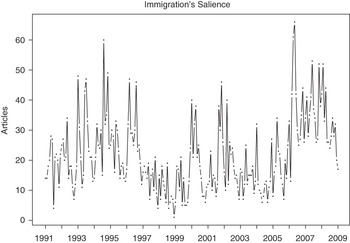
What made 2006 distinctive was chiefly the salience of immigration as a national political issue, as Figure 1 makes clear. It presents monthly counts of articles mentioning ‘immigration’ or ‘immigrants’ in USA Today, the most widely read American newspaper.Footnote 59 Articles about immigration in countries other than the United States were excluded. Immigration began to generate headlines in December 2005 following congressional action, and grew more salient during the pro-immigrant marches in March, April and May of that year. In a 2006 Pew survey, 19 per cent of respondents called immigration ‘a very big problem in my local community’ and 42 per cent deemed it a big national problem. The percentage naming immigration as the single most important local problem increased fivefold, from 0.5 per cent in 2001 to 2.7 per cent in 2006. This section focuses on the 2006 survey, since it alone asked whether immigration was a big problem in respondents’ local communities. But we know from the 2001 survey that only a handful of people were worried about immigration as a local problem at that point in time.
The number of stories about the United States in USA Today using the words ‘immigration’ or ‘immigrants’ (monthly)

The 2006 survey included a nationally representative sample with 1,687 respondents born in the United States who were non-Hispanic whites or African Americans.Footnote 60 Of these respondents, 830 answered the question about immigration as a local problem. Although the US Census is only conducted every ten years, county-level demographic information from the 2006 American Community Survey (ACS) is available for 70 per cent of these respondents, allowing us to reduce measurement error by using contextual measures that reflect recent population movements.Footnote 61 Missing data for contextual and other variables were multiply imputed,Footnote 62 although we obtain the same substantive results through listwise deletion.Footnote 63 The same results also hold when using older ZIP code-based contextual measures from the decennial census.Footnote 64 The Pearson’s correlation between the percentage of immigrants at the county level and at the ZIP level was 0.83 in 2000, indicating that a higher level of aggregation does not substantially impact measurement. This figure is markedly higher than the Pearson correlation of 0.66 for the percentage of African Americans, and is likely to indicate immigrants’ concentration in certain areas of the United StatesFootnote 65 and their relative residential integration within those areas.Footnote 66
To gauge the impact of local demographics more precisely, the analysis used an ordered probit to model the factors making respondents more likely to say that immigration was ‘a very big problem’.Footnote 67 Formally, an ordered probit models a latent, continuous variable  where μi = xiβ, xi is a vector of the sixteen covariates listed below for observation i, and where yi belongs to category j if it falls between cutpoints τj −1 and τj. Given the dependent variable, there are four categories and three estimated cutpoints. Note that this is not a multilevel model: with only an average of 5.8 respondents per county, using county fixed-effects or multilevel modelling would overfit the data, making it impossible to recover contextual effects.
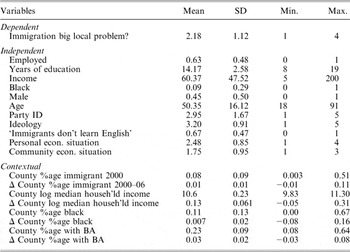
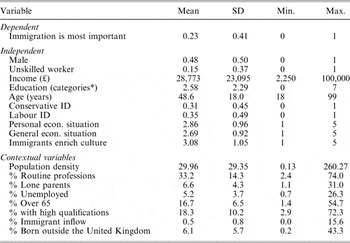
The individual-level independent variables include the respondent’s ideology, partisanship, income, employment status, age, race, sex and education.Footnote 68 At the county level, the models include the percentage of immigrants, the percentage with a college degree, the percentage black, and the log of the median household income, all measured through the 2000 Census. The models also include the changes in each contextual estimate from 2000 to 2006. The Appendix details the question wording for the dependent variable and select independent variables; Table 1 provides the descriptive statistics.Footnote 69 These basic models avoid using attitudinal variables such as subjective economic perceptions or cultural concerns, since such attitudes could easily be endogenous to one’s level of concern about immigration. However, robustness checks confirm that the results are substantively identical when using the respondent’s assessment of their own or their community’s economic prospects.Footnote 70
Summary Description of 830 Non-Hispanic White and Black Respondents in the National Sample of the Pew Survey on Immigration (United States, 2006)

From the ordered probit model, we can estimate the probability that a respondent’s answer would fall into the most concerned category. If an otherwise average respondent lives in an area where the immigrant population shrank by one-fifth of a percentage point, the probability that she calls immigration a very big local problem is 10.7 per cent. Had the same respondent lived in a county where the immigrant population grew by 3.2 percentage points between 2000 and 2006, she would have called immigration a very big local problem 25.1 per cent of the time. Put differently, when shifting from a county at the 10th percentile in terms of its changing immigrant population to one at the 90th percentile, the probability of responding in the most concerned category more than doubles. Holding continuous variables at their means and ordinal variables at their medians, we find that those living in counties with growing immigrant populations in 2006 were far more likely to be concerned about immigration. The same is true for people living in counties with large baseline immigrant populations, with an effect of similar magnitude. To the extent that selection bias influences these results, it is likely to drive them downwards, since some subset of people who are especially worried about immigration’s impacts might select away from heavily or increasingly immigrant areas.
Given the prominence of resource competition as an alternative explanation, it is worth devoting special attention to economic variables as potential confounders. The initial models include the respondent’s education and income as well as aggregated measures of education and median household income and their changes from 2000 to 2006. To ensure the robustness of results, the analysis then added the 2005 county-level unemployment rate and its change from 2005 to 2006 to capture local economic conditions. Using an interaction term, we learn that those with full-time jobs are actually less responsive to the changing local context than are other respondents. The other variables have little influence, either on their own or interacting with the measure of local inflows of immigrants. Economic threat does little to explain these findings.
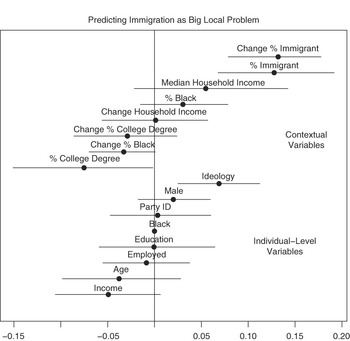
Returning to the main model, Figure 2 depicts the first differences for each independent variable when holding other variables at their means or medians. Each dot represents the estimated change in the probability of being very concerned about immigration when the variable in question moves from its 10th percentile to its 90th percentile. The lines represent 95 per cent confidence intervals for these changed probabilities. The figure makes it clear that the share of immigrants in 2000 and changes in that metric from 2000 to 2006 are the strongest predictors of increased local concern about immigration. At a time when immigration was a prominent national topic of debate, the presence of many immigrants or growing numbers of immigrants in the area produced concerns about immigration’s local impact as well. Given the national attention to the issue, local contexts can indeed generate threatened responses. But as we saw in 2001, demographic changes alone are not always threatening – nor are large local immigrant populations.
The first difference and 95 per cent confidence interval when each variable is shifted from its 10th percentile to its 90th percentile while holding others at their means or medians (2006 US Survey)

General Election in England and Wales
The idea of an interaction between salient political rhetoric – typically at the national level – and local experiences has precursors in qualitative research about anti-immigrant politics in Britain.Footnote 71 In their narratives, Hewitt, Solomos and Husbands illustrate how groups mobilize locally in response to national rhetoric and shifts in national politics. Husbands, for example, points out that the National Front’s ‘fortune has risen and fallen according to the occurrence of race-related events, and in particular, to the type of coverage these events have been given by the media’.Footnote 72 This section provides a test of whether local–national interactions can explain which British respondents are especially concerned about immigration.
This section employs BES panel data collected during the 2005 general election campaign in Britain to confront these possibilities and test the argument in an unlikely case.Footnote 73 It shows that contextual effects vary systematically in a period of months, making explanations based on economic conditions or other slow-moving variables less likely. At the same time, these data allow us to rule out several key alternative explanations based on selection bias and endogeneity. By observing the same respondents before and after exposure to significant rhetoric about immigration, we can identify whether contexts become a stronger predictor of concern about immigration. Most selection processes are held constant in such a design, since they cannot explain the change in a contextual influence. Also, attitudes observed after the campaign cannot explain the salience of rhetoric during the campaign, reducing concerns about the endogeneity of political rhetoric. The dependent variable is whether respondents report that ‘immigration’ or ‘asylum’ is the most important problem facing Britain.
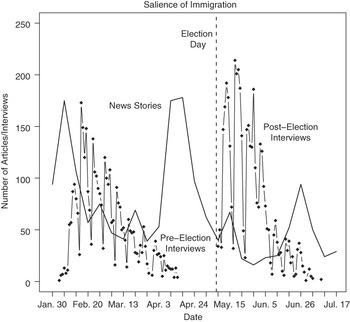
Figure 3 demonstrates the research design underpinning these analyses. The two dotted lines indicate the number of respondents interviewed each day both before and after the election. In total, 3,589 respondents were interviewed prior to the election, and 2,959 of those respondents were re-interviewed afterwards. We see from the figure that the vast majority of the pre-election interviews took place prior to the 11 April announcement of the election, and the vast majority of post-election interviews were completed within two months of the 5 May election. Virtually all were prior to the terrorist attacks in London on 7 July 2005. In these analyses, all interviews were face-to-face.Footnote 74
Interviews per day and attention to immigration-related issues each week (Britain, 2005)

The solid line in Figure 3 indicates the number of news stories by week mentioning ‘race’, ‘immigration’, ‘immigrants’ or ‘asylum’.Footnote 75 As other researchers have noted, elite attention to immigration spiked during the early phase of the campaign.Footnote 76 In part, that was driven by the Conservative party’s election theme, ‘Are you thinking what we’re thinking?’, which some believed to be a subtle attempt to evoke unease about immigration. This type of politics, which attempts to send signals to one constituency that go unheeded by another, has earned the name ‘dog-whistle politics’. The notion that the Tories were trying to appeal to racial sentiment was reinforced by their hiring of Lynton Crosby, a strategist who had previously used immigration in Australian campaigns.Footnote 77 Alongside concerns about asylum, the immigration issue tapped concerns about terrorism and about the East European migrants who arrived following the 2004 expansion of the European Union.
Irrespective of the Conservatives’ intentions, immigration and asylum issues became central in the early part of the campaign.Footnote 78 This allows us to compare the same respondents living in the same neighbourhoods before and after exposure to national rhetoric on issues of asylum and immigration. It is important to clarify that the dependent variable is not a respondent’s vote choice, as other issues could easily have intervened in voters’ decisions about whether to vote and for whom. Indeed, there is evidence that they did: both The Economist and ICM surveys suggest that immigration and asylum were not the voters’ most important issue, and that the issue’s salience did not provide an overall boost to the Conservatives.Footnote 79 Instead, we are asking a narrower question about the changing relationship between local contexts and respondents’ concern about immigration.
Contextual data are available at a variety of levels of aggregation, from Lower Level Super Output Areas with an average of 1,513 people, through electoral wards with an average of 5,909 to parliamentary constituencies with an average of 91,387.Footnote 80 We can thus compare respondents at multiple levels of aggregation as well. Note that because the data include respondents from 909 separate local output areas, there is an average of just 2.6 respondents per output area. This means that multilevel models with random effects at the output area would obscure which local factors were correlated with respondents’ attitudes.
The dependent variable is a binary indicator of whether the respondent deemed immigration (or asylum) the most important issue facing the country. The exact question wording for this and a selection of other questions is available in the online Appendix. The individual-level independent variables include the respondent’s sex, age, educational level and income as well as indicator variables for unskilled workers, respondents receiving Jobseekers’ Allowance or unemployment assistance, Conservative identifiers and Labour identifiers.Footnote 81 To account for respondents’ subjective perceptions of economic insecurity, the model included both their assessment of their own economic situation over the last year and the nation’s. The model also accounts for respondents’ cultural concerns about immigration by using their agreement or disagreement that ‘immigrants make Britain more open to new ideas and cultures’. To prevent confounding, all of the independent variables are drawn from responses to the pre-campaign survey. In substantive terms, the results are identical with or without the three attitudinal measures. Table 2 provides descriptive statistics for all variables included in the model.
For Key Variables in the BES, Descriptive Statistics for the 2,386 White Respondents in England and Wales

*See fn. 81 for explanation.
At the neighbourhood level – operationalized here as the Lower Level Super Output Area – the model includes the percentage with high qualifications (well educated), the percentage of the economically active who are in routine or semi-routine occupations, the percentage of lone-parent or single-parent households, the percentage unemployed, the percentage over 65, the population density, the proportion born abroad, and the inflow of immigrants in the prior year. We restrict the sample to white British respondents living in England and Wales, which leaves us with 2,386 respondents.Footnote 82 Some of these measures have considerable numbers of missing responses: 12.9 per cent of respondents declined to report their income and 11.8 per cent declined to report their party affiliation. Given the overall pattern of missing data, listwise deletion would eliminate 34.8 per cent of the respondents; so here again, missing data are multiply imputed.Footnote 83 In this case, the dependent variable is binary, and therefore the estimating equation is a logistic regression of the form:

where πi is the probability that the binary outcome yi is 1 for respondent i and xi is a vector of the individual-level and neighbourhood-level covariates listed above and in Table 2.
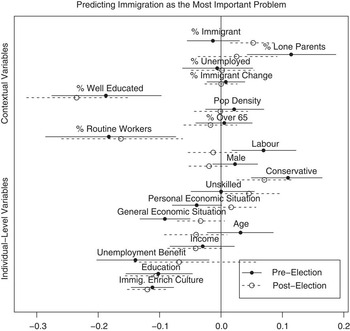
The results from separate models for the pre-election and post-election responses are shown in Figure 4.Footnote 84 Consider the solid lines first. For the pre-election data, we fit a logistic regression predicting whether the respondent calls ‘immigration or asylum’ Britain’s most important issue. For each independent variable, we then estimated the difference in the expected outcome as the independent variable shifts from its 10th percentile to its 90th, holding others constant. This change in probability is a first difference. The dot indicates the average first difference across 10,000 simulations, and the solid line represents its 95 per cent confidence interval. We see, for example, that the first difference for the change in the per cent immigrant is almost exactly zero, indicating that this variable has little predictive power in the pre-election data. The local percentage of immigrants in the pre-election period is positive but very close to zero, indicating that we cannot make strong statements about its influence.
Living in a heavily immigrant neighbourhood was a stronger predictor of concern about immigration after the 2005 British general election Note: First differences given a shift in each independent variable, with data separated into pre-election and post-election periods.

However, the post-election results tell a different story, as demonstrated by dotted lines. After the election, we see that the percentage of immigrants in the neighbourhood becomes a significant predictor of thinking that immigration is the most important problem. Shifting from a neighbourhood at the 10th percentile (1.6 per cent born abroad) to a neighbourhood at the 90th percentile (11.4 per cent born abroad), we see a 5.2 percentage point increase in the probability of naming immigration as the most important issue on average. The confidence interval runs from 1.5 percentage points to 9.0 percentage points. Once the campaign had ended, there was consistent evidence that those respondents in heavily immigrant neighbourhoods were significantly more concerned about immigration. Moreover, that had not been the case just months before. Thus, we cannot attribute the contextual effect to straightforward selection bias, or to any other alternative causal factor that acted prior to the campaign itself.
Comparing the estimated effects before and after the campaign, we see stable influences in most cases. The technique does confirm our expectation that people who initially identified with Labour would become less concerned about immigration relative to other respondents over the course of the campaign (p = 0.01, one-sided test). This is no surprise: the Conservative emphasis on immigration was likely to shift attitudes among the non-identified or among Conservatives more than among Labour identifiers.Footnote 85 The technique of comparing impacts at two different points in time detects effects where we expect them and does not reveal many effects where we would not.
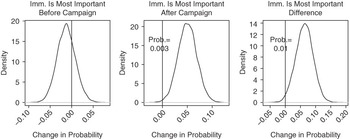
The true test of the hypothesis of a national–local interaction lies in the extent to which contextual effects change over the course of the election. The left side of Figure 5 plots the change in predicted probabilities when shifting to a heavily immigrant neighbourhood during the pre-campaign period.Footnote 86 Context has virtually no predictive power. The middle figure demonstrates the comparable estimate in the post-campaign period, when respondents have just been exposed to sustained rhetoric on immigration. There, we do see a marked effect averaging 5.2 percentage points. The p-value for the test that this effect is positive is 0.003. At right, we see the difference-in-difference estimate when we subtract the post-election estimated effect from the pre-election estimated effect. The p-value of 0.01 indicates that in only 1.1 per cent of simulations is the contextual effect of living near many immigrants stronger before the election. In the span of a few months, contexts can be politicized.
Pre-election predicted impact of shifting to a heavily immigrant context, the post-election predicted impact, and the difference-in-difference estimate (2005 British panel data)

Certainly, one might worry that this result stems from some idiosyncrasy of the data collection or model specification. However, the pattern of results holds very consistently when we include any one of eighteen additional neighbourhood-level measures, from the percentage under 15 to the percentage without a car.Footnote 87 They also hold up when using the share of Labour’s vote in the constituency in the 2001 election, a fact which rules out the alternative explanation that local differences are driven by aggregate partisanship. The only variable that obscures its influence is the percentage of black respondents, which correlates with the percentage foreign born at 0.72.Footnote 88 The result is also robust when we remove any of the measures of skills or economic deprivation, since there are several such measures in the model. One might also worry that these findings are driven by London, the most diverse metropolis in the United Kingdom. But even excluding the capital city, the results remain robust. They are also robust when using the larger census wards or parliamentary constituencies as the geographic unit.
Local Campaigns or National Information?
An additional concern is that these results are confounded by local campaigns as well as by variations in information environments across England and Wales. One might point to the 2005 example of Margaret Hodge, a Labour MP from Barking who gave voice to the concerns of constituents about immigration – and in doing so, raised the profile of the issue nationally. One might also point to a 2005 Conservative campaign letter sent to South Dorset voters that calculated the local cost of Labour’s ‘chaotic asylum system’ at more than one million pounds.Footnote 89 Certainly, the conceptualization of a single, nationally driven information environment across England and Wales is an over-simplification. Issues emerge from certain constituencies, and the parties target their appeals to certain constituencies. The 2005 campaign in particular was targeted, with the parties competing very differently across the constituencies.Footnote 90 Nonetheless, when we take into account the log of total campaign spending by constituency,Footnote 91 which should measure the intensity of local campaigning, we find the same results as reported above. Similarly, we do not see an interaction where the effects of the percentage of immigrants are stronger or weaker in the most competitive constituencies.Footnote 92 Voters are responding to immigrant neighbours similarly in the most and least competitive constituencies, a fact which weighs against the alternative explanation that these effects are driven locally. Certainly, local elites are likely to mobilize on immigration to differing extents, but we see few traces of their efforts in the pre-election period.
If local contexts are in fact politicized by national events rather than local activities, we should expect people who paid close attention to the campaign to be especially susceptible to environmental influence. Respondents were asked if they had seen ‘any of the Party Election Broadcasts that were shown on television during the election campaign’, and 68 per cent of respondents in our sample said that they had. Among those respondents, the contextual effect of shifting from a neighbourhood that is at the 10th percentile foreign born to one at the 90th percentile is 9.6 percentage points, with a 95 per cent confidence interval from 4.9 to 14.5 percentage points. Since only one in five respondents in the survey indicated that immigration was the nation’s most important problem, this 9.6 percentage point increase represents a change of 45 per cent over the baseline probability. Among those who did not watch a broadcast, the contextual effect is a statistically insignificant −4.9 percentage points. No such interaction existed before the campaign. Not only did the campaign induce a contextual effect, it did so in the subset of people who were paying close attention.Footnote 93 This finding is counter-intuitive, since media effects and local contextual effects are often thought of as substitutes. But it provides yet more evidence that national politics can shape local contextual effects.
Using interaction models, we can also examine whether the neighbourhood effect is especially strong among other key sub-groups. For instance, one might suspect that concerns about immigration are rooted in views that are at once local and sociotropic: respondents might be concerned about its impact on their neighbours. If so, we might expect a positive interaction between the proportion born outside Britain and the respondent’s commitment to the neighbourhood just after the election. The BES mail-back survey provides two such measures of neighbourhood attachment. The first asked respondents, ‘How strong are your feelings of attachment to your neighbourhood?’ The second asked respondents to agree or disagree that: ‘I feel like I belong in this neighbourhood.’ Yet in the post-election data, neither of these measures of community attachment interacts with the local proportion born outside Britain.Footnote 94 These effects are not more pronounced among people who are more community-oriented, and are not likely to be driven by concern for one’s neighbours.
Discussion and conclusion
Contextual effects are not static. Even the same respondents living in the same neighbourhoods will respond differently to their neighbours depending on the broader national context. And this is not a finding that is specific to the United States: it shows up in Britain as well. Having identified the same processes at work in two different countries, we can be more confident that they are not idiosyncratic, or artefacts of multivariate analysis. Across countries and across time, we observe that contextual effects are influenced by the national political environment. This provides an alternative explanation for the past conflicting findings on inter-group threat. Perhaps the conflicting findings reflect a conflicted reality, as threatened responses come and go with national attention to immigration.
One might also invert these conclusions, and use them to gain leverage in debates about the role that elites play in shaping public opinion.Footnote 95 This study suggests that salient elite rhetoric on an issue might be more effective when it resonates with experiences in people’s day-to-day lives.Footnote 96 The influence of frames could be contingent not only on their persuasiveness and timing, as argued by Chong and Druckman,Footnote 97 but on their resonance – that is, their ability to highlight factors observed in people’s own experience. Already, scholars have observed some evidence in favour of this view. As Butler and Stokes note, in 1964, British respondents living in heavily immigrant areas were more likely to differentiate between the two parties based on their stances on immigration.Footnote 98 Information provided by national politics may resonate locally in different ways.
Still, this study itself leaves several questions for future work. Here, for simplicity’s sake, the information environment is typically characterized as a single national stream of information, received with equal intensity by all respondents or by those watching Party Broadcasts. Scholars can nuance that understanding in two ways. We can develop more accurate characterizations of the information environment, characterizations that acknowledge variation by media source and location. Where people get news shapes, what news they get. And we can link that variation to the characteristics that make people more or less susceptible to the interactive effects highlighted in this article. The interaction with campaign attention described above is a small step in this direction. Both characteristics of the respondent and characteristics of the community might shape the dissemination of contextual information.
Future work should also explore why specific aspects of the local context do or do not become politicized. Past research on the United States (and, to some extent, this article’s American analyses) emphasize the role of changes in local contexts, demonstrating that sudden inflows of immigrants can generate adverse responses. In those cases, residence in heavily immigrant communities did not correlate with anti-immigrant views. The studies here demonstrate that at least in Britain it is not changes but levels of ethnic diversity alone that generate concern about immigration. One might try to explain those differences with reference to residential mobility or differences in the role of local government in providing resources. Given that government-provided housing is far more prevalent in Britain, it is plausible that traditional threat-style responses to large immigrant populations are more common there as well. In Britain, larger immigrant populations could be thought to indicate a shift in local political power and the allocation of local resources. In the United States, with its high rates of home ownership, changes might be especially destabilizing. Changes might induce uncertainty about the future of the neighbourhood and an impetus to sell one’s home quickly before prices decline.Footnote 99 But as this article has demonstrated, to produce a sizeable contextual effect, the broader information environment must be conducive as well.