


%20--%3e%3c!DOCTYPE%20svg%20PUBLIC%20'-//W3C//DTD%20SVG%201.0//EN'%20'http://www.w3.org/TR/2001/REC-SVG-20010904/DTD/svg10.dtd'%3e%3csvg%20version='1.0'%20id='Layer_1'%20xmlns='http://www.w3.org/2000/svg'%20xmlns:xlink='http://www.w3.org/1999/xlink'%20x='0px'%20y='0px'%20width='64px'%20height='64px'%20viewBox='5.5%20-3.5%2064%2064'%20enable-background='new%205.5%20-3.5%2064%2064'%20xml:space='preserve'%3e%3cg%3e%3ccircle%20fill='%23FFFFFF'%20fill-opacity='0'%20cx='37.785'%20cy='28.501'%20r='28.836'/%3e%3cpath%20fill='%23595959'%20d='M37.441-3.5c8.951,0,16.572,3.125,22.857,9.372c3.008,3.009,5.295,6.448,6.857,10.314%20c1.561,3.867,2.344,7.971,2.344,12.314c0,4.381-0.773,8.486-2.314,12.313c-1.543,3.828-3.82,7.21-6.828,10.143%20c-3.123,3.085-6.666,5.448-10.629,7.086c-3.961,1.638-8.057,2.457-12.285,2.457s-8.276-0.808-12.143-2.429%20c-3.866-1.618-7.333-3.961-10.4-7.027c-3.067-3.066-5.4-6.524-7-10.372S5.5,32.767,5.5,28.5c0-4.229,0.809-8.295,2.428-12.2%20c1.619-3.905,3.972-7.4,7.057-10.486C21.08-0.394,28.565-3.5,37.441-3.5z%20M37.557,2.272c-7.314,0-13.467,2.553-18.458,7.657%20c-2.515,2.553-4.448,5.419-5.8,8.6c-1.354,3.181-2.029,6.505-2.029,9.972c0,3.429,0.675,6.734,2.029,9.913%20c1.353,3.183,3.285,6.021,5.8,8.516c2.514,2.496,5.351,4.399,8.515,5.715c3.161,1.314,6.476,1.971,9.943,1.971%20c3.428,0,6.75-0.665,9.973-1.999c3.219-1.335,6.121-3.257,8.713-5.771c4.99-4.876,7.484-10.99,7.484-18.344%20c0-3.543-0.648-6.895-1.943-10.057c-1.293-3.162-3.18-5.98-5.654-8.458C50.984,4.844,44.795,2.272,37.557,2.272z%20M37.156,23.187%20l-4.287,2.229c-0.458-0.951-1.019-1.619-1.685-2c-0.667-0.38-1.286-0.571-1.858-0.571c-2.856,0-4.286,1.885-4.286,5.657%20c0,1.714,0.362,3.084,1.085,4.113c0.724,1.029,1.791,1.544,3.201,1.544c1.867,0,3.181-0.915,3.944-2.743l3.942,2%20c-0.838,1.563-2,2.791-3.486,3.686c-1.484,0.896-3.123,1.343-4.914,1.343c-2.857,0-5.163-0.875-6.915-2.629%20c-1.752-1.752-2.628-4.19-2.628-7.313c0-3.048,0.886-5.466,2.657-7.257c1.771-1.79,4.009-2.686,6.715-2.686%20C32.604,18.558,35.441,20.101,37.156,23.187z%20M55.613,23.187l-4.229,2.229c-0.457-0.951-1.02-1.619-1.686-2%20c-0.668-0.38-1.307-0.571-1.914-0.571c-2.857,0-4.287,1.885-4.287,5.657c0,1.714,0.363,3.084,1.086,4.113%20c0.723,1.029,1.789,1.544,3.201,1.544c1.865,0,3.18-0.915,3.941-2.743l4,2c-0.875,1.563-2.057,2.791-3.541,3.686%20c-1.486,0.896-3.105,1.343-4.857,1.343c-2.896,0-5.209-0.875-6.941-2.629c-1.736-1.752-2.602-4.19-2.602-7.313%20c0-3.048,0.885-5.466,2.658-7.257c1.77-1.79,4.008-2.686,6.713-2.686C51.117,18.558,53.938,20.101,55.613,23.187z'/%3e%3c/g%3e%3c/svg%3e)
%20--%3e%3c!DOCTYPE%20svg%20PUBLIC%20'-//W3C//DTD%20SVG%201.0//EN'%20'http://www.w3.org/TR/2001/REC-SVG-20010904/DTD/svg10.dtd'%3e%3csvg%20version='1.0'%20id='Layer_1'%20xmlns='http://www.w3.org/2000/svg'%20xmlns:xlink='http://www.w3.org/1999/xlink'%20x='0px'%20y='0px'%20width='64px'%20height='64px'%20viewBox='5.5%20-3.5%2064%2064'%20enable-background='new%205.5%20-3.5%2064%2064'%20xml:space='preserve'%3e%3cg%3e%3ccircle%20fill='%23FFFFFF'%20fill-opacity='0'%20cx='37.637'%20cy='28.806'%20r='28.276'/%3e%3cg%3e%3cpath%20fill='%23595959'%20d='M37.443-3.5c8.988,0,16.57,3.085,22.742,9.257C66.393,11.967,69.5,19.548,69.5,28.5c0,8.991-3.049,16.476-9.145,22.456%20C53.879,57.319,46.242,60.5,37.443,60.5c-8.649,0-16.153-3.144-22.514-9.43C8.644,44.784,5.5,37.262,5.5,28.5%20c0-8.761,3.144-16.342,9.429-22.742C21.101-0.415,28.604-3.5,37.443-3.5z%20M37.557,2.272c-7.276,0-13.428,2.553-18.457,7.657%20c-5.22,5.334-7.829,11.525-7.829,18.572c0,7.086,2.59,13.22,7.77,18.398c5.181,5.182,11.352,7.771,18.514,7.771%20c7.123,0,13.334-2.607,18.629-7.828c5.029-4.838,7.543-10.952,7.543-18.343c0-7.276-2.553-13.465-7.656-18.571%20C50.967,4.824,44.795,2.272,37.557,2.272z%20M46.129,20.557v13.085h-3.656v15.542h-9.944V33.643h-3.656V20.557%20c0-0.572,0.2-1.057,0.599-1.457c0.401-0.399,0.887-0.6,1.457-0.6h13.144c0.533,0,1.01,0.2,1.428,0.6%20C45.918,19.5,46.129,19.986,46.129,20.557z%20M33.042,12.329c0-3.008,1.485-4.514,4.458-4.514s4.457,1.504,4.457,4.514%20c0,2.971-1.486,4.457-4.457,4.457S33.042,15.3,33.042,12.329z'/%3e%3c/g%3e%3c/g%3e%3c/svg%3e)
%20--%3e%3c!DOCTYPE%20svg%20PUBLIC%20'-//W3C//DTD%20SVG%201.0//EN'%20'http://www.w3.org/TR/2001/REC-SVG-20010904/DTD/svg10.dtd'%3e%3csvg%20version='1.0'%20id='Layer_1'%20xmlns='http://www.w3.org/2000/svg'%20xmlns:xlink='http://www.w3.org/1999/xlink'%20x='0px'%20y='0px'%20width='64px'%20height='64px'%20viewBox='5.5%20-3.5%2064%2064'%20enable-background='new%205.5%20-3.5%2064%2064'%20xml:space='preserve'%3e%3cg%3e%3ccircle%20fill='%23FFFFFF'%20fill-opacity='0'%20cx='36.924'%20cy='28.403'%20r='28.895'/%3e%3cpath%20fill='%23595959'%20d='M37.442-3.5c8.99,0,16.571,3.085,22.743,9.256C66.393,11.928,69.5,19.509,69.5,28.5c0,8.992-3.048,16.476-9.145,22.458%20C53.88,57.32,46.241,60.5,37.442,60.5c-8.686,0-16.19-3.162-22.513-9.485C8.644,44.728,5.5,37.225,5.5,28.5%20c0-8.762,3.144-16.343,9.429-22.743C21.1-0.414,28.604-3.5,37.442-3.5z%20M12.7,19.872c-0.952,2.628-1.429,5.505-1.429,8.629%20c0,7.086,2.59,13.22,7.77,18.4c5.219,5.144,11.391,7.715,18.514,7.715c7.201,0,13.409-2.608,18.63-7.829%20c1.867-1.79,3.332-3.657,4.398-5.602l-12.056-5.371c-0.421,2.02-1.439,3.667-3.057,4.942c-1.622,1.276-3.535,2.011-5.744,2.2%20v4.915h-3.714v-4.915c-3.543-0.036-6.782-1.312-9.714-3.827l4.4-4.457c2.094,1.942,4.476,2.913,7.143,2.913%20c1.104,0,2.048-0.246,2.83-0.743c0.78-0.494,1.172-1.312,1.172-2.457c0-0.801-0.287-1.448-0.858-1.943l-3.085-1.315l-3.771-1.715%20l-5.086-2.229L12.7,19.872z%20M37.557,2.214c-7.276,0-13.428,2.571-18.457,7.714c-1.258,1.258-2.439,2.686-3.543,4.287L27.786,19.7%20c0.533-1.676,1.542-3.019,3.029-4.028c1.484-1.009,3.218-1.571,5.2-1.686V9.071h3.715v4.915c2.934,0.153,5.6,1.143,8,2.971%20l-4.172,4.286c-1.793-1.257-3.619-1.885-5.486-1.885c-0.991,0-1.876,0.191-2.656,0.571c-0.781,0.381-1.172,1.029-1.172,1.943%20c0,0.267,0.095,0.533,0.285,0.8l4.057,1.83l2.8,1.257l5.144,2.285l16.397,7.314c0.535-2.248,0.801-4.533,0.801-6.857%20c0-7.353-2.552-13.543-7.656-18.573C51.005,4.785,44.831,2.214,37.557,2.214z'/%3e%3c/g%3e%3c/svg%3e)
%20--%3e%3c!DOCTYPE%20svg%20PUBLIC%20'-//W3C//DTD%20SVG%201.0//EN'%20'http://www.w3.org/TR/2001/REC-SVG-20010904/DTD/svg10.dtd'%3e%3csvg%20version='1.0'%20id='Layer_1'%20xmlns='http://www.w3.org/2000/svg'%20xmlns:xlink='http://www.w3.org/1999/xlink'%20x='0px'%20y='0px'%20width='64px'%20height='64px'%20viewBox='5.5%20-3.5%2064%2064'%20enable-background='new%205.5%20-3.5%2064%2064'%20xml:space='preserve'%3e%3cg%3e%3ccircle%20fill='%23FFFFFF'%20fill-opacity='0'%20cx='36.944'%20cy='28.631'%20r='29.105'/%3e%3cg%3e%3cpath%20fill='%23595959'%20d='M37.443-3.5c8.951,0,16.531,3.105,22.742,9.315C66.393,11.987,69.5,19.548,69.5,28.5c0,8.954-3.049,16.457-9.145,22.514%20C53.918,57.338,46.279,60.5,37.443,60.5c-8.649,0-16.153-3.143-22.514-9.429C8.644,44.786,5.5,37.264,5.5,28.501%20c0-8.723,3.144-16.285,9.429-22.685C21.138-0.395,28.643-3.5,37.443-3.5z%20M37.557,2.272c-7.276,0-13.428,2.572-18.457,7.715%20c-5.22,5.296-7.829,11.467-7.829,18.513c0,7.125,2.59,13.257,7.77,18.4c5.181,5.182,11.352,7.771,18.514,7.771%20c7.123,0,13.334-2.609,18.629-7.828c5.029-4.876,7.543-10.99,7.543-18.343c0-7.313-2.553-13.485-7.656-18.513%20C51.004,4.842,44.832,2.272,37.557,2.272z%20M23.271,23.985c0.609-3.924,2.189-6.962,4.742-9.114%20c2.552-2.152,5.656-3.228,9.314-3.228c5.027,0,9.029,1.62,12,4.856c2.971,3.238,4.457,7.391,4.457,12.457%20c0,4.915-1.543,9-4.627,12.256c-3.088,3.256-7.086,4.886-12.002,4.886c-3.619,0-6.743-1.085-9.371-3.257%20c-2.629-2.172-4.209-5.257-4.743-9.257H31.1c0.19,3.886,2.533,5.829,7.029,5.829c2.246,0,4.057-0.972,5.428-2.914%20c1.373-1.942,2.059-4.534,2.059-7.771c0-3.391-0.629-5.971-1.885-7.743c-1.258-1.771-3.066-2.657-5.43-2.657%20c-4.268,0-6.667,1.885-7.2,5.656h2.343l-6.342,6.343l-6.343-6.343L23.271,23.985L23.271,23.985z'/%3e%3c/g%3e%3c/g%3e%3c/svg%3e)
Introduction
The genus Scoliciosporum A. Massal. was erected by Massalongo (Reference Massalongo1852) for two species with multiseptate ascospores: S. holomelaenum (Flörke) A. Massal. and S. molle A. Massal. Massalongo (op. cit.) separated his new genus from Bacidia De Not. by the apothecia having a darker disc and epihymenium and the ascospores being only 3-septate. In his discussion, Massalongo also mentioned the worm-like ascospores, from which he derived the generic name. Although the new genus was accepted by some lichenologists (e.g. Koerber Reference Koerber1855; Arnold Reference Arnold1858; Mudd Reference Mudd1861), others preferred to include the species in other genera, such as Bacidia (Anzi Reference Anzi and Franchi1860; Fries Reference Fries1861) and Biatora (Hepp Reference Hepp1853), or to retain them in Lecidea (Nylander Reference Nylander1855, Reference Nylander1861; also treated L. holomelaena Flörke as a later synonym of L. umbrina Ach. (= Scoliciosporum umbrinum (Ach.) Lojka)). Zahlbruckner (Reference Zahlbruckner1926) included both species under Bacidia (section Scoliciosporum Jatta): S. holomelaenum as a synonym of Bacidia umbrina var. psotina (Fr.) Th. Fr., and S. molle as a synonym of Bacidia incompta (Borrer) Anzi (= Bellicidia incompta (Borrer) Kistenich et al.). Scoliciosporum then fell into disuse until it was resurrected by Vĕzda (Reference Vĕzda1978), who also selected S. holomelaenum (= S. umbrinum) as the type species.
As currently circumscribed, the genus includes c. 25–30 species of crustose lichens occurring most often on bark, stones and leaves in temperate areas, mostly with a thin scurfy thallus, immarginate apothecia with gelatinized, branched and anastomosing paraphyses, 8-spored (8–16 in S. curvatum Sérus.), Lecanora-type asci, and hyaline, septate ascospores (Kantvilas Reference Kantvilas2008). Specifically, they are distinguished from species of Bacidia by the poorly developed proper exciple consisting of paraphysis-like hyphae, the abundantly branched and anastomosing paraphyses, the wide axial body of the Lecanora-type ascus, and the presence of some paraphyses terminating in swollen apices that are surrounded by darkly pigmented hoods (Ekman Reference Ekman1996). The group of species containing lobaric acid and having a Bacidia/Biatora-type ascus (S. pensylvanicum R. C. Harris, S. pruinosum (P. James) Vězda and S. schadeanum (Erichsen) Vězda) is anomalous within Scoliciosporum. Kantvilas (Reference Kantvilas2008) suggested that S. pruinosum could belong to the Australasian genus Jarmania Kantvilas, and this was also the opinion of Palice et al. (Reference Palice, Printzen, Spribille, Svensson, Tønsberg, Urbanavichene, Yakovchenko and Ekman2013). These latter authors also mentioned a close relationship of this group with Myrionora R. C. Harris. However, the type species of that genus, M. albidula (Willey) R. C. Harris, was shown by Kistenich et al. (Reference Kistenich, Timdal, Bendiksby and Ekman2018) to be referable to Biatora Ach., and so Myrionora becomes a synonym of Biatora. Both Biatora and Jarmania belong in Ramalinaceae C. Agardh, and so it is probable that the lobaric acid-containing Scoliciosporum species also belong in that family and are not considered further here.
Systematically, Scoliciosporum is placed in its own family, Scoliciosporaceae Hafellner in Lecanorales Nannf. (Hyde et al. Reference Hyde, Noorabadi, Thiyagaraja, He, Johnston, Wijesinghe, Armand, Biketova, Chethana and Erdoğdu2024), the species forming a well-supported clade in molecular analyses (e.g. Svensson & Fryday Reference Svensson and Fryday2022).
Here we describe a further species of Scoliciosporum from the Canadian Arctic that is anomalous in the genus by occurring on terricolous bryophytes and having large, flat apothecia with a persistent, thin proper margin but is shown by molecular data to be a species of Scoliciosporum s. str.
Materials and Methods
Morphological methods
Gross morphology was examined under a dissecting microscope, and apothecial characteristics by light microscopy (compound microscope) on hand-cut sections mounted in water, 10% KOH (K), 50% HNO3 (N) or Lugol’s reagent (1.5% aqueous solution; I/KI). Thallus sections were investigated in water, commercial bleach (C), K, N and concentrated Lugol’s reagent (6% aqueous solution; I/KIconc.). The presence of light-refractive crystals was detected using polarized light (POL). Ascospore dimensions of the new taxon were measured in water and are given as (minimum value–)mean ± standard deviation(–maximum value), with ‘n’ indicating the number of ascospores measured. Thallus chemistry was investigated by thin-layer chromatography (TLC), following the methods of Orange et al. (Reference Orange, James and White2001).
DNA extraction and amplification
We extracted DNA following the methods described in Svensson & Fryday (Reference Svensson and Fryday2022). To amplify and sequence the mitochondrial ribosomal small subunit (12S, hereafter mtSSU), the nuclear ribosomal large subunit (28S, hereafter LSU), nuclear ribosomal DNA ITS1-5.8S-ITS2 (hereafter ITS), and the DNA-directed RNA polymerase II subunit RPB2 (hereafter RPB2), we used the primers and protocols described by Svensson & Fryday (Reference Svensson and Fryday2022).
Taxon sampling
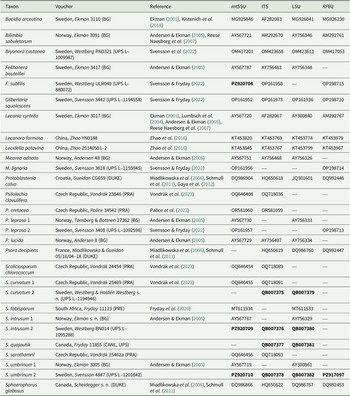
To determine the generic affinities of the possibly new Scoliciosporum species from the Canadian Arctic, we assembled a dataset of DNA sequences representing families that have been attributed to Sphaerophorinae (e.g. Miadlikowska et al. Reference Miadlikowska, Kauff, Högnabba, Oliver, Molnár, Fraker, Gaya, Hafellner, Hofstetter and Gueidan2014; Svensson & Fryday Reference Svensson and Fryday2022; Hyde et al. Reference Hyde, Noorabadi, Thiyagaraja, He, Johnston, Wijesinghe, Armand, Biketova, Chethana and Erdoğdu2024; Myllys et al. Reference Myllys, Svensson, Kantvilas, Sérusiaux, van den Boom, Aptroot, Cezanne, Eichler, Pino-Bodas and Printzen2026). Taxon sampling largely followed that of Svensson & Fryday (Reference Svensson and Fryday2022) but the number of species per family was reduced, except for Scoliciosporaceae which was expanded, and likewise for Psilolechiaceae, which in earlier analyses has sometimes been recovered as the sibling family of Scoliciosporaceae, albeit without support (e.g. Miadlikowska et al. Reference Miadlikowska, Kauff, Högnabba, Oliver, Molnár, Fraker, Gaya, Hafellner, Hofstetter and Gueidan2014). For the specimen of Psora decipiens, a further mtSSU sequence is available in GenBank (DQ986863) in addition to the three markers used by us. However, this sequence differed markedly from all other mtSSU sequences in our alignment and showed close affinity to Placidium in BLAST searches. It was therefore excluded from the final analysis. To root the phylogenetic tree, we selected species from three genera in Lecanoraceae as outgroup because this family was recovered as sibling to the clade containing Sphaerophorinae in Miadlikowska et al. (Reference Miadlikowska, Kauff, Högnabba, Oliver, Molnár, Fraker, Gaya, Hafellner, Hofstetter and Gueidan2014). Newly generated sequences and those obtained from GenBank are listed in Table 1.
Sequence data used for the phylogenetic analysis (Fig. 1), with voucher information and GenBank Accession numbers. Newly generated sequences are in bold.
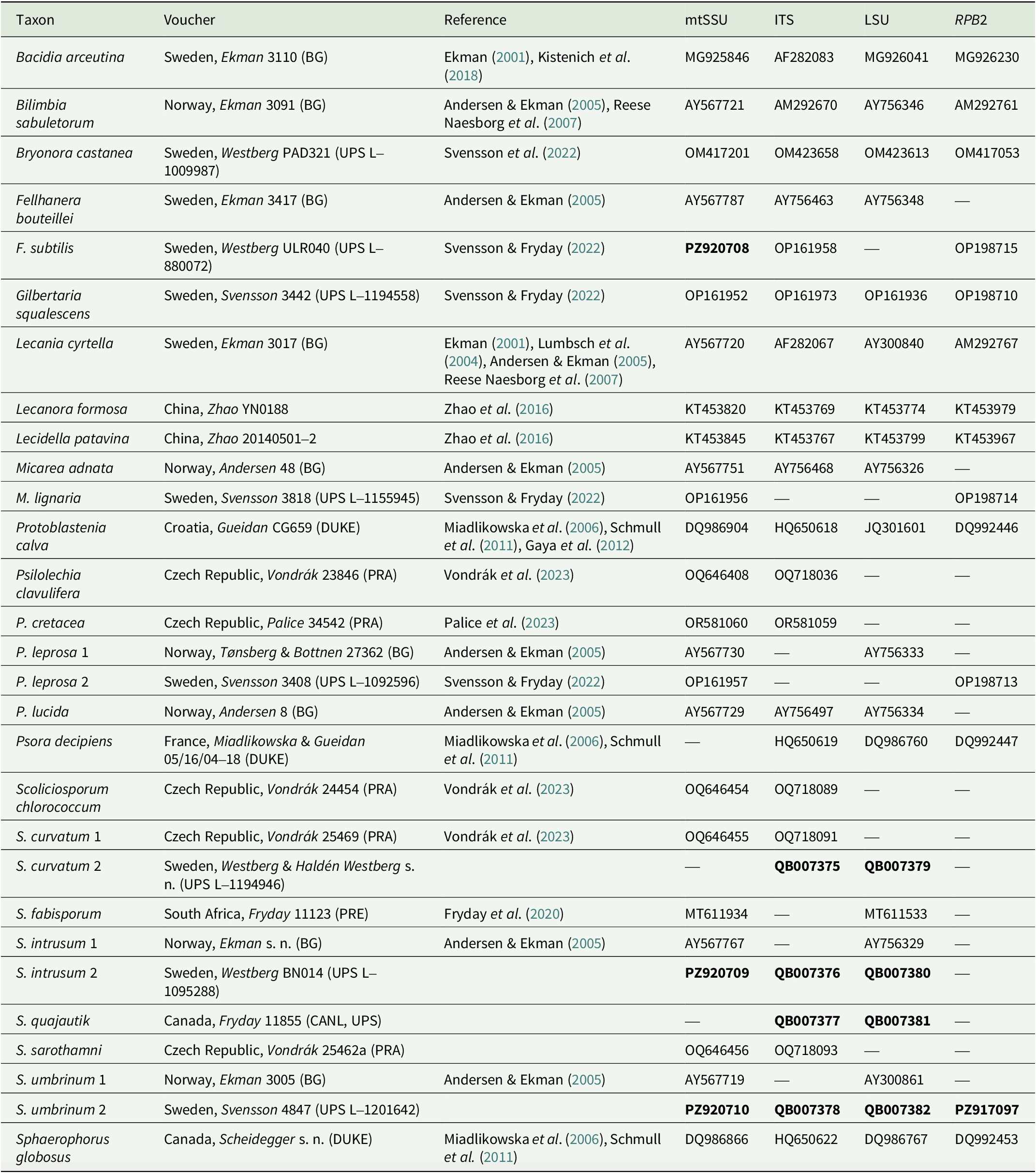
Table 1. Long description
The table contains seven columns: Taxon, Voucher, Reference, m t S S U, I T S, L S U, and R P B 2.
Key entries include:
* Bacidia arceutina: Voucher Sweden, Ekman 3110 (BG); Accessions MG925846, AF282083, MG926041, MG926230.
* Fellhanera subtilis: Voucher Sweden, Westberg ULR040; Accessions PZ920708 (bold), OP161958, and OP198715.
* Psilolechia species: Includes P. clavulifera, P. cretacea, P. leprosa 1 and 2, and P. lucida with various European vouchers.
* Scoliciosporum species: Includes S. chlorococcum, S. curvatum 1 and 2, S. fabisporum, S. intrusum 1 and 2, S. quajautik, S. sarothamni, and S. umbrinum 1 and 2.
* Newly generated sequences (bolded in the table) include m t S S U PZ920708 for F. subtilis; I T S QB007375 and L S U QB007379 for S. curvatum 2; m t S S U PZ920709, I T S QB007376, and L S U QB007380 for S. intrusum 2; I T S QB007377 and L S U QB007381 for S. quajautik; and m t S S U PZ920710, I T S QB007378, L S U QB007382, and R P B 2 PZ917097 for S. umbrinum 2.
* Outgroup: Sphaerophorus globosus from Canada with accessions DQ986866, HQ650622, DQ986767, and DQ992453.
Sequence alignment, partitioning scheme and phylogenetic analysis
For the non-protein-coding markers (ITS, mtSSU and LSU), we used PASTA v. 1.8.5 to estimate alignments (Mirarab et al. Reference Mirarab, Nguyen, Guo, Wang, Kim and Warnow2015). The mask option was activated, with MAFFT (algorithm L-INS-i) as the aligner, OPAL for pairwise merging and FastTree as the tree estimator, applying the GTR + G model for molecular evolution. Given the moderate divergence among taxa sampled, we relied on manual inspection combined with PASTA’s default gap-masking rather than post hoc trimming tools (e.g. Gblocks, GUIDANCE) which we consider unnecessary at this taxonomic scale (cf. Svensson & Fryday Reference Svensson and Fryday2022; a similarly divergent alignment encompassing the Sphaerophorinae was analyzed here using both PASTA and MAFFT + GUIDANCE, yielding congruent topologies and no effect on the taxonomic conclusions). Inspection of the mtSSU alignment revealed problems caused by a long intron. Consequently, we re-estimated the mtSSU alignment using MAFFT v. 7.0 with the E-INS-i algorithm (Katoh et al. Reference Katoh, Rozewicki and Yamada2019), removed a 923 bp intron from Gilbertaria squalescens, and then re-estimated the alignment using PASTA as described above. For the protein-coding gene (RPB2), we generated alignments using MAFFT with the E-INS-i algorithm (Katoh et al. Reference Katoh, Rozewicki and Yamada2019). To reduce potential issues with missing data, the ends of all alignments were trimmed.
We assessed incongruence among markers by conducting maximum likelihood analyses on each of the four alignments using IQ-TREE v. 3.0.1 with 500 standard bootstrap replicates (Wong et al. Reference Wong, Ly-Trong, Ren, Demotte, Baños, Roger, Susko, Bielow, De Maio and Goldman2026). Conflict across markers was defined as clades with > 70% bootstrap support for incongruent groups (Mason-Gamer & Kellogg Reference Mason-Gamer and Kellogg1996). No significant conflicts were detected, allowing us to concatenate the four alignments into a single dataset.
We assessed partitioning schemes and models of molecular evolution for the concatenated alignment using ModelFinder as implemented in IQ-TREE v. 3.0.1 (Kalyaanamoorthy et al. Reference Kalyaanamoorthy, Minh, Wong, von Haeseler and Jermiin2017; Wong et al. Reference Wong, Ly-Trong, Ren, Demotte, Baños, Roger, Susko, Bielow, De Maio and Goldman2026). The assessment was performed on a division of the concatenated alignment into eight subsets: mtSSU, LSU, ITS1, 5.8S, ITS2 and independent 1st, 2nd and 3rd codon positions for RPB2. We used the BIC for model selection and allowed merging of subsets. The best model fit was achieved when the eight subsets were merged into five (subset and corresponding substitution model): 5.8S + LSU (TIM3 + I + G4); ITS1 + ITS2 (GTR + F + I + G4); RPB2 3rd (TN + G4); RPB2 1st + RPB2 2nd (TPM3 + G4); mtSSU (TVM + F +G4).
We performed a maximum likelihood analysis of the concatenated alignment with IQ-TREE v. 3.0.1. We assessed branch support by running 1000 standard bootstrap replicates (not ultrafast bootstrap), with a bootstrap value ≥ 70% considered as support. The phylogenetic tree was visualized using ggtree v. 3.10.1 (Guangchuang et al. Reference Guangchuang, Smith, Zhu, Guan and Lam2017) in R v. 4.3.3.
Results
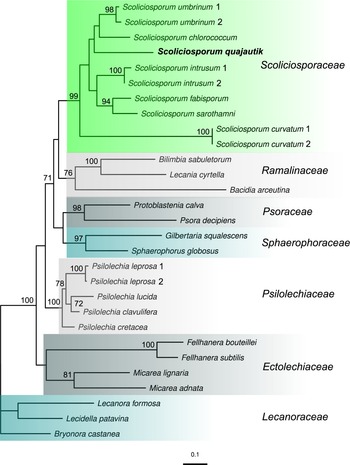
The final alignment included 29 terminals, 84 sequences and 3113 characters, of which 876 were parsimony-informative. Generally, all of the families of the Sphaerophorinae included in the analysis were recovered with support (Fig. 1), with the exception of Ectolechiaceae. Scoliciosporaceae was recovered with high support (BS = 99%) and included the putative new species from the Canadian Arctic, which is described as Scoliciosporum quajautik below. Relationships within Scoliciosporaceae were, however, largely unsupported.
Maximum likelihood phylogeny inferred from four loci (ITS, mtSSU, LSU, RPB2), showing the position of Scoliciosporum quajautik sp. nov. (in bold) within Scoliciosporaceae. Bootstrap support values, based on non-parametric bootstrapping, are shown only when ≥ 70%. In colour online.
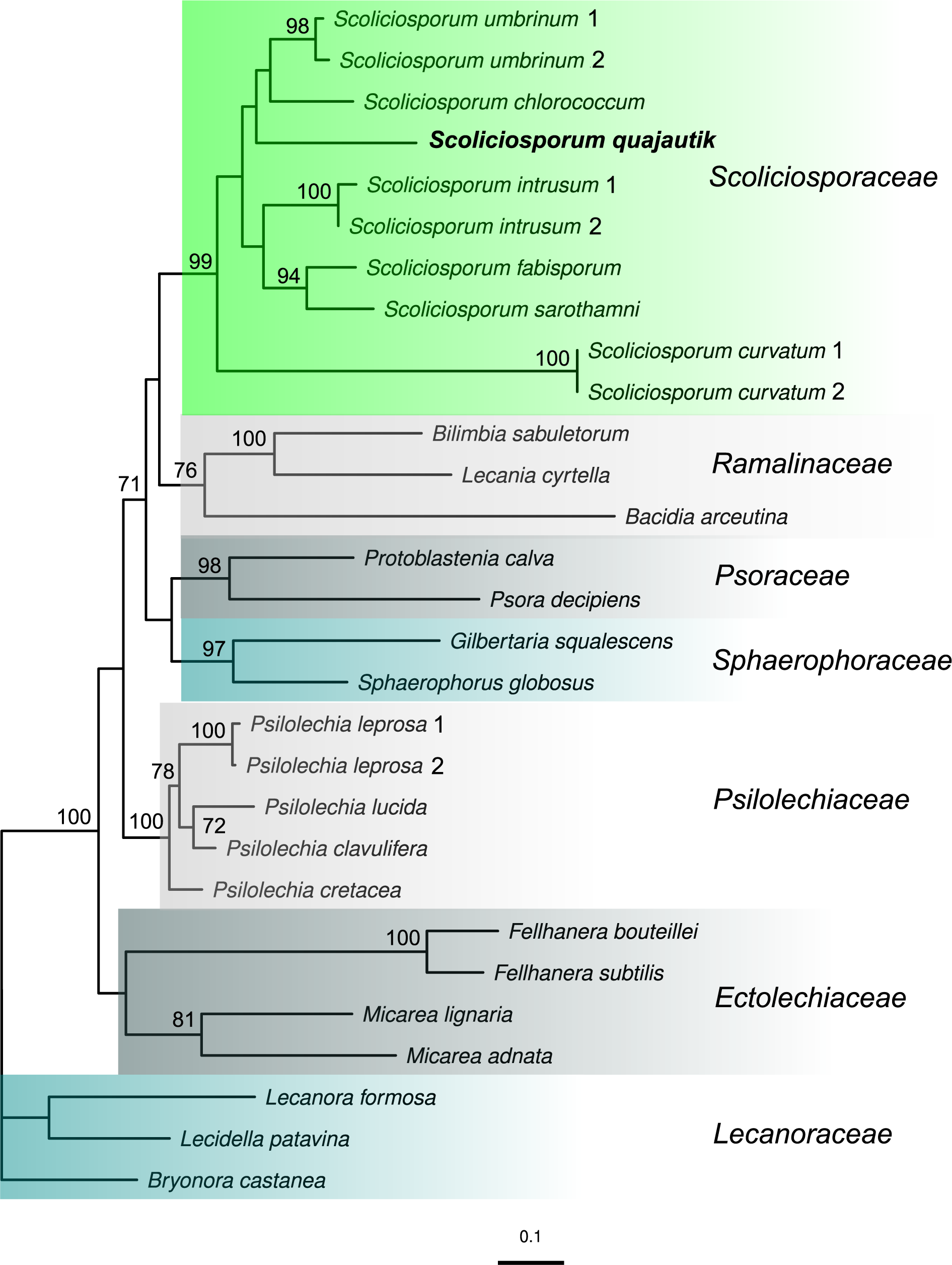
Figure 1. Long description
A maximum likelihood phylogeny based on I T S, mt S S U, L S U, and R P B 2 loci. The tree branches from left to right with bootstrap support values indicated at the nodes.
From top to bottom, the major clades are:
* Scoliciosporaceae: This top shaded section contains Scoliciosporum umbrinum 1 and 2 (98 percent support), Scoliciosporum chlorococcum, and the target species Scoliciosporum quajautik in bold. Below these are Scoliciosporum intrusum 1 and 2 (100 percent), Scoliciosporum fabisporum, and Scoliciosporum sarothamni (94 percent). The clade ends with Scoliciosporum curvatum 1 and 2 (100 percent).
* Ramalinaceae: Contains Bilimbia sabuletorum and Lecania cyrtella (100 percent), and Bacidia arceutina.
* Psoraceae: Contains Protoblastenia calva and Psora decipiens (98 percent).
* Sphaerophoraceae: Contains Gilbertaria squalescens and Sphaerophorus globosus (97 percent).
* Psilolechiaceae: A large clade including Psilolechia leprosa 1 and 2 (100 percent), Psilolechia lucida and Psilolechia clavulifera (72 percent), and Psilolechia cretacea.
* Ectolechiaceae: Contains Fellhanera bouteillei and Fellhanera subtilis (100 percent), Micarea lignaria, and Micarea adnata (81 percent).
* Lecanoraceae: The bottom-most clade containing Lecanora formosa, Lecidella patavina, and Bryonora castanea.
A scale bar at the bottom center represents 0.1 substitutions per site.
Taxonomy
Scoliciosporum quajautik Fryday & M. Svenss. sp. nov.
MycoBank No.: MB 865207
Distinguished from other species of the genus by its habitat of terricolous bryophytes and morphologically by its large, flat apothecia with a thin, persistent proper margin, its broad-ellipsoid to fusiform, simple to 1-septate ascospores, and its pigmented, K+ magenta hypothecium.
Type: Canada, Nunavut, Kivalliq, Kangiqiniq/Rankin Inlet, Iqalugaarjuup-Nunanga Territorial Park, immediately north of park access road 3.6 km from Meliadine All Weather Access Road, north-west of Hiuralik Tahiq/Sandy Lake, 62.8874°N, 92.1767°W, 28 m, 12 July 2023, A. Fryday (11855), R.T. McMullin, J. L. Allen & P. C. Sokoloff (CANL—holotype; UPS—isotype).
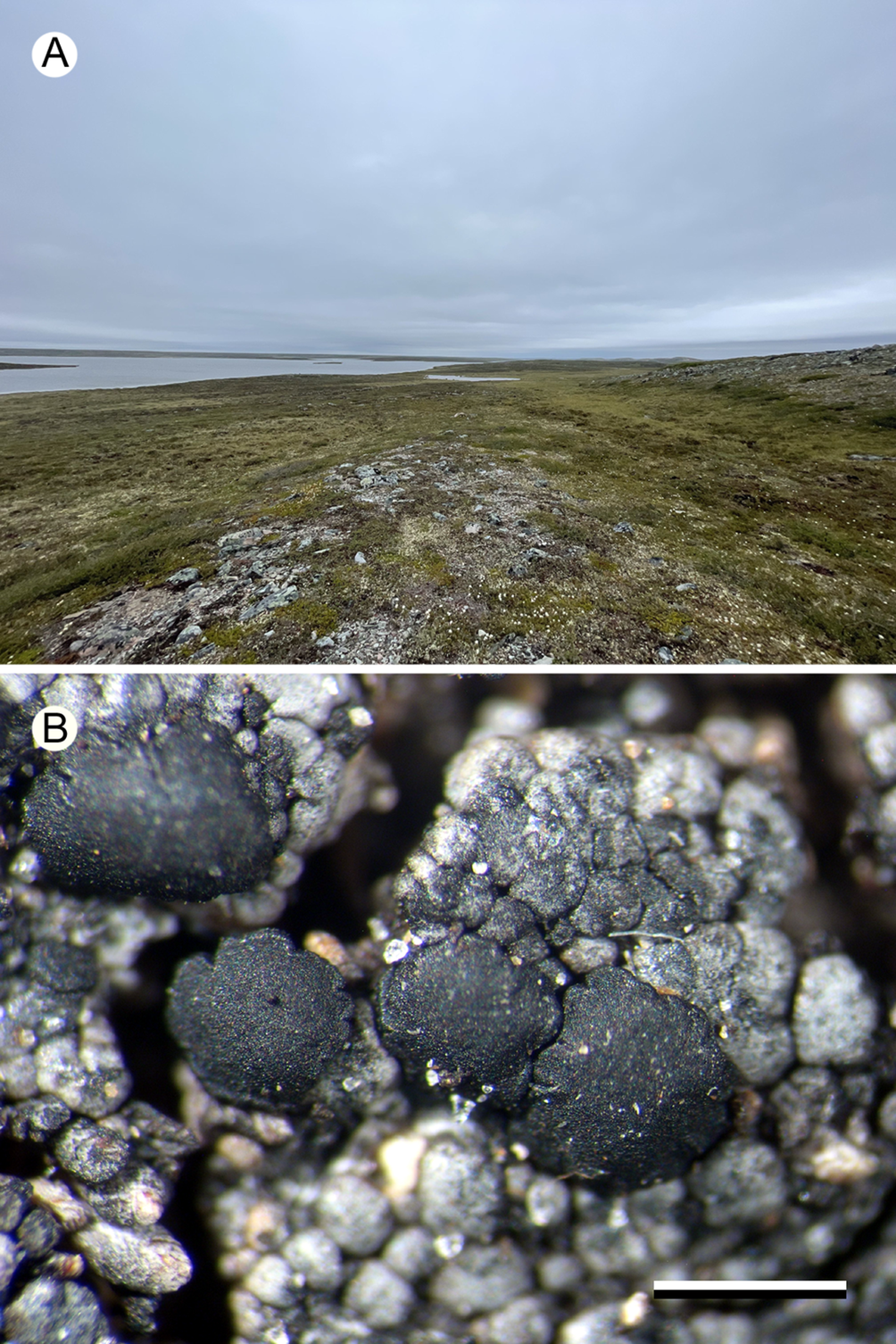
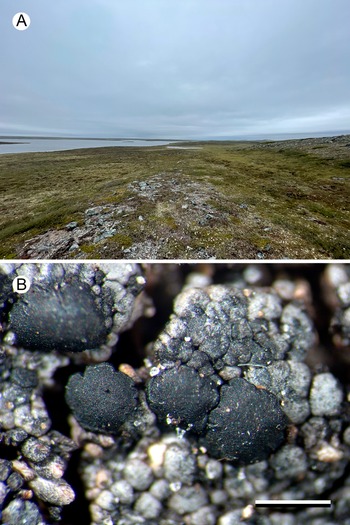
Scoliciosporum quajautik. A, the type locality in Iqalugaarjuup-Nunanga Territorial Park, Nunavut. B, thallus and apothecia (Gauthier C1-12). Scale = 1 mm. In colour online.
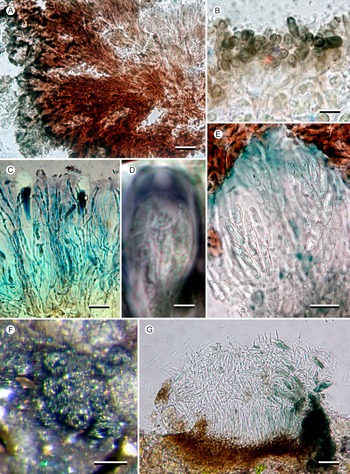
Scoliciosporum quajautik (Fryday 11855—holotype). A, apothecium exciple (in K). B, thallus cortex (in K). C, apothecium section (in ink after pretreatment with N). D, ascus (in I/KI) showing wide Lecanora-type tholus. E, ascospores (in K). F, conidiomata. G, conidia. Scales: A = 20 μm; B, C & E = 10 μm; D = 5 μm; F = 0.2 mm; G = 25 μm. In colour online.
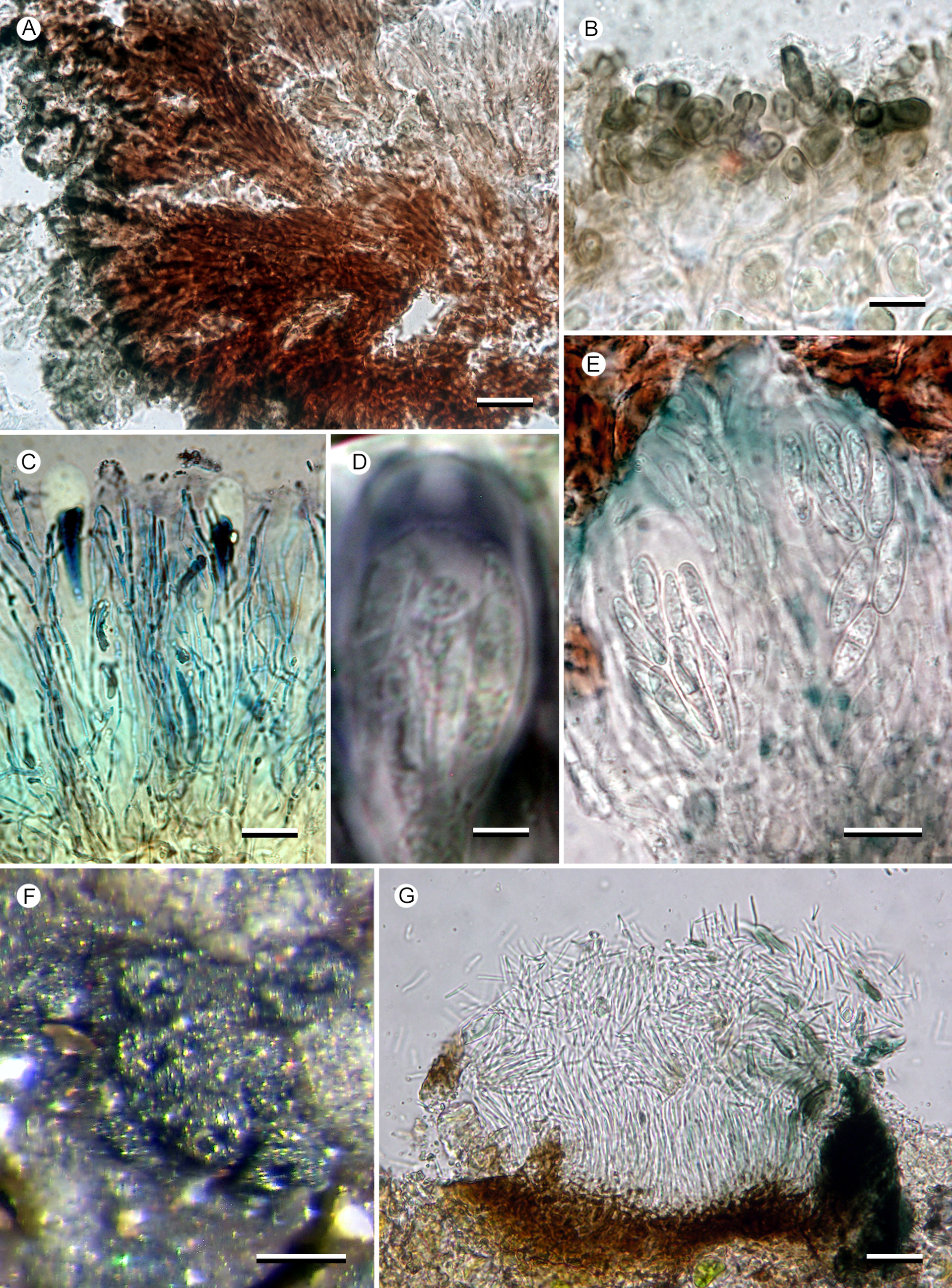
Figure 3. Long description
The figure consists of seven panels labeled A through G.
* Panel A at the top left shows a cross-section of an apothecium exciple treated with K, appearing as a dense, reddish-brown fan-shaped fibrous structure. Scale bar is 20 micrometers.
* Panel B at the top right displays the thallus cortex in K, featuring rounded, dark-pigmented cells at the surface above a lighter, translucent cellular layer. Scale bar is 10 micrometers.
* Panel C in the middle left shows an apothecium section pretreated with N and stained with ink, revealing vertical blue-stained hyphae and structures. Scale bar is 10 micrometers.
* Panel D in the center shows a close-up of an ascus in I / K I, highlighting a wide Lecanora-type tholus at the apex. Scale bar is 5 micrometers.
* Panel E in the middle right shows several elongated, multi-septate ascospores within the fungal tissue in K. Scale bar is 10 micrometers.
* Panel F at the bottom left is a macro photo of the conidiomata, appearing as dark, granular spots on the thallus surface. Scale bar is 0.2 millimeters.
* Panel G at the bottom right shows a mass of needle-like conidia emerging from a dark base. Scale bar is 25 micrometers.
Thallus composed of ±contiguous but separate areoles, 0.4–0.8 mm across, usually ±flat or slightly convex with rounded edges, rarely almost bullate, usually mid-grey but sometimes with a brownish tinge or paler grey with a pinkish tinge, large areoles becoming almost lobed at the edges. In section, a thin epinecral layer 10–12(–20) μm thick overlays a layer of vertically aligned brown cortical cells (K+ blue-grey, N+ red) c. 15–20 × 5 μm, which is subtended by a thick layer (c. 50 μm) composed of a network of fine, branched and anastomosing hyphae, interspersed with photobiont cells; medulla I−. Photobiont chlorococcoid, individual cells 12–15 μm diam.
Apothecia black, lecideine, orbicular, ±flat or shallowly convex, 0.8–1.2(–1.8) mm diam., with a thin, persistent, barely raised proper margin (c. 0.05 mm wide), larger apothecia becoming somewhat flexuose and more convex. In section, proper exciple cupular, c. 50–60 μm wide, composed of conglutinated radiating hyphae 2–3 μm thick that are c. 5 μm wide at the surface with a thick gelatinous coat to 10 μm, becoming randomly oriented below the hypothecium; cortical zone c. 10–15 μm wide, blue-black (K−, N+ red), medulla dark red-brown (K+ magenta solution, N+ red). Hymenium ±colourless or with blue streaks originating from the epihymenium, c. 70 μm high; paraphyses sparingly branched and anastomosing, c. 2 μm thick, conglutinate, not capitate, septate, cells c. 10–12 μm long; epihymenium c. 12.5 μm thick, dark blue (K−, N+ red); subhymenium grey (K−, N+ red) 40–50 μm thick. Hypothecium red-brown (K+ magenta solution, N+ brown) c. 250 μm deep. Asci cylindrical becoming slightly clavate when mature, c. 50 × 15 μm, Lecanora-type with a wide (c. 3–4 μm), I− apical cushion; ascospores 8 per ascus, hyaline, 0–1-septate, thick-walled (c. 1 μm), broad-ellipsoid to fusiform with rounded attenuated apices, ±straight, sometimes curved, often with an irregular outline, with a thin perispore c. 1 μm thick visible in N + ink, (10–)19.2 ± 3.4(–25) × (3–)3.9 ± 0.7(–5) μm, l/w ratio (2.5–)5.1 ± 1.4(–8.3); n = 28.
Conidiomata black, raised, 0.1–0.15 mm diam. with a gaping ostiole, walls blue (N+ red), base brown (K−); often forming multilocular stroma up to 0.5 mm across; conidia straight, filiform, 12.5–15 × 1 μm.
Chemistry
All spot tests negative. No substances detected by TLC.
Etymology
The specific epithet quajautik (ᖁᐊᕐᓂᖅ) is one of several Inuktitut words for lichens used by the Inuit of eastern Canada. It specifically refers to lichens on rocks but is also used for lichens in general (Cuerrier & the Elders of Kangiqsujuaq Reference Cuerrier2011).
Ecology and distribution
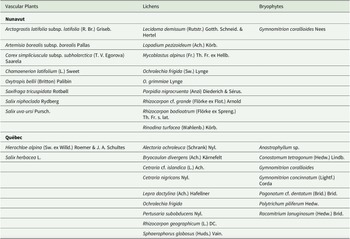
The new species occurs on terricolous bryophytes in lichen-rich tundra and is known from five collections: four from northern Québec and one from Nunavut. Four of the five collections occurred on exposed ridges or summits that are presumably blown free of snow earlier than the surrounding areas, thus facilitating a longer period for active metabolism. The other collection is from a depression and is very poorly developed. All five collections were also associated with the liverwort Gymnomitrion corallioides Nees and it is probable that it is restricted to this host, at least when young. Vascular plants, lichens and bryophytes associated with the collections of Scoliciosporum quajautik at both localities are given in Table 2. The geology and climate of the two localities are described in detail below.
Vascular plants, lichens and bryophytes associated with collections of Scoliciosporum quajautik.
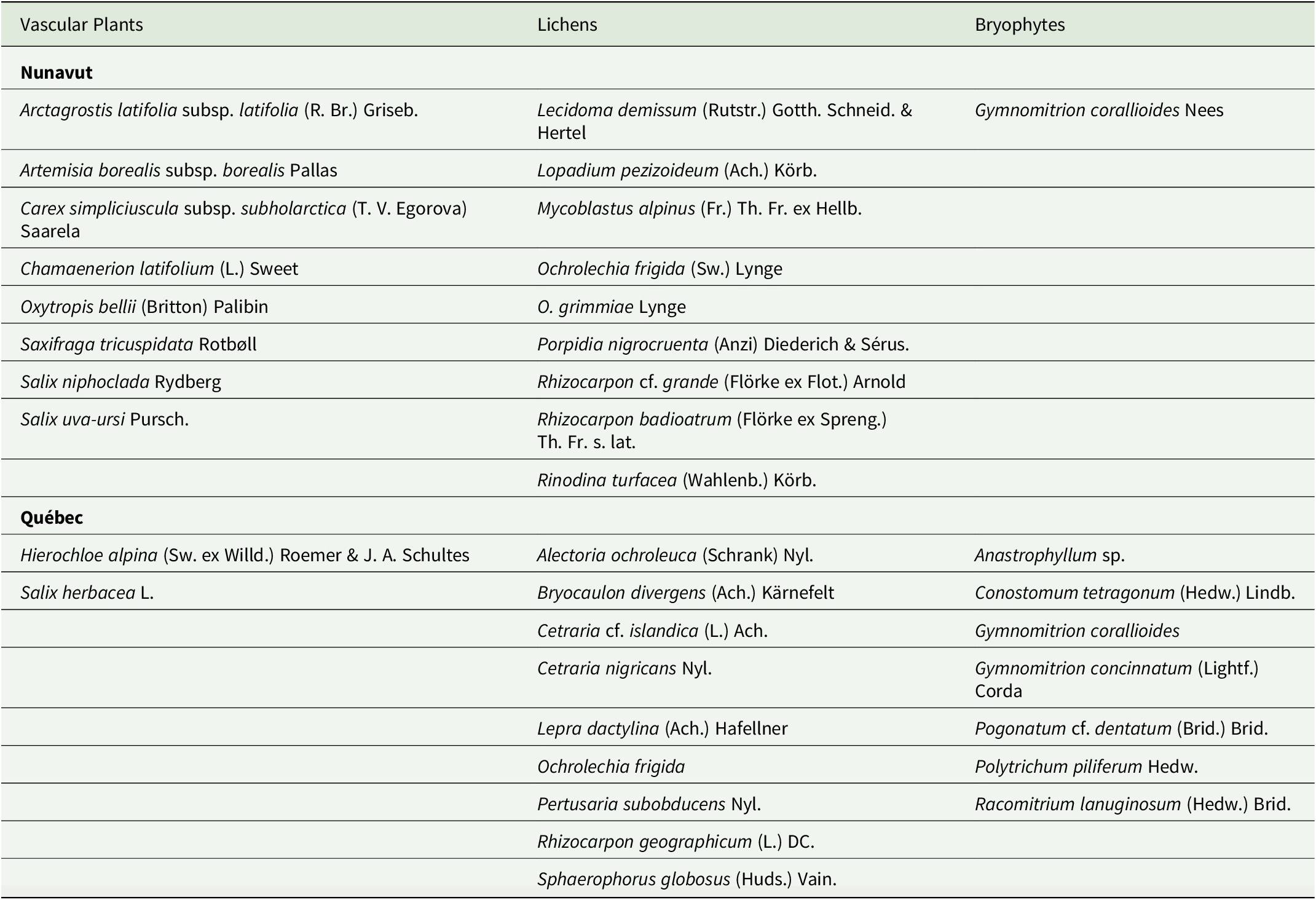
Table 2. Long description
The table is divided into two primary geographical sections.
Nunavut Section:
* Vascular Plants: Arctagrostis latifolia subsp. latifolia (R. Br.) Griseb., Artemisia borealis subsp. borealis Pallas, Carex simpliciuscula subsp. subholarctica (T. V. Egorova) Saarela, Chamaenerion latifolium (L.) Sweet, Oxytropis bellii (Britton) Palibin, Saxifraga tricuspidate Rotbøll, Salix niphoclada Rydberg, and Salix uva-ursi Pursch.
* Lichens: Lecidoma demissum (Rutstr.) Gotth. Schneid. and Hertel, Lopadium pezizoideum (Ach.) Körb., Mycoblastus alpinus (Fr.) Th. Fr. ex Hellb., Ochrolechia frigida, O. grimmiae Lynge, Porpidia nigrocruenta (Anzi) Diederich and Sérus., Rhizocarpon cf. grande (Flörke ex Flot.) Arnold, Rhizocarpon badioatrum (Flörke ex Spreng.) Th. Fr. s. lat., and Rinodina turfacea (Wahlenb.) Körb.
* Bryophytes: Gymnomitrion corallioides Nees.
Québec Section:
* Vascular Plants: Hierochloe alpina (Sw. ex Willd.) Roemer and J. A. Schultes, and Salix herbacea L.
* Lichens: Alectoria ochroleuca (Schrank) Nyl., Bryocaulon divergens (Ach.) Kärnefelt, Cetraria cf. islandica (L.) Ach., Cetraria nigricans Nyl., Lepra dactylina (Ach.) Hafellner, Ochrolechia frigida (Sw.) Lynge, Pertusaria subobducens Nyl., Rhizocarpon geographicum (L.) DC., and Sphaerophorus globosus (Huds.) Vain.
* Bryophytes: Anastrophyllum sp., Conostomum tetragonum (Hedw.) Lindb., Gymnomitrion corallioides, Gymnomitrion concinnatum (Lightf.) Corda, Pogonatum cf. dentatum (Brid.) Brid., Polytrichum piliferum Hedw., and Racomitrium lanuginosum (Hedw.) Brid.
Geology
The type collection is from the Iqalugaarjuup-Nunanga Territorial Park near Rankin Inlet, Nunavut. Geologically, this area is situated on the Rankin Inlet greenstone belt, which is composed of metamorphosed volcanic and sedimentary rocks, including mafic volcanic rocks, felsic pyroclastic rocks, and banded iron formations (Bannatyne Reference Bannatyne1958; Lawley et al. Reference Lawley, McNicoll, Sandeman, Pehrsson, Simard, Castonguay, Mercier-Langevin and Dubé2016). However, the park itself is situated on a glacial esker and the loose stones and gravel on the top of the low ridge from which Scoliciosporum quajautik was collected are of an indeterminate origin, although the vegetation of the ridge (Table 2) indicates that the soil and rocks are generally siliceous in composition.
The Québec localities of S. quajautik are located in the north-eastern portion of the Ungava Peninsula near the settlement of Kangiqsujuaq on the west coast of Ungava Bay and c. 75 km further inland in the NE section of Parc national des Pingualuit. This area lies on the boundary between the granodioritic gneisses of the Superior Craton and the southern section of the Ungava Orogen (part of the Churchill Province), known as the Cape Smith Belt or Ungava Trough. This formation runs E–W through the northern Ungava Peninsula from Kangiqsujuaq to Cape Smith on the east shore of Hudson Bay and consists predominantly of mafic volcanic rocks and associated intrusives, with sedimentary rocks widespread near the southern margin. Metamorphic assemblages within the fold belt are generally in the greenschist facies (Hynes & Francis Reference Hynes and Francis1982; St-Onge & Lucas Reference St-Onge and Lucas1993). The collections of S. quajautik by the second author are from the eastern end of the Cape Smith Belt, whereas the Gauthier collections are from an area just south of it, although one is on a drumlin that may be an intrusion of Cape Smith Belt geology.
Climate
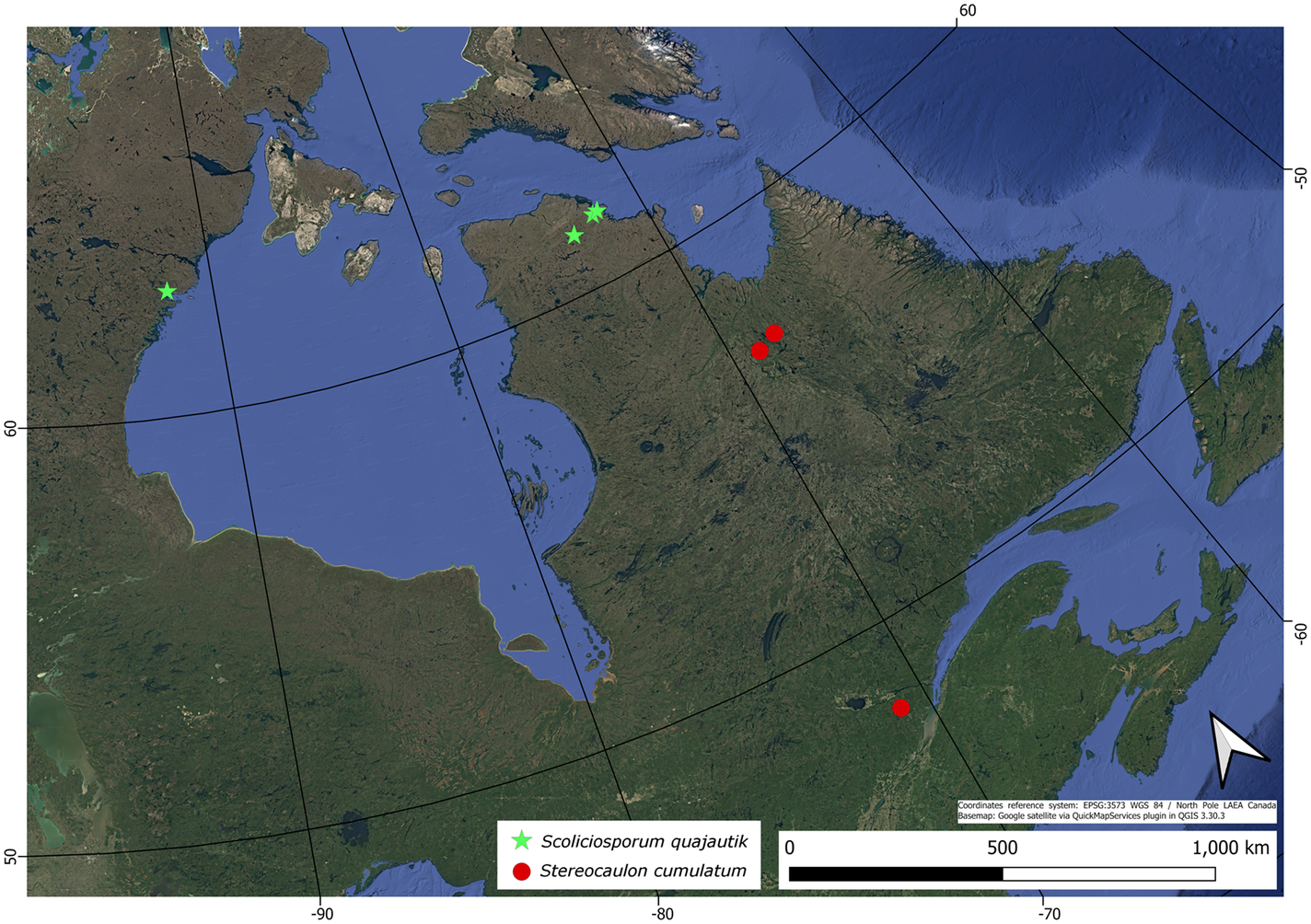
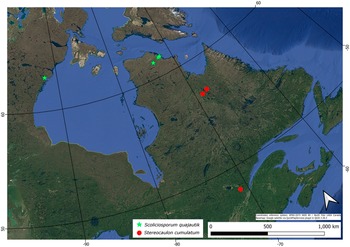
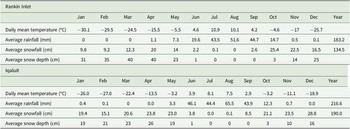
Interestingly, although the Québec and Nunavut localities of this species are on opposite sides of Hudson Bay, all five collections were made between 61–63°N (Fig. 4), which places them near the boundary between the Northern and Southern Arctic Ecozones (http://www.ecozones.ca/english/zone/index.html). For the type collection, climate data from Rankin Inlet Airport (Table 3A), c. 9 km further south, give average daily temperature ranges from −30.1 °C in January to 10.9 °C in July, with only four months (June–September) having an average temperature above freezing. Precipitation is moderate, with most falling between mid-May and the end of October. Consequently, most precipitation falls as rain during the summer months, with the heaviest snowfalls in spring (April–May) and autumn (October–November). The annual total depth of snowfall is much greater than the depth of rainfall, but snow is much less dense than rain. The traditional conversion rate of snow to rain is 10:1 but at Arctic temperatures, where snow is much less dense, it can be 20:1 or higher. Consequently, the proportion of annual precipitation that falls as snow is significantly less than that which falls as rain. Climate data also show that the ground becomes snow-free in June (Table 3A), which coincides with the results of Gupta & Ehn (Reference Gupta and Ehn2023) who calculated the date at which the ground at Rankin Inlet became snow-free as ‘day of year 148’ (i.e. around the end of May), giving four months of snow-free ground before the heavy snow falls of autumn. However, because the locality of the new species is on the top of a low ridge in an open situation, it is probably blown free of snow at an earlier date.
Map showing the known distribution of Scoliciosporum quajautik (★) in Canada and the location of the three collections of Stereocaulon cumulatum ( ) referenced herein. In colour online.
Climate data for Rankin Inlet (Rankin Inlet Airport) and Iqaluit 1991–2020. Source: Environment and Climate Change (https://climate.weather.gc.ca/climate_normals/; Accessed 3 November 2025).
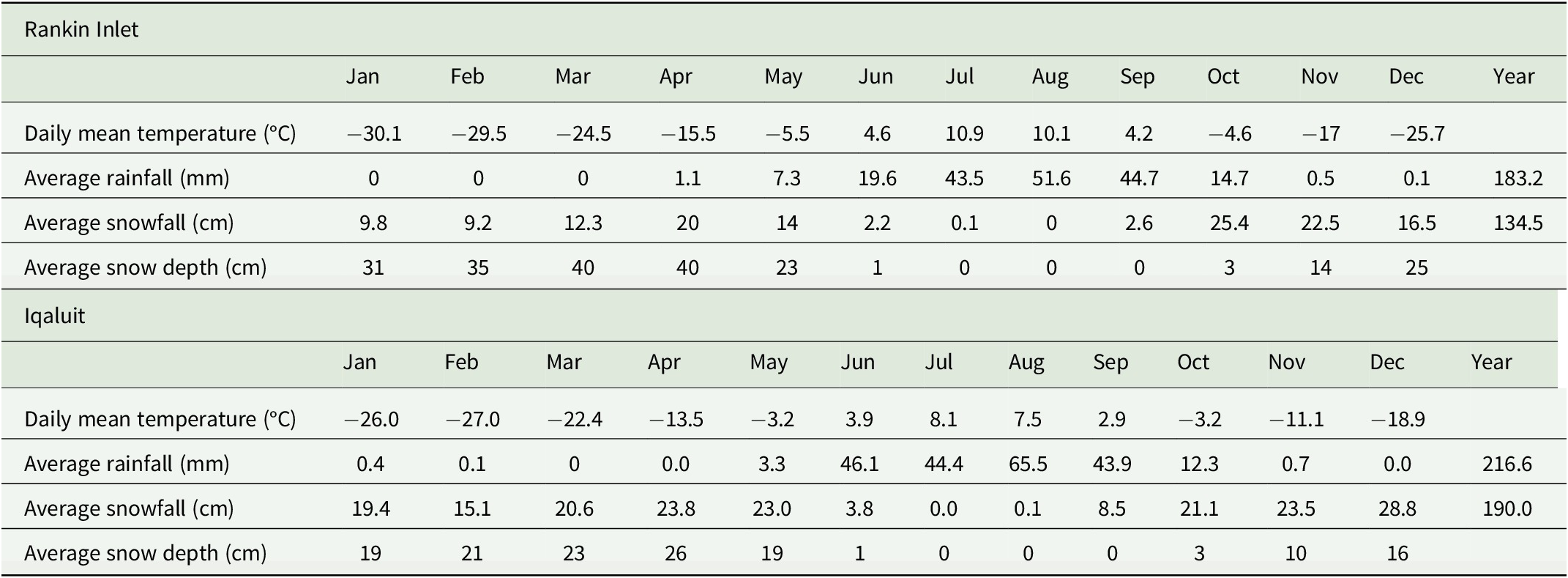
Table 3 Table 3A. Long description
The first table for Rankin Inlet shows:
* Daily mean temperature in degrees Celsius: Starts at minus 30.1 in January, peaks at 10.9 in July, and drops to minus 25.7 in December.
* Average rainfall in millimeters: 0 from January to March, peaking at 51.6 in August, with a yearly total of 183.2.
* Average snowfall in centimeters: Ranges from 9.8 in January to a peak of 25.4 in October, with a yearly total of 134.5.
* Average snow depth in centimeters: Peaks at 40 in March and April, dropping to 0 from July to September.
The second table for Iqaluit shows:
* Daily mean temperature in degrees Celsius: Starts at minus 26.0 in January, peaks at 8.1 in July, and drops to minus 18.9 in December.
* Average rainfall in millimeters: Minimal until June (46.1), peaking at 65.5 in August, with a yearly total of 216.6.
* Average snowfall in centimeters: Ranges from 19.4 in January to a peak of 28.8 in December, with a yearly total of 190.0.
* Average snow depth in centimeters: Peaks at 26 in April, dropping to 0 from July to September.
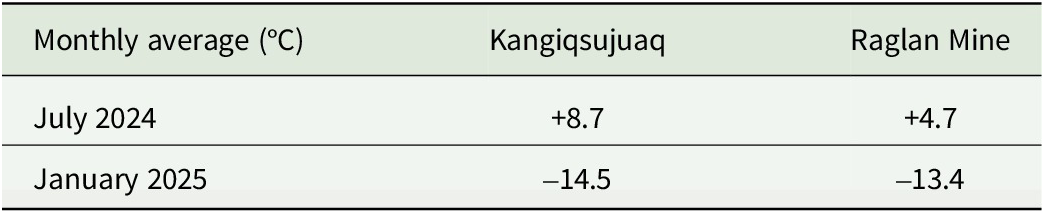
Unfortunately, detailed climate data for the Québec localities are lacking because there are no Canadian Government weather stations on the Ungava Peninsula, the closest being 300 km to the NE at Iqaluit on southern Baffin Island (Table 3A). However, limited data are available from the Québec Government (Table 3B) for Raglan Mine, c. 40 km further north, indicating that summer temperatures are similar to those of Rankin Inlet but winter temperatures are not as cold. This is supported by the fact that the −7 °C mean annual air temperature isotherm passes through the area (St-Onge & Lucas Reference St-Onge and Lucas1993), which means it is slightly warmer than Rankin Inlet (−10 °C).
Average monthly temperature in northern Ungava Peninsula (Québec Government).
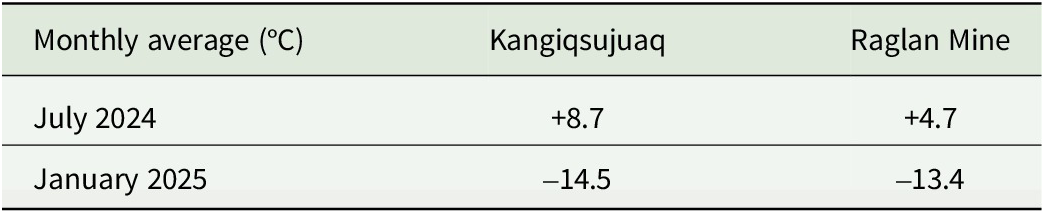
Table 3 Table 3B. Long description
The table consists of three columns and three rows.
Column headers from left to right are: Monthly average (degrees Celsius), Kangiqsujuaq, and Raglan Mine.
Row 1: July 2024. Kangiqsujuaq recorded plus 8.7. Raglan Mine recorded plus 4.7.
Row 2: January 2025. Kangiqsujuaq recorded minus 14.5. Raglan Mine recorded minus 13.4.
Remarks
The circumscription of Scoliciosporum given by Vězda (1978) when he resurrected the genus included species with 8-spored asci of the Lecanora-type, thin, branched and anastomosing paraphyses, and long, worm-like to acicular, 3-septate to multiseptate ascospores; this circumscription has since been broadly followed (e.g. Purvis Reference Purvis, Purvis, Coppins, Hawksworth, James and Moore1992; Ekman & Tønsberg Reference Ekman, Tønsberg, Nash, Ryan, Diederich, Gries and Bungartz2004). The genus was progressively broadened to include Scoliciosporum curvatum, with 8–16 ascospores per ascus, fusiform, 1-septate ascospores and rather thick (up to 2 μm) and simple paraphyses (Sérusiaux Reference Sérusiaux1993), S. intrusum (Th. Fr.) Hafellner, with ellipsoid to fusiform, unicellular to 3-septate ascospores (Hafellner Reference Hafellner2004), and S. fabisporum Fryday & I. D. Medeiros, with fabiform, unicellular to 1-septate ascospores (Fryday et al. Reference Fryday, Medeiros, Siebert, Pope and Rajakaruna2020). As we demonstrate here, these species, together with S. quajautik, are all nested in a strongly supported clade with species exhibiting the ‘classical’ Scoliciosporum anatomy, such as S. umbrinum, S. chlorococcum and S. sarothamni; this suggests that some morphological characters previously considered informative in delimitation of the genus, such as ascospore shape and septation, thin and branched paraphyses, and a poorly developed exciple, may be less reliable than previously thought. Nevertheless, relationships within the Scoliciosporum clade are largely unresolved and, with the exception of the lobaric acid-containing species (see Introduction), no obvious pattern emerges that could serve as the basis for a further subdivision of the genus.
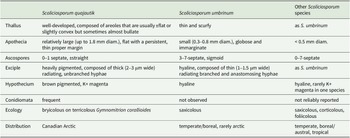
The most similar species to Scoliciosporum quajautik may be S. intrusum, which also sometimes has a K+ magenta hypothecium but is a saxicolous species with small (up to 0.4 mm diam.), convex, immarginate apothecia that internally have a lower hymenium (40–50 μm tall), a ±hyaline hypothecium and shorter ascospores up to 17 μm (Coppins Reference Coppins1983; Hafellner Reference Hafellner2004; Cannon et al. Reference Cannon, Coppins, Aptroot, Fryday, Sanderson, Simkin and Yahr2024). Table 4 outlines the differences between S. quajautik and other species of Scoliciosporum, specifically S. umbrinum, a synonym of the type species S. holomelaenum (see Introduction).
Characters in which Scoliciosporum quajautik differs from the type species of Scoliciosporum and other species of the genus.
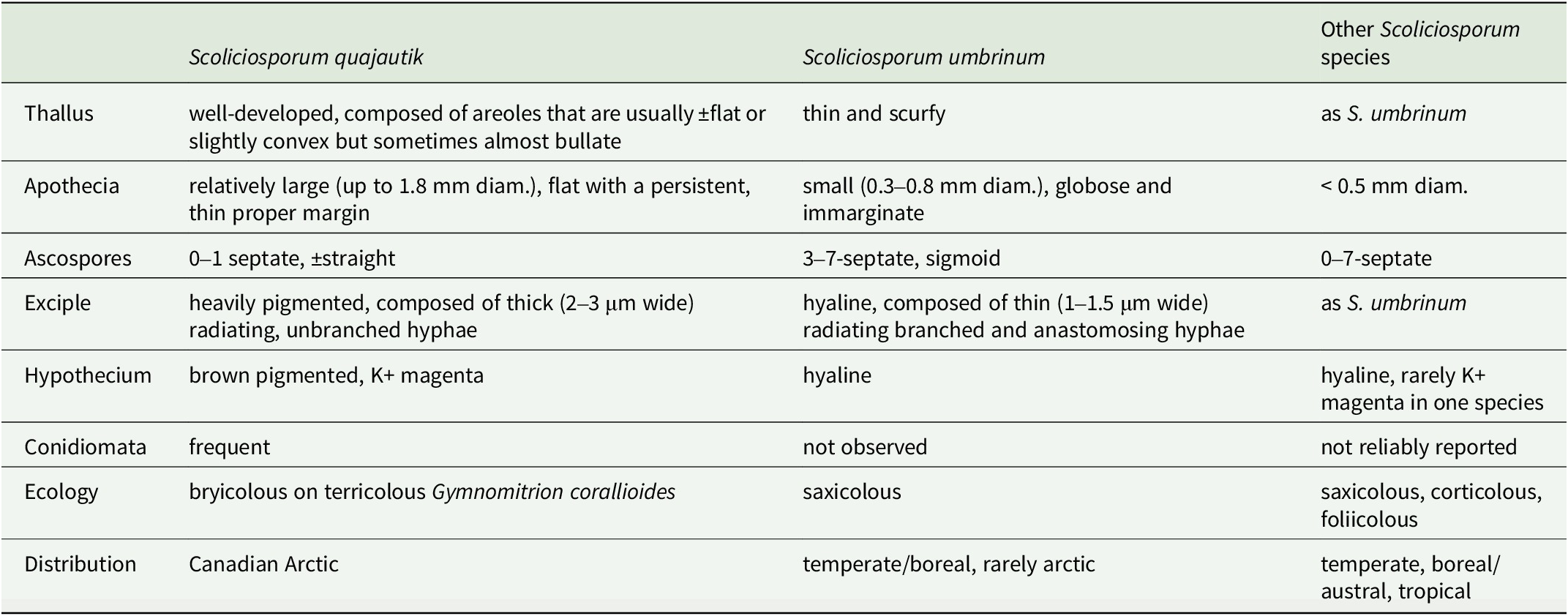
Table 4. Long description
The table consists of four columns: Character, Scoliciosporum quajautik, Scoliciosporum umbrinum, and Other Scoliciosporum species.
* Thallus: S. quajautik has a well-developed thallus with flat to convex areoles; S. umbrinum and others are thin and scurfy.
* Apothecia: S. quajautik features large (up to 1.8 mm) flat apothecia with a persistent margin; S. umbrinum has small (0.3 to 0.8 mm) globose apothecia; others are less than 0.5 mm.
* Ascospores: S. quajautik has 0 to 1 septate, straight spores; S. umbrinum has 3 to 7 septate, sigmoid spores; others have 1 to 7 septate spores.
* Exciple: S. quajautik has a heavily pigmented exciple with thick (2 to 3 mu m) unbranched hyphae; S. umbrinum and others have hyaline exciples with thin (1 to 1.5 mu m) branched hyphae.
* Hypothecium: S. quajautik is brown pigmented and K plus magenta; S. umbrinum is hyaline; others are typically hyaline.
* Conidiomata: Frequent in S. quajautik; not observed or reported in others.
* Ecology: S. quajautik is bryicolous on Gymnomitrion corallioides; S. umbrinum is saxicolous; others vary from saxicolous to foliicolous.
* Distribution: S. quajautik is found in the Canadian Arctic; S. umbrinum is temperate or boreal; others are found globally across temperate to tropical zones.
Additional specimens seen
Canada: Québec: Péninsule d’Ungava, Parc national des Pingualuit, extrémité sud-est du lac Saint-Germain, 61°20′26″N, 73°24′20″O, 478 m, sommet de drumlin à Salix herbacea et Hierochloe alpina, 11 viii 1998, R. Gauthier C1-12 (QFA0584889 – sub Gymnomitrion corallioides); ibid., 61°19′50″N, 73°23′30″O, 478 m, dépression à Racomitrium lanuginosum séparant d’énormes polygones développés sur un delta glacio-lacustre, 11 viii 1998, R. Gauthier C6-11 (QFA0585038 – sub Gymnomitrion corallioides); ibid., 55.8 km au sud-est de Purtuniq, 14.7 km à l’ouest-sud-ouest du village de Kangiqsujuaq, 6.2 km au nord-nord-ouest de la rivière Iqaluttuuq, 2.6 km à l’est de la rivière Wakeham, 3.1 km au sud de la baie Tasiujaq, 61°33′39.3″N, 72°13′23.8″W, 394 m, lichénaie terricole xérophile à Ochrolechia frigida, Rhizocarpon geographicum; cailloutis exposé, sommet, entre roches, 2011, J. Gagnon 062b 1m2 lot a (QFA0628488 – sub Gymnomitrion corallioides); ibid., village de Kangiqsujuaq, environ 300 m à l’ouest du village au début d’un sentier, 61°35′41.0″N, 71°58′27.4″W, 19 m, haut de saillie de schistes calcaires, anfractuosité, avec 97.7 saxicoles [Gymnomitrion corallioides and G. concinnatum], à la verticale, exposition nord-ouest 330°, 2011, J. Gagnon 97.06 (QFA0646114 – sub Gymnomitrion corallioides).
Notes on the status of some other crustose species in the North American Arctic
Catillaria muscicola Lynge
In our search for a previously published name for, or other collections of, S. quajautik, we examined all the North American collections identified as Catillaria muscicola, which was described by Lynge from North-East Greenland (Lynge Reference Lynge1940). Although Lynge described it as a species of Catillaria A. Massal., he states that ‘It cannot fail to be a Biatorina.’ It certainly does not belong in Catillaria s. str. and the name Biatorina A. Massal. has been conserved against Catinaria Vain.; it does not belong in that genus either, or in the family Catillariaceae where both of these genera belong (Svensson et al. Reference Svensson, Ekman and Westberg2026). Printzen (Reference Printzen1995) could not assign it to any of the families described by Hafellner (Reference Hafellner1984).
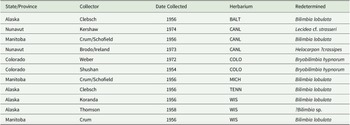
There are nine records for Catillaria muscicola on the Consortium of Lichen Herbaria website (https://lichenportal.org/portal/collections/list.php?usethes=1&taxa=53305) that are scattered across the North American Arctic from Manitoba to Alaska. We have seen all these collections, and all are incorrect determinations of other species (Table 5). A collection by J. W. Thomson from Alaska in the herbarium of the University of Wisconsin (WIS) is more or less consistent with the description of this species in the protologue (Lynge Reference Lynge1940); this specimen was examined by Irwin Brodo in 1977 who annotated the packet ‘agrees with the type in O’. We examined a type collection of C. muscicola (O-L-000362!) and found that it differed from the Alaskan collection in a number of characters, most significantly in the structure of the paraphyses and the apothecial pigmentation. The Alaskan collection has slender, coherent paraphyses, whereas those of C. muscicola were short and swollen and easily separated, even in water. Similarly, the apothecia of the Alaskan collection have only purplish brown pigments, whereas the type collection of C. muscicola has a blue-green epihymenium, an olivaceous excipulum and a pale brown hypothecium. We also found the ascospores of C. muscicola to be somewhat shorter than reported by Lynge (Reference Lynge1940) in the protologue (10–14 × 3–6 μm vs 12–17 × 5–6 μm) and observed several ascospores with three septa. The ascus structure was unclear but appeared to be of the Porpidia/Psora-type. Unfortunately, the Alaskan collection is poor and we were unable to determine the ascus type, but we suspect it belongs to a genus of Ramalinaceae, probably Bilimbia De Not. or Mycobilimbia Rehm. Of these, we consider Bilimbia the most probable.
North American collections originally identified as Catillaria muscicola.
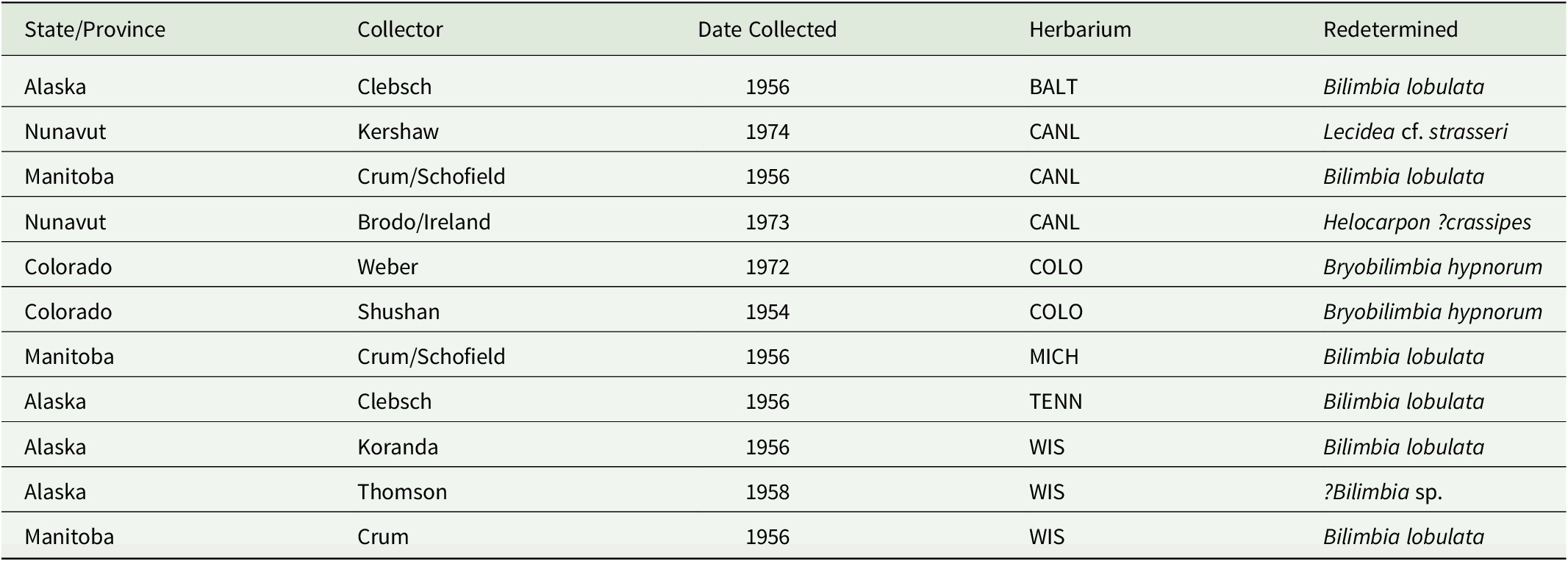
Table 5. Long description
The table consists of 11 entries organized into five columns.
1. Alaska, Clebsch, 1956, B A L T, Bilimbia lobulata.
2. Nunavut, Kershaw, 1974, C A N L, Lecidea cf. strasseri.
3. Manitoba, Crum or Schofield, 1956, C A N L, Bilimbia lobulata.
4. Nunavut, Brodo or Ireland, 1973, C A N L, Heiocarpon ?crassipes.
5. Colorado, Weber, 1972, C O L O, Bryobilimbia hypnorum.
6. Colorado, Shushan, 1954, C O L O, Bryobilimbia hypnorum.
7. Manitoba, Crum or Schofield, 1956, M I C H, Bilimbia lobulata.
8. Alaska, Clebsch, 1956, T E N N, Bilimbia lobulata.
9. Alaska, Koranda, 1956, W I S, Bilimbia lobulata.
10. Alaska, Thomson, 1958, W I S, ?Bilimbia species.
11. Manitoba, Crum, 1956, W I S, Bilimbia lobulata.
Stereocaulon cumulatum (Sommerf.) Timdal
(Fig. 5)
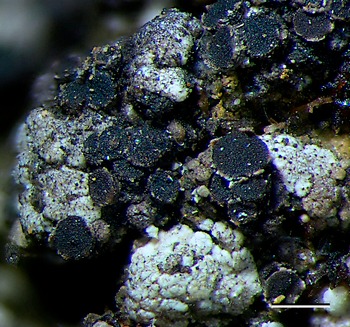
Stereocaulon cumulatum (Gagnon SF12-0559); thallus and apothecia. Scale = 0.5 mm. In colour online.
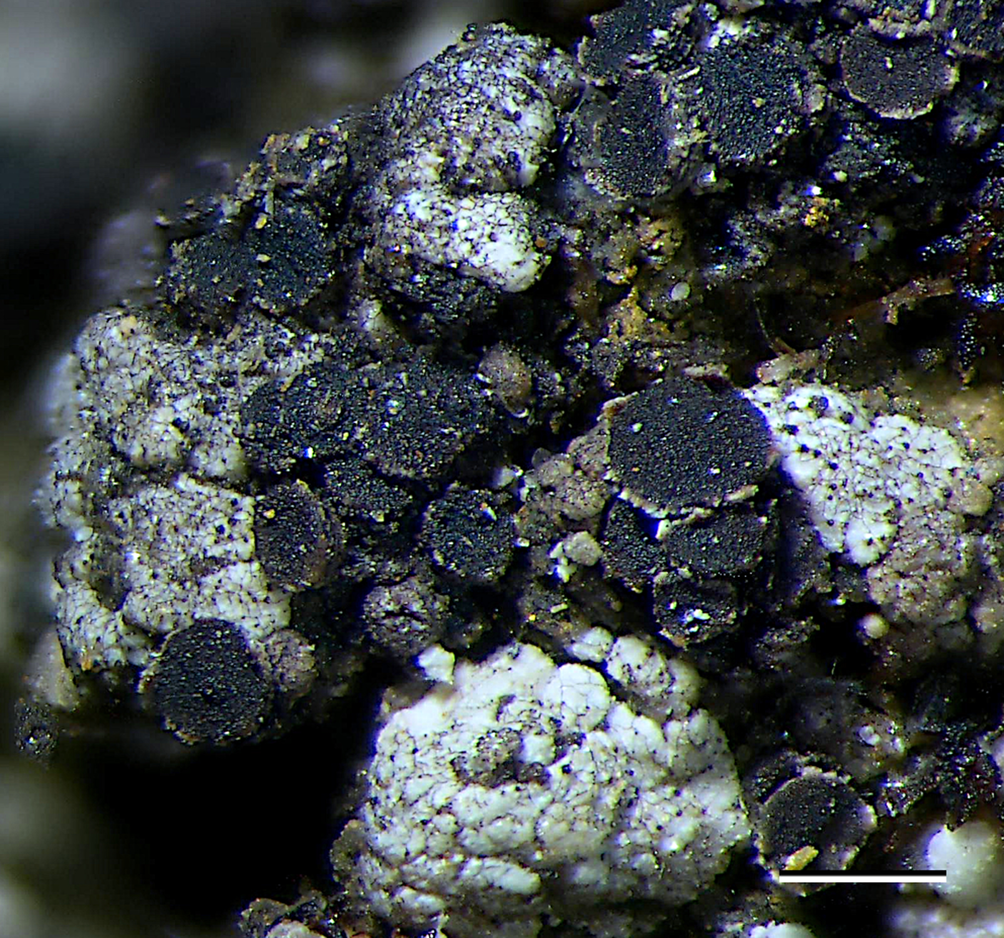
Figure 5. Long description
A satellite map of Eastern Canada and the Hudson Bay region with a coordinate grid.
* Distribution of Scoliciosporum quajautik is indicated by green stars. These are concentrated in the Northwest, with one star on the western coast of Hudson Bay and three stars clustered on the northern coast of the Ungava Peninsula.
* Distribution of Stereocaulon cumulatum is indicated by red circles. Two circles are located in the central-northern region of the Quebec-Labrador Peninsula, and one circle is located further South, near the southeastern coast of the mainland.
A legend at the bottom center identifies the symbols. A scale bar at the bottom right indicates a distance of 0 to 1,000 km. A white north arrow is positioned in the bottom right corner. Text in the bottom right corner specifies the coordinate reference system as E P S G 3573 W G S 84 North Pole L A E A Canada.
We also take this opportunity to confirm Stereocaulon cumulatum as a North American species.
Previous reports of this species (as Toninia cumulata (Sommerf.) Th. Fr.) were excluded from the Checklist of North American Lichens by Esslinger & Egan (Reference Esslinger and Egan1995) as ‘misidentifications’, citing Weber & Wittmann (Reference Weber and Wittmann1992) as the reason. However, as pointed out by Spribille et al. (Reference Spribille, Fryday, Hampton-Miller, Ahti, Dillman, Thor, Tønsberg and Schirokauer2023), Weber & Wittmann (op. cit.) stated only that the Colorado reports of Toninia cumulata were ‘misidentifications of Leproloma angardianum’ and made no mention of any records from the North American Arctic. Similarly, Timdal (Reference Timdal2002), when making the combination into Stereocaulon, cited Esslinger & Egan (op. cit.) and did not revise the North American Arctic collections.
In fact, S. cumulatum appears to be relatively frequent in the Canadian Arctic, with its range extending well into the boreal zone in eastern Québec (Fig. 4). In addition to the three specimens from Québec cited below, we have seen photographs of correctly identified collections made by Curtis Björk from the Northern Territories, and there are also several other reports in the online aggregator websites CLH (lichenportal.org/portal/collections/map/index.php?menuClosed&usethes=1&taxa=127710) and GBIF (https://www.gbif.org/species/5470645), although it is probable that some of these are misidentifications for other species (e.g. the single collection from Alaska (WIS-L-0099323) is Bilimbia lobulata (Sommerf.) Hafellner & Coppins).
Stereocaulon cumulatum is readily separated from other terricolous crustose species with a white bullate thallus (e.g. Bilimbia lobulata, Protomicarea limosa (Ach.) Hafellner) by its K+ yellow thallus (contains atranorin) and botryose apothecia that are flat with a thin proper margin when young and a disc that is brown when wet (Yahr et al. Reference Yahr, Cannon, Coppins, Košuthová, McCune, Aptroot and Simkin2025; convex, immarginate and black when wet in other comparable species).
Specimens examined
Canada: Québec: Comté de Charlevoix-ouest, sud-ouest du lac Ha!Ha!, 2 km au sud du lac Légal, 47°59′05″N, 70°53′20″W, 960 m, sommet dénudé suite à un feu de forêt, sur mousse et matières organiques, sur Polytrichum nécrosé, 11 viii 1982, G. Ayotte, C. Roy & A. Gagnon 1120A (QFA 0422195); Nunavik, 115.0 km au sud-sud-est du village de Kuujjuaq, 10.0 km au sud-sud-ouest des Lacs Turgis, 2.6 km à l’est du lac Buteux, 2.5 km á l’ouest de la rivière False, Relevé: GPS 003, 57.09883°N, 68.08283°O, 283 m, 18 vii 2012, Jean Gagnon SF12-9087 (QFA 067137); ibid., 133.0 km au sud-sud-ouest du village de Kuujjuaq, 6.9 km au sud-ouest du lac Douay, 3.0 km au sud-sud-ouest du lac Aulneau, 1.6 km au nord-est du lac Daubancourt, Relevé: GPS 006, haut de talus, exposition nord-est 60°, sur galets ferrugineux, 56.92906°N, 68.92906°O, 373 m, 18 vii 2012, Jean Gagnon SF12-0559 (QFA 067136).
Acknowledgements
The research at Iqalugaarjuup-Nunanga Territorial Park was undertaken as a joint partnership between Nunavut Parks and Special Places and the Canadian Museum of Nature, with the support of The McLean Foundation and Mark McLean. AF thanks Troy McMullin (Ottawa) for inviting him to join the expedition; Troy, Paul Sokoloff (Ottawa) and Jessi Allen (Spokane) for excellent company and support in the field; and the community of Rankin Inlet for graciously hosting him and allowing him to carry out research on their land. He is especially grateful to Neil Ammaklak, Harry Niakrok Sr, Jakub Garbarczyk, Patrick Graillon (Nunavut Parks and Special Places), Jamal Shirley (Nunavut Research Institute) and Nori Gowan (Canadian Museum of Nature) for all their help making that programme possible, and Tomas Angoshadluk for keeping him safe on the land. The type specimen of the new species was collected under Nunavut Wildlife Division Research Permit No. WL 2023-043, Kivalliq Inuit Association Certificate of Exemption No. KVX23N06, and Nunavut Planning Commission Conformity Determination File No. 150082. The 1998 research at the Parc national des Pingualuit and the 2011 land inventories in the Kangiqsujuaq area were undertaken by the Québec Ministère de l’Environnement, de la Lutte contre les changements climatiques, de la Faune et des Parcs, to which organization JG is grateful. JG also thanks Benoît Tremblay for his excellent company during the 2011 inventories. AF thanks Kativik Regional Government, Marianne Ricard and Élise Rioux-Paquette for a contract to identify these collections that led directly to the discovery of the new species. Research by MS was financially supported by the Swedish Taxonomy Initiative (2016-206 4.3 and 2023.4.3-30). We also thank Einar Timdal (Oslo) for the loan of the type collection of Catillaria muscicola, Paul Sokoloff (Ottawa) for the photograph of the type locality of S. quajautik (Fig. 2A) and for information about the vegetation at the site, Curtis Björk for sharing his photographs of his Stereocaulon cumulatum collections, Philip Bell-Doyon (Québec) for producing the distribution map (Fig. 4), and Kim Damboise (Herbier Louis-Marie, Université Laval, Québec City) for her assistance with label information.
Competing Interests
The authors declare none.

 Open access

