As numerous conflicts have come to an end in Africa over the past two decades, women's movements have sought to advance a women's rights agenda through peace accords; through constitutional, legislative, and electoral reforms; as well as through the introduction of gender quotas. This article focuses the impact women's movements have had in shaping constitutions after periods of turmoil, particularly in areas of equality, customary law, antidiscrimination, violence against women, quotas, and citizenship rights. It demonstrates how countries that have come out of major civil conflict and violent upheaval in Africa after the mid-1990s—but especially after 2000—have made more constitutional changes with respect to women's rights than other African countries. The second part of the article provides two examples of how women's movements influenced constitutional changes pertaining to gender equality as well as the difficulties they encountered, particularly with respect to the international community.
The first is the case of Kenya, a country that experienced massive election violence in 2008, which spurred the conclusion of a constitutional process in which women were leaders and relatively successfully pressed their agenda. The second case is that of Somalia, where women were less successful in obtaining their demands even though they were organized and had been struggling for more than two decades for inclusion. This failure was a result of the lack of transparency in the constitution making process and of the way in which various internal and external actors manipulated the process. The two cases of Kenya and Somalia reveal the ways in which conflict may have the unintended consequence of opening up new opportunity structures for women's rights advocates but with different outcomes, one more successful than the other.
The two East African cases were selected because they are among the most recent postconflict cases that demonstrate the links between conflict and constitution making, and the contrast between the two reveals the difference in the ways international influences impacted outcomes. The study involves comparison of women's rights provisions in all African postindependence constitutions to examine (1) change over time and (2) differences between conflict and postconflict constitutions. The study is also informed by individual and focus group interviews and discussions in Nairobi, Naivasha, Mombasa, and Kisumu in 2009, 2012, and 2014. The interviews were with more than 60 Kenyan government officials and politicians, as well as leaders of civil society, women's organizations, the Gender Commission, the Commission for the Implementation of the Constitution and Human Rights Commission, members of the judiciary including the chief justice, legislators, local government, party representatives, media workers, academics, UN women gender experts, and donors. The study also relies on secondary literature and newspaper accounts of both Kenya and Somalia in addition to interviews and correspondence with Somali scholars.
It should be noted that the literature on women and constitution making is extremely scarce in Africa generally. There are some descriptions of women's involvement in constitution making processes, especially in South Africa (Andrews Reference Andrews, Andrews and Ellmann2001, Mabandla Reference Mabandla, Peters and Wolper1995) and a handful of books on women and constitution making in Uganda (Matembe Reference Matembe2002) and Kenya (Kabira Reference Kabira2012). There is also commentary on applications of constitutional provisions (Maluwa Reference Maluwa1999; Ssenyonjo Reference Ssenyonjo2007), impacts of constitution type on gendered outcomes contrasting South Africa and Botswana (Jagwanth and Murray Reference Jagwanth, Murray, Baines and Rubio-Marín2005, Scribner and Lambert Reference Scribner and Lambert2010), constitutional design in South Africa (Irving Reference Irving2008), and limitations of applications of constitutional frameworks with respect to customary law in Liberia (Coleman Reference Coleman and Williams2009), South Africa (Albertyn Reference Albertyn2009, Reference Albertyn2011) and in Africa more generally (Tripp Reference Tripp2009, 2011; Tripp et al. Reference Tripp, Casimiro, Kwesiga and Mungwa2009). However, there are few comparative studies that look at the politics of constitution making from a gender perspective and none that look at the links of constitutional reform and conflict as this article does.
BACKGROUND TO CONSTITUTIONAL CHANGES
Since the mid-1990s we have seen an increase in constitutional provisions addressing gender concerns in Africa. These are part of global trends in which women's rights are being incorporated through both universal and gender-specific protections of equality (Cassola et al. Reference Cassola, Raub, Foley and Heymann2014). In Africa most of these changes, especially the most far-reaching ones, are found in postconflict countries. A large number of countries came out of conflict in Africa after 1995 and especially after 2000. The decline of conflict precipitated political opening, even if limited. Nevertheless, the opening was sufficient to allow for the emergence of women's movements and autonomous women's organizations to press for constitutional changes. Conflict itself had produced major disruptions in gender relations and in gender roles as women took on new leadership roles in their households, communities, towns, and in national politics. In countries like postconflict Uganda, women started engaging to a much greater extent as leaders in business, civil society, academia, religious institutions, and other institutions in which women had previously not been visible (Tripp Reference Tripp2000). The gender disruptions created incentives for women to demand greater rights and representation. In countries like Kenya, women's rights activists were able to take advantage of disarray and divisions among the elite to advance their cause. This also contributed to many of the gains that women's organizations were able to make. Nonconflict countries experienced some of the same pressures as postconflict countries did as a result of changing international norms and pressures from women's movements, but the postconflict countries were on a different trajectory that started earlier and was quicker in pace as a result of intense gender disruptions within society.
All this took place against a backdrop of changing norms regarding gender, which in turn affected donor strategies and donor support of women's organizations, along with new pressures from multilateral and regional organizations for governments to address women's rights concerns. The end of conflict and political upheaval was accompanied by the signing of (1) peace agreements, (2) the rewriting of constitutions, and (3) major electoral reforms, all of which provided opportunities for women's movements to advocate for a women's rights agenda. These three changes in opportunity structures after conflict together with pressure from women's movements ultimately contributed to some of the legislative and policy changes affecting women, including the increase in political representation of women at all levels (Hughes Reference Hughes2009, Tripp et al. Reference Tripp, Casimiro, Kwesiga and Mungwa2009, Tripp Reference Tripp2010). For example, in the 17 postconflict countries in Africa that experienced major conflict, women have twice the rates of legislative representation (30% seats) on average compared with nonmajor conflict countries (15%). Similar patterns are evident in other areas of leadership in government and at the local level. Donor support for these processes reinforced the efforts of women's rights activists on the ground in most cases; however, the way they engage civil society also matters, as the Somali case shows.
Virtually all African countries have either rewritten their constitutions or made major reforms since 1990. Many of these changes were precipitated by the shift to multipartyism. But it was in the countries coming out of conflict where we saw significantly greater constitutional changes when it came to women's rights. Since 1995, 44 constitutions have been rewritten in sub-Saharan Africa and of those, 19 have been in postconflict countries and 17 in countries where conflicts were high intensity and or long in duration. The only postconflict constitution that has not been rewritten since 1990 is Liberia's. The remaining four are nonpostconflict countries (Botswana, Guinea Bissau, Mauritius, and São Tomé é Príncipe).
Although women were present in some of the early constitution writing exercises, these constitutions did not result in the kind of language and provisions we are seeing today. Interestingly, women had been involved in constitution-making efforts in several African countries, such as Kenya, Ghana, Mali, Nigeria, and Sierra Leone, at the time of independence (Turrittin Reference Turrittin1993, 63). In fact, when women were excluded from the Sierra Leonean process, they were outraged, and the Sierra Leone Women's Movement petitioned to be included, arguing that the government had deliberately ignored half the population and that the constitution needed to protect women's rights (Denzer Reference Denzer1987, 450). Two women were eventually included and ended up playing a pivotal reconciliatory role between the delegates.
One might argue that the introduction of women's rights language is a function of the newness of the constitutions. However, while newness is one factor in these developments, it is not sufficient as an explanation. Since 1990, almost all African constitutions have been rewritten or amended. Thus one can contrast the language in the postconflict and conflict constitutions within this context that created opportunity structures for women in almost all contexts. Mauritius, which is a long- standing democracy, revised its constitution in 2011. It does not mention gender equality, nor does it have references to problematic aspects of customary law that might infringe on the rights of women, violence against women, quotas, or any of the other provisions one finds in postconflict constitutions. Botswana similarly is another long-standing democracy that amended its 1966 constitution in 2006 and did not include references to gender equality, customary law, and women's rights, nor does it mention violence against women or make any mention of women other than ensuring gender equality and opposing discrimination against women. Another more recent democracy, Ghana, similarly does not have references to gender in provisions regarding customary law, nor does it mention violence against women. Nondemocratic nonconflict countries are not much different from nonconflict democracies in this regard.
In the aftermath of conflict, several developments conspired to facilitate constitutional reforms regarding women in sub-Saharan Africa during this period. The first development had to do with democratizing trends, which even if weak, framed the general impetus for women's rights reforms. These trends included transitions to multipartyism and the demise of the one-party state, efforts to decrease the relative power of the executive by instituting term limits, measures to better protect basic individual rights and liberties, and initiatives to enhance the role of local government through decentralization. In many countries, the press experienced more freedom, even if constrained; there was a shift from military to civilian rule; and civil society found new political spaces within which to operate. New debates also emerged regarding the role of traditional authorities, the protection of customary rights, and issues of land rights as they related to the status of women. Although these changes were halting and problematic, most sub-Saharan African countries were affected by political liberalization to one degree or another.
Second, autonomous women's movements emerged either as part of peace movements during the war or in the aftermath of conflict to serve as catalysts for many of the constitutional and legal challenges. These movements had new priorities, new leaders, and new sources of funding independent of state patronage networks, which older women's organizations had depended on to a greater extent. The democratizing trends allowed women's organizations greater room to manoeuvre. As these new women's rights organizations became more visible, they increasingly began to clash with advocates of customary laws and practices. Often both women's rights advocates and traditional leaders became energized by the same democratizing processes, pushing them into a collision course over such issues as land rights, inheritance rights, child rights, and family law more generally.
A third factor relates to changing international norms, the influences of global and regional women's movements, and the diffusion of female-friendly policies through multilateral entities like United Nations (UN) agencies or regional bodies like the Southern African Development Community. The women's rights discourses in Africa that are reflected in the new constitutional and legislative changes can be seen as part of rights-based approaches that are not only prevalent in civil society but have been adopted by UN agencies, bilateral donors, and even international financial institutions involved in the development enterprise. Women's rights and African discourses on rights both informed and were informed by these changing international norms and debates around rights.
These changing international norms were accompanied by new international donor strategies, which in the 1990s shifted from a sole emphasis on funding activities related to economic development, education, health, and welfare concerns to an added interest in advocacy around women's legal reform, as well as promoting women's political leadership and political participation within peacemaking and state-building contexts. This shift was especially apparent in the case of bilateral donors, international nongovernmental organizations (NGOs) like Oxfam and ActionAid, and foundations like the Ford Foundation. They began to fund organizations involved in peacemaking as well as constitutional and legislative advocacy regarding women's land ownership, family law, female genital cutting, violence against women, and many other such issues. Some donors helped support women's caucuses of parliamentarians or members of constituent assemblies. Funding for national and regional networking around such concerns also increased. In South Africa, for example, most cases brought to the Constitutional Court on behalf of disadvantaged groups were brought by public interest firms or NGOs who relied heavily on donor funds (Jagwanth and Murray Reference Jagwanth, Murray, Baines and Rubio-Marín2005, 254).
Thus, the end of a significant number of conflicts after the mid-1990s and the end of political upheaval in other countries created important political opportunities for women's movements and for advancing important constitutional reforms in particular. The conjuncture of the developments mentioned above laid the basis for much of the constitutional change mentioned in this article. The key difference, however, between the conflict and postconflict countries—which all experienced pressures from women's movements and international actors as well as similar political openings—had to do with the gender disruptions that occurred during conflict and sped up the processes of change and influenced the extent of change in postconflict countries (Tripp Reference Tripp2015).
LIMITS OF CONSTITUTIONAL REFORM
It is important to recognize that legal strategies are only a start. They set the normative bar and baseline for societal change, but they are no substitute for other political, economic changes in society that address power and resource imbalances. The constraints and human capability limitations, particularly among the poorest members of society, are great. Women face problems of literacy, cultural constraints, the easy corruptibility of courts and law enforcement, and the difficulty of enforcing decisions taken in legal aid clinics and local courts, which influence family law. This is compounded by the legacy of conflict, which results in a weak legal infrastructure and dilapidated buildings. Family courts may be underfunded while the majority of users are women. There are poor legal aid services in family law, and an underrepresentation of women judges in higher courts (Nyamu-Musembi Reference Nyamu-Musembi2006).
Other constraints, particularly in family law, have their origins in the colonial period. African legal systems are the product of a mix of legal traditions. These systems built on colonial common law traditions (e.g., in former British colonies) and civil law traditions (e.g., in former French, Portuguese, Belgian, German, Italian, and Spanish colonies). Statutory legal traditions have coexisted at different levels of comfort with customary law. While there are examples of ways in which these systems benefited women (Hirsch Reference Hirsch1998), the unpredictability of these localized legal systems and the ability of these systems to be unduly influenced by male power and resources has made them a less than reliable source of justice for women. This is not to say that statutory courts always fare better in practice, but studies that have compared the two types of courts have found the statutory courts to be more likely to adjudicate in favor of women when it comes to their rights claims because these courts are less likely to succumb to community influences (Khadiagala Reference Khadiagala2001).
PROVISIONS IN POSTCONFLICT CONSTITUTIONS
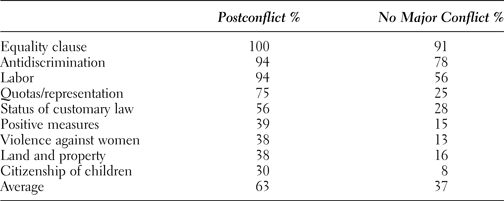
If one compares postconflict with nonpostconflict constitutions, the patterns are fairly clear, with postconflict constitutions being much more likely to adopt more provisions supporting women's rights, broadly defined. It is impossible to provide a completely satisfactory comparison because the content of the provisions varies. But the overall patterns are clear, and a careful analysis of the text of African constitutions bears this out (see Table 1). Postconflict constitutions, for example, are more likely to ensure that constitutional or statutory law prevails over customary law, particularly where there is a divergence between women's rights and customary practice—that is, where customary practices violate women's rights or discriminate against them in some form. Similarly, almost all of sub-Saharan Africa's constitutions today incorporate some clause specifically mentioning equality between men and women. Only the nonpostconflict countries of Botswana, Mauritius, Seychelles, and Zambia do not include such a provision. All the postconflict countries have such a provision.
Gender-related provisions in African constitutions, 2014

Source: Tripp Reference Tripp2015.
As with gender equality provisions, 94% of postconflict countries have provisions barring discrimination based on sex, whereas only 91% of nonpostconflict countries have this provision. All but one of the countries specifically mentioning that the citizenship of the children can follow that of the mother are postconflict countries. Of the postconflict countries, 30% have such a provision, while only 8% of nonpostconflict countries do. Gender-based violence has become one of the most important areas of new legislation, and of constitutional provisions, 26% of postconflict constitutions mention violence against women, whereas only 8% of nonpostconflict constitutions do so.
African women's movements are leading many of the efforts to promote political representation of women. As a result, half the countries in Africa have adopted quotas to increase the numbers of women in legislatures with the result that Africa has some of the highest representation of women in parliaments in the world. In Rwanda, more than 64% of parliamentary seats are held by women, the highest rate in the world. In Senegal and South Africa, more than 40% of parliamentary seats are held by women, while in Mozambique, Angola, Tanzania, and Uganda more than 35% of seats are occupied by women. All of these are postconflict or postupheaval countries, with the exception of Tanzania. Thus, it is no surprise that 75% of postconflict countries mention gender quotas in their constitutions, while 25% of the nonpostconflict countries do so. Many other postconflict countries refer to positive measures the state needs to take to address the status of women or past discrimination, where significantly fewer postconflict countries do so. About 38% of postconflict countries in sub-Saharan Africa have constitutional provisions that seek to eliminate discrimination of women in the acquisition and inheritance of property whereas only 16% of such countries did not experience major conflict.
WOMEN'S MOBILIZATION AROUND CONSTITUTION MAKING
The constitutional reforms detailed above were generally the product of intense mobilization on the part of women's organizations and activists. The following case studies are examples of the ways in which women engaged in the constitution-making process with varying degrees of success. Those countries that have gone the furthest in advancing women's constitutional rights were generally places where women's movements were most active around these issues, where the processes were relatively transparent and inclusive, and where this inclusion was generally supported also by foreign donors. In both cases, it was factional fighting based on clan (Somalia) and ethnicity (Kenya) that propelled women to become engaged in the constitutional process and fight political exclusion. The major push to resolve the constitutional crisis in Kenya came only after the 2008 election related violence. Women had already been advocating for their constitutional agenda for almost two decades. But it was only in the aftermath of political upheaval that key gender-based reforms were finally implemented along with other democratizing measures. Somalia had experienced conflict for an even longer period, and women had similarly been pressing for inclusion for a long time. The opaque and hasty nature of the constitution-making process, the difficulties Somalis faced in claiming ownership of the process, and perceived manipulations by neighboring countries, the United Nations Development Programme, clan leaders and other actors, made it extremely difficult for women to gain a foothold, even though they had been active in peacemaking in their communities for two decades (Elmi Reference Elmi2013). Nevertheless, both Kenya and Somalia have continued to experience challenges with implementing key constitutional provisions, particularly in ensuring that the legislative quota is fully implemented. Thus, the way in which local actors engaged with external actors affected constitutional outcomes regarding women's rights.
Kenya
Kenya has had one of the most active women's movements engaged in constitution making. Women were involved from the beginning in the constitutional review process. The first head of the Constitution of Kenya Review Commission (CKRC), Yash Ghai (Reference Ghai2005), referred to Kenyan women as the most active civil society group within the constitution-making process. As Cottrell and Ghai (Reference Cottrell and Ghai2007) wrote: “They made full and skillful use of the opportunities opened up by the review for women in particular. … The group which came out best from the process were women, who were able to present a united and coordinated position, transcending ethnic or religious distinctions.” The women were able to take advantage of elite splits to advance their agenda (Mati Reference Mati2012). The activists not only advanced a women's rights agenda that is evident in the 2010 constitution, but they also played an important role in moving the process forward and finding common ground between competing groups. In 2004, women's rights activist and leader in the Muslim community, Abida Ali-Aroni, who had been a vice chairperson of the Commission, became its chairperson when Ghai left. This was a huge difference from the early 1960s when only one woman went to the three Lancaster House conferences in the UK to negotiate the constitutional framework for the country prior to independence in 1963.
From the outset in the 1990s, the Kenyan constitution-making process was fraught but eventually ended in a constitution in 2010 that granted women extensive rights. Women had begun mobilizing to increase women's political representation around 1992 when Kenya opened up to multipartyism and the Women's National Convention was organized by FEMNET and National Council of Women of Kenya. Women activists and politicians like Martha Karua, Maria Nzomo, Rose Waruhiu, Phoebe Asiyo, and Wangari Maathai actively lobbied the Inter Parties Parliamentary Group (IPPG), which had been formed to look into constitutional reforms and reforms of the Electoral Commission. The Constitution of Kenya Review Bill was passed in 1997 and was the product of negotiations between the government and the opposition to the exclusion of civil society organizations, who rejected the Act (Ndegwa et al. Reference Ndegwa, Mwagi, Kasera, Owuor and Karanja2012).
In 1997 women activists and parliamentarians sought to introduce legislation to require all parties to nominate at least one-third candidates in national and local elections, amend the constitution to increase the representation of women in the parliament, and provide funding to parties commensurate to the number of female candidates they ran. This motion was defeated, and according to Kabira (Reference Kabira2012), it traumatized the women activists, but at the same time it served to galvanize women across political parties, including from the ruling party, to form the Women's Political Caucus. They sought to pass an affirmative action bill in 2000, but the issue was passed along to the CKRC. In 2007 they revived the affirmative action bill, and once again the Honorable Martha Karua, minister for justice and constitutional affairs, attempted to get the bill passed, which would give women 30% of the parliamentary seats. The president had already signed a directive insisting that all new appointments have 30% of women as a minimum. Women, under the auspices of the Women's Agenda Coalition, held major meetings in Nairobi of up to 2,000 women from around the country. They collected close to 700,000 signatures and 42,000 petitions from all 210 constituencies. On the day of the debate, members of parliament boycotted the session, and the debate never occurred for lack of a quorum. More than 1,000 women convened again in April 2010 at Bomas to review their gains and adopt a position on the 2010 referendum. They agreed to vote yes on the referendum (Kabira Reference Kabira2012).
Protests about the structure of the reform process led to a series of negotiations in 1998 involving civil society, opposition parties, and the Inter-Parliamentary Parties Group (IPPG), resulting in an amendment of the Kenya Review Act. Public participation was a key concern, and as a result of pressure from civil society, 54 stakeholder groups were represented on the CKRC. The ruling party, the Kenya African National Union (KANU), tried to prevent the Women's Political Caucus from being the nominating body for female candidates for the CKRC and tried to replace them with Maendeleo ya Wanawake (MYW). The Caucus was able to defeat this motion, arguing that MYW was one of its member organizations. Member organizations of the Caucus nominated 46 women, and five names were submitted. KANU did not accept these names and tried to prevent the women from being registered on the grounds that the Caucus nomination process was flawed and unrepresentative. The high court judge eventually ruled in favor of the Caucus.
The government, political parties, and civil society organizations could not agree on how to design the constitution-making process and so the Caucus stepped in to form a negotiating team to restart the review process. The team was led by the Caucus coordinator, Jane Ogot. In fact, it was the Kenya Women's Political Caucus that took the initiative to break the stalemate in the constitution review process at several junctures. Eventually in 2000, the Constitution of the Kenya Review Commission (CKRC) was finally constituted. Four women from civil society were part of the CKRC (Abida Ali Aroni, Nancy Baraza, Salome Muigai, and Wanjiku Kabira). Four other women came from the parliamentary group (Phoebe Asiyo, Alice Yano, and Kavesta Adagala). All saw themselves as representatives of Kenyan women. The women worked together at all stages, especially on all issues relating to women. The CKRC produced a draft constitution that provided for the devolution of executive power; however, President Moi dissolved parliament before they could consider it. This led to the start of the Ufungamano Initiative made up of religious organizations, women's organizations, and civil society. This was a parallel process that pitted civil society against the parliamentary process dominated by the ruling party. Professor Yash Ghai, the chairman of the Constitutional Review Commission, intervened to merge the Ufungamano group and the parliamentary group to form the Constitution of Kenya Review Commission (CKRC), after the enactment of the Constitution of Kenya Review Commission (Amendment) Act of 2001.
The opposition political parties came to an agreement on how to proceed with the constitutional reforms after the 2002 election; however, after the election, one of the former opposition leaders, Mwai Kibaki, who had just been elected president, reneged on his party's commitments to a decentralized arrangement that would have created a largely ceremonial executive with a strong prime minister, directly elected president, and system of proportional representation that would have benefited the smaller parties. He now favored a centralized system with a strong executive and majoritarian electoral system. Raila Odinga, his Liberal Democratic Party (LDP), and allies in the former ruling party, KANU, favored a version of the constitution referred to as the Bomas draft, named for the cultural center and museum where it had been drafted. Kibaki took measures to stop the Bomas draft and had Attorney General Amos Wako revise the draft, keeping the presidency strong and providing for a limited devolution of government. Thus, the Bomas and Wako drafts were pitted against one another, and no resolution was in sight. In 2006, the debate over the constitution in Kenya became intertwined with a debate over the Mwai Kibaki presidency and his attempt to expand the powers of the executive. The government's Wako draft was defeated in a November 21, 2006, referendum. Opposition to the draft led to a new alliance between Raila Odinga and KANU, called the Orange Democratic Movement, which challenged Kibaki in the 2007 elections. The split over the constitution led to the violence that ensued after the election.
The violence precipitated an intervention by the former UN secretary, General Kofi Annan. His efforts led to a National Accord and Reconciliation Act (2008) and the establishment of a new legal framework for a constitution, which was seen as key to preventing further violence. One-fourth (2 out of 8) of the negotiators involved in peace talks that led to the 2008 Nairobi Agreement on the Principles of Partnership of the Coalition Government were women, and Martha Karua led the government's negotiating team. This came about as a result of pressure from women's organizations. Key to their success was their ability to bridge ethnic and religious differences and focus on a common women's rights agenda (Mutua Reference Mutua2006).Footnote 1
A Committee of Experts, including Kenyan legal scholars and non-Kenyan technical experts, drafted yet another version, bringing together the Wako, Boma, and KCRC drafts. They left the presidential system intact but weakened key powers of the executive and strengthened those of the legislature. The draft passed the parliament in April 2010, and it went to a referendum on August 4 in which it was approved by 67% of all Kenyans. Two of the main issues of contention during the referendum debates affected women specifically and had to do with abortion and the constitution's recognition of the Kadhi courts, which decide on family law issues pertaining to marriage, divorce, and inheritance of the Muslim community.
In all drafts of the constitution (CKRC draft 2002, Bomas draft 2004, Wako draft 2005, Harmonised draft 2009, and final constitution 2010), women were able to get their demands reflected in the text. Those women engaged with the process worked closely with women's organizations. The women's coalition that was involved in the process consulted regularly with the political parties, members of Parliament, the media, and civil society groups and worked closely with men like Oki Ombaka and Professor Okoth Ogendo, who supported them on the commission. At key moments when the process began to fray, they consulted party leaders, the attorney general, and other important players. They made sure that one of three delegates from the districts was a woman at the National Constitutional Conference in 2003–2004 organized at Bomas. They mobilized strategically to ensure a strong presence in all the major committees (representation, legislature, devolution, bill of rights, and constitutional committees). When the Bomas draft was brought to parliament for review, they found that the 30% quota for women in the national assembly, senate, and district assemblies and local authorities had been removed. Some parliamentarians also sought to remove the affirmative action seats. In the end, the women's coalition lost the district representation for women in the national assembly (lower house) but retained the 30% quota for country assemblies and Senate.
Women's concerns were broad but focused on the issue of representation in elected bodies and government. Women sought the right to inherit and use property equally. This was aimed at putting an end to the practice whereby in-laws grabbed the property from the widow. Female and male children would also be able to inherit land from their parents. They made sure that customary law no longer overrode women's rights as was the case in the 1963 constitution. They also sought a gender commission.
The final draft of the constitution that was accepted retained strong provisions for women's rights. Women felt proud of their gains, which have been clearly documented in Wanjiku Kabira's wonderful book, Time for Harvest: Women and Constitution Making in Kenya (Reference Kabira2012). But women also came out of the process with a strong awareness of how much resistance there was to their demands and that it would be an uphill battle to see that the provisions would actually be implemented, particularly the quota in the national legislature. They had few illusions that this would be an easy process. Nevertheless, the 2010 constitution makes the following provisions:
-
• Any law, including customary law, that is inconsistent with this constitution is void to the extent of the inconsistency, and any act or omission in contravention of this constitution is invalid.
-
• Women and men have the right to equal treatment, including the right to equal opportunities in political, economic, cultural, and social spheres.
-
• Neither the state nor a person can discriminate against another based on sex and other grounds.
-
• The state shall put in place affirmative action programs for minorities and marginalized groups with respect to governance, education, economic opportunity, employment, and other such factors.
-
• The constitution established the Kenya National Human Rights and Equality Commission.
-
• The constitution provides for the elimination of gender discrimination in law, customs, and practices related to land and property in land.
-
• Not more than two-thirds of the members of elective public bodies shall be of the same gender.
-
• Parliament shall enact legislation to promote the representation in parliament of women.
In spite of these gains, women's rights activists like the Federation of Women Lawyers (FIDA) noted that they lost out in the areas of equal marriage rights, women's rights to reproductive health care and the addition of more restrictive abortion rights language than they would have liked, the removal of language affirming shared parental responsibility for the care of children, and the subsuming of children, persons with disabilities, and minority and marginalized groups under the category of vulnerable groups. It should be noted that even with the restrictive abortion rights language, American Christians organized petition drives in Kenya and pro-life U.S. congressmen pressed for audits on USAID's role in supporting the constitution-making process because of references in the constitution to the “health of the mother,” which they felt opened the door to abortion on demand.Footnote 2 They were concerned that the agency had violated the Siljander Amendment, which forbids U.S. funds to go overseas for lobbying for or against abortion. The inspector general found no evidence of direct lobbying on the part of USAID.
In addition to U.S. pro-life advocates, Kenyan religious and antichoice advocates also came out strongly in opposition to the draft constitution because of the abortion clause. As a result, FIDA and other women's organizations pressed vigorously to protect abortion rights even in their limited form. FIDA received support from international partners like the Centre for Reproductive Rights (CRR) in strategizing how to protect women's reproductive rights. FIDA, along with other local women's groups, carried out civic education around the issue throughout the country. Seven amendments were proposed to Article 26 to gut the provisions, and all failed as a result of efforts by FIDA and other women's organizations (Maingi Reference Maingi2011).
The main actors influencing the process of incorporating women's rights provisions into the Kenyan constitution included the women's movement, supported by their male allies in government, as well as donors. The U.S. government, for example, supported the constitution-making process, including women's rights advocates, with about $23 million. Other donors included the UN Fund for Women (UNIFEM) and the Nordic countries. The key to the successes of the women's movement in the constitution-making process was, first, the fact that there was a strong sense of ownership of the process among Kenyans and among women activists and, second, the capacity of the women's movement to remain united when it mattered and bridge ethnic and religious differences. The women's rights activists also took advantage of the failure of political leadership during the political upheaval to insert themselves into the process. The political elite were in disarray as a result of the 2008 postelection violence that had divided the nation. The women's rights activists' involvement was made possible by political opening, however tentative and problematic, that allowed them to mobilize and express their interests independent of the state.
After the constitution was passed, impressive gains were made to implement affirmative action policies, especially within the cabinet, judiciary, local county assemblies, and other government bodies. However, reduced support by donors, as well as poor government coordination and monetary commitment, made it more difficult after the 2013 elections for women's organizations to ensure the implementation of their key demand regarding affirmative action in the national legislature.
Somalia
The Somali case is more complex and shows how the lack of an open constitution-making process hindered women's engagement. Women activists made some gains in the constitution-making process but were ultimately disappointed that the outcome fell far short of their expectations because the process itself was flawed. Moreover, many felt that the process had been driven by outsiders, further compromising the outcome.
Women have a long history of activism in Somalia that predates the independence movement in the 1940s and 1950s. They were involved in the revolution led by Siyad Barre in the 1970s and were also part of the opposition to the tyrannical Barre regime, which suppressed all civil society organizations, including independent women's associations (Affi Reference Affi and Tripp2003; Timmons 2004). For more than 20 years, women's organizations had lobbied for representation in the peace talks, in the transitional government, and in the constitution-writing process. Their key demand was a 30% quota in parliament and government, and most of the debates regarding women's rights focused on this critical issue.
Zahra Abdullahi, a women's rights activist, articulated many of the concerns of Somalia women when she said Somali women are treated like second-class citizens: “All Somali citizens are equal before the law, but Somali women are still subjected to injustice and marginalisation in the political arena.” She also mentioned that Somali women are not always aware of their rights; they are pulled out of school and are married at an early age. “No one gives women the courage or inspiration to leave their homes and demand their rights,” she added (Mohamed Reference Mohamed2012). Dr. Dini has also argued that women are marginalized because men have greater resources, the support of their clan, and because they actively campaign for seats. Women, on the other hand, “lack the resources, family connections, and the support of traditional leaders” (Dini Reference Dini2012). These realities gave urgency to women's demands to be represented politically.
Women's indignation at being excluded from the political process was also fired by a desire to participate in the reconstruction of the country and a frustration with a male-dominated leadership. As Asha Abdalla said, “Somalia needs change. We are sick and tired of male leaders who have done nothing except create wars. They have been fighting over power while people die of poverty and starvation.” The head of the Somali Women's Federation, Asha Omar stated, “We [women] are the peace-lords, we're working hard,” she said. “It's the men who left their work—they're just fighting between themselves. Everyone wants to be a president” (IOL 2003).
Women had been left out of 13 reconciliation conferences between 1991 and 1999, along with all other civil society groups. Only the warring factions were included. Starting in 2000, women became even more engaged in grassroots and national level peacebuilding initiatives and were insistent on being included because they were increasingly left to shoulder responsibilities that they had previously shared with husbands and other family members as a result of the war. Women had been caring for the wounded, providing social welfare, and building schools in communities, regardless of clan or political affiliation. In fact, it was Somali women who persuaded the leaders of the five main clans to attend the Somalia Reconciliation Conference at Arta, Djibouti, in 2000 and who pushed them to think beyond clan boundaries. Women had been cooperating across clan and kinship lines since the start of the conflict in order to obtain basic provisions. They eventually shifted to advocacy, mediation, and peacebuilding (Timmons 2004).
At the 2000 Djibouti conference, women also lobbied to be considered a separate sixth clan because the clans would not include them in their official delegations. During the transitional government, the assembly seats were balanced between competing clans. Each of the four major clans was represented by one of five women with five remaining women representing minor clans. Interestingly, the women formed a bloc (“rainbow coalition”) to advocate for women's interests across clan lines. One delegate to the 2000 reconciliation conference in Arta, Djibouti, Mariam Arif Qasim explained: “We [women] are now the sixth clan. We do not think in terms of clans. We are from different clans and live together in the same house” (Hollier-Larousse Reference Hollier-Larousse2000). The women were given permission by the president of Djibouti, Ismaïl Omar Guelleh, to be represented as the sixth clan and became delegates on the charter drafting committee and the steering committee of the conference. They claimed 100 seats as special delegates at the invitation of President Guelleh.
The women were well organized, and the Sixth Clan Coalition of women campaigned for a 25% quota along with other gender-related demands. They were granted only 11% of the 225 seats in the transitional government. At the Djibouti conference, women pressed for the revival of a controversial 1975 family law. It required court consent in order to marry more than one wife, provided equal inheritance between men and women, limited the amount of bridewealth, provided for cost sharing between bride and groom and sharing household assets in the event of a divorce. It also limited the practice of easy divorce declarations and ensured equal rights for men and women (Abdullahi Reference Abdullahi2009).
A major breakthrough took place at the 2003 and 2004 Somali Reconciliation Conferences in Kenya where women activists (with the help of UNIFEM and NOVIB-Somalia) struggled for and won the right for women to become presidents and judges, a provision that made it into the 2012 constitution. They also lobbied the charter crafting committee and got them to insert gender sensitive language into the charter (“he and she”). By getting the technical committee to make this change, they were able to avoid a major uproar that it would have created had it been raised at the conference for debate. This language is reflected in the final 2012 constitution (Abdullahi Reference Abdullahi2009).
In 2003, at the Reconciliation Conference in Kenya women were allocated 12% of the parliamentary seats, but women delegates felt this was not commensurate with their percentage of the population and their contributions to society. In 2004, a group of 19 Somali NGOs called for stronger women's representation in the country's new government, saying that women should be given “significant ministries” to reflect their true position in the Somali society. Halimo Abdi Arush of the Women's Development Organisation (IIDA), said that the women were demanding “what is rightfully theirs.” The women called for full representation in parliament and in every aspect and level of the new government. “We cared for the weak and the dispossessed,” she told IRIN. “It would be unfair to deny the women their rights of political participation at this stage” (IRIN 2004).
It was very important for women to be included at the ground level in negotiations that set the stage for the process that led to a new constitution. Thus, women lobbied vigorously to influence the Garowe talks. At the December 2011 Somalia National Consultative Conference in Garowe the signatories had agreed to a 30% quota for women in parliament. This was part of what were known as the Garowe Principles, a set of agreements between the Transitional Federal Government of Somalia and other key Somali political players outlining the framework for the political transition. The principles were reaffirmed in the Garowe II Principles (February 2012) and the London Somalia conference (February 2012), but were somewhat modified in the Galkayo Amendment (March 2012), which brought the number of National Constituent Assembly (NCA) members down from 1000 to 825. It was also agreed that the traditional leaders would select the NCA members in April of 2012.
In addition to the 30% quota for the Constituent Assembly (CA), the Garowe Principles I and II also stipulated that women were to be included in the Interim Independent Electoral Commission (5 members). Women were also to make up 30% of the new parliament in seats set aside from the 4.5 principle that divided seats between the four major clans. Civil society and respected women members of the clans were to nominate and select the women. The 30% quota energized many women to consider getting involved in politics. Although many key provisions regarding women made it into the final constitution, none of these basic provisions were included.
Many Somali observers were critical of the way in which the constitution-making process was manipulated, particularly in the last phase, making it impossible for women, civil society actors, and Islamists to have any input into the process. They had wanted the process to be removed from political manipulation, but instead the process was hijacked by key political actors. In 2011, the Somali government formed a nine-member Committee of Experts (COE) who were to assist the Independent Federal Constitution Commission (IFCC), made up of clan representatives, in drafting a constitution. The constitution itself was drafted by international law experts and members of the Somalia diaspora who have lived in the United States, Canada, Britain, and Australia. The technical committee drew on Somalia's past and present constitutions as well as those of South Africa, Kenya, Indonesia, Malaysia, and Spain. They were funded by the UNDP and UN Political Office for Somalia (UNPOS).
While this kind of external technical support is common in constitution writing exercises in postconflict countries, there was a widespread perception among Somalis that the process was led by the international community, which dictated the content of the constitution. The IFCC and CoE carried out in 2012 a series of consultations with members of the Somali public in Mogadishu, Guriyeel, Herale, Adado, and Galkaayo South (Galmudug State), as well as with diaspora communities in Nairobi, London, and Oslo as well as Minnesota and Ohio in the United States. Interestingly, while the respondents in the consultation were critical of the role of the international community, there were also critical that the Garowe Principles of guaranteeing a 30% quota were not specifically referred to in the constitution and they were also generally supportive of women's participation in institutions of governance, although there were some differences over the extent to which Islam as a religion allows for women's leadership.
A first draft was issued in 2010 and they started collecting feedback from citizens and subsequently revised the draft. UNPOS and six Somali politicians rejected the draft and secretly formed a new constitutional review committee and planned a constitutional meeting in Addis Ababa in May 2012 without the participation of the IFCC and COE. They revised the constitution, changing or deleting 70 articles relating to key issues of governance. The constitution was signed on June 25, 2012, in Nairobi, by UN Secretary General Ambassador Augustine Mahiga and six Somali politicians, throwing the entire legitimacy of the process into question. No independent constituent assembly was held to vet the constitution (Elmi 2013).
Many of the key provisions that were dropped in the final constitution related to women's representation. The constitution left the exact number of women open but said that women should be represented. This pattern of denying women seats that had been promised to them became a primary bone of contention for women activists. They felt large numbers of women had been very engaged at the grass roots in peacemaking but were being deprived of a role at the national level. Women were now even aspiring to the presidency in a country where women had historically been completely left out of national politics. In the 2004 presidential elections three women registered as presidential candidates for the first time in the country's history. In the 2012 elections, two women ran for president: Amal Abdi Ibrahim and Asha Ahmad Abdalla.
Thus, in July 2012 women participating in the conference on the ratification of Somali draft constitution walked out of the meeting after stating that their grievances were not being considered (Somali Midnimo.com 2012). At this time hundreds of Somali women demonstrated in the streets of Mogadishu, demanding representation in Somali politics. Women's organizations also held a conference in July 2012 to strategize how they might advance their demands, particularly around the 30% quota. The meeting was held at the Ministry of Women and Family Affairs in Garowe, Puntland, and women delegates attended from Galmudug, Himan and Heeb, Ahlu Sunna, and Hiiraan regions (Garowe Online 2012).
In the end, women were allowed to fill 38, or 13.8%, of the 275 parliamentary seats. Women activists continued to press for the 30% quota agreed to in the Garowe Principles. The Somali Women's Circle Network (SWNC), for example, criticized the selection process by traditional elders and argued for an independent oversight women's committee that would ensure that women's interests were represented rather than relying on the traditional elders. Still, many of the women entering politics were either from the diaspora or had spent time in Nairobi, and it took time for women to claim ownership of the process, according to Ekambi (IRIN 2012). Some elders refused to have women representing their clan, while other women's seats were bought by men. Allegedly, seats were sold for tens of thousands of dollars, which most women could not afford to pay. Some women were able to outwit their clan to gain representation; however, these types of machinations and lack of transparency in the process served as a real constraint on women. Amazingly, then president of Puntland, Abdirahman Farole, submitted a list of parliamentarians on behalf of the clans living in Puntland, and his list complied with the 30% quota for women. The major clans, however, did not make a good faith effort to include women, and there were no sanctions for noncompliance. Moreover, the constitution was now vague on how female representation would come about.
The same pattern evident in the parliament was repeated in the cabinet. Only 2 of the 10 ministers announced were women. Mariam Arif Qasim is in charge of the social development services minister, overseeing the largest ministry in charge of education, health and social services. Fowsia Yusuf Haji Aden heads the foreign ministry and became deputy prime minister, which is a first in Somali history. Already the Somali Ministry of Development and Social Affairs is drafting a bill that outlines a new gender policy for the country that protects women's rights, especially in politics, health, and education.
One of the big stumbling blocks to women's advancement in politics has been clan politics since the clan is the main vehicle through which one can access political power in Somalia. Powersharing is divided between the clans in a 4.5 formula that divides power between the four clans (Darood, Hawiye, Dir, and Digil, and Mirifle, who constitute one clan) and .5 for other minority groups. This means that women don't have the same entitlements as men to become leaders and represent the clans. Dini finds it ironic that this system, which is at the root of so much of the conflict in Somalia, is being used as a basis for reconstructing the polity (Dini Reference Dini2012).
In the allocation of parliamentary seats by traditional elders, women were told that the number of seats allocated to each clan was too few to allow them to give more seats to women. Women in cross-clan marriages face additional challenges since they cannot be allocated seats from their natal clan nor from the clan of their husband (Dini Reference Dini2012). Although women were forced to work across clans in ways that men have found more challenging, ultimately the fact that clan politics was allowed to infuse the new political arrangement remains a hindrance to women's full political participation. A women's activist, Asho Usman Ugas, explained, “Women should be treated as women and their share given as such and not as part of clans.” Because women are treated as part of the clan, she said, “men will never give the rightful share to women” (IRIN 2004).
The 2012 constitution, unlike many other contemporary constitutions, is written with gendered pronouns (“he and she”). It includes the following gender related provisions:
-
• The Somali constitution provides for women to be included in all national institutions across three branches of government. Women can run for the presidency.
-
• As in other postconflict constitutions, it provides for equal rights based on gender and has an antidiscrimination clause that states that women and other groups “who have long suffered discrimination” should “get the necessary support to realize their socio-economic rights.”
-
• Unlike the other postconflict constitutions, the Somali constitution states that all law must conform with the general principles of the Shari'ah. Of course, this is subject to interpretation, which many worry will not favor women's rights. It does not have the clause that allows for statutory law to override customary or shari'ah law, but rather takes a more neutral position without mentioning women specifically: “The state shall promote the positive traditions and cultural practices of the Somali people, whilst striving to eliminate from the community customs and emerging practices which negatively impact the unity, civilization and well-being of society.”
-
• The constitution mentions the right to personal security, which includes the right to protection from violence against women.
-
• The constitution bans female genital cutting (FGB): “Circumcision of girls is a cruel and degrading customary practice, and is tantamount to torture. The circumcision of girls is prohibited.” Some women activists were concerned that in a society where the practice is widespread, that the criminalization of the practice would not only signal a disapproval of the practice, but might drive the practice underground rather than eradicating it. They felt it would require education, programs for girls and women, and work with religious and other leaders to bring an end to the practice, particularly since it is widely believed that women cannot get married without being cut, nor can they be considered adults or participate in public settings.
-
• It is interesting that the only constitutions in the world that mention abortion are the Somali, Kenyan, and Swazi constitutions. Abortion in Somalia is prohibited except in cases of necessity, particularly where the mother's life is in danger.
-
• There are few references to women and labor law in postconflict constitutions, perhaps because in most postconflict countries in Africa the majority of women are engaged in the agricultural sector and in the informal economy due to the disruption of conflict. Thus it is especially forward looking, for the constitution includes such provisions in the Somali case: The constitution stipulates that “[e]very labour law and practice shall comply with gender equality in the work place.”
-
• No marriage shall be legal without the free consent of both the man and the woman.
-
• The Somali constitution is the only constitution in Africa to mention that women can serve on armed forces. During the Siyad Barre era, women served in all branches of the armed forces.
The Somali constitution-making process shows the limits of women's mobilization when they are not adequately supported by international actors. Various UN agencies played a positive role at various stages in the process in advancing women's rights, but the signature of the UN secretary general ambassador on the June 2012 constitution and the lack of transparency of the final process created a perception that the UN was implicated in a flawed and politicized process of which Somalis did not have a sense of ownership. It shows how women's demands were swallowed up within manipulations of politicians who had narrower interests and political ambitions. At the same time, it shows the extent to which the postconflict dynamics allowed women activists to get some of their demands into the constitution that went well beyond previous constitutions. Nevertheless, consultations with key Somali constituents after the process was over showed that there would have been support for stronger provisions for women's representation.
CONCLUSIONS
This article focuses on a set of changing opportunity structures that resulted in institutional reforms that advance women's rights. In Africa both the introduction of democratization, albeit often very limited, and the end of conflict opened up possibilities for constitutional reform. In the Kenyan case, the disarray among the political elite opened up possibilities for women to assert leadership in the overall process as well as regarding women's rights. However, it was the end of conflict that precipitated constitutional reforms that advanced women's rights to a greater extent than in countries that had not experienced conflict. This happened as a result of pressures from women's movements, supported by donors. It also came about as a result of changes in women's position during the conflict and as a result of subsequent political opening that allowed for autonomous mobilization in postconflict countries. Although the gender-related constitutional reforms came about in countries that had experienced long and violent civil war as in Somalia, they also happened in countries that experienced more contained political upheaval and election violence as in Kenya.
In sum, women's movements determined the extent to which these changes took effect. In those countries where women's movements were weak, divided, or uncoordinated, we saw far fewer of these changes (for example, Chad). Where women came together, even in very hostile environments, they made gains, as in Kenya. Moreover, it was also necessary that women activists got engaged early on in the process at the stage where the rules of transition were made: in the peace processes and in the constitution framing processes. These rules of transition determine who the players would be and the extent to which women would actually participate in the process. It was also necessary that women were involved in every step of the transition and constitution-making process, including the technical process. This was where the Somali women, for example, made important gains in getting gender-sensitive language into the constitution. Had they ignored this aspect, they would have missed an important opportunity to advance their agenda.
The capacity of women's movements to build alliances with male politicians, ruling parties, and the executive was critical. So too was their ability to work with women already in power and to actively suggest women for top positions, heading up negotiating teams, constitutional review commissions, electoral commissions, speakers of the house, and other key positions. Movements often have divisions within them and are riven by jealousies, jockeying for the limelight, and other human tendencies. The capacity to rise above such pettiness paid off in the long run in the countries where women's movements were successful in advancing their goals.
Finally, the constitution-making exercises were an important exercise in transforming the normative framework for discussing women's rights. They were more than simply a reflection of existing patterns of gender relations. They became a means through which women's movements could envision a new order that included their input and their aspirations. Thus we saw entirely new norms emerging through the process in which postconflict constitutions began for the first time to prohibit customary practices if they undermined the dignity, welfare, or status of women in countries like DRC, Ethiopia, Kenya, Somalia, Sudan, South Sudan, and Uganda. In Somalia women can now participate in the military. FGM is explicitly banned in Somalia and Ethiopia. Quotas can be used to significantly increase women's representation in many countries. Women's movements played an important role in ensuring that these clauses were included.
The fact that women's movements in the 1990s started tackling some of the most intransigent and difficult societal issues within constitutional reform is an indication of how far the debates have come and how much has changed. Some of issues being taken up could not even be mentioned in public and were considered taboo well into the 1990s (e.g., domestic violence and female genital cutting).
Nevertheless, the tensions between customary law and women's rights remain an important constraint on advancing women's status in society. Even in countries where customary law is subordinate to a constitution that bans gender discrimination, there is still the danger that laws will interpret constitutional provisions supporting customary laws and practices in ways that are detrimental to the welfare of women. The issue of customary law and the arbitrariness of rulings by traditional authorities remains a major source of concern for women's rights activists.
At the same time, the very fact that there is resistance to many efforts at constitutional reform regarding women's rights suggests that laws matter and that laws are not merely passed to satisfy changing international norms. These examples from Africa also show the extent to which African women are at the forefront of efforts to redefine women's rights as human rights as well as the extent to which they are redefining their own societies.