INTRODUCTION
The importance of agricultural soil for climate change mitigation through soil carbon (C) sequestration has dominated current global climate change debates and therefore accompanied recommendations for mitigation of climate change impacts because it is environmentally sound and ensures ecosystem productivity (Food and Agriculture Organisation (FAO) 2010). Soil organic carbon (SOC) modifies soil physical, chemical and biological properties, eventually affecting nutrient provision, water retention and microbial nourishment (de la Jimenez et al. Reference de la Jimenez, de la Horra, Pruzzo and Palma2002). The amount and stability of SOC in agricultural soils determine their productivity and contribution to sustaining environmental quality (Lal Reference Lal2004). The Kyoto Protocol's article 3·4 (United Nations 1998) provides a method of assigning credits for C sequestration in agricultural soils, enabling the C sequestered by soils to be traded as a marketable commodity comparable with other farm products. Such a goal can only be achieved through the establishment of a C database for land management practices and technological options that can enhance the sequestration of C in agricultural soils. Agricultural practices therefore influence the amounts of C stocks in farming systems, including a potential role in sequestering C to diminish greenhouse gas (GHG) concentrations and global warming. In tropical and sub-tropical regions, soils are inherently low in SOC; this is compounded by long annual dry spells that increasingly cause farmers to use soil amendments to overcome the challenges of low SOC and nutrient retention.
Practices that have been identified for enhancing SOC sequestration in agricultural soils include: (i) application of manure and inorganic fertilizer (Liu Reference Liu2004; Gulde et al. Reference Gulde, Chung, Amelung, Chang and Six2008; Gong et al. Reference Gong, Yan, Wang, Hu and Gong2009), (ii) conservation tillage (Six et al. Reference Six, Elliott and Paustian2000; Chivenge et al. Reference Chivenge, Murwira, Giller, Mapfumo and Six2007; Marongwe et al. Reference Marongwe, Kwazira, Jenrich, Thierfelder, Kassam and Friedrich2011), (iii) crop rotation (Havlin et al. Reference Havlin, Kissel, Maddux, Claassen and Long1990; Smith et al. Reference Smith, Powlson, Glendining and Smith1998), (iv) improved fallowing, (v) mulching (Mafongoya & Dzowela Reference Mafongoya and Dzowela1999) and (vi) intercropping. A combination of manure and inorganic fertilizer has been found to improve soil organic matter (SOM) contents and its fractions, thus enhancing C sequestration (Manna et al. Reference Manna, Swarup, Wanjari, Ravankar, Mishra, Saha, Singh, Sahi and Sarap2005; Rudrappa et al. Reference Rudrappa, Purakayestha, Singh and Bhadraray2006; Purakayastha et al. Reference Purakayastha, Rudrappa, Singh, Swarup and Bhadraray2008; Li et al. Reference Li, Liu, Wu, Han and Zhang2010) mainly through increased dry matter production. Contrary to these positive results, Wu et al. (Reference Wu, Schoenau, Li, Qian, Malhi, Shi and Xue2004) found decreasing SOC after application of nitrogen (N) fertilizer, while others found no difference in the effects of single organic and single inorganic fertility amendments on TON storage (Šimon Reference Šimon2008).
Most arable fields in smallholder areas of Eastern and Southern Africa are characterized by gradients of decreasing soil fertility as one moves away from homesteads, resulting from preferential application of manure, household waste and inorganic fertilizers to fields closest to homesteads (Tittonell et al. Reference Tittonell, Vanlauwe, Leffelaar, Shepherd and Giller2005; Zingore et al. Reference Zingore, Murwira, Delve and Giller2007b). The resource allocation strategies affect the quantity of SOC after addition of farmyard manure and inorganic fertilizers, resulting in greater C in fields close to homesteads than fields further away on both clayey and sandy soils (Zingore et al. Reference Zingore, Delve, Nyamangara and Giller2008; Dunjana et al. Reference Dunjana, Nyamugafata, Shumba, Nyamangara and Zingore2012). Progressive studies done in Murewa District, Zimbabwe at 3 (Zingore et al. Reference Zingore, Delve, Nyamangara and Giller2008) and 7 years (Dunjana et al. Reference Dunjana, Nyamugafata, Shumba, Nyamangara and Zingore2012) confirmed decreasing C and N with distance from homesteads. Available phosphorus (P) also decreases significantly with distance from homesteads, particularly where farmers have cattle, due to preferential application of manure and mineral fertilizers on fields closest to the homesteads (Zingore et al. Reference Zingore, Murwira, Delve and Giller2007b). Increased SOC and total organic nitrogen (TON) were also closely related to increases in crop yields. Similar results have also been reported elsewhere (Mapfumo & Giller Reference Mapfumo and Giller2001; Mtambanengwe & Mapfumo Reference Mtambanengwe and Mapfumo2005; Tittonell et al. Reference Tittonell, Vanlauwe, Leffelaar, Shepherd and Giller2005; Zingore et al. Reference Zingore, Delve, Nyamangara and Giller2008; Masvaya et al. Reference Masvaya, Nyamangara, Nyawasha, Zingore, Delve and Giller2010). However, Haileslassie et al. (Reference Haileslassie, Priess, Veldkamp and Lesschen2007) found contradictory results with greater soil fertility in fields away from homesteads in the east African highlands of Ethiopia.
The losses or gains of SOC and TON over the short- and medium-term are difficult to detect due to spatial and temporal variability, and may not be a sensitive indicator of short- and medium-term changes in soil quality (Hassink Reference Hassink1997). Labile organic C fractions such as free light fraction (fLF) and dissolved organic C can be used as early and sensitive indicators of changes in SOC (Haynes Reference Haynes2000). Light fraction organic C is important in reflecting short-term turnover of nutrients and is considered to be an early indicator of changes in soil quality (Hassink Reference Hassink1997) with greater concentrations of N than the mineral-associated heavy fraction (MaHF) (Compton & Boone Reference Compton and Boone2000). Methods such as density fractionation, size separates or a combination of the two divide SOM into three basic levels of functional and structural complexity with different turnover rates (von Lützow et al. Reference von Lützow, Kögel-Knabner, Ekschmitt, Matzner, Guggenberger, Marschner and Flessa2006). The light fraction (LF) is easily decomposed, has a greater turnover rate and is smaller than MaHF and can be used to characterize the impacts of different soil amendments and other land use practices.
The importance of fLF, occluded light fraction (oLF) and MaHF is widely recognized in studies outside Southern Africa (Dalal & Mayer Reference Dalal and Mayer1986; Janzen et al. Reference Janzen, Campbell, Brandt, Lafond and Townley-Smith1992; Liu et al. Reference Liu, Liu, Xing, Herbert and Zhang2005; Swanston et al. Reference Swanston, Torn, Hanson, Southon, Garten, Hanlon and Ganio2005) but the relationship between the three fractions is poorly understood in African soils. Yin et al. (Reference Yin, Cai and Lu2005) and Yin & Cai (Reference Yin and Cai2006) studied this relationship using a linear form of the Langmuir equation and found a positive correlation between light fraction organic matter (LFOM) and the ratio of LFOM and heavy fraction organic matter (HFOM) (i.e. LFOM/HFOM ratio) under organic and inorganic fertilizer treatments in China. They calculated the potential increase and the maximum equilibrium value of HFOM of soils from three long-term experimental fields in China and their LFOM/HFOM ratios ranged between 0·01 and 0·50, with higher values under organic fertilizer amendments. Knowledge of the equilibrium levels allows the evaluation of the potential of the different soil types and agricultural practices for soil C sequestration (Yin & Cai Reference Yin and Cai2006).
Little is known about the long-term effects of applying inorganic fertilizers either alone or in combination with organic manure on SOC and TON and their distribution in SOM fractions at different soil depths. Data from long-term experiments can help to understand and estimate the contribution of manure and fertilizer to SOC dynamics. The present study provides an opportunity to examine the long-term effects of manure and fertilizer on SOC pools under smallholder farming in Zimbabwe. The main objective was to study the depth distribution (0–50 cm) of SOC and N and their fractions in a 9-year field experiment in Murewa District, Zimbabwe. Improved understanding of SOM fractions can provide valuable information for soil management systems to enhance and maintain soil quality. It was hypothesized that long-term manure and fertilizer application would influence the distribution of C in bulk soil and SOM fractions. Furthermore, the fLF C was considered as a responsive indicator of SOC change after soil fertility amendments and it was also hypothesized that there is a stronger relationship between LF and MaHF in clayey soils than in sandy soils, because of the larger adsorption capacity of clay particles for organic molecules.
MATERIALS AND METHODS
The study site
The soils were collected from Murewa District of Zimbabwe which is located ~80 km east of Harare (17°39′13″S, 31°48′30″ E, 1300 m a.s.l.). The area receives unimodal rainfall of 750–1000 mm annually, has a mean maximum temperature of 26 °C and mean minimum temperature of 14 °C. The soils in the area are predominantly granitic sandy soils (Haplic Arenosols) (FAO/IIASA/ISRIC/ISSCAS/JRC 2012), strongly weathered with low levels of available nutrients and nutrient reserves. Pockets of dolerite intrusions give rise to small patches of more fertile clay soils (Chromic Luvisols) (Nyamapfene Reference Nyamapfene1991; FAO 2006).
Farming practices are based on integrated crop/livestock systems with maize (Zea mays L.) as the dominant staple crop. In addition, other crops such as sunflower (Helianthus annuus L.), groundnut (Arachis hypogaea L.), sweet potatoes (Ipomoea batatas L.) and assorted vegetables are grown. Cattle are the main livestock, communally grazed in open access areas mostly during the wet season and in arable fields during the dry season. The cattle are corralled close to homesteads at night. In most cases, cattle feed on crop residues during the dry period while organic fertilizer is used to fertilize crops, although a small proportion of farmers use the residues as mulch in fields where conservation agriculture (CA) is practised. Cattle provide draught power for conventional tillage and for ferrying fertilizer inputs to the fields.
Characterization of experimental sites
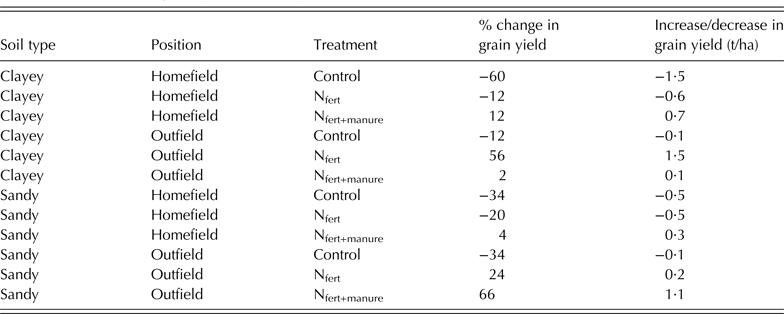
Soils were collected from three fertility treatments after 9 years of continuous maize (Z. mays L.) cultivation, based on soil fertility gradients and treatments described by Rusinamhodzi et al. (Reference Rusinamhodzi, Corbeels, Zingore, Nyamangara and Giller2013). Two farms with fields having contrasting soil types were selected for the study: one on Arenosol (sandy soil) and another on red clay soil which is a Luvisol (clayey soil). Each farm had representative homefields (<50 m from homestead) and outfields (100–500 m from homestead) as described by Zingore et al. (Reference Zingore, Murwira, Delve and Giller2007a). Existence of fertility gradients, evidenced by decreasing soil fertility with increasing distance from homesteads in smallholder farms, was confirmed by Tittonell et al. (Reference Tittonell, Muriuki, Klapwijk, Shepherd, Coe and Vanlauwe2013). Mean SOC concentration given by Zingore et al. (Reference Zingore, Murwira, Delve and Giller2007a) for sandy homefields was 5 g C/kg, whereas sandy outfields had 3 g C/kg. Clayey homefields had 14 g C/kg whilst outfields had 7 g C/kg. The TON concentrations were 0·4 and 0·3 g N/kg in homefields and 0·9 and 0·5 g N/kg in outfields on Arenosols (sandy soil) and Luvisols (clayey soil), respectively. The corresponding C : N ratios were 13 and 10 for homefields and 16 and 14 for outfields. Biomass yields generally increased with time in treatments under N fertilizer and manure (Table 1). Residue retention was minimal and <0·5 t/ha due to competing uses and the free-range grazing in the off-season period. The free grazing was not controlled and is likely to have similar effects on all treatments.
Mean maize grain yields for the period 2003–11

Source: Rusinamhodzi et al. (Reference Rusinamhodzi, Corbeels, Van Wijk, Rufino, Nyamangara and Giller2011).
Experimental design in each soil type was a split-plot design within a randomized complete block with four replications on 0·003 ha plots in each soil type and field position. Three treatments were selected in each soil type and field position based on applicability to smallholder farmers’ fields: (1) unfertilized (control), (2) inorganic nitrogen fertilizer (Nfert) = 100 kg/ha of N split applied as ammonium nitrate in equal amounts at about 3 and 6 weeks after plant emergence and (3) cattle manure (0·9% N) + ammonium nitrate (100 kg/ha of N) (Nfert+manure) where cattle manure was applied at 5 t/ha (equivalent of 10 kg P/ha), prior to each cropping season in every year.
Soil sampling and analysis
Four representative soil samples were collected from each soil type and field position (i.e. homefields and outfields) at incremental depths of 0–10, 10–20, 20–30 and 30–50 cm. Samples were composited for each depth and replication, air dried and passed through a 2-mm sieve before analysis of C and total N concentrations by dry combustion in a EA1108 CHN Elemental analyser (Fisons Instruments, Ipswich, UK). Additional samples were taken from all four depths using a metal ring (volume 100 g/cm3) for bulk density measurement and results were expressed on an oven-dry basis. Bulk density (BD, in g/cm3) was expressed as the ratio of dry weight of soil core and volume of metal core. Total SOC stock for each of the four depths was computed separately for each treatment, field position and depth using Eqn (1):
 $$\eqalign{& \hbox{SOC stock} \left( {{\rm t/ha}} \right)\,{\rm =} \cr & \,\hbox{SOC concentration} \left( {\rm \%} \right)\,{\rm \times} \,{\rm BD}\,{\rm \times} \,{\rm Depth}\ \left( {{\rm cm}} \right)}$$
The SOC and TON in amended treatments was used to estimate the sequestration rate for each treatment relative to the unfertilized control.
Soil density fractionation
Sodium polytungstate (SPT) (3Na2WO4·9WO3.xH2O) was used to separate SOM by density into three fractions (fLF, oLF and MaHF) following the method described by Roscoe et al. (Reference Roscoe, Buurman, Velthost and Pereira2000). A brief description of the method is given in Mujuru et al. (Reference Mujuru, Mureva, Velthorst and Hoosbeek2013). Briefly, 10 g of air-dried soil <2 mm were separated into three density fractions using SPT solution (1·60 g/cm3), centrifuged at 5546·68 g, filtered and dried at 40 °C for 48 h and weighed. Material left in the supernatant was considered to be fLF (mostly partially decomposed plant residues), whereas that in the sediment was a mixture of oLF and MaHF (more fully decomposed residues and mineral material). Sodium polytungstate solution (50 ml) with density 1·6 g/cm3 was added to the residual soil material and an ultrasonic probe was used to disperse the oLF and centrifuged for 23 min, decanted over a Büchner funnel and oven-dried at 40 °C for 48 h. The remaining precipitate, the MaHF, needed to be rinsed thoroughly, (i.e. at least five times for clayey soils and three times for sandy soils, or until conductivity of the filtrate was <50 μS/cm) in order to remove all SPT. Total C and N contents of fLF, oLF and MaHF were determined by dry combustion using a CN analyser after grinding.
Soil carbon sequestration potential
The Langmuir equation was used to evaluate the adsorption of fLF onto mineral surfaces, where the adsorbed organic matter, i.e. MaHF, is regarded as sequestered OM (Yin et al. Reference Yin, Cai and Lu2005). It was assumed that LFC is decomposed and adsorbed onto mineral soil particles as MaHF C over time and that soil minerals can randomly adsorb LFC until the MaHF has reached C saturation. Therefore, interaction between LFC and soil minerals was regarded as an adsorption and desorption process that can be described using the Langmuir equation. The following linearization was used to fit the data (Yin & Cai Reference Yin and Cai2006; Bolster & Hornberger Reference Bolster and Hornberger2007).
 $${\rm LFC/MaHFC = LFC/MaHFC}_{{\rm max}} {\rm + 1/}\left( {k\,{\rm MaHFC}} \right)$$
where MaHFCmax is the maximum adsorption capacity for organic C (equilibrium value for soil organic C in the MaHF) and k is the equilibrium constant: LFC/MaHFC vs. LFC yields a linear relationship with slope 1/(MaHFCmax) and intercept 1/(k MaHFC). Equation (2) was used to determine the relationship between light fraction (fLF + oLF) C and its adsorption onto mineral surfaces. The goodness of fit was checked through the coefficient of determination R 2 and the P value.
Statistical analysis
Data on C and N contents were tested for normality using the Kolmogorov–Smirnoff test and homogeneity of variance was assessed using Levene's test. Treatment effects were evaluated using one-way ANOVA and differences were considered significant at P ⩽ 0·05. Tukey's HSD test was used to compare the mean differences between fertility treatments and depth for bulk soil and the three fractions (fLF, oLF and MaHF) in the two soil types. Linear regression was used to evaluate the relationship between LF and mineral-associated heavy fraction carbon. All statistical analysis was performed with SPSS for windows version 19 and GENSTAT 15.
RESULTS
Soil carbon and nitrogen in bulk soil
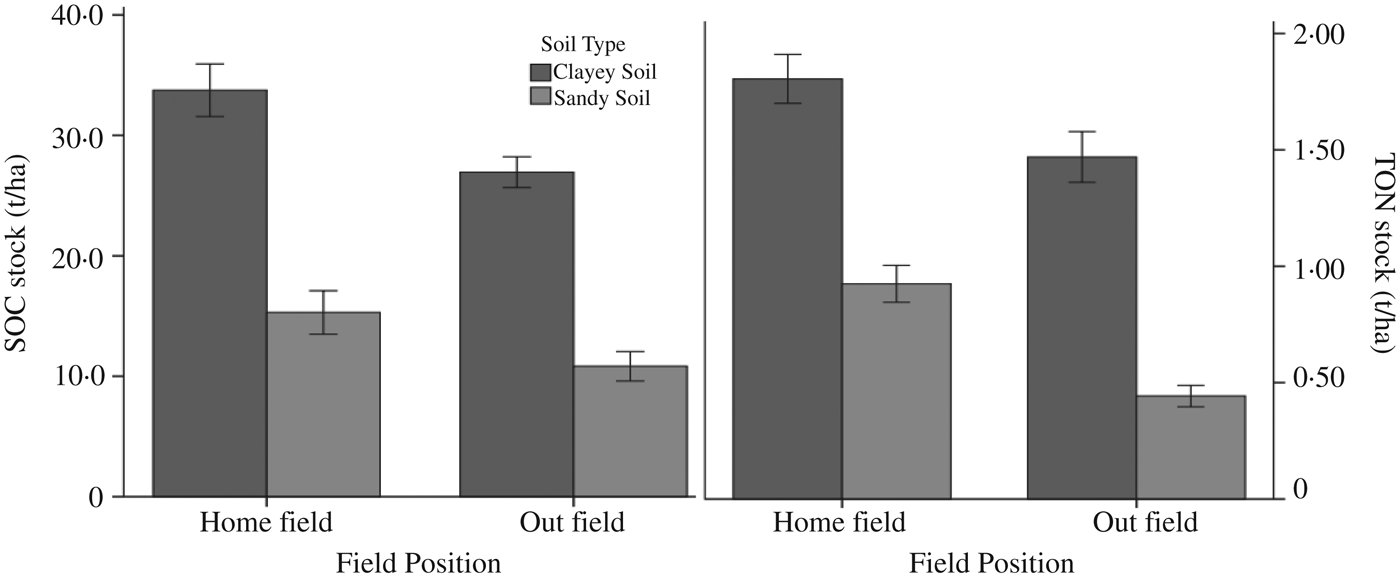
For each soil type, bulk density in homefields was not significantly different from that in outfields, ranging from 1·1 to 1·4 g/cm3. In addition, bulk densities were not statistically different by depth in each field position. The SOC and TON stocks of the 0–50 cm depth increment were significantly (P < 0·01) higher in clayey soil than sandy soils and also higher in homefields than outfields, having a mean of 31 t C/ha and 1·8 t N/ha in clayey soils and 12 t C/ha and 0·8 t N/ha in sandy soils (Fig. 1).
Density of carbon (C) and nitrogen (N) in homefields and outfields of clayey and sandy soils.
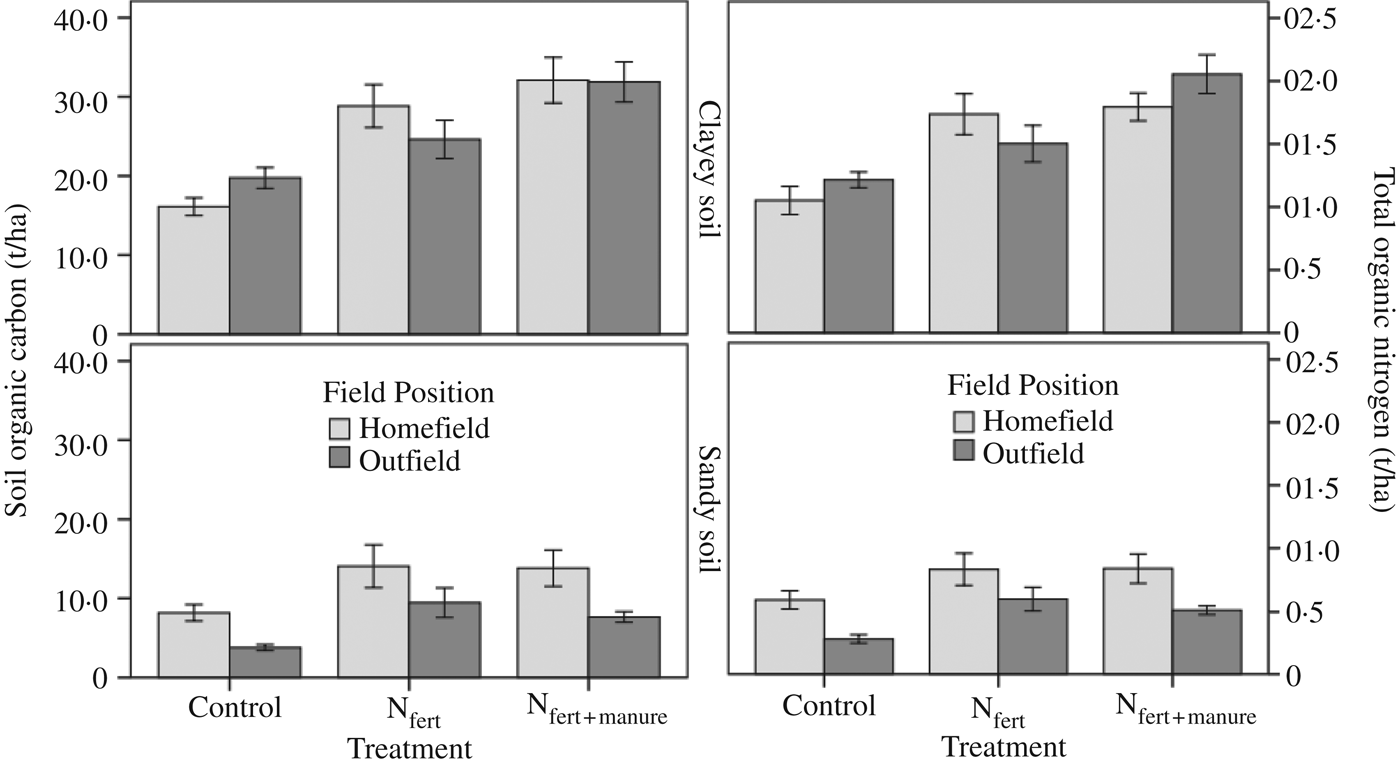
The storage of C and N was affected significantly by fertility amendment (Fig. 2) relative to the unfertilized control. Mean SOC in clayey homefields was significantly higher (P < 0·05) than in outfields and increased from the control (19·8 ± 1·46 t/ha) to Nfert (28·8 ± 1·58 t/ha) and Nfert+manure (31·9 ± 1·42 t/ha). Outfield C stocks followed similar trends being 16·1 t/ha under the control, 24·6 t/ha under Nfert and 32·1 t/ha under Nfert+manure. Sandy homefields also had the lowest C stocks under the control (8·2 ± 1·42 t/ha) followed by Nfert+manure (14·1 ± 1·41 t/ha) and was highest under Nfert (13·8 ± 1·34 t/ha). Sandy outfields had 3·4 t C/ha for control, 9·5 t C/ha for Nfert and 7·7 t C/ha under Nfert+manure. Therefore, application of Nfert and Nfert+manure increased C stocks in clayey soils by 1·0 and 1·3 t/ha/year in homefields and 0·9 and 1·8 t/ha/year in outfields, when compared with the control. In sandy soils, C stocks increased by 0·65 and 0·62 t/ha/year in homefields, and 0·68 and 0·48 t/ha/year in outfields, respectively, relative to the control. The C stock was 2·1 t/ha under Nfert+manure, while it was 1·1 t C/ha under the control (P ⩽ 0·01). The TON followed similar trends to those of SOC in all treatments, being higher in homefields (1·7 t N/ha) than outfields (1·5 t N/ha). In sandy soil, N stocks were also greater in homefields (0·73 t N/ha) than outfields (0·37 t N/ha) and were significantly higher (P < 0·01) in fertilized treatments than the control.
Effects of nitrogen fertilizer (Nfert) and nitrogen fertilizer plus cattle manure (Nfert + manure) application on soil organic carbon (SOC) and total organic nitrogen (TON) stocks in homefields and outfields of clayey and sandy soils. Error bars show ± 1 s.e.m.
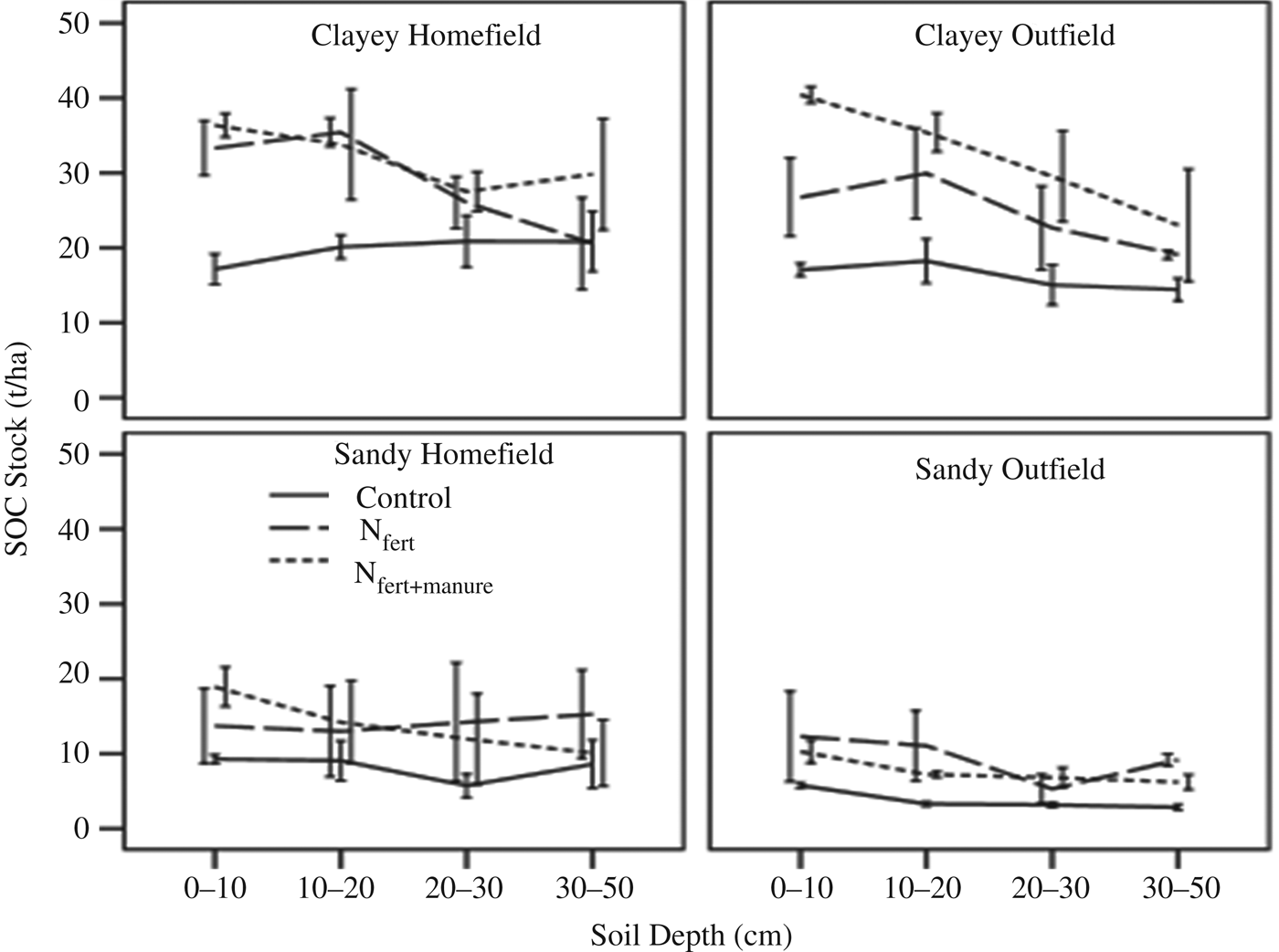
At all sampling depths, fertilizer amendments enhanced SOC and TON stocks better than the unfertilized control, irrespective of field position (Figs 3 and 4). Application of Nfert in sandy soils resulted in greater SOC than Nfert+manure and the control at all depths except the 10–20 cm depth on homefields and 20–30 cm depth on outfields (Fig. 3). At 0–10 cm, the application of Nfert resulted in accumulation of 33·3 t C/ha, while application of Nfert+manure resulted in 36·4 t C/ha, significantly higher (P < 0·05) than the control with 17·1 t C/ha (Fig. 3). Similar trends were observed for TON, being higher under Nfert (2·1 t N/ha) and Nfert+manure (2·3 t N/ha) than the control, which had 1·1 t N/ha (Fig. 4). Although the C and N decreased with increasing depth in all except Nfert in sandy homefields, there were no significant differences between the 30 and 50 cm depths of Nfert and the control in homefields. In clayey soils, TON was significantly higher under Nfert+manure than control in both homefields and outfields, except for the 10–20 cm depth in outfields, where Nfert and Nfert+manure were similar.
Depth distribution of soil organic carbon (SOC) stocks under different fertility treatments on clayey and sandy soils. Nfert = nitrogen fertilizer, Nfert+manure = nitrogen fertilizer plus cattle manure.
Depth distribution of total organic nitrogen (TON) stocks under different fertility treatments on clayey and sandy soils. Nfert = nitrogen fertilizer, Nfert = manure = nitrogen fertilizer plus cattle manure.
Carbon and nitrogen in density fractions
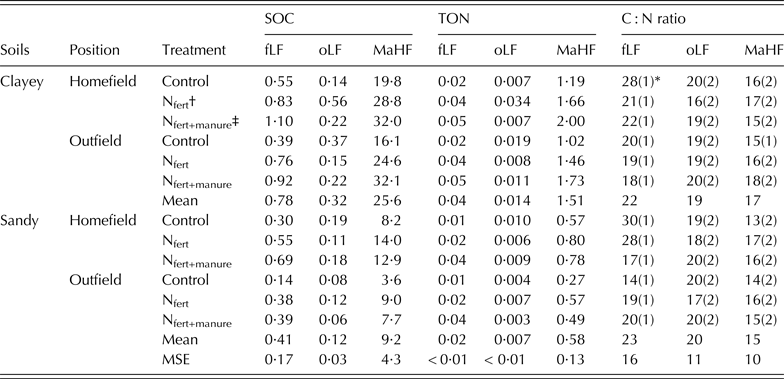
Similar to total SOC and TON stocks, density fractions also showed significant difference between soil types (P < 0·001), field position (P < 0·01), fertility treatments (P < 0·001), soil depth (P < 0·01), soil type × treatment (P < 0·001) and soil type × field position × treatment (P < 0·001). The C and N stocks in the three density fractions were generally of the order oLF < fLF < MaHF (Table 2). The addition of nitrogen fertilizer and cattle manure (Nfert+manure) had variable influence on the three fractions, resulting in significant increases of fLF C and MaHF C compared with control treatments. In clayey soils, the proportions of SOC in fLF was 0·03, oLF was 0·02 and MaHF was 0·95, being similar under the control and Nfert+manure, while the proportions under Nfert were 0·03 fLF, 0·01 oLF and 0·96 MaHF. In sandy soils, the proportions of fLF, oLF and MaHF were correspondingly different between the control (0·04, 0·08 and 0·88), Nfert (0·04, 0·01 and 0·95) and Nfert+manure (0·05, 0·04 and 0·91).
Total soil organic carbon (SOC), total organic nitrogen (TON) (t/ha) and C : N ratios for density fractions as affected by fertilizer and manure applications on clayey and sandy soil under continuous maize cropping
fLF, free light fraction; oLF, occluded light fraction; MaHF, mineral-associated heavy fraction.
* Figures in brackets show s.e.m.
† Nfert = 100 kg N/ha.
‡ Nfert + manure = 100 kg N/ha + 5 t/ha cattle manure (about 0·9% N).
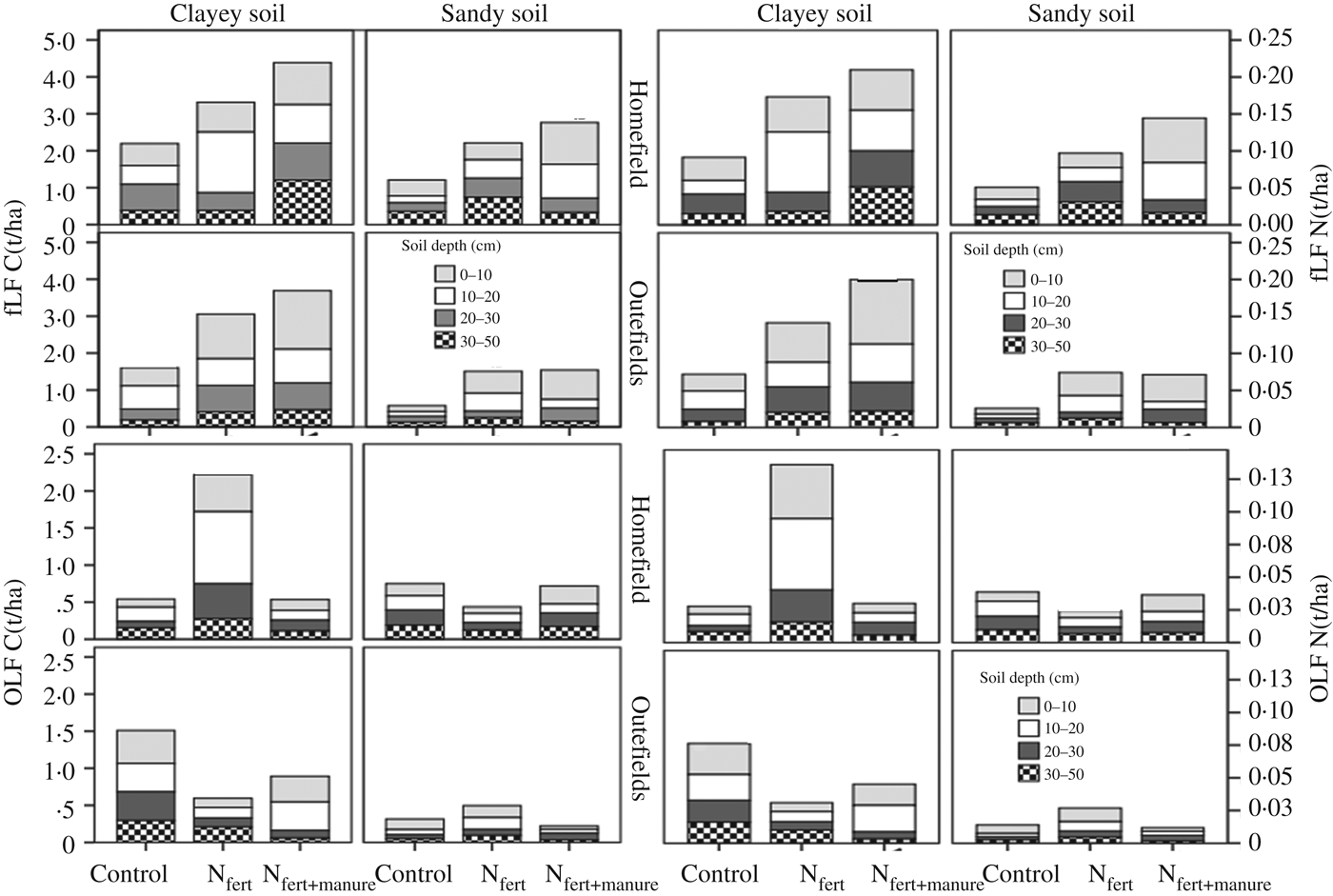
The Nfert and Nfert+manure treatments enhanced fLF C in homefields by 19 and 24% and in outfields by 9 and 22%, respectively, when compared with the control. In sandy homefields, Nfert and Nfert+manure treatments increased carbon storage by 17 and 26%, respectively, when compared with the control, whereas in outfields both Nfert and Nfert+manure had 26% more C than the control treatment. In sandy soils, Nfert and Nfert+manure had less oLF C than the control in homefields, whereas in outfields, Nfert enhanced oLF C stocks by 15% and Nfert+manure was 8% lower than the control. The oLF N was statistically similar in the two soil types. Vertical distribution of C and N in density fractions showed that control treatments in clayey soils had the lowest fLF C and N at all depth levels (Fig. 5) with the oLF N being significantly higher in the control (P < 0·05) than Nfert+manure at all depths except 20–30 cm in sandy soil. The MaHF dominated SOM, accounting for >0·98 of the total soil mass, and 0·95–0·97 of total SOC in clayey soils and 0·84–0·95 of total SOC in sandy soils. The MaHF N accounted for 0·95–0·96 of TON in the two soil types. Mineral-associated heavy fraction C concentration ranged from 12 to 27 g/kg in clayey soils and from 4 to 12 g/kg in sandy soils. The resulting mean MaHF C stocks per depth were also significantly different between clayey homefields and outfields (25·7 and 22·7 t/ha) and sandy homefields and outfields (11·3 and 6·6 t/ha) (Fig. 6). The MaHF C stocks were significantly different between treatments; 17·3 t/ha under the control, 25·6 t/ha under Nfert and 30·8 t/ha under Nfert+manure in clayey soils and 5·6 t/ha under the control, 11·2 t/ha under Nfert and 10·1 t/ha under Nfert+manure in sandy soils. The MaHF N was 1·11 t/ha in the control treatment, 1·56 t/ha in Nfert and 1·86 t/ha in Nfert+manure treatments in clayey soils. The MaHF N was 0·42 t/ha under the control, 0·69 t/ha under Nfert and 0·64 t/ha under Nfert+manure treatments in sandy soils. The MaHF C and N decreased with increasing soil depth, being larger in clayey than sandy soils, and were strongly related to bulk soil organic C (R 2 = 0·99, P < 0·01 for sandy soils and R 2 = 0·98, P < 0·01 for clayey soils). Similar relationships were seen for MaHF N. The C : N ratios for MaHF were smaller than fLF and oLF, ranging from 13 to 18 compared with 16–20 for oLF and 14–30 for fLF (Table 2). The MaHF C : N ratios were significantly higher in clayey than sandy soils (P < 0·01). The fLF (P ⩽ 0·001) and oLF (P < 0·05) C : N ratios were significantly higher in the control than Nfert+manure treatments.
Soil carbon (C) and nitrogen (N) stocks in free light fraction (fLF) and occluded light fraction (oLF) under different fertility treatments at four depths on clayey and sandy soils separated into homefields and outfields. Nfert = nitrogen fertilizer, Nfert+manure = nitrogen fertilizer plus cattle manure.
Depth distribution of mineral-associated heavy fraction (MaHF) carbon (C) and nitrogen (N) in homefields and outfields of clayey and sandy soils as affected by fertility treatments. Nfert = nitrogen fertilizer, Nfert+manure = nitrogen fertilizer + cattle manure.
Soil carbon sequestration potential
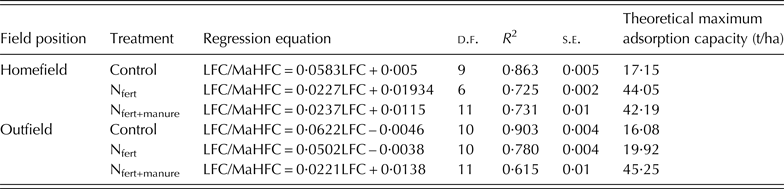
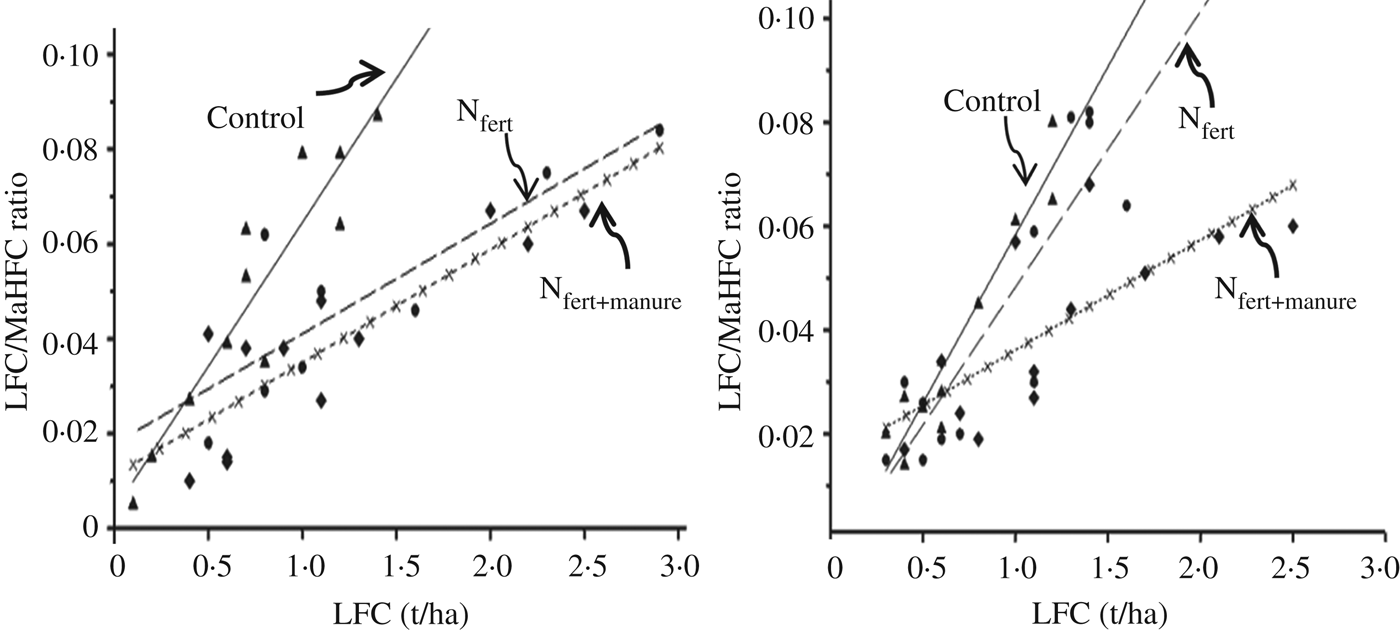
There was a linear relationship between LF C and the ratio of LF C/MaHF C, with all fertilizer treatments in clayey soils having highly significant (P < 0·01) and strong positive correlation (i.e. control R 2 = 0·83 and 0·90, NfertR 2 = 0·73 and 0·77, and Nfert+manureR 2 = 0·73 and 0·59 in homefields and outfields, respectively) (Table 3). In sandy soils, the three treatments had weak R 2 values (R 2 < 0·30) and were excluded from further analysis using regression. Thus, LFC data failed to fit an appropriate linear or non-linear regression model as was shown by the low R 2 values, despite sandy soils having significant gains in C and N under Nfert and Nfert+manure treatment when compared with the control.
Regression equations for fertility treatments in homefields and outfields on clayey soils and associated theoretical maximum adsorption capacity of mineral associated heavy fraction (MaHF)
LFC, Light fraction carbon; Nfert, nitrogen fertilizer; Nfert+manure, nitrogen fertilizer; Nfert + manure, nitrogen fertilizer + cattle manure; d.f., degrees of freedom; s.e., mean standard error.
The slopes of the regression equations were steepest under the control at 5·8 for homefields and 6·2% for outfields (Table 3; Fig. 7). The regression equations were used to estimate the equilibrium level and results showed that the control treatments had lowest equilibrium values.
The relationship between light fraction carbon (C) and mineral associated heavy fraction (MaHF) C in (a) homefields and (b) outfields under control, nitrogen fertilizer (Nfert) and nitrogen fertilizer plus manure (Nfert+manure) treatments on clayey soils. Unfertilized control = ▲, nitrogen fertilizer (Nfert) = ●, nitrogen fertilizer plus cattle manure (Nfert+manure) = ♦.
The equilibrium levels for MaHF C in homefields were 17·15 t/ha under the control, 44·05 t/ha in Nfert and 42·19 t/ha in Nfert+manure treatments, all being 20 and 16% higher than current stocks (in Fig. 1) under Nfert and Nfert+manure, respectively. In outfields, only the control treatment had current stocks equal to the equilibrium value of 16·08 t/ha.
DISCUSSION
Carbon and nitrogen in bulk soil
Clay soils have greater capacity to protect organic matter from decomposition because the finer texture can result in the presence of occluded and adsorbed stable humus, although management activities also influence the capacity of a soil to store SOC. In the present study, C stocks in Nfert+manure were not significantly affected by distance from homesteads whereas, in the other treatments, homefields had higher organic C and N than outfields, supporting the findings of Zingore et al. (Reference Zingore, Murwira, Delve and Giller2007a) and showing that the fertility gradients have been maintained over the 9-year period. Thus, addition of manure and other organic fertilizers improves nutrient efficiency and enhances biomass yields (Gregorich & Janzen Reference Gregorich, Janzen, Carter and Stewart1996; Nyamangara et al. Reference Nyamangara, Bergström, Piha and Giller2003; Matsumoto et al. Reference Matsumoto, Paisancharoen and Hakamata2008). Inorganic fertilizers may also cause accelerated decomposition of SOM in clayey soils when compared with organic inputs, resulting in less C accumulation. Bremer et al. (Reference Bremer, Janzen and Johnston1994) and Eghball & Ginting (Reference Eghball and Ginting2003) found the application of manure and compost to have significant C sequestration effects while chemical fertilizers had no effect.
Variations in C and N stocks can be caused by different C inputs from biomass leftovers (Purakayastha et al. Reference Purakayastha, Chhonkar, Bhadraray, Patra, Verma and Khan2007), although return of crop residues to fields is threatened by competing uses as some farmers collect and store the crop residues for livestock feed over the dry season. If left in the field, existing policies allow free-range livestock grazing over the dry period (Rufino et al. Reference Rufino, Dury, Tittonell, van Wijk, Herrero, Zingore, Mapfumo and Giller2011), threatening the persistence of residues in the fields. Therefore, if the crop residues are grazed in situ, input of organic matter is most likely a result of varying amounts of available C in root biomass, organic manure and remnants of crop residues estimated to be between 0·2 and 0·3 t/ha (Mtambanengwe & Mapfumo Reference Mtambanengwe and Mapfumo2005; Mujuru et al. Reference Mujuru, Mureva, Velthorst and Hoosbeek2013). Rusinamhodzi et al. (Reference Rusinamhodzi, Corbeels, Van Wijk, Rufino, Nyamangara and Giller2011) worked in the same fields and reported increased crop yields under fertility treatments and decreased crop yields in the control treatments over the 9-year period. The 0·9% difference in N content between Nfert and Nfert+manure treatments resulted in no significant gain in maize grain yields in homefields.
Sandy soils have (very) low clay content, so OM complexation on mineral surfaces will be very limited and organic matter can easily be lost. In clayey soils, Nfert+manure treatment had more SOC and TON than Nfert, thus agreeing with Wu et al. (Reference Wu, Schoenau, Li, Qian, Malhi, Shi and Xue2004) who found organic additions more effective for C accumulation in Chinese soils than inorganic fertilizer alone. Stroosnijder & Hoogmoed (Reference Stroosnijder and Hoogmoed2004), working in Burkina Faso, found a C increase of 1·8 g/kg of soil after 10 years of annual application of 10 t/ha of manure and concluded that a combination of either hand hoeing or conventional tillage with manure can increase SOC and crop yields.
The magnitude of differences in C and N storage among treatments was greater at 0–10 and 10–20 cm. In support of the results in clayey soils, studies by Berzsenyi et al. (Reference Berzsenyi, Györffy and Lap2000), Hao et al. (Reference Hao, Lal, Owens, Izaurralde, Post and Hothem2002) and Brar et al. (Reference Brar, Singh, Dheri and Balwinder-Kumar2013) also found a combination of manure and inorganic fertilizer had significant cumulative benefits for both increased C stocks and crop yield compared with inorganic fertilizer alone at 0–15 cm (Liu et al. Reference Liu, Liu, Xing, Herbert and Zhang2005). In the present study, the beneficial effects of organic and inorganic amendments may not have been fully maximized in surface layers of sandy soil as a result of possible leaching of nutrients to lower layers, causing significantly higher accumulation of C and N at 30–50 cm depths under the Nfert treatment, facilitated by faster infiltration rates. This is because sandy soils are low in clay and silt and have reduced capacity to protect soil nutrients.
Carbon and nitrogen in density fractions
The analysis of SOC fractions were used to show the influence of land use activities on organic matter quality because the fractions have different stabilities and turnover rates and are extracted from different positions in the soil matrix (Golchin et al. Reference Golchin, Oades, Skjemstad and Clarke1994). The most dynamic and sensitive fraction is fLF, known to be easily influenced by management practices (Janzen et al. Reference Janzen, Campbell, Brandt, Lafond and Townley-Smith1992) and can be affected by the quality and quantity of materials added to the soil (i.e. inorganic or organic inputs). The largest amounts of LF were found under Nfert+manure, reflecting the presence of inherent labile materials. The proportion of fLF and oLF in the soils was 1–2% of initial soil mass, which is similar to the amount obtained by Swanston et al. (Reference Swanston, Torn, Hanson, Southon, Garten, Hanlon and Ganio2005) although it was less than that obtained from elsewhere. For example, Yin et al. (Reference Yin, Cai and Lu2005) worked on three soil types in China and found the LF accounted for 1–27% of bulk SOM and Tan et al. (Reference Tan, Lal, Owens and Izaurralde2007) found a range between 5 and 12% while working on tillage experiments in the USA.
In the current work, the addition of manure plus nitrogen fertilizer (Nfert) and addition of Nfert alone showed greater partitioning of fLF C in homefields than outfields, with less effect on oLF C and N. This showed the importance of land use history with fLF reflecting changes caused by land management, e.g. the effect of fertility gradients which decrease with increasing distance from homestead (Zingore et al. Reference Zingore, Murwira, Delve and Giller2007a). The amounts of fLF in each treatment can also be attributed to the quantities of crop root biomass, which is proportional to better yields (Banger et al. Reference Banger, Toor, Biswas, Sidhu and Sudhir2010). Similarly to the present study, Bremer et al. (Reference Bremer, Janzen and Johnston1994) found more LF under inorganic fertilizer than the other treatments, while Mirsky et al. (Reference Mirsky, Lanyon and Needelman2008) found the fLF was unaffected by fertilizer treatments. Furthermore, Nfert is known to enhance growth of crop roots and shoots, thus promoting C inputs into the soil, although it can also affect the local micro-environment negatively, thus controlling decomposition and causing no effect on C accumulation (Campbell et al. Reference Campbell, Janzen, Juma, Gregorich and Carter1997). However, oLF, which consists of processed organic material and partially degraded plant materials associated with mineral particles and aggregates (Golchin et al. Reference Golchin, Oades, Skjemstad and Clarke1994), was less in manure than the control. Nfert+manure had enhanced fLF and MaHF but did not enhance oLF, indicating that aggregation was not affected.
The Nfert and Nfert+manure treatments significantly increased C and N in fLF in the top 20 cm as compared with the lower 20–30 and 30–50 cm depths. The addition of manure and inorganic fertilizer affects distribution of fLF in surface layers, decreasing with increasing soil depth, depending on tillage practice (Rudrappa et al. Reference Rudrappa, Purakayestha, Singh and Bhadraray2006; Brar et al. Reference Brar, Singh, Dheri and Balwinder-Kumar2013). Organic amendments induce rapid and conspicuous alterations to the function and structure of soil microbial communities, thus affecting SOM fractions. The form and application rate of manure and associated C content have been reported to influence the comparative reaction of soil micro-organisms (Paul & Beauchamp Reference Paul and Beauchamp1996).
The fLF is a more available labile C pool which increases microbial activity, subsequently increasing aggregation and thus SOC stabilization through occlusion mainly in clayey soils. Increased microbial turnover, in turn, enhances production of dissolved organic carbon (DOC) which increases stabilization of SOC by adsorption. Furthermore, the quality of the incoming above- and below-ground plant residues and organic amendments determine the quality and degradability of organic matter by soil organisms (Gregorich & Ellert Reference Gregorich, Ellert and Carter1993). Although the LF was considerably smaller than the heavy fraction, it plays an important role in soil biological processes as an energy source for the soil micro-organisms (Gong et al. Reference Gong, Yan, Wang, Hu and Gong2009).
The MaHF was the most abundant density fraction on both clayey and sandy soils and is considered a more stable C pool with a long turnover time (>100 years), having high amounts of protected C (von Lützow et al. Reference von Lützow, Kögel-Knabner, Ludwig, Matzner, Flessa, Ekschmitt, Guggenberger, Marschner and Kalbitz2008). The results suggest that in clayey soils, addition of Nfert+manure was possibly more effective in stabilizing C and N in the MaHF, when compared with Nfert alone. Thus, increase in SOC and associated MaHFC contents under Nfert and the Nfert+manure in both clayey and sandy soils relative to the control treatments could be attributed to 9 years of continuous addition of C via manure, root biomass and residues associated with higher crop yields (Liu et al. Reference Liu, Liu, Xing, Herbert and Zhang2005; Banger et al. Reference Banger, Kukal, Toor, Sudhir and Hanumanthraju2009; de Rouw et al. Reference de Rouw, Huon, Soulileuth, Jouquet, Pierret, Ribolzi, Valentin, Bourdon and Chantharath2010; Ding et al. Reference Ding, Han, Liang, Quao, Li and Li2012). The potential to store C and N may not have been fully exploited since the soils studied were subjected to conventional tillage known to cause increased mineralization of labile LFC without significant effect on MaHF.
The increase in recalcitrant C after addition of a combination of Nfert+manure is normally attributed to higher lignin content of the manure when compared with Nfert alone, as some of the lignin is assumed to enter directly into the slow pool (Parton et al. Reference Parton, Schimel, Cole and Ojima1987). However, a study by Hofmann et al. (Reference Hofmann, Heim, Gioacchini, Miltner, Gehre and Schmidt2009) showed that lignin may not be an important factor in SOM decomposition. Therefore, the significant increase of C and N in MaHF and associated fractions after manure addition suggests the importance of manure in stabilization of SOC and N agricultural soils. Larger C : N ratios of the light fraction can be attributed to decreased net N mineralization and N immobilization to meet metabolic demands for microbial decomposers (Swanston et al. Reference Swanston, Homann, Caldwell, Myrold, Ganio and Sollins2004). In another study, Mujuru et al. (Reference Mujuru, Mureva, Velthorst and Hoosbeek2013) analysed C : N ratios in density fractions from similar soils under different tillage systems and found higher C : N ratios in fLF (17–32) than those in the present study.
Soil carbon sequestration potential
Sandy soils showed no statistically significant linear dependence of the ratio LFC/MaHFC and LFC although there were positive linear relationships between SOC or TON and associated MaHF. Yin et al. (Reference Yin, Cai and Lu2005) also found that Chinese fluvo-aquic and reddish paddy soils had no linear relationship between LF and the LF/MaHF ratio. The relationship of LFC and LFC/MaHF C ratio in clayey soils showed that application of both Nfert+manure and Nfert alone on homefields facilitated accumulation of LFC and MaHFC over time and is maximized when the management practices remain unaltered.
Potential for more C storage can be realized when C stocks are below equilibrium. In outfields, only the control had reached equilibrium whereas the rest had potential to store more C. The differences in slopes caused corresponding effects on the equilibrium levels in each field position and treatment. The slope was greatest under the control, showing greater amplitude in the loss of LF over the 9-year period, and the intercept was also highest under the control, showing that the amount of C mineralization may be greater than the other treatments and field positions. The lowest intercept was in inorganic fertilizer of outfields. A similar regression was used to determine equilibrium levels of organic matter in the heavy fraction (Yin et al. Reference Yin, Cai and Lu2005; Yin & Cai Reference Yin and Cai2006) under organic and inorganic fertilizer application in Chinese soils: their results showed that C stocks under organic fertilizers were below equilibrium levels, while inorganic fertilizers were above equilibrium levels.
The current results showed that in homefields, the equilibrium values under Nfert+manure and Nfert were similar but 2·5 times more than in the control. This could be attributed to better management in homefields than outfields and control treatments. In outfields, however, the equilibrium value of control treatments was lowest whilst measured SOC stocks in homefields under control treatments were 3 t/ha lower than equilibrium levels. Outfields have inherent infertility (Zingore et al. Reference Zingore, Murwira, Delve and Giller2007a) and the Nfert inputs could be utilized by crops, leaving the soil with insufficient organic inputs.
Control treatments and outfields reflected a long-term balance between C inputs and outputs and showed that the soils had approached a new lower steady state. The long-term balance between addition and loss of organic matter under control results in a balance between the crop uptake and inputs from residues and crop roots. Thus, land use history and management become important in attainment of equilibrium levels of a soil. The adsorption of organic matter onto mineral surfaces mostly depends on the amount of organic matter input and its quality (Rasmussen et al. Reference Rasmussen, Allmaras, Rohde and Roager1980). When MaHF reaches equilibrium levels, it can no longer increase whereas the LF can increase with more inputs, striving to attain a new equilibrium level (Yin & Cai Reference Yin and Cai2006). The MaHF C can increase over time in soils that are below equilibrium level, provided the same land use management practice is maintained or improved. Results suggest clayey soil as a potential C and N sink as indicated by the differences between actual and estimated equilibrium levels.
There is a need for promotion of cheaper alternatives and assistance for inorganic fertilizer inputs for small holder farmers to enhance soil C sequestration. Alternatives such as use of compost, legume crops, reduced tillage and improved fallows should be some of the extension options for promoting soil C sequestration. There is also a need for strategic management of crop residues, so that farmers can make decisions about whether to keep their residues or to use them for other alternative uses. This calls for formulation of regulations to limit free communal grazing in fields during the dry season. The use of abundant grass biomass to improve quantity of SOM in agro-ecosystems can be more beneficial instead of it being lost annually through wildfires, thus reducing emissions from wildfires.
CONCLUSIONS
Results suggest that addition of organic manures is an important fertilization option to enhance soil C and N storage in agricultural systems. Despite being under conventional tillage, fertilizer amendments mitigated the decrease of total SOC and TON in both homefields and outfields but at different magnitudes. The greatest capacity in clayey soils was obtained after application of a combination of cattle manure and Nfert whereas in sandy soils the greatest C and N storage was through application of Nfert alone. Carbon and N at 0–10 cm depth increased considerably under Nfert and Nfert+manure treatments compared with the control and supported the hypothesis that SOC and TON decreased with increasing soil depth. Nitrogen fertilizer alone or in combination with cattle manure consequently increased the accumulation of C and N in the three density fractions after 9 years of continuous cropping, except that the manure treatment had limited capacity to increase oLF C and N. The fLF C may be used as an indicator of change in C accumulation following application of manure and inorganic fertilizer on both clayey and sandy soils. In clayey soils, estimation of equilibrium level enabled assessment of the relationships between light and HFOM, thus determining potential to sequester additional C. Carbon stocks under control in outfields were similar to theoretical equilibrium levels whereas in homefields equilibrium levels were only 3 t/ha higher than current stocks. Application of organic fertilizers can be a low-cost alternative for promoting soil C and N sequestration in conventionally tilled continuous maize cropping systems.
The first author received a grant from the Netherlands Fellowship Programmes/PhD programme (grant award CF 6677/2010) and support from climate food and farming (CLIFF) Network.