Introduction
About 20–30 per cent of all children suffer from recurrent acute otitis media; that is, 3 or more episodes in 6 months, or 4 or more episodes in 12 months.Reference Sipila, Pukander and Karma 1 – Reference Kilpi, Herva, Kaijalainen, Syrjanen and Takala 5 The recurrent pain and fever experienced during acute otitis media episodes,Reference Niemela, Uhari, Jounio-Ervasti, Luotonen, Alho and Vierimaa 6 – Reference Kontiokari, Koivunen, Niemela, Pokka and Uhari 9 together with parents’ concern about hearing loss,Reference Koivunen, Uhari, Laitakari, Alho and Luotonen 10 , Reference Dempster and MacKenzie 11 impairment of speechReference Winskel 12 – Reference Haapala, Niemitalo-Haapola, Raappana, Kujala, Suominen and Kujala 16 and cognitive abilities,Reference Winskel 12 – Reference Teele, Klein, Chase, Menyuk and Rosner 14 may all affect the quality of life (QoL) of children and their families. Deterioration in QoL has also been demonstrated in children with otitis media with effusion.Reference Paradise, Dollaghan, Campbell, Feldman, Bernard and Colborn 15
We have shown previously that the QoL of children aged less than two years with recurrent acute otitis media improves with age, and that surgical treatment has no additional effect on QoL when measured with otitis media specific questionnaires.Reference Kujala, Alho, Kristo, Uhari, Renko and Pokka 17 The QoL of children aged one to seven years with recurrent acute otitis media seems to be poorer than that of healthy children, and recurrent acute otitis media causes concern to caregivers.Reference Lee, Witsell, Dolor, Stinnett and Hannley 18 , Reference Brouwer, Rovers, Maille, Veenhooven, Grobbee and Sanders 19 While disease-specific instruments may identify problem areas typical of this particular patient group, generic instruments allow comparisons with general populations.Reference Stewart, Friedman, Sulek, Hulka, Kuppersmith and Harrill 20 The Child Health Questionnaire is a generic objective measure of health-related QoL, which has been used among diverse groups of sick and healthy children.
We aimed to evaluate the health-related QoL of children aged less than 24 months with recurrent acute otitis media and to compare them with control children without acute otitis media or control children with a history of only a few acute otitis media episodes, using the Child Health Questionnaire as a generic measure. We also evaluated the effect of surgery on the QoL of children with recurrent acute otitis media during a one-year follow up.
Materials and methods
Population
Recurrent acute otitis media children
Quality of life was assessed in 152 consecutive children participating in a prospective, randomised controlled trial (ClinicalTrials.gov trial registration identifier: NCT00162994) that dealt with the effectiveness of surgical treatments on recurrent acute otitis media.Reference Kujala, Alho, Luotonen, Kristo, Uhari and Renko 21 In that trial, children who had been referred to the Department of Otolaryngology at Oulu University Hospital on account of recurrent acute otitis media were randomised into three intervention groups: tympanostomy tubes, tympanostomy tubes with adenoidectomy, or neither (no surgery). The parents of eligible children gave their written consent for participation in the study before the randomisation.
The inclusion criteria were: age between 10 months and 2 years, at least 3 acute otitis media episodes during the past 6 months, and residence within 25 miles of the hospital. The exclusion criteria were: chronic otitis media with effusion, previous adenoidectomy or tympanostomy tubes, cranial anomalies, documented immunological disorders, or ongoing antimicrobial prophylaxis for a disease other than acute otitis media.
The tympanostomy and adenoidectomy operations were performed under general anaesthesia as same-day out-patient surgical procedures at Oulu University Hospital. Acute otitis media episodes were usually treated with antibiotics in all randomised groups.
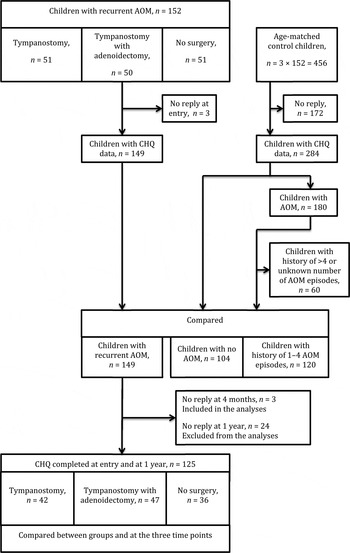
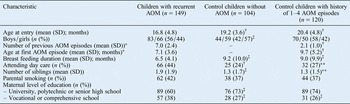
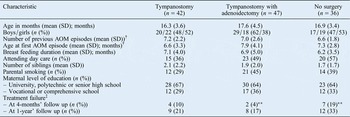
The QoL in 152 children with recurrent acute otitis media was evaluated at entry, before the surgical treatments, at which stage the parents of 149 of these children answered the questionnaire (Figure 1, Table I). The same questionnaire was repeated after 4 and 12 months of follow up. The 125 children whose parents completed the questionnaire at entry and at the 1-year follow up were included in the analyses, in order to evaluate the effect of surgery on the QoL of children with recurrent acute otitis media (Figure 1, Table II). The Ethical Committee of the Northern Ostrobothnia Hospital District considered the protocol to be acceptable.
Participant flow chart. AOM = acute otitis media; CHQ = Child Health Questionnaire

Baseline characteristics for all study patients

*Based on information received from the parents. † p < 0.001, ‡ p < 0.05 and **p < 0.01 – statistically significant difference compared with recurrent acute otitis media group. AOM = acute otitis media; SD = standard deviation
Baseline characteristics for recurrent acute otitis media children*

*The 125 children (whose parents completed the questionnaire at entry and at the 1-year follow up), who were randomised to undergo tympanostomy, tympanostomy with adenoidectomy, or neither, and who were followed up for 1 year. †Based on information received from the parents. ‡Treatment failure was defined as two acute otitis media episodes in two months or three episodes in six months, as assessed by a doctor attached to the project. **Statistically significant difference (p < 0.05) between tympanostomy with adenoidectomy and no surgery groups. SD = standard deviation; AOM = acute otitis media
Control groups
The control children were selected randomly from the general population of children born in the Northern Ostrobothnia Hospital District on the same days as the children with recurrent acute otitis media (Figure 1). Three controls were selected for each child with recurrent acute otitis media. Child Health Questionnaires were sent with a stamped return envelope to the control children at the time when the child with recurrent acute otitis media entered the study. We then divided the control children whose parents returned completed questionnaires into two groups: those without any acute otitis media episodes (n = 104) and those with a history of one to four acute otitis media episodes (n = 120) (Table I).
Quality of life questionnaire
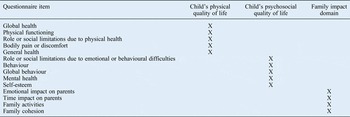
The Child Health Questionnaire is a generic objective measure of health-related QoL, for children aged 5 to 18 years, which has been shown to have good internal consistency and validity in diverse patient groups.Reference Landgraf, Abetz and Ware 22 The Child Health Questionnaire Parent Form 50 (‘CHQ-PF50’), which can be completed in approximately 10–15 minutes, provides information covering 14 specific physical and psychosocial concepts (Table III). All the domain scores are standardised from 0 to 100, with higher scores indicating better functioning and greater well-being. It has also been validated and standardised in Finnish language according to international guidelines.Reference Pelkonen, Ruperto, Honkanen, Hannula, Savolainen and Lahdenne 23 , Reference Ruperto, Ravelli, Pistorio, Malattia, Cavuto and Gado-West 24 As it requires a certain amount of adaptation when applied to age groups younger than 4 years,Reference Raat, Bonsel, Essink-Bot, Landgraf and Gemke 25 we modified some of the questions for use with our children aged 10–36 months.
Child health questionnaire 50

Outcome measures
We compared the QoL of the children with recurrent acute otitis media with that of the control children who were not affected by recurrent acute otitis media. We also compared the QoL of the children with recurrent acute otitis media at entry and after one year of follow up. In addition, we evaluated the effects of surgery (tympanostomy with or without adenoidectomy) on QoL after 4 and 12 months in the 3 recurrent acute otitis media intervention groups (tympanostomy tubes, tympanostomy tubes with adenoidectomy, or no surgery).
Sample size and data analysis
In children with recurrent acute otitis media participating in a prospective, randomised controlled trial on the effectiveness of surgical treatments, we expected a 40 per cent intervention failure rate in the no surgery group (two acute otitis media episodes in two months, or three acute otitis media episodes in six months).Reference Kujala, Alho, Luotonen, Kristo, Uhari and Renko 21 A difference of 20 percentage points between the surgery and no surgery groups was considered clinically important. A type I error of 0.05 and a power of 80 per cent were chosen. According to these estimates, the number of children needed per group was 82. To allow comparison between the 3 groups and to ensure that this number was achieved in the analyses, we recruited 100 children for each group. Quality of life was assessed in 152 consecutive children participating in the prospective trial on the effectiveness of surgical treatments.Reference Kujala, Alho, Luotonen, Kristo, Uhari and Renko 21 The results were analysed according to the original randomised groups, despite possible protocol violations.
The Child Health Questionnaire responses were scored for each of the 14 concepts according to the Child Health Questionnaire Parent Form 50 manual.Reference Landgraf, Abetz and Ware 22 The baseline differences in QoL between the children with recurrent acute otitis media and the control children without acute otitis media or the control children with a history of one to four acute otitis media episodes, and the differences in QoL between the surgery and no surgery groups at entry, at four months and at one year, were tested using analyses of variance with Tukey's post-hoc correction for multiple comparison tests. The differences in QoL for the children with recurrent acute otitis media at entry and after one year of follow up were tested using the paired t-test, and the differences in QoL between the children with recurrent acute otitis media after one year and the control children without acute otitis media at entry were tested using the student's t-test. General linear model analysis with simple and repeated contrast for repeated measurements was used to evaluate how the QoL scores changed over time within the randomised surgery or no surgery groups of children with recurrent acute otitis media, the results being analysed according to the original randomisation groups. All analyses were performed using IBM SPSS® Statistics 21.0 software.
Results
Population
The children in the recurrent acute otitis media group had suffered at least three acute otitis media episodes during the previous six months, with a mean of 7.0 previous acute otitis media episodes (standard deviation (SD) = 2.4) (Table I). The control children with a history of 1–4 acute otitis media episodes had suffered on average 2.1 previous acute otitis media episodes (SD = 1.0). The children with recurrent acute otitis media had their first acute otitis media episode statistically significantly earlier than control children, and more often had recurrent acute otitis media risk factors (Table I). The surgery groups appeared to be comparable in terms of background and demographic data at enrolment (Table II).
Quality of life between groups
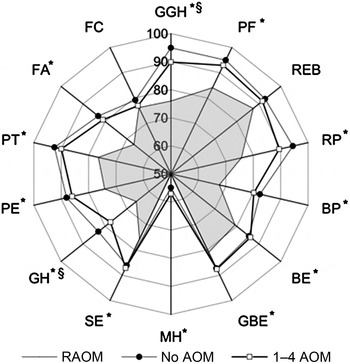
The QoL of the children with recurrent acute otitis media was statistically significantly poorer on almost all scales as compared with the controls without acute otitis media or the controls with a history of one to four acute otitis media episodes (Figure 2). The greatest differences between the recurrent acute otitis media children and the control children were in the physical domain scores for global health, role or social limitations due to physical health, general health, and bodily pain, and in the ‘family impact’ domain for family activities, time impact on the parents and emotional impact on the parents (Figure 2). Only the scores on role or social limitations due to emotional or behavioural difficulties, and family cohesion, did not differ statistically significantly between children with and without recurrent acute otitis media. The scores for global health and general health indicated that QoL was statistically significantly poorer in the control children with a history of one to four acute otitis media episodes than in those with no previous episodes (Figure 2).
Quality of life of all patients. All domain scores are standardised to 0 to 100, with higher scores indicating better functioning and greater well-being. Statistically significant differences (analysis of variance, Tukey's post-hoc p < 0.05) for: *recurrent acute otitis media children compared with control children (with and without acute otitis media history), and §control children without acute otitis media compared with those with a history of one to four acute otitis media episodes. GGH = global health; PF = physical functioning; REB = role or social limitations due to emotional or behavioural difficulties; RP = role or social limitations due to physical health; BP = bodily pain or discomfort; BE = behaviour; GBE = global behaviour; MH = mental health; SE = self-esteem; GH = general health; PE = emotional impact on parents; PT = time impact on parents; FA = family activities; FC = family cohesion; RAOM = recurrent acute otitis media; AOM = acute otitis media

Quality of life over time
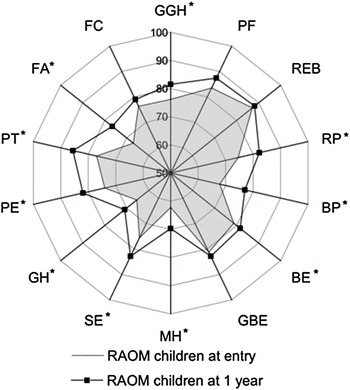
The QoL of the children with recurrent acute otitis media improved on all scales during the one-year follow up (Figures 3 and 4). These changes were statistically significant in the case of: the physical domain items global health, role or social limitations due to physical health, bodily pain or discomfort, and general health; the psychosocial domain items behaviour, mental health and self-esteem; and the ‘family impact’ domain items emotional impact on the parents, time impact on the parents and family activities (Figure 3).
Changes in quality of life in 125 recurrent acute otitis media children during the one-year follow up. All domain scores are standardised to 0 to 100, with higher scores indicating better functioning and greater well-being. *Statistically significant differences (paired t-test, p < 0.05). GGH = global health; PF = physical functioning; REB = role or social limitations due to emotional or behavioural difficulties; RP = role or social limitations due to physical health; BP = bodily pain or discomfort; BE = behaviour; GBE = global behaviour; MH = mental health; SE = self-esteem; GH = general health; PE = emotional impact on parents; PT = time impact on parents; FA = family activities; FC = family cohesion; RAOM = recurrent acute otitis media

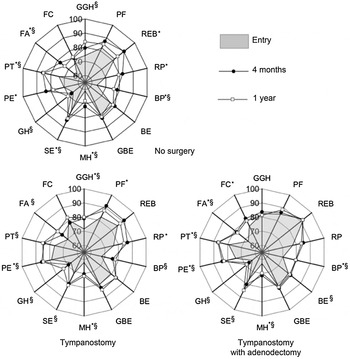
Quality of life in recurrent acute otitis media children at 4 and 12 months’ follow up in the tympanostomy, tympanostomy without adenoidectomy, and no surgery groups. All domain scores are standardised to 0 to 100, with higher scores indicating better functioning and greater well-being. Statistically significant differences (general linear model with repeated contrast, p < 0.05) for: *scores at entry compared with those after four-months’ follow up, and §scores at entry compared with those after 12 months’ follow up. When differences between the randomised groups were tested (analysis of variance, Tukey's post-hoc p < 0.05) at entry, and after four months and one year of follow up, quality of life was marginally better (p = 0.048) in the tympanostomy with adenoidectomy group than in the tympanostomy group for global health only. GGH = global health; PF = physical functioning; REB = role or social limitations due to emotional or behavioural difficulties; RP = role or social limitations due to physical health; BP = bodily pain or discomfort; BE = behaviour; GBE = global behaviour; MH = mental health; SE = self-esteem; GH = general health; PE = emotional impact on parents; PT = time impact on parents; FA = family activities; FC = family cohesion; RAOM = recurrent acute otitis media

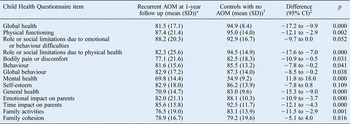
The QoL of the children with recurrent acute otitis media after the one-year follow up was still poorer than that of the control children with no previous acute otitis media episodes at entry (Table IV), and it was only in the domain items role or social limitations due to emotional or behavioural difficulties, and family cohesion, where the score differences were not statistically significant.
Patients’ quality of life at one-year’ follow up

*n = 125; † n = 104. ‡Standardised normal deviate test was used for the comparisons. AOM = acute otitis media; SD = standard deviation; CI = confidence interval
Effect of surgery
There were no statistically significant differences between the randomised intervention groups for any of the QoL item scores after four months and one year of follow up (Figure 4). At entry, the tympanostomy with adenoidectomy group parents reported their children to have a marginally better QoL in terms of global health than did those of the tympanostomy group (p = 0.048). The QoL of the children with recurrent acute otitis media had already improved within the first four months in all three treatments groups (Figure 4).
Quality of life had improved significantly between entry and the one-year follow-up assessment in seven item scores in the no surgery group and in eight item scores in each of the surgery groups. Statistically significant improvements were observed in all three intervention groups in the physical domain for bodily pain and general health, in the psychosocial domain for mental health and self-esteem, and in the ‘family impact’ domain for time impact on the parents and family activities (Figure 4). Between the 4- and 12-month follow up, only scores in family cohesion and general health in the tympanostomy group significantly improved.
Discussion
We found that the children with recurrent acute otitis media had a significantly poorer QoL in terms of generic measurements than did the children with no history of acute otitis media. Correspondingly, the QoL of the children with a history of only a few (one to four) previous acute otitis media episodes was better than that of the children with recurrent acute otitis media, but poorer than that for the children with no history of acute otitis media. However, the QoL improved in recurrent acute otitis media children when they were closely monitored, although it did not reach the same level after one-year of follow up as in children with no history of acute otitis media.
Measurements of health-related QoL can be important for assessing the burden caused by a disease and in the evaluation of treatment efficacy. To achieve a realistic picture of health-related QoL, it is useful to obtain both disease-specific and generic measurements. We have shown previously that when disease-specific instruments are used, the QoL of children suffering from recurrent acute otitis media is reduced.Reference Kujala, Alho, Kristo, Uhari, Renko and Pokka 17 However, sometimes specific instruments may be too sensitive, and the burden imposed by recurrent acute otitis media cannot be compared with that arising from other diseases when using only recurrent acute otitis media specific QoL instruments. In the present work, we used a generic instrument to evaluate health-related QoL in children suffering from recurrent acute otitis media, in order to compare the disease burden caused by recurrent acute otitis media with healthy populations and that caused by other childhood diseases.
Although the QoL of the recurrent acute otitis media children improved considerably once the acute otitis media gradually became less frequent during the one-year follow up, it did not reach the level of the control children with no history of acute otitis media. Our results are in line with two previous studies that used other generic measurements of QoL, wherein children aged over five years affected by various forms of otitis media (acute otitis media, recurrent acute otitis media and otitis media with effusion),Reference Lee, Witsell, Dolor, Stinnett and Hannley 18 and children aged one to seven years with recurrent acute otitis media,Reference Brouwer, Rovers, Maille, Veenhooven, Grobbee and Sanders 19 had a lower global QoL score than healthy children of a similar age. However, those studies did not include a follow up.
The use of a generic QoL instrument in the case of children with a heavy otitis burden enables the impact of recurrent acute otitis media to be compared with that of other illnesses known to have a detrimental effect on a child's everyday life. It could be found, for instance, that the QoL of children with recurrent acute otitis media in this study was poorer than that of Finnish children aged 11 to 15 years with asthma,Reference Merikallio, Mustalahti, Remes, Valovirta and Kaila 26 as has been reported previously.Reference Brouwer, Rovers, Maille, Veenhooven, Grobbee and Sanders 19 Recurrent acute otitis media in young children in this study seemed to detract from QoL in a similar manner to chronic juvenile arthritis in Finnish children aged around 10 years.Reference Pelkonen, Ruperto, Honkanen, Hannula, Savolainen and Lahdenne 23 As reported previously, the QoL of children with recurrent acute otitis media is poorer than that of children with mild-to-moderate diseases, such as allergies, chronic bronchitis or intestinal problems, and similar to that of children with mild-to-moderate asthma.Reference Brouwer, Rovers, Maille, Veenhooven, Grobbee and Sanders 19 Thus, recurrent acute otitis media has a fairly significant effect on QoL.
We found that even though these surgical procedures were effective in preventing recurrent acute otitis media as assessed by a doctor attached to the project, the QoL of the recurrent acute otitis media children in this study was not affected by whether they were treated surgically or merely followed up. An otitis-specific questionnaire among these same children with recurrent acute otitis media revealed similar findings in an earlier study.Reference Kujala, Alho, Kristo, Uhari, Renko and Pokka 17 The same has also been found among one- to two-year-old children with persistent bilateral otitis media, in whom generic measurements of QoL improved, but where the tympanostomy tube group did not show a significantly greater improvement than the no surgery group.Reference Rovers, Krabbe, Straatman, Ingels, van der Wilt and Zielhuis 27
There was a rapid improvement in QoL within the first four months in all three of our randomised intervention groups, even in the no surgery group. In previous otitis-specific measurement studies, tympanostomy tubes yielded significant improvements in QoL within one to six months of placement.Reference Rosenfeld, Bhaya, Bower, Brookhouser, Casselbrant and Chan 28 – Reference Chow, Wabnitz and Ling 30 One reason for the rapid improvement in QoL could be the follow up and the parents’ opportunities to contact the doctors engaged in this project at any time if they suspected acute otitis media in their child. The frequent follow-up sessions were particularly reassuring for the parents, despite continuing infections, and may have had a positive impact on QoL. This could have reduced the differences in QoL between the surgery and no surgery groups too.
One problem of studies conducted on younger children, who are not able to answer the questionnaires themselves, is that reports may vary substantially depending on who completes the questionnaire. Caregivers’ own personal situations in life may also influence their ratings of their child's QoL.Reference Boruk, Lee, Faynzilbert and Rosenfeld 31 Caregiver concern may be a domain of paediatric QoL, although those concerns may be more indicative of caregiver QoL than of child QoL. Parents’ QoL has been reported to deteriorate when facing illnesses in their children,Reference Pelkonen, Ruperto, Honkanen, Hannula, Savolainen and Lahdenne 23 , Reference Aitken, Tilford, Barrett, Parker, Simpson and Landgraf 32 as was the case among the parents in the present study too.
Although the Child Health Questionnaire was developed and tested on children aged 5–18 years, it has been used on younger children too.Reference Aitken, Tilford, Barrett, Parker, Simpson and Landgraf 32 In this study, the validated Finnish version was used, although we had to adapt it for younger children. The validity of the questionnaires and their results may be limited in terms of application; the psychometric properties have not been assessed in the younger age group. We do not know the validity of our modified survey either and this could be a major potential source of bias in this study. However, the Child Health Questionnaire scores for our children with no acute otitis media were close to those for older healthy Finnish children reported in previous studies.Reference Pelkonen, Ruperto, Honkanen, Hannula, Savolainen and Lahdenne 23 , Reference Merikallio, Mustalahti, Remes, Valovirta and Kaila 26 Although the QoL scores of the children with recurrent acute otitis media did not reach the level of the previously defined poor health-related QoL,Reference Hullmann, Ryan, Ramsey, Chaney and Mullins 33 the difference to the controls without acute otitis media was evident. Similarly, having a group of recurrent acute otitis media children who did not undergo surgery controlled the inevitable impact of ageing of the children in the surgical treatment groups with recurrent acute otitis media. A global health status survey validated for those younger than five years of age was not available at the time of this study. The infant and toddler version of the Child Health Questionnaire may be useful also in the case of children with recurrent acute otitis media, 34 but no Finnish version of it is available.
We studied children who had been referred for assessment with regard to surgical treatment for recurrent acute otitis media, and compared the health-related QoL of these children at entry to that of age-matched controls who were classified into two groups according to their history of acute otitis media. Although the healthcare system in Finland guarantees equal treatment for all children, with no financial burden on parents, there are some possible confounding factors. The parents seeking referral to a specialist because of recurrent acute otitis media in their children were probably more concerned than those who did not seek referral, and it is certainly the case that not all children who have experienced recurrent acute otitis media episodes are referred for further treatment.Reference Alho, Koivu, Sorri, Oja and Kilkku 35 In addition, evaluation of the number of acute otitis media episodes in the Child Health Questionnaire was based on information received from the parents. It has been shown that parents seeking surgical treatment for their child's recurrent acute otitis media tend to exaggerate the number of acute otitis media episodes.Reference Alho, Koivu, Sorri, Oja and Kilkku 35 Even so, we found among the controls selected from the general child population that one to four acute otitis media episodes may already detract from QoL, so that there was a significant difference relative to the control group without acute otitis media. We thus believe that even though the recurrent acute otitis media group may have been somewhat selective, the results are generalisable and our protocol reflects the manner in which recurrent acute otitis media children are treated in actual everyday clinical practice. However, in other countries with different cultural backgrounds, or a more diverse genetic, racial or ethnic background, the findings may not be the same.
Acute otitis media gives rise to healthcare costs in the form of physician's visits, antibiotics prescriptions, otorhinolaryngological surgery and loss of parental working days.Reference Alsarraf, Jung, Perkins, Crowley, Alsarraf and Gates 36 , Reference Niemela, Uhari, Mottonen and Pokka 37 In addition, we found that recurrent acute otitis media detracts from the health-related QoL of both the children and their parents to an extent comparable to that seen in asthma and juvenile arthritis. Only a few episodes of acute otitis media in early childhood can have an effect on families and their well-being. Consequently, research on both children's and their caregiver's QoL is important to understand the full burden of diseases in pre-school aged children. Assessment of the treatment options and measurements of treatment efficacy should include the children's and parents’ perspectives.
-
• Acute otitis media causes discomfort to children and inconvenience to parents, and may impair quality of life (QoL)
-
• Recurrent acute otitis media impairs children's and parents’ QoL when assessed with general health-related QoL measures
-
• Even a few acute otitis media episodes can reduce QoL compared to no acute otitis media episodes
-
• Although QoL improves with time irrespective of treatment, only primary prevention of acute otitis media ensures QoL during early childhood
When a child with recurrent acute otitis media is closely monitored, and the caregivers are well informed and have easy access to a physician, the additional value in terms of QoL to be yielded by surgical treatment for recurrent acute otitis media may be diminutive. However, as recurrent acute otitis media can cause significant, long-lasting deterioration in QoL, as measured using a generic instrument, the importance of the early prevention of recurrent acute otitis media must be highlighted.
Acknowledgements
Personal funding was received by the corresponding author from the Maud Kuistila Memorial Foundation, the Alma and K A Snellman Foundation, the Orion Pharmacy Foundation, and the Päivikki and Sakari Sohlberg Foundation, Finland, enabling her to concentrate largely on this work between 2002 and 2005.