I. INTRODUCTION
The ThCr2Si2-type structure is one of the most abundant structural prototypes of ternary intermetallics (Bażela et al., Reference Bażela, Baran, Leciejewicz, Szytuła and Ding1997; Cao et al., Reference Cao, Klingeler, Leps, Vinzelberg, Kataev, Muranyi, Tristan, Teresiak, Zhou, Löser, Behr and Büchner2008; Frontzek, Reference Frontzek2009; Shatruk, Reference Shatruk2019), which shows a variety of interesting physical properties such as pressure-induced superconductivity in CePd2Si2 (Stewart, Reference Stewart2001), anomalous valence fluctuations in EuPd2Si2 (Stewart, Reference Stewart2001), and heavy fermion behavior (Shatruk, Reference Shatruk2019). Among them, the erbium palladium silicide (ErPd2Si2) displays an anisotropic magnetic behavior along the three crystallographic axes at low temperatures (Sampathkumaran et al., Reference Sampathkumaran, Mohapatra, Iyer, Cao, Löser and Behr2008). The ErPd2Si2 compound shows ferromagnetic ordering along the c-axis and antiferromagnetic ordering within the ab plane, according to the measurements of paramagnetic Curie–Weiss behavior derived from the high-temperature linear regime of the inverse magnetic susceptibility χ −1 (Sampathkumaran et al., Reference Sampathkumaran, Mohapatra, Iyer, Cao, Löser and Behr2008). Furthermore, the magnetic susceptibility χ parallel to the ab plane shows a sharp peak at ~3.8 K and a broad peak in the temperature range of 8–20 K. These were attributed to spin fluctuations with a finite antiferromagnetic component (Sampathkumaran et al., Reference Sampathkumaran, Mohapatra, Iyer, Cao, Löser and Behr2008). Moreover, a neutron powder diffraction study on polycrystalline ErPd2Si2 reveals a sine modulated magnetic structure (Bażela et al., Reference Bażela, Leciejewicz, Szytuła and Zygmunt1991). Later, polarized and unpolarized neutron diffraction studies reported two distinct antiferromagnetic modulations with respective propagation vectors at Q ± = [H ± 0.557(1), 0, L ± 0.150(1)] and Q C = [H ± 0.564(1), 0, L] for a ErPd2Si2 single crystal (Li et al., Reference Li, Cao, Wildes, Schmidt, Schmalzl, Hou, Regnault, Zhang, Meuffels, Löser and Roth2015). The Q ± modulation was attributed to localized 4f moments, whereas the Q C was related to itinerant moments from conduction bands (Li et al., Reference Li, Cao, Wildes, Schmidt, Schmalzl, Hou, Regnault, Zhang, Meuffels, Löser and Roth2015).
Intermetallic REPd2Si2 (RE = rare-earth) silicides (Sampathkumaran et al., Reference Sampathkumaran, Frank, Kalkowski, Kaindl, Domke and Wortmann1984; Stewart, Reference Stewart2001; Mazilu et al., Reference Mazilu, Teresiak, Werner, Behr, Cao, Löser, Eckert and Schultz2008; Frontzek, Reference Frontzek2009; Xu et al., Reference Xu, Liu, Wolfgang and Ge2011; Prokofiev, Reference Prokofiev, Gille and Grin2018) have the same tetragonal I4/mmm structure as the high-temperature structural phase of the family of 122-iron-pnictides (Sasmal et al., Reference Sasmal, Lv, Lorenz, Guloy, Chen, Xue and Chu2008; Li et al., Reference Li, Tian, Zarestky, Kreyssig, Ni, Bud'ko, Canfield, Goldman, McQueeney and Vaknin2009, Reference Li, Broholm, Vaknin, Fernandes, Abernathy, Stone, Pratt, Tian, Qiu, Ni, Diallo, Zarestky, Bud'ko, Canfield and McQueeney2010). There exist simultaneous antiferromagnetic and structural phase transitions for SrFe2As2 at ~201.5 K upon cooling, from the high-temperature tetragonal phase (I4/mmm) to the low-temperature orthorhombic one (Fmmm). With hole or electron doping in the parent compound SrFe2As2, superconductivity appears with T C up to 55 K after both the magnetic and structural phase transitions were suppressed (Rotter et al., Reference Rotter, Tegel and Johrendt2008; Sefat et al., Reference Sefat, Jin, McGuire, Sales, Singh and Mandrus2008; Torikachvili et al., Reference Torikachvili, Bud'ko, Ni and Canfield2008).
Most of the previous studies on ErPd2Si2 were focused on the low-temperature regime (Yakinthos and Gamari-Seale, Reference Yakinthos and Gamari-Seale1982; Bażela et al., Reference Bażela, Leciejewicz, Szytuła and Zygmunt1991, Reference Bażela, Baran, Leciejewicz, Szytuła and Ding1997; Tomala et al., Reference Tomala, Sánchez, Malaman, Venturini, Blaise, Kmif and Ressouche1994; Szytuła et al., Reference Szytuła, Jaworska-Gołab, Baran, Penc, Leciejewicz, Hofmann and Zygmunt2001; Cao et al., Reference Cao, Klingeler, Leps, Behr and Löser2014; Uchima et al., Reference Uchima, Uwatoko and Shigeoka2018), and there exist few temperature-dependent studies, especially from the structural point of view. Therefore, we grew the intermetallic ErPd2Si2 single crystals and performed a temperature-dependent structural study up to 500 K. We carried out both in-house X-ray powder diffraction (XRPD) and synchrotron X-ray powder diffraction (SXRPD) measurements on a pulverized ErPd2Si2 single crystal to determine the temperature dependence of the unit-cell parameters and to check the potential structural phase transition.
II. EXPERIMENTAL
A. Single crystal growth
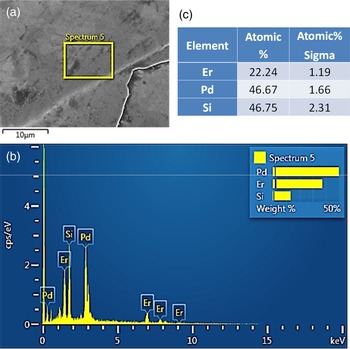
We prepared polycrystalline ErPd2Si2 samples with constituent metals of Er (99.98% purity), Pd (99.95% purity), and Si (99.99% purity) in a well-equipped arc-melting furnace (WK-11, Physcience Opto-electronics Co., Ltd.) under argon atmosphere (99.999% purity) at the University of Macau, Macao, China. Additional 3–5% mole Pd metal was added according to the stoichiometric ratio to supplement the loss due to volatilization. Having melted the mixture for three times, the ingot was ground manually, and the resulting powder was filled into plastic balloons for preparations of seed and feed rods. The balloon was shaped with a hydrostatic pressure of ~70 MPa. The prepared rods were sealed into cylindrical glass tubes with protecting argon gas and sintered at 950 °C for 36 h. After sintering, the samples are pure ErPd2Si2 phase without additional metals or impurity oxides. We grew the single crystals of ErPd2Si2 compound with the sintered rods treated additionally (Li et al., Reference Li, Zhu, Wu and Tang2021) by the floating-zone (FZ) technique using a well-equipped laser-diode FZ furnace (Model: LD-FZ-5-200W-VPO-PC-UM) at the University of Macau, Macao, China (Wu et al., Reference Wu, Zhu, Gao, Xiao, Xia, Zhou, Ouyang, Li, Chen, Tang and Li2020). The growth conditions are similar to those reported previously (Cao et al., Reference Cao, Klingeler, Leps, Behr and Löser2014). It is stressed that the grinding and the shaping processes were carried out in a glove box. Scanning electron microscopy with energy-dispersive X-ray analysis of the grown ErPd2Si2 single crystal reveals a chemical stoichiometry of Er1.00(5)Pd2.10(7)Si2.10(10) (Figure 1), indicating ~5% vacancies on the Er site.
(a) Scanning electron microscopy image of the ErPd2Si2 single crystal with a scale bar of 10 μm. (b) Energy-dispersive X-ray analysis of the ErPd2Si2 single crystal. (c) Atomic ratio of Er, Pd, and Si elements in the ErPd2Si2 single crystal.

B. High-temperature synchrotron X-ray powder diffraction
An ErPd2Si2 single crystal was gently ground into powdered sample using a Vibratory Micro Mill (FRITSCH PULVERISETTE 0) with a vertical vibrating amplitude of 0.5 mm for 1.0 h for the SXRPD study. The grain size of the powdered sample is 4.07 ± 0.97 μm on average. The SXRPD measurements were performed on the beamline I11 at Diamond Light Source, Didcot, UK (Thompson et al., Reference Thompson, Parker, Potter, Hill, Birt, Cobb, Yuan and Tang2009; Li et al., Reference Li, Wildes, Hou, Zhang, Schmitz, Meuffels, Roth and Bückel2014; Tang et al., Reference Tang, Thompson, Hill, Wilkin and Wagner2015). The beamline consists of an array of permanent magnets, three sets of slits, a double-crystal-monochromator composed of two liquid nitrogen cooled Si (111) crystals, a pair of double bounce harmonic rejection mirrors, and an intensity monitor comprising a thin Kapton scattering foil and a scintillation counter. The beamline comprises a transmission geometry X-ray instrument with a wide range of position-sensitive detectors. A triple-axis/two-circle diffractometer with high precision rotary stages was used. Synchrotron X-rays with a wavelength of λ = 0.827032 Å were chosen as the radiation source. High-resolution SXRPD patterns were collected over a diffraction 2θ angle range of 9–66° at 298 and 500 K. The 2θ step interval is 0.001°, and the counting time is 1800 s (for 298 and 500 K) and 3600 s (for 500 K). The ErPd2Si2 powder was loaded onto the external surface of a 0.3-mm diameter borosilicate glass capillary tube by applying a thin layer of hand cream to it. The capillary sample holder was mounted directly on a magnetic spinner and in the center of the θ circle faceplate. The magnetic spinner keeps rotating around the vertical axis of the sample holder plate during the SXRPD measurements. The rotation technique is effective to obtain quality diffraction profiles and to minimize absorption and preferred orientation. The sample temperature was controlled using the beamline hot air blower and detected by a thermocouple near the sample. The symmetric θ-2θ scan technique was used for data collection (Thompson et al., Reference Thompson, Parker, Potter, Hill, Birt, Cobb, Yuan and Tang2009; Tang et al., Reference Tang, Thompson, Hill, Wilkin and Wagner2015).
C. Low-temperature in-house X-ray powder diffraction
The same powdered ErPd2Si2 sample was used for an in-house X-ray powder diffraction study. The measurements were carried out on a Rigaku, SmartLab 9 kW X-ray diffractometer employing Cu Kα 1 = 1.54056 Å radiation and a 2D multidimensional semiconductor detector. XRPD patterns were collected at a voltage of 45 kV and a current of 200 mA. The 2θ range was from 30 to 78° with a step size of 0.005°. The measurements were performed at 20, 100, and 200 K with a dwell time of 1.0 h at each temperature.
D. Rietveld refinements
The computer program FULLPROF SUITE (Rodríguez-Carvajal, Reference RodrÍguez-Carvajal1993) was used to analyze all powder diffraction data. The initial crystal structure model was obtained from a room-temperature XRPD study (Li et al., Reference Li, Cao, Wildes, Schmidt, Schmalzl, Hou, Regnault, Zhang, Meuffels, Löser and Roth2015). The peak profile shape was modeled with a Pseudo-Voigt function. The background was refined using linear interpolation between automatically identified background points. We considered the parameters relevant to improving refinement results, including scale factor, zero shift, peak shape parameters, asymmetry, preferred orientation, unit-cell parameters, atomic positions, as well as isotropic thermal parameter B. The refining procedure is as follows: (i) First, we refined the scale factor, zero shift, and unit-cell parameters. (ii) Second, we refined the peak shape parameters and background points. (iii) Third, we refined the atomic positions, thermal parameters, asymmetry, and preferred orientation step by step. Furthermore, we tentatively refined the strain effect on the collected data with a general strain broadening model (quartic form).
III. RESULTS AND DISCUSSION
A. High-temperature structure from the SXRPD study
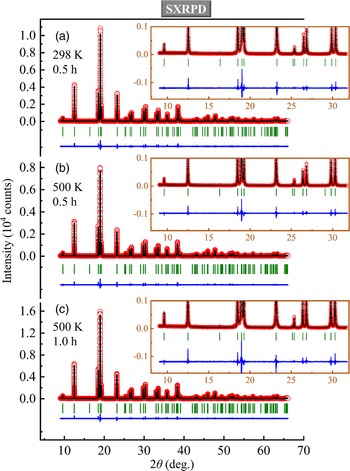
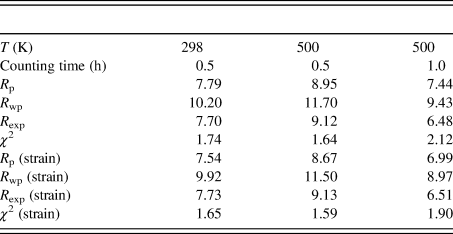
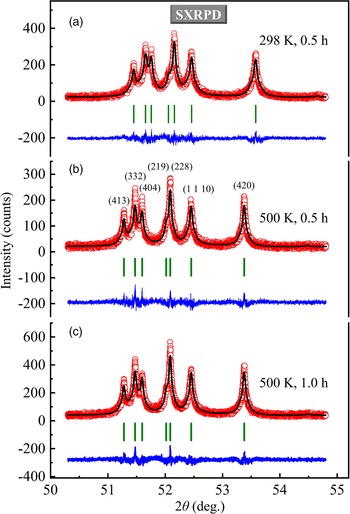
Compared to in-house X-ray powder diffraction and neutron powder diffraction data, SXRPD holds the highest resolution for studying structural phase transitions by detecting possible Bragg peak splitting and observing appearance of additional Bragg peaks. Figure 2 displays the SXRPD patterns of ErPd2Si2 measured at 298 K for 0.5 h [Figure 2(a)] and 500 K for 0.5 h [Figure 2(b)] and for 1.0 h [Figure 2(c)]. All observed patterns were refined satisfactorily in the tetragonal I4/mmm model. All the Bragg peaks recorded were accounted for (insets of Figure 2). Table I lists values of the refinement reliability parameters, R p, R wp, and R exp, as well as the goodness of fit χ 2. These values are acceptable within the present experimental accuracy, which validates the FULLPROF refinements. By carefully checking the patterns at 298 K [Figure 2(a)] and 500 K [Figures 2(b) and 2(c)], we confirm that there is no structural phase transition as temperature increases from 298 to 500 K.
Observed (circles) and calculated (solid lines) synchrotron X-ray powder diffraction patterns of a pulverized ErPd2Si2 single crystal, collected at (a) 298 K, 0.5 h; (b) 500 K, 0.5 h; and (c) 500 K, 1.0 h. Vertical bars mark the positions of Bragg reflections. The bottom curves represent the difference between observed and calculated patterns. The diffraction angle 2θ is in the range of 9–66°. Insets of (a), (b), and (c) display their respective enlarged patterns in the 2θ range of 8–32°.

Experimental conditions and refinement parameters for the SXRPD study of single-crystal ErPd2Si2 compound.

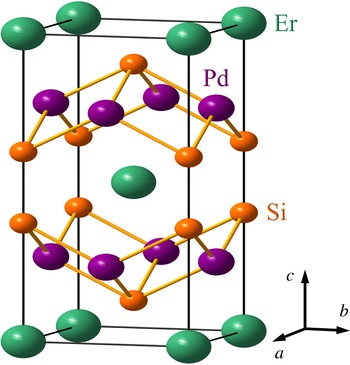
The unit cell of the refined structural model is shown in Figure 3, where Er, Pd, and Si ions were marked. It is noticed that the Pd and Si layers are staggered with a separation of the Er layer. Among the atomic positions of Er, Pd, and Si, only the z coordinate of Si ions may change. The electric and magnetic properties of ErPd2Si2 compound, e.g., anisotropic magnetoresistance, are determined by the Er ions and their coupling between interlayers, as well as the position of Si ions.
View of the unit cell of ErPd2Si2 in space group I4/mmm (No. 139). The Er, Pd, and Si ions are labeled.

Since the splitting degree of Bragg peaks will become larger and larger as the diffraction angle increases, the diffraction data at higher 2θ angles is better used to monitor possible structural phase transitions. Figure 4 shows the SXRPD patterns as well as the corresponding FULLPROF refinements in the 2θ range of 50.3–54.8°. The Bragg peaks are indexed as (4 1 3), (3 3 2), (4 0 4), (2 1 9), (2 2 8), (1 1 10), and (4 2 0) as marked in Figure 4(b). The refinements for 298 and 500 K data show no splitting of the (4 1 3), (3 3 2), and (4 0 4) Bragg peaks.
Observed (circles) and calculated (solid lines) synchrotron X-ray powder diffraction patterns of a pulverized ErPd2Si2 single crystal in the 2θ range of 50.3–54.8°. The patterns were collected at (a) 298 K, 0.5 h; (b) 500 K, 0.5 h; and (c) 500 K, 1.0 h. Vertical bars mark the positions of bragg reflections. The bottom curves represent the difference between observed and calculated patterns. The Bragg peaks of (4 1 3), (3 3 2), (4 0 4), (2 1 9), (2 2 8), (1 1 10), and (4 2 0) were marked.

SXRPD patterns collected at 500 K for 0.5 h [Figure 2(b)] and for 1.0 h [Figure 2(c)] were collected to check the effect of counting time on Rietveld refinements. As listed in Table I, the reliability values of R p, R wp, and R exp for the data collected at 500 K with counting time of 0.5 h are higher than those of the data with counting time of 1.0 h, indicating that a higher counting time increases the ratio of intensity/background. Whereas the goodness of fit (χ 2 = 1.64) of 0.5 h data is smaller than that (2.12) of the 1.0 h data, which we attribute to the enhancement of diffracted intensity. Finally, the data with a longer counting time also does not show Bragg-peak splitting and newly-appeared Bragg peaks.
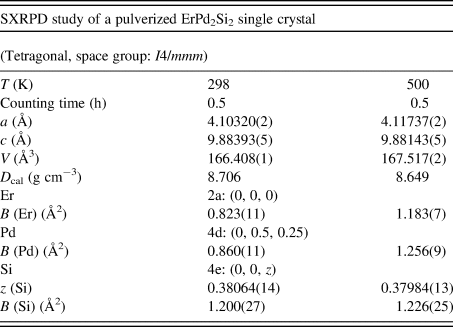
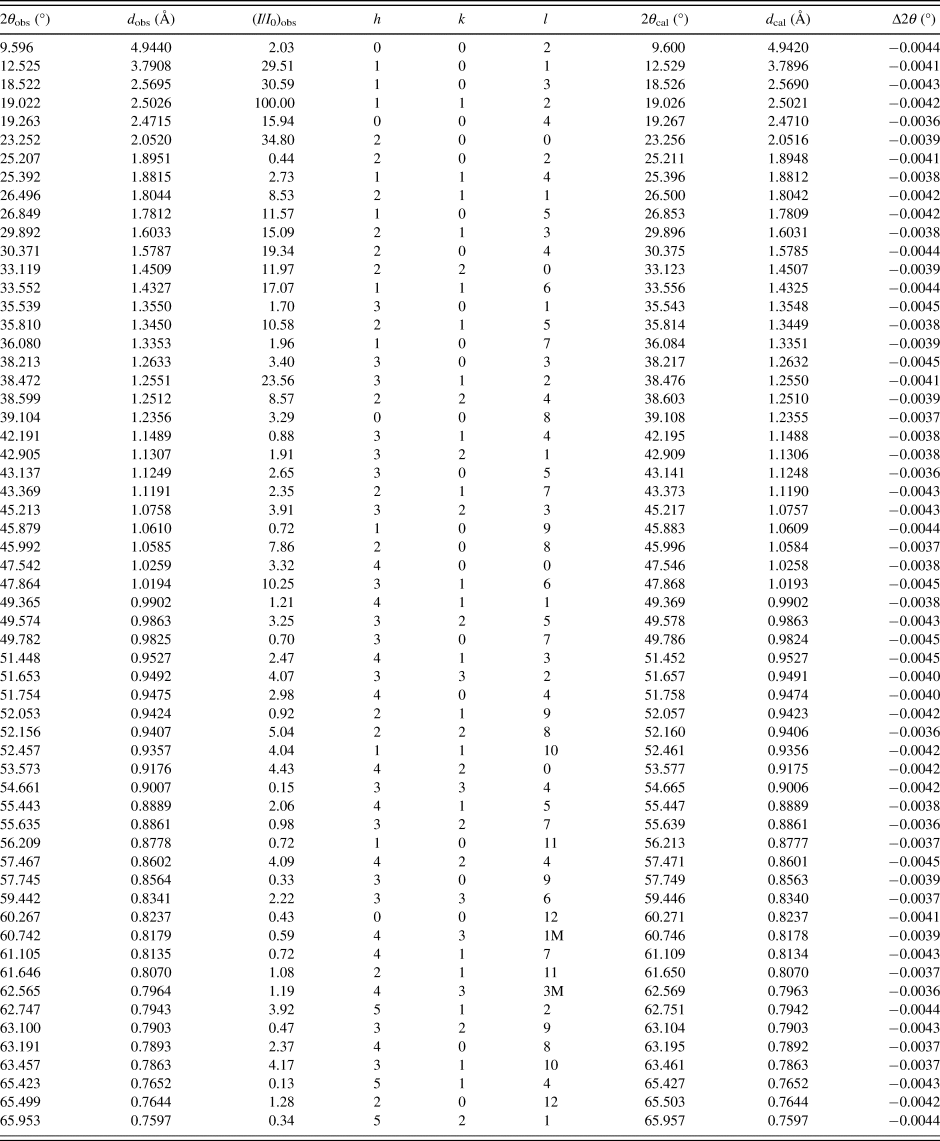
The refined structural parameters of all patterns are included in Table II. The unit-cell parameter a of ErPd2Si2 is 4.10320(2) Å at 298 K and 4.11737(2) Å at 500 K, displaying an increase with temperature. The unit-cell parameter c is equal to 9.88393(5) Å at 298 K and 9.88143(5) Å at 500 K, showing a decrease upon warming. The unit-cell volume V = 166.408(1) Å3 at 298 K and 167.517(2) Å3 at 500 K, expanded by ~0.67% with temperature. This is accompanied by a decrease in density from 8.706 g cm−3 (298 K) to 8.649 g cm−3 (500 K). The refined results show a lattice shrinkage along the c-axis and an extension along the a-axis upon warming. The tetragonal crystal system does not change in the studied temperature range. The detailed synchrotron X-ray powder diffraction data at 298 K was indexed in Table III.
Refined structural parameters of an intermetallic ErPd2Si2 single crystal from the SXRPD study, obtained from FULLPROF refinements of the SXRPD data collected on the I11 beamline (Diamond, UK) at 298 and 500 K.

The Wyckoff sites of all atoms are listed.
Powder diffraction data of ErPd2Si2 from the SXRPD study with λ = 0.827032 Å at 298 K.

Δ2θ (°) = 2θ obs (°) − 2θ cal (°). The Smith-Snyder figure-of-merit F 20 = 195.12 (0.0041, 25) (Smith and Snyder, Reference Smith and Snyder1979), and the de Wolff figure-of-merit M20 = 134.37 (de Wolff, Reference de Wolff1968). The peaks that contain intensity contributions from multiple reflections are labeled with “M”.
In the ThCr2Si2-type structure (Figure 3), Er ions are located at the Wyckoff site 2a (0, 0, 0), and Pd ions are fixed at 4d (0, 0.5, 0.25). The Si ions stay at 4e (0, 0, z) with only one degree of freedom along the coordination z-axis. The z-coordinates of Si ions were refined to 0.38064(14) at 298 K and 0.37984(13) at 500 K.
B. Low-temperature structure from the in-house XRPD study
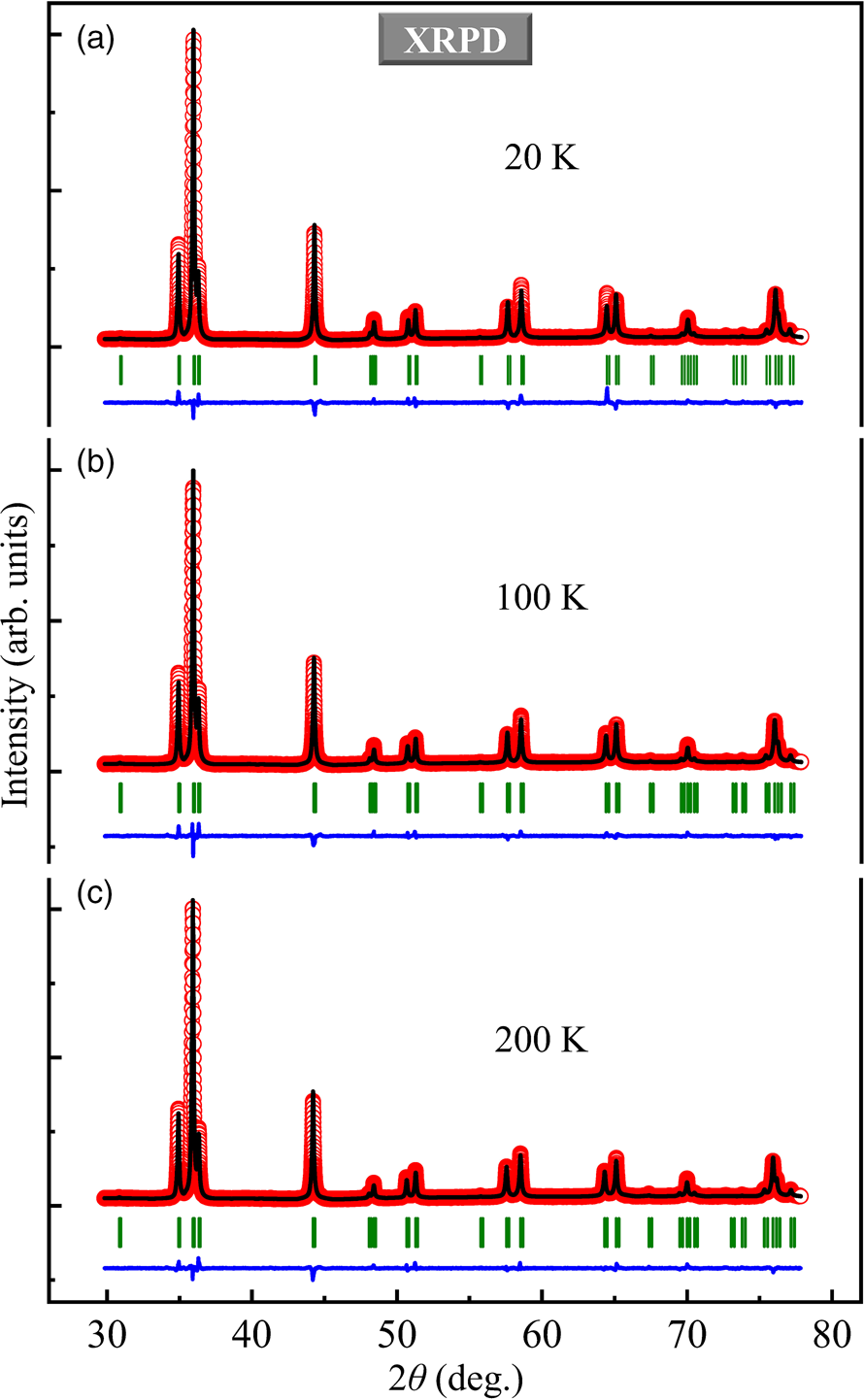
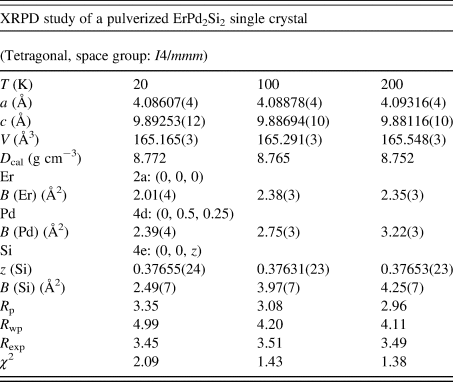
Figure 5 shows the XRPD diffraction patterns collected at 20 K [Figure 5(a)], 100 K [Figure 5(b)], and 200 K [Figure 5(c)], as well as the corresponding structural refinements. We meticulously examined the temperature evolution of the shape and position of Bragg peaks. Overall, the collected data can be effectively indexed with the I4/mmm space group. The extracted crystallographic information, such as unit-cell parameters and atomic positions as well as the goodness of fit, is listed in Table IV. The unit-cell parameters a and c increase by ~0.17% and decrease by ~0.11%, respectively, as the temperature rises from 20 to 200 K. Temperature variances in unit-cell parameters cause an expansion of the unit-cell volume and a decrease of the calculated density by ~0.23% with temperature.
Observed (circles) and calculated (solid lines) in-house X-ray powder diffraction patterns of a pulverized ErPd2Si2 single crystal collected at (a) 20 K, (b) 100 K, and (c) 200 K. Vertical bars mark the positions of Bragg reflections. The bottom curves represent the difference between observed and calculated patterns. The diffraction angle 2θ range is from 30 to 78°.

Extracted structural parameters of an intermetallic ErPd2Si2 single crystal from the XRPD study, including unit-cell parameters a and c, unit-cell volume V, calculated density D cal, atomic positions, and isotropic thermal parameter (B), obtained from FULLPROF refinements of the XRPD data collected on an in-house X-ray diffractometer at 20, 100, and 200 K.

The numbers in parenthesis are the estimated standard deviations of the (next) last significant digit.
C. Strain effect
Although the values of goodness of fit are low enough for a good FULLRPOF refinement, for example, χ 2 = 1.74 for the refinement of SXRPD data collected at 298 K (Table I), and χ 2 = 1.43 for the refinement of XRPD data collected at 100 K (Table IV), we still tried to refine the strain parameters with an introduction of a general strain broadening model (quartic form) for the collected data. As listed in Table I, the values of reliability parameters and goodness of fit get a little smaller with refinements including the strain parameters, indicating small strains exist in the pulverized powder sample.
IV. CONCLUSION
ErPd2Si2 single crystals were grown using a laser-diode FZ furnace. We performed SXRPD and in-house XRPD studies from 20 to 500 K on a pulverized ErPd2Si2 single crystal. The FULLPROF refinements demonstrate that there is no structural phase transition in the studied temperature range, and the tetragonal I4/mmm space group is maintained. The refined unit-cell parameters display an elongation in the basal ab plane and a shrinkage along the c-axis, resulting in a larger unit-cell volume upon warming. This study provides temperature-dependent crystallographic information of single-crystal ErPd2Si2 compound, which would serve as an important basis for further experimental and theoretical studies.
V. DEPOSITED DATA
CIF and RAW data files were deposited with ICDD. You may request this data from ICDD at info@icdd.com.
ACKNOWLEDGEMENTS
The work at University of Macau was supported by the opening project of the State Key Laboratory of High Performance Ceramics and Superfine Microstructure (Grant No. SKL201907SIC), the Science and Technology Development Fund, Macao SAR (File Nos. 0051/2019/AFJ and 0090/2021/A2), Guangdong Basic and Applied Basic Research Foundation (Guangdong–Dongguan Joint Fund No. 2020B1515120025), University of Macau (MYRG2020-00278-IAPME and EF030/IAPME-LHF/2021/GDSTIC), and Guangdong–Hong Kong–Macao Joint Laboratory for Neutron Scattering Science and Technology (Grant No. 2019B121205003). The work at Northwestern Polytechnical University was supported by Shenzhen Fundamental Research Program (JCYJ20210324122203010), the National Natural Science Foundation of China (51971180), Shaanxi Provincial Key R&D Program (2021KWZ-13), and Guangdong Provincial Key R&D Program (2019B090905009).
CONFLICTS OF INTEREST
The authors have no conflicts of interest to declare.