





Introduction
Fertility, which forms the basis of reproduction, is shaped by anatomical and physiological factors, lifestyle habits, and individuals’ fertility knowledge (Daşıkan and Cirban Ekrem, Reference Daşıkan and Cirban Ekrem2022; Kocaarslan Hasbek and Dağlar, Reference Kocaarslan Hasbek and Dağlar2024). Worldwide, the age at first parenthood is increasing for both women and men, while fertility is declining. Individuals postpone having children for reasons such as building a career, increasing educational attainment, strengthening their current financial status, and finding a suitable spouse. Nevertheless, fertility decreases with age (Daşıkan and Cirban Ekrem, Reference Daşıkan and Cirban Ekrem2022; Sileo et al., Reference Sileo, Reynosa, Torok, Moreno and Miura2024). Limited awareness of age-related fertility decline may reduce individuals’ ability to make informed reproductive decisions, accurately assess their reproductive options, and achieve their intended family-building goals. Consequently, demographic changes in the timing of parenthood and growing concerns regarding infertility have increased research attention to fertility knowledge and awareness worldwide (Sileo et al., Reference Sileo, Reynosa, Torok, Moreno and Miura2024).
In addition to these global demographic changes, reproductive decision-making is strongly shaped by sociocultural norms. In Türkiye, traditional family structures, religious values, and social expectations regarding marriage and parenthood continue to influence young adults’ attitudes toward fertility and childbearing (Hacettepe University Institute of Population Studies [HUIPS], 2019). At the same time, increasing educational attainment and career orientation among university graduates have contributed to delayed marriage and postponed parenthood. In this context, improving fertility awareness is important not to encourage earlier childbearing but to enable young adults to make informed reproductive decisions and pursue their intended family-building goals according to their own life circumstances and preferences.
Preconception Health (PCH) is a specific form of care that targets women and men of reproductive age before pregnancy, with the aim of identifying, treating, and providing counselling for existing medical and social conditions that may hinder safe motherhood and favourable pregnancy outcomes (Demeke et al., Reference Demeke, Yetwale, Mulaw, Yehualashet, Gashaw and Mengistie2024). The purpose of PCH is to plan pregnancies, help prospective mothers and fathers gain healthy lifestyle habits, optimize maternal–infant health, and enable a healthy course of pregnancy and childbirth (Bodin et al., Reference Bodin, Tydén, Käll and Larsson2018; Maas et al., Reference Maas, Poels, Ista, Menge, Vanden Auweele, Bie, Smit, Vliet-Lachotzki, Franx and Koster2022). PCH contributes to reducing unintended pregnancy rates, increasing the use of antenatal, intrapartum, and postpartum care services, and reducing maternal and child mortality (ACOG, 2019; Setegn Alie, Reference Setegn Alie, Alemu, Alemayehu, Negesse and Gebremariam2022).
To support the acquisition of healthy lifestyle habits, PCH focuses on identifying, preventing, and treating modifiable and non-modifiable risk factors in individuals’ lives, as well as on education and counselling (Bodin et al., Reference Bodin, Tydén, Käll and Larsson2018; ACOG, 2019). Today, a substantial proportion of individuals of reproductive age are exposed to modifiable lifestyle-related risk factors associated with impaired fertility, including unhealthy nutrition, physical inactivity, tobacco and alcohol use, and obesity. In addition, among young people, there is a growing tendency toward having multiple sexual partners and engaging in risky sexual behaviours. These behaviours may increase the risk of sexually transmitted infections and may negatively affect reproductive health and fertility outcomes (Cairncross et al., Reference Cairncross, Ravindran, Yoganathan, Dennis, Enders, Graves, Mill, Telner and Brown2019; Daly et al., Reference Daly, White, Sanders and Kipping2022; Zaçe et al., Reference Zaçe, Gatta, Orfino, Viteritti and Pietro2022; Demeke et al., Reference Demeke, Yetwale, Mulaw, Yehualashet, Gashaw and Mengistie2024).
Although PCH is recognized as an important component of reproductive health care, the prevalence of women’s use of PCH services worldwide ranges between 5.5% and 45.2%, indicating considerable variability and generally low utilization rates across settings (Kasim et al., Reference Kasim, Draman, Kadir and Muhamad2016; Fransen et al., Reference Fransen, Hopman, Murugesu, Rosman and Smith2018; Yurtsever and Set, Reference Yurtsever and Set2018; Akinajo et al., Reference Akinajo, Osanyin and Okojie2019; Setegn Alie et al., Reference Setegn Alie, Alemu, Alemayehu, Negesse and Gebremariam2022; Timraz et al., Reference Timraz, Abu-Hamad and Ibaid2022). Men’s health status, despite playing an important role in improving PCH, is often overlooked (Çevik Ergi and Şahin, Reference Çevik Ergi and Şahin2023; Arief and Naji, Reference Arief and Naji2024; Kalyebi and Orishaba, Reference Kalyebi and Orishaba2024). Evidence regarding men’s utilization of PCH services is also scarce. Among the few studies examining this topic, research conducted in the Netherlands found that only 20.5% of men utilized these services (Maas et al., Reference Maas, Poels, Ista, Menge, Vanden Auweele, Bie, Smit, Vliet-Lachotzki, Franx and Koster2022). To date, no studies have investigated PCH service utilization among men in Türkiye.
Enhancing fertility awareness and PCH knowledge and attitudes is a critical component of public health initiatives aimed at supporting informed reproductive decision-making, enabling individuals to achieve their intended reproductive goals, and promoting reproductive autonomy throughout the life course (Daly et al., Reference Daly, White, Sanders and Kipping2022; Demeke et al., Reference Demeke, Yetwale, Mulaw, Yehualashet, Gashaw and Mengistie2024; Sylvest et al., Reference Sylvest, Koert, Balslev, Steenberg, Schmidt and Ziebe2024). Final-year university students represent a pivotal population for examining these factors, as they are at a transitional life stage where decisions regarding education, career development, relationships, and future parenthood converge (Ragnar et al., Reference Ragnar, Grandahl, Stern and Mattebo2018; Sileo et al., Reference Sileo, Reynosa, Torok, Moreno and Miura2024; Sylvest et al., Reference Sylvest, Koert, Balslev, Steenberg, Schmidt and Ziebe2024). Furthermore, expanding fertility awareness and PCH interventions is emphasized as a vital strategy to protect maternal and child health while reducing health inequalities (Daly et al., Reference Daly, White, Sanders and Kipping2022; Çevik Ergi and Şahin, Reference Çevik Ergi and Şahin2023; Arief and Naji, Reference Arief and Naji2024).
Although previous studies have examined fertility awareness and PCH knowledge among university students, the existing literature has focused predominantly on female cohorts, students in health-related disciplines, or Western populations. Consequently, evidence regarding male students and non-health majors remains scarce, particularly in middle-income countries with distinct sociocultural norms surrounding family formation, such as Türkiye. Furthermore, few studies have simultaneously evaluated both fertility knowledge and PCH attitudes among final-year students approaching major life-course transitions such as employment, marriage, and childbearing. This study addresses these critical gaps by investigating reproductive health dynamics among final-year students across non-health faculties in a Turkish context. Rather than promoting a particular reproductive timing, this study is grounded in the premise that adequate fertility and preconception health knowledge can empower young adults to make informed reproductive decisions consistent with their own values, preferences, and future family-building intentions. Ultimately, this research aims to examine fertility and PCH knowledge and attitudes among female and male final-year university students in non-health majors, thereby contributing to a broader understanding of reproductive health awareness among young adults in socioculturally diverse settings. Accordingly, this study aimed to examine fertility and PCH knowledge and attitudes among final-year university students majoring in non-health disciplines.
Research questions
-
• What is the fertility knowledge level of female and male final-year university students in non-health majors?
-
• What is the PCH knowledge level of female and male final-year university students in non-health majors?
-
• What is the fertility attitude level of female and male final-year university students in non-health majors?
-
• What is the PCH attitude level of female and male final-year university students in non-health majors?
-
• Is there an association between fertility and PCH knowledge and attitudes among female and male final-year university students in non-health majors?
Methods
Study design
This study was cross-sectional and analytical. It was conducted online between November and December 2024. This study was conducted and reported in accordance with the STROBE (Strengthening the Reporting of Observational Studies in Epidemiology) guideline for cross-sectional studies.
Population and sample
The study population comprised final-year undergraduate students majoring in non-health-related disciplines at Bartın University during the 2024–2025 academic year. Bartın University is a public institution located in northwestern Türkiye. Faculties within the healthcare field and those with health-related courses in their curricula were excluded. Consequently, five faculties were deemed eligible: the Faculty of Letters, the Faculty of Science, the Faculty of Engineering and Architecture, the Faculty of Economics and Administrative Sciences, and the Faculty of Islamic Sciences. The total number of final-year students across these included faculties was identified as 1,387, all of whom were invited to participate. The minimum required sample size was calculated using the standard sample size formula for a finite population. Given a known population size of N = 1,387, the calculation was performed assuming a 95% confidence level, a 5% margin of error, a design effect of 1.0, and an expected proportion of 50% to achieve the maximum variance and ensure the highest statistical power (https://www.openepi.com). Accordingly, the minimum required sample size was calculated as approximately 301 students.
A total of 804 students voluntarily participated in the online survey. However, 55 participants were excluded due to incomplete responses on the Sociodemographic Information Form, resulting in a final analytical sample of 749 students. This sample size substantially exceeds the minimum requirement, thereby ensuring adequate statistical power. To assess the potential impact of missing data and participant attrition, the baseline characteristics of the excluded participants were compared with those of the final sample. No statistically significant differences were observed regarding sex, age, or faculty distribution (p > .05), suggesting that the excluded participants did not differ systematically from those who completed the survey.
Regarding gender distribution, the final sample comprised 540 female and 209 male students. This unequal distribution is a recognized limitation that may restrict the statistical power required to detect subtle effect sizes within the male subgroup; consequently, the pooled descriptive statistics predominantly reflect the characteristics and perspectives of the female cohort.
Because attitudes toward marriage, fertility, and reproductive planning may vary according to sociocultural and educational backgrounds, the inclusion of the Faculty of Islamic Sciences was addressed analytically via faculty-stratified analyses. Specifically, two-way ANOVA and subgroup comparisons were conducted to examine whether fertility and PCH knowledge and attitude scores differed systematically across faculties. No significant Gender × Faculty interaction effects were identified for PCH knowledge or attitude scores. While a significant interaction effect was observed for fertility health knowledge scores, the associated effect size was small and did not substantially alter the interpretation of the primary gender comparisons. Because these stratified findings demonstrated no systematic patterns capable of confounding the primary outcomes, students from all eligible non-health faculties – including Islamic Sciences-were retained in the final pooled analyses.
Inclusion criteria
The inclusion criteria for the study were as follows: (1) being a final-year undergraduate student enrolled in a non-health-related major at Bartın University; (2) not having taken any elective or compulsory courses containing reproductive health-related content during their undergraduate education (e.g., healthy living and sports, nutrition, women’s health, sexual health, or reproductive health); (3) being a female student aged 20–35 or a male student aged 20–40; (4) being single and having no children; (5) being literate in Turkish; (6) having no self-reported visual, hearing, or intellectual disabilities; and (7) volunteering to participate in the study. The age criteria were based on reproductive age ranges commonly referenced in fertility and reproductive health research (Daşıkan and Cirban Ekrem, Reference Daşıkan and Cirban Ekrem2022; Sileo et al., Reference Sileo, Reynosa, Torok, Moreno and Miura2024). Despite these broad eligibility criteria, the final sample was demographically homogeneous, with 98.3% of the participants aged between 22 and 24 years. This concentration is likely attributable to the typical age profile of final-year university students and the voluntary nature of the study, which may have resulted in limited engagement from individuals outside this narrow age bracket.
Exclusion criteria
The exclusion criteria for the study were as follows: being pregnant, working in the healthcare field or having taken health-related courses, and failing to complete the Demographic Information Form.
Instruments
Study data were collected using the Demographic Information Form, the Fertility Health Knowledge Survey (FHKS), the Preconception Health Knowledge Questionnaire (PCHKQ), and the Fertility and Preconception Health Attitude Questionnaire (F-PCHAQ).
Demographic information form
Developed by the researchers based on the relevant literature (Maeda et al., Reference Maeda, Miyata, Boivin, Nomura, Kumazawa, Shirasawa, Saito and Terada2020; Rabiei et al., Reference Rabiei, Shariati, Mogharabian, Tahmasebi, Ghiasi and Motaghi2022; Setegn Alie, Reference Setegn Alie, Alemu, Alemayehu, Negesse and Gebremariam2022; Xu et al., Reference Xu, Li, Ma, Zhang, Qiao and Redding2022), this 20-item form captures participants’ sociodemographic characteristics (e.g., age, gender, marital status, longest place of residence, and employment status) as well as their obstetric and gynaecological history, including personal and familial chronic or genetic diseases.
Fertility health knowledge survey (FHKS)
Originally developed by Barron et al. (Reference Barron, Lithgow, Wade and Mueller Luckey2022), the Turkish validity and reliability of the FHKS were established by Sümen and Teskereci (Reference Sümen and Teskereci2022). The FHKS is a single-factor, 30-item instrument rated on a five-point Likert scale (1 = definitely no, 5 = definitely yes). Responses of “definitely yes” and “probably yes” are scored as correct answers. Item 20 is reverse-worded. The total FHKS score is calculated as the percentage frequency of correct responses across all items, where higher frequencies indicate greater fertility health knowledge. While the original Turkish validation study reported a Cronbach’s alpha of .949 (Sümen and Teskereci, Reference Sümen and Teskereci2022), the Cronbach’s alpha in the present study was .892.
Preconception health knowledge questionnaire (PCHKQ)
Developed by the researchers based on a comprehensive review of the relevant literature (Maeda et al., Reference Maeda, Miyata, Boivin, Nomura, Kumazawa, Shirasawa, Saito and Terada2020; Maas et al., Reference Maas, Poels, Ista, Menge, Vanden Auweele, Bie, Smit, Vliet-Lachotzki, Franx and Koster2022; Rabiei et al., Reference Rabiei, Shariati, Mogharabian, Tahmasebi, Ghiasi and Motaghi2022), this 47-item questionnaire evaluates PCH knowledge among both women and men. The items are conceptually organized into six descriptive domains:
-
1. Reproductive Awareness and Fertility Planning (items 1–9),
-
2. Healthy Lifestyle Habits (Nutrition, Physical Activity/Exercise, Pre-pregnancy Body Mass Index, and Weight Control; items 10–21),
-
3. Harmful Habits and Teratogens (Cigarettes, Waterpipe, Alcohol, and Substance Use; items 22–29),
-
4. Hereditary/Genetic Diseases and Sexually Transmitted Infections (items 30–35),
-
5. Chronic Diseases, Medications, and Vaccines (items 36–42), and
-
6. Psychosocial Health (items 43–47).
In PCHKQ four items (1, 13, 16, and 42) utilize a multiple-choice format and are dichotomously coded as correct or incorrect. The remaining 43 items feature a three-option response format (“True,” “False,” and “I don’t know”). Correct responses receive 1 point, whereas incorrect or “I don’t know” answers receive 0 points. Items 11, 25, 35, 41, and 43 are reverse-coded; for these items, a response of “False” receives 1 point, while “True” or “I don’t know” yields 0 points. The total score ranges from 0 to 47, with higher scores reflecting greater PCH knowledge.
Because the PCHKQ was designed as a structured, population-specific knowledge assessment tool rather than a standardized latent-construct scale, statistical analyses focused primarily on internal consistency and item reliability rather than factor-analytic validation procedures. Reliability analyses demonstrated high internal consistency for the total questionnaire, supported by multiple robust indices (Cronbach’s alpha = .905; KR-20 = .930; KR-21 = .905). Split-half reliability analyses further confirmed strong internal consistency between test halves (odd-even correlation = .918; Spearman–Brown coefficient = .954). Additionally, item difficulty and discrimination analyses demonstrated that most items possessed moderate difficulty levels and acceptable discriminative power, indicating that the instrument effectively differentiated participants based on their knowledge levels.
Given that exploratory or confirmatory factor analyses and test–retest reliability metrics were not within the scope of this study, the six domains serve as a conceptual framework for content organization rather than a validated factor structure. Consequently, domain-level comparisons were evaluated as exploratory, and the subscale scores were interpreted cautiously and primarily utilized for descriptive purposes.
Fertility and preconception health attitude questionnaire (F-PCHAQ)
Developed by the researchers based on a comprehensive review of the relevant literature (Maeda et al., Reference Maeda, Miyata, Boivin, Nomura, Kumazawa, Shirasawa, Saito and Terada2020; Maas et al., Reference Maas, Poels, Ista, Menge, Vanden Auweele, Bie, Smit, Vliet-Lachotzki, Franx and Koster2022; Rabiei et al., Reference Rabiei, Shariati, Mogharabian, Tahmasebi, Ghiasi and Motaghi2022). F-PCHAQ assesses fertility and PCH attitudes among male and female students. It includes seven items related to fertility attitudes and ten items related to PCH attitudes. Each item is scored as “Disagree (1),” “Undecided (2),” and “Agree (3).” Items 3, 6, 9, 10, 11, 12, 16, and 17 are reverse-scored. The minimum total score is 17, and the maximum is 51. Higher scores indicate more positive attitudes toward fertility and PCH.
Content validity and contextual application
To evaluate content validity of both newly developed questionnaires (PCHKQ and F-PCHAQ), expert opinions were obtained from 12 faculty members specializing in the field. Utilizing the Davis technique, the Content Validity Indices (CVI) were determined to be .895 for the PCHKQ and .975 for the F-PCHAQ, indicating excellent content validity. Because these context-specific questionnaires were explicitly developed to assess fertility and PCH knowledge and attitudes among final-year university students in non-health majors, they should be interpreted as structured research instruments optimized for this current target population rather than universally validated psychometric scales.
Data collection
Data were collected via the Google Forms online survey platform. To facilitate recruitment, the researchers held preliminary meetings with the academic staff and student representatives of the participating faculties to introduce the study’s objectives. Subsequently, the online survey link was disseminated through class-specific WhatsApp groups. Prior to accessing the questionnaires, participants were required to provide informed online consent on the landing page; the instrument became active only upon consent validation. To prevent duplicate submissions and ensure data integrity, response settings were configured to limit submissions to one entry per participant. The questionnaires were completed via self-report, requiring approximately 15–20 minutes to complete.
Statistical analysis
Statistical analyses were performed using the Statistical Package for the Social Sciences (SPSS) version 26.0 (IBM Corp., Armonk, NY, USA). Descriptive statistics were computed and reported as means (M), standard deviation (SD), frequency (n), and percentage (%). Prior to conducting inferential analyses, normality assumptions were evaluated independently for female and male subgroups using skewness and kurtosis values, alongside visual inspections of histograms and Q–Q plots. The data demonstrated approximately normal distributions, meeting the criteria for parametric testing. Although the FHKS score was calculated as a percentage of correct responses, the total score distribution functioned as a continuous variable and was deemed appropriate for parametric evaluation given the large sample size.
Independent-samples t-tests were performed to compare mean FHKS, PCHKQ, F-PCHAQ, and domain scores across genders. Levene’s test was performed to evaluate homogeneity of variances prior to group comparisons. In cases where the assumption of equal variances was violated, Welch’s t-test results (“equal variances not assumed”) were interpreted. Beyond standard significance testing (p-values), Cohen’s d was calculated to estimate the practical significance of gender-based differences, with values of .20, .50, and .80 representing small, medium, and large effect sizes, respectively (Cohen, Reference Cohen1988). Because multiple comparisons were performed across questionnaire domains, both adjusted and unadjusted p-values were evaluated concurrently with effect size estimates to maintain a cautious, exploratory approach to domain-level findings.
To evaluate whether faculty affiliation moderated gender-based variations, full-factorial two-way analysis of variance (ANOVA) models were constructed for FHKS, PCHKQ, and F-PCHAQ total scores. Gender and faculty were entered as fixed factors to examine both main effects and Gender x Faculty interaction effects. Partial eta squared (partial η 2) values were computed to measure effect sizes and interpreted using conventional thresholds: small (.01), medium (.06), and large (.14). Finally, Pearson correlation analysis was performed to examine the relationships among FHKS, PCHKQ, and F-PCHAQ scores. Pearson correlation coefficients (r) were interpreted as small (r = .10 − .29), moderate (r = .30 − .49), or large (r ≥ .50), (Cohen, Reference Cohen1988). All statistical evaluations were conducted at a 95% confidence interval, with p < .05 considered statistically significant.
Ethical approach
Ethical approval for this study was officially granted by the Ege University Faculty of Medicine Medical Research Ethics Committee (Decision/Approval No: 24-11T/53). The first author is a doctoral candidate in Women’s Health and Diseases Nursing at Ege University and a lecturer at Bartın University, while the second author is her academic advisor; therefore, the ethical approval process for that author was obtained from Ege University. Furthermore, as the study data were gathered electronically via an online survey platform without utilizing any institutional records, administrative databases, or physical university infrastructure, formal institutional permission from Bartın University was not required.
Participation in the study was entirely voluntary, and data collection was strictly anonymous. On the introductory page of the electronic questionnaire, students were provided with a digital informed consent form detailing the study’s objectives, scope, voluntary nature, and rigorous confidentiality measures. Potential participants were explicitly informed that they maintained the right to withdraw from the study at any stage prior to final submission without any penalty and that no personally identifiable information would be collected. Electronic informed consent was mandatory for participation; the electronic survey system automatically restricted questionnaire access to individuals who did not explicitly provide consent. All collected data were securely stored in password-protected digital repositories, accessible exclusively to the research team. The study was designed and conducted in strict accordance with the ethical principles outlined in the Declaration of Helsinki. The authors received no external funding for this research and declare no conflicts of interest.
Results
Descriptive characteristics
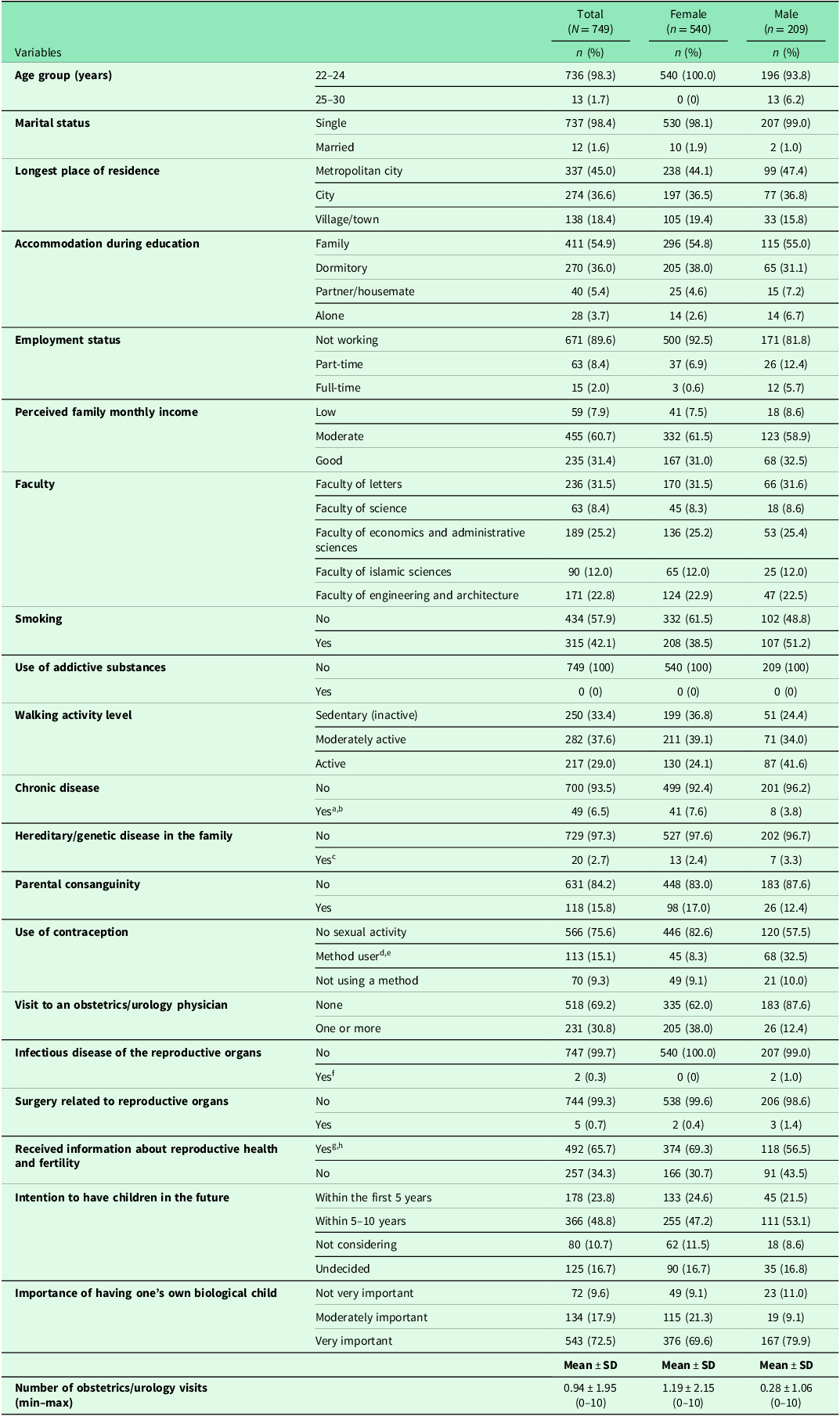
A total of 749 final-year undergraduate students aged 22–30 years, enrolled in non-health-related majors, participated in the study. The vast majority of the sample was aged 22–24 years (98.3%) and single (98.4%). Regarding geographic background, 45.0% of the participants had lived the longest in a metropolitan city, and 54.8% resided with their families during their education. Most students (89.6%) were not employed, and 60.7% perceived their family’s monthly income as moderate.
Notably, 42.1% of the participants reported smoking. This rate surpasses smoking prevalence estimates reported for the general young adult population in Türkiye, potentially indicating heightened vulnerability to smoking-related fertility and PCH risks among university students. Conversely, no participant reported the use of addictive substances. Given the self-reported nature of the data collection process and the pronounced sociocultural sensitivity surrounding substance use in Türkiye, this finding should be interpreted with caution; underreporting due to social desirability bias may have occurred despite the anonymous online survey format. In terms of lifestyle behaviours, 37.6% of the participants maintained a moderately active lifestyle, whereas 33.4% reported a sedentary lifestyle. Furthermore, parental consanguinity – a critical risk factor in preconception counselling within specific regional contexts – was prevalent among 15.8% of the sample.
Regarding reproductive health characteristics, 75.6% of the participants reported no history of sexual activity, 15.1% reported utilizing a contraceptive method, and 9.3% were sexually active without using any contraception. These categories were evaluated distinctly to differentiate contraceptive behaviour from sexual inactivity, thereby preventing an overestimation of contraceptive non-use among sexually inactive individuals. Furthermore, 30.8% of the students had visited an obstetrics–gynaecology or urology outpatient clinic, and 65.7% had previously obtained information regarding reproductive health and fertility. In terms of future family planning, 48.8% intended to have children within the next 5–10 years, and 72.5% deemed having a biological child to be highly important (Table 1).
Sociodemographic and health characteristics of university students

Table 1. Long description
The table presents sociodemographic and health characteristics of university students. It includes 19 rows and 12 columns. The columns are labeled as Variables, Total (N = 749), Female (n = 540), and Male (n = 209), with sub-columns for n (%) under each category. The rows include variables such as age group, marital status, longest place of residence, accommodation during education, employment status, perceived family monthly income, faculty, smoking, use of addictive substances, walking activity level, chronic disease, hereditary/genetic disease in the family, parental consanguinity, use of contraception, visit to an obstetrics/urology physician, infectious disease of the reproductive organs, surgery related to reproductive organs, received information about reproductive health and fertility, intention to have children in the future, importance of having one’s own biological child, and number of obstetrics/urology visits. Each row provides detailed percentages and counts for each variable across the total, female, and male categories.
a Chronic disease type (female n = 41): asthma: 16, heart disease: 9, diabetes mellitus: 5, thyroid disease: 3, bronchitis: 2, epilepsy: 2, hypertension: 1, kidney disease: 1, rheumatism: 1, multiple sclerosis: 1.
b Chronic disease type (male n = 8): asthma: 2, heart disease: 3, diabetes mellitus: 1, thyroid disease: 1, hypertension: 1.
c Type of hereditary disease (n = 20): thalassaemia: 20 (13 female, 7 male).
d Method used for contraception (female n = 45): condom: 37, oral contraceptive pill: 4, withdrawal method: 3, emergency contraception pill: 1.
e Method used for contraception (male n = 68): condom: 58, oral contraceptive pill: 1, withdrawal method: 7, emergency contraception pill: 2.
f Infectious disease of reproductive organs (male n = 2): gonorrhoea: 1, human papillomavirus: 1.
g Source of information on reproductive health and fertility (female n = 374): communication channels such as TV/radio: 491, friends/neighbours/relatives: 73, health professionals: 392, internet/social media: 231).
h Source of information on reproductive health and fertility (male n = 118): communication channels such as TV/radio: 16, friends/neighbours/relatives: 25, health professionals: 38, internet/social media: 70).
*Multiple responses were allowed.
Percentages may not total exactly 100% because of rounding.
Fertility and preconception health knowledge and attitudes
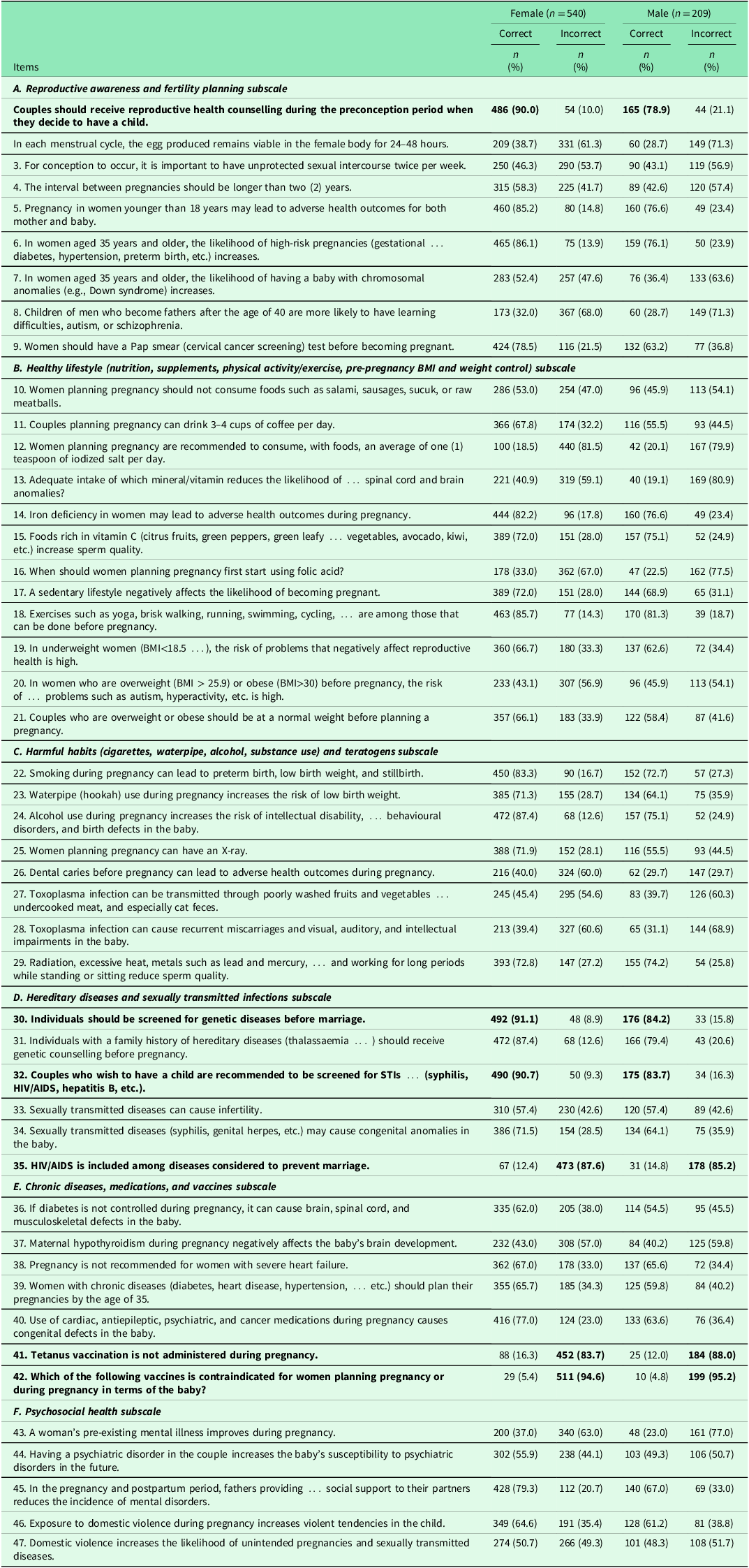
When students’ PCH knowledge levels were examined by gender the items with the highest correct response rates were “Individuals should be screened for genetic diseases before marriage” (Female: 91.1%, Male: 84.2%); “Couples who want to have children are recommended to be screened for sexually transmitted diseases” (Female: 90.7%, Male: 83.7%); and “When should couples receive reproductive health counselling when they decide to have children?” (Female: 90.0%, Male: 78.9) (Table 2).
Preconception health knowledge levels of university students

Table 2. Long description
The table compares preconception health knowledge levels of university students by gender across various topics. It has 4 rows and 6 columns. The columns are labeled as Female Correct, Female Incorrect, Male Correct, Male Incorrect, and two additional columns for subtopics. The rows are labeled with specific health knowledge items. Row 1: Couples should seek reproductive health counselling during the preconception period when they decide to have children, Female Correct: 488, Female Incorrect: 54, Male Correct: 165, Male Incorrect: 44. Row 2: During menstrual cycle, the egg produced remains viable in the female body for 24-48 hours, Female Correct: 481, Female Incorrect: 61, Male Correct: 173, Male Incorrect: 36. Row 3: For conception to occur, the sperm must be present in the fallopian tube within two hours of ovulation, Female Correct: 353, Female Incorrect: 189, Male Correct: 139, Male Incorrect: 70. Row 4: The ideal interval between pregnancies should be longer than the 22 years, Female Correct: 303, Female Incorrect: 239, Male Correct: 117, Male Incorrect: 92.
The statements most and least correctly identified by students are shown in bold.
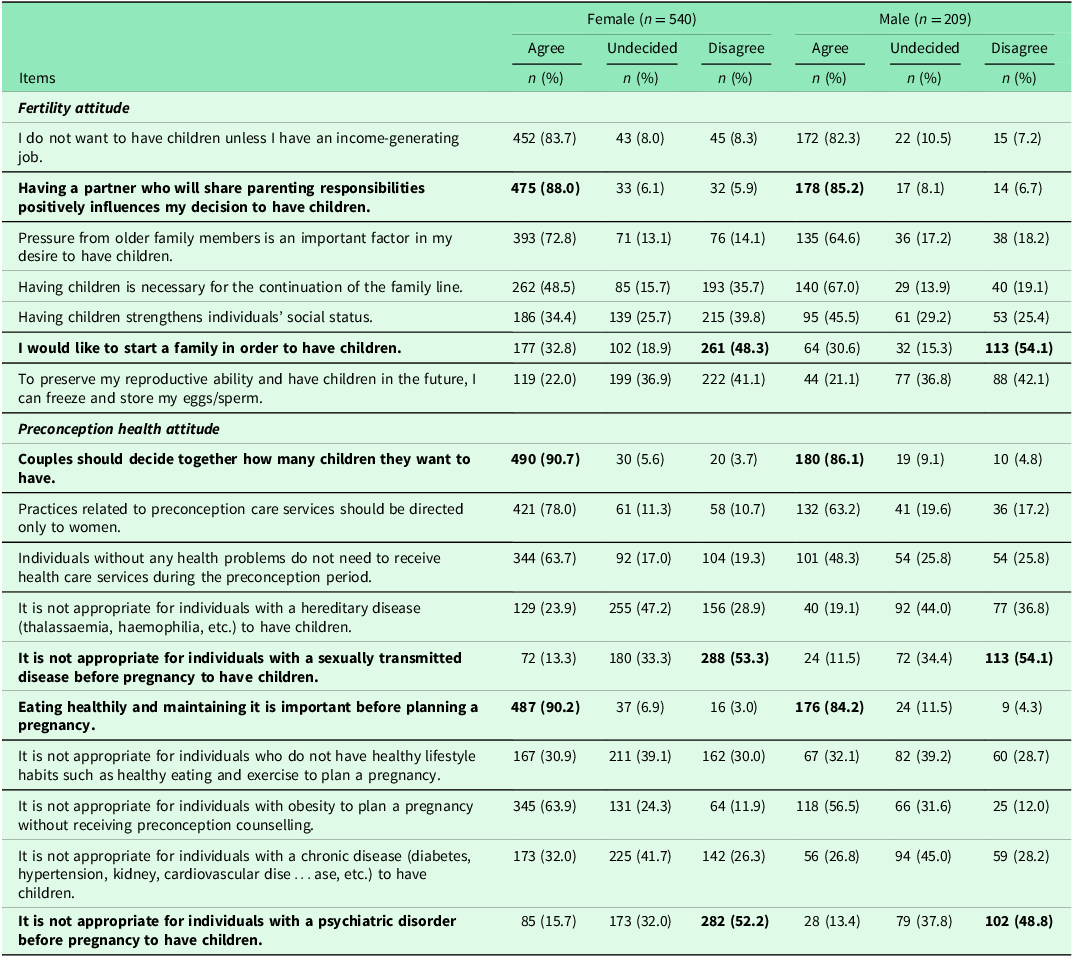
Regarding the evaluation of fertility and PCH attitudes, the statements demonstrating the highest levels of positive attitudes were “Couples should decide together on the number of children they want to have” (Female: 90.7%, Male: 86.1%); “It is important to eat healthy before planning a pregnancy and to maintain this” (Female: 90.2%, Male: 84.2%); and “Having a partner who will share parenting responsibilities positively affects my decision to have children” (Female: 88.0%, Male: 85.2%) (Table 3).
Fertility and preconception health attitude levels of university students

Table 3. Long description
The table presents data on fertility and preconception health attitudes among female and male university students. It has 16 rows and 6 columns. The columns are labeled as Female (n=540) and Male (n=209), with sub-columns for Agree, Undecided, and Disagree, each showing the number and percentage of respondents. The rows are labeled with various statements related to fertility and preconception health attitudes. Row 1: I do not want to have children unless I have an income-generating job. Female: Agree 452 (83.7%), Undecided 43 (8.0%), Disagree 45 (8.3%). Male: Agree 172 (82.3%), Undecided 22 (10.5%), Disagree 15 (7.2%). Row 2: Having a partner who will share parenting responsibilities positively influences my decision to have children. Female: Agree 475 (88.0%), Undecided 33 (6.1%), Disagree 32 (5.9%). Male: Agree 178 (85.2%), Undecided 17 (8.1%), Disagree 14 (6.7%). Row 3: Pressure from older family members is an important factor in my desire to have children. Female: Agree 393 (72.8%), Undecided 71 (13.1%), Disagree 76 (14.1%). Male: Agree 135 (64.6%), Undecided 36 (17.2%), Disagree 38 (18.2%). Row 4: Having children is necessary for the continuation of the family line. Female: Agree 262 (48.5%), Undecided 85 (15.7%), Disagree 193 (35.7%). Male: Agree 140 (67.0%), Undecided 29 (13.9%), Disagree 40 (19.1%). Row 5: Having children strengthens individuals’ social status. Female: Agree 186 (34.4%), Undecided 139 (25.7%), Disagree 215 (39.8%). Male: Agree 95 (45.5%), Undecided 61 (29.2%), Disagree 53 (25.4%). Row 6: I would like to start a family in order to have children. Female: Agree 177 (32.8%), Undecided 102 (18.9%), Disagree 261 (48.3%). Male: Agree 64 (30.6%), Undecided 32 (15.3%), Disagree 113 (54.1%). Row 7: To preserve my reproductive ability and have children in the future, I can freeze and store my eggs/sperm. Female: Agree 119 (22.0%), Undecided 199 (36.9%), Disagree 222 (41.1%). Male: Agree 44 (21.1%), Undecided 77 (36.8%), Disagree 88 (42.1%). Row 8: Couples should decide together how many children they want to have. Female: Agree 490 (90.7%), Undecided 30 (5.6%), Disagree 20 (3.7%). Male: Agree 180 (86.1%), Undecided 19 (9.1%), Disagree 10 (4.8%). Row 9: Practices related to preconception care services should be directed only to women. Female: Agree 421 (78.0%), Undecided 61 (11.3%), Disagree 58 (10.7%). Male: Agree 132 (63.2%), Undecided 41 (19.6%), Disagree 36 (17.2%). Row 10: Individuals without any health problems do not need to receive health care services during the preconception period. Female: Agree 344 (63.7%), Undecided 92 (17.0%), Disagree 104 (19.3%). Male: Agree 101 (48.3%), Undecided 54 (25.8%), Disagree 54 (25.8%). Row 11: It is not appropriate for individuals with a hereditary disease (thalassaemia, haemophilia, etc.) to have children. Female: Agree 129 (23.9%), Undecided 255 (47.2%), Disagree 156 (28.9%). Male: Agree 40 (19.1%), Undecided 92 (44.0%), Disagree 77 (36.8%). Row 12: It is not appropriate for individuals with a sexually transmitted disease before pregnancy to have children. Female: Agree 72 (13.3%), Undecided 180 (33.3%), Disagree 288 (53.3%). Male: Agree 24 (11.5%), Undecided 72 (34.4%), Disagree 113 (54.1%). Row 13: Eating healthily and maintaining it is important before planning a pregnancy. Female: Agree 487 (90.2%), Undecided 37 (6.9%), Disagree 16 (3.0%). Male: Agree 176 (84.2%), Undecided 24 (11.5%), Disagree 9 (4.3%). Row 14: It is not appropriate for individuals who do not have healthy lifestyle habits such as healthy eating and exercise to plan a pregnancy. Female: Agree 167 (30.9%), Undecided 211 (39.1%), Disagree 162 (30.0%). Male: Agree 67 (32.1%), Undecided 82 (39.2%), Disagree 60 (28.7%). Row 15: It is not appropriate for individuals with obesity to plan a pregnancy without receiving preconception counselling. Female: Agree 345 (63.9%), Undecided 131 (24.3%), Disagree 64 (11.9%). Male: Agree 118 (56.5%), Undecided 66 (31.6%), Disagree 25 (12.0%). Row 16: It is not appropriate for individuals with a chronic disease (diabetes, hypertension, kidney, cardiovascular disease, etc.) to have children. Female: Agree 173 (32.0%), Undecided 225 (41.7%), Disagree 142 (26.3%). Male: Agree 56 (26.8%), Undecided 94 (45.0%), Disagree 59 (28.2%). Row 17: It is not appropriate for individuals with a psychiatric disorder before pregnancy to have children. Female: Agree 85 (15.7%), Undecided 173 (32.0%), Disagree 282 (52.2%). Male: Agree 28 (13.4%), Undecided 79 (37.8%), Disagree 102 (48.8%).
The statements with the most positive and most negative attitudes are shown in bold.
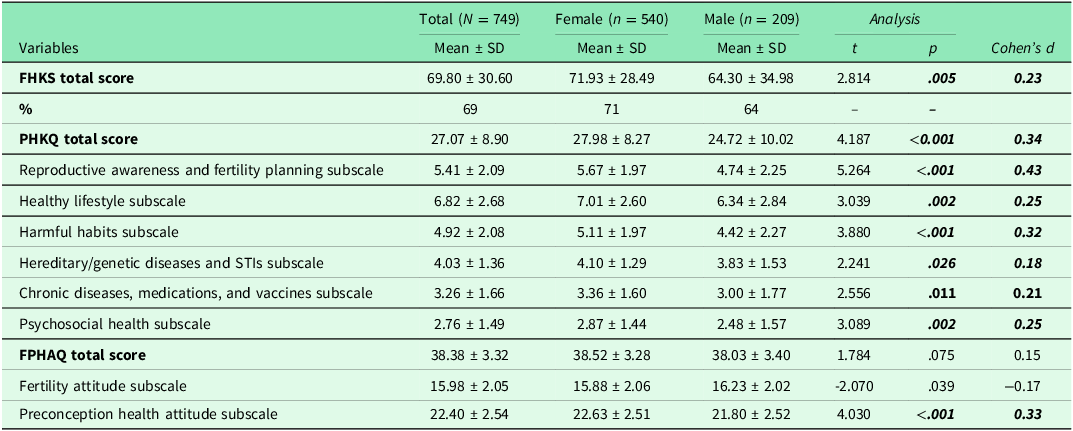
Gender-stratified analyses revealed statistically significant differences in the FHKS total score (p = .005), the PCHKQ total score (p < .001), and across all PCHKQ domains: reproductive awareness and fertility planning (p < .001), healthy lifestyle (p = .002), harmful habits (p < .001), hereditary and genetic diseases and STIs (p = .026), chronic diseases, medications, and vaccines (p = .011), and psychosocial health (p = .002), with female students consistently achieving higher scores. Conversely, no statistically significant gender difference was found for the F-PCHAQ total score (p = .075). However, significant differences emerged within its specific subscales, namely the fertility attitude subscale (p = .039) and the preconception health attitude subscale (p < .001). Effect size analyses indicated that these statistically significant gender differences were generally small to moderate in magnitude, with Cohen’s d values ranging from 0.18 to 0.43 (Table 4).
Comparison of students’ FHKS, PHKQ, and FPHAQ total and subscale scores by sex

Table 4. Long description
A table comparing students’ scores by sex across various health knowledge and attitude scales. The table has 12 rows and 8 columns. Column headers are Variables, Total (N = 749), Female (n = 540), Male (n = 209), Analysis, t, p, and Cohen’s d. Row labels include FHKS total score, PHKQ total score, and various subscales. Notable trends include higher scores for females in most categories, with significant p-values highlighted in bold italics. Specific subscales show varying degrees of difference between genders, with effect sizes ranging from 0.18 to 0.43.
Note: Bold italic values indicate statistically significant differences between female and male students (p < .05) and their corresponding Cohen’s d effect sizes. Cohen’s d represents the magnitude of the difference between groups.
FHKS: Fertility Health Knowledge Survey; PHKQ: Preconception Health Knowledge Questionnaire; FPHAQ: Fertility and Preconceptional Health Attitude Questionnaire; %: Percentage; Mean; SD: Standard deviation; t: Independent-samples t test.
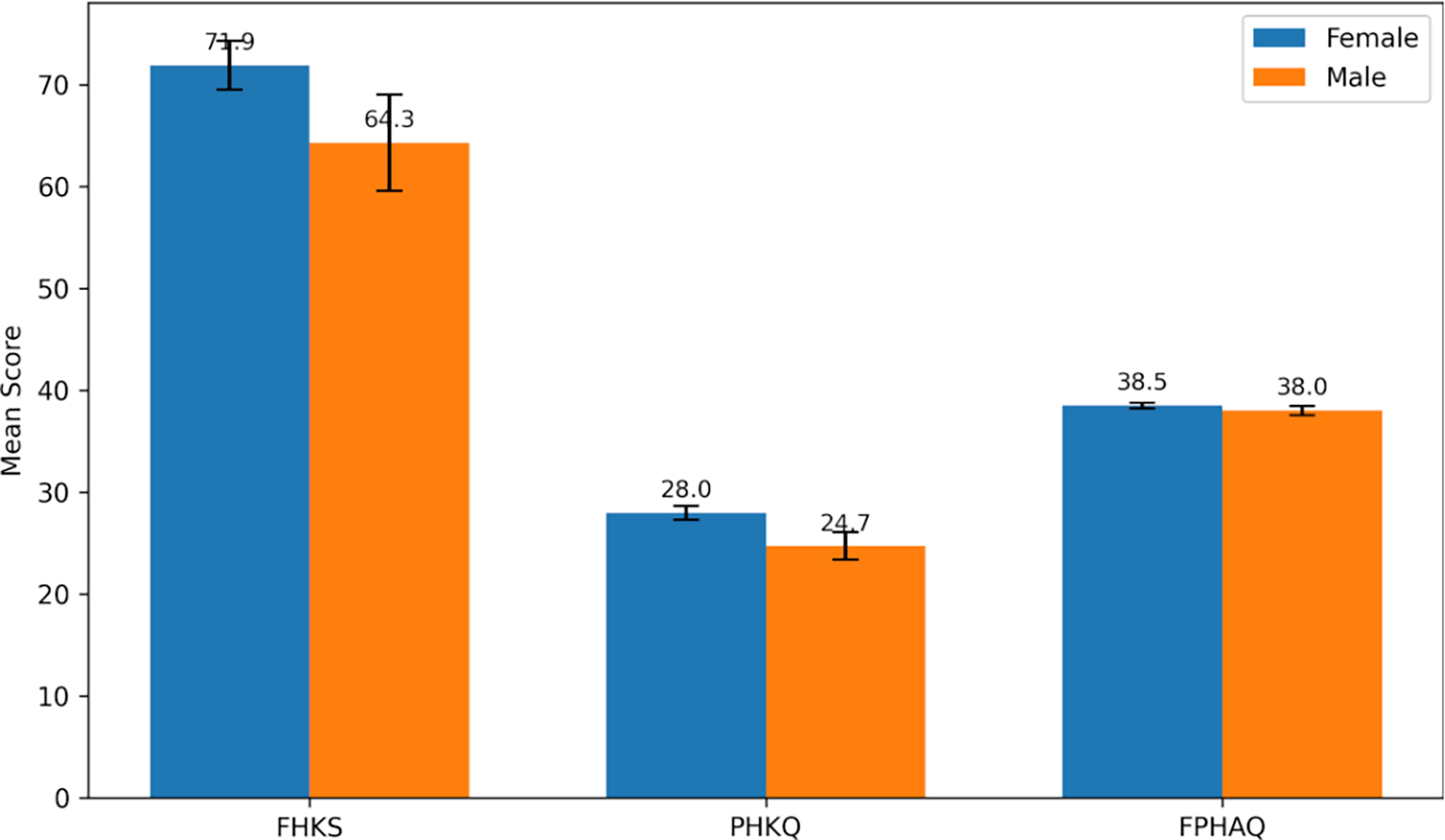
The total mean score on FHKS was 69.80 ± 30.60 (Female: 71.93 ± 28.49; Male: 64.30 ± 34.98), PCHKQ total mean score was 27.07 ± 8.90 (Female: 27.98 ± 8.27; Male: 24.72 ± 10.02), and F-PCHAQ total mean score was 38.38 ± 3.32 (Female: 38.52 ± 3.28; Male: 38.03 ± 3.40) (Figure 1). In analyses by gender, statistically significant differences were found in FHKS total score (p = .005), PCHKQ total score (p < .001), and PCHKQ domains : reproductive awareness and fertility planning (p < .001), healthy lifestyle (p = .002), harmful habits (p < .001), hereditary and genetic diseases and STIs (p = .026), chronic diseases, medications and vaccines (p = .011), and psychosocial health (p = .002). No statistically significant difference was found in F-PCHAQ total score (p = .075). However, significant differences were identified in the fertility attitude subscale (p = .039) and the preconception health attitude subscale (p < .001). Effect size analyses showed that the statistically significant gender differences were generally small to moderate in magnitude (Cohen’s d range: 0.18–0.43) (Table 4).
Comparison of female and male students’ mean FHKS, PHKQ, and FPHAQ total scores. Error bars represent 95% confidence intervals, and values above the bars indicate mean scores.

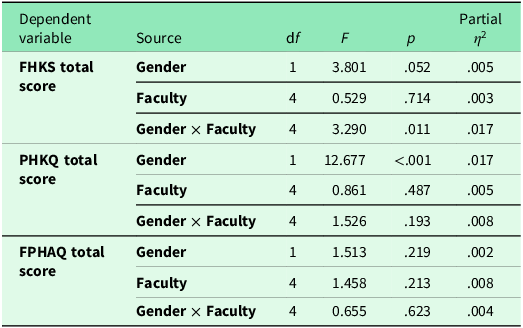
Faculty-stratified two-way ANOVA analyses were conducted to evaluate whether faculty affiliation modified gender-based comparisons for FHKS, PCHKQ and F-PCHAQ total scores. For FHKS total scores, a significant Gender × Faculty interaction effect was identified, F(4,739) = 3.290, p = .011, partial η 2 = .017, indicating that gender differences in fertility health knowledge varied across faculties. However, the effect size was small. For PCHKQ total scores, female students demonstrated significantly higher knowledge levels than male students across faculties, F(1,739) = 12.677, p < .001, partial η 2 = .017. Neither the faculty main effect nor the Gender × Faculty interaction effect was statistically significant (p > .05). For F-PCHAQ total scores, no significant main effects of gender or faculty affiliation were identified, and the Gender × Faculty interaction effect was also non-significant, F(4,739) = 0.655, p = .623, partial η 2 = .004. These findings suggest that fertility and preconception health attitudes were comparable across faculties for both female and male students (Table 5).
Two-way ANOVA9 results for FHKS, PHKQ, and FPHAQ total scores according to gender and faculty affiliation

Table 5. Long description
A table with three rows and four columns comparing ANOVA results for FHKS, PHKQ, and FPHAQ total scores by gender and faculty. The columns are labeled Dependent variable, Source, df, F, p, and Partial η2. The rows are grouped by FHKS total score, PHKQ total score, and FPHAQ total score. Each group has sub-rows for Gender, Faculty, and Gender × Faculty. For FHKS total score, Gender has df 1, F 3.801, p .052, Partial η2 .005; Faculty has df 4, F 0.529, p .714, Partial η2 .003; Gender × Faculty has df 4, F 3.290, p .011, Partial η2 .017. For PHKQ total score, Gender has df 1, F 12.677, p <.001, Partial η2 .017; Faculty has df 4, F 0.861, p .487, Partial η2 .005; Gender × Faculty has df 4, F 1.526, p .193, Partial η2 .008. For FPHAQ total score, Gender has df 1, F 1.513, p .219, Partial η2 .002; Faculty has df 4, F 1.458, p .213, Partial η2 .008; Gender × Faculty has df 4, F 0.655, p .623, Partial η2 .004.
FHKS: Fertility Health Knowledge Survey; PHKQ: Preconception Health Knowledge Questionnaire; FPHAQ: Fertility and Preconception Health Attitude Questionnaire, F: Full-factorial two-way ANOVA.
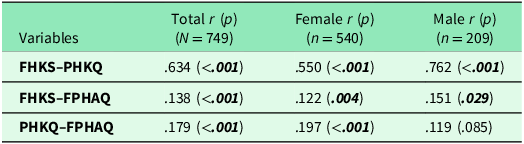
Pearson correlation analysis revealed a strong positive correlation between fertility health knowledge and preconception health knowledge in the total sample (r = .634, p < .001). Weak positive correlations were identified between fertility health knowledge and fertility/preconception health attitudes (r = .138, p < .001), as well as between preconception health knowledge and fertility/preconception health attitudes (r = .179, p < .001). In sex-stratified analyses, strong positive correlations between fertility health knowledge and preconception health knowledge were observed in both female (r = .550, p < .001) and male students (r = .762, p < .001). Among female students, weak positive correlations were found between fertility health knowledge and fertility/preconception health attitudes (r = .122, p = .004), and between preconception health knowledge and fertility/preconception health attitudes (r = .197, p < .001). Among male students, a weak positive correlation was identified between fertility health knowledge and fertility/preconception health attitudes (r = .151, p = .029), whereas the correlation between preconception health knowledge and fertility/preconception health attitudes was not statistically significant (r = .119, p = .085) (Table 6).
Pearson correlation coefficients between fertility health knowledge, preconception health knowledge, and fertility/preconception health attitudes

Table 6. Long description
A table with three rows and four columns comparing Pearson correlation coefficients between fertility health knowledge, preconception health knowledge, and fertility/preconception health attitudes. The columns are labeled Variables, Total r (p) (N = 749), Female r (p) (n = 540), and Male r (p) (n = 209). The rows are labeled FHKS-PHKQ, FHKS-FPHAQ, and PHKQ-FPHAQ. Row 1: FHKS-PHKQ, Total r (p) .634 (p .001), Female r (p) .550 (p .001), Male r (p) .762 (p .001). Row 2: FHKS-FPHAQ, Total r (p) .138 (p .001), Female r (p) .122 (p .004), Male r (p) .151 (p .029). Row 3: PHKQ-FPHAQ, Total r (p) .179 (p .001), Female r (p) .197 (p .001), Male r (p) .119 (p .085).
FHKS: Fertility Health Knowledge Survey; PHKQ: Preconception Health Knowledge Questionnaire; FPHAQ: Fertility and Preconception Health Attitude Questionnaire. Pearson correlation coefficients are presented. Correlation strengths were interpreted according to Cohen (Reference Cohen1988): small (r = .10 − .29), moderate (r = .30–.49), and large (r ≥ .50).
Discussion
In the present study, conducted to examine fertility and PCH knowledge and attitudes among final-year female and male university students in non-health majors, more than two-thirds of students (65.7%) reported having previously obtained information regarding reproductive health and fertility. Similar findings have been reported among university students in Japan and other educational settings (Akizuki et al., Reference Akizuki, Maeda, Okinaga, Sato, Mouri, Takagishi, Suzuki, Nomura and Shirasawa2025). These findings suggest that exposure to reproductive health information among university students has been reported across different sociocultural and educational contexts.
Furthermore, approximately half of the participants (48.8%) anticipated family formation within the next 5–10 years, and a substantial majority (72.5%) considered having a biological child highly important. Similar reproductive intentions have been documented among young adults in Denmark, China, and Belgium (Sørensen et al., Reference Sørensen, Marcussen, Backhausen, Juhl, Schmidt, Tydén and Hegaard2016; Miserez et al., Reference Miserez, Holder, Bogaerts and Steijvoort2025; Zhou et al., Reference Zhou, Luo, Wang, Cui, Chen and Fu2020). These similarities may reflect common developmental transitions among university students, including career establishment, relationship formation, and future family planning. However, reproductive intentions are also shaped by broader sociocultural and economic contexts. In Türkiye, traditional family structures, gender norms, and social expectations regarding marriage and parenthood continue to influence reproductive attitudes and decision-making among young adults (HUIPS, 2019). Accordingly, improving fertility awareness and preconception health literacy during university years may help young adults make informed reproductive decisions and pursue their intended family-building goals according to their own preferences and life circumstances.
Fertility health knowledge
The findings of this study demonstrated that students’ fertility health knowledge levels were above the midpoint of the scale. Gender-based analyses revealed that female students exhibited significantly higher fertility health knowledge levels than male students (p = .005). Similar gender differences have been reported in previous studies conducted in Türkiye, the United States, and Belgium, as well as in several systematic reviews indicating that fertility knowledge levels are generally higher among women than men (Ragnar et al., Reference Ragnar, Grandahl, Stern and Mattebo2018; Barron et al., Reference Barron, Lithgow, Wade and Mueller Luckey2022; Sümen and Teskereci, Reference Sümen and Teskereci2022; Ren et al., Reference Ren, Xie, Xu, Long, Zheng, Li and Niu2023; Yılmaz Sinan and Kızılkaya Beji, Reference Yılmaz Sinan and Kızılkaya Beji2024; Miserez et al., Reference Miserez, Holder, Bogaerts and Steijvoort2025).
Conversely, studies conducted in Iran and China have reported lower to moderate fertility knowledge levels without statistically significant gender differences (Zhou et al., Reference Zhou, Luo, Wang, Cui, Chen and Fu2020; Khalajabadi Farahani et al., Reference Khalajabadi Farahani, Gharacheh, Montazeri, Mirghafourvand, Sadeghi, Taheri, Haghani and Ranjbar2025). These cross-cultural differences may reflect variation in educational contexts, access to reproductive health information and services, public health communication, and sociocultural norms surrounding fertility and parenthood. Previous research has similarly emphasized that fertility awareness and reproductive decision-making are embedded within broader educational, healthcare, and sociocultural contexts (Daly et al., Reference Daly, White, Sanders and Kipping2022; Sylvest et al., Reference Sylvest, Koert, Balslev, Steenberg, Schmidt and Ziebe2024). Gender differences in fertility knowledge should therefore be interpreted within these broader contextual influences rather than attributed to gender alone.
Although fertility health knowledge scores were above the midpoint of the instrument, this finding should not be interpreted as indicating comprehensive reproductive health literacy. Rather, the results suggest that important knowledge gaps remain, particularly among male students and regarding modifiable fertility-related risk factors. Previous research has demonstrated that higher fertility knowledge is associated with greater awareness of lifestyle-related fertility risks (Mu et al., Reference Mu, Hanson, Hoelzle and Fehring2019; Maeda et al., Reference Maeda, Miyata, Boivin, Nomura, Kumazawa, Shirasawa, Saito and Terada2020; Ren et al., Reference Ren, Xie, Xu, Long, Zheng, Li and Niu2023). Similarly, a study among Nigerian university students reported lower fertility knowledge among men and among individuals with unhealthy lifestyle behaviours (Wellington, Reference Wellington2024). Because lifestyle-related factors such as smoking, alcohol use, poor nutrition, obesity, and physical inactivity are recognized as important determinants of reproductive health outcomes, improving fertility literacy among young adults remains an important public health priority.
Faculty-stratified analyses were conducted to evaluate whether academic affiliation modified gender-based comparisons. No significant Gender × Faculty interaction effects were identified for preconception health knowledge or fertility/preconception health attitude scores, suggesting that the overall gender-related patterns remained generally consistent across faculties, including the Faculty of Islamic Sciences. However, a small but statistically significant interaction effect was identified for fertility health knowledge scores. Although the effect size was small, this finding suggests that academic and sociocultural contexts may partially influence fertility-related knowledge acquisition. In particular, male students from the Faculty of Islamic Sciences demonstrated relatively higher fertility knowledge scores than male students from other faculties. This finding may partly reflect differences in attitudes toward family formation and childbearing reported in previous studies conducted in Türkiye (Dündar and Kaya Elverdi, Reference Dundar and Kaya Elverdi2023).
Preconception health knowledge
The findings demonstrated that final-year university students’ preconception health knowledge scores were above the midpoint of the questionnaire, and female students exhibited significantly higher preconception health knowledge scores than male students. Similar findings have been reported in multicountry studies, whereas lower preconception health knowledge levels have been documented in studies conducted in Iraq, Egypt, Cyprus, and Ethiopia (Alemu et al., Reference Alemu, Bitew, Zeleke, Sharew, Desta, Sahile, Yemaneh and Kassa2021; Arief and Naji, Reference Arief and Naji2024; Cannas et al., Reference Cannas, Middleton, Philippou, Kassianos, Panayiotou, Constantinou, Papageorgiou, Malatras, Deltas and Kolokotni2025; Craig et al., Reference Craig, Mabetha, Stephenson, Schoenaker and Norris2025). Differences across studies may reflect variations in educational systems, reproductive health services, public health policies, and accessibility of evidence-based reproductive health information (Daly et al., Reference Daly, White, Sanders and Kipping2022; Sylvest et al., Reference Sylvest, Koert, Balslev, Steenberg, Schmidt and Ziebe2024; Craig et al., Reference Craig, Mabetha, Stephenson, Schoenaker and Norris2025).
The relatively higher preconception health knowledge scores observed in the present study may partly reflect participants’ prior exposure to reproductive health and fertility-related information. However, because the quality and content of this information were not evaluated directly, this interpretation should be approached cautiously. Universities and healthcare institutions may therefore contribute to improving preconception health literacy by providing evidence-based reproductive health education for students in non-health majors.
The item with the highest correct response rate concerned genetic disease screening before marriage. Similar findings have been reported among university students in Jordan and Saudi Arabia, where positive attitudes toward premarital genetic screening were also identified (Ali et al., Reference Ali, Elshabory, Hassan, Zahra and Alrefai2018; Aga et al., Reference Aga, Alghamdi, Alghamdi and Khan2021). This finding may reflect increasing public awareness regarding hereditary diseases and premarital screening practices.
Another frequently answered item concerned screening for sexually transmitted infections before pregnancy planning. Previous literature has emphasized the importance of sexually transmitted infection screening and treatment in protecting reproductive, maternal, and infant health outcomes (Sørensen et al., Reference Sørensen, Marcussen, Backhausen, Juhl, Schmidt, Tydén and Hegaard2016; Haapa et al., Reference Haapa, Suominen, Paavilainen and Kylmä2018; Rabiei et al., Reference Rabiei, Shariati, Mogharabian, Tahmasebi, Ghiasi and Motaghi2022).
Participants also correctly identified that reproductive health counselling should ideally begin during the preconception period. Similar findings have been reported in studies conducted in Nigeria, the Netherlands, and multicountry cohorts (Fransen et al., Reference Fransen, Hopman, Murugesu, Rosman and Smith2018; Akinajo et al., Reference Akinajo, Osanyin and Okojie2019; Craig et al., Reference Craig, Mabetha, Stephenson, Schoenaker and Norris2025). These findings may indicate that many young adults recognize the importance of receiving reproductive health counselling before pregnancy planning, although actual utilization of preconception health services may still depend on accessibility, awareness, and perceived need. Because PCHKQ domains were conceptually organized rather than validated through factor-analytic procedures, domain-level findings should be interpreted cautiously and considered exploratory.
Fertility and preconception health attitudes
The findings indicated that participants generally demonstrated relatively positive fertility and preconception health attitudes. Although no statistically significant gender difference was identified for the total F-PCHAQ score (p = .075), significant gender differences emerged within the Fertility Attitude subscale (p = .039) and the Preconception Health Attitude subscale (p < .001). These findings suggest that female and male students share broadly similar overall attitudes toward fertility and preconception health despite differing baseline knowledge levels. However, the significant variations observed within specific subdimensions indicate that internal attitudinal dynamics may differ between sexes. Similar patterns have been reported in multicountry studies, whereas lower preconception health attitude levels were observed in Egypt (Ragnar et al., Reference Ragnar, Grandahl, Stern and Mattebo2018; Ren et al., Reference Ren, Xie, Xu, Long, Zheng, Li and Niu2023; Craig et al., Reference Craig, Mabetha, Stephenson, Schoenaker and Norris2025). The relatively positive attitudes identified in the present study may partially reflect the sociocultural importance attributed to family structure, parenthood, and shared reproductive decision-making within the Turkish context (HUIPS, 2019; Dündar and Kaya Elverdi, Reference Dundar and Kaya Elverdi2023). Nevertheless, because religiosity, socioeconomic status, and cultural orientation were not directly measured, these interpretations should be approached cautiously.
The statement receiving the strongest positive response was “Couples should decide together on the number of children they want to have.” Similar findings from Iran, Türkiye, and the United States indicate that partnership dynamics and shared responsibilities influence fertility intentions (Moradi et al., Reference Moradi, Kariman, Simbar, Pourhoseingholi and Baki2017; Guzzo et al., Reference Guzzo, Hayford and Lang2019; Fiskin and Sari, Reference Fiskin and Sari2021). This finding highlights the importance young adults place on collaborative reproductive decision-making. Another highly endorsed item stated, “It is important to eat healthy before planning a pregnancy and to maintain this.” This finding is consistent with previous literature emphasizing the role of preconception nutrition in maternal and neonatal health outcomes (Akinajo et al., Reference Akinajo, Osanyin and Okojie2019; Craig et al., Reference Craig, Mabetha, Stephenson, Schoenaker and Norris2025). However, positive attitudes toward healthy nutrition do not necessarily translate into adequate nutritional literacy or sustained healthy dietary behaviours.
Participants also expressed positive attitudes toward having a partner who shares parenting responsibilities. Similar findings from China suggest that relational stability and equitable divisions of labour are important determinants of future parenthood intentions (Xu et al., Reference Xu, Li, Ma, Zhang, Qiao and Redding2022). Collectively, these findings indicate that fertility and preconception health attitudes are shaped not only by reproductive knowledge but also by psychosocial expectations regarding partnership equity and shared parenting roles. Notably, although several gender differences reached statistical significance, the observed effect sizes were generally small to moderate, suggesting limited practical or clinical magnitude for these differences.
Correlation analyses revealed positive associations between fertility health knowledge, preconception health knowledge, and fertility/preconception health attitudes. The strongest positive correlation was observed between fertility health knowledge and preconception health knowledge, whereas weaker correlations were identified between knowledge domains and attitudinal scores. These findings suggest that greater reproductive health literacy may be associated with more positive fertility and preconception health attitudes; however, the relatively small correlation coefficients indicate that attitudes are also shaped by broader psychosocial, cultural, and interpersonal factors beyond factual knowledge alone. Furthermore, because of the cross-sectional design of this study, causal relationships between knowledge acquisition and attitudinal change cannot be inferred.
Within the Turkish primary care system, fertility awareness and preconception health counselling could potentially be integrated into preventive family medicine services, premarital counselling programmes, and youth-oriented reproductive health initiatives. Such approaches may improve access to evidence-based reproductive health information among university-aged populations and support informed reproductive decision-making.
In conclusion, this study contributes uniquely to the literature by evaluating fertility and preconception health knowledge and attitudes among male and female final-year university students enrolled in non-health majors in Türkiye. Although participants generally demonstrated scores above the midpoint of the instruments used, male students exhibited lower fertility and preconception health knowledge levels than female students, alongside significant gender differences in specific attitudinal subdimensions. Consequently, future educational initiatives should ensure that both women and men, particularly male students, have equitable access to evidence-based fertility and preconception health information to support informed reproductive decision-making throughout the reproductive life course. Because the present study did not evaluate intervention effectiveness directly and did not comprehensively assess broader sociocultural determinants such as religiosity or cultural orientation, recommendations regarding tailored interventions should be interpreted as exploratory implications requiring further longitudinal and multicentre investigation.
Limitations
This study has several methodological limitations that should be considered when interpreting the findings. First, the data were collected from a single institution using a non-probability, voluntary convenience sampling method distributed via student communication networks and mobile messaging groups. Consequently, the study is susceptible to selection and self-selection biases, as students with a baseline interest in fertility, reproductive health, or preconception health may have been more inclined to participate. Therefore, the generalizability of these findings to the broader university student population in Türkiye, or to cohorts in different educational, institutional, or sociocultural environments, remains limited. Second, the skewed gender distribution between female and male participants represents a notable limitation. The relatively small size of the male subgroup may have attenuated the statistical power required to detect subtle effect sizes during stratified analyses. Furthermore, the aggregate descriptive statistics for the total sample predominantly reflect the characteristics and responses of the female cohort. Third, this investigation relied strictly on self-reported data obtained through an online survey infrastructure. Because dimensions such as fertility, sexual activity, reproductive intentions, and substance use carry distinct social sensitivities, some responses may have been affected by recall bias or social desirability bias, despite the deployment of rigorous anonymity protocols during data collection. Fourth, due to the cross-sectional design of the study, causal relationships or temporal connections cannot be inferred between fertility knowledge, PCH knowledge, and attitudinal orientations.
Finally, PCHKQ and F-PCHAQ were developed as structured questionnaires for the present study population and should not be interpreted as fully validated psychometric scales. Although internal consistency analyses demonstrated acceptable reliability within the current sample, exploratory or confirmatory factor analyses and test–retest reliability analyses were not conducted. Accordingly, subscale-level and domain-specific findings should be interpreted cautiously and considered exploratory. Future multicentre investigations employing psychometrically validated instruments are warranted to comprehensively evaluate fertility and preconception health literacy across diverse university populations.
Conclusion
This study investigated fertility and PCH knowledge and attitudes among male and female final-year university students enrolled in non-health majors in Türkiye. The findings demonstrated a distinct gender disparity in reproductive health literacy, with female students exhibiting significantly higher fertility and PCH knowledge scores than male students. In contrast, overall fertility and preconception health attitudes were broadly similar across genders, although significant differences emerged within specific attitudinal subdimensions. The positive correlations identified between fertility knowledge, preconception health knowledge, and attitudinal scores suggest that improving reproductive health literacy may contribute to more positive fertility and preconception health attitudes.
Collectively, these findings indicate that university students outside the health sciences may benefit from increased access to evidence-based fertility and preconception health education and counselling resources. Primary care professionals, including family physicians, nurses, midwives, and public health practitioners, may play an important role in improving fertility awareness and preconception health literacy among university-aged populations. Educational and healthcare institutions should therefore prioritize initiatives aimed at reducing reproductive health information gaps, particularly among male students. Finally, future multicentre and longitudinal studies using psychometrically validated instruments are warranted to further evaluate fertility and preconception health knowledge and attitudes across diverse sociocultural and institutional contexts.
Data availability statement
Data will be made available on reasonable request and ethical reguirements.
Author contributions
Conceptualization: ECE, ZD; Methodology: ECE, ZD; Formal analysis and investigation: ECE, ZD; Writing and original draft preparation: ECE, ZD; Writing – review and editing: ECE, ZD; Supervision: ECE, ZD.
Funding statement
The author(s) reported there is no funding associated with the work featured in this article.
Competing interests
No potential conflict of interest was reported by the author(s).
Consent to participate
Informed consent was obtained from the participants.

 Open access

