


Introduction
The evidence base for both pharmacotherapy and CBT has resulted in them featuring prominently in the National Institute for Health and Clinical Excellence (NICE) Guidelines for depression (2004). In contrast, there is a relative lack of evidence to address problems that may arise at the end of therapy, such as relapse on cessation of treatment, especially during withdrawal from medications such as Selective Seretonin Reuptake Inhibitors (SSRIs). Although there are strong evidence-based recommendations for the use of both antidepressants and CBT, there are only “C” graded statements addressing discontinuation, meaning “This grading indicates that directly applicable clinical studies of good quality are absent or not readily available” (NICE, 2004, p. 43). Established practice, and now enshrined in NICE guidance, indicates that combined CBT and antidepressant medication are recommended for both antidepressant resistant depression and relapse from antidepressant treatment.
From the authors' clinical observations, certain clients (with depression, panic and obsessive-compulsive disorder) who relapse following SSRI withdrawal appear to experience an increase in negative beliefs and interpretations, similar to those targeted earlier in therapy. Further, depending on the model that has been presented to them, clients at the end of therapy or during follow-up may attribute any increase in symptoms as a sign of reduced levels of serotonin. They may have little opportunity to re-apply CBT to these symptoms as a typical patient request to, or response by, the prescribing doctor may be to increase the dose, and often the problem does resolve. This may then be seen as good relapse prevention practice, but can also reinforce clients’ perceptions that they may not be able to cope without SSRIs or equivalent medication. Some clients appear to have a conflict between the medical advice given, the real risks of relapse upon withdrawal, the perceived risks of relapse upon withdrawal, and their own values, given many report a desire to be medication free. This is especially prominent when symptoms remit and service users find themselves symptom free for considerable periods of time yet remain on considerable doses of prescribed medication when they are no longer ill and there is little clear justification for continuation.
Ethical issues aside, there are a number of unexplored clinical possibilities during medication withdrawal, such as the role of beliefs and assumptions about relapse. For example, withdrawal problems for non-addictive medication like SSRIs could be conceptualized as attributions of normal fluctuations in mood and other symptoms to changing serotonin levels. It is argued that this perception and corresponding return of previous symptoms could be treated by CBT instead of resuming medication. The efficacy of CBT is already proven for reducing relapse in a preventative intervention (Blackburn and Moore, Reference Blackburn and Moore1997) but has not been used specifically when people are close to or in relapse with medication withdrawal.
In recent years, CBT has developed robust and effective models for panic and health anxiety that include psychological processes such as attentional focusing, sensitivity, and scanning for symptoms as key features (Salkovskis, Reference Salkovskis and Salkovskis1996). Examples of this and associated safety seeking behaviours, that are believed to maintain disorders, can be seen in CBT models of anxiety, particularly in panic (Clark, Reference Clark1986) and hypochondriasis (Salkovskis, Reference Salkovskis and Salkovskis1996). These behaviours are related to beliefs about threat and fear of coming to harm unless the person acts in a particular way. Many people with panic and agoraphobia also use medication (or even the possibility of using medication) as safety seeking behaviour. Certain medication behaviours would be identified in CBT for panic as safety behaviours and their elimination would be targeted, along with all other safety behaviours, as important maintenance factors. Teasdale et al. (Reference Teasdale, Segal, Williams, Ridgeway, Soulsby and Lau2000) have suggested similar processes in recurrent depression where people scan for and then interpret normal mood fluctuations as signs of possible relapse.
We propose that as in panic and in Teasdale et al.'s (Reference Teasdale, Segal, Williams, Ridgeway, Soulsby and Lau2000) account of relapse in depression, people seeking to withdraw from antidepressant medication are also monitoring their internal states, interpreting their findings, and then taking action based on what they believe to be happening. We believe that this can occur during medication withdrawal. For example, individuals monitoring their mood and cognition during or following withdrawal from SSRIs for depression could interpret slight dysphoric fluctuations or greater access to key negative cognitions as signs of vulnerability, because medication dose had been reduced, especially if their mental model is based on a serotonin imbalance or deficit. Simply reducing dosage of a substance regarded as beneficial can lead to perceived threats, or at least concern of relapse, and indeed at one level is evidence-based.
While on a higher dose or when believing medication is actively working, such beliefs may not be activated and monitoring/scanning behaviours are less likely to be deployed. If these cognitive, behavioural, emotional and physiological processes were occurring during medication withdrawal it is plausible that clients and clinicians would construe the phenomenon as primarily biological in origin, caused by reduced dosage. This may be particularly plausible when users who have relapsed improve rapidly in the initial few days after resuming medication, although the active metabolites are still building up to their maximum therapeutic level and may not in fact be working to their full effect. The same goes for individuals who use single antidepressant tablets as ad-hoc safety seeking behaviour in panic and claim the drug has a therapeutic effect. Thus, what the biological psychiatric literature describes as placebo, and the CBT literature describes as processes of attentional focusing, interpretation, attribution and safety behaviours, could be one and the same.
CBT programmes have been proven effective for withdrawal from benzodiazepines (e.g. Otto, Hong and Safren, Reference Otto, Hong and Safren2002) but not for antidepressants. The distinction between “non-addictive” and “addictive” medication, however, is not necessarily clear-cut. Several SSRI antidepressant drugs have recognized “discontinuation effects” (NICE, 2004). Even if recognizable discontinuation symptoms are present during SSRI reduction, it may be important to examine how clients who have a history of difficulty during withdrawal interpret this phenomenon.
We hypothesize that the proposed study would assist clients who relapse due to 1) misinterpretation of a medication withdrawal syndrome; 2) acute relapse through worries and attentional bias about being medication free; 3) failure to discontinue (when discontinuation is indicated) due to unfounded fears of relapse; and 4) where the previous three conditions are exacerbated by context such as stressful life events or environment.
The study is based on and further develops a cognitive model to examine the role of psychological constructs that may influence relapse and lead to resumption of medication. The first part of the study tracks changes as medication decreases; the second examines changes in these beliefs when a CBT intervention is introduced, if required. The specific questions are: 1) What are the changes, if any, in medication-related cognitions as the person tapers medication? 2) Are these changes amenable to cognitive-behavioural intervention?
Method
Inclusion criteria
The criteria are rather broad given the naturalistic exploratory nature of the study:
1. Consenting participants with previous diagnosis of major depression according to DSM IV.
2. Participants must have a) completed CBT; b) want to reduce or withdraw from psychotropic medication; and c) have reasonably stable life circumstances.
3. Participants must have the support of their prescribing doctor.
4. Participants will have previously received combined cognitive therapy and medication. Suitable drugs include SSRI and tricyclic antidepressants with proven efficacy in treating depression.
5. Participants must agree to follow a medication-tapering regime prescribed by their doctor and approved by the study's consultant psychiatrist.
Exclusion criteria
1. History of psychosis.
2. Past suicide attempts or current suicidal ideation.
3. Alcohol or substance misuse.
4. Use of benzodiazepines or any other prescribed drug with recognized addictive properties (unless used as sleeping medication and remains stable while an SSRI or equivalent is tapered).
5. History of recurrent severe depression or current episode of severe depression.
Participants
The study involves three participants with a DSM-IV diagnosis of major depression, described respectively as Participant A, B, and C.
Participant A
Background. The first participant is a 24-year-old woman who had received 18 sessions of CBT for longstanding depression and low self-esteem. She had been on antidepressants for 5 years and recently the SSRI paroxetine for 12 months. Onset of her depressive symptoms occurred when aged 18 at university. Currently she works in an administrative post in a large organization. She has been married for over a year, having met her husband at university. They are both in similar employment and have no children. She described him as very supportive and noted that she got on very well with his parents. Her own parents were compared unfavourably, being described as critical and unsupportive. As well as her major depression, there was a history of irritable bowel syndrome and asthma. The latter was controlled with a bronchial dilator and steroid inhalers.
Medication history and beliefs. The first prescribed medication was a 70-milligram dose of lofepramine, which she felt was not helpful. She had attempted to discontinue lofepramine after approximately 2 years but felt her mood rapidly worsened. The change to paroxetine was as a result of a visit to her GP who advised that lofepramine had not been sufficient to treat her symptoms and an SSRI may be more successful. The participant reported feeling noticeably calmer and happier after a few weeks on paroxetine. After a sustained period of CBT and paroxetine her symptoms improved, almost to the extent they were prior to initial onset. As she neared discharge from CBT she identified her aim to be medication free. This was given greater urgency when she reported her GP had become aware that paroxetine might be contra-indicated by asthma symptoms.
A number of underlying beliefs were identified during the initial CBT treatment, relating to themes that she doubted her capacity to cope with life events and that she was of no value. Some of her statements relating to these themes included, “I am useless”, “I am a crap person”, “Others will think I am worthless” and “There's not much point in being alive”. She expressed concerns that these beliefs may increase in strength and frequency as she withdrew from paroxetine, as she was certain that it had a positive effect on her mood. She reported that she believed information given by her prescribing doctor, directly concerning serotonin that SSRI medication, increased serotonin levels in the brain and that depression was therefore linked to a resulting lack of serotonin. It seemed logical to her that on withdrawal she may have a decrease in serotonin in her brain and become depressed again.
Participant B
Background. The second participant is a 48-year-old man with a 2-year history of depressive symptoms with an acute onset following a period of work related stress. The client himself felt that he had a 25 year history of untreated depression and anxiety symptoms. He felt it was significant that his parents were distant and unemotional during his upbringing and he had been sent away to boarding school. He held a busy management role in a large company and had been married for 20 years and had no children. He described his marriage as unhappy and his wife as anxious but controlling. He described himself as unemotional, passive and unable to assert himself at work and in his personal life. He initially received 12 sessions of CBT and then a further 5 booster sessions over a 2-year period.
Medication history and beliefs. He had been on a 150 mg dothiepin for 4 years, prescribed by his GP who was also the referrer. During this time he had unsuccessfully attempted to withdraw from his antidepressant three times. He returned to work following CBT but feared he would relapse without medication and described a return of depressive and anxious symptoms each time he attempted withdrawal. He still remained hopeful that it would be possible for him to cope without medication in future. His own belief was that medication somehow suppressed his symptoms but did not strengthen his ability to cope, therefore leaving him vulnerable on withdrawal. He identified core themes in his negative beliefs regarding perceived lack of worth and inability to cope. His beliefs made withdrawal from medication appear threatening, even when his mood was stable. He recalled a comment from a clinician that, “You might have to be on medication for the rest of your life, as you may have an endogenous depression”, which he felt had stuck in his mind.
Participant C
Background. The third participant is a 36-year-old woman with a 3-year history of major depression and exhaustion. She had been told by her GP that fatigue and exhaustion symptoms were part of her depression; she was very open to see this as psychological from the outset, but met diagnostic criteria for chronic fatigue syndrome, in addition to major depression. She had worked in a large care organization for several years but had resigned after she became depressed and planned to change career. Onset occurred following a period of reorganization and change at her workplace. This affected other colleagues more directly but she experienced high levels of guilt and responsibility at being unable to help them. She interpreted symptoms as signs of an inability to function to her normal high standards and thought that she was no longer in control of her life and referred to herself as stupid. She linked her high standards to her upbringing, which emphasized achievement, and recalled her father calling her “stupid” if she challenged his opinions. She had been in a relationship with the same man for over 10 years but lived alone. They had lived together before but she moved out stating it was a result of him being too dependent on her. She had been an active person with energetic hobbies and voluntary work.
Medication history and beliefs. She had been on a 75 mg venlafaxine for 2 years. One year before commencing CBT she had initiated a withdrawal from venlafaxine but felt that her mood and fatigue began to worsen and resumed after 3 months. Four weeks prior to discharge from CBT she requested her GP reduce her venlafaxine but had not mentioned this to her therapist. On entering the study she had been on a 37.5 mg dose of venlafaxine for one month. Her view was that antidepressants worked on a chemical imbalance in her brain. She reported being told by her doctor that it would stabilize her emotions, as she was not producing serotonin in her brain. She claimed to be sceptical of the effects of medication, but acknowledged that she had been unable to withdraw previously. She described that being on medication was contrary to her beliefs; “Being on them added to my sense of failure at getting ill in the first place; I couldn't sort it out myself and I should be able to be in control.”
Design
A single case AB style design has been chosen, as it is a naturalistic observational study; the design allows more detailed measurement of variables related to process and outcome of an individual treatment. The emphasis is on the pattern of change within an individual, rather than the mean change within a group (Barlow and Hersen, Reference Barlow and Hersen1984). The longitudinal design can provide evidence of key processes through measurement of change over time, rather than cross sectional evidence of a relationship between variables at one given point in time. It has high clinical and face validity. It is also a very convenient sample for NHS clinical practice, with high inference and low number. Manipulating variables in an ABAB design would raise ethical issues as well as methodological issues, by sequentially withdrawing then resuming medication from which they clearly wish to remain free. The study is a mapping process rather than manipulating and is thus more naturalistic than an outcome focussed standard single case design. There are still distinct phases; A, tapered withdrawal, and, B, medication free, in phase C intervention, CBT may be introduced on the condition of likely relapse with the intention to continue to D, monitoring but with condition stable, medication free and no concurrent CBT. The first two phases are decided by clinical decision concerning medication and the next two phases would occur naturalistically, whether this is likely relapse and CBT in phase C, remission and monitoring (phase D) or directly from phase B to phase D without problem or intervention. In all cases all three participants underwent a twelve-week period of recording/mapping data.
Data collection
Target variables recorded by the participants were:
1. Main independent variables: Idiosyncratic interpretations/beliefs/attitudes regarding reduction of medication and the perceived level of medication in the body.
2. Symptom levels: Specific symptoms associated with the disorder (e.g. low mood) were tracked to detect any deterioration in the clinical state of the participant. This serves both the needs of the study (i.e. the ability to investigate whether cognition changes with change in mood state), and ethical/safety concerns about the participant's well being (i.e. should dose be further modified).
3. Beliefs about symptoms that may indicate likelihood of relapse.
4. Beliefs regarding perceived likelihood of relapse. This was used to determine when the cognitive-behavioural intervention is necessary.
5. Number of pills/medication dosage per day was recorded as a control variable.
6. Subjective beliefs regarding proximity to the therapeutic dose of medication in the body. This variable served as a subjective dose level, and from a psychological standpoint may be more important than actual dose when dose response is believed to be a step function (i.e. window of therapeutic efficacy) rather than linear.
All self-monitoring variables were recorded via an individualized log in a small notebook format (together with rating scales). One notebook was used each week. Variables were rated on a 0–100 scale with corresponding anchor points. This methodology (i.e. variable definition and notebook format) has been used for a number of recent published studies (e.g. Freeston, Léger and Ladouceur, Reference Freeston, Léger and Ladouceur2001). The 0–100 scale completed daily by an individual, measuring idiosyncratic data, allows for a sensitive measure of change. The log was divided into six sessions, corresponding to the six classes of target variables.
All participants completed three widely recognized measures of symptoms and functioning: The Beck Depression Inventory (Beck et al., Reference Beck, Ward, Mendleson, Mock and Erbaugh1961); the Beck Anxiety Inventory (Beck et al., Reference Beck, Epstein, Brown and Steer1988) and the Clinical Outcome Routine Evaluation (CORE, 1998).
Data analysis
Data were transformed using SPSS version 12, for the purpose of smoothing data from daily self-monitoring diaries; this allows illustration of a complete set of data on each subject that can be graphically presented and show daily variability in raw data, non-linear trends with the non-parametric smoothed data, and linear trends within phase.
Clinical intervention
In the initial part of the study, the participant was monitored only through brief sessions (e.g. 20–30 minutes). The psychiatrist involved in the study advised that it is standard practice to taper dosage, because of known discontinuation effects of drugs such as paroxetine. No attempt was made to intervene with CBT during initial sessions. Cognitive-behavioural treatment would not be introduced at all in the study unless therapist and participant jointly agreed that one or more of the following circumstances were met as an indicator of relapse, or that the participant continued to strongly believe that relapse was imminent in the absence of clear signs of deterioration.
1. Deterioration in clinical status defined as a 20% worsening (7 day average) in key symptoms or mood variables, such as low mood.
2. Emergence of suicidal ideation assessed by clinician during monitoring sessions or by self-reports.
3. Increase of belief in the subjective likelihood of relapse, defined as a 20% increase (7 day average).
4. Continuing high belief in perceived likelihood of relapse when all indicators suggest that withdrawal is not accompanied by deterioration in status; defined as 3 weeks without change (i.e. less than 20% change) in highly rated beliefs (rating 50 or greater) that relapse is likely, although there has been no significant (i.e. less than 20%) increase in symptom ratings. This criterion covers the possibility that the discontinuation of medication may be prevented by unchanging beliefs about relapse rather than signs of relapse per se.
The focus of therapy was upon beliefs that are thought to mediate relapse. As well as identifying and testing distorted and negative interpretations, sessions included developing coping strategies and resources to meet life events and deal with avoidance or safety behaviours that may result. This formulation based CBT approach was to be used as an intervention, instead of resuming medication. The therapist delivering treatment was a highly experienced and trained cognitive behavioural therapist. In addition, a consultant psychiatrist was available to provide credible and accurate information on withdrawal from medication. The duration of treatment for the purpose of the study was approximately 3 months. Samples of clinical sessions were videotaped following consent.
Results
All three participants took part in the full 12 weeks and continued until 6 months follow-up. Results show a series of changes in symptoms, appraisal of symptoms, and beliefs about medication over the course of the study. Therapeutic gains stabilized in all three cases and all participants remained medication free at 6 months follow-up. The pattern of change in each case is discussed in terms of current approaches to medication cessation and the possible role of planned and focused CBT during and immediately following withdrawal. The graphic representations are taken from examples of the six target areas in their client-administered diary. The six broad areas measured included symptoms, mood and emotions, negative beliefs during symptoms, beliefs regarding relapse/stability, beliefs regarding medication and beliefs regarding therapeutic dose versus actual dose.
Participant A
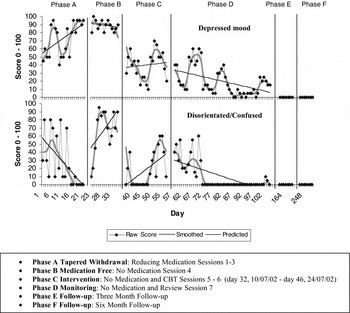
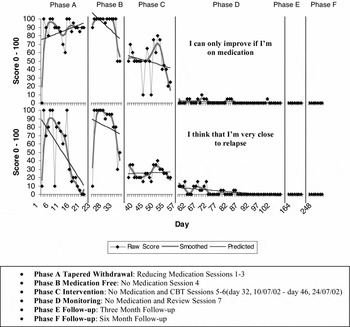
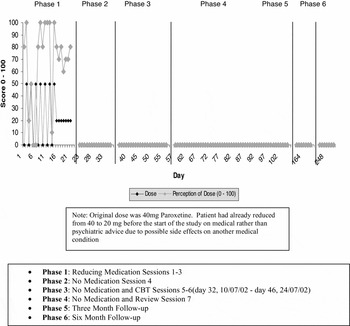
During phase B there were increased levels of two symptoms that could indicate relapse, namely depressed mood and confusion. There were also high levels in the beliefs that symptoms meant medication was required and that the condition was becoming unstable. Likewise negative beliefs about self were also reaching high levels. Overall, high levels were observed across four out of six areas being measured. Indeed, there was evidence that these four reached significantly high levels before the participant became medication free. The participant appeared in the most distress at this time and these four scores in particular indicate that a relapse was occurring. Interestingly, the belief in proximity to relapse in phase A decreased during tapering but raised immediately as actual and perceived dose reached zero. At the end of phase A the participant had been in the study for 35 days. By this time she had been on a tapered dose of paroxetine for 21 days and medication free for 15 consecutive days, which would appear to rule out a discontinuation syndrome being responsible.
In phase C two sessions of CBT were introduced after 32 then 46 days instead of resuming an SSRI, although there was some suggestion that levels of symptoms, hopelessness and beliefs about medication and relapse had already peaked and started to reduce. Major symptoms began to significantly decrease, suggesting a full relapse had been averted. The participant stabilized during the monitoring phase D without resuming medication, remaining well and medication free up to 6 months follow-up. Had the client not been in the study during withdrawal, both she and the therapist believed she would have resumed medication as she had done in the past. A carefully monitored tapering, with some fact-based discussion of SSRIs in phase A, followed by two CBT booster sessions, appeared a viable alternative to resuming antidepressants.
Participant A: Raw scores, smoothed and predicted trend for daily ratings of depressed mood and being disorientated/confused during active, monitoring and follow-up phases

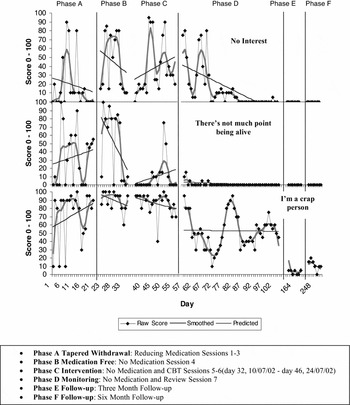
The client was already familiar with CBT and had used it previously to reduce distress and increase her mood. The relapse did not directly relate to medication beliefs. It appeared connected to triggers in her work and personal life that she felt she was not dealing with competently. This situation appears to have interacted with medication beliefs, with her perceiving that being off SSRIs made her more vulnerable to stress. In the first phase C CBT session, recapping the model put this into perspective. What was initially interpreted as vulnerability and incompetence, meaning she was, “A crap person”, was examined as an exaggerated and distorted negative reaction to normal day-to-day stresses.
Participant A: Raw scores, smoothed and predicted trend for daily ratings of beliefs of “no interest”, “there's not much point being alive” and “I'm a crap person” during active, monitoring and follow-up phases

Participant A: Raw scores, smoothed and predicted trend for daily ratings of beliefs of “I can only improve if I'm on medication” and “I think that I am very close to relapse” during active, monitoring and follow-up phases

From this formulation a role-play was devised in the second CBT session, practising assertiveness in work and family situations. Initially the therapist modelled the client, being polite but assertive and the client modelled the person causing her concern. The first was her mother and the second a colleague at work. Feedback was exchanged then roles were swapped and the role-plays repeated. The participant described positive mood shifts after both CBT sessions, especially the second. She identified needing to be clearer in her communication and not give messages to others that it was acceptable to speak to her in a certain manner. She also became clear that she did not have to justify herself to others for her behaviour or views that did not impinge on theirs, even if these differed. She was also able to see that she was entitled to the same treatment as others and any unassertive behaviour was related to an unhealthy lack of entitlement. She was aware that the “crap person” belief ties in with this lack of assertiveness and an underlying lack of self-esteem, which becomes exacerbated when depressed. She agreed to practise the above principles and role-play before next session. On review she felt the two CBT sessions were of considerable benefit and no more were required.
Participant A: Perception of therapeutic and actual dose of medication

Participant B
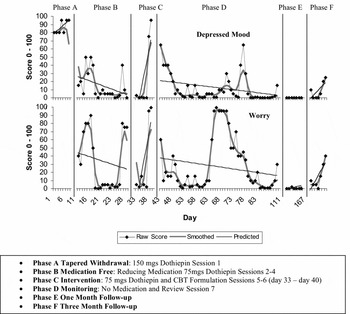
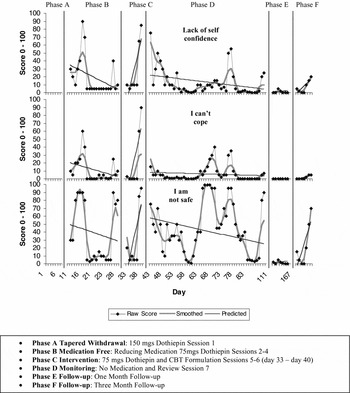
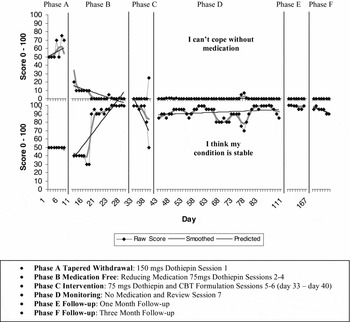
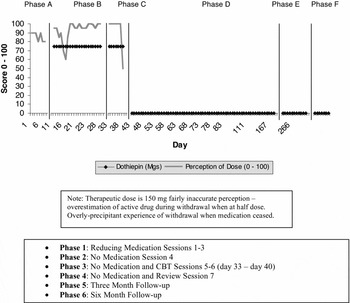
Participant B began dose tapering 150 mgs of dothiepin and reported a sharp increase in depressive symptoms after 5 weeks during phase B. At this point he had received five short monitoring appointments and had been on 75 mgs of dothiepin for 3 weeks, and was due to stop altogether. Although this relapse was initially marked by an increase in symptoms, it was not initially accompanied by an increase in beliefs he needed medication. At session 5, day 33 of the study, he had been busy at work but managed not to have any time off. He attributed his increased symptoms to work pressure. He felt that he would have experienced the same difficulties had he remained on medication and opted to tolerate them. An important factor that he noticed was his wife's reaction to his symptoms. He noted that his wife often stated he needed to go back on medication if his mood fluctuated or he was irritable, especially if they had a disagreement. He described that in the past he would automatically accept this assertion and was unable to hold a view of his own. He linked this to his beliefs that he was useless, vulnerable and unable to cope. At present he reported being able to disagree with his wife and form his own view that he did not have to resume an increased dose of medication. The participant and therapist agreed this session contained more than the usual monitoring, concluding that a CBT formulation was used to explore beliefs and develop an alternative view. A second session continued this theme the following week on day 40, after a major argument with his wife who he reported was telling him he was ill. He described that a minor argument had escalated until he was feeling low and depressed. He reported feeling tired and “slowed down”, with a sense of despair. His beliefs that he needed medication also increased slightly for the first time, accompanied by a dip in belief about the stability of his condition. We used a CBT formulation to conclude that perhaps his relationship was unstable and dysfunctional at present, rather than him. He felt that their arguments would recede in time, and when the relationship stabilized so would his mood; he was clear that increasing medication would not allow him to discover this. This shift to a less personalized position allowed him to continue with the reduction and he decided to go ahead with complete withdrawal as planned on day 40. He used this shared formulation independently over the following weeks. He continued to note throughout phase D that although he was no longer on medication, he still had arguments but did not feel so upset or low afterwards. He reported, “She has to get used to me expressing my own views, perhaps she prefers me being depressed.” His mood and depressive beliefs about himself continued to fluctuate throughout phase D up to 6 months follow-up relating to ongoing life stresses. Interestingly, his beliefs in the overall stability of his condition and his ability to cope without medication remained stable during any fluctuating periods of low mood. This finding did not escape his attention, allowing him to view low mood as a temporary state and that he had proven to be far more robust than he anticipated without medication.
Participant B: Raw scores, smoothed and predicted trend for daily ratings of depressed mood and ratings of feelings of “Worry” during active, monitoring and follow-up phases

Participant B: Raw scores, smoothed and predicted trend for daily ratings of the feeling, “Lack of self confidence” and the beliefs, “I can't cope” and “I am not safe” during active, monitoring and follow-up phases

Participant B: Raw scores, smoothed and predicted trend for daily ratings of the beliefs, “I can't cope without medication” and “I think that my condition is stable” during active, monitoring and follow-up phases

Participant B: Perception of therapeutic and actual dose of medication

Participant C
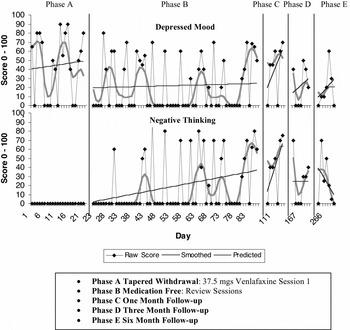
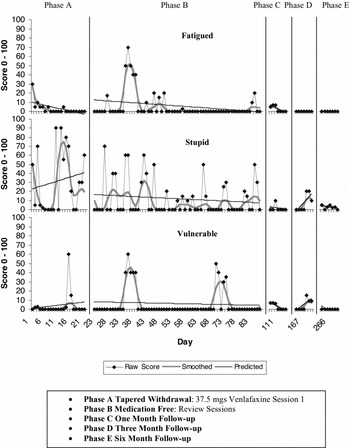
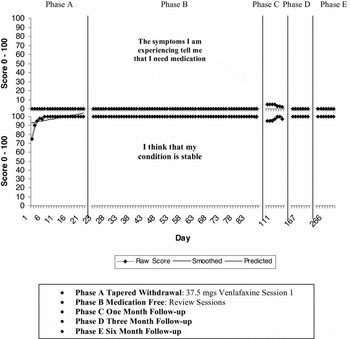
Participant C tapered her dose of venlafaxine from 75 mgs then 37.5 mgs to zero over the study period without any sign of relapse or even discontinuation symptoms. She continued to have an active work and social life during withdrawal. Her previous withdrawal attempt, over 2 years ago, led to a relapse after 3 months. She reported a lack of concern this would occur again, which she attributed to the effectiveness of CBT. Participant C had identified strongly with the rationale of CBT from the outset. She perceived that being on medication added to her sense of failure and upset her rules about being in control in the past. Her sense of control from having CBT was not regarded as unhealthy or compensatory as she reported being less sensitive to symptoms of fatigue and dysphoria and no longer regarded them as harmful, when feeling slightly tired or low. Her mood had some slight variation and negative thinking increased when medication free, which continued into follow-up. The client had her own view that the negative thinking was isolated to ongoing disagreements with her partner about the status of their relationship. She stated that when she had become well he had repeatedly suggested they live together again and that she did not want to commit to this nor did she wish to end the relationship. The client did not wish to explore this further nor was it in the remit of her sessions to do so when she was well. At the same time as these symptoms, other key ratings regarding fatigue, vulnerability, being stupid, regarding her condition as stable and that she did not need medication, remained constantly stable.
Participant C: Raw scores, smoothed and predicted trend for daily ratings of depressed mood and negative thinking during active, monitoring and follow-up phases

Participant C: Raw scores, smoothed and predicted trend for daily ratings of the feelings “fatigued”, “stupid”, and “vulnerable” during active, monitoring and follow-up phases

Participant C: Raw scores, smoothed and predicted trend for daily ratings of the beliefs “The symptoms I am experiencing (e.g. fatigue, brain not functioning, low mood) tell me that I need medication” and “I think that my condition is stable” during active, monitoring and follow-up phases

Discussion
There are a number of limitations to the study. First, it did not use a full experimental design, and the independent variables occurred semi-naturalistically. For both ethical and clinical reasons, withdrawal and (near) relapse were mapped rather than manipulated. Second, the variables used are idiosyncratically defined as is the tradition in single case research. Thus it is the participant's perception of their key symptoms that have particular significance for them and their degree of belief in relapse and stability. It is possible that Participant A, for example, may have been experiencing degrees of low mood and other symptoms at follow-up that could be detected by interview or on other measures, but this may not be the same for her as the “depressed mood” as rated in the earlier parts of study, which, if it increased, was a possible sign of relapse. The key issue here is that she perceived herself as stable and not showing specific signs of depression that for her could cause concerns about relapse. In fact, her scores on the Beck Depression Scale at 3 and 6 month follow-ups were 6 and 8 respectively, indicating some signs but clearly in the non-depressed range.
Third, the study is a case series that seeks evidence of generalization through replication rather than through generalizability theory. Thus, examining the range of participant response is as important as establishing “typical” or “average” response. Retrospective examination of the smoothed and linear trend values for Participant A seems to indicate that a trend towards improvement was beginning to occur on certain measures, before CBT was introduced. This could lead to the conclusion that improvement may be an effect of time rather than CBT intervention. Notwithstanding this interpretation, this sub group of clients who experience difficulties withdrawing from medication rarely test whether improvements are an effect of time, as they are likely to recommence medication as soon as signs of relapse occur. Had there been no indications of relapse, the study design meant no CBT intervention would have occurred and improvements would have been more easily attributed to time, but only if the participant had remained medication free. It can be argued that the possibility of CBT enabled the participant to remain medication free until the time factor took effect. In either case, further improvements occurred following the CBT intervention without re-administering medication.
Some of the information discussed during monitoring appeared to have a beneficial effect on participants and may go beyond that received during basic clinical management. It appears to have changed participants’ views that distress during withdrawal may be a temporary stage on the way to becoming medication free and eventual tolerance of this. Such a view represents a positive shift from previous views that distress during withdrawal was a sign that the participant could not cope without medication, which in turn appeared to activate other negative self-beliefs. This may have helped challenge clients perceptions that depleted serotonin levels on withdrawal were the likely cause of relapses. A simple version of the serotonin depletion hypothesis was discussed with all participants as being over simplistic and inaccurate near the start of the study and could have made them more hopeful they could manage without medication, even influencing their decision not to resume. However, this information alone still did not prevent increased belief in imminent relapse with two participants, but the CBT booster sessions did appear to have contributed to reducing this belief.
Although being informed that medication can restore depleted levels of serotonin may be helpful and aid compliance at the outset of pharmacotherapy, it may be unhelpful on discontinuation as it may increase concerns about relapse. At least two of the clients did explicitly report fears that the neurotransmitter levels in their brain would drop. Although NICE (2004) state that prescribers should warn patients about the likelihood of discontinuation effects, this is not explicitly linked to one or more rationales as to why withdrawal can be safely considered. One such rationale states that the medication has “done its job” and that serotonin was not depleted in the first place and that SSRIs balance rather than increase seretonin levels. An alternative rationale may be that antidepressants have helped shift the balance between positive and negative emotional processing and now that the balance has been restored and the individual may now attempt to consolidate this balance without recourse to medication (see Harmer, Goodwin and Cowen, Reference Harmer, Goodwin and Cowen2009). There may be considerable value in a protocol for prescribers that includes a suitable rationale for initially introducing medication because it is believed to act in a particular helpful way in restoring the patient's psychological equilibrium, but equally specifies that once the person's condition is stabilized, the medication can then be (and should be) withdrawn.
Acknowledgements
Thanks to Natasha Abajian for proofing and Hamish McAllister Williams for discussions on medication regimes and prescribing.



Comments
No Comments have been published for this article.