Introduction
In a moment of frustration in late 1942, Chiang Kai-shek proposed that China's bureaucracy, which had grown significantly in the early War years, be slashed by a third, and the unemployed civil servants sent to Xinjiang to cultivate wasteland.Footnote 1 It is unlikely that Chiang had any real intention of doing this, but his threat chimes with what new studies highlight as one of the major outcomes of the War of Resistance against Japan. For many Chinese people, the War prompted sojourns or relocations in places that they considered part of the western ‘frontiers’ (bianjiang) or the ‘internal frontiers’: the peripheral, often mountainous, zones between or beyond provincial heartlands. Such places became strategically important ‘rear areas’ and zones of refuge. Hsiao-ting Lin shows that preparing for and fighting the War forced the Nationalists to engage with the Chinese warlords and Tibetan lamaseries in the Northwest.Footnote 2 Andres Rodriguez charts the wartime development of the ideas of ‘frontier reconstruction’ and ‘frontier service’, which saw young people mobilized to work in Kham and Amdo.Footnote 3 Judd Kinzley shows how the search for new sources of metals and coal led to a proliferation of geological surveys in the highlands of the Southwest.Footnote 4 A large number of historians in China have written on similar topics: Wang Haiyan and Xirao Nima on wartime relations between the Nationalists and Tibet; Sun Yi on wartime education policy for the peoples of the western frontiers; and Fang Sumei on the relocation of industry, to name just a few of many new studies.Footnote 5
Micah Muscolino has analysed the land settlement and cultivation scheme for refugees initiated by the Shaanxi provincial government in the previously forested hills of Huanglongshan in eastern Shaanxi.Footnote 6 Peter Ho notes that provincial governments further west planned similar ventures, and Pauline Keating has discussed the Communists’ land cultivation efforts.Footnote 7 Motivated by a combination of self-interest and a belief—widespread in pre-War China—that the agricultural settlement of the western bianjiang would rapidly deliver large economic and social gains, the governors of Xikang, Sichuan, Gansu, Ningxia, and Xinjiang vigorously promoted plans for the resettlement of millions of refugees from Japanese-occupied territory on peripheral ‘wastelands’ (huang) in their provinces. Early ventures were founded and managed by provincial governments, with support from the centre. In 1939, the Central Bureau of Land Cultivation (kenwu zongju) of the Ministry of Forestry and Agriculture took over Shaanxi's Huanglongshan resettlement area, and over the following three years it established another nine kenzhiqu (‘land settlement and cultivation zones’) in peripheral parts of Sichuan, Xikang, Gansu, Shaanxi, Guizhou, and Jiangxi.Footnote 8 In 1942, the ministry sent around 7,000 people to land cultivation projects in Xinjiang. There was also a proliferation of private initiatives. A 1948 report referred to 193 provincial and privately managed sites.Footnote 9
In Huanglongshan, as in parts of eastern China, land reclamation schemes seem to have been a relatively successful response to the refugee problem.Footnote 10 In western China, they were more quixotic, and the results less clear. For the total number of people who went to kenzhiqu, the range of figures is large. Lu Hejian's sources indicate that a total of 70,000 people went to Ministry of Forestry and Agriculture kenzhiqu, while 181,584 individuals and 596 households went to provincial and private sites.Footnote 11 Muscolino cites a figure of 500,000 for the total number of participants in land reclamation schemes throughout China.Footnote 12 Hsiao-ting Lin writes that 20,000 people were resettled in Xinjiang.Footnote 13 Some of these figures are derived from the numbers that sites planned to recruit, rather than the numbers who actually went. Ministry of Forestry and Agriculture reports from 1943 gave a figure of only about half the 70,000 in Lu's summary reports, while only around 7,000 of the 20,000 that the Ministry planned to send to Xinjiang actually made it there.Footnote 14 Private land cultivation initiatives were often fraudulent attempts to gain tax exemptions and undertook little cultivation work. Although one scholar suggests that there was ‘an unprecedented massive influx of population and resources to the borderland regions during the war period’, apart from certain locations in Shaanxi and Xinjiang, in no other region that would have been seen as a bianjiang was the population increase significant, let alone massive or unprecedented, as this article will show.Footnote 15 In fact, in the western provinces, conscription and the rise of war industries drew people away from places that had been settler frontiers in previous generations, towards the cities and main supply lines of unoccupied China. Some bianjiang saw many more people leave during the War than arrive, and living in one was generally an economically unattractive proposition, even for refugees.
Proposals for settlements in the western provinces often claimed that they would boost unoccupied China's food supplies and thereby aid the War effort. But this claim seldom influenced the actual planning for them, which did not address questions such as how any food surplus they produced would be transported from remote settlements to food-deficient areas. In many places, refugees’ labour could (and probably did) do more to boost grain production in unoccupied China's agricultural heartlands, given the desperate labour shortages which caused land in such places to be abandoned. Wartime frontier settlements responded less to the needs of the wartime economy, and more to the widespread early twentieth century belief that frontier settlements would be a means of resolving unemployment in densely populated regions, generating substantial revenue, and cementing the position of the frontier lands and their non-Chinese inhabitants within the Chinese nation.
Despite this being largely a story of unfulfilled ambitions, the logic of the proposals for settlements had seemed compelling in the early War years, and reflected a broad pre-War consensus. It led to the planning and establishment of new forms of rural communities which often invoked the idea of the ‘collective’ (jiti) well before Communist rule. It won converts among central government officials like Shen Honglie, the minister of Agriculture and Forestry from December 1941 to September 1944, who never lost faith in the idea of developing settlements in Xinjiang and Kham (eastern Tibet), even though his plans received only lukewarm support as the War drew on, and despite the decline in cultivated land in places like the Sichuan basin. Moreover, when the initiatives failed to attract significant numbers of settlers, coercive measures became increasingly common. Whereas the late Qing government had moved towards abolishing exile to Xinjiang as a punishment, and several intellectuals had argued against an incipient penal colony system in the 1930s, the difficulties faced by wartime resettlement projects stimulated renewed interest in penal settlements from around 1942 onwards.
Early twentieth-century views on frontier settlement
Wartime plans for refugee land cultivation projects in the western frontiers grew out of early twentieth century ideas about frontier colonization. From the late imperial period to the end of Mao Zedong's rule, there was a continuity of certain basic assumptions regarding migration in Chinese political economic thought. Although the Qing government periodically tried to ban migrants from some frontiers due to fears that they would stir up trouble or, in the case of Mongolia and Manchuria, that they would spoil the homelands of the empire's founders and their allies, both the Ming and Qing governments used state-supported resettlement as a way of revitalizing regions that had been devastated by war and providing food for frontier garrisons.Footnote 16 The Qing emperors also felt that migration to sparsely populated regions would aid the ‘jobless poor’ and ‘impoverished homeless’ of China's most heavily populated provinces.Footnote 17 In the late nineteenth and early twentieth centuries, Chinese leaders and scholars began to see the settlement of frontiers as a matter of utmost importance, largely viewing it as a solution to the same sorts of problems that their predecessors had. As Kang Youwei wrote in 1895: ‘All the provinces of the Northwest are vast and thinly populated [. . .] the prompt organization of migration will not only provide relief for the poor, but facilitate the exploitation of new resources and bolster frontier defences.’Footnote 18 Kang's stress on the ‘exploitation of new resources’ obviously owed something to the import of Western developmentalism and awareness of Western and Japanese settler colonies, but it also reflected the concern within late imperial political economic thought for the ‘full exploitation of the resources of the earth’ (jin di li).Footnote 19
Support for state-sponsored frontier settlement schemes grew in the Republican period. In The International Development of China, Sun Yat-sen wrote that the ‘colonization [of Xinjiang and Mongolia] is the most urgent need of the first magnitude’.Footnote 20 Sun phrased the benefits of colonization schemes slightly differently from Kang, highlighting the profit they would make, as well as citing the examples of the Americas, Australia, and Manchuria more explicitly, and arguing that the schemes were necessary to facilitate the demobilization of ‘more than a million soldiers’.Footnote 21 Still, the core principles in most of the Republican period discourse on the settlement of the Northwest did not differ very much from those articulated in the last decades of the Qing. Two key advocates of borderlands settlement in the Southwest were Ren Naiqiang, one of the most prominent twentieth century Chinese writers on the Tibetan lands, and Chen Zhongwei.Footnote 22 These writers highlighted the same trio of benefits as Kang Youwei. Chen wrote:
Today there could be no better course of action than to build roads [. . .] and allow people to migrate to the four frontiers and settle there to cultivate the soil. This will decrease the number of idle in the interior, eliminate the problem of banditry, open up the unlimited resources of the frontier, and stop the threat of foreign incursion.Footnote 23
Ren stressed jin di li and border security, but paid particular attention to the social welfare benefits of colonization. He divided Sichuan's history into four kinds of age: order and disorder, on major and minor scales.Footnote 24 In this Malthusian narrative, peace caused the population to increase, and because the Sichuanese were ‘indulgent’ (kuanhuan) and attached to their native place, population increases led to shortages that resulted in ages of ‘major disorder’, of which the Republican period was but the latest example. Only the settling of Sichuan's surplus population in Kham would bring an end to the present age of chaos. Writing on Mongolia and Xinjiang also almost always argued that settlement was the best way of increasing frontier security and relieving poverty and population pressure in China proper.Footnote 25
Advocates of state-sponsored migrations to the Northwest predicted huge movements of people, in visions that were probably inspired by the settlement of tens of millions in Manchuria between the late 1890s and the Japanese takeover (a migration to which they often referred).Footnote 26 A 1910 Datongbao article said that the late Qing colonial regime in Kham had ‘formulated a comprehensive plan to recruit settlers [. . .] In no time at all [Kham] will have the prosperity and population of a great metropolis.’Footnote 27 Sun Yat-sen assumed that ten million people could be settled in Mongolia within a decade.Footnote 28 Chen Zhongwei envisaged a million Sichuanese farmers settling in Kham within the same timeframe, while Ren Naiqiang thought that a million arrivals in Kham per year would be possible with the right government policy.Footnote 29
On this matter, the Nationalist leaders of the 1930s were in tune with Sun and the rest of China's academic and political elite. In 1930, Zhang Jingjiang (1877–1950), the chairman of the Zhejiang provincial government and a member of the Nationalist Party's National Construction Committee, published Xibei jianshe jihua (Plans for the development of the Northwest). Zhang stated that more than 18 million migrants (about five per cent of the population in the provinces the migrants would come from) could be settled on uncultivated land in Shaanxi, Gansu, Ningxia, Suiyuan, Xinjiang, and Qinghai.Footnote 30 Ye Xiufeng (1900–1990), who had a Master's degree from the University of Pittsburgh and was a member of the Central Club Organization (or CC Clique) surrounding Chiang Kai-shek, also took great interest in the development of the frontiers. In a letter co-signed with 22 other Nationalist officials, he urged a series of measures to facilitate their settlement.Footnote 31
Building on the initiatives of private land-cultivation societies and northern militarists like Feng Yuxiang, the Nationalists implemented a variety of schemes to develop land in the Northwest in the 1930s. Many were programmes operated by military units as part of efforts to demobilize some of the huge numbers of soldiers in North China at the end of the Northern Expedition (although, in reality, most soldiers and former soldiers preferred to rent their land to peasants than farm it themselves).Footnote 32 After 1931, the government also designed settlement schemes for refugees from Japanese-occupied Manchuria, with one such programme intending to arrange the resettlement to Suiyuan of 1,000 people.Footnote 33
Like most Chinese intellectuals and political activists, Nationalist leaders were extremely optimistic about the likely returns from schemes to develop uncultivated land. In 1932, for example, the Central Political Council created a plan to increase financial aid to schools throughout China by giving them shares in land development schemes in the Northwest.Footnote 34 Schools would be able to borrow money from banks against these shares. The borrowed money would be used to fund the development of land in the Hetao region in Suiyuan and Ningxia, the value of the securities would increase ‘ten times within three to five years’, and the schools would repay the loans and keep the profit. The Council claimed that the plan would provide revenue to schools equivalent to all the loans and grants they currently received from the central government.
In addition to almost utopian ideas about the returns, the resettlement schemes also appealed because they promised to provide a permanent home and livelihood for people who moved from place to place and were seen as a threat to social order.Footnote 35 As one 1933 text on Suiyuan explained, migrants ‘must have perpetual ownership of land and provide for themselves so that there is no danger of them becoming rogues’.Footnote 36
Wartime kenzhiqu
Some 60 to 90 million people became refugees at some point during the War of Resistance. A minority of them—small in relative terms but large in absolute numbers—followed the Nationalists west. By late spring of 1938, Wuhan's population had increased by 500,000, while Chongqing's population increased by 600,000 in the course of the War.Footnote 37 In the early War years, the Nationalist leadership and provincial officials in western China—whether they were close to the Nationalists or not—saw the refugee crisis as an opportunity to realize the long-held dream of creating agricultural settlements in the western frontiers.
In 1938, Luo Lixue, who had been appointed the chief of Gansu's Bureau of Development (jianshe ting) by the central government, presented a plan at a meeting of the Supreme Council on National Defence which envisaged a million people moving to Suiyuan, Xikang, Yunnan and Ningxia.Footnote 38 In the same year, the governors of Xikang, Ningxia, and Gansu submitted plans to the central government for the resettlement of tens of thousands of people in their territories. The Preparatory Committee of Xikang Province (Xikang jiansheng weiyuanhui)—controlled by the warlord Liu Wenhui—wanted 40,000 refugees to be sent to the Ningshu region of Xikang (and the cover sheet of the proposal stated that there was enough unused arable land there for 80,000).Footnote 39 Bold proposals persisted throughout the War. When Shen Honglie, the wartime minister of Agriculture and Forestry met Sheng Shicai, the military governor of Xinjiang, in 1942, Sheng requested that one million refugees be resettled in Xinjiang every year.Footnote 40
Like the pre-War proposals, wartime plans were characterized by highly optimistic ideas about the potential benefits. The Nationalist field office in Xichang (in Xikang) asked for funding for a Xikang Land Cultivation Management Office (Xikang kenwu duban gongshu), which, the field office claimed, would make a profit of 4,300,000 yuan within two years from land cultivation programmes.Footnote 41 Like other, similar claims, this was little more than fantasy. As we shall see, more sober estimates would have shown that in many cases the labour of refugees would have done more to increase food production on already-existing farms, which were to become desperately short of labour due to conscription and the demand for workers in war-related industry and infrastructure projects.
Although the backers of settlement projects often claimed that they would aid the War effort by increasing food production, war-related problems were never the sole, guiding consideration. Plans gave little or no consideration to questions such as how food grown in kenzhiqu could be transported to the places it was needed, or what the opportunity cost would be in terms of foregone spending on alternative means of assisting agricultural production. Instead, the kenzhiqu in the western regions pursued pre-War development plans more vigorously than the goals that were narrowly related to solving problems caused by the War. Indeed, their backers often explicitly acknowledged that the War had merely created an opportunity to do something that had long been desirable anyway.Footnote 42 Luo Lixue, for example, wrote:
Normally life in the Southeast [of China] is comfortable and people are unwilling to leave their home regions, much less go to the Northwest to cultivate wasteland. We should take advantage of this opportunity and quickly survey land in the Northwest, establish land cultivation zones (kenqu), and facilitate large scale migrations of refugees, wounded soldiers and the families of soldiers who have been killed.Footnote 43
Similarly, when Wang Zhaolong, the magistrate of Leibo on the frontier of Yi territory in Liangshan in southwestern Sichuan, proposed his own cultivation scheme in December 1941 (arguing that 40,000 to 50,000 people could be settled in his county), he promoted it both in terms of broad nationalist goals that were independent of the War, as well as in terms of war-related aims. He claimed (in the face of all the historical evidence to the contrary), that the influx of settlers would lead to the ‘coming together of Han and Yi, the elimination of racial thinking (zhongzu guannian) and the causes of conflict’.Footnote 44 A scheme proposed by the Sichuan Bureau of Development in February 1943 for several regions in western Sichuan even envisaged land settlement as a preparation for post-War nation-building, without mentioning war-related goals at all. The Bureau argued that the central government should fund the establishment of ‘experimental cultivation zones for the settlement of wounded soldiers (rongyu yuanbing) as a preparation for the resettlement in the frontiers of demobilized soldiers and their families after the War. [This will] facilitate the gradual elimination of barriers between ethnic groups (minzu gehe).’Footnote 45
It is unclear whether men like Luo Lixue, Wang Zhaolong, Liu Wenhui, and those in the Sichuan Bureau of Development were motivated more by self-interested desire for the prestige and financial support that would come from grand schemes of national significance, or by a genuine commitment to the pre-War belief that the development of settler colonies in the western regions was in the national interest. Historiographies of China have traditionally seen the warlords as mostly self-interested, though this view has been challenged, most recently by Chen Zhongping's account of warlord support for the May Fourth Movement, and Emily Hill's study of the economic policy of the pre-War Guangdong provincial government.Footnote 46 It is difficult to know what sort of evidence could prove what the real motivations were of frontier governors who supported wartime kenzhiqu. Liu Wenhui, at least, had a record of initiating Chinese colonial endeavours in Kham well before he gained (or even sought) support from authorities outside Sichuan for doing so. Between 1930 and 1933, he fought the Tibetan army in Kham in conflicts that promised to gain him little or nothing in the Sichuan basin and were often in defiance of the Nationalist government.Footnote 47 The latter only began to aid Liu in 1935.Footnote 48 Hence his 1938 claim that sending refugees to Xikang would ‘relieve the endless suffering of refugees, add limitless production, and strengthen our nation's defences’ was consistent with a long-standing colonial engagement with Kham, which Liu probably sincerely believed was in the national interest.Footnote 49
Self-interested politics were probably more apparent when the warlord governor of Xinjiang, Sheng Shicai, called for the transfers of large numbers of refugees to his province. Sheng had never advocated such policies before 1942, but in that year he proposed, in a meeting with Shen Honglie, the minister of Agriculture and Forestry, that one million refugees could be resettled in Xinjiang every year.Footnote 50 Sheng had just broken ties with the Soviet Union, either because he anticipated a Soviet defeat at the hands of the Nazis, or, as he explained it, because Soviet demands for Xinjiang's resources became exacting after the Nazi invasion.Footnote 51 There were some suggestions that the proposals for wartime settlements in Xinjiang came from the central government and that made Sheng uneasy: Qu Zhuowu, the chief of the Xinjiang section of the Nationalist Party training corps (jiao wu tuan), recalled that when Sheng went to Chongqing in 1943, he ‘felt pressured’ by the demands of the ‘Nationalist central authorities’ that large numbers of Party personnel be sent to Xinjiang to ‘develop the frontiers’.Footnote 52 However, documents from the previous year suggest that Sheng and Shen Honglie both wanted to implement large-scale settlement plans, while the Central Political Council (Zhongyang zhengzhi huiyi) was unsure about their viability. Sheng initially called for a million settlers; with Shen he formulated a proposal to settle 200,000 to 300,000 refugees and soldiers in Xinjiang in one year.Footnote 53 These plans make it seem likely that Sheng's conversion to the idea of transferring large numbers of settlers to Xinjiang was part of his search for a new patron following the collapse of his relationship with the Soviet Union.
The earliest wartime initiatives were organized in 1938 by the provincial governments of Shaanxi, Ningxia, Gansu, Xikang, Guizhou, and Sichuan, usually with funding from the central government. These were joined by large numbers of private and county level kenzhiqu—one historian counts 110 different organizations by the end of 1942.Footnote 54 This proliferation of different organizations was viewed with concern by some in the central government. In December 1942 members of the Supreme Council on National Defence wrote:
Today there are too many institutions involved with land cultivation and settlement. There are organizations under the central government, local governments, and professional associations (fatuan). This creates needless duplication; countless programs all doing the same thing.Footnote 55
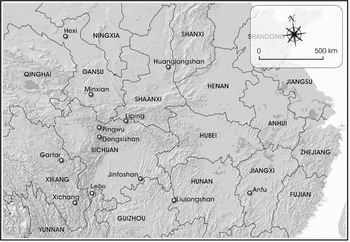
In 1941, 1942, and 1943, the Ministry of Agriculture's Central Bureau of Land Cultivation founded more of its own kenzhiqu, partly in order to create a more centralized system, and partly due to the tensions with provincial governments, outlined below. The locations of the ventures founded by the central government's Bureau of Land Cultivation are shown in Figure 1.
Map showing the locations of Ministry of Forestry and Agriculture kenzhiqu, as well as Pingwu (a penal colony; see below), and Gartar, the site of a joint venture between the Ministry of Forestry and Agriculture and the Xikang Development Bureau. Not shown are the Ministry's kenzhiqu in Xinjiang.Source: Map drawn by Tracy Porter with information supplied by the author.

There was often more to private land cultivation projects than their name implied. In June 1945 a report to the Land Settlement and Cultivation Office (kenzhi si) of the Ministry of Forestry and Agriculture wrote: ‘Of all provinces, the land cultivation societies of Sichuan's Leibo, Pingshan, Ebian, Muchuan and Leshan are the most complicated. According to many reports, the Kangjian [‘Resist and Rebuild’] land cultivation society and others are illegally growing opium.’Footnote 56 Another government agent agreed; in southwestern Sichuan, in particular, many of these private societies were more interested in growing opium than in cultivating wasteland, and only claimed to do cultivation work to avoid taxes:
They protect their men from the draft, claiming that because they are settlers (ken min), they cannot be conscripted. They do not even pay the land tax, arguing that ‘land cultivation is a productive industry (shengchan shiye); it is exempt from all obligations.’ [. . .] In their every action, the societies disobey the law.Footnote 57
The rhetoric of frontier settlement was important to these ventures, and helped them to gain funding from banks and the favour of some government officials, but they contributed relatively little to actual frontier settlement.
Kenzhiqu managed by the central and provincial governments were more like what they claimed to be. Few were self-sufficient. Even by 1948, eight years after it was founded, the Ministry of Agriculture kenzhiqu at Liping in Shaanxi was still not self-sufficient with regard to food. ‘Because the land cultivation area is too wet, and heavy rains often cause flooding, the annual harvest is unable to support even the lowest standard of living. The settlers have thus been forced to make a living elsewhere.’Footnote 58 Or, as a 1943 article indicated (concerning programmes for wounded soldiers in particular): ‘most kenqu are in mountainous areas, which are much less productive than flatlands or rice-growing regions, therefore it is necessary to provide side-occupations to allow the veterans to improve their living conditions’.Footnote 59 In the absence of such ‘side occupations’, most settlers at Liping and other kenzhiqu relied on the welfare payments made by the farm management, although not everyone was eligible for benefits rather than loans. A monthly report from the farm at Xichang, for example, recorded that 169 people had received a daily ration of 3.2 yuan in June 1942, while 83 had not.Footnote 60 The payments were adjusted monthly, in a vain attempt to compensate for inflation. Exactly what qualified one for support in Xichang is unclear from the farm's reports. Central government regulations indicate that central planners intended there to be a difference between ‘refugees’ (nanmin), who would be maintained by the farms until they could grow enough food for themselves, and ‘settlers’ (kenmin), who would have to borrow money for food, agricultural equipment, and housing costs.Footnote 61 The farm reports do not indicate how many kenmin and nanmin there were, however, nor how they were distinguished. Some of the men on the Xichang farm were also disabled soldiers who might have received separate benefits, though the reports do not clarify this.
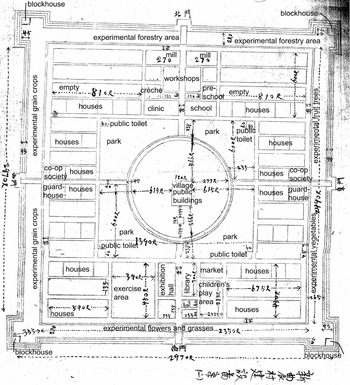
Provincial governments created elaborate plans for new villages for the settlers. A design from Ningxia is shown in Figure 2. The village plan was designed for 50 households, with enough space left for 190 households (whose homes would be built on the unmarked building spaces on the plan). The plan in Figure 2 calls it a ‘new village’, though elsewhere in the documents it is referred to as a ‘collective village’ (jiti nongcun). The planners used the latter term casually, without defining exactly what they meant. Its ‘collective’ nature seems to have lain mostly in the socialized nature of many elements of village life, including health care and education. As for the land, settler households had rights over the individual plots they farmed, but, in keeping with imperial China's tradition of state-farming colonies (tun), the land belonged to the state. Households could sublet their use-rights, but not sell, mortgage, or give land to anyone else, preserving an egalitarian distribution of land among the village households.Footnote 62
Plan for a new village in Ningxia.64 ‘Village public buildings’ are labelled cun gongsuo in Chinese; another plan indicates that this compound would include administrative offices, plus a small theatre, exhibition spaces and research offices. The measurements on the design are in chi 尺 (one-third of a metre). (Labels translated by author.Footnote 65)

In 1939 the Shaanxi government established a ‘collective farm’ (jiti nongchang) at Meifu. Building on ideas from the cooperative movement, the farm aimed to ‘resolve the question of the distribution of land, reduce operating expenses, and allow the adoption of new machinery and spearhead farmers’ welfare initiatives’.Footnote 63 It borrowed work-scheduling techniques from Soviet farms, and production and consumption was initially entirely communal. This had to be reformed because ‘when everyone had food to eat, they worked lazily, did not put effort into their duties, did not take care of the communal property and wasted a lot’.Footnote 66 Hence, just like the ‘work unit’ (danwei) organizational form in state enterprises, plans for new rural communities which invoked the notion the ‘collective’ (jiti) were not post-1949 imports from the Soviet Union, but were developed by provincial governments in western China during the War years.Footnote 67
Frontier officials and the Nationalist leadership anticipated millions making new homes in villages like this in sparsely populated parts of western China, but only tens of thousands did. The exact numbers are not clear. The Huanglongshan kenzhiqu in Shaanxi took in about 50,000 refugees, and, as Muscolino and Sun Yankui, note it was by far the most successful resettlement endeavour.Footnote 68 Far more people went to Huanglongshan than any other kenzhiqu because of its proximity to Henan where the government destroyed the Yellow River dykes in 1938 in a bid to halt the Japanese advance, and where, in 1942–1943, wartime disruptions and taxation resulted in famine. Refugees from these catastrophes made their way to the Wei River Valley in Shaanxi and the provincial government started the Huanglongshan land cultivation venture in response to the first wave of arrivals in 1938. Numbers of recorded refugees at all other government kenzhiqu throughout China were far smaller.
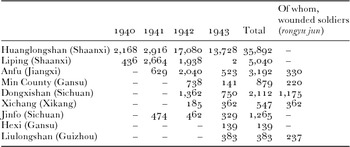
A 1943 report indicated that 46,845 people had participated in the Ministry of Agriculture and Forestry cultivation initiatives, though some of the numbers in this report do not match those in other reports.Footnote 69 Moreover, this figure appears to reflect the number of people who had spent some time on a kenzhiqu by the time the report was compiled, rather than the total number of people living on farms in 1943. As we shall see, some farms had high rates of people leaving. The numbers from the report are shown in Table 1.Footnote 70
Total arrivals at Ministry of Agriculture kenzhiqu between 1940 and 1943

Source: Yao Guangyu, ‘San nian lai ben bu zhi xia kenqu’, p. 11.
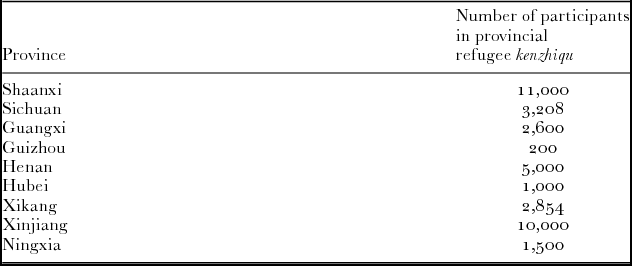
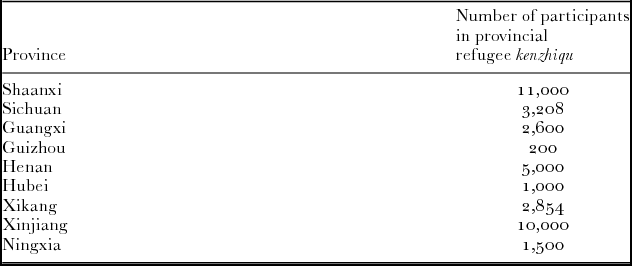
As for the provincial government projects, Sun Yankui cites sources that give the same numbers in Table 2, and which also show that about two-thirds of those who participated in a provincial government-organized land cultivation project did so in Shaanxi or Henan, in relatively close proximity to the catastrophes in the latter province. Clearly the round numbers are most likely either estimates or the number of refugees that provincial kenzhiqu planned to recruit. Actual numbers recruited were often far smaller than planned targets, as we shall see.
Estimated numbers of participants in provincial kenzhiqu
Source: Sun Yankui, ‘Kang Ri zhanzheng shiqi nanmin kenhuang’, p. 89.
Some sources cite larger figures for the numbers who participated in all land cultivation endeavours, including both county and private projects. Zhou Yunrong cites figures of 24,834 (from a 1990s gazetteer) and 17,760 (from a 1944 report by the Sichuan Provincial Bureau of Development) as totals for the number of people who participated in all projects in Sichuan.Footnote 71 But, as indicated above, private initiatives were not always what they claimed to be, and these figures probably include large numbers of people whose contribution to the cultivation of peripheral wasteland was minimal.
Moving to, and away from the periphery
Why did so few people end up going to kenzhiqu, despite the widespread initial hopes that the refugee crisis would create millions of willing participants? The wartime pressures on government finances and a lack of bureaucratic capacity were two reasons. In response to Sheng Shicai and Shen Honglie's plan to send 200,000 refugees to Xinjiang, for example, the Central Political Council ruled that the numbers were ‘too high, and the plan is unaffordable at present’.Footnote 72 In 1944, Shen reported that only 7,000 had gone because of ‘limited funds’.Footnote 73 Still, that was more than the number who travelled shorter distances (presumably at less cost) to kenzhiqu in other provinces. Moreover, by 1943, spending on the kenzhiqu was very small relative to the amount of credit extended to agricultural cooperatives (and it is worth noting that credit at normal interest rates in a currency subject to hyperinflation was essentially a gift). In 1941, the total amount lent by all village cooperatives in Sichuan alone came to more than 111 million yuan; by contrast the total amount spent that year on all Ministry of Forestry and Agriculture kenzhiqu was only a little more than 3 million yuan.Footnote 74 Despite the near-universal belief in the importance of getting more land under cultivation in the Northwest—and the sense at the beginning of the War that the refugee crisis was an opportunity to achieve this aim—the kenzhiqu never threatened to divert money funnelled into the cooperatives through the Agricultural Credit Association (nongbenju) until 1942, and the China Farmers’ Bank (zhongguo nongmin yinhang) after then.
There was another important reason why the millions did not flock to the kenzhiqu in the western periphery during the War (and, therefore, why not much money was spent on them): not many people wanted to go. A post-War report on the central government's Liping kenzhiqu hinted at what it was like to live in such places.Footnote 75 ‘The only means of transport is walking, and carrying things on one's back. The paths go over dangerous and steep peaks that require the traveller to climb rocks or crawl. In the snow, every inch is difficult.’Footnote 76 And why make the trek, when the development of war-related industries and infrastructure provided plenty of new work opportunities in the cities and in the rural heartlands of Nationalist China? In most cases, refugees could earn more money, and grow more food, in already cultivated parts of the Sichuan basin that were now desperately short of labour. Unemployment was a serious problem for some refugees, but mostly only for educated people seeking professional jobs.Footnote 77 On farms, road-building projects, and in factories, the key wartime labour problem was not a surplus of labour caused by the influx of refugees, but a significant shortage of labour caused by the onset of conscription for military service and the construction of transport and defence infrastructure.Footnote 78
The real income of manual labourers employed on a casual or temporary basis in cities increased during the early War years, while farmers’ incomes declined. As Joshua Howard comments, supply and demand was on urban workers’ side during the War.Footnote 79 The government tried to implement harsh legislation to force workers to stay in jobs in arsenals (in the post-War period such legislation was not necessary because workers almost entirely stopped leaving arsenals voluntarily).Footnote 80 Though arsenals sometimes may have been successful at keeping a lid on the growth of wages, the market price of manual labour in many cities rose faster than prices of basic commodities. At the beginning of 1937, rickshaw pullers in Chongqing earned about 10.5 yuan per month. By the end of 1940 their average earnings were 160 yuan per month, a more than 15-fold increase.Footnote 81 Over the same period, food prices in Chongqing had increased about seven times.Footnote 82 In contrast to the rickshaw pullers, farmers saw their real incomes fall. A survey of 19 locations in Sichuan found that the prices paid to farmers for their produce increased an average of 4.9 times between the start of 1937 and the end of 1940, while the price of commodities bought by farmers increased 5.5 times.Footnote 83
For many easterners, the War brought journeys to places in the west that they considered peripheral, but many inhabitants of the western peripheries embarked on journeys away from frontiers, towards the major metropolises of unoccupied China. While the population of Dartsemdo (Kangding) and Xichang increased, the demand for labour in cities and on transport routes led to people leaving regions that had been settler frontiers before the War. In 1939 a government-sponsored survey of Sichuan and Xikang found that in a village in Yuexi near Yi territory in Xikang, ‘all of the able-bodied men have left to work as porters [. . .] In the whole village there are only women and children, while the land has all reverted to wasteland.’Footnote 84 Li Youyi described an exodus of labour from the Yunnanese countryside towards factories and trade firms in cities.Footnote 85 Han Chinese farmers began employing Yi labour in the busy season and, less commonly, Yi bought or rented vacated Han land.Footnote 86 In these parts of Yunnan at least, Han were not settling the frontiers; they were withdrawing from them, leaving space for the expansion of Yi agriculture. In 1946 Ren Naiqiang surveyed Xikang's Ningshu region (present-day Liangshan Yi Autonomous Region). Still a believer in mass frontier settlement (there was room for five to 10 million migrants in the region, Ren guessed), he recognized that much land had been abandoned because ‘labour power (lao li) is expensive and food is cheap; it is not worth cultivating’.Footnote 87
The Nationalist Sichuan-Xikang survey team viewed the movement of people out of villages around Yuexi as a product of rural poverty, rather than as a result of new work opportunities elsewhere. The writers felt the sight of the half-abandoned village ‘covered in autumn mist’ was ‘indescribably sad’.Footnote 88 But the migration of men from the village was predicated on the new work opportunities generated by the War, as well as the poverty they left behind. Li Youyi was more attentive to this in Yunnan: ‘The migration of people away from villages [. . .] does the villages no harm, on the contrary it is good for them.’Footnote 89
Even in Huanglongshan, close to disaster-stricken Henan, the labour shortage meant that it was not always easy to get refugees to participate in land cultivation schemes. In 1941 some began to refuse resettlement to Huanglongshan because they could earn more money working on the Longhai railway in Shaanxi.Footnote 90 In 1944, Shen Honglie, the minister of Agriculture, wrote that ‘the number of refugees from the Henan catastrophe has declined and it is difficult to gather them together’.Footnote 91
In the Southwest, recruiting refugees for the kenzhiqu was even more difficult. The Central Bureau of Land Cultivation founded a farm in Xichang in November 1941.Footnote 92 Many of those who had moved to the farm left again. From the beginning of March 1942 to the end of October 1942, 239 new settlers arrived on the farm, but over the same period, 105 people left. The farm's aim was to recruit 600 settlers (kenmin), but it does not appear to have ever had more than half this number at any one time.Footnote 93 On a farm at Puge that was under the umbrella of the Xichang farm, half the guards had left by April 1942 because they were able to find better wages elsewhere, and ten per cent of the settlers had gone too.Footnote 94 Like the Sichuan-Xikang survey team, the Xichang farm managers viewed this as a product of the low wages on the farm, but the decision to leave must have reflected the fact that higher wages could be earned elsewhere. Moreover, 77 per cent of the arrivals to the Xichang farms came from other parts of Xikang, and five per cent of the rest came from Yunnan. The age and gender composition of the settlers changed in 1942 as well. In March, 86 per cent of the farm workers were men over 17; by October, this had dropped to just 57 per cent. The percentage of workers who were men or women over 17 dropped from 97 to 73. This gives the impression that able-bodied adults left their children on the farm in order to take advantage of its welfare payments, and then departed in order to earn higher wages either in China's cities, or as hired porters or labourers on farms in the core agricultural regions.
Other state kenzhiqu had trouble recruiting too. A Ministry of Agriculture cultivation project spread over various sites in a set of four counties (Emei, Leibo, Pingshan, and Mabian) on the Yi-Han frontier of Sichuan's mountainous Southwest planned to recruit 1,000 refugees in 1942, but managed just 90.Footnote 95 In October 1942, the Ministry of Agriculture turned the sites over to a military bureau in charge of wounded soldiers, in part to save labour. Provincial farms in Pingbei in mountainous northwestern Sichuan also struggled to recruit settlers. As one report commented, it was ‘very difficult for outsiders to move there’.Footnote 96 Once there, they found it hard to adjust. ‘Because of this most of the settlers (kenmin) at the kenzhiqu are from nearby.’Footnote 97 The Pingbei farm probably did very little to increase food production, or even cultivated acreage, if those who worked there had left nearby farms to do so.
Thus it turned out that Gansu Bureau of Development Chief Luo Lixue and his fellow officials from the western provinces were wrong. People were no more likely to want to go to peripheral parts of western China to cultivate land than they had been before the War. It was also far from clear that the creation of new agricultural settlements on the peripheries was the easiest way of employing refugees to increase agricultural production. Shortages of labour led to serious declines in agricultural production in the core areas of unoccupied China. Rather than crawling over rocks and snow to reach kenzhiqu that, in some cases, never became self-sufficient, much evidence suggests that refugees’ labour could have done more to boost food production in already cultivated parts of Sichuan.
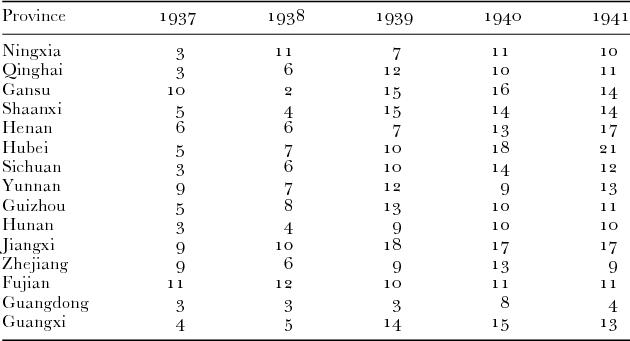
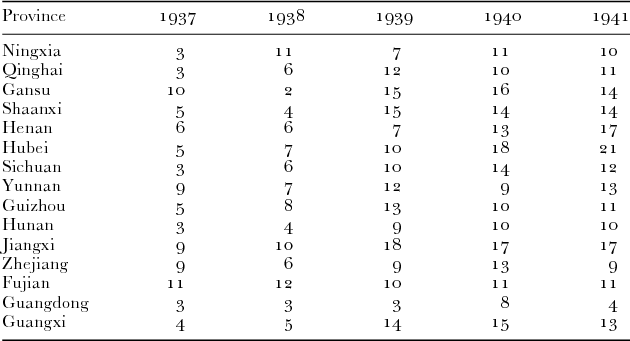
As Lloyd Eastman pointed out, in core areas of unoccupied China, ‘large farmers complained about the shortage of labour’.Footnote 98 This was discussed relatively widely in wartime agricultural and economic journals, and is often noted in historical accounts of the War, but the impact of the labour shortage on agricultural production has not been explored in detail,Footnote 99 and nor have the plans to cultivate peripheral ‘wasteland’ been analysed in light of the fact that a large amount of already cultivated land was abandoned in places like the Sichuan basin. The National Bureau of Agricultural Research (Zhongyang nongye shiyansuo) conducted surveys in an attempt to measure the shortage of rural labour.Footnote 100 Every year between 1937 and 1941, the Bureau compiled results from between 591 and 770 counties in 15 provinces. The exact methodology is unclear, but it appears that surveyors asked households how many workers they had hired for how many days, and how many more days they felt they needed, a figure that the surveys conceptualized as ‘number of missing days of labour’ (quefa duangong gongshu). The Bureau divided this number by the number of days of labour that households had actually hired in an attempt to show the severity of the rural labour shortage. The results, shown in Table 3, indicate a clear rise in the demand for agricultural labour in all provinces except Guangdong and Zhejiang.
Estimated number of extra days of agricultural labour needed as a percentage of the estimated number of total days of hired labour in unoccupied areas of 15 provinces
Source: Zhongyang nongye shiyan suo, ‘Woguo ge sheng duan gong gongji’.
While the survey indicated that labour shortages were most acute in Gansu and Fujian in 1937, overall Sichuan, Hubei, and Zhejiang required the most extra labour, because of the huge populations of those provinces. The Bureau estimated that farms in Sichuan had required an additional 28.66 million days of labour in 1940. Accordingly, the cost of hired agricultural labour increased dramatically during the War. In 1937, farm wages had made up 12 per cent of farm expenditures in Sichuan; in 1941, they made up 26 per cent.Footnote 101 In research conducted in 1941, John Lossing Buck found that farmers in Mianyang, 100 kilometres from Chengdu, not only made no profit, but lost an average of 8.6 yuan per mu (about one-sixth of an acre) due to the high cost of hired labour.Footnote 102
Shortages of labour in the core areas of China caused a decline in agricultural production. In 1941, high-school students in Yongchuan, 65 kilometres from Chongqing, petitioned the Ministry of Agriculture and Forestry to be allowed to leave school to do agricultural work, reporting that conscription had made it hard for farmers to hire labour which had resulted in the abandoning of ‘many fields’.Footnote 103 Between 1938 and 1944, cultivated acreage in Sichuan fell by 16.6 million mu, fully 13 per cent of the 1938 total acreage, and vastly more than the 300,155 mu said to have been brought under cultivation in the Ministry of Agriculture and Forestry kenzhiqu.Footnote 104 In Guangxi agricultural production also fell significantly.Footnote 105
The rural labour shortage also led to changes in the crops that farmers planted. Buck's 1930s surveys in the east of China found that on average a hectare of rice required 117 days of adult male labour, while wheat required only 60.Footnote 106 As Liu Qiuhuang commented: ‘because of economic difficulties, a labour shortage and human-related factors, many people have switched to non-rice grains (za liang), which have a lower production cost’.Footnote 107 In 1941 Buck noted that farmers in Sichuan would profit from switching to wheat on land that was more marginal for rice.Footnote 108 In line with Buck's expectations and Lin's observations, the area of land planted with rice plummeted from around 38 million mu (the average area planted between 1929 and 1937) to 28 million mu in 1944, while the area planted with wheat rose from 15.5 million mu before the War to 23 million mu in 1943 (though it was back at 17 million mu in 1944).Footnote 109
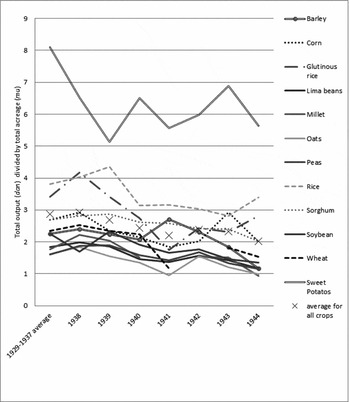
Because rice yields more grain per unit of area than wheat, the decline in rice acreage was disastrous for Sichuanese food production. Between 1929 and 1937, the average total crop of rice in Sichuan had been 144 million shidan (hectolitres); in 1944 it was only 95 million. Wheat production had increased from 36 million shidan to 55 million in 1942, but this did not even come close to making up the shortfall in rice—and the wheat harvest subsequently dropped to only 26 million shidan in 1944.Footnote 110 While giving credit to Nationalist policies that saw a rise in potato and wheat cultivation, Hans van de Ven also shows that, on a national level, ‘rice harvests plummeted and never recovered’.Footnote 111 As Figure 3 below indicates, for most crops in Sichuan there was a general trend towards declining output per mu during the War. Year-to-year variation may be explained by weather, inaccurate data, or special efforts made by the cooperatives, but the labour shortage as well as declining fertilizer availability are the most likely explanations for the decline in yield per mu over the course of the War.
Average yield per mu in shidan for main crops in Sichuan. Source: Liu Qiuhuang, ‘Zhanshi Sichuan liangshi shengchan’, pp. 145–146, 150.

Due to the difficulties of resettling refugees in remote peripheries, the enthusiasm of some leaders cooled and, as we shall see, the problems that the kenzhiqu had with recruiting people probably stimulated interest in coercive forms of resettlement such as penal colonies. But some key proponents never lost their faith in the original idea. Despite rejecting the plan of sending 200,000 refugees to Xinjiang, the Central Political Council did not question the basic benefits of agricultural settlement in Xinjiang, only its present affordability. Shen Honglie scaled the scheme back to 20,000 refugees, and in December 1942 was still confident that the lower target would be achieved.Footnote 112 Even though his own Ministry had done the research that showed the labour would probably have been more useful on farms in the Sichuan basin, Shen Honglie remained a supporter of frontier settlement throughout his tenure as minister of Forestry and Agriculture. The Republic of China produced a lot of research on agricultural economics and science, but Shen, who had trained at the Japanese Naval Academy and spent most of his career before the Japanese invasion preoccupied with the development of the Navy in Northeast China, gave no sign of being very familiar with it.
Ren Naiqiang was an employee of Liu Wenhui and a supporter of Chinese settlement in Kham, but he had also studied agricultural science at Beijing Agricultural College and had come to the conclusion—before the War—that schemes to greatly expand cultivation in Kham had been based on ‘unscientific fantasies (weifan kexue zhi miming), from which the officials of the border region still have not woken to this day’.Footnote 113 Yet in 1944, Shen Honglie's Ministry of Agriculture combined with the Xikang Agriculture Improvement Institute to develop a land cultivation zone in Taining, near the Gartar monastery near Tau (Chinese: Daofu) in Kham, where the Xikang government had already established a ranch.Footnote 114 At its height the farm employed more than 52 people, mostly Tibetan guards and labourers.Footnote 115 In the Nationalist government, the job of minister of Agriculture and Forestry seems to have been reserved for military men who had formerly ruled areas outside the Nationalist regime's control and who needed to be given a high-ranking job of some kind. Shen Honglie's predecessor was Chen Jitang, the former military commissioner of the Southwest and ‘King of the South’ within an autonomous southern regime.Footnote 116 He had supported agricultural initiatives there, but does not appear to have been very involved with them. Shen's successor in October 1944 was Sheng Shicai, who had finally been dislodged from his position as the ‘King of Xinjiang’. The comments of one of Sheng's associates in Xinjiang are revealing: ‘He [Sheng] knew that if he went back to the Interior (neidi), no matter what position he held, it would be nothing but an empty title (tuyou xuming).’Footnote 117 The grand settlement schemes Shen had promoted were impractical and did almost nothing to solve the nation's key wartime agricultural problems, but they had the prestige of being part of the sort of nation-building mission that Sun Yat-sen, Kang Youwei, as well as most other early twentieth century visionaries, had proposed. Next to this, the labour shortage in the Sichuan basin was an unfamiliar, and probably rather uninteresting, problem.
Central and regional government
Another reason why frontier land cultivation projects did not develop as well as their backers had hoped early in the War was their dependence on cooperation between the central government and regional regimes that had long been autonomous. Different layers of authority were often deeply mistrustful of each other. There were arguments over who would pay unexpected and ever-mounting costs, which fed allegations of corruption and sometimes counter-productive attempts by the central authorities to assert greater control.
As we have seen, at the start of the War most leaders had extremely optimistic ideas about the financial benefits of land cultivation on the peripheries. Few had a realistic understanding of how much the resettlement of refugees in distant locations would cost, and it was more expensive than most had envisaged. In 1938, Luo Lixue suggested a figure of ten million yuan to send 919,000 refugees to Suiyuan, Ningxia, Xikang, and Yunnan—about 11 yuan per settler.Footnote 118 In March 1939, the Xikang Preparatory Committee budgeted around 50 yuan per settler in its proposal to the central government.Footnote 119 The Committee assumed that the relief agencies of other provinces would pay for transport. If a student study-expedition from Chongqing to Xichang led by Ye Xiufeng in March 1939 is any guide, transport expenses for refugees would have also been about 50 yuan per person.Footnote 120 A March 1939 Ningxia plan requested more than twice the amount per settler that Xikang had proposed: 275,000 yuan to resettle and build communities for 2,000 people.Footnote 121
Ningxia's government was probably more realistic than Xikang’s, but it appears to have suffered due to Xikang's under-budgeting. The central government was only willing to give Ningxia 49,000 yuan per 1,000 migrants, about the same as it offered Xikang.Footnote 122 In August 1939, the Ningxia government complained that the migrants had increased the costs of policing, hygiene, and education bureaus. It did not mention inflation, but, although the hyperinflation of the later War years had not yet begun, it is likely that inflation also contributed to resettlement being more expensive than anticipated. The cost of the new communities was now put at 177,000 yuan per 1,000 settlers.Footnote 123 ‘Having tried every possible means’, the Ningxia authorities raised another 49,000 yuan (clearly they were willing to match, but not exceed, the central government's contribution). The central government offered another 31,000 yuan per 1,000 refugees, arguing that Qinghai had only been given 80,000 yuan per 1,000 refugees.Footnote 124 Even before the issue of who would pay for what had been resolved, 2,000 refugees in Shaanxi had been selected for resettlement in Ningxia and moved to Xi’an.Footnote 125
Central government officials did not accuse the Ningxia government of corruption, but, in pointing out that they were asking for more than Qinghai had received, they implied that the Ningxia project could have managed with less. When members of central government bodies discussed resettlement, allegations of misuse of funds were raised more openly. In the December 1942 meeting of the Supreme Council on National Defence, members argued that the process was in dire need of ‘rationalization’ (helihua).Footnote 126 Frontier land cultivation schemes had achieved ‘no results other than to increase the number of opportunities for devious individuals to make a profit for themselves’.Footnote 127 The members argued that control over resettlement needed to be centralized. In addition, there were fears about potential Communist infiltration, which had prompted the central government to assume control over Huanglongshan in 1939.Footnote 128
Kong Xiangxi, who, unusually for Nationalist leaders, had actually worked in rural North China (with the China International Famine Relief Commission), proposed that central government bodies whose work related to the settlement of the Northwest, like the Bureau of Land Cultivation, ought to relocate there.Footnote 129 There they would have a clearer idea of the conditions on the ground and exercise more direct control over resettlement projects. This never happened, but in addition to taking over Huanglongshan, the Nationalists did move to exercise more control over frontier development projects. Ye Xiufeng, a long-time advocate of settlement schemes in the west, was dispatched to Xikang in 1939 to be the director of the provincial Bureau of Development (jianshe ting), which was mostly funded by the central government. The same year, Kong Xiangxi sent Russian émigré, Peter Goullart, to Xikang to oversee the development of agricultural cooperatives and monitor the Xikang regime's ranch near the Gartar monastery, where the Ministry of Agriculture wished to establish a land cultivation project. The Nationalist government also set up a field office in Xichang to monitor, among other things, cultivation and other development projects.
The attempts to exercise more control over initiatives in Xikang did not go well. Liu Wenhui bullied Ye out of the new province within a year.Footnote 130 Peter Goullart recalled that the other officials on the farm near Gartar ‘tried to forget my very presence on the farm, treating me as a superfluous parasite and, I suspect, as a sort of spy sent by the central government’ (probably a fair description of the job Kong Xiangxi had intended for him).Footnote 131 Like Ye, Goullart left Xikang shortly after arriving, having been put under house arrest by Liu Wenhui's forces, who confiscated ‘every scrap of paper that I had, including my official and private correspondence, all my photographs, and even a carton of vegetable seeds recently sent by a well-wisher from America’.Footnote 132
Regional elites in the Han areas of Xikang also resented the Nationalist intrusion and its effects. In 1940, members of the Xikang Provincial Assembly (canyihui) complained about ‘capital from outside the province’ in the hands of unnamed ‘companies, groups and private individuals’.Footnote 133 Working under the pretext of the ‘admirable cause of land cultivation’ such outsiders were said to use large amounts of money to ‘snatch (juequ) fields that had already been cultivated by Han farmers’.Footnote 134 ‘Attracted by the large sums offered to them, the [Yi] chieftain landlords cancelled agreements with Han tenants without consultation, transferred the tenancy to others or even sold the land’ to the outsiders.Footnote 135 Nor were investments in other areas always welcome either: the Xikang Provincial Assembly's proposed regulations on mining stipulated that joint public-private mining ventures had to first offer shares exclusively to Xikang residents, and then solicit ‘outside capital’ only after a certain period of time had elapsed.Footnote 136
The rise of coercion
With the wartime labour shortage and the tension between frontier residents, governors, and central authorities, the numbers of people who went to kenzhiqu was very small in comparison to the numbers floated in proposals in the early War years. Nevertheless, the War did alter the character of frontier land settlement ventures. In response to the movement of labour away from the frontier—and away from kenzhiqu in particular—coercive measures and systems became more common. The government's regulations stated that: ‘After refugees have been settled in the kenzhiqu, they may not leave without the permission of the management, except in cases of unforeseen accidents (teshu shigu).’Footnote 137 A year later, an updated set of regulations issued by Guangdong province backed up the rule with the threat that anyone who left without permission would have to repay all the costs the relief commissions had spent on them.Footnote 138 Likewise, at the Meifu collective farm in Shaanxi, farm workers could only leave the farm if they received permission to do so at an end- of-year meeting.Footnote 139 There was a suggestion at the December 1942 Supreme Council on National Defence that a ‘semi-compulsory system’ be adopted for the ‘urgent mission of settling the frontiers’.Footnote 140
Even though there were restrictions around leaving the Meifu collective farm and the kenzhiqu, it was always possible with management approval. The most coercive mechanisms for forcing people to settle in the Northwest were penal settlements. The Nationalist government had created regulations for penal colonies in the 1930s, but little had come of the embryonic system. During the War the government's enthusiasm for convict settlements in the frontiers grew, particularly when it became clear that refugees were unlikely to be willing to migrate to the Northwest on the scale that leaders had initially hoped. As Kong Xiangxi wrote in 1943: ‘The mobilization of prisoners to migrate and cultivate land (yi ken) is one of the critical tasks of the present moment.’Footnote 141 Kong did not explain why exactly; throughout the first half of the twentieth century it became common to describe the migration of free citizens to the frontiers as a ‘critical task’, so Kong probably felt that that part did not need explaining. The focus on prisoners was new, however.
In the 1930s, convict settlements had been controversial. Many elites who had been to the Northwest felt that migrant society was already depraved, without adding to the mix prisoners, who would gain free land on release under the Nationalist plan.Footnote 142 Making plans for Kham, Chen Zhongwei did not even want to accept colonists who had been convicted of an offence in the past, let alone consider schemes whereby criminals would be transported and given free land after their release.Footnote 143 Wu Jingchao, a professor of sociology at Tsinghua University who would later become the secretary of the Executive Yuan, also wrote a critique of the idea of using convicts to settle the frontiers, which raised a similar concern:
The borderlands are critical in terms of national defence, so it is to be hoped that the people who settle there will not be of lower physical, mental and moral character than the people of the interior. [. . .] If the government makes the borderlands into a sink hole for criminals, then men of honour and gentlemen (zhengren junzi) who cast their eyes on the frontiers will recoil.Footnote 144
Misgivings on the part of intellectuals like Wu and Chen did not cause the Nationalist leadership to abandon the idea of penal colonies in the Northwest, but draft regulations that the Central Political Council created in the 1934 nodded in the direction of their concerns. Article 2 stated that transported convicts had to be men ‘who can do farm work and are of sound health and relatively good moral character’.Footnote 145 A pre-War scheme established by Pingshan in Sichuan also demonstrated a certain amount of reticence. The original plan was to use only ‘old convicts who deeply regret their crimes’.Footnote 146 During the War, these concerns disappeared in the wake of the new urgency to send prisoners to the frontiers. A new set of regulations was promulgated omitting the requirement that prisoners be men over the age of 20 and of sound moral character.Footnote 147
In October 1941 the Ministry of Judicial Administration established a colony with a initial planned capacity of 500 prisoners in Pingwu, in the mountainous country on the frontier of Kham in the north of Sichuan.Footnote 148 The settlement became a model for other proposals, including one at Huanglongshan in Shaanxi; colonies were also planned for Hexi in Gansu and Pingba in Guizhou.Footnote 149 An area of 40,000 mu was surveyed for the latter settlement, but results were much more limited.Footnote 150
Early plans were for penal colonies on the fringes of Sichuan, Guizhou, Gansu, and Shaanxi. But around 1943 top Nationalist leaders often felt the need to underline that the convict settlements ought to be on the Northwest frontiers. ‘There are more advantages and fewer disadvantages to creating colonies in the frontiers (bianjiang) than in the interior (neidi),’ the Ministry of Agriculture and Forestry wrote in 1943.Footnote 151 The same year, He Yingqin, the minister of War (junzhengbu zhang), also wrote that ‘convict resettlement and land cultivation should focus on the Northwest’.Footnote 152 He reminded officials that the first regulation of the Temporary Measures for Convict Resettlement and Cultivation stipulated that the penal kenzhiqu were to be in ‘the remote frontiers (bian yuan) or large expanses of wasteland (huang kuang zhi difang)’.Footnote 153 According to wartime regulations, convict colonies were to be large-scale settlements, covering 10,000 to 40,000 mu of wasteland, to be cultivated by up to 2,000 prisoners each.Footnote 154 In 1943, Kong noted that this could be paid for out of the 400 million yuan that the central government had allocated for the development of the Northwest. Kong and He did not say so directly, but it seems likely that they began to talk more about convict settlements in the Northwest because they realized that it would be impossible to get large numbers of people to move there voluntarily when there was a labour shortage in places like the Sichuan basin.
As Frank Dikötter has shown, lack of funds was the most critical barrier.Footnote 155 But there were other obstacles too. The union of criminal justice and frontier development created difficulties and disagreements. Even when the 1934 draft regulations for the resettlement of convicts were created, there was a dispute between the Judicial Yuan (sifa yuan) and the Executive Yuan (xingzheng yuan) over who would control the process. Penal colonies would be directly managed by the Ministry of Judicial Administration, which in 1934 came under the direction of the Executive Yuan. Legal bodies, including the Supreme Court and the high courts of Jiangsu and Shandong, argued that the task of creating the penal colony system should be given to the Judicial Yuan.Footnote 156 The Legal System Committee (fazhi weiyuanhui) of the Legislative Yuan suggested that because military prisoners were involved too, and the general nature of the task related closely to the work of the Executive Yuan, the system should be managed by a joint body.Footnote 157
The cooperation envisaged by this solution did not always work very well. The directors of criminal justice organs did not necessarily have the knowledge required to organize farming colonies, and at times were completely wrong about the situation in locations where prisoners might be sent. In 1942 Xie Guansheng, the legal scholar director of the Ministry of Justice, wrote to the Ministry of Agriculture with a plan for a convict settlement in Huanglongshan modelled on the one in Pingwu.Footnote 158 It is not clear why Xie chose Huanglongshan; it seems likely that he had heard about the refugee kenzhiqu there and had little idea about where else might be suitable. He asked Shaanxi provincial officials to set aside 40,000 mu of uncultivated land for a convict settlement.Footnote 159 The Ministry of Agriculture was not impressed: there was no spare 40,000 mu in Huanglongshan. In fact, there was not even enough land for the refugees who were already there.Footnote 160
Likewise, officials in the Ministry of Agriculture, and the Executive Yuan were unfamiliar with criminal justice institutions, and had unrealistic ideas about the number of suitable prisoners that could be mobilized. In 1944 the central government ordered prisons in China to compile reports listing all prisoners who met the requirements for transportation as laid out in the regulations. The results were disappointing. Reports from prisons in 316 counties in 16 provinces indicated that only 2,887 civilian prisoners were suitable for resettlement and cultivation schemes.Footnote 161 As one official wrote: ‘it is neither practical nor economical’ to arrange for these prisoners from all over China to be concentrated at a single camp.
A report from a county in Xikang commented that ‘eight or nine out of ten prisoners were sentenced for crimes relating to opium. Because of this there are only two prisoners who have sentences long enough [more than three years] to be sent to do farm work.’Footnote 162 Some prison directors were perhaps reluctant to report prisoners to the Executive Yuan for fear that they would have to bear the costs of transporting them, which was a significant burden, as Dikötter shows.Footnote 163 Yet a post-War survey of prisons suggests that the reason for the low wartime counts of prisoners suitable for transportation to a penal colony lies elsewhere. In Sichuan there were 19,370 people in detention (not including those in counties that did not send information to the Ministry of Judicial Administration), but 74 per cent had not been convicted of the alleged offences that had led to their arrest.Footnote 164 The situation was similar in other provinces. The justice system was falling apart, but the idea of due process was still important. The government does not appear to have discussed transporting prisoners who had not been sentenced, lengthening the sentences for some crimes, or otherwise altering the justice system to produce more transportable convicts.
Conclusion
In the early twentieth century, there was a consensus among Chinese intellectual and political leaders in favour of state support for the mass agricultural colonization of the steppe and upland biomes in the country's West. The refugee crisis created by the Japanese invasion led many officials, particularly those in provincial and warlord regimes in the western provinces, to see an opportunity for the realization of this long-held ambition. In many ways, the War did prompt new relationships between China's elites and the western periphery they had long talked of colonizing—encounters that are the subject of a growing literature. But the War also led to countervailing trends. People already on the western frontiers began to move to cities and infrastructure projects that desperately needed labour, abandoning farmland as they did so, as did farmers in core areas of unoccupied China.
The faith of the minister of Agriculture, Shen Honglie, in the idea of frontier settlement projects is evident in his continued planning of them in 1944, despite the labour shortage and the weakness of the case that they were the best way of increasing food production. Hsiao-ting Lin has suggested that Nationalist engagement with leaders in the Northwest might best be characterized by ‘pragmatism, survivalism and opportunism’.Footnote 165 But there was little that was pragmatic or survivalist about the kenzhiqu founded by Shen's ministry, or the idea of sending settlers to Xinjiang. The Huanglongshan resettlement zone was a relatively pragmatic response to a nearby disaster, but it was exceptional among the kenzhiqu, and it was founded by the Shaanxi provincial government, rather than the Ministry of Forestry and Agriculture.
Around two-thirds of the people who spent time at state kenzhiqu in the War were victims of the disasters in North China, and they went to kenzhiqu in Henan or Shaanxi that were relatively close to disaster zones. Elsewhere, cultivation projects struggled to recruit the numbers of people they had aimed for due to the labour shortages in urban areas and key transport routes. Even though the results must have been a disappointment to the likes of Shen Honglie, and Gansu bureau of development chief, Luo Lixue, the wartime efforts to develop settlements in the western provinces spurred the development of plans for new communities in the North- and Southwest that anticipated those created by the Communist government in the 1950s.Footnote 166
The kenzhiqu's poor record at recruiting and keeping refugee-settlers was probably responsible for the increase in discussions of coercive measures around 1942. Penal colonies in the Northwest had been on the Nationalist agenda in the 1930s, but plans to go ahead were somewhat restrained by criticism rooted in fears about their impact on migrant communities. The idea of putting prisoners to work during the War was not itself related to the disappointing record of kenzhiqu beyond Shaanxi and Henan. But prisoners could have been made to perform any kind of labour; it is likely that the idea of sending them to the Northwest to cultivate wasteland was related to the difficulties of persuading free people to go there. The increased role of coercion in settlement schemes is important because coercion was such a prominent part of Communist policy to settle the Northwest. In the 1950s, one state farm in Qinghai received tens of thousands of prisoners—and these are merely the numbers given in publications from the People's Republic.Footnote 167 The criminal justice system of the Republic of China was either insufficiently punitive, or insufficiently efficient, to send many convicts to the Northwest, but in important ways, the Communist approach built upon the system the Nationalists had created during the War.
The wartime experience of planning and managing kenzhiqu was also significant because in some cases it further increased tensions between central and regional authorities. Relations between the Nationalists and regional regimes like Liu Wenhui's Xikang government were distant and unfriendly before the War. But conflict between the two was not inevitable. Liu did not have any aspirations to form a national government, and the Nationalists had offered more autonomy to other leaders in past times of crisis.Footnote 168 Whether wartime development projects also led to conflicts with regional leadership in Yunnan, Guizhou, and Sichuan requires more research, but the implications are significant. When the Nationalists attempted to fight the Civil War, there was much mistrust and little cooperation between central and provincial commanders, and provincial forces were more likely to defect to the Communists.Footnote 169 Land cultivation was only one of the types of development project that involved (not very successful) cooperation between central and regional governments. But if the tensions created in land cultivation projects were symptomatic of conflicts that occurred in other development projects, this may have been part of the reason for the Nationalists’ inability to rally regional regimes to the anti-Communist cause during the Civil War.