Introduction
In his 1846 account, John Macmullen, formerly Staff Sergeant of the 13th Light Infantry, recalled landing at Calcutta following the long sea voyage from England. On returning to his quarters after a wander through town, he found the men of his regiment in various states of intoxication, breaking up furniture and engaged in pitched battles. ‘Several’, he noted disdainfully, ‘completely showed the cloven foot’.Footnote 1 The scene Macmullen described was, by many accounts, a common occurrence and this view of the men, as aggressive, drunken louts, was one widely held by officers. More worryingly, Macmullen admitted that the ‘non-commissioned officers possessed no control whatever over the men, by whom they were thoroughly despised’,Footnote 2 Indeed, Monier Williams, surveyor-general in Bombay (and father of Sanskritist Monier Monier-Williams), would have no doubt concurred with Macmullen's assessment lamenting as he did in 1823 that, through drunkenness,
. . .the English soldier exhibits to the natives of India, a disgusting specimen of the European character—the Christian character, and even of human nature itself. This abominable vice of drunkenness, which brings such dreadful evils upon themselves, and such disgrace upon our national character and religion, among our native subjects, is almost universal among the English soldiery.Footnote 3
The men's drunken behaviour prompted a raft of anxieties; ranging from social and class tensions to the expense incurred as a result of alcohol-related illness and crime, as well as broader fears about threats to ‘imperial’ or ‘national’ prestige. Colonial administrators and officers viewed intemperance as a vicious moral vice endemic among the soldiery.Footnote 4 However, somewhat ironically, it was often the case that the soldiers themselves were blamed only indirectly for their drunken behaviour. Assumptions about the men's class and character meant that most officers saw the soldier as a creature of animal needs.Footnote 5 The visible presence of a European corps of soldiers was thought to be essential to the maintenance of empire. From the daily drill and parade to his imposing uniform, the European soldier's importance was as much symbolic as physical. However, medical and military observers attacked these same men for their supposedly wanton and ‘inferior’ behaviour, and display of dangerous tendencies which openly threatened not only military security, but broader imperial discipline. Although there has been significant work on the perceived malleability of the soldier in the eighteenth centuryFootnote 6, this paper examines how this perception informed attempts to regulate temperance and shaped both medical and disciplinary beliefs in cantonment across British India.Footnote 7 Moreover, it looks at the other groups blamed for the soldier's misbehaviour, namely ‘disorderly’ European women and illicit liquor vendors in and around the cantonment. Finally, it explores the actual punishments imposed for misdemeanours committed in the cantonment in order to show how such class-based understandings, and a preoccupation with the ‘masculinity’ of the European soldiery, shaped penal regimes.
Intemperance and the soldier
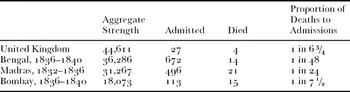
In his 1858 series on maintaining the health of the European soldiery, Norman Chevers, then a surgeon in the Bengal Medical Service (who would go on to produce a number of medical manuals for India), began a section dedicated to temperance with the warning that it was impossible to really convey how dire the situation of drunkenness among the European troops in India truly was.Footnote 8 Each of the three Presidency armies possessed different characteristics. Moreover, there were key differences in the recruiting patterns and composition of Company and Crown troops.Footnote 9 However, these distinctions appeared to have little resonance for those warning about the perils of drink among the European soldiery in India. When compared with similar statistics of the army in Britain, the situation in India did appear much more dramatic (see Table 1).
Statistics of Delirium TremensFootnote 10 in the British Army

Source: Chevers, ‘On the Means of Preserving the Health of the European Soldiers’, p. 749; and Macpherson, Hugh, ‘Analysis of the Later Medical Returns of European Troops Serving in the Bengal Presidency’, Indian Annals of Medical Science 5 January (1858), p. 238.
One author, writing in the Calcutta Review, solemnly assured his readers that, ‘. . .nowhere does drinking flourish more rampant [sic] than in India, where it is a principal source of much of the sickness and mortality which exists’,Footnote 11 Like his colleagues who warned that the ‘variety’ of venereal disease present in India was more widespread and pernicious than its European counterpart, the author of ‘The European Soldier in India’ cautioned that the liquor supplied in India was not only more readily available than in England, but was itself of a more noxious variety.Footnote 12 This idea appears to have followed on from earlier assumptions which linked climate, excess and disease. Before the nineteenth century, European observers on ‘health’ in India sought to project the idea that, given certain precautions were taken in one's lifestyle, India was a perfectly healthy place in which to live.Footnote 13 However, these observers warned that the heat compounded the many excesses common to the lifestyles of many Europeans in India.Footnote 14 Habits of drink were deemed particularly threatening due to the potential alcohol had to excite and upset bile production, as well as affecting the liver and stomach more generally. The idea that the drink most commonly consumed by the soldiers in India was toxic quickly became a theme which ran though proposals to remedy the ‘drink problem’ among European soldiers.
As the perceived fuel for much of the men's misconduct, drink was also seen to open the door to more serious ills, from delirium tremens to death by cholera. It shared this dubious honour with venereal disease. Indeed, medical observers suggested that had the men not been such inveterate drunkards, they might be more attuned to the venereal threats posed by illicit prostitutes ‘lurking’ in and around cantonments. For military and medical observers these threats were crucially connected. The link between ‘vice’ and illness was made explicit in an 1855 article titled ‘Soldiers; their Morality and Mortality’ which appeared in the Bombay Quarterly Review.Footnote 15 Most admissions to hospital, the author proclaimed, resulted from two causes—‘vagrant amours’ and drunkenness.Footnote 16 Both ‘vice-driven’ threats provoked a similar response. It is no coincidence that the perception of both was that they were not only preventable, but driven by human weakness. In the article (itself an essay-style review of eight contemporary works on the subject of temperance and the health of the soldiery), the author attempted to display through the careful use of statistics, how vice directly led soldiers to ill health, poor performance and bad behaviour. The author unflinchingly declared that there was a sure causal link between morality and mortality, noting that the, ‘. . .laxity of morals has a tendency to shorten the period of human life, and purity has a corresponding tendency to longevity’.Footnote 17
The war on drink and the soldiery in India was waged by an alliance of medical men, like Chevers, in close connection with commanding officers and (after 1813), missionaries.Footnote 18 However, by the time the latter established themselves across India, this coalition of medical and army men had already substantively shaped the debate on the issue. The Age of Reform is usually described as one powered by an alliance of free traders, utilitarians, liberals and missionaries. However, equally important were a host of other characters; in this case, surgeons and commanding officers, who once again dictated their demands to preserve the men's health which, in turn, were carried out by government.
Medical and military concerns combined to create a new type of morality imposed on cantonments. Intemperance was seen not as a problem of the individual soldier and his self-control (or lack thereof), but of the soldiery as a whole. According to this rhetoric, the lure towards intemperance and bad behaviour came from without. It dismissed the agency of the individual soldier in actively seeking out drink (illicit or otherwise). Instead, given his ‘natural’ propensity to drink, attempts to regulate the soldier's alcohol consumption targeted those who ‘encouraged’ him to do so. The individual soldier was not blamed for his intoxication, unless, of course, it went beyond what was considered ‘normal’. For most officials, drunkenness was part of the composition of a British soldier. As will be discussed, the punishments (or lack thereof) inflicted on men for drunkenness as well as in the laws and regulations drawn up to sanitize cantonment space reflect this very belief. No doubt this perception of the men contributed to the construction of one of the tropes of colonial masculinity.Footnote 19 As such, any attempt to prevent the men's ‘natural’ urges, it was feared, could provoke unwanted consequences, either pushing them towards homosexuality (and therefore ‘emasculation’), or an explosion of pent-up ‘passions’, as John Macmullen described it.Footnote 20 While the Company desperately needed European soldiers to reinforce and maintain control, these men struck fear into the hearts of their own officers. This disquiet influenced the measures which the colonial state enacted to preserve the men's health. Thus, while Sara Suleri has observed that an overwhelming anxiety complicated the Anglo-Indian narrative—that of India and its ‘incomprehensible’ traditions—so too were decisions regarding European soldiers spiked with a similar panicked sense of incomprehension.Footnote 21
Observers thus presented two pictures of the soldier which sat rather uneasily with each other: that of the ‘naturally’ intemperate, low-class ruffian; and, conversely of the naïve victim of outside forces who lured him into a life of drink and misbehaviour. Although at first glance these two visions appear to be contradictory, when we consider that the theme common to both was that soldiers were, in effect, malleable, the two can be seen as more complementary. As Foucault has argued, by the eighteenth century, ‘. . .the soldier has become something that can be made; out of a formless clay. . .the machine required can be constructed’.Footnote 22 As such, the Company and Crown both harboured the belief that they could mould ‘low-class’ men into efficient, masculine soldiers. However, such flexibility also meant that the men were equally exposed to the whims of those bent on less salubrious and more salacious habits. Threats to the men's health could arise from any number of sources, but when it came to drink, those thought to be the most dangerous were the illicit liquor sellers ‘lurking’ around the bazaars and the soldier's wives, secretly selling liquor from their quarters. This set of assumptions, regarding both the men and the various threats to their health, definitively shaped the construction of drink-related regulations.
In his 1813 tract, The Influence of Tropical Climates, More Especially the Climate of India, on European Constitutions, James Johnson asserted that the excitement to one's system caused by excessive ‘debauchery’ (here referring to both food and drink), was followed by a general torpor in the liver.Footnote 23 This sluggishness in turn obstructed the production of healthy bile which then encouraged fever, dysentery and hepatitis. To prove his point, Johnson noted that on the Coromandel Coast, where, he asserted, Europeans were temperate and sensible, the instances of hepatitic problems were lessened. This, he noted, contrasted with soldiers and sailors
. . .who, to the stimulating effects of the climate, add inebriety, too much food, or ill-timed exercise, then the biliary secretion and perspiration are so hurried and augmented, and the vessels so debilitated, that the smallest atmospherical vicissitude becomes dangerous.Footnote 24
Johnson urged his readers against this excess which, in his mind, was detrimental not only to health, but also to the very stability of European society and social control in India.
Observers on the problem of drink were careful to assure their readers that in the respectable circles of society, there was a general mood of temperance. Unsurprisingly, fears over levels of drink-related illness (and violence) peaked during periods of imperial insecurity. Johnson was writing in 1813, following a series of costly military campaigns and protracted debates surrounding the renewal of the Company's charter. He suggested that a healthy, sober physical state, combined with good manners, was essential to preserve Britain's empire. The drunkard, he reasoned, not only destroyed his own health but was responsible for, ‘. . .deteriorating the European character in the eyes of those natives, whom it was desirable at all times to impress with a deep sense of our superiority’,Footnote 25 A steady stream of similar essays and indictments continued throughout the nineteenth century. Observers frequently echoed Johnson's vision of the low-class soldier, with another observer noting that ‘The ratio of deaths among the higher classes of Europeans is less by eighty per cent than among the troops’,Footnote 26 The ‘higher classes’ with their more regular habits and propensity to favour claret rather than hard liquor, were, in this instance, thought better able to withstand the rigours of the climate thanks to their good manners and upright behaviour.Footnote 27 However, this, of course, conveniently overlooked the differences in lifestyle which encouraged the good health of the well-to-do, such as superior diet, housing and their reduced exposure to both sun and violent conflict.
Medical topographical reports, which multiplied from the 1820s, reinforced earlier warnings and tropes about the soldier. These reports analysed levels of health at the various European stations across India. The reports’ authors envisioned a range of solutions for countering health problems on the subcontinent. The author of the 1827 report on Bengal noted that:
Those who are temperate, take moderate exercise, attend to keeping their body open and mind at ease, enjoy good health in almost all these stations in Bengal, as is proved by the inferior degree of sickness which occurs among officers, or persons in Civil Life. . ..Footnote 28
On the other hand, the report blamed soldiers stationed in Meerut for their ‘want of care and prudence’, in their reckless attitude to alcoholic over-indulgence.Footnote 29 Reiterating Johnson's theory, it warned that drunkenness paralysed the ducts, obstructing the secretion of healthy bile as well as weakening stomachs already debilitated by India's climate.Footnote 30 The authors asserted that this dual threat led to liver disorders which, combined with the heat, greatly increased levels of disease.Footnote 31 In addition, the report disdainfully dismissed the suggestion that liquor be given to soldiers to mitigate the effects of strenuous exercise. To prove the fallacy of this theory, it pointed to the comparatively good health of the native troops, noting that they were subjected to the same (if not more vigorous) exercise as their European counterparts, yet never drank at all.
The anonymous author of ‘Soldiers; their Morality and Mortality’ drove this class-based analysis of the soldiery even further. He divided recruits to the army into three groups. The first, and largest of the classes, was composed of men, ‘whose follies and vices have alienated them from their friends, and rendered them unfit for the duties of civil life’.Footnote 32 Men in the second category were those who, by virtue of their poverty, entered the army to provide for their subsistence. The third category, which the author clearly viewed as the most ‘virtuous’, was composed of men who chose soldiering as a profession due to their own personal spirit of adventure. Class assumptions and prejudices were perhaps at their most bare when discussing the health of the rank-and-file. By this standard, those who chose soldiering out of financial need were less noble than those who had the freedom to ‘choose’ a life of adventure. The largest group of soldiers, by his estimation, appeared little better than common criminals. These civil misfits, it is implied, were dumped into the army as there was nowhere else safe to put them (besides, perhaps, prison). It was reasonable, then, to assume that such vice-filled men would prove dangerous when given access to drink.
Echoing the earlier security panic of Johnson as well as more recent reports linking drink to high levels of violence and crime, Chevers used his piece to warn of the threats contained in allowing this rash of intemperance to continue. These consequences not only included impaired health, but were, he suggested, linked to much greater imperial concerns. Apart from the Dutch and the Portuguese (who he similarly regarded as excessive drinkers), he noted that the other ‘. . .continental nations of Europe. . .are vastly our superiors, and have abundantly proved their greater fitness to bear exposure to the climates of the tropics, both in the East and in the West’.Footnote 33 The French in Pondicherry, he argued, were almost entirely free of hepatic complaints, subsisting as they did, on light wines, vegetables and curry.Footnote 34 No doubt Chevers hoped to provoke his readers into action with the perceived threat to imperial and national prestige and security, timed as it was so soon after the Crimean War and the 1857 Rebellion.
Ordering the cantonment: military solutions and medical proposals
Military and medical proposals for containing alcohol-related illnesses were determined by a vision of the European soldier as immature, volatile and reckless. In their ‘solutions’ and the regulations which followed, surgeons and commanding officers never relinquished this set of beliefs. The prevailing logic argued that those younger soldiers with only a few years’ service in the country posed the highest risk for both bad behaviour and ‘tropical’ ailments. Surgeon Ainslie of the Medical Board suggested a plan for the health of the newly arrived troops which involved a period of ‘seasoning’.Footnote 35 The idea of ‘seasoning’ was not new. In 1773, East India Company surgeon John Clark suggested that newly arrived troops be sent to the Coromandel Coast for twelve months to allow them to acclimatize gradually.Footnote 36 In these suggestions we see the nucleus of the idea behind later sanatoriums and hill stations. In a manner similar to Clark, Ainslie's plan proposed the creation of a station for the newly-arrived at an elevated location close to the sea, properties felt to be essential prerequisites for good heath in India. Situated at a distance from arrack and toddy shops, this site would allow the men to adjust to temperature, food and lifestyle over a period of eight months. Ainslie's plan restricted alcohol allowances and prevented young men from ‘wandering’ outside of the cantonment in search of women. However, Ainslie's proposals (like Clark's before him) ultimately came to naught, as the Medical Board (while supportive of aspects of the plan), ultimately failed to approve it—in all likelihood due to its proposed expense. The call for more careful attention to be paid to the recruitment and early stages of a soldier's career in India did not disappear. Chevers set out step-by-step instructions that he deemed expedient and necessary in order to reduce illness among the European troops in India.Footnote 37 These began with the proper selection of recruits and proceeded through the appropriate daily activities with which to occupy a soldier's mind and time. For Chevers, like Ainslie, optimum health in India was attainable only if the military and medical authorities paid stricter attention to the careful moulding and guidance of young recruits.
Initially, many observers on the problem of drink within the army railed against the canteen system. By this system, an alcohol ration formed part of the men's daily mess. The first modern European-style distillery in India opened in Kanpur in 1805 to provide rum supplies to the army's European troops.Footnote 38 The daily ration for each European soldier was one dramFootnote 39 of either arrack, rum or other ‘fiery spirit’. During the rainy season or while on field duty this increased to two drams daily.Footnote 40 In addition, a soldier could buy a further dram at the cantonment's licensed canteen or liquor shop. It seems likely that the policy of daily liquor allowances grew out of an earlier notion that a ‘stimulating’ drink could counter the effects of India's oppressive climate on the European constitution. Although this idea fell from favour by the early nineteenth century, the daily ration remained. Monier Williams blamed the canteen policies of both Company and Crown for fostering the habit of excessive drink.Footnote 41 Williams argued that through a system which promoted daily group drinking, soldiers who, on first joining had been adverse to the taste of alcohol, simply grew accustomed to it and to the habit of consumption. To remedy this, Williams suggested that the alcohol allowance be cut entirely, which, he admitted, might result in a few short-term minor mutinies, but, with persistence (and the replacement of tea for liquor), a happy outcome would prevail. The East India Company's Court of Directors did not heed Williams’ warning. But whether this was due to the fear of revolt amongst the men, the perceived expense, or alternative financial reasons, is unclear. Douglas Peers argues for the latter, noting that the government and Company not only profited directly from the sale of liquor at the canteens, but gained substantial additional income from the duties imposed on local liquor production.Footnote 42 Hence, attempts at moderating the ill-effects of drink which sought to promote the consumption of alcohol that was less debilitating, in the process stamped out the Company's ‘illegal’ rivals in the drink monopoly.
What measures for controlling the behaviour of the European troops did the army see as open to them? Explicit in the plans proposed by medical men and commanding officers for ordering the cantonment, and implicit in the rules and regulations governing cantonment land, was a sense of who was believed to be at fault for exciting disorder in the stations. Regulations which aimed at curtailing the soldier's misbehaviour sought to control those around him as well as the actual physical space of the cantonment and surrounding land. This very fact adds a new dimension to current debates about colonial governmentality.Footnote 43 Indeed, while the colonial state expanded its framework for surveillance and discipline over the Indian population, in this case, the intended target for management (or protection) was its own (often ungovernable) soldiers. Cantonment regulations did not suggest that the soldier was himself blameless, but placed a greater degree of the burden on others—the unscrupulous wife, the shadowy illicit arrack seller or the (overly-)seasoned Old India Hand who, it was asserted, fostered this culture of heavy drinking and ‘uncivilized’ behaviour. As will be seen, relatively straightforward demands to curb the behaviour of European soldiers developed into much more complex calls to push out the boundaries of military-controlled space, all on the supposed grounds of health and morality. This transformation involved a complex series of understandings—that of the soldiers themselves, of European women in India, and of those Indians (excluding sepoys) in the service of the army, who held positions from translators to dhobis. Later cantonment acts (most notably Act XXII of 1864), would combine military and medical imperatives thought essential to maintain a healthy corps. Piece by piece, the earlier regulations discussed below established a normative view of what cantonments would look like; they dictated how their internal economy should be governed, and sought to regulate all military space.
In March 1809, the Government at Fort William passed Regulation III, which sought to fix the physical limits of cantonments as well as more clearly define the respective powers of the civil and military authorities in carrying out their duties in the bazaar.Footnote 44 By this regulation, the limits of all cantonments (where more than half a battalion were quartered) were fixed through the joint decision of the commanding officer and the magistrate of each cantonment. The commanding officer and magistrate sent detailed reports on the specific boundaries to government. This regulation made clear the decision that the responsibility for maintaining the peace and preventing ‘public crimes’ within cantonments and military bazaars lay with the officer commanding the troops at each. This was hugely significant in shaping the future understanding and management of cantonment land. Nicholas Dirks has illustrated the multiple, intricate ways in which the Company asserted its own sovereign position from the mid-seventeenth century.Footnote 45 This ‘right’ to rule often masked the aggressive violence and corruption of Company rule. In the case of the cantonments, this aggression was only very thinly disguised. The Company's physical control over cantonment space was one of the most blatant of these measures. Through a clear demarcation of military space and by ultimately assigning punitive control for crimes committed within that space to a military official, the Government at Fort William made clear their partiality towards military-controlled, over civil, space. Cantonments were the areas where some of the most explicit, bald and direct control over the local Indian population existed. Regulation III, and others that followed were, in effect, a preview of how the military would dictate later demands for the direct control of land across India.
To bolster Regulation III, further additions came in 1810 through Regulation XX.Footnote 46 What Regulation III had rather tentatively begun, Regulation XX boldly and aggressively pushed forward. By this act, all persons associated with military establishments were subject to military law, in effect extending the Articles of War to every Indian serving the troops, either as retainers in camp or in the field. Furthermore, whereas Regulation III had left both the prevention and prosecution of petty crimes to the magistrate, it was now expressly stated that any person serving the army and in receipt of public pay was now subject to trial by court martial for any offence ranging from petty theft to murder.Footnote 47 This provision was even extended to those persons not directly in the public pay, but nevertheless serving the army (such as the ‘menial servants of officers’).Footnote 48 Through this Regulation, the punitive power of the military in India expanded monumentally. It firmly and swiftly established legal and penal control over any and all of the army's legions of servants.
Following the enactment of these regulations, demands for greater ‘moral’ control over the cantonment escalated throughout the 1820s and 1830s. In addition, commanding officers themselves sought even greater (and more absolute) personal control over their cantonments. Correspondence in 1826 between the Commissary General, Mr Morison and the Chief Secretary, Mr Hill, notes that commanding officers and bazaar police solicited the power to inflict swift corporal punishment on camp followers and retainers who had either committed a petty offence or had conducted a breach of ‘good order’ without having to go through the formal procedures required to call a court martial.Footnote 49 Morison suggested that Hill make official already existing practices which allowed the police to inflict ‘summarily and promptly moderate corporal punishment’ for petty offences committed by camp followers in the field.Footnote 50 Morison felt that this power would curtail the ‘disorderly habits’ prevalent among the camp followers. It is clear from Morison's statement that, unofficially, commanding officers exercised similar powers and maintained near total penal control over the cantonments. In this way, the perceived needs of the military further shaped notions of what constituted a punishable offence.
Regulation XX laid the ground for such all-permissive control. In addition to making the Articles of War more widely applicable, Regulation XX required all persons who were resident, or who owned shops operating within the limits of a cantonment, garrison or station to register on a list maintained by the bazaar police. By the order, houses and shops were subject to possible military or police inspection at all ‘reasonable’ hours.Footnote 51 In effect, this formalized a cantonment-wide (and indeed beyond) surveillance operation on ordinary residents and shopkeepers. This was part and parcel of a broader military-state pattern of information-gathering which included data ranging from regional resources to trusted informants.Footnote 52 As military control over Indian civilians spread, the army, in effect, enlisted (or, rather conscripted) ordinary individuals, sweeping them into this militarized state.
Ostensibly, such surveillance aimed to curtail the illicit production and trade in liquor and spirits as well as prevent unauthorized ‘vice’ houses, be they brothels or toddy shops. It required all those wishing to carry on their business within cantonment limits to register. While the Regulation explicitly noted that commanding officers were not authorized to dispossess rightful landowners of house or land in the military bazaar, it gave them the right to make and impose any general regulations on government-owned bazaar land. This series of rights related to the terms or occupation of houses, shops or other ‘fixed places’,Footnote 53 Following the enactment of Regulation XX, officials generated countless lists relating to cantonment space. Not only were the registration details of those residents or shop owners within the cantonment recorded, but broader registers generated of the cantonment boundaries themselves. The number of official cantonments grew rapidly in the next 25 years. In 1811, the number of officially demarcated cantonments stood at 18; by 1835, this had jumped to 88.Footnote 54 Not only were officials given greater control over bodies, buildings and land within cantonments, but the physical space which the military occupied across India was itself rapidly expanding. In 1836, one military observer, argued for a further expansion of bazaar surveillance networks and police. He noted with favour the fact that in all stations across Bombay (as well as the area around Fort Saint George in Madras), all crimes committed by anyone within two miles of the station were tried under the Articles of War.Footnote 55
With each new regulation, the remit of military power over individuals and space expanded further; the colonial state was content to let this continue. Regulation VII of 1832 in Madras targeted the excessive use of liquor and drugs by European troops.Footnote 56 This regulation echoed the earlier Bengal orders, however, it went into more explicit detail about those individuals it was now deemed acceptable forcibly to exclude from military areas. Section VI of the Regulation allowed the bazaar police (under the control of the Senior Commissariat Officer of the station) to summon any person within the given area, charged with any number of minor offences, including ‘abusive language, slight trespass, inconsiderable affrays. . .using false weights or measures, or breach of local regulations’.Footnote 57 Such summons would require the accused party to appear at a designated time and place (most likely the bazaar police station) to explain their conduct or to receive a warning or reprimand. The unwritten suggestion here is that following an initial summons, the bazaar police or senior officer had the right to expel any unwanted ‘troublemaker’ from the designated cantonment lines should they continue their objectionable behaviour. Persons of ‘notoriously bad character’ and those ‘suspicious persons without ostensible means of honest livelihood’ were by this order also liable to apprehension and expulsion by the bazaar police.Footnote 58 Similarly, the officer commanding the station now had the power to remove physical ‘nuisances’ from military areas.Footnote 59 Such nuisances consisted of any buildings or pandals Footnote 60 found to encroach upon the streets of either bazaar or pettah Footnote 61 within military jurisdiction.
In order to prevent the smuggling of alcohol and drugs into and around the cantonment, Regulation VII expressly marked for punishment any Indian who attempted to sell liquor or drugs within the limits of the cantonment to any European, unless specifically licensed to do so by the government. The punishment for anyone convicted under this clause was imprisonment with hard labour for up to one month, as well as the possibility of up to 50 lashes for aggravated offences. Perhaps more crucially for the government's coffers, the exclusive control of the sale of liquor and drugs within and around the cantonment was deemed to rest with the Commissary General. Any individual who wished to possess anything more than a bottle of liquor or a seer of drugsFootnote 62 now applied to the Officer in charge of the station who was responsible for granting permits. This officer also held the exclusive power to grant licenses for the sale of liquor and drugs to vendors in and around the cantonment.
Liquor contracts were expensive. One liquor seller in Bombay, Luxemon Mahodjee Roomdar, purchased a contract for the camp bazaar at Suvarnadurg in 1825 at the cost of Rs. 759 for a six-month period. Contracts required vendors to adhere to a long list of regulations which sought to further ‘sanitize’ military space. By signing the contract, shopkeepers, in effect, agreed to act as police in and around their shops. In addition to the above requirements, Roomdar was required to agree to everything from the shop's trading hours to limits on the daily sale allowed to each European.Footnote 63 Any ‘disorderly conduct’ or gaming within the shop was forbidden, and vendors were required not only to prevent such activities but to pass on any information that they might have about ‘thieves or riotous persons’ directly to both the chowdry Footnote 64 and the officer in charge of the bazaar.Footnote 65 This suggests that surveillance networks were firmly established in the bazaar—by this Section, the shopkeepers, already themselves subjected to such surveillance, became informants.
In 1836, a General Order in Bengal further reinforced the spatial controls available to the military.Footnote 66 By this Order, anyone hoping to build upon unoccupied land within the cantonment had to first gain approval for their plans from the Commanding Officer of the station. Further, the Order noted,
As the health and comfort of the troops are paramount considerations, to which all other must give way, the Commanding Officer will be held responsible that no ground is occupied in any way calculated to be injurious to either, or to the appearance of the cantonment. . ..Footnote 67
This Order allowed house owners within cantonment limits to rent them to military officers, but imposed strict regulations on the transfer of any property or land. The land, it was clearly stated, belonged in every case to the Government and in no instance could individuals sell it.
While the regulations and General Orders emerged from presidency capitals, individual surgeons and commanding officers continued to put forward more detailed plans to contain the problem facing the army. Henry Piddington's 1839 pamphlet, A Letter to the European Soldiers in India, on the Substitution of Coffee for Spirituous Liquors proposed a different solution to the problem (as suggested by the title of his pamphlet).Footnote 68 He expressed his deep conviction that, were the troops shown how to make a proper cup of coffee, the problem of intemperance among them would be greatly reduced. Piddington suggested that the high level of drink in India was due to the anxiety many soldiers felt about their situation. Piddington is among the few authors who alluded to some level of humanity (and agency) among the rank-and-file. Indeed, the harsh conditions of service (including low pay, daily exercises determined by the heat, distance from home, etc.) would doubtless provoke some ‘anxiety’. Piddington reasoned that the men drunk grog to make their minds more ‘comfortable’ and the properties of a good cup of coffee could offer the same relief.Footnote 69 Piddington asserted that a soldier could drink twelve cups of coffee without feeling ‘tipsy’ and still wake up the next morning without the ‘. . .sickness and horrors to which persons who drink are subject’.Footnote 70 Coffee and tea became more widely available in regimental mess as the century progressed, but unfortunately for Piddington, this fact did not appear to detract from the men's fondness for alcohol.
Another alternative was proffered by the numerous temperance societies which sprang up in cantonments and towns from the late 1830s. These societies were usually promoted by regimental clergymen and missionaries and required their members to take a pledge, whereby they would promise to abstain from drink and contribute the money they would have spent on this ‘vice’ to social or religious causes. The societies’ success in curbing intemperance varied. Often, as was the case with the men of the 18th Regiment in Bengal, temperance and ‘virtue’ levels were inconsistent over time. In this Regiment, a number of men signed a temperance pledge while in Fort William, but, on learning that they were to be despatched to Burma, begged the clergyman who had administered the pledge to relieve them from it. This plea was made on the grounds that they felt they would not be able to tolerate the climate of Burma without the assistance of liquor.Footnote 71
Temperance societies within cantonments were ordered to be abolished by the government in 1845, on the grounds that clubs and societies were not permitted within the army, and their presence violated this rule. The societies remained in towns (and their strength grew markedly in the latter part of the century) but, from 1845, they could no longer be as close to the soldiery as they might have hoped. No material remains which could outline the reasons behind this decision. However, concurrent debates suggest that the army was not interested in wholly stopping the men from drinking, as this was seen to be an integral part of the soldier's composition. In the eyes of many commanding officers, temperance societies’ attempts to reform and uplift the soldiery threatened to undermine the men's brute strength. For any medical ‘temperance’ plan to win the approval of both government and military, it needed to enable change without compromising the masculinity and fighting ability of the soldiery. Alterations to the canteen system were introduced from the late 1830s, though these were not as extensive as many surgeons might have hoped (and Piddington's caffeinated utopia never came to fruition).
In Bengal, it was thought best to supply beer to European soldiers in the hope that this would discourage them from drinking the more potent spirits to be found in the bazaar.Footnote 72 The Court of Directors remarked favourably upon one experiment in 1840 to supply the troops of HM's 26th Regiment at Fort William with beer, noting to the Military Board that the picture of the health of the regiment was so favourable that it led them to believe that the whole ‘. . .internal economy of the Corps must be in a very perfect state’,Footnote 73 They had come to this conclusion by comparing hospital admissions with the number of gallons of spirits sold in the canteen—in this case being some 8,242 gallons less than the government allowance in 1838.Footnote 74 This healthy state was deemed to be the result of a well-run hospital, the substitution of beer instead of spirits in the canteen and the establishment of a temperance society. Of course, the reduced level of spirits sold in the canteen did not exclude the possibility that the men were purloining alcohol elsewhere, but the Court of Directors did not explore this eventuality.
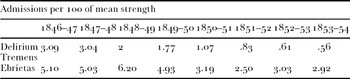
Hugh Macpherson, a surgeon in the Bengal army, also observed this supposed down-turn in drink in the 1850s. Macpherson similarly attributed the decrease in drink-related admissions to hospital to the more carefully-supervised introduction of beer into the canteen system. He tried to prove this by using statistics which tracked the numbers of men admitted for delirium tremens and brain fever in the 8 years from 1846 (see Table 2).
Showing the admissions into hospital on account of drunkenness and the brain fever of drunkards, among European soldiers in the Bengal Presidency in each of the 8 years ending 1853–1854

Source: Macpherson, ‘Analysis of the Later Medical Returns of European Troops’, p. 238.
Singing similar praises, the author of ‘The European Soldier in India’ in 1858 happily noted that a new canteen recently opened in Calcutta on the plain between the fort and the town, so that the men would not be forced to go into the bazaars to seek refreshment. In this way, medical concerns led to increased racial segregation as men were encouraged to mix only with ‘their own’ in the safety of the military canteen. To prevent the dangers which so often accompanied intemperance and in common with the aims of the beer experiment, the Calcutta canteen provided ‘sound, drinkable liquor’ as well as a host of other amusements, including quoits, in order to draw men in for the evening.Footnote 75 While no doubt such ‘amusements’ and readily-available beer and liquor did induce more balanced behaviour in some men, it remained to be seen how canteen liquor, priced as it was so significantly higher than that available in the bazaar, could compete.
In addition to the introduction of beer and more carefully-managed canteens, the military made further alterations to encourage temperance through such measures as good conduct pay, which was first introduced in 1837. Through this measure, men with a clean conduct sheet for two years were entitled to receive an extra rupee each month following 16 years of service. This amount increased to two rupees a month after 20 years of service.Footnote 76 However, this system of conduct rewards was not without its problems. Until the Crown takeover in 1858, there was some disparity in the levels of conduct rewards administered to men in the Crown and Company armies. While invalids in the 1850s in Her Majesty's service could expect to receive an increase of pension based on good conduct, those men serving in the Company's army failed to receive this bonus.Footnote 77 Naturally, and like other pay-related issues such as batta Footnote 78, this provoked some resentment among the men.
F. S. Arnott, a Surgeon serving in the 1st European Bombay Regiment in 1854, thought an improvement in the health of soldiers in Bombay to be the result of a combination of factors. However, Arnott's factors, unlike those of the government and most observers on the subject, focused on changes to the soldiers themselves. These, in his view, included the recruitment of a better class of men into the service, better treatment of the soldiers, and the ongoing reorganization and professionalization of both medical and military services in India.Footnote 79 The men now recruited into the Company's service, he asserted, were ‘. . .men of great ability and intelligence, of respectable birth, of superior social position, and of excellent education’, with this, he noted that, ‘sobriety is gradually taking the place of drunkenness and sickness and mortality are yearly diminishing’,Footnote 80 Here again, the emphasis rested on the perceived class of the men. Arnott's stress lay on the recruitment of a different sort of individual than had previously been recruited for service in India.Footnote 81 Surgeons and commanding officers holding this view were in the minority, however.
While temperance societies and a few observers focused on the need to reform the men's behaviour, the government saw the greatest danger (with regard to intemperance) lying elsewhere. This menace took the form of illegal liquor vendors in both the bazaar and cantonment. The illicit sale of liquor threatened the government on a number of counts. Not only were the spirits unregulated and often adulterated with more noxious drugs, but as suggested earlier, their sale undercut the government-regulated liquor prices (and therefore threatened not only the profits garnered from the monopoly they retained on liquor sale in the canteens, but also the duties collected from licensed vendors). By this argument, ill-health and intemperance arose when the men wandered outside the cantonment walls in search of both liquor and women. Those who supported this thinking argued that grog, toddy and spirit shops sold the most poisonous and threatening of home-made liquors, laced with a cocktail of drugs and hallucinogens. Norman Chevers recounted tales of Flag Street in Calcutta, a street in the lal bazaar known for punch houses and debauchery.Footnote 82 The liquor available to soldiers in this area, he insisted, was the most dangerous variety, a rice-based spirit drugged with ‘. . .datura, cocculus indicus, gungah or. . .other narcotic[s]’.Footnote 83 Chevers described Flag Street as an area choked with a lair of wide, open sewers, around which these clandestine warrens of sin were located. Chevers assured his readers that entry to most punch houses came via a board laid over the open sewer. He recounted a story about one house in particular, which was linked to a number of sudden deaths. In this house (which was very popular with sailors), the incapacitated men were taken in to the back room and laid out across a plank on the floor to benefit from the cooler air. Unfortunately, it was the rush of the open sewer which ran below which produced this coolness and this resulted in a number of cases of cholera and a handful whereby men suffocated from the sewer fumes.Footnote 84
Chevers proposed a redevelopment of Flag Street based around contemporary medical thinking. Through the combined might of the military, government, local merchants, the Calcutta Municipal Commission and, of course, European medicine, he felt confident that such a plan would ‘sweep away the evils’ of Flag Street.Footnote 85 Based on its drainage and proximity to both Fort and shipping, officials would choose a new spot for the regimental bazaar. Next, Chevers proposed the construction of a proper sewer network for the area; the well-behaved amongst the Flag Street publicans could apply for permission to resettle in the new bazaar. Close to this ‘utopia’ (and to complete it), Chevers proposed the establishment of a lock hospital to receive those ‘prostitutes’ deemed to be infected with venereal disease.Footnote 86 Earlier regulations had attempted to draw a moral and administrative line in the dirt regarding the boundaries of cantonments. These projected the idea that moral and medical dangers lay outside this boundary. Chevers’ solution to this problem, therefore, was to integrate the outlying city into the regulatory fabric of the cantonment. The implications of a plan such as Chevers’ were immense. If seen to fruition, it would have combined control over the individual bodies of soldiers as well as the physical space they traversed. This ‘space’ had the potential to cover much of British India.
However, it is unlikely that such micromanagement of the troops would have been approved. Judicious as Chevers’ plan was thought to be, the costs involved in his proposals were high. After the massive expenditure involved in suppressing the 1857 revolts, and the further cost of maintaining greatly-increased numbers of European troops in India, Chevers’ carefully thought-out plans for everything from on-board ship sanitation to proper time and place for drilling, were simply too expensive and complex for the government to contemplate.
Instead the military released new sets of guidelines in 1858 for sanitation and the soldier's ‘mode of living’. These were more basic and laid out suggestions on lifestyle choices such as the advisable times at which to sleep and the ideal thickness of clothing.Footnote 87 These guidelines cautioned soldiers that, ‘A drunkard, or even one who drinks spirits freely without being intoxicated dies early in India’,Footnote 88 The military printed these sanitary commandments in both pamphlet and poster form and placed them in the barracks for the men to read. However, concrete physical plans, such as those proposed by Clark, Ainslie and Chevers remained unrealized.
This series of regulations and medical tracts played an extremely significant role in constructing the idea and physical reality of military space in the early nineteenth century. The increasing boldness of the regulations suggest that as the Company grew more confident in their control and expansion across India, they were more willing to directly involve themselves in the daily lives of a growing number of Indian subjects. In each instance, the reasons given for the introduction of each was a greater concern for the health of the European soldier. As exemplified in the 1836 Bengal General Orders, the men's health was central to the decision-making of the military and medical boards. As the European soldiery represented such a costly and essential asset to the Company and Crown, the boards and surgeons alike confidently and aggressively laid out their demands regarding spatial and bodily control—for the men's health—in and around the cantonments. This spreading control reflected a broader militarization of the colonial state.
Disorderly European women
For those attempting to forge a new medical and moral order within the cantonment, it was all too easy to blame the supposedly untrustworthy Indians ‘lurking’ in bazaars whose ‘natural habits’, it was alleged, predisposed them to vice. However, when the guilty party was a European woman, blame was quickly reconstructed to suit a separate, but complementary set of class-based assumptions. Some of the European wives and widows of soldiers sold liquor illegally in the bazaar or ran small operations out of their quarters. It was alleged that a number also prostituted themselves, at times with the understanding or support of their husbands. These facts raised a complex set of problems for commanding officers and the government alike. Such violations came at a time when there were still active debates surrounding the wisdom of allowing increased numbers of European women into India. The presence of European women in India raised a number of fears for many Company officials. Many felt that such an influx had the potential to severely disrupt the recently-attained balance in society. In addition, European women were generally believed to be too ‘delicate’ to withstand the rigours of India and therefore the accompanying unavoidable medical costs concerned the Company. Both debates shared a common vision of the European woman. The image of the ‘pure’ and delicate European female was used by early Company officials in order to prevent their entry to India as well as later imperial propagandists who encouraged their ‘domestication’ of the empire alike to suit their respective need.Footnote 89 As Ann Stoler has argued (with regard to Southeast Asia) the attitude towards ‘poor whites’ and white women were closely linked and inherently problematic.Footnote 90 Similarly, in India, problems arose when the very same European women were accused of a wealth of vices within the Indian cantonments. It was imperative therefore, that such women were portrayed as symbolically (and often physically) separate from the desired ideal of European womanhood. In a strikingly similar manner to how Indian women deemed to be ‘prostitutes’ were dealt with, ‘dissolute’ European women were systematically ring-fenced and pronounced to be both of low-class and bad character and they were often ordered to be physically removed from the cantonment. It was stressed that such women were anomalies, distinct from the ‘respectable’ and ‘quiet’ women of the regiment.
Opinion as to the reasons why some European wives of soldiers carried out activities such as the illegal sale of liquor and prostitution in cantonments remained divided. On the one hand, some observers suggested that the ‘type’ of European woman who came out to India to find a husband was of the same degraded moral stature as the men themselves, and accordingly, she ‘naturally’ engaged in these activities. On the other hand, was a smaller group who argued that the pay of the married soldier was so miserly that women were forced into such activities to supplement their husband's earnings and support their families. An 1825 correspondence between G. A. Weatherall, Secretary to the Commander in Chief at Fort Saint George and Thomas Munro, Governor of Madras, captures these two arguments. On writing his proposals for checking the illegitimate sale of liquor within the cantonment, Weatherall argued that the illicit sale of liquor within cantonments would quickly be checked if the government were willing to grant an increased allowance to the wives and children of soldiers.Footnote 91 Munro responded by swiftly dismissing Weatherall's claim, noting, ‘If the selling of spirits were confined to women having families the argument would be conclusive, but. . .I believe that the practice is owing less to real want than to abandonment and the thirst of gain’.Footnote 92 Clearly belonging to the military school of thought which sought to restrict the number of European women entering India, Munro appeared to maintain a vision of a military space denuded of women as essential to maintaining Company rule in India. It is no coincidence that in this same Minute, he also dismissed requests to provide greater support to the half-caste families of European soldiers. Such relief, Munro claimed, would only encourage a proliferation in their already large numbers.Footnote 93
Munro's obvious prioritization of economy and restrained spending pointed to the economic concerns present throughout the 1820s and 1830s. However, his response highlights just how important economic considerations were in determining approaches to medical, moral and social control within military spaces. Munro suggested that his decision had been made on ‘moral’ and ‘humanitarian’ grounds, however, his preoccupation with cost reveals that such decisions were never clear-cut. Military and government decision-making operated in a space restricted by a number of important parameters, including fiscal and health concerns. Munro's suggestion for a solution to the problem of soldiers’ wives selling liquor was simple—restrict the number of European women allowed to come out to India, as the cost of maintaining such a body of European wives and children had become a heavy burden to the Company.Footnote 94
The anonymous author of ‘Soldiers; their Morality and Mortality’ further corroborated Munro's vision of the dissolute, greedy and lustful soldier's wife:
There are two classes of soldiers’ wives—those who have been born in India, and those who have been introduced from Europe. The former, particularly if their skin is of a darker tinge, are rather looked down upon in Her Majesty's regiments, but we are bound to say that this is most unjust. They are usually superior, intellectually and morally, to their European sisters. . . The wives who are brought from England have been for the most part inhabitants of sea-ports and garrisoned towns, but a few were once rural maidens, ignorant of the world until they saw one of its phases in a barrack.Footnote 95
He goes on to insist that many of the women, when faced with intemperate husbands, simply fell in with the common habits in the barracks and in this way, quickly transformed into ‘Doll Tearsheets’.Footnote 96 The only women of the regiment who managed to escape this fate were those who refused to mix with the other women within the regiment.Footnote 97 In these instances, the ‘low-class’ European woman was seen to be ‘naturally’ inclined to such activities. Yet, pivotally, unlike her husband, these wives were deemed eligible for punishment for such activities.
Regardless of where an observer's sympathies lay, European women who were repeatedly caught selling liquor (or engaging in illicit prostitution) were seen as hugely disruptive to the good moral order of the cantonment. To solve this dilemma, commanding officers often requested permission to expel such women from cantonment lines. Lone women who had left their husbands and the widows of soldiers were as threatening as the single daughters of soldiers, all of whom could easily disrupt the equilibrium of the cantonment. Lieutenant Colonel Henry Havelock, in 1848 serving as Deputy Adjutant General of Bombay, wrote of one such woman in the Deesa cantonment, whose husband was serving in Karachi and whose presence in camp was, in his view, problematic.Footnote 98 Havelock argued that it was within the rights of the Adjutant General to forcibly expel her from the cantonment, but worried that if she roamed freely about the surrounding areas, her dissolute behaviour would serve to ‘disgrace the European character in the eyes of the natives’.Footnote 99
The practice of expelling ‘dissolute’ European women from the cantonments and sending them to Europe was a well-established one. General Orders issued in Madras in 1813 reveal that such women had, until that point, been treated as prisoners until their return to England could be arranged. The 1813 orders discontinued the practice of imprisoning the women at Poonamallee, but maintained the government's right to forcibly return them to England.Footnote 100 The objection made to imprisoning the women prior to their departure mainly came on account of expense. However, the practice of enforced return remained a favoured option and women deemed to be ‘dissolute’ or ‘irregular’ continued to be handed over to the custody of the Town Major to await their deportation to England.Footnote 101
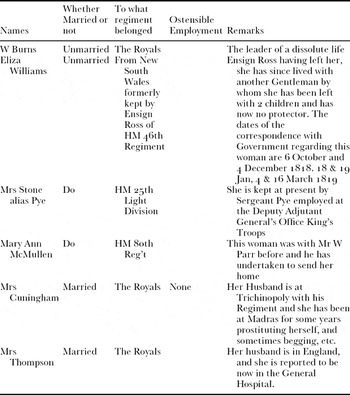
The idea of a more punitive control over ‘unprotected’ European women was highly appealing to many military officials. Such women (either loosely married or widowed), who failed to comply with the moral imperatives dictating married life in the cantonments, were often accused of ‘idleness’ even if they were not themselves involved in illegal activities. In 1822, the Madras Superintendent of Police went as far as to suggest that all women, not ‘belonging’ to the troops be required to register with the Town Major and be subject to surveillance.Footnote 102 In this way, any improper behaviour could be swiftly detected and it would then be easier to report women whose behaviour fell foul of cantonment rules. This plan would extend beyond ‘unattached’ women, however. He suggested that all European wives and widows of soldiers and officers be issued with regimental passports, which they would be required to produce when travelling outside regimental lines.Footnote 103 Even without such official sanction, the cantonment police often kept single and widowed European women under unofficial surveillance. When asked to produce a detailed list of ‘troublesome’ European women for the Secretary to Government, Mr Ormsby (Superintendent of Police at Fort St George in 1823) in reply, quickly produced a detailed list of the women's whereabouts and activities (see Table 3).
European women who led a dissolute life in Madras, as also of those left without protection

Source: Letter to the Secretary to Government from Mr Ormsby, Superintendent of Police, 22 February 1823. TNSA, Fort St George Public Consultations, 28 February 1823.
Upon receiving Ormsby's list, the Secretary to Government ordered the arrangement of a sea passage back to England for the six named women. However, the women themselves, who appeared to have little desire to return to England, foiled these plans. Upon receiving written notification from Ormsby that they were to prepare for embarkation, Eliza Williams and Mary Ann McMullen wrote back stating their inability to return due to their health (Macmullen was pregnant while Williams noted her condition to be ‘delicate’).Footnote 104 Ms Burns wrote Ormsby a similar letter from Wallajahabad, sending her regrets, but noting that she had left Fort St George on account of her ill-health for a much-needed change of air. Mrs Pye, like Mrs Thompson, was found to be convalescing in the General Hospital. No specific report was given on Mrs Cunningham, although from Ormsby's remarks, she appears to have been the most ‘threatening’ of the six, as she was found to be directly engaged in prostitution and begging. In other instances, where the Town Major had arranged transportation for women back to England, they fled before their ship was due to sail.Footnote 105
Women who remained married to their husbands, but who displayed signs of ‘abandonment’ posed an additional problem. In such cases, the military sought to protect the men. Men serving in higher positions were seen to have their reputations at stake, but even in disputes between soldiers and their wives, the decision on the woman's right to remain in India remained firmly with the husband. ‘Abandoned’ wives were routinely sent back to England after first obtaining the permission of their husbands.Footnote 106 Husbands, having fallen out with their wives, could also request their return to England, citing the women's behaviour or general misconduct. Should a wife remain in camp without permission while the regiment moved on and later wished to join her husband, it was entirely left up to him as to whether she be allowed to do so. If he refused, government sought his permission for her removal to England. It would appear that most local magistrates willingly agreed to this compulsion. However, there were a handful of dissenting opinions. In 1865, remarking on the case of a Mrs Philips, the wife of a sergeant in the army, the Judge Advocate General wrote his opinion that neither civil nor military authority had the power to deport her by means of compulsion or without her consent. Nevertheless, in response to this, the Officiating Secretary to Government noted that although it was not permissible to use violence to compel Mrs Philips to leave, her husband's consent would serve as a bar to any civil action taken against the Government.Footnote 107 In a separate case a few years later involving two women in Ahmedabad who were reported to be bad characters (by virtue of their heavy drinking, violent tempers and obscene language), the Adjutant General ruled that with the consent of their husbands (one of whom was serving in Abyssinia and the other in the Bombay jail), they could be sent to England.Footnote 108 This line was, however, blurred somewhat when the subjects in question were the daughters of soldiers (many of whom had never lived in England) accused of leading ‘dissolute’ lives. This once again raised the thorny issue of what it meant to be a ‘European’. Here, it became more difficult to force women ‘home’ who had never set foot on British soil.
In 1862, the Government returned to the idea of a designated prison for dissolute European women. One proposal questioned if it would be more efficient to establish such a jail for European women in the hills, or at least in a ‘healthy’ location far enough away from any military stations.Footnote 109 However, in response to this query, the Quarter Master General at Fort St George returned to the ever-important concern of cost. He felt that the cost of sending the women to England was still cheaper than establishing and maintaining a separate jail for them, and, as such, the idea appears to have been set aside. A similar bill was proposed and rejected in Bombay in 1865, again on the grounds of expense.Footnote 110
European women living in the cantonments in India in the early nineteenth century occupied a curious position both socially and legally. As a symbol of white womanhood, they were held up as supposed examples of civilization, yet the reality in many cantonments was much more complex. As in England, many women moonlighted in more marginal occupations in order to supplement the meagre incomes of their soldier husbands. The army and government alike resented these informal sidelines and deemed them illegal. As such, the army blamed these European women for disrupting the order of the cantonment and endangering the men's health. Punishment for carrying out illegal activities in the cantonment which led to the men's intemperance divided along racial lines. Indian camp followers and cantonment dwellers were subject to surveillance, corporal punishment and expulsion from the camp for any ‘disorderly’ behaviour. While European women living in the camps were still subject to surveillance, there is no evidence that they were ever subject to corporal punishment (nor was it discussed). The preferred method to discipline these women was the threat of expulsion from the camp and forced return to Britain. Although, both punishments were unquestionably unpleasant, the fact of a difference between the two further reinforced the idea of racial difference.
Disgraceful, subversive and disorderly: courts martial and punishment in the cantonment
The exponentially increasing punitive power over Indians and European women handed to military officials was, ostensibly, to protect the health of the soldiers. However, this period did not witness a similar expansion in their power to punish the European soldier for placing his own health at risk through intemperate behaviour. This begs the question—which offences were solders formally punished for? When army and medical men lay so much stress on health and physical threats from without, what was their response when the men brought harm upon themselves or others through their ‘misbehaviour’? Punishment of soldiers in the cantonment was administered in a number of ways, from the informal (for example, assigning extra duties or withholding pay), to the formal (in this case, the Regimental, District or General Courts Martial).Footnote 111 However, with drink being such a concern for officers, it is important to examine how the army dealt with drunkenness and misbehaviour.
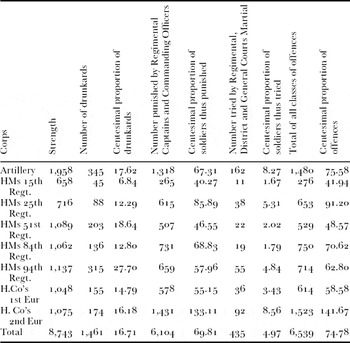
Anxiety about the level of drunkenness amongst the troops was not strictly limited to medical concerns. The predominant belief among external observers and officers alike was that drink fuelled the majority of crime committed by soldiers. It would appear that such fears were justified. Observers on the subject of drink argued that the majority of courts martial on European troops were on account of the men's habitual drunkenness. An 1842 conduct report on the 1st European Light Infantry noted that although the regiment was generally well-behaved, a spate of courts martial took place in the four months following the regiment's return from Afghanistan. During this time, the report recounted, the men, having received their back pay, drank more than normal and an outbreak of crime ensued.Footnote 112 While this swell of courts martial is impressive in itself, what is perhaps even more significant is the fact that most offences and incidences of ‘bad behaviour’ and drunkenness within the cantonment were punished without recourse to court martial.Footnote 113 The ‘character books’ kept in every regiment on the men support this fact. In these books, officers carefully recorded any misconduct by the men along with accompanying punishments.Footnote 114 These reveal that a badly-behaved soldier often needed to commit a number of offences before any formal action was taken to castigate him. Monier Williams and the author of ‘Soldiers; their Morality and Mortality’ both cited examples of drunkenness and punishment (the latter in Madras) to support this claim that most punishments, both formal and informal, came as a result of drink (see Table 4).Footnote 115
Drunkenness and punishment in Madras, 1847

Source: ‘Soldiers, their Morality and Mortality’, p. 196.
Unfortunately, because few accounts have survived, it is difficult to more broadly confirm these assertions. From the few records which are available, however, it would appear that there is strong evidence to support these claims. Moreover, even those men formally accused of drink-related offences were not always convicted. Acquittals often resulted even in seemingly clear-cut cases (such as when men repeatedly appeared drunk on duty or suffered from delirium tremens).Footnote 116 However, this fact seemed to depend upon a number of factors. These included (but were not limited to), the rank of the offender, whether the bouts of drunkenness were conducted in a public or private place (i.e. in town or on regimental parade versus in the barracks or canteen) and whether any additional misbehaviour or violence was also involved.
A clear distinction existed between attitudes towards those soldiers court martialled for drink or bad behaviour and officers accused of the same.Footnote 117 For many of the cases in which soldiers were called before a court martial, the case had been brought only following especially severe misconduct and/or repeated bouts of public drunkenness. With higher officials, on the other hand, the public nature of their bad behaviour was a far more damning offence. Intemperate behaviour from a man in a position of power suggested a loss of order and, related to this, a threat to public confidence in the moral and physical ability of Europeans to control India. Bad behaviour, it was implied, would place Europeans on a similar moral level as Indians; this was to be avoided at all costs. However, this is not to imply that soldiers were dealt with any less severely for their ‘crimes’, but simply that such transgressions were more often punished using more informal means. Legal observers believed that the public shame which accompanied a court martial was much more effective in disciplining men of officer rank. Again, this highlights the ‘moral’ and class separation of officers from the rank-and-file. An officer was seen to be an individual, a man of dignity and honour. Such a man would naturally be ashamed by the process of a court martial. The soldier, on the other hand, was thought to be much more a slave to his natural [read: carnal] impulses. In this light, as a more animalistic creature, a process which called his dignity into question would less easily abash the soldier. Therefore, military officials saw more tactile, physical punishments as more effective.
A public display of ‘insensibility’ was enough to strip those in more senior ranks of their position and earn them a discharge from the service. Such was the case for Lieutenant Dick of the 74th Regiment Native Infantry who was charged with ‘conduct scandalous and highly disgraceful to an officer and a gentleman’ in having been drunk on multiple occasions and, in consequence, taken in by the Calcutta town police on repeated occasions.Footnote 118 There is no suggestion that Lieutenant Dick behaved aggressively or committed a physical offence, per se. The core of his crime was in the public nature of his drunkenness—in the shame of a lieutenant being seen inebriated on a street in Calcutta. Such a display, which was expected of the ‘lower’ ranks, was simply unacceptable for men who had reached his rank (and, perhaps more importantly in Dick's case, one assigned charge of the native troops).
It was not just officers who were held to a different standard than the rank-and-file. This divide treated surgeons as part of the officer class. The punishments handed down to surgeons for misconduct reinforces this point. In addition to being charged with conduct ‘unbecoming’ and ‘disgraceful’, Assistant Surgeon Alexander Storm of the 51st Regiment, Native Infantry, was charged with a raft of other offences, including contempt of authority, disobedience of orders and neglect of duty.Footnote 119 From what remains of the proceedings of his trial, it appears that Storm had appeared drunk in front of his Commanding Officer. When accused of the offence the following day, he had responded rudely and violently. Following his arrest (which he resisted), Storm had barged in drunk to the quarters of the brigadier commanding his regiment. Finding Storm guilty and sentencing him to suspension from rank, pay and allowances for 6 months, the court noted that they had issued a ‘lenient’ sentence. They made clear that they had granted such clemency on the grounds that Storm was a habitual opium-user (purportedly for medicinal purposes) and they considered it most likely that his state of intoxication was concomitant with the effects of the drug.Footnote 120
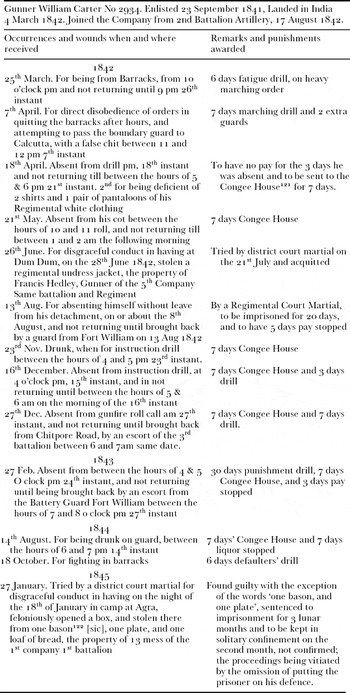
While the military courts martial severely sanctioned officers for their intemperance, a measure of bad behaviour appeared to be expected of the soldier. Courts martial against the rank-and-file often involved a repeated pattern of bad behaviour or the commission of a serious offence. Typically, punishment for general misconduct was by less formal means, including extra duties or pay stoppages. The character book of one Gunner, William Carter, of the 1st Company 1st Battalion Artillery, provides particular insights in its illustration of different types of punishment inflicted (see Table 5).
Extract from the Character Book of the 1st Company, 1st Battalion Artillery, Agra, 28 February 1845

Source: Extract from the Character Book of the 1st Company, 1st Battalion Artillery, 29 February 1845. Proceedings, 28 March 1845, no. 82. NAI, Home (Military).
From this, it appears that Carter was in the habit of ‘wandering’ out of the cantonment, an action frequently lamented by surgeons in their reports due to the high level of illness which often followed such peregrinations (the understanding being that men either wandered off in search of drink, women or other forms of ‘dangerous’ amusement, and returned drunk, venereal or both). Interestingly, despite his wanderings, Carter was punished only twice for drunken behaviour, first on 23 November 1842, while he was on instruction drill, and second on 14 August 1844, while he was meant to be on guard. Carter's other instances of drunken behaviour were overlooked, but these two instances were targeted as he was, after all, meant to be on duty. As such, these instances of public drunkenness potentially threatened the general discipline of the corps. Carter's numerous absences from barrack or cantonment, while possible court martial offences, instead earned him time in the Congee House or additional drill. Indeed, his liquor allowance at the canteen was stopped only after his second instance of drunkenness. Carter's repeated misconduct did, however, add up; following the theft of Rs. 64 from the kit box of a corporal, a district court martial sentenced him to corporal punishment and dismissed him from the service with ignominy.Footnote 123 The pattern of punishment evident from Carter's character book is further supported by the more general record kept of drunkenness and punishment in Madras in 1847 (see Table 4). These figures suggest that the majority of drink-related offences were informally punished by captains and commanding officers, with only a relatively small percentage of those (though still significant numbers) progressing as far as the court martial stage.Footnote 124 Whilst the number of soldiers brought before a courts martial on drink-related offences was significant, as evidenced by the Madras figures, it represented only a very small number of those punished in other ways for their intemperance. Army officials picked their fights carefully when it came to the soldiery. Clearly, the fact that individuals like Carter, who committed multiple offences (many of which were grounds for dismissal), were retained suggests that the army was desperately short of suitable European recruits. The quality of the recruits made the Company all the more vulnerable. Not only was punishment adapted for fear of invoking mutiny, but, once again, it exposed the uneasy control which officers held over their European soldiers.
Conclusion
The soldier seemed destined to maintain his ‘lowly’ status. From attitudes and measures taken to control intemperance to the punishments themselves, officials viewed the European soldier in the first half of the nineteenth century in India as little more than a fighting machine. Yet, paradoxically, as he represented such a high cost for the Company, control over his health and behaviour was of vital importance. Measures to expand military control within and beyond the cantonment were frequently justified on the grounds of the men's health.
Central to these measures was the ever-present anxiety surrounding what is best described as the social and leisure activities of the soldiers. Linked, directly as they were, to health and therefore productive ability, there was an effort made, beginning in the early nineteenth century, to control and manage these activities. The low esteem in which the soldier was held helps to explain why proposals to shift the focus from alcohol to ‘healthier’ drinks and activities such as gardening, theatres and reading, were not adopted by either the Company or Crown for much of the first half of the nineteenth century.
Yet, as fearful as officials were of the effects of alcoholic and bodily intemperance, there remained a belief that both were somehow inherent to the soldier's very being. This juxtaposition goes some way towards explaining why it was that little real progress (or even effort) was made in reducing the amount of alcohol which soldiers consumed. Instead, it clarifies the alternate approach adopted—to regulate the ‘others’ in the cantonment who supplied the men with drink. In this light, the carefully balanced ‘proper’ functioning of the cantonment was seriously threatened by both those individuals outside its boundaries who attempted to lure soldiers away, as well as those who represented a ‘fifth column’ within, such as the wayward wives of European soldiers. These European wives who participated in ‘immoral’ activities (such as prostitution and the illicit sale of liquor in the barracks) were the focus of extreme anger and censure from both commanding and medical officers. Similarly, those arrack vendors in and around the cantonments who operated without government permits not only deprived the treasury of valuable revenues, but were thought to produce a much more lethal variety of spirits.
Perhaps most importantly for the formation and understanding of the empire, however, were the consequences of this approach. As countless invasive regulations were justified on the grounds of protecting the health of the European soldier, the Company pushed out the boundaries of the actual physical space under their control. Medical (and moral) demands made by officers, were quickly fortified and validated through regulations which expanded military space and gave greater, more absolute punitive power to commanding officers not only over soldiers, but over all those who came into contact with them.