Introduction
Ensuring global food security now and for the future is one of the greatest challenges of our time (FAO, IFAD and WFP, 2015). The UN World Population Prospects, 2017 revision, estimates current world population at 7.6 billion rising to reach 8.6 billion in 2030, 9.8 billion in 2050 and 11.2 billion in 2100 (United Nations, 2017), therefore pressure on food production systems is likely to increase dramatically (FAO, 2015). The need to address growing food insecurity and mitigate the adverse impacts of climate change has highlighted the need to maximize breeder's use of the entire breadth of Plant Genetic Resources for Food and Agriculture (PGRFA) (Maxted et al., Reference Kell, Maxted, Bilz, Maxted, Dulloo, Ford-Lloyd, Frese, Iriondo and Pinheiro de Carvalho2012; FAO 2015). The greatest breadth of adaptive trait diversity is found in crop wild relatives (CWR) because they have not passed through the domestication bottleneck (Tanksley and McCouch, Reference Tanksley and McCouch1997).
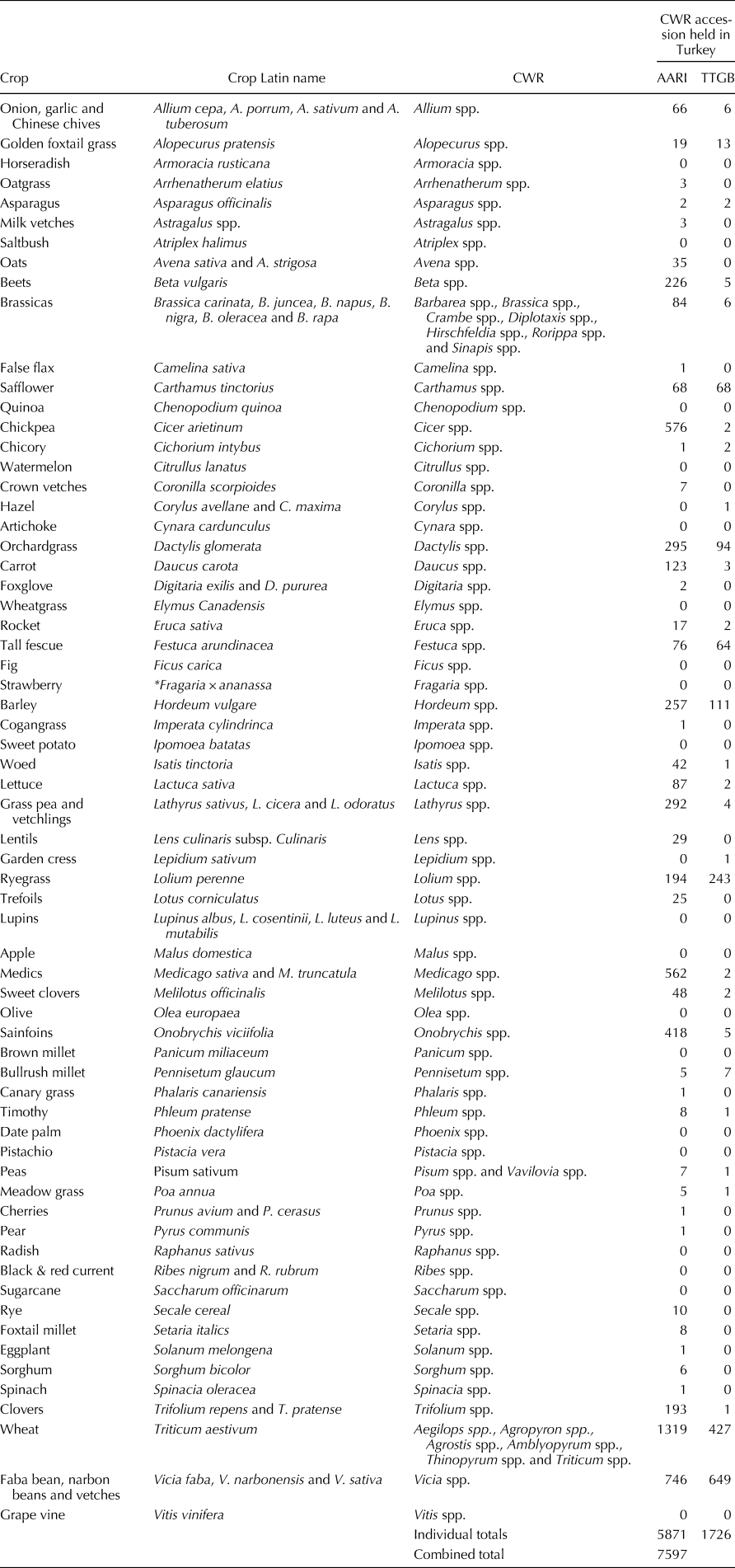
Globally Turkey is a well-recognized region of floristic diversity of approximately 11,000 higher plant taxa (Davis et al., Reference Davis, Mill and Tan1965–1988), has two Vavilov centres of crop diversity (i.e. the Mediterranean and the Near East) (Vavilov, Reference Vavilov1926), is recognized as the cradle of agriculture providing the northern boundary of the Fertile Crescent (Breasted, Reference Breasted1916), and has recently been identified as the country with the highest concentration of CWR diversity (Vincent et al., Reference Vincent, Wiersema, Kell, Dobbi, Fielder, Castañeda Alvarez, Guarino, Eastwood, Leόn and Maxted2013). In the global analysis of priority CWR distribution, Vincent et al.(Reference Vincent, Wiersema, Kell, Dobbi, Fielder, Castañeda Alvarez, Guarino, Eastwood, Leόn and Maxted2013) found the Eastern end of the Mediterranean Basin was home to 262 out of the 1667 global priority CWR taxa for 173 crop complexes, and Turkey itself contained 189 of these taxa. Turkey has two Plant Genetic Resource Centres, the Aegean Agricultural Research Institute (AARI) and the Field Crops Central Research Institute (TTGB), both of which have extensive CWR collections (Table 1). While Turkey has an extensive network of protected areas, none were selected to specifically conserve in situ CWR diversity, although affording some degree of protection to CWR diversity (Tan, Reference Tan2009). Possible sites for in situ conservation of CWR were studied at Kaz Dag (Aegean Anatolia), Amanos, (Southern Turkey) and Ceylanpinar (in Southern Turkey) between 1993 and 1998 (Ertug Firat and Tan, Reference Ertug Firat, Tan, Maxted, Ford-Lloyd and Hawkes1997), but these sites were not formally established. More recently the 122 Important Plant Areas of Turkey have been mapped and it is hoped that their identification will in the long-term engender greater in situ conservation at these locations (Özhatay et al., Reference Özhatay, Byfield and Atay2005).
Genebank ex situ holding of CWR germplasm in Turkey

* hybrid species.
The aim of this paper is systematic conservation planning of CWR taxa in Turkey, ensuring both effective in situ and ex situ conservation of this vitally important global resource. The specific objectives include (a) identification of regions of CWR concentration, (b) recommended existing protected sites that could form the basis of in situ genetic reserves to conserve both taxon richness and ecogeographic (as a proxy for genetic) diversity, (c) identification of areas outside formal PAs for in situ conservation actions, and (d) areas where additional ex situ population samples should be collected. The methodology used is based on that proposed by Maxted et al. (Reference Maxted, Dulloo, Ford-Lloyd, Iriondo and Jarvis2008a, Reference Maxted, Castañeda-Álvarez, Vincent, Magos Brehm, Guarino, Ramanatha Rao and Goldberg2011, Reference Maxted, Magos Brehm and Kell2013), Ramírez-Villegas et al. (Reference Ramírez-Villegas, Khoury, Jarvis, Debouck and Guarino2010) and Magos Brehm et al. (Reference Magos Brehm, Kell, Thormann, Gaisberger, Dulloo and Maxted2017), and has been successfully applied by Maxted et al. (Reference Maxted, Dulloo, Ford-Lloyd, Iriondo and Jarvis2008a), Maxted and Kell (Reference Maxted and Kell2009), Vincent et al. (Reference Vincent, Wiersema, Kell, Dobbi, Fielder, Castañeda Alvarez, Guarino, Eastwood, Leόn and Maxted2013), Castañeda-Álvarez et al. (Reference Castañeda-Álvarez, de Haan, Juárez, Koury, Achicanory, Sosa, Bernau, Salas, Heider, Simon, Maxted and Spooner2015), Fielder et al. (Reference Fielder, Brotherton, Hosking, Hopkins, Ford-Lloyd and Maxted2015), Khoury et al. (Reference Khoury, Heider, Castañeda-Álvarez, Achicanoy, Sosa, Miller, Scotland, Wood, Rossel, Eserman, Jarret, Yencho, Bernau, Juarez, Sotelo, de Haan and Struik2015), Phillips et al. (Reference Phillips, Asdal, Magos Brehm, Rasmussen and Maxted2016), Garcia et al. (Reference Garcia, Parra-Quijano and Iriondo2017).
Material and methods
The first stage in national CWR conservation planning is the production of a CWR checklist (Maxted et al., Reference Maxted, Magos Brehm and Kell2013), which is a list of all CWR present in the country. However, the checklist is likely to be too extensive to form the basis for effective conservation planning, so the checklist will need to be prioritized to form a more focused set of CWR taxa for active conservation planning. This was necessary for Turkey with an estimated total flora of 11,707 taxa of which about a third, 3649 are endemic (Güner et al., Reference Güner, Aslan, Ekim, Vural and Babaç2012). The first national CWR checklist for Turkey was extracted from the CWR Catalogue for Europe and the Mediterranean (Kell et al., Reference Kell, Knüpffer, Jury, Ford-Lloyd, Maxted, Maxted, Ford-Lloyd, Kell, Iriondo, Dulloo and Turok2008) using the country filter and it contained 7235 CWR taxa. The checklist was prioritized as proposed by Kell et al. (Reference Kell, Maxted, Bilz, Maxted, Dulloo, Ford-Lloyd, Frese, Iriondo and Pinheiro de Carvalho2012, Reference Kell, Ford-Lloyd, Magos Brehm, Iriondo and Maxted2017) using (a) the relative socio-economic value of the related crop using FAOSTAT data (FAO 2017), (b) the potential ease of use or known value of the wild taxon in crop improvement programmes using genepool and taxon group data (Vincent et al., Reference Vincent, Wiersema, Kell, Dobbi, Fielder, Castañeda Alvarez, Guarino, Eastwood, Leόn and Maxted2013), and (c) the relative level of threat to the CWR (Kell et al., Reference Kell, Maxted, Bilz, Maxted, Dulloo, Ford-Lloyd, Frese, Iriondo and Pinheiro de Carvalho2012; IUCN, 2017). Taxonomy nomenclature was confirmed using GRIN-ARS (https://npgsweb.ars-grin.gov) and only those taxa native to Turkey were included in the inventory.
Ecogeographic data for the priority CWR taxa were compiled from GBIF (GBIF, 2016), the herbaria and genebanks of the AARI (Anonymous, 2017a) and the TTGB (Anonymous, 2017b). Presence points consisted of GPS longitude and latitude coordinates and erroneous data, such as those with incomplete or inaccurate coordinates and incorrect or ambiguous taxon names, were removed. Analysis of taxon richness, observational bias and complementarity analysis was undertaken using the DIVA GIS programme (Hijmans et al., Reference Hijmans, Guarino and Mathur2012). Within DIVA GIS taxon richness was assessed using the Point to Grid function, the CWR name was chosen as the parameter, a new grid was created with cell size set at 0.5 and the output variable as Richness with No Data hidden. Observational bias used the analysis function point to grid and then Richness was selected, the CWR name was chosen as the parameter, a new grid was created with cell size 1 and the output variable was Number of Observations with No Data hidden. To assess the effectiveness of the current ex situ CWR conservation coverage, the predictive distribution (calculated from the existing georeferenced locations climatic envelop) was compared with the observed distribution based on the ex situ conserved accessions for the priority CWR taxa. Complementarity reserve selection employed the method proposes by Rebelo (Reference Rebelo and Huntley1994) to locate the most appropriate locations for the establishing a network of complementary reserve sites. Once grid cell locations were determined they were compared with the current protected areas network across the study region, using protected area data obtained from Protected Planet (http://www.protectedplanet.org). The above analyses were conducted on a grid cell size of 2 degrees (equivalent to 110 km2), which gave a large enough scale to be easily seen across the wide area of study but a small enough resolution to enable patterns of taxon distribution to be identified. All maps were displayed in WGS 84 projection.
Results
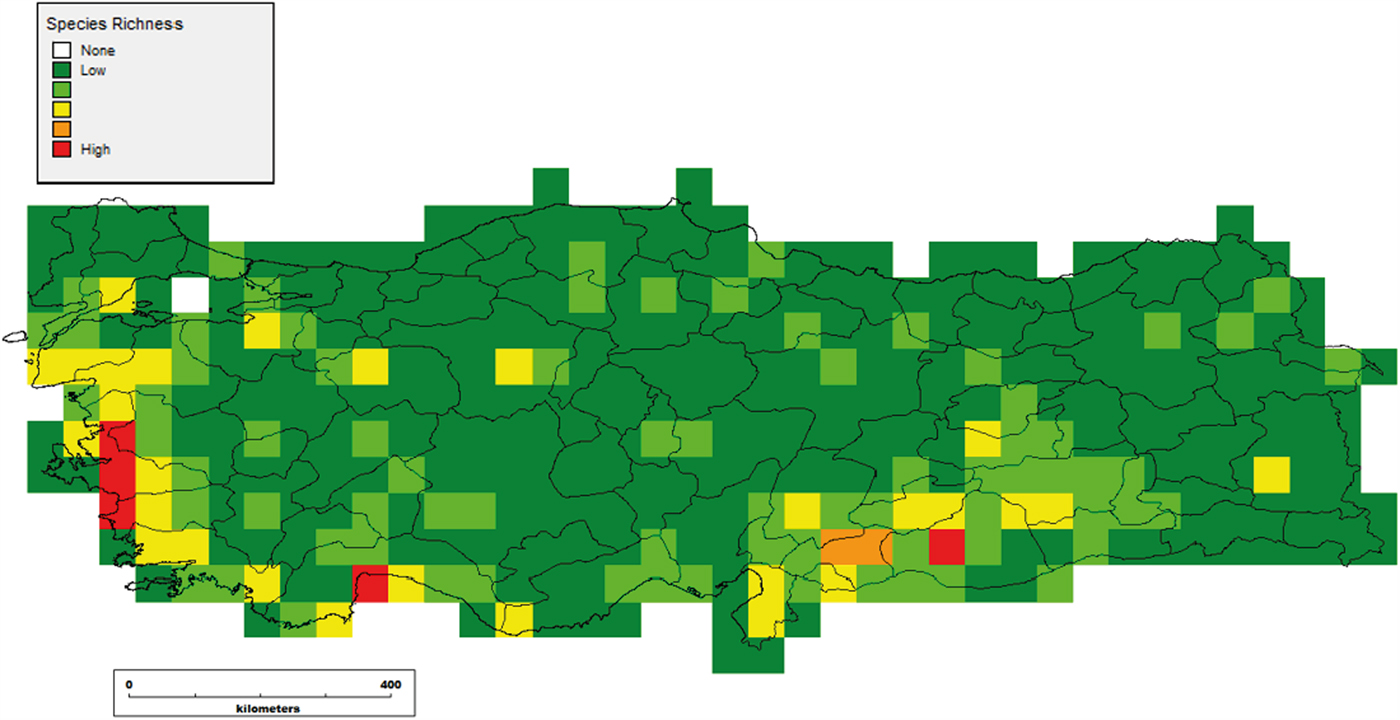
The final inventory of priority CWR for Turkey contained 764 CWR taxa from 79 genera and 20 plant families. These include 369 CWR taxa that are also included in the global priority CWR list (updated version of the Vincent et al., Reference Vincent, Wiersema, Kell, Dobbi, Fielder, Castañeda Alvarez, Guarino, Eastwood, Leόn and Maxted2013 list found at https://www.cwrdiversity.org/checklist/) (see online Supplementary Table S1). The ecogeographic dataset contained 27,597 georeferenced data points representing the 458 CWR taxa from Turkey with currently available georeferenced data (see online Supplementary Table S1). The taxon richness analysis (Fig. 1) highlighted the Aegean Coast and the Syrian border in the south of Turkey as the areas with highest CWR taxon concentration. The hotspots on the Aegean Coast were centred on the provinces of Izmir (61 taxa), Menemen (59), Bergama (57) and Kusadasi (53). On the Syrian Border, the hotspots were in the provinces of Gaziantep (63), Sanliurfa (58) and Diyarbakir (51). The southern Mediterranean coast of Turkey also had higher diversity with two hotspots in the provinces of Antalya (42) and Mersin (39).
Taxon richness of priority CWR taxa for Turkey.

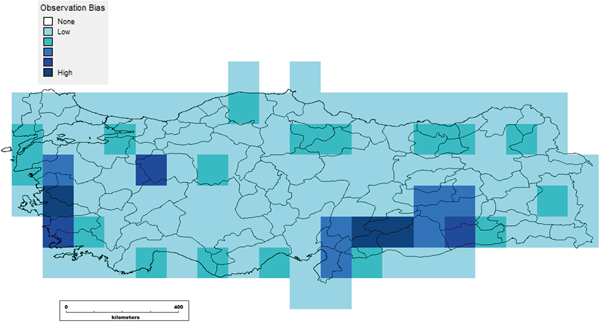
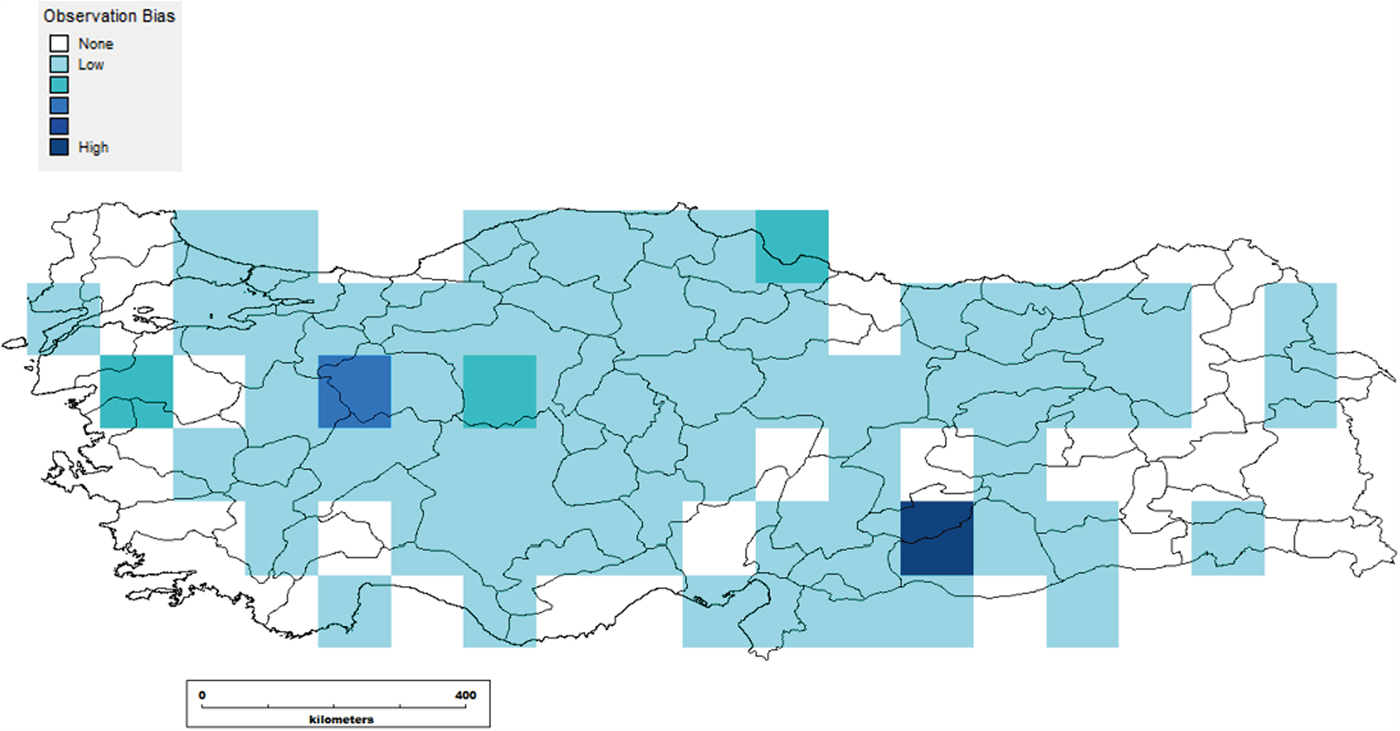
The areas with the highest number of presence points (Fig. 2), and therefore potential areas of observational bias occurred along the Syrian Border and the Aegean Coastline, followed by many observations (991) around Eskisehir. The largest number of observations were recorded from the provinces of Gaziantep, Sanliurfa and Adiyaman along the Syrian border, with 2558 observations, approximately 9% of all records. To assess current Turkish ex situ CWR conservation effectiveness predicted priority CWR taxa distribution was compared to that distribution based on the ex situ conserved accessions alone (Fig. 3) and distinct gaps were found near the Syrian border, followed by Eskisehir, Ankara, Balikesir and Samsun provinces. Further in terms of maximising genetic representation of ex situ collections, Brown and Marshall (Reference Brown, Marshall, Guarino, Ramanatha Rao and Reid1995) recommend the collection of 50 seeds from each of 50 plants per crop, if this were extended to each target CWR taxon in Turkey only 41 of 764 priority Turkish CWR taxa would have sufficient ex situ accessions. The full analysis found that 41 taxa had >50 ex situ accessions, 44 had 10–49 accessions, 87 had 2–9 accessions, 68 had one accession and 524 CWR taxa had no accessions in genebanks.
Potential observational bias of priority CWR taxa for Turkey.

Observations of ex situ accessions.

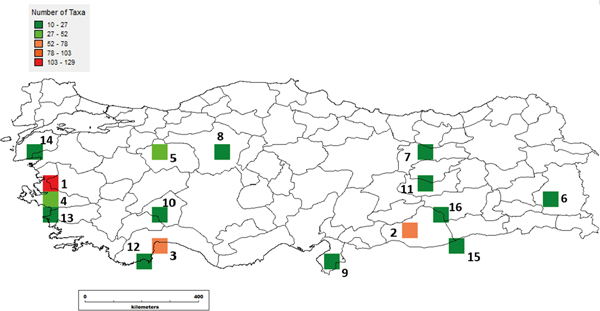
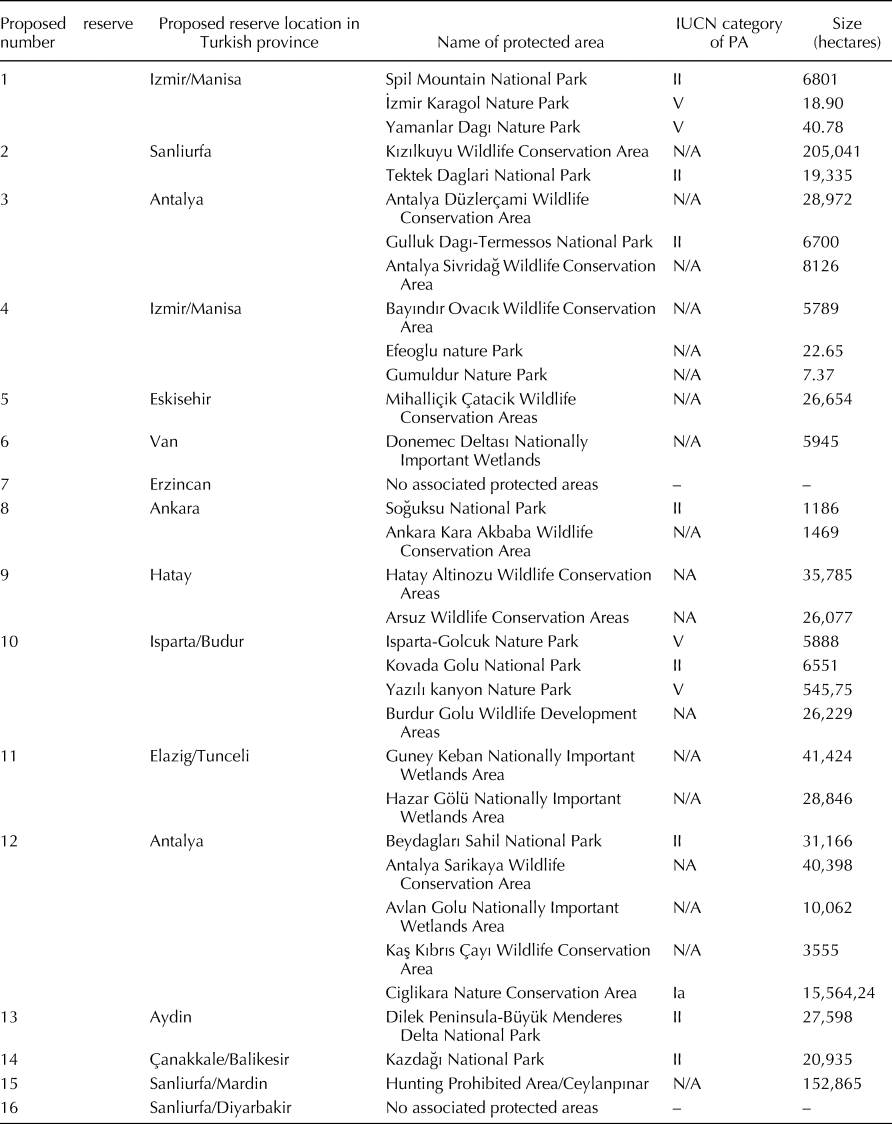
The complementarity reserve analysis identified 16 locations that contain 497 of the 764 priority CWR taxa – approximately two-thirds of the priority CWR taxa (Fig. 4). The analysis results indicate Izmir province (1) is the Turkish province with the highest priority for genetic reserve establishment with 129 taxa. The next two province locations are Sanliurfa (2) with 77 taxa, followed by Antalya (3) with 58 taxa. The next level of priority locations to establish in situ genetic reserves for CWR conservation are near Kusadasi in Aydin province (4) (33 taxa), site 5 in Eskişehir province (30 taxa) and to the south of Lake Van in Van province (6) (26 taxa). Most of the top 16 proposed locations identified included protected areas and these are summarized in Table 2; however, proposed reserve locations 7 and 16 in Erzincan and Sanliurfa/Diyarbakir provinces, respectively, have no known associated protected areas. The review of priority Turkish CWR taxon populations found 145 taxa are present in at least one existing protected area and 619 are not found in any existing protected area. To conserve all 764 priority CWR taxa in situ 165 complementary reserve locations were required. There is a total of 21,921 presence points for CWR taxa that are present within protected areas, which means 79.4% of recorded populations, if these populations still exist they are at least passively conserved. The 5676 CWR populations not present in any protected areas account for 20.6% of the predicted CWR populations, but account for 62% of the CWR taxa. For these CWR populations, the possibility of establishing novel protected areas, particularly in Gaziantep, Sanliurfa and Mardin provinces, or extra-protected area in situ conservation sites should be considered where the existing protected area network is less comprehensive.
Complementarity analysis of priority CWR taxa for Turkey.

Protected areas found within proposed reserve locations

Discussion
Turkey has a unique role in global agrobiodiversity conservation and use because of its distinct ecological and geographical features which have resulted in high floristic diversity per unit area, high levels of endemism and significant representation of European and the Middle Eastern Floras (CBD, 2001). However, the uniqueness and scale of its agrobiodiversity make it the most important global centre of agrobiodiversity, which also explains why it is regarded as the cradle of agricultural development (Breasted, Reference Breasted1916; Schwanitz, Reference Schwanitz1967; Filatenko et al., Reference Filatenko, Diederichsen, Hammer, Damnaia, Valkoun, Wilcox and Qualset1998; Harlan, Reference Harlan, Damnaia, Valkoun, Wilcox and Qualset1998). Therefore, effective in situ and ex situ conservation and use of agrobiodiversity in Turkey is a national but also a global priority.
In this paper, we have used genetic gap analysis techniques to help plan future conservation of Turkish CWR diversity. The georeferenced ecogeographic dataset and the basis for the analysis only contained representatives of 458 CWR taxa out of the 764 priority CWR taxa from Turkey (60%). Therefore, the findings of this gap analysis should be treated as an initial analysis and the gap analysis should be repeated when the ecogeographic data have been digitized for more of the 40% of the taxa which currently have no digitized data. The production of the Flora of Turkey (Davis, Reference Davis and Davis1965; Davis et al., Reference Davis, Mill and Tan1965–1988; Güner et al., Reference Güner, Özhatay, Ekim and Başer2000), the Check List of the Flora of Turkey (Vascular Plants) (Güner et al., Reference Güner, Aslan, Ekim, Vural and Babaç2012) and new Illustrated Flora of Turkey (http://www.isikguner.com/category/flora-of-turkey/) means that significant herbarium specimens are available for Turkish plants in Turkey and the specimen data can be digitized for future CWR gap analysis.
The taxon richness analysis (Fig. 1) identifies the Central Aegean Coast, Central Syrian border region and the Antalya/Mersin coast as particular areas of highest taxon richness. This concentration of CWR plant diversity is distinct from both the general pattern of plant richness (Babaç et al., Reference Babaç, Bilgin and Usta1997; http://www.tubives.com/index.php?sayfa=istatistik) and the more recently established Important Plant Area network (Özhatay et al., Reference Özhatay, Byfield and Atay2005). The first two of these areas, Central Aegean Coast and Central Syrian border (Fig. 2) have historically been collected more frequently than other regions of Turkey, which can be justified by the higher taxon richness of these areas. However, the relative concentration of CWR taxa throughout Turkey means that all provinces should be thoroughly surveyed.
The review of the effectiveness of current ex situ CWR conservation identified areas of high priority for future ex situ collection near the Syrian border (particularly in Sanliurfa province), followed by Eskisehir then Ankara, Balikesir and Samsun provinces. However, given that (a) out of the 764 priority Turkish CWR taxa, only 240 CWR taxa had accessions represented in genebanks (b) almost half of Turkey's provinces had no or few representative accessions in genebanks, and (c) even areas of high CWR taxon richness, such as the Aegean or Mediterranean coastlines, are obviously undercollected which indicates further CWR ex situ collection is recommended throughout Turkey. However, given the identification of the areas of Turkish CWR taxon richness above it may be considered expedient to start in the regions identified as CWR hotspots and areas where CWR surveying has yet occurred. Further, given the global importance of Turkish CWR diversity for international food security in the next century, this should be a global priority and international funding provided for the extensive collection work recommended.
The complementarity reserve selection analysis (Fig. 4) located more than half of the top 16 proposed reserve locations within the Aegean coast (sites 1, 4, 13 and 14), Syrian border region (sites 2, 9, 15 and 16) and Mediterranean coast (sites 3 and 12), which were already identified as Turkish CWR hotspots. Maxted et al. (Reference Maxted, Dulloo, Ford-Lloyd, Iriondo and Jarvis2008a, Reference Maxted, Iriondo, De Hond, Dulloo, Lefèvre, Asdal, Kell, Guarino, Iriondo, Maxted and Dulloob) argue that it is most resource effective to establish genetic reserves for in situ CWR conservation within existing protected areas by altering their management plans. The existing Turkish protected area network is currently conserving CWR diversity ad hoc and fortuitously, but more active conservation is required. Iriondo et al. (Reference Iriondo, Maxted, Kell, Ford-Lloyd, Lara-Romero, Labokas, Magos Brehm, Maxted, Dulloo ME, Ford-Lloyd, Frese, Iriondo and Pinheiro de Carvalho2012) propose that management plans should be revised to promote specific CWR management and monitoring to be considered CWR genetic reserves as has happened for genetic reserves in the UK (Fielder et al., Reference Fielder, Brotherton, Hosking, Hopkins, Ford-Lloyd and Maxted2015) and Norway (Phillips et al., Reference Phillips, Asdal, Magos Brehm, Rasmussen and Maxted2016). Although 165 complementary reserve would be required to conserve in situ all 764 priority CWR taxa, such an extensive is unlikely to be practical due to resource limitations, it is therefore recommended that the Turkish Network of CWR Genetic Reserves is initially established in the protected areas found within the 16 complementary sites identified. It is recognized that network establishment is likely to be implemented pragmatically, commencing with those sites whose managers appreciate the value of the network and wish to see the additional value being added to their protected area through making the food security link. Such an approach was taken when establishing similar networks in the UK (Fielder et al., Reference Fielder, Brotherton, Hosking, Hopkins, Ford-Lloyd and Maxted2015) and Norway (Phillips et al., Reference Phillips, Asdal, Magos Brehm, Rasmussen and Maxted2016). As noted above, proposed reserve locations 7 and 16 (Erzincan and Sanliurfa/Diyarbakir provinces) have no known associated protected areas and about 20% of predicted CWR populations are found outside of existing protected areas which historically were often established to protect mega-fauna, threatened taxa or unusual habitats assemblages. In the absence of protected area coverage either new protected areas need to be established, as suggested above, particularly in Gaziantep, Sanliurfa and Mardin provinces, or extra-protected area in situ conservation needs to be enacted as discussed by Maxted et al. (Reference Maxted, Dulloo, Ford-Lloyd, Iriondo and Jarvis2008a, Reference Maxted, Iriondo, De Hond, Dulloo, Lefèvre, Asdal, Kell, Guarino, Iriondo, Maxted and Dulloob).
Supplementary material
The supplementary material for this article can be found at https://doi.org/10.1017/S1479262118000564.