Introduction
During the last two decades, the business group has not only become a ubiquitous organizational form, it is often seen as the main driver of economic growth in many emerging or transition economies, such as Taiwan, Korea, China, India, etc. Therefore, the operations and performances of business groups, particularly in emerging markets, have drawn much attention from researchers in the fields of management and organization. Related empirical studies and theoretical interpretations on the performance of business groups in emerging markets has been one of the most important issues in recent organization studies (Khanna & Palepu, Reference Khanna and Palepu1997; Hoskisson, Eden, Lau, & Wright, Reference Hoskisson, Eden, Lau and Wright2000; Khanna & Rivkin, Reference Khanna and Rivkin2001; Wright, Filatotchev, Hoskisson, & Peng, Reference Wright, Filatotchev, Hoskisson and Peng2005; Yiu, Bruton, & Lu, Reference Yiu, Bruton and Lu2005).
In this research, ‘does the business-group effect matter?’ is one of the fundamental questions. Several related studies have found that the business-group effect determines the affiliated companies’ performance to a substantial degree (Chang & Choi, Reference Chang and Choi1988; Khanna & Rivkin, Reference Khanna and Rivkin2001; Chang & Hong, Reference Chang and Hong2002; Galbreath & Galvin, Reference Galbreath and Galvin2008). However, few studies use Taiwan as a sample to explore business-group effects. In a study on 14 emerging countries, Khanna and Rivkin (Reference Khanna and Rivkin2001) argue that different business-group effects among countries correlate with distinctive country conditions. However, further data collection and empirical inquiry are needed.
Dissimilar to business groups in other countries, such as Korea and Japan, Taiwanese business groups are numerous and small. Taiwanese business groups are loosely coupled networks of firms that depend primarily on informal ties, such as family connections and friendships, among the firm's leaders. In addition, in the context of business groups in a recent market-oriented transition in Taiwan, business groups became larger in scale and richer in resources, representing an ideal case for providing insight into the development of Taiwanese business groups.
Moreover, in contrast to prior studies, this study argues that different features of business groups moderate the relationships between business-group effects and affiliate performance. Thus, this study aims to address three research inquiries designed to clarify the influence of business-group effects on affiliate performance. First, how much do business groups matter? This study examines the relative influence of business-group effects by explaining the variation in affiliate performance, accompanied with industry and affiliate effects. Second, what types of business-group features affect affiliate performance? This study applies multilevel analysis to test the cross-level impacts of group features on determining affiliate performance. Finally, do different group features also lead to different magnitudes of business-group effects?
The first question addresses a subsequent series of debates on decomposing variance in accounting returns and establishes that industry and business-level effects are important to firm performance (e.g., Schmalensee, Reference Schmalensee1985; Rumelt, Reference Rumelt1991; McGahan & Porter, Reference McGahan and Porter1997, Reference McGahan and Porter2002). Most of the previous studies are based on data from the United States, one of the most efficient markets in the world. The influences of institutional environments are largely ignored because a market-based institutional framework is taken for granted (Scott, Reference Scott1995; Peng, Reference Peng2002). Investigating samples from emerging markets to verify the theory of the sources of firm performance and to generalize the results to the global environment is thus necessary (Chang & Hong, Reference Chang and Hong2002; Galbreath & Galvin, Reference Galbreath and Galvin2008).
The second research question arises from the comment of McGahan and Porter (Reference McGahan and Porter2005: 873) regarding prior studies in the research area that ‘offer no information on the drivers of business performance.’ Business groups are ubiquitous in emerging economies, where they often control a substantial fraction of the productive assets of a country and account for the largest and most visible firms in a country. Business groups tend to span a diverse set of industries and are typically associated with a single founding family (Khanna & Rivkin, Reference Khanna and Rivkin2001). Beyond only providing an assessment of the long-running debate regarding the relative importance of each effect, this study applies a multilevel approach to examine how ownership, resource abundance, and resource dispersion of business groups, such as family ownership, group size, financial resources, and diversification, may determine affiliate performance. Identifying specific group-level features that may affect affiliate performance would not only provide an understanding of the influence that strategy has on performance (Bowman & Helfat, Reference Bowman and Helfat2001), but it would also provide clear practical implications for managers (Misangyi, Elms, Greckhamer, & Lepine, Reference Misangyi, Elms, Greckhamer and Lepine2006).
The third research question addresses whether business-group effects are homogeneous or heterogeneous. In other words, does any type of business group provide significant business-group effects? Business groups of various ownership systems and resources possess inter-group heterogeneity, such as differences in monitoring and controlling quality, in resource sharing and synergy, and in the efficacy in operating internal markets, resulting in various business-group effects and affiliate profitabilities. Chang and Hong (Reference Chang and Hong2002) also suggest that the analysis of sub-samples may generate interesting contrasts. However, they split samples only based on business-group size and time period. In addition, rare studies categorize the sub-samples based on business-group level features. Focusing on business-group effects in this study, we argue that samples should be separated based on important business-group level features, such as ownership and resources, which lead to heterogeneous group strategies. This study, therefore, examines, in depth, how business groups with different features affect their affiliates differently, a factor that prior studies have largely ignored.
To develop several insights into the influence of business-group effects on affiliate performance in an emerging market, this study addresses these three research inquiries.
Theoretical Background
Sources of a Firm's Profitability
Research has traditionally identified two specific effects that determine business-unit profitability: industry effects and business-level effects. Industry effects refer to the differences between the averaged returns of industries and individual businesses within each industry. The traditional industrial organization perspective treats the industry or market as a unit of analysis and theorizes that market structure and changes in other structural elements, such as industry concentration, growth, fluctuation, and the height of mobility barriers, influence firm performance (Schmalensee, Reference Schmalensee1985).
In contrast to classic economic theory that discusses the homogeneity within industry, the business strategy literature focuses on heterogeneity within industry and the differences between firms, that is, business-unit effects and corporate-parent effects. In terms of the business-unit effects, the resource based view (RBV) argues that firms may own unique resources that are important in determining competitive advantages within a market (Barney, Reference Barney1991). In terms of the corporate-parent effects, the RBV also plays a significant role in corporate strategy and emphasizes utilizing common resources by related businesses within a corporation. Sharing or transferring resources between business units creates synergy and builds competitive advantage (Wernerfelt, Reference Wernerfelt1984; Porter, Reference Porter1987; Barney, Reference Barney1991; Peteraf, Reference Peteraf1993). Several corporate-level factors may influence business-unit profitability, including the scope of the firm, core competences, organizational structure and climate, and planning and control (Bowman & Helfat, Reference Bowman and Helfat2001).
The literature offers equivocal conclusions about the contribution of corporate-parent effects to firm performance, which account for an amount of variation that fluctuates from as little as 1.6% to as much as 17.9% in business-unit profitability (Rumelt, Reference Rumelt1991; Roquebert, Phillips, & Westfall, Reference Roquebert, Phillips and Westfall1996; Bowman & Helfat, Reference Bowman and Helfat2001). The influences of institutional environments are largely ignored because most prior studies focus on the United States, where an efficient institutional market is taken for granted (Scott, Reference Scott1995; Peng, Reference Peng2002). In addition, the special institutional setting may render observations of corporate-parent effects difficult (Khanna & Palepu, Reference Khanna and Palepu1997). Therefore, corporate-parent effects deserve more research in many different institutional settings, including emerging markets (Chang & Hong, Reference Chang and Hong2002). The corporate-parent effects reflected in emerging markets are business-group effects.
Business Groups in Emerging Markets
Business groups are ‘a collection of formally independent firms under single common administrative and financial control that are owned and controlled by certain families’ (Chang & Hong, Reference Chang and Hong2002: 266). These legally independent firms are bound by economic (such as ownership, financial, and commercial) and social (such as family, kinship, and friendship) ties (Yiu, Bruton, & Lu, Reference Yiu, Bruton and Lu2005), which distinguish business groups from other organizational forms, such as multi-business firms in the WestFootnote 1. Due to their persistent ties, affiliates within-business groups usually coordinate strategies, behaviors, and resources to a greater extent than do subunits inside corporations as the latter are typically self-reliant and evaluated in financial terms (Chung & Mahmood, Reference Chung and Mahmood2006).
Business groups are observed in many economies. For example, South Korea has some of the largest and most vertically integrated groups (called chaebol) in Asia. Chaebol also have dense inter-organizational relationships that are centered on a single person/family. Large Japanese business groups (called keiretsu) usually span a wide range of markets and include a bank and trading company. Keiretsu have looser ties that are maintained only by common identity. Taiwanese groups, known as jituanqiye, are in the middle of a continuum between chaebol and keiretsu. Jituanqiye ‘are loosely coupled networks of firms owned by the same individuals or related persons who join together in multiple enterprises’ (Orru, Biggart, & Hamilton, Reference Orru, Biggart and Hamilton1991: 384). Taiwanese groups often use a ‘pyramid structure’ to handle the needs of growth and control (Chang & Hong, Reference Chang and Hong2000; Claessens, Djankov, & Lang, Reference Claessens, Djankov and Lang2000). The pyramid is a multiple-level ownership network constructed by chains of inter-organizational shareholding, and it is often structured with a control center at the top, a few intermediary firms in the middle, and many subordinate firms at the bottom (Chung & Mahmood, Reference Chung and Mahmood2006).
With the rapid pace of economic development, government policies favoring market liberalization, and the adoption of a free-market system, emerging economies are assuming an increasingly prominent position in the world (Wright et al., Reference Wright, Filatotchev, Hoskisson and Peng2005). A main feature of emerging markets is the market failure that stems from information problems, misguided regulations, and an inefficient judicial system. The institutional context is associated with high transaction costs in external markets, such as product, capital, and labor markets, considered institutional voids (Khanna & Palepu, Reference Khanna and Palepu1997). In the institution-based view (Peng & Heath, Reference Peng and Heath1996; Peng, Reference Peng2002; Peng, Lee, & Wang, Reference Peng, Lee and Wang2005), business groups can be an effective organizational form in emerging markets to reduce the high transaction costs caused by information asymmetry and agency problems (Leff, Reference Leff1978), that is, business-group effects. For example, a business group can create value by functioning as an internal capital market to obtain diverse financial resources and channels (Chatterjee & Wernerfelt, Reference Chatterjee and Wernerfelt1991; Khanna & Palepu, Reference Khanna and Palepu1997), as an internal labor market to transfer key personnel among affiliates to utilize scarce managerial resources (Khanna & Palepu, Reference Khanna and Palepu1997, Reference Khanna and Palepu2000), and as an internal information market to share valuable information (Luo & Chung, Reference Luo and Chung2005).
In evaluating the business-group effects on an affiliated company's performance, Khanna and Rivkin (Reference Khanna and Rivkin2001) find that business groups affect the broad patterns of affiliate performance in 12 emerging markets. Chang and Hong (Reference Chang and Hong2002) also find that business groups matter in Korea and account for almost 10% of the variance of affiliate performance. However, related empirical studies are sparse, especially those that use business group affiliate samples from a specific economy. In addition, as previously noted, it is necessary to further elaborate the business-group effects on affiliates for different types of business groups before identifying more implications for practice from this line of research.
Business Groups in Taiwan (BGT)
Taiwanese business groups gained the opportunity to grow rapidly through their advantages in the wave of market liberalization and deregulation since the 1990s. In the product market, the Taiwanese government supported the privatization of state-owned enterprises in industries. The gross production value of state-owned enterprises to gross domestic product decreased from 15.4% in 1991 to 7.9% in 2005. Private businesses gained many opportunities to expand into high-profit and high-growth industries, which they had not been allowed to enter before. Regarding the capital market, from 1991 to 2001, the number of local banks increased from 25 to 53, and the number of their branch offices increased from 1,046 to 3,005, while the transaction costs involved in obtaining capital decreased significantly. As for the labor market, the overall education level of Taiwanese employees has also steadily increased. By 2002, approximately one-third of the working population had received a college education or above, a phenomenon that indicates an increase in labor quality.
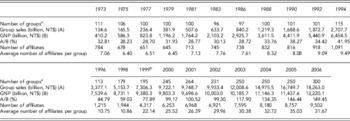
In the wave of market liberalization, the contributions of the top 100 business groups’ sales to Taiwan's gross national product have increased rapidly over time. In the past 30 years, the ratio increased from 30% in the 1970s and 1980s to 70% in 1999 and to >100% in 2004Footnote 2. Employees in the top 100 business groups, compared to the total labor force of Taiwan, have increased from 5% in 1992 to >20% in 2005. The total number of affiliates increased from 625 in 1970 to 4,317 in 1999 and then to 8,180 in 2004. The average number of affiliates per group increased from 6.25 in 1970 to 10.75 in 1996 and to 32.72 in 2004 (China Credit Information Service Company (CCIS), 2006). Table 1 shows the economic significance of large BGT.
Economic significance of large business groups in Taiwan

Source. Business Group in Taiwan (various years).
Notes. aThis is the number of business groups that is incorporated in the BGT directory in each year.
bThe average number of affiliates per group in 1999 is double than the number in 1998. The reason is that Taiwan Securities & Futures Institute asked every publicly traded company to disclosure all of their associated companies in annual reports since 1999.
GNP = gross national product.
Thus, consistent with the research on the sources of a firm's profitability and related studies in emerging markets, this study argues that by attenuating institutional inefficiency and sharing group resources or costs, business groups are an important element in shaping affiliate performance in Taiwan. Furthermore, business groups’ contributions to the variations in affiliate performance in Taiwan are significant, leading to the following hypothesis:
Hypothesis 1: Business-group effects account for a significant share of the variation in affiliate performance in Taiwan.
Family Ownership of Business Groups and Affiliate Performance
In emerging markets where formal rules fail, informal constraints will reduce uncertainty and provide consistency to organizations (North, Reference North1990). There are three main sources of informal constraints that may influence firm strategy: social capital, political capital, and reputation capital (Peng, Reference Peng2002). Family, one type of social capital, is the strongest tie in this weak institutional context and, therefore, family control becomes a common governance type among business groups. Family plays a critical role in the economic activities of many emerging markets. For instance, due to a lack of reliable information about market opportunities, managers in Asia rely heavily on personal and family relationships to develop their business and to cope with crises (Child, Reference Child1994; Peng, Reference Peng2002). Furthermore, decision-making processes and corporate governances are significantly different between family-owned businesses and non-family-owned businesses (Chung & Mahmood, Reference Chung and Mahmood2006).
Is family ownership and control helpful for, or detrimental to, firm performance? The literature offers mixed answers to this question (Heugens, van Essen, & van Oosterhout, Reference Heugens, van Essen and van Oosterhout2009). On one hand, the interest convergence hypothesis posits that when a family controls a greater share of a firm, it has a higher risk burden because the family's benefit and the firm's benefit converge. The moral risk thus becomes lower because family owners are more motivated to manage the firm effectively, thus resulting in positive management effects (Schulze, Lubatkin, & Dino, Reference Schulze, Lubatkin and Dino2003).
On the other hand, the entrenchment hypothesis argues that the goals of the controlling family shareholders and the goals of the minority shareholders may diverge and lead to agency problems, a phenomenon referred to as the principal–principal conflict (Young, Peng, Ahlstrom, Bruton, & Jiang, Reference Young, Peng, Ahlstrom, Bruton and Jiang2008). Due to self-interest, families may attempt to perform actions detrimental to the rights of other shareholders (La Porta, Lopez-de-Silanes, & Shleifer, Reference La Porta, Lopez-de-Silanes and Shleifer1999; Claessens, Djankov, & Lang, Reference Claessens, Djankov and Lang2000). For example, families may tunnel out company resources to other affiliates in the business group (Claessens, Djankov, & Lang, Reference Claessens, Djankov and Lang2000) or buy from intra-group firms at below-market costs (Chang, Reference Chang2003). As a result, the controlling family can realize its private benefits of control (Dyck & Zingales, Reference Dyck and Zingales2004), while harming the performance of the firm.
Thus, we had an opportunity to test these two conflicting hypotheses. However, regarding the context in Taiwan, Taiwanese owners are inclined to retain a business group's ownership and management in the hands of family members (Wong, Reference Wong1985; Redding, Reference Redding1990; Fukuyama, Reference Fukuyama1995). Family members actively involve themselves in management and board positions, and as the business group expands in size and scale, family members are more likely to serve as chairpersons of the board, thereby maintaining decision-making power over new affiliates (Chung & Mahmood, Reference Chung and Mahmood2006). In such a common phenomenon, there are two reasons that family-owned business groups’ affiliates perform worse. First, to control the entire business group, the funding family often employs a pyramidal ownership structure and cross-stockholdings to control multiple affiliates with comparatively little equity (La Porta, Lopez-de-Silanes, & Shleifer, Reference La Porta, Lopez-de-Silanes and Shleifer1999; Claessens, Djankov, & Lang, Reference Claessens, Djankov and Lang2000; Chung & Mahmood, Reference Chung and Mahmood2006), while most affiliates are not publicly traded. Thus, the family owner can use the public investor's funding at will via internal transactions or reinvestments. Second, because family business groups tend to be highly diversified in many unrelated industries, individual family members often occupy positions of top management in many affiliates at the same time. Under the condition that the individual capacity for information processing is limited, it is more likely that poor decisions will be made, thus leading to poorer performances by the affiliates.
Consistent with Jiang and Peng (Reference Jiang and Peng2010), who stated that the principal–principal conflicts resulting from family control are likely to be intensified in emerging economies where institutions are underdeveloped and markets for corporate control are less effective, we believe that the effect of family ownership in Taiwan more closely conforms to the entrenchment hypothesis. Therefore, this study expects that affiliates in a family business group may perform worse than affiliates in a non-family business group, thus the following hypothesis is examined in this study:
Hypothesis 2: There is a negative association between family ownership of a business group and affiliate performance.
Resource Abundance of Business Groups and Affiliate Performance
As for group resources in emerging markets, business groups have developed the ability to transfer and share resources in internal markets that substitute for inefficient external markets, thus having positive effects on group members. Therefore, the resource abundance of business groups, such as group size and financial resources, matters (Chang & Hong, Reference Chang and Hong2000; Yiu, Bruton, & Lu, Reference Yiu, Bruton and Lu2005; Chen & Chu, Reference Chen and Chu2010). The way in which the resources of a business group are dispersed, or diversified, among different markets and affiliates will also influence affiliate performance (Chang & Hong, Reference Chang and Hong2000; Khanna & Palepu, Reference Khanna and Palepu2000). The relationships between resource abundance/dispersion and affiliate performance thus deserve further examination.
From the perspective of organizational slack, the abundance of business-group resources may affect the performance of group members. Organizational slack in resources forces business groups to quickly adapt to internal pressure and respond to external pressure from environmental shifts (Cyert & March, Reference Cyert and March1963; Bourgeois, Reference Bourgeois1981; Lawson, Reference Lawson2001). Organizational slack in resources includes revenue reserves, stock, operating funds, employees, and so on. This study regards group size and financial resources as representatives of the abundance of group resources.
Regarding group size, a comparatively large scale indicates more organizational slack in resources and more influence and power in the market. Large companies are able to set prices, control production, or further influence decisions of their counterparts. Furthermore, large companies are also more resistant to pressure caused by abrupt external charges and have more response time to learn about external threats and respond appropriately (Haveman, Reference Haveman1993).
In emerging markets where the institutional context is imperfect, large business groups still have some advantages over small groups (Chang & Choi, Reference Chang and Choi1988; Khanna & Palepu, Reference Khanna and Palepu1997, Reference Khanna and Palepu2000; Chu, Reference Chu2004). For example, large business groups have more affiliates and resources than do small business groupsFootnote 3. Therefore, the benefits of internalization are more obvious in large business groups because such groups can provide more aid to their affiliates (Chang & Hong, Reference Chang and Hong2002). Conversely, small business groups possess few resources to overcome market inefficiencies, thus their affiliates are more likely to suffer from unsatisfactory economic performance.
In the wave of market liberalization and deregulation, there are some opportunities for businesses to enter into high-profit and high-growth industries, such as telecom, financial, and media industries, which they had not been allowed to enter before. Large business groups can execute the investment plan based on their advantages of scope economies and thereby gain the opportunity to grow rapidly. However, small groups lack the sufficient resources and cumulative capability to obtain the first mover advantage to enter new markets (Chandler, Reference Chandler1990; Guillén, Reference Guillén2000; Hoskisson et al., Reference Hoskisson, Eden, Lau and Wright2000). As to the informal constraints (Peng, Reference Peng2002), such as political capital, large business groups often interact with political actors continuously because it is uncertain when and where opportunities from political connections may arise (Ahn & York, Reference Ahn and York2011). Therefore, large business groups can leverage their political connections to reduce uncertainty in their decision making, while minimizing the risk of overloading the bureaucracy (Peng, Reference Peng2002; Peng, Lee, & Wang, Reference Peng, Lee and Wang2005). As to the reputation capital, the image of large business groups also reduces asymmetric information among customers regarding product quality (Khanna & Palepu, Reference Khanna and Palepu1997). However, the costs and effects of brand building of small groups are inefficient.
Hence, this study expects that as business groups become larger, they have a more positive influence on the performance of affiliates. Therefore, the following hypothesis is formulated:
Hypothesis 3: There is a positive association between the size of a business group and the performance of the group's affiliates.
As for financial resources, the RBV suggests that the unique resources of firms result in superior performance (Penrose, Reference Penrose1959; Wernerfelt, Reference Wernerfelt1984). The two categories of resources include tangible resources, which refer to financial and physical resources, and intangible resources, which include human resources, good will, intellectual property, reputation, and brand (Wernerfelt, Reference Wernerfelt1984; Chatterjee & Wernerfelt, Reference Chatterjee and Wernerfelt1991). Financial resources are the most flexible resources and also can be used to purchase other types of resources, and therefore, they significantly contribute to the firm's competitive advantage (Chatterjee & Wernerfelt, Reference Chatterjee and Wernerfelt1991). For business groups, organizational slack in financial resources that are unauthorized, current, and easily re-allocated, such as current cash and debt financing (Singh, Reference Singh1986), can efficiently support group members. In Taiwan, Yeh (Reference Yeh2005) also finds that the most frequent interactions between group members are through financial capital.
Abundant financial resources mean that business groups are able to devote resources to affiliates with more potential for flexibility and that affiliates are able to raise capital and benefit from internal capital markets (Leff, Reference Leff1978). In an asymmetric information environment, the cost of internal capital market financing is lower and has more effective resource distribution than the external capital market (Leff, Reference Leff1978; Yeh, Reference Yeh2005). A business group is also willing to provide internal financing to their members because it can obtain correct information on member firms and thus make proper financing decisions (Williamson, Reference Williamson1985; Gertner, Scharfstein, & Stein, Reference Gertner, Scharfstein and Stein1994). Therefore, the affiliates that belong to business groups with high financial resources can borrow money more easily, even with a higher debt ratio (Merit, Kyj, & Welsh, Reference Merit, Kyj and Welsh2000).
In contrast, low financial resources increase the likelihood of financial distress, default, and even bankruptcy, which leads to poor credit and the bad reputation for the business group. Group affiliates share this reputation simply by being associated with the particular business group. Therefore, if a firm is affiliated with a group that has poor credit and a bad reputation, the affiliate will suffer from this association (Chang & Hong, Reference Chang and Hong2000). Accordingly, sufficient financial resources facilitate improved affiliate performance. Thus, this study proposes the following hypothesis:
Hypothesis 4: There is a positive association between the financial resources of a business group and affiliate performance.
Resource Dispersion of Business Groups and Affiliate Performance
After the emergence of the Taiwan economy, business group diversification steadily increased from 1973 onward due to resource advantages that allowed easy access to emerging industries. When business groups become involved in diverse industries, their affiliates also expand (Chung & Mahmood, Reference Chung and Mahmood2006). Investment-promoting policies in Taiwan also offer tax cuts and benefits to newly established companies (Chung, Reference Chung2001). Because Taiwan lacks a good mergers and acquisitions environment, business groups are more inclined to establish new affiliates as opposed to expanding the existing operations of a company (Hamilton & Kao, Reference Hamilton and Kao1990). As a result, all of these factors contribute to the phenomenon of high diversification of Taiwanese business groups and low diversification of affiliates (Chung & Mahmood, Reference Chung and Mahmood2006).
Diversification has always been an important topic in strategic management, and firms have become more diversified for two primary reasons. The first reason for diversifying is to avoid the waste of excessive production potential and to increase corporate value. The other reason is to lower potential risks during environmental shifts or uncertainties. However, the relationship between diversification and performance has not been consistent (Palich, Cardinal, & Miller, Reference Palich, Cardinal and Miller2000). One reason for this inconsistency is due to the frequent ignoring of the influence of institutional environments (Geiger & Hoffman, Reference Geiger and Hoffman1998). Western management theories indicate that diversified firms that refocus on their core businesses to reduce their degree of diversification show improved performance (Markides, Reference Markides1995); however, in emerging markets, business groups are able to benefit from internalization of production activities and resources (Leff, Reference Leff1978; Khanna & Palepu, Reference Khanna and Palepu1997, Reference Khanna and Palepu2000).
Because the market mechanism is imperfectly supported, institutionalism argues that in spite of business groups in emerging economies tending to tap into high diversification, the member firms of a business group can achieve competitive advantages by internalizing trading activities through transacting and sharing resources with other members of the same business group, even if the members are across different product markets (Khanna & Palepu, Reference Khanna and Palepu1997; Chang & Hong, Reference Chang and Hong2000; Kock & Guillén, Reference Kock and Guillén2001). For example, firms affiliated with business groups freely share intangible resources with their affiliates. Group-wide advertising generates considerable scale-and-scope economies. A diversification strategy reduces the cost of building brands in emerging markets. Therefore, the reputation of business groups has a positive effect on affiliate performance (Khanna & Palepu, Reference Khanna and Palepu1997). Group-level R&D activities are also sources of competitive advantages for diversified groups operating in several industries. Hence, managerial talent and key technology can be transferred among affiliates (Khanna & Palepu, Reference Khanna and Palepu1997, Reference Khanna and Palepu2000; Chang & Hong, Reference Chang and Hong2000). In contrast, without scale and scope, low diversified business groups have difficulty building and sharing valuable resources and difficulty using efficient internal markets to substitute inefficient external markets. In summary, business groups with high diversification perform better in emerging markets than those with low diversification (Khanna & Palepu, Reference Khanna and Palepu1997; Ramaswamy, Li, & Petitt, Reference Ramaswamy, Li and Petitt2004).
Hypothesis 5: There is a positive association between the degree of group diversification and affiliate performance.
Heterogeneity of Business-Group Effects
Recent studies on the sources of business profitability divide the full sample into sub-samples to examine the differences between the sub-samples. Some studies categorize the sub-samples based on industry features (McGahan & Porter, Reference McGahan and Porter1997, Reference McGahan and Porter2002; Hough, Reference Hough2006), while other studies base the categorization on the features of the business, such as firm size (Chang & Hong, Reference Chang and Hong2000). Except Chang and Hong (Reference Chang and Hong2002), who apply business group size, it is rare for studies to focus on business-group effects and separate samples based on business-group level features. This study argues that business groups with various ownership systems, resource abundance, and resource dispersion possess inter-group heterogeneity, such as group-level strategies, organizational structures, and corporate cultures, resulting in various business-group effects and affiliate profitability. In addition, reviewing the characteristics of our research sample, significant differences exist between business groups. Business-group assets range from NT$4,248 million to NT$2,542,440 million, and almost half of the business groups (47.6%) are family groups. As for the financial resources of business groups, the ratio of self-owned capital to total capital of the best-performing group is 87.5%; however, the worst-performing group has a ratio of −7.6%. Furthermore, the most diversified business group operates in 26 different industries, while the least diversified group focuses in only one industry.
The variety of group features enables us to examine how business-group effects may vary according to various ownership, group size, financial resources, and diversification, and this variety of features further supports the premise that not all types of business groups matter equally with respect to affiliates. Therefore, the following hypothesis emerges:
Hypothesis 6: Different business group features, specifically, size, financial resources, and diversification, will lead to different levels of business-group effects.
The benefits and costs of group affiliation tend to be shared among member affiliates and tend to differ among business groups, increasing the within-group affiliate profit-homogeneity and inter-group affiliate profit-heterogeneity. Large business-group effects mean that affiliates possess high inter-group heterogeneity and high within-group profit-homogeneity. Conversely, small business-group effects mean that affiliates possess low inter-group profit-heterogeneity and low within-group profit-homogeneity (Khanna & Rivkin, Reference Khanna and Rivkin2001). According to this rule, this study compares the relative share of business-group effects on the variations in affiliate performance among business groups with different features.
First, family business groups and non-family business groups implement different decision-making processes and corporate governance structures (Chung & Mahmood, Reference Chung and Mahmood2006). On the one hand, founding families constrain the growth of family business groups (Wong, Reference Wong1985). Family business groups often use a pyramidal structure to maintain their decision-making power (Chung & Mahmood, Reference Chung and Mahmood2006). Thus, the strategies and corporate cultures of family business groups are more or less homogeneous, leading to low inter-group heterogeneity. On the other hand, within-family business groups, some affiliates are controlled by family members and some are not. According to the power-dependence perspective (Kim, Hoskisson, & Wan, Reference Kim, Hoskisson and Wan2004) and the social network perspective (Ibarra, Reference Ibarra1993), family-controlled affiliates have the high power and status to access group resources that non-family-controlled affiliates do not possess, thus leading to low within-group affiliate profit-homogeneity. These factors lead to decreased business-group effects on the variations in affiliate profitability of family business groups.
Hypothesis 6a: The relative share of business-group effects on the variations in affiliate performance is less in family business groups than in non-family business groups.
Second, large business groups mainly grow during the same period and thus have a long history. Accordingly, large groups are more or less homogeneous in their group-level strategies, organizational structures, and corporate cultures (Chang & Hong, Reference Chang and Hong2002), thereby leading to low inter-group affiliate profit-heterogeneity. On the other hand, affiliates within a large and complex network of business groups must compete for the limited group resources with many other member firms, thus further resulting in varying and less affiliate profit-homogeneity. These factors lead to decreased business-group effects on the variations in affiliate profitability of large business groups.
Hypothesis 6b: The relative share of business-group effects on the variations in affiliate performance is less in large business groups than in small business groups.
Third, business groups with abundant financial resources often sufficiently promote specific group strategies. The business groups can invest financial resources more flexibly in a new business with reasonable potential, leading to low inter-group affiliate profit-heterogeneity. Conversely, business groups with abundant financial resources may use their efficient internal capital markets to subsidize poorly performing affiliates or new ventures to maximize the profit of the entire group (Chang & Hong, Reference Chang and Hong2000). Cross-subsidization is widely used by business groups, and it is often carried out by manipulating transfer prices in various forms of internal transactions such as loans, debt guarantees, equity investments, and internal business trades (Chang & Hong, Reference Chang and Hong2000). Therefore, non-profitable affiliates benefit and profitable affiliates suffer from the cross-subsidization (Lincoln, Gerlach, & Ahmadjian, Reference Lincoln, Gerlach and Ahmadjian1996). These factors lead to low within-group affiliate profit-homogeneity. As a result, high financial resource groups have significant business-group effects.
Hypothesis 6c: The relative share of business-group effects on the variations in affiliate performance is greater in business groups with high financial resources than in business groups with low financial resources.
Finally, business groups with different resource dispersion may affect affiliate performance differently. On the one hand, highly diversified groups possess high management complexity and often have a difficult time using and distributing resources among various affiliates to produce synergy. Such groups are likely to operate as holding companies to control shares and obtain investment profits (Dundas & Richardson, Reference Dundas and Richardson1980, Reference Dundas and Richardson1982; Williamson, Reference Williamson1985). Therefore, these business groups use similar decision-making strategies, which lead to low inter-group affiliate profit-heterogeneity. On the other hand, highly diversified groups’ low involvement in affiliate operations and lower group strategy participation result in the independent operations of affiliates (Dundas & Richardson, Reference Dundas and Richardson1980, Reference Dundas and Richardson1982; Williamson, Reference Williamson1985). In addition, affiliates operating in various industries have difficulty sharing complementary resources; thus, they must depend on their own competencies and resources, which, again, leads to low within-group profit-homogeneity. These factors are likely to limit business-group effects of highly diversified business groups.
Hypothesis 6d: The relative share of business-group effects on the variations in affiliate performance is less in highly diversified business groups than it is in low diversified business groups.
Methods
Sample and Data
Data for this study were collected via six editions of the directory BGT, published in 2001–2006. This study focuses on this period because it provides stable circumstances, which is after the Asian Financial Crisis in 1997 and before the Subprime Mortgage Crisis in 2007, generating a reliable research result without the effect of significant external events. BGT is compiled by the CCIS, the oldest and most prestigious credit-checking agency in Taiwan and an affiliate of the Standard and Poor's in the United States. The BGT directory is also a widely used data source for academic research on Taiwanese companies (e.g., Khanna & Rivkin, Reference Khanna and Rivkin2001; Chu, Reference Chu2004; Luo & Chung, Reference Luo and Chung2005), containing systematic financial data, such as profit, assets, sales, and background of both publicly traded companies and privately held companies affiliated with large BGT.
The current research further screened the sample by using the following criteria (Chang & Hong, Reference Chang and Hong2002; Misangyi et al., Reference Misangyi, Elms, Greckhamer and Lepine2006). First, we deleted affiliates with only one year of data. Second, affiliates with assets <NT$10 million were removed from the sample. Third, we removed some affiliates that showed unusual or unreasonable financial reports [such as return on assets (ROA) exceeding positive or negative 100%] (Roquebert et al., Reference Roquebert, Phillips and Westfall1996). This study omitted affiliates from financial and insurance service industries, because their returns are not comparable to those of other industries (McGahan & Porter, Reference McGahan and Porter1997). Finally, owing to the inability in distinguishing corporate-parent effects from business-unit effects for single business firms (Bowman & Helfat, Reference Bowman and Helfat2001), Chang and Hong (Reference Chang and Hong2002) suggest that a business group needs to have at least two affiliated companies to be included in the research sample. This work thus deleted the affiliate that was the only member from their business groups. For the same reason, we excluded the affiliate that was the only member of an industry. Same procedure was applied when splitting sub-samples.
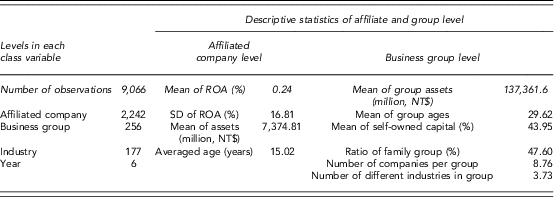
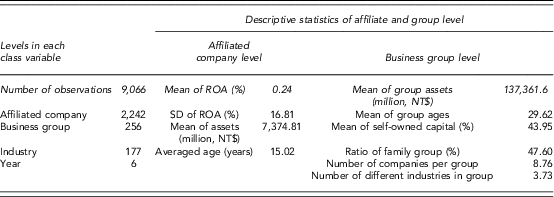
After the screening process, the final sample consists of 9,066 firm-year observations nested within 2,242 affiliated companies that are cross-classified within 256 business groups and 177 industries from 2001 to 2006. Table 2 shows the descriptive statistics of research sample.
Descriptive statistics of the research sample
Note. ROA = return on assets.
Measures
This study employs two analytical methods, analysis of variance (ANOVA) and hierarchical linear modeling (HLM). The former is applied when decomposing the variations of affiliate performance to clarify the sources of affiliate performance. The latter is applied when examining the significance of specific group features to clarify the business groups’ cross-level influences on affiliate performance. We introduce the variables for these two methods.
Dependent variable
The dependent variable of ANOVA and HLM is the performance of affiliates (afROA). To be consistent with earlier studies, afROA is measured by the ROA. ROA is taken into account for efficiency using firm assets, and it reflects firm profitability.
Independent variables in ANOVA
This study has four categorical independent variables (i.e., effects) in the ANOVA model.
1. Industry: this variable denotes the differences among industries in which the affiliates operate. The identification of industry membership is based on the four-digit Taiwan Standard Industry Classification code.
2. Business group: business-group effects denote the differences among business groups. The identification of group membership is determined via the data provided by CCISFootnote 4.
3. Affiliate: this variable denotes the differences among affiliates. In hierarchical-ordered systems of organizations, each affiliate is a member of both a business group and an industry (Chang & Hong, Reference Chang and Hong2002).
4. Year: year effects refer to the differences over the six-year observation period.
Independent variables in HLM
This study uses one categorical and three continuous independent variables in the HLM model.
1. Business group size (bgSIZE) is calculated by taking the natural logarithm of business group assets for each year (Chang & Hong, Reference Chang and Hong2000; Chen & Chu, Reference Chen and Chu2010).
2. Family ownership (bgFAMILY) is measured with a categorical variable, which is 1 if a business group is family owned and 0 otherwise. The BGT directory provides the list of family-owned groups. If there are any family members who serve as the chairman of an affiliate of a business group, the BGT directory regards it as a family-owned group (CCIS, 2006).
3. Financial resources (bgFIN) are measured by the ratio of self-owned capital to total assets, which indicates the financial resources of a business group. The higher the value of bgFIN, the lower the debt level and the more plentiful the financial resources of the group (Yiu, Bruton, & Lu, Reference Yiu, Bruton and Lu2005; Chen & Chu, Reference Chen and Chu201).
4. Business group diversification (bgDIV) is measured by the number of different industries in the group. This is the simplest measure of diversification as it is simply a count of the number of different four-digit Taiwan Standard Industry Classification industries in which a group is involved (Khanna & Palepu, Reference Khanna and Palepu2000)Footnote 5.
Control variables in HLM
Previous research has determined that firm age and size can affect both short- and long-term performances and are common control variables in strategic management research (Shane, Reference Shane1998; Khanna & Palepu, Reference Khanna and Palepu2000; Chu, Reference Chu2004). In addition, research reports significant differences between small private companies and large public companies in their leverage, ROA, and asset turnover ratios (Osteryoung, Constand, & Nast, Reference Osteryoung, Constand and Nast1992; Ballantine, Cleveland, & Koeller, Reference Ballantine, Cleveland and Koeller1993). Therefore, to remove whatever affects these variables may have on affiliate performance at the affiliated-company level, we control for affiliate age (afAGE), defined as the years of establishment of the affiliated company. This work also controls for affiliate size (afSIZE), measured by taking the natural logarithm of affiliate assets for each year. The listing status (afPUBLIC) is measured with a categorical variable, which is 1 if an affiliate is a publicly traded firm and 0 otherwise. At the business-group level, we control for business-group age (bgAGE), defined as the years since establishment for the first member firm of the business group (Chang & Hong, Reference Chang and Hong2000; Chen & Chu, Reference Chen and Chu2010).
Analysis method
ANOVA
Since the seminal study of Schmalensee (Reference Schmalensee1985), empirical studies on the sources of performance have used two main methods to estimate the profit variances: variance components analysis and nested ANOVA. However, variance components analysis may lack the reliability in variance estimates (Brush & Bromiley, Reference Brush and Bromiley1997) and produce negative variance estimates (Rumelt, Reference Rumelt1991). The other inherent disadvantage of variance components analysis is that the procedure does not provide reliable tests for the significance of the independent effects. Given these limitations with variance components analysis, follow-up research has relied more on nested ANOVA (e.g., Rumelt, Reference Rumelt1991; Roquebert et al., Reference Roquebert, Phillips and Westfall1996; McGahan & Porter, Reference McGahan and Porter1997, Reference McGahan and Porter2002; Hawawini et al., Reference Hawawini, Subramanian and Verdin2003; Hough, Reference Hough2006; Short, Ketchen, Palmer, & Hult, Reference Short, Ketchen, Palmer and Hult2007). Following the order of entering effects, that is, year, industry, business group, and affiliate (Rumelt, Reference Rumelt1991; McGahan & Porter, Reference McGahan and Porter1997, Reference McGahan and Porter2002), we adopt nested ANOVA to decompose the variance of affiliate profitability and test Hypotheses 1, 6, 6a, 6b, 6c, and 6d. The model is shown in Equation 1.
 $${{{\rm{(afROA)}}}_{k,j,t}}\, = \,{\rm{\rmu }}\, + \,{{{\rm{\rgamma }}}_t}\, + \,{{{\rm{\ralpha }}}_k}\, + \,{{{\rm{\rbeta }}}_j}\, + \,{\tf="MPi-One"\char102}{_{k,j}}\, + \,{{{\rm{{\repsilon}}}}_{k,j,t}}$$
where the subscripts t, k, and j denote time, industries, and business groups, respectively. (afROA)k,j,t is the ROA of an affiliate at time t in business group j and industry k, and it can be described as a linear combination of its mean μ, year effects γt, industry effects αk, business-group effects βj, affiliated-company effects φk,j, and the error term εk,j,t.
HLM
We also follow the multilevel technique presented by Misangyi et al. (Reference Misangyi, Elms, Greckhamer and Lepine2006) to further examine the specific group features (Hypotheses 2, 3, 4, and 5) by incorporating the group features as predictors into the corresponding level. Hierarchical models are appropriate when data at different levels are involved. The hierarchical model is as shown in Equation 2Footnote 6.
 $$no{\matrix {{{\rm{(afROA)}}}_{tij}}\, = \,{{{\rm{\rpi }}}_{{\rm{0}}ij}}\, + \,{{{\rm{\rpi }}}_{{\rm{1}}ij}}{{({\rm{Time}})}_{tij}}\, + \,{{{\rm{e}}}_{tij}} \cr {{{\rm{\rpi }}}_{0ij}}\, = \,{{{\rm{\rbeta }}}_{{\rm{00}}j}}\, + \,{{{\rm{\rbeta }}}_{{\rm{01}}j}}{{({\rm{afAG E}})}_{ij}}\, + \,{{{\rm{\rbeta }}}_{{\rm{02}}j}}{{({\rm{afSIZE}})}_{ij}}\, + \,{{{\rm{\rbeta }}}_{{\rm{03}}j}}{{({\rm{afPUBLIC}})}_{ij}}\, + \,{{r}_{ij}} \cr {{{\rm{\rbeta }}}_{00j}}\, = \,{{r}_{{\rm{000}}}}\, + \,{{r}_{{\rm{001}}}}{{({\rm{bgAGE}})}_j}\, + \, {{r}_{{\rm{002}}}}{{({\rm{bgFAMILY}})}_j}\, + \,{{r}_{{\rm{003}}}}{{({\rm{bgSIZE}})}_j}\, \cr + \,{{r}_{{\rm{004}}}}{{({\rm{bgFIN}})}_j}\, + \,{{r}_{{\rm{005}}}}{{({\rm{bgDIV}})}_j}\, + \,{{u}_j}<$$><$$l> {\quad{{{\rm{\rpi }}}_{{\rm{1}}ij}}\, = \,{{{\rm{\rbeta }}}_{{\rm{ 10}}j}} \cr {{{\rm{\rbeta }}}_{{\rm{01}}j}}\, = \,{{r}_{{\rm{010}}}} \cr {{{\rm{\rbeta }}}_{{\rm{02}}j}}\, = \,{{r}_{{\rm{020}}}}\, + \,{{u}_{{\rm{02}}j}} \cr {{{\rm{\rbeta }}}_{{\rm{03}}j}}\, = \,{{r}_{{\rm{030}}}} $$
where the subscripts t, i, and j denote time, affiliates, and business groups, respectively (afROA)tij is the affiliate ROA at time t in affiliate i nested within-business group j. (Time)tij is incorporated because the research data are longitudinal. π0ij is the mean ROA across time for affiliate i in business group j regressed on the following effects expected to explain between-affiliate variance: afAGE, afSIZE, and afPUBLIC. β00j is the mean ROA of all affiliates in business group j regressed on the following effects expected to influence between-business group variance: bgAGE, bgFAMILY, bgSIZE, bgFIN, and bgDIV. r 000 is the grand mean of affiliate ROA. The effect across time that afSIZE has on affiliate ROA significantly varies across affiliates (p < .001), and thus β02j is modeled with a random variance term (u 02j) (Misangyi et al., Reference Misangyi, Elms, Greckhamer and Lepine2006). Each level of analysis has its own unique random error term: etij is the across-time residual; rij is the between-affiliate residual; and uj is the between-group residual.
Results
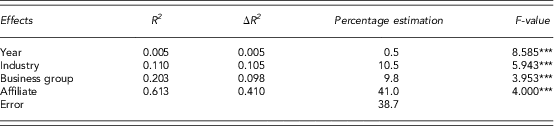
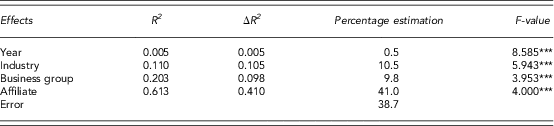
Table 3 summarizes the results of the percentage of total variance in affiliated companies associated with business groups and industries. The results show that business-group effects account for a respectable and significant variance (9.8%). According to the ANOVA F-test, business-group effects are significant at the p < .01 level, supporting Hypothesis 1. Affiliated-company effects account for the most variance (41.0%); industry effects account for 10.5% variance; and year effects account for a very small proportion of the total variance (0.5%)Footnote 7.
Variance components results of the full sample
Note. ***p < .001.
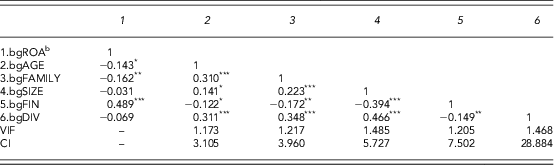
Table 4 presents the correlation matrix and multicollinearity testing of all variables in the business-group level. The results show that all variance inflation factors are below 2 and condition indexes are below 30, indicating no substantial problems with multicollinearity in the analysis.
Correlations and multicollinearity testingFootnote a
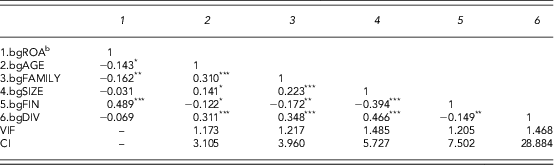
Notes. a n = 257.
b We aggregate the affiliates ROA (afROA) to business group performance (bgROA) which is treated as a dependent variable only in correlations and multicollinearity testing. The main analysis of this study uses afROA as a dependent variable.
CI, condition index; ROA = return on assets; VIF, variance inflation factor.
* p < .05, **p < .01, ***p < .001.
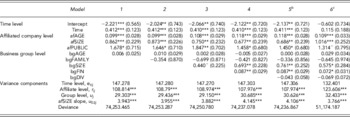
The multilevel analysis was used to test our Hypotheses 2–5, with results shown in Table 5. Model 1 is the baseline model with all the control variables included. All affiliate-level control variables (afAGE, afSIZE, and afPUBLIC) are positively related to affiliate ROA (p < .05).
HLM estimates of the effect of predictor variables on affiliate ROAFootnote a

Notes. a Robust standard errors in parentheses.
b This study also tests the other two diversification indexes – Herfindahl and Entropy index, respectively. The results are similar to Model 5. They are both negative and insignificant.
c Model 6 is a lagged structure model. It contains 6,249 observations, 2,063 affiliates, 240 business groups, and four years of performance data.
HLM = hierarchical linear modeling; ROA = return on assets.
+p < .1, *p < .05, **p < .01, ***p < .001.
Models 2, 3, 4, and 5 are used to test Hypotheses 2, 3, 4, and 5, respectively. In Model 2, bgFAMILY is added as a categorical variable in the business-group level. The result presents whether the business group is a family group or not, and has no significant effect on affiliate performance. Thus, Hypothesis 2 is not supported. In Models 3 and 4, bgSIZE and bgFIN is added to the business-group level, respectively. These two variables both positively relate to affiliate ROA (p < .1 and p < .01, respectively). Thus Hypotheses 3 and 4 are both supported. In Model 5, this study tests the relationship between business group diversification and affiliate performance by incorporating bgDVI at the business-group level. bgDVI appears to have no significant effect on affiliate performance. Thus Hypothesis 5 is not supported. Model 6 is a lagged structure model that was used to improve the ability to make causal inferences. The results show the consistency between Model 5 and Model 6, providing evidence supporting the robustness of our findings.
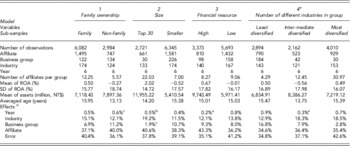
The descriptive statistics and research results of the sub-sample analysis were shown in Table 6. Model 1 includes family and non-family groups. Business-group effects (6.9 vs. 11.2%, respectively) are smaller in family groups than they are in non-family groups, supporting Hypothesis 6a. In Model 2, the sample is divided into two groups: the top 30 groups (group assets beyond NT$277,475.4 million) and the smaller groups (Chang & Hong, Reference Chang and Hong2002). Business-group effects are much smaller in the top 30 groups than they are in the smaller groups (1.9 vs. 10.7%, respectively), supporting Hypothesis 6b. In Model 3, the rate of self-owned capital is proper to exceed more than 50% (CCIS, 2006); hence, we use these criteria to divide groups into high financial resource groups and low financial resource groups. The results show that business-group effects (9.3 vs. 8.0%, respectively) are greater in high financial resource groups than they are in low financial resource groups, supporting Hypothesis 6c.
Comparison of results among sub-samples

Notes. aNot significant at p < .05.
bSignificant at p < .05.
cSignificant at p < .01.
dExcept the effects marked as ‘a, b, and c,’ all other effects are significant at p < .001.
eThis study also split sample based on the other two diversification indexes – Herfindahl and Entropy index, respectively. The results are similar to Model 4. The more diversified one business group is, the less business-group effects observed.
ROA = return on assets.
In Model 4, for analyzing the effect of group scope, this work divides groups into three diversification categories: least diversified (groups with one to four industries), intermediate diversified (groups with five to seven industries), and most diversified (groups with more than seven industries) (Khanna & Palepu, Reference Khanna and Palepu2000). The results indicate that the more different industries one business group involves in, the less business-group effects (16.8, 7.9, 2.8%, respectively) are observed, supporting Hypothesis 6d.
In summary, the results of Models 1–4 in Table 6 support Hypothesis 6.
Discussion
This study first examines the relative importance of business-group effects associated with industry and affiliate effects on affiliate performance, and it then uses multilevel analysis to find the influence of family ownership, resource abundance, and resource dispersion of business groups on affiliate performance. Finally, this study divides the full sample into sub-samples based on family ownership, resource abundance, and resource dispersion of business groups to examine the different business-group effects between sub-samples.
In terms of the first research inquiry, the study discovers that business groups are significantly associated with affiliate performance. Although affiliate effects are strongest, group affiliation appears to be at least as important as industry in Taiwan. The results are similar to the findings of previous studies, thus confirming the significance of business-group effects in emerging markets (Khanna & Rivkin, Reference Khanna and Rivkin2001; Chang & Hong, Reference Chang and Hong2002). The findings suggest that the RBV is applicable in emerging markets and that the heterogeneity between firms explains more variability of firm performance than does the heterogeneity between industries. This study also supports the institution-based view that business groups can use internal markets to lower transaction costs associated with external markets in emerging economies.
The results of the second research inquiry show that the resource abundance, that is, the size and financial resources of business groups, positively affect affiliate performance. Chu (Reference Chu2004) suggests that firms affiliated with large groups tend to exhibit higher profitability than those affiliated with small groups in Taiwan. Agarwal and Ramaswami (Reference Agarwal and Ramaswami1992) also argue that as business groups become larger, they have a more positive influence on the decision-making abilities of affiliates and group development. The findings support the RBV and the view of organizational slack in resources that argues that large size and abundant financial resources cause business groups to face external pressures calmly and share resources among affiliates efficiently.
Different from our expectations, family ownership and family control of business groups are irrelevant for affiliate performance. These results are similar to the studies of Daily and Dalton (Reference Daily and Dalton1992) and Miller, Le Breton-Miller, Lester, and Cannella (Reference Miller, Le Breton-Miller, Lester and Cannella2007), who do not find significant performance differences between family-owned and non-family-owned firms. As to the resource dispersion, the results show that group diversification has a negative but insignificant effect on affiliate performance. In theory, diversification has both benefits and costs, and the latter is mainly derived from the conflict between business units and headquarters, such as information asymmetry (Harris, Kriebel, & Raviv, Reference Harris, Kriebel and Raviv1982), the cost of entry (Porter, Reference Porter1987), bureaucratic and control costs (Gupta, Reference Gupta1987; Hill, Reference Hill1995), and agency costs resulting from managers’ self-interest to reduce employment risks through diversification (Eisenhardt, Reference Eisenhardt1989; Montgomery, Reference Montgomery1994). Empirical evidence from emerging markets show the mixed associations between diversification and firm performance (i.e., Khanna & Palepu, Reference Khanna and Palepu2000; Choi & Cowing, Reference Choi and Cowing2002; Chakrabarti, Singh, & Mahmood, Reference Chakrabarti, Singh and Mahmood2007).
In terms of the third research inquiry, the results show that the share of business-group effects is subject to ownership, resource abundance, and resource dispersion of each business group. Business-group effects are smaller in family groups than they are in non-family groups, and they are smaller in the top 30 groups than they are in smaller groups. Business-group effects are also greater in high financial resource groups than they are in low financial resource groups. The results further show that the more diversified the business group is, the less likely it is that the business-group effects will be observed. These results are consistent with those of Roquebert et al. (Reference Roquebert, Phillips and Westfall1996), who find that corporate-parent effects are inversely related to diversification.
Most prior studies do not consider the distinctive features of the sampled firms and only provide the relative magnitude of each effect based on the full sample. However, business groups of various ownership and resources possess inter-group heterogeneity in resource sharing and synergy, as well as in the efficacy of operating internal markets. Furthermore, business-group effects may be particularly obvious in some business groups, while not all types of business groups provide significant business-group effects.
Conclusion
Business groups are prevalent organizations in emerging markets and the primary source of economic development, thus their performance is an important research topic. Given the consistency of previous studies to decompose performance (e.g., Schmalensee, Reference Schmalensee1985; Rumelt, Reference Rumelt1991; McGahan & Porter, Reference McGahan and Porter1997, Reference McGahan and Porter2002) and the expanding research in various institutional contexts, the current findings help to advance this stream of research and contribute to bringing some closure to this debate.
This paper also describes practical implications for group managers and policy makers. Top managers of business groups can use this information to better understand the sources and determinants of affiliate performance. In addition, managers of various types of business groups should give more consideration to the appropriateness of group strategy when allocating resources and involving the operations of affiliates. For policy makers, business groups as a common phenomenon in emerging economies can be viewed as a signal of poorly established market-supporting institutions of the economic system. Policy makers should commit to improving the institutional environment with market-supporting mechanisms to reduce transaction costs within markets and increase trading efficiency.
This study has some limitations. First, the number of affiliates in this study is small after the data screening. In addition, only information about large-sized business groups is included in the CCIS directory. These limitations may cause some biases in the results, and the results may be limited to large-sized business groups. Future studies should collect complete data of affiliates and also include data for small- and medium-sized business groups to achieve broader understandings of the associations between business groups and affiliates. Second, there has been little research on the performance of firms in small- or medium-sized economies. Future studies may focus on emerging or developing economies to examine whether the sources of firm profitability are similar in different economic, cultural, and political settings. Third, the significant peak in the distribution of the ROA indicates the affiliate performance-homogeneity. Affiliates’ performances are much more similar to one another than the implicit normal distribution assumed. Future studies should explore how different firms can generate similar performances as opposed to how a few firms distinguish themselves with very dissimilar performances (Arend, Reference Arend2009).
Acknowledgements
This study was supported by a grant from the National Science Council in Taiwan (NSC 98-2410-H-259-029). The author would like to thank the editor and the anonymous reviewers for their helpful comments and recommendations.