INTRODUCTION
Tropical forests are the greatest reservoirs of terrestrial biodiversity with tree diversity comprising at least 40 000 to 53 000 species (Slik et al. Reference SLIK, ARROYO-RODRÍGUEZ, AIBA, ALVAREZ-LOAYZA, ALVES, ASHTON, BALVANERA, BASTIAN, BELLINGHAM, VAN DEN BERG, BERNACCI, DA CONCEIÇÃO BISPO, BLANC, BÖHNING-GAESE, BOECKX, BONGERS, BOYLE, BRADFORD, BREARLEY, BREUER-NDOUNDOU HOCKEMBA, BUNYAVEJCHEWIN, MATOS, CASTILLO-SANTIAGO, CATHARINO, CHAI, CHEN, COLWELL, CHAZDON, CLARK, CLARK, CLARK, CULMSEE, DAMAS, DATTARAJA, DAUBY, DAVIDAR, DEWALT, DOUCET, DUQUE, DURIGAN, EICHHORN, EISENLOHR, ELER, EWANGO, FARWIG, FEELEY, FERREIRA, FIELD, DE OLIVEIRA FILHO, FLETCHER, FORSHED, FRANCO, FREDRIKSSON, GILLESPIE, GILLET, AMARNATH, GRIFFITH, GROGAN, GUNATILLEKE, HARRIS, HARRISON, HECTOR, HOMEIER, IMAI, ITOH, JANSEN, JOLY, DE JONG, KARTAWINATA, KEARSLEY, KELLY, KENFACK, KESSLER, KITAYAMA, KOOYMAN, LARNEY, LAUMONIER, LAURANCE, LAURANCE, LAWES, DO AMARAL, LETCHER, LINDSELL, LU, MANSOR, MARJOKORPI, MARTIN, MEILBY, MELO, METCALFE, MEDJIBE, METZGER, MILLET, MOHANDASS, MONTERO, DE MORISSON VALERIANO, MUGERWA, NAGAMASU, NILUS, OCHOA-GAONA, ONRIZAL, PAGE, PAROLIN, PARREN, PARTHASARATHY, PAUDEL, PERMANA, PIEDADE, PITMAN, POORTER, POULSEN, POULSEN, POWERS, PRASAD, PUYRAVAUD, RAZAFIMAHAIMODISON, REITSMA, DOS SANTOS, SPIRONELLO, ROMERO-SALTOS, ROVERO, ROZAK, RUOKOLAINEN, RUTISHAUSER, SAITER, SANER, SANTOS, SANTOS, SARKER, SATDICHANH, SCHMITT, SCHÖNGART, SCHULZE, SUGANUMA, SHEIL, DA SILVA PINHEIRO, SIST, STEVART, SUKUMAR, SUN, SUNDERLAND, SURESH, SUZUKI, TABARELLI, TANG, TARGHETTA, THEILADE, THOMAS, TCHOUTO, HURTADO, VALENCIA, VAN VALKENBURG, VAN DO, VASQUEZ, VERBEECK, ADEKUNLE, VIEIRA, WEBB, WHITFELD, WICH, WILLIAMS, WITTMANN, WÖLL, YANG, YAO, YAP, YONEDA, ZAHAWI, ZAKARIA, ZANG, DE ASSIS, LUIZE and VENTICINQUE2015). Due to historical and ongoing deforestation across the biome, most remaining tropical forests exist as small fragments interspersed among agriculture, plantations and other non-forest human land uses (Haddad et al. Reference HADDAD, BRUDVIG, CLOBERT, DAVIES, GONZALEZ, HOLT, LOVEJOY, SEXTON, AUSTIN, COLLINS, COOK, DAMSCHEN, EWARS, FOSTER, JENKINS, KING, LAURANCE, LEVEY, MARGULES, MELBOURNE, NICHOLLS, ORROCK, SONG and TOWNSHEND2015, Lewis et al. Reference LEWIS, EDWARDS and GALBRAITH2015, Newbold et al. Reference NEWBOLD, HUDSON, PHILLIPS, HILL, CONTU, LYSENKO, BLANDON, BUTCHART, BOOTH and DAY2014). With anthropogenic pressures predicted to further intensify forest fragmentation in most regions (Haddad et al. Reference HADDAD, BRUDVIG, CLOBERT, DAVIES, GONZALEZ, HOLT, LOVEJOY, SEXTON, AUSTIN, COLLINS, COOK, DAMSCHEN, EWARS, FOSTER, JENKINS, KING, LAURANCE, LEVEY, MARGULES, MELBOURNE, NICHOLLS, ORROCK, SONG and TOWNSHEND2015, Lewis et al. Reference LEWIS, EDWARDS and GALBRAITH2015), understanding how fragmentation alters the structure and composition of tropical forest tree communities has gained importance globally.
The effects of forest fragmentation on plant communities are driven by a combination of abiotic and biotic factors affecting different life stages and operating across a range of temporal scales (Hobbs & Yates Reference HOBBS and YATES2003, Kolb & Diekmann Reference KOLB and DIEKMANN2005). While forest dynamics in the initial decades following fragmentation are characterized by elevated mortality of large, old-growth trees (Laurance Reference LAURANCE1997), in the longer term fragmentation is known to impose strong biotic and abiotic filters on tree regeneration (Laurance et al. Reference LAURANCE, FERREIRA, MERONA, LAURANCE, HUTCHINGS and LOVEJOY1998, Santo-Silva et al. Reference SANTO-SILVA, ALMEIDA, MELO, ZICKEL and TABARELLI2013). Abiotic changes, such as increased light in forest understoreys due to the presence of nearby edges, are known to favour regeneration of shade-intolerant early-successional tree species over more shade-tolerant old-growth species (Laurance et al. Reference LAURANCE, NASCIMENTO, LAURANCE, ANDRADE, FEARNSIDE, RIBEIRO and CAPRETZ2006a, Tabarelli et al. Reference TABARELLI, LOPES and PERES2008). Regeneration dynamics of fragments are also influenced by shifts in faunal communities, with reduced seed removal and dispersal distances decreasing recruitment of old-growth tree species having large, animal-dispersed seeds (Cordeiro & Howe Reference CORDEIRO and HOWE2003, Cramer et al. Reference CRAMER, MESQUITA and WILLIAMSON2007, Melo et al. Reference MELO, MARTÍNEZ-SALAS, BENÍTEZ-MALVIDO and CEBALLOS2010).
Our understanding of abiotic factors and seed dispersal limitation leads to two hypotheses regarding fragmentation effects on the composition of regenerating classes (i.e. seedlings and saplings). First, fragmentation would be expected to decrease density and diversity of old-growth species, while early-successional tree species would be expected to increase in density and diversity in fragments, compared with continuous forests (Tabarelli et al. Reference TABARELLI, LOPES and PERES2008). Previous studies, mostly from the Neotropics, have reported reductions in overall seedling densities and species richness in fragments (Benítez-Malvido Reference BENÍTEZ-MALVIDO1998, Benítez-Malvido & Martínez-Ramos Reference BENÍTEZ-MALVIDO and MARTÍNEZ-RAMOS2003), with declines of old-growth tree species underlying shifts in seedling community composition (Melo et al. Reference MELO, MARTÍNEZ-SALAS, BENÍTEZ-MALVIDO and CEBALLOS2010, Santo-Silva et al. Reference SANTO-SILVA, ALMEIDA, MELO, ZICKEL and TABARELLI2013). However, our understanding of fragmentation effects on regeneration of Palaeotropical tree communities – which differ markedly in taxonomy and function and have been geologically separate for tens of millions of years (Corlett Reference CORLETT2007, Corlett & Primack Reference CORLETT and PRIMACK2006) – remains limited.
A second hypothesis relating to tree regeneration in fragments is that by reducing seed dispersal (Cordeiro & Howe Reference CORDEIRO and HOWE2003, Cramer et al. Reference CRAMER, MESQUITA and WILLIAMSON2007), fragmentation would increase the influence of overstorey trees on the structure and composition of regenerating stands locally (Melo et al. Reference MELO, MARTÍNEZ-SALAS, BENÍTEZ-MALVIDO and CEBALLOS2010). Previous research has shown that understoreys of tropical forest fragments have fewer old-growth immigrant recruits (i.e. inferred as having emerged from dispersed seeds due to the absence of conspecific adults nearby, following Martínez-Ramos & Soto-Castro Reference MARTÍNEZ-RAMOS and SOTO-CASTRO1993) than larger forest patches (Melo et al. Reference MELO, MARTÍNEZ-SALAS, BENÍTEZ-MALVIDO and CEBALLOS2010). However, no studies to our knowledge have examined relationships of regeneration density and diversity with overstorey tree diversity in tropical forest fragments, nor asked how these understorey–overstorey relationships differ between continuous forests and fragments.
In this study, we compare tree sapling communities of relatively undisturbed continuous tropical rain forests and rain-forest fragments in the Western Ghats of peninsular India, and ask how sapling density and species composition vary in relation to fragmentation and overstorey tree species richness. The specific hypotheses tested are that (1) fragments have lower sapling densities and species richness overall and of old-growth tree species, and higher densities and richness of early-successional species than continuous forests; (2) fragments have lower densities and species richness of immigrant saplings – as an index of seed dispersal (Martínez-Ramos & Soto-Castro Reference MARTÍNEZ-RAMOS and SOTO-CASTRO1993, Melo et al. Reference MELO, MARTÍNEZ-SALAS, BENÍTEZ-MALVIDO and CEBALLOS2010) – than continuous forests, especially of old-growth tree species which depend on large birds and mammals for seed dispersal; and (3) as a consequence of seed-dispersal limitation, sapling density and species richness are more strongly correlated with overstorey tree species richness in fragments than in continuous forests.
METHODS
Study area
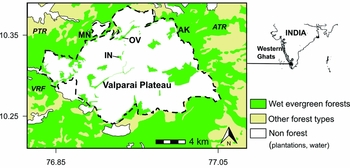
The study was conducted on the Valparai plateau in the Anamalai Hills (22 000 ha, 10°15′–10°22′N, 76°52′–76°59′E) of the Western Ghats (Figure 1), a global biodiversity hotspot (Kumar et al. Reference KUMAR, PETHIYAGODA, MUDAPPA, Mittermeier, Myers, Mittermeier and Robles Gil2004). The Valparai plateau has an undulating terrain and ranges between 600 m and 1400 m asl. The annual rainfall averages about 3500 mm, with 70% of the precipitation occurring during the south-west monsoon between June and September (data from Injipara estate, 1989–1998). The natural vegetation of the area has been classified as mid-elevation tropical evergreen rain-forest of the Cullenia exarillata–Mesua ferrea–Palaquium ellipticum type (Pascal Reference PASCAL1988, Pascal et al. Reference PASCAL, RAMESH and FRANCESCHI2004). The most abundant trees in the forests are Palaquium ellipticum (Sapotaceae), Vateria indica (Dipterocarpaceae), Cullenia exarillata (Malvaceae), Reinwardtiodendron anamallayanum (Meliaceae), Drypetes malabarica (Putranjivaceae) and Oreocnide integrifolia (Urticaceae) (Muthuramkumar et al. Reference MUTHURAMKUMAR, AYYAPPAN, PARTHASARATHY, MUDAPPA, RAMAN, SELWYN and PRAGASAN2006).
Map of Valparai plateau and adjoining protected areas in southern India showing wet evergreen forests (rain forests), other forest types and non-forest areas. Locations of continuous forest sites Akkamalai (AK) and Manamboli (MN) and forest fragment sites Old Valparai (OV) and Injipara (IN) are marked. General locations of Anamalai Tiger Reserve (ATR), Parambikulam Tiger Reserve (PTR) and Vazhachal Reserved Forest (VRF) are also indicated. Forest and land cover maps were derived from layers generated by French Institute of Pondicherry, available at http://indiabiodiversity.org/, and from digitized rain-forest fragment boundaries available with Nature Conservation Foundation.

Rain forests on the Valparai plateau have been cleared for establishing plantations – mainly of tea, shade coffee and cardamom – since the late 1800s (Mudappa & Raman Reference MUDAPPA, RAMAN, Shahabuddin and Rangarajan2007). The rapid expansion of plantations to over 13 000 ha by the 1940s was the main cause of rain-forest fragmentation (Mudappa & Raman Reference MUDAPPA, RAMAN, Shahabuddin and Rangarajan2007). At present, the plateau has a landscape matrix dominated by plantations of tea, followed by shade coffee, and small areas of cardamom and Eucalyptus (c. 15 000 ha in total). There are also over 40 remnant rain-forest fragments (1– 300 ha in area) nestled within these plantations and abutting or extending into the surrounding wildlife reserves. The surrounding reserves – chiefly Anamalai Tiger Reserve in Tamil Nadu (95 800 ha, 10°12′–10°35′N, 76°49′–77°24′E) and Parambikulam Tiger Reserve (63 400 ha, 10°20′–10°32′14″N, 76°35′–76°50′E) and Vazhachal Reserved Forest in Kerala (41 395 ha, 10°31′–10°33′N, 76.70′–76.81′E) – also contain extensive continuous rain forests extending to over 30 000 ha alongside other vegetation types.
The Valparai landscape matrix allows us to compare rain-forest fragments to contiguous forests and examine changes in tree species assemblages. In this study, we compare tree sapling communities of two relatively undisturbed continuous tropical rain forests, Akkamalai (AK, 2600 ha) and Manamboli (MN, 100 ha), with two rain-forest fragments, Injipara (IN, 18 ha) and Old Valparai (OV, 32 ha; earlier known as Tata Finlay, TF, in Muthuramkumar et al. Reference MUTHURAMKUMAR, AYYAPPAN, PARTHASARATHY, MUDAPPA, RAMAN, SELWYN and PRAGASAN2006). While AK and MN are within the Anamalai Tiger Reserve, IN and OV are located in the plantation-dominated part of the Valparai plateau. IN is surrounded by privately owned tea and Eucalyptus plantations, while OV adjoins traditional shade coffee plantations under a canopy of native tree species, and Eucalyptus plantations. Both forest fragments face a moderate amount of human disturbance, with non-native Spathodea campanulata (Bignoniaceae) and Maesopsis eminii (Rhamnaceae) trees present in IN, which were planted as plantation shade trees in the past, while AK and MN are relatively undisturbed except for some understorey invasion by robusta coffee Coffea canephora (Rubiaceae) from adjoining plantations in MN (Joshi et al. Reference JOSHI, MUDAPPA and RAMAN2009).
Vegetation sampling
The sampling design for assessing tree regeneration in this study was nested within and carried out concurrently with vegetation sampling plots surveyed in 2003 for a larger study examining plant community structure in the same rain-forest fragments and continuous forests (Muthuramkumar et al. Reference MUTHURAMKUMAR, AYYAPPAN, PARTHASARATHY, MUDAPPA, RAMAN, SELWYN and PRAGASAN2006). Each sampling unit consisted of a 20 × 20-m (0.04 ha) plot for sampling adult tree communities (hereafter, overstorey trees and species). All plots were randomly placed, maintaining a minimum distance of 50 m between plots. They were also located at least 20 m away from roads, major trails and habitat edges. Each plot was then divided into four 10 × 10-m quarters. The regeneration sampling was done in a 5 × 5-m plot (0.0025 ha) placed at the outer corner of the first (south-west) quarter. Within each regeneration plot, we identified, counted and measured all tree saplings >1 cm diameter at breast height (dbh, at 1.3 m) and <9.55 cm dbh (equivalent to <30 cm girth at breast height, gbh). Woody shrubs of 1–9.55 cm dbh were also recorded in the regeneration plots, but were not included in the present analysis. All stems ≥9.55 cm dbh within the 20 × 20-m plot were identified and counted as overstorey plot trees. In addition, trees (dbh ≥ 9.55 cm) outside the tree plot but whose canopy extended directly overhead the 5 × 5-m regeneration plot area were identified and counted as overhanging trees. Plant species were identified using Gamble & Fischer (Reference GAMBLE and FISCHER1935) and herbarium collections from previous studies in the region kept at the Salim Ali School of Ecology, Pondicherry University (Annaselvam & Parthasarathy Reference ANNASELVAM and PARTHASARATHY1999, Ayyappan & Parthasarathy Reference AYYAPPAN and PARTHASARATHY2001, Muthuramkumar & Parthasarathy Reference MUTHURAMKUMAR and PARTHASARATHY2000, Parthasarathy Reference PARTHASARATHY1999, Reference PARTHASARATHY2001). Species names were updated with reference to The Plant List (Version 1.1, http://theplantlist.org). A total of 90 regeneration plots were sampled including 25 each in the two continuous forest sites and 20 each in the two fragments.
Tree species groups
All the tree species in the regeneration dataset were divided into groups of ecologically similar species based on successional status and seed dispersal mode. First, all native species were classified as either old-growth (climax) species, which are shade-tolerant and closely associated with interiors of mature and undisturbed rain forests, or early-successional (pioneer) species, which are less shade-tolerant and more closely associated with clearings, habitat edges and disturbed areas (Swaine & Whitmore Reference SWAINE and WHITMORE1988). We based our classification of old-growth and early-successional species groups on published species descriptions in online databases containing information on trees of the Western Ghats such as Biodiversity Informatics and co-Operation in Taxonomy for Interactive shared Knowledge base (http://www.biotik.org/), India Biodiversity Portal (http://indiabiodiversity.org/) and the Kerala Forest Research Institute Herbarium (http://kfriherbarium.org), and on previous studies that provided information on the successional status of rain-forest species in the Western Ghats (Chetana Reference CHETANA2013, Pascal Reference PASCAL1988, Raman et al. Reference RAMAN, MUDAPPA and KAPOOR2009, Sreejith Reference SREEJITH2005).
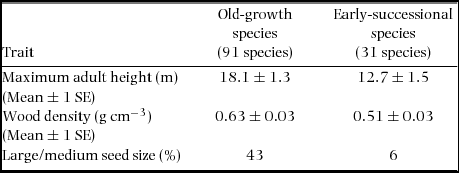
Information on other species traits such as seed size (length: small ≤ 1 cm; medium = 1–3 cm; large ≥ 3 cm), wood density and maximum adult height, collated from secondary sources, were also used to corroborate our species classifications (Appendix 1 gives a species list, traits-based groups and information sources). Consistent with expectations based on known ecological differences between old-growth and early-successional species (Laurance et al. Reference LAURANCE, NASCIMENTO, LAURANCE, ANDRADE, FEARNSIDE, RIBEIRO and CAPRETZ2006a, Reference LAURANCE, NASCIMENTO, LAURANCE, ANDRADE, RIBEIRO, GIRALDO, LOVEJOY, CONDIT, CHAVE, HARMS and D'ANGELOb; Tabarelli et al. Reference TABARELLI, LOPES and PERES2008), old-growth species have 43% greater maximum adult heights and 24% higher wood densities, on average, than early-successional species, and a greater proportion of old-growth species have large- or medium-sized seeds (43%) than early-successional species (6%; Table 1). Apart from old-growth and early-successional species, two non-native tree species that are grown in plantations and woodlots in the surrounding matrix, namely Spathodea campanulata and Maesopsis eminii, were found regenerating in one of the fragments and were classified as introduced species.
Maximum adult heights, wood densities and percentage of species having large or medium-sized seeds among old-growth and early-successional tree species in rain forests of the Anamalai Hills, Western Ghats.

Next, each tree species was assigned to one of four seed-dispersal categories, namely: (1) bird, (2) mammal, (3) bird and mammal, and (4) abiotic – including wind, water, gravity and explosive dehiscence. Dispersal mode classifications were based on published information on seed-dispersal mechanisms of Western Ghats tree species (Appendix 1), combined with unpublished notes and observations recorded by DM and TRSR over the last 20 y in the study area. Species that could not be placed with certainty into any seed-dispersal group were assigned to an unknown dispersal-mode group.
Immigrant saplings
Tree saplings in the regeneration plots were classified based on dispersal history as either immigrant or local saplings. Saplings within regeneration plots belonging to species that were not present in corresponding 20× 20-m overstorey tree plots were classified as immigrants – their presence in the regeneration plot is most likely an outcome of seed-dispersal events because no adults of those species were recorded in the immediate vicinity (Martínez-Ramos & Soto-Castro Reference MARTÍNEZ-RAMOS and SOTO-CASTRO1993, Melo et al. Reference MELO, MARTÍNEZ-SALAS, BENÍTEZ-MALVIDO and CEBALLOS2010). Immigrant densities therefore provide a conservative estimate of the amount of regeneration that has arisen from dispersed seeds in continuous forests and forest fragments (Melo et al. Reference MELO, MARTÍNEZ-SALAS, BENÍTEZ-MALVIDO and CEBALLOS2010). On the other hand, saplings establishing under or close to conspecific adults could have arisen from seeds that simply fell – rather than having been dispersed – from nearby parent trees, and are therefore classified as local. All small tree species (maximum adult height ≤5 m) were placed in a third category – unknown – because even as adults these trees rarely attain sizes needed (>10 cm dbh) to be recorded in overstorey tree plots.
Data analysis
The regeneration-plot data, which contained individuals ranging in size from 1–9.55 cm dbh, was filtered to retain only tree saplings (1–5 cm dbh). We then counted the numbers of individuals (density) and species (richness) of saplings in the regeneration plots, taken overall and as separate subsets of species grouped by successional status (old-growth and early-successional) and seed-dispersal mode (bird, mammal, bird and mammal, and abiotic). As species richness was also expressed per unit area of the plot (0.0025 ha), it is equivalent to species density as defined by Gotelli & Colwell (Reference GOTELLI and COLWELL2001).
We used generalized linear mixed models (GLMMs) to first examine variation in plot-level sapling densities and species richness of all, old-growth and early-successional species in relation to fragmentation status (hypothesis 1) and, second, to examine how regeneration density and richness vary with respect to overstorey species richness in continuous forests and fragments (hypothesis 3). Sapling responses at the plot level were modelled with fragmentation status, overstorey species richness and a two-way interaction between fragmentation status and overstorey richness as fixed predictors, while site was included as the random grouping variable. We compared model intercepts to ask whether sapling density and richness differed between continuous forests and fragments. Model slope estimates for continuous forests and fragments were compared to ask whether relationships between sapling responses and overstorey species richness differed between the two habitats. Model parameters (intercept and slope) were considered to differ significantly between continuous forests and fragments when the 95% confidence interval (95% CI) of the estimated difference between the two habitats spanned a range that did not include zero (Nakagawa & Cuthill Reference NAKAGAWA and CUTHILL2007).
We also examined sapling species-richness patterns at the site level after controlling for differences in sampling effort across sites using rarefaction. As the number of plots sampled per site varied from 20 (IN and OV) to 25 (AK and MN), species richness of 15 plots, averaged across 500 random 15-plot samples, was assessed for each site.
Next, we used GLMMs to test for differences in the densities and species richness of immigrant saplings between continuous forests and fragments, and asked whether responses differed across seed-dispersal modes and successional status groups (hypothesis 2). We modelled immigrant densities and richness of bird-, mammal-, bird-and-mammal-, and abiotically dispersed species as well as immigrant densities and richness of old-growth species and early-successional species belonging to different dispersal groups as response variables, with fragmentation status as a fixed predictor and site as a random grouping variable.
The placement of regeneration plots at the corners, rather than centres, of the respective overstorey tree plots, which was done to simplify plot marking and data collection at the time of sampling, could introduce a bias by inflating the numbers of saplings classified as immigrants. We tested for this bias by repeating the immigrant classification and analysis by defining the overstorey species pool as the list of species from within the 20 × 20-m plots combined with overhanging trees that were located outside the plots. Immigrant densities and richness estimated using the latter (20 × 20-m plots plus overhanging trees) and former (20 × 20-m plots only) classifications were virtually identical (average differences: density = 1%, species richness = 0.7%), suggesting that including overstorey trees beyond the corner of the 20 × 20-m plot does not strongly modify immigrant responses. Hereafter, only the former set of immigrant results (overstorey trees in 20 × 20-m plots only) is presented.
As all response variables assessed were in the form of counts, GLMMs were specified using a Poisson error distribution. As the GLMMs comprised multiple predictors, values of numerical predictors (overstorey tree species richness) were scaled and centred on zero prior to the analysis. All data processing, statistical analyses and preparation of figures and other outputs were performed using the R statistical and computing environment. GLMM analyses were run using the lme4 package in R (Bates et al. Reference BATES, MÄCHLER, BOLKER and WALKER2015).
RESULTS
We recorded 955 saplings of at least 110 tree species during the study, including 538 individuals (87 species) in continuous-forest plots and 417 individuals (65 species) across plots in forest fragments. Overall sapling densities ranged from 1–23 individuals per plot (0.0025 ha) across continuous forest plots and 2–25 individuals per plot across plots in forest fragments. Sapling species richness ranged from 1–18 species and 1–12 species per plot in continuous forests and forest fragments, respectively. At the site level, Akkamalai (continuous forest) had the highest average rarefaction species richness across 15 plots (mean ± SD = 51.1 ± 3.3), followed by Old Valparai (fragment: 42.9 ± 2.7) and Manamboli (continuous forest: 37.9 ± 2.4), while the more disturbed Injipara fragment had fewest species per 15 plots (28.6 ± 1.6).
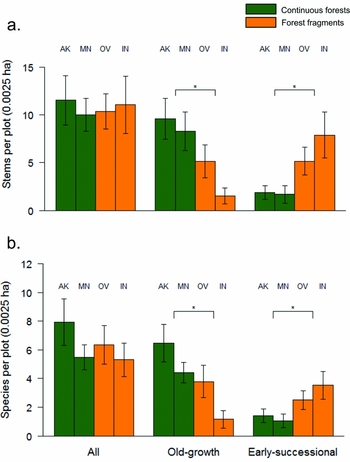
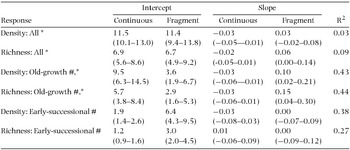
Overall sapling densities and species richness were not consistently related to fragmentation status (Figure 2), with 95% CIs of the estimated difference between continuous forests and fragments having a range that spanned zero (in other terms, mean density estimates for continuous forests falling within the 95% CI range of sapling densities for fragments, and vice versa; Table 2). However, there were marked differences when species’ successional status was considered, with saplings of old-growth species showing strong declines and early-successional species increasing in density and richness in fragments (Figure 2). Our GLMMs estimated 62% lower densities of old-growth tree species on average in fragments than in continuous forests, while densities of early-successional species showed over a twofold increase in fragments (Figure 2a, Table 2). Similar patterns were noted in sapling species richness per plot. Species richness of old-growth trees decreased by 48% in fragments, while richness of early-successional species was over twice as high in fragments compared with continuous forests (Figure 2b, Table 2).
Regeneration plot-level stem densities (a) and species richness (b) of all species, old-growth species and early-successional species in continuous (AK and MN) and fragmented (OV and IN) rain forests in the Anamalai Hills, Western Ghats. Bars represent means and error bars represent 95% CIs. Statistically significant differences between continuous forests and fragments are indicated by *.

Generalized linear mixed model intercept, slope and R2 values for tree sapling density and species richness responses to fragmentation and overstorey tree species richness in rain forests of the Anamalai Hills, Western Ghats. Intercepts represent average sapling densities and species richness per plot (0.0025 ha), and slopes represent proportional changes in these responses for unit increase in overstorey tree species richness. Values in parentheses indicate 95% CIs of the parameter estimates. Statistically significant differences between continuous forests and fragments, inferred from 95% CI ranges of parameter estimates (see text), are indicated by # (intercept) and * (slope). Marginal R2 values representing variance explained by fixed factors of GLMMs (Nakagawa & Schielzeth Reference NAKAGAWA and SCHIELZETH2013) are reported.

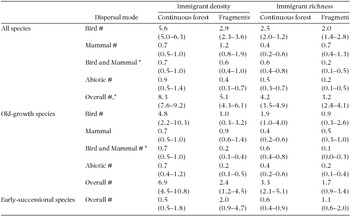
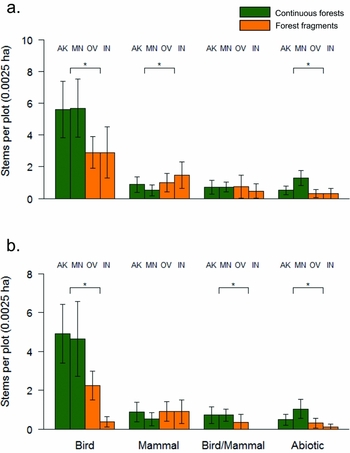
Although continuous forests and fragments had similar sapling densities overall, there were 39% fewer immigrant recruits (i.e. belonging to species not present in the neighbourhood overstorey) in forest-fragment plots (mean = 5.1 saplings per plot, 45% of total saplings, 95% CI = 4.3–6.1 saplings per plot) than in plots in continuous forests (mean = 8.3 saplings per plot, 72% of total saplings, 95% CI = 7.6–9.2 saplings per plot; Table 3). Among seed-dispersal modes, sapling densities of immigrant bird-dispersed species and abiotically dispersed species were 48% and 56% lower, respectively, in fragments than continuous forests, while densities of immigrant mammal-dispersed species increased by 71% in fragments (Figure 3a; Table 3). Densities of immigrant old-growth species that are dispersed by birds, and those dispersed by both birds and mammals, were lower in fragments by 79% and 71%, respectively, and old-growth species with abiotic dispersal decreased by 71% (Figure 3b). In contrast, densities of immigrant early-successional species increased four-fold in fragments (Table 3).
GLMM-derived average immigrant sapling densities and species richness per 0.0025 ha plot (associated 95% confidence intervals in parentheses) across successional status and seed-dispersal mode groups in continuous rain forests and fragments in the Anamalai Hills, Western Ghats. Responses showing significant differences between continuous forests and fragments, based on 95% CI ranges (see text), are indicated using # (density) and * (richness).

Densities of immigrant saplings in regeneration plots belonging to different seed dispersal modes across all species (a) and old-growth species (b). Bars represent means and error bars depict 95% CIs of the means for continuous rain-forests (AK and MN) and fragments (OV and IN) in the Anamalai Hills, Western Ghats. Statistically significant differences between continuous forests and fragments are indicated by *.

Overall immigrant species richness was 24% lower in forest fragments (mean = 3.2 species per plot, 48% of total species, 95% CI = 2.4–4.1 species per plot) than in continuous forests (mean = 4.2 species per plot, 61% of total species, 95% CI = 3.5–4.9 species per plot), and richness of bird-and-mammal-dispersed species decreased by 67% (overall) and 83% (old-growth species) in fragments (Table 3). Patterns of immigrant species richness of old-growth species and of other seed-dispersal groups were qualitatively similar to corresponding immigrant density patterns, but with overlapping means and 95% CIs of richness estimates between habitats suggesting relatively weak differences in most of the cases (Table 3). As over 78% of early-successional saplings belonged to a single seed-dispersal category (bird-dispersed), with relatively few individuals (9–16 individuals) and species (3–4 species) within other dispersal mode groups, responses of different seed dispersal modes within early-successional species were not assessed separately.
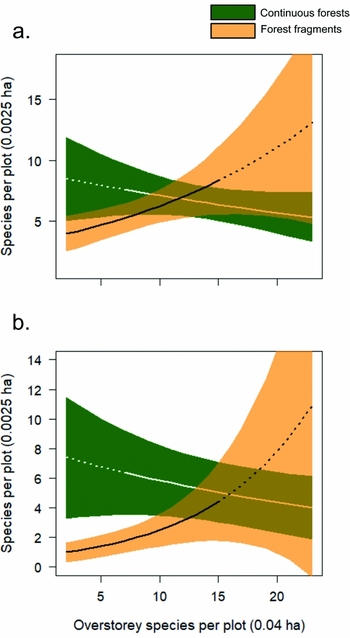
The responses of sapling density and species richness per plot to gradients in overstorey tree species richness varied across species groups and differed between continuous and fragmented forests. Overall sapling densities showed a weak negative relationship with overstorey species richness in continuous forests (average change in sapling density for unit increase in overstorey richness = −3%; 95% CI = −5% to −1%), but was unrelated to overstorey richness in fragments (mean = 3%; 95% CI = −2% to 8%; Table 2). Overall sapling species richness was unrelated to overstorey richness in continuous forests, but increased by 6% on average in fragments for unit increase in overstorey richness (Figure 4a; Table 2). This overall pattern was driven by responses of old-growth species saplings, which increased in density by 10% and richness by 15% for unit increase in overstorey richness in fragments, but were weakly related or unrelated to overstorey richness in continuous forests (Figure 4b; Table 2). In contrast, sapling density and richness of early-successional species were unrelated to overstorey species richness in continuous and fragmented forests (Table 2).
Fitted GLMMs of regeneration plot-level sapling species richness (a) and old-growth sapling species richness (b) in relation to overstorey tree richness and fragmentation in the Anamalai Hills, Western Ghats. Mean fitted lines in continuous and fragmented forests are marked and shaded areas represent corresponding 95% CIs. Model predictions outside the observed range of overstorey richness in each habitat are represented using broken lines.

DISCUSSION
Our study shows that tree sapling communities in tropical rain-forest fragments in the Western Ghats have similar overall sapling densities and species richness as nearby continuous rain forests. At the site-level, the larger and less-disturbed fragment (OV) had greater overall rarefied species richness than one of the continuous rain forest sites (MN). The lack of consistent differences in overall species richness between fragments and continuous forests distinguish our findings from previous work (Santo-Silva et al. Reference SANTO-SILVA, ALMEIDA, MELO, ZICKEL and TABARELLI2013), and highlight the value of fragments for sustaining tree diversity in human-dominated tropical landscapes (Muthuramkumar et al. Reference MUTHURAMKUMAR, AYYAPPAN, PARTHASARATHY, MUDAPPA, RAMAN, SELWYN and PRAGASAN2006, Turner & Corlett Reference TURNER and CORLETT1996). However, there were marked differences in sapling species composition between continuous forests and fragments in this study. Sapling densities and species richness of old-growth species were substantially lower in fragments, while early-successional species that are typically associated with open and degraded forests showed an increase. These shifts favouring regeneration of early-successional species over old-growth species are consistent with fragmentation effects seen elsewhere in the tropics (Laurance et al. Reference LAURANCE, NASCIMENTO, LAURANCE, ANDRADE, FEARNSIDE, RIBEIRO and CAPRETZ2006a, Santo-Silva et al. Reference SANTO-SILVA, ALMEIDA, MELO, ZICKEL and TABARELLI2013, Tabarelli et al. Reference TABARELLI, LOPES and PERES2008), and similar to effects of other forest disturbances in the Western Ghats (Anitha et al. Reference ANITHA, JOSEPH, CHANDRAN, RAMASAMY and PRASAD2010, Bhat et al. Reference BHAT, NAIK, PATAGAR, HEGDE, KANADE, HEGDE, SHASTRI, SHETTI and FURTADO2000, Daniels et al. Reference DANIELS, GADGIL and JOSHI1995, Parthasarathy Reference PARTHASARATHY1999).
The decreased recruitment of old-growth tree species is likely to be driven by a combination of factors affecting reproduction, seed dispersal and post-dispersal establishment in fragments (Benítez-Malvido Reference BENÍTEZ-MALVIDO1998, Benítez-Malvido & Martínez-Ramos Reference BENÍTEZ-MALVIDO and MARTÍNEZ-RAMOS2003). The contrasting patterns of immigrant saplings belonging to different seed-dispersal modes provide insights into shifts in regenerating communities that have most probably arisen due to varying levels of seed-dispersal limitation in fragments. Consistent with previous studies (Cramer et al. Reference CRAMER, MESQUITA and WILLIAMSON2007, Melo et al. Reference MELO, MARTÍNEZ-SALAS, BENÍTEZ-MALVIDO and CEBALLOS2010), fragments had fewer saplings of old-growth species inferred as having arrived via seed dispersal than continuous forests. Interestingly, responses also differed among old-growth species, wherein species that depend partially or entirely on birds for seed dispersal consistently declined in fragments, while immigrant densities of mammal-dispersed species either did not differ between fragments and continuous forests, or increased in fragments. These contrasting responses correspond well with what is known about the composition of faunal communities in the study area – particularly reductions in densities of large avian frugivores such as hornbills and pigeons (Raman Reference RAMAN2006), but not densities of large-mammal species in fragments (Sridhar et al. Reference SRIDHAR, RAMAN and MUDAPPA2008).
In the case of smaller-seeded early-successional species, which are dispersed either abiotically or by smaller frugivores that are less sensitive to forest fragmentation (Raman Reference RAMAN2006), densities in fragments are also likely to be increased by favourable edge effects – such as desiccation and increased light availability – which are known to penetrate as far as 150 m into fragments (Laurance et al. Reference LAURANCE, NASCIMENTO, LAURANCE, ANDRADE, FEARNSIDE, RIBEIRO and CAPRETZ2006a). Edge effects and other past disturbances such as understorey crop planting, tree felling and planting of non-native shade trees, could have exacerbated this effect in a part of one of our fragment sites (IN). Such disturbances are also known to increase regeneration of non-native trees and shrubs such as Coffea canephora in fragments, which could further impede regeneration and recovery of old-growth rain-forest tree species in fragments (Joshi et al. Reference JOSHI, MUDAPPA and RAMAN2009, Reference JOSHI, MUDAPPA and RAMAN2015).
Previous single-species studies have shown that reduced seed dispersal distances can restrict natural regeneration of old-growth species to areas of fragments having nearby conspecific adults (Cordeiro & Howe Reference CORDEIRO and HOWE2003, Cordeiro et al. Reference CORDEIRO, NDANGALASI, MCENTEE and HOWE2009, Ismail et al. Reference ISMAIL, GHAZOUL, RAVIKANTH, KUSHALAPPA, UMA SHAANKER and KETTLE2017). Our results suggest that at the community level, seed-dispersal limitation due to fragmentation can alter local relationships of sapling density and richness with overstorey tree species richness. Sapling density and richness were similar across areas of low and high overstorey richness in continuous forests, suggesting that there is potential for natural forest regeneration and recovery even in areas where overstorey disturbances or other factors have reduced adult tree species richness locally. In contrast, sapling densities and richness, particularly of old-growth tree species, were considerably lower in areas with depauperate tree overstoreys in fragments, suggesting that fragmentation decreases the potential for rain-forest tree communities to naturally recover following overstorey disturbances and species loss.
Conclusions
With large, continuous tropical forests presently restricted to just a few regions such as the Amazon and Congo basins, fragmented forest landscapes are gaining importance for biodiversity conservation and ecosystem services across the human-dominated tropics (Gardner et al. Reference GARDNER, BARLOW, CHAZDON, EWERS, HARVEY, PERES and SODHI2009, Turner & Corlett Reference TURNER and CORLETT1996). However, decreased recruitment of old-growth tree species in ageing fragments of the Western Ghats (this study), and elsewhere in the tropics (Santo-Silva et al. Reference SANTO-SILVA, ALMEIDA, MELO, ZICKEL and TABARELLI2013), underlie persistent losses of floristic integrity, biodiversity values and ecosystem services that are widely associated with tropical forest fragmentation and associated disturbances (Laurance & Cochrane Reference LAURANCE and COCHRANE2001, Tabarelli et al. Reference TABARELLI, LOPES and PERES2008). Furthermore, our results suggest that the potential for natural regeneration and recovery of old-growth tree communities is especially limited in fragments that have species-poor tree overstoreys. This suggests that restoration of old-growth tree species could be important for facilitating recovery of rain-forest tree communities in degraded forest fragments.
ACKNOWLEDGEMENTS
We thank our field assistants A. Silamban, T. Dinesh, G. Murthy and A. Sathish Kumar. For funding, AMO thanks Science and Engineering Research Board (Govt of India) for post-doctoral fellowship support (PDF/2016/000104), and DM and TRSR gratefully acknowledge a grant from Rohini Nilekani for the rain-forest restoration programme. The 2003 fieldwork was financially supported by the Tropical Rain Forest Programme of the Netherlands Committee for the IUCN. We thank the Tamil Nadu Forest Department, including Mr. V. Ganesan and Range Officers of the Anamalai Tiger Reserve for permits and support. We thank managers of Tata Coffee Ltd and Hindustan Lever Ltd (now Tea Estates India Limited) for site permissions. We are grateful to three anonymous reviewers and the editor for comments that have substantially improved the quality of this manuscript.
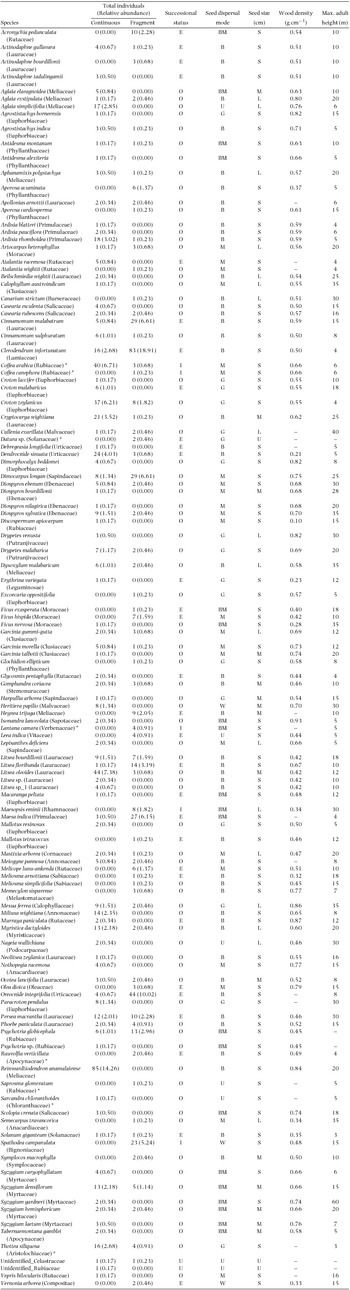
List of species encountered as saplings (1–5 cm dbh) in regeneration plots in continuous and fragmented rain forests in the Anamalai Hills, Western Ghats. Information on species abundances in the two habitats and species traits are also provided. Column codes are as follows: Successional status: O = Old-growth species; E = Early-successional species; I = Introduced species; U = Unknown; Seed-dispersal mode: B = Bird; M = Mammal; BM = Bird and mammal; G = Gravity; W = Wind; U = Unknown; Seed size: L = Large (> 3 cm); M = Medium (1–3 cm); S = Small (<1 cm). *indicates shrub species recorded in regeneration plots but not included in the present analysis. Species traits information was collated from BIOTIK (http://www.biotik.org/), Flowers of India (http://www.flowersofindia.net/), India Biodiversity Portal (http://indiabiodiversity.org/), Global wood density database (doi: http://dx.doi.org/10.5061/dryad.234/1) and Osuri et al. (Reference OSURI, KUMAR and SANKARAN2014).