Introduction
Enthusiasm for routine use of high-dose antipsychotic therapy waned in the 1980s due to tolerability concerns and the absence of evidence to support superior efficacy compared with more traditional approaches.Reference Bollini, Andreani and Colombo 1 , Reference Mackay 2 By the early 1990s, prior to the widespread availability of second-generation antipsychotics, extended use of high-dose antipsychotic treatment was often relegated to long-term inpatient settings populated by severely ill, violent patients with schizophrenia.Reference Krakowski, Kunz, Czobor and Volavka 3 The improved neurological adverse effect profile with second-generation antipsychotics combined with data demonstrating clozapine's unique efficacy for persistent violence in patients with schizophreniaReference Frogley, Taylor, Dickens and Picchioni 4 provided a valid rationale for limiting the use of high doses of potent dopamine D2 antagonists.Reference Volavka, Czobor and Nolan 5 Nonetheless, high-dose antipsychotic prescribing persists in inpatient settings despite consensus recommendations 6 and efforts to curtail this practice.Reference Paton, Barnes, Cavanagh, Taylor and Lelliott 7 The Royal College of Psychiatrists (RCP) consensus statement succinctly summarizes a rational view of high-dose antipsychotics:
On the basis of current evidence, high-dose prescribing, either with a single agent or combined antipsychotics, should rarely be used and then only for a time-limited trial in treatment-resistant schizophrenia after all evidence-based approaches have been shown to be unsuccessful or inappropriate. 6
Unlike acute inpatient settings, forensic psychiatric facilities are more likely to contain significant numbers of treatment-resistant or violent schizophrenia patients whose care demands the use of high plasma level antipsychotic strategies due to pharmacodynamic response failure at lower dosages despite therapeutic antipsychotic levels. In this sense, we are making a clear distinction between those who achieve expected plasma antipsychotic levels but fail to respond as opposed to patients treated with known cytochrome P450 (CYP) or p-glycoprotein (PGP) inducers such as carbamazepine,Reference Meyer 8 or who possess biological variants (eg, CYP 2D6 ultrarapid metabolizers)Reference Kirchheiner, Schmidt and Tzvetkov 9 that require high dosages to achieve therapeutic drug levels. As will be discussed below, the use of plasma antipsychotic levels is crucial to ascertaining whether the high dosages used are indeed resulting in high plasma drug levels or whether nonresponse is due to kinetic failure.
The biological hypothesis for pharmacodynamic nonresponders revolves around the concept that some schizophrenia patients require ≥80% D2 receptor blockade for efficacy. Because antipsychotic D2 receptor occupancy curves flatten out considerably around 80%, large increases in plasma antipsychotic levels are required to realize small increases in receptor occupancy.Reference Uchida, Takeuchi and Graff-Guerrero 10 For example, tripling the plasma olanzapine level from 50 ng/mL to 150 ng/mL changes D2 receptor occupancy from just below 80% to a value close to 83%.Reference Uchida, Takeuchi and Graff-Guerrero 10
In the absence of modern clinical guidelines for high plasma level antipsychotic therapy, the following practice-based treatment principles have been developed by the California Department of State Hospitals (DSH) Psychopharmacology Resource Network for the use of antipsychotics in schizophrenia patients with psychotic or impulsive violence in whom the need for high antipsychotic dosages is not primarily to overcome the impact of CYP or PGP induction or rapid drug metabolism. These are not strategies for the management of routine nonviolent community patients, nor do these principles apply to the use of antipsychotics in psychotic patients who may have severe or profound intellectual disability due to the limited clinical experience and literature in this area, or for control of violence driven by sociopathic or predatory behavior, or psychopathy.
Principles
-
1. Clozapine has the best evidence for violence reduction in patients with schizophrenia independent of its impact on psychotic symptom severity.
-
2. High plasma level antipsychotic therapy may be considered in violent schizophrenia patients prior to a clozapine trial in the following circumstances:
-
a. Failure of routine clinical doses of medium/potent D2 antagonists
-
b. And, the absence of dose limiting adverse effects, particularly extrapyramidal side effects (EPS) or akathisia
-
-
3. High plasma level antipsychotic therapy can be used for violent schizophrenia patients who refuse or have failed a clozapine trial and who did not exhibit dose limiting adverse effects during routine antipsychotic exposure.
-
4. Antipsychotic treatment should be carefully titrated until one of two well-defined clinical endpoints are reached: clinical response or intolerability.
-
a. Treatment trials should not be routinely terminated on the basis of daily dose or high plasma levels: certain patients may both require and tolerate high doses and high plasma levels of D2 antagonists.
-
b. A small subset of schizophrenia patients exhibits enormous tolerance for D2 antagonism without EPS or akathisia. While not an absolute rule, consideration can be given for terminating a medication trial for futility with any of the following plasma levels: haloperidol >> 30 ng/mL, fluphenazine >> 4.0 ng/mL, or olanzapine >> 200 ng/mL.
-
The first principle was derived from open label experienceReference Frogley, Taylor, Dickens and Picchioni 4 and data from a randomized, double-blind, 12-week, parallel-group trial in which clozapine demonstrated superiority to olanzapine and haloperidol for the treatment of violent schizophrenia patients, especially in those with low cognitive function, and without statistical separation between the medication arms for symptom reduction.Reference Krakowski, Czobor, Citrome, Bark and Cooper 11 , Reference Krakowski, Czobor and Nolan 12 Olanzapine was also superior to haloperidol for some measures of aggression.Reference Krakowski, Czobor, Citrome, Bark and Cooper 11 The second principle emerged from two clinical realities: (1) certain individuals may fail to evince adverse effects for kinetic or adherence reasons, and thus are deprived of an adequate antipsychotic trial;Reference Glick, Balon, Ballon and Rovine 13 (2) there is an enormous range in antipsychotic tolerability.Reference Simpson and Kunz-Bartholini 14 Principle 3 may be viewed as a corollary of the first two principles, and reiterates the RCP position regarding the appropriate use of high-dose antipsychotics in a treatment algorithm.
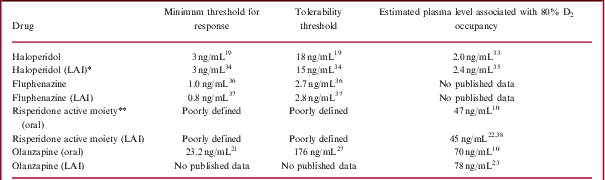
The use of plasma antipsychotic levels as noted in Principle 4 is critical to documenting the antipsychotic trial and guiding treatment decisions. While older literature often used the term high-dose treatment as synonymous with a high level of antipsychotic exposure, this is clearly not the case and engenders significant confusion. Most antipsychotics undergo significant phase I metabolism through the CYP system, with intestinal absorption (and central nervous system penetration across the blood–brain barrier) influenced by antipsychotic affinity for the efflux transporter PGP.Reference Meyer 8 The concurrent use of potent PGP and CYP 3A4 inducers, such as carbamazepine, phenytoin, rifampin, efavirenz, or nevirapine, lower antipsychotic levels significantly, ranging from 16% for asenapine 15 and 35–37% for ziprasidone or paliperidone (due to their limited phase I metabolism)Reference Meyer 8 to 50% for haloperidol, fluphenazine, olanzapine, and risperidone,Reference Meyer 8 and a 70–80% reduction for aripiprazole, quetiapine,Reference Meyer 8 and lurasidone. 16 Valproate in some reports has also been associated with reductions in plasma levels of olanzapineReference Haslemo, Olsen, Lunde and Molden 17 and clozapine,Reference Longo and Salzman 18 although the mechanism and extent of the effect on other agents is not well defined. The use of any of these inducers, and possibly valproate, will often result in subtherapeutic plasma antipsychotic levels for most agents and inadequate response unless markedly higher antipsychotic doses are employed, or the patient can be switched from potent inducers such as carbamazepine to those with lower (eg, valproate) or no propensity (eg, lithium) to induce antipsychotic metabolism. It should be anticipated at the outset of treatment that the use of potent inducers with most antipsychotics may result in kinetic failures, underscoring the need to obtain antipsychotic plasma levels. Several reviews provide a good resource for correlations between threshold plasma antipsychotic levels and response for haloperidol,Reference Coryell, Miller and Perry 19 fluphenazine,Reference Midha, Hubbard, Marder, Marshall and Van Putten 20 and olanzapine,Reference Perry, Lund, Sanger and Beasley 21 and for plasma levels of risperidone and olanzapine with central D2 occupancyReference Uchida, Takeuchi and Graff-Guerrero 10 , Reference Gefvert, Eriksson and Persson 22 , Reference Mamo, Kapur and Keshavan 23 (Table 1). These correlations between antipsychotic plasma levels and D2 occupancy hold for both oral and the comparable long-acting injectable forms.Reference Gefvert, Eriksson and Persson 22 , Reference Mamo, Kapur and Keshavan 23 The abundance of clinical data for haloperidol, fluphenazine, and olanzapine that provides therapeutic ranges makes these antipsychotics ideal candidates for treatment decisions guided by therapeutic drug monitoring. Such correlations have generally not been found consistently with risperidone.Reference Seto, Dumontet and Ensom 24 It should be noted that D2 occupancy data are from normal volunteers or stable schizophrenia patients, and not from violent forensic populations.
Therapeutic plasma antipsychotic ranges for selected agents and plasma levels associated with 80% dopamine D2 receptor occupancy

*LAI = long acting injectable.
**Active moiety = risperidone + 9-OH risperidone.
A clinically occult source of kinetic failure for some schizophrenia patients prescribed antipsychotics metabolized via CYP 2D6 relates to duplication of the genes encoding CYP 2D6. The net result of these extra copies is greater enzyme production and increased 2D6 clinical activity.Reference Kirchheiner, Schmidt and Tzvetkov 9 While relatively uncommon in white northern Europeans (3%), the prevalence of these 2D6 ultrarapid metabolizers (UM) is 10–29% in populations from northeastern Africa (eg, Ethiopia) and geographically proximate parts of the Middle East (eg, Saudi Arabia).Reference Kirchheiner, Schmidt and Tzvetkov 9 Although genetic testing exists for CYP polymorphisms, it is not routinely employed due to expense or lack of local availability, so this effect is difficult to anticipate in those who are not clear descendants of individuals from areas with high 2D6 UM prevalence. In the absence of genetic testing, one might infer the presence of UM status in those who are on antipsychotics metabolized via 2D6 in whom adherence issues have been ruled out (eg, by use of long-acting injectable antipsychotics), and plasma levels are significantly below what might be expected for the degree of medication exposure.Reference Hiemke, Baumann and Bergemann 25
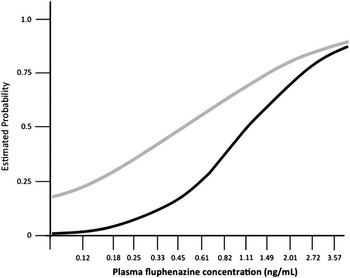
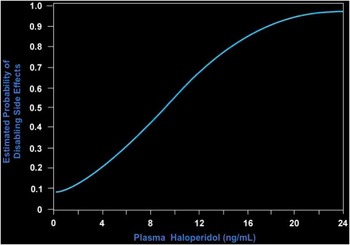
At a minimum, the use of plasma antipsychotic levels thus helps avoid treatment failure due to known or unrecognized kinetic issues.Reference Salzman, Glick and Keshavan 26 As will be illustrated in Case 1, Principle 4a enunciates the proposition that some patients may require high plasma antipsychotic levels for response —— levels that might be outside of the reported therapeutic reference range. When no clinical evidence exists for adverse effects, this fact must documented before further dose titration is pursued if the clinical endpoint (violence reduction) has not been met. Aside from clozapine, few antipsychotics have robust data on response and tolerability, including haloperidol, fluphenazine, and olanzapine (Table 1).Reference Kelly, Richardson, Yu and Conley 27 , Reference Meyer 28 While tolerability may decrease significantly for plasma fluphenazine levels > 2.0 ng/mLReference Midha, Hubbard, Marder, Marshall and Van Putten 20 (Figure 1), haloperidol levels > 12 ng/mLReference Van Putten, Marder, Mintz and Poland 29 (Figure 2), or olanzapine levels > 100 ng/mL,Reference Kelly, Richardson, Yu and Conley 27 the absence of EPS/akathisia or other significant adverse effects despite higher plasma levels is an indication that the patient might reasonably be tried at a higher dosage, especially if clozapine is not an option or the patient is a clozapine failure.
Relationship between plasma fluphenazine levels and estimated probability of improvement (gray line) and disabling side-effects (black line).Reference Midha, Hubbard, Marder, Marshall and Van Putten 20

The relationship between plasma haloperidol and the estimated probability of disabling side effects.Reference Midha, Hubbard, Marder, Marshall and Van Putten 20

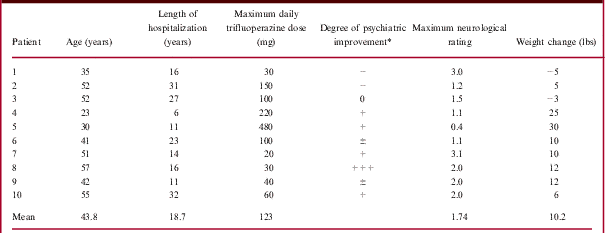
It should be acknowledged that there are rare circumstances in which schizophrenia patients may exhibit no threshold for neurological adverse effects. The data in Table 2 are from a trifluoperazine titration study in which 10 male patients with schizophrenia were started on trifluoperazine 15 mg/d (equivalent to 6 mg haloperidol) without antiparkinsonian treatment, and advanced by 10 mg per week until they reached a predefined level of neurological adverse effects.Reference Simpson and Kunz-Bartholini 14 Subject 5 remained in the titration arm for over 36 weeks, achieving a daily trifluoperazine dose of 480 mg, yet had the lowest neurological side effect rating among the subjects in this study despite obvious evidence of significant drug exposure (weight gain). In such individuals, an antipsychotic trial may be terminated for futility (Principle 4b), although no definite guidelines exist. Clinical experience within the DSH system has yielded very few responders at fluphenazine levels significantly greater than 4.0 ng/mL, haloperidol levels above 30 ng/mL, and olanzapine levels above 200 ng/mL.
Outcomes in an escalating trifluoperazine dose protocolReference Simpson and Kunz-Bartholini 14
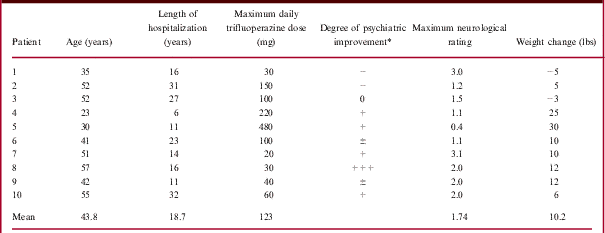
*Interpretation of psychiatric symptom change: − = no improvement with later worsening; 0 = no improvement; ± = mild improvement with later worsening;+ = mild improvement; ++ = moderate improvement; +++ = marked improvement.
The principles listed above do not cover details such as the rapidity of titration or duration for any dosage, as these parameters are often dictated by clinical acuity. Recent analyses of industry-sponsored schizophrenia trials do indicate that, with respect to symptom reduction, the absence of any treatment effect after 2 weeks predicts nonresponse at week 6, and should prompt reconsideration of the treatment approach.Reference Stauffer, Case and Kollack-Walker 30 In many instances, the response to the lack of improvement will include documentation of plasma levels and consideration of dose increases when tolerability is not yet an issue. In patients who have failed high doses of high-potency first-generation antipsychotics with supporting plasma level data, olanzapine is an option for those who cannot or will not take clozapine, bearing in mind its inferiority to clozapine.Reference Krakowski, Czobor, Citrome, Bark and Cooper 11
Case 1: A High-Dose Responder: Plasma Level Guided High-Dose Antipsychotic Therapy
The patient is a 50-year-old African American female with a diagnosis of schizophrenia, and multiple medical problems including type 2 diabetes mellitus (DM), who was admitted to a forensic psychiatric hospital following a conviction for manslaughter. Due to ongoing assaultiveness and suicidality, she was started on clozapine with significant clinical response, but also the development of poorly controlled DM, necessitating the withdrawal of clozapine therapy. Trials of other atypical antipsychotics at high dosages proved ineffective in managing her psychotic symptoms and violence, so the decision was made to embark on a course of high-dose haloperidol therapy, given her prior tolerance for lower dosages. Over several months, the patient was titrated to a daily dose of 45 mg with a marked reduction in psychotic symptoms, requirements for PRN medications, and acts of aggression toward herself and others. Neither EPS nor akathisia were evident, and she was not maintained on routine antiparkinsonian medication. A new psychiatrist assumed the patient's care and obtained a plasma haloperidol level of 29.5 ng/mL. Alarmed that this greatly exceeded the laboratory reference range (5–12 ng/mL), the haloperidol dose was decreased to 20 mg/d (plasma level 8.1 ng/mL). Over the next month, the patient deteriorated, started to refuse routine medication, and required numerous PRN medications for stability. The haloperidol dose was increased to 30 mg for several months, but the patient was frequently assaultive despite this dose increase and the addition of adjunctive lithium and lamotrigine. Another psychiatrist agreed to assume the patient's care, but the patient continued to intermittently refuse oral haloperidol, primarily for delusional reasons. The patient was convinced to try fluphenazine in lieu of haloperidol, and titrated to 20 mg/d with a trough plasma level of 0.7 ng/mL, but limited clinical improvement. To increase the plasma level and also to limit any confounding issues related to adherence, fluphenazine decanoate was started at 25 mg every 2 weeks, oral fluphenazine was tapered off, and the depot dose increased over ensuing months to 100 mg every 2 weeks. With moderate improvement on this regimen and the absence of EPS and akathisia, the psychiatrist chose to supplement fluphenazine decanoate with oral fluphenazine 15 mg with marked reduction in psychosis and complete resolution of aggressive acts. The plasma fluphenazine level on this combination ranged from 3.0–3.2 ng/mL.
Commentary
Although a plasma haloperidol level of 29.5 ng/mL would be intolerable for the vast majority of patients, this patient clearly demonstrated both a requirement of, and tolerability for, a very high level of D2 blockade, with significant clinical deterioration at lower antipsychotic levels. The latest treating psychiatrist correctly recognized the clinical situation and convinced the patient to try a similar medication to haloperidol, fluphenazine. The patient's response to a second high potency first-generation antipsychotic at extremely high plasma levels is consistent with the prior clinical history. The lack of significant adverse effects also supports continued fluphenazine treatment with dosages required to maintain a plasma fluphenazine level ≥ 3.0 ng/mL.
Case 2: High-Dose Failure: The Value of Plasma Levels
The patient is a 29-year-old Latino with a diagnosis of schizophrenia, who was admitted to a forensic psychiatric hospital after being found incompetent to stand trial on numerous charges including assault with a deadly weapon, criminal threats, and arson of an inhabited structure. The court commitment included an involuntary medication order in the case of treatment refusal. The patient was admitted to the hospital from custody on a combination of oral olanzapine 40 mg at bedtime and divalproex 1000 mg twice per day, but extent of adherence was unknown, and he was grossly psychotic in the admission suite, requiring intramuscular medications to control agitation. The medication combination started in jail was continued with good adherence, as documented by trough plasma olanzapine levels of 73 ng/mL and 79 ng/mL and therapeutic serum valproate levels, but on hospital day 12, the patient engaged in an unprovoked assault on a peer with serious injury, and required seclusion and restraints.
Given the severity of the assault, the ongoing significant level of psychotic symptoms, and records from a prior hospitalization that this patient tolerated oral haloperidol doses of 20 mg/d or more, a decision was made to load the patient on haloperidol decanoate while continuing olanzapine and divalproex at prior dosages. The most aggressive depot haloperidol load permissible in DSH facilities is 300 mg weekly for three doses; this regimen is designed to mimic plasma levels achievable with 30 mg/d of oral haloperidol.Reference Meyer 28 This dosing equivalency is an extrapolation of prior loading studies demonstrating that, after 3 weekly injections of haloperidol decanoate 100 mg, mean plasma haloperidol concentrations from the depot were comparable to 10 mg/d of oral haloperidol (7.95 ± 4.94 ng/mL vs 7.79 ± 4.79 ng/mL).Reference Wei, Jann, Lin, Piao-Chien and Chang 31 The 3 loading injections of 300 mg were administered in weekly intervals without evidence of adverse effects. Of note, a plasma haloperidol level obtained 1 week after the last loading injection (ie, at TMax) was 6.4 ng/mL. An assault occurred two days after the third loading injection, but the patient was subsequently free from assaultive behavior and continued to show no evidence of EPS or akathisia. However, his psychotic symptoms appeared to worsen slightly in the week prior to the scheduled maintenance depot dose, so haloperidol decanoate 300 mg was administered 22 days after the last loading injection. A haloperidol level obtained 4 days later was 2.8 ng/mL. The following week, this patient was again involved in a serious unprovoked assault that necessitated seclusion and restraints. A psychopharmacology consultation was obtained to assist with management. Based on the unexpectedly low plasma haloperidol levels obtained despite aggressive loading, it was concluded that this patient's inadequate response to haloperidol was a kinetic failure, but one that might not be easily overcome without the administration of extremely high weekly or biweekly injections of haloperidol decanoate—doses that would be unlikely to be continued outside of the forensic setting due to unfamiliarity with the rationale for a high-dose regimen in this patient. As this patient manifested expected plasma levels from oral olanzapine, a high-dose strategy for this medication was recommended, noting that doses of 60–80 mg/d might be required to achieve plasma levels in the 100–150 ng/ml range, levels associated with 80–85% D2 occupancy.
Commentary
In the absence of plasma haloperidol levels, one might conclude that this patient was one of the unusual individuals who does not experience EPS or akathisia, and is likely a pharmacodynamic failure of haloperidol treatment. As noted above, an expected haloperidol level after 3 weekly loading doses of 100 mg haloperidol decanoate is approximately 7 ng/ml.Reference Wei, Jann, Lin, Piao-Chien and Chang 31 The fact that this patient's haloperidol level 1 week after his third 300 mg dose was 6.4 ng/mL was critical to the conclusion that this patient was a kinetic failure, and most likely was an ultrarapid metabolizer for medications such as haloperidol that utilize cytochrome P450 (CYP) 2D6,Reference Panagiotidis, Arthur, Lindh, Dahl and Sjöqvist 32 but not for those metabolized via CYP 1A2 (eg, olanzapine) based on plasma olanzapine levels.
Conclusions
For treatment-resistant and violent patients with schizophrenia, there are limited therapeutic options, with clozapine and high antipsychotic plasma levels having the greatest evidence base. High plasma level antipsychotic therapy thus remains a viable strategy when employed in a rational manner as enumerated by the principles above. The appropriate use of plasma antipsychotic levels is central to the management of high-dose antipsychotic regimens, but must be complemented by documentation of changes in target symptoms and tolerability. Ongoing tolerability without efficacy represents a failure to achieve 1 of 2 firm clinical endpoints, and provides a sound basis for continued dose advancement despite what might be considered supratherapeutic plasma levels for average patients with schizophrenia.
Disclosures
Jonathan M. Meyer discloses the following: BMS, speaker, speaker's fee; Genetech, speaker, speaker's fee; Genetech, advisor, honoraria; Otsuka, speaker, speaker's fee.