The dawn of the second millennium a.d. was a time of commercial effervescence in Mesoamerica. Trade networks reached an intercontinental scale, stretching at least from northern South America to the American South. In these connections, Mesoamerica’s coastal networks took on a leading role, as did the pathways and waterways that connected them to the inland highlands (Glover and Rissolo Reference Glover, Rissolo, Stanton, Taube, Coltman and Marengo2023; Parsons Reference Parsons and Pasztory1978; Solar Reference Solar Valverde, Stanton, Taube, Coltman and Marengo2023, Reference Solar Valverde, Mathiowetz and Pohl2025).
It was also an epoch of technological innovations regarding the production and distribution of sumptuary goods and imports, with a streamline in logistics that made it possible to achieve a pan‐Mesoamerican distribution. To trace macroregional exchange during this period, among the archaeological artifacts with the greatest diagnostic value are Tohil Plumbate ceramics, stone effigy vessels, turquoise mosaics, and a range of polychromes with iconographic themes that reflect the assimilation of shared ideological codes across this vast territory (Neff et al. Reference Neff, Castillo, Sakai, Stanton, Taube, Coltman and Marengo2023; Smith and Heath‐Smith Reference Smith and Heath‐Smith1980; Solar Reference Solar Valverde, Mathiowetz and Pohl2025). This is also the case of metallurgy, which was introduced and spread throughout Mesoamerica beginning around a.d. 900.
The procurement, transformation, distribution, and use of the goods involved in long‐distance exchange comprised specialists operating at different geographic scales and in distinct contexts of social interaction. Among them, this article explores the character and dynamics of the agents who transferred the most sought-after exotic goods of the Early and Middle Postclassic period (ca a.d. 900–1350), with emphasis on the participation of pre‐Hispanic west Mexico in these supraregional networks.
This analysis is undertaken through the examination of a specific category of effigy metal rings and their potential association with the distributive mechanisms of highly valued merchandise. The technological aspects of their manufacture are not considered here (for a discussion on Mesoamerican metalworking techniques and organization, see Grinberg Reference Grinberg1993; Hosler Reference Hosler1986, Reference Olay Barrientos2005 [Reference Hosler1994], Reference Hosler2009; Maldonado Reference Maldonado2008, Reference Maldonado, Nichols and Pool2012; Shugar and Simmons Reference Shugar Aaron and Simmons2013); instead, attention is given to the extent of their distribution and to the possible social contexts of their use subsequent to production.
The advent of metallurgy in west Mexico
The knowledge of metallurgy was adopted in west Mexico from Central and South America and it is often thought that it spread from there to other Mesoamerican regions (Anawalt Reference Anawalt and Townsend1998; Arsandaux and Rivet Reference Arsandaux and Rivet1923; Beltrán Reference Beltrán Medina2001; Easby Reference Easby1965; Hosler Reference Hosler1986, Reference Hosler1988b, Reference Olay Barrientos2005 [Reference Hosler1994], Reference Hosler2009; Meighan Reference Meighan, Kelley and Riley1969:13–15, Reference Meighan and Meighan1976:1259; Mountjoy Reference Mountjoy, Kelley and Riley1969; Simmons and Shugar Reference Simmons, Shugar, Simmons and Shugar2013). The exact date of adoption is a matter of debate, but a.d. 900 seems now a realistic estimate for when the knowledge of metallurgy and the use of metal artifacts became widespread (Nelson et al. Reference Nelson, Canchola, Luis Punzo Díaz and Minnis2015; Pendergast Reference Pendergast1962b:535; Punzo Reference Punzo Díaz, Valverde and Nelson2019, Reference Punzo Díaz2024; Solar et al. Reference Solar Valverde, Nelson, Ohnersorgen, Valverde and Nelson2019:17–19).
Archaeological work in west Mexico at sites occupied during the Early and Middle Postclassic (ca. a.d. 900–1350) has led to the recovery of significant collections of copper and bronze artifacts. These consist primarily of bells or tinklers, followed in frequency by functional objects such as needles, fishhooks, tweezers, awls, and axes, as well as ornamental artifacts like buttons, hoops, beads, and earrings. Special items such as earflares, figurines, pendants, and finger rings are also present. It has been proposed that a number of these items were objects intended to mark their user’s social status (see Aguilar Reference Aguilar Piedra1946; Brush Reference Brush1962; Cabrera Reference Cabrera1976:219–224; Ekholm Reference Ekholm1942:97–101; Ganot and Peschard Reference Ganot Rodríguez, Fernández and Reyman1995:161–163, 1997:154–156; García Reference García Zaldúa2007, Reference García Zaldúa2016; González Reference González Gómez2001:36, 177; Hers Reference Hers and Bargellini1990; Hosler Reference Hosler1986, Reference Olay Barrientos2005 [Reference Hosler1994]; Kelley Reference Kelley, Ekholm and Bernal1971:790, Reference Kelley, Foster and Gorenstein2000:139; Kelly Reference Kelly1945, Reference Kelly1947, Reference Kelly1949; Lister Reference Lister1949:70–73; Meighan Reference Meighan and Meighan1976:112–121; Meighan and Foote Reference Meighan and Foote1968:135–137; Mountjoy and Torres Reference Mountjoy, Torres, Foster and Weigand1985; Olay Reference Olay Barrientos2005:257–258, 487–497; Pendergast Reference Pendergast1962a, Reference Pendergast1962b; Punzo Reference Punzo Díaz, Valverde and Nelson2019; Quintana Reference Quintana Cruz2014; Ruiz and Almendros Reference Ruiz Martín, López and Reyes2009; Schöndube Reference Schöndube Baumbach and Muriá1980, Reference Schöndube Baumbach1994:201–202; Solar et al. Reference Solar Valverde, Méndez and Betts2021).
Most metal finger rings, as discussed by Pendergast (Reference Pendergast1962b), are simple hoops or bands, while some examples show modest false-filigree designs, often a double spiral or xonecuilli. However, there are a few with more elaborate decorations. In the following pages, I focus on metal finger rings with anthropomorphic figures discovered in west Mexico over several decades. This specific category of rings is being studied, for the first time, as a coherent set. In line with proposals regarding metal effigy rings recorded in the Maya region (Bray Reference Bray and Hammond1977; Paris Reference Paris2025; Paris et al. Reference Paris, López Bravo, Laló Jacinto, Stanton, Taube, Coltman and Marengo2023), I propose that these sophisticated pieces of craftsmanship reflect economic relationships and commercial logistics from the late first millennium a.d. onwards.
Copper effigy rings in west Mexico
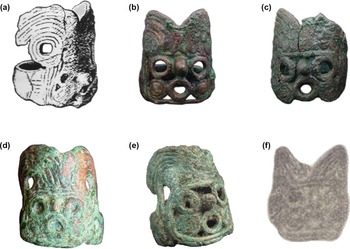
During his excavations at a burial mound in Guasave, Sinaloa (Figure 1), Ekholm (Reference Ekholm1942:97–99) recovered 134 metal objects, including one copper finger ring of which he details “The lateral extension obviously represents a face surmounted by an ornamental headdress” (Figure 2a). This specimen served later as the basis for the definition of Type IVB (“band with attached filagree forms”) in Pendergast’s influential classification of metal artifacts in pre-Hispanic Mesoamerica (Reference Pendergast1962b:529, Figure 9).
Distribution of effigy rings mentioned in the text. Mexico: (1) Guasave, Sinaloa, (2) Amapa and Pozo de Ibarra, Nayarit, (3) Cerro del Teúl, Zacatecas, (4) La Peña, Jalisco, (5) La Rajadura, Jalisco, (6) El Chanal, Colima, (7) Yahualica, Hidalgo, (8) Cholula, Puebla, (9) Ixhuacan, Veracruz, (10) Xalapa, Veracruz, (11) Cerro Montoso, Chicuasen, and Rancho las Ánimas, Veracruz, (12) Texmelincan, Guerrero, (13) Huajuapan, Oaxaca, (14) Zaachila, Oaxaca, (15) Mayapan, Yucatan, (16) Chichen Itza, Yucatan, (17) Cancuc, Chiapas, (18) Tonina, Chiapas, (19) Tenam Puente, Chiapas, (20) La Libertad, Chiapas. Specimens reported with only approximate provenance: (A) Jalisco, (B) Michoacán, (C) Central Highlands, (D) Gulf Coast Veracruz, (E) Mixteca. Belize: (21) Santa Rita Corozal, Corozal District. Guatemala: (22) Las Flores, Petén, (23) Zacualpa, El Quiché, (24) Santo Tomás Chichicastenango, El Quiché, (25) Bosque de San Nicolás, Guatemala City, (26) Buena Vista, Escuintla, (27) Finca El Sitio, Santa Rosa. El Salvador: (F) El Salvador-Guatemala Border. Numbers indicate specific locations. Capital letters indicate general regions to which some specimens are attributed. Drawing by the author.

Ekholm (Reference Ekholm1942:99) found affinity between the effigy ring he recovered and others from Michoacán housed in the National Museum of Anthropology in Mexico (MNA), but pointed to closer analogies in the general shape and “wire‐like” structure with some copper rings from Veracruz. Nevertheless, the resemblance is not as striking as that between the Guasave ring and examples recovered from sites in Jalisco and southern Zacatecas, whose existence was discovered much later and which Ekholm unfortunately never got to know. These pieces display an anthropomorphic figure with a prominent nose and a two-lobed feathered headdress, rendered in a highly distinctive style (see Solar and Hirth Reference Solar Valverde and Hirth2025) (Figure 2, Table 1).
Copper effigy rings from west Mexico. (a) Guasave, Sinaloa. Drawing by Gordon Ekholm (Reference Ekholm1942:Figure 19a), courtesy of the Division of Anthropology, American Museum of Natural History. (b) and (c) Unknown provenance, Regional Museum of Guadalajara. Photographs by Sarah Fernández (INAH 2020), reproduced with permission of the National Institute of Anthropology and History. (d) Presumably from the site of La Peña, Regional Museum of Teocuitatlán, Jalisco, courtesy of Cuenca de Sayula Archaeological Project, University of Guadalajara. (e) Cerro del Teúl, Zacatecas, courtesy of Cerro del Teúl Archaeological Project, INAH. (f) Unknown provenance (Arsandaux and Rivet Reference Arsandaux and Rivet1923:Plate I, Figure 1). Not to scale. When measurements are mentioned, the diameter ranges between 1.8 and 2.5 cm.

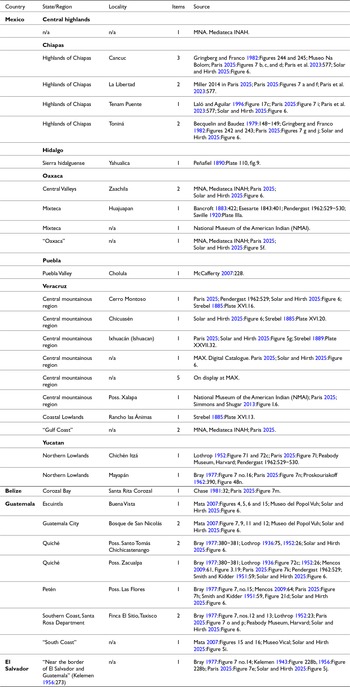
Sites and regions mentioned in the text with reported copper effigy rings in west Mexico (n/a = data not available)

Table 1 Long description
Regions and localities are listed with an Items count and a Source column. Colima Valley at El Chanal has no item count given. In Guerrero, the Montainous region at Texmelincan lists 2 items. In Jalisco, Chachahuatlan at La Rajadura has no item count given, Cuenca de Sayula at Poss. La Peña lists 1 item, west Mexico and Jalisco lists 12 items with locality shown as not given, and Poss. west Mexico lists 2 items with locality shown as not given. In Michoacan, lists 4 items with locality shown as not given. In Nayarit, the Coastal plain lists 1 item at Pozo de Ibarra and 1 item at Poss. Amapa. In Sinaloa, the Coastal plain at Guasave lists 2 items. In Zacatecas, Southern Zacatecas at Cerro del Teúl lists 1 item.
In Jalisco, the Regional Museum of Guadalajara (MRG) houses a collection of more than 4,500 pre‐Hispanic metal objects (Hosler Reference Hosler1986; Rivera and Gutiérrez Reference Rivera Pérez and Gutiérrez Vargas2014; Quintana Reference Quintana Cruz2014) including 34 finger rings from different periods and chemical compositions. At least 10 of them are copper pieces that display the defining anthropomorphic image (see Fernández Reference Mendiola and Eugenia2020; INAH 2020; Quintana Reference Quintana Cruz2014:380–385) (Figures 2b and 2c). Hosler (Reference Hosler1986:434–435) performed characterization analyses on two of those effigy rings, determining that they were cast in unalloyed copper. Two additional examples depicting the same figure are housed at the Western Mexico School of Conservation and Restoration (ECRO), where they were recently restored (Lorenza López-Mestas, personal communication 2025).
Another comparable ring presumably comes from the site of La Peña, in the Sayula Basin, looted from a burial area within the ceremonial center (García Reference García Zaldúa2007:134–136; Ramírez Reference Ramírez Urrea2016:Figure 112) (Figures 1 and 2d). A further analogous piece was recovered from a burial context at the site of Cerro del Teúl, in southern Zacatecas (Figures 1 and 2e). This last object was found on a human phalanx, confirming that it was worn by a person at the time of interment (Solar and Pérez Reference Solar Valverde, Pérez Cortés, Valverde and Betts2012:222; Solar et al. Reference Solar Valverde, Méndez and Betts2021). Characterization studies by X‐ray fluorescence, led by Dr. José Luis Ruvalcaba of the Universidad Nacional Autónoma de México, determined that it was cast in unalloyed copper.
Arsandaux and Rivet (Reference Arsandaux and Rivet1923:65, Plate I) reproduced photographs of two copper rings accompanied by the following description: “Two examples, very similar to each other in their general form, are decorated with a human figure, crudely executed, with a very protruding nose, topped by a double spiral ornament” (translation by author). At the time of their publication, these pieces were housed at the Trocadero Ethnographic Museum (now the Musée de l’Homme) in Paris (Figure 2f). Although the origin of these pieces is unknown, their similarity to the examples from Jalisco and southern Zacatecas is evident.
Other examples of effigy finger rings found in west Mexico deserve mention. Besides the pieces alluded to by Ekholm from Michoacán (four rings without precise location, e.g., Figures 3a and 3b), the MNA houses an additional ring said to come from Guasave, whose graphic style does not largely correspond to the one published by Ekholm, but again displays an individual with a long nose and feathered headdress in bilobed form (Figure 3c). From the coastal plain in Nayarit, two anthropomorphic rings have recently been documented, one recovered at the site of Pozo de Ibarra and the other presumably originating from Amapa (Mauricio Garduño, personal communication 2025). In turn, Kelly (Reference Kelly, Foster and Weigand1985:156) refers to a group of copper finger rings “with a human head” that were looted from burial areas at El Chanal, Colima, and Chachahuatlán, Jalisco; and García-Payón (Reference García Payón1940:351–352, Figure VI) illustrates two anthropomorphic copper rings recovered from a burial context at the site of Texmelincan, located in the mountainous region of Guerrero (Figure 1, Table 1).
Copper effigy rings from west Mexico. (a) and (b) Michoacan, (c) Guasave, Sinaloa. National Museum of Anthropology (MNA), Mexico City. Reproduced with permission of the National Institute of Anthropology and History. Not to scale. When measurements are mentioned, the diameter ranges between 1.8 and 2.5 cm.

West Mexico’s copper effigy rings are comparable to each other in general design and iconography but differences in manufacturing techniques and graphic style discourage the idea that they were made in the same workshop or by the same group of metalworkers. Rather, their distinctive symbolism suggests that they may have been produced to order by different master metalsmiths, following an established prototype. However, specific pieces are so similar that they may have been produced within a locality or group of localities that followed the same craft school (or a “metalworking community of practice” [Paris Reference Paris2025:13]).
Pendergast (Reference Pendergast1962b:529) highlighted similarities between the copper ring found by Ekholm in Guasave and anthropomorphic finger rings from west Mexico, Veracruz, Oaxaca, and the Maya Region (Table 2). This relationship exists, not always in terms of craftsmanship, style, or chronology, but in conceptual, functional, and possibly symbolic aspects.
Sites and regions mentioned in the text with reported metal effigy rings in central, east, and southern Mesoamerica (n/a = data not available)
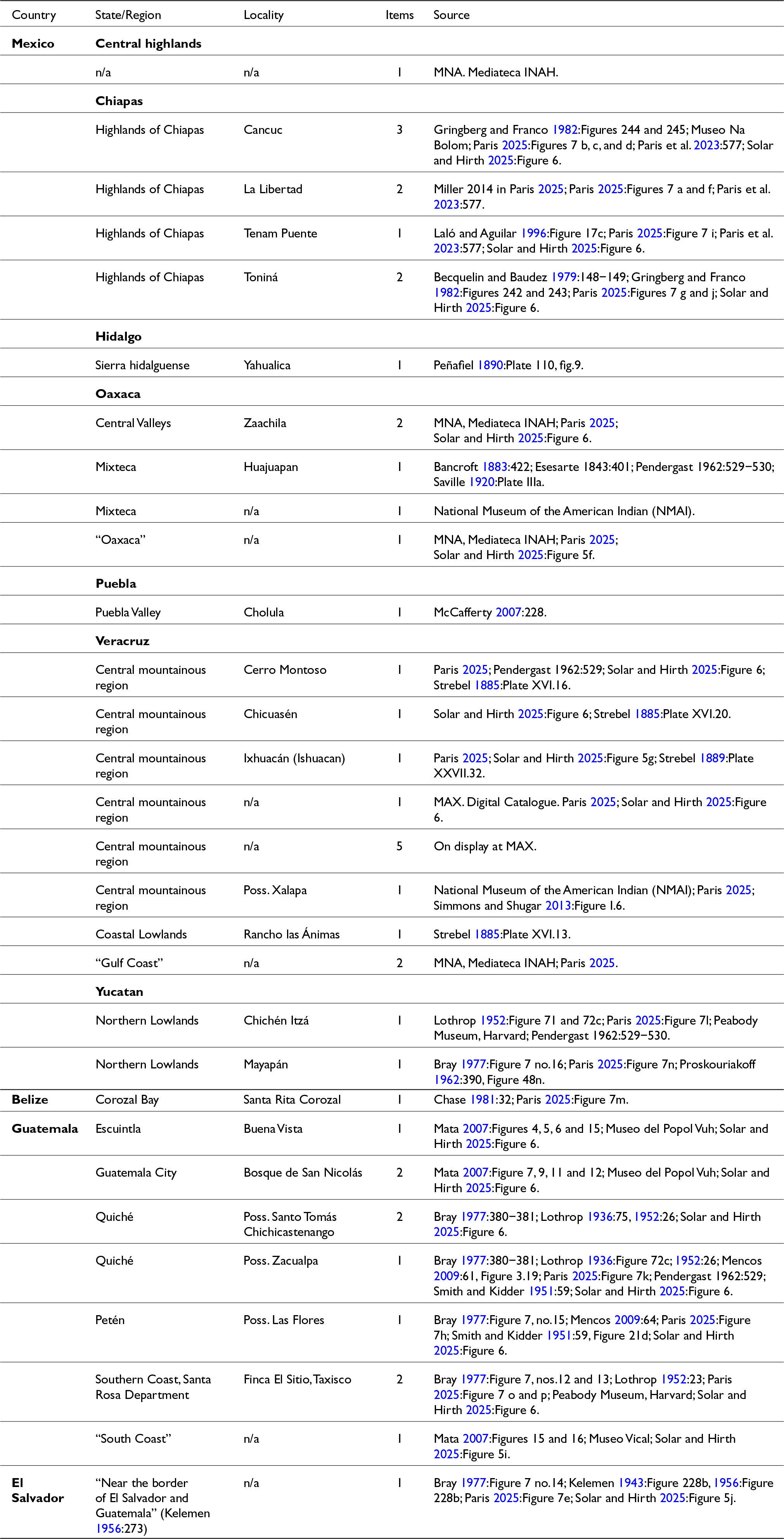
Table 2 Long description
Columns list Country, State or Region, Locality, Items, and Source, with Items giving the number of metal effigy rings reported for each locality. Mexico includes entries for Chiapas, Hidalgo, Oaxaca, Puebla, Veracruz, and Yucatan, plus one Central highlands entry where State or Locality are not specified; Mexico item counts are mostly 1 or 2, with higher counts at Cancuc in the Highlands of Chiapas with 3 and an unspecified Locality in Veracruz, Central mountainous region with 5. Chiapas localities include Cancuc 3, La Libertad 2, Tenam Puente 1, and Tonina 2. Oaxaca includes Zaachila 2, Huajuapan 1, one Mixteca entry with Locality not specified at 1, and one entry with State or Region shown as Oaxaca and Locality not specified at 1. Veracruz includes Cerro Montoso 1, Chicuasen 1, Ixhuacan also shown as Ishuacan 1, two entries with Locality not specified at 1 and 5, Pos. Xalapa 1, Rancho las Animas 1, and one entry with State or Region shown as Gulf Coast and Locality not specified at 2. Yucatan lists Chichen Itza 1 and Mayapan 1, and Puebla lists Cholula 1. Belize lists Santa Rita Corozal in Corozal Bay with 1. Guatemala lists Buena Vista in Escuintla 1, Bosque de San Nicolas in Guatemala City 2, Poss. Santo Tomas Chichicastenango in Quiche 2, Poss. Zacualpa in Quiche 1, Poss. Las Flores in Peten 1, Finca El Sitio, Taxisco in Southern Coast, Santa Rosa Department 2, and one entry with State or Region shown as South Coast and Locality not specified at 1. El Salvador lists one entry described as near the border of El Salvador and Guatemala with Locality not specified and Items 1.
Copper effigy rings in central and southern Mesoamerica
The database of the MNA includes three copper finger rings from Oaxaca (one without precise location and two from Zaachila) (Figures 4a, 4b, and 4c), which display characters with protruding nose and bilobed feathered headdress, although in notably different styles.
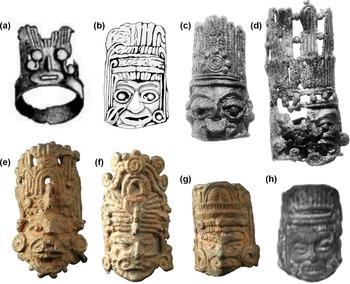
Copper effigy rings from Oaxaca and Veracruz. (a) and (b) Zaachila, Oaxaca, Mediateca INAH. (c) Oaxaca, MNA, reproduced with permission of the National Institute of Anthropology and History. (d) Chicuasén, Veracruz (Strebel Reference Strebel1885:Plate XVI.20). (e) Ixhuacán, Veracruz (Strebel Reference Strebel1889:Plate XXVII.32). (f) Las Ánimas, Veracruz (Strebel Reference Strebel1885:Plate XVI.13). (g) Cerro Montoso, Veracruz (Strebel Reference Strebel1885:Plate XVI.16), public domain. (h) Veracruz, Xalapa Anthropology Museum (MAX), reproduced with permission of the MAX. Not to scale. When measurements are mentioned, the diameter ranges between 1.8 and 2.5 cm.

Several similar examples are exhibited at the Xalapa Anthropology Museum (MAX), suggesting that these personal adornments were also popular in the Gulf of Mexico region (Figure 4h). One copper effigy ring presumably from the Xalapa region is housed at the National Museum of the American Indian (Simmons and Shugar Reference Simmons, Shugar, Simmons and Shugar2013:Figure I.6). Also from Veracruz, anthropomorphic finger rings were acquired by Strebel (Reference Strebel1885:13, Plate XVI, 16, Plate XVI) from Rancho las Ánimas (Figure 4f) and Cerro Montoso (Figure 4g). The first is described as a ring made of copper “with human head and rich headdress” (Strebel Reference Strebel1885:78). About the second piece he says: “[it] represents a face with hemispherical eyes, a long, prominent nose, and disc‐shaped earrings, surmounted by a rich headdress that falls down at the sides” (Reference Strebel1885:37, translations by author). A similar third finger ring was recovered from Chicuasén (Strebel Reference Strebel1885:20, Plate XVI) and a fourth item was published later (Strebel Reference Strebel1889:32, Plate XXVII) from Ixhuacán, in the central mountainous region of Veracruz, not far from the current political border with the state of Puebla (Figure 1). The workmanship of these last two pieces is less complex (Figures 4d and 4e), but they reproduce the same iconography. Very close by in the Valley of Puebla, a “copper ring with a filigree design of an anthropomorphic face” was recovered from excavations in a residential structure in Cholula (McCafferty Reference McCafferty, Gonlin and Lohse2007:228).
There are not many known examples of copper effigy rings from central Mexico, so it is worth mentioning a piece illustrated by Peñafiel (Reference Peñafiel1890:Plate 110) that was found at the Yahualica site, in the mountainous region of the state of Hidalgo.
Regarding southern Mesoamerica, Paris (Reference Paris2025) has recently published the first detailed study on anthropomorphic copper rings in the Maya area, which I will mention briefly. Lothrop (Reference Lothrop1936:75) recovered one copper finger ring depicting a human face from a looted tomb at Zacualpa, in the Guatemalan highlands (Figures 1 and 5a) and mentions two other similar examples said to have been found near Santo Tomás Chichicastenango. In their classic study of Nebaj, Smith and Kidder (Reference Smith and Alfred1951:59, Figure 21d) included an anthropomorphic ring from a private collection, presumably from Las Flores, in the Petén region. This ornament and the one published by Kelemen (Reference Kelemen1943:Plate 228b, Reference Kelemen1956:Plate 228b) (Figure 5b) possibly from El Salvador—near the Guatemalan border—were included in Bray’s classification of Maya metalwork under his categories “Maya face rings” and “Mexican face rings” (Reference Bray and Hammond1977:380–381, Figure 7.14), together with two specimens found at Finca El Sitio, Taxisco, Santa Rosa Department (Figures 1, 5c, and 5d).
Copper effigy rings from Guatemala and República de El Salvador. (a) Zacualpa, Guatemala (Lothrop Reference Lothrop1936:Figure 72c), courtesy of Carnegie Science. (b) El Salvador, redrawn from Kelemen Reference Kelemen1943:Plate 228b, digitalization by Saira Saldaña Zacarías. (c) and (d) Finca El Sitio, Taxisco, Guatemala, courtesy of the Peabody Museum of Archaeology and Ethnology, Harvard University, 39-113-20/6729, 39-113-20/6730. (e) and (f) Bosque de San Nicolás, Kaminaljuyú, Guatemala, collection of the Popol Vuh Museum, Francisco Marroquín University, courtesy of Camilo Luin. (g) Buena Vista, Escuintla, Guatemala, collection of the Popol Vuh Museum, Francisco Marroquín University, courtesy of Camilo Luin. (h) Costa sur de Guatemala, Vical Museum, Antigua Guatemala, courtesy of Susana Campins. Not to scale. When measurements are mentioned, the diameter ranges between 1.8 and 2.5 cm.

More recently, Mata (Reference Mata Amado, Laporte, Arroyo and Mejía2007:1306–1312) published three examples of rings with highly complex designs recovered from altered contexts, two from Bosque de San Nicolás, near Kaminaljuyú, the other one from the site of Buena Vista, in Escuintla. These pieces are now housed at the Popol Vuh Museum in Guatemala City (Figures 5e, 5f, and 5g). Mata (Reference Mata Amado, Laporte, Arroyo and Mejía2007:1313–1314) also presented an effigy ring presumably from the southern coast of Guatemala, currently on display at the Vical Museum in Antigua (see Solar and Hirth Reference Solar Valverde and Hirth2025) (Figure 5h).
Some of the few rings recovered through controlled excavations originate from the eastern highlands of Chiapas, in Tenam Puente (one specimen) and Toniná (two specimens). The pieces from both sites were placed inside vessels containing cremated bone remains (Becquelin and Baudez Reference Becquelin and Baudez1979:148–149; Laló and Aguilar Reference Laló Jacinto and de la Luz Aguilar1996:Figure 17; Paris Reference Paris2025; Paris et al. Reference Paris, López Bravo, Laló Jacinto, Stanton, Taube, Coltman and Marengo2023:577). Grinberg and Franco (Reference Grinberg, Velázquez, Becquelin and Baudez1982:Figure 246) analyzed the Toniná rings and associated each one with a different category defined by Bray. They also illustrated three copper effigy rings recovered by Frans Blom in Cancuc, Chiapas (Grinberg and Franco Reference Grinberg, Velázquez, Becquelin and Baudez1982:Figures 244, 245), which are currently on display at the Na Bolom Museum in San Cristóbal de las Casas. In her analysis, Paris (Reference Paris2025:16, Figures 7a and 7f) includes two specimens recovered by Donald Miller from controlled excavations of a burial context at the La Libertad site, Chiapas, where the rings were worn by an individual. Similarly, in Santa Rita Corozal, Belize, a copper effigy ring was found in a Postclassic burial of a woman (Chase Reference Chase1981:28, 32).
As previously noted, technological, conceptual, and stylistic differences may imply chronological, spatial, or cultural distances that are not yet understood. In any case, the set of copper effigy finger rings presented so far seems to reflect a pan‐Mesoamerican phenomenon, with a geographical scope from Northwestern Mexico to Central America, from the Gulf of Mexico to the Pacific Ocean (Figure 1, Tables 1 and 2).
With few exceptions, the anthropomorphic finger rings discussed in this study derive from looted contexts or form part of museum collections that lack records of their original provenience. In some cases, only an approximate location (region or subregion) is known, rather than the specific site or archaeological context of recovery. This situation is both unfortunate and frustrating, as it limits key aspects of the analysis, including chronological resolution and the reconstruction of the rings’ contextual associations. Regrettably, this problem is not unique to the present study. Many collections housed in museums—and illustrated in some of the classic and foundational publications in Mesoamerican archaeology and art history—contain a substantial number of unprovenienced objects. Nevertheless, compiling as many examples of metal effigy finger rings as possible and integrating them into a broader analytical framework allows for the identification of regional patterns and the appreciation of the supraregional scope of their distribution. It also contributes to restoring a measure of scholarly value to these objects.
Copper effigy rings as horizon markers
Due to their constituent material and design, the copper effigy rings from west Mexico correspond to the Period I (a.d. 800 to 1100/1200) of metallurgy development in Mesoamerica as originally defined by Hosler (Reference Hosler1986, Reference Hosler1988a), which refers to cold working and the cast technology using unalloyed copper. The smelting and casting of other metals occurred shortly thereafter and gave rise to the production of new artifacts, thanks to the mastery of the properties offered by alloys (Period II, ca. a.d. 1100/1200 to the arrival of the Spaniards, Hosler Reference Hosler1988a:208, 213, Reference Hosler2009, Reference Olay Barrientos2005 [Reference Hosler1994]:199–259).
In the burial mound excavated by Ekholm in Guasave, the metal artifacts correspond to the site’s second occupational phase, that Carpenter (Reference Carpenter Slavens and Ekholm2008) assigns to a.d. 1050/1100 to 1400/1450 based on radiocarbon dates. In La Peña all metal artifacts technologically correspond to Hosler’s Period I, which in the Sayula Basin dates to the Cojumatlán (a.d. 800/850 to 1050/1100) and Tizapán (a.d. 1050/1100 to 1250/1300) phases (García Reference García Zaldúa2016). As for Cerro del Teúl, a radiocarbon date places one of Period I diagnostics (the beam tweezers, see Hosler Reference Hosler1986:133–148, Reference Hosler1988b:838; Reference Olay Barrientos2005 [Reference Hosler1994]:113–125) between cal a.d. 1160 and 1265 (2σ). Furthermore, the burial deposit from which the effigy ring was recovered intruded into a layer of volcanic ash characteristic of the site’s stratigraphic sequence, dated to between a.d. 990 and 1020 (García‐Zeferino et al. Reference García Zeferino, Solleiro Rebolledo, Víctor Cabadas Báez, Sedov, Sánchez Pérez, Darras, Valverde, Octavio Martínez Méndez and Jiménez Betts2024). Although it is not known how much time elapsed between this natural deposit and the burials, the range offers a terminus post quem for the ring’s final deposition context at Cerro del Teúl.
These chronological references allow us to position the widespread distribution of west Mexico’s copper effigy rings, from northern Sinaloa to southern Zacatecas and central Jalisco, to between the tenth and mid-thirteenth centuries a.d.
The discovery of copper effigy rings at Early Postclassic sites in Chiapas, coupled with their frequent contextual association with Tohil Plumbate and Silho Orange vessels, allow Paris (Reference Paris2025:15) to propose the appearance of these objects in southeastern Mesoamerica between a.d. 900 and 1000, that is, contemporaneous with their emergence in west Mexico (Solar and Hirth Reference Solar Valverde and Hirth2025).
At the other end of their chronology, although the most extended distribution of these effigy rings appears to have taken place during the Early Postclassic, examples of metal rings with anthropomorphic imagery are also documented for later periods.
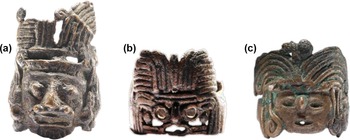
The sophistication of metallurgical techniques developed in Period II included the casting of gold, silver, and other metals to produce alloys, allowing for the manufacture of more complex pieces of art (Hosler Reference Hosler1986, Reference Hosler1988a, Reference Olay Barrientos2005 [Reference Hosler1994]; Maldonado Reference Maldonado, Nichols and Pool2012). This is the case of a ring with a human head carrying small pendants, recovered in Mayapán by the Carnegie Institution of Washington, which was cast in copper-tin bronze (Root Reference Root, Pollock, Roys, Proskouriakoff and Smith1962:397–398) (Figure 6a). This piece, dating to the Middle Postclassic (ca a.d. 1200-1350), introduces a feature that would subsequently characterize Mixtec and Aztec metallurgy: the incorporation of small pendants hanging as ornaments from the main figure (Caso Reference Caso1969). Two additional pieces of similar design are known, seemingly cast also through a copper alloy: one without provenance, housed at the Saint Louis Art Museum (Parsons Reference Parsons1932:Figure 178), the other extracted from the Sacred Cenote in Chichén Itzá (Lothrop Reference Lothrop1952:Figures 71 and 72c) (Figures 6b and 6c, Table 2). The similarity between these two specimens is outstanding.
Bronze and gold rings with anthropomorphic figures. (a) Mayapán, Yucatán (copper-tin bronze), courtesy of Carnegie Science. (b) Chichén Itzá, Yucatán. Gift of Charles Peabody, 1910, courtesy of the Peabody Museum of Archaeology and Ethnology, Harvard University, 10-5620/C5982. (c) Unknown provenance. Gift of Morton D. May 23:1979, courtesy of the Saint Louis Art Museum. (d) Huajuapan, Oaxaca (gold) (Bancroft Reference Bancroft1883:422), public domain. (e) Central highlands, Mexico (gold), Museo Nacional de Antropología, reproduced with permission of the Instituto Nacional de Antropología e Historia. (f) Unknown provenance (gold). National Museum of the American Indian (NMAI), used under CC0 license. Not to scale. When measurements are mentioned, the diameter ranges between 1.8 and 2.5 cm.

Attributable to the Late Postclassic, a period in which Mesoamerican goldsmithing in gold, silver, and their alloys attained its highest refinement (see Pillsbury et al. Reference Pillsbury, Potts and Richter2017), several metal rings portraying anthropomorphic faces are documented. As examples, I shall mention here three specimens cast with faux filigree in gold that are significant for their iconography, as will be discussed further. One item was illustrated by Bancroft (Reference Bancroft1883:422) and Saville (Reference Saville1920:144–145, Plate IIIa) from Huajuapan, in the Mixteca Region of Oaxaca (Figure 6d). A second piece is preserved in the MNA, attributed to the Mexica (Figure 6e). The third effigy ring, now housed in the National Museum of the American Indian, is regarded as a Mixtec piece (Figure 6f).
In sum, though less abundant and characterized by notably new styles and techniques, metal finger rings continued to reproduce some of the earlier attributes, suggesting that their symbolic utility lingered for some centuries after the Early Postclassic (see Paris Reference Paris2025:16).
Merchant rings and tutelary gods
Bray (Reference Bray and Hammond1977:380–381) associated certain anthropomorphic rings from the Maya region with those worn by individuals committed to specialized commerce in the Basin of Mexico during the sixteenth century. In the Florentine Codex, Bernardino de Sahagún describes:
And behold what were the goods exclusively of the merchants…rings for the fingers, called matzatzaztli; and golden ear plugs; and rock crystal ear plugs…All these were prepared as goods exclusively of the merchants, the vanguard merchants, the reconnoiterers, the outpost merchants. (Sahagún Reference Sahagún1959 [ca. 1575–1577]:bk. 9, f. 8).
Bray specified that the Maya rings he referred to “usually have a human face with an elaborate headdress.” Grinberg and Franco (Reference Grinberg, Velázquez, Becquelin and Baudez1982:1149) took up that designation when referring to one effigy ring from Toniná as a “merchant ring.” Later, Taube (Reference Taube1992:90) identified the images of the rings illustrated by Bray as representations of the Maya merchant god: “With the Post‐Classic advent of metal working, representations of the long-nosed merchant god frequently appear on rings, pendants, and other metal jewelry.” This identification has been recently scrutinized and expanded by Paris (Reference Paris2025) and Solar and Hirth (Reference Solar Valverde and Hirth2025).
The two-lobed feathered headdress carried by the figure in the rings is a relevant aspect. When speaking of Yacatecuhtli, the main god of long‐distance commerce among the Aztecs, Sahagún (Reference Sahagún2000 [ca. 1575–1577]:bk. 1, ch. 19) offers a description that recalls that feature: “In his hair he wore two tassels of rich feathers, which were called quetzalli: they were tied to the hair in the middle of his head, gathered like a sheaf from the top of his head” (translation by author from the Spanish text). In many pre‐Hispanic representations of the merchant god a colorfully feathered bird rests on his bundle, which Taube (Reference Taube1992:81) interprets as a sign that his load contains feathers or some other exotic goods. Exotic feathers were one of the most sought-after products in long‐distance trade, due to the restricted niches in which the birds lived and the difficulty of obtaining and transporting the feathers without damage.
Also notable in most anthropomorphic rings is the character’s protruding nose, particularly in the artifacts from west Mexico. Images of Yacatecuhtli and his Maya counterpart Ek Chuah are depicted in the codices with a prominent nose (Figure 7). Thompson (Reference Thompson1965:344) referred to this noticeable feature as a “Pinocchio”-type nose (see also Paris Reference Paris2025:11; Taube Reference Taube1992:88). It has been suggested that the long nose is a metaphor for leading the way (going ahead). In his etymological analysis of the name of the Nahua deity, Robelo (Reference Robelo1905:822) points out: “Yacatecuhtli. (Yacatl, nose; fig. guide; tecuhtli, lord, god: *the god or lord who serves as a guide, *that is, who goes ahead like the nose.)” (translation by author, see also León‐Portilla Reference León Portilla2013:43; Olivier Reference Olivier1997:36). In practice, among merchants this guiding function is embodied in their staff—a distinctive sign of travelers—and in the spiritual realm the role is carried out by their patron god, as a leader who precedes and gives security to their journey.
Depiction of Yacatecuhtli: (a) Redrawn from Codex Fejérváry-Mayer 36. Depiction of Ek Chuah: (b) Redrawn from Codex Madrid 53. (c) Miniature silver mask depicting Yacatecuhtli, recovered from the Templo Mayor de Tenochtitlan (4.9 x 4.5 cm) (López-Luján and Ruvalcaba 2017:259). Redrawn from photograph (Aguilar et al. Reference Aguilar Piedra, Barba, Piña-Chán, Montes, Velázquez and Ahuja1989). Digitalization by Saira Saldaña Zacarías.

The above suggests that in different times and places, certain concepts were considered intrinsic to a tutelary deity of long‐distance trade. In most copper effigy rings, the basic and recurring attributes are undoubtedly the prominent nose and the feathered headdress. The conjunction of both icons in such a widely reproduced image recalls the effectiveness of pan‐Mesoamerican pictograms to convey meanings. This is in line with Taube’s (Reference Taube1992:90) proposal that:
The complex ritual lore surrounding merchants was not limited to particular cultures or political boundaries. Instead, it was a symbolic language, a sort of “ritual pidgin” that could be readily shared among many differing groups engaged in trade.
For Thompson (Reference Thompson1964:23), the close resemblance between the representations of the merchant gods in distant regions is indicative of equally close trade relations. Significantly, among the Maya the god of merchants is also the god of cacao (León-Portilla Reference León Portilla2013:46; Paris Reference Paris2025:11; Thompson Reference Thompson1964), one of the most valuable exotic goods—and a widely accepted currency—in Postclassic Mesoamerica.
In contrast to the standardization of west Mexico’s anthropomorphic rings (Figure 2), the southern Maya region reflect a greater freedom of metalsmiths to represent the alleged merchant’s deity (Figure 5). This is consistent with the different manifestations of the divinity and its transformations over the centuries, from God L during the Classic period, to God M in the Late Classic and Early Postclassic, to Ek Chuah venerated at the time of Hispanic contact (see Taube Reference Taube1992:79–92; Thompson Reference Thompson1965; Tokovinine and Beliaev Reference Tokovinine, Beliaev, Hirth and Pillsbury2013:192).
A feature almost exclusive to Guatemalan copper rings is the presence of protruding fangs, which apparently relates to the recurring association of the merchant numen with the jaguar (see Taube Reference Taube1992:79–92). Furthermore, certain Guatemalan rings clearly feature an old man, a life-stage often associated with merchant deities, not only among the Maya but also in southern Veracruz and central Mexico. This—and the connection with the jaguar—can be seen in the mural of the Red Temple at the Epiclassic site of Cacaxtla in Tlaxcala and in numerous images related to merchants in ceramics, sculpture, and painting (see Taube Reference Taube1992; Tokovinine and Beliaev Reference Tokovinine, Beliaev, Hirth and Pillsbury2013:184–194).
In the codices and other media—such as ceramic masks and turquoise mosaics—Ek Chuah displays as a distinctive trait his protruding tongue and elongated, pendulous lower lip. This feature was reproduced with great clarity in the figure on the copper ring documented by Smith and Kidder (Reference Smith and Alfred1951:Figure 21d) for the Peten region (Figure 1, Table 2). The figure also exhibits a prominent nose and eye-rings, in a clear allusion to the numen of merchants. For his part, Yacatecuhtli is often depicted with a beard (Figure 7a). This trait, converges with protruding fangs and a prominent nose in the figure of the gold ring housed at the MNA (Figure 6e), which likely alludes to this deity.
The gods of mercantile activity were not the only deities associated with people engaged in commerce. In addition to paying homage to their patron god, some merchants offered vows to deities related to activities or situations parallel to their trade. For instance, Olivier (Reference Olivier1997:40) refers the convergence of traits typical of merchants with those of gods who protected roads, gods of markets such as Tezcatlipoca, or even with cultural heroes like Quetzalcoatl, who constitutes the mythical model of a proactive merchant. In the case of trade in specialized goods, devotion is expressed for patron gods of specific craft activities, such as Xipe Totec, god of metallurgists. In the Maya region, Paris (Reference Paris2025:11) shows instances of Chaac, K’awiil, Itzamna, or Tlaloc portrayed as merchants or displaying some of Ek Chuah features.
In west Mexico, where effigy-ring representations follow a highly standardized pattern, the figure was not rendered realistically but rather was schematized. The strange guise derives from the peculiar handling of the eyes and mouth, always from holes outlined by circular rims (Figure 2). This feature has prompted interpretations of these images as representations of Tlaloc; yet the ocular rings equally characterize Ek Chuah and Yacatecuhtli. In that sense, a comparison with the famous miniature silver mask recovered from the Templo Mayor of Tenochtitlan (Figure 7c), which depicts Yacatecuhtli through the art of metalsmithing (Klein Reference Klein1986:150, Figure 7; López-Luján and Ruvalcaba Reference López Luján, Luis Ruvalcaba Sil, Pillsbury, Potts and Richter2017:259, Figure 208), provides another valuable point of reference—together with the salient nose and bilobed headdress—for the association of west Mexican effigy rings with the deity of commerce.
To the best of my knowledge, prior to this research the manifestation of Ek Chuah or Yacatecuhtli has not been identified within the pantheon of west Mexico. This association is significant, as it underscores the symbolic dimension of mercantile activity in the region.
In any event, it is of interest that the visage on the artifacts from west Mexico likewise give the appearance of a mask more than an organic face. This is accentuated by framing the face with a rectangle with rounded corners. The composition seems to bear a resemblance to the image of Xipe Totec, who is frequently depicted wearing a mask with a gaping mouth and hollow eyes, fashioned from the skin of a flayed individual. In addition to these features, Soustelle (Reference Soustelle1996:132) notes that in some of his portraits Xipe Totec wears on his head “an ornament called ‘the feather ornament of the people of the coast’.”
Although Xipe Totec is better known for the sinister aspects of his cult among the Aztecs, the deity is far more complex. The essence of his role relates to the forces of transformation, hence he is also identified as the tutelary god of metallurgists (Hosler Reference Hosler1995:113; Roskamp Reference Roskamp2010; Soustelle Reference Soustelle1996:132). Significantly, the knowledge of metallurgy and the widespread use of metal artifacts in west Mexico is diagnostic of an Early Postclassic panregional system closely related to interregional and supraregional trade.
It is interesting that in central Mexico Xipe Totec was considered a foreign deity, and it has been proposed that he originated in west Mexico, from which early representations of this deity are known (Schöndube Reference Schöndube Baumbach and Bell1974:172–175). The Spanish text of the Florentine Codex states that Xipe Totec “was honored by those who lived by the seashore, and his origin was in Tzapotlán, a town of Xalisco.” (Sahagún Reference Sahagún2000 [ca. 1575–1577]:bk 1, ch. 18) (translation by author); whereas the Nahuatl text of the same codex, translated into English (Sahagún 1950:16), indicates that “He was the god of the sea-shore people, the proper god of the Zapotecs.” This discrepancy has generated debate regarding his origin (cf. Caso and Bernal Reference Caso and Bernal1952, Nicholson Reference Nicholson, King and Tejero1972), depending on whether the scholar is familiar with one version of Sahagún’s texts or the other. Nevertheless, both versions converge in locating the deity’s origin in regions of the Pacific corridor that are now understood to be associated with metallurgical development. Interestingly, the gold ring housed at the NMAI (Figure 6f) reproduces the conventional depiction of this god.
Returning to the copper rings of west Mexico, fusing attributes of two deities—one associated with long-distance commerce (Yacatecuhtli-Ek Chuah) and the other with the practice of metallurgy (Xipe Totec)—may have constituted an ideographically eloquent way of alluding to merchants involved in the trade of metals, as the agents responsible for disseminating goods and knowledge that permanently transformed the history of west Mexico.
Emblems of long-distance enterprises
Different representational styles may denote technical and aesthetic regionalization in the manufacture of the copper rings. However, there is an underlying reference to similar concepts, displayed in the same type of artifact, made of the same material, and intended for a specific use, which suggests a common semiotic function.
From its conception and workmanship, the object’s purpose was to be part of an adult’s attire. This is evident from their manufactured diameter, which ranges between 1.8 and 2.5 cm. In Cerro del Teúl and La Libertad, the effigy rings remained on the fingers of their owners, who were adults. This is not the case with other copper and bronze ornaments such as buttons, bells, and hoops, which were made in several sizes to be worn by individuals of different ages, including infants.
A finger ring is an item specifically designed to be conspicuous and is intended to communicate something to the observer about the wearer (see Mason Reference Mason2010). The depiction on the rings may have conveyed symbolic associations linking the wearer to certain attributes (see Paris Reference Paris2025:14). Additionally, as mentioned by Paris (Reference Paris2025:14), “they are light-weight, portable, and can be crafted with visually distinctive symbols such as supernatural patrons.” Finally, the reproduction of conventionalized images constitutes the most effective means of transmitting information between societies whose primary form of documentation was the use of pictograms.
In one of her iconic works, Helms (Reference Helms1993) shows how in preindustrial societies long‐distance exchange of goods and knowledge is equivalent to entering a universe inaccessible to most people. Individuals who master the necessary knowledge to navigate inhospitable terrain, overcome travel obstacles, obtain and transport highly prized exotic objects, often occupy a distinguished and influential position in their communities. If the effigy finger rings were reserved for individuals responsible for long‐distance exchange (see Paris Reference Paris2025), then their public display would signal such information, constituting active expressions of the owner’s social distinction (Helms Reference Helms1986).
The very material with which the rings were made carries a high social value, since Mesoamericans attributed outstanding properties to metals (Hosler Reference Hosler1986, Reference Olay Barrientos2005 [Reference Hosler1994]; Simmons and Shugar Reference Simmons, Shugar, Simmons and Shugar2013). Helms (Reference Helms1993) describes how metals in ancient times were considered to be imbued with supernatural force and sacredness, due to the complex transformation process they undergo to become objects, a phenomenon with strong esoteric implications for nonindustrial societies. In the case of Mesoamerica, Hosler (Reference Hosler1986, Reference Olay Barrientos2005 [Reference Hosler1994]) has explored the symbolic connotations of metal artifacts, taking into account qualities such as the sound they produce, their color, and their brilliance. Consequently, the material from which the rings were manufactured added an important layer of meaning and value to the object.
Regarding their presence in the archaeological record, the geographical extent of their distribution is inversely proportional to their abundance at specific sites. Scholars who mention copper effigy rings underscore their rarity in site collections, since finds are generally limited to one or two specimens. This stands in sharp contrast to other copper and bronze artifacts, which often appear in dozens or even hundreds, as is frequently the case with bells. The inverse proportion likely reflects a differential pattern of consumption rather than divergent channels of transfer.
Copper bells are the most abundant artifacts in metal collections, and a single ornament was often composed of dozens. They also were used in a wide range of activities, for instance, as musical instruments in public ceremonies that included dances or performances of various kinds (Hosler Reference Hosler1986, Reference Olay Barrientos2005 [Reference Hosler1994]; Pendergast Reference Pendergast1962b). In addition, bells were used as currency (Bray Reference Bray and Hammond1977:370; Simmons and Shugar Reference Simmons, Shugar, Simmons and Shugar2013:6). In general, the abundance of copper bells and the contexts in which they are recorded indicate their widespread use among the population.
On the contrary, the very shape of the rings implies that they were intended for personal use, which does not exclude the possibility that they might be offered as votive offerings or as wealth finance at some point. However, their final destination was often to accompany the dead—as evidenced by their consistent recovery in burial contexts—most likely as part of belongings.
I suspect that the consumption of copper effigy rings was smaller in quantity, although not smaller in geographical extension or archaeological representativeness, because a merchant or a broker would wear one or a couple of effigy rings, at the same time that they could carry with them, for trade, hundreds of bells and other metal artifacts, although all the pieces were obtained through the same metallurgical suppliers.
To summarize, it is possible that anthropomorphic copper rings recovered in west Mexico and other Mesoamerican regions are related to merchants and their patron gods as has been proposed for the Maya (Bray Reference Bray and Hammond1977; Grinberg and Franco Reference Grinberg, Velázquez, Becquelin and Baudez1982; Paris Reference Paris2025; Taube Reference Taube1992), thereby fulfilling the function of portable emblems (or “signifiers” [Paris Reference Paris2025; Paris et al. Reference Paris, López Bravo, Laló Jacinto, Stanton, Taube, Coltman and Marengo2023:577]) to indicate the status, occupation, and power of their wearers.
First, these objects could have been worn as part of an individual’s distinctive attire. Second, they functioned as active expressions of status (Helms Reference Helms1986), assertively communicating the wearer’s distinction. Third, they would denote the owners’ access to high‐value products (e.g., metal artifacts). Finally, they would reflect the user’s ability to obtain goods from afar, with all that this meant in terms of access to distant realms with sacred or mythical associations (Helms Reference Helms1993).
Agents of interregional trade
In the centuries prior to Spanish contact, groups of specialists in international trade existed in the Maya region and central Mexico, as well as among the Mixtecs and the Tarascans. These merchants operated in highly complex networks with considerable geographic reach. It is to be expected that an organization of this nature did not emerge spontaneously, but rather evolved from the trade networks of previous centuries (Bray Reference Bray and Hammond1977:395; Publ Reference Publ1990).
Sabloff and Rathje (Reference Sabloff and Rathje1975) propose that during the Postclassic period maritime trade intensified across the Gulf of Mexico, extending to the eastern coasts of Central America. This expansion represented a shift of economic power from large settlements to a market-based economy. They propose that market exchange in this area was driven by groups of traders operating efficiently at different scales in different regions, due to their knowledge of nautical technology. They observe a tendency toward “trade oriented political expansion” at the time, which would have fostered “the ascendancy of a merchant class” (Sabloff and Rathje Reference Sabloff and Rathje1975:77).
Speaking of merchants does not always refer to individuals with formal occupations or who perform a single profession (Hirth Reference Hirth, Hirth and Pillsbury2013b, Reference Hirth2020:195–198). From the analysis of the dictionaries of indigenous languages that were integrated following the Hispanic colonization of Mayan territories, Tokovinine and Beliaev (Reference Tokovinine, Beliaev, Hirth and Pillsbury2013) unveil the complexity of indigenous trade, which is perceived from the categorization of merchants depending on the geographical scope of their operations and the nature of their merchandise (see also Hirth Reference Hirth, Hirth and Pillsbury2013b; Sahagún Reference Sahagún2000 [ca. 1575–1577]:bk. 9). These documents and other sources show that the highest place in the hierarchy belonged to the merchants who covered great distances to distribute luxury items, whether consumables or artifacts (see Hirth Reference Hirth, Hirth and Pillsbury2013b:87–89; Tokovinine and Beliaev Reference Tokovinine, Beliaev, Hirth and Pillsbury2013:169–171).
In a society as prolific in graphic and epigraphic records as the Mayans of the Classic period, Tokovinine and Beliaev (Reference Tokovinine, Beliaev, Hirth and Pillsbury2013) note the scarcity of representations of merchants. They attribute this to the fact that most records were intended as tools for political legitimation or elite aggrandizement, and most merchants did not belong to those social spheres. Even so, the images captured in ceramics and mural painting from the Classic and Late Classic periods distinguish a category of characters going by the name of ebeet, who were involved in both diplomatic actions and the long-distance exchange of valuable objects, in the same way as is known for their later merchant counterparts in central Mexico (Tokovinine and Beliaev Reference Tokovinine, Beliaev, Hirth and Pillsbury2013:178).
Among the Tarascans at the time of Hispanic contact, the Relación de Michoacán indicates that merchants dealing in luxury goods were included among the specialists whose activities were overseen by a “deputy” appointed by the Cazonzi. In other words, they constituted a group under state control (see Relación de Michoacán Reference León1903 [1541]:18–19). By contrast, another sixteenth-century document recounts the establishment in the territory of Michoacán of 20 Nahua families engaged in commerce, who were permitted to reside there on account of having at some point served as military allies of the Tarascans (Monzón et al. Reference Monzón, Roskamp and Warren2009; Pollard Reference Pollard2017:23). These families maintained cooperative arrangements with the Tarascan state, although they do not appear to have been directly controlled by it.
The combat proficiency of merchants may have become an important attribute in the practice of their profession, as suggested in the same document: “At night they were weary; by day they traveled long distances; they remained vigilant, for in earlier times there was great danger along the roads” (Monzón et al. Reference Monzón, Roskamp and Warren2009:32).
Acquiring goods from distant sources required risky and prolonged travel, specialized knowledge of their sources of supply, as well as the special needs and means for handling and transporting fragile materials. It is also necessary to have the knowledge to establish value conversions during transactions and the ability to deal with assaults and robbery. For all these reasons, the interregional trade carried out by professional merchants, whether acting independently, in informal groups, or organized in guilds, involved a tendency for these agents to coordinate with their peers in other regions to strengthen and ensure successful outcomes (Hirth Reference Hirth2020:195–197). From this, they facilitate the circulation of products, as well as the flow of information about the demand for certain goods and the places or means of obtaining them. Likewise, through this communication, logistical information was exchanged, minimizing the risks inherent in transporting goods over long distances, through untamed territories, and with high‐value merchandise (Hirth Reference Hirth2020:216).
Although most traders were not part of the highest social hierarchies, in Mesoamerica merchants who specialized in long‐distance exchange did occupy a special place in society (Hirth Reference Hirth, Hirth and Pillsbury2013b; Sahagún Reference Sahagún2000 [ca. 1575–1577]:bk. 9, prologue, ch. 2; Thompson Reference Thompson1964:24; Tokovinine and Beliaev Reference Tokovinine, Beliaev, Hirth and Pillsbury2013) They were valued as suppliers of exotic goods, due to the risks they took during their travels, and for their connection with distant regions, which in indigenous thought were unknown territories with esoteric connotations (Helms Reference Helms1993).
The absence of mechanized land transport and draft animals required that a good deal of the inland transport in Mesoamerica be carried out on foot by tlamemes (specialist porters), a situation that conditioned the volume and weight of the goods that could be transported (Hirth Reference Hirth2013a:85). For merchants and their companions, land travel meant strenuous walks through inhospitable places, which is why they had to master knowledge about roads and strategic places for interregional connections, in addition to the location of sheltered places to cope with diverse environmental conditions that represented a range of adversities for travelers (Hirth Reference Hirth2013a:85).
For its part, travel through coastal, riverine, and lacustrine waterways required mastery of nautical technology, or the hiring of people who had it, and knowledge about the seasonal behavior of the bodies of water, for example, regarding river floods or ocean currents. It also required information on ports suitable for landing and temporary or seasonal stay (Favila Reference Favila Vázquez2020; Sabloff and Rathje Reference Sabloff and Rathje1975). This is why Mesoamerican merchants, like their counterparts around the world, tended to build alliances to mitigate risks. The ability to take advantage of opportunities and avoid risks depended largely on the exchange of information between colleagues; even their lives could depend on maintaining those links (Hirth Reference Hirth2020:216–217). In short, to be successful in their enterprises, long-distance merchants in ancient times relied more on their peers in other regions than on their own society at home.
In the absence of remote communication systems, these travelers had to be able to recognize and support each other by displaying distinctive symbols—often as part of their clothing—that would be recognized by their allies (see Hirth Reference Hirth2013a:31). Moreover, it is expected that common needs and shared experiences would forge a group identity, and this identity would be expressed through mutually comprehensible symbols. By displaying these symbols, not only would individuals identify each other, but reflect a sense of belonging.
As an example, the case of the ebeet of the Classic Maya and the pochteca of the Late Postclassic of central Mexico can be mentioned again. Regarding the former, Tokovinine and Beliaev (Reference Tokovinine, Beliaev, Hirth and Pillsbury2013:178) distinguish these individuals based on a characteristic attire, which the authors define as an “international dress code” (see also Thompson Reference Thompson1964:24). Regarding the latter, Sahagún (Reference Sahagún2000 [ca. 1575–1577]:bk. 9, ch. 2) reports that pochteca merchants specializing in long‐distance trade had certain ornaments reserved for them, some of which they only displayed at prominent public ceremonies.
It is believed that the copper effigy rings to which this work is dedicated were reserved for merchants specializing in long‐distance exchange (Paris Reference Paris2025; Paris et al. Reference Paris, López Bravo, Laló Jacinto, Stanton, Taube, Coltman and Marengo2023; Solar Reference Solar Valverde2024; Solar and Hirth Reference Solar Valverde and Hirth2025) and who occupied the highest rank of individuals who carried out commercial transactions. This is inferred both from the economic and symbolic value of their emblematic ornament, and from the burial of their bearers in the civic‐ceremonial areas of sites that have been interpreted as important nodes in the commercial networks of the Early Postclassic, such as Cerro del Teúl (Jimenez Reference Jimenez Betts2020; Solar et al. 2021), La Peña (Ramírez Reference Ramírez Urrea2016), Tenam Puente, and Toniná (Paris et al. Reference Paris, López Bravo, Laló Jacinto, Stanton, Taube, Coltman and Marengo2023:576).
The discovery of anthropomorphic copper rings in settlements where luxury goods of distant origins have been reported could indicate that, alongside other distribution mechanisms (e.g., marketplaces), a select and controlled trade operated at that time, such as that proposed by Feldman (1985 cit. Tokovinine and Beliaev Reference Tokovinine, Beliaev, Hirth and Pillsbury2013:170) for the highest value goods. These sumptuary items would have been transported and managed by highly prestigious specialists.
Concluding thoughts
In this article I have suggested that copper effigy rings were artifacts associated with the pan‐Mesoamerican exchange systems during the Early and Middle Postclassic. Echoing the proposals of Paris (Reference Paris2025; Paris et al. Reference Paris, López Bravo, Laló Jacinto, Stanton, Taube, Coltman and Marengo2023:577) concerning the Maya rings, I consider these ornaments not merely as trade goods, but rather individual emblems that distinguished the status and functions of the agents who carried out long‐distance transactions, or their eminent partners. The form and iconography of these rings transmitted socially recognized qualities to their wearer.
The existence of an archaeological artifact that provides direct identification of long‐distance trade specialists during the Early Postclassic has important implications for the study of the economic institutions of that period. Organization of trade in the hands of a network of merchants responsible for the most far‐reaching transactions is in line with the existence of a well‐established market economy in most Mesoamerican regions since the beginning of the second millennium a.d. From my perspective, this does not imply that all merchants were members of a single formal organization or guild (as suggested by Paris [Reference Paris2025]), or that they operated under the same rules. In my view, it is more likely that such a mercantile system was structured around alliances based on the advantages of mutual support and a sense of shared identity on the part of both independent merchants and those who belonged to formal organizations, local or regional. There certainly must have been variation in the hierarchy and organization of the merchants, depending on the degree of complexity and integration among the societies participating in the system.
The greater standardization of copper effigy rings from west Mexico suggests that the merchants within this region shared a strong affinity in the symbols that denoted their status and with which they felt identified. It can also be said that they had access to the same goods and, in the case of metal artifacts, that they supplied themselves from workshops or metalsmiths who worked from the same prototypes. Naturally, they interacted with merchants of different affiliations, possibly in regional centers that were home to permanent large markets that functioned as main axes in the flow of exotic products from one end of the network to the other.
Access to goods from distant sources, such as shell, turquoise, travertine, obsidian, metals, and many perishables, shows that several regions maintained a strong connection to exchange networks throughout the Postclassic. Whether due to a geographical position that favored contact with other areas or their status as main ceremonial and political centers, some places functioned as exchange nodes within far reaching networks. It is likely that among their population there were people dedicated to long‐distance trade, who could be circular migrants or immigrants who adopted permanent residence at those sites. Perhaps, they were individuals native to the region, who acquired special knowledge, traveled to other places, and returned to their community at some mature stage of their lives (see Hirth Reference Hirth2020:210). These individuals would take some of their possessions to their graves, especially those that, like the effigy rings, were capable of perpetuating their social distinction beyond death.
The Postclassic period was the time of greatest cohesion and reach of pre‐Hispanic exchange networks, linking Mesoamerica with the American South, Central America, and northern South America in a global dynamic that allowed for the dispersion of objects, symbols, and ideology (e.g., see Anawalt Reference Anawalt1992; Glover and Rissolo Reference Glover, Rissolo, Stanton, Taube, Coltman and Marengo2023; Jimenez Reference Jimenez Betts2020; Smith and Berdan Reference Smith and Berdan2003; Solar Reference Solar Valverde, Mathiowetz and Pohl2025; Stanton et al. Reference Stanton, Taube, Coltman, Stanton, Taube, Coltman and Camacho2023). It is very likely that the gears of this complex interaction system were lubricated by the action of merchants who specialized in long‐distance trade. For them, the effigy rings may have constituted an emblem of identity, which enables us to track them in the archaeological record.
Data availability statement
The data supporting this study are available from the following sources: Digital catalogs and digital archives of the National Institute of Anthropology and History, https://mediateca.inah.gob.mx/islandora_74/; the Peabody Museum at Harvard, https://peabody.harvard.edu/collections-and-research); and the Museum of Anthropology of Xalapa (MAX), https://sapp.uv.mx/catalogomax/. Some of the items mentioned or illustrated in the text are housed in storage or are on display at the following museums or institutions: the National Museum of Anthropology (MNA) in Mexico City; the Regional Museum of Guadalajara (MRG); The Western Mexico School of Conservation and Restoration (ECRO) in Guadalajara, Jalisco; the MAX in Jalapa, Veracruz; the Regional Museum of Teocuitatlán de Corona in Jalisco; the Na Bolom Museum in San Cristobal de las Casas, Chiapas; the Vical Museum in Antigua Guatemala; the Popol Vuh Museum in Guatemala City; and the National Museum of the American Indian in Washington DC. Other data supporting the findings of this study are available in published works or unpublished Technical Reports from the INAH Technical Archive of Archaeology in Mexico City. The availability of some of this data, used under license for this study, is subject to restrictions. The author obtained permission to reproduce the images in this article and reserves no rights to their future use or transfer to third parties. However, the data are available upon reasonable request to the institutions holding the corresponding copyrights.
Acknowledgements
Kenneth G. Hirth has generously shared his knowledge and reflections on ancient economy and merchants. I’m grateful for his insight and stimulating feedback; as well as for kindly reviewing and improving an earlier version of this manuscript. Peter Jiménez, Luis Martínez, and Susana Ramírez have shared a long-standing interest in the copper effigy rings associated with the Aztatlán network. I am indebted to Elizabeth Paris, through whom I first learned about the association of Maya effigy rings with the merchant’s gods, and to Agapi Filini who encouraged me to put all this on paper “in one go” as an essay for the Ancient Economy class taught by Dr. Hirth in 2023. My gratitude goes to the many people and institutions that provided and authorized the reproduction of the photographs and drawings that illustrate this text. I further appreciate the constructive comments and suggestions from the anonymous reviewers. This work forms part of a doctoral research project at El Colegio the Michoacán, funded by Conahcyt. I extend my thanks to Rodrigo Esparza, Blanca Maldonado, and Víctor Gayol for institutional support.
Funding statement
A preliminary draft of this article was prepared in 2023 as an essay within a doctoral program in Social Sciences at El Colegio de Michoacán, A.C., sponsored by Conahcyt, Mexico.
Competing interests
The author declares none.