Resolved, that the Council of the City of New York, on behalf of the people of the City of New York, and with a most humble respect and deep concern for the people of the entire world, hereby prohibits the production, transport, storage, placement, or deployment of nuclear weapons within the territorial limits of the City of New York, and proclaims and designates the City of New York a Nuclear Weapons Free Zone.Footnote 1
Cambridge residents are free to construct nuclear weapons in their backyard or park their nuclear warship under the Fergusson Bridge.Footnote 2
Introduction
Is the nuclear threat a subject of urban history? Are cities and towns places where questions of Cold War policies and nuclear deterrence took on a special relevance? Proponents of municipal interventions in defence who in the 1980s urged town councils and local authorities to deal with defence policies and the nuclear arms race would probably have answered these questions with a ‘yes’. In co-operation with broader movements for peace and disarmament that were mushrooming at the time, various municipalities in western Europe, North America, Australia, New Zealand and Japan addressed issues of defence, war and peace from a local point of view.
Even though cities and their representatives had intervened in earlier phases in the debate on nuclear armament,Footnote 3 municipal involvement intensified in the 1980s. In several countries, city councils passed generalized resolutions on defence issues or declared their city to be a ‘nuclear free zone’. Local representatives and citizens initiated practical activities for encouraging peace and disarmament, for instance public campaigns or measures for peace education. Moreover, many inter-city networks and partnerships ‘for peace’ were founded or strengthened in the 1980s.
Welcomed by some as the advent of participatory democracy long overdue in defence politics, and categorically rejected by others as an unconstitutional and dangerous interference in the affairs of the sovereign state,Footnote 4 this spread of what have been dubbed ‘paradiplomatic’ activities has so far mainly interested scholars of international relations.Footnote 5 In this academic field, the occurrence of local and regional foreign policies – which were not restricted to peace and disarmament initiatives, but also took place in fields such as economic co-operation and human rights initiatives – motivated reflections about the role of state-centred diplomacy and its singularity or embedding in other, non-governmental forms of international relations.Footnote 6
This article situates municipal foreign policy initiatives in defence and disarmament in the context of Cold War history. Municipal interventions in defence are only one example for the variety of practices and discourses in which urban histories intersected with the history of the Cold War. Yet, the case of municipal interventions in defence offers an excellent opportunity to reflect upon the role of cities and towns within Cold War historiography. Even though scholars in diverse fields of Cold War history have recently proposed directing more attention to the relevance of the ‘local’, evaluating the specific role of urban histories in the Cold War remains a challenging task.Footnote 7 In this context, the history of municipal interventions in defence is an especially interesting field of study since it leads our attention not only to the history of single towns and cities, but also to the question of urban interconnections on regional, national and international scales.
Supposing that the history of municipal interventions in defence is about both transnationalism and local specificities, this article discusses municipal foreign policy initiatives from Great Britain, New Zealand, West Germany and the United States of America within their broader contexts. Due to the characteristics of urban defence policies themselves as well as the differences in political and geographical circumstances, these four countries are particularly amenable to a comparative approach. With respect to strategic alliances, Great Britain and the Federal Republic of Germany both represent NATO member states; they can be compared to the ANZUS-bound New Zealand and to the USA as a partner in both military alliances. West Germany represents a state that was directly situated at the border between the Western and the Eastern Bloc. Conversely, New Zealand provides the perspective of a Pacific island state from the southern hemisphere. Examining municipal anti-nuclear policies within these four countries, distributed across three continents, also serves to illustrate the scope and significance of transnational transfers and international interdependencies.
The article first describes how and when municipal debates on defence issues emerged within their diverse national political contexts. It then argues that within the 1980s quest for alternative defence and security policies, activists rejected regarding cities and towns as places where consequences and effects of ‘high politics’ only manifested themselves. Instead of subjecting themselves to national or international decision-making processes, protagonists of municipal interventions in defence insisted that issues of (nuclear) armament and deterrence should – and indeed could – be dealt with by municipal institutions. To justify this claim, cities were portrayed as future victims of nuclear war. At the same time, anti-nuclear discourse interpreted cities and towns as concrete places and locality as a scale that might have political potential and which could enable citizens to work for arms control and disarmament. But in fact, municipal interventions in defence evolved in far more complex spatial relations than references to the ‘local’ as a scale of empowerment and involvement might imply.
The study draws on a wide range of primary sources including documents from municipalities active in local foreign policies, publications and material from peace movement organizations and local peace and nuclear free zone initiatives. The archives used for this study include the Swarthmore College Peace Collection (USA),Footnote 8 the London School of Economics archive,Footnote 9 the Manchester local archiveFootnote 10 (both in Great Britain) and the Macmillan Brown Library, University of Canterbury, Christchurch (New Zealand).Footnote 11 The German sources have been collected from activists’ and other archives.Footnote 12 Although the collections utilized mainly focus on activists’ and peace movement's publications, they also contain relevant local sources – for instance local newspaper clippings as well as leaflets and brochures distributed by city councils.Footnote 13
The emergence of municipal interventions in defence
Advocated and initiated both by peace groups and local elected representatives, municipal interventions in defence were part of a broader anti-nuclear surge that occurred in many nation-states in the 1980s.Footnote 14 Municipal interventions in defence were primarily organized on a local level. However, they reflected specific problems and dangers associated with defence alliances or regional geopolitical specificities, and their concrete claims, goals and practices evolved within the political and judicial framework of the respective nation-states.
The involvement of European municipalities in questions of armament and defence was closely linked to the debate about the NATO double-track decision. Passed at a special meeting of foreign and defence ministers on 12 December 1979 in Brussels, the double-track decision proposed the deployment of 108 Pershing II missiles and 464 Ground-Launched Cruise Missiles should arms control talks with the Soviet Union fail. This announcement of a potential nuclear arms upgrade contributed to a significant upswing of peace movements and anti-nuclear groups all over western Europe,Footnote 15 and it facilitated the evolution of peace activism at a municipal level.
Initiatives in Great Britain carried particular weight for the emergence of municipal peace policies in Europe and beyond. In November 1980, the Labour-dominated Manchester City Council passed a motion that appealed to the British government to refrain from the production or deployment of nuclear weapons within the boundaries of the city. In addition, the motion supported the establishment of a nuclear weapons free zone throughout Europe and urged other local authorities ‘to make similar statements on behalf of the citizens they represent’.Footnote 16
To encourage similar resolutions, Manchester City Council sent letters to other local authorities and asked them to join their campaign. The replies document how, in a situation of re-awakening international tensions and an intensifying debate about Britain's nuclear policy, the nuclear free zones movement quickly caught on.Footnote 17 A first national conference of nuclear free zone authorities in October 1981 brought together representatives of the (until then) 119 predominantly Labour governed local authorities who had joined the Manchester initiative. At this event, the participants founded a national steering committee formed by 10 local authorities under the leadership of Manchester City Council as secretary.Footnote 18 One particularly zealous proponent of local peace policies was the Greater London Council, whose chairman asserted in 1985 that in the last three years the council had spent over two million pounds ‘on anti-nuclear activities’.Footnote 19
Following the model of British initiatives, protest against the NATO double-track decision in the Federal Republic of Germany likewise formed via local governments. Numerous municipalities made anti-nuclear resolutions, opposed the deployment of nuclear weapons within their administrative area or declared their respective towns to be nuclear weapon free zones.Footnote 20 In some cases, such municipal peace policies were initiated by local peace groups, often with the help of peace manuals and instructions edited by larger groups on the national level.Footnote 21 In other cases, the impetus for local peace activities came from elected local representatives, most often officials from the Social Democrats and the Green Party.
Reliable numbers concerning the overall scope of nuclear free municipalities in Germany are scarce, and the number of decisions that were recorded varied widely between federal states due to regionally differing interpretations of law. In any case, a questionnaire survey administered by the ‘Gemeindebund’ in Germany's most populated state, North-Rhine Westfalia, illustrates the spread of local anti-nuclear motions in the early 1980s. According to survey data collected in late 1983/early 1984, among the 360 Gemeindebund member municipalities, a total of 208 had brought forward such motions between 1981 and 1983. The majority of cases were counted in 1983, at the peak of the controversy surrounding Pershing II and Cruise Missiles.Footnote 22
In New Zealand, protest against the global dangers of nuclear armament developed as a part of the opposition to the ‘nuclearization of the Pacific’.Footnote 23 By protesting against visits from atomic powered or nuclear-capable ships, activists in New Zealand sparked a debate about the country's role and duties towards the United States in the context of ANZUS.Footnote 24 Not incidentally, it was the borough council of Devonport (on Auckland's North Shore, situated in the immediate vicinity of New Zealand's naval base) that made the first municipal nuclear free declaration in the country.Footnote 25
Similarly to the situation in Great Britain and Germany, the data collected by activists in New Zealand testifies to a growth of municipal anti-nuclear activities in the first half of the 1980s. According to numbers given by the national Nuclear Free Zone Committee, 28 local councils had declared themselves nuclear weapons free by 1983; this number rose to 94 by 1984 and 101 by 1985.Footnote 26 Municipalities where councillors did not commit themselves to an outright declaration of nuclear weapon free zones due to legal or general concerns could still decide on local declarations on peace politics. In 1983, numerous municipalities took up a resolution by the Stratford Borough Council that was directed against ‘the proliferation of nuclear weapons, capable of destruction with horrific effect’ and questioned ‘the right of any individual or government to dictate the elimination of millions of human lives or cause the indescribable agonies of those unfortunate enough to survive’.Footnote 27
As a part of this initiative, local representatives wrote anti-nuclear letters to their national government and to representatives of the nuclear powers in which they insisted that they were ‘well qualified to speak on issues that concern our community’.Footnote 28
In the USA, anti-nuclear activism was mainly directed against governmental defence policies and the economic as well as non-material costs and associated dangers of nuclear armament.Footnote 29 Peace initiatives in the US increasingly resorted to localized strategies and arguments after attempts to negotiate a bilateral freeze on the testing, production and deployment of nuclear weapons by the US and the Soviet Union had failed on the federal level. Many councils and town meetings passed – often legally bindingFootnote 30 – anti-nuclear decisions. Activists and local representatives also initiated local referenda on questions of nuclear policies.
Supported by initiatives like Mobilization for Survival, Nuclear Free America, Nuclear Free Zone Registry and Nukewatch, the nuclear weapon free zones movement formed a major part of the municipal involvement in defence in the United States. An ordinance, passed by Hawaii County Council on 4 February 1981, was considered to be the ‘first’ commonly recognized nuclear free zone initiative in the US.Footnote 31 This ordinance banned nuclear reactors, nuclear waste and the transport and storage of nuclear materials from the Big Island of Hawaii, its bays and harbours, and imposed misdemeanour penalties with fines of up to $1,000 or one year of imprisonment for violations of the ban.Footnote 32 After the citizens of Garrett Park, Maryland, approved a nuclear free zone ordinance in May 1982, soon followed by a resolution by the City Council of Sykesville, Maryland, the US nuclear free zones movement established several municipal and county nuclear free zones. But with 5 declarations in 1982 and 30 in 1983, most of them in smaller towns and cities, the municipal nuclear free zone movement in the United States evolved later and with a comparatively narrower scope than in the countries discussed above.Footnote 33 New York was the first large city to be made a nuclear weapon free zone in 1984 by city council resolution,Footnote 34 followed by Chicago in 1986 by city council ordinance.Footnote 35
Localized debates on nuclear (dis)armament
Despite their differing thematic emphases, municipal interventions in defence in all four countries showed a certain congruence in form. For in all the contexts, local anti-nuclear initiatives brought questions of nuclear danger to the High Street, right up to people's doorsteps and into the shops, and facilitated debates about central questions of Cold War reality in citizens’ everyday surroundings. Councillors argued in the local political bodies about the pros and cons of nuclear armament and of concrete defence strategies. These meetings were often joined by representatives of local anti-nuclear initiatives as well as members of the general public who followed the arguments and sometimes tried to add to the debate. Discussions also ensued in public with newspaper articles and letters to the editor in the local press.
Contrary to what lists of successful political motions compiled by peace initiatives appear to suggest, many motions were either rejected, abandoned or only accepted after several re-submissions. Moreover, local involvement was not necessarily directed towards disarmament or détente. In some few cases from the United States, local interventions in defence were not meant to de-escalate the Cold War, but aimed at aggravating political tension with the Soviet Union and the Eastern Bloc – for example, when American cities and states protested against the shooting down of a South Korean aircraft by the Soviet Union by trying to prevent Soviet representatives from accessing local airports, or when state liquor commissions reacted ‘by banning sales of Soviet-produced vodka’.Footnote 36
Although the idea of localizing peacebuilding efforts is still alive today,Footnote 37 contemporary debates about local involvement often convey rather ambiguous feelings. On the one hand, local debates on defence issues were characterized by a high degree of earnestness in their proponents. Residents submitted motions several times over to win a majority; they pointed out the existential importance of local political decisions, went to great lengths and showed a lot of dedication, for example in collecting signatures. Local bodies sometimes remained locked in heated debate about propositions until late at night. On the other hand, attempts by municipalities to voice an opinion about matters of armament and defence politics not only provoked opposition, but also attracted contempt and derision, irony and caricature. All-encompassing and terrifying statements occurred together with comments that undermined their absolute nature (for instance: ‘The annihilation of the world, and with it the good works of the East Coast Bays City Council, was becoming more and more likely, North Shore Peace Group coordinator M. . .told last week's city council meeting’Footnote 38). Discussions about local anti-nuclear resolutions were experienced and described with undercurrents of irony or sarcasm (for example: ‘Opononi and Omapere are now only places in the Hokianga where nuclear weapons are allowed’Footnote 39). Outright insults (‘well-meaning but woolly-minded’;Footnote 40 ‘quite idiotic for local government to put its head in the sand’Footnote 41) as well as strange alternative solutions arose in local debates.Footnote 42 Suggestions of local foreign policies were followed by arguments over local authorities’ legal competencies and raised judicial questions time and again.Footnote 43
This collision came about because local interventions in defence strategically localized a political field which conventionally is understood nationally or internationally. Thus, local interventions in defence were a politics of scale which questioned established orders of the political; they interfered with competencies seemingly fixed on a certain scale, with the aim of shaking up conventional spatial-political arrangements and gaining influence by the jumping and subsequent redefinition of spatial scales and associated political arrangements.Footnote 44 It was through this relocation of nuclear policies to the municipal scale that local interventions in defence stressed the Cold War and its presuppositions as something that citizens could and, indeed, should discuss in the context of everyday life.
Pre-apocalyptic cities
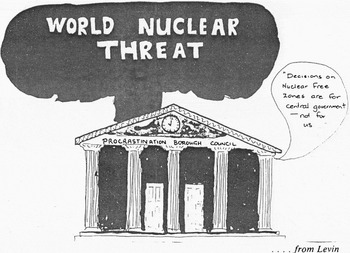
Despite ample criticism and derision, their proponents justified municipal interventions in defence as an unusual approach that acquired legitimacy in a situation that was viewed as a state of emergency. Central to all attempts at justification were the dangers of nuclear armament. A caricature, published in 1983 in a journal for peace from New Zealand, may serve to introduce the subject (see Figure 1). In the cartoon, a colonnaded building with the inscription ‘Procrastination Borough Council’ is overshadowed by a black mushroom cloud marked in contrasting white letters as the ‘world nuclear threat’. A speech bubble from inside the council building reads: ‘Declarations on Nuclear Free Zones are for central government – not for us.’ In this cartoon, the danger of the arms race framed both as ‘global’ (‘world nuclear threat’) and imminent (visible immediately behind the council building) is contrasted with the local authority's refusal to deal with the issue on grounds of jurisdiction. The inscription (and a large clock showing one minute past the full hour, possibly echoing the contemporary notion of a world five minutes away from the apocalypse) above the colonnades at the front side of the building points to the perceived absurdity of this refusal.Footnote 45
‘Procrastination Borough Council’ (Peacelink New Zealand, August 1983, 12)

Here and in other cases, this view of their own situation as a pre-apocalyptic one served as a key rationale for the interference of municipalities in issues of defence. References to nuclear dangers developed an obvious urban aspect when activists addressed cities and towns as the designated first casualties of nuclear war. Many local declarations contained, for instance, references to the destructive potential of nuclear weapons that should not be tolerated any longer. Resolutions in Great Britain, the United States and West Germany brought forward the argument that the presence of nuclear weapons, military infrastructure or manufacturing sites of weapons in the city or region would attract nuclear strikes in the event of war. In New Zealand, the diagnosis of nuclear threat tended to be made in more general terms than in the countries discussed above. Here, beyond the global arms race itself, activists cited dangers stemming from visits by nuclear-powered or nuclear-capable vessels, the presence of military infrastructure or climate changes that might affect New Zealand in the aftermath of a nuclear war.
To the same extent that we can examine the features of post-catastrophic cities and analyse how war experiences or natural catastrophes affect local communities,Footnote 46 we can also concentrate our attention on cities as pre-apocalyptic, querying how citizens drew conclusions for community life in their neighbourhoods even before any catastrophe actually took place. This perspective does not necessarily coincide with debates about ‘cities as targets’,Footnote 47 or, in the Cold War setting, preparations for nuclear war, for instance in town planning or civil defence, but manifests itself on a more general level. The pre-apocalyptic view of the city did not so much focus on future events and preparedness, but instead sought novel perspectives for the here and now in order to avoid a particular turn of events in the future. It was, therefore, a reflection about future events seen not in the light of prospective continuity, but with the aim of facilitating discontinuity and change. In this endeavour, pre-apocalyptic perspectives could merge with the remembrance of post-catastrophic experiences. In West Germany and Great Britain, for instance, activists referred to urban experiences with conventional and nuclear warfare during World War II in order to justify municipal interventions in defence. Not incidentally, some cities with catastrophic war experiences were especially active in initiating urban peace policies.Footnote 48
The threat of urban destruction, however, was not simply diagnosed and described by activists, but actively investigated and visualized. Peace movement guides and handbooks encouraged activists to look for specific local threats and utilize them for their line of argumentation. A peace action handbook from Great Britain, for instance, stated that the participation of municipalities in questions of defence was not ‘necessarily self-evident’. It thus suggested that local peace activists who aspired to influence local policies should try to refer as concretely as possible to nuclear dangers that were potentially threatening the region:
If your area contains nuclear weapons facilities, communications back-up, military bases and some other obvious nuclear target, you can put it to your council that as the area is almost certainly now on the target-list for Soviet missile aimers, they, as your elected representatives, have a duty to address themselves to the question of how to best avoid Soviet missiles being sent your way.Footnote 49
The handbook also called on local activists to research potential nuclear dangers themselves. If their research did not lead to the identification of acute nuclear risks specifically affecting their region, it would still be possible to refer to the dangers of fallout from nuclear targets in the wider region: ‘One way or another, it is possible to show that almost every locality in Britain will be massively damaged, directly or indirectly, by a nuclear attack.’Footnote 50 Activists should argue that local action was necessary in a state of emergency that arose from the special vulnerability of cities, resulting in a duty to rebel against the nuclear threat: ‘You can say that whereas normally these matters might be left to the central government, you believe that the policies central government has adopted (i.e., having our own nuclear weapons and playing host to American ones) make your area more vulnerable and not less; and therefore the council should take action.’Footnote 51 Peace movement handbooks in West Germany and the USA made similar suggestions.Footnote 52
Corresponding with this diagnosis of a pre-apocalyptic situation, activities focusing on the question of nuclear dangers were a main area of activity for municipal peace initiatives. BritishFootnote 53 and some AmericanFootnote 54 municipalities published brochures that described the possible effects of nuclear war for cities and towns in gruesome detail. Municipalities were also involved in campaigns against civil defence measures, with the argument that they played down the nuclear threat by providing a false sense of security and were therefore, from a psychological point of view, dangerous.Footnote 55 Furthermore, city representatives and local initiatives tried to put economic pressure on defence contractors and arms corporations,Footnote 56 initiated conversion projects,Footnote 57 or opposed the presence of nuclear-capable ships in the local ports.Footnote 58
Locality as a preferred scale of action
In addition to the dangers of nuclear armament for the urban population, elected representatives and peace activists justified municipal interventions in defence with the special political potential of the local scale. One argument brought forward by anti-nuclear initiatives was that the usually rather abstract perception of the arms race could be changed by means of localization, ‘bringing the decision-making back to the home-towns of the activists’, as an activist from the United States put it.Footnote 59 Local campaigns were also viewed as ‘more winnable than the large national campaigns’, being able to ‘produce a tangible, significant victory in a finite period of time’.Footnote 60 Moreover, activists highlighted the integrative potential of local peace policies. Through discussion of nuclear-related questions within an urban setting, they hoped to encourage the participation of residents who, otherwise, had little opportunity to take an active part in policies of nuclear armament. Sometimes moral standards, believed to manifest themselves especially in ordinary life, were also cited as reasons for local interventions – for instance, when a motion in Santa Cruz, California, opposed the ‘manufacture and testing of nuclear weapons’ as a ‘violation of community moral standards which place high value on the welfare of persons and the quality of the living environment’.Footnote 61
It therefore turns out that the local was not merely seen as the backdrop in front of which the end of the world was imagined as one's own, but that visions of the possible apocalypse also contributed to a new and different view and interpretation of the city. Pre-apocalyptic scenarios led to visions of peaceful, peace-keeping cities, connected with other cities equally striving for peace. Many fields of activity taken over by municipalities made peace an aim of political action resulting from local contexts, for example through the support of peace education and peace research, by the introduction of peace studies as a subject in schools,Footnote 62 or by the establishment of Peace Commissions or Peace Departments.Footnote 63 Activities also included the organization or funding of peace festivals, exhibitions and concerts, as well as financial and practical aids extended to local or national anti-nuclear initiatives. Municipalities in Great Britain even intervened in media policies by demanding the broadcasting of BBC's War Game.Footnote 64
The significance of the local level for tackling nuclear armament regularly became apparent when anti-nuclear initiatives tried to improve the visibility of their work against war and armament in their respective city areas. Municipalities placed city limit signs or welcome signs which informed visitors of the nuclear weapons-free status of the town or city;Footnote 65 they mounted plaques and distributed anti-nuclear stickers,Footnote 66 planted peace treesFootnote 67 or created peace gardens.Footnote 68 Practices like these should not be interpreted as a somehow pre-political area of demonstration and representation of anti-nuclear initiatives. On the contrary, they themselves were an important part of local peace initiatives. By appropriating the urban space and linking the aim of peace to an everyday surrounding, they transformed questions of nuclear policy into something that communities should take a position on and where the behavioural choices of citizens mattered.
Regarding this appreciation of the small-scale and local, cities and towns were not interpreted as isolated entities, but conceived as members of a joint municipal community. This is indicated by the fact that cities and towns sought exchange with other municipalities, for instance by writing letters or joining national and international conferences about local peace initiatives.Footnote 69 Furthermore, they were integrated into a wider framework of transnational peace action in as far as many local interventions supported by peace initiatives organized at the national level first evolved out of transnational transfer processes. Municipal peace initiatives also reinterpreted twin city arrangements, a traditional instrument of urban peace and reconciliation strategies, as protagonists experimented with local partnerships as an instrument for détente and disarmament.Footnote 70
Lastly, associations that were specifically established for the purposes of peace and arms control initiated contacts between cities and towns, intending to utilize local action in an international scope with the goal of changing global structures. One example of a transnationally organized alliance of municipalities is the ‘Program to Promote the Solidarity of Cities towards the Total Abolition of Nuclear Weapons’ that was announced by the mayor of Hiroshima at the Second UN General Assembly Special Session on Disarmament in New York in June 1982 (today ‘Mayors for Peace’).Footnote 71 The so-called ‘Peace Messenger Cities’ are another example of international ties between cities ‘for peace’. This alliance was founded in 1987 when the secretary-general of the United Nations honoured an initial group of 62 cities from around the world in recognition of their exceptional efforts during the International Year of Peace 1986.Footnote 72 Because of these international contacts and the resulting international positioning of municipalities, local attempts to become involved in foreign policies could also be placed within discussions about a ‘new localism’, with the evolution of novel forms of hybridized socio-spatial arrangements in a historical period seen as shaped by increased processes of globalization and transnational contact.Footnote 73
Local interventions and democracy in the nation-state and beyond
Our view of municipal interventions in defence needs to be complemented with the role that these practices played within the framework of the nation-state. Local interventions in defence were an arena where citizens debated aspects of national politics within a rhetorical framework of the local and the international, and where they tested options for political participation in the nation-state with instruments of representative as well as direct democracy.
The connection between local interventions in defence and political structures in the nation-state is particularly clear in the example of Great Britain, where Labour-governed councils used the topic to rebel against the Thatcher government. In this context, localizing strategies could be legitimized with the argument that government was not fulfilling its duties adequately and thus forced local authorities to ‘undertake work which should have been done by Westminster and Whitehall’, as CND's honorary vice-president Bruce Kent put it in a letter to the editor in The Times.Footnote 74 Practical conflicts arising over municipal interventions in defence, for instance concerning local opposition to civil defence,Footnote 75 were shaped by this oppositional relation to government. In West Germany, relations between the federal government and municipalities’ peace policies were similarly tense; however, confrontations comparable to those in Great Britain did not come about.Footnote 76 In the USA, activists likewise viewed local interventions in defence as a strategy to expose and criticize government policies, aiming to ‘make it increasingly difficult for the government to implement their destructive policies’,Footnote 77 and thereby enforce positions that had not found a majority via the electorate system.
Yet it would be a simplification to view municipal interventions in defence as necessarily conflicting with national governments’ policies. This assumption, which originates in the predominant focus on the United States, West Germany and Great Britain, may be corrected by the example of New Zealand. In this country, local municipal peace initiatives ceased to be in direct opposition to government after a Labour administration was elected under the leadership of David Lange in 1984 and committed itself to anti-nuclear policies. In February 1985, the New Zealand government refused a request by the US to let the USS Buchanan enter a New Zealand port. With the ‘New Zealand Nuclear Free Zone, Disarmament and Arms Control Act’, parliament formally declared the country nuclear free in June 1987.Footnote 78
These policy changes most notably had the consequence that ANZUS was practically suspended by the United States.Footnote 79 But they also had palpable implications for the relation between grassroots anti-nuclear campaigning and politics on the national scale, as activists now could appraise governmental anti-nuclear policies as a success of their own campaigns. For instance, a prominent protagonist of the New Zealand Nuclear Free Zone Committee interpreted the Labour victory in 1984 as ‘evidence that the expression by local councils of the popular will of the people, by the way of N.W.F.Z. declarations, can result in policy and government changes’. In this new narrative, the strength of the local authority nuclear weapon free zone campaign had ‘been an important factor in electing a Labour government pledged to declare New Zealand a Nuclear Weapon Free Zone and ban nuclear warship visits’. Municipalities, in turn, were invited to declare nuclear free zones in order ‘to support government policy’.Footnote 80 In this situation, the implementation of anti-nuclear policies could even be interpreted as a victory of democracy, and New Zealand's newly achieved ‘nuclear free’ status stylized as a national symbol.Footnote 81 Municipal interventions in defence therefore proved to be embedded in complex spatial–political relations that went beyond opposition to the nation-state and its political institutions.
If we think about the relation between the nuclear threat, the Cold War and the city from the perspective of urban peace and disarmament strategies, it becomes clear that municipal interventions in defence do not connect to urban history because of their simplistic ‘local’ nature. As this article has argued, local peace policies often evolved in transnational contexts. Cities and towns active in municipal foreign policies stressed their international connections, while at the same time focusing on locality as a motivation and inspiration for getting involved in issues of defence. Rather than being restricted to a certain scale, municipal peace policies made locality itself a subject of political discourse and practice and turned it into a reference to what was, in fact, a hybrid and multiscalar constellation.
Conclusion
Municipal interventions in defence emerged in different political situations; yet, they were all intended to provoke arguments about matters of foreign and defence policy in everyday situations and aimed at advancing the participation of ordinary men and women in questions of nuclear armament and defence. In the four countries discussed in this article, citizens spoke out for or against nuclear disarmament or arms control, debated the costs of the arms race, reflected on their personal experiences of war and discussed their nation-state's strategic alliances in the context of municipal interventions in defence. They referred to moral judgments and sentiments, told stories of their own lives which helped them to evaluate nuclear armament and, through dialogue, came to their own conclusions about questions of nuclear weapons, the possibility of a nuclear catastrophe and its consequences for urban settlements. In these interactions, an ‘everyday antimilitarism’ – here defined as refusal to take for granted or accept nuclear deterrence and defence policies based on nuclear weapons, as well as possible practices of economic, military and moral non-participation in nuclear armament – met a phenomenon which could be dubbed a ‘Cold War from below’, that is the acceptance, reproduction or intensification of nuclear confrontation and political tension between ‘east’ and ‘west’ through simple, everyday interactions.
However one might judge the significance, efficiency and legitimacy of local foreign policies, they at least are inspirational for historiographical approaches to the Cold War. Not only do they lead us to think about the Cold War and particularly its last phase from a perspective of micropolitical breaches and disruptions; they also demonstrate that there are alternatives to viewing the Cold War predominantly as a product or consequence of international relations and government activity, which then in some way or another ‘impacted’ on towns and cities and elicited responses from inhabitants. Rather, in the cases discussed above, towns and cities actively assumed a role in Cold War policies – be it through the confirmation of geopolitical normalcy and its implicit assumptions, or through attempts to limit and overcome east–west tensions and nuclear armament.
The examples discussed in this article invite us to explore the multifarious practices and discourses of stepping in or backing out of Cold War policies from the viewpoint of urban settlements. This will strengthen a historiography which connects local life to governmental and international politics and vice versa. It will also allow us to elucidate further to what extent Cold War topics such as atomic armament, the strategy of deterrence and the intensity of international tensions depended on debates conducted in ordinary citizens’ towns, cities and everyday contexts. Focusing on concrete urban settlements, examining urban interconnections as well as analysing the variability of scales, then, may arise as one key to a better understanding of the complex interrelations between political and spatial phenomena and their role in constituting and challenging the ‘global’ Cold War.