Caladium species are members of the plant family Araceae and are widely used as landscape and container plants. After years of plant breeding, cultivars and hybrids are available in a wide range of plant heights and leaf colors, patterns, shapes, and sizes (Bell et al. Reference Bell, Wilfret and DeVoll1998; Cai et al. Reference Cai, Cao, Xu and Deng2015; Cao et al. Reference Cao, Deng and Mclaughlin2014, Reference Cao, Sui, Cai, Yang and Deng2016a, Reference Cao, Sui, Yang and Deng2016b, Reference Cao, Sui, Yang and Deng2017a, Reference Cao and Deng2017b; Deng et al. Reference Deng2012, Reference Deng, Harbaugh and Peres2016; Miranda and Harbaugh Reference Miranda and Harbaugh2003). Caladium tuber production typically occurs on high organic and well-aerated soils. Most of the world production of caladium tubers occurs in a small geographical area in Highlands County in Central Florida (Deng et al. Reference Deng, Harbaugh, Schoellhorn and Andrew2005).
Weed control is a constant issue in caladium tuber production (Gilreath et al. Reference Gilreath, Harbaugh and Bates1994, Reference Gilreath, McSorley and McGovern1999) due to the lack of registered herbicides for POST weed management. Caladium establishes slowly from tubers and the growing season can exceed 9 months. Weed control is critical during the first several months of caladium establishment, before the plants produce enough foliage to cover the row middles. Currently, there are no registered herbicides for POST weed control in caladium. Caladium growers historically relied on soil fumigation with methyl bromide to control soil-borne pests including weeds (Overman and Harbaugh Reference Overman and Harbaugh1983). However, the Montreal Protocol and Clean Air Act classified methyl bromide as a Class I ozone-depleting substance and called for its gradual phaseout. The phaseout of methyl bromide has been completed in 2005 (USEPA 2018). In recent years, growers have transitioned to alternative fumigants due in part to the rising cost of methyl bromide. However, the alternative fumigants are generally not as effective on weeds as methyl bromide (Boyd et al. Reference Boyd, Vallad, Wu, Noling and Guan2017; Hanson and Shrestha Reference Hanson and Shrestha2006; Shrestha et al. Reference Shrestha, Browne, Lampinen, Schneider, Simon and Trout2008). As a result, weed density and diversity have increased in most commercial fields. For example, doveweed [Murdannia nudiflora (L.) Brenan] was not historically a significant problem, but in recent years doveweed populations have increased and hindered harvest operations and reduced tuber yields in some fields.
A number of PRE herbicides have been evaluated for use in field-grown caladium. Gilreath et al. (Reference Gilreath, Harbaugh and Lott1985) evaluated 12 herbicides and reported that oryzalin provided acceptable weed control without reducing caladium yield. Gilreath et al. (Reference Gilreath, Harbaugh and Bates1994) reported that flumetralin, S-metolachlor, and a combination of isoxaben and oryzalin were possible weed management options for field-grown caladiums. However, these PRE herbicides do not control established weeds, and poor weed control may result if applications are inappropriately timed. Furthermore, the caladium growing season can exceed 9 months. PRE herbicides may have limited soil longevity and do not provide season-long weed control. For example, the reported half-life of S-metolachlor is 15 to 25 d in southern soils based on bioassay determinations (Shaner Reference Shaner2014). Therefore, selective POST herbicides are needed to provide a means for controlling weeds effectively during the extended growing season.
Preliminary research conducted at the Gulf Coast Research and Education Center (GCREC) in Balm, Florida indicated that many caladium cultivars are tolerant to POST applications of the sulfonylurea (SU) herbicides halosulfuron, thifensulfuron-methyl, and trifloxysulfuron. However, the application rates required to control problematic weeds were not fully identified. The objective of this research was to 1) evaluate the halosulfuron, thifensulfuron-methyl, and trifloxysulfuron rate required to effectively control four common broadleaf weeds of field-grown caladiums and 2) determine caladium cultivars ‘Florida Fantasy’ and ‘Florida cardinal’ tolerance to POST applications of halosulfuron.
Materials and Methods
Common Purslane and Spotted Spurge
Greenhouse experiments were conducted from July to September 2014 at the GCREC in Balm, FL (27.75°N, 82.26°W) to evaluate six rates of halosulfuron (Sandea®, 75 WDG, Gowan Company, LLC., Yuma, AZ 85364), thifensulfuron-methyl (Harmony®, SG, Dupont, Wilmington, DE 19898), and trifloxysulfuron (Envoke®, 75WG, Syngenta Crop Protection, LLC, Greensboro, NC 27419) on common purslane and spotted spurge.
Common purslane seeds were hand-harvested from plants collected at the GCREC, then stored in a seed storage room at 10 C until use. Pots with a 15-cm diameter and 10-cm depth were filled with potting soil (Fafard 3B, Sungro Horticulture, Agawam, MA 01001) and purslane seeds were planted on August 13, 2014. Pots were placed in the greenhouse after sowing and drip irrigated daily. Common purslane seedlings were thinned to a single plant in each pot after emergence. The longest stem of common purslane was at 9 (±0.24 SE) cm when the herbicides were applied.
Spotted spurge seedlings were collected from a commercial caladium field in Highlands County, Florida (27.34°N, 81.34°W). Spotted spurge plants had 5- to 10-cm-long stems when collected in the field. The seedlings were transplanted on July 8, 2014, using aforementioned pots and potting soil. Pots were placed in the greenhouse after the spotted spurge seedlings were transplanted. A single plant was grown in each pot. The longest stem of spotted spurge was 21 (±0.32 SE) cm when the herbicide treatments were applied.
The treatment design was a factorial arrangement with herbicide as one factor and herbicide rate as the second factor. Herbicide rates were based on 0, 0.5×, 1×, 2×, 4×, and 8× the recommended rate where the 1× rate for each herbicide was the rate registered for use in the herbicide label. Halosulfuron was applied at 0, 13, 26, 52, 105, or 210 g ai ha−1, thifensulfuron-methyl was applied at 0, 1.75, 3.5, 7, 14, or 28 g ai ha−1, and trifloxysulfuron was applied at 0, 5.2, 10.5, 21, 42, or 84 g ai ha−1. Herbicide treatments were applied with a handheld CO2-pressured sprayer calibrated to deliver 187 L ha−1 with a single 8002E flat-fan nozzle boom (Teejet Spraying Systems Co., Riverview, FL 33579) at 240 KPa. Herbicide treatments included a nonionic surfactant (Activator 90, 90% alkylphenol ethoxylate and tall oil fatty acid, Loveland Products, Loveland, CO 80538) at 0.2% (v/v). Plants were returned to the greenhouse 1 h after herbicide treatment and irrigation was withheld for 24 h.
Common purslane and spotted spurge control was visually evaluated at 2 and 4 weeks after treatment (WAT) on a percent scale ranging from 0% (no control) to 100% (complete control). Common purslane and spotted spurge control was expressed as tissue chlorosis and stunted plant growth. Results from 4 WAT are presented due to similar trends among treatments observed at 2 WAT. Shoots were harvested at 8 WAT, oven-dried at 65 C for 72 h, and then weighed.
Hairy Indigo and Sharppod Morningglory
Field experiments were conducted at two separate sites at the GCREC from August to October in 2014 to evaluate the control of hairy indigo and sharppod morningglory with halosulfuron, thifensulfuron-methyl, and trifloxysulfuron. Experiments were conducted in the field where tomatoes (Solanum lycopersicum L.) had been grown the preceding season and a substantial number of hairy indigo and sharppod morningglory seedlings emerged. Hairy indigo was 10 to 15 cm tall and sharppod morningglory vine length was 52 (±4.45 SE) cm when the herbicide treatments were applied. Soil was a Myakka series fine sand (sandy, siliceous, hyperthermic Aeric Alaquods) with 1.5% organic matter, a pH of 6.0, and sand, silt, clay content of 97.6%, 1.0%, and 1.4%, respectively.
The treatment design was a factorial arrangement with herbicide as one factor and herbicide rate as the second factor. A nontreated check was included in each replication. Plots were 7.6 m by a single 0.8-m-wide bed. Herbicide applications and rates were the same as they were in the previous experiment. Herbicide treatments included a nonionic surfactant (Activator 90) at 0.2% (v/v). Control of hairy indigo and sharppod morningglory was measured visually at 4 WAT on the same scale mentioned previously.
Caladium Tolerance
Greenhouse experiments were conducted from June to October 2014 at the GCREC to evaluate caladium cultivars ‘Florida Fantasy’ and ‘Florida Cardinal’ tolerance to POST applications of halosulfuron. Caladium tubers were collected from a commercial caladium field in Highlands County, Florida (27.34°N, 81.34°W). Commercial grade tubers were obtained from a grower and used for the experiments. Uniform caladium tubers (4 to 5 cm) were selected and planted one per pot in 15-cm diameter and 10-cm depth pots in a greenhouse set for 28/16 C (day/night). The soil used was a commercial potting soil including 30% Canadian peat, 20% cypress dust, 20% pine bark, 20% bark, and 10% perlite at pH 5.5 to 6.5. Six grams of 14-9-15 (N-P-K) Plantacote PlusS (X-Calibur Plant Health Company, Summerville, SC) was mixed into the upper 5 cm of the soil at 2 weeks after planting to promote plant growth. The averages of plant height and leaf number were 12 (±1.89 SE) cm and 3.4 (±0.17 SE) leaves plant−1 for ‘Florida Fantasy’, respectively, and were 24.9 (±0.74 SE) cm and 3.5 (±0.21 SE) leaves plant−1 for ‘Florida Cardinal,’ respectively, when the herbicides were applied.
The treatment design was a factorial combination with caladium cultivar as one factor and herbicide rate as the second factor. A nontreated check was included in each block. Halosulfuron at 0, 13, 26, 52, 105, or 210 g ai ha−1 was applied with a handheld CO2-pressured sprayer calibrated to deliver 187 L ha−1 with a single 8002E flat-fan nozzle (Teejet). A nonionic surfactant at 0.25% (v/v) was included in the herbicide treatments. Plants were returned to the greenhouse at 1 h after treatment, and irrigation was withheld for 24 h.
Caladium damage was visually evaluated at 2 and 4 WAT on a percent scale where 0% equaled no damage and 100% equaled complete desiccation. Visual assessment was based on chlorosis, necrosis, stunting growth, and crinkling of caladium leaves. Caladium tubers were harvested at 8 WAT. Caladium tubers were graded prior to weighing as small (<4 cm diam), medium (4 cm≤diam<6 cm), large (6 cm≤diam<9 cm), and extra large (≥9 cm diam). Soil adhering to the tubers was washed off with tap water and fresh weight was determined once air dried.
Experimental Design and Statistical Analysis
All experiments were conducted as a randomized complete block with four replications. All experiments were conducted twice over time.
Percent shoot mass reduction of common purslane and spotted spurge as compared to nontreated controls was calculated. Weed control and shoot mass reduction data subjected to regression analysis with the Nonlinear Regression procedure in SAS (version 9.4, SAS Institute, Cary, NC). Levene’s test for homogeneity of variances was conducted before combining the data from the two experimental runs. Data were regressed with the following two-parameter growth function equation:
 $$y\,{\equals}\,{\rm \beta }_{0} \left\{ {1-\left[ {{\rm exp}\left( {-{\rm \beta }_{1} x} \right)} \right]} \right\}{\rm },$$
where y is plant response, β0 is the asymptote, β1 is the slope estimate, and x is herbicide rate. The effective herbicide dose that provides 50% (ED50) and 80% (ED80) weed control and 50% (GR50) and 80% (GR80) shoot mass reduction was determined from the regression equations.
Caladium tolerance data were analyzed in SAS using the mixed procedure with experimental repeat and block as the random factors and caladium cultivar and herbicide rate as the fixed factors. Data were checked for normality and constant variance prior to analysis. Means were compared using the least squares means statement with the Tukey adjustment at P=0.05.
Results and Discussion
Common Purslane and Spotted Spurge
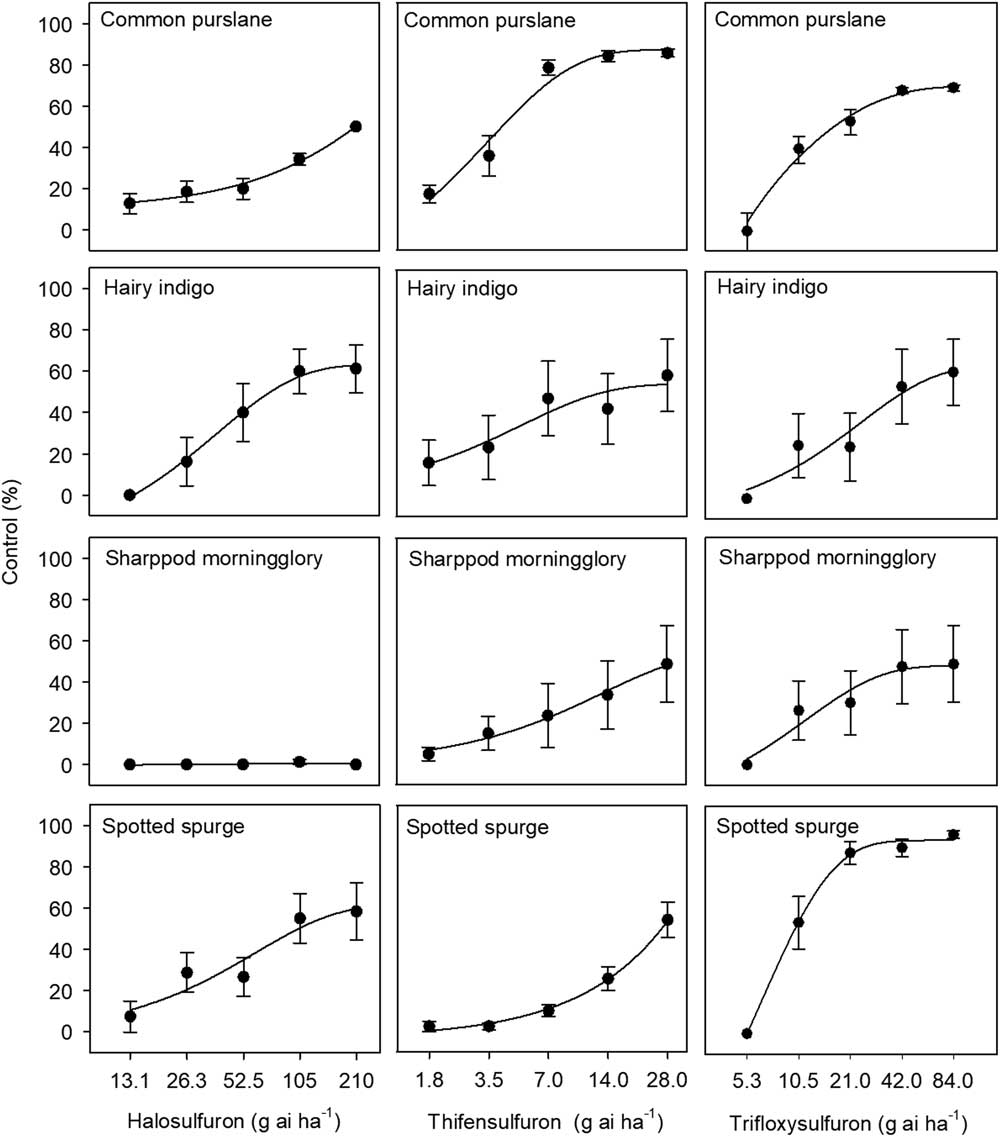
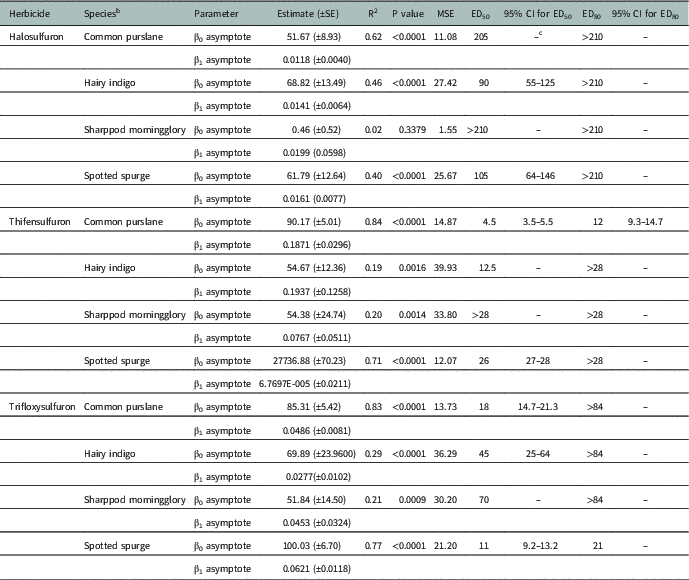
Common purslane exhibited substantially greater susceptibility to thifensulfuron-methyl and trifloxysulfuron than it did to halosulfuron (Figure 1; Table 1). At 4 WAT, thifensulfuron-methyl and trifloxysulfuron at 7 and 21 g ha−1 controlled approximately 80% and 60% common purslane, respectively, while halosulfuron at 52.5 g ha−1 controlled <20%. At the highest rate, thifensufluron-methyl and trifloxysulfuron controlled approximately 90% and 70% common purslane, respectively, while halosulfuron controlled <50%. Common purslane ED50 values were 205, 4.5, and 18 g ha−1 for halosulfuron, thifensulfuron-methyl, and trifloxysulfuron, respectively. Common purslane ED80 measured >210, 12, and >84 g ha−1 for halosulfuron, thifensulfuron-methyl, and trifloxysulfuron, respectively.
Control of common purslane, hairy indigo, sharppod morningglory, and spotted spurge at 4 weeks after halosulfuron, thifensulfuron, and trifloxysulfuron applications in two combined experiments, 2014, in Balm, Florida. Common purslane and spotted spurge experiments were conducted in pots in the greenhouse. Hairy indigo and sharppod morningglory experiments were conducted on naturally occurring populations in field. Weed control was visually evaluated on a percent scale ranging from 0% (no control) to 100% (complete control). Results were pooled over experimental runs. Vertical bars represent standard errors of the mean (n=8).

Estimates from regression analysis for 50% (ED50) and 80% (ED80) weed control after halosulfuron, thifensulfuron-methyl, and trifloxysulfuron applications in two combined experiments, Balm, Florida.Footnote a

a Data were regressed with the equation y=β0 {1 − [exp(−β1 x)]}, where y is plant response, β0 is the asymptote, β1 the slope estimate, and x is herbicide rate. The effective herbicide dose that provides 50% (ED50) and 80% (ED80) weed control was determined from the regression equations.
b Common purslane and spotted spurge experiments were conducted in pots in the greenhouse. Hairy indigo and sharppod morningglory experiments were conducted on naturally occurring populations in field.
c Herbicide rates evaluated in these experiments were not high enough to cause 50% or 80% weed control.
Abbreviations: CI, confidence interval; SE, standard error of estimate; MSE, mean squared error.
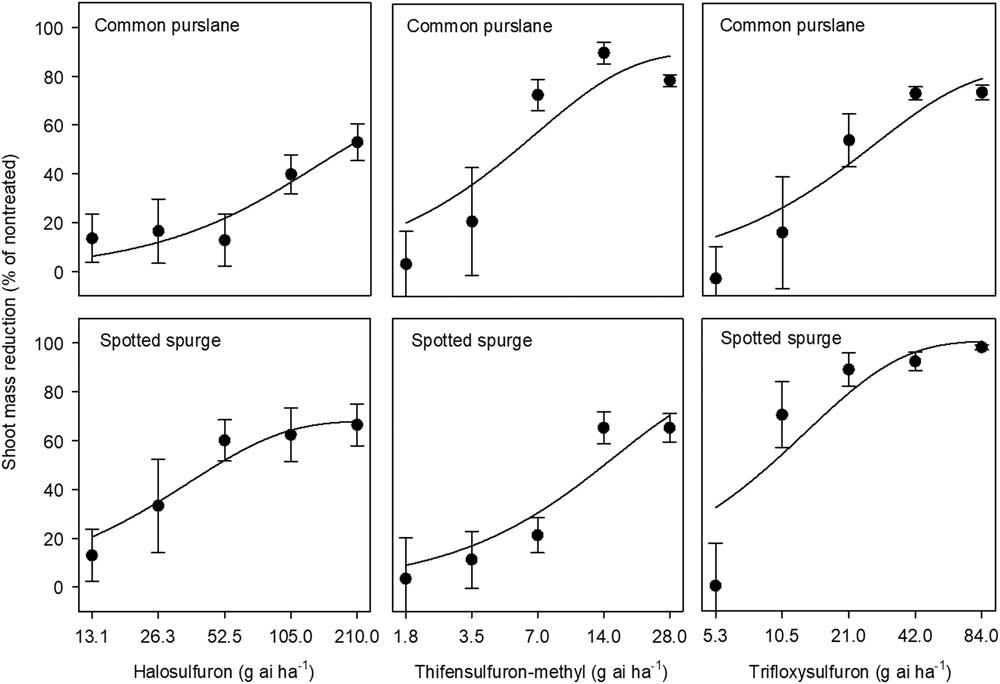
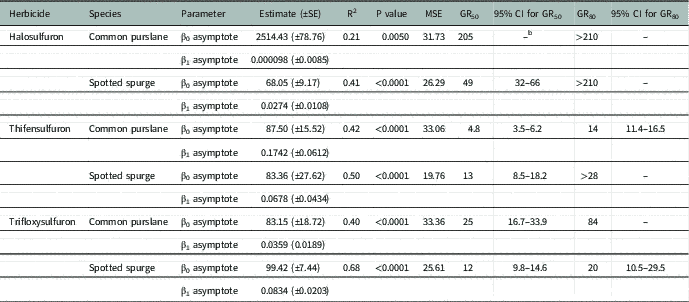
At 8 WAT, the highest rate of halosulfuron reduced common purslane shoot mass 50% compared with the nontreated (Figure 2). Thifensulfuron-methyl at ≥14 g ha−1 caused >90% shoot mass reduction compared to the nontreated, indicating that common purslane is quite sensitive to thifensulfuron-methyl. As rates increased from 42 to 84 g ha−1, trifloxysulfuron caused >70% shoot mass reduction from the nontreated. Common purslane GR50 measured 205, 4.8, and 25.3 g ha−1 from halosulfuron, thifensulfuron-methyl, and trifloxysulfuron, respectively, while GR80 measured >210, 14, and 84 g ha−1, respectively (Table 2). These findings show that thifensulfuron was the most effective of these herbicides on common purslane, while halosulfuron was the least effective.
Shoot mass reductions compared to the nontreated for common purslane and spotted spurge at 8 weeks after halosulfuron, thifensulfuron-methyl, or trifloxysulfuron applications in two combined greenhouse experiments, 2014, in Balm, Florida. Results were pooled over experimental runs. Vertical bars represent standard errors of the mean (n=8).

Estimates from regression analysis for 50% (GR50) and 80% (GR80) shoot mass reduction after halosulfuron, thifensulfuron-methyl, and trifloxysulfuron applications in two combined greenhouse experiments, Balm, Florida.Footnote a

a Data were regressed with the equation y=β0 {1 − [exp(−β1 x)]}, where y is plant response, β0 is the asymptote, β1 the slope estimate, and x is herbicide rate. The effective herbicide dose that provides 50% (GR50) and 80% (GR80) shoot mass reduction was determined from the regression equations.
b Herbicide rates evaluated in these experiments were not high enough to cause 50% or 80% shoot mass reduction.
Abbreviations: CI, confidence interval; SE, standard error of estimate; MSE, mean squared error.
Halosulfuron and thifensulfuron-methyl did not adequately control spotted spurge, with only 60% control obtained at the highest rate (Figure 1). Trifloxysulfuron at 42 and 84 g ha−1 controlled spotted spurge≥90%. Spotted spurge ED50 from halosulfuron, thifensulfuron-methyl, and trifloxysulfuron measured 105, 26.5, and 11 g ha−1, respectively, while ED80 measured >210, >28, and 21 g ha−1, respectively (Table 1).
Trifloxysulfuron reduced shoot mass of spotted spurge more than did halosulfuron and thifensulfuron-methyl. At 8 WAT, the highest rate of halosulfuron and thifensulfuron-methyl reduced spotted spurge shoot mass 65% compared with the nontreated. Conversely, trifloxysulfuron at≥21 g ha−1 reduced spotted spurge shoot mass≥90% from the nontreated (Figure 2). Spotted spurge GR50 was 49, 13.3, and 12.2 g ha−1 for halosulfuron, thifensulfuron-methyl, and trifloxysulfuron respectively, while GR80 was >210, >28, and 20 g ha−1, respectively. These findings suggest that trifloxysulfuron is the most effective herbicide for controlling spotted spurge.
Hairy Indigo and Sharppod Morningglory
Hairy indigo control increased with rate for all herbicides, but never surpassed 65% at 4 WAT (Figure 1). The ED50 for hairy indigo treated with halosulfuron, thifensulfuron-methyl, and trifloxysulfuron was 90, 12.5, and 45 g ha−1, respectively, while ED80 was >210, >28, and >84 g ha−1, respectively (Table 1). There is limited reporting on hairy indigo control using the SU herbicides. In previous research, Mesch et al. (Reference Mesch, Howard, Ó-Connell, Jacob, Dodd and Moore2002) reported that trifloxysulfuron applied as a tank-mix with ametryn gave excellent hairy indigo control at 4 WAT.
The highest rate of thifensulfuron-methyl and trifloxysulfuron provided approximately 50% sharppod morningglory control at 4 WAT, whereas halosulfuron provided no control (Figure 1). ED50 for sharppod morningglory treated with halosulfuron, thifensulfuron-methyl, or trifloxysulfuron was >210, >28, and 70 g ha−1, respectively (Table 1). Similar to our findings, Norsworthy and Meister (Reference Norsworthy and Meister2007) noted that halosulfuron at 35 g ha−1 was ineffective against pitted morningglory (Ipomoea lacunosa L.) and tall morningglory [Ipomoea purpurea (L.) Roth]. In other research, Monks et al. (Reference Monks, Wilcut and Richburg1993) noted that thifensulfuron-methyl at 4 g ha−1 provided 79% and 63% control for a mixture populations of ivyleaf (Ipomoea hederacea Jacq.), pitted, and tall morningglory in 1988 and 1989, respectively, when the herbicide was applied at cotyledon to three-leaf stage. Previous researchers noted that weed growth stage often influenced the effectiveness of POST herbicides with greater efficacy when the herbicides were applied at early growth stage (Klingaman et al. Reference Klingaman, King and Oliver1992; Yu and McCullough Reference Yu and McCullough2016). It is possible that the herbicides evaluated in this study would give better sharppod morningglory control if applications were made at an earlier growth stage.
Differential control of various broadleaf weed species by SU herbicides has been previously reported. For example, halosulfuron effectively controlled wild mustard (Sinapis arvensis L.) and water pennywort (Hydrocotyle umbellata L.), but was ineffective on common lambsquarters (Chenopodium album L.) and Palmer amaranth [Amaranthus palmeri S. Watson] (Derr Reference Derr2012; Norsworthy and Meister Reference Norsworthy and Meister2007; Soltani et al. Reference Soltani, Nurse, Shropshire and Sikkema2014). Thifensulfuron-methyl effectively controlled annual (Sonchus oleraceus L.) and spiny [Sonchus asper (L.) Hill] sowthistle (Rashid et al. Reference Rashid, Newman, O'donovan, Robinson, Maurice, Poisson and Hall2003), but did not adequately control common cocklebur (Xanthium strumarium L.) and common ragweed (Ambrosia artemisiifolia L.) (Ackley et al. Reference Ackley, Wilson and Hines1996; Isaacs et al. Reference Isaacs, Wilson and Toler2002). Trifloxysulfuron provided effective POST control of corn speedwell (Veronica arvensis L.), common chickweed [Stellaria media (L.) Vill.], and henbit (Lamium amplexicaule L.). However, control of prostrate knotweed (Polygonum aviculare L.) has not been satisfactory with trifloxysulfuron (Derr Reference Derr2012).
Caladium Tolerance
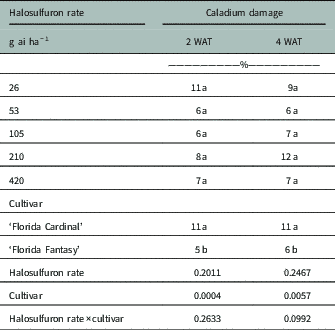
Cultivar and halosulfuron rate interactions were not significant for caladium damage (2 WAT, P=0.2633; 4 WAT, P=0.0922), and thus the main effects are presented (Table 3). Halosulfuron damage did not differ between rates (2 WAT, P=0.2011; 4 WAT, P=0.2467), whereas the effect of cultivar was significant (2 WAT, P=0.0004; 4 WAT, P=0.0057). Averaged over cultivars, the evaluated halosulfuron rates caused 6% to 11% and 6% to 12% caladium damage at 2 and 4 WAT, respectively. Averaged over halosulfuron rates, ‘Florida Fantasy’ damage was 5% and 6% at 2 and 4 WAT, respectively, while “Florida Cardinal” damage was 11%. These results suggest that both cultivars have acceptable tolerance to halosulfuron, but less damage was observed with ‘Florida Fantasy’ than ‘Florida Cardinal’.
Caladium visual damage following the applications of halosulfuron in two combined greenhouse experiments in Balm, Florida.

a Means within columns followed by the same letter are not significantly different according to Tukey adjusted mean comparisons at the 0.05 probability level.
Abbreviation: WAT, weeks after treatment.
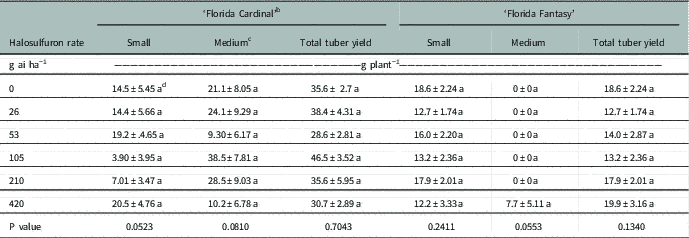
Cultivar by halosulfuron rate interactions had no significant effect on the weight of small tuber and total tuber yield, but had a significant effect on the weight of medium tuber yield (P=0.0062) and as a result all possible treatment combinations are presented (Table 4). Overall, the present study reports that POST application of halosulfuron could be incorporated in caladium tuber production for weed management. However, it is important to recognize that the repeated use of the same herbicide or herbicides with the same mechanism of action can select for herbicide-resistant weeds (McCullough et al. Reference McCullough, Yu, McElroy, Chen, Zhang, Grey and Czarnota2016; Vencill et al. Reference Vencill, Nichols, Webster, Soteres, Mallory-Smith, Burgos, Johnson and McClelland2012; Yu et al. Reference Yu, Han and Powles2008, Reference Yu, McCullough and Czarnota2017). Caladium growers should be cautious and use a diversity of weed management tactics rather than relying on halosulfuron alone.
Caladium tuber weights following the applications of halosulfuron in two combined greenhouse experiments in Balm, Florida.Footnote a

a Means within columns followed by the same letter are not significantly different according to Tukey adjusted mean comparisons at the 0.05 probability level.
b Tubers were classified to small (diam <4 cm), medium (4 cm≤diam<6 cm), large (6 cm≤diam<9 cm), and extra large (diam≥9 cm). Total tuber yield was the sum of all tuber size categories for each plant. No large and extra-large tubers were harvested for both cultivars.
c Medium tuber yield data had significant cultivar by halosulfuron rate interactions (P=0.0062). Thus, all treatments are presented.
d Data present are mean±standard error (n=8).
We conclude that thifensulfuron-methyl and trifloxysulfuron at 7 and 21 g ha−1 provide effective common purslane and spotted spurge control, respectively. Regardless of application rate, the evaluated SU herbicides were not efficacious on hairy indigo and control never exceeded 65%. While thifensulfuron-methyl and trifloxysulfuron provided <50% suppression of sharppod morningglory, they still provided superior control of that species compared to halosulfuron. Therefore, sequential treatments or high rates of these SU herbicides may be necessary to adequately control hairy indigo and sharppod morningglory. We also conclude that both caladium cultivars are tolerant of halosulfuron, while ‘Florida Fantasy’ is more tolerant than ‘Florida Cardinal’. The POST halosulfuron applications did not significantly reduce ‘Florida Fantasy’ and ‘Florida Cardinal’ tuber yields. Further study is needed to evaluate caladium tolerance to other SU herbicides.
Acknowledgments
The authors would like to thank Amy Hays, Julie Franklin, and Mike Sweat for technical assistance with this research. Research funding provided by caladium growers.