Prolonged exposure (PE) therapy is associated with significant reductions in posttraumatic stress disorder (PTSD; Cusack et al., Reference Cusack, Jonas, Forneris, Wines, Sonis, Middleton, Feltner, Brownley, Olmsted, Greenblatt, Weil and Gaynes2016). However, not all patients who receive PE benefit equally (e.g. Schnurr et al., Reference Schnurr, Friedman, Engel, Foa, Shea, Chow, Resick, Thurston, Orsillo, Haug, Turner and Bernardy2007; Brady et al., Reference Brady, Warnock-Parkes, Barker and Ehlers2015). Three potential outcomes are particularly concerning, namely delayed response, whereby a patient receives a benefit of treatment that is delayed relative to their peers, non-response, whereby a patient fails to respond to treatment altogether, and symptom exacerbation, whereby a patient reports worsening of symptoms at some point in treatment, which may be stable or time-limited. Some studies have documented rapid improvement in PTSD symptoms in PE (e.g. Aderka et al., Reference Aderka, Appelbaum-Namdar, Shafran and Gilboa-Schechtman2011; Jun et al., Reference Jun, Zoellner and Feeny2013), whereas others have documented brief, reversible symptom exacerbation, which was not related to treatment outcome, in a subset of patients (Foa et al., Reference Foa, Zoellner, Feeny, Hembree and Alvarez-Conrad2002). Thus, there are likely subclasses of patients that exhibit discrete patterns of symptom exacerbation or resolution; these patterns are obfuscated when examining group-level symptom change. As clinicians frequently report concern about potential symptom exacerbation in PTSD treatments, it is critical to understand the nuanced patterns of symptom change over time in PE.
Prior attempts at characterizing symptom change in PE for civilians have been mixed. Group-level data in PE and cognitive processing therapy (CPT) suggested that symptoms changed in a curvilinear fashion, with accelerated reductions following the fourth treatment session (Nishith et al., Reference Nishith, Resick and Griffin2002), when patients in PE completed their second imaginal exposure, and in CPT completed their first reading of the trauma account. Using another methodological approach (reliable change index), Kelly and colleagues (Reference Kelly, Rizvi, Monson and Resick2009) found that approximately 40% of patients experienced sudden PTSD reductions around the same point, session 4, in CPT. Reliable change index calculations also revealed that about 50% of patients experienced rapid PTSD reductions, which were associated with better posttreatment PE outcome (Doane et al., Reference Doane, Feeny and Zoellner2010; Aderka et al., Reference Aderka, Appelbaum-Namdar, Shafran and Gilboa-Schechtman2011; Jun et al., Reference Jun, Zoellner and Feeny2013), and 15% experienced a worsening in PTSD symptoms, though this exacerbation was not associated with worsened outcome (Foa et al., Reference Foa, Zoellner, Feeny, Hembree and Alvarez-Conrad2002). Similar rates of symptom exacerbation using reliable change emerged in another study of CPT (29%), PE (20%), and CPT-writing only (15%); unlike prior research, symptom exacerbation was related to a reduced likelihood of PTSD remission, though all participants experienced significant improvement in symptoms (Larsen et al., Reference Larsen, Wiltsey Stirman, Smith and Resick2016). Accordingly, evidence for the relationship between sudden gains, symptom exacerbation, and posttreatment PTSD outcome in civilians remains mixed.
Some of the discrepancies in prior research may be due to differences in methodology. For example, Foa and colleagues (Reference Foa, Zoellner, Feeny, Hembree and Alvarez-Conrad2002) used reliable exacerbation, which was compared against end-state symptoms. However, their null finding only indicated that a significant difference was not detected between the exacerbation and non-exacerbation groups; it cannot inform whether outcome was equivalent between the groups, which can only be achieved with a formal test of the null hypothesis. In contrast, Larsen and colleagues (Reference Larsen, Wiltsey Stirman, Smith and Resick2016) used mixed-effects models to predict change in PTSD from reliable exacerbation. However, mixed-effects models impose a mean growth curve on all participants. In other words, if a quadratic function best describes the overall change, this function is estimated for all participants. Thus, this approach cannot account both for participants who experience a sudden linear worsening and for those who experience an initial improvement and subsequent worsening in symptoms. The weaknesses of prior research could be resolved by using latent profile analysis (LPA). LPA categorizes participants into unobserved subgroups (‘classes’) based on differences in the pattern of symptom change. This approach offers a clear advantage over growth mixture models, which assume comparable patterns of change among classes (Goodman, Reference Goodman, Hagenaars and McCutcheon2002). LPA can calculate classes based on patterns of deviation from baseline scores, thus avoiding the extraction of classes that are dictated by overall symptom severity.
One prior study explored LPA to examine changes in PE in a naturalistic sample of veterans receiving PE (VA; Clapp et al., Reference Clapp, Kemp, Cox and Tuerk2016). A three-class solution best described the data. One ‘rapid responder’ group experienced substantial reductions from weeks 1–2 with stable reductions in remaining sessions; the second, ‘linear responder’ group experienced linear recovery throughout treatment; the third, ‘delayed responder’ group had a slow slope of change in treatment and an eventual reduction from week 10 to the final assessment. This study also evidenced preliminary support for an additional symptom exacerbation class, not included in the final model due to sample size. Rapid responders had significantly lower PTSD severity at posttreatment relative to the other classes, and linear responders had significantly lower posttreatment PTSD severity relative to delayed responders. As this was a naturalistic study, a comparison group was not included, precluding conclusions about treatment-specific classes of symptom change. Nevertheless, this study offered an important first attempt to understand the discrete patterns of symptom change in PE.
Several unanswered questions about treatment-driven PTSD change remain. First, are there differences in the pattern of symptom change in trauma-focused and non-trauma-focused treatments (e.g. present-centered therapy, PCT) for PTSD? While some studies demonstrated the superiority of trauma-focused treatments (Foa et al., Reference Foa, McLean, Capaldi and Rosenfield2013), others found differences at posttreatment that disappear by follow-up (Schnurr et al., Reference Schnurr, Friedman, Engel, Foa, Shea, Chow, Resick, Thurston, Orsillo, Haug, Turner and Bernardy2007), and others failed to find differences altogether (Suris et al., Reference Suris, Link-Malcolm, Chard, Ahn and North2013). The heterogeneity in study findings may be attributed to differences in the proportion of individuals who responded, failed to respond, or experienced symptom worsening in a given treatment modality. However, these studies did not account for the pattern of symptom change across treatments.
Second, does the timing of sessions alter the pattern of symptom change? Based on principles of fear conditioning and extinction, spaced therapy sessions should provide greater opportunities for learning consolidation compared with massed therapy sessions (Urcelay et al., 2009). However, some studies have not supported this hypothesis (Orinstein et al., Reference Orinstein, Urcelay and Miller2010). Thus, it is unclear whether massed (i.e. daily) therapy sessions will alter the overall pattern of symptom change compared with spaced (i.e. weekly) treatment sessions.
Third, does baseline clinical severity predict the pattern of symptom change over time? In the only study that used LPA, class was not predicted by initial PTSD or depression severity (Clapp et al., Reference Clapp, Kemp, Cox and Tuerk2016). Thus, there are limited findings on the associations between baseline clinical severity and the pattern of treatment response.
Finally, does the pattern of symptom change influence long-term outcome? While one underpowered study found that there was not an association between symptom exacerbation and long-term outcome (Foa et al., Reference Foa, Zoellner, Feeny, Hembree and Alvarez-Conrad2002), another found the opposite (Larsen et al., Reference Larsen, Wiltsey Stirman, Smith and Resick2016). Therefore, it is unclear whether patterns of symptom change are associated with long-term symptoms.
To address these questions, this study evaluated patterns of treatment response in secondary data from a randomized controlled trial comparing spaced-PE (S-PE; 10 sessions delivered over 8 weeks), PCT (10 sessions delivered over 8 weeks), and massed-PE (M-PE; 10 sessions delivered over 2 weeks; Foa et al., Reference Foa, McLean, Zang, Rosenfield, Yadin, Yarvis, Mintz, Young-McCaughan, Borah, Dondanville, Fina, Hall-Clark, Lichner, Litz, Roache and Wright2018). The first aim was to determine whether discrete classes of symptom change emerged within each condition. We used LPA to calculate discrete classes of symptom deviation from baseline over time. Based on prior research (Clapp et al., Reference Clapp, Kemp, Cox and Tuerk2016), we hypothesized that S-PE and M-PE would each demonstrate three distinct classes, namely rapid responders, linear responders, and delayed responders. As no prior literature has reported on PTSD symptom change patterns in PCT, examination of class in this treatment was exploratory. The second aim was to determine whether baseline clinical severity predicted class. Limited data are available on this research question for both PE and PCT. Therefore, this analysis was also exploratory in nature. The third aim was to determine whether baseline clinical characteristics predicted class membership. One prior study (Clapp et al., Reference Clapp, Kemp, Cox and Tuerk2016) did not find an association between baseline PTSD or depression and class membership. Therefore, we had no a priori reason to suspect that baseline clinical characteristics would predict class membership. The final aim was to determine whether classes predicted long-term outcome. We hypothesized that classes reflecting slower response or non-response would be associated with greater symptom severity at posttreatment and follow-up.
Methods
Participants
Participants (N = 326) were active duty military personnel with combat exposure and PTSD (per Diagnostic and Statistical Manual of Mental Disorders-IV, American Psychiatric Association, 2000). Average age was 32.5 years old (s.d. = 7.3), and participants were primarily male (89.3%) and white (61.2%).
Procedure
All procedures were approved by the Institutional Review Board. Informed consent was obtained from all participants. Eligible participants were randomized to either S-PE (n = 109), PCT (n = 107), or M-PE (n = 110) and were reassessed at posttreatment, and at 2-week, 3-month, and 6-month follow-ups (Foa et al., Reference Foa, McLean, Zang, Rosenfield, Yadin, Yarvis, Mintz, Young-McCaughan, Borah, Dondanville, Fina, Hall-Clark, Lichner, Litz, Roache and Wright2018).
Treatments
S-PE
PE is a manualized therapy with two primary components: imaginal exposure, processing and in-vivo exposure. In S-PE, 10 sessions (90 minutes) were administered over 8 weeks. Sessions 1 and 2 occurred during week 1, followed by one weekly session during weeks 2–7, and two sessions in week 8.
PCT
PCT is a manualized treatment that provides a credible comparison with control for nonspecific factors. Sessions were provided at the same frequency and duration as S-PE. The therapist's role was to listen actively, identify daily stressors, and discuss stressors in a supportive, nondirective manner.
M-PE
M-PE was identical to S-PE, except that 10 sessions were administered over 2 weeks.
Measures
Session measure
PTSD checklist (PCL; Weathers et al. Reference Weathers, Litz, Herman, Huska and Keane1993)
The PCL is a 17-item self-report measure to assess PTSD severity. The measure has strong psychometric performance and internal consistency (Weathers et al., Reference Weathers, Litz, Herman, Huska and Keane1993), including in the current study (α = 0.88). The measure timing was altered to reflect the ‘time since we last saw you.’ In S-PE and PCT, the PCL was completed at each session; in M-PE, the PCL was completed at sessions 1, 3, 5, 7, 9, and 10.
Outcome measures
The outcome measures were collected at baseline during the eligibility assessment, as well as immediately upon treatment completion at post-treatment, and again at 3-months and 6-months after treatment completion.
PTSD Symptom Scale-Interview (PSS-I; Foa et al. Reference Foa, Riggs, Dancu and Rothbaum1993)
The PSS-I is a 17-item clinical interview that evaluates the frequency and severity of PTSD symptoms. Scores range from 0 to 51, with higher scores reflecting greater severity, and the measure has excellent psychometric properties (Foa and Tolin, Reference Foa and Tolin2000), including in the current study (α = 0.79).
Beck Depression Inventory-II (BDI-II; Beck et al. Reference Beck, Steer and Brown1996)
The BDI-II is a 21-item self-report measure of past-week depression symptoms rated on a 0–3-point scale. Higher scores reflect greater depression severity. The measure has strong psychometric properties (Beck et al., Reference Beck, Steer and Brown1996), including in the current study (α = 0.89).
Posttraumatic Cognitions Inventory (PTCI; Foa et al. Reference Foa, Tolin, Ehlers, Clark and Orsillo1999)
The PTCI is a measure of trauma-related cognitions about self, the world, and self-blame. The measure has excellent psychometric properties (Foa et al., Reference Foa, Tolin, Ehlers, Clark and Orsillo1999), including in the current study (α = 0.96).
Data-analytic plan
We ran a series of LPA using MPlus version 7.4 (Muthén and Muthén, Reference Muthén and Muthén2012). Given the potential for raw scores to extract classes based on overall symptom severity, weekly deviations from the initial session (PCLWeekj − PCLWeek1) were used to identify heterogeneous patterns of response with maximum likelihood estimation. While all participants were included in the model, a handful of participants from each condition were dropped due to missing data (PCT n = 5; S-PE n = 4; M-PE n = 9).
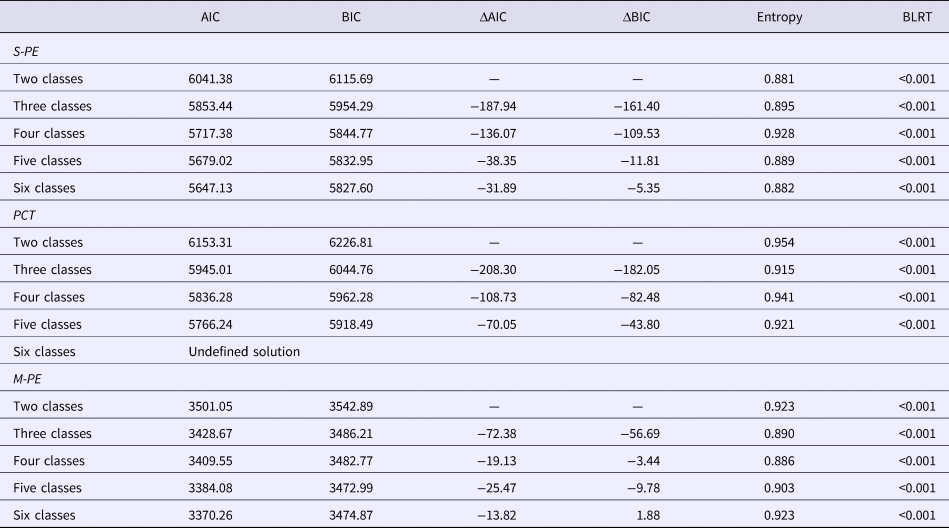
Determination of the optimal number of classes per treatment condition was based on a combination of four fit indices and theoretical conceptualization of the profiles.Footnote †Footnote 1 First, models were required to have an entropy of 0.80 or higher (Lubke and Muthén, Reference Lubke and Muthén2007).Footnote 2 Second, the Bayesian Information Criterion (BIC) was considered, with differences >10 between models considered ‘very strong’ evidence of discrimination (Raftery, Reference Raftery1995).Footnote 3 The BIC is the best performing of the information criterion indices (Nylund et al., Reference Nylund, Asparouhov and Muthén2007). Third, lower Akaike Information Criterion (AIC) values indicated better fit (Akaike, Reference Akaike1987). Fourth, the bootstrap likelihood ratio test (BLRT) statistic compared the number of latent classes to a model with one fewer classes (Nylund et al., Reference Nylund, Asparouhov and Muthén2007). When interpreting the classes, a treatment responder was operationally defined as a decrease in PCL of 10 points based both on calculations from the current sample and from prior research (Jacobson and Truax, Reference Jacobson and Truax1991; Clapp et al., Reference Clapp, Kemp, Cox and Tuerk2016).
Once the number of classes was determined, class membership was extracted, which is justified when entropy is >0.80 (Lubke and Muthén, Reference Lubke and Muthén2007; Clark and Muthen, Reference Clark and Muthen2009). Differences in baseline, posttreatment, and follow-up PSS-I, PTCI, and BDI-II across classes were examined using the Auxiliary BCH command in MPlus (Asparouhov and Muthen, Reference Asparouhov and Muthen2014; Bakk and Vermunt, Reference Bakk and Vermunt2016). Due to the large number of statistical tests, the Benjamini–Hochberg test was used to determine significance thresholds (Howell, Reference Howell2010).
Results
Determination of class membership
For S-PE, the five-class model resulted in a very strong improvement in BIC and AIC relative to the four-class model (which had very strong improvements in BIC and AIC relative to the two- and three-class models; see Tables 1 and 2), and included: (1) a rapid responder class, demonstrating an immediate reduction in PCL from Sessions 1 to 2 (see Fig. 1); (2) a steep responder class with little change in symptoms from Sessions 1 to 2 followed by dramatic reductions in the following weeks; (3) a gradual responder class, which demonstrated little change from Sessions 1 to 2, with more gradual reduction over time; (4) a non-responder class, which never achieved responder status; and (5) a symptom exacerbation class, in which symptoms worsened in a negative curvilinear pattern. The six-class model marginally improved BIC relative to the five-class model and only added an additional non-responder class. When considering parsimony, stability of class membership, and the marginal increase in fit, there was a lack of meaningful differentiation between the new class and the pre-existing five classes. Therefore, the five-class solution was optimal and retained.
Change in PCL scores by class membership for S-PE. PCL = PTSD Checklist; S = session.

Class membership determination

AIC, Akaike Information Criterion; BIC, Bayesian Information Criterion; BLRT, bootstrap likelihood ratio test; S-PE, spaced prolonged exposure therapy; PCT, present-centered therapy; M-PE, massed prolonged exposure therapy. Problems with standard error estimation resulted in nonconvergence for the six-class model for PCT.
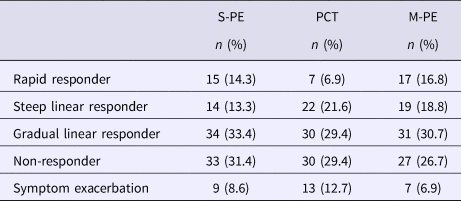
Proportion of participants in each class by condition

S-PE, spaced prolonged exposure therapy; PCT, present-centered therapy; M-PE, massed prolonged exposure therapy.
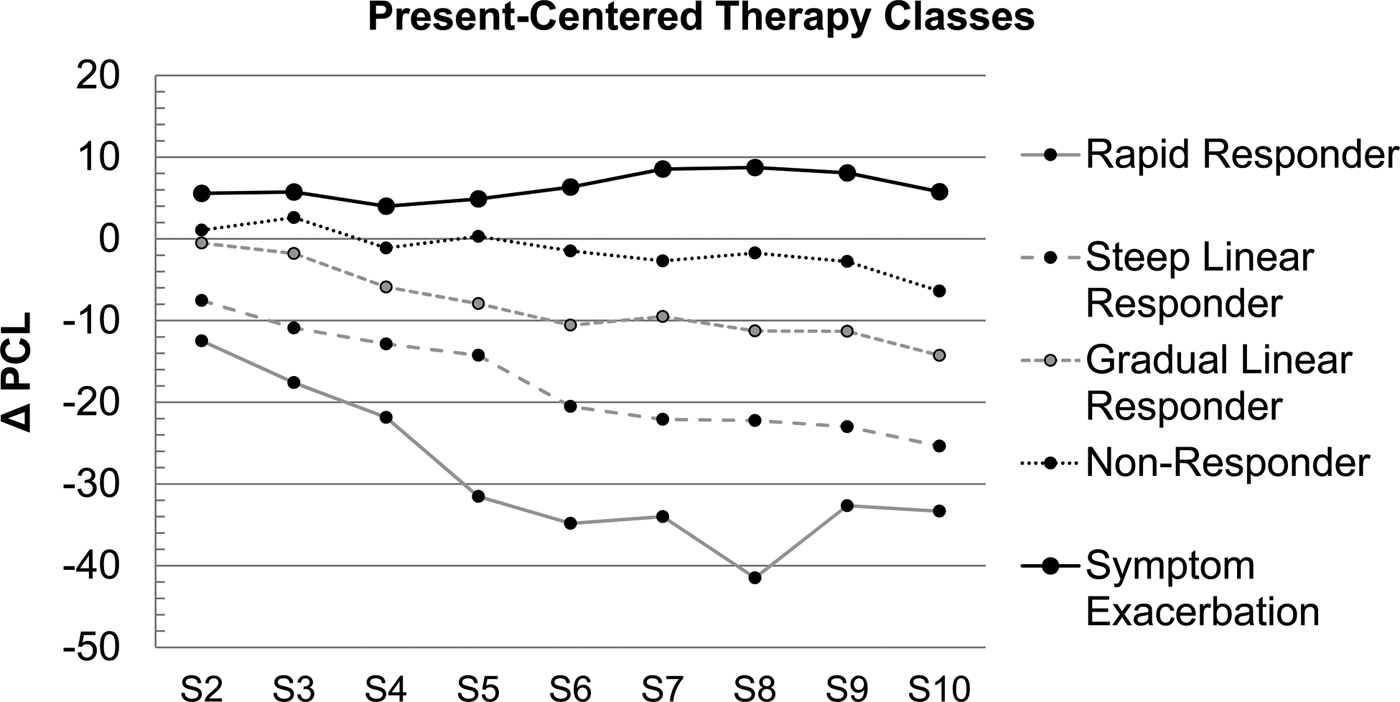
For PCT, the five-class model resulted in a very strong improvement in BIC and AIC relative to the four-class model (Fig. 2). Classes resembled S-PE in the pattern of deviation from baseline scores except that the differentiation of profiles became clearer around session five. The six-class model resulted in problems with standard error estimation for some parameters and therefore was not reported. Thus, the five-class solution was optimal and was retained.
Change in PCL scores by class membership for PCT. PCL = PTSD Checklist; S = session.

For M-PE, the five-class model resulted in a strong improvement in BIC relative to the four-class model. Classes largely resembled S-PE, except with some additional curvature in classes (see Fig. 3). Model fit worsened on the BIC from the five-class to six-class model. Therefore, the five-class model was the final solution for M-PE.
Change in PCL scores by class membership for M-PE. PCL = PTSD Checklist; S = session.

A χ2 test between Condition and Class was non-significant (χ2 = 8.47, p = 0.39, Cramer's V = 0.12), suggesting that the proportion of participants classified into classes did not differ by Condition.
Associations with baseline characteristics
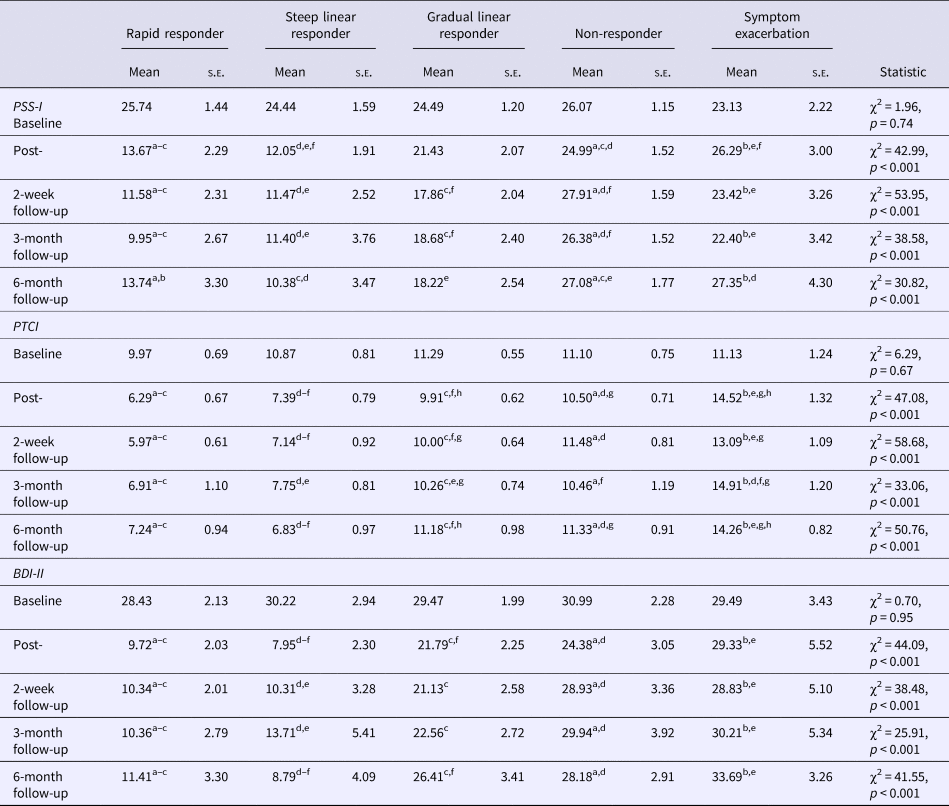
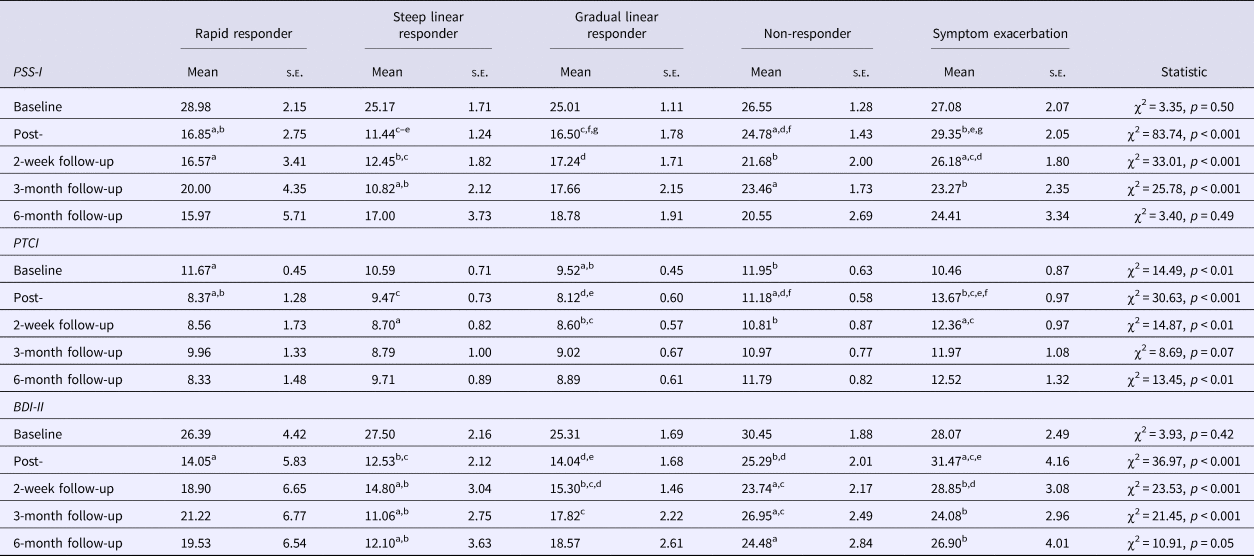
There were no differences between the five classes on baseline PSS-I, PTCI, or BDI-II for S-PE or M-PE (see Tables 3 and 4). For PCT, there were no differences by class on baseline PSS-I or BDI-II (see Table 5), but there was a significant difference by class on baseline PTCI. The gradual responder class had significantly lower baseline PTCI than both the rapid responder (d = 0.91) and non-responder (d = 0.76) classes.
Spaced prolonged exposure associations with class membership

PSS-I, PTSD Symptom Scale-Interview version; Post-, posttreatment; PTCI, Posttraumatic Cognitions Inventory; BDI-II, Beck Depression Inventory-II.
a–i Indicate significant differences between class means at α = 0.05.
Massed prolonged exposure associations with class membership

PSS-I, PTSD Symptom Scale-Interview version; Post-, posttreatment; PTCI, Posttraumatic Cognitions Inventory; BDI-II, Beck Depression Inventory-II.
a–i Indicate significant differences between class means at α = 0.05.
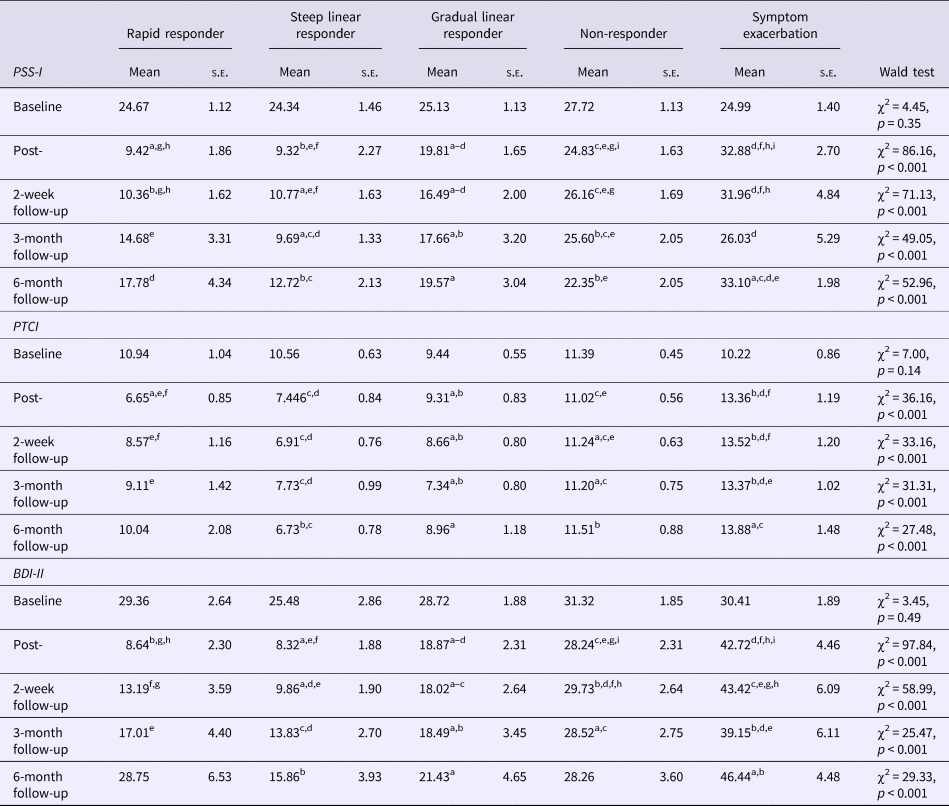
Present-centered therapy associations with class membership

PSS-I, PTSD Symptom Scale-Interview version; Post-, posttreatment; PTCI, Posttraumatic Cognitions Inventory; BDI-II, Beck Depression Inventory-II.
a–i Indicate significant differences between class means at α = 0.05.
Associations with treatment outcome
For S-PE and M-PE, class membership was significantly associated with PSS-I at posttreatment and all follow-ups (see Tables 3 and 4). The symptom exacerbation class had higher PSS-I relative to the rapid responder (S-PE: d = 1.00–3.83; M-PE: d = 1.29–1.42) and steep responder classes (S-PE: d = 1.87–3.60; M-PE: d = 1.69–2.01). Class membership was also significantly associated with PTCI at posttreatment and all follow-up time-points for S-PE and M-PE. As with PSS-I, the symptom exacerbation class was generally higher on the PTCI relative to the rapid responder class (S-PE: d = 0.93–2.42; M-PE: d = 2.21–2.76) and the steep responder class (S-PE: d = 1.77–2.50; M-PE: d = 1.83–2.83). For BDI-II, a similar pattern emerged for S-PE and M-PE; there were significant differences in BDI-II at posttreatment and all follow-up assessments, with the symptom exacerbation class generally higher than the rapid responder class (S-PE: d = −0.03 to 1.95; M-PE: d = 1.88–2.16) and the steep responder class (S-PE: d = 0.87–2.05; M-PE: d = 0.99–2.27).
For PCT, class membership was significantly associated with PSS-I at posttreatment, 2-week follow-up, and 3-month follow-up, but not 6-month follow-up (see Table 5). When there were differences in outcome by class membership, they were in the direction of generally higher PSS-I scores for the symptom exacerbation class relative to the rapid responder (d = 0.39–1.88) and steep responder classes (d = 0.68–3.09). There were significant differences by class membership in PTCI at posttreatment, 2-week follow-up, and 6-month follow-up, but not at 3-month follow-up. These differences were largely driven by greater PTCI scores for the symptom exacerbation class relative to the rapid responder (d = 0.57–1.66) and steep responder classes (d = 0.79–1.36). Class membership was significantly associated with BDI-II at posttreatment, 2-week, and 3-month follow-up, but not 6-month follow-up. Consistent with the other outcome measures, the symptom exacerbation class was generally higher on the BDI-II than the rapid responder (d = 0.25–1.25) and the steep responder classes (d = 1.18–1.79).
Discussion
Across the three treatments that varied in session timing and content, five distinct classes of symptom change emerged representing responders, non-responders, and symptom exacerbation. The first class, rapid responders, experienced a significant reduction in PTSD symptoms early in treatment. In both PE conditions, 14–17% of participants were characterized by this rapid responder class, whereas only 7% were characterized as rapid responders in PCT. Due to the early symptom reduction in this class, it is not clear whether this change is due to the treatment condition (for instance, the introduction of psychoeducation or breathing retraining in PE), a placebo effect, or general relief from beginning treatment. This class should be explored in future research to understand what factors drive rapid response. The second class, steep responders, experienced a steep reduction in PTSD symptoms beginning after two–three sessions. In S-PE and M-PE, 13% and 19% of participants, respectively, were characterized as steep responders v. 23% in PCT. The third class, gradual responders, experienced a slower reduction in PTSD symptoms. Across all conditions, approximately 30% (range 29–33%) were categorized into the gradual responder class. The fourth class, non-responders, experienced relatively minimal change in PTSD symptoms. Again, approximately 30% of participants were characterized as non-responders (range 27–31%). The fifth class, symptom exacerbation, reported some worsening of PTSD symptoms. In PCT, 13% were characterized by symptom exacerbation v. only 7% and 9% in M-PE and S-PE, respectively. These findings are consistent with a recent meta-analysis of cognitive behavior therapy for anxiety disorders in which 49.5% of patients were considered responders by posttreatment, with a response rate for PTSD treatment ranging widely (28–88%; Loerinc et al., Reference Loerinc, Meuret, Twohig, Rosenfield, Bluett and Craske2015). The current findings justify exploration into factors that moderate responder status and consideration of strategies to augment treatment to enhance its efficacy.
Importantly, the pattern of symptom change within each class was not equivalent across conditions. For some conditions, linear change best described a given class; for others, a hyperbolic, quadratic, or higher-order polynomial change appeared to best characterize change. This provides further justification for using LPA in lieu of other computational methods that assume homogeneous patterns of change across classes (Joesch et al., Reference Joesch, Golinelli, Sherbourne, Sullivan, Stein, Craske and Roy-Byrne2013). Further consideration of the underlying process of change in class membership is necessary. Linear treatment responders followed a somewhat predictable pattern of change; specifically, additional treatment sessions result in steady symptom improvement. Non-responders reflected a group of treatment-resistant participants, possibly owing to failure to achieve sufficient levels of fear activation, between-session habituation, or cognition change, all key mechanisms of PE (Brown et al., in press). In all groups, symptom levels were mostly consistent throughout treatment after the initial sudden improvement or exacerbation. It is possible that rapid responders and symptom exacerbation class members engaged in different behaviors in treatment that dramatically affected their symptom severity. At least within the context of PE, differential understanding of the treatment rationale and variable commitment to treatment tasks, like completing imaginal and in vivo exposure exercises, may predict group membership. Identifying and altering patterns of behavior that lead to symptom exacerbation instead of rapid response is critical to improving response rates. Future research should explore an understanding of the association between in-session indicators of engagement and the pattern of symptom response.
The current findings differ somewhat from naturalistic research on PE in veterans (Clapp et al., Reference Clapp, Kemp, Cox and Tuerk2016), in which three classes of responders emerged (rapid responders, linear responders, and delayed responders; Clapp et al., Reference Clapp, Kemp, Cox and Tuerk2016). However, Clapp and colleagues’ study included a trend toward a fourth class, symptom exacerbation, which was not included in the final model because of concerns about power. Nevertheless, this finding along with others (Foa et al., Reference Foa, Zoellner, Feeny, Hembree and Alvarez-Conrad2002) provides precedent for symptom exacerbation in PE. However, in the current study and prior reports, PE does not exacerbate PTSD to a greater extent than non-trauma-focused treatments.
Baseline PTSD severity, depression, and negative trauma-related cognitions were not associated with class membership for either S-PE or M-PE. Only baseline PTCI was associated with class membership for PCT, with higher PTCI in the non-responder and rapid responder classes relative to the gradual responder class. The direction of this finding was unexpected, and indicates the importance of exploring the in-session behavior of participants who received PCT and reported elevated baseline PTCI. This finding should be explored in future research before strong conclusions are drawn, as it may have emerged as a result of the large number of tests run in the study, although we employed a family-wise error correction to reduce the risk of this possibility. It is possible that some patients with extremely negative trauma-related cognitions receive substantial benefit from PCT, whereas others do not. Alternatively, perhaps extreme scores on certain types of negative-trauma related cognitions (e.g. self-blame) may be responsive to PCT, whereas others are not (e.g. negative thoughts about the world). This possibility should also be explored in future research. In contrast, in PE, negative trauma-related cognitions were not associated with outcome. By and large (with the exception of baseline PTCI for PCT), it was not possible to predict which participants would respond to treatment. This differs from prior research in which PTSD and depression severity were associated with the pattern of symptom change over time (Schumm et al., Reference Schumm, Walter and Chard2013), although class membership was derived using a method other than LPA in this earlier study. However, the current findings are consistent with prior research on LPA (Clapp et al., Reference Clapp, Kemp, Cox and Tuerk2016). Future research should explore the inclusion of additional baseline predictor variables and within-treatment predictor variables (e.g. habituation of distress, expectancy violation, or psychophysiological response) to improve clinicians’ ability to predict response class.
One goal of treatment outcome research is to determine which patients are likely to respond to a given treatment. Therefore, it is concerning that after exploring three baseline variables of conceptual importance, none reliably predicted responder class. These findings are more alarming in light of findings indicating that responder class predicted long-term outcome, especially in PE. In other words, we currently cannot predict who is likely to respond to PE, and if a patient does not respond, it is unlikely that s/he will improve over follow-up. Future research should determine whether additional sessions of the same treatment or therapeutic augmentation strategies will assist such patients.
Class membership was a less reliable predictor of long-term symptoms for PCT. By 6-month follow-up, class membership was not associated with PTSD or depression severity in PCT. One possible explanation for this finding is that PCT is a supportive and non-skill-based intervention; thus, symptom change during treatment may reflect longer-term symptoms. In other words, perhaps symptom reduction or exacerbation is less stable in non-skill-focused therapies like PCT.
Significant resources have been allocated by the Department of Defense and VA to train mental health providers in the delivery of empirically supported PTSD treatments (Karlin et al., Reference Karlin, Ruzek, Chard, Eftekhari, Monson, Hembree, Resick and Foa2010). Additionally, recent policy mandates in the VA state that veterans receiving treatment for PTSD must have access to PE or CPT (U.S. Department of Veterans Affairs, Reference Urcelay, Wheeler and Miller2008). These mandates have led to the rapid dissemination of PE for veterans with PTSD. Although PE is highly efficacious (Cusack et al., Reference Cusack, Jonas, Forneris, Wines, Sonis, Middleton, Feltner, Brownley, Olmsted, Greenblatt, Weil and Gaynes2016), it does not result in universal improvement. A recent large-scale (N = 1931) analysis of PE for veterans with PTSD found that only about 60% of participants exhibited a clinically significant reduction in symptoms (Eftekhari et al., Reference Eftekhari, Ruzek, Crowley, Rosen, Greenbaum and Karlin2013), consistent with the current study. Prior studies have demonstrated that approximately 10–20% of patients experience symptom exacerbation during PE, which is slightly lower than the rate of symptom exacerbation in CPT (Foa et al., Reference Foa, Zoellner, Feeny, Hembree and Alvarez-Conrad2002; Larsen et al., Reference Larsen, Wiltsey Stirman, Smith and Resick2016). Thus, there is a need to improve response rates for approximately 40% of individuals who receive PE, including in the military.
There are several limitations to this study. First, this study was conducted in active duty military personnel who were mostly young, male, and white; therefore, the results may not generalize to more diverse samples. Additionally, results from the parent trial (Foa et al., Reference Foa, McLean, Zang, Rosenfield, Yadin, Yarvis, Mintz, Young-McCaughan, Borah, Dondanville, Fina, Hall-Clark, Lichner, Litz, Roache and Wright2018) deviated from some prior trials, in that S-PE and PCT were largely similar in treatment outcome. These findings are inconsistent with a PE trial in civilians (Foa et al., Reference Foa, McLean, Capaldi and Rosenfield2013) but are consistent with findings in veterans (Schnurr et al., Reference Schnurr, Friedman, Engel, Foa, Shea, Chow, Resick, Thurston, Orsillo, Haug, Turner and Bernardy2007). It is possible that the patterns of symptom change may therefore depend on the sample. Additionally, as described above, Clapp and colleagues (Reference Clapp, Kemp, Cox and Tuerk2016) identified that three or four classes of symptom change best identified their naturalistic dataset from veterans in the VA. This discrepancy from the current study may be due to the population under study (i.e. veterans v. active duty military) and their naturalistic data collection. Unlike in RCTs, in naturalistic studies in the VA, there are no strict limitations on the number of sessions. Thus, perhaps additional sessions are necessary for some patients to benefit from PE or PCT. The current analyses did not allow for a comparison of within-session symptom changes, which is a limitation of the findings, and should be a direction of future research. Finally, the parent trial for this study (Foa et al., Reference Foa, McLean, Zang, Rosenfield, Yadin, Yarvis, Mintz, Young-McCaughan, Borah, Dondanville, Fina, Hall-Clark, Lichner, Litz, Roache and Wright2018), reported on the pattern of findings for the conditions which were ‘relatively modest’ in terms of effects on PTSD. While the cutoff for ‘response’ was decided based both on the prior literature and on a calculation of reliable change, more research is needed to determine the clinical meaning of the outcomes from this study.
In summary, symptom change varied widely across participants in PE and PCT. While the majority of participants responded well to both treatments, a substantial minority failed to respond. Unfortunately, no baseline characteristics reliably predicted which participant would respond to treatment. This is problematic because class membership was a robust predictor of symptoms up to 6 months after treatment for PE. For PCT, class membership was not a robust predictor of PTSD and depression 6 months after treatment termination. Therefore, clinicians should consider either stopping treatment early for non-responders, provide additional sessions, or use an augmentation strategy beyond typical PE recommendations. Future research should investigate which of these approaches results in the best long-term outcome.
Acknowledgements
We would like to acknowledge the participants who were involved in this study.
Financial support
Funding for this work was made possible by the U.S. Department of Defense through the U.S. Army Medical Research and Materiel Command, Congressionally Directed Medical Research Programs, Psychological Health and Traumatic Brain Injury Research Program awards W81XWH-08-02-109 (Alan Peterson), W81XWH-08-02-0111 (Edna Foa), and W81XWH-08-02-0115 (Brett Litz). The views expressed herein are solely those of the authors and do not reflect an endorsement by or the official policy or position of the U.S. Army, the Department of Defense, the Department of Veterans Affairs, or the U.S. Government.
Conflict of interest
Dr Foa has received income from books written on posttraumatic stress disorder.
Ethical standards
The authors assert that all procedures contributing to this work comply with the ethical standards of the relevant national and institutional committees on human experimentation and with the Helsinki Declaration of 1975, as revised in 2008.