Introduction
Beginning in the 1970s, a disparate group of Italian photographers, provoked by a profound disassociation with place, turned their gaze to the nation’s natural and urban landscape. They were motivated by a set of local circumstances, including the oil crisis of that decade, post-industrialisation, and the renewed economic prosperity of the 1980s. These events were written into the landscape: the scars of de-industrialisation and ecological damage, and the new topographies of suburban expansion and mass tourism along the peninsula’s treasured natural coastline, which were enabled by Italy’s weak and shifting planning controls. This turn to landscape marked a deliberate and self-reflexive moment, heralding a new chapter in Italy’s photographic history that continued well into the 2000s and was supported by regional, civic, and private commissions.Footnote 1
Focusing on this complex reality, these photographers sought to confront, and in some cases counter, the iconic – as in distinctive, highly visible, and enduring – image of their nation’s landscape that had long exploited the splendour of the natural and built environment.Footnote 2 Their work attempted to strip away the allure and myth of the picturesque conception of Italy, a legacy of the pictorial outputs of the Grand Tour. They wished to counter the Fratelli Alinari photography firm, well-known for producing photographic images of Italy inspired by Renaissance perspective and archival rigour. The work of these photographers also served as a counterpoint to those prominent TV shows and ad campaigns of the 1970s that perpetuated the myth of the Bel Paese or ‘beautiful country’, such as Touring Club Italia, an archive dating from between the late 1800s and the 1970s of over 400,000 photographic prints documenting Italian and foreign landscapes.Footnote 3 Such initiatives promoted the idea of Italy as ‘photogenic’ and the image that they propagated has endured, like postcards ‘imprinted on the memory of Italians, contributing to the construction of a certain image’ of the country (Turri Reference Turri1979, n.p.).Footnote 4
Although this disparate group of photographers did not have a shared methodology, vision, or visual language, and although each photographer’s body of work was distinct from the others’, the term ‘school of landscape’ has widely been used to group them. This so-called ‘school’ functioned by way of a hierarchy, with generations of followers and five ‘masters’: the photographers Gabriele Basilico, Mario Cresci, Luigi Ghirri, Guido Guidi and Mimmo Jodice.Footnote 5 All approximately the same age, the ‘masters’ are sessantottini, and came of age at a time when the phenomenon of impegno was powerfully ingrained in the production of art in Italy. The cultural context in which they individually began to develop photography no doubt had an influence on their impulse to probe and question the iconic conceptualisation of the Italian landscape.
The career trajectory, work, and success of one master in particular, Gabriele Basilico (1944–2013), exemplifies this period in Italian photography history. Basilico dedicated his career to photographing mainly the built but sometimes the natural environment at home in Italy as well as abroad. Although at the beginning of his career he used a small-format camera, from 1984 onwards Basilico was faithful to the slower method of the large-format camera, which allowed him better control over perspective and depth of field. His approach, method, style, and aesthetic did not change considerably over his career, nor did it alter from one location to another. In many cases, Basilico’s photographs are visually interchangeable; it can also be difficult to tell the difference between his early and late works. In this sense, his vision was based on a traditional conception of the documentary genre: a neutral photographic record of information about the world without subjective intent or overt interpretation.
As a forerunner of the turn to landscape, Basilico’s sensibilities were aligned with other photographers at the time who questioned the iconic image of their nation’s landscape. To this end, Basilico preferred not to focus on its architectural marvels or landmarks. Instead, his gaze was drawn to the subtle, the everyday, and to marginalised spaces. Working within the constraints of the traditional documentary format that he had set himself – namely the use of a large-view camera, black-and-white film, and unpeopled scenes – Basilico’s compositions can be described as monumental and balanced. Interestingly, in this way his photographs make use of some of the conventions of the iconic images the ‘school’ sought to counter – for example, on a formal level his work recalls the tradition of the Alinari brothers mentioned above. Yet, this was not intended as protest or ironic commentary, but is instead characteristic of Basilico’s visual language, which relies on balanced and resolute formalism. Somewhat paradoxically, however, it was largely this aesthetic that made Basilico the go-to photographer for many Italian institutions looking to photograph their cities or regions, and which in turn elevated his work to the status of icon. By simultaneously countering and generating iconicity, Basilico’s photographs of the Italian landscape can arguably be described as anti-icon icons.
This article debates the peculiarity of Basilico’s visual aesthetic, which found its roots in the iconoclastic impulse of the so-called ‘school’, but which nevertheless has arguably come to be regarded as iconic in itself. It first explores Basilico’s alignment with the ‘school’ by considering his involvement in the seminal exhibition Viaggio in Italia (1984), comparing, contrasting, and highlighting relevant influences on his work. The discussion then makes a case for the iconic potential of Basilico’s photographs using the example of the 2007/08 exhibition Milano si mostra: 1 Km con Gabriele Basilico.
Gabriele Basilico and an anti-iconic impulse
Similar to the other ‘masters’ of the so-called ‘school’ of landscape who did not train at specialised schools, studios, or photo clubs, Basilico taught himself how to take photographs whilst studying for a degree in architecture at Milan’s Politecnico. Like the other ‘masters’, Basilico drew on an eclectic mix of sources and interests outside the visual arts for inspiration, including contemporary art, graphic design, cinema, music, literature, philosophy, psychology, sociology, and architecture (Valtorta 2008, 19). In this way, Basilico and the other ‘masters’ were, as Arturo Carlo Quintevalle claims, a ‘generation of intellectuals’ turned photographers (1993, 50).
Indeed, during Basilico’s formative years in the 1960s and 1970s, a decade marked by the end of Italy’s economic ‘miracle’ and the country’s prolonged season of protest, he was well-placed to draw upon the rich and varied intellectual resources that accompanied his training in architecture at the Politecnico. Basilico’s alma mater was a hub for key figures engaged in the political and social debates that defined the discipline of architecture during this time. Many of them advanced ideas that appealed for the reinterpretation of the city space, and they spoke out against the status quo and outmoded practices in the discipline. The city’s artistically and socially vibrant atmosphere also offered the budding photographer a suitable arena for interaction with a network of photographers, artists, architects, and intellectuals. Moreover, rooted in Milan – then the centre of Italy’s prolonged season of revolt, often played out in the streets in large part through student protests – Basilico was immersed in an atmosphere infused with impegno, a moral, philosophical, and ideological phenomenon which greatly informed cultural production at the time.Footnote 6
With regards to the visual arts, the ‘masters’ and Basilico were influenced by artists from within the tradition of Italian painting such as Giorgio De Chirico. Mario Sironi’s depictions of city space were also important points of reference, as was the work of Italian photographers Giuseppe Pagano, Paolo Monti, Ugo Mulas, Gianni Berengo Gardin, and Franco Vaccari. However, the ‘masters’ were most significantly influenced by foreign practitioners. These included Walker Evans, the American photographer best known for his work during the Great Depression of the 1930s documenting the living conditions of rural farmers for the Farm Security Administration photography campaign; the German collaborative duo Bernd and Hilla Becher, who chronicled disappearing industrial sites, and organised their defunct structures into visual typologies; and some of the ‘masters” US contemporaries, who exhibited in New Topographics: Photographs of a Man-Altered Landscape held in Rochester, New York in 1975.
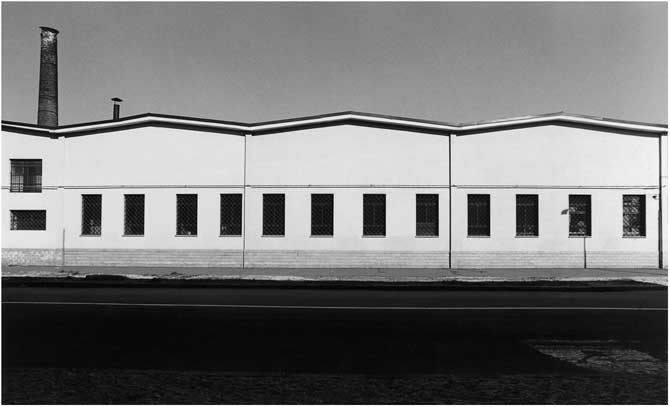
Basilico’s prolific documentation of the Italian landscape, especially its urban fabric, started early on in his career whilst he was still finishing his degree in architecture. In 1978–1980 he completed his career-launching solo project Milano. Ritratti di fabbriche, depicting the disused factory spaces located on the city’s outskirts (Fig. 1). From that point on he dedicated his practice almost exclusively to depicting the built and natural environment both in Italy and abroad. Basilico’s choice to devote himself to this subject also coincided with an increase in institutional support of photography commissions, funded by Italian government committees, civic bodies, private entities, and museums; the influx of this funding was no doubt a result of the turn to landscape photography, but it did also encourage its persistence.Footnote 7 As a result, Basilico was repeatedly commissioned throughout his career to contribute works to such projects.
Gabriele Basilico, Milano. Ritratti di fabbriche, 1978–1980.

For example, after photographing Milan’s defunct factory spaces at the end of the 1970s, a project which was itself partially supported by Milan’s mayor at the time, Basilico took part in his first group public commission on the Italian landscape, Napoli, città di mare con porto (1982).Footnote 8 Throughout the 1980s, Basilico continued to photograph Italy’s changing landscape (with an emphasis on urban areas) in addition to his international projects. His commissions included projects such as Trasimeno, percorsi e visioni on the lake region outside of Perugia completed in 1987 and Esplorazioni di fabbriche: Percorsi nell’archeologia industriale di Biella in 1989, which documented the industrial areas of that northern Italian city (Tagliasacchi 1987). In the 1990s, commissions from Italian civic governments continued to abound. For example, Basilico repeatedly worked on Archivio dello spazio, a key example of a local-government-led initiative organised by the Province of Milan from 1987 to 1997, which was set up to photographically mark the passage of the province from an industrial to a post-industrial landscape (Sacconi, Valtorta 1997). In 1996 Basilico collaborated with architect Stefano Boeri on Italia. Sezioni di paesaggio, a project conceived for the sixth Venice Architecture Biennale. In 1998 he was commissioned to complete two projects. One was for the Associazione Eva Kant and the Province of Palermo to complete a series of portraits of the city, which were eventually published in the exhibition catalogue Palermo città (1998). For the second he was commissioned by the Bergamo Association of Building Constructors, or ACEB (Associazione Costruttori Edili Bergamo), to photograph the territories of the city of Bergamo and its province on the occasion of the Association’s fiftieth anniversary (ACEB Informa 2002).
In some cases, practitioners themselves organised photography initiatives, such as the seminal exhibition Viaggio in Italia, held in Bari at the Pinacoteca Provinciale in 1984 and organised by fellow master Luigi Ghirri in collaboration with photographers Gianni Leone and Enzo Velati. The exhibition brought together twenty practitioners, all of whom were Italian except for one American and two Frenchmen. Counted among them were all five ‘masters’, including Basilico.Footnote 9 Like the ‘masters’, many of the photographers had been documenting and critically exploring the changing Italian landscape since the mid-1970s.
Viaggio in Italia marked a seminal moment in Italian photographic history, and saw photographers looking more critically at the land rather than seeing it as immaculate, as a site to savour. It was also important for the conceptualisation of the ‘school’, and of Italian landscape photography in general. In the introduction to the exhibition catalogue, Quintavalle wrote that the photographs represent a kind of manifesto for a type of photography that rejects the postcard landscape and instead seeks to reflect on the image itself. He stated that the aim was to conduct ‘research on the Italy of margins, ambiguity; the finished, two-faced, an essentially excluded Italy […] the only one that we can consider in direct rapport with our own disassociated existence’ (Ghirri, Leoni and Velati Reference Ghirri, Leone and Velati1984, 10–11). The Italian practitioners navigated their nation’s topography in search of factory spaces, disused zones, highways, urban sprawl, the effects of land speculation, tourism, urban degradation, and failures in urban planning and architecture. The exhibition’s title, Viaggio in Italia, makes ironic use of this shared desire, employing the word viaggio or ‘journey’ to simultaneously conjure up and subvert the notion of the Grand Tour.
The exhibition also constituted a protest against not only what was happening to the nation’s landscape, but also the marginalisation of photography within wider Italian visual culture. When asked about the inherent problems confronted by landscape photographers in Italy, Ghirri remarked: ‘Italian photography doesn’t have a photographic tradition to begin with; in the images of Italy, its iconography is pictorial, it’s the idea of a place that contains art; it is about a consolidated iconography, difficult to modify’ (Belpoliti Reference Belpoliti2004, 244–245). Considering Ghirri and Quintavalle’s words on the motives behind the exhibition cited above, it would seem that deep-rooted questions about identity are embedded within the work of the so-called ‘school’ of landscape photography. This crisis in identity is evidenced in Ghirri’s remarks in his writing about the irony of being on a train journey through Italy and noticing the juxtaposition of an advertisement photograph of the beautiful rolling Tuscan hills and the stark reality of the Italian landscape he saw outside the window – the representation was at odds with the reality (Costantini and Chiaramonte Reference Costantini and Chiaramonte1997, 17).
All of the images included in Viaggio in Italia explore the nation’s fragmented landscape. A visual comparison between selected works by two participants in the show, Basilico and Ghirri, gives a sense of the sort of work exhibited, and highlights the contrasting modes of practice among the disparate group of Italian landscape photographers. Originally from the Emilia Romagna region, Ghirri trained as a surveyor, a qualification that at the time in Italy was obtained at a specialist high school. Similar to Basilico, Ghirri worked on commission from civic and state institutions. In the 1980s, the tourism board of Naples also commissioned his work, and abroad he was commissioned by the French Ministry of Culture to take photographs of Versailles. He also completed commercial photography work, which included services for the luxury goods brand Bulgari and sports car manufacturer Ferrari. In addition, Ghirri’s work for Paesaggio italiano, carried out between 1980 to 1992, shows, to varying degrees, a similar urge traced in Basilico’s work to research and survey his surroundings. Ghirri’s career was cut short by his untimely death in 1992.
Similar to Basilico’s work, Ghirri’s often does not include people; when it does, faces are usually not discernible, or the figures are shown from behind. Ghirri’s photography often relies on visual puns, as in one of his now well-known images from the Viaggio in Italia exhibition, Alpe di Siusi (1979).Footnote 10 The viewer is at once engaged with and estranged from the scene, as a couple walks hand-in-hand through a picturesque Alpine heath towards a row of silvery grey mountains set against a clear-blue sky. This seemingly flawless setting can be likened to an artificial backdrop, and is doubtless an ironic reference to the notion of Bel Paese.
Ghirri was much more influenced by conceptual art than Basilico. His photography for the series Paesaggi di cartone, produced between 1971 and 1974, and his most notable work, Atlante (Atlas) (1973), merge conceptual undertones with observation, similar to some of the New Topographics photographers. Atlante, a series of 36 thumbnail photographs of an atlas, takes the viewer on a conceptual journey through time and space, traversing the globe via mountains, oceans, cities, towns, pyramids, and even the stars and the sun. Ghirri’s work raises profound questions about the nature of the world and the way it is represented.
Basilico’s contribution included selections from his project Milan. Ritratti di fabbriche, such as the photograph Gasometri (1979).Footnote 11 In this unpeopled scene, three gas holders populate the picture plane. Electrical cables draw horizontal lines across the cloudy sky and bisect the lattice-like iron frames of the cylindrical reservoirs. A textured stone wall creates a strong horizontal border between the three circular forms and the street in front. In contrast to Ghirri, Basilico’s visual language seems less suggestive and more straightforward, rooted in the practice of documentary photography and closer to the conventions of landscape and architectural photography. Composition in Basilico’s photographs is defined by the geometric boundary of urban space, and his gaze is ruled by perpendicular, parallel, or intersecting lines and perspectives created by streets, buildings, and the landscape. Basilico’s photography is a meditation on the artefacts and vestiges of Milan’s industrial identity just at the moment when it was in the process of becoming (or had in some cases already become) defunct. Whereas Ghirri’s work is spontaneous and infused with a sense of wit, this approach is not essential to Basilico’s visual language.Footnote 12 Basilico’s gaze unites technical skill with empathy, and does not, as Ghirri’s work does, exist between two worlds (Pelizzari Reference Pelizzari2013, n.p.).
In order to further explore Basilico’s work and his particular way of probing the traditional image of Italy’s landscape as a land of many pleasures, it is interesting to consider the foreign influences on Basilico and the ‘masters’ of the so-called ‘school of landscape’ mentioned earlier, specifically the 1975 New Topographics exhibition. This US exhibition, which also brought together a disparate group of photographers, set into dialogue issues surrounding architecture and urban planning, resulting in a reassessment of the medium of photography in post-modernist discourse. The show included works by US photographers Lewis Baltz, Robert Adams, Joe Deal, Henry Wessel, Jr., Frank Gohlke, Nicholas Nixon, John Schott, and Stephen Shore. Bernd and Hilla Becher were also included, and were the only European practitioners involved in the exhibition. The works displayed in the New Topographics show set a precedent for ‘apparently straightforward’ representations of landscape, ‘drained of emotion and judgment’, marking a watershed moment for the medium of photography by ‘ridiculing long-established definitions of what made photographs artful’.Footnote 13 These works exemplified a shift away from street photography, a mode that had dominated the medium in the US in the 1940s and 1950s. Accordingly, instead of focusing on the human figure in urban space, as street photographers had done in previous decades, the photographers in the exhibition turned their gaze to the desolate built environment. In many respects, Ghirri’s mission with Viaggio in Italia recalled the US exhibition.
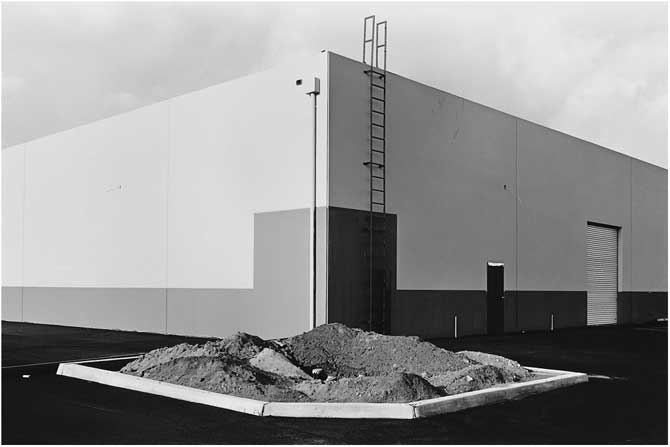
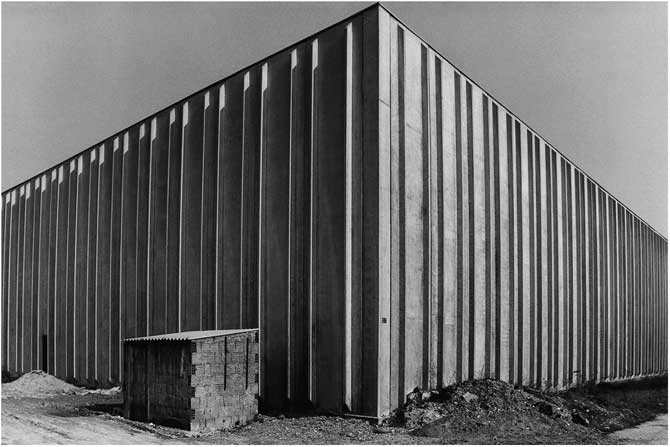
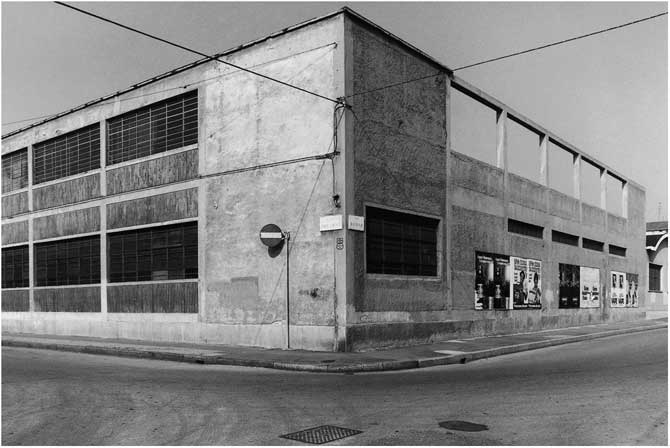
Basilico attested to the importance of the US exhibition, and especially Lewis Baltz’s work, for his own practice. In my interview with Basilico in December 2010, he remarked on Baltz’s clean, graphic images and focus on vernacular architecture, stating that Baltz’s photographs transmitted the ‘notion of historical poverty’.Footnote 14 Basilico was referencing Baltz’s contribution to the New Topographics exhibition, The New Industrial Parks near Irvine, California, which is a series of 51 photographs featuring ‘industrial sites composed of elegant, Bauhaus-style buildings, off-street parking, hidden loading docks, sidewalks and landscaping – everything belonging to an apartment complex except the people’ (Rian Reference Rian2001, 30). Although Baltz’s images of industrial parks belong within the tradition of nineteenth-century US landscape photography, his images are more directly indebted to the repetitive imagery and serial representational strategies of conceptual art. Basilico’s avowed interest in Baltz’s visual language is evident in a few photographs from Milano. Ritratti di fabbriche. The framing of the Milanese industrial structures in these examples echoes Baltz’s formal arrangement of the Irvine California buildings, as the sharp corner of a building is given the privilege of centrality, and emphatic linear planes are created by the focus on this dramatic angle (Fig. 2, Fig. 3, and Fig. 4).
Lewis Baltz, Southeast corner, Semicoa, 333 McCormick, Costa Mesa, 1974. The New Industrial Parks near Irvine, California. Copyright © Successors of Lewis Baltz. Used by permission. Courtesy Galerie Thomas Zander, Cologne.

Gabriele Basilico, Milano. Ritratti di fabbriche, 1978–1980.

Gabriele Basilico, Milano. Ritratti di fabbriche, 1978–1980.

Although Basilico’s words and this visual comparison demonstrate an appreciation for Baltz’s formal language, the Italian photographer’s mission did not adopt the same challenging position towards the alteration of the landscape. Baltz, like fellow New Topographics photographer Robert Adams, took a critical stance towards the influence of mass culture on the American landscape. Baltz once commented: ‘As you can clearly see from the photographs I made, I thought it was a nightmare’ (Pfeifer Reference Pfeifer2011, 67). Baltz’s work can be read as activist photography in which he sought to uncover the despoiling consequences of American industrial progress.
Basilico’s stance towards the Milanese peripheries he photographed was less charged.Footnote 15 His use of black and white stabilises the varied compositional elements that comprise the depreciated scenes, and evokes a sense of reassurance. Compositional balance and resolute formalism underscore these images. Where present, the commentary inherent in these photographs is neither incisive nor ironic, unlike Baltz’s visual commentary on the devastating consequences of industrial progress in the US. Basilico’s urban vision registers acceptance and possibility. Unlike Baltz’s sociological gaze on the urbanisation of his native Southern California, Basilico approached the landscapes that he photographed like a doctor examining a patient, uniting technical and diagnostic skill with empathy. Fascination with the places visited as well as interest in the curiosities and idiosyncrasies underscore Basilico’s work.
Gabriele Basilico and how an image becomes an icon
Basilico’s photographs, which derive from the impulse to counter the iconic image of the Italian landscape, acquired a certain cultural significance in Italy. The Basilico aesthetic is strong and commanding, and he developed it over his career in the form of high-profile commissions, exhibitions, and publications, especially within Italy. It would seem, therefore, that this aesthetic lent itself to the demands of projects that generally involved large-scale, monumental, seemingly objective, and eloquently composed urban views. In addition, when Basilico’s photographs are considered as framed within a traditional documentary project, like those in which they are set, it is clear that there is an element of neutrality inherent in them. By aestheticising the complexities and ambiguities of Italy’s contemporary landscape, the Basilico image is in some cases used to transmit visual, artistic, and metaphysical content.
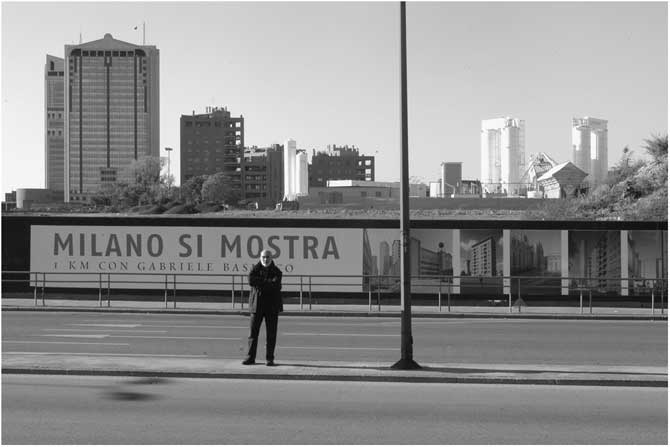
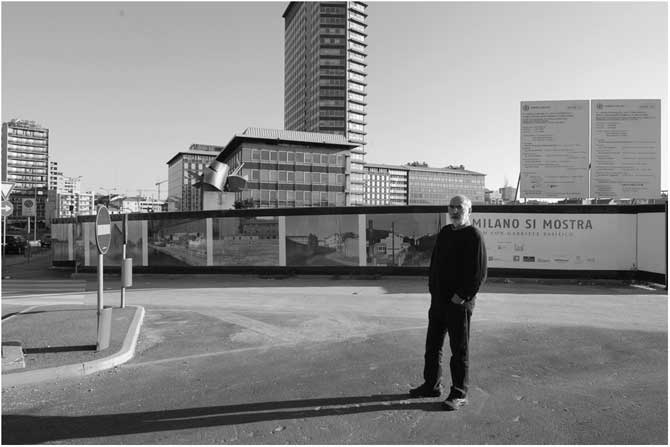
Nowhere is this more evident than in the case of Milan, Basilico’s hometown. The city, its regional body the Province of Lombardy, and its private institutions, were all long-standing supporters of Basilico’s work. Following the initial encouragement of the mayor’s office, which asked him to publish a photobook of the project on the Milanese factory spaces in 1982, and with his engagement in similar civic projects, such as Archivio dello Spazio, throughout the 1990s and 2000s, Basilico repeatedly photographed the city. One prime example of this icon-making is the outdoor exhibition Milano si mostra: 1 Km con Gabriele Basilico, held from October 2007 to January 2008. The display for this outdoor exhibition ran a course measuring one kilometre around the periphery of a building site in the Porta Nuova area of Milan. At the time, this urban zone, which comprised Via Melchiorre Gioia and Viale della Liberazione up to Via Sturzo and Largo De Benedetti, was undergoing tremendous transformation. Affixed to the temporary construction site’s barrier walls were enlargements of a selection of Basilico’s black-and-white photographs of Milan taken throughout his career. Basilico and the exhibition curator, Andrea Lissoni, selected each of the 150 images on display (Fig. 5 and Fig. 6). They represented work carried out on the city of Milan between 1977 and 1996.
Claudio Sabatino, Milano si Mostra: 1 Km con Gabriele Basilico, installation shot 1, 2007.

Claudio Sabatino, Milano si Mostra: 1 Km con Gabriele Basilico, installation shot 2, 2007.

The project was organised by the Fondazione Catella for the city, with an overall mission to ‘stimulate innovation and Italian creativity’ through development projects in ‘architecture, urban planning, green spaces, public spaces, environmental sustainability, design, and communication’. The Fondazione had invested in the site, and in doing so reclaimed an old soap factory in the area, turning it into a cultural centre (Bozzo Reference Bozzo2007). Five of the photographs on display were used as poster images; 25,000 copies of these posters were given away to visitors. An accompanying smaller exhibition of photographs of the Isola neighbourhood, taken by Basilico from 1976–1977, was located on Largo De Benedetti.
The exhibition display contrasted with the reality of the chaotic and busy urban area. Cars swiftly drove around and past the exhibition, through the fickle irregularities of the transitioning Milanese zone. In an article about the exhibition in Corriere della Sera, Basilico stated: ‘It is the first time that I have exhibited my work on the street; my envy for graffiti artists and artists like Keith Haring no longer needs to exist. I anticipate that the photos will be experienced with creativity’ (Bozzo Reference Bozzo2007, 15). The exhibition was in fact experienced creatively, as Basilico had hoped. In many ways, the photographs became part of the urban fabric. One blogger noted that, given the lack of sufficient parking in that area, cars populated any spare space available, including in front of Basilico’s black-and-white enlargements (Fotografia: Parliamone! blog). In this way, Basilico’s exhibition of the city appropriately interacted with one of its identifying features, the tremendous parking problem.
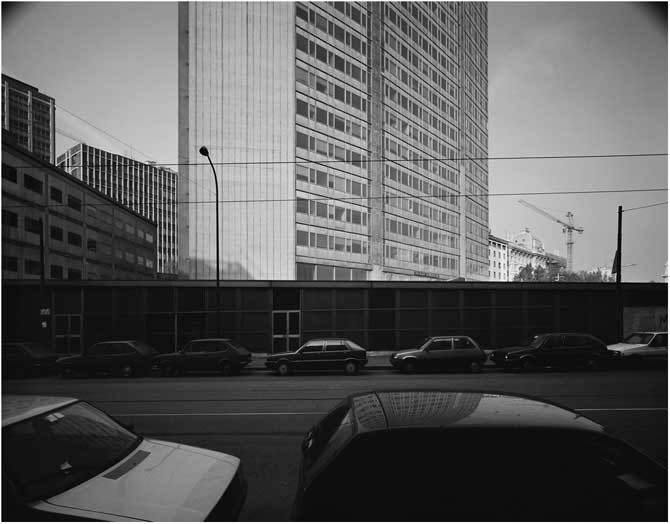
Milano si mostra was praised as both a relaunching of Milan’s civic image and a ‘declaration of love’ for the city (Arealocale website). This response is curious, given that the selection of images recalled some of the most difficult aspects of the city’s recent history. Images such as Gasometri (1979), discussed previously, and other photographs from Milano. Ritratti di fabbriche that captured the defunct, ignored, and even forgotten buildings of Milan’s vibrant industrial past, were displayed alongside photographs from various later commissions, such as Archivio dello spazio, which presented a vision of the city’s fragmented urban identity. Other images from the 1990s are equally as incongruous, such as one image of the Pirelli Tower – a symbol of Milan’s modernist past – in which the compositional choices dispossess the skyscraper of its most symbolic feature, its height, meaning that the tower is rendered almost unrecognisable (Fig. 7). The viewer’s eyes are not drawn to the tower but instead to street level, to the angles and lines made by the streets, and onto the amalgamation of parked cars that line the pavement in the photograph. By picturing the Pirelli Tower from this vantage point, the photograph exemplifies the iconoclasm of Basilico and the cohort of Italian photographers looking at the nation’s landscape. In the context of the exhibition Milano si mostra, however, the photograph seems to transcend its original function and become something symbolic and referential: at once generic and specific, both public and private.
Gabriele Basilico, Milan, Pirelli Tower, 1989.

Considering the selection of images, little notice seems to have been given to the tension between ideological structures that inform the built environment in these pictures. These photographs are not necessarily what one would expect from a promotional, identity-building campaign. They are often reminders of a difficult history or an interrupted civic memory. Given the selection of photographs included, the images could instead be read as representing Milan’s civic identity as schizophrenic or fraught – not necessarily the ‘loving’ portrait that exhibition enthusiasts described.
Furthermore, Basilico’s comment about his ‘envy’ of graffiti artists adds a further problematic element to the concept behind the exhibition. Graffiti art generally involves the illicit act of appropriating public space without consent, normally in order to communicate a social or political message. By reputation, graffiti art is associated with a rebellious subculture. The tension between the Basilico images displayed on the exhibition’s site would certainly make one think that there were some subversive undertones to the exhibition. Yet, judging by the reaction to the show, what could have potentially been a rebellious exhibition instead resulted only in a mildly controversial artistic intervention. Milano si mostra seemed to have potentially had the necessary ingredients for interesting, thoughtful, and perhaps polemical observations about Milan’s civic identity, yet none of this was realised. Instead, the images remained locked in a cycle of generic and referential ambiguity – not unlike many popular icons.
Nevertheless, Basilico’s amalgamation of Milan images seemed to be able to speak to the collective identity of the Milanese. The original documentary function of the photographs, steeped in the problematics of the city’s history and urban fabric, were eclipsed by the desire to make an icon.
Conclusion
In Milano si mostra, Basilico’s photographs of the complexities and difficult history of the city of Milan were used to symbolise the city, and point to particular civic aspirations for the future of its urban renewal. Similar to the way that iconic images are often widely consumed, Basilico’s photographs in Milano si mostra were meant to live in the minds of the city dwellers and reflect their particular view of their own reality. Arguably, the photographs lend themselves to the pictorial privileging that is integral to the creation of an iconic image. Large, panoramic views of city streets and recognisable architecture, framed within a traditional documentary project such as that offered by Basilico’s photographs, could be attractive to those looking for iconic images of a city or region. Raising Basilico’s anti-iconic images of the Italian built and natural environment to the status of icon can, however, be problematic, especially when the original intention or function of the image is transcended, as the Milan si mostra example demonstrates.
Although the idea of an anti-icon icon seems incongruous, it would seem that this contradiction, and perhaps even ambiguity, best describes Basilico’s image-making. Unintentionally symbolic, Basilico’s work highlights the overlooked areas of the nation’s urban and natural environment, and in so doing remains aligned with the aims and trends of the so-called landscape ‘school’. Instead of shattering the icon or making ironic commentary, Basilico’s images reveal the complexity of the nation’s contemporary landscape – they take the shine off the icon without compromising its value.
Acknowledgements
The author would like to thank the anonymous reviewers who commented on an earlier version of this article; Claudio Sabatino and Galerie Thomas Zander for allowing to be reproduced in this article; and the editors of this special edition. A special thankyou goes to Gabriele Basilico’s widow, Giovanna Calvenzi, for her gracious support and for generously providing images for publication.
Notes on contributor
Alexandra Tommasini is a specialist in the study of contemporary Italian photography and completed her PhD, The Patient City: The Work and Practice of Photographer Gabriele Basilico, in 2014 at the Courtauld Institute of Art. She is co-convenor of Ph: The Photography Research Network and co-organised the seminar A Photographer’s Sense of Space: Looking at the Work of Gabriele Basilico held at the University of Westminster (2016). She holds a BA in Art History and Italian (UCLA) and an MA in European Languages and Cultures (University of Exeter). Alexandra works as Bridget Riley’s archivist, cataloguing and researching the artist’s extensive body of work.