Introduction
Upper aero-digestive tract foreign bodies are common ENT emergencies. These foreign bodies can potentially be aspirated or inhaled into the airway, especially in children, or alternatively may be swallowed. History-taking and physical examination remain the hallmarks for assessment of these patients. Plain radiographs are routinely used in the management of upper airway foreign bodies,Reference Walner, Ouanounou, Donnelly and Cotton1 although their usefulness remains debatable.Reference Fleisher and Ludwig2, Reference Silva, Muntz and Clary3
Our hypothesis was that plain radiographs provide a valuable input into the management of patients with non-aspirated, upper aero-digestive tract foreign bodies. This retrospective study was performed in order to assess the value of lateral soft tissue neck X-rays in these patients.
Materials and methods
The radiology department at Dudley Group of Hospitals began using a Siemens Sienet PACS (picture archiving and communications system) in January 2005. Hardcopy films taken before introduction of the PACS were excluded from the study in order to ensure that the viewing methodology of the images would be consistent, and that the standard PACS tools could be used (e.g. magnification).
A list of patients presenting to the emergency Department of Russells Hall Hospital, Dudley, with a diagnosis of upper aero-digestive tract foreign bodies between January 2005 and September 2006 was cross-referenced with the radiology database in order to identify patients who had had lateral soft tissue neck radiographs taken. The medical records of these patients were obtained and data collected. Standard demographic details, symptoms at presentation, outcome and type of foreign body were recorded.
The consensus of two experienced consultant radiologists was taken as the gold standard radiological diagnosis. We also compared the radiological diagnoses made by doctors in the emergency and ENT departments with the gold standard radiological diagnosis.
Results
From January 2005 to September 2006, a total of 62 patients were identified for whom a diagnosis of upper aero-digestive tract foreign body had been made and a lateral soft tissue neck X-ray performed. Their ages ranged from 12 months to 98 years, with a median age of 28 years.
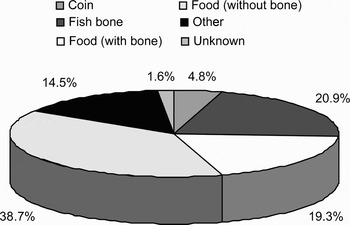
The male to female ratio was 1.1:1. The commonest category of foreign body was food without bone (24 patients; 38.7 per cent). Other categories of foreign body were fish bones (13 patients; 20.9 per cent), food with bone (12; 19.3 per cent), ‘other’ (nine; 14.5 per cent), coins (three; 4.8 per cent) and unknown (one; 1.6 per cent) (see Figure 1). (The category of ‘other’ included a Lego® piece, a piece of glass, a lollipop, a medicine tablet, a denture, a peanut, a needle, a tooth and an earring.)
Types of foreign bodies found.

Twenty-four (38.7 per cent) of the patients had positive findings on lateral soft tissue neck X-rays. Actual foreign bodies were seen in six patients (i.e. food with bone in one patient, food without bone in three, a medicine tablet in one and a denture in one), whilst ‘soft’ signs, such as widened pre-vertebral shadow and loss of lordosis, were seen in all 24 patients.
The total number of radiopaque foreign bodies was 21 (comprising food with bone, coins, glass piece, denture, needle, tooth, earring and medicine tablet). Eight of these patients (38.09 per cent) had normal lateral soft tissue neck X-rays. 13 of these patients (61.9 per cent) had positive lateral soft tissue neck X-rays, with foreign bodies seen in three (14.2 per cent). These included food with bone (one patient), denture (one) and medicine tablet (one). Additionally, soft signs were seen in all 13 patients.
The total number of non-radiopaque foreign bodies was 27 (comprising food without bone, Lego piece, lollipop, medicine tablet and peanut). The X-rays were normal in 19 patients (70.3 per cent). Eight patients (29.6 per cent) had positive lateral soft tissue neck X-rays, and all 27 had soft signs. Additionally, food without bone could be seen as a soft tissue density mass in three of the patients (11.1 per cent).
Thirteen patients presented with fish bones. These can be radiolucent or radiopaque. Three (23 per cent) of these patients had soft signs on their lateral soft tissue neck X-rays, but none of the fish bones were visible as foreign bodies.
The three patients with a history of coin ingestion had normal lateral soft tissue neck X-rays but showed the coin on abdominal X-ray films. Their normal lateral soft tissue neck X-rays meant that no acute ENT intervention was necessary. Similarly, in patients with radiopaque glass piece, needle, denture, tooth and earring, normal lateral soft tissue neck X-rays ruled out the need for acute ENT intervention.
Of the 24 patients with positive X-ray findings, emergency department doctors correctly identified five (20.8 per cent) and ENT doctors eight (33.3 per cent). More importantly, emergency department doctors missed widened pre-vertebral shadows in six patients and foreign bodies in three. Ear, nose and throat department doctors missed widened pre-vertebral shadow in six patients and foreign bodies in four. Four of the 24 patients with radiological signs were actually sent home after initial assessment.
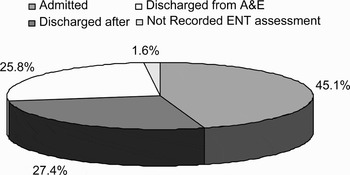
Twenty-eight patients (45.1 per cent) were admitted, 17 (27.4 per cent) were discharged after initial ENT assessment and 16 (25.8 per cent) were discharged from the emergency department (see Figure 2). No details were available for one patient.
Outcome for patients presenting with upper aero-digestive tract foreign bodies. A&E = accident and emergency department

Discussion
Lateral soft tissue neck X-rays were considered useful in all 21 patients with radiopaque foreign bodies, including those with negative X-rays, as no acute ENT intervention would be necessary for those patients. For non-radiopaque foreign bodies, only positive lateral soft tissue neck X-rays (eight cases) were considered useful, as negative X-rays could not completely rule out the presence of a foreign body. In total, lateral soft tissue neck X-rays were considered useful in the management of 32 patients (51.6 per cent). These include the three patients with impacted fish bones and positive X-rays.
Lateral soft tissue neck X-rays represent a quick, relatively low radiation dosage and low cost radiological modality which, if interpreted in an accurate and timely manner, can be invaluable in the management of patients with upper aero-digestive tract foreign bodies. Unfortunately, the high number of positive findings missed by junior doctors meant that this potential usefulness was not fully realised at the time the X-rays were taken.
Knowledge of normal radiographic anatomy is essential. Assessment of lateral soft tissue neck X-rays should include looking at the pharyngo-laryngo-oesophageal structure itself as well as at adjacent soft tissue structures.
However, in this study, lateral soft tissue neck X-rays were not always useful. Five patients with absolute dysphagia and with normal X-rays nevertheless required urgent oesophagoscopy and removal of food bolus (two flexible and three rigid). We also found that the severity of symptoms did not correlate well with the presence of X-ray findings. As to be expected, lateral soft tissue neck X-rays should complement and not replace clinical history-taking and examination. Some patients with swallowed fish bones and normal lateral soft tissue neck X-rays were discharged from the emergency department. As fish bones can be radiolucent, an ENT referral and flexible naso-endoscopy would have been recommended.
• Upper aero-digestive tract foreign bodies can be either aspirated or swallowed
• The role of plain radiographs in the management of aspirated foreign bodies has been evaluated, although their usefulness remains debatable
• This study evaluated the usefulness of plain radiographs in the management of swallowed or non-aspirated foreign bodies
• Plain radiographs provided useful information which would have helped in the clinical management of more than half these patients
• The usefulness of plain radiographs was limited by the poor radiology interpretation skills of junior doctors
The role of plain radiographs in patients presenting with upper airway foreign bodies remains debatable. Silva et al. suggested that the routine use of plain radiographs in cases of airway foreign bodies is neither efficient nor cost-effective, quoting a sensitivity and specificity of 73 and 45 per cent, respectively.Reference Silva, Muntz and Clary3 However, Walner et al. found that antero-posterior and lateral radiographs had a high sensitivity (100 per cent) and specificity (100 per cent) for airway foreign bodies, when compared with bronchoscopic findings.Reference Walner, Ouanounou, Donnelly and Cotton1 Esclamado and Richardson found that 12 of 13 patients with laryngotracheal foreign bodies had abnormal findings on postero-anterior and lateral cervical airway radiographs.Reference Esclamado and Richardson4 Halvorson et al. found that five out of seven patients with a subglottic foreign body had a positive cervical airway film.Reference Halvorson, Merritt, Mann and Porubsky5
In many hospitals, lateral soft tissue neck X-rays are routinely ordered for patients with upper aero-digestive tract foreign bodies, regardless of whether the foreign bodies are thought to have been aspirated or swallowed. Our study is the first, as far as we are aware, to evaluate the value of these X-rays in patients with non-aspirated foreign bodies.
Conclusion
In our study, lateral soft tissue neck X-rays provided useful information which would have helped in the clinical management of more than half the patients with non-aspirated, upper aero-digestive tract foreign bodies. However, this usefulness is dependent on the timely and accurate interpretation of these X-rays. The ability of non-radiologists in interpreting these X-rays was suboptimal and better training is needed, as consultant radiologists are not always available.
Acknowledgements
We sincerely thank Dr Ruth Shave (Consultant Radiologist) for her help with X-ray reporting, and Simon Tovey (PACS manager) for his support throughout this project.