THE PROBLEM
There is emerging global recognition of the significant contribution mental health problems make to disease burden, and mental illness likely constitutes a large proportion of the burden of disease in Zambia. According to the Mental Health and Poverty Project (MHaPP) Country Report (10), approximately 2,667 patients per 100,000 population are admitted annually to the only tertiary referral psychiatric hospital and other units around the country. It is expected that mental health problems in general will increase, taking into account the extent of predisposing factors like HIV/AIDS, poverty, and unemployment. The expected prevalence is approximately 3 percent for severe mental disorders and 19 percent for mild to moderate disorders (Reference Katontoka7). Currently, there is a lack of mental health services at the primary and secondary care level and mental health services are largely limited to the tertiary care level.
By contrast, mental health has continued to receive inadequate attention. It was not among the twelve priority areas in the National Health development plan and was not provided for in the basic package of services defined by the ministry of Health. In addition, only 0.38% of healthcare funding was directed toward mental illness in 2008 and legislation related to mental health care has not been updated since 1951. The 1951 Act fails to address basic human rights related to the mentally ill (10).
The current system of mental health care is based largely on secondary and tertiary health institutions. Mental health services at the primary healthcare level are either inadequate or lacking due to several factors, the main one being the low level and misdistribution of mental health professionals.
SIZE OF THE PROBLEM
Treatment for mental illness is either lacking or provided in a fragmented manner at the primary healthcare level for an estimated 200,000 people with mental disorders, of an adult population of 5 million in Zambia (10;23;24). It is cause for concern that mental health at the primary care level has been largely overlooked in Zambia (Reference Mayeya, Chazulwa and Mayeya9). It is not one of the top ten priorities and has not been included within the Zambian Basic Health Care Package. Consequently, psychotropic medications are not included in the primary care health kit and are generally unavailable in primary care.
Mental healthcare services are unavailable throughout most parts of the country. There is currently only one mental care specialist in each of the nine provinces while only three psychiatrists are responsible for a population of 12 million (10;24).
Mental health services are mainly hospital based with Chainama Hills Hospital, located in the capital city of Lusaka, as the only third level inpatient, long-term care facility in Zambia. It is supported by a network of psychiatric units in seven provincial general hospitals and three general psychiatric rehabilitation units (11). However, the Mental Health Policy (11) reports that the rehabilitation centers are not funded by the Ministry of Health. Apart from that, they are inadequate, and are located far away from patients. The document further notes that there are scanty mental health services for vulnerable groups such as children, young people, women, single parents, terminally ill, unemployed, prisoners, homeless, widows, divorcees, and those who have been declared redundant.
Although data regarding the burden of mental disorders in Zambia are lacking, some indicators are available. Mayeya et al. (Reference Mayeya, Chazulwa and Mayeya9) for example found a prevalence rate based on hospital figures of 36 and 18 per 100,000 population for acute psychotic states and schizophrenia, respectively, with alcohol and drug misuse cases accounting for 10 percent of acute psychotic states. This prevalence is slightly higher than expected, which when measured by years lived with disability and years lost as a result of premature death in disability-adjusted life-years, accounted for 13 percent of the global disease burden in 2002 (25). However, both the global and the Zambian prevalence do not capture other types of burden associated with mental disorders, including the burden of care giving for family members, financial costs, stigma, and human rights violations (Reference Prince, Patel and Saxena20). Furthermore, the burden of mental disorders is likely to have been underestimated because of inadequate appreciation of the connectedness between mental illness and other health conditions (26).
According to the Mental Health and Poverty Project (10), approximately 2,667 patients per 100,000 population are admitted to Chainama and psychiatric units around the country. The total number of beds at Chainama is 210. Primary healthcare units (health centers) form the first level in terms of the structure of healthcare provision. They are expected to refer complex cases to district hospitals (second level) and the district hospitals are expected to refer to third level (tertiary) hospitals. However, neither health centers nor district hospitals have mental health plans. Both are fragmented and uncoordinated in their provision of mental health services (11;12).
Mental healthcare providers at the primary care level are generally clinical officers who have undergone 3 years of training. They are able and allowed to diagnose mental illness, but are not allowed by law to provide prescriptions for psychotropic drugs. Meanwhile, medical officers are generally not available at the primary care level, especially so in rural areas. Training of nurses and general practitioners about mental illness is limited. This may be attributed to the lack of knowledgeable trainers for mental illness and care (10). Generally, research in mental health in Zambia is scarce, with no research, apart from the MHaPP project, having been conducted on issues around integration of mental health within primary health care (10;12;23).
FACTORS UNDERLYING THE PROBLEM
Key factors underlying the failure to integrate mental health into primary care include legislative challenges, inadequate financing, and an inadequate mental health information system, among others.
Legislative Challenges
Legislation related to mental health care in Zambia is an appendage of a colonial legacy. Created in 1951, the policy discusses how the general population needs to be protected from the mentally ill but fails to address basic human rights related to those living with mental illness (10). It does not recognize nor provide for the protection of the human rights of mentally ill patients or the involvement of communities in the provision of mental health care. The National Mental Health Bill, which will repeal the Mental Health Ordinance of 1951, has been in under review for approximately 10 years. The Mental Health Policy which was ratified in 2005 is still based on the Mental Health Ordinance of 1951, and has not been fully implemented due to financial constraints and inadequacy of the mental health legislation. This has perpetuated the slow pace at which integration of mental health services into primary health care is progressing, despite the good intentions of the Ministry of Health's vision of “providing equity of access to quality health care as close to the family as possible.”
Inadequate Financing
As mentioned earlier, only 0.38 percent of healthcare funding is directed toward mental illness (10). The Zambia Mental Health Policy (11) makes it clear that this is insufficient. The Ministry of Health's Annual Action Plan (12) with a total of 756 billion Zambian kwacha (ZMK, some 151 million USD) shows Mental Health as having been allocated only 889 million ZMK (178,000 USD). In comparison, sexually transmitted diseases/HIV were allocated 8.6 billion ZMK (1.7 million USD), while 2.4 billion ZMK (478,000 USD) was allocated for tuberculosis and leprosy activities.
Inadequate Mental Health Information System
The Zambian Ministry of Health collects health information from health facilities in the country through a data capture form that clinicians complete by tallying conditions of patients seen each day. The data capture form has a list of conditions from which clinicians select. However, there are only two categories (psychosis and neurosis) through which mental health problems are captured, leaving all others unrecorded. This has significantly contributed to under reporting of mental health disorders. It has further contributed to patients being referred to the only tertiary level hospital without being treated at the primary care level (10). This is done regardless of the distance the patient must travel to the hospital or the cost of transportation.
Contributing Factors
Other factors underlying the need for improving the integration of mental health into primary care can be summarized in relationship to the reasons for integrating mental health into primary health care listed below.
The Burden of Mental Health Problems Is Increasing
Mental health problems are increasing in the Zambian population, mostly arising from the socio-economic difficulties that exist in the country. These include: HIV/AIDS, poverty, and joblessness. With the population of 12 million people, an HIV prevalence of 17 percent and only approximately 400,000 formal jobs, over 68 percent of the population live on 1 US Dollar per day or less (Reference Mweemba, Zeller, Ludwick and Gosnell18;Reference Saxena, Sharan and Saraceno21).
Mental and Physical Problems Are Interlinked
Consistent associations have been reported between physical conditions and mental health problems in both low and high-income countries (Reference Mwape, Sikwese and Kapungwe17). Furthermore, an association has been found between mental health problems and epilepsy (Reference Chisholm, Sekar and Koshore Kumar3;13); pregnancy (13) and HIV/AIDS (Reference Mwape, Sikwese and Kapungwe17). The World Health Organization (WHO) World Report (27) shows that between 11 percent and 63 percent of HIV-positive people in low- and middle-income countries have depression. People with the condition also are prone to anxiety due to the unpredictable nature of AIDS progression. Stress has been reported to impair immunity, and depression is likely to affect adherence to antiretroviral therapy.
Psychotropic Drugs and Respect of Human Rights Are Lacking
As a consequence of not including mental health in the basic healthcare package, psychotropic drugs are not included in the primary care drug kit (10;Reference Petersen19). Furthermore, although the process of integration is slowly commencing, there has not yet been an attempt made to review the basic healthcare package to incorporate mental health. Yet mental health services delivered in primary care minimize stigma and discrimination. They also remove the risk of human rights violation (Reference Chipimo and Fylkesnes2).
Mental Health Services in Primary Care Are Inadequate
While general health services are well catered for in primary care, mental health services are either inadequate or lacking. This may be attributable to several factors including declining human resources for mental health, which has been largely due to low numbers of healthcare providers being trained in mental health, retirement, death due to HIV/AIDS, and migration. As of 2001, Zambia had altogether 132 mental health workers for an estimated population of 12 million people. After the reintroduction of the Registered Mental Health Nursing and the Clinical Medicine Psychiatry programs in 2006, the numbers are slowly increasing.
In addition to being scarce, mental health workers are often misplaced and end up being assigned duties in the provision of general health. For example, none of the mental health workers in the urban clinics within the capital city were providing mental health care because they had been placed outside the mental healthcare system (10).
Evidence shows that mental health services at the primary healthcare level are less expensive than psychiatric hospitals for both patients and government (Reference Mkhize and Molelekoa15;Reference Mohlakoana16). Integrating mental health services that are affordable and cost-effective into primary care can lead to improvements in health seeking behavior that ultimately lead to better health outcomes (14).
POLICY OPTIONS
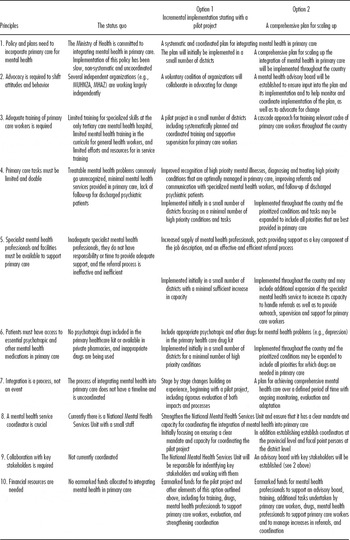
Globally, mental health has been integrated into primary health care across a range of contexts, including difficult economic and political circumstances (Reference Bosch-Capblanch and Garner1;Reference Ducharme, Knudsen and Roman5;Reference Lewin, Munabi-Babigumira and Glenton8). The specific models of integration vary due to differences in socioeconomic situations, healthcare systems, and healthcare resources (Reference Clement, Jarrett, Henderson and Thornicroft4;Reference Grilli, Ramsay and Minozzi6). Generally, success is achieved through leadership, commitment, and clear policies (Reference Chipimo and Fylkesnes2). The two policy options that are discussed here focus on the integration of mental health into primary health care using ten principles for integrating mental health into primary health care, as jointly recommended by WHO and the world organization of primary care doctors’ associations (WONCA) (27). These options represent an incremental approach (10) and a comprehensive approach (Reference Katontoka7). The two options are summarized in Table 1.
Key Characteristics of Two Options for Integrating Mental Health Into Primary Care

ADVANTAGES AND DISADVANTAGES OF THE POLICY OPTIONS
Possible advantages of both options for integrating mental health into primary health care are that they will: (i) Bring mental health services closer to the community in line with the Ministry of Health vision (22). (ii) Help reduce travel costs for the patients and relatives who travel to Chainama hospital to access mental health services. (iii) Reduce stigma and discrimination considering that people with mental health problems will be seen within the same setting as other patients. (iv) Increase the number of patients accessing the mental health services both at primary care and tertiary levels of care.
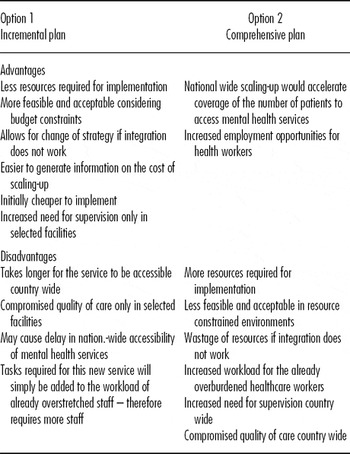
Possible disadvantages of both options for integrating mental health into primary care are that they will: (i) Increase the workload for already overburdened primary health workers. (ii) Compromise quality of care being provided due increase in workload. (iii) Require deployment of more healthcare providers. (iv) Increase the need for supervision. (v) Increase the need for financial resources. (vi) Waste of resources if integration is found not to be feasible. (vii) Reduce the time available for primary care workers to attend to their usual patients. (viii) Table 2 highlights the comparative advantages and disadvantages of the options.
Advantages and Disadvantages of Option 1 Versus Option 2

IMPLEMENTATION CONSIDERATIONS
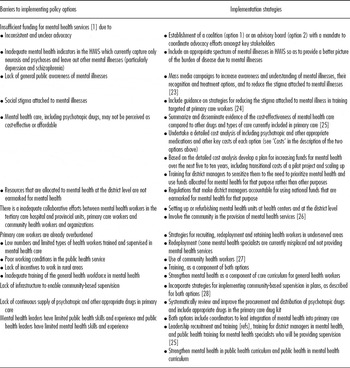
Key barriers to integrating mental health into primary care and implementation strategies for addressing these are summarized in Table 3. The same strategies and barriers are relevant for both options.
Barriers to Implementing the Policy Options and Implementation Strategies

The policy brief was discussed in a policy dialogue involving policy makers from the Ministry of Health, local and international Non-Governmental Organizations, and researchers from various research institutions. The dialogue served as an opportunity for the mentioned participant groups to discuss the policy brief in and systematic and organized manner. This also facilitated refinement of the document by incorporating changes suggested by the participants. Most of the participants expected the policy brief to provide recommendations and the discussion to end with some form of consensus.
However, all the participants, especially the Ministry of Health, who are consumers of the policy brief responded positively to the policy dialogue and evaluated the policy brief and dialogue positively. It was also realized from the policy dialogue and other activities undertaken for Supporting Use of Research Evidence (SURE) that engaging stakeholders from the early stages would facilitate easy uptake of the evidence generated through policy briefs. Policy options were well received though diversity in participants’ opinions was evident. Some participants suggested having both options implemented while others preferred to start small and scale up the integration gradually. Some suggested comprehensive implementation outright. After the policy dialog, a follow-up meeting has been planned with the Ministry of Health to discuss strategies for resource mobilization so that implementation of the suggested options commenced.
CONTACT INFORMATION
Lonia Mwape, BSc, MSc, PhD, Monitoring and Evaluation Fellow-ZAMFOHR, Lecturer: Universuty of Zambia, School of Medicine, Department of Nursing Sciences, P.O. Box 50110, Lusaka, Zambia
Prudencia Mweemba, BSc, MSc, PhD, Head of Department: University of Zambia, School of Medicine, Department of Nursing Sciences, P.O. Box 50110, Lusaka, Zambia
Joseph Kasonde, MD, Executive Director: ZAMFOHR, Ministry of Health, P.O. Box 30205, Lusaka, Zambia
CONFLICTS OF INTEREST
All authors report their institution has received funding from SURE (Supporting Use of Research Evidence) project and the Alliance for Health Policy and Systems Research.