INTRODUCTION
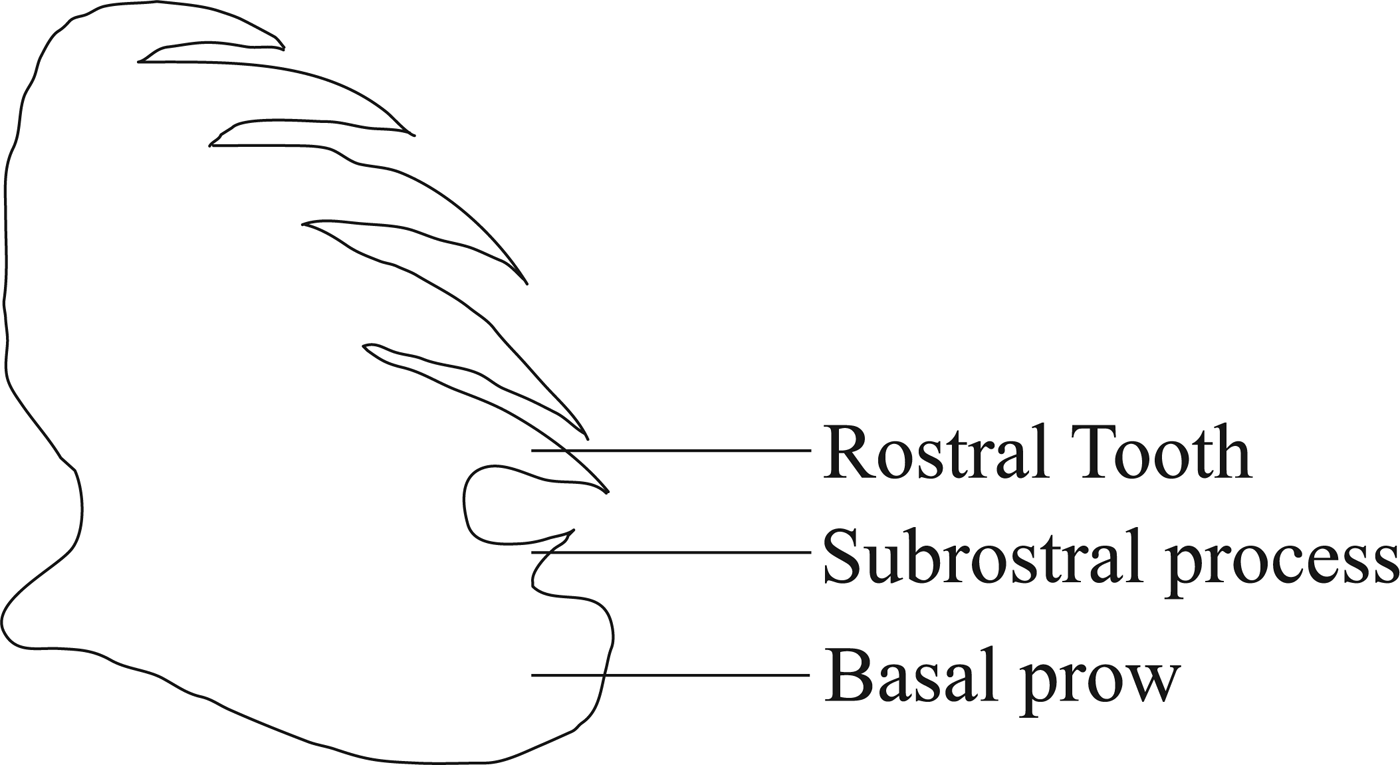
This is the third paper in the series on Ampharetidae from Japan, following the reports on the genus Ampharete Malmgren, Reference Malmgren1866 (Imajima et al., Reference Imajima, Reuscher and Fiege2012) and genera with elevated or modified notopodia (Imajima et al., Reference Imajima, Reuscher and Fiege2013). Amphicteis Grube, Reference Grube1850 is the second largest genus of the family Ampharetidae, exceeded in species numbers only by Ampharete. At the time of this study, Amphicteis contained 27 valid species and three subspecies. The genus Phyllamphicteis Augener, Reference Augener1918 included two species. The genera Paramphicteis Caullery, Reference Caullery1944 and Pseudoamphicteis Hutchings, Reference Hutchings1977 were monotypic. Amphicteis is characterized by a prostomium with paired longitudinal glandular ridges and transverse or oblique nuchal ridges, smooth buccal tentacles, four pairs of cirriform branchiae usually arranged in two transverse rows in segments III and IV, absence of modified notopodia, absence of intermediate uncinigers (as defined in Imajima et al., Reference Imajima, Reuscher and Fiege2012), presence of tuberculate ventral cirri in thoracic notopodia, rudimentary abdominal notopodia, digitiform or cirriform dorsal cirri in abdominal pinnules, filiform anal cirri, and uncini with a subrostral process and teeth arranged in one vertical row (Figure 1). According to Parapar et al. (Reference Parapar, Helgason, Jirkov and Moreira2011) the genus also possesses a pair of nephridial pores between the two groups of branchiae. This character was not observed in this study because we did not use scanning electron microscopy.
Typical uncinus of Amphicteis spp. The nomenclature is in accordance with the suggestions of Holthe (Reference Holthe1986).

Phyllamphicteis can be distinguished from Amphicteis by the presence of foliose branchiae. In the type species, P. collaribranchis Augener, Reference Augener1918, all branchiae carry pinnae on their median face and the first pair is conspicuously enlarged.
We suggest that Pseudoamphicteis is treated as junior synonym of Paramphicteis. The distinction between these two genera based only on the absence or presence of chaetae in segment II seems unwarranted because their size is very variable within the Amphicteis genus complex. We consider their absence as an extreme point in this wide range of development (see also discussions on this issue in Jirkov (Reference Jirkov1994) and Reuscher et al. (Reference Reuscher, Fiege and Wehe2009)).
Jirkov (Reference Jirkov2001, Reference Jirkov2011) suggested that Paramphicteis, Phyllamphicteis and Pseudoamphicteis are junior synonyms of Amphicteis. We consider the presence of pinnate buccal tentacles as sufficient to distinguish Paramphicteis (including Pseudoamphicteis) from Amphicteis. We recommend that Phyllamphicteis is treated as a valid genus because the branchiae are unique within the Amphicteis complex and the shape of its buccal tentacles is unknown.
Additional genera that may belong to the Amphicteis complex but that need further examination to clarify their relationship to the herein described genera include Ecamphicteis Fauchald, Reference Fauchald1972, Hobsonia Banse, Reference Banse1979 and Paiwa Chamberlin, Reference Chamberlin1919.
The species Amphicteis vestis Hartman, Reference Hartman1965 was transferred to the new genus Tanseimaruana Imajima, Reuscher & Fiege, Reference Imajima, Reuscher and Fiege2013 because of the lack of prostomial glandular ridges, the presence of four foliose dorsal lobes in the first abdominal unciniger, and the different shape of uncini. Its sister species Tanseimaruana boninensis Imajima, Reuscher & Fiege, Reference Imajima, Reuscher and Fiege2013 was described in the second paper of this series (Imajima et al., Reference Imajima, Reuscher and Fiege2013).
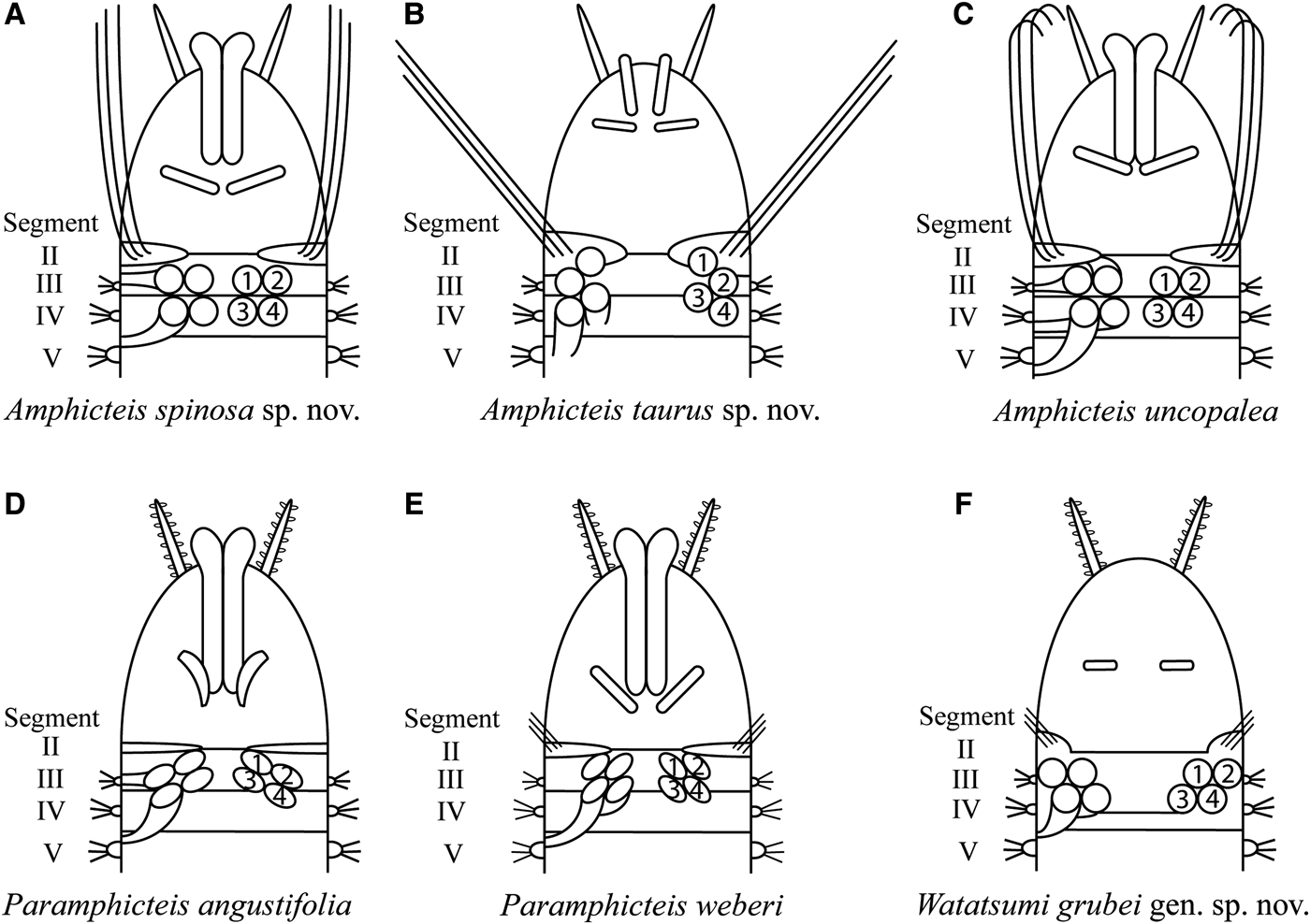
Here we describe another new genus, Watatsumi gen. nov., which is closely related to Amphicteis and Paramphicteis, but lacks the prostomial glandular ridges. In addition, we describe two new species of Amphicteis, A. spinosa sp. nov. and A. taurus sp. nov. Furthermore, A. uncopalea Chamberlin, Reference Chamberlin1919, originally described from the Mexican Pacific and Paramphicteis angustifolia (Grube, Reference Grube1878), originally described from the Philippines, are newly recorded from Japanese waters. Amphicteis uncopalea was recorded for the first time since its original description.
MATERIALS AND METHODS
The specimens examined in this study were collected between 1962 and 2008 from 54 stations including intertidal, subtidal, and the deep-sea around Japan, from Chichijima Island in the south-east and the East China Sea in the south-west to the north-western coast of Honshu and the Chishima Trench off the Hokkaido east coast. Samples were taken using various types of dredges and trawls and sieved on board. Specimens were fixed in 7% formaldehyde-seawater solution and preserved in 70% ethanol. Preserved specimens were examined using stereo and compound microscopes. Drawings were made using a camera lucida.
For some of the species, permanent slides with uncini were prepared. If specimens were small enough to be mounted on a concave slide, uncini were examined without dissection.
The completeness of specimens is indicated in the text as: cs (complete specimen) and af (anterior fragment).
The schematic figures of the anterior ends were prepared in Adobe Illustrator.
Types and other specimens are deposited in the following institutions: National Museum of Nature and Science, Tokyo (NSMT) and Senckenberg Museum Frankfurt (SMF). Full details for the material deposited at Senckenberg can be found at http://sesam.senckenberg.de/.
SYSTEMATICS
AMPHARETIDAE Malmgren, Reference Malmgren1866
AMPHARETINAE Malmgren, Reference Malmgren1866
Amphicteis Grube, Reference Grube1850
TYPE SPECIES
Amphitrite gunneri Sars, Reference Sars1835
SYNONYMS
Crossostoma Gosse, Reference Gosse1855
GENERIC DIAGNOSIS
Prostomium with paired longitudinal glandular ridges and oblique or transverse nuchal ridges. Buccal tentacles smooth. Four pairs of cirriform branchiae. Notochaetae in segment II present and usually developed as strong paleae. Seventeen thoracic chaetigers with capillary chaetae-bearing notopodia from segment III. Notopodia usually with tuberculate ventral cirri. Elevated or modified notopodia absent. Fourteen thoracic uncinigers with uncini-bearing neuropodial tori from segment VI. Tori usually with small dorsal papilla. No intermediate uncinigers. Usually 15 abdominal uncinigers present. Abdominal uncinigers with rudimentary notopodia and uncini-bearing pinnules with dorsal cirri. Usually one pair of anal cirri present, inserted laterally in pygidium. Thoracic and abdominal uncini with single row of teeth above basal prow, rostral tooth and usually subrostral process.
Amphicteis spinosa sp. nov.
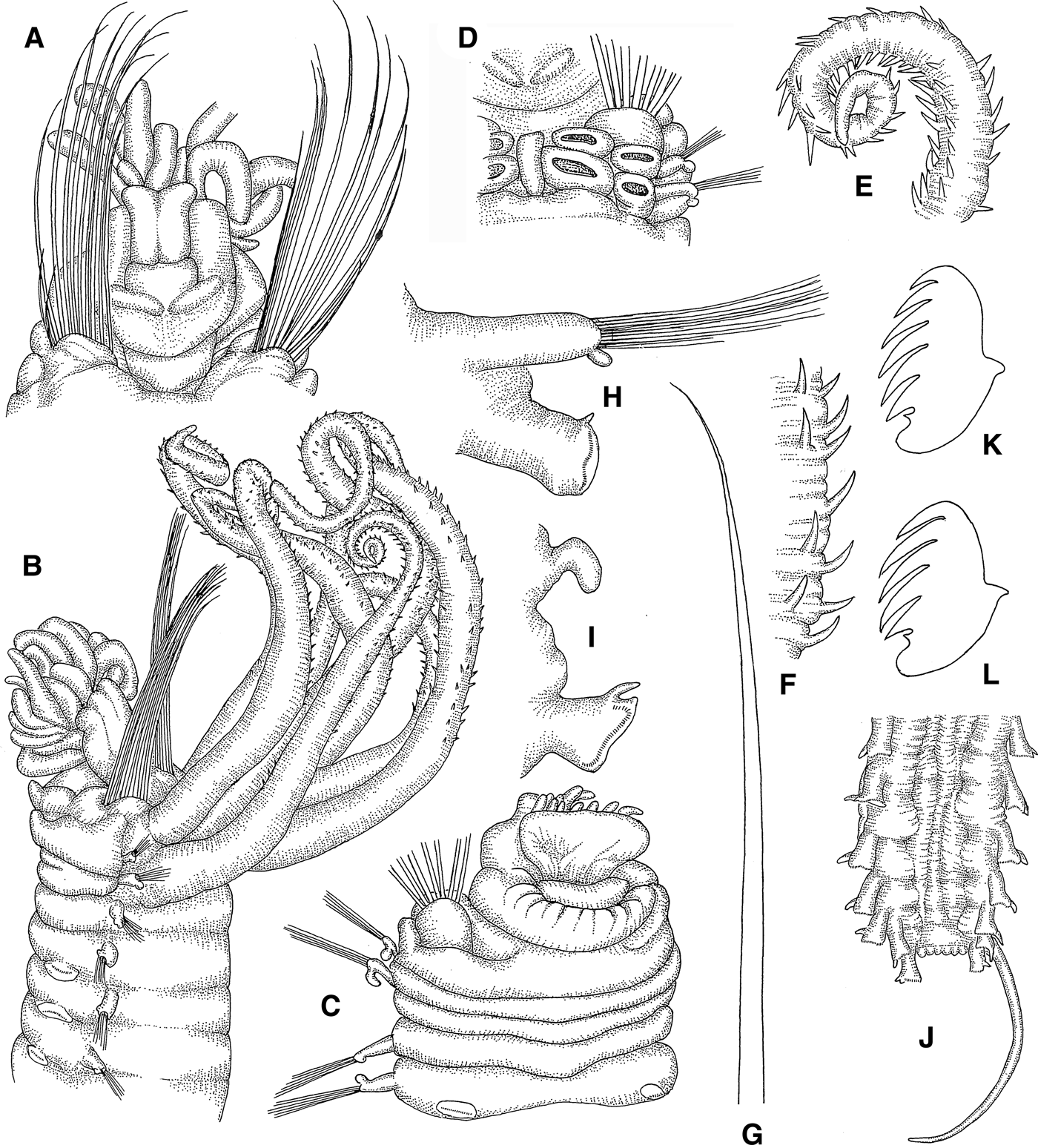
(Figures 2A–L & 8A)
SPECIMENS EXAMINED
Holotype: NSMT-Pol. H 576, off Cape Toi, Miyazaki Prefecture, 31°18.8′N 131°28.0′E, 164 m, RV ‘Toyoshio-maru’, Station 3, 5. 2003 (cs). Paratype: SMF 23916, same locality as holotype (1cs).
DESCRIPTION
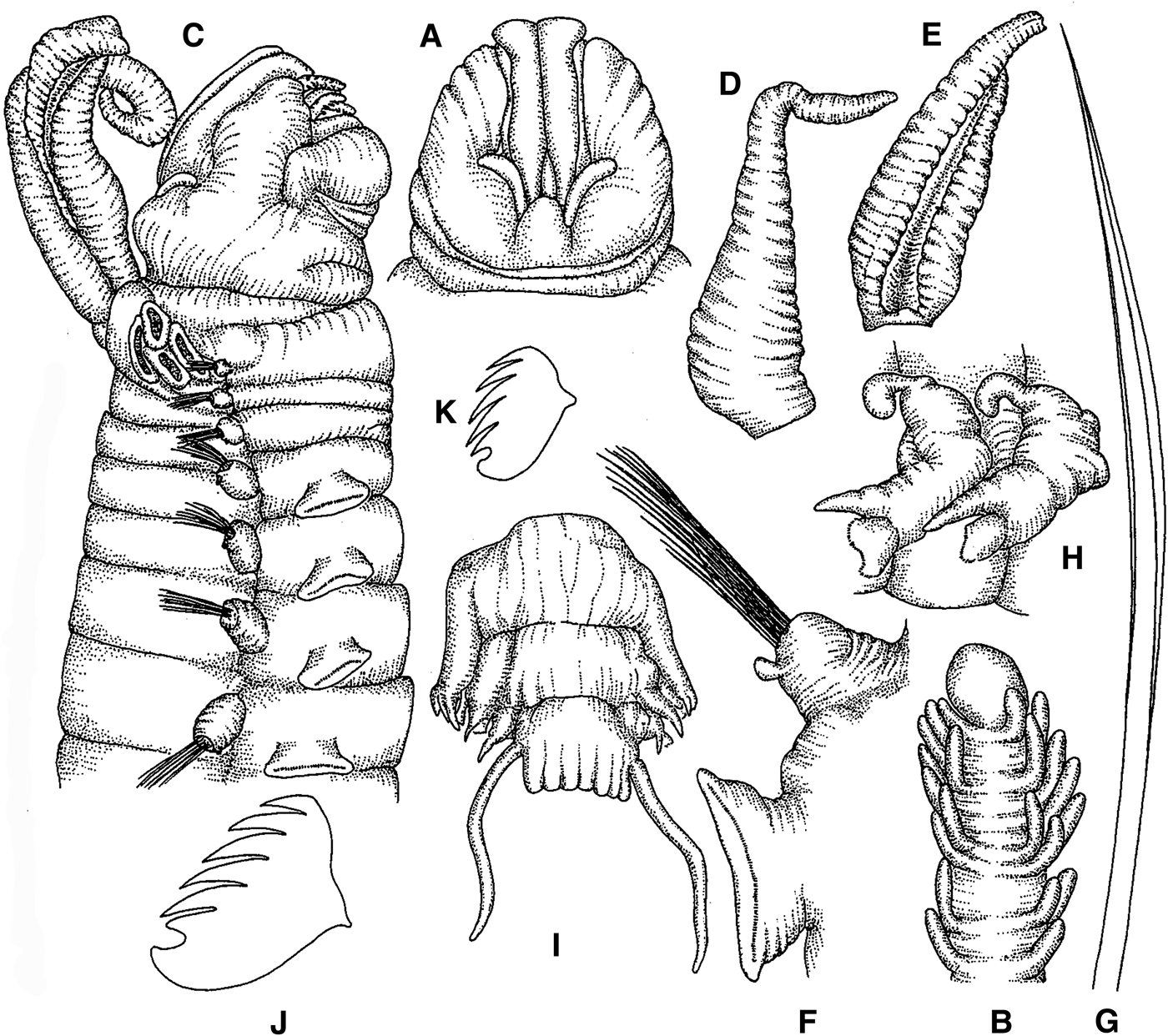
Length 14 mm, width 1.9 mm. Prostomium with paired longitudinal glandular ridges, curving sideways anteriorly; gap between glandular ridges absent (Figure 2A). Paired nuchal ridges straight, separated by small median gap, arranged at wide angle. Eyes absent. Buccal tentacles smooth, without ventral groove (Figure 2A–C). Four pairs of cirriform branchiae in 2 transverse rows in segments III and IV, separated by small median gap (Figure 2D); branchiae basally smooth, with 4 rows of pointed protuberances in apical two-thirds of their lengths (Figure 2B, E, F); innermost branchiae of anterior transverse row originating from segment II, outermost branchiae of anterior transverse row originating from segment III, innermost branchiae of posterior transverse row originating from segment IV, outermost branchiae of posterior transverse row originating from segment V (Figure 8A). Segment II with 10–11 strongly enlarged chaetae on either side (Figure 2A–D), formed as slightly curving and evenly tapering paleae (Figure 2G). Notopodia with capillary chaetae and tuberculate ventral cirrus (Figure 2H) from segment III, present in 17 chaetigers; anterior notopodia small, increasing in size from first to fourth pair (Figure 2B). Neuropodial tori with uncini and small conical dorsal lobe (Figure 2H) from segment VI, present in 14 thoracic uncinigers. Continuous ventral shields present to approximately thoracic unciniger 12. Elevated or modified notopodia absent. Intermediate uncinigers absent. Fifteen abdominal uncinigers with digitiform rudimentary notopodia (Figure 2I). Pinnules with short digitiform dorsal cirrus (Figure 2I). Pygidium with terminal anus and one long, lateral, cirriform anal cirrus on left side (Figure 2J). Thoracic and abdominal uncini with 4–5 teeth in 1 row over basal prow, subrostral process and rostral tooth (Figure 2K, L).
Amphicteis spinosa sp. nov.: (A) prostomium, dorsal view, 15 ×; (B) anterior end, lateral view, 12 ×; (C) anterior end, ventro-lateral view, 14 ×; (D) position of branchiae, dorsal view, 13 ×; (E) tip of branchia, 36 ×; (F) side of branchia, 68 ×; (G) palea, 34 ×; (H) thoracic parapodium, 28 ×; (I) abdominal parapodium, 34 ×; (J) posterior end, ventral view, 15 ×; (K) thoracic uncinus, 465 ×; (L) abdominal uncinus, 485×.
REMARKS
The third branchia of the left group is missing. The posterior thorax of the holotype is poorly preserved. Therefore, it is difficult to exactly determine the last segment with continuous ventral shields. The right anal cirrus is most likely broken off.
The spiny protrusions in the branchiae are unique in the genus Amphicteis. Among the species from the Indo-West Pacific, A. dalmatica Hutchings & Rainer, Reference Hutchings and Rainer1979, and A. philippinarum Grube, Reference Grube1878 also differ from the new species by their short paleae. Amphicteis gunneri malayensis Caullery, Reference Caullery1944 and A. mederi Annenkova, Reference Annenkova1929 differ from A. spinosa sp. nov. by the possession of prostomial eyespots. Amphicteis quadridentata Caullery, Reference Caullery1944 and A. theeli Caullery, Reference Caullery1944 have 16 and 14 abdominal uncinigers, respectively.
ETYMOLOGY
The name refers to the spiny dermal protrusions of the branchial filaments.
DISTRIBUTION
Off Cape Toi, Miyazaki Prefecture, Pacific coast of Kyushu, in 164 m.
Amphicteis taurus sp. nov.
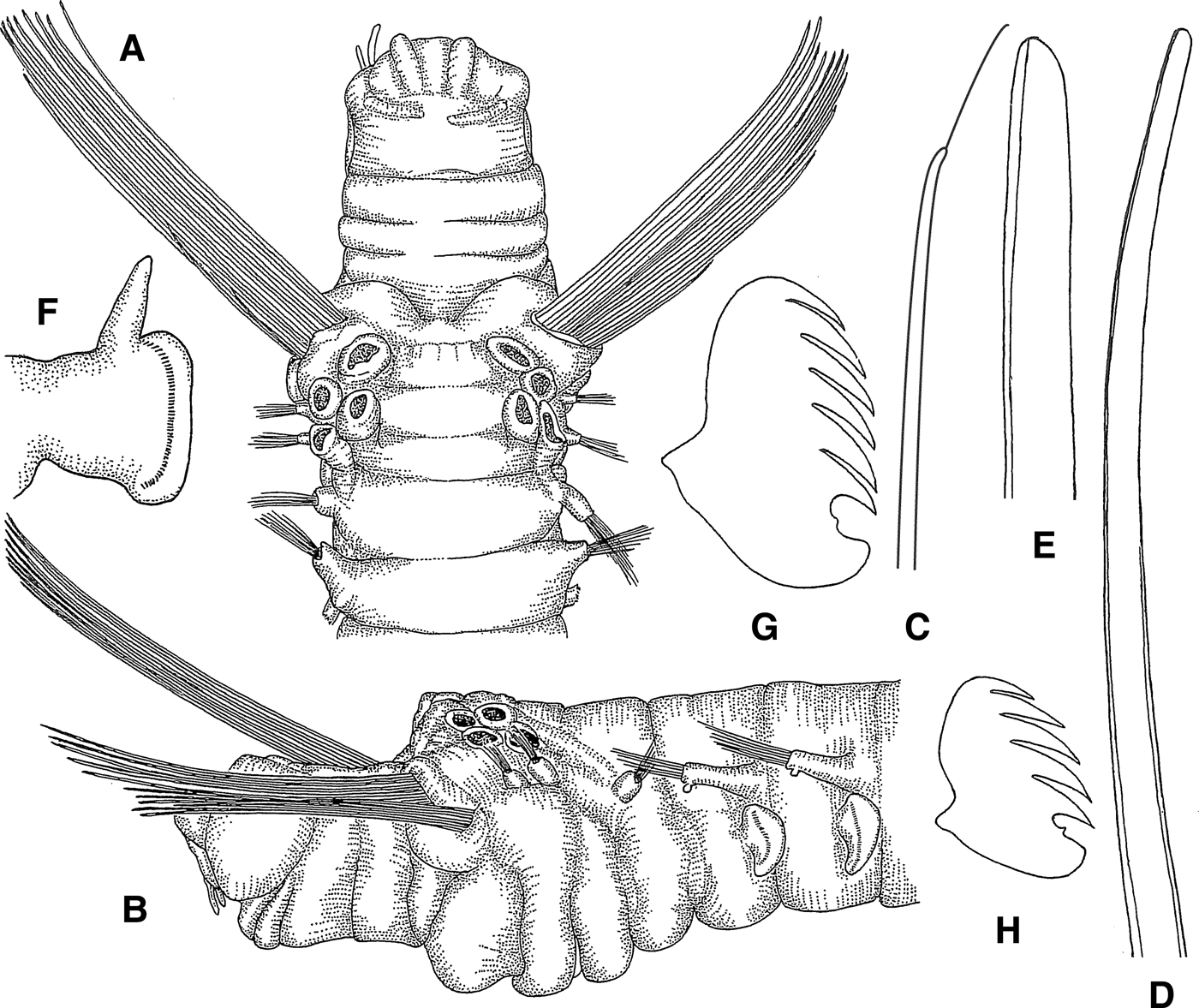
(Figures 3A–H & 8B)
SPECIMENS EXAMINED
Holotype: NSMT-Pol. H 577, Chishima Trench, 41°25.4′N 146°23.5′E – 41°26.6′N 146°22.7′E, 5565–5613 m, RV ‘Hakuho-maru-01-02’, Station XR-10, 9. 2001 (cs). Paratypes: NSMT-Pol. P 578, same locality as holotype (1cs, 5af); SMF 23917, 41°50.1′N 145°37.8′E – 41°49.8′N 145°35.8′E, 5692–5674 m, RV ‘Hakuho-maru-01-02’, Station XR-8, 9. 2001 (1cs).
DESCRIPTION
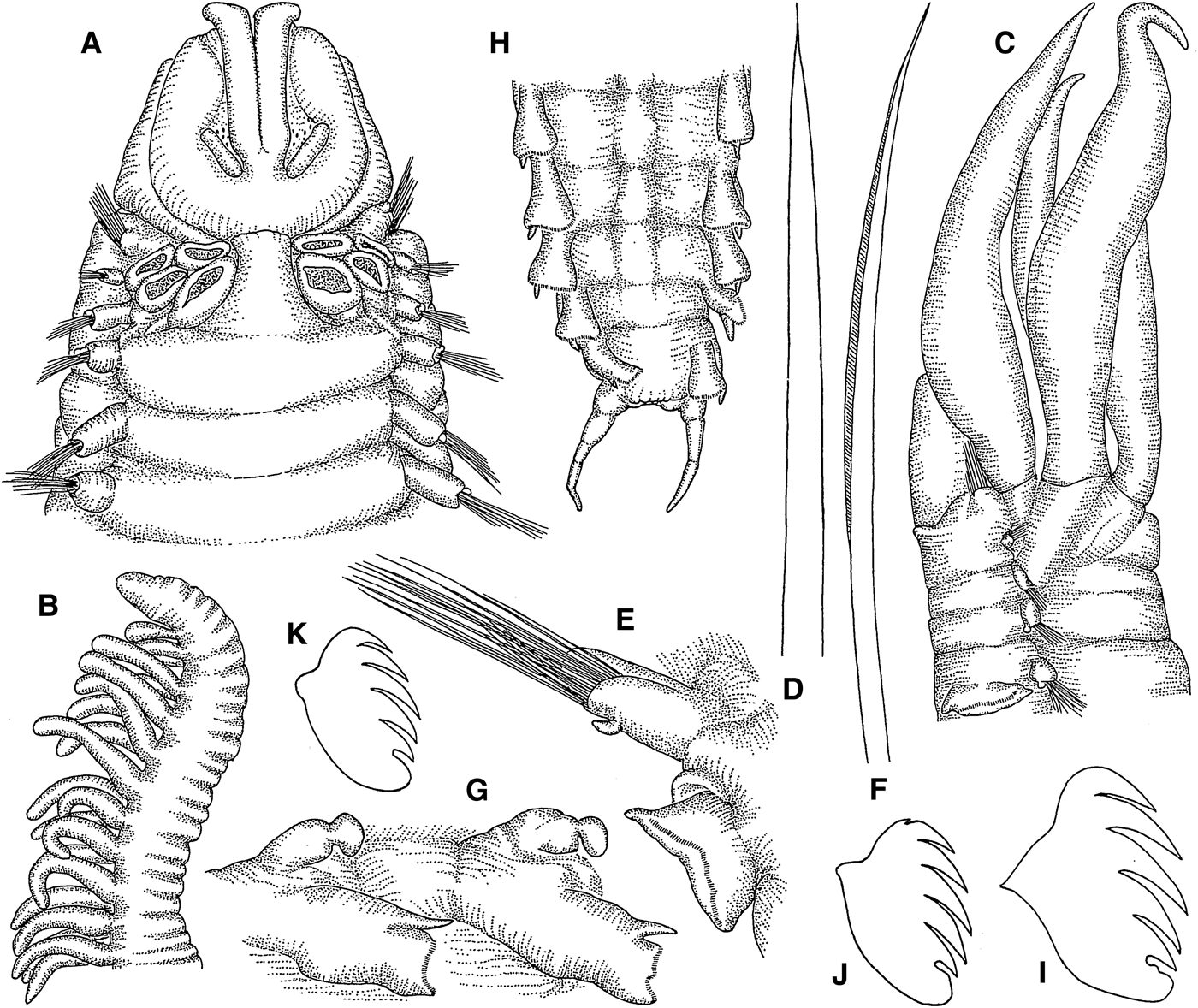
Length 22 mm, width 4 mm. Prostomium with paired longitudinal, straight and approximately parallel glandular ridges, separated by wide median gap. Paired nuchal ridges in transverse line, separated by wide median gap. Eyes absent. Peristomium elongated. Buccal tentacles smooth. Four pairs of branchiae, all broken off, in rhomboid arrangement in segments II to IV, separated by wide median gap (Figure 3A); anterior branchiae originating from segment II, outermost branchiae originating from segment III, innermost branchiae originating from segment IV, posterior branchiae originating from segment V (Figure 8B). Girth of body increasing between peristomium and segment III, decreasing thereafter. Segment II with 12 chaetae on either side (Figure 3A, B); shortest 1–2 chaetae abruptly tapering to arista (Figure 3C), remaining chaetae strongly enlarged and formed as nearly straight paleae with constant thickness over entire length and rounded tips (Figure 3D, E). Notopodia with capillary chaetae and tuberculate ventral cirri from segment III, present in 17 chaetigers; anterior notopodia small, increasing in size from first to third pair (Figure 3A, B). Neuropodial tori with uncini from segment VI (Figure 3B), present in 14 thoracic uncinigers; tori without dorsal cirrus. Last segment of continuous ventral shields indeterminable. Elevated or modified notopodia absent. Intermediate uncinigers absent. Fifteen abdominal uncinigers with digitiform rudimentary notopodia. Pinnules with digitiform dorsal cirrus (Figure 3F). Pygidium with terminal anus, one pair of lateral filiform anal cirri and dorsal row of papillae. Thoracic and abdominal uncini with 4–5 teeth in a single row over basal prow, subrostral process and rostral tooth (Figure 3G, H).
Amphicteis taurus sp. nov.: (A) anterior end, dorsal view, 10 ×; (B) same, lateral view, 10 ×; (C) palea with aristate tip, 47 ×; (D) palea, 96 ×; (E) distal end of paleae, 244 ×; (F) abdominal parapodium, 59 ×; (G) thoracic uncinus, 650 ×; (H) abdominal uncinus, 650×.
REMARKS
Up to 16 paleae have been observed in the paratype specimens. The long and thick, nearly straight paleae and their unusual angle in respect to the body are very characteristic of this new species. In contrast to the longer paleae that do not taper off distally, the youngest paleal chaetae, of which we found 1–3 on each side of most specimens studied, do taper abruptly to a very thin arista. Unique within the genus Amphicteis are also the small prostomial glandular ridges and the wide gap separating them. Other unusual characters of this new species are the long and annulated cephalic region (peristomium and possibly segment I), the arrangement of the nuchal ridges in a nearly transverse line, and the absence of a conical dorsal lobe in thoracic neuropodia.
ETYMOLOGY
The name refers to the bull-like appearance of this new species, caused by the long and sturdy paleae.
DISTRIBUTION
Chishima Trench, North-west Pacific Ocean, in 5565–5692 m.
Amphicteis uncopalea Chamberlin, Reference Chamberlin1919
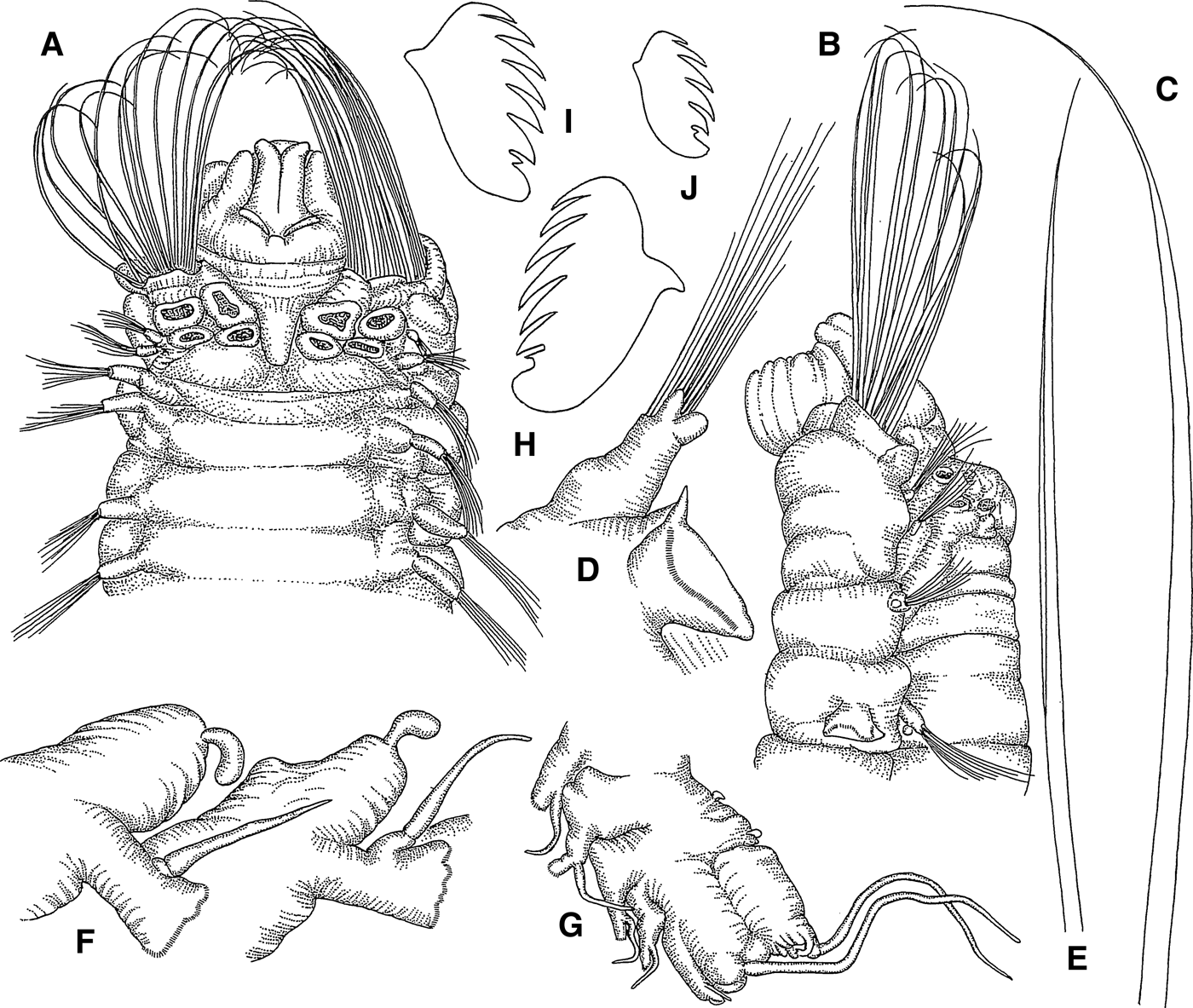
(Figures 4A–J & 8C)
Amphicteis uncopalea Chamberlin, Reference Chamberlin1919, pp. 448–450, pl. 76, figures 5, 6, pl. 77, figure 4.
SPECIMENS EXAMINED
Off Sendai Bay, 38°02.6′N 142°40.9′E, 1398 m, 4.1996 (2cs). Off Kashima-nada, 36°34.9′N 140°55.6′E – 36°35.6′N 140°56.2′E, 120–122 m, KT-79-13, Station KB-13, 8.1979 (2af); 36°09.3′N 140°56.6′E – 36°10.0′N 140°56.1′E, 280–295 m, Station KB-5, 8.1979 (2cs, 1af); 36°09.8′N 141°01.5′E – 36°08.5′N 141°02.5′E, 498–517 m, Station KB-6, 8.1979 (1cs); 36°30.1′N 141°12.5′E – 36°30.8′N 141°13.5′E, 690–705 m, Station KB-10, 8.1979 (4af); Sagami Bay, 35°16.2′N 139°33.0′E, 28 m, 7.1967 (2cs, 1af); 35°16.3′N 139°13.3′E, 24 m, 5.1966 (2cs, 2af); 35°07.7′N 139°32.0′E, 310 m, Station E 22, 8. 1979 (1cs, 4af); 35°09.7′N 139°24.0′E, 570 m, Station E 50, 9.1979 (3cs). Off Hatsushima Island, Sagami Bay, SMF 23915, 35°03.8′N 139°12.2′E – 35°04.8′N 139°12.6′E, 699–754 m, KT-07-31, Station L-1, 11. 2007 (4cs); 35°03.8′N 139°34.4′E – 35°04.1′N 139°34.0′E, 715–728 m, KT-07-31, Station L-2′, 11. 2007 (4cs, 2af). Sagami Sea, 34°54.0′N 139°37.1′E – 34°53.9′N 139°37.0′E, 815–1070 m, KT-66-12, Station 22, 7.1966 (1cs). Suruga Bay, 34°49.3′N 138°32.2′E, 550 m, KT-68-2, Station D-5, 1.1968 (4af); 35°03.9′N 138°48.8′E – 35°03.6′N 138°49.6′E, 123–112 m, KT-73-6, Station A, 6.1973 (1cs, 2af); 34°46.1′N 138°42.4′E – 34°46.8′N 138°42.5′E, 306–317 m, KT-73-6, Station TR-D, 6.1973 (3cs); 35°04.1′N 138°47.3′E – 35°03.9′N 138°47.6′E, 282–211 m, KT-73-6, Station B, 6.1973 (4af); 35°04.0′N 138°47.4′E – 35°04.0′N 138°47.5′E, 252–270 m, KT-73-15, Station B, 10.1973 (3cs); 34°54.4′N 138°43.7′E – 34°53.6′N 138°43.8′E, 355–337 m, KT-74-14, Station B-8, 9.1974 (5cs); 35°03.9′N 138°47.3′E – 35°06.6′N 138°46.6′E, 290–320 m, KT-74-14, Station B-10, 9.1974 (1af); 35°04.0′N 138°47.7′E – 35°03.5′N 138°47.0′E, 260–297 m, KT-75-15, Station B, 11.1975 (3af); 34°55.8′N 138°43.8′E – 34°56.4′N 138°43.8′E, 365–380 m, KT-76-3, Station 003, 2.1976 (1cs, 1af); 34°46.1′N 138°42.7′E – 34°45.8′N 138°42.8′E, 262–290 m, KT-76-3, Station 006, 2.1976 (3cs); 34°47.0′N 138°30.4′E – 34°47.0′N 138°30.3′E, 435–590 m, KT-78-2, Station Z-11, 2.1978 (5cs); 34°49.7′N 138°42.6′E, 375 m, Seishin-maru, Station DG-94-3, 10.1994 (1af); 34°58.3′N 138°45.1′E – 34°58.6′N 138°45.2′E, 247–227 m, Seishin-maru, Station DG 95-14, 10.1995 (2cs, 2af). Tomioka Bay, Amakusa, 32°31.5′N 130°02.2′E, intertidal zone, 10.1963 (2cs). East China Sea, 28°00.0′N 125°21.0′E – 27°57.1′N,125°19.2′E, 105–108 m, Yoko-maru, Station YK 01-C21-30, 11.2001 (3cs, 2af).
ADDITIONAL MATERIAL EXAMINED
Amphicteis obscurior Chamberlin, Reference Chamberlin1919
Type: USNM 19327. Pacific Ocean off Mexico. 16°32′N 99°48′W, 902 m. Bottom of green mud, bottom temperature 4.8°C. 11 April 1891.
Amphicteis orphnius Chamberlin, Reference Chamberlin1919
Type: USNM 19759. Pacific Ocean off Mexico. 16°32′N 99°48′W, 902 m. Bottom of green mud, bottom temperature 4.8°C. 11 April 1891.
Amphicteis uncopalea Chamberlin, Reference Chamberlin1919
Type: USNM 19328. Pacific Ocean off Mexico. 21°15′N 106°23′W, 1236 m. Bottom of grey sand with black specks, bottom temperature 3.3°C. 18 April 1891.
DESCRIPTION
Length 26–38 mm, width 4.0–4.5 mm. Prostomium with paired longitudinal glandular ridges, curving sideways anteriorly; gap between glandular ridges small or absent. Paired nuchal ridges separated by median gap, arranged at wide angle. Eyes absent. Tips of buccal tentacles smooth. Four pairs of branchiae in 2 transverse rows in segments III and IV, separated by median gap of branchial width (Figure 4A); branchiae short, not quite reaching anterior end of prostomium; innermost branchiae of anterior transverse row originating from segment II, outermost branchiae of anterior transverse row originating from segment III, innermost branchiae of posterior transverse row originating from segment IV, outermost branchiae of posterior transverse row originating from segment V (Figure 8C). Segment II with 16–21 strongly enlarged chaetae on either side (Figure 4A, B), formed as long paleae, evenly tapering to slender, curly tips (Figure 4C). Prominent rounded fleshy hump of anterior segment III projecting behind paleae (Figure 4A, B). Notopodia with capillary chaetae and tuberculate ventral cirrus (Figure 4D, E) from segment III, present in 17 chaetigers. Anterior notopodia small, increasing in size from first to fourth pair (Figure 4B). Neuropodial tori with uncini and distinctly offset conical dorsal lobe (Figure 4D) from segment VI, present in 14 thoracic uncinigers. Continuous ventral shields distinct to unciniger 11, faint in unciniger 12. Elevated or modified notopodia absent. Intermediate uncinigers absent. Fifteen abdominal uncinigers with digitiform rudimentary notopodia (Figure 4F). Pinnules with long cirriform dorsal cirrus (Figure 4F, G). Pygidium with terminal anus and one pair of long, lateral, cirriform anal cirri (Figure 4G). Thoracic and abdominal uncini with 4–5 teeth in 1 row over basal prow, subrostral process and rostral tooth (Figure 4H–J).
Amphicteis uncopalea: (A) anterior end, dorsal view, 15 ×; (B) same, lateral view, 13 ×; (C) palea, 44 ×; (D) thoracic notopodium, 27 ×; (E) limbate capillary notochaeta, 70 ×; (F) abdominal parapodia, 27 ×; (G) posterior end, dorso-lateral view, 19 ×; (H) thoracic uncinus, 642 ×; (I) anterior abdominal uncinus, 642 ×; (J) posterior abdominal uncinus, 642×.
REMARKS
The very well developed paleae with curly tips are characteristic for A. uncopalea and have not been described in any other species. We found this type of paleae in the Japanese specimens and the type specimen as well. Prostomium, branchial arrangement, thoracic notopodia and neuropodia of our specimens are also in agreement with the type specimen. The dorsal cirri in the abdominal pinnules are unusually long in the Japanese specimens. Unfortunately, we were not able to confirm their presence in the type specimen because it is missing the last four thoracic uncinigers and the entire abdomen.
We examined A. obscurior and A. orphnius because both species were described from the same general area as A. uncopalea and each of the descriptions lacked information on important diagnostic characters. We consider A. obscurior and A. orphnius to be synonyms. Both types have paleae in segment II that are slightly longer than regular notochaetae, barely reaching the anterior end of the prostomium, nuchal ridges that are arranged in a nearly transverse line and separated by a small median gap, and a small gap between the branchial groups. The type of A. obscurior has 20 paleae on both sides, the type of A. orphnius has only 14 paleae on each side. The difference is probably due to the larger size of the type specimen of A. obscurior. We recommend that A. orphnius is treated as the senior synonym because the type specimen of A. obscurior is broken after thoracic unciniger 7, and the remaining specimen is in poor condition.
We can confirm that A. uncopalea is different from A. obscurior and A. orphnius. Amphicteis uncopalea has much longer paleae with curled tips, a distinct rounded lobe behind the paleae that originates from segment III and dorsal conical lobes in thoracic neuropodia that are more conspicuous. While the holotypes of A. obscurior and A. uncopalea are missing their abdomen, we found long cirri in the abdominal neuropodia of the Japanese specimens that we refer to A. uncopalea. These cirri seem to be missing in the holotype of A. orphnius.
DISTRIBUTION
This species had only been found from the East Pacific deep-sea off Mexico. It is newly recorded from the North-west Pacific, including Sendai Bay to Suruga Bay along the coast of Honshu, Tomioka Bay (Kyushu), and the East China Sea, from the intertidal zone to 1398 m.
Paramphicteis Caullery, Reference Caullery1944
TYPE SPECIES
Sabellides angustifolia Grube, Reference Grube1878
SYNONYMS
Pseudoamphicteis Hutchings, Reference Hutchings1977
GENERIC DIAGNOSIS (EMENDED)
Prostomium with paired longitudinal glandular ridges and oblique or transverse nuchal ridges. Majority of buccal tentacles pinnate, few lateral ones smooth. Four pairs of branchiae; usually at least one pair foliose. Chaetae in segment II, if present, not reaching anterior end of prostomium. Seventeen thoracic chaetigers with capillary notochaetae-bearing notopodia from segment III. Notopodia with tuberculate ventral cirri. Elevated or modified notopodia absent. Fourteen thoracic uncinigers with uncini-bearing neuropodial tori from segment VI. Tori usually with small dorsal papilla. No intermediate uncinigers. Usually 15 abdominal uncinigers present. Abdominal uncinigers with rudimentary notopodia and uncini-bearing pinnules with dorsal cirri. Usually one pair of anal cirri present, inserted laterally in pygidium. Thoracic and abdominal uncini with single row of teeth above basal prow and rostral tooth.
REMARKS
The generic diagnosis was emended to accommodate the species of Paramphicteis and the synonymized genus Pseudoamphicteis, as well as Paramphicteis weberi (Caullery, Reference Caullery1944) comb. nov, transferred from Amphicteis, and Paramphicteis foliata (Haswell, Reference Haswell1883) comb. nov., transferred from Phyllamphicteis.
The buccal tentacles of P. weberi comb. nov. were unknown until now. Below we are describing pinnate buccal tentacles, along with four pairs of foliose branchiae in P. weberi comb. nov. The presence of foliose branchiae in Paramphicteis papillosa (Hutchings, Reference Hutchings1977) comb. nov. has not been observed. According to the original description, the first two pairs are not foliose (Hutchings, Reference Hutchings1977). However, the third and fourth pairs were missing.
Paramphicteis foliata comb. nov. was described with pinnate buccal tentacles. Additionally one pair of branchiae (the third pair, according to the illustration) was described as foliose, but not as pinnate. Therefore, we transferred the species from Phyllamphicteis to Paramphicteis.
The lateral smooth buccal tentacles are slightly shorter and thinner than the median pinnate ones. We consider it likely that they are not a different type, but merely in an earlier stage of development.
Paramphicteis angustifolia (Grube, Reference Grube1878)
(Figures 5A–K & 8D)
Sabellides angustifolia Grube, Reference Grube1878, pp. 206–207, pl. XII, figure 1.
Not Amphicteis angustifolia von Marenzeller, Reference von Marenzeller1884, p. 198, pl. II, figure 5.
Paramphicteis angustifolia: Caullery, Reference Caullery1944, pp. 83–85, figure 67.
SPECIMENS EXAMINED
Iyo-nada, northern Shikoku, 33°26.3′N 131°50.9′E, 67 m, Toyoshio-maru, Station 1, 4.2008 (5cs). South of Nagannu Island, near Okinawa Island, 26°14.8′N 127°31.9′E, 53 m, Toyoshio-maru, Station 12, 3.2003 (1cs). Tomioka Bay, Amakusa, 32°32.0′N 130°03.5′E, 30 m, 12.1962 (2cs).
ADDITIONAL MATERIAL EXAMINED
Phyllamphicteis collaribranchis Augener, Reference Augener1918
Holotype: ZMH V-1644. Atlantic Ocean off Wapoo (Ivory Coast), leg. A. Hupfer.
DESCRIPTION
Length 16–19 mm, width 3.2–3.5 mm. Prostomium with paired longitudinal glandular ridges, not separated by median gap, curving sideways anteriorly. Paired nuchal ridges crescent-shaped, separated by wide median gap (Figure 5A). Eyes absent. Buccal tentacles pinnate, with 2 ventral rows of digitiform filaments (Figure 5B). Four pairs of foliose branchiae (Figure 5C–E), in 2 staggered transverse rows in segments III and IV, separated by small median gap; innermost branchiae of anterior transverse row originating from segment II, outermost branchiae of anterior transverse row originating from segment III, innermost branchiae of posterior transverse row originating from segment IV, outermost branchiae of posterior transverse row originating from segment V (Figure 8D). Segment II without chaetae (Figure 5C). Notopodia with capillary notochaetae and tuberculate ventral cirri (Figure 5F, G) from segment III, present in 17 chaetigers; anterior notopodia small, increasing in size from first to fourth pair (Figure 5C). Neuropodial tori with uncini (Figure 5F) from segment VI, present in 14 thoracic uncinigers; tori without offset dorsal lobe. Continuous ventral shields distinct to thoracic unciniger 11, faint in thoracic unciniger 12. Elevated or modified notopodia absent. Intermediate uncinigers absent. Fifteen abdominal uncinigers with short digitiform rudimentary notopodia (Figure 5H). Pinnules with short digitiform dorsal cirri (Figure 5H). Pygidium crenulated with terminal anus and one pair of lateral cirriform anal cirri (Figure 5I). Thoracic and abdominal uncini with 4–5 teeth in 1 row over basal prow and rostral tooth (Figure 5J, K).
Paramphicteis angustifolia: (A) prostomium, dorsal view, 12 ×; (B) tip of buccal tentacle, 61 ×; (C) anterior end, lateral view, 12 ×; (D) branchia, lateral view, 11 ×; (E) branchia, dorsal view, 11 ×; (F) thoracic parapodium, 23 ×; (G) notochaeta of chaetiger 10, 118 ×; (H) abdominal parapodia, 24 ×; (I) posterior end, dorsal view, 23 ×; (J) thoracic uncinus, 440 ×; (K) abdominal uncinus, 463×.
REMARKS
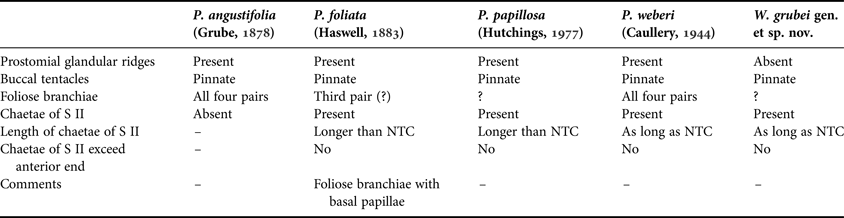
Paramphicteis angustifolia is the only species within the Amphicteis genus complex that has pinnate buccal tentacles and foliose branchiae, but no chaetae in segment II (Table 1).
Distinguishing characters of all Paramphicteis and Watatsumi gen. nov. species. NTC, notochaetae; S II, segment II.
DISTRIBUTION
The species is known from the Philippines (Grube, Reference Grube1878; Caullery, Reference Caullery1944) and Indonesia (Caullery, Reference Caullery1944). Newly recorded from south-western Japan, including Shikoku, Kyushu and Okinawa Islands, in 30–67 m.
von Marenzeller's (Reference von Marenzeller1884) specimens from southern Japan, identified as Amphicteis angustifolia belong most likely to Paramphicteis weberi comb. nov. They were characterized by foliose branchiae, which occur in both species, and the presence of small paleae, which are absent in P. angustifolia but present in P. weberi comb. nov. Therefore, we consider the finding of our specimens a new record from Japan.
Paramphicteis weberi (Caullery, Reference Caullery1944) comb. nov.
(Figures 6A–K & 8E)
Amphicteis angustifolia von Marenzeller, Reference von Marenzeller1884, p. 198, pl. II, figure 5.
Amphicteis weberi Caullery, Reference Caullery1944, pp. 83–85, figure 67.
SPECIMENS EXAMINED
Onagawa Bay, 38°25.5′N 141°29.6′E – 38°25.6′N 141°29.5′E, 37 m, Station 10, 9.1994 (4cs). Sagami Bay, 35°09.1′N 139°35.8′E – 35°09.5′N 139°35.6′E, 44 m, Station 17, 9.1979 (5cs); 35°08.3′N 139°11.1′E – 35°08.4′N 139°11.1′E, 115–120 m, Tachibana-maru, Station 3, 8.2004 (3cs, 2af); 35°07.6′N 139°34.8′E – 35°07.8′N 139°34.7′E, 91–91 m, Rinkai-maru, Station 5, 3.2002 (3af). Suruga Bay, 34°39.5′N 139°01.3′E – 34°39.6′N 139°01.2′E, 126–128 m, KT-02-5, Station 1 ZE-1, 5.2005 (3cs); 34°38.4′N 138°56.3′E – 34°38.5′N 138°56.5′E, 37–39 m, 9.1987 (5cs, 2af); 34°36.9′N 138°57.3′E – 34°36.4′N 138°57.2′E, 80–80 m, 11.1981 (3cs); 34°57.8′N 138°45.5′E, 110 m, 9.1994 (2cs). Tsukumo Bay, Noto Peninsula, 37°18.3′N 137°14.4′E, intertidal zone, 5.1973 (5cs). Iyo-nada, northern Shikoku, 33°26.3′N 131°50.9′E, 67 m, Toyoshio-maru, Station 1, 4.2008 (5cs). Iyo-nada, 33°35.3′N 132°12.4′E, 64 m, Toyoshio-maru, Station 1, 5.2007 (3cs). Sasebo Bay, 33°06.1′N 129°40.9′E, 53 m, 5.1972 (3af). Ariake Sea, 32°59.6′N 130°22.5′E, 10 m, 12.1957 (1cs); 32°48.0′N 130°23.6′E, 30 m, 9.1958 (2af). Off Tsushima Island, 33°49.6′N 129°29.0′E, 100 m, Genkai-maru, Station 8, 7.1968 (3cs); 33°56.3′N 129°30.1′E – 33°56.1′N 129°30.0′E, 95–94 m, Soyo-maru, Station SO 08-D6, 7.2008 (2af). Off Okino-shima, 34°15.1′N 130°15.0′E – 34°15.0′N 130°14.9′E, 100–100 m, Soyo-maru, Station SO 08-D5, 7.2008 (4af); 32°20.2′N 128°46.4′E – 32°20.3′N 128°46.4′E, 185–185 m, Station SO 08-D7, 8.2008 (2cs, 3af). East China Sea, 29°58.6′N 126°29.7′E – 29°58.1′N 126°26.1′E, 90–90 m, Yoko-maru, Station YK 01-C25-20, 11.2001 (4af). Off Cape Ashizuri, Shikoku, 32°45.4′N 132°42.5′E, 99 m, KT-99-18, Station DG-7, 12.1999 (1af). Chichijima, Ogasawara Islands, 27°03.8′N 142°15.4′E – 27°03.7′N 142°15.2′E, 95–98 m, Koyo-maru, Station 21, 10.2008 (3cs).
DESCRIPTION
Length 19–23 mm, width 2.6–3.0 mm. Prostomium with paired longitudinal glandular ridges, curving sideways anteriorly, not separated by median gap. Paired nuchal ridges separated by wide median gap, arranged at right angle to each other (Figure 6A). Eyes absent. Buccal tentacles pinnate, with 2 ventral rows of digitiform filaments (Figure 6B). Four pairs of foliose branchiae (Figure 6C) in 2 staggered transverse rows in segments III and IV, separated by wide median gap (Figure 6A); innermost branchiae of anterior transverse row originating from segment II, outermost branchiae of anterior transverse row originating from segment III, innermost branchiae of posterior transverse row originating from segment IV, outermost branchiae of posterior transverse row originating from segment V (Figure 8E). Paleae of segment II as long as following notochaetae, but slightly thicker (Figure 6D), numbering 6–10 per bundle. Notopodia with capillary notochaetae and tuberculate ventral cirri from segment III (Figure 6E, F), present in 17 chaetigers; anterior notopodia small, increasing in size from first to fourth pair (Figure 6A, C). Neuropodial tori with uncini and conical dorsal lobe from segment VI (Figure 6E), present in 14 thoracic uncinigers. Continuous ventral shields distinct to thoracic unciniger 10, faint in thoracic uncinigers 11 and 12. Elevated or modified notopodia absent. Intermediate uncinigers absent. Fifteen abdominal uncinigers with club-shaped rudimentary notopodia (Figure 6G). Pinnules with digitiform dorsal cirrus (Figure 6G). Pygidium with terminal anus and one pair of lateral cirriform anal cirri (Figure 6H). Thoracic uncini with 4–5 teeth in 1 row over basal prow, small subrostral process and rostral tooth (Figure 6I). Subrostral process in abdominal uncini reduced (Figure 6J, K).
Paramphicteis weberi comb. nov.: (A) anterior end, dorsal view, 16 ×; (B) distal end of buccal tentacle, 15 ×; (C) anterior end, lateral view, 16 ×; (D) palea, 107 ×; (E) thoracic parapodium, 27 ×; (F) limbate notochaeta, 117 ×; (G) abdominal parapodia, 27 ×; (H) posterior end, ventral view, 27 ×; (I) thoracic uncinus, 690 ×; (J) anterior abdominal uncinus, 690 ×; (K) posterior abdominal uncinus, 690×.
REMARKS
The presence of pinnate buccal tentacles in Paramphicteis weberi comb. nov. was formerly unknown because they were withdrawn in Caullery's (Reference Caullery1944) specimens. Because of the presence of pinnate buccal tentacles the species is transferred to Paramphicteis. Only the first two pairs of branchiae of Caullery's specimens were present, whereas the third and fourth pairs were missing. The examination of our specimens proved that all four pairs of branchiae are foliose. The only difference between our specimens and Caullery's is the number of abdominal uncinigers (15 vs 14).
Paramphicteis weberi comb. nov. shares the presence of pinnate buccal tentacles with its congeners P. angustifolia, P. foliata comb. nov. and P. papillosa comb. nov., and the newly described Watatsumi grubei gen. et sp. nov. (Table 1). Paramphicteis weberi comb. nov. differs from the latter species by the presence of prostomial glandular ridges. Furthermore, P. weberi comb. nov. has 4 pairs of foliose branchiae, whereas P. foliata comb. nov. has only 1 pair of foliose branchiae, in addition to 3 pairs of cirriform branchiae. The first 2 pairs of P. papillosa comb. nov. are cirriform (the shape of the other 2 pairs is unknown) and it has 4, rather than 2 anal cirri. P. weberi comb. nov. differs from P. angustifolia by the presence of chaetae in segment II.
DISTRIBUTION
Originally described from Indonesia (Caullery, Reference Caullery1944). Recorded here from Onagawa Bay to Cape Ashizuri, along the coast of Honshu and Shikoku, the coast of Kyushu, off Chichijima Island, Tsukumo Bay in the Sea of Japan, off Tsushima Island in the Korea Strait, and off Okinawa Island in the East China Sea, between the intertidal zone and 185 m.
von Marenzeller's (Reference von Marenzeller1884) specimens from southern Japan, identified as Amphicteis angustifolia, belong most likely to P. weberi comb. nov. (see discussion above).
Watatsumi gen. nov.
TYPE SPECIES
Watatsumi grubei sp. nov.
GENERIC DIAGNOSIS
Prostomium simple, without incisions or glandular ridges, but with transverse nuchal ridges. Majority of buccal tentacles pinnate, few lateral ones smooth. Four pairs of branchiae. Notochaetae in segment II present. Seventeen thoracic chaetigers with capillary chaetae-bearing notopodia from segment III. Notopodia with tuberculate ventral cirri. Elevated or modified notopodia absent. Fourteen thoracic uncinigers with uncini-bearing neuropodial tori from segment VI. Tori without dorsal papilla. No intermediate uncinigers. Fifteen abdominal uncinigers present. Abdominal uncinigers with rudimentary notopodia and uncini-bearing pinnules with dorsal cirri. One pair of anal cirri, inserted laterally in pygidium. Thoracic and abdominal uncini with single row of teeth above basal prow, rostral tooth and subrostral process.
REMARKS
Watatsumi gen. nov. is closely related to Amphicteis and Paramphicteis, sharing number and arrangement of the branchiae, presence of chaetae in segment II, number of thoracic chaetigers and uncinigers, presence of cirri in thoracic notopodia and abdominal neuropodia, presence of rudimentary abdominal notopodia, number of abdominal uncinigers, presence of one pair of anal cirri, and shape of uncini. The main reason for erecting this new genus is the lack of prostomial glandular ridges, an important diagnostic character of the genera Amphicteis and Paramphicteis. The nuchal ridges of the type species are inconspicuous, compared with most Amphicteis and Paramphicteis species. The development of pinnate buccal tentacles is reminiscent of Paramphicteis: the majority of tentacles are pinnate, but few shorter and thinner lateral tentacles lack the digitiform pinnae. It is likely that the smooth tentacles are in an earlier stage of development, in which they have not yet developed pinnae. The shape of the branchiae is unknown.
ETYMOLOGY
The genus is named after Watatsumi, Japanese god of the sea.
Watatsumi grubei sp. nov.
(Figures 7A–I & 8F)
SPECIMENS EXAMINED
Holotype: NSMT-Pol. H 579, off Cape Toi, Miyazaki Prefecture, 31°16.2′N 131°15.9′E – 31°15.9′N,131°33.4′E, 411–383 m, RV ‘Toyoshio-maru’, Station 2, 5. 2007 (cs).
DESCRIPTION
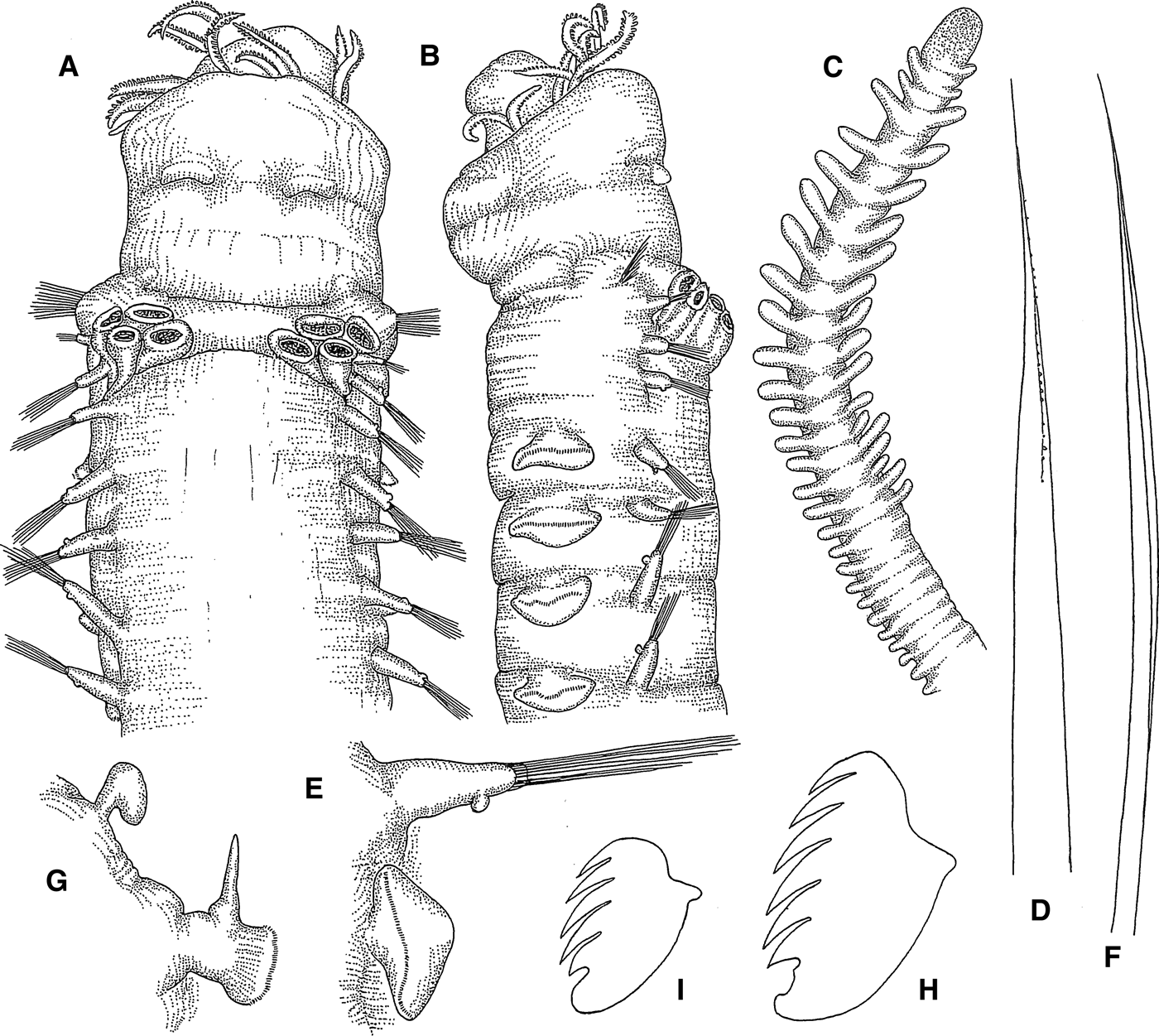
Length 27 mm, width 3 mm. Prostomium without glandular ridges. Paired nuchal ridges in one transverse line, separated by wide median gap (Figure 7A). Eyes absent. Most buccal tentacles pinnate, with 2 rows of pinnae (Figure 7A–C); few lateral buccal tentacles smooth. Four pairs of branchiae, all broken off, in 2 staggered transverse rows in segments III and IV, separated by wide median gap (Figure 7A) and connected by dermal ridge; innermost branchiae of anterior transverse row originating from segment II, outermost branchiae of anterior transverse row originating from segment III, innermost branchiae of posterior transverse row originating from segment IV, outermost branchiae of posterior transverse row originating from segment V (Figure 8F). Chaetae of segment II of same length as following notochaetae (Figure 7A), but thicker (Figure 7D); their distal end tapering consistently to thin tip; left and right bundle with 12 and 9 paleae, respectively. Notopodia with capillary chaetae and tuberculate ventral cirri (Figure 7E, F) from segment III, present in 17 chaetigers; anterior notopodia small, increasing in size from first to third pair (Figure 7A, B). Neuropodial tori with uncini from segment VI, present in 14 thoracic uncinigers (Figure 7E); tori without offset dorsal lobe. Continuous ventral shields distinct to unciniger 11, faint in unciniger 12. Elevated or modified notopodia absent. Intermediate uncinigers absent. Fifteen abdominal uncinigers with club-shaped rudimentary notopodia (Figure 7G). Pinnules with cirriform dorsal cirrus (Figure 7G). Pygidium with terminal anus and one pair of lateral filiform anal cirri. Thoracic uncini with 4–5 teeth in 1 row over basal prow, small subrostral process and rostral tooth (Figure 7H). Subrostral process of abdominal uncini reduced (Figure 7I).
Watatsumi grubei gen. et sp. nov: (A) anterior end, dorsal view, 12 ×; (B) same, lateral view, 12 ×; (C) distal end of buccal tentacle, 58 ×; (D) palea, 222 ×; (E) thoracic parapodium, 23 ×; (F) notochaeta, 113 ×; (G) abdominal parapodium, 22 ×; (H) thoracic uncinus, 652 ×; (I) abdominal uncinus, 700×.
ID-cards of reported Amphicteis species: (A) Amphicteis spinosa sp. nov.; (B) Amphicteis taurus sp. nov.; (C) Amphicteis uncopalea; (D) Paramphicteis angustifolia; (E) Paramphicteis weberi comb. nov.; (F) Watatsumi grubei gen. et sp. nov.
REMARKS
Watatsumi grubei sp. nov is unique among all species of the Amphicteis genus complex because it lacks prostomial glandular ridges, an important diagnostic character of Amphicteis, Paramphicteis and Phyllamphicteis. Additionally, it is characterized by the presence of pinnate buccal tentacles, and inconspicuous nuchal ridges.
ETYMOLOGY
The species is named after Adolph Eduard Grube (1812–1880), one of the pioneers in polychaete taxonomy and describer of the genus Amphicteis, as well as the genus complex' first species with pinnate buccal tentacles (Paramphicteis angustifolia).
DISTRIBUTION
Off Cape Toi, Miyazaki Prefecture, Pacific coast of Kyushu, in 383–411 m.
ACKNOWLEDGEMENTS
We thank Angelika Brandt, Kathrin Philipps-Bussau and Petra Wagner (Zoologisches Institut und Museum Hamburg) and Karen Osborn and William Moser (National Museum of Natural History, Smithsonian Institution in Washington, DC) for the loan of type specimens. Two anonymous reviewers are thanked for their suggestions that improved this publication.