Introduction
Complex cerebral aneurysms are rare but formidable lesions that pose significant therapeutic challenges and are often associated with poor outcomes. Their management has evolved alongside advances in neurosurgery and neuroanesthesia – from early perceptions of inoperability to microsurgical clipping, enhanced brain relaxation techniques, deep hypothermic neuroprotection, controlled flow arrest techniques and, more recently, selective brain cooling. Despite the advent of endovascular interventions, microsurgery remains the only viable treatment option for a subset of giant and posterior circulation aneurysms. As these cases become less commonly treated surgically, expertise is often transmitted informally. This review focuses on the anesthetic considerations for the surgical management of giant and posterior circulation cerebral aneurysms, drawing on our institutional experience and relevant literature (Supplementary 1).
Complex Cerebral Aneurysm
Cerebral aneurysms are classified by rupture risk, which correlates with size. The maximal dome diameter defines classification: small (<5 mm), medium (5–10 mm), large (10–25 mm), very large (>20 mm) and giant (>25 mm). Reference Merritt, Berns, Ducruet and Becker1 A wide-necked aneurysm is characterized by a neck diameter >4 mm or a dome-to-neck ratio <2 Reference Merritt, Berns, Ducruet and Becker1 and is often treated surgically.
Morphologically, aneurysms can also be classified as either saccular or fusiform, with fusiform aneurysms more commonly arising in the vertebrobasilar and middle cerebral artery (MCA) territories.
Giant cerebral aneurysm
Giant aneurysms account for approximately 2–5% of all intracranial aneurysms and are more frequent among aneurysms within the pediatric population. They most commonly arise from the internal carotid artery (ICA), particularly the cavernous and paraclinoid segments, followed by the vertebrobasilar system, MCA and anterior cerebral artery.
The clinical presentation is variable Reference Lownie, Drake, Peerless, Ferguson and Pelz2,Reference Hahn, Nicolle, Lownie and Drake3 : the majority (60–80%) present with mass effect or distal embolic events, while a smaller proportion (20–30%) present with subarachnoid hemorrhage (SAH), intracerebral hemorrhage or both. Less commonly, patients experience perforator infarction, seizures or remain asymptomatic.
The natural history is poor due to their high rupture risk, significant mass effect, intraluminal thrombus and distal embolization leading to cerebral ischemia. This grave prognosis underscores the imperative for curative treatment, regardless of rupture status. The International Study of Unruptured Intracranial Aneurysms Reference Wiebers, Whisnant and Huston4 reported a five-year rupture incidence of 40% for anterior circulation and 50% for posterior circulation giant aneurysms (annual rupture risk 8–10%). Early data from Peerless and Drake Reference Peerless and Drake5,Reference Peerless, Hernesniemi, Gutman and Drake6 at the University of Western Ontario (UWO) further underscore the poor prognosis: among patients without hemorrhagic presentation, mortality exceeded 60% within two years, and all survivors exhibited significant neurological deficits. Outcomes were worse for those presenting with SAH.
Posterior circulation aneurysm
Posterior circulation aneurysms comprise approximately 8–15% of all intracranial aneurysms with a poorer natural history than anterior counterparts due to an even higher rupture risk. Reference Wiebers, Whisnant and Huston4 This elevated risk – estimated at 3–5% annually – often warrants definitive surgical treatment, particularly in younger patients. In a case series by Luzzi et al., Reference Luzzi, Maestro and Galzio7 the majority (137/157) of posterior circulation aneurysms were located proximally. Of the total cohort, 14% were classified as giant and 12% as large. Proximal aneurysms most frequently involved the vertebral artery, basilar artery and proximal segments of the posterior cerebral artery (PCA). Distal aneurysms were typically located in the distal PCA, superior cerebellar artery (SCA) and anterior inferior cerebellar artery.
“Complex aneurysm” typically refers to giant aneurysms but may also include smaller aneurysms located in technically challenging regions, such as those in the posterior circulation. Reference Hanel and Spetzler8 Additional features that confer complexity include unfavorable location, prior treatment, compromised collateral circulation, intraluminal thrombus, neck calcification, complex neck morphology and aneurysmal wall calcification. Collectively, aneurysm size, location and anatomical or technical considerations contribute to the complexity and treatment risks.
Surgical Considerations
Microsurgical treatment of giant aneurysms is technically challenging due to intraluminal thrombus, atherosclerotic plaques and calcified walls or necks, all of which complicate direct clipping. Although a thick, sclerotic aneurysmal wall may slightly reduce the risk of intraoperative rupture, large size and poorly defined neck limit visualization and hinder circumferential dissection. Posterior circulation aneurysms present additional difficulty because of dense network of perforators supplying the brainstem, often rendering direct clipping infeasible.
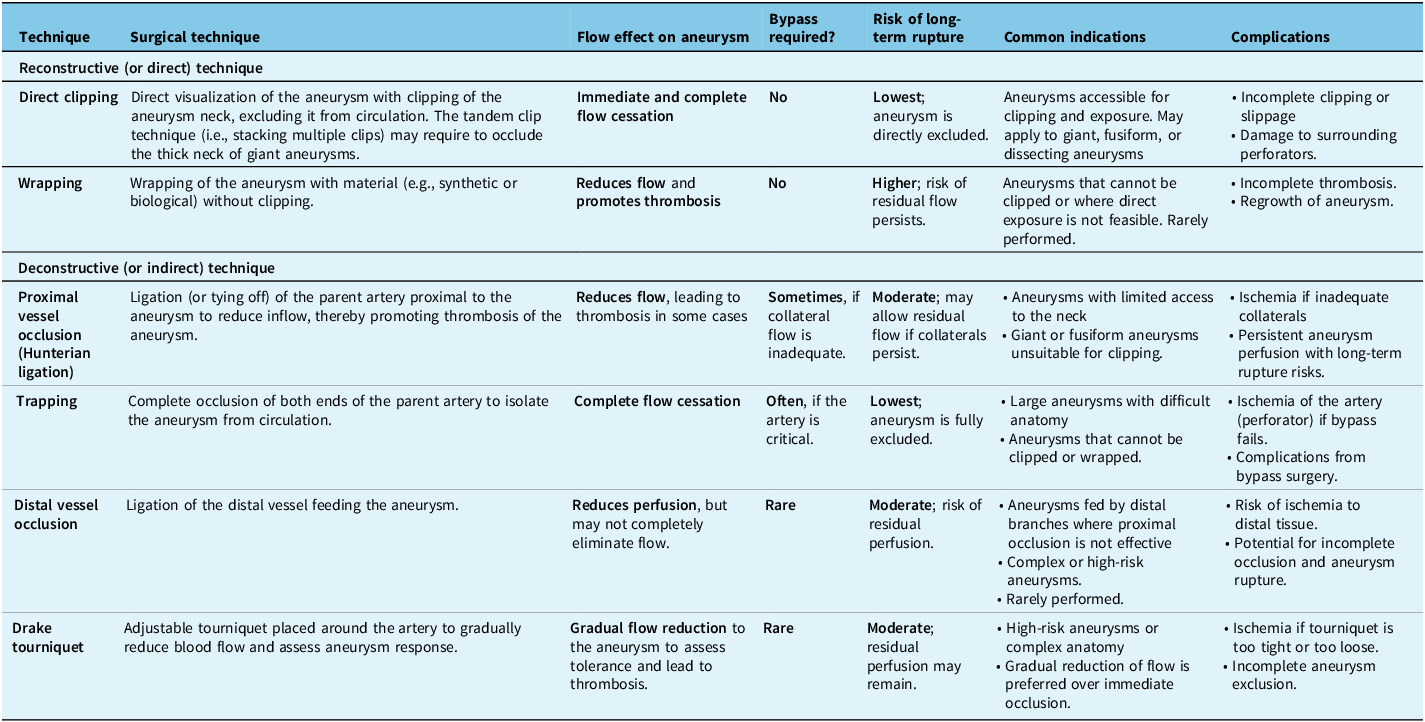
Surgical approaches are generally classified as either direct (reconstructive), involving manipulation of the aneurysm and its parent vessel, or indirect (deconstructive), which modifies blood flow to reduce rupture risk without directly addressing the aneurysm (Table 1 and Figure 1).
Illustrative figures of commonly used microsurgical and endovascular techniques for complex surgical aneurysm.

Summary of surgical techniques for cerebral aneurysm surgery

Direct clip deconstruction remains the gold standard for treating aneurysms with a well-defined neck. In giant or complex aneurysms, direct clipping may be challenging due to the proximity of surrounding neurovascular structures. The fenestrated clip, developed by Dr Drake at UWO, features a windowed design originally intended to preserve the P1 segment during clipping basilar artery aneurysms. Reference Drake9 Subsequent modifications have expanded its use to various vascular locations. Reference Drake, Peerless and Hernesniemi10
Deconstructive technique is often used when direct clipping is not feasible. Wrapping is typically employed for fusiform or thin-walled aneurysms by reinforcing the aneurysm wall with materials like cotton, muslin or synthetic wraps. Trapping involves the complete exclusion of the aneurysm by occluding both the proximal and distal arteries feeding it. In cases where trapping is anatomically impossible or undesirable due to intervening perforating branches, proximal or rarely distal vessel occlusion may be preferred. Drake reported satisfactory outcomes in 90% of giant carotid aneurysms treated with proximal (Hunterian) ligation, Reference Drake, Peerless and Ferguson11 and in 73% for vertebral or basilar aneurysms Reference Steinberg, Drake and Peerless12 ; however, surgical bypass may be required for flow replacement or augmentation in selected cases. Proximal basilar artery ligation using a Drake tourniquet Reference Drake13,Reference Martinez-Perez, Pelz and Lownie14 is a classic technique employed for large, unclippable bifurcation aneurysms – typically giant, fusiform and/or heavily atherosclerotic lesions. The method involves gradual occlusion of the basilar artery at a perforator-free segment, either below the SCAs or between the SCAs and the basilar bifurcation, relying on the collateral flow from the posterior communicating arteries to avoid brain-stem ischemia. Drake originally externalized the tourniquet, enabling gradual tightening over several days in hospital for monitoring and to allow collateral adaptation. Despite its ingenuity, the technique carries risks of ischemic deterioration, partial thrombosis and aneurysm rupture, though long-term vascular complications are rare. Reference Drake13,Reference Martinez-Perez, Pelz and Lownie14
Combined surgical and endovascular strategies – such as flow diversion followed by clipping or bypass with endovascular occlusion – are sometimes required in some complex aneurysm. These may be performed in hybrid ORs or in staged procedures.
A clear understanding of the surgical strategy is essential to anticipate ischemic and hemorrhagic risks and to develop an appropriate perioperative plan, including neuroprotection and flow arrest strategies.
Anesthetic Considerations
The shared goal between anesthesia and surgery is to secure the aneurysm while preserving surrounding neurovascular structures. In complex cases, this often necessitates temporary aneurysm flow arrest to decompress the aneurysm and deliberate brain relaxation to improve exposure. However, flow arrest can carry a significant risk of cerebral ischemia, underscoring the importance of intraoperative neuromonitoring for early ischemic detection and neuroprotective strategies for prolonging ischemic tolerance.
Aneurysm sac relaxation
An aneurysm presents as a pulsating, pressure-tense yet fragile mass. Reducing inflow (or intramural pressure) can soften the aneurysm sac, decrease the risk of rupture and facilitate permanent clipping and/or reconstruction. Historically, extreme induced hypotension – targeting an initial mean arterial pressure of 40 mmHg, and in critical cases as low as 20 mmHg – was employed, guided by an aneroid manometer (See Supplementary Information 2 for the interview transcript with Emeritus Professor Dr Gord Sellery of UWO, recounting his experience with the use of aneroid manometer-guided induced hypotension in the late 1960s and 1970s). Reference Sellery, Aitken and Drake15 In contemporary practice, for small or straightforward anterior circulation aneurysms, temporary afferent artery clipping and supplemented with controlled hypotension is often sufficient. However, ICA, posterior circulation and giant aneurysms pose greater challenges. ICA control may require exposure of cervical, petrous (via Glasscock’s triangle) or clinoid segments (via anterior clinoidectomy) of the ICA, while posterior circulation aneurysms may necessitate endovascular balloon occlusion due to inaccessibility. In complex cases, limited exposure may hinder safe placement of temporary clips, especially if multiple clips are needed for trapping or if deep-seated aneurysms preclude direct access. Temporary clipping also carries risks of thromboembolism, vessel injury and intraoperative rupture.
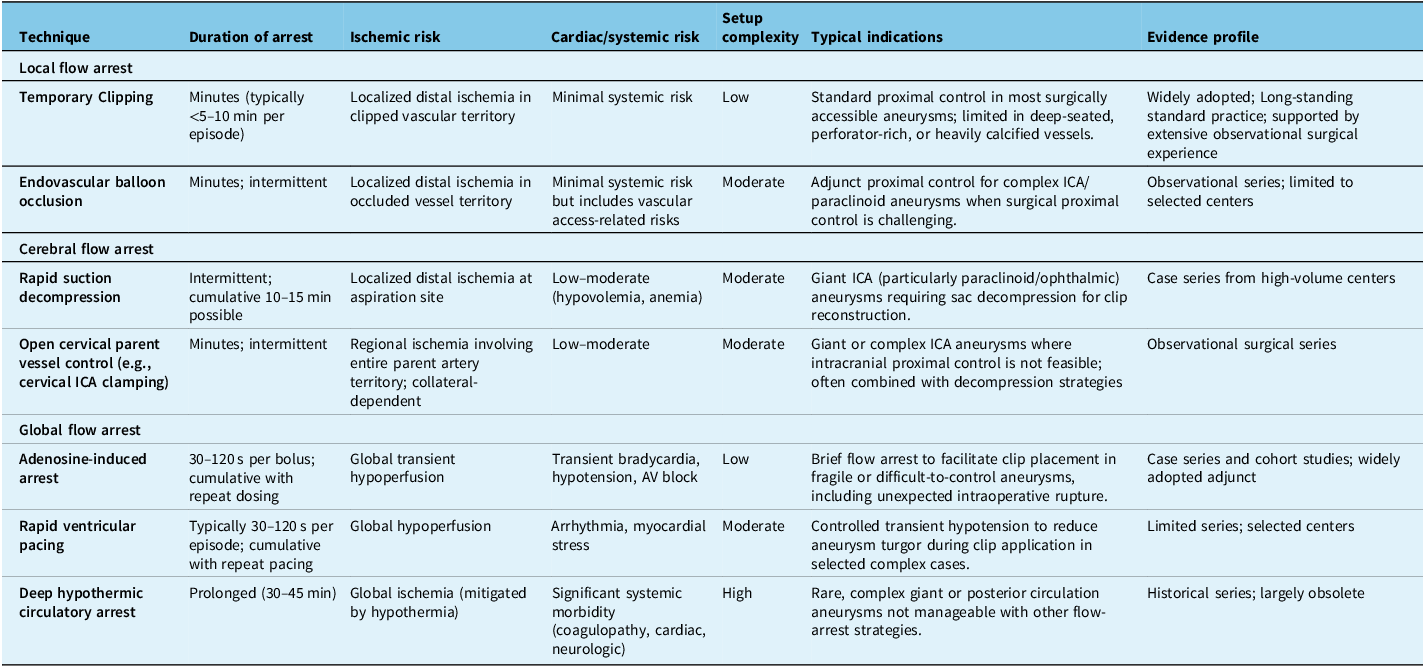
Alternative flow arrest techniques address these limitations. In the literature, these techniques are often referred to as “cardiac standstill” or “circulatory arrest,” terms that imply global circulatory arrest; however, a more precise description is “aneurysm blood flow arrest.” Approaches can be categorized into local (e.g., temporary clip), cerebral (e.g., retrograde suction decompression (RSD)) and systemic flow arrest (e.g., adenosine-induced asystole, rapid ventricular pacing (RVP) or deep hypothermic total circulatory arrest (DH-TCA)). Each carries distinct ischemic risks. Selection should depend on aneurysm location and morphology, anticipated dissection difficulty and institutional experience (Table 2).
Summary of flow arrest strategy

ICA = internal carotid artery; AV = atrioventricular.
Retrograde suction decompression
Proximal retrograde suction decompression, first described by Batjer and Samson in the 1990s, Reference Batjer and Samson16 provides rapid indirect aneurysm decompression and minimizes optic nerve manipulation. Reference Mattingly, Kole, Nicolle, Boulton, Pelz and Lownie17 It is especially valuable for paraclinoid ICA aneurysms, which often exhibit brisk backflow from the ophthalmic artery and cavernous ICA – even when trapped. Historically, such aneurysms were managed with cervical carotid ligation.
The technique of RSD is illustrated in Figure 2. Reference Batjer and Samson16,Reference Eliava, Filatov and Yakovlev18–Reference Srinivasan, Zhang, Scherschinski, Whiting, Labib and Lawton20 A 16-gauge angiocatheter is inserted into the common carotid artery (CCA) and connected via sterile extension tubing and a three-way stopcock to a 60-mL syringe and heparinized circuit. Temporary clamps are applied to the CCA and external carotid artery, and a temporary clip is placed on the intracranial ICA distal to the aneurysm to achieve trapping. Blood is aspirated via the syringe to collapse the aneurysm sac, with aspirated blood collected and reinfused intravenously. If distal clipping is not feasible, rapid aspiration alone may collapse the sac, albeit with greater transient blood loss. After definitive clipping, all temporary clips and angiocatheter are removed.
Illustrative figures of open and endovascular retrograde suction decompression. The above figure illustrates (left) open surgical retrograde suction decompression technique, where internal carotid artery is exposed surgically and a balloon catheter is inserted directly for suction decompression and (right) endoscopic technique using double balloon catheter to occlude the external carotid artery and common carotid artery, respectively. The aspirated blood, in both surgical and endoscopic techniques, is transfused back to the patient directly or collected via cell-saver.

A modified endovascular technique, first reported by Scott in 1991 Reference Scott, Horner and Leipzig21 and subsequently by other authors, Reference Parkinson, Bendok and Getch22–Reference Pojskić, Arnautović, Essayed and Al-Mefty25 uses a transfemoral 5-Fr double-lumen balloon catheter advanced into the ICA about 2 cm above the bifurcation. Balloon inflation achieves proximal control, while a 20-mL syringe provides aspiration to soften the aneurysm. Additional advantages include rapid access to the paraclinoid ICA, immediate balloon occlusion if intraoperative rupture occurs and control angiography after clipping is completed.
A systematic review Reference Flores, White, Batjer and Samson26 of 26 studies (1990–2016) involving 525 patients compared surgical and endovascular RSD techniques. The average duration of temporary flow arrest was 13 minutes and the aneurysm obliteration rates reaching 95% in both approaches. Procedure-specific complication rates were low (1.3%), with good or fair neurological outcomes reported in over 91% of patients. Surgical RSD was associated with slightly lower morbidity. In a case series of 18 patients, one ICA dissection required emergency endarterectomy. Reference Batjer and Samson16 Additional complications include thromboembolism and hemispheric ischemia. Overall, both surgical and endovascular RSD have demonstrated high aneurysm obliteration rates, favorable long-term neurological outcomes and low procedure-related morbidity and mortality. However, RSD does not prevent distal brain ischemia. Intermittent reperfusion via distal clip release and continuous neuromonitoring are essential. RSD is also contraindicated in heavily calcified or thrombosed aneurysms and in significant ICA stenosis, which may impede effective decompression.
In our experience, RSD reliably decompresses the aneurysm and facilitates safe clipping. We prefer endovascular RSD in the recent years and use a cell saver to centrifuge and filter the aspirated blood before reinfusion to reduce thromboembolic complications. However, reinfusion may be delayed by the minimum volume (∼1 L) needed for processing, and the heparinized salvage blood may increase coagulopathy risk. Hypotension due to acute blood loss may occur, while awaiting the centrifugation of the salvaged blood, which can be managed with vasopressors or blood transfusion as needed.
Total circulatory arrest
TCA, often achieved via induced asystole, provides a bloodless field and complete aneurysm decompression. Shorter durations of cardiac arrest – induced by adenosine or RVP – are better tolerated and preferred for less complex cases. To mitigate prolonged global ischemia, TCA together with profound hypothermia (i.e., DH-TCA) necessitates the use of extracorporeal circulation; however, its use has significantly declined due to high morbidity and the emergence of safer alternatives.
Extracorporeal circulation
The first recorded case of total cerebral flow arrest was performed by Dott et al. in 1955, involving bilateral carotid and vertebral artery occlusion for 47 minutes without any neuroprotection strategies. Reference Wright, Huang and Sharma27,Reference Todd, Howie and Miller28 The patient succumbed four days later due to extensive vertebral artery thrombosis. Reference Wright, Huang and Sharma27,Reference Lougheed, Sweet, White and Brewster29 The first substantive series was reported by the Toronto General Hospital group, who employed moderate hypothermia (28–30°C) using surface cooling with temporary carotid and/or vertebral artery occlusion in 73 patients. Reference Botterell, Lougheed, Morley and Vandewater30 Favorable outcomes were reported in 50 patients, supporting the role of hypothermia in extending tolerable durations of circulatory arrest. Reference Botterell, Lougheed, Morley and Vandewater30
By the early 1960s, cardiac surgeons began using profound hypothermic TCA with extracorporeal circulation for valve surgery, which laid the groundwork for its adoption in cerebrovascular procedures. Drake and colleagues Reference Drake, Barr, Coles and Gergely31 from UWO were among the first to report 10 cases treated with deep hypothermia (15–18°C) and arrest durations of 2–18 minutes. Deep hypothermia can afford cerebral protection for 30–45 minutes, allowing ample time for complex dissection and aneurysm clipping. TCA provides a motionless, bloodless field and a completely decompressed aneurysm sac. However, the technique carries substantial risk, including coagulopathy, vasospasm and ischemic brain injury. Subsequent refinements came through multiple case reports and small series. The largest series, reported by Lawton et al. (University of California, San Francisco) and Spetzler et al. (Barrow Neurological Institute), described 60 patients undergoing 62 DH-TCA procedures, predominantly for posterior circulation aneurysms. Reference Lawton, Raudzens, Zabramski and Spetzler32 Morbidity and mortality rates were 13.3% and 8.3%, respectively. All these experienced authors consistently concluded that DH-TCA should be reserved for complex aneurysms not amenable to conventional or endovascular treatments or for recurrent aneurysms following endovascular coiling.
Extracorporeal circulation techniques can be performed via open-and closed-chest approach. The open-chest approach mirrors standard cardiac surgery, utilizing aortic and right atrial venous cannulation. Cardiac arrest is achieved through profound hypothermia-induced standstill (<18°C), extreme low-flow bypass and/or cardioplegia administered via aortic cross-clamping. In contrast, the closed-chest approach avoids sternotomy by employing femoral arterial and venous cannulation. Cardiac arrest can be induced by RVP (150–180 beats per minute). Some centers utilize an endo-aortic catheter with an inflatable balloon to occlude the proximal ascending aorta, followed by pacing at a reduced rate to maintain coronary perfusion pressure (20–30 mmHg) or retrograde administration of cardioplegia. Reference Campkin and Dallas33 Some authors described the use of high-concentration potassium infusion via the pulmonary artery catheter venous port or electric shock to induce cardiac arrest. Reference McMurtry, Housepian, Bowman and Matteo34 In closed-chest approach, external defibrillator pads should be placed for potential synchronized cardioversion or defibrillation.
Regardless of technique, precise control of circulatory arrest is critical, as even occasional escape beats can lead to dramatic and abrupt aneurysm motion. Implementation of DH-TCA is logistically demanding and requires coordinated multidisciplinary planning. A recommended checklist and perfusion circuit set-up are provided in Supplementary Information 3 and Figure 3, respectively.
Illustrative figures of bypass circuit for deep-hypothermic total circulatory arrest and selective brain cooling. This schematic shows different bypass configurations used in complex aneurysm surgery. (A) Full cardiopulmonary bypass circuit performed via median sternotomy with aortic cannulation and bicaval venous access. Venous blood is drained into a reservoir, oxygenated by an oxygenator, and returned to the body via a centrifugal pump. System deep hypothermia is achieved with a heat exchanger, and cardioplegia is delivered through a dedicated cardioplegia pump. Standard left ventricular venting and aortic cross-clamping are applied. (B) Selective brain cooling. Blood is withdrawn from the femoral artery through an outflow cannula, cooled by a heat exchanger, and infused – mixed with cardioplegia – directly into the internal carotid artery (ICA). (C) Femoral-femoral bypass. Venous blood is drained from the femoral vein to the oxygenator and returned via the femoral artery. (D) Endovascular circuit for minimally invasive cardiac surgery that can also be used to avoid sternotomy in complex aneurysm surgery. Venous return to the extracorporeal circuit is achieved through a femoral venous cannula advanced to the junction of the inferior vena cava and right atrium. The endoaortic catheter, an inflatable balloon device, functions as an aortic cross-clamp and allows antegrade cardioplegia infusion into the aortic root and coronary arteries; its lumen can also be used for aortic root venting. Alternatively, endocoronary sinus catheter is inserted via the internal jugular or another neck vein and advanced in the coronary sinus for retrograde cardioplegia delivery. An endopulmonary vent catheter is placed in the pulmonary artery for decompression. CP = cardioplegia pump; R = reservoir; P = centrifugal pump; HE = heat exchanger; O = oxygenator.

A recent review Reference Nager, Pontes and Udoma-Udofa35 summarized pooled outcomes in 233 patients undergoing DH-TCA: 30-day mortality was 12%, postoperative neurological deficit rate was 35%, and 69% of patients achieved good neurological recovery. Although DH-TCA is now reserved for the most extreme cases, these results support its efficacy when employed judiciously; nevertheless, its application has become rare and is no longer employed in many institutions.
Rapid ventricular pacing
RVP is a well-established technique commonly employed during percutaneous cardiac interventions, such as transcatheter aortic valve implantation, to facilitate controlled device deployment. Extreme rapid pacing induces ventricular tachycardia, which leads to atrioventricular dyssynchrony, limiting ventricular filling and subsequently lowering cardiac output and blood pressure. It is most frequently performed via endocardial pacing of the right ventricle, though transcutaneous and esophageal pacing have also been reported – albeit with less reliable capture.
RVP offers precise control over the timing of circulatory arrest. Each pacing episode is limited to 40–60 s, but can be repeated as needed. In the context of giant and complex aneurysms, this duration may be insufficient for adequate dissection. In a study by Saldien et al., Reference Saldien, Schepens and Loock36 the average aneurysm size was 11 mm, with pacing episodes lasting a mean of 31 s and a total pacing time of 104 s per case. Mean arterial pressure dropped to 35–55 mmHg during pacing and recovered afterward.
The overall cardiac risk associated with RVP is low Reference Nager, Pontes and Udoma-Udofa35 : perioperative arrhythmia in 0.64% of cases, postoperative arrhythmia in 0.3% and no instances of myocardial infarction. However, approximately 50% of patients exhibited transient troponin elevation (“troponitis”), which normalized within a few days. Additionally, neither intraoperative cerebral desaturation Reference Argiriadou, Anastasiadis, Karapanagiotidis and Papakonstantinou37 nor postoperative MRI evidence of cerebral ischemia was observed. Reference Saldien, Schepens and Loock36 In contrast, ventricular tachyarrhythmias following RVP occur in 0–3% of cardiology patients.
Adenosine
Among all flow arrest techniques, adenosine is the simplest to administer and has been widely adopted. However, its use in giant or complex aneurysms may be limited due to its short and unpredictable duration of action. Nonetheless, adenosine offers a valuable alternative when proximal control is difficult Reference Groff, Adams, Kahn, Kumbar, Yang and Bederson38,Reference Heppner, Ellegala, Robertson, Nemergut, Jaganathan and Mee39 – such as in challenging exposures of ICA aneurysms, situations requiring avoidance of extensive bone drilling, calcified parent vessels or intraoperative rupture where temporary clipping fails to soften the aneurysm adequately. A cohort study Reference Intarakhao, Thiarawat and Jahromi40 reported similar rates of intraoperative rupture and brain infarction between temporary clipping and adenosine-induced flow arrest.
Adenosine induces sinoatrial and atrioventricular nodal block, leading to transient hypotension and, occasionally, brief asystole. Reference Layland, Carrick, Lee, Oldroyd and Berry41 Its rapid onset (10–20 s) and short half-life (<10 s) make it ideal for transient flow arrest. Dosing is typically titrated in 6–12 mg increments, with a median dose of 12 mg yielding 30–45 s of flow arrest. Bebawy et al. Reference Bebawy, Gupta and Bendok42 reported that 0.3–0.4 mg/kg (ideal body weight) achieved approximately 45 s of hypotension in patients under burst-suppression anesthesia. Similar dosing (0.2–0.4 mg/kg) was reported by other authors Reference Guinn, McDonagh and Borel43,Reference AL-Mousa, Bose, Hunt and Toma44 to produce at least 30 s of asystole.
Adenosine’s main advantage is the ease of use – it requires no setup, making it valuable in unexpected intraoperative ruptures. Its safety profile is also favorable. Sinus rhythm typically returns spontaneously; however, rare cases of transient cardiac arrest requiring compressions or cardioversion have been reported, particularly with repeated dosing or major blood loss. Reference Layland, Carrick, Lee, Oldroyd and Berry41,Reference AL-Mousa, Bose, Hunt and Toma44,Reference Desai, Rosas and Britz45 External defibrillator pads should be applied pre-emptively. In a retrospective cohort of 413 patients (72 received adenosine), Bebawy et al. Reference Bebawy, Zeeni and Sharma46 observed no difference in neurologic outcomes at 48 hours or discharge and no increase in cardiac complications. A recent systematic review Reference Nager, Pontes and Udoma-Udofa35 reported low pooled incidences of perioperative arrhythmia (0.19%), postoperative arrhythmia (0.56%) and myocardial infarction (0.01%). Rare adverse events include bronchospasm, increased airway pressures, self-limited ST depression, hemodynamically stable atrial fibrillation requiring cardioversion and asymptomatic troponitis. Reference Bebawy, Gupta and Bendok42
Neuroprotection
Hypothermia
Hypothermia remains one of the most reliable neuroprotective strategies during prolonged cerebral ischemia in aneurysm surgery. By reducing cerebral metabolic rate and oxygen consumption, it extends neuronal survival during ischemic periods. This protective effect is dose-dependent and well-documented at profound levels (18–26°C). Reference Chawla and Tempe47 Routine use of mild hypothermia (32–35°C), as investigated in the IHAST trial, Reference Todd, Hindman, Clarke and Torner48 has shown no neuroprotective benefit in predominantly good-grade SAH patients; however, these findings may not necessarily extrapolate to situations like prolonged aneurysm flow arrest.
Selective brain cooling
Selective brain cooling is an emerging investigational approach targeted at cooling part of the brain while maintaining normothermia in the rest of the body. Verdura et al. first demonstrated this concept in dogs using bilateral carotid perfusion to lower brain temperature to 15°C, while systemic temperature remained above 29°C. Reference Verdura, White and Albin49 In humans, Williams et al. Reference Williams and Turner50 applied unilateral carotid perfusion with occlusion of the contralateral carotid and both vertebral arteries to achieve total cerebral circulatory arrest, reaching brain temperatures as low as 11.6°C. However, the technique was abandoned due to high mortality. Demian et al. Reference Demian, White, Yashon and Kretchmer51 later introduced bi-hemispheric cooling via a heat exchanger without a perfusion pump during frontal tumor resection. However, this technique renders cerebral perfusion fully dependent on the patient’s cardiac output.
Our institution has been employing selective (ipsilateral) brain cooling using a simplified extracorporeal perfusion technique in highly selected cases. Reference Lownie, Menkis, Craen, Mezon, MacDonald and Steinman52 The key procedural steps utilized at our center are outlined in Supplementary Information 4. After preparing the patient for full cardiopulmonary bypass, temperatures are monitored at two sites (e.g., nasopharyngeal and rectal, or via pulmonary artery catheter). A crystalloid-primed cardioplegia circuit is connected to a cannulated CCA, with a distal catheter in the ICA for pressure monitoring. The proximal CCA is clamped to direct perfusate into both internal and external carotid territories. This setup – leveraging external carotid branches to cool the scalp, muscle and dura – promotes early cerebral hypothermia and minimizes rewarming via convection. As the arterial inflow originates from an already oxygenated femoral outflow, no oxygenator is needed, simplifying the circuit.
Extracorporeal perfusion is titrated to 150–180 mL/min to maintain mean ICA pressure ≤100 mmHg or lower. Cooling is achieved by circulating ∼20°C blood, reducing brain temperature to 28°C within 10–12 minutes. Flow adjustments may be required to maintain hemodynamic stability and minimize bleeding. The target temperature (22–25°C) is then maintained. Once the aneurysm is secured, active rewarming is unnecessary. Brain temperature typically rises from ∼22°C to 26°C within 5 minutes and normalizes over 30 minutes. Systemic temperature remains near normothermic with the use of convective warming blankets to counteract cerebral venous return cooling. Hemodynamic stability is generally preserved, and in uncomplicated cases, most patients can be extubated at the end of surgery.
Endovascular selective brain cooling
Endovascular selective hypothermia utilizes percutaneous dual-lumen catheter systems such as the TwinFlo (Thermopeutix Inc.™). Reference Mattingly, Lopez-Ojeda and Arango53,Reference Solar, Mattingly, Lownie and Meerkin54 The setup requires approximately 40 minutes between insertion of the outer flow lumen to the descending aorta and the initiation of perfusion. To avoid overperfusion, brain temperature is gradually reduced to approximately 27°C over a 60 to 70-minute period. Initial flow rates around 240 mL/min are tapered to 170 mL/min. Subdural temperature decreases to approximately 30°C within 30 minutes. Intra-arterial pressures, measured through the inner flow lumen balloon catheter, typically range from 65 to 85 mmHg and correlate well with mean arterial pressure. Flow reduction below 200 mL/min during simulated aneurysm trapping has been associated with a reversible rise in subdural temperature of up to 8°C, reinforcing the principle that – once inflow temperature is held constant – perfusion flow rate is the dominant factor in determining brain temperature. These physiological responses are in agreement with earlier experimental studies and highlight the controllability of this approach.
The main advantage of selective brain cooling is the avoidance of systemic hypothermia and its associated complications, including platelet dysfunction, coagulopathy, sepsis-like syndromes. Unlike DH-TCA, it preserves continuous perfusion to the rest of brain regions. The procedural setup is markedly less complex – eliminating the need for sternotomy, aortic cannulation or oxygenators. Total bypass time is significantly reduced, from 1.5–3 hours (with mean circulatory arrest durations of ∼ 22 minutes) to approximately 54 minutes of ipsilateral perfusion with similar durations of aneurysm flow arrest. Overall, our experience of employing the selective brain cooling technique has been favorable; however, this technique carries potential risks of embolism, perfusion mismatch and carotid injury. Its application remains limited to single-center experience without comparative outcome data, and it has not undergone broader external validation.
Neuromonitoring for brain ischemia detection
The goal of neuromonitoring in aneurysm surgery is to detect intraoperative cerebral ischemia, especially during flow arrest or when assessing the adequacy of flow-limiting or replacement maneuvers (e.g., bypass grafts or selective vertebral artery occlusion). Detection of ischemia may prompt surgical reassessment, intermittent reperfusion or expedited surgical steps. In certain scenarios, neuromonitoring findings may justify a fundamental change in strategy, such as switching from trapping to proximal occlusion or adding a bypass.
Ischemic risk assessment should begin preoperatively. A balloon test occlusion helps determine tolerance of parent vessel sacrifice by temporarily occluding the target artery to assess collateral adequacy. For posterior circulation aneurysms, the Allcock test evaluates the functional competence of the posterior communicating artery by injecting contrast into the vertebral artery while compressing the ipsilateral carotid artery, simulating basilar artery occlusion. Inadequate collateral flow on either test often necessitates a bypass.
Choice of neuromonitor
Intraoperative neuromonitoring should be tailored to the brain region at risk of ischemia. While EEG and near-infrared spectroscopy offer real-time cortical monitoring, their effectiveness may be limited when sensor placement overlaps with the surgical field. A multimodal approach is often necessary. Evoked potentials (EP) – somatosensory (SSEPs), motor (MEPs) and brainstem auditory (BAEPs) – assess the functional integrity of sensory, motor and auditory pathways via far-field responses, making them especially valuable for detecting perfusion deficits beyond the exposed cortex. However, interpretation is complex due to the distinct anatomical pathways involved, requiring experience to distinguish ischemic patterns. Effective use demands a strong understanding of cerebral vascular anatomy, modality-specific limitations and the functional implications of injury to eloquent brain regions. A detailed discussion of neuromonitoring strategies specific to each aneurysm type or location is beyond the scope of this review.
Diagnostic performance
The diagnostic performance of EP monitoring in aneurysm clipping remains a topic of debate. Although several studies Reference Thirumala, Udesh and Muralidharan55,Reference Thomas and Guo56 have reported high diagnostic test accuracy, these estimates are often confounded by methodological limitations. Reference Howick, Cohen, McCulloch, Thompson and Skinner57 Specifically, intraoperative rescue interventions are typically initiated in response to EP signal changes (diagnostic test) before postoperative neurological examination (reference/gold standard) is assessed. One way to mitigate this limitation is to estimate a plausible range of diagnostic performance under best-and worst-case scenarios, assuming that surgical interventions have either full or no effect. Reference Zhu, Chui, Herrick and Martin58 This under best-and worst-case approach allows for the estimation of a range of diagnostic accuracy.
For anterior circulation aneurysms, the ranges of pooled sensitivity and specificity for SSEPs are 50–63% and 81–100%, respectively. For MEPs, the corresponding ranges are 74–100% and 93–100%. Reference Zhu, Chui, Herrick and Martin58 When SSEP and MEP are combined, the ranges of pooled sensitivity and specificity improve substantially, to 94–100% and 93–100%, respectively. Reference Zhu, Chui, Herrick and Martin58 Although precise point estimates remain elusive, these high diagnostic ranges (exceeding 93%) of combined SSEP and MEP support the clinical utility of EP monitoring in anterior circulation aneurysm surgery. The diagnostic thresholds of EP monitoring vary among institutions; the commonly accepted criteria for significant SSEP change include ≥50% amplitude reduction and/or ≥10% latency prolongation. MEP interpretation is less standardized; in our practice, complete loss of signals is considered clinically significant. During flow arrest, significant neuromonitoring deterioration typically prompts immediate reassessment and restoration of perfusion, generally within minutes, guided by established principles of cerebral ischemic tolerance in specific clinical context rather than a fixed time cutoff.
Data for posterior circulation aneurysms are limited and primarily derived from an early report from our institution. Reference Lam, Keane and Manninen59 BAEPs alone yield poor sensitivity (42%) and moderate specificity (89%). Reference Lam, Keane and Manninen59 However, diagnostic performance improves when BAEPs are combined with SSEPs, resulting in a pooled sensitivity of 84% and specificity of 79%. Reference Zhu, Chui, Herrick and Martin58
Respiratory monitoring
Respiratory monitoring is an additional, anecdotal yet practically useful adjunct for detecting brainstem ischemia; however, published reports to date have been primarily confined to our institution. Sellery et al. Reference Sellery, Aitken and Drake15 from UWO observed that changes in respiratory pattern were often the earliest sign of impending brainstem ischemia, preceding alterations in blood pressure or cardiac rhythm. Respiration has therefore been used as an intraoperative monitor to ensure adequate cerebral perfusion, particularly during concurrent induced hypotension. A subsequent report by Manninen et al. Reference Manninen, Cuillerier, Nantau and Gelb60 from UWO reported the monitoring of respiration in 50 patients during temporary occlusion of the vertebrobasilar artery system. In this cohort, 13 patients exhibited reversible respiratory changes: six developed apnea, two of these also showed simultaneous hypertension (defined as >30% above baseline) and only one patient had changes in all three parameters – respiratory, cardiovascular and EP. Of the 13 patients monitored with EPs, only two demonstrated concurrent changes in SSEPs and BAEPs, highlighting the complementary nature of respiratory monitoring alongside neurophysiologic modalities.
The technique for respiration monitoring is usually straightforward but could be challenging in selected patients such as those with history of drug abuse, as it involves maintaining a narrow anesthetic window that permits spontaneous respiration while suppressing all catastrophic movements. Our typical regimen includes total intravenous anesthesia using propofol, dexmedetomidine and remifentanil infusion. Remifentanil is discontinued approximately 10 minutes before monitoring begins. In the series by Manninen, naloxone (median dose 0.2–0.3 mg) was used to reverse the respiratory depressant effects of fentanyl or sufentanil. The ventilator is transitioned from synchronized intermittent mandatory ventilation to pressure support ventilation (PSV) if respiratory triggering persists and finally to full spontaneous breathing. Respiratory function is monitored for signs such as irregular breathing patterns, decreased frequency, reduced tidal volume and/or onset of apnea. A more detailed respiratory changes by injury to specific brainstem centers are listed in Supplementary Information 5. Significant hypertension may also accompany respiratory arrest. If severe hypercapnia leads to brain swelling, PSV may be reintroduced, although monitoring can only focus on respiratory rate rather than tidal volume/pattern. Respiratory arrest is usually clinically obvious, even on PSV mode. If anesthesia depth is excessive, reducing the propofol dose may help restore respiratory effort, and low-dose ketamine (0.1–0.2 mg/kg/hr) can be added to maintain adequate anesthetic depth without respiration suppression. No diagnostic accuracy data are available for respiratory rate monitoring.
In addition to functional monitoring, anatomical assessment of cerebral blood flow is critical for assessing adequacy of blood flow. Compared with intraoperative Doppler ultrasound and indocyanine green angiography, a hybrid operating room equipped with conventional digital subtraction angiography is ideal for managing complex aneurysms. At our institution, we routinely perform baseline conventional angiography for all complex cases in our hybrid OR. Intraoperative angiography is repeated if the anatomy remains uncertain or if a conversion to a hybrid microsurgical and endovascular techniques is considered. A final angiographic assessment is performed after vascular reconstruction to confirm the adequacy of repair. We have found that combining anatomical and functional neuromonitoring assessments is particularly effective and advantageous in managing complex aneurysms. However, such a setup requires substantial institutional resources, including dedicated biplane angiography equipment, specialized operating room infrastructure and the coordinated availability of neuroradiology personnel and technical staff.
Conclusion
A nuanced understanding of surgical approach to complex cerebral aneurysms is essential for selecting the appropriate flow arrest technique, neuromonitoring modality and neuroprotective strategy. Advances in controlled circulatory arrest and selective brain protection have enabled brief, controlled windows for safe aneurysm manipulation. Meticulous preoperative planning, combined with real-time multimodal neuromonitoring, offers critical insight into the adequacy of cerebral and brainstem perfusion. The evolution of both microsurgical and anesthetic techniques reflects a paradigm shift toward a more selective, physiology-guided approach – one that prioritizes neuroprotection while optimizing surgical precision and outcomes.
Supplementary material
The supplementary material for this article can be found at https://doi.org/10.1017/cjn.2026.10594
Author contribution
JC: Literature review; Writing – original draft. SL: Writing – review & editing, interview & narrative editing. All authors reviewed and approved the final manuscript.
Competing interests
No conflicts of interest to declare in this report.
Statement on AI Use
During the preparation of this work, the author(s) used ChatGPT (OpenAI) to assist in redrawing illustrative figures. All figures were first hand-drawn by the author(s), and ChatGPT was used solely to improve clarity, consistency and graphical quality. The author(s) subsequently reviewed and edited all figures as needed and take full responsibility for the final content.