


1. Introduction
Citizens’ ability to attribute responsibility and update their perceptions of government performance is critical for political accountability and regime stability. While research on retrospective evaluations is well-established in democracies (Fiorina, Reference Fiorina1978; Malhotra and Kuo, Reference Malhotra and Kuo2008; Marsh and Tilley, Reference Marsh and Tilley2010; Alcañiz and Hellwig, Reference Alcañiz and Hellwig2011; León, Reference León2012; Healy and Malhotra, Reference Healy and Malhotra2013; Aldrich et al., Reference Aldrich, Bishop, Hatch, Hillygus and Rohde2014; Hobolt and Tilley, Reference Hobolt and Tilley2014; Harding, Reference Harding2015; Graham and Singh, Reference Graham and Singh2023), evidence in authoritarian contexts is limited (Javeline, Reference Javeline2003, Reference Javeline2009; Lü, Reference Lü2014; Alkon and Wang, Reference Alkon and Wang2018; Rosenfeld, Reference Rosenfeld2018; Beazer and Reuter, Reference Beazer and Reuter2019). In contrast to social environments with independent media and political opposition (Carlin et al., Reference Carlin, Hellwig, Love, Martínez-Gallardo and Singer2021), citizens are at an information disadvantage where state censorship and propaganda are prevalent (Guriev and Treisman, Reference Guriev and Treisman2019; Rosenfeld and Wallace, Reference Rosenfeld and Wallace2024).
This study shows that in low-information environments, citizens can rely on extraordinary events, such as public safety incidents, as signals to gauge government competence (Healy and Malhotra, Reference Healy and Malhotra2009; Atkeson and Maestas, Reference Atkeson and Maestas2012). These events are socially salient and highly visible, which heightens public attention and makes them difficult for the regime to hide. The clarity of responsibility is relatively straightforward, allowing citizens to reason and assign blame to the government if it is deemed responsible for safety failures (Iyengar, Reference Iyengar1989; Powell and Whitten, Reference Powell and Whitten1993; Tavits, Reference Tavits2007). The study further argues that the government’s treatment performance does not offset its causal responsibility, and that citizens weigh causal responsibility more heavily than treatment performance in assigning blame. Citizens’ ability to make informed attributions serves as a bottom-up accountability mechanism and has implications for authoritarian stability.
To test this theory, the study focuses on China, a high-capacity authoritarian country that has undergone rapid industrialization and urbanization. The Chinese government has received an overall favorable opinion from citizens, reflected in high levels of political trust (Cunningham et al., Reference Cunningham, Saich and Turiel2021). One strand of literature attributes the government’s popularity to developmental outcomes, including economic growth (Chen, Reference Chen2004; Tang, Reference Tang2016), public goods provision (Dickson et al., Reference Dickson, Landry, Shen and Yan2016; Huang, Reference Huang2020), and redistribution (Wallace, Reference Wallace2014; Gao, Reference Gao2017; Pan, Reference Pan2020). Another strand of literature highlights the government’s flexibility in responding to public demands, from everyday requests (Chen et al., Reference Chen, Pan and Xu2016; Distelhorst and Hou, Reference Distelhorst and Hou2017) to consultative governance (Teets, Reference Teets2014; Truex, Reference Truex2016; Gueorguiev, Reference Gueorguiev2021) to national campaigns on anti-corruption and clean air (Tsai, Reference Tsai2021; Ding, Reference Ding2022). While existing literature emphasizes sources of citizens’ approval, little work shows when trust in the government begins to erode (Alkon and Wang, Reference Alkon and Wang2018; Wang and Dickson, Reference Wang and Dickson2022).
The research design takes advantage of three national safety crises in contemporary China that occurred during the fieldwork of public opinion surveys. The first incident is the 2011 bullet train crash, the only major incident in the history of China’s high-speed rail, which resulted in 40 deaths and shook public confidence in the system (Bondes and Schucher, Reference Bondes and Schucher2014; Pontell et al., Reference Pontell, Ghazi-Tehrani and Chang2017). The second incident is the 2018 vaccine scandal, where the government found counterfeit rabies vaccines on the market, leading to a national panic about drug safety (Zhu et al., Reference Zhu, Manion and Rothschild2025). The state bore causal responsibility in both incidents, while its perceived treatment performance varied. While the press conference following the train crash generated controversies, the response to the vaccine scandal was largely uncontroversial. To further disentangle evidence-based responsibility from emotional factors, the analysis also includes the 2008 Wenchuan earthquake, where the government did not bear any causal responsibility (Landry and Stockmann, Reference Landry and Stockmann2009).
The data come from the 2011 Asian Barometer Survey, the 2018 World Values Survey, and the 2008 China Survey, which cover the bullet train crash, the vaccine scandal, and the Wenchuan earthquake, respectively. The main dependent variable is political trust across different state institutions, which is comparable across these datasets. Using the “unexpected event during survey design” (Muñoz et al., Reference Muñoz, Falcó-Gimeno and Hernández2020), the analysis compares pre- and post-incident respondents to provide causal estimates of attitudinal change.
The results show that post-incident respondents lowered their political trust following the bullet train crash and the vaccine scandal but not the earthquake. Following the train crash, trust in the local government and in the civil service declined, while the declines in trust in the central government and in the Party did not reach statistical significance. Following the vaccine scandal, trust in the central government, in the Party, and in the civil service declined by comparable magnitudes, suggesting that the central leadership was not shielded from blame. Further analysis does not detect significant changes in perceptions of political corruption across the three cases. After the train crash, however, perceptions of free expression and government responsiveness declined, consistent with dissatisfaction over information control during crisis response, while perceptions of free expression did not decline after the earthquake. The findings suggest that citizens can make informed attributions based on perceived responsibility during safety incidents in authoritarian environments.
This study contributes to the literature on retrospective evaluations, particularly in authoritarian contexts less studied by existing research. Relative to extensive work on democracies (Gibson and Gouws, Reference Gibson and Gouws1999; Malhotra and Kuo, Reference Malhotra and Kuo2008; Marsh and Tilley, Reference Marsh and Tilley2010; Alcañiz and Hellwig, Reference Alcañiz and Hellwig2011; León, Reference León2012; Aldrich et al., Reference Aldrich, Bishop, Hatch, Hillygus and Rohde2014; Hobolt and Tilley, Reference Hobolt and Tilley2014; Harding, Reference Harding2015; Carlin et al., Reference Carlin, Hellwig, Love, Martínez-Gallardo and Singer2021), little is known about whether and how attribution operates in authoritarian regimes (Javeline, Reference Javeline2009; Rosenfeld, Reference Rosenfeld2018; Beazer and Reuter, Reference Beazer and Reuter2019; Sirotkina and Zavadskaya, Reference Sirotkina and Zavadskaya2020). The findings show that citizens can assign responsibility to the government despite information constraints. Citizens’ ability to form their perceptions of government competence helps explain the wide variation in authoritarian regimes’ popularity across regions and time (Guriev and Treisman, Reference Guriev and Treisman2020).
This study underlines the potential of examining the safety dimension of government performance (Healy and Malhotra, Reference Healy and Malhotra2009; Atkeson and Maestas, Reference Atkeson and Maestas2012). Perceiving changes in government performance is challenging in authoritarian regimes, where official statistics are susceptible to political manipulation (Wallace, Reference Wallace2016). In the absence of trustworthy data, individuals tend to rely on personal experiences (Rosenfeld, Reference Rosenfeld2018; Steinberg, Reference Steinberg2022). Safety crises, such as industrial accidents, infrastructure failures, violent crimes, and health emergencies, provide valuable signals to citizens who seek to infer the quality of governance (Gilens et al., Reference Gilens, Mendelberg and Short2024). Informed retrospection has mixed effects on authoritarian stability (Nathan, Reference Nathan2003; Lü, Reference Lü2014; Wallace, Reference Wallace2014; Huang et al., Reference Huang, Intawan and Nicholson2022, Reference Huang, Intawan and Nicholson2024). Distrust may put the regime under pressure in the short run, but if mass dissatisfaction forces the government to respond and adapt, it can strengthen the regime’s rule in the long run.
2. Theoretical framework
2.1. Attribution and information constraints in authoritarianism
In the study of retrospective evaluations in democracies, much of the literature focuses on government performance in the economic domain (Healy and Malhotra, Reference Healy and Malhotra2013), where the public can assess economic conditions from a variety of indicators, such as GDP growth, inflation, and unemployment. However, these statistics might not be reliable in authoritarian regimes because of political manipulation (Wallace, Reference Wallace2016). By controlling information, the regime can hide negative economic data and keep the public uninformed (Gehlbach and Sonin, Reference Gehlbach and Sonin2014). Citizens have few clues to infer government competence when they are unaware of the underlying performance. When negative news cannot be suppressed, the government can shape public perceptions through propaganda (Roberts, Reference Roberts2020; Carter and Carter, Reference Carter and Carter2023). The state narrative can obscure perceptions of responsibility by deflecting blame onto external factors, such as weather, global markets, and foreign actors (Carlin et al., Reference Carlin, Hellwig, Love, Martínez-Gallardo and Singer2021; Rosenfeld and Wallace, Reference Rosenfeld and Wallace2024).
In practice, authoritarian regimes adopt mixed methods to distort public perceptions. For example, during the hyperinflation in Venezuela that began in 2016, the government stopped publishing economic indicators and blamed price-gouging individuals, political adversaries, and the U.S.Footnote 1 In Russia, state-controlled media systematically framed economic difficulties as consequences of foreign governments’ actions and associated positive outcomes with the domestic government (Rozenas and Stukal, Reference Rozenas and Stukal2019). During famines in multiple parts of the world in the 20th century, regimes blamed the weather rather than admitting policy failures (Sen, Reference Sen1982). When the public internalizes these narratives, the regime’s popularity can be sustained or even increase in times of uncertainty, even though some crises are a result of government actions (Sirotkina and Zavadskaya, Reference Sirotkina and Zavadskaya2020).
In addition to information manipulation, authoritarian regimes also design institutional structures that benefit central leadership to take credit and deflect blame onto lower-level officials (Cai, Reference Cai2008). This power imbalance within the government pits citizens against officials who lack the authority or resources to solve systemic problems (Weaver, Reference Weaver1986). For example, anti-corruption campaigns in Uganda disproportionately punished low-ranking officials and left high-ranking officials unscathed (Lowenstein, Reference Lowenstein2013). Moreover, Javeline (Reference Javeline2003) shows that when numerous interrelated factors might have caused wage arrears, Russian citizens had difficulty assigning responsibility to the government and thus failed to hold the government accountable. Beazer and Reuter (Reference Beazer and Reuter2019) find that Russian voters were less likely to blame the ruling party for poor economic performance when mayors were elected rather than centrally appointed. In China, although local governments were responsible for financing education, the public credited the central government for abolishing school fees (Lü, Reference Lü2014).
Social desirability bias or preference falsification in authoritarian contexts not only prevents individuals from expressing their opinions in public, but it also affects perceptions of collective opinion, which in turn shapes individual beliefs (Kuran, Reference Kuran1991; Wedeen, Reference Wedeen1999). Using a novel experimental design, Buckley et al. (Reference Buckley, Marquardt, Reuter and Tertytchnaya2023) show that modifying the level of perceived popularity of Putin affected respondents’ actual support. Their finding reveals why authoritarian regimes tightly control the media and create the perception of overwhelming public support. On the other hand, regimes may allow public discussions to demonstrate opinion heterogeneity on contentious issues to defuse collective action (Chen and Xu, Reference Chen and Xu2017). This misperception of public opinion at the aggregate level further weakens citizens’ ability to make informed attributions.
Because of these informational and institutional constraints, conventional wisdom considers citizens as passive actors in authoritarian regimes. Their inability to attribute poor performance to government actions sustains regime popularity and undermines political accountability (Magaloni, Reference Magaloni2006; Svolik, Reference Svolik2012). This dynamic benefits the regime by increasing voluntary compliance and reducing dependence on coercion, which ultimately contributes to authoritarian stability.
2.2. The safety dimension of government performance
In low-information environments (Popkin, Reference Popkin1991), what politically relevant clues might the public use to infer government performance? This study proposes that one way to do so is by observing extraordinary events, such as public safety incidents. The advantages of assessing government competence through such events are threefold: strong social saliency that captures public attention, high visibility that survives censorship, and clear responsibility that allows citizens to reason.
2.2.1. The stakes of public safety
Preparing for safety incidents, ranging from workplace accidents to health emergencies to natural disasters, lies at the core of government responsibility (Perrow, Reference Perrow2011; Atkeson and Maestas, Reference Atkeson and Maestas2012), regardless of the regime type (Guriev and Treisman, Reference Guriev and Treisman2020). Safety incidents draw focused attention from the public and act as a catalyst for social change. Incidents, such as the Triangle Shirtwaist Factory fire in New York City in 1911, have been critical in advancing labor rights (Markel, Reference Markel2021). Weak regulations and the lack of resources in industrializing countries increase safety risks. Despite high safety standards in industrialized countries, some incidents are virtually unavoidable. From crisis prevention to relief, governments allocate substantial resources to foster a safe environment for citizens (Healy and Malhotra, Reference Healy and Malhotra2009; Gilens et al., Reference Gilens, Mendelberg and Short2024).
Authoritarian regimes are particularly vulnerable to unexpected safety incidents because they can lead to social instability. Incidents that turn into societal crises prompt self-organization and civic participation that potentially rival the regime’s authority. Furthermore, these incidents can serve as focal points for citizens to express political grievances, undermining regime legitimacy (Schelling, Reference Schelling1960; Olson, Reference Olson1971). When lives are at stake, safety concerns can mobilize citizens to act collectively and seek government accountability. Although collective action is risky under authoritarian rule, protesting against safety risks might constitute a type of “rightful resistance” (O’Brien, Reference O’Brien1996; O’Brien and Lianjiang, Reference O’Brien and Lianjiang2006). These activities pose less danger to participants when their demands are non-political. For example, grassroots environmental movements in China achieved considerable success in spite of government monitoring (Deng and Yang, Reference Deng and Yang2013; Steinhardt and Fengshi, Reference Steinhardt and Fengshi2016; Anderson et al., Reference Anderson, Buntaine, Liu and Zhang2019). In these instances, the government is more likely to tolerate demonstrations because they do not appear to challenge the political status quo.
2.2.2. The limits of information control
For both practical and strategic reasons, regimes rarely censor all negative news (Roberts, Reference Roberts2020; Carter and Carter, Reference Carter and Carter2023). Shadmehr and Bernhardt (Reference Shadmehr and Bernhardt2015) theorize that if citizens perceive a lack of news as a result of censorship, they may infer that all bad news is being suppressed. To avoid this perception, the regime may find it optimal to release some information, even if it reflects poorly on the regime. Compared to events that are inherently political, such as corruption and economic downturns, safety incidents tend to pose less systemic risk to the regime and thus are less susceptible to political manipulation.
Unlike economic data, which can be misrepresented or falsified, safety incidents are observable in real life. When events are sudden, unexpected, and apolitical, they reduce the government’s ability and the need to censor news about such events, although the political sensitivity of those events varies and is contingent on their clarity of responsibility and mobilization potential (King et al., Reference King, Pan and Roberts2013; Lorentzen, Reference Lorentzen2014). It is difficult to hide physical events when members of the public are witnesses, and blatant attempts to censor news events after they have already spread are likely to backfire and motivate citizens to seek alternative information that is independent of the regime’s narrative (Hobbs and Roberts, Reference Hobbs and Roberts2018). The public expects official announcements about the development of safety issues, and decentralized social media facilitates the spread of information.
Because safety incidents typically leave more room for reasoning, citizens may have access to additional information sources, such as independent outlets, public discussions, and personal networks. Information exchange through informal channels or grapevines can spread alternative views that contrast with the mainstream (Zhu et al., Reference Zhu, Jie and Shi2013; Huang, Reference Huang2017). Personal experience provides another useful benchmark to countervail the bias in state propaganda (Steinberg, Reference Steinberg2022). Under prolonged exposure to social control, citizens may develop the ability to read between the lines of propaganda, recognizing subtle changes in language or sentiment that imply different levels of government performance. While the bias in propaganda is inherent, patterns of bias across episodes of events can serve as clues for inferring the regime’s intention or capacity (Huang, Reference Huang2015). If personal experience, such as visible hardships, air quality, or bureaucratic corruption, is significantly worse than the rosy pictures painted by the regime, propaganda will lose credibility. For instance, Alkon and Wang (Reference Alkon and Wang2018) show that air pollution lowers public support in China. Rosenfeld (Reference Rosenfeld2018) finds that Russian citizens were able to navigate a distorted information environment and blame the government for an economic downturn.
2.2.3. Learning from safety incidents
Identifying responsibility is a key step in citizens’ attribution processes (Iyengar, Reference Iyengar1989; Powell and Whitten, Reference Powell and Whitten1993; Tavits, Reference Tavits2007; Ashworth et al., Reference Ashworth, de Mesquita and Friedenberg2018). Compared to the government’s complex role in the economy, its role in safety performance is well-defined (Gilens et al., Reference Gilens, Mendelberg and Short2024). Economic outcomes depend on business cycles, public sentiment, and technological advancement, all of which are beyond the government’s control. When the boundary of responsibility is ambiguous, it creates room for regimes to deflect blame onto external factors (Rozenas and Stukal, Reference Rozenas and Stukal2019; Aytaç, Reference Aytaç2021). In contrast, a safety incident contains a limited set of factors with clear triggers and root causes. Thus, disentangling the government’s share of responsibility is possible, and deflecting blame for safety failures is not credible. This attribution process requires less political sophistication and thus makes it accessible for ordinary citizens to reason in a low-information environment.
A safety incident provides an opportunity for citizens to infer both past and present government performance, corresponding to “causal responsibility” and “treatment responsibility,” respectively (Iyengar, Reference Iyengar1989). The former reveals how much effort the government has spent on crisis preparedness and prevention. A highly competent government would prevent avoidable crises. In practice, however, governments face constraints in policy-making, such as fiscal resources and communication between government agencies (Gilens et al., Reference Gilens, Mendelberg and Short2024). Safety incidents may expose corruption or regulatory failures that would otherwise remain hidden in normal times (Stone, Reference Stone2012).
After an incident occurs, the public expects the government to respond with prompt communication and emergency relief. While a weak response may damage the government’s reputation, an effective one can turn a crisis into an opportunity to show commitment and strengthen public support (Healy and Malhotra, Reference Healy and Malhotra2009; Lazarev et al., Reference Lazarev, Sobolev, Soboleva and Sokolov2014; Boittin et al., Reference Boittin, Cecilia Hyunjung and Utych2020). The interaction between the government’s causal and treatment responsibilities influences how citizens attribute blame during safety incidents.
A key question is whether government performance in treatment can offset its causal responsibility. Conditional on government responsibility, there are reasons why individuals weigh causal responsibility more heavily than treatment performance. When harms are severe or preventable and the state has clear operational or regulatory authority, safety failures are strong signals that responsibility is concentrated rather than diffused (Javeline, Reference Javeline2009).
Treatment responsibility is a secondary obligation triggered by causal responsibility, so a satisfactory treatment performance does not negate the government’s causal responsibility. Subsequent government responses can reduce anger or redirect attention and emotions, but they cannot eliminate causal responsibility or systemic failure, at least in the short term (Zhu et al., Reference Zhu, Manion and Rothschild2025). This distinction is pronounced in authoritarian settings, where opaque day-to-day performance and carefully managed post-incident responses make causal responsibility more informative than treatment performance. Thus, my two hypotheses are:
H1a. Political trust will decline during safety crises when the state bears major causal responsibility, under both controversial and uncontroversial treatment performance.
H1b. Safety crises with low state causal responsibility will not lead to a decline in trust if the state fulfills its treatment responsibility.
Attributing blame to the government can serve as a form of bottom-up accountability in authoritarian regimes (Tsai, Reference Tsai2007; Harding, Reference Harding2015). While citizens lack formal mechanisms, such as elections, to enforce accountability, their collective actions, such as turning opinion against the government, demanding political reform or policy changes, or seeking alternative authorities, can constrain the regime’s decisions (Albertus et al., Reference Albertus, Slater and Fenner2018). Mass dissatisfaction that threatens social and political stability can force the regime to respond.
Citizens’ ability to make informed retrospection is likely to have mixed effects on regime stability (Wallace, Reference Wallace2014; Huang et al., Reference Huang, Intawan and Nicholson2022). Durable regimes are successful at taking credit for positive outcomes while deflecting blame for failures (Javeline, Reference Javeline2003, Reference Javeline2009). Disappointment can undermine the government’s credibility and the effectiveness of propaganda and therefore destabilize the regime (Huang et al., Reference Huang, Intawan and Nicholson2024). However, if the government can adapt or the erosion of political trust incentivizes governance improvement, it may strengthen the regime’s rule in the long run.
3. Background
3.1. Government performance and public opinion in China
As in many authoritarian countries, scholarship generally agrees that the legitimacy of the Chinese ruling regime rests on its performance (Espinal et al., Reference Espinal, Hartlyn and Kelly2006; Magaloni, Reference Magaloni2006; Guo, Reference Guo2007). Perceived government performance appears to be strong in China, as indicated by high levels of political trust and satisfaction in polls (Saich, Reference Saich2017).Footnote 2 Research suggests that propaganda is effective in shaping citizens’ favorable views of the government (Stockmann and Gallagher, Reference Stockmann and Gallagher2011; Huang, Reference Huang2015; Chen, Reference Chen2020). Through state media, citizens learn about a wide range of positive state actions on social, economic, and political issues, including corruption crackdowns (Tsai et al., Reference Tsai, Trinh and Liu2022), bureaucratic responsiveness (Chen et al., Reference Chen, Pan and Xu2016; Distelhorst and Hou, Reference Distelhorst and Hou2017), government transparency (Distelhorst, Reference Distelhorst2017; Stromseth et al., Reference Stromseth, Malesky and Gueorguiev2017), consultative governance (Teets, Reference Teets2013; Truex, Reference Truex2017; Gueorguiev, Reference Gueorguiev2021), and public goods provision (Dickson et al., Reference Dickson, Landry, Shen and Yan2016; Huang, Reference Huang2020).
The high trust in government stands in contrast to the little political power that the public holds. A puzzling question is what motivates the government to achieve satisfactory performance in the absence of electoral competition. Prior scholarship suggests three accountability mechanisms. First, the hierarchy of the political system generates top-down accountability that incentivizes lower-level officials to execute political tasks and meet developmental goals planned by higher-level officials (Guo, Reference Guo2007; Lü, Reference Lü2014; Ding, Reference Ding2022; Zhu et al., Reference Zhu, Manion and Rothschild2025). Second, social factors, such as norms and personal networks, can generate informal accountability, particularly in rural communities where local leaders have encompassing interests in development (Tsai, Reference Tsai2007; Jiang, Reference Jiang2018). Third, a growing volume of research identifies authoritarian responsiveness, in which the government strategically guides political engagement and selectively responds to public demands (Teets, Reference Teets2014; Chen et al., Reference Chen, Pan and Xu2016; Truex, Reference Truex2016; Distelhorst and Hou, Reference Distelhorst and Hou2017; Tsai and Xu, Reference Tsai and Xu2018; Gueorguiev, Reference Gueorguiev2021).
While existing literature focuses on the virtuous cycle of performance, accountability, and opinion, causal evidence on how the public recognizes and reacts to government incompetence remains limited (Chen, Reference Chen2017; Alkon and Wang, Reference Alkon and Wang2018; Wang and Dickson, Reference Wang and Dickson2022). China’s economic performance has been outstanding without major downturns, but its record on other issues, particularly public safety, has been mixed. Throughout contemporary China, citizens see headlines about catastrophes, such as coal mine explosions, infrastructure failures, and food safety scandals. As China continues to develop, the value placed on individual safety will keep rising (Wu et al., Reference Wu, Yang and Chen2017).
Citizens’ behavior reflects their view of safety as a priority. For example, during the early stages of COVID-19, citizens were overwhelmingly cooperative and supportive of China’s zero-COVID policy (Wu et al., Reference Wu, Shi and Wilkes2021). Besides obeying government orders, citizens have also resisted its agenda when they learn about safety risks. Their pushbacks were particularly successful in the environmental domain (Ran, Reference Ran2017; Ding, Reference Ding2022), such as stopping the construction of chemical plants (Steinhardt and Fengshi, Reference Steinhardt and Fengshi2016). Organizers categorize these protests as “rightful resistance,” as their activities do not pose systemic risks to regime stability, so the government is more likely to grant leeway to collective action and make policy concessions (O’Brien, Reference O’Brien1996; Deng and Yang, Reference Deng and Yang2013).
Officials and bureaucrats have reason to be concerned with public safety because of career incentives. An event resulting in 30 or more deaths, categorized as “extreme major incident,” automatically triggers an investigation led by the State Council.Footnote 3 While the public cannot directly hold officials accountable through formal mechanisms, it is not uncommon for those linked to safety incidents to resign or face punitive actions. Such top-down enforcement helps to relieve public anger and restore confidence.
Despite the social and political consequences of safety crises (Truex, Reference Truex2020), how the public responds to those events is understudied. Do citizens reason through government responsibility in crises, and will they attribute blame if they find the government responsible? To answer this question, this study examines public opinion shifts during three of the highest-stakes safety crises in contemporary China.
3.2. Three public safety crises
3.2.1. The bullet train crash
China’s high-speed rail system is one of the largest infrastructure projects and a symbol of the Chinese model of development, reflecting China’s advantage in economies of scale. The project has received publicity for its record-breaking network length, passenger capacity, visits from high-profile foreign leaders, and technology export to other countries. Unfortunately, its development has not been without setbacks. On the evening of July 23, 2011, during heavy rain, a bullet train traveling on a bridge was rear-ended by another bullet train in Wenzhou, southern China. The collision caused four passenger cars of the rear train to derail and fall off the bridge, resulting in 40 fatalities and 172 injuries.Footnote 4 This was the first and only major incident in the history of China’s high-speed rail.
News about the crash quickly spread on Weibo, a popular social media platform in China. Hindered by severe weather and challenging geography under the bridge, the rescue efforts were slow and not perceived positively by the public (Bondes and Schucher, Reference Bondes and Schucher2014; Pontell et al., Reference Pontell, Ghazi-Tehrani and Chang2017). Shi et al. (Reference Shi, Wang and Shaoyi2013) find that the train crash caused widespread anxiety, and public sentiment shifted to anger over the inadequate response by the government, especially following a controversial press conference by the Ministry of Railways. In response to public pressure, the State Council launched a formal investigation and vowed to restore public confidence. The official report, released five months later, identified faulty system designs as the primary cause of the accident rather than the thunderstorm that triggered signal malfunction (LaFraniere, Reference LaFraniere2011). While the bullet train crash was not the deadliest transportation accident in China, its implications were far-reaching, casting doubt on the reliability of the country’s flagship infrastructure project.
3.2.2. The vaccine scandal
As living standards rise in China, public awareness of health has led to increased attention to food and drug safety (Wu et al., Reference Wu, Yang and Chen2017). A major public health crisis in recent years was the circulation of counterfeit human rabies vaccines.Footnote 5 On July 15, 2018, the National Drug Administration announced that the Changsheng Biotech company had falsified production records for its rabies vaccine. However, this issue did not attract public attention until a journalistic report, “The King of Vaccine,” went viral on the Internet on July 21. The article detailed the company’s development and wrongdoing and implicated government agencies in regulatory failure. This article was censored after millions of views, but news about the fake vaccines continued to spread among the general public. Research suggests that public confidence in vaccines declined following the incident (Hu et al., Reference Hu, Martin, Dredze and Broniatowski2020).
The severity of the scandal alarmed the central government, which quickly responded by launching an investigation and vowing to restore public confidence. As a result, the company received the most severe punishment. The fine was so astronomical that it bankrupted the company, and company executives were indicted on criminal charges (Wee, Reference Wee2018). In the following year, the government enacted stricter regulations on the production and distribution of vaccines. In this incident, a private company committed malpractice, while the government was implicated because vaccine production was under stringent regulation.
Using an original dataset, Zhu et al. (Reference Zhu, Manion and Rothschild2025) show that the government’s subsequent response was able to restore confidence in some members of the public but not in those who had prior exposure to vaccine safety failures. Both Zhu et al. (Reference Zhu, Manion and Rothschild2025) and this paper take a comparative perspective to study the 2018 vaccine scandal but do so in distinct ways. Zhu et al. (Reference Zhu, Manion and Rothschild2025) examine individuals’ repeated exposure to the same type of crisis and focus on the role of prior experience in attitude formation. To complement existing research, this paper conducts a cross-case comparison in different issue domains and investigates the role of state causal responsibility. Furthermore, if findings from two different datasets are consistent, this should bolster the robustness of both studies.
3.2.3. The Wenchuan earthquake
On May 12, 2008, three months before the Beijing Olympics, a massive earthquake struck Wenchuan, a county in Sichuan province in southwest China. This was one of the most devastating natural disasters in China in the 21st century, resulting in over 80,000 people dead or missing. In contrast to the previous two incidents, where the government bore causal responsibility, the Wenchuan earthquake was a natural disaster beyond the government’s control. The collapse of buildings, especially schools, resulted in student deaths and raised public questioning about building quality and allegations of corruption in construction projects (Landry and Stockmann, Reference Landry and Stockmann2009).
Table 1 summarizes the mixed role of the government across the three crises. Hypothesis 1a applies to the bullet train crash and the vaccine scandal, where the government was responsible for the safety failures and varied in its performance in handling them. In each case, H1a predicts a decline in political trust. Hypothesis 1b applies to the Wenchuan earthquake, where the government bore no causal responsibility and fulfilled its treatment responsibility. In this case, H1b predicts no decline. Including a natural disaster also helps to separate responses to the event itself from evidence-based attribution, because safety incidents are inherently tragic and likely to evoke negative feelings, such as grief and anxiety, which may shape citizens’ evaluations of the government independently of its responsibility (Achen and Bartels, Reference Achen and Bartels2016).
The government’s role across three crises

1 Long description
Three crises are listed with two attributes: Causal Responsibility and Treatment Performance. For the Train Crash, Causal Responsibility is Yes and Treatment Performance is Controversial. For the Vaccine Scandal, Causal Responsibility is Yes and Treatment Performance is Uncontroversial. For the Earthquake, Causal Responsibility is No and Treatment Performance is Uncontroversial. Treatment Performance is Uncontroversial in two of the three crises, while Controversial appears only once. Causal Responsibility is Yes for two crises and No for one crisis.
4. Research design
4.1. Empirical strategy
To estimate attitude change during these three real-world events, I exploit the timing of public opinion surveys that happened to be in the field and overlapped with the events, known as the “unexpected event during survey design” (Muñoz et al., Reference Muñoz, Falcó-Gimeno and Hernández2020). By comparing pre-incident respondents to post-incident respondents, this approach creates a natural experimental setting that is suitable for capturing public opinion shifts during an event.
This method offers three advantages. First, it provides a control group that consists of respondents surveyed before the incident. Because a safety incident is an exogenous shock, pre-incident respondents cannot anticipate the event. Pre-incident responses help to establish baseline attitudes, making it feasible to track attitudinal change during the event and provide a comparison with post-incident responses. Having a reference group overcomes the limitation of extrapolating solely from reactions after the incident.
Second, comparing respondents’ real-time attitudes avoids retrospective biases, especially in an environment with information control. Over the long run, citizens’ recollections are susceptible to the influence of propaganda, which reshapes their perceptions of the events and, in turn, may distort their evaluations of the government (Stockmann and Gallagher, Reference Stockmann and Gallagher2011; Huang et al., Reference Huang, Intawan and Nicholson2024). Post-incident responses from individuals surveyed immediately after the incident reflect their real-time reactions during the event rather than their recollections or responses to a hypothetical event.
Third, this approach mitigates social desirability bias in authoritarian contexts, where respondents might hide their sincere attitudes in public because of fear (Huang et al., Reference Huang, Intawan and Nicholson2022). Since the implementation of the survey and the occurrence of a safety incident are independent, respondents interviewed before and after the event are comparable on personal traits and thus unlikely to systematically differ in how they respond to political questions (Shen and Truex, Reference Shen and Truex2021). Even if preference falsification exists, the intensity of self-censorship is likely to remain constant before and after the event. The comparison between pre- and post-incident responses cancels out its effect, making the results attributable to the incident rather than biases in response.
4.2. Data and variables
The 2011 Asian Barometer Survey documented public opinion before and after the bullet train crash.Footnote 6 Supplementary Appendix Figure A1 shows that the survey was in the field between June and October. Since the bullet train crash occurred on the evening of July 23, I categorize respondents surveyed before and on July 23 as the control group, as they could not have learned about the incident. Since the event occurred in the later stages of the survey, the main model specifications use a two-week bandwidth before the incident. Respondents surveyed on and after July 24 are the treatment group who were likely to have learned about the incident from news. Post-incident respondents who were not aware of the event by the time of completing the survey would likely bias against finding an effect.
As shown in Supplementary Appendix Figure A2, the 2018 World Values Survey in China conducted between July and October was suitable to capture the public’s response to the vaccine scandal (Haerpfer et al., Reference Haerpfer, Inglehart and Moreno2024). The government identified counterfeit vaccines on July 15, but the scandal did not receive widespread attention until July 21 when a journalistic report went viral. Thus, respondents surveyed before July 21 form the control group, and those surveyed on or after July 21 form the treatment group. If some pre-incident respondents knew about the scandal before July 21, this would likely bias the results toward a lower bound.
Effect on Political Trust. (a) The 2011 Bullet Train Crash. (b) The 2018 Vaccine Scandal. (c) The 2008 Wenchuan Earthquake.

Figure 1 Long description
Timeframe: plus 1 Week plus 1 Month. a) The 2011 Bullet Train Crash. Horizontal axis label: Estimates. Tick labels: minus 0.3, minus 0.2, minus 0.1, 0.0. Vertical dashed reference line at 0.0. Vertical axis categories in order: The Local Gov., The Central Gov., The Party, The Civil Service. All plotted points for both timeframes are on the negative side of 0.0. The Central Gov. and The Part y points are closest to 0.0. The Civil Service points are farthest left among the four categories. Horizontal confidence interval lines extend across each point, with several intervals reaching toward 0.0. b) The 2018 Vaccine Scandal. Horizontal axis label: Estimates. Tick labels: minus 0.4, minus 0.2, 0.0. Vertical dashed reference line at 0.0. Vertical axis categories in order: The Central Gov., The Part y, The Civil Service. All plotted points for both timeframes are on the negative side of 0.0. The Civil Service points are farthest left among the three categories. The Central Gov. and The Party points are closer to 0.0 than the Civil Service points. Horizontal confidence interval lines extend across each point, with several intervals reaching toward 0.0. c) The 2008 Wenchuan Earthquake. Horizontal axis label: Estimates. Tick labels: minus 0.6, minus 0.3, 0.0, 0.3, 0.6. Vertical dashed reference line at 0.0. Vertical axis categories in order: The Local Officials, The National Officials, Satisfaction with the Local Gov., Satisfaction with the Central Gov. The Local Officials and The National Officials points are on the positive side of 0.0 for both timeframes. Satisfaction with the Local Gov. points are on the positive side of 0.0 for both timeframes. Satisfaction with the Central Gov. points are on the negative side of 0.0 for both timeframes. Horizontal confidence interval lines extend across each point, with several intervals spanning across 0.0. Notes: Lines are 95 percent confidence intervals. Trust is on 4 point scale; satisfaction with the local and the central governments is on an 11 point scale.
The 2008 China Survey, which was in the field between April and June, overlapped with the Wenchuan earthquake (Supplementary Appendix Figure A3).Footnote 7 The pre-incident control group includes respondents surveyed before May 12, and the post-incident treatment group includes respondents surveyed after this date.
The main dependent variable is political trust, measured using similarly worded questions across the three datasets. Respondents were asked to indicate their levels of trust in different state institutions, including the local government, the central government, the ruling party, and the civil service on a 4-point scale.Footnote 8 The inclusion of specific state institutions helps to examine how citizens attribute blame to different levels of government and provides a robust measure of change in political trust (Chen, Reference Chen2017; Li, Reference Li2022). The original questions are available in Appendix B.
The main estimating equation is:
 \begin{equation*}{Y_{ip}} = {\beta_0}+{\beta_1}{{PostIncident}_i}+{\beta_2}{X_i}+{\delta_p}+{\epsilon_{ip}}\end{equation*}
where  ${\beta_1}$ is the quantity of interest;
 ${Y_{ip}}$ represents the outcome variables;
 $\mathrm{PostIncident}$ is an indicator that equals 1 if respondent
 $i$ is surveyed after the incident, and 0 otherwise;
 ${X_i}$ is the vector of pre-treatment covariates, including gender, age, education, income, and urban residence;
 ${\delta_p}$ is province fixed effects.Footnote 9
5. Results
5.1. Political trust
Figure 1 shows the effect of the three safety crises on political trust across state institutions. Following the train crash, post-incident respondents reported lower trust compared to pre-incident respondents. The train crash reduced trust in the local government and in the civil service by 9% and 12%, respectively, relative to pre-incident baselines. Declines in trust toward the central government and toward the Party were smaller in magnitude and did not reach statistical significance. Supplementary Table C5 shows the heterogeneity analysis, and the lack of heterogeneous effects for education and income suggests an overall decline in trust among the masses across socioeconomic indicators. This pattern differs from more sophisticated forms of attribution, which depend on individuals’ knowledge and their receptivity to state media (Lü, Reference Lü2014). This result is consistent with the theoretical argument that highly visible and salient events provide an opportunity for all individuals to update their beliefs, so large-scale safety incidents are a common signal for individuals to evaluate government performance.
Supplementary Table C5 also shows that the decline in trust appeared to be smaller among urban residents than among rural residents following the train crash. The difference may stem from their living experiences, as urban residents interact with a number of government agencies, whereas rural residents deal with a collective government unit. The gaps may also reflect the urban bias in China’s development that favors cities (Wallace, Reference Wallace2014). The urban-rural inequality extends to crisis management as well, as studies show that rural regions are disadvantaged in disaster preparedness and resilience compared to cities (Chai et al., Reference Chai, Han, Han, Wei and Zhao2021; Li et al., Reference Li, Wang, Zhang and Guoming2024). Because the government tends to be more responsive in crisis relief in urban areas, the steeper decline in trust among rural respondents may reflect their expectations of a widening urban-rural gap.
The larger declines in trust in the local government and in the civil service relative to trust in the central government may reflect citizens’ disappointment in state capacity, whereas trust in the central government reflects perceptions of state commitment, which are harder to shift (Li, Reference Li2022). The weekly estimates in Supplementary Tables C1 and C3 show that the significant declines appear in the first two weeks following each incident, while the later estimates in the third and fourth weeks are imprecise. The estimates over time show that trust in the local government started to rebound after the second week, while trust in the central government and in the Party continued to decline through the first month following the incident. This pattern suggests that the changes in trust do not necessarily favor the central leadership.
The vaccine scandal also reduced political trust. Figure 1b shows that post-incident respondents reported lower trust in the central government, in the Party, and in the civil service by a similar magnitude, suggesting that the central leadership was not insulated from blame. The negative effects of these two incidents on political trust are similar to the impact of air pollution found by Alkon and Wang (Reference Alkon and Wang2018). The results from these two cases support H1a.
While political trust declined following the train crash and the vaccine scandal, the analysis does not compare their magnitudes. First, the observational setting cannot account for baseline differences in environments, institutions, and time periods. The data lack specific measures, such as individuals’ trust in the Ministry of Railways and in the National Drug Administration. Second, the public may weigh different issues with different levels of sensitivity. In some domains, the public expects a probability of risk. For example, transportation accidents are seen as unavoidable, so the link between failure and trust may be more flexible. However, the public may have zero tolerance for vaccine scandals, where opinion does not respond to the intensity of crises or government correction efforts. Third, the crises followed different development trajectories. The train crash involved debates over rescue tactics and transportation safety, while the vaccine scandal involved a prolonged investigation and punishment of a private company. An average citizen might suspect that high speed was a risk factor in the train incident, but understanding vaccine safety requires technical knowledge.
In contrast, political trust did not decline after the Wenchuan earthquake (Figure 1c). Post-incident respondents’ trust in the local officials and in the national officials increased. Because the survey questions were different, I also use respondents’ levels of satisfaction with the local and the national governments as additional measures. No evidence suggests that their levels of satisfaction declined following the earthquake, which provides little support for an effect of negative emotions on political evaluations. The results are consistent with H1b that low causal responsibility does not lead to trust decline, but the subsequent dynamics of a natural disaster are a non-exclusive explanation. The government’s subsequent response, including its choice in information management, is endogenous to the type of crisis and can be a function of state causal responsibility. If rally-around-the-flag dynamics were responsible for the null finding (Lazarev et al., Reference Lazarev, Sobolev, Soboleva and Sokolov2014; Boittin et al., Reference Boittin, Cecilia Hyunjung and Utych2020), the framework would apply less to crises outside state control, which may be more likely to produce a rally. Causal responsibility would still predict attribution when the state is implicated, but its absence alone would be insufficient to explain the result.
5.2. Perceptions of corruption and expression
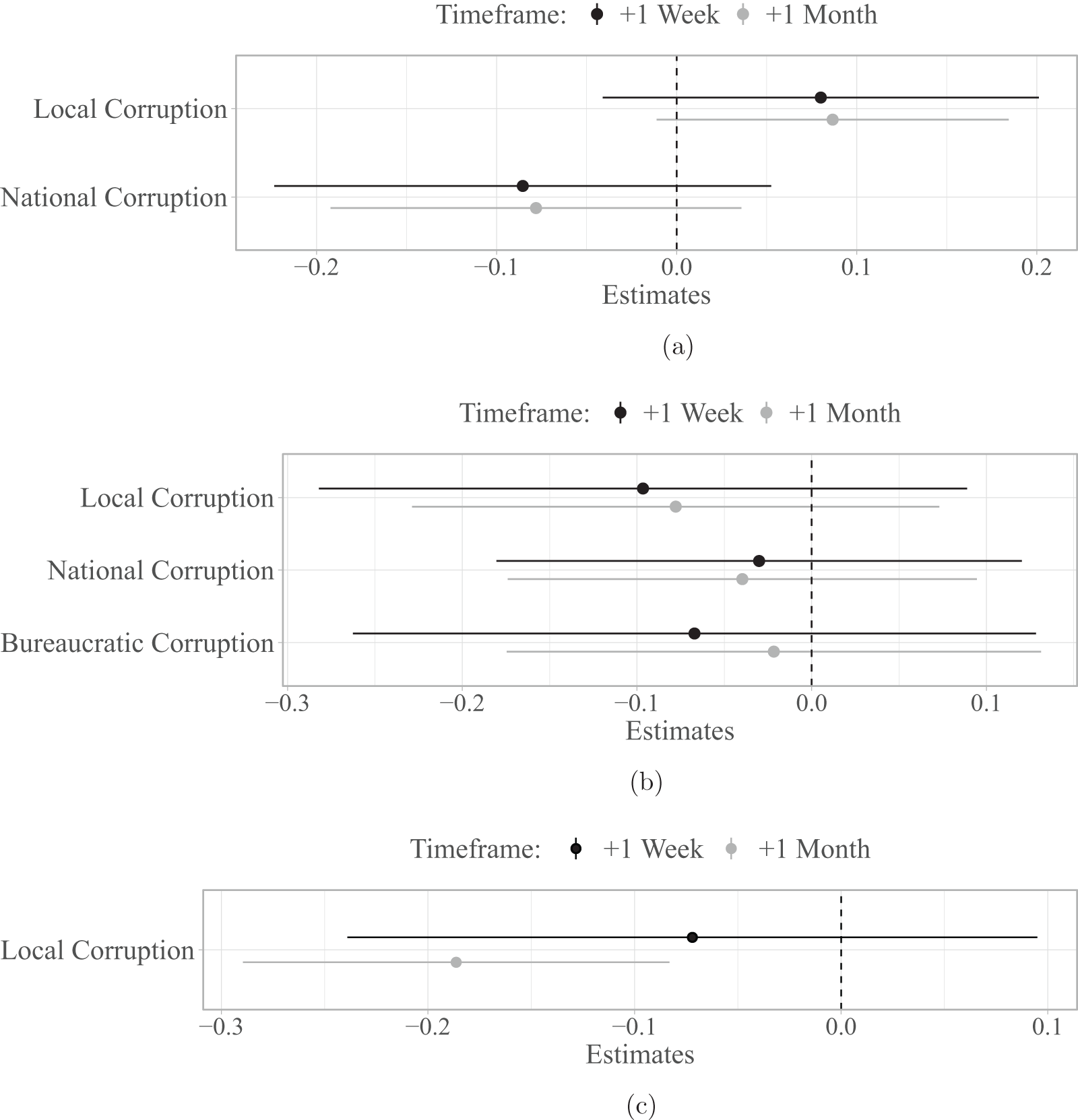
Both the train crash and the vaccine scandal implicated government negligence in oversight, and citizens might suspect that corruption played a role in causing safety failures. However, it does not appear that these crises negatively shaped respondents’ perception of corruption (Figure 2).Footnote 10 Figure 2a shows that following the train crash, respondents’ perceived corruption increased at the local level and decreased at the national level, but the estimates do not reach statistical significance. Figure 2b also shows no evidence that respondents’ perceptions of corruption worsened at either the local or national level following the vaccine scandal. The findings suggest that citizens’ trust in government can shift independently of their perceptions of political problems, such as corruption.
Effect on Perceptions of Corruption. (a) The 2011 Bullet Train Crash. (b) The 2018 Vaccine Scandal. (c) The 2008 Wenchuan Earthquake.

Figure 2 Long description
Timeframe: plus 1 Week, plus 1 Month. Two rows are labeled Local Corruption and National Corruption. The horizontal axis is labeled Estimates, with tick labels minus 0.2, minus 0.1, 0.0, 0.1, 0.2. A vertical dashed reference line is at 0.0. For Local Corruption, the plus 1 Week point is near 0.08 with a horizontal interval extending to about 0.20 on the right and to just below 0.0 on the left. The plus 1 Month point is near 0.09 with a horizontal interval extending to about 0.18 on the right and to about minus 0.03 on the left. For National Corruption, the plus 1 Week point is near minus 0.08 with a horizontal interval extending to about 0.05 on the right and to about minus 0.22 on the left. The plus 1 Month point is near minus 0.07 with a horizontal interval extending to about 0.03 on the right and to about minus 0.20 on the left. The image B showing Timeframe: plus 1 Week, plus 1 Month. Three rows are labeled Local Corruption, National Corruption and Bureaucratic Corruption. The horizontal axis is labeled Estimates, with tick labels minus 0.3, minus 0.2, minus 0.1, 0.0, 0.1. A vertical dashed reference line is at 0.0. For Local Corruption, the plus 1 Week point is near minus 0.10 with a horizontal interval extending to about 0.08 on the right and to about minus 0.28 on the left. The plus 1 Month point is near minus 0.08 with a horizontal interval extending to about 0.07 on the right and to about minus 0.24 on the left. For National Corruption, the plus 1 Week point is near minus 0.03 with a horizontal interval extending to about 0.12 on the right and to about minus 0.17 on the left. The plus 1 Month point is near minus 0.03 with a horizontal interval extending to about 0.11 on the right and to about minus 0.16 on the left. For Bureaucratic Corruption, the plus 1 Week point is near minus 0.06 with a horizontal interval extending to about 0.13 on the right and to about minus 0.26 on the left. The plus 1 Month point is near minus 0.02 with a horizontal interval extending to about 0.13 on the right and to about minus 0.17 on the left. The image C showing Timeframe: plus 1 Week, plus 1 Month. One row is labeled Local Corruption. The horizontal axis is labeled Estimates, with tick labels minus 0.3, minus 0.2, minus 0.1, 0.0, 0.1. A vertical dashed reference line is at 0.0. The plus 1 Week point is near minus 0.07 with a horizontal interval extending to about 0.10 on the right and to about minus 0.22 on the left. The plus 1 Month point is near minus 0.19 with a horizontal interval extending to about minus 0.05 on the right and to about minus 0.30 on the left. Notes: Lines are 95 percent confidence intervals.
There are several explanations for the null finding on corruption perception. First, while the government was responsible for both crises, there were no direct links that proved actual corruption caused by the government, at least during the initial phase of the events. In the absence of firm evidence, citizens did not update their perceptions of corruption. Second, propaganda may have been effective in deflecting responsibility away from systemic problems such as corruption (Chen, Reference Chen2023). Third, before the crises, citizens were aware of corruption through publicized anti-corruption campaigns as well as personal experiences (Wang and Dickson, Reference Wang and Dickson2022). Their prior beliefs about corruption were established before the crises. While the analysis cannot estimate the intensity of preference falsification, it is unlikely that respondents were willing to lower their political trust but hesitant to acknowledge corruption problems.
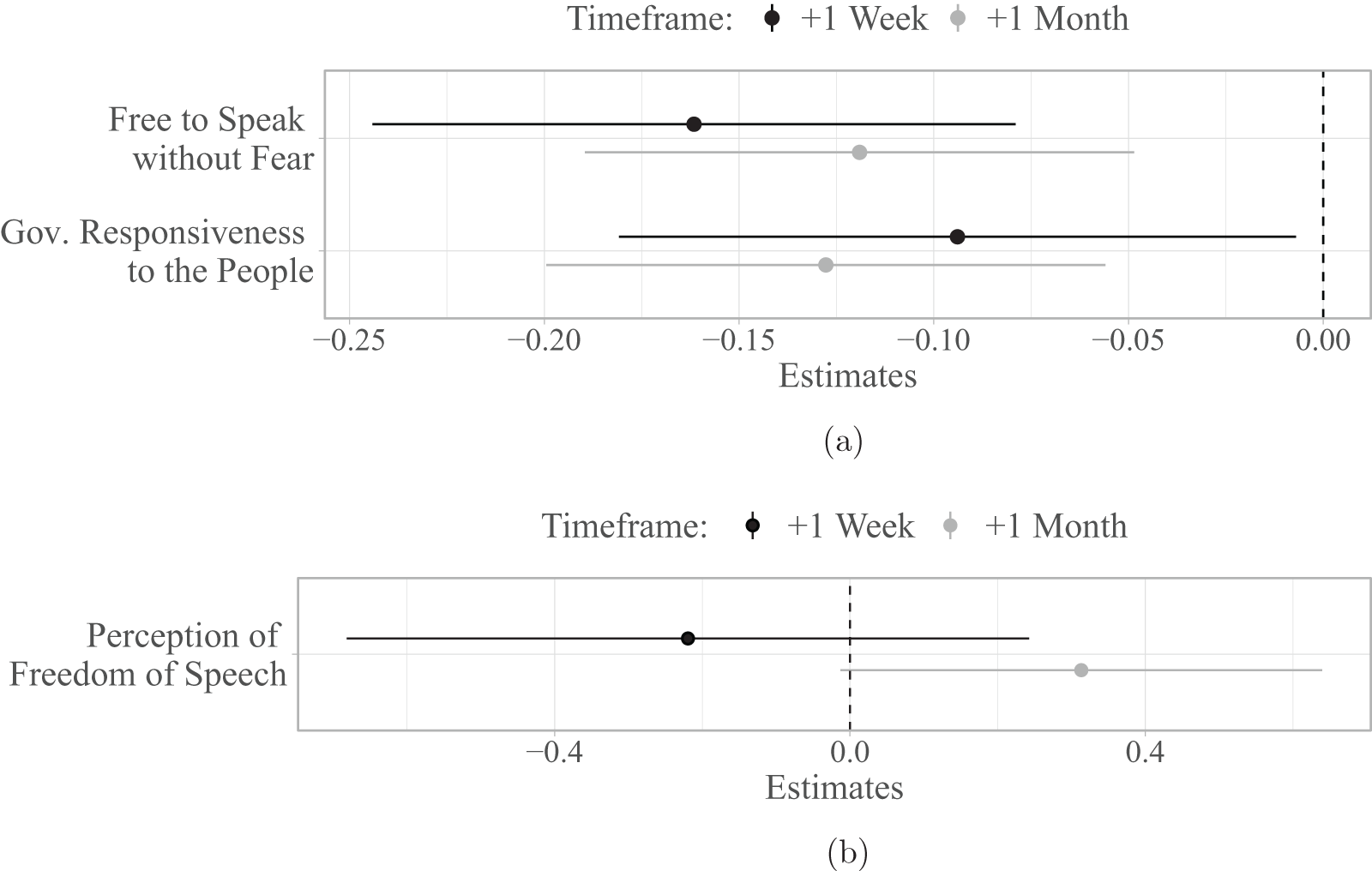
Managing public opinion is an important aspect of crisis response, as citizens seek clarifications and accountability (Chen, Reference Chen2023). The questions in the Asian Barometer Survey allow me to examine citizens’ perceptions of free expression during the train crash (Appendix B.3). Figure 3a shows that post-incident respondents reported lower satisfaction with free speech and government responsiveness, while Figure 3b indicates that respondents’ perceptions of free speech did not decline during the Wenchuan earthquake. Supplementary Appendix Figure C1 reports average causal mediation effects of perceptions of expression. The estimates should be interpreted as suggestive because the mediator is measured after the incident, and the analysis cannot rule out post-treatment bias, since a decline in trust may lead to more negative evaluations of expression. With this caution, the estimated mediation effects are statistically significant and smaller than the estimated average direct effects (Tingley et al., Reference Tingley, Yamamoto, Hirose, Keele and Imai2014), a pattern consistent with the theoretical expectation that perceptions of government responsibility are the primary mechanism and perceptions of expression a secondary one. The findings suggest that respondents’ dissatisfaction is in part associated with information control during the crisis, and the next section discusses the broader implications.
Effect on Perceptions of Free Expression. (a) The 2011 Bullet Train Crash. (b) The 2008 Wenchuan Earthquake.

Figure 3 Long description
A dot and interval plot with the heading text, Timeframe: plus 1 Week and plus 1 Month. Two rows are labeled, Free to Speak without Fear and Gov. Responsiveness to the People. The horizontal axis label is, Estimates, with tick labels minus 0.25, minus 0.20, minus 0.15, minus 0.10, minus 0.05 and 0.00. A vertical dashed reference line is at 0.00. For Free to Speak without Fear, the plus 1 Week point is at about minus 0.16 with a horizontal interval spanning roughly from minus 0.24 to minus 0.08 and the plus 1 Month point is at about minus 0.12 with an interval spanning roughly from minus 0.19 to minus 0.05. For Gov. Responsiveness to the People, the plus 1 Week point is at about minus 0.09 with an interval spanning roughly from minus 0.18 to minus 0.01 and the plus 1 Month point is at about minus 0.13 with an interval spanning roughly from minus 0.20 to minus 0.06. The image B showing a dot and interval plot with the heading text, Timeframe: plus 1 Week and plus 1 Month. One row is labeled, Perception of Freedom of Speech. The horizontal axis label is, Estimates, with tick labels minus 0.4, 0.0 and 0.4. A vertical dashed reference line is at 0.0. The plus 1 Week point is at about minus 0.22 with a horizontal interval spanning roughly from minus 0.70 to 0.20. The plus 1 Month point is at about 0.30 with a horizontal interval spanning roughly from minus 0.10 to 0.60.
5.3. Robustness
Bertoli et al. (Reference Bertoli, Jakli and Pascoe2024) discuss four types of biases in the “unexpected event during survey design” (Muñoz et al., Reference Muñoz, Falcó-Gimeno and Hernández2020). Because of the nature of those safety crises, anticipation bias can be reasonably ruled out. To mitigate the threat of demographic bias between pre- and post-incident respondents, the analysis applies the entropy balancing method to create a more balanced sample between the control and treatment groups based on their demographic covariates. In all three cases (Supplementary Appendix Figures C3, C5, and C8), the estimates from the weighted samples are similar to the main results.
In the analysis of the vaccine scandal and the Wenchuan earthquake, the main model specifications include province fixed effects to account for demographic factors that are correlated with regional characteristics. The trade-off is a smaller sample size, as not every province was sampled both before and after the incident. Excluding province fixed effects does not change the results (Supplementary Appendix Figures C6 and C9). While province fixed effects are not available in the analysis of the bullet train crash, restricting the bandwidth of the control group to one week before the incident does not change the results (Supplementary Appendix Figure C2).
As shown in Supplementary Appendix Figure C11, no evidence suggests that interview quality was different between pre- and post-incident respondents in any of the three cases. If the incidents did not systematically alter how individuals answered surveys, then the comparisons between pre- and post-incident responses would cancel out potential biases in survey responses. The analysis also includes model specifications with a linear time trend to control for temporal factors, such as weather. Supplementary Appendix Figures C4, C7, and C10 show consistent results, which mitigates the concern of temporal bias.
6. Discussion
Information control is neither causal responsibility nor treatment responsibility because it aims at shaping narratives and managing attribution rather than providing direct crisis relief. Through everyday experiences, citizens are familiar with some methods of social control, such as propaganda and censorship. They may perceive them as neutral or positive under justifiable circumstances (Pan et al., Reference Pan, Xu and Yiqing2024; Yang, Reference Yang2024a, Reference Yang2024b), and research shows that information control strategies are effective in shaping favorable public opinion toward the regime (Roberts, Reference Roberts2020; Xu et al., Reference Xu, Kostka and Cao2022; Carter and Carter, Reference Carter and Carter2023).
To contain heightened public attention during crises, the state often exerts greater control over information, while the public seeks updates and wants to understand the causes and aftermath of events. Restricting information under such circumstances can trigger reactance, as individuals perceive their safety or freedom is threatened (Brehm and Brehm, Reference Brehm and Brehm2013), so a sudden increase in the intensity of information control may backfire (Hobbs and Roberts, Reference Hobbs and Roberts2018). Although information control is a secondary source of changes in trust following a safety incident, it can amplify uncertainty during emergencies and exacerbate negative public response. Yang and Zhu (Reference Yang and Zhu2025) provide direct evidence of these limits, showing that inconsistent state messaging during COVID-19 lowered public perceptions of the government’s response. Public skepticism of propaganda may grow as political trust declines (Huang et al., Reference Huang, Intawan and Nicholson2024).
Furthermore, in the absence of clear censorship rules, institutions that monitor public opinion, including lower-level governments and social media platforms, tend to be risk-averse and censor all discussions that relate to the event, which might pose a risk to social stability (Roberts, Reference Roberts2020). This strict approach leads to over-censorship, which prevents collective actions at the expense of constructive civic engagement, as citizens seek information, share updates, and hope to contribute to disaster relief (Bondes and Schucher, Reference Bondes and Schucher2014).
The government’s tendency to passively manage public opinion during crises may pose a risk for social stability in the long term. To divert attention and let the event fade from public attention, authorities may minimize communication and withhold information. A persistently underinformed public will grow skeptical about the severity of future events, increasing the chance of overreaction. Rumors may lead to social chaos, such as the panic buying of salt after the Fukushima nuclear disaster in 2011 and again after the release of treated radioactive water in 2023. Research on participatory governance shows that citizens in both democratic and authoritarian regimes are more satisfied with political processes and outcomes when they are involved (Verba et al., Reference Verba, Schlozman and Brady1995; Truex, Reference Truex2016; Gueorguiev, Reference Gueorguiev2021). When citizens feel alienated from the decision-making process, they are more likely to be disappointed with how the government responds to the crisis (Guriev and Treisman, Reference Guriev and Treisman2020), which highlights the role of civic participation in shaping citizens’ perception of the regime’s legitimacy.
The tension between the state and societal forces creates a dilemma in crisis management in authoritarian countries. Urbanization and industrialization have diversified governance needs, requiring greater coordination from the government (Perrow, Reference Perrow2011). The government needs to collaborate with the social sector to prepare for and mitigate crises. However, extracting the potential of societal forces requires space for civic participation, a trade-off for the government (Gao, Reference Gao2020; Hasmath et al., Reference Hasmath, Hildebrandt, Teets, Hsu and Hsu2022).
7. Conclusion
This study shows that citizens in authoritarian regimes can blame the government for safety failures when they identify responsibility. Low-information environments prompt citizens to seek alternative proxies and draw on personal experiences in making retrospective evaluations. While this study focuses on incidents in China, the findings are relevant to other contexts where governments influence public perceptions through information control. Many authoritarian and democratic regimes are involved in public works and crisis management, making safety issues a fruitful area for comparative analysis (Healy and Malhotra, Reference Healy and Malhotra2009; Landry and Stockmann, Reference Landry and Stockmann2009).
Citizens’ ability to attribute blame has implications for authoritarian stability. On the one hand, identifying government responsibility facilitates coordination among citizens to find a target for grievances. Such collective action poses a threat to regime stability in the short run (Javeline, Reference Javeline2009). However, public pressure can be a source of political accountability, forcing the regime to respond (Chen et al., Reference Chen, Pan and Xu2016; Distelhorst and Hou, Reference Distelhorst and Hou2017). If the regime can adapt or meet public demands and improve governance, it will strengthen its durability in the long run. Thus, informed retrospective evaluations are likely to have mixed effects on authoritarian stability.
A limitation of this study is that it does not offer a precise relationship between causal responsibility and treatment responsibility. While government responsibility in real-world crises is mixed, experiments can disentangle its role in crisis prevention, preparedness, and response, as well as explore how citizens evaluate policy trade-offs and respond to state messaging (Gilens et al., Reference Gilens, Mendelberg and Short2024). As a future direction, experimental designs can hold crisis type and subsequent development constant and manipulate one variable at a time to detect possible interactions between state causality and treatment responsibility. In addition to national crises, studies could examine safety incidents at the subnational level to observe how citizens assign responsibility to relevant actors, as well as whether such events shape citizens’ policy preferences (Hou and Quek, Reference Hou and Quek2019).
In China and other developing countries, citizens’ conceptions of government vary based on their experiences with state institutions, leading to wide variation in how they differentiate among politicians, bureaucrats, government agencies, and levels of government (Grossman and Slough, Reference Grossman and Slough2022). A more complete understanding of these conceptions in local contexts is a first step toward studying attribution. The interaction between urban bias and safety incidents is another promising direction for future research, as China continues to urbanize and has begun to transition from infrastructure expansion to maintenance, while land finance has been largely exhausted at the local level and regional variation in the quality of governance persists.
Acknowledgements
For helpful comments, I thank Alex Lee, Bethany Lacina, Mayya Komisarchik, Jidong Chen, Jamie Druckman, Karl Kaltenthaler, Jingran Yang, participants at MPSA 2026 and APSA 2026, the editors, and the reviewers.
Declaration of interests
None.
Funding statement
None.
Supplementary material
The supplementary material for this article can be found at https://doi.org/10.1017/psrm.2026.10133.




 Open access

