Multiple and lengthy deployments to the recent Middle East conflicts are associated with adjustment problems for military personnel (Brown, Williams, Bray, & Hourani, Reference Brown, Williams, Bray and Hourani2012; Milliken, Auchterlonie, & Hoge, Reference Milliken, Auchterlonie and Hoge2007) and their nondeployed family members (Gewirtz, McMorris, Hanson, & Davis, Reference Gewirtz, McMorris, Hanson and Davis2014; Lester et al., Reference Lester, Peterson, Reeves, Knauss, Glover, Mogil and Beardslee2010). This has led to the development and evaluation of family-based interventions to promote individual members’ adjustment and to improve family functioning (Monson, Taft, & Fredman, Reference Monson, Taft and Fredman2009; Saltzman et al., Reference Saltzman, Lester, Beardslee, Layne, Woodward and Nash2011). Using a randomized control trial design and intent-to-treat analyses, recent reports indicate the parenting intervention, After Deployment: Adaptive Parenting Tools (ADAPT; Gewirtz, Pinna, Hanson, & Brockberg, Reference Gewirtz, Pinna, Hanson and Brockberg2014), improves postdeployment parenting skills and enhances child as well as parental adjustment for families of National Guard and Reserve service members deployed to Operation Enduring Freedom (OEF), Operation Iraqi Freedom (OIF), and Operation New Dawn (OND; DeGarmo & Gewirtz, Reference DeGarmo and Gewirtz2018; Gewirtz, DeGarmo, & Zamir, Reference Gewirtz, DeGarmo and Zamir2016, Reference Gewirtz, DeGarmo and Zamir2018; Piehler, Ausherbauer, Gewirtz, & Gliske, Reference Piehler, Ausherbauer, Gewirtz and Gliske2016; Zhang, Zhang, Gewirtz, & Piehler, Reference Zhang, Zhang, Gewirtz and Piehler2018).
Prior publications have focused on behavioral changes to the family (e.g., couple parenting) as a result of ADAPT, with recent papers beginning to examine changes in emotional processes and intervention moderators. This report examines the effects of ADAPT on fathers in particular, focusing on program effects on deployed fathers’ expression and management of emotional distress during father–child interactions and how these may be related to their parenting practices and their children's internalizing symptoms. This focus is important for two reasons. First, military fathers’ management of distress associated with combat-related trauma is central to their own adjustment and to reestablishing constructive father–child relationships after deployment (DeGarmo, Reference DeGarmo, Gewirtz and Youssef2016; Walsh et al., Reference Walsh, Dayton, Erwin, Muzik, Busuito and Rosenblum2014). Second, children may experience and display elevated emotional distress during the postdeployment period as a result of their father's absence and threats to his safety during deployment, as well as the challenges of reestablishing a relationship with their fathers (Creech, Hadley, & Borsari, Reference Creech, Hadley and Borsari2014).
Channeling the work and the spirit of the late Tom Dishion, to whom this Special Issue is dedicated, we use multiple methods and informants, including observed parent–child interactions, to understand the impact of a preventive intervention on families. Dishion made extensive contributions to both prevention science and developmental psychopathology, and his influence is evident in this paper. In addition to his extensive prevention research on the Oregon model of behavior family therapy (e.g., Family Check-Up; Dishion & Stormshak, Reference Dishion and Stormshak2007), Tom Dishion developed family and peer interactions and coding systems to understand the transmission and origins of coercive family process. In this article we focus on a different kind of disruptive family process: foundational attentional processes vulnerable to disruptions due to parental emotion regulation difficulties. We draw from Dishion's work, as well as the work of his—and our—close collaborator and late colleague James Snyder. In a jointly edited recent volume on coercive relationship dynamics (Snyder & Dishion, Reference Snyder, Dishion, Dishion and Snyder2016) Snyder linked coercion to deficits in the development of child self-regulation (Snyder, Reference Snyder, Dishion and Snyder2016, p. 101). In this paper, we focus on parents’ emotion regulation deficits in relation to their capacity to manage and respond to children's distress. Using, in part, coding schemes and interactions developed by both Dishion (parental monitoring, a core effective parenting practice) and Snyder (distress avoidance), we examine how fathers’ baseline emotion regulation difficulties might magnify or limit the impact of a behavioral parent training intervention for military families on fathers’ subsequent distress avoidance with children, their parenting practices, and their children's internalizing symptoms.
The ADAPT intervention is a modification of the empirically supported Parent Management Training—Oregon model (now known as GenerationPMTO; Forgatch & Gewirtz, Reference Forgatch, Gewirtz, Weisz and Kazdin2017) to enhance parenting skills with adaptations designed to meet the unique needs of service members and their families following deployment (Gewirtz, Pinna, et al., Reference Gewirtz, Pinna, Hanson and Brockberg2014). These adaptations included an explicit focus on fostering parents’ emotion regulation skills by enhancing parent mindfulness (Bishop et al., Reference Bishop, Lau, Shapiro, Carlson, Anderson, Carmody and Devins2004) as a personal and parenting resource, and emotion coaching skills to enhance sensitivity and responsiveness to children's emotions (Gottman, Katz, & Hooven, Reference Gottman, Katz and Hooven1996). While the focus and impact of the ADAPT intervention is family-wide, this report examines how fathers’ emotion regulation difficulties might influence for whom ADAPT has its most beneficial effects on parenting, how fathers’ responses to their children's emotional distress (i.e., distress avoidance behaviors) may mediate the beneficial effects of ADAPT on military fathers’ postdeployment parenting practices, and how parenting links to children's internalizing symptoms.
Distress Avoidance and Effective Parenting
The critical role of effective parenting (e.g., limit setting, skill encouragement, positive involvement, monitoring, and problem solving) in promoting children's development and adjustment is well supported by both longitudinal and randomized control trial prevention/intervention research (Forgatch & Gewirtz, Reference Forgatch, Gewirtz, Weisz and Kazdin2017; Forgatch & Rodríguez, Reference Forgatch, Rodríguez, Dishion and Snyder2016). Effective parenting is built on parents’ capacity for sustained attention and adeptly timed responses to children's behavior, needs, and emotions. These foundational attentional processes are reflected in parents’ moment-to-moment responses to child affect and behavior, and can be easily disrupted when children display strong negative emotions. Constructive responses to children's negative emotion arousal depends on parents’ capacity to regulate their own behavior, distress, and negative emotions. Disruption or breakdown in these foundational processes have been extensively described in research on coercive interactions (Patterson, Reference Patterson1982; Snyder & Dishion, Reference Snyder, Dishion, Dishion and Snyder2016). Coercive interactions entail reciprocal exchanges of aversive behavior, engendering sustained conflicts that escalate in intensity, fueled by parent and child irritability and anger and sustained by negative reinforcement. Coercive parent–child interactions reflect a breakdown in parent emotion regulation and a reliance on overlearned automatic responding, which undermine and disrupt effective parenting.
Disruptions in parental attention and emotion regulation in response to children's aversive behavior and negative emotions may also be reflected in avoidant tactics (Brockman et al., Reference Brockman, Snyder, Gewirtz, Gird, Quattlebaum, Schmidt and DeGarmo2016), and these avoidant tactics may similarly undermine and disrupt effective parenting. Distress avoidance occurs when parents minimize or dismiss children's displays of negative emotion in order to avoid or reduce parents’ own emotional arousal. Child distress may be emotionally arousing for the parent and lead to efforts to diminish or deflect that distress by rapid soothing, distraction, comforting, reassurance, and attempts to “fix” or alter the child's emotional experience. These parent responses reflect a fusion of the child's emotions with the parent's own emotions (Snyder et al., Reference Snyder, Low, Bullard, Schrepferman, Wachlarowicz, Marvin, Reed, Larzelere, Morris and Harrist2013) and are accompanied by a vigilant and wary approach to family interaction based on the belief that negative emotions are dangerous and need to be controlled, altered, or assuaged (Gottman et al., Reference Gottman, Katz and Hooven1996). Parents’ distress avoidance is functional in the short term in that it may avoid or diminish their own negative affective arousal as well as that of their child.
Previous research provides some evidence for parents’ use of distress-avoidant tactics in response to child negative emotion arousal and display. Snyder et al. (Reference Snyder, Low, Bullard, Schrepferman, Wachlarowicz, Marvin, Reed, Larzelere, Morris and Harrist2013) identified a factor independent of coercion derived from parent reports of how they would respond to child negative affect that involved rapid comforting and acquiescence, similar to distress avoidance. This factor was reliably associated with parent reports of their own anxiety, worry, and sadness. Using sequential analyses of parent–child interaction, Snyder et al. (Reference Snyder, Low, Bullard, Schrepferman, Wachlarowicz, Marvin, Reed, Larzelere, Morris and Harrist2013) also identified parental distress-avoidant responses that involved efforts to minimize, fix, or alter their child's negative emotion displays. These responses were associated with less effective parenting (e.g., positive involvement and monitoring) and with teacher, parent, and peer reports of child adjustment problems over a subsequent 2-year period, although the associations were modest. Theoretically, parents who exhibit distress-avoidant responses are likely to score low on both responsiveness and demandingness. Because they tend to be overwhelmed by their own anxiety and distress, they may focus their effort on downregulating their own negative emotions and do poorly in monitoring children's behaviors, setting limits and expectations, and staying engaged with children (Snyder et al., Reference Snyder, Low, Bullard, Schrepferman, Wachlarowicz, Marvin, Reed, Larzelere, Morris and Harrist2013). Research has also described parent responses to child anxiety displays similar to distress avoidance. For example, parents of children with anxiety problems have been observed to attempt to control how children should feel, to provide excessive reassurance in response to child distress, and to collude with the child to avoid distressing situations. These responses simultaneously provide parents relief from their own and their child's distress (Crowley & Silverman, Reference Crowley, Silverman, Dishion and Snyder2016; Tiwari et al., Reference Tiwari, Podell, Martin, Mychailyszyn, Furr and Kendall2008).
Research on responses to others’ distress in personality and social psychology are also congruent with the notion of distress-avoidant responding. Bateson, O'Quin, Fultz, Vanderplas, and Isen (Reference Batson, O'Quin, Fultz, Vanderplas and Isen1983) and Davis (Reference Davis1980) identified three distinct types of responses to others’ distress. The first, empathy, is characterized by compassion, warmth, and sympathy, and is associated with altruistic motivation to help. The second, perspective taking, entails understanding of others’ distress without emotional fusion with that distress. The third type of response, personal distress, is characterized by being disturbed, worried, and upset by the others’ suffering, and is associated with high arousal and egoistic motivation to escape or avoid the situation, similar to distress avoidance. Recent neurobiological evidence suggests a shared brain mechanism underlying both the perception of others’ pain and painful experiences by the self, yet a distinction between the self and others is essential for empathic social interaction without personal distress (Decety & Lamm, Reference Decety, Lamm, Decety and Ickes2009). Furthermore, emotion regulation is particularly helpful in modulating one's responses to others’ pain when their distress is perceived as overwhelming.
Central roles of dysregulation and distress avoidance in military families following deployment
The experience, display, and regulation of emotions in general, and emotional distress in particular, are likely to be salient issues for fathers and children following a father's deployment to war. Military fathers may struggle with frequent emotional arousal related to combat stress, which may contribute to distress-avoidant interactions with children. However, many military families show considerable resilience in the face of challenges posed by the stress related to deployment and postdeployment family reintegration (Park, Reference Park2011). As such, the ADAPT intervention may have its strongest effects for fathers who lack constructive strategies to respond to their own and their children's distress (i.e., who experience greater emotion dysregulation). It is these fathers who likely experience distress when they see their child's negative emotions.
Deployed fathers’ trauma exposure and emotion regulation difficulties
Involvement in combat and exposure to war-related trauma present substantial challenges for individuals and families. The extensive trauma experienced by military service members during the OIF, OEF, and OND conflicts is well documented. A large portion of National Guard and Reserve service members report being targets of hostile fire, serving in units sustaining combat casualties, and seeing severely wounded comrades and dead or wounded civilians (Polusny et al., Reference Polusny, Erbes, Murdoch, Arbisi, Thuras and Rath2011). Exposure to combat-related trauma is prospectively associated with a two- to three-fold increase in risk for posttraumatic stress disorder (PTSD) relative to deployment alone or to nondeployment (Polusny et al., Reference Polusny, Erbes, Murdoch, Arbisi, Thuras and Rath2011; Smith et al., Reference Smith, Ryan, Wingard, Slymen, Sallis and Kritz-Silverstein2007) and PTSD symptoms often persist and increase post-deployment (Smith et al., Reference Smith, Ryan, Wingard, Slymen, Sallis and Kritz-Silverstein2007).
Emotion regulation difficulties are core to PTSD but also predict functional impairments in trauma-exposed individuals over and above PTSD symptoms (Cloitre, Miranda, Stovall-McClough, & Han, Reference Cloitre, Miranda, Stovall-McClough and Han2005). As well as compromising service members’ own adjustment, emotion regulation difficulties may be linked to their behavior during family interaction in two ways. First, dysregulation may sustain service members’ PTSD symptoms, evoking reciprocal distress of family members, and creating a vigilant and wary approach to daily interaction. Second, service members’ difficulties managing their own distress may also manifest in response to other family members’ strong emotions, bids for attention, discipline exchanges, and challenges associated with reestablishing parenting and marital roles (Brockman et al., Reference Brockman, Snyder, Gewirtz, Gird, Quattlebaum, Schmidt and DeGarmo2016). In this manner, the social responses of family members become mutually entrained, evoking frequent emotional arousal and attempts to diminish that arousal using distress-avoidant responses. While potentially adaptive in reducing one's own and others’ emotional distress in the short term, the continued use of distress avoidance may maintain distress over the longer term (Kumpula, Orcutt, Bardeen, & Varkovitzky, Reference Kumpula, Orcutt, Bardeen and Varkovitzky2011), interfering with service members’ capacity to constructively engage other family members (Gewirtz, Erbes, Polusny, Forgatch, & Degarmo, Reference Gewirtz, Erbes, Polusny, Forgatch and Degarmo2011).
Child emotional distress and father distress avoidance
There is considerable evidence that parental deployment to war zones is associated with children's heightened emotional distress. Parents in military families report that nearly two-thirds of children showed increases in fear and anxiety associated with parental deployment (US Department of Defense, 2010), and this increase in child anxiety is also apparent to school staff (Chandra, Martin, Hawkins, & Richardson, Reference Chandra, Martin, Hawkins and Richardson2010). Deployment length and parent distress also increment children's psychological distress (White, de Burgh, Fear, & Iversen, Reference White, de Burgh, Fear and Iversen2011), including worry, depression, and acute stress reactions (Murphy & Fairbank, Reference Murphy and Fairbank2013).
Children's anxiety and emotional distress likely reflect worry about their deployed parent's safety and well-being, and changes in family roles associated with deployment. This emotional distress may extend into the postdeployment period, reflecting challenges in renegotiating relationships with the previously deployed parent that may be disrupted by military parents’ own trauma-related emotions, thoughts, and memories (McFarlane, Reference McFarlane2009). For example, among OEF/OIF/OND service members referred for mental health evaluation, avoidance and numbing symptoms of PTSD were associated with children's fear of and emotional distance from the military parent during postdeployment (Sayers, Farrow, Ross, & Oslin, Reference Sayers, Farrow, Ross and Oslin2009).
Thus, fathers experiencing higher levels of emotion dysregulation and responding to child emotional arousal with distress avoidance may also inadvertently shape and maintain their children's internalizing difficulties (Tiwari et al., Reference Tiwari, Podell, Martin, Mychailyszyn, Furr and Kendall2008). Similarly, low levels of parent awareness, acceptance, and coaching of children's negative emotions are related to lower children's awareness, acceptance, and regulation of their own emotions (Hunter et al., Reference Hunter, Katz, Shortt, Davis, Leve, Allen and Sheeber2011).
Fathers’ inability to effectively respond to children's emotional distress (i.e., distress avoidance) also is likely to short circuit or diminish parenting practices (i.e., the ability to set limits, discipline, and problem solve, and to respond constructively to children's bids for attention and instrumental assistance). Distress-avoidant responses likely undermine effective parenting, which at a basic level, entails a willingness to patiently and nonreactively engage the child when dealing with emotionally hot issues, challenging behaviors, and insistent bids for attention.
Hypotheses
Previous analyses of ADAPT baseline data (Brockman et al., Reference Brockman, Snyder, Gewirtz, Gird, Quattlebaum, Schmidt and DeGarmo2016) suggest that a relatively novel social interaction pattern, distress avoidance, characterizes some fathers’ responses to negative child behavior and emotional distress. The first aim of this report is to examine whether the ADAPT program, with its focus on strengthening parental emotion regulation and emotion coaching of children, might be beneficial in reducing fathers’ observed distress avoidance at 12 months, particularly among higher risk fathers (i.e., those reporting high baseline levels of emotion regulation difficulties). The second aim is to examine whether reductions in fathers’ distress-avoidant responses toward their child may be associated with subsequent reductions in children's internalizing symptoms. The third aim is to examine whether reductions in distress avoidance index improvements to observed parenting practices (i.e., discipline, problem solving, monitoring, skill encouragement, and positive involvement), and whether parenting practices, in turn, are associated with reductions in child internalizing symptoms.
We examined ADAPT intervention effects, incorporating a theory-driven moderator likely to be associated with intervention effects on distress avoidance: fathers’ emotion regulation difficulties. We hypothesized that the ADAPT intervention would have its strongest effects for fathers who displayed higher levels of emotion dysregulation at baseline. This moderated mediation intervention model also incorporated fathers’ distress avoidance as a mediator of treatment effects on children's internalizing symptoms, and on fathers’ behavioral parenting practices.
Method
Participants
This study focused on a subset of the families who participated in a randomized controlled trial of the ADAPT program. The original study included 336 National Guard or Reserve military families with N = 282 fathers, in which at least one parent had been deployed to the OIF/OEF/OND conflicts with at least one target child aged between 4 and 13 years. The current sample was part of a secondary NIH-funded study to recode and examine father–child interactions in a subset of families (N = 181 families) of male service members with nondeployed spouses. The men were primarily White, non-Hispanic (87.8%), an average of 37.76 years old (SD = 6.43), relatively well educated (52.0% completed at least a bachelor's degree), and middle to upper middle class (4.0% reported annual family incomes below $30,000, 25.7% from $30,000 to $60,000, and the remaining 67.3% above $60,000). The mean number of deployments was 2 (SD = 1.13, range = 1–8). Parents reported that 31.7% of the sample were deployed for a total of 1 year or less, 33.9% for 1–2 years, and 34.4% for 2 years or more. The majority of the males were affiliated with the Army National Guard or Army Reserves (74.6%) with the remainder serving in the Air Guard, Air Reserves, Navy Reserves, or other military branches.
The men's wives were a mean of 35.91 years old (SD = 5.72, range = 23–51), and they were married 9.83 years on average (SD = 5.26, range = 1–26). Target children were a mean of 8.43 years old (SD = 2.44, range = 4.15–13.72). A little over half (58%) were in their early elementary years (between 4 and 8 years old), and 42% were in middle childhood or early adolescence (age 9–13 years). Almost half (53.7%) were girls. The mean number of children in the families was 2.39 (SD = 0.87, range = 1–5).
The current sample (n = 181) was compared to the remainder of the postdeployed fathers who were left out from this study (n = 101) on baseline demographics and study variables. Three statistically significant differences were detected. Fathers who were included in the current sample exhibited less effective behavioral parenting (M = 2.20, SD = 0.42) than those who were not (M = 2.48, SD = 0.44), F (1, 262) = 25.26, p < .001. The current sample also reported significantly less exposure to combat (M = 8.72, SD = 7.55) than the remainder of the larger sample (M = 10.93, SD = 7.81), F (1, 272) = 5.18, p < .05. In addition, fathers in the current sample exhibited fewer PTSD symptoms (M = 28.72, SD = 10.86) measured with the Post-Traumatic Stress Checklist—Military version (Weathers, Litz, Herman, Huska, & Keane, Reference Weathers, Litz, Herman, Huska and Keane1993) than the remainders (M = 32.65, SD = 14.69), F (1, 274) = 6.35, p < .05). The differences are likely due to the fact that the most recent large deployment of the Minnesota National Guard, though it was considered a combat mission, involved relatively little combat exposure (the brigade was based in Kuwait and entered Iraq only to bring out heavy US Army equipment in service of the US military's withdrawal).
Procedure
The ADAPT program was specifically designed to meet the postdeployment needs of service members deployed to OIF/OEF/OND, and their families (Gewirtz, McMorris, et al., Reference Gewirtz, Pinna, Hanson and Brockberg2014). Participants were recruited via presentations at mandatory predeployment and reintegration events for National Guard and Reserve personnel in Minnesota, by mailings from the Minneapolis Veterans Affairs Medical Center to all OIF/OEF/OND veterans, at family picnics for individual units, at general community events for and by the military, by announcements in fliers and media, by social media, and by word of mouth, with active support of key military leaders. Participation in the research was voluntary, and all study procedures were approved by the institutional review board.
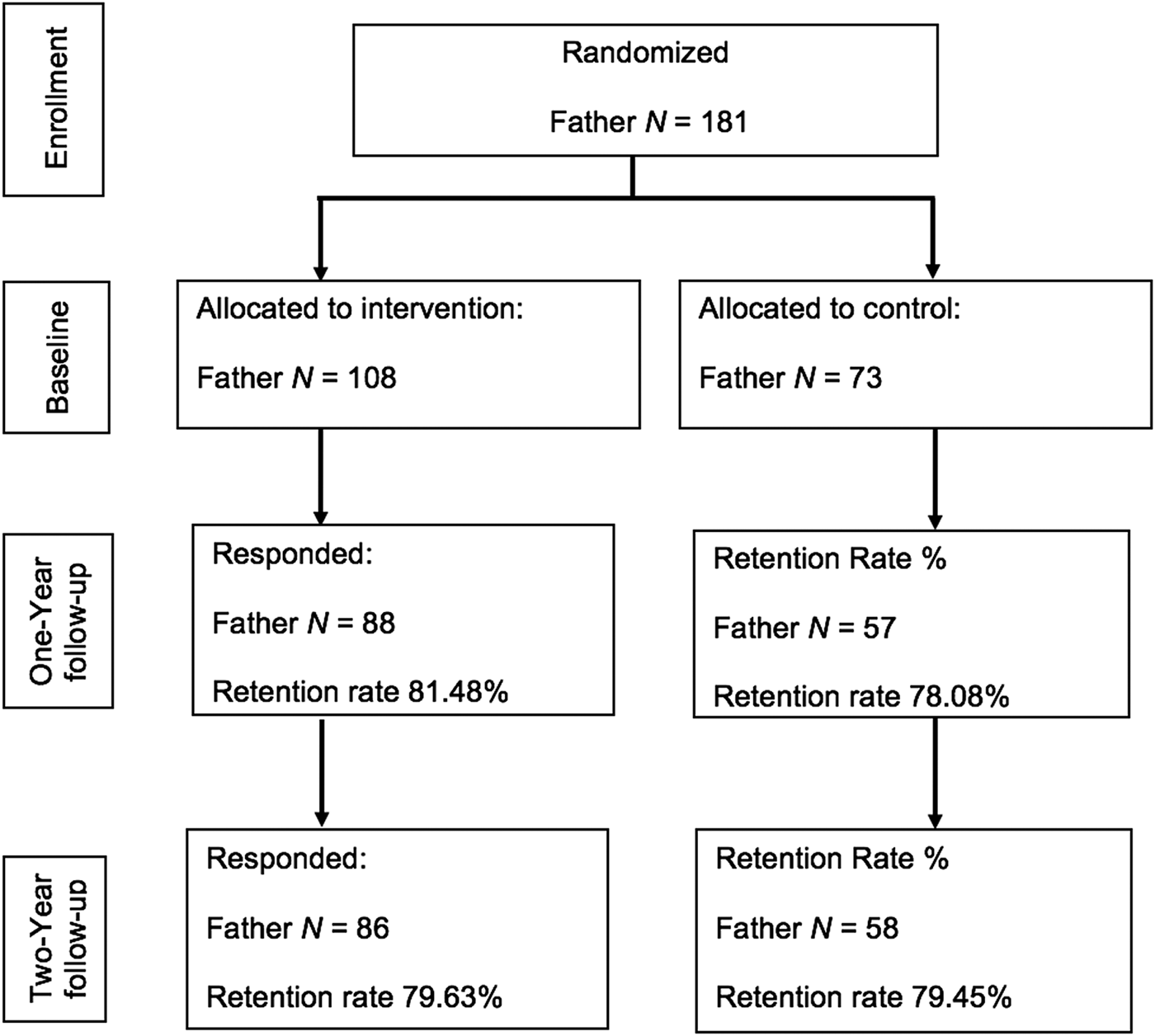
Interested families could go directly online to consent to participate or do so after contacting program staff. Consenting participants and their partners were directed to a web site to complete initial online assessments. After completion of the online assessments at baseline and again at 12 and 24 months after baseline, project staff scheduled an in-home assessment with family members during which additional self-report data were collected and video records of the interactions among male service members, their spouses/partners, and their child were obtained. Parents each received $25 for the online assessments, and the family received $50 for the in-home assessments. Following the baseline in-home assessment, families were randomized to a services-as-usual condition (printed and online parenting resources such as “tip sheets”; N = 73 for this report) or to the ADAPT group parenting intervention described below, N = 108 for this report). This report uses intent-to-treat (ITT) analysis of longitudinal data collected at three occasions: baseline prior to intervention assignment, 1 year postbaseline, and 2 years postbaseline. See Figure 1, CONSORT chart, for the numbers of families retained at each time point in each condition.
A CONSORT diagram of the current study.

To check the comparability of the intervention and control groups, differences on baseline demographics and study variables were tested. Only one significant difference was detected: fathers in the intervention group reported having slightly fewer children (M = 2.28, SD = 0.85) than those in the control group (M = 2.57, SD = 0.88), F (1, 173) = 4.48, p < .05. This difference might have occurred by chance due to sampling variability.
Intervention
ADAPT modified the empirically supported Parent Management Training—Oregon (now named GenerationPMTO) model to enhance parenting skills, but with significant adaptations designed to meet the unique needs of service members and contextualized to promote constructive family reintegration following deployment (Gewirtz, Pinna, et al., Reference Gewirtz, Pinna, Hanson and Brockberg2014). ADAPT focuses on improving positive parenting practices including problem solving, skill encouragement, positive involvement, discipline, monitoring, and emotion coaching. Mindfulness practices are infused into each session to strengthen parents’ emotion regulation. Parents learn to recognize and regulate their emotions with awareness and acceptance and effectively respond to children's emotions using emotion coaching strategies, which are taught over several sessions. Each session involves active teaching of skills, practice through role-play, and support through group discussion. Parents are given take-home practice assignments, and midweek phone calls are used to promote success in at-home skill application. An ADAPT website is available for parents who miss sessions, or who want further resources; the website includes videos of the skills taught in the groups, as well as videos showing parents practicing the skills, a PDF summary of the skills, and a short knowledge quiz.
ADAPT was delivered in a community setting to groups of typically 6 to 10 families in 14 weekly 2-hr sessions, supported by child care and a $10 stipend for travel costs. The intervention was led by two to three military and nonmilitary, male and female facilitators who received extensive training prior to implementing the intervention and who received ongoing coaching throughout the study. Fidelity of implementation was monitored via an established system for PMTO that is observationally based via expert ratings of videotapes of each intervention session (Knutson et al., Reference Knutson, Forgatch, Rains and Sigmarsdottir2009). Additional fidelity components were developed for emotion coaching and mindfulness skills.
Measures
Emotion regulation
The Difficulties in Emotion Regulation Scale (Gratz & Roemer, Reference Gratz and Roemer2004) was used to measure fathers’ emotion regulation at baseline. The Difficulties in Emotion Regulation Scale is a multidimensional assessment of one's abilities to use appropriate strategies to modulate emotional responses. It is a 36-item scale consisting of six subscales: nonacceptance, difficulties engaging in goal-directed behaviors, impulse control difficulties, lack of awareness, limited strategies, and lack of clarity. Participants were asked to rate on a 5-point Likert scale (1 = almost never, to 5 = almost always) to indicate how often the items apply to them. The composite score was created with a higher score indicating more difficulties in emotion regulation. The internal consistency of the scale in this sample was α = .94.
Fathers’ and children's behavior during family interaction
Father–child interaction was assessed across a series of videotaped seven 5-min structured dyadic or triadic tasks at baseline, and 1 year and 2 years postbaseline. Parents were asked to discuss and solve a conflict, discuss deployment-related concerns, provide children with help in a game, gather information from the child when parents were not present (i.e., monitoring), and plan a fun family activity with their children (i.e., father–child and mother–father–child). These videotaped observations were coded to define two constructs in the proposed models: fathers’ distress avoidance using the Macro-level Family Interaction Coding System (MFICS; Snyder et al., Reference Snyder, Low, Bullard, Schrepferman, Wachlarowicz, Marvin, Reed, Larzelere, Morris and Harrist2013), and fathers’ effective parenting behaviors using the Family Interaction Tasks global coder ratings (Forgatch & DeGarmo, Reference Forgatch and DeGarmo1999; Gewirtz, DeGarmo, Lee, Morrell, & August, Reference Gewirtz, DeGarmo, Lee, Morrell and August2015; Gewirtz, DeGarmo, Plowman, August, & Realmuto, Reference Gewirtz, DeGarmo, Plowman, August and Realmuto2009). Different individuals served as coders for the MFICS and FITs coding systems. In each case, coders were unaware of the family's treatment assignment, and of which video samples of family interaction were used to assess coder agreement.
Fathers’ distress avoidance during father–child interaction
Observers rated each father's behavior at the end of each of three 5-min tasks using the MFICS: (a) father–child problem solving, (b) father–mother–child problem solving, and (c) father–child conversations about fathers’ (re)deployment. Given the definition of this construct, only stressful tasks involving the child were used to assess distress avoidance; monitoring, play, and teaching tasks were not used. The MFICS is composed of 55 Likert scale items (1 = not true, did not occur, 5 = clearly evident, very descriptive) designed using an a priori, face-valid approach to yield multi-item scales reflecting positive engagement (20 items), withdrawal (18 items), and reactivity-coercion (17 items). A fourth factor, labeled distress avoidance, used in the current analyses emerged during psychometric analyses of the MFICS items (Brockman et al., Reference Brockman, Snyder, Gewirtz, Gird, Quattlebaum, Schmidt and DeGarmo2016; Snyder & Dishion, Reference Snyder, Dishion, Dishion and Snyder2016). Sample items comprising the MFICS distress avoidance scale are “Engages in soothing in response to others’ distress,” “Is fearful or anxious,” “Is wary and tentative,” and “‘walks on eggshells’ to not upset other family members.” The items reflect a combination of minimal validation, rapid soothing and efforts to reassure or deflect the distress of the child, accompanied by fathers’ wariness and low empathy.
Coders were first trained until each reached an item by item κ > .70, later recalculated after psychometric identification of the four MFICS scales as an average scale-level intraclass correlation (ICC) agreement > .70. Biweekly recalibration meetings were used to minimize observer drift and continue training. Coder agreement was assessed for 25% of the family video samples, and coders were unaware of which video samples were used to assess agreement. The average coder agreement for fathers’ distress avoidance as indexed by ICCs was .67 across the three assessment occasions. The scale internal consistency (Cronbach's α) was greater than .75 at all three assessment occasions. A distress avoidance score was calculated separately at the baseline, 1-year, and 2-years postbaseline time points as a mean of the 10 items aggregated across the three interaction tasks.
Fathers’ effective parenting skills
Global ratings of effective parenting behaviors were derived from coding the video records of six father–child interaction tasks (the seventh interaction tasks only included mother and child): two problem-solving tasks, one father–child conversation about fathers’ (re)deployment, one father–mother–child conversation assessing parental monitoring, and two father–mother–child play and teaching tasks. Observers were trained for 60 hr to criterion reliability, and biweekly recalibration meetings were used to minimize observer drift. Twenty percent of the tasks were randomly selected at each assessment occasion to assess interrater reliability, and coders were unaware of which samples were used to assess reliability. Interrater reliability was assessed using ICCs. These ratings of parenting behaviors have been shown to have good construct validity and sensitivity to change in previous research (Forgatch & DeGarmo, Reference Forgatch and DeGarmo1999).
Effective parenting was derived by averaging codes across five parenting domains: positive involvement, skill encouragement, problem solving, harsh discipline (reverse scored), and monitoring at each time point. Alpha coefficient (α) and ICCs are provided for each domain at baseline, 1-year, and 2-year follow-ups. Positive involvement was measured by 10 global rating items measuring parents’ warm, affection empathy, and encouragement during interaction with the child (α > .75; ICCs > .84 across three time points). Skill encouragement was measured using 8 Likert-scale global ratings of the promotion of skill development through contingent encouragement and scaffolding strategies. Sample items included breaks tasks into manageable steps, reinforces success, and prompts appropriate behavior (α > .83; ICCs > .72 across three time points). Problem solving was based on 9 Likert-scale global ratings from the three mother-issue problem-solving tasks. Sample items included solution quality, extent of resolution, and likelihood of follow-through. Scale scores were averaged across tasks (α > .87; ICCs > .88 across three time points). Harsh discipline was measured as the mean of 8 Likert-scale global ratings. Sample items included overly strict, authoritarian, used nagging or nattering, expressed anger, indecisive, and inappropriate discipline (α > .75; ICCs > .78 across three time points). Monitoring comprised four items rated by coders reflecting parents’ skill at supervising the child and knowledge about their children's daily activities (α > .71; ICCs > .74 across three time points).
Child internalizing problems
Child internalizing problems were assessed using items from the Behavioral Assessment Scale for Children (BASC-2; Reynolds & Kamphaus, Reference Reynolds and Kamphaus2006) at baseline and 2 years postbaseline. The parent version (BASC-2-PRS) assesses parents’ evaluations of their child's problem behaviors. Parents rated the frequency of their children's behaviors on a 4-point scale ranging from 0 (never) to 3 (almost always). The measure has established construct validity, and convergent validity with other scales such as the Child Behavior Checklist (Achenbach & Rescorla, Reference Achenbach and Rescorla2001). The scale has good internal consistency and test–retest reliability (Reynolds & Kamphaus, Reference Reynolds and Kamphaus2006). Three age-specific versions of the BASC-2: preschool (aged 5–7), children (aged 8–11), and adolescents (aged 12–18), were used, reflecting the whole range of the children in the study. The internalizing scale was composed of three subscales: depression (e.g., “is sad” or “cries easily”), anxiety (e.g., “worries” or “is fearful,”), and somatization (e.g., “Complains of being sick when nothing is wrong” or “Complains of pain”). Age-normed T score was created for final analysis and mothers’ and fathers’ reports of child internalizing problems (rs = .49–.56) were averaged to create an aggregate measure of child internalizing problems at baseline and 2 years postbaseline.
Covariates
Fathers’ education levels at baseline were coded as 1= some high school or less, 2 = GED, 3 = high school diploma, 4 = some college, 5 = associate's degree, 6 = 4-year college degree, 7 = master's degree, and 8 = doctoral or professional degree. Length of deployment was reported on a scale of 1 to 7 (1 = 6 months or less; 2 = 7~12 months; 3 = 13 ~ 18 months; … ; 6 = 31 ~ 36 months; and 7 = 37 months or more). Years of marriage with current partner was reported as a continuous variable. Child-related covariates were child age group (1 = early elementary between 4 and 8 years, 2 = middle childhood/early adolescence between 9 and 13 years) at baseline, child sex (1 = male; 2 = female), and number of children at baseline.
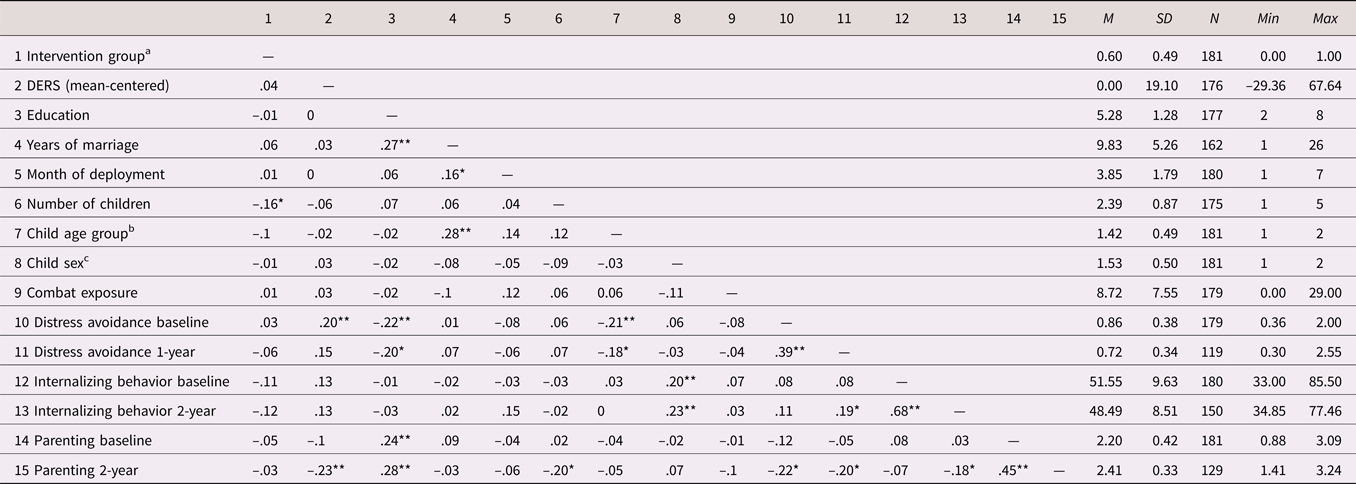
Combat exposure was measured using the Deployment Risk and Resilience Inventory (King, King, Vogt, Knight, & Samper, Reference King, King, Vogt, Knight and Samper2006). Participants were asked to endorse 15 items regarding their combat experience, as well as 15 items regarding their aftermath of battle experience (Yes = 1, No = 0). The items of the combat experience subscale include “I went on combat patrols or missions,” “I was in a vehicle (for example, a truck, tank, APC, helicopter, plane, or boat) that was under fire,” and “I fired my weapon at the enemy.” The items of the aftermath of battle subscale include “I observed homes or villages that had been destroyed,” “I saw enemy soldiers after they had been severely wounded or disfigured in combat,” and “I saw the bodies of dead Americans or allies.” In the current study, the internal reliability (Cronbach's α) was .88 for combat experience and .91 for aftermath of battle. A composite score of the two subscales was used such that higher scores indicate greater combat-related trauma exposure. Table 1 shows descriptive statistics and correlations among the study variables.
Descriptive statistics and correlation matrix of study variables

Note: DES, Difficulties in Emotion Regulation Scale. *Correlation is significant at the .05 level (two-tailed). **Correlation is significant at the .01 level (two-tailed). aIntervention group was coded as 0 = intervention; 1 = control. bChild age group was coded as 1 = early childhood (4–8 years); 2 = middle childhood (9–13 years). cChild sex was coded as 1 = male, 2 = female.
Analysis plan
A time-ordered cascade model of intervention effects was specified to test the hypotheses that the intervention may reduce fathers’ distress avoidance as proximal targets at 1 year, and this effect may be moderated by fathers’ emotion regulation preintervention. Moreover, reduced distress avoidance, in turn, is hypothesized to predict reduced child internalizing behaviors directly or indirectly as a mediated effect through improved parenting at 2 years. The analyses were conducted in two stages. First, we conducted moderation analyses, examining intervention effects on distress avoidance (1 year) moderated by emotion regulation. Second, we estimated time-ordered path models to test the hypothesized cascading effects. To determine if there was evidence supporting a mediation effect, we used the joint significant test, which indicates a significant mediation effect if both of the paths in the mediated effect (X to M and M to Y) are statistically significantly different from zero (Taylor, MacKinnon, & Tein, Reference Taylor, MacKinnon and Tein2008). This is a preferred method for hypothesis testing as it controls Type I error well and has good statistical power (MacKinnon, Lockwood, Hoffman, West, & Sheets, Reference MacKinnon, Lockwood, Hoffman, West and Sheets2002; Taylor et al., Reference Taylor, MacKinnon and Tein2008). Mplus 8.2 (Muthén & Muthén, Reference Muthén and Muthén1998–2017) was used for conducting moderation and mediation analyses with maximum likelihood estimation. Model fit was evaluated using recommended criteria (McDonald & Ho, Reference McDonald and Ho2002). A model is considered acceptable if the chi-square minimization p value is above .05, the comparative fit index (CFI) is above .95, the chi-square ratio (χ2/df) is below 2.0, the root mean square error of approximation (RMSEA) is below .08, and the standardized root mean square residual (SRMR) is below .06.
Missing data
There were 34.3% missing data on distress avoidance at 1 year, 28.7% missing data on parenting at 2 years, and 17.1% missing data on child internalizing behaviors at 2 years. No demographic or study variables at baseline were associated with missing data, except that fathers’ lower education levels or fewer years of current married were associated with a higher likelihood of missing values on parenting at 2 years (ps < .05), and lower education levels were associated with missing values on child internalizing behaviors at 2 years (p < .01). Thus, education and years of marriage are included as covariates when modeling parenting and child internalizing behaviors using full information maximum likelihood to handle missing data.
Results
Moderation analyses
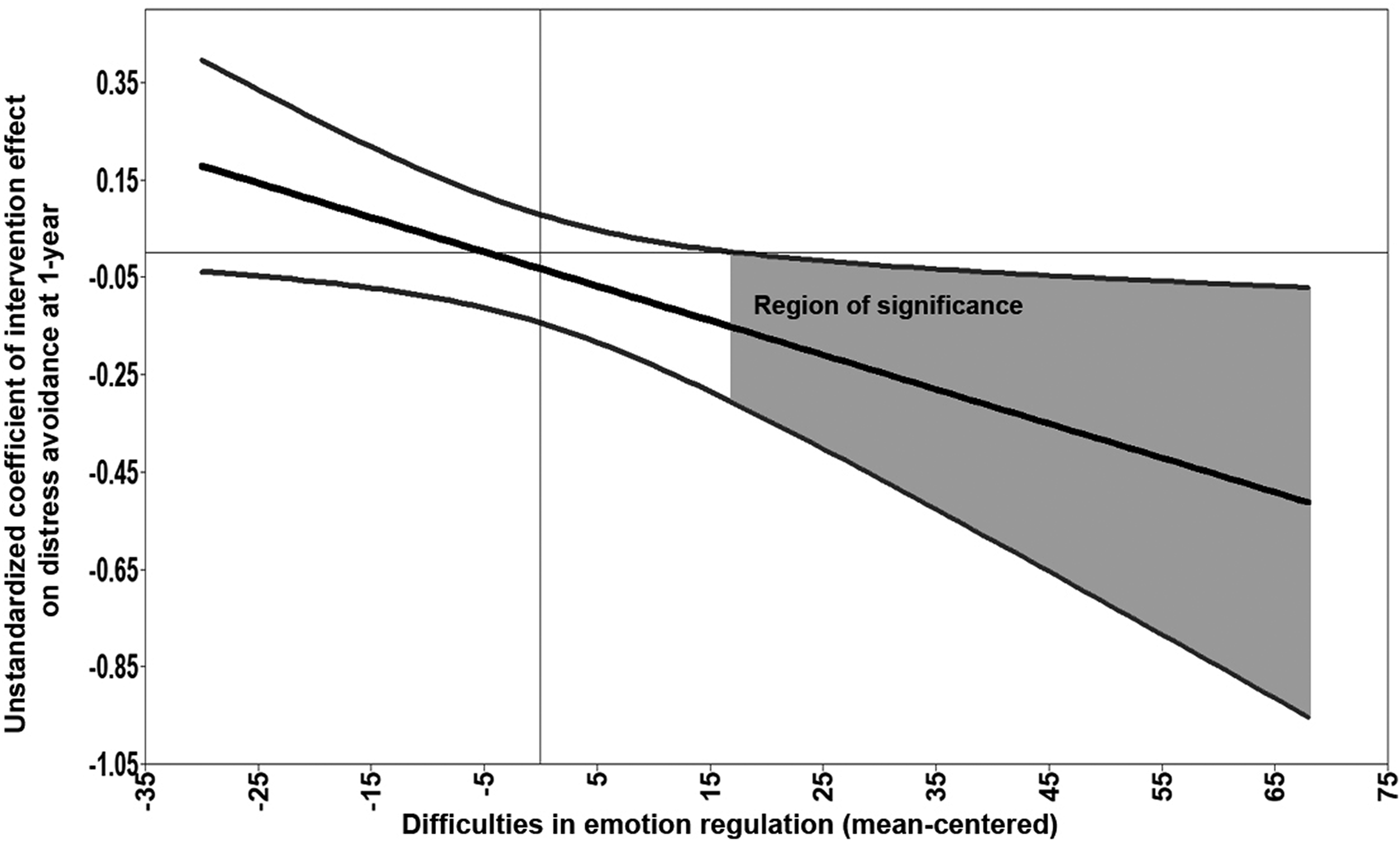
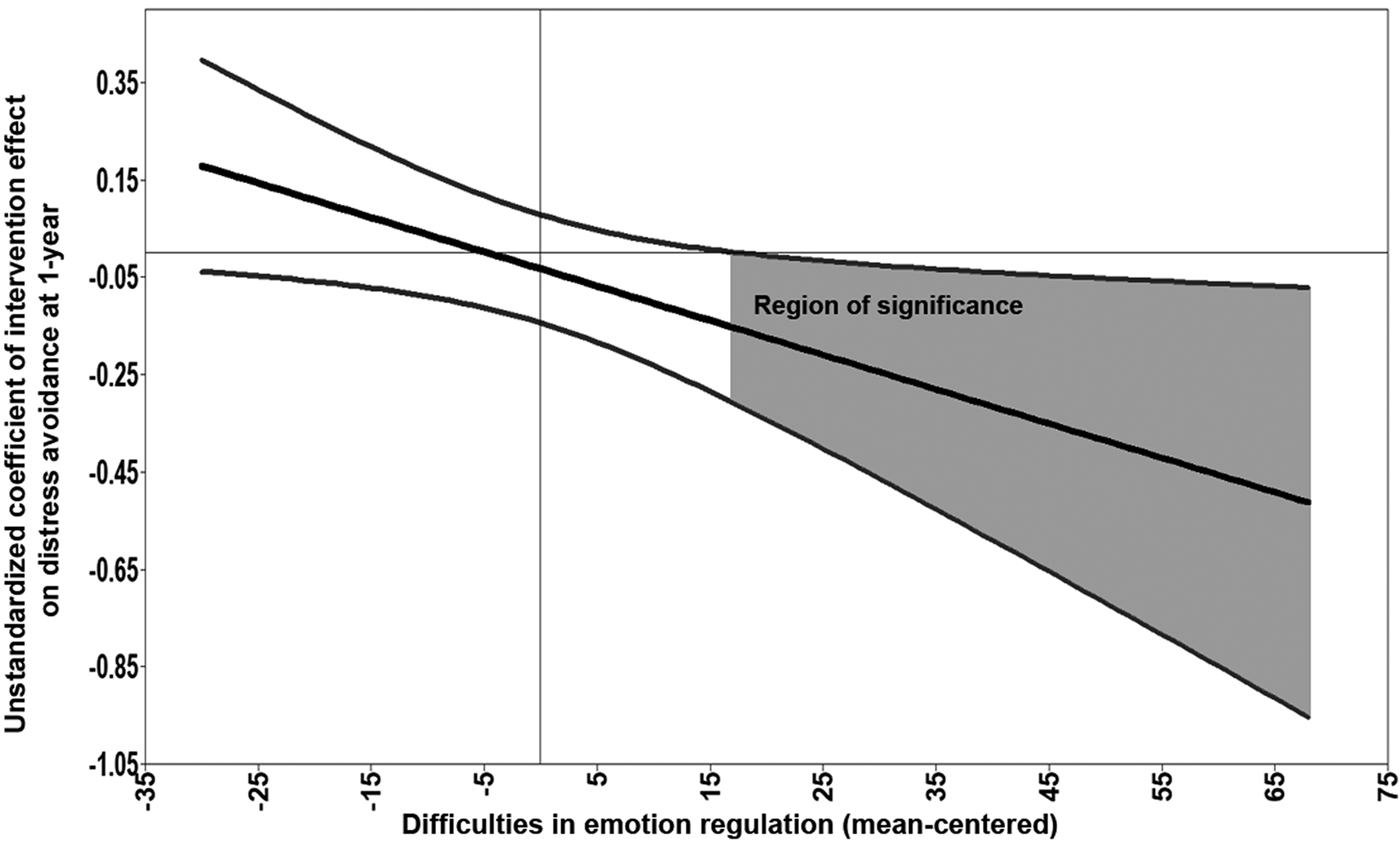
We computed a moderation model testing whether intervention effects on distress avoidance (DA) at 1 year were moderated by baseline emotion regulation, while controlling for baseline DA and covariates (fathers’ education, month of deployment, combat exposure, child age group, child sex, and number of children). Although there was no ITT effect on DA at 1 year, B = –0.033, SE = 0.057, β = –.048, p > .05, we found the interaction between intervention by emotion regulation statistically significant, B = –0.007, SE = 0.003, β = –.328, p < .05. After plotting the region of significance of this interaction effect, as shown in Figure 2, we found that there was no intervention effect on DA at 1 year for the majority of the sample, but fathers who scored about 0.87 SD above the mean (17.6% of the sample) showed significantly lower levels of DA at 1 year if they were randomized into the intervention (vs. control) group. Baseline emotion regulation acted as a moderator of the intervention effect; as fathers’ preexisting difficulties in emotion regulation increased, the intervention effect size on reduced DA increased (ranged –0.15 ~ –0.55, as shown in Figure 1). For example, the intervention effects for fathers with emotion regulation difficulties at 1 SD above the mean and those at 2 SD above the mean were estimated at about 0.17 and 0.31, respectively, meaning that those fathers would show lower levels of DA at 1 year if they were randomized into the intervention by 0.172 or 0.31 on the raw scale of the DA measure, depending on their risk.
Emotion regulation moderated the intervention effect on distress avoidance at 1-year follow-up. The x-axis indicates mean-centered scores of the Difficulties in Emotion Regulation Scale. The slope suggests that the unstandardized coefficients of the intervention effect on reduced distress avoidance at 1-year follow-up increases as difficulties in emotion regulation increase. The band indicates the 95% confidence interval of the estimates.
Moderated mediation analyses
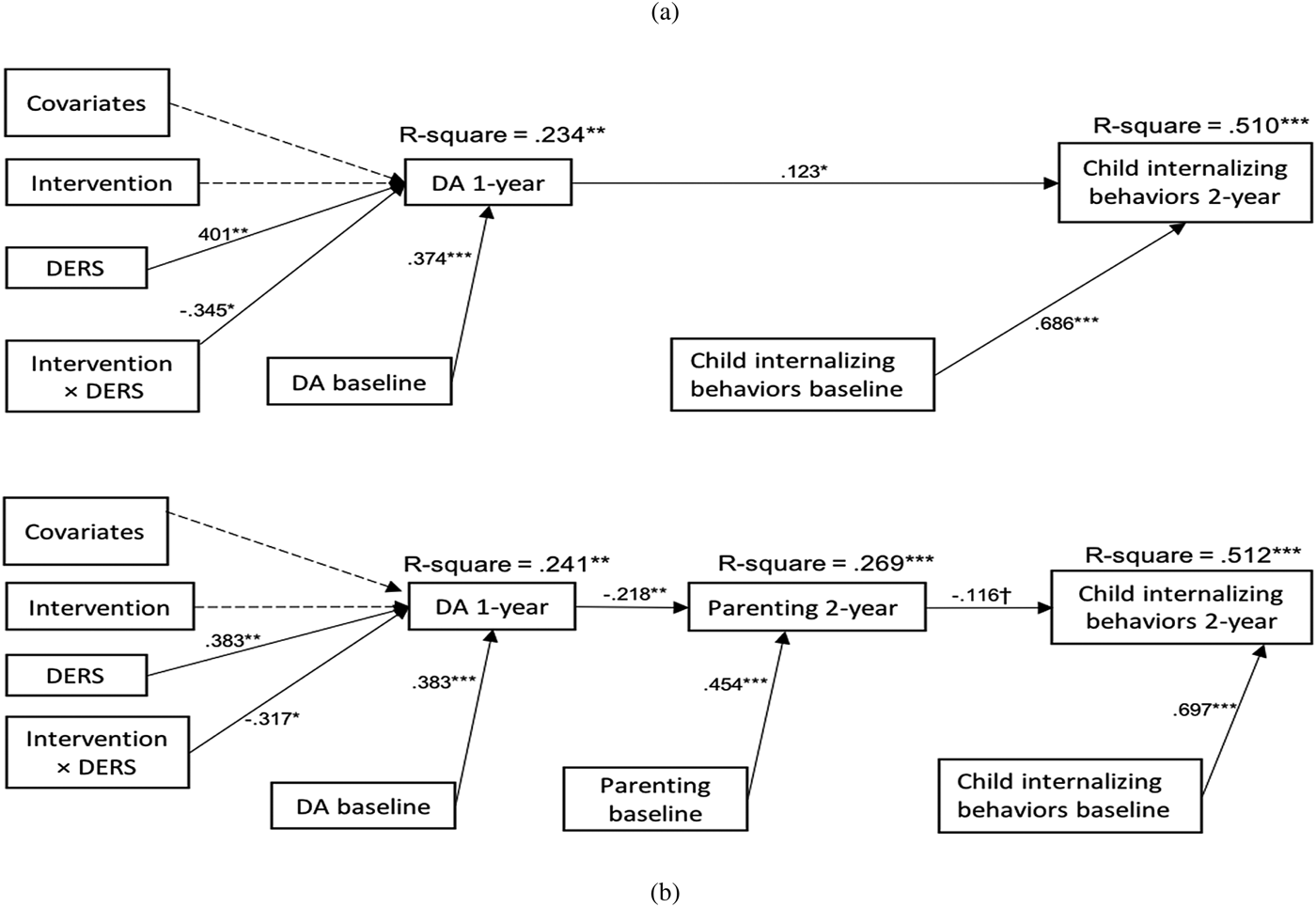
We specified a time-ordered moderated mediation model, testing the interaction effect of intervention by emotion regulation on child internalizing behaviors at 2 years via DA at 1 year. In this model, the effect of DA on child internalizing behaviors was tested as a direct effect. Covariates regressed on DA at 1 year were consistent with the moderation model described above (i.e., fathers’ education, month of deployment, combat exposure, child age group, child sex, and number of children). The data fit the model well, χ2 (11) = 9.719, p = .556, χ2/df < 2.00, CFI = 1.00, RMSEA = .00, SRMR = .021. The model is shown in Figure 3a. The results showed that controlling for baseline DA, emotion regulation moderated the intervention effect on DA at 1 year, that is, the at-risk group (those with higher levels of emotion regulation difficulties) who were randomized into the intervention showed lower levels of DA at 1 year than those in the control group, and lower DA was in turn positively associated with child internalizing behaviors, at 2 years, B = 3.192, SE = 1.621, β = .123, p < .05, while controlling for baseline child internalizing behaviors. The association between DA and child internalizing behavior was small.
Two models testing the intervention cascading effects on distress avoidance and child internalizing behaviors. Solid lines show significant relationships, while dotted lines show nonsignificant relationships. Covariates were number of children, father education, and months of deployment. Standardized coefficients are shown. †p < .10. *p < .05. **p < .01. ***p < .001.
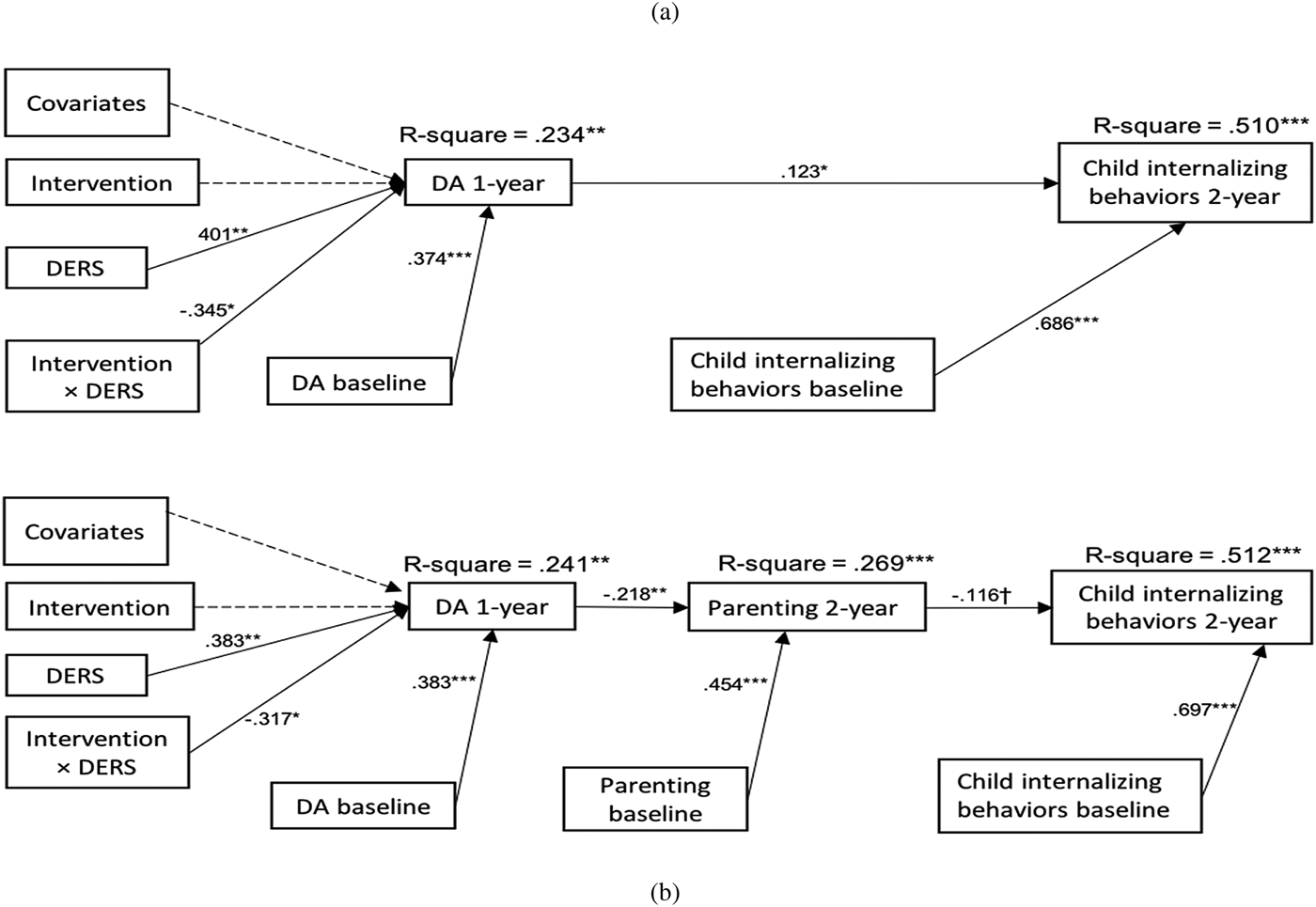
Next, we added parenting to the model as a mediator for the relationship between DA and child internalizing behaviors. Covariates regressed on DA at 1 year were fathers’ education, months of deployment, combat exposure, child age group, child sex, and number of children. Years of marriage was regressed on parenting at 2 years as it was related to missing values for this variable. The model demonstrated a good fit to data, χ2 (27) = 36.209, p = .111, χ2/df < 2.00, CFI = .941, RMSEA = .043, SRMR = .039. The results, shown in Figure 3b, suggested that controlling for baseline DA, emotion regulation moderated the intervention effect on DA at 1 year, that is, the at-risk group (those with higher levels of emotion regulation difficulties) who were randomized into the intervention showed lower levels of DA at 1 year than those in the control group, and lower DA at 1 year was in turn negatively associated with parenting (i.e. lower DA was associated with stronger parenting) at 2 years, B = –0.212, SE = 0.079, β = –.219, p < .01, while controlling for baseline parenting. The association between DA and parenting was small to moderate. Cross-sectionally, parenting at 2 years was marginally and negatively associated with child internalizing behaviors at 2 years, B = –3.071, SE = 1.586, β = –.116, p = .053, while controlling for baseline child internalizing behaviors. The association between parenting and child internalizing behaviors was small.
As post hoc analyses, we computed a separate regression model testing whether there were ITT or moderated intervention effects on behavioral parenting at 1-year follow-up. We found that there was no ITT effect on behavioral parenting at 1 year in this sample, B = 0.051, SE = 0.070, β = .056, p > .05. Fathers’ emotion regulation also did not moderate the intervention effect on behavioral parenting at 1 year, B = 0.004, SE = 0004, β = .152, p > .05, though fathers’ emotion regulation preintervention was marginally associated with parenting at 1 year, controlling for baseline parenting, B = –0.007, SE = 0.003, β = –.277, p = .05, meaning that fathers with higher preexisting emotion regulation difficulties showed more declines in observed parenting from baseline to 1 year, regardless of intervention status.
Discussion
The goal of this report was to examine in detail the effects of the ADAPT intervention on military fathers’ postdeployment parenting by specifying relationship processes impacted by the intervention and by identifying father characteristics under which those processes operate. Military deployment to war zones creates a specific and perhaps unique context in which combat stressors increase risk for emotion dysregulation. The experience, expression, and regulation of father and child emotional distress are keys to effective parenting and consequently are central targets of the ADAPT postdeployment family intervention. The multimethod, multi-informant, longitudinal data in this report suggest that fathers’ emotion regulation difficulties potentiate distress-avoidant responses to child emotion displays. In addition, results indicate that the ADAPT intervention has its most beneficial effects on parenting by reducing these distress-avoidant responses for fathers who are most dysregulated in the emotion domain. Reductions in these distress-avoidant responses in turn index reduced child internalizing symptoms, as well as improved parenting practices.
The demonstrated links between fathers’ baseline reports of emotion regulation difficulties and subsequent observations of avoidant responding in the presence of child distress are consistent with, and extend prior findings with, a small sample of 50 civilian families (Snyder et al., Reference Snyder, Low, Bullard, Schrepferman, Wachlarowicz, Marvin, Reed, Larzelere, Morris and Harrist2013). The current study is the first we know of to extend findings to a larger father sample. An additional advantage of the current study is its use of multiple-method data, which provide a more robust test of relationships over time (Podsakoff, MacKenzie, Lee, & Podsakoff, Reference Podsakoff, MacKenzie, Lee and Podsakoff2003).
Relatively little is known about the behavioral and emotional mechanisms by which vulnerable fathers transmit the residue of battle to their children after they return home. Data from the current study suggest that distress avoidance may be one key mechanism, and this is consistent with a larger body of primarily self-report literature on PTSD and parenting (see, e.g., Creech & Misca, Reference Creech and Misca2017) For example, studies of Vietnam veterans reported that among the PTSD symptom clusters, avoidance symptoms may be the most damaging for parent–child relationships and parenting (Ruscio, Weathers, King, & King, Reference Ruscio, Weathers, King and King2002; Samper, Taft, King, & King, Reference Samper, Taft, King and King2004). Emerging evidence points to the accommodation to this avoidance that may be demonstrated by other family members (Fredman, Vorstenbosch, Wagner, Macdonald, & Monson, Reference Fredman, Vorstenbosch, Wagner, Macdonald and Monson2014), also reported as “treading on eggshells” (Brockman et al., Reference Brockman, Snyder, Gewirtz, Gird, Quattlebaum, Schmidt and DeGarmo2016), in which spouses and children painstakingly avoid exposing the service member to trauma triggers, such as loud noises.
ADAPT is a modification of a well-validated, behavioral parent training program (PMTO) for families in which at least one parent has likely been exposed to considerable traumatic stress. The adaptations were aimed at helping parents be present with and responsive to their children, with the assumption that a significant minority of deployed fathers (as well as some mothers) would be experiencing combat stress symptoms such as avoidance and the concomitant disruptions in emotion responding to children (e.g., dismissing, or minimizing children's emotional expressions). More than 30 min of each 2-hr group session was spent on emotion regulation and/or emotion coaching skill development. Intervention-induced reductions in distress avoidance may enable fathers to engage in supportive emotion coaching. Emotion coaching requires a set of fairly sophisticated skills: the ability to identify and effectively respond to children's emotions, as well as the capacity to regulate one's own emotions in high-stress family situations. As Brockman et al. (Reference Brockman, Snyder, Gewirtz, Gird, Quattlebaum, Schmidt and DeGarmo2016, p. 53) note: “The family is the crucible for strong emotions.” Our prior studies showed that fathers who were randomized into ADAPT versus the control group self-reported greater declines in nonsupportive reactions to children's negative emotions (e.g., dismissive or punitive responses) over the 2 years following the intervention, and those declines were associated with improved children's internalizing symptoms (Zhang, Lee, Zhang, Piehler, & Gewirtz, Reference Zhang, Lee, Zhang, Piehler and Gewirtz2019). The current study provided more robust evidence with behavioral observational data showing that the strategies fathers use to respond to children's distress or negative behaviors during family interactions are subsequently associated with children's internalizing behaviors, although such objectively measured behavioral changes as a function of the intervention may only be evident among a subset of fathers—those reporting higher levels of baseline emotion dysregulation.
ADAPT group facilitators noted that parent participants (both men and women) reported that emotion coaching was a particularly challenging skill to master, and facilitators confirmed that this was evident in observing the group participants practicing these skills. We surmise that this is likely due to the emphasis that military culture places on active problem solving more than the processing of emotions (i.e., immediate action may be emphasized over awareness and intentional responding), increasing the likelihood of unintentional emotional suppression across the family (Vujanovic, Niles, Pietrefesa, Schmertz, & Potter, Reference Vujanovic, Niles, Pietrefesa, Schmertz and Potter2011). These cultural norms may make it harder for families to change.
Despite the challenges, however, it appears that the ADAPT program did reduce observed distress avoidance among the highest risk quintile of fathers. To report higher levels of emotion regulation difficulties requires awareness of those problems, and it may be that those fathers who were aware of their emotion dysregulation were more open to learning emotion regulation strategies (e.g., mindfulness) and the emotion coaching offered in the ADAPT intervention. Of note, findings from the ADAPT study have demonstrated intervention benefits to observed parenting for fathers at both ends of the risk spectrum (i.e., higher risk and higher functioning). For example, deployed fathers with stronger vagal flexibility (a physiological index of interpersonal/social emotion regulation) benefited more if they were assigned to the ADAPT intervention (vs. control) condition, displaying more effective observed parenting at 12 months postbaseline than those with weaker vagal flexibility (Zhang, Hoch, & Gewirtz, Reference Zhang, Hoch and Gewirtz2019). In the current study, we relied on a broadband self-report measure of emotion dysregulation, which typically does not index physiological arousal (Mauss, Levenson, McCarter, Wilhelm, & Gross, Reference Mauss, Levenson, McCarter, Wilhelm and Gross2005), and we focused on distress avoidance as a more immediate mechanism of change prior to changes in behavioral parenting. We speculate that the intervention differentially benefited those both at the higher and lower risk ends of the spectrum depending on the nature of the construct.
These findings have potential implications for targeting those who might particularly benefit from the ADAPT parenting intervention. For example, screening parents for emotion regulation difficulties would help to identify those who might particularly benefit from the intervention and thus be prioritized for services. Additional research is needed to uncover what modifications might be beneficial for those fathers with less emotion regulation problems who did not evidence significant benefit to their observed parenting from this “standard” version of the ADAPT program. A sequential, multiple assignment randomized trial is currently under way in order to examine questions of dosage, timing, and format of ADAPT.
Still to examine are mechanisms through which these changes are facilitated. For example, future research should examine how the intervention might differentially affect fathers who tend to display coercive versus avoidant responses in relation to children's distress. In addition, to what extent might maternal emotion regulation facilitate or inhibit father changes? How might child attributes affect fathers’ distress avoidance over time?
The distal goal of the ADAPT program is to strengthen child adjustment. Our results indicate that for the most dysregulated fathers, a cascading effect of program improvements appears evident; that is, program-related reductions in distress avoidance link to subsequent reductions in child internalizing symptoms. Fathers’ ability to tolerate the distress engendered by anxiety-provoking interactions with children demonstrates that emotions are not threatening, but instead, opportunities for children to receive validation, support, and encouragement from their fathers. These types of reassuring interactions are likely to reduce children's anxiety and distress. It is not surprising, then, that intervention-related reductions in distress avoidance were directly associated with reductions in children's internalizing symptoms.
Given that the proximal goal of the ADAPT intervention is to strengthen parenting practices (both behavioral and emotional), we tested whether improvements in distress avoidance might be subsequently associated with improvements in behavioral parenting practices, and whether those improvements might link to the reductions in children's internalizing symptoms. The finding that intervention-driven decreases in distress avoidance at 1 year indexed improvements in behavioral parenting practices at 2 years for high-risk fathers suggests that the reductions in distress avoidance likely enable fathers to be more present and responsive to their children, and to engage more actively in parenting them.
Prior ITT evaluations of ADAPT showed that while the intervention significantly improved couple parenting and mothers’ parenting, there were no main effects on fathers’ behavioral parenting practices. The current data suggest that, for fathers experiencing high levels of emotion dysregulation, changing parenting practices may first require them to be able to tolerate and respond to their children's difficult emotions, and also, that the process by which fathers reintegrate into the family following a deployment may be facilitated by explicitly addressing emotion socialization.
It is not surprising that the improvements to behavioral parenting practices associated with reductions in distress avoidance were only marginally associated with reductions in children's internalizing symptoms. There is extensive evidence that improving effective behavioral parenting practices reduces children's externalizing symptoms (e.g., Offord & Kraemer, Reference Offord and Kraemer2000) but the relationship of parenting practices to children's internalizing (and particularly anxiety symptoms) is weaker (McLeod, Wood, & Weisz, Reference McLeod, Wood and Weisz2007). Another possibility for the marginal findings is that the sample size of this study limits the statistical power to detect the relation between behavioral parenting and children's internalizing behaviors as tested in the model shown in Figure 3b. Still to be examined is whether these cascading changes will magnify or shrink over a longer period of time. There is growing evidence that, for family-based prevention interventions, effects grow over time (e.g., Patterson, Forgatch, & DeGarmo, Reference Patterson, Forgatch and DeGarmo2010).
Findings from this study augment earlier findings demonstrating that, for the full sample, the ADAPT program had indirect effects (through parenting practices) on improvements in overall child adjustment at 1 year (Gewirtz et al., Reference Gewirtz, DeGarmo and Zamir2018), and on reductions in youth substance use risk at 2 years (Gewirtz & DeGarmo, Reference Gewirtz and DeGarmo2019). The current findings provide preliminary evidence for what appears to be a proximal beneficial effect of the intervention for the most dysregulated fathers in reducing distress avoidance. The increasing willingness of these fathers to experience their own and their child's distress during ongoing interaction may consequently enable them to more fully utilize constructive parenting practices. Similarly, improved parent–child interaction appears to benefit children themselves via reductions in internalizing symptoms.
Strengths of the current study include the use of two observational coding systems (coded by different research teams) and demonstrating the significant correlation between the two constructs: DA and behavioral parenting. The effects detected in our mediation models were found to be small, which is likely due to the fact that the DA and parenting variables in our study were measured through observational data. Meta-analyses of evidence-based parenting interventions such as the Incredible Years program and the Triple P program have shown significant program effects on improved self-reported parenting, but not on observed parenting (Leijten et al., Reference Leijten, Melendez-Torres, Gardner, Van Aar, Schulz and Overbeek2018; Nowak & Heinrichs, Reference Nowak and Heinrichs2008; Sanders, Kirby, Tellegen, & Day, Reference Sanders, Kirby, Tellegen and Day2014). Nevertheless, in a prevention context, small effects are considered important because of the potential impact on public health.
Several limitations should be noted. First, the current study included only a subset of the full ADAPT sample due to the constraints of separate NIH funding, as well as limiting the sample to two-parent married families in which only the father was the service member. Using a larger sample would have produced more power to detect relationships among variables. Second, because the follow-up period was limited to 2 years, we were unable to model cascading relationships across more than that time period, and thus parenting practices and child internalizing symptoms were modeled at the same time point. Despite these drawbacks, the current study provides important information about the social and emotional communication processes of postdeployment fathers and their children, and how a parenting intervention benefits these processes.
Acknowledgments
We are grateful to the ADAPT research team and all the remarkable military family participants in the ADAPT studies. In addition, we are indebted to our late colleague, Dr. Jim Snyder, whose pioneering work on understanding emotion communication in families formed the basis for this paper.
Financial Support
This study was funded by National Institute on Drug Abuse grants R01DA030114 to Abigail Gewirtz and R21 DA034166 to James Snyder. Na Zhang's work on this paper was supported by a National Research Service Award (NRSA) in Primary Prevention by NIDA T32DA039772.