Introduction
Smoking remains the leading cause of preventable death and illness (World Health Organization, 2012), and lung screening and tobacco treatment may reduce mortality for patients at high-risk for lung cancer (National Lung Screening Trial Research Team, 2011). This study evaluates whether two novel interventions tailored for patients receiving lung screening or considered high-risk for lung cancer (NCCN, 2017; USPSTF, 2013) improve smoking outcomes when added to standard tobacco treatment.
This study builds on research indicating that (1) gain-framed messaging (i.e., focussing on cessation benefits) substantially increases quit intentions, attempts, and success rates in general populations of smokers (McKee et al., Reference McKee, O'Malley, Steward, Neveu, Land and Salovey2004; Schneider et al., Reference Schneider, Salovey, Pallonen, Mundorf, Smith and Steward2001; Toll et al., Reference Toll, O'malley, Katulak, Wu, Dubin and Latimer2007, Reference Toll, Martino, Latimer, Salovey, O'malley and Carlin-Menter2010), (2) smoking cessation is associated with improvements in biomarkers (i.e., skin carotenoid, lung function, plasma bilirubin levels (Galan et al., Reference Galan, Viteri, Bertrais, Czernichow, Faure and Arnaud2005; O'Malley, Wu, Mayne, & Jatlow, Reference O'Malley, Wu, Mayne and Jatlow2014; Scanlon et al., Reference Scanlon, Connett, Waller, Altose, Bailey and Sonia Buist2000)), and (3) biomarker feedback may encourage quitting (Bize et al., Reference Bize, Burnand, Mueller, Rège-Walther, Camain and Cornuz2012; McClure, Reference McClure2001). The current study is the first to test personalized gain-framed messaging and feedback about biomarker changes among patients eligible for lung cancer screening.
We hypothesize that (1) personalized gain-framed messages will improve quit rates over standard tobacco treatment, and (2) feedback about improvements in biomarkers following initial cessation/reduction efforts will reinforce behaviour change and prevent relapse.
Methods and Design
Study Design
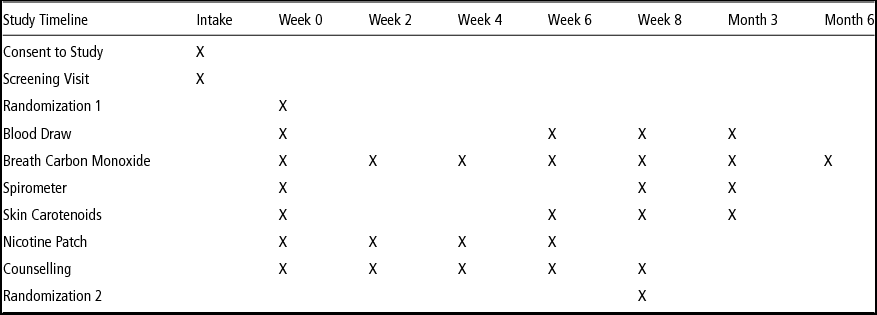
We will test two separate, sequential interventions to promote tobacco cessation/reduction compared to standard care (SC). Separate randomizations will occur at baseline (week 0) and week 8 (Figure 1). Sequential randomization (rather than a 2 × 2 design) requires fewer subjects and allows us to examine responder status at week 8 as a moderator of the effect of the phase 2 intervention. All participants will receive $120 for study completion.
Study Timeline Randomization in Phase 1 will be stratified by recruitment route (e.g., electronic medical record) within site and time to first morning cigarette (≤ or > 30 min). Randomization in Phase 2 will be stratified by site, treatment group, and responder status in Phase 1.

Planned Recruitment
The enrolment target is 276 current smokers across two outpatient hospitals. Inclusion criteria are: (1) receiving lung screening or considered high-risk for lung cancer based on age and smoking history, thereby eligible for lung cancer screening (NCCN, 2017; USPSTF, 2013), (2) current smoker, (3) not known to currently have lung cancer, (4) willing to be randomized; Exclusion criteria are: (1) dementia or current serious psychiatric or unstable medical illnesses, (2) known fat mal-absorption diseases possibly affecting skin carotenoid status, (3) current tobacco treatment. Participants will be identified through the hospital electronic medical records system, lung cancer screening, or lung health visits. Additional recruitment sites such as pulmonology clinics and Veteran Affairs hospitals may be included to meet recruitment goals.
Intervention 1
Participants will be randomized to either: (1) SC from a Tobacco Treatment Service provider (i.e., intake, five counselling sessions, 8-week supply of nicotine patch following standard dosing procedures) or (2) SC + personalized gain-framed video and print messaging (SC+P). SC counselling will be based on cognitive behavioural, evidence-based, smoking cessation treatment (Fiore et al., Reference Fiore, Jaen, Baker, Bailey, Benowitz and Curry2008). Participants will begin using nicotine patches following the first counselling session, prior to their scheduled quit date. In addition to the SC procedures, participants receiving the SC+P intervention will view brief (8–10 min) gain-framed videos at four visits (week 0, 2, 4, and 6) and receive personalized gain-framed print media at all five counselling visits. The videos are designed for patients at high-risk for lung cancer based on age and smoking history and address the benefits of quitting smoking. Print media messages will be personalized based on participant demographics and smoking history (Webb, Hendricks, & Brandon, Reference Webb, Hendricks and Brandon2007).
Intervention 2
All participants will be randomized again at 8 weeks to (1) biomarker feedback or (2) no feedback. Biomarker feedback scripts will use language consistent with a personalized, gain-framed intervention. All participants will complete blood draws and biomarker assessments following the same schedule (Table 1). The biomarker feedback group will receive personalized information at the 8-week and 3-month visits, summarizing changes in their biomarker data from baseline. The control group will be informed that we are evaluating novel biomarkers that may change with tobacco reduction or cessation. They will receive feedback at the 6-month visit.
Timeline of assessments

Measures
Breath Carbon Monoxide (CO)
Expired breath CO, an objective measure of smoking, will be assessed at every visit.
Biomarkers
We will collect measures of carotenoid status, lung function (measured via spirometry), and plasma bilirubin at multiple time-points. While most studies measure plasma/serum carotenoids, our team pioneered non-invasive methods (resonance Raman spectroscopy) to measure skin carotenoids using a brief palm scan (Mayne et al., Reference Mayne, Cartmel, Scarmo, Jahns, Ermakov and Gellermann2013).
Primary Outcomes
Primary outcomes include CO-verified (CO≤6 ppm) 7-day point-prevalence abstinence (week 8, aim 1) and mean cigarettes per day in the past week (6 months, aim 2).
Data Analysis and Management
The protocol was approved by the Institutional Review Board at both sites, and a Data and Safety Monitoring Plan was established. Logistic regressions will test the main effect of SC+P versus SC on smoking cessation in the intent to treat sample. Linear-mixed models will test the effect of providing biomarker feedback on change in cigarette use. We anticipate a 70% follow-up rate, allowing complete data for n = 96 per group at the end of 8 weeks. We have 80% power (two-tailed alpha = 0.05) to detect a 17% difference in quit rates at 8 weeks (35% vs. 52%, 30% vs.47%) and a four cigarette mean difference at 6 months (SD = 10) between the two conditions. We attempt to account for potential differences between sites (e.g., patient demographics and therapist effects) by including site as a stratification factor for randomization and including site as a predictor in all data analyses.
Discussion
This is the first randomized trial evaluating personalized, gain-framed messages tailored specifically for high-risk patients who are eligible for lung cancer screening. This project is also the first large, well-powered study examining the effects of smoking cessation on novel biomarkers including skin carotenoids and bilirubin and the effects of feedback about these biomarkers. Results may inform ways to optimize interventions for patients at high-risk for lung cancer including lung screening patients who present to cancer centers or healthcare organizations. Effective interventions to promote cessation among these high-risk patients are greatly needed to reduce lung cancer incidence and mortality.
Acknowledgements
We would like to thank the tobacco treatment staff at the lung cancer screening centers at Yale University and the Medical University of South Carolina.
Financial Support
This work was supported in part by grants from the National Institutes of Health, National Cancer Institute, and National Institute on Drug Abuse (P50CA196530, R01CA207229, T32DA019426).
Conflict of Interest
Although not related to the current work, Dr O'Malley reports the following: Donated study medications – AstraZeneca, Pfizer; Consultant or advisory board member – Alkermes, Amygdala, Cerecor, Mitsubishi Tanabe, Opiant; member of the American Society of Clinical Pharmacology Alcohol Clinical Trials Initiative supported by Ethypharm, Lilly, Lundbeck, Otsuka, Pfizer, Arbor Pharmaceuticals, Indivior; Dr Gueorguieva discloses consulting fees for Palo Alto Health Sciences and Mathematica Policy Research and a provisional patent submission by Yale University: Chekroud, AM., Gueorguieva, R., & Krystal, JH. ‘Treatment Selection for Major Depressive Disorder’ [filing date 3 June 2016, USPTO docket number Y0087.70116US00]. Dr Toll received a grant from Pfizer for medicine only and he testifies as an expert witness on behalf of plaintiffs who filed litigation against the tobacco industry. No other authors report potential conflicts of interest.
Ethical Standards
The authors assert that all procedures contributing to this work comply with the ethical standards of the relevant national and institutional committees on human experimentation and with the Helsinki Declaration of 1975, as revised in 2008. Trial registration: # NCT02658032.