Kefir is a fermented milk food product that originated in the Caucasus. Due to its unique aroma and flavour, nutritional value and potential probiotic properties, it is becoming increasingly more popular all over the world. Kefir is produced with the use of kefir grains, representing a specific combination of various bacteria and yeasts. The microbial composition of kefir grains has not been fully elucidated and attempts to produce synthetic kefir grains from isolated microorganisms have so far been unsuccessful (Garrote et al. Reference Garrote, Abraham, De Antoni, Mozzi, Raya and Vignolo2010). It is worth emphasising that the microbial content of kefir grains depends on their origin, storage conditions and handling pattern (Pintado et al. Reference Pintado, Lopes Da Silva, Fernandes, Malcata and Hogg1996).
Most studies on biodiversity of kefir or kefir grains were based on classical microbiological methods using selective growth media. The resultant identification of microbes could have been inadequate because certain organisms are uncultivable. Additionally, in complex microbial ecosystems such as kefir grains, symbiotic interactions between yeasts and lactic acid bacteria have been observed (Lopitz-Otsoa et al. Reference Lopitz-Otsoa, Rementeria, Elguezabal and Garaizar2006). Thus, molecular techniques based on culture independent methods offer new possibilities for determining the microbiological composition of kefir grains. Recent publications identifying the microorganisms in kefir grains by culture independent methods demonstrated the results of DGGE analysis of bacterial 16S rDNA amplicons or yeast 26S rDNA generated directly from kefir grains. Garbers et al. (Reference Garbers, Britz and Witthuhn2004) identified, using specific primers and total DNA isolated with glass beads as template, several species belonging to the Lactobacillus genus and two yeasts from Candida and Saccharomyces. In spite of limitations of the DGGE analysis, they identified two uncultivable strains and two species previously not detected in kefir grains (Garbers et al. Reference Garbers, Britz and Witthuhn2004). Other bacteria were identified by a Chinese group (Wang et al. Reference Wang, Li, Jia, Wu and Guo2006); nucleotide sequences of DNA bands generated by DGGE were highly homologous to those of bacteria from the genus of Sphingobacterium, Lactobacillus, Enterobacter and Acinetobacter. In another study, total DNA of bacterial strains from three different kefir grains were extracted using a blood and tissue genomic extraction system and directly identified by PCR-DGGE (Chen et al. Reference Chen, Wang and Chen2008). The results indicated the presence of Lb. kefiranofaciens in all analysed samples, Lb. kefiri in one, and Lactococcus lactis in two. Culture-independent method revealed also two non LAB species in these kefir grains not detected by culturing: Escherichia coli and Pseudomonas spp. However, the varieties of the LAB strains identified by PCR-DGGE culture-independent method were fewer than those identified with the use of initial enrichment stage on nutritive media (Chen et al. Reference Chen, Wang and Chen2008). Zhou et al. (Reference Zhou, Liu, Jiang and Dong2009) analysed the microflora in Tibetan kefir grains using the FTA® membrane-based method combined with PCR-DGGE. They showed that the dominant microorganisms of these kefir grains were Pseudomonas spp., Leuconostoc mesenteroides, Lb. helveticus, Lb. kefiranofaciens, Lb. kefiri, Lb. casei, Lc. lactis, Kasachstania unispora, Kluyveromyces marxianus, Sac. cerevisiae, and Kazachstania exigua. Previously, the membrane card-based method was evaluated for different types of raw milk and dairy food products, with specific primers for dominant bacterial strains or species (Tilsala-Timisjarvi & Alatossava, Reference Tilsala-Timisjarvi and Alatossava2004). The comparison of the FTA® protocol with conventional DNA isolation showed that both methods were very similar except in the case where the Lb. rhamnosus GG was detected in yoghurt with strain-specific primers only by the FTA® method. This method combined with PCR-DGGE with general bacterial or yeast primers applied for kefir grains by Zhou et al. (Reference Zhou, Liu, Jiang and Dong2009) allowed the identification of several dominant microorganisms. However, the completeness of this analysis is difficult to assess as data enabling the comparison with culture dependent or other methods were not presented. Thus, taking into account the big diversity of different kefir grains and the limited number of molecular analyses, culture independent methods ought to be used for further comprehensive studies of microbial composition of kefir grains. One of culture-independent methods that enables a comprehensive view of the genetic diversity is metagenomics. In this approach DNA is isolated directly from environmental samples and sequenced. High-throughput sequencing methods make shotgun sequencing of the whole metagenome from environmental samples informative. Shotgun sequencing of DNA isolated from complex environments can be used for identification of microorganisms, pool of genes and for prediction of proteins from global sampling data (Hutchinson, Reference Hutchinson2007). The metagenomic approach has been applied to study microbial populations in many environments including an acid-mine biofilm (Tyson et al. Reference Tyson, Chapman, Hugenholtz, Allen, Ram, Richardson, Solovyev, Rubin, Rokhsar and Banfield2004), Sargasso Sea (Venter et al. Reference Venter, Remington, Heidelberg, Halpern, Rusch, Eisen, Wu, Paulsen, Nelson, Nelson, Fonts, Levy, Knap, Lomas, Nealson, White, Peterson, Hoffmon, Parsons, Baden-Tillson, Pfannkoch, Rogers and Smith2004) or the human gut (Gill et al. Reference Gill, Pop, Deboy, Eckburg, Turnbaugh, Samuel, Gordon, Relman, Fraser-Liggett and Nelson2006). To our knowledge, there are no published data pertinent to shotgun sequencing of genomic libraries for studying Kefir grains.
The aim of this study was to optimise the DNA extraction procedure for efficient identification of gene and microbial biodiversity in the complex microbial consortium present in kefir grains. Our goal was to isolate DNA from fresh material. The proposed culture-independent approach is based on microbial enrichment at the level of DNA extraction. The procedure comprises a cascade of several cell lyses in order to isolate DNA from diverse and also less prevalent organisms. Such DNA pools were used for preparation of genomic DNA banks for sequencing and could also be used for sequencing of 16S or 26S rRNA-coding DNA fragments, which should increase the chance of identification of various microorganisms, not only those which dominate this ecosystem.
Materials and Methods
Culturing of kefir grains
Samples of kefir grains supplied by Danisco Biolacta, Olsztyn, Poland were cultured in 10% skimmed milk, pH 6·6, and sterilised for 30 min at 95°C, according to the method described by Oklinski (Reference Oklinski2006). Briefly, 600 ml of the milk medium was inoculated with 60 g of fresh kefir grains. After 22 h incubation at 18°C kefir grains were drained in a sieve, washed with sterile water (3 vols water to 1 vol culture medium) and drained on sterile paper towel for 10 min. Subsequently, kefir grains were weighed and a portion of 60 g was used for inoculation of a new batch of medium. A series of passages were performed until kefir grains attained appropriate characteristics, including medium pH (4·0–4·3) and increase in biomass (12–18%), pointing to full activity of kefir grains.
Homogenisation of kefir grains
Sterile 0·9% NaCl solution was added to 20 g washed and drained active kefir grains to the final volume of 200 ml and homogenised at 24 000 rpm for 5 min in laboratory homogeniser H500 (POL-EKO-APARATURA, Poland).
Isolation of DNA
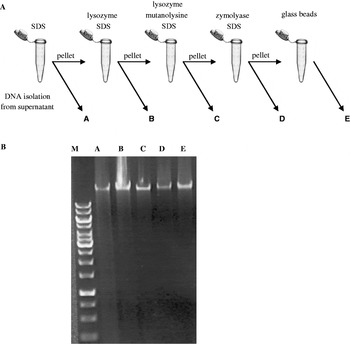
Homogenised kefir grains were subjected to a gradual change in cell lysis conditions – a cascade of cell lysis. A 2 ml sample of homogenised kefir grains was harvested for 1 min at 8944 g in the microcentrifuge. The pellet was resuspended in 300 μl TES buffer (25 mm Tris; 10 mm EDTA; 50 mm sucrose) and 150 μl 20% SDS – lysis A. After 5 min incubation at room temperature the sample was centrifuged. The supernatant was used for DNA extraction and the cell pellet was subjected to lysis step B (Fig. 1). Lysis step B was based on the method of DNA isolation from Lc. lactis (Tailliez et al. Reference Tailliez, Tremblay, Ehrlich and Chopin1998). The pellet after lysis A was resuspended in 300 μl TES solution containing 20 mg lysozyme/ml (cat. no. 62971, Fluka, Belgium) and incubated for 30 min at 37 °C. Then, 150 μl 20% SDS was added, the total was incubated for 5 min at room temperature and centrifuged. Lysis C was performed similarly to lysis B, except that 15 μl of 1 U mutanolysin/μl (cat. no. M9901, Sigma-Aldrich Co., USA) was added to the TES-lysozyme solution and incubation was prolonged to 1 h. This method has been used for DNA isolation from several Lactobacillus spp. (Fliss et al. Reference Fliss, Emond, Simard and Pandian1991). Lysis D was based on the method of DNA isolation from Sac. cerevisiae (Sherman et al. Reference Sherman, Fink and Hicks1986). The pellet after lysis C was resuspended in 0·5 ml SE buffer (1 m sorbitol; 0·1 m EDTA; pH 7·5) and 20 μl of 5 mg zymolyase/ml (cat. no. 320932, ICN, Costa Mesa, CA, USA) was added – lysis D. After 1 h incubation at 37°C the sample was centrifuged. The pellet was resuspended in 0·5 ml TE buffer (50 mm Tris; 20 mM EDTA; pH 7·4) with 50 μl 10% SDS, incubated for 30 min at 65°C and centrifuged at 8944 g for 1 min. Finally, the pellet after lysis D was resuspended in 400 μl TES buffer and the cells were mechanically disrupted with glass beads (100 μm, 0·6 g) by three 1-min pulses in MBB-8 apparatus (Biospec, USA) with 1 min cooling intervals – lysis E. To inhibit DNA degradation, 1 μl diethylpyrocarbonate (DEPC) was added for every 100 μl of the sample just before addition of SDS (in lyses A, B, C and D) and before mechanical disruption of cells (for lysis E). In addition, 1 μl of 20 mg proteinase K/ml (cat. no. 124568·0100, Merck, Germany) was added for every 100 μl of supernatant from every lysis step, and samples were then incubated for 30 min at 37°C. DNA in supernatants from lyses A, B, C and E was purified by phenol/chloroform extraction (Sambrook et al. Reference Sambrook, Fritsch and Maniatis1989), whereas the supernatant from lysis D was incubated for 15 min on ice with 200 μl 5 m potassium acetate and centrifuged for 15 min at 17 530 g at 4°C in a microcentrifuge.
Cascade cell lysis for DNA extraction (pools A, B, C, D, E) from kefir grains. (A) Gradual change in cell lysis conditions; (B) electrophoresis of DNA in 0·8% agarose gel visualised under UV light. Chromosomal DNA pools (A, B, C, D, E), M: GeneRuler 1 kb DNA Ladder (Fermentas).

Finally, 1 ml isopropanol was added to the water phase after phenol/chloroform extraction and to the supernatant of the centrifuged sample D. DNA was precipitated over-night at −20°C. After centrifugation for 30 min at 17 530 g at 4°C, the pellet was washed with 70% ethanol, dried, dissolved in 60 μl RNase (100 μg/ml) for lyses A, B, C or in 75 μl for lyses D, E and incubated 15 min at 37°C. The extracted DNA was stored at −20°C until required.
DNA electrophoresis
DNA was analysed by electrophoresis in TAE buffer on 0·8–1·0% agarose gel supplemented with 0·1 μg ethidium bromide/ml (Sambrook et al. Reference Sambrook, Fritsch and Maniatis1989). After electrophoresis, gels were photographed under UV light for documentation.
RAPD fingerprinting
RAPD-PCR was carried out in a final volume of 30 μl reaction mixture containing: 20 pmol of each primer, 250 μm of each of the deoxynucleotide triphosphates (TaKaRa Bio Inc., Japan), 2 U of TaKaRa ExTaq polymerase (TaKaRa Bio Inc.) and 0·5 μg of template DNA (from each of A–E DNA pools) in 1×PCR buffer. Two decamer primers, RAPD-B06 (Tailliez et al. Reference Tailliez, Tremblay, Ehrlich and Chopin1998) or RAPD-M13 (Andrighetto et al. Reference Andrighetto, Psomas, Tzanetakis, Suzzi and Lombardi2000; Rossetti & Giraffa, Reference Rossetti and Giraffa2005), were used to generate random amplicons. The PCR consisted of an initial denaturation step at 94°C for 5 min, followed by 30 cycles comprising heat denaturation at 94°C for 1 min, primer annealing at 42°C for 2 min and extension at 72°C for 2 min; it was completed with a final extension step at 72°C for 7 min, after which samples were held at 4°C in a PTC 200 Thermal Cycler (MJ Research, USA).
Preparation and validation of DNA banks
The extracted DNA was sheared and subcloned using the TOPO Shotgun Subcloning Kit according to the manufacturer's instructions (Invitrogen Corporation). 2 μg of each DNA pool (A, B, C, D or E) was sheared in 750 μl Shearing Buffer (TE, pH 8 containing 20% glycerol) in nebulisers connected to compressed helium. Undiluted, blunt-end, dephosphorylated DNA was cloned into pCR 4Blunt-TOPO. The TOPO cloning reactions were dialysed 15 min on MF-Millipore Membrane Filters 0·025 μm (Millipore Corporation) and transformed into One Shot TOP10 Electrocomp Escherichia coli (Invitrogen Corporation). Transformed bacteria were plated on selective LB medium (60 μg/ml X-Gal; 0·3 mm IPTG; 50 μg/ml ampicillin) and incubated overnight at 37°C. Then, 30 white colonies from each DNA bank were analysed for the presence of inserts with a colony PCR technique. Colonies were picked and suspended in 20 μl reaction mixture in 1×PCR buffer containing: 10 pmol of each of the two universal primers – M13/pUC19, 250 μm of each of the deoxynucleotide triphosphates (Polgen, Poland) and 1 U of Taq polymerase (Polgen). Reaction mixtures were first incubated at 94°C for 10 min to lyse the cells and inactivate nucleases. Then, amplifications were done for 30 cycles, with each cycle consisting of 94°C step for 1 min, 50°C step for 1 min and 72°C step for 2 min. For the final extension, samples were incubated at 72°C for 10 min and held at 4°C.
After confirming the quality of the DNA banks, bacteria growing as white colonies were frozen in 100 μl LB medium with 10% glycerol and 100 μg ampicillin/ml, in 96-well microtiter plates. Five DNA banks (A, B, C, D, E), each in duplicate, were kept at −80°C for later analysis.
Sequencing analysis
Sequencing of DNA inserts of 96 clones from each DNA bank (A, B, C, D and E) was done by the Sanger method (Sanger et al. Reference Sanger, Nicklen and Coulson1977). The sequencing products were analysed by the ABI 3730/xl Genetic Analyzer in the Laboratory of DNA Sequencing and Oligonucleotide Synthesis, Institute of Biochemistry and Biophysics, Polish Academy of Sciences.
For bioinformatic analyses the following programs were used: Clone Manager 9 Professional Edition, PhredPhrap/Consed (Genome Science Department, University of Washington, USA) and BLAST (NCBI).
Results
Processing of kefir grains for DNA extraction
The first attempt to isolate DNA from kefir grains was undertaken using homogenised kefir grains stored at 4°C in 0·9% NaCl (‘stored grains’). However, stored grains generated problems during the lysis procedure in terms of their viscosity and with separation of water and phenol/chloroform phases due to the presence of exopolysaccharides. This resulted in a very low yield and poor quality of obtained DNA. However, when fresh kefir grains were used, both DNA quality and yield were much better than in the case of stored grains. Thus, DNA was isolated from fresh and active kefir grains cultured and homogenised directly before extraction, as described in Materials and Methods.
Efficiency of the cascade cell lysis procedure
The applied DNA extraction method relied on a gradual change in cell lysis conditions, termed here as cascade cell lysis and described in detail in Materials and Methods. The efficiency of the cascade cell lysis was monitored by microscopic observations of cell pellets obtained after each lysis step. Microbial biodiversity of the cell pellet was examined by assessing the cell number, morphology (rod, coccus, yeast cells) and form (single, chain, aggregate) observed under a phase-contrast microscope. In homogenised kefir grains, cocci and rods forming various types of structures (chains, aggregates) as well as much larger yeast cells were observed. Biodiversity of microorganisms was observed to decrease during the applied cell lysis procedure. At the end of lysis D, rod shaped bacteria were the only morphological forms visible in the pellet. Due to large amounts of cell pellet forming after centrifugation of homogenised kefir grains, it was necessary to increase the volume of reagents used. In addition, in order to decrease DNA degradation, DEPC – a nuclease inhibitor, and proteinase K were added. In effect, five DNA pools, A–E, were obtained (Fig. 1B). The quality of DNA preparations was examined by agarose gel electrophoresis. DNA bands visible under UV corresponded well to the position of the chromosomal DNA in the gel and confirmed the good quality of the isolated DNA. The amount of DNA was measured with NanoDrop ND-1000 spectrophotometer (NanoDrop Technologies, USA). The following concentrations were obtained: A=1·6 μg/μl, B=0·5 μg/μl, C=0·2 μg/μl, D=0·3 μg/μl, E=0·3 μg/μl, and they were found to be sufficient for preparation of DNA banks.
Validation of DNA pools by RAPD analysis
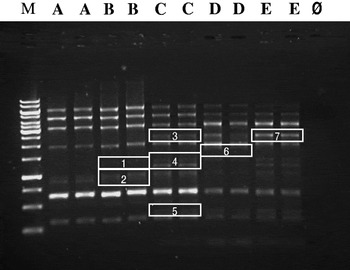
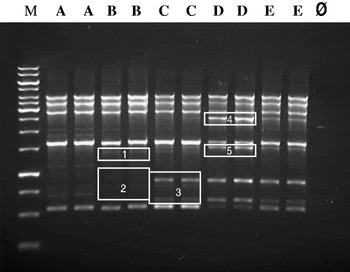
To validate that the different DNA pools obtained represent different sets of microorganisms, RAPD-PCR analyses with primers RAPD-B06 (Fig. 2) or RAPD-M13 (Fig. 3) and five DNA pools as templates were performed. The RAPD-B06 primer has been commonly used for classification of Lc. lactis strains (Tailliez et al. Reference Tailliez, Tremblay, Ehrlich and Chopin1998), and the RAPD-M13 primer has been used for classification of different microorganisms, including yeasts (Andrighetto et al. Reference Andrighetto, Psomas, Tzanetakis, Suzzi and Lombardi2000; Rossetti & Giraffa, Reference Rossetti and Giraffa2005).
RAPD-PCR electrophoretic patterns in 1% agarose gels obtained for different DNA pools (A, B, C, D, E) with primer B06 (5′-TGCTCTGCCC-3′). Ø, negative control for PCR; M, GeneRuler 1 kb DNA Ladder (Fermentas). The most important differences between the following pools were marked with white frames; B:A (frames 1+2), C:B (frames 3+4+5), D:C (frame 6), E:D (frame 7).

RAPD-PCR electrophoretic patterns in 1% agarose gels obtained for different DNA pools (A, B, C, D, E) with primer M13 (5′-GAGGGTGGCGGTTCT-3′). Ø, negative control for PCR; M, GeneRuler 1 kb DNA Ladder (Fermentas). The most important differences between the following pools were marked with white frames; B:A (frames 1+2), C:B (frame 3), D:C (frames 4+5).

Differences in DNA band patterns generated by RAPD-PCR and in the intensity among DNA pools were clearly visible (Figs. 2 & 3). The most important differences between DNA pools were marked with white frames. Analysis of DNA patterns generated with primer B06 showed that several DNA bands were present in all five DNA pools, while some of them were highly represented in A, B and C pools, but not in the last two pools (Fig. 2). The higher intensity of bands obtained in pools A, B and C compared with the same obtained in pools D and E could be due to the higher amount of DNA template corresponding to particular microorganisms, which indicates their preferential extraction in the first pools. Interestingly, there were also bands characteristic for particular DNA pools. For pool B, two differences were observed compared with pool A. The first difference, marked by the white frame 1, concerns a barely visible band that appeared in pool B; the second difference, in frame 2, concerns the reversed intensity of two bands. The lower band in this frame was no longer visible for DNA pools C-E. Moreover, two novel bands appeared in pool C which were absent in pool B (frames 3 and 5). In addition, the intensity of the lower band, corresponding to one of the bands observed in frame 1, was much higher (frame 4). A similar DNA electrophoretic pattern to that generated for pool C was observed for pool E; yet, it differed in the intensity of one band (frame 7). Unique DNA bands were also observed in the case of the second primer – RAPD-M13 (Fig. 3). A novel previously unobserved DNA band appeared in pool B compared with pool A (frame 1). However, at the same time several bands observed for pool A were no longer visible in pool B (frame 2) as well as in other DNA pools. Besides that three DNA bands appeared in pool C (frame 3), where the middle band seems to be unique only for this DNA pool. Finally, two other differences were observed between pools D and C (frames 4 and 5), with much higher intensity of the two DNA bands in pool D.
Overall, the RAPD fingerprinting method allowed discrimination between the five DNA pools isolated from kefir grains.
Implementation of the cascade cell lysis for semi-massive sequencing of genomic DNA
DNA pools were used to prepare representative DNA banks (A, B, C, D and E) using the TOPO Shotgun Subcloning Kit according to the manufacturer's instructions (Invitrogen Corporation). Nebulisations resulted in generation of DNA fragments ranging from 0·5 to 8 kb. The quality of the DNA banks was tested by colony PCR for thirty transformants of each bank. The amplified fragment of the vector without insert was expected to have 212 bp. For all the DNA banks most of the amplified inserts were longer than 500 bp, with the longest fragment cloned having 3 kb.
Ninety six clones from each DNA bank were sequenced, and bioinformatic analyses of the obtained sequences, including removal of fragments of vector sequences, were done using the Phred/Phrap/Consed package. The 427 sequences obtained were compared with those available in NCBI using the BLAST algorithm version blastx (Altschul et al. Reference Altschul, Madden, Schaffer, Zhang, Zhang, Miller and Lipman1997). Each blast alignment was filtered for three hits with the highest score value, with sequence identity above 50 or 70% (at least 30 amino acids identical) and E-value thresholds of 10–3. As much as 50% of the analysed nucleotide sequences, 215 of 427, showed homology to sequences from bacteria belonging to the Lactobacillus genus (Table 1). Several sequences were similar to sequences from bacteria representing Lactococcus, Oenococcus, Pediococcus, Streptococcus and Leuconostoc species (data not presented). Among homologues (above 70% of sequence identity) of yeast proteins were those from Cand. albicans, Cand. glabrata, K. lactis and Sac. cerevisiae. In addition, several sequences were found to be homologous to sequences from bacteriophages. However, 98 nucleotide sequences longer than 500 bp (including 54 sequences longer than 1000 bp) had no identified homologues.
Number of nucleotide sequences homologous to amino acid sequences from different groups of microorganisms. Results for the identity of more than 50% and more than 70% (in brackets)

Discussion
Different methods can be used to determine microbial biodiversity. Classical, non-direct methods based on the culturing of microorganisms on different rich and selective media have to be complemented by direct estimation of microbial biodiversity in the sample. Direct approaches are particularly important for complex populations like kefir grains. In such ecosystems, there are uncultivable organisms requiring symbiotic interactions, which are believed to be difficult to reconstruct.
Total DNA isolated from kefir grains contains large amounts of DNA from different microbial groups (bacteria and yeasts) that have the potential to interfere with specific amplification of particular DNA (Chen et al. Reference Chen, Wang and Chen2008). Moreover, dominant species may yield greater amounts of template DNA and, therefore, have a higher probability of detection (Prakitchaiwattana et al. Reference Prakitchaiwattana, Fleet and Heard2004). The detection limitations in determining microbial biodiversity by PCR approaches can also be the consequence of the interactions of proteins and aged cultures with genomic DNA, thereby affecting primer annealing to the template or the activity of DNA polymerase (de Barros Lopes et al. Reference de Barros Lopes, Soden, Henschke and Langridge1996; Beh et al. Reference Beh, Fleet, Prakitchaiwattana and Heard2006). For these reasons it is very important to pay attention to DNA extraction protocols and to preparation of DNA templates.
In this study we proposed a culture-independent approach based on microbial enrichment that could be applied to particular cases for various types of dairy products. Cascade cell lysis could be useful for identification of species with a small population size in a mixture of other abundant microorganisms.
Elaboration of the method of DNA isolation directly from kefir grains was the first step toward determining the biological diversity of this complex ecosystem. Kefir grains were cultured according to the procedure used by the grains producer, as published by Oklinski (Reference Oklinski2006). Preservation of original culture conditions and storage of grains were essential in order to increase the probability of obtaining reproducible and reliable results. These parameters influence the number and type of microorganisms isolated from kefir grains (Garrote et al. Reference Garrote, Abraham and De Antoni1997; Witthuhn et al. Reference Witthuhn, Schoeman and Britz2005a, Reference Witthuhn, Schoeman, Cilliers and Britzb). In order to increase the likelihood of isolating DNA from microorganisms which occur in grains in small quantities, DNA was isolated in several pools. This novel methodological approach – cascade cell lysis, was validated by RAPD analysis. Differences in DNA band patterns confirmed the diversified representation of microbial DNA in each DNA pool. These DNA pools were used to create DNA banks for direct sequencing.
It was expected that bank A represents DNA from microorganisms whose cells lysed easily or whose cell walls were partially disrupted during homogenisation. Other DNA banks were anticipated to represent DNA originating from cells of various microorganisms which could be destroyed by such factors as: lysozyme, lysozyme and mutanolysin, zymolyase and finally, mechanical disruption. For all the DNA banks, most sequences were homologous to those from bacteria belonging to the Lactobacillus genus. The small representation of other microorganisms can be due to the dominance of Lactobacillus spp. in kefir grains. The number of species detected in a sample is strongly affected by the number of sequences analysed (Schloss & Handelsman, Reference Schloss and Handelsman2005). The biggest variability in the microbial content was visible for bank D, where several sequences were homologous to yeast proteins and there were fewer sequences homologous to bacterial proteins (Table 1). The number of already sequenced bacterial and yeast genomes isolated from kefir grains is fairly low, which could explain the lack of homologous sequences to such microorganisms. Interestingly, a few sequences from the first three banks were homologous to bacteriophage proteins (Table 1), which indicates that kefir grains can be a source of new, potentially interesting bacteriophages. These results may be supported by the recently published work of De Antoni et al. (Reference De Antoni, Zago, Vasek, Giraffa, Carminati, Marcó, Reinheimer and Suárez2010) regarding the first isolation of bacteriophages from kefir grains. Finally, the observation that for 98 nucleotide sequences longer than 500 bp no homologues were found suggests that there might be unique sequences of microorganisms in kefir grains that have not yet been sequenced. The other, less probable explanation, could be that these cloned fragments are long non-coding regions.
Concluding, cascade cell lysis is a useful approach for assessing biodiversity of complex microbial ecosystems. By applying this approach in dairy microbial sample analysis, we isolated different pools of DNA and increased the chance for identification of less prevalent microorganisms.
This work was supported by the grant of the Polish Ministry of Science and Higher Education No. N312074 31/3966. We thank our colleagues from the Laboratory of DNA Sequencing and Oligonucleotide Synthesis at the Institute of Biochemistry and Biophysics of the Polish Academy of Sciences for DNA sequencing. We also appreciate the help of Dr Agnieszka Szczepankowska and Prof. Halina Sierakowska for language improvements of this manuscript.