





1. Introduction
Yellow Hypergiants (YHGs) and Yellow Supergiants (YSGs) occupy the upper region of the Hertzsprung-Russell diagram. Their main differentiating factor is their evolutionary status: YHGs are evolved stars that have lost much of their mass during the Red Supergiant (RSG) phase and are now evolving back towards higher temperatures (de Jager et al. 1998), while YSGs are less evolved and have yet to become RSGs. However, finding alignment of these objects with stellar evolutionary tracks is hampered by their uncertain distance determinations.
Many evolved massive stars are found in young stellar clusters, but estimates of the fraction born in bound clusters range from about 10% (Grudić et al. Reference Grudić2023) up to 80% (Quintana et al. Reference Quintana2025). If a cluster survives the initial gas expulsion, its dissolution time depends on its initial mass. For example, a small cluster with an initial mass of
 $100 M_\odot$
remains bound for about
 $\log t_\mathrm{dis} = 7.89$
years, and the time increases for more massive clusters (Lamers & Gieles Reference Lamers and Gieles2006). Other young massive stars are found in loosely bound OB associations, with approximate ages of
 $\log(\mathrm{Age})\approx6.7-7.0$
(5-10 Myr) based on their member spectral types (Melnik & Dambis Reference Melnik and Dambis2020). Single-star evolution models predict that only stars with
 $M_\mathrm{ini} \gt 20 M_\odot$
evolve into YHGs, with lifetimes of
 $\log (\mathrm{Age}) \approx 7.0$
(Ekström et al. Reference Ekström2012). Therefore, unless ejected, YHGs and YSGs are likely still located near their birth environments. Using Gaia DR3, we revisit the cluster and association memberships of Galactic YSGs and YHGs, explore links to their evolutionary states, and improve distances for stars with uncertain parallaxes.
2. Methods
We selected 35 luminous Galactic YSGs and YHGs. We used astrometric data from Gaia DR3 (Gaia Collaboration et al. Reference Collaboration2023) and catalogues of stellar clusters (Hunt & Reffert Reference Hunt and Reffert2024) and associations (Chemel et al. Reference Chemel2022) to compare the kinematics of each target with stars within a 1-degree sky region. We determined cluster memberships based on:
-
• Projected on-sky location
-
• Similarity in proper motion:
 $3\sigma$
tolerance
-
• Parallax: only if reliable,
$\varpi / \sigma_\varpi \gt5$


We combined parallaxes of nearby stars following Campillay et al. (Reference Campillay2019) and estimated group distances using Bayesian inference with priors from Bailer-Jones et al. (Reference Bailer-Jones2021).
3. Results
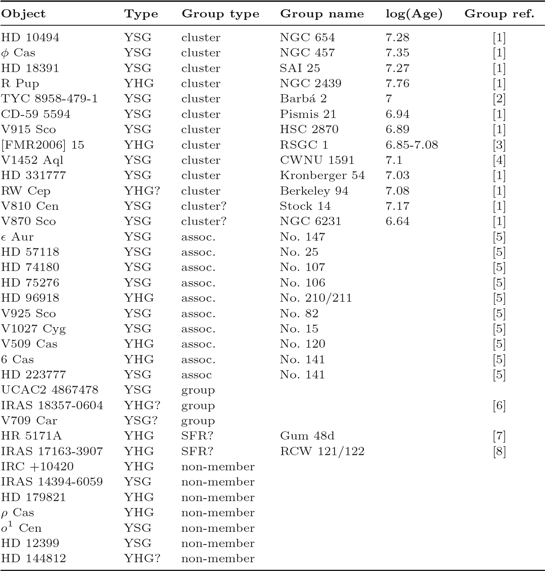
Group memberships of the sample stars are listed in Table 1. Most of the 13 stars identified as cluster members are YSGs, in clusters aged around 10 Myr. Two stars – V810 Cen and V870 Sco – are projected on a cluster on-sky, but their proper motions are inconsistent with being cluster members and they may be background stars. Three YHGs are located in cluster environments: R Pup in the oldest cluster (though the listed age may be too high for co-formation); [FMR 2006] 15 in a rare RSG cluster (Figer et al. Reference Figer2006); and RW Cep is a Red/Yellow Hypergiant in a young cluster.
Identified cluster and association memberships of YHGs and YSGs.

Table 1 Long description
The table has 11 columns and 30 rows. The columns are labeled: Object, Type, Group type, Group name, log(Age), and Group ref. The rows list various objects with their corresponding types, group types, group names, log(Age) values, and group references. For example, Row 1: HD 10494, YSG, cluster, NGC 654, 7.28, [1]. Row 2: φ Cas, YSG, cluster, NGC 457, 7.35, [1]. Row 3: HD 18391, YSG, cluster, SAI 25, 7.27, [1]. Row 4: R Pup, YHG, cluster, NGC 2439, 7.76, [1]. Row 5: TYC 8958-479-1, YSG, cluster, Barba 2, 7, [2]. Row 6: CD-59 5594, YSG, cluster, Pismis 21, 6.94, [1]. Row 7: V915 Sco, YSG, cluster, HSC 2870, 6.89, [1]. Row 8: [FMR2006] 15, YHG, cluster, RSGC 1, 6.85-7.08, [3]. Row 9: V1452 Aql, YSG, cluster, CWNU 1591, 7.1, [4]. Row 10: HD 331777, YSG, cluster, Kronberger 54, 7.03, [1]. Row 11: RW Cep, YHG, cluster, Berkeley 94, 7.08, [1]. Row 12: V810 Cen, YSG, cluster?, Stock 14, 7.17, [1]. Row 13: V870 Sco, YSG, cluster?, NGC 6231, 6.64, [1]. Row 14: ε Aur, YSG, assoc., No. 147, [5]. Row 15: HD 57118, YSG, assoc., No. 25, [5]. Row 16: HD 74180, YSG, assoc., No. 107, [5]. Row 17: HD 75276, YSG, assoc., No. 106, [5]. Row 18: HD 96918, YHG, assoc., No. 210/211, [5]. Row 19: V925 Sco, YSG, assoc., No. 82, [5]. Row 20: V1027 Cyg, YSG, assoc., No. 15, [5]. Row 21: V509 Cas, YHG, assoc., No. 120, [5]. Row 22: 6 Cas, YHG, assoc., No. 141, [5]. Row 23: HD 223777, YSG, assoc., No. 141, [5]. Row 24: UCAC2 4867478, YSG, group, No. 141, [5]. Row 25: IRAS 18357-0604, YHG?, group, [6]. Row 26: HR 5171A, YHG, SFR?, Gum 48d, [7]. Row 27: IRAS 17163-3907, YHG, SFR?, RCW 121/122, [8]. Row 28: IRC +10420, YHG, non-member, [8]. Row 29: IRAS 14394-6059, YSG, non-member, [8]. Row 30: HD 179821, YHG, non-member, [8]. Row 31: ρ Cas, YHG, non-member, [8]. Row 32: o1 Cen, YSG, non-member, [8]. Row 33: HD 12399, YSG, non-member, [8]. Row 34: HD 144812, YHG?, non-member, [8].
Notes: [1] Hunt & Reffert (Reference Hunt and Reffert2024), [2] Maíz Apellániz & Negueruela (Reference Maíz Apellániz and Negueruela2025), [3] Figer et al. (Reference Figer2006), [4] He et al. (Reference He2023), [5] Chemel et al. (Reference Chemel2022), [6] Clark et al. (Reference Clark2014), [7] Chesneau et al. (Reference Chesneau2014), [8] Wallström et al. (Reference Wallström2015). Cluster ages have errors
 $\sim$
0.2 dex.
Three YHGs and seven YSGs have proper motions compatible with OB associations in Chemel et al. (Reference Chemel2022). Some stars may belong to association-like stellar groups. IRAS 18357-0604 likely belongs to an association rich in RSGs (Clark et al. Reference Clark2014). UCAC2 4867478 and V709 Car have groups of stars within a 10’ projected radius with similar proper motions and distances, but no matching clusters are listed in used catalogues.
Two YHGs – HR 5171A and IRAS 17163-3907 – may belong to star-forming regions (SFR), but their distances are highly uncertain. Gaia DR3 data for possible nearby reddened and distant stars have large uncertainties, and we were not able to confirm or exclude membership.
Finally, non-membership does not necessarily mean that the star is isolated. For the most distant objects, e.g. IRC +10420 and HD 179821 nearby Main Sequence stars may be too faint. Alternatively, if the star has been dynamically ejected, its proper motion no longer aligns with its birth group.
Using nearby stars with good quality parallaxes (
 $\varpi / \sigma_\varpi \gt5$
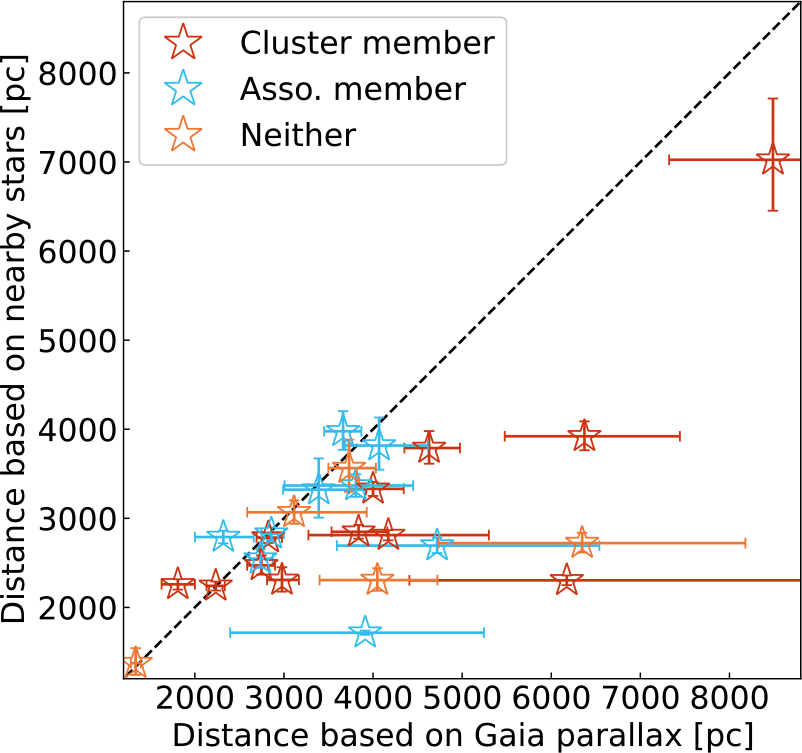
), we calculated the mean group distances. Our results agree well with Bailer-Jones et al. (Reference Bailer-Jones2021) for stars with reliable parallaxes (see Fig. 1). For stars with large parallax errors, Gaia distances tend to be significantly larger.
Comparison between distances from parallaxes (Bailer-Jones et al. Reference Bailer-Jones2021) and based on identified stellar groups (our work). The dashed line is 1:1 relation.

4. Conclusions
-
• 10 of 13 YHGs and YHG candidates are located in loosely bound stellar environments such as associations or are not clearly affiliated to a stellar population.
-
• YSGs are equally common in clusters and associations.
-
• We improved the distance estimates for 26 of 35 stars. For six, the new distances are smaller by more than 1000 pc compared to Bailer-Jones et al. (Reference Bailer-Jones2021).

 Open access

