1. INTRODUCTION
Intense laser beams propagating in plasmas are subject to many nonlinear phenomena like parametric instabilities (Nishikawa & Liu, Reference Nishikawa and Liu1976; Liu & Kaw, Reference Liu and Kaw1976; Kruer, Reference Kruer1988), harmonic generation (Grebogi et al., Reference Grebogi, Tripathi and Chen1983), mode conversion (Kruer, Reference Kruer1988; White & Chen, Reference White and Chen1974), soliton formation (Shukla, Reference Shukla1962), self-focusing (Sprangle et al., Reference Sprangle, Tang and Esarey1987; Max et al., Reference Max, Arons and Langdon1974), and modulation instabilities. Modulation instability is a general characteristic of wave propagation in nonlinear dispersive media and has been studied in diverse fields like fluid dynamics (Benjamin & Feir, Reference Benjamin and Feir1967), nonlinear optics (Ostrovskiy, Reference Ostrovskiy1966), and plasma physics (Hasegawa, Reference Hasegawa1975). When an intense laser pulse propagates through plasma, it alters its refractive index, which now has a linear as well as an intensity dependent nonlinear component. An important interaction that sets in due to this process is modulation interaction (Drake et al., Reference Drake, Kaw, Lee, Schmidt, Liu and Rosenbluth1974), which leads to a nonlinear shift in the laser group velocity in such a way that the wave amplitude becomes spatially modulated, thus leading to modulation instability. Due to modulation instability the continuous wave (cw) or quasi-continuous radiation beam breaks up into a train of short pulses. It has been extensively studied because of its fundamental nature as well as technological applications. Relativistic self-phase modulation (SPM) has been observed experimentally (Clayton et al., Reference Clayton, Tzeng, Gordon, Muggli, Mori, Joshi, Malka, Najmudin, Modena and Dangor1998) in plasma.
Study of propagation of multiple laser beams in plasma finds applications in charged particle acceleration and in inertial confinement fusion. Generation of large amplitude plasma waves by two colliding laser pulses (Bingham et al., Reference Bingham, Mendonca and Shukla2004) and energy transfer by super-radiant amplification of a short pulse by a counter-propagating laser pulse in plasma have been reported (Shvets et al., Reference Shvets, Fisch and Rax1998). It has been recently reported that stability and reproducibility of electron acceleration can be improved by counter-propagating laser pulses (Faure et al., Reference Faure, Rectiatin, Norlin, Lifschitz, Glinec and Malka2006). The reduction of amplitude of an ion acoustic wave (IAW) associated with stimulated Brilloin scattering (SBS) and amplification of electron plasma waves (EPW) associated with stimulated Raman scattering (SRS) for multiple lasers, have been reported (Labaune et al., Reference Labaune, Baldis, Cohen, Rozmus, Depierreux, Schifano, Baur and Michard1999). These two instabilities have important implications in inertial confinement fusion (ICF) due to possible large conversion of laser energy into scattered light affecting ICF drive efficiency and symmetry.
When two or more optical fields co-propagate in a medium, SPM is accompanied by another instability known as cross phase modulation (XPM). XPM is the nonlinear phase change of an optical field induced by the other co-propagating fields. Modulation instability (induced by SPM and XPM) due to two laser beams propagating in plasma (McKinstrie & Bingham, Reference McKinstrie and Bingham1989; McKinstrie & Luther, Reference McKinstrie and Luther1990) and fibers (Agrawal, Reference Agrawal1987; Agrawal et al., Reference Agrawal, Baldeck and Alfano1989) has been reported. An experimental result demonstrating relativistic cross phase modulation (RXPM) of one light pulse (generated by forward Raman scattering) by another relativistically intense light pulse in plasma has been reported by (Chen et al., Reference Chen, Rever, Zhang, Theobald and Umstadter2006). Besides being of fundamental physical interest, the observation of RXPM may provide a means to generate powerful single cycle light pulses.
The present paper deals with the analysis of spatial amplitude modulation instability that arises due to RSPM and RXPM of two co-propagating, with arbitrary relative linearly polarized laser beams interacting with homogeneous plasma. In Section 2, the wave equation describing the evolution of two linearly polarized laser beams in plasma has been set up. The effect of finite perturbation length, group velocity dispersion and coupled nonlinear source term, have been considered. The coupled dispersion relation leading to modulation instability has been obtained in Section 3. Section 4 deals with numerical analysis of the growth of modulation instability. Summary and conclusions are presented in Section 5.
2. FORMALISM
Consider two linearly polarized laser beams having the same frequency ω0 and wavenumber k 0, propagating through uniform plasma. The electric field vector of each of the two beams propagating along the z-direction is given by
 $${\bf E}_j=\displaystyle{{\hat e_j E_j } \over 2}\left({r\comma \; z\comma \; t} \right)\exp i\left({k_0 z - {\rm \omega} _0 t} \right)+c.c.\comma$$
where j = 1, 2 for the two beams. E j (r, z, t) is the complex, slowly varying amplitude of the laser field and ê j represents the arbitrary polarization direction (lying in the x-y plane) of each beam, The wave equation governing the propagation of the j th laser beam is given by
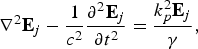 $$\nabla ^2 {\bf E}_j - \displaystyle{1 \over {c^2 }}\displaystyle{{\partial ^2 {\bf E}_j } \over {\partial t^2 }}=\displaystyle{{k_p^2 {\bf E}_j } \over {\rm \gamma} }\comma$$
where 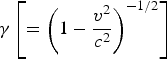 ${\rm \gamma} \left[{=\left({1 - \displaystyle{{v^2 } \over {c^2 }}} \right)^{ - 1/2} } \right]$ is the relativistic factor and v(=v1 + v2) is the combined quiver velocity of the plasma electrons in the presence of the two radiation fields. The quiver velocity of the plasma electrons in the electric field of the laser can be obtained from the Lorentz force equation
 $$\displaystyle{{\partial {\bf v}_j } \over {\partial t}}=- \displaystyle{{e{\bf E}} \over m}\comma$$
where E = E1 + E2. Thus,
 $$\eqalign{& {\bf v}=\displaystyle{1 \over {2i}}\left[\hat e_1 ca_1 \exp i\left({k_0 z - {\rm \omega} _0 t} \right)+\hat e_2 ca_2 \exp i\left({k_0 z - {\rm \omega} _0 t} \right)\right]+c.c.\comma \; }$$
where a j (=eE j/mcω0) is the normalized electric field amplitude. Assuming a j ≪1, the combined relativistic factor due to the two beams is given by
 $${\rm \gamma}=1+\displaystyle{{a_1^2 } \over 4}+\displaystyle{{a_2^2 } \over 4}+\displaystyle{{\hat e_1 .\hat e_2 } \over 4}\left({a_1^{\ast} a_2+a_1 a_2^{\ast} } \right).$$
Substituting Eqs. (1) and (5) into Eq. (2), the wave equation governing the interaction dynamics is obtained as
 $$\eqalign{& \left[\nabla _ \bot ^2+2ik_0 \displaystyle{\partial \over {\partial z}}+\displaystyle{{\partial ^2 } \over {\partial z^2 }} - \displaystyle{1 \over {c^2 }}\displaystyle{{\partial ^2 } \over {\partial t^2 }} \right. \left. +\displaystyle{{2i{\rm \omega} } \over {c^2 }}\displaystyle{\partial \over {\partial t}}+\displaystyle{{{\rm \omega} _0^2 } \over {c^2 }} - k_0^2 - \displaystyle{{{\rm \omega} _p^2 } \over {c^2 }} \right]a_j \cr & \quad = - \displaystyle{{{\rm \omega} _p^2 } \over {4c^2 }}\left[{a_1^2+a_2^2+\hat e_1 .\hat e_2 \left({a_1^{\ast} a_2+a_1 a_2^{\ast} } \right)} \right]a_j.}$$
To include the effect of the finite spot size, 4/r j02 is added and subtracted on the left side of Eq. (6). Now using the linear dispersion relation 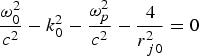 $\displaystyle{{{\rm \omega} _0^2 } \over {c^2 }} - k_0^2 - \displaystyle{{{\rm \omega} _p^2 } \over {c^2 }} - \displaystyle{4 \over {r_{\,j0}^2 }}=0$, Eq. (6) reduces to
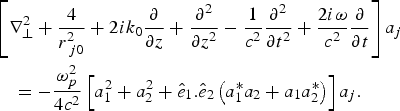 $$\eqalign{& \left[{\nabla _ \bot ^2+\displaystyle{4 \over {r_{\,j0}^2 }}+2ik_0 \displaystyle{\partial \over {\partial z}}+\displaystyle{{\partial ^2 } \over {\partial z^2 }} - \displaystyle{1 \over {c^2 }}\displaystyle{{\partial ^2 } \over {\partial t^2 }}+\displaystyle{{2i{\rm \omega} } \over {c^2 }}\displaystyle{\partial \over {\partial t}}} \right]a_j \cr & \quad = - \displaystyle{{{\rm \omega} _p^2 } \over {4c^2 }}\left[{a_1^2+a_2^2+\hat e_1 .\hat e_2 \left({a_1^{\ast} a_2+a_1 a_2^{\ast} } \right)} \right]a_j.}$$
The right side of Eq. (7) shows that the source driving each of the two beam amplitudes is due to a nonlinear combination of both beam amplitudes and leads to coupling of the beams as they propagate in plasma.
In order to study the spatial modulation instability of the laser beams, it is convenient to transform the spatial and temporal coordinates (z, t) to spatial coordinates (z, ξ). The transformation is achieved by substituting ξ = z − βgjct, where ξ defines the region from front to back of the laser pulse and βgj is the normalized group velocity. Thus Eq. (7) reduces to
 $$\eqalign{& \left[\nabla _ \bot ^2+\displaystyle{4 \over {r_{\,j0}^2 }}+2ik_0 \displaystyle{\partial \over {\partial z}}+2ik_0 \left({1 - \displaystyle{{{\rm \omega} _0 } \over {ck_0 }}{\rm \beta} _{gj} } \right)\right. \left. \displaystyle{\partial \over {\partial {\rm \xi} }}+\left({1 - {\rm \beta} _{gj}^2 } \right)\displaystyle{{\partial ^2 } \over {\partial {\rm \xi} ^2 }} _j \right. \cr & \quad \left. + {2\displaystyle{{\partial ^2 } \over {\partial z\partial {\rm \xi} }}+\displaystyle{{{\rm \omega} _p^2 } \over {4c^2 }}\left({a_1^2+a_2^2+\hat e_1 .\hat e_2 \left({a_1^{\ast} a_2+a_1 a_2^{\ast} } \right)} \right)} \right]a_j=0.}$$
In deriving Eq. (8), the radiation field amplitude is considered to be a slowly varying function of z; therefore, ∂2/∂z 2 has been neglected in comparison to 2k 0 ∂/∂z.
3. DISPERSION RELATION LEADING TO MODULATION INSTABILITY
To study the longitudinal modulational instability of an initially uniform laser beam interacting with plasma, we consider a simple one dimensional model. Neglecting transverse variations of the laser field amplitude, the plane wave limit of Eq. (8) gives
 $$\eqalign {& \left[2k_0 \left({i\displaystyle{\partial \over {\partial z}}+\displaystyle{{\Omega _j } \over {2k_0 }}\displaystyle{{\partial ^2 } \over {\partial {\rm \xi} ^2 }}} \right)+2\displaystyle{{\partial ^2 } \over {\partial z\partial {\rm \xi} }}+\displaystyle{{{\rm \omega} _p^2 } \over {4c^2 }} \right. \cr & \quad \left.\left({a_1^2+a_2^2+\hat e_1 .\hat e_2 \left({a_1^{\ast} a_2+a_1 a_2^{\ast} } \right)} \right)\right]a_j=0\comma \; }$$
where Ωj (=1 − βgj2 = ωp2/ω02 + 4c 2/ω02r j02) is the dispersion parameter.
In the long pulse limit, variations in the laser pulse amplitude with respect to ξ may be considered to be a perturbation that results in modulation instability. Thus, the zeroth order (ξ independent) solution of Eq. (9) will be given by
 $$a_{sj} \left(z \right)=a_{\,j0} \exp \left({imz} \right)\comma$$
where  $m=\displaystyle{{{\rm \omega} _p^2 } \over {8k_0 c^2 }}\left({a_{10}^2+a_{20}^2+2\hat e_1 .\hat e_2 a_{10} a_{20} } \right)$ is the nonlinear phase shift parameter induced by relativistic self and cross phase modulation (RSPM and RXPM). Assuming the first order contribution to the pulse amplitude obtained due to ξ variations to be of the same form as that of the unperturbed amplitude, the total amplitude may be written as
 $$a_j \left({z\comma \; {\rm \xi} } \right)=a_{sj} \left(z \right)+a_j^{\prime} \left({z\comma \; {\rm \xi} } \right)\exp \left({imz} \right)\comma$$
where a′j(z, ξ) is the complex perturbed beam amplitude. Substituting Eq. (11) in Eq. (9) and considering | a′j| ≪ |a sj| we get
 $$\eqalign{& i\displaystyle{{\partial a^\prime_j} \over {\partial z}} +\displaystyle{{\Omega _j } \over {2k_0 }} \displaystyle{{\partial ^2 a^{\prime}_j } \over {\partial {\rm \xi} ^2 }} +\displaystyle{{im} \over {k_0 }}\displaystyle{{\partial a^{\prime}_j } \over {\partial {\rm \xi} }}+\displaystyle{1 \over {k_0 }}\displaystyle{{\partial ^2 a^{\prime}_j } \over {\partial z\partial {\rm \xi} }} \cr & \quad = - \displaystyle{{{\rm \omega} _{\,p}^2 } \over {8k_{0}c^2 }} \left({a_{10}^2+a_{20}^2+\hat e_1 .\hat e_2 a_{10} a_{20}}\right)\left(a_j^{\prime}+a_j^{\prime \ast} \right) \cr & \quad \quad +\displaystyle{{{\rm \omega} _p^2 } \over {8c^2\, k_0 }}a_{\left({3- j} \right)0}^2 \left({a_j^\prime+a_j^{\prime \ast}} \right) \cr & \qquad +\displaystyle{{{\rm \omega} _p^2 } \over {8c^2\, k_0 }} \left\{\left(a_{\,j0}a_{\lpar 3-j\rpar 0}\right)+ \hat e_1 .\hat e_2 a_{\,j0}^2 \right\}\left(a_{\lpar 3 - j\rpar }^{\prime}+a_{\lpar 3 - j\rpar }^{\prime \ast } \right).}$$
The second and third terms on the right side of Eq. (12) couple the two beams and arise due to cross phase modulation, whereas first term is induced by self-phase modulation. If either of the beams is absent Eq. (12) reduces to the evolution of a single beam (Sprangle et al., Reference Sprangle, Hafizi and Penano2000) propagating in plasma.
It is assumed that Eq. (12) has a general solution of the form
 $$a^{\prime}_j = u_j \cos \!\lpar Kz+k{\rm \xi} \rpar +iv_j \sin \!\lpar Kz+k{\rm \xi} \rpar \comma$$
where K is the modulation wave number representing the spatial growth, while k is the propagation wave number of the perturbed wave amplitude. Substituting Eq. (13) into Eq. (12), provides a set of four homogeneous equations for u 1, u 2, ν1, and ν2. This set has a nontrivial solution when K and k satisfy the dispersion relation
 $$\eqalign{& \left[{\left({K+\displaystyle{{mk_{} } \over {k_0 }}} \right)^2 - \left\{{\left({\displaystyle{{k^2 \Omega _2 } \over {2k_0 }}+\displaystyle{{Kk} \over {k_0 }} - 2n+2R} \right)\left({\displaystyle{{k^2 \Omega _2 } \over {2k_0 }}+\displaystyle{{Kk} \over {k_0 }}} \right)} \right\}} \right]\cr &\quad \times \left[{\left({K+\displaystyle{{mk_{} } \over {k_0 }}} \right)^2 - \left\{{\left({\displaystyle{{k^2 \Omega _1 } \over {2k_0 }}+\displaystyle{{Kk} \over {k_0 }} - 2n+2P} \right)\left({\displaystyle{{k^2 \Omega _1 } \over {2k_0 }}+\displaystyle{{Kk} \over {k_0 }}} \right)} \right\}} \right]\cr & \quad - 4\displaystyle{{k^2\, K} \over k}QS\left\{{\displaystyle{1 \over 2}\left({\Omega _1+\Omega _2 } \right)+K} \right\}=4\displaystyle{{k^4 } \over {k_0^2 }}\Omega _1 \Omega _2 QS.}$$
Where  $n=\displaystyle{{{\rm \omega} _p^2 } \over {8k_0 c^2 }}\left({a_{10}^2+a_{20}^2+\hat e_1 .\hat e_2 a_{10} a_{20} } \right)$, R = ωp2a 102/8c 2k 0, P = ωp2a 202/8c 2k 0, Q=(ωp2/8c 2k 0)(a 10a 20 + ê 1.ê 2a 102) and S = (ωp2/8c 2k 0)(a 10a 20 + ê 1.ê 2a 202) and the term on the right side represents the coupling of the dispersion parameters of the two beams. Eq. (14) represents a complex dispersion relation which can be solved numerically. However, analytical solutions can be obtained if the mixed derivative (fourth) term in Eq. (12) is neglected. This approximation is valid if (Ωj2/2)∂2/∂ξ2 ≫ ∂2/∂z∂ξ or
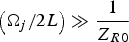 $\left(\Omega_j / 2L \right) \gg \displaystyle{{1} \over {Z_{R0}}}$ where L is the pulse length and Z R0 is the Rayleigh length. In this limit the dispersion relation reduces to
 $$\left[{\left({\hat K^2 - f_1 } \right)\times \left({\hat K^2 - f_2 } \right)} \right]=C\comma$$
where  $\hat K=KZ_{R0}\comma \; \ \hat k={k / {k_0 }}\comma \; \ Z_{R0}={{k_0 r_0^2 } / 2}\comma \; \ r_0=\sqrt {r_{10} r_{20} }\comma $
 $ m_0={{mk_0 r_0^2 } / 2}\comma \; n_0={{nk_0 r_0^2 } / 2}f_1=\left({\hat k^2 \hat \Omega _1 - 2n_0+2P_0 } \right)\hat k^2 \hat \Omega _1\comma $
 $ f_2=\left({\hat k^2 \hat \Omega _2 - 2n_0+2R_0 } \right)\hat k^2 \hat \Omega _2 \comma \ \ P_0=P_{} k_0 {{r_0^2 } / 2}\comma \ \ \hat \Omega _j={{\Omega _j k_0^2 r_0^2 } / 4}\comma $
 $R_0={{Rk_0 r_0^2 } / 2}\comma \ \ \quad \quad Q_0={{Qk_0 r_0^2 } / 2}\comma \quad \quad\ S_0={{Sk_0 r_0^2 } / 2}\quad \ \ and \ \quad\ \ C=4\hat k^4 \hat \Omega _1 \hat \Omega _2 Q_0 S_0 $
The dispersion Eq. (15) is a quadratic in  $\hat K^2 $ and therefore has four roots. Modulation instability is invoked if the roots are complex and growth of modulation instability is given by the imaginary part of these roots as
 $$\Gamma=\left[{\displaystyle{{\left({\,f_1+f_2 } \right)\pm \left\{{\left({\,f_1+f_2 } \right)^2 - 4\left({\,f_1 f_2 - C} \right)} \right\}^{{1 / 2}} } \over 2}} \right]^{\displaystyle{1 \over 2}}.$$
It may be noted that two pairs of sidebands having equal growth rate will arise.
4. NUMERICAL ANALYSIS OF MODULATION INSTABILITY
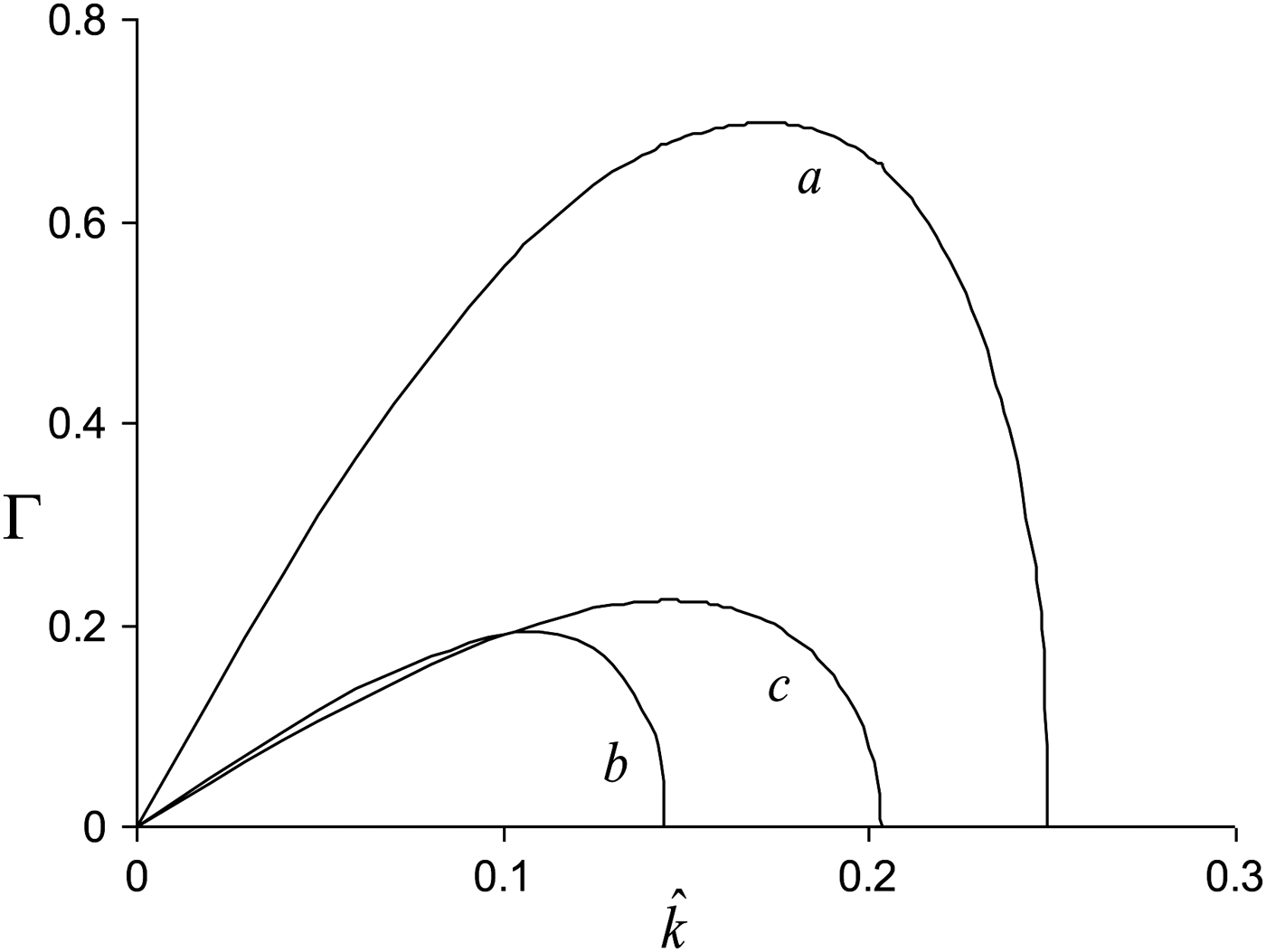
In order to study the complete modulation instability including the mixed derivative terms (∂2/∂z∂ξ), numerical solution of the fourth order polynomial (Eq. (14)) in  $\hat K$ is obtained. The imaginary part of the complex roots thus obtained represents the growth rate of modulation instability. For a given set of parameters the two solutions correspond to two spectral bands (k 0± k 1 and k 0 ± k 2). Figure 1 shows the growth of spatial modulation instability due to two identical (a 10 = a 20 = 0.3 and r 10 = r 20 = 15 μm) and parallel polarized (ê 1.ê 2 = 1) laser beams (curves a) co-propagating in plasma having density n 0 = 4.96 × 1018 cm−3. Curve c shows the growth of a single laser beam having the same parameters. It is observed that the peak gain of the sideband with higher growth rate increases by about 3.3 times, whereas the sideband with lower growth is suppressed as compared to the single beam sideband growth. The modulation wavenumber corresponding to maximum gain, decreases for the lower gain sideband, and increases for higher gain sideband for the two beams case, as compared to the wavenumber of the sideband of a single beam.
Growth of spatial modulation instability over a range of modulation wave numbers for two co-propagating, identical (a 10 = a 20 = 0.3 and r 10 = r 20 = 15 μm) and parallel polarized (ê 1.ê 2 = 1) laser beams (curves a and b) and single beam (curve c) for the same parameters; plasma density n 0 = 4.96 × 1018 cm−3.

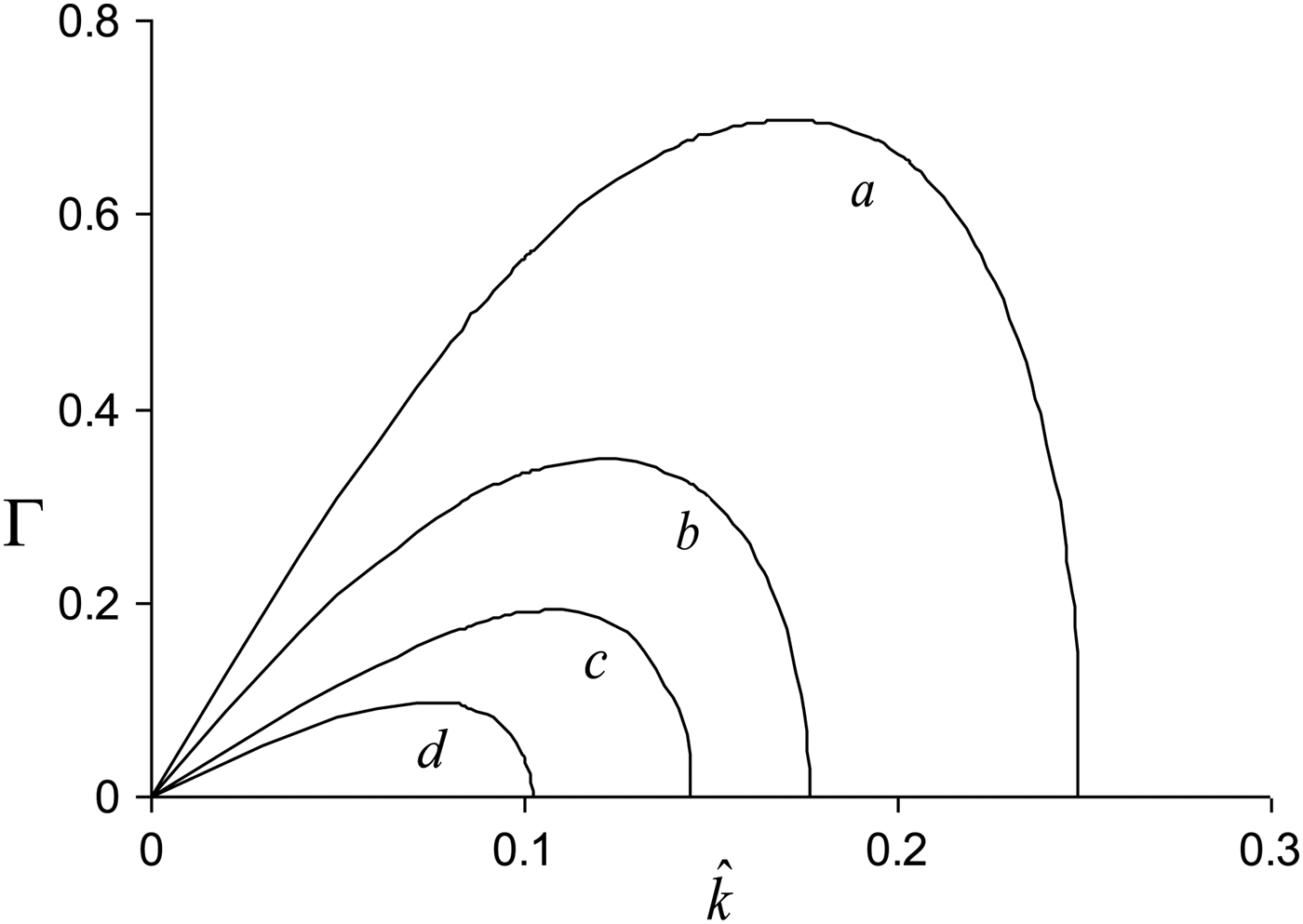
Figure 2 is plotted for different polarization conditions for two laser beams with parameters a 10 = a 20 = 0.3 and r 10 = r 20 = 15 μm and n 0 = 4.96 × 1018 cm−3. It is seen that the peak growth rate of the predominant sideband obtained when the two beams have parallel polarization (ê 1.ê 2 = 1, curve a) is twice the growth obtained for two beams having perpendicular polarization (ê 1.ê 2 = 0, curve b). Similarly, the peak growth rate of the suppressed sideband for the parallel polarization case (curve c) is also nearly twice the peak growth rate obtained for perpendicular polarization case (curve d). If the two laser beams have antiparallel polarization (ê 1.ê 2 = −1), growth of modulation instability does not occur.
Variation of growth of modulation instability for parallel (ê 1.ê 2 = 1, curves a and c) and perpendicular (ê 1.ê 2 = 0, curves b and d) polarized beams for a 10 = a 20 = 0.3 and r 10 = r 20 = 15 μm and n 0 = 4.96 × 1018 cm−3.
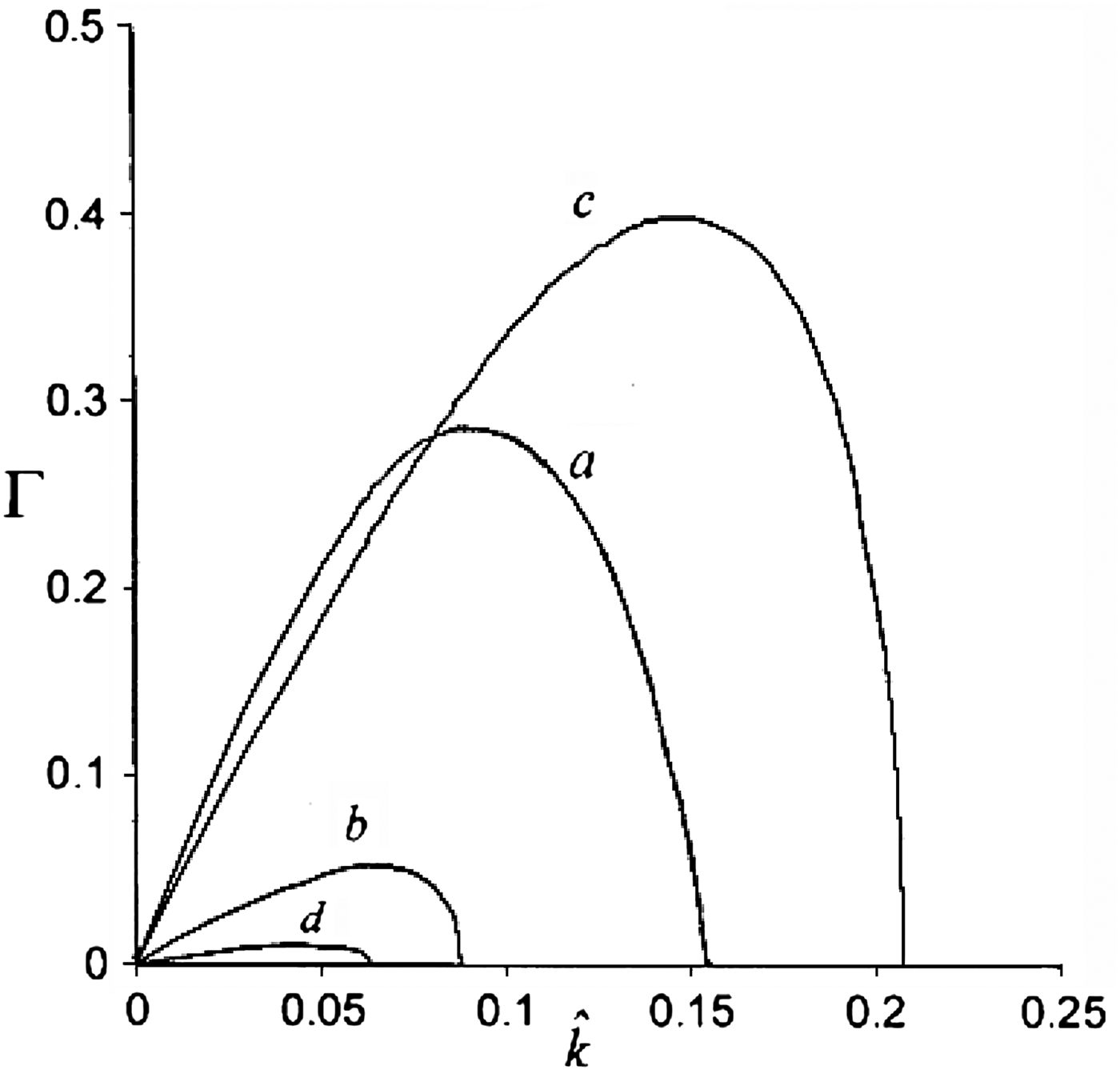
In order to study the modulation instability invoked by two parallel polarized laser beams having different spot size and laser strength parameters (a 10 = 0.1, r 10 = 10 μm, a 20 = 0.3, r 20 = 20 μm, power ratio = 1:36) propagating in plasma (n 0 = 4.96 × 1018 cm−3), Figure 3 is plotted. Growth of two sidebands is represented by curves a and b. Curves c and d depict the sidebands obtained by single beam propagation for the higher and lower power lasers respectively. It may be noted that the growth of instability for the high power beam is suppressed when a lower power beam co-propagates with it. On the contrary, growth rate of the low power beam enhances due to the presence of the high power laser beam.
Growth of modulation instability for sidebands in the presence of two parallel polarized laser beams for parameters a 10 = 0.1, r 10 = 10 μm, a 20 = 0.3, r 20 = 20 μm, (power ratio = 1:36), n 0 = 4.96 × 1018 cm−3 (curves a and b) and the growth of sidebands of their single beam counterparts (curves c and d).
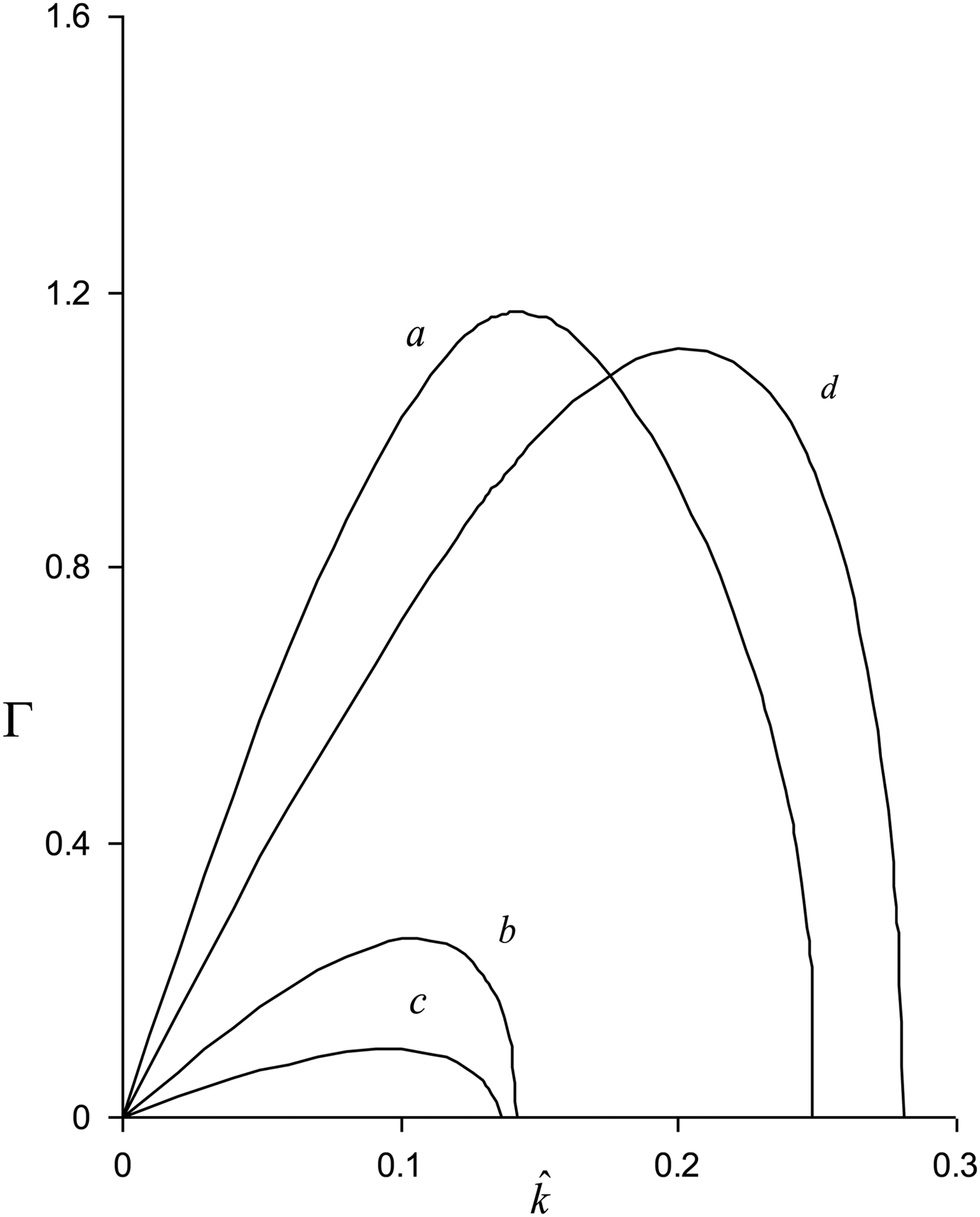
Figure 4 is plotted for two beams with a lower power ratio. The parameters used are a 10 = 0.2, r 10 = 15 μm and a 20 = 0.4, r 20 = 25 μm that implies a power ratio 1:11 and n 0 = 4.96 × 1018 cm−3. It is seen that the peak growth rate of the predominant sideband due to two beams (curve a) is slightly higher than the growth of the single higher power beam (curve d). The growth of instability of both (curves a and b) sidebands for the two beam case is higher than the growth rate obtained for the single low power beam (curve c).
Growth of modulation instability for sidebands in the presence of two parallel polarized laser beams for parameters a 10 = 0.2, r 10 = 15 μm, a 20 = 0.4, r 20 = 25 μm (power ratio =1:11), n 0 = 4.96 × 1018 cm−3 (curves a and b) and the growth of sidebands of their single beam counterparts (curves c and d).
5. SUMMARY AND CONCLUSIONS
In this paper, modulation instability of two beams (having the same frequency), co-propagating in homogeneous plasma has been analyzed. It is observed that for two identical (same polarization, spot size and laser strength parameter) beams co-propagating in plasma, two pairs of sidebands are generated. It is observed that the sideband with higher growth rate increases, whereas sideband with lower growth is suppressed as compared to single beam growth. The modulation wave number corresponding to maximum gain decreases for lower gain sideband and increases for higher gain sideband for two beam case as compared to single beam. The effect of polarization of two beams has been considered and it is observed that the growth rate of the predominant sideband increases if the two beams have parallel polarization as compared to perpendicular polarization case. The growth rate of the suppressed sideband also increases for parallel polarization case as compared to perpendicular polarization case. For two beams co-propagating with anti-parallel polarization, modulation instability does not occur.
Modulation instability arising due to propagation of two parallel polarized beams having different spot sizes and laser strength parameters has been analyzed for high as well as low power ratios of the two beams. When the power ratio is high, the growth of the higher power beam is suppressed when a lower power beam co-propagates with it. On the contrary, growth rate of the low power beam enhances due to the presence of the high power laser beam.
If the power ratio of the two beams is small, it is seen that the peak growth rate of the predominant sideband due to two beams is nearly the same as the growth of the single higher power beam. The growth of instability of both sidebands for the two beam case is higher than the growth rate obtained for the single low power beam.
The present analysis will be relevant for laser-plasma devices in which two or more beams are used. It is important to note that modulation instability of a linearly polarized laser beam can be completely suppressed, by allowing co-propagation of an identical laser beam having antiparallel polarization. By using two beams with high power ratio, modulation instability of the higher power beam can be suppressed i.e., the distortion of pulses can be controlled, leading to propagation up to large distances under stable conditions. Stable propagation will increase the interaction length which is essential for applications such as laser wakefield accelerator, X-ray sources and harmonic generation. Also, the increase in growth rate of sidebands due to co-propagation of two pulses, could point towards the possibility of generation of optical pulses of short duration.