Introduction
Feldspars are among the most widespread minerals in the terrestrial planets and form ∼50 wt.% of the Earth’s crust and a significant part of the Moon’s crust (e.g. Ohtake et al., Reference Ohtake, Matsunaga, Haruyama, Yokota, Morota, Honda, Ogawa, Torii, Miyamoto, Arai, Hirata, Iwasaki, Nakamura, Hiroi, Sugihara, Takeda, Otake, Pieters, Saiki, Kitazato, Abe, Asada, Demura, Yamaguchi, Sasaki, Kodama, Terazono, Shirao, Yamaji, Minami, Akiyama and Josset2009; Vadawale et al., Reference Vadawale, N.P.S, Shanmugam, Basu Sarbadhikari, Sinha, Bhatt, Vijayan, Srivastava, Shukla and S.V.S2024). Most widespread in Nature are alkaline aluminosilicate feldspars, such as microcline, orthoclase, sanidine (KAlSi3O8) and albite (NaAlSi3O8). Countless works have been devoted to their study, including handbooks, monographs and reviews (e.g. Smith and Brown, Reference Smith and Brown1988; Angel, Reference Angel and Parsons1994; Deer et al., Reference Deer, Howie and Zusmann2001; Bokiy and Borutzky, Reference Bokiy and Borutzky2003; Krivovichev, Reference Krivovichev2020). Interest in their study is associated not only with their geological significance, but also due to the wide application in various industries (e.g. Carter and Norton, Reference Carter and Norton2008; Zhang et al., Reference Zhang, Hu, Sun, Jiu, Wang, Wang and Sun2018; Silva et al., Reference Silva, Carolina, Sousa and Silva2019; Fuertes et al., Reference Fuertes, Reinosa, Fernandez and Enriquez2022). In addition, feldspars are among the most important mineral-sources of rubidium (e.g. Greenwood and Earnshaw, Reference Greenwood and Earnshaw1998; Xing et al., Reference Xing, Wang, Ma, Wang, Zhang and Chen2018).
Despite the relatively high concentrations of rubidium in the Earth’s crust (90 ppm by mass; Christy, Reference Christy2015), minerals with essential rubidium are extremely rare in Nature (mindat.org; Ralph et al., Reference Ralph, Von Bargen, Martynov, Zhang, Que, Prabhu, Morrison, Li, Chen and Ma2024). The geochemical similarity of rubidium to potassium means that this element is scattered and, unlike other alkali metals, almost all rubidium is dispersed between feldspars, leucite–pollucite and mica (e.g. Solodov et al., Reference Solodov, Balashov and Kremenetsky1980). Nevertheless, according to the list of minerals accepted by the International Mineralogical Association (IMA, Pasero, Reference Pasero2025), only three mineral species with essential rubidium are known to date: ramanite-(Rb) RbB5O6(OH)4·2H2O (Rainer et al., Reference Rainer, Paul and Hahn2008), voloshinite Rb(LiAl1.5□0.5)(Al0.5Si3.5)O10F2 (Pekov et al., Reference Pekov, Kononkova, Agakhanov, Belakovskiy, Kazantsev and Zubkova2009) and rubicline RbAlSi3O8 (Teertstra et al., Reference Teertstra, Černý, Hawthorne, Pier, Wang and Ewing1998a). It is worth noting, that all three of them were found in granitic pegmatites and two of the three are Rb analogues of rock-forming minerals. It is also interesting to note that all three Rb-minerals are usually formed in association with pollucite (Teertstra et al., Reference Teertstra, Černý and Hawthorne1997, Reference Teertstra, Černý, Hawthorne, Pier, Wang and Ewing1998a, Reference Teertstra, Černý and Hawthorne1999a; Rainer et al., Reference Rainer, Paul and Hahn2008; Pekov et al., Reference Pekov, Kononkova, Agakhanov, Belakovskiy, Kazantsev and Zubkova2009). Rubicline, the first approved and most widespread rubidium mineral, is a rubidium analogue of microcline, i.e. belongs to the feldspar family and is usually found in granitic pegmatites (Teertstra et al., Reference Teertstra, Černý and Hawthorne1997, Reference Teertstra, Černý, Hawthorne, Pier, Wang and Ewing1998a, Reference Teertstra, Černý and Hawthorne1999a; Krivovichev, Reference Krivovichev2020).
Historically, due to the similarity of the physical properties of Si (Z = 14) and Ge (Z = 32), germanium analogues of rock-forming silicates have been synthesised at lower pressure–temperature (PT) conditions to simulate the possible mineral structure types of the Earth’s interior (Kume et al., Reference Kume, Matsumoto and Koizumi1966, Reference Kume, Ueda and Koizumi1969; Ringwood et al., Reference Ringwood, Reid and Wadsley1967; Ahrens et al., Reference Ahrens, Petersen and Rosenberg1969; Kinomura et al., Reference Kinomura, Koizumi and Kume1971; Kovalev et al., Reference Kovalev, Spivak, Setkova, Ksenofontov, Volkova, Korepanov, Balitsky and Zakharchenko2024). Though Ge is a trace element in the Earth’s crust, it tends to substitute for Si in rock-forming minerals (Goldschmidt, Reference Goldschmidt1926, Reference Goldschmidt1958), therefore, the Ge/Si ratio in different natural environments can be used as a tracer of silicate weathering and secondary mineral formation (De Argollo and Schilling, Reference De Argollo and Schilling1978; Bernstein, Reference Bernstein1985; Mortlock and Frohlich, Reference Mortlock and Frohlich1987; Murnane and Stallard, Reference Murnane and Stallard1990) and feldspars are the most important minerals for evaluation of such processes (e.g. Froelich et al., Reference Froelich, Blanc, Mortlock, Chillrud, Dunstan, Udomkit and Peng1992; Kurtz et al., Reference Kurtz, Derry and Chadwick2002; Baronas et al., Reference Baronas, Torres, West, Rouxel, Georg, Bouchez, Gaillardet and Hammond2018). In materials-science studies, the substitution of Ge for Si is known to influence properties such as ion exchange, catalysis and molecular sieving. (Breck, Reference Breck1974; Lerot et al., Reference Lerot, Poncelet and Fripiat1975; Corma et al., Reference Corma, Martín-Aranda and Sánchez1990; Helliwell et al., Reference Helliwell, Kaučič, Cheetham, Harding, Kariuki and Rizkallah1993). Some investigations have demonstrated that Ge addition during the synthesis of silicates (e.g. in zeolites) leads to enhanced rates of nucleation and growth (e.g. Cheng et al., Reference Cheng, Juttu, Mitchell and Shantz2006). It is also known that the partial substitution of Si to Ge can lead to improvements in the efficiency and thermal stability of the luminescent properties, lowering of the sintering temperature and improvement of dielectric properties of some compounds (Suzuki et al., Reference Suzuki, Takahashi, Iwasaki, Terakado and Fujiwara2015; Zhang et al., Reference Zhang, Mei, Rao, Shu and Li2022; Appiah et al., Reference Appiah, Yang, Ullah, Xiao, Stavrou, Zhang and Tan2024). Nevertheless, differences in the atomic radii of Si and Ge (0.26 and 0.39 Å, respectively; Shannon, Reference Shannon1976) does lead to the formation of new crystal structures, which have no silicate analogues (e.g. Li and Yaghi, Reference Li and Yaghi1998; O’Keeffe and Yaghi, Reference O’Keeffe and O.M1999).
To date only three ‘ternary’ compounds are known in the Rb2O–Al2O3–GeO2 system: RbAlGe3O8 (Kinomura et al., Reference Kinomura, Koizumi and Kume1971; Tripathi and Parise, Reference Tripathi and Parise2002), RbAlGe2O6 (Torres-Martinez and West, Reference Torres-Martinez and A.R1989; Bell, Reference Bell2024) and RbAlGeO4 (Kivlighn, Reference Kivlighn1966; Terry et al., Reference Terry, Vinton, McMillen, Chen, Zhu and Kolis2022). According to published data RbAlGe2O6 has a pollucite-like structure, RbAlGeO4 most probably, can crystallise with a triclinic tridymite-like structure (Terry et al., Reference Terry, Vinton, McMillen, Chen, Zhu and Kolis2022) or with tetragonal symmetry (Kivlighn, Reference Kivlighn1966). RbAlGe3O8 is known in three different polymorphic modifications: feldspar-, hollandite- and paracelsian-like (Kinomura et al., Reference Kinomura, Koizumi and Kume1971; Tripathi and Parise, Reference Tripathi and Parise2002). Note that only approximate values of the unit-cell parameters are provided for feldspar-like and hollandite-like RbAlGe3O8 and no structural data have been obtained for these polymorphs.
The present study is aimed at characterising the crystallisation process, crystal structure and high-temperature behaviour of RbAlGe3O8 with feldspar topology using single-crystal X-ray diffraction (SCXRD) and in situ high-temperature (HT) powder X-ray diffraction (PXRD) up to 1110°C in order to determine its crystal structure, thermal expansion and transformation and compare it with the previously studied isostructural compounds.
Materials and methods
Synthesis, phase and chemical composition
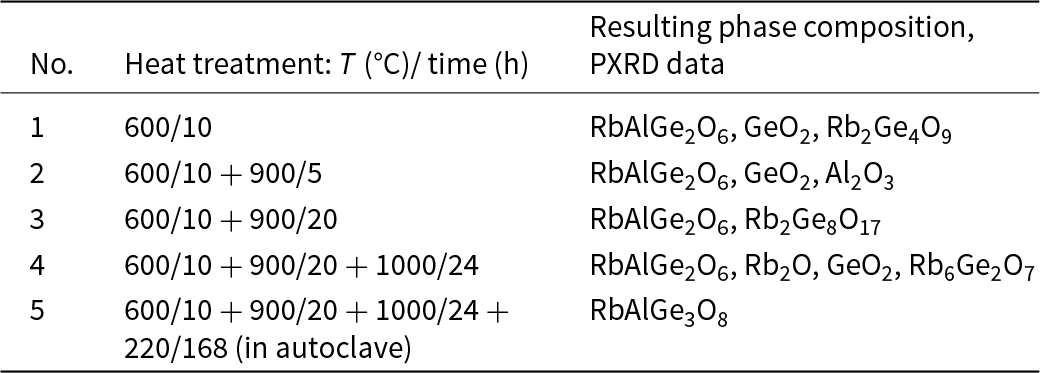
RbAlGe3O8 was synthesised from chemically pure Rb2CO3 (99.99%, Sigma-Aldrich), Al2O3 (99.99%, Sigma-Aldrich) and GeO2 (99.99%, Sigma-Aldrich), taken in the mole ratios of 0.5:0.5:3, respectively. The reagents were ground in an agate mortar and placed in a platinum crucible. The mixture was heated in air at 600, 900 and 1000°C (Table 1). After heating, the sample was transferred to a Teflon liner containing distilled water. The liner was sealed and placed in an autoclave, which was then heated in an oven at 220°C for 7 days (vapour pressure of ∼3 MPa) before cooling to room temperature.
Synthesis conditions and resulting phase composition

The phase composition of all synthesised samples was determined by PXRD using a MiniFlex II (Rigaku Oxford Diffraction, Japan) X-ray diffractometer (CuKα1+2 radiation, 30 kV/15 mA, Bragg-Brentano geometry, DTEX/ULTRA). The chemical composition of the obtained compounds was determined using a S-3400 N scanning electron microscope (Hitachi, Japan) equipped with an AzTec Energy 350 energy dispersive (EDX) spectrometer (Oxford Diffraction, UK) (Supplementary Table S1).
Single crystal X-ray diffraction (SCXRD)
The SCXRD analysis of RbAlGe3O8 was performed using a XtaLAB Synergy-S (Rigaku, Japan) diffractometer equipped with an HyPix-6000HE detector (MoKα radiation, 50 kV and 1 mA). The single crystal of RbAlGe3O8 with the approximate size of 10 × 10 × 10 μm was mounted on a glass fibre using paraton-n. The obtained SCXRD data were integrated and corrected for background, Lorentz, and polarisation effects. An empirical absorption correction based on the spherical harmonics implemented in the SCALE3 ABSPACK algorithm was applied in the CrysAlisPro program (Agilent, 2012). The unit-cell parameters were refined using the least-square techniques. The SHELXL program package (Sheldrick, Reference Sheldrick2008) was used for all structural calculations (Supplementary Tables S2 and S3). The crystallographic information file has been deposited with the Principal Editor of Mineralogical Magazine and is available as Supplementary material (see below).
High-temperature powder X-ray diffraction (HT-PXRD)
The HT behaviour of all compounds studied (see below) has been observed by heating in air and HT-PXRD using an Ultima IV (Rigaku, Japan) diffractometer (CuKα radiation, 40 kV/30 mA, Bragg-Brentano geometry, PSD D-Tex Ultra detector) with a thermo-attachment in the range 30–1110°C using steps of 30°C. A fine powdered sample was deposited on a platinum sample holder (20 × 12 × 1.5 mm) from an ethanol suspension (Filatov, Reference Filatov1971). An external Si standard was used before the measurements to control the 2θ correctness and peaks from the platinum sample holder were used as the internal standard during the experiment. The calculations of the unit-cell parameters were performed using the program package Topas 4.2 (Dinnebier et al., Reference Dinnebier, Leineweber and Evans2019). The temperature dependence of the unit-cell parameters was described by linear functions. The calculation and visualisation of the thermal expansion parameters tensor was performed using the TTT program package (Bubnova et al., Reference Bubnova, Firsova and Filatov2013).
Results and discussion
Formation of RbAlGe3O8
The solid-state synthesis method does not lead to formation of RbAlGe3O8 (Table 1). All the heat treatment leads to the formation of a RbAlGe2O6 leucite-like phase ( $I\bar 4$3d space group; PDF 00-037-0348, https://www.icdd.com) with an admixture of different phases. Such results are in agreement with alkali aluminosilicate feldspars (M +AlSi3O8) being difficult to nucleate and grow from their anhydrous melts (Schairer and Bowen, Reference Schairer and Bowen1955; Kirkpatrick et al., Reference Kirkpatrick, Klein, Uhlmann and Hays1979; McMillan, Reference McMillan1979; Taylor and Brown, Reference Taylor and Brown1979; Smith and Brown, Reference Smith and Brown1988; Liu et al., Reference Liu, Komarneni and Roy1994) and it is much easier to synthesise alkali feldspar crystals using hydrothermal methods (Barrer and McCallum, Reference Barrer and McCallum1953; Barrer and Baynham, Reference Barrer and Baynham1956).
Thus, hydrothermal synthesis leads to the formation of RbAlGe3O8, whose powder XRD pattern is similar to the compound described by Kinomura et al. (Reference Kinomura, Koizumi and Kume1971). Considering the low symmetry of the obtained compound and the presence of single crystals, the crystal structure of RbAlGe3O8 has been studied and refined using SCXRD data (see below). Chemical analysis of the obtained compound showed that it is stoichiometric (Rb:Al:Ge 1:1:3) and does not contain impurities in quantities determined by EDX (> 0.1 wt.%; Supplementary Table S1).
As mentioned above, RbAlGe3O8 has been obtained during hydrothermal synthesis at 220°C. The formation conditions of its aluminosilicate analogue, rubicline, are very close to hydrothermal conditions, where it can form at 250–150°C (Teertstra et al., Reference Teertstra, Černý and Hawthorne1999b). Also note that rubicline is usually found as a dispersed phase in pollucite, (Cs,Na)2(Al2Si4O12)·2H2O or microcline (e.g. Teertstra et al., Reference Teertstra, Černý and Hawthorne1997, Reference Teertstra, Černý, Hawthorne, Pier, Wang and Ewing1998a; Pekov et al., Reference Pekov, Kononkova, Agakhanov, Belakovskiy, Kazantsev and Zubkova2009). Synthetic rubicline and its analogue RbGaSi3O8 can be obtained hydrothermally at 0.1 GPa and 500 or 600°C, respectively (Henderson, Reference Henderson2021). In other words, the formation pathway of synthetic RbAlGe3O8 is close to that of rubicline.
Crystal structure of RbAlGe3O8 under ambient conditions and its comparison with other feldspar-related compounds
The crystal structure of the RbAlGe3O8 was refined in the C2/m space group (Table 2), which is typical for disordered modifications of alkaline feldspars and their synthetic analogues (e.g. Colville and Ribbe, Reference Colville and Ribbe1968; Gasperin, Reference Gasperin1971; Kimball and Megaw, Reference Megaw, MacKenzie and Zussman1974; Winter et al., Reference Winter, Okamura and Ghose1979; Kroll and Ribbe, Reference Kroll and Ribbe1987; Kroll et al., Reference Kroll, Floegel, Breit, Loens and Pentinghaus1991). A similar type of Ge/Al disordering has been also observed for RbAlGe3O8 with paracelsian topology (Tripathi and Parise, Reference Tripathi and Parise2002). The crystal structure of the third known modification of RbAlGe3O8 (with hollandite topology) is characterised by the unit-cell parameters only (Kinomura et al., Reference Kinomura, Koizumi and Kume1971).
Crystallographic data on some feldspar-related compounds with feldspar topology

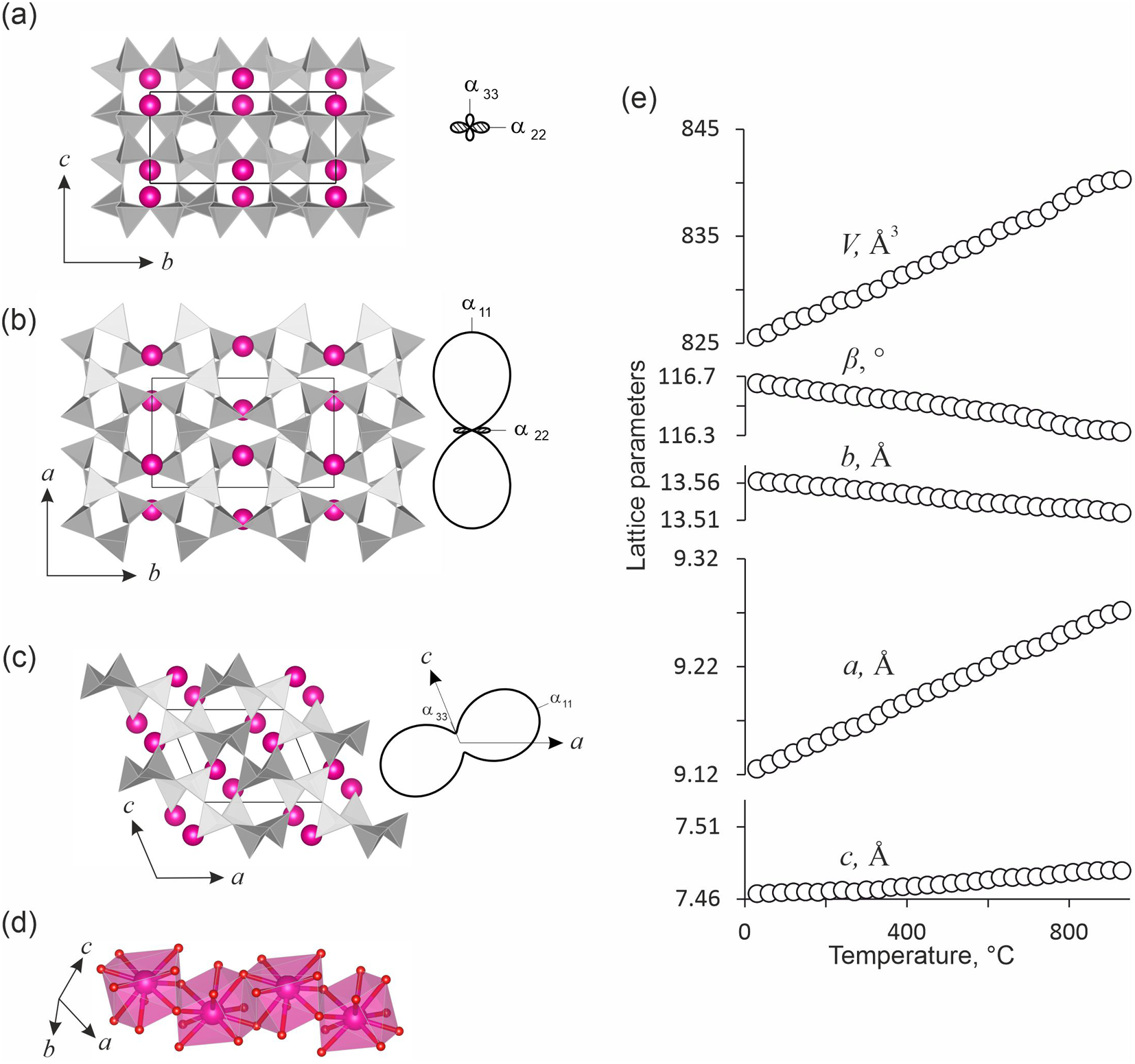
The crystal structure of studied RbAlGe3O8 can be described by analogy with other feldspar-related compounds, i.e. as three-dimensional framework, consisting of corner-sharing TO4 tetrahedra (T = Al, Ge) (Figs 1a–c). According to the symmetry and chemical composition, there are two independent tetrahedrally coordinated sites, which are occupied by statistically distributed Ge and Al with the 3:1 ratio that is confirmed by the similar bond lengths in both tetrahedra (Supplementary Table S3). Rubidium atoms, located in the framework cavities, are coordinated by ten oxygen atoms with the average bond length of 3.156 Å (Supplementary Table S2). Connected via edges, the RbO10 polyhedra form infinite chains along the [101] direction (Fig. 1d).
The crystal structure of RbAlGe3O8 with feldspar topology with (a–c) averaged thermal expansion section (dashed part of the sections demonstrate negative thermal expansion) in different projections and (d) chain of RbO10 polyhedra. (e) Unit-cell parameters of RbAlGe3O8 at different temperatures. The (Al,Ge)O4 tetrahedra are given in grey, Rb and O atoms are shown as pink and red spheres, respectively. Errors are smaller than symbols. The crystal structure vizualisation is made using Vesta (Momma and Izumi, Reference Momma and Izumi2011).

Among natural feldspars, the studied RbAlGe3O8 is the closest to rubicline in chemical composition (Teertstra et al., Reference Teertstra, Černý and Hawthorne1997, Reference Teertstra, Černý, Hawthorne, Pier, Wang and Ewing1998a; Reference Teertstra, Černý and Hawthorne1998c). Natural rubicline is crystallised in triclinic symmetry ( $C\,\bar 1$ space group), with an ordered crystal structure (Teertstra et al., Reference Teertstra, Černý and Hawthorne1998c) and occurs in granitic pegmatites; there are also data on possible crystallisation of disordered rubicline in metasomatic rocks (e.g. Teertstra et al., Reference Teertstra, Černý and Hawthorne1998b). Interestingly, synthetic analogues of rubicline can crystallise both in ordered (
 $C\,\bar 1$) (Wietze and Wiswanathan, Reference Wietze and Wiswanathan1971; Grove and Ito, Reference Grove and Ito1973; McMillan et al., Reference McMillan, Brown and Openshaw1980) and as Al/Si-disordered (C2/m) modifications (Barrer and McCallum, Reference Barrer and McCallum1953; Ghelis and Gasperin, Reference Ghelis and Gasperin1970; Gasperin, Reference Gasperin1971; Pentinghaus and Bambauer, Reference Pentinghaus and Bambauer1971; Bruno and Pentinghaus, Reference Bruno, Pentinghaus, Mackenzie and Zussmann1974; Voncken, Reference Voncken1996; Kovalskii et al., Reference Kovalskii, Kotel’nikov, Bychkov, Chichagov and Samokhvalova2000; Kyono and Kimata, Reference Kyono and Kimata2001). The disordered modification (with monoclinic symmetry) is more typical for ‘high-temperature’ feldspars, whereas ‘low-temperature’ feldspars are usually ordered and have triclinic symmetry (Deer et al., Reference Deer, Howie and Zussman2013). It should also be noted, that other alkaline feldspar minerals with feldspar topology, such as NaAlSi3O8 and KAlSi3O8 are also known in both ordered and disordered forms (e.g. Winter et al., Reference Winter, Okamura and Ghose1979; Kroll and Ribbe, Reference Kroll and Ribbe1987), whereas their synthetic Ge- and Ga-analogues are forming in disordered modifications only (Kroll et al., Reference Kroll, Floegel, Breit, Loens and Pentinghaus1991; Kimata et al., Reference Kimata, Saito and Shimizu1995). This relationship is probably related to the long duration of geological processes compared to laboratory experiments.
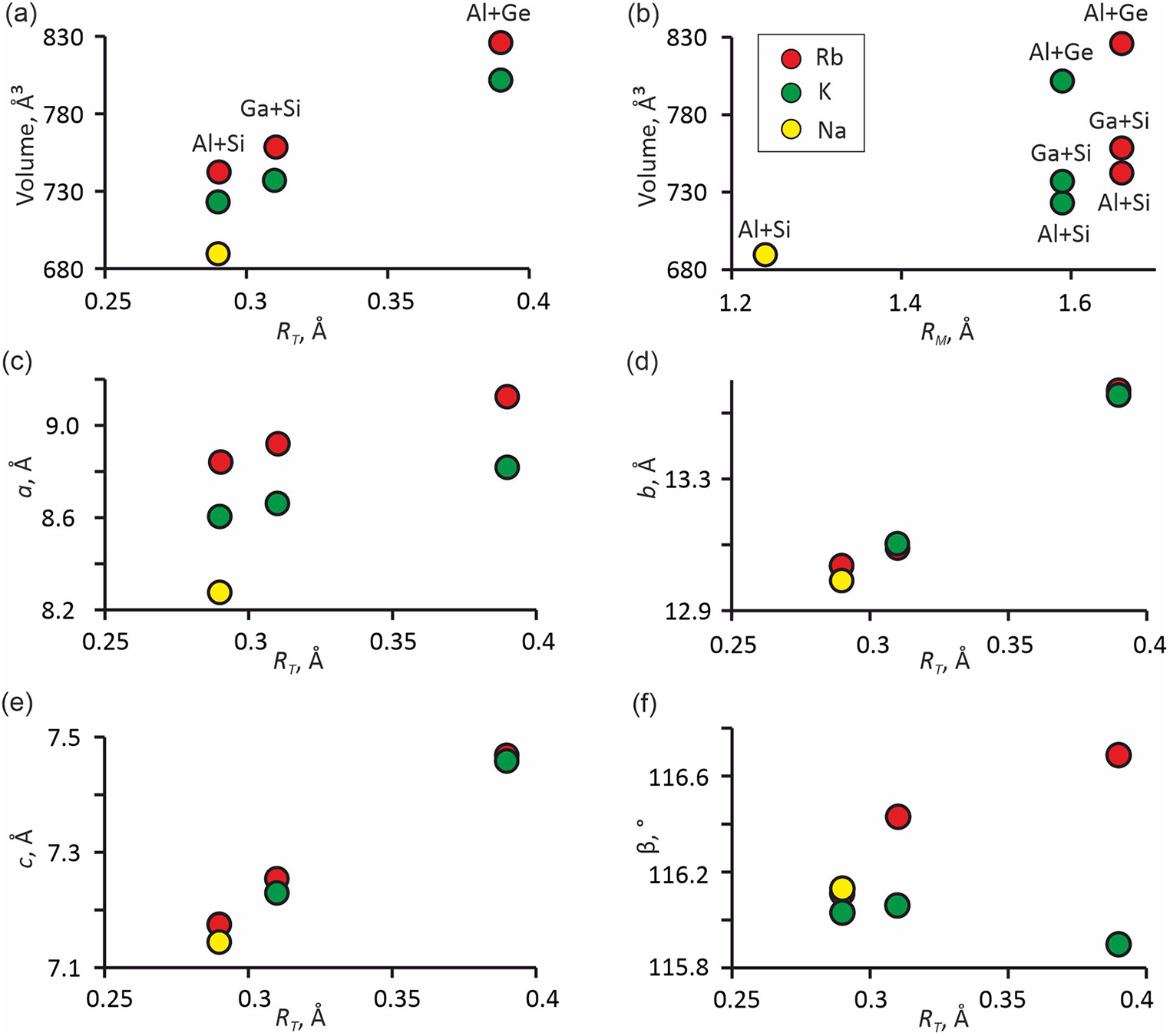
The volume of the unit-cell of alkaline feldspars is determined more by the size of framework-forming (T) cations, than by size of extraframework (M) cations (Fig. 2a,b), i.e. from the crystallographic point of view, RbAlGe3O8 is closest to KAlGe3O8, with unit cell volumes >800 Å3 (Table 2). A similar tendency is observed not only for volume, but also for the b and c parameters, whereas a parameters are more influenced by the M cation (Fig. 2c). It is also interesting to note that RbAlGe3O8 has the maximum β angle among alkaline feldspars (Table 2, Fig. 2f). These features reflect the significant flexibility of the framework with feldspar topology (Smith, Reference Smith1958, Reference Smith1974).
Crystal chemical aspects of alkaline feldspar-related compounds with different chemical composition: (a) dependence of the volume of the unit-cell on radii (R T = (R T1+3R T2)/4) of tetrahedrally coordinated cations (T); (b) on radii of extraframework cations (M); and (c–f) dependence of the unit-cell parameters on radii (R T = (R T1+3R T2)/4) of tetrahedrally coordinated cations (T).

Temperature behaviour of RbAlGe3O8 and its analogues with feldspar topology
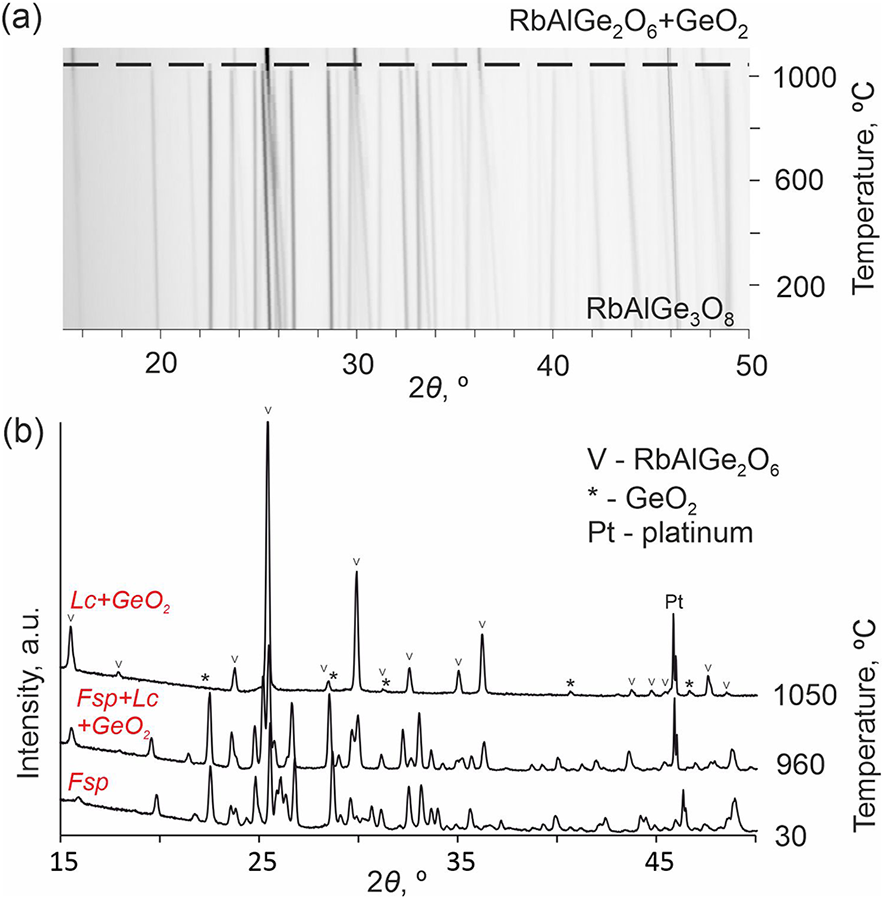
The temperature evolution (in the range 30–1110°C) of the diffractions peaks of feldspar-like RbAlGe3O8 is given in Fig. 3. The experiment demonstrates that above 930°C RbAlGe3O8 starts to decompose according to the reaction: RbAlGe3O8 → RbAlGe2O6 + GeO2, where RbAlGe2O6 is a leucite-like phase (PDF 00-037-0348). The feldspar-like phase disappears completely above 1050°C (Fig. 3). The leucite-like phase has cubic symmetry ( $I\,\bar 4$3d; a = 14.0535(2) Å and V = 2775.6(1) Å3) at 1080°C, that is a good agreement with previously obtained data (
 $I\,\bar 4$3d; a = 13.7153(5) Å, V = 2579.97(26) Å3) for the compound at ambient temperature (Bell, Reference Bell2024).
The evolution of the PXRD patterns of RbAlGe3O8 in (a) the range 30–1110°C and (b) at 30, 960 and 1050°C. Fsp – RbAlGe3O8, Lc – leucite/pollucite-like phase RbAlGe2O6.

The transformation of RbAlGe3O8 into a leucite/pollucite-like phase (RbAlGe2O6) is not unexpected, as a similar transformation is known for other K- and Rb-aluminosilicate alkali feldspar solid solutions to single phase leucites (e.g. Henderson et al., Reference Henderson, Bell and Knight2017). However, depending on the chemical composition of the initial phase, the transformation temperature increases with increasing K content (Henderson et al., Reference Henderson, Bell and Knight2017, their figure 2). Note that end-member RbAlSi3O8 monoclinic alkali feldspar changed to a leucite-type structure above 1000°C (Henderson, Reference Henderson2021).
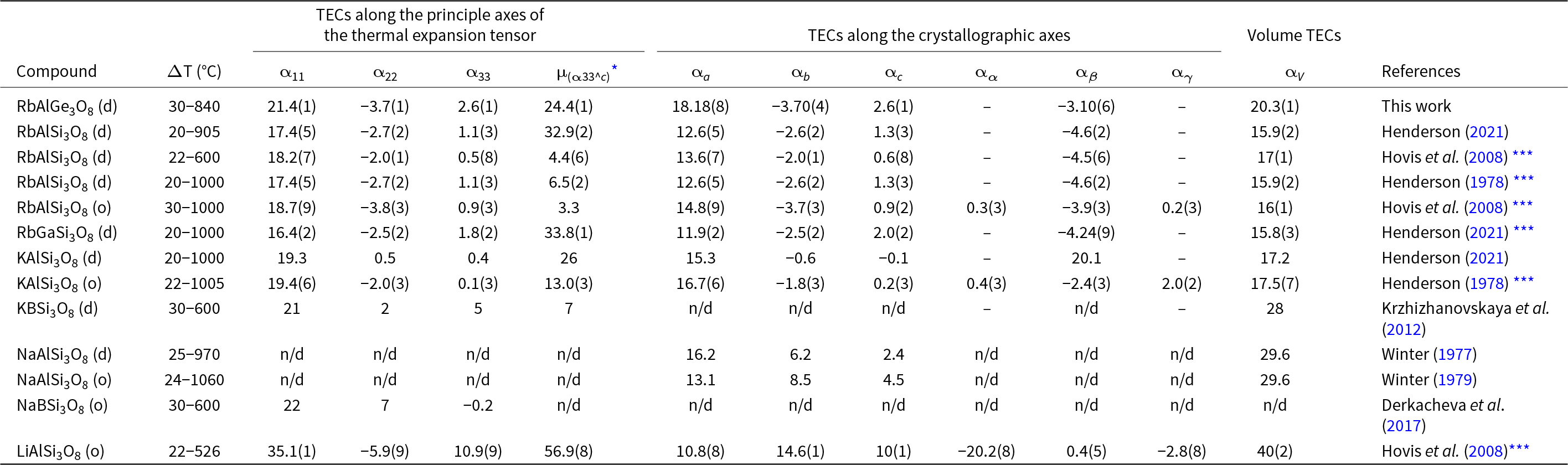
The temperature dependencies for the unit-cell parameters of RbAlGe3O8 with feldspar topology before its phase transformation into leucite-like phase are shown in Fig. 1e. The thermal expansion of RbAlGe3O8 with feldspar topology has a sharply anisotropic character with the b axis showing a small decrease, whereas maximum expansion is observed for the a axis (Table 3, Fig. 1). This thermal behaviour of the b parameter (with negative thermal expansion) is specifically typical for Rb-bearing feldspars, whereas almost all other feldspars (with alkaline extraframework cations) demonstrate the positive thermal expansion along the b axis (Brown et al., Reference Brown, Openshaw, McMillan and Henderson1984). Notably, published data demonstrate that there are some exceptions from this rule: microcline (ordered KAlSi3O8) and LiAlSi3O8 demonstrate the negative TECs in this direction (Table 3). One more exception from this rule is filatovite, K(Al,Zn)2(As,Si)2O8, which demonstrates the negative thermal expansion along b axis (αb = –1.2(1) ×10–6 °C–1; Gorelova et al., Reference Gorelova, Vereshchagin, Bocharov, Potekhina, Zhitova and Pekov2024). Negative thermal expansion is also found along the c axis below room temperature in albite (Tribaudino et al., Reference Tribaudino, Bruno, Nestola, Pasqual and Angel2011), and the thermal expansion ellipsoid, calculated from the thermal expansion tensor, shows one axis of negative expansion in plagioclase (Tribaudino et al., Reference Tribaudino, Angel, Camara, Nestola, Pasqual and Margiolaki2010). It is interesting to note that the direction of maximum thermal expansion is close to the direction of the minimum thermal vibration of Rb atoms. Such a behaviour intuitively seems illogical, but is typical for alkaline feldspars (e.g. Filatov, Reference Filatov1990; Gorelova et al., Reference Gorelova, Vereshchagin, Bocharov, Potekhina, Zhitova and Pekov2024). That means that for feldspar-like compounds thermal expansion does not depend on expansion of the M–O bonds (Brown et al., Reference Brown, Openshaw, McMillan and Henderson1984). For a long time it was believed that the anisotropy of feldspars could be explained by the straightening of the crankshaft chains (Megaw, Reference Megaw, MacKenzie and Zussman1974), which leads to high thermal expansion coefficients along these chains – usually located along a direction close to the (100) plane normal (Tribaudino et al., Reference Tribaudino, Angel, Camara, Nestola, Pasqual and Margiolaki2010). Later, Brown et al. (Reference Brown, Openshaw, McMillan and Henderson1984) demonstrated that strong anisotropy is caused by tilting and rotating of rigid TO4 tetrahedra. The development of this idea leads to the conclusion that the main reason for such anisotropy lies in the topology of the tetrahedral framework (Angel et al., Reference Angel, Sochalski-Kolbus and Tribaudino2012). The high-temperature behaviour of RbAlGe3O8 is one more example, confirming trends suggested for all alkaline feldspars.
Thermal expansion coefficients (TECs) (×106 °C–1) of feldspars and feldspars-like synthetic phases with alkaline cations at different temperatures

Notes: n/d – no data available
* μ(α33^c) show the orientation angle between the α11 and c axis
** (d) and (o) indicate disordered and ordered crystal structures, respectively
*** TECs are calculated based on the original data
The volume thermal expansion (αV) of RbAlGe3O8 is slightly higher compared to its alumino- and gallium-silicates, but lower than borosilicate analogues (Table 3). Besides, if the feldspar-related compound has ordered (o) and disordered (d) modifications, their volume and linear TECs are very similar (Hovis et al., Reference Hovis, Morabito, Spooner, Mott, Person, Henderson, Roux and Harlov2008). Note that for comparison the volume TECs discussed here are calculated using the linear approximation model and do not consider the fact that variations of αV with temperature is typical for feldspars (Tribaudino et al., Reference Tribaudino, Angel, Camara, Nestola, Pasqual and Margiolaki2010). In addition, RbAlGe3O8 has the largest unit-cell volume among other alkaline feldspars (Table 2). It is traditionally believed that feldspars with larger unit cell expand less upon heating (Hovis et al., Reference Hovis, Morabito, Spooner, Mott, Person, Henderson, Roux and Harlov2008), that contradicts the result obtained in this study. This discrepancy may be due to the fact that the statement by Hovis et al. (Reference Hovis, Morabito, Spooner, Mott, Person, Henderson, Roux and Harlov2008) is formulated for feldspars with aluminosilicate frameworks and does not consider isostructural compounds with other composition of the framework. Nevertheless, the linear TECs and the general trends of thermal expansion are very close for all of them (Table 3). The K-borosilicate feldspar has the highest αV in the series, and exhibits the least anisotropy. We can see that volume thermal expansion (Table 3) of alkali feldspars decreases with increasing cation size from Li to Rb (0.92 Å to 1.66 Å, respectively, Shannon, Reference Shannon1976). Interestingly, this dependence is inverse for alkaline earth feldspars with paracelsian topology, i.e. the volume thermal expansion increases with the increasing size of extra-framework cations (Gorelova et al., Reference Gorelova, Filatov, Krzhizhanovskaya and Bubnova2015; Gorelova, Reference Gorelova2023). The high temperature behaviour of RbAlGe3O8 is also consistent with the main factor controlling the thermal expansion being the framework topology rather than the extra-framework or framework-forming cations (Angel et al., Reference Angel, Sochalski-Kolbus and Tribaudino2012).
Conclusion
The experiments on synthesis of the Ge analogue of rubicline showed that it forms at similar temperatures and via similar stages to rubicline: both compounds are formed in hydrothermal conditions after crystallisation of a leucite/pollucite-like Rb-rich phase. The crystal structure of synthetic RbAlGe3O8, obtained during this work (as well as other synthetic alkaline feldspars) is Ge/Al disordered, whereas natural rubicline was found to occur in both ordered and disordered crystal structures. The high temperature behaviour of RbAlGe3O8 is typical for feldspar-related minerals with feldspar topology, i.e. it is quite anisotropic. Obtaining experimental data on the thermal behaviour of feldspars with different framework-forming cations will make it possible to create a model for predicting thermal expansion coefficients for feldspars with all possible chemical compositions.
Supplementary material
The supplementary material for this article can be found at https://doi.org/10.1180/mgm.2025.6.
Acknowledgements
The authors thank the X-ray Diffraction Centre and Geomodel Centre of Saint Petersburg State University for providing instrumental and computational resources.
Funding statement
This research was funded by the Russian Science Foundation, grant number 22-77-10033 (to L.A.G., V.A.Y. and O.S.V.).
Competing interests
The authors declare none.