Introduction
Transparency is a fundamental aspect of an effective and efficient trade system and a major part of the task of the World Trade Organization (WTO) (Kerr, Reference Kerr2008). A recent article in this journal has provided a framework for systematically evaluating the efficiency of the many aspects of WTO transparency (Collins-Williams and Wolfe, Reference Collins-Williams and Wolfe2010). This framework identifies a progression of transparency functions from addressing the ‘right to know’ through ‘targeted’ transparency that structures information to address particular policy issues to ‘external’ transparency that makes possible the use of this information to improve public understanding of the nature of the trade system and the performance of trade policies. The provision of basic information about trade flows and tariff levels has been enhanced by improvements in data collection and analysis, though non-tariff trade measures (NTMs) still pose a significant challenge.Footnote 1 However, monitoring and surveillance, a key aspect of targeted transparency, is highly variable in its effectiveness, ranging from the relatively data-rich notifications of information on health and safety regulations to the Sanitary and Phytosanitary (SPS) Committee to the essentially vacuous notifications to the Subsidies and Countervailing Measures (SCM) Committee. Collins-Williams and Wolfe point out that notifications to the Agriculture Committee mandated by the Agreement on Agriculture by WTO members are often delayed and incomplete, and the monitoring and surveillance of these notifications is ‘spotty’ (2010: 569).Footnote 2
The monitoring of agricultural support has indeed been useful in tracing the developments in domestic farm policies in the light of the constraints introduced by the Agreement on Agriculture (AoA) and embedded in country schedules (Orden et al., Reference Orden, Blandford, Josling, Orden, Blandford and Josling2011). But the notifications have been of limited use in improving the ‘external’ transparency of the link between farm policies and world trade.Footnote 3 This limited usefulness is reduced even more by the slow reporting: transparency would be considerably enhanced by more timely notification of support levels. But this should not be an insuperable problem.
Data exist in the public domain for the construction of provisional WTO notifications within months of the end of the reporting period. These data are collected by the Organization for Economic Cooperation and Development (OECD) in connection with its own agricultural policy monitoring. In 1982, the OECD ministers mandated a report from the Agriculture and Trade Committees on the farm policies of the member states and the trade implications of these policies (OECD, 1982). The Secretariat adopted (and adapted) the PSE (producer support estimate) that had been developed by the FAO in the context of a program of International Agricultural Adjustment (FAO, 1975). The PSE measure proved useful in the ‘monitoring and evaluation’ of adherence to a set of guidelines, required of the Secretariat on an annual basis (OECD, 1988). This process has continued until the present, though the link with the policy guidelines has essentially gone. The purpose of the data collection by the OECD is notably different from that of the WTO monitoring, and the classification system used reflects these differences. But the two datasets are based on essentially the same data, so the calculation of provisional notifications (or counter-notifications) from OECD data is a relatively straightforward if somewhat detailed technical task.
The existence of these two overlapping datasets on farm policies has posed its own problems for transparency. The interpretation of the information (by politicians, government officials, and academic scholars) contained in both the WTO notifications and the OECD support estimates has been hindered by the differences in the classification systems used. In particular, the AoA makes a somewhat artificial distinction between market access (tariffs and border measures), export competition (subsidies and export credit), and domestic support (price support, direct payments, and other subsidies). The OECD implicitly incorporates border measures into its measurement of support by using domestic producer prices. Thus, the WTO notifications treat support through border measures as being additional to that from domestic ‘administered prices’ even though the one is a necessary component of the other.
In addition, there is a clear difference in the use of the data accumulated by the two institutions. The WTO notifications address compliance rather than illuminating policy change. In the Collins-Williams and Wolfe framework, the transparency is ‘targeted’. The OECD database is organized in such a way as to focus on policy changes, but is not monitoring compliance with any specific agreement.Footnote 4 In this sense, it is addressing an issue of ‘external’ transparency.
Our argument is that the two systems should be viewed as complementary rather than competitive: as each contributing to the understanding of farm support policies rather than being a source of confusion. By treating the two classification systems as revealing different facets of the same set of policies, we would claim that these two contributions taken together significantly enhance the overall transparency of indicators for agricultural policy analysis. The two systems nicely complement each other precisely because they are structured differently, and that using one to throw light on the other can yield new insights into policy developments, and to the task of disciplining farm policies in the interests of a more responsive trade system.Footnote 5
A major benefit of looking at both datasets as being complementary is to suggest the use of the OECD classification as a way of contributing to the improvement of WTO monitoring practices. Such an examination could, for instance, show the extent to which key policy attributes (such as the requirement to produce) identified in the OECD dataset match up with definitions embedded in the AoA.Footnote 6 One major issue that will have to be tackled eventually (regardless of the outcome of the Doha Round) is the extent to which payments notified in the green box are actually being administered in a way that conforms to the criteria.Footnote 7 Though legal considerations dominate the present notification procedure when allocating payments to the green box, the underlying policy question is the usefulness of the notifications themselves to monitor the movement to less trade-distorting support. Although the issue of green box payments is perhaps the most prominent one, the merits of looking at both datasets are not limited to the green box. This includes looking at measures notified within the blue box, which covers payments under production-limiting programs, and matching these payments to the OECD labels regarding production limits. Indeed, the comprehensive nature of the OECD support estimates, which include the impact of border measures, may itself be of value in understanding the significance of the disciplines imposed through the WTO on policies that impact trade in agricultural products.
A second benefit of exploiting the complementarity between the two databases is the ability to calculate provisional WTO notifications from recent OECD data, thus reducing the time-lag common with official notifications.Footnote 8 This contributes to the attribute of timeliness, an essential aspect of transparency. This benefit primarily rests on the OECD's ability to quickly update the dataset. The almost continuous process of keeping up-to-date with policy developments in the OECD Secretariat gives that institution an advantage in timeliness over the WTO. It also makes use of the accumulated knowledge of the Secretariat and the OECD Committee for Agriculture that has been an important part of the credibility of the PSE database. The concept of provisional notifications has already been introduced in the Doha Round negotiations, and so the opportunity could present itself in the future to make up-to-date information on the implementation of WTO commitments available on a regular basis. Annex M of the latest draft of the modalities (Rev 4) addresses the issue of Monitoring and Surveillance (WTO, 2008). The Annex states that ‘as a matter of urgency’ the basic documents defining procedures and formats for notification be revised, and the Agriculture Committee play an ‘enhanced role’ in reviewing and monitoring implementation of commitments. In addition, the Annex provides a suggested replacement for AoA Article 18 (Review of the Implementation of the Commitments) that includes, inter alia, a provision for provisional notifications ‘in the event that a member is unable to submit the final notification by the appropriate deadline’ (Annex M, para. 4).Footnote 9
The remainder of this note illustrates these benefits with two examples: the potential light that the OECD classification of some payments under the heading ‘production required’ can shed on the placement of these payments under the various headings of the WTO green box; and the feasibility of ‘pre-notification’ of domestic support levels using OECD data so as to add timeliness to transparency.Footnote 10
Appropriate notifications: production requirements and the green box
Domestic support for the producers of agricultural goods is categorized in the Agreement on Agriculture to reflect presumed degrees of trade distortion. Payments that are deemed to be the most trade distorting (price supports and direct payments linked to output or price) are constrained in country ‘schedules’ as are those that are tied to production limits. No such constraints are placed on spending that meets the green box criteria. The basic notion of the green box is to shelter from support reductions such programs that have little or no effect on production. The payment for the provision of public goods by the farm sector would often come within this category.Footnote 11 The aggregate effect could still be to increase production from the sector even when the size of any individual producer's payment did not depend on his production. But the legal manifestation of this notion is by no means clear-cut. The conditions under which a policy is exempted from reduction are given in AoA Article 6, para. 1 (WTO, 1994). This article, inter alia, refers to Annex 2 of the Agreement (the green box) that specifies that domestic support measures ‘shall meet the fundamental requirement that they have no, or at most minimal, trade-distorting effects or effects on production’ (para. 1). This would appear to exclude from the green box any payment that has any impact (in either direction?) on production. However, the paragraph continues ‘accordingly, all [green box] measures shall conform to the following basic criteria’: (a) support is provided by a publicly funded government program, and (b) it does not have the effect of providing price support to producers. In addition, specific criteria and conditions apply for each of twelve sub-categories of the green box.
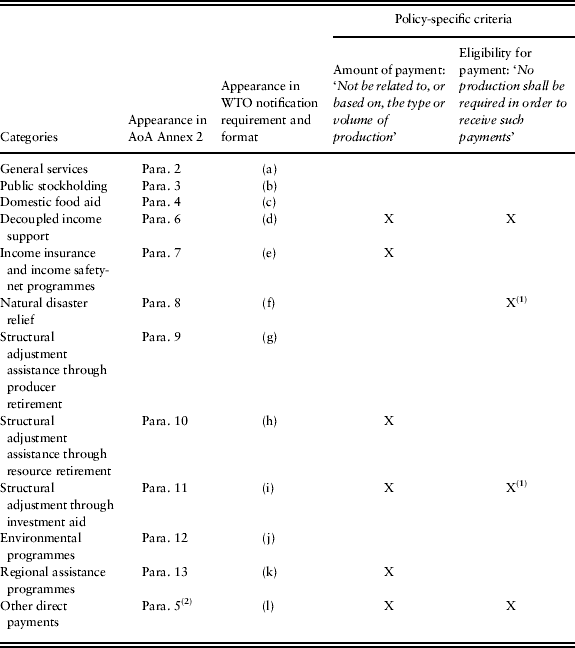
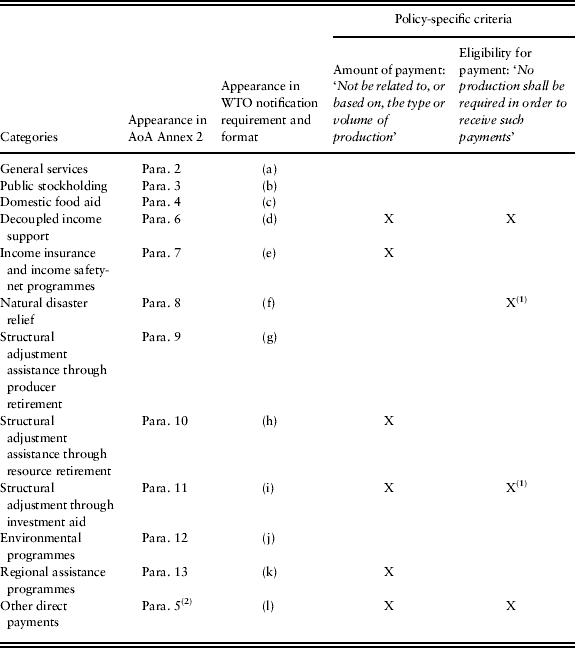
Two of these specific criteria are of special interest with regard to production requirements and production-based payments. The first of these criteria requires that the amount of the payment must not be related to or to be based on the type or volume of production, prices, or factors of production. This criterion applies to payments under the headings related to decoupled income support, natural disaster relief, resource retirement, investment aid, and regional assistance, and to other direct payments. The second criterion states that no production shall be required in order to receive the payment. This applies only to decoupled income support and ‘other direct payments’ not covered by the specific categories. The criteria for the other categories of payments do not include the requirement that the payment, in order to qualify for the green box, must not require production: a payment can be unrelated to production volume or type and still be paid only if some production occurs. In fact, many programs necessarily imply that there is some ‘requirement’ for production: governments are unlikely to pay a subsidy for meeting some environmental production standard and then make payments even in those cases where there is no production. Some production is de facto required to receive that payment. In these cases, the eligibility for receiving a payment (and the size of the payment) is defined with reference to, for example, the extent of income loss due to natural disasters, structural or regional disadvantages, or environmental program compliance.Footnote 12 And, for another group of green box categories (such as general services and food aid) there are no payments to producers, and hence no opportunity to place a restriction on payments on the basis of production.
The relationship between the green box criteria and the production requirements is summarized in Table 1, which also identifies the categories in the notification format used by WTO members. There has not yet been a panel ruling on the interpretation that countries have put on these criteria.Footnote 13
Categorization of domestic support measures in the WTO green box
The OECD database identifies programs that have specific production requirements. The focus is on the distinction between policy instruments for which production is required (PSE categories A1, A2, B1, B2, B3, C, and D) and those for which production is not required (PSE categories E to N, all GSSE categories). This feature was presumably introduced as an indication as to the extent to which the policy instrument in question might distort production and hence trade: this is an important part of the process of quantitative evaluation of policy change in OECD members. The modeling of the quantitative effect of farm policies relies crucially on the extent to which direct payment policies give an incentive to producers.Footnote 14 However, the link with the WTO green box criteria discussed above is somewhat obscure. Some payments can fall under the OECD heading of ‘no production required’ and still be ineligible for the WTO green box. A prominent example is the counter-cyclical payments in the US: no current production is required to receive such payments, as they are paid on base acreage. But the counter-cyclical payments do not qualify for the green box as they are triggered by and related to price movements. Thus the most interesting link with the OECD categories is in the criteria for ‘decoupled income support’. The OECD category of ‘no production required’ seems to cover cases where production is not required for eligibility and the payments are not related to production. Both these conditions must be met in order place these payments under AoA Annex 2, paras. 5 or 6.Footnote 15
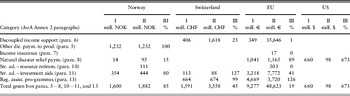
Using the OECD database and matching individual policy instruments with payments notified in the WTO green box reveals the extent of this grey area between production requirements, production-based payments, and green box eligibility (Table 2). Payments for which a match was found, and which were classified by the OECD as ‘production required’, were notified in the seven (of the 12) sub-categories of green box payments that prohibit payment on the basis of production.Footnote 16
Support classified as requiring production by the OECD and notified as green box payments to the WTO in 2008 by green box sub-category: (I) amount of payment requiring production in sub-category (million units of national currency), (II) total amount of payment in sub-category (million units of national currency), (III) share of support requiring production in sub-category (per cent)

Source: Own calculation based on OECD (2011) and WTO (var.).
As mentioned above, it is not inconsistent to require production but base the payments on other criteria. But in the case of ‘other direct payments’ (para. 5) and ‘decoupled income support’ (para. 6), there is no such ambiguity. Norway and Switzerland each notified significant payments that appear a priori to be ineligible for the green box. For example, NOK 1.232 billion or 100 of Norway's payments in the category ‘other direct payments’ were regarded as requiring production by the OECD. This includes the Vacation and Replacement Scheme that reimburses farmers for the costs of hired labor during vacation and illness.Footnote 17 The Swiss Payment for the Holding of Roughage Eating Farm Animals (PHREFA) accounts for roughly one fourth of decoupled income support notified by Switzerland. The OECD has put PHREFA in PSE category C that covers payments made on current animal numbers for which production is required. This would seem to be inconsistent with the criteria for the green box. In the case of the EU, the amount of such ambiguous payments is small relative to the total payments notified under paras. 5 and 6. For the US, there appeared to be no such conflicting notifications.
Though the case of decoupled income support and other direct payments to producers (AoA Annex 2, paras. 5 and 6) is the most clear-cut example of where the OECD data can help to focus on the consistency of WTO notifications, other categories of the green box also raise issues that need to be explored – including the compatibility with the ‘fundamental requirement’ of Annex 2 para. 1 that payments have no, or at most minimal, effects on production.Footnote 18Table 2 shows the total green box notifications for categories that bar the use of production as a basis for payments (paras. 8,11,12,and 13) and the payments in those categories that are reported by the OECD as requiring production. For European countries, typical examples of green box measures that require production are environmental protection programs, regional assistance programs, and investment aid. Two other Swiss programs, the Milk Price Supplement for Cheese Production (MPSCP) and the Payments for Non-Silage Feeding of Cows (PNSFC), have been notified as green box payments in the category ‘Regional assistance’. But these are classified by the OECD as output payments and hence depend on ‘the type and volume of production’. Examples of EU programs notified in the green box include (regional) support to Less Favoured Areas (LFA), investment aids, and agri-environmental support. These are considered as requiring production by the OECD, thus at least raising the question of compatibility with the ‘fundamental requirement’ in para. 1 of Annex 2.
Timely notifications: the case for pre-notifications of WTO domestic support
The second example of where the complementarity between the WTO notifications and the OECD database can be exploited relates to timeliness. The notification rules require notifications to be submitted ‘no later than 60 days following the year in question’ (WTO, 1995). This rule has been broken frequently by almost all major WTO members in the past. Serious concerns about these lags have arisen among members as the notifications are intended to facilitate the review of members’ implementation of commitments, and this has led to discussions on how to improve notification procedures (Brink, Reference Brink2009, Reference Brink, Orden, Blandford and Josling2011). This raises the question as to why countries have taken, in some cases, several years to submit the required notifications. Data availability may account for a minimal delay, but this is not credible as the major cause. Indeed, several members have revised their notifications in subsequent years, in response to improved data. WTO members may have tactical reasons for delaying their notifications, particularly during trade negotiations, but this seriously undermines the effectiveness of the WTO system. To remove these lags could even ease the path of trade talks, though the main benefit would still be on monitoring the implementation of existing commitments.
In this section we provide WTO pre-notifications, by which we mean synthetic notifications for years for which official WTO-notifications are not yet available. The pre-notifications are achieved by adding up support under individual support measures as identified in the PSE database by the WTO categories of market price support, non-exempt direct payments, blue box, and green box.
Some additions to the OECD database have been made to improve the fit, so as to accommodate the definitional differences between WTO notifications and OECD classifications. We include market price support only for those commodities that are listed as receiving MPS in the WTO-notifications and for which data are also available in the PSE database. Moreover, we use administered prices (instead of producer prices) and WTO (fixed) reference prices instead of OECD (current) reference prices to conform to WTO definitions. We do however apply the price difference to the total quantity of production reported in the OECD database rather than to ‘eligible’ production as used in the WTO MPS calculations. This departure from the WTO notification procedures is intended to avoid the (somewhat subjective) choice of an ‘eligible’ production quantity. The designation of eligible production is one of the ways in which WTO members have controlled their notified MPS (Orden et al., Reference Orden, Blandford, Josling, Orden, Blandford and Josling2011). Using the total production may therefore give MPS levels that would be higher than those eventually reported by the country.Footnote 19 We also disregarded de minimis exemption of product-specific and non-product-specific support from current total AMS (aggregate measurement of support) so as to focus on the issue of comparability.Footnote 20
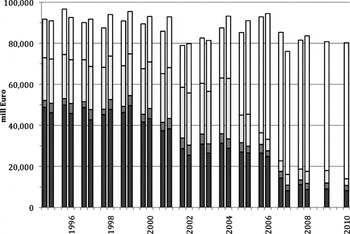
As an example of such a pre-notification process, Figure 1 compares official notifications and our constructed pre-notifications for the EU. The period from 1995 to 2008 acts as a check on the ability to reconstruct the notifications based on data available from the OECD database at the time when the notification was ‘due’. The figure shows reasonable correspondence between the actual notifications and the reconstructions. The policy changes that moved support among the boxes is captured adequately. This suggests that such pre-notification is feasible.
Official WTO notifications (left column for each year) for the EU for 1995–2008 and pre-notifications (right column for each year) for 1995–2010 (million Euro)

As the latest EU notification of domestic support is for the marketing year 2008/09 (i.e., 2008 in the OECD convention), pre-notifications can be calculated for the two years from 2009 to 2010. The pre-notifications for the years 2009 to 2010 show no increase of total support compared to 2008. The differences mostly reflect higher green box payments. Market price support and non-exempt direct payments have apparently remained at their 2008 level. The continued phasing-in of the Single Payment Scheme (SPS) is illustrated in the shift from blue box support to green box support from 2008 to 2010. SPS payments (green box) are increased at the expense of per hectare payments to crops (blue box), roughly maintaining the total of blue box and green box payments.Footnote 21 So WTO members could have this information well in advance of the formal notification without any need for additional data beyond that collected by the OECD.
Conclusion
The two datasets that monitor the development of agricultural policies in OECD countries and several non-OECD countries need to be seen as complementary resources in the search for transparency. The OECD PSE dataset includes more policies but fewer commodities. The WTO notifications of domestic support are more inclusive on a product basis (covering all domestic support in favor of agricultural producers) but employ classification conventions that are less transparent as a result of the drafting of the AoA. By comparing the two, through the tracing of the treatment of individual policy instruments, the WTO dataset can be enhanced with the better policy detail of the OECD estimates. The intention is not to interfere with the notification of compliance per se, as this is a legal rather than an economic matter, but to make the discussion of the possible improvements of the AoA monitoring less obscure. Knowledge of the extent to which policies placed in the Green Box policies require production is one example of the benefits from making use of both datasets together.
Our argument for the possibility of pre-notifications rests on the technical feasibility of the use of OECD data for constructing plausible WTO notifications in advance of the formal notification by the government to the WTO. For this to happen would require major countries to embrace the idea as being strategically desirable. The conclusion of the Doha Round would tighten the constraints on farm policy and enhance the monitoring provisions. Under such conditions, the improved transparency of more-timely notifications could be even more valuable, as one would anticipate several cases of potential violations of new domestic support limits. Without a Doha Round outcome, the focus will remain on the trade impact of the set of policies currently in use. Though less politically charged, the improved transparency of more timely notifications would still be of value.
Two major hurdles stand in the way of exploiting the complementarity of the two farm policy monitoring efforts. First, if countries really wish to hide their policies from scrutiny in the WTO, they might withdraw their cooperation within the OECD so as to prevent the construction of pre-notifications. The OECD itself is premised on transparency and the open discussion of policy issues among its members. It seems unlikely that OECD members would compromise such useful cooperation merely to hide data most of which is readily available within the countries concerned. And, in any case, the cooperation of countries with the OECD Secretariat is more in the nature of confirming interpretation and refining judgments rather than providing confidential data.
The second problem is that the OECD membership comprises mainly countries that are considered developed countries in the WTO context. But the OECD follows and monitors policy developments in a group of non-OECD members and collects the same information on their farm policies.Footnote 22 The links between the two monitoring exercises would not immediately resolve issues such as the slow WTO notifications in the case of India, but it could provide some urgency to the situation. Other studies are underway for similar policy monitoring in Latin America and Africa. It is possible that the provisional notifications could be expanded from the countries monitored by the OECD to include most of the WTO members when these databases are completed.
Inevitably the question would arise as to who would undertake to implement the improvements in transparency and timeliness suggested in this paper? The WTO is naturally concerned with the accuracy of notifications as well as with their timeliness. But it is unlikely that the WTO Secretariat could be asked to undertake the additional task of mapping the notifications with the data available at the OECD. Similarly, the OECD Secretariat would probably not be asked to monitor WTO notifications. But WTO members that are impacted by the imperfect system of notification currently in place could well institute a monitoring process that made use of both databases. And the Agriculture Committee provides a venue for discussion of the outcome of such monitoring.
To date, the issue of the trade distortion caused by farm policies has primarily been framed in terms of developed countries. But this is changing as the programs that have caused most trade problems in the past recede and new policies are put in place to meet a growing demand for food (Brink, Reference Brink2009). In the future, the main interest in monitoring domestic support may shift from the impact of the farm policies of the developed world to those of developing and emerging countries. At that stage transparency and timeliness could become a major issue.