Double-orifice mitral valve or left atrioventricular valve along with atrioventricular septal defect is a complicated condition with an incidence of about 3–7%. Reference Craig1 The clinical spectrum of the double-orifice mitral valve/double-orifice left atrioventricular valve with atrioventricular septal defect ranges from an incidental finding during pulmonary banding, autopsy, surgical procedures, or echocardiography, to less frequent presentation with mitral valve regurgitation or stenosis. Reference Sharma, Burkhart, Schaff, Cabalka, Grogan and Dearani2,Reference Pillai and Karunakaran3 Clinical reports in the literature suggest that patients with double-orifice mitral valve without mitral regurgitation or stenosis are asymptomatic. Reference Abdul and Chowdhury4 Therefore, the surgical management of the defect is considerably challenging due to the lack of clinical effects depending on the severity and duration of mitral regurgitation.
Evidence from the literature reports improvement in the clinical outcomes and surgical implications in recent years. Reference Sharma, Burkhart, Schaff, Cabalka, Grogan and Dearani2,Reference Pontailler, Haidar and Méot5,Reference Ohta, Sakamoto and Kado6 Surgical repair in early infancy is a common practice nowadays. Reference Ohta, Sakamoto and Kado6,Reference Hoohenkerk, Bruggemans, Koolbergen, Rijlaarsdam and Hazekamp7 However, pre- and post-operative regurgitation, incomplete cleft closure, and associated cardiovascular anomalies remain risk factors of re-operation and mortality. Reference Hoohenkerk, Bruggemans, Koolbergen, Rijlaarsdam and Hazekamp7 The risk factors are attributed to the presence of an immature or abnormal lateral leaflet, especially in the intermediate or complete type. Reference Pontailler, Kalfa and Garcia8 Since the diseased condition is highly uncommon as represented by fewer studies present in the literature, this meta-analysis is an attempt to review the clinical and surgical experiences to establish the possible outcomes of double-orifice mitral or left AV valve repair in patients with atrioventricular septal defect.
Methods
The meta-analysis follows the guidelines of the Cochrane Handbook and Meta-analysis of Observational Studies in Epidemiology guidelines, Reference Higgins, Thomas and Chandler9 which were prepared according to the Preferred Reporting Items for Systematic Reviews and Meta-Analyses recommendations. A literature search was performed using PubMed, Google Scholar, Embase, and Cochrane databases using the following search keywords in various combinations: “double orifice mitral valve,” “surgical repair,” “double orifice left atrioventricular valve,” “endocardial cushion defect,” “atrioventricular septal defect,” “valve repair,” “atrioventricular canal defect,” “DOMV,” “DOLAVV,” “AVSD,” and “AVCD.” Only English language studies with full publications were considered for this study with no restrictions on publication year.
Inclusion criteria
Clinical trials, observational studies, and retrospective studies that reported the experiences, strategies, and outcomes of surgical repair of double-orifice mitral valve/double-orifice left atrioventricular valve with partial, intermediate, and complete atrioventricular septal defect were included. In addition, studies with inclusive parameters such as patient characteristics, surgical procedures, cleft closure, pre- and post-operative regurgitation, stenosis, mortality, and mean follow-up of a minimum of 1 year were noted.
Exclusion criteria
Case reports, expert opinions, literature reviews, editorials, and conference abstracts were excluded from the study. In addition, studies with missing data on any one of the mentioned parameters and studies associated with only double-orifice tricuspid valves were excluded.
Data extraction
The following variables were noted: study details (sample size, study period, length of follow-up), age, diseased condition (partial, intermediate, or complete atrioventricular septal defect, stenosis, regurgitation), surgical procedures (partial or complete cleft closure), and post-operative data (early or late mortality, incidence of re-operation, post-operative regurgitation).
Statistical analysis
Depending on the availability, the data for clinical outcomes were retrieved from the selected publications or were calculated after extracting the numeric data. The proportions were calculated from the exact number of patients in each group with 95% credible intervals [CI]. The Bayesian hierarchical models were used to estimate the pooled proportion of surgical outcomes and associated factors across studies. The results were depicted using forest plots. We also performed fixed-effects meta-regression of the natural logarithm of the odds ratio for pre- and post-operative regurgitation. Further, heterogeneity tests were performed to estimate the level of inconsistency (I2) across the selected publications. Lastly, the publication biasness was assessed using Egger’s and Begg’s tests. Publication bias is considered in a situation when the decision to publish a manuscript depends on statistically significant results. The statistical analysis was performed using MetaXL software.
Results
Search results
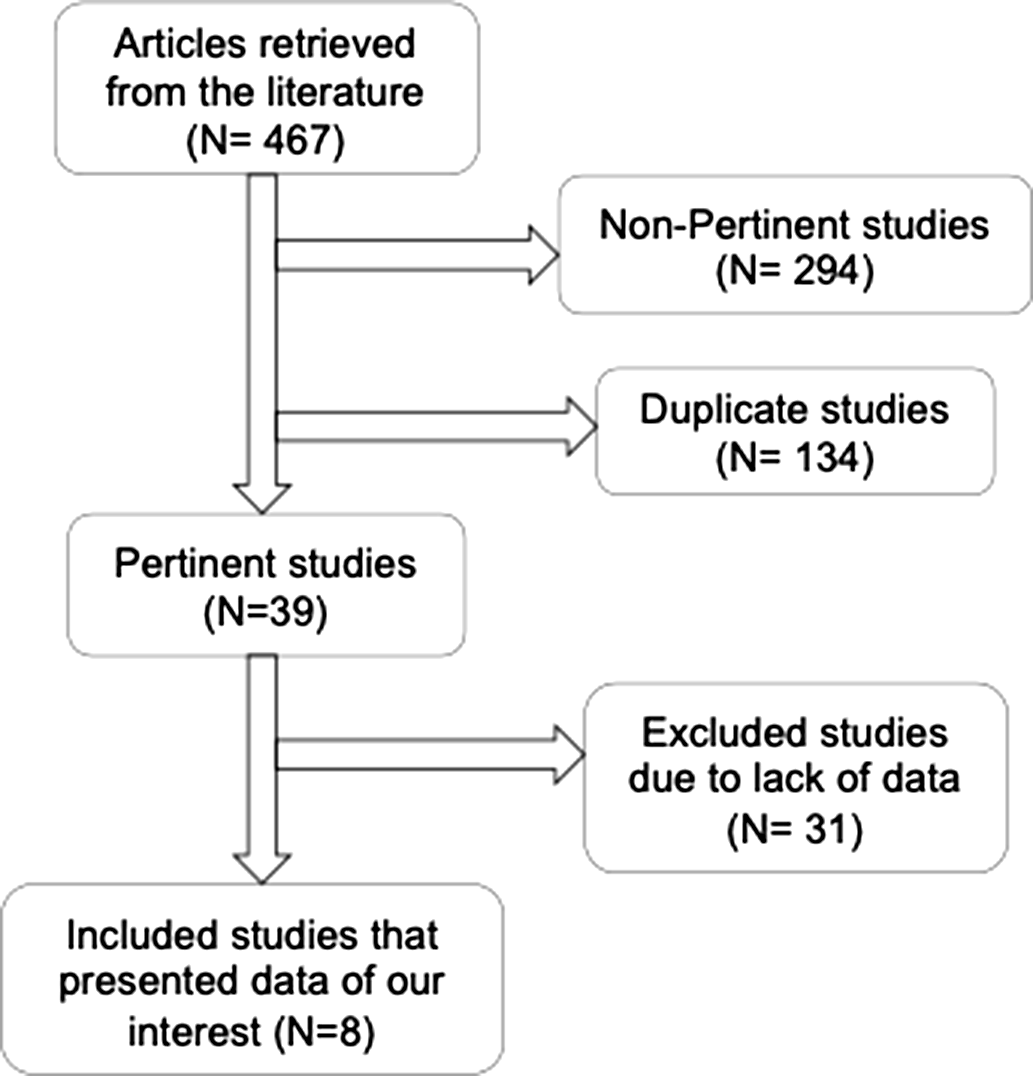
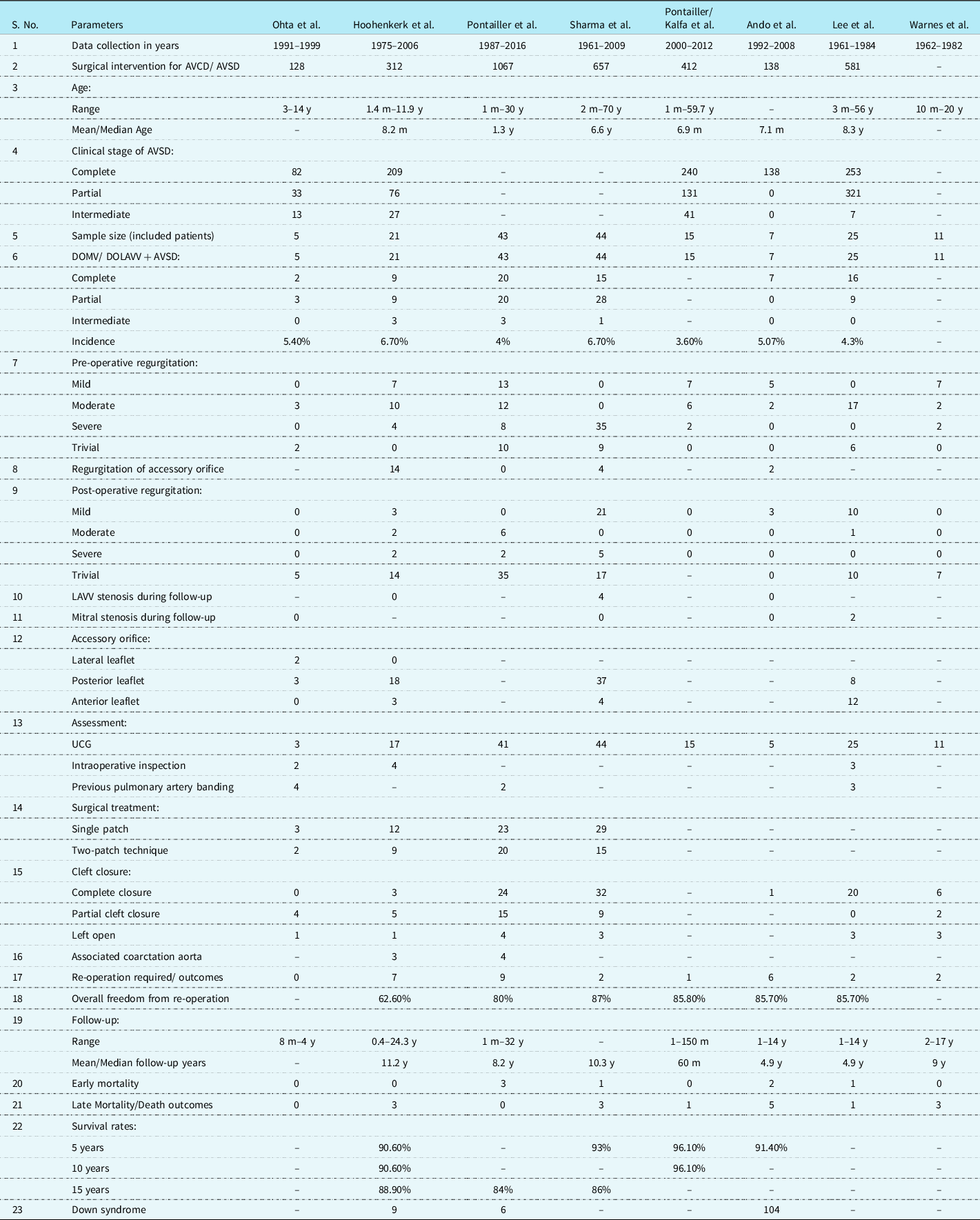
Although the literature search resulted in 467 articles, only 39 pertinent studies were identified and included in a full-text review. After close analysis, eight articles were included in the final meta-analysis based on the data of interest (Fig. 1). Among them, five studies were retrospective. The study characteristics and included variables of these publications are summarised in Table 1.
Consort flow diagram.

Study characteristics and operative outcomes.

AVSD/AVCD = atrioventricular septal/canal defect; % = percentage; LAVV = left atrioventricular valve; DO = double orifice; m = months; MV = mitral valve; UCG = electrocardiography; y = years.
Incidence of double-orifice mitral valve/double-orifice left atrioventricular valve with atrioventricular septal defect
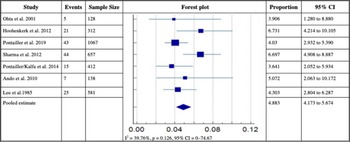
A total of 3,306 patients who underwent surgical repair were included in the analysis. Among them, only 4.88% of patients showed the incidence of double-orifice mitral valve/double-orifice left atrioventricular valve with atrioventricular septal defect (7 studies, 3,295 patients, 95% CI 4.2–5.7%). The I 2index (I2 = 39.76%, p = 0.126) (Fig. 2) and publication biasness using Egger’s test (intercept = 0.67, p = 0.69) and Begg’s test (Kendall’s Tau = 0.143, p = 0.65) were found to be non-significant. Egger’s and Begg’s tests suggested no evidence of asymmetry and small-study effects for the incidence of double-orifice mitral valve/double-orifice left atrioventricular valve with atrioventricular septal defect in selected studies. Further, the data on complete or incomplete double-orifice mitral valve/double-orifice left atrioventricular valve with atrioventricular septal defect were given in 6 studies only. Out of 145 patients, 76 patients showed complete double-orifice mitral valve/double-orifice left atrioventricular valve with atrioventricular septal defect, whereas 69 patients showed incomplete double-orifice mitral valve/double-orifice left atrioventricular valve with atrioventricular septal defect.
Forest plot showing the incidence of DOMV/DOLAVV with AVSD patients.

Pre- and post-operative regurgitation
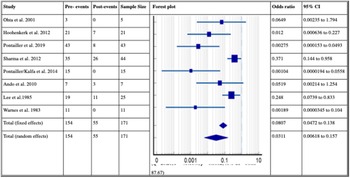
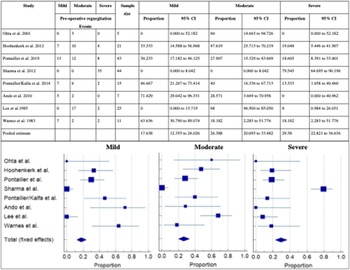
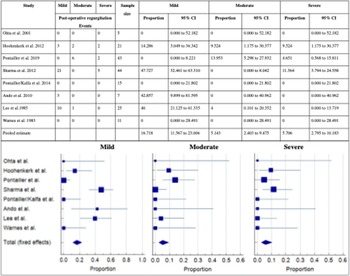
The severity of regurgitation ranges from trivial to severe. Based on the severity levels, the data were extracted from the publications, and severity proportions were estimated separately (8 studies; 171 patients). In 8 studies, 154/171 patients represented pre-operative regurgitation, whereas 55/171 patients represented post-operative regurgitation. A significant difference in the regurgitation status was found (OR = 0.08, p = 0.0002), as shown in Figure 3.
Forest plot showing pre-operative and post-operative regurgitation in DOMV/DOLAVV with AVSD (Odds ratio).

Further, the pooled proportion results revealed a tremendous decline in the moderate and severe status of post-operative regurgitation in patients as compared to those with pre-operative regurgitation. Moreover, heterogeneity tests revealed consistency in moderate (I2 = 38.11%, p = 0.126) and severe (I2 = 0%, p = 0.447) status of post-operative regurgitation. The forest plots of pre-operative and post-operative regurgitation are shown in Figures 4 and 5, respectively.
Forest plot showing pre-operative regurgitation in DOMV/DOLAVV with AVSD patients.

Forest plot showing post-operative regurgitation in DOMV/DOLAVV with AVSD patients.

Lastly, the publication biasness using Egger’s test (intercept = –1.09, p = 0.65) and Begg’s test (Kendall’s Tau = 0.048, p = 0.88) were found to be non-significant.
Surgical interventions
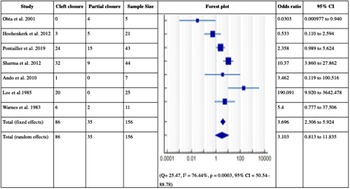
Double-orifice mitral valve/double-orifice left atrioventricular valve with atrioventricular septal defect patients underwent one-patch and two-patch techniques as surgical intervention based on the partial, intermediate, or complete stage of the atrioventricular septal defect condition. Out of 8 studies, only 4 studies with 117 patients provided data on surgical intervention techniques. Among 117 patients, 67 patients underwent one-patch treatment and 46 patients underwent two-patch treatment. Moreover, the clefts were partially closed in 35 patients and completely closed and sutured in 86 patients, whereas the cleft was left open in 15 patients, based on data provided by 7 studies. A significant difference in surgical intervention methods for partial and complete cleft closure was found (OR = 3.7, p < 0.001), as shown in Figure 6.
Forest plot showing surgical interventions in DOMV/DOLAVV with AVSD patients (Odds ratio).

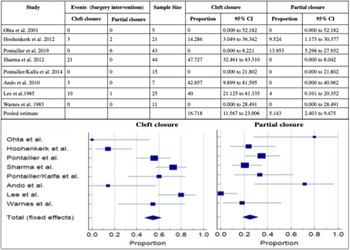
Further, the pooled proportions of partially and completely closed clefts associated with surgical repair of patients were 5.1% and 16.7%, respectively (Fig. 7). Furthermore, the heterogeneity test revealed I2 index of 83.79% for partial and 80.3% for completely closed clefts in 156 patients (p < 0.0001). Lastly, the publication biasness using Egger’s test (intercept = 2.38, p = 0.26) and Begg’s test (Kendall’s Tau = 0.33, p = 0.35) were found to be non-significant.
Forest plot showing surgical interventions in DOMV/DOLAVV with AVSD patients.

Surgical outcomes: mortality and re-operation
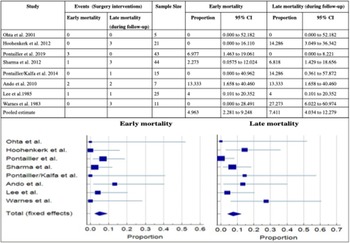
Among 171 patients, the number of early and late mortality associated with surgical repair of double-orifice mitral valve/double-orifice left atrioventricular valve in atrioventricular septal defect patients were seen in 7 and 13 patients, respectively. Their estimated pooled proportions were 5% and 7.4%, respectively, as shown in Figure 8. Furthermore, heterogeneity tests on early mortality revealed insignificant and zero inconsistency (I2 = 0%, p = 0.702), whereas significant inconsistency was observed for late mortality (I2 = 53.21%, p = 0.036).
Forest plot showing mortality in DOMV/DOLAVV with AVSD patients.

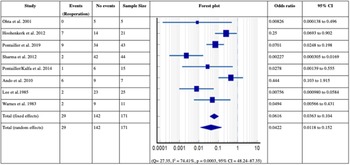
The re-operation following surgical interventions was needed in 29/171 patients only (OR = 0.042, p < 0.001) (Fig. 9), and the pooled estimated proportion was 16.67% along with significant inconsistency of 59.89% (p = 0.015). Lastly, the publication biasness using Egger’s test (intercept = –2.6, p = 0.19) and Begg’s test (Kendall’s Tau = –0.29, p = 0.32) were found to be non-significant.
Forest plot showing the incidence of re-operation of DOMV/DOLAVV with AVSD patients (odds ratio).

Discussion
Double-orifice mitral valve/double-orifice left atrioventricular valve is a rare congenital anomaly that is caused due to inadequate embryonic fusion of endocardial cushions and may accompany chorda-papillary anomalies including parachute mitral valve and mitral cleft. Reference Sharma, Burkhart, Schaff, Cabalka, Grogan and Dearani2,Reference Pontailler, Haidar and Méot5 Double-orifice mitral valve/double-orifice left atrioventricular valve substantially obstructs mitral valve inflow or produces mitral valve incompetence. Trowitzsch et al (1985) classified double-orifice mitral valve as an incomplete bridge, complete bridge, and hole type10. Eccentric or hole type is the commonest type occurs in 85% of cases and is characterised by the presence of a larger main orifice and a smaller accessory orifice either at the anterolateral or the poster medial commissure. On the other hand, central or bridge type occurs in about 15% of patients. In this, fibrous or abnormal leaflet tissue extends from the leaflet ends and divides the orifice into medial and lateral parts. Reference Trowitzsch, Bano-Rodrigo, Burger, Colan and Sanders10,Reference Bano-Rodrigo, Van Praagh, Trowitzsch and Van Praagh11 Several factors including differential patient recruitment of varied age ranges, valvular structural context aetiology, left ventricular function, and other co-morbidities have hindered the interpretation of clinical outcomes and hence, limiting the provisions for patient management. Reference Abdul and Chowdhury4 A little change could affect the clinical outcomes. Based on this background, the present systematic review and meta-analysis is an attempt to pool the clinical experiences and surgical outcomes in atrioventricular septal defect patients who underwent repair of double-orifice mitral or left AV valves.
Double-orifice left atrioventricular valve/double-orifice mitral valve with atrioventricular septal defect has lesser incidence rates Reference Sharma, Burkhart, Schaff, Cabalka, Grogan and Dearani2,Reference Pontailler, Kalfa and Garcia8,Reference Pratap, Gupta, Acharya and Mahajan12; therefore, only a few series and case reports have been published in the literature. The estimated pooled proportion of incidence of double-orifice mitral valve/double-orifice left atrioventricular valve with atrioventricular septal defect was 4.88%, and the heterogeneity test resulted in insignificant inconsistency (I2) among the selected studies for meta-analysis (p = 0.126). The majority of the patients were infants below 3 years. Reference Craig1–Reference Sharma, Burkhart, Schaff, Cabalka, Grogan and Dearani2,Reference Hoohenkerk, Bruggemans, Koolbergen, Rijlaarsdam and Hazekamp7–Reference Higgins, Thomas and Chandler9,Reference Ando and Takahashi13–Reference Lee, Danielson, Schaff, Puga and Mair14 Mostly, double-orifice mitral/left AV valve in atrioventricular septal defect patients was found with a frequency of 2.1% for partial (n = 69), 2.1% for complete (n = 69), and 0.2% for intermediate type AV canal (n = 7). Further, the basic available information on specific outcomes of early and late mortality, regurgitation, repair techniques, and re-operation was included in the analysis.
Double-orifice mitral valve/double-orifice left atrioventricular valve with atrioventricular septal defect patients develop mitral regurgitation or stenosis, Reference Ando and Takahashi13–Reference Lee, Danielson, Schaff, Puga and Mair14 and surgical management of such patients is quite challenging. Reference Abdul and Chowdhury4 In double-orifice mitral valve, all the chordae of one papillary muscle go to one of the ostia while all of the chordae of the other papillary muscle go to the other ostia. Reference Lee, Danielson, Schaff, Puga and Mair14 In case of extensive suturing of the cleft, stenosis may develop due to parachute mitral valve-like pathophysiology. Reference Warnes and Somerville15 Mild regurgitation can be accepted than new significant stenosis. Treatment of non-regurgitant cleft in double-orifice mitral valve + atrioventricular septal defect is controversial because closing the cleft can create new stenosis; however, partial closure can prevent late development of mitral regurgitation. The persistent history of mitral valve regurgitation remains enigmatic. The results of post-operative regurgitation in patients showed a tremendous and significant decline in the moderate and severe status of regurgitation than in pre-operative regurgitation. Moreover, this decline in moderate (I2 = 38.11%, p = 0.126, 95% CI = 0–72.67) and severe (I2 = 0%, p = 0.447, 95% CI = 0–67.13) status of regurgitation was found to be consistent among the studies as revealed by heterogeneity test for post-operative regurgitation. Thus, the data suggest that the severity of regurgitation is corrected using the differential surgical interventions that possibly provide freedom from re-operation and better survival rates. Reference Sharma, Burkhart, Schaff, Cabalka, Grogan and Dearani2,Reference Pontailler, Haidar and Méot5–Reference Hoohenkerk, Bruggemans, Koolbergen, Rijlaarsdam and Hazekamp7,Reference Ando and Takahashi13–Reference Lee, Danielson, Schaff, Puga and Mair14
Based on the complex aetiology of the disease, years of clinical and surgical experiences remain the key determining factor for the selection of surgical procedures. “Repair” is often opted for the surgical management of regurgitation as left ventricular functions better after repair. Reference Bano-Rodrigo, Van Praagh, Trowitzsch and Van Praagh11 Based on the severity of lesions, the reported procedures for surgical repair varied across the studies such as single-patch vs. two-patch technique, partial vs. complete cleft closure, cleft left open, pulmonary banding, or repair of accessory orifice. Reference Craig1,Reference Abdul and Chowdhury4,Reference Kozak, Kozak, De Marchi, Sobrinho Junior, Croti and Moscardini16 These variations depend on the aetiology of the disease, that is, partial, intermediate, or complete type and associated anatomic abnormalities. Reference Bano-Rodrigo, Van Praagh, Trowitzsch and Van Praagh11 The partial and complete cleft closure estimated the pooled proportions of 46.05% and 29.52%, respectively, and suggested partial cleft closure as a significant approach. However, the heterogeneity test revealed a high and significant inconsistency in surgical interventions of partial (I2 = 83.79%, p < 0.0001, 95% CI = 69.66–91.34) or completely (I2 = 80.3%, p < 0.0001, 95% CI = 61.88–89.82) closed clefts. The surgical interventions have shown a lot of discrepancies due to the presence of differential regurgitation (mild, moderate, and severe). Reference Sharma, Burkhart, Schaff, Cabalka, Grogan and Dearani2,Reference Pontailler, Haidar and Méot5–Reference Hoohenkerk, Bruggemans, Koolbergen, Rijlaarsdam and Hazekamp7,Reference Pratap, Gupta, Acharya and Mahajan12–Reference Ando and Takahashi13 For instance, a completely closed cleft may create some turbulence or a parachute mitral valve with acute mitral stenosis production; or at least partial closure of a cleft should be preferred to prevent late development of mitral regurgitation. Reference Craig1,Reference Kozak, Kozak, De Marchi, Sobrinho Junior, Croti and Moscardini16 This could affect the survival and re-operation rates. However, the ultimate aim of varied surgical procedures is to improve efficacy and minimise valvular incompetence.
The associated risk of mortality and re-operation after surgical repair of double-orifice left atrioventricular valve in atrioventricular septal defect is low. This meta-analysis showed consistency in early mortality (I2 = 0%, p = 0.702, 95% CI = 0–51.73); however, significant inconsistency was observed in late mortality (I2 = 53.21%, p = 0.036, 95% CI = 0–78.94) with heterogeneity test. Re-operation after atrioventricular septal defect repair remains a surgical challenge and the pooled estimated proportion for the incidence of re-operation following surgical interventions was only 16.67%. Despite medium proportions, significant inconsistency of 59.89% (p = 0.015, 95% CI: 12.70–81.57) was estimated. Studies by Ando et al., Hoohenkerk et al., and Pontailler et al. stated that re-operations for valvular regurgitation were performed within months of surgical repair. Reference Pontailler, Haidar and Méot5,Reference Hoohenkerk, Bruggemans, Koolbergen, Rijlaarsdam and Hazekamp7–Reference Pontailler, Kalfa and Garcia8 Furthermore, Hoohenkerk et al. reported significantly higher overall survival at 10 and 15 years after repair and re-operation. Reference Hoohenkerk, Bruggemans, Koolbergen, Rijlaarsdam and Hazekamp7 Thus, the data suggest that surgical management of double-orifice mitral or left AV valves in patients with a septal defect is considerably beneficial and provides better clinical outcomes.
Limitations
The study has several limitations. Being a rare occurring disorder, most of the publications included in the meta-analysis were relatively small in size and had the inherent biasness of retrospective studies. Another limitation is that the meta-analysis covered a very long time frame with several surgical interventions and evolving operative techniques since 1960. Nowadays, several different strategies are being explored such as percutaneous edge-to-edge techniques, coronary sinus devices, suture-based techniques, and implantation of artificial cords. Reference Condado, Acquatella, Rodriguez, Whitlow, Vélez-Gimo and St Goar17–Reference Piazza and Bonan19 These variations caused discrepancies in quantifying the proper surgical intervention in a particular diseased condition.
Conclusion
This systematic review and meta-analysis indicate strong support for surgical repair of double-orifice mitral valve in atrioventricular septal defect patients as a significantly low trend in post-operative regurgitation was achieved. The surgical management of double-orifice mitral or AV valves is a rare, unique, and challenging task. Mitral valve repair exhibits tremendous advantages of trivial regurgitation, better survival rates, low rates of early and late mortalities, and freedom from re-operations. The outcome of the intervention depends on the aetiology of the valvular defect. The modality of surgical therapy should be more focused and detailed to reduce the current limitations of the study. More effective studies are awaited in this context of surgical repair of double-orifice mitral valve/double-orifice left atrioventricular valve that could adequately provide stronger conclusions and better future directions.
Acknowledgements
We are grateful to Dr Rajni Bala for the statistical analysis.
Competing interests
None.