Introduction
Over the last decade, the positive effects that dietary fat can exert on animal performance and the quality of ruminant-derived products for human consumption have led to a resurgence of interest in feeding supplemental fat. Human dietary guidelines recommend decreasing the intake of saturated fats, while increasing the content of polyunsaturated fatty acids (PUFA) and the isomers of the conjugated linoleic acid (CLA) from animal products (Williams, Reference Williams2000). However, in ruminants, the possibilities for manipulation of fatty acid (FA) content are limited, because dietary FA may affect the efficiency of microbial protein synthesis (EMPS) and fibre digestion (Elizalde et al., Reference Elizalde, Aldrich, LaCount, Drackley and Merchen1999; Ueda et al., Reference Ueda, Ferlay, Chabrot, Loor, Chilliard and Doreau2003). Moreover, PUFA undergo extensive biohydrogenation (BH) in the rumen (Harfoot and Hazlewood, Reference Harfoot and Hazlewood1997), which increases the duodenal flow of saturated FA at the expense of PUFA. The BH of FA is also characterized by isomerization and hydrogenation, which produces trans-FA and CLA. It has been claimed that some CLA have a positive impact on human health, at least the c9,t11-C18:2 isomer (Martin and Valeille, Reference Martin and Valeille2002), while some trans-FA possibly have negative effects (EFSA, 2004). In addition, duodenal flows of FA also include dietary cis-FA that escaped BH, and FA synthesized de novo by ruminal bacteria.
Manipulations of diet composition such as lipid content, FA profile of added lipids, percentage and/or nature of the concentrate and addition of buffers are key factors that influence EMPS, BH and FA profiles in the duodenum. Consequently, different forms of protection of FA such as Ca salts, amides, encapsulation and formaldehyde treatment of protein-rich lipid supplements have been developed to protect PUFA from BH and/or prevent the negative effects of PUFA on microbial metabolism in the rumen.
There are numerous reviews dealing with the digestion of dietary fat in ruminants (Jenkins, Reference Jenkins1993; Doreau and Ferlay, Reference Doreau and Ferlay1994; Sauvant and Bas, Reference Sauvant and Bas2001), but there is also a growing body of data that could be compiled to establish a more quantitative and more precise prediction of the response of rumen FA metabolism to dietary factors. Consequently, the objectives of this meta-analysis are to predict duodenal flows and intestinal absorption of total FA as well as of individual FA in relation to their chain length and their response to changes in dietary FA content, source or technological treatment of the fat supplement. The consequences of changing dietary fat characteristics on BH and EMPS are also quantified. The companion paper (Glasser et al., 2008) focuses on the major saturated and unsaturated forms of C18.
Data selection and calculation
Data inclusion
A database was compiled based on studies published between 1970 and 2006 dealing with in vivo ruminal metabolism of FA and including the key words ‘fatty acids’, ‘ruminal fermentation’, ‘biohydrogenation’ and ‘duodenum’. Criterion for selecting publications was the reporting of both daily FA intake and duodenal (or omasum) FA flows. Two publications were eliminated because reported duodenal flows of FA represented less than 20% of FA intake (Chang et al., Reference Chang, Sturdivant, Greene, Lunt and Smith1991) or FA digestion in the intestine was very low compared with the other publications in the database (Aldrich et al., Reference Aldrich, Merchen, Drackley, Gonzalez, Fahey and Berger1997). Publications reporting several experiments were dealt with by assigning a specific code for each experiment. This resulted in a database of 74 publications reporting 95 experiments (N exp) with a total of 303 treatments (N trt) reporting FA intake, partitioned between dairy cows (N exp = 43; N trt = 147), growing cattle (N exp = 31; N trt = 96) and sheep (mostly fed at a maintenance level; N exp = 21 and N trt = 60). The database consisted of 625, 596 and 339 observations for dairy cows, growing cattle and sheep, respectively. Each observation corresponded to the mean of each treatment group.
Most of the studies investigated the effects of dietary lipid supplementation on duodenal flows of FA, with lipids from different sources (palm oil, soybean, rapeseed, sunflower or linseed for oils and seeds; tallow, yellow grease or blends for animal fats) and/or the physical form of fat source (raw or processed seeds, extracted oil) and/or protection of the lipid supplements (Ca salts of FA (CaSalt), FA encapsulated in a formaldehyde-treated protein matrix or FA-amides). Although it has been established that direct treatment of oilseeds with formaldehyde is ineffective without a prior emulsification procedure in protecting PUFA from BH (Petit, Reference Petit2003), this aspect was generally not detailed in the studied publications. We also included publications reporting the effects of forage and its conservation, forage-to-concentrate ratio, nature of the energy supplement (wheat v. barley v. corn), the physical process applied to the cereal (dry-rolling, steam-flaking, etc.) and the formaldehyde treatment of dietary protein on duodenal flows of FA.
Experiments in the database were mainly designed as Latin squares (85% of the designs). Wide ranges in duration of experimental periods, in methods to estimate total duodenal or microbial FA flows and in methods of FA analysis were observed. For instance, durations of experimental periods (including the adaptation period to experimental diets) were between 14 and 44 days. Flows of FA to the duodenum were assessed using triple-, double- or single-marker methods, representing 4%, 28% and 70% of the observations, respectively. With the single-marker method, chromic oxide either in the diet or infused into the rumen was the most used molecule, whereas combination of polyethylene glycol, Cr-ethylenediamine tetraacetic acid (EDTA), rare earths and chromic oxide was used for the double-marker method. Duodenal samples were generally collected over 3 to 5 days of the experimental period, so that every 90 to 240 min in a 24-h period were represented; such a time schedule could have affected the representativeness of the pooled samples. For FA analysis, in older publications total FA were extracted with chloroform–methanol (Folch et al., Reference Folch, Lees and Sloane Stanley1957) or petroleum ether including saponification with ethanol–NaOH and acidification with HCl. In the most recent experiments, total FA content of feed and duodenal samples were determined according to Sukhija and Palmquist (Reference Sukhija and Palmquist1988) by a one-step extraction and trans-esterification procedure with BF3–methanol. In some instance, direct trans-methylation procedure using methanol–HCl (Park and Goins, Reference Park and Goins1994) was also used. No attempt was made to take into account such experimental factors of variation. Duodenal flow of microbial FA was calculated from microbial FA content and duodenal flow of microbial organic matter (OM) (flow of duodenal microbial N divided by the ruminal bacterial N : OM ratio). Duodenal microbial N was derived from the ratio of purine to N in isolated bacteria and in duodenal samples (Zinn and Owens, Reference Zinn and Owens1986).
Methods used to isolate bacteria were highly variable, suggesting that representation of solid-associated bacteria (SAB) and liquid-associated bacteria (LAB) was not homogenous between publications. This may have led to bias the estimation of microbial FA flows, as FA composition and response to lipid supplementation are different between SAB and LAB bacteria (Vlaeminck et al., Reference Vlaeminck, Fievez, Demeyer and Dewhurst2006).
Data processing and calculation
FA intake expressed relatively to metabolic body weight (BW) is a more reliable indicator of changes in intestinal FA digestion than percentage FA in the diet; however, BW in the database (N trt = 246) was unreported in numerous studies conversely to dry matter intake (DMI) (N trt = 303). Consequently, FA intake, duodenal FA flows and absorbed FA flows were expressed relatively to DMI to pool data obtained on both ovine and bovine species. Overall, BH of FA in the rumen was evaluated as the difference between the intake (DBint) of double bonds (DB) and their flow to the duodenum (DBduo). DBint and DBduo were obtained by multiplying the daily flow of each FA (intake or duodenum, g/day) by their respective number of DB. Overall, BH of FA in the rumen was expressed as a proportion of the DBint entering the rumen (BHpc, %).
To determine apparent FA absorption in the intestine, only publications reporting flows of FA at both the duodenal and the terminal ileum were considered. To be consistent with the approach described in the companion paper (Glasser et al., 2008), and although there is little or no absorption of long-chain FA in the large intestine, we excluded publications that provided duodenal and only faecal flows.
Encoding and statistical analysis
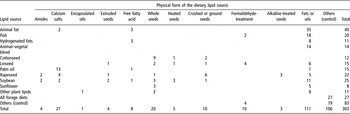
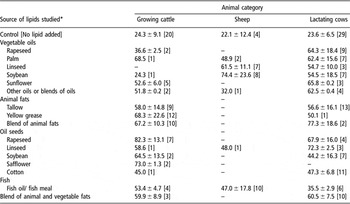
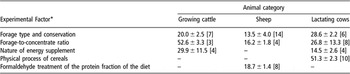
Data were encoded according to the lipid source with two codes. The first code indicated the origin of the lipid source (complete forage diet, control diets without lipid supplementation, cottonseed, linseed, palm, rapeseed, soybean, sunflower, other plant lipids, animal fat (tallow, yellow grease), fish, hydrogenated fats, animal–vegetal blend). The category ‘animal–vegetal blend’ included associations of tallow (partially hydrogenated or not) with whole seeds (soybean or cottonseed) or with vegetal oils. The second code indicated the ‘physical form’ of the lipid source, i.e. mode of protection of oils or seeds (amide or encapsulated), whole v. extruded v. cracked v. heated seeds, alkaline treatment, formaldehyde treatment, triglycerides (oils), calcium soaps and free FA. Table 1 gives the partition of experimental data according to dietary lipid sources and their physical form. Tables 2 and 3 give cross-table representations of the experimental treatments (N trt) and the level of FA supplementation (FAint) according to studied species and dietary lipid sources. As fish oils are supposed to affect ruminal fermentation patterns and FA metabolism (mainly C18), all data dealing with fish oils or combining fish oils and vegetable oils (N trt = 20) were analysed separately from data relative to the other lipid sources. Experiments dealing with forage (N trt = 27) were encoded according to forage species (mainly clover without distinction between red or white clover, orchardgrass and ryegrass) and conservation (as silage, hay, green forage), and they were analysed separately. Other experimental protocols studied the effects of forage-to-concentrate ratio (N trt = 15), nature of energy supplement (N trt = 8), physical process of cereals (N trt = 10, only studied in dairy cows) and formaldehyde treatment of the protein fraction of the diet (N trt = 8, only studied in sheep) on the duodenal flows of FA. Consequently, the effects of the two latter factors may have been confounded with animal species; however, as these experiments had iso-lipid diets, they were not included to predict duodenal flows of FA, but they were used to validate the obtained equations (see below).
Partition of experimental treatments in the database according to lipid source and technological treatment (physical form) of the dietary lipid source

Distribution of the experimental treatments according to animal category and source of lipid supplement, and mean levels of fatty acid intake (g/kg dry matter intake)

*Data are expressed as mean ± s.d. (when appropriate). Data in brackets indicate the number of experimental treatments.
Level of lipid intake (g fatty acid /kg dry matter intake) in experiments without dietary lipid supplementation

*Data are expressed as mean ± s.d. (when appropriate). Data in brackets indicate the number of experimental treatments.
Data distribution between dietary lipid sources, level of lipid supplementation and animal species was not homogenous; e.g., vegetable oils were mostly studied in dairy cows, whereas animal fats were mostly studied in growing cattle. Moreover, when no lipid was added, DMI expressed relatively to BW was 1.76 ± 0.28% (N trt = 17), 1.95%±0.37, (N trt = 37) and 3.08%±0.55, (N trt = 22) for sheep, growing cattle and lactating cows, respectively (P < 0.001). Consequently, it cannot be ruled out that effects of lipid supplementation may be partly confounded with animal species and/or level of intake. It should also be emphasized that in order to compare dietary treatments at an approximately similar theoretical value of energy intake, the increase in FAint content occurred mainly at the expense of starch content in the diet (g/kg DMI)

Fitting a higher polynomial model provided a higher RMSE and a higher AIC (Akaike’s Information Criterion, see below). Lipid supplementation had no significant influence on the other dietary components (NDF, ADF and CP) in the database.
Data for a dependent variable Y were processed using variance–covariance analysis with the MIXED procedure of the SAS statistical software package (release 8.01, 1999; SAS Institute Inc., Cary, NC, USA) including the source of added lipid, physical form and the overall slope of Y v. X (covariate) as fixed factors. Random part of the model was constituted by experiment effect and a slope clustered on the experiment effect. It has previously been shown that considering experiment effect as a random factor results in a better prediction of coefficients and a more accurate description of prediction error (St-Pierre, Reference St-Pierre2001). Consequently, the model of analysis was

where i = number of experiments, j = number of groups, B 0 + B 1Xij + B 2(lipid source × physical form), Xij is the fixed effect part of the model and si + biXij + eij is the random effect part of the model. In this model, B 1 is the overall slope of Y v. X, and B 2 is the difference from the overall slope for a given combination of lipid source × physical form. Statistical significance of B 2 (significant interaction between Xij and lipid source × physical form) was reported only when there were at least three observations (N trt). In some cases, quadratic models were also tested for the same dependent variable: the selected model was the one with the lowest Akaike’s Information Criterion (Wang and Goonewardene, Reference Wang and Goonewardene2004). Statistical analyses were not weighed for several reasons. First, studies in the database had similar number of animals (between 3 and 8), and most of them had the same experimental design (see below). Moreover, optimal weighing of the observations would require identical expression of the variability of the studied parameters. Unfortunately, this was not the case: variability was expressed either as SEM (or SE), or SD of the difference between means, or SD for the mean of each treatment group; in some publications variation was even not reported.
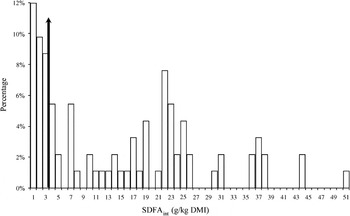
Statistical analysis was performed in two successive steps. The first step included all experiments (N exp) of the database, while the second step selected only those experiments that had an intra-experiment variation (standard deviation, s.d.) above a predefined threshold. Theoretically, the inclusion of all available data would provide a more precise relationship because of an improved prediction of the random intercept of each experiment. However, this was not the case in our database (see below); moreover, the aim of our analysis focused on the response of different flows (Y) to variation in X, rather than on an explanation of between-experiment variations. Consequently, the threshold of inclusion was arbitrarily set at a value above which intra-variation of the independent variable was considered relevant, with regard to its overall distribution in the database. For example, the distribution of SD for the independent variable FAint (SDFAint) is presented in Figure 1: the experiments with SDFAint lower than 3 g FA/kg DMI were excluded, i.e. approximately 30% of the observations (N trt). Theoretically, these two approaches estimate a ‘true’ intra-experiment effect of independent variable on the selected dependent variables (except if there was a covariation of other variables). However, because the independent variable (FAint mainly) was generally affected by an experiment effect on this data set, the calculated intra-experiment coefficients have to be interpreted with caution.
Distribution of the intra-experiment standard deviations of dietary fatty acid content (SDFAint, g FA/kg dry matter intake (DMI)) in the database. The arrow indicates the threshold (SDFAint ⩾ 3 g/kg DMI) used to select experiments retained for the analysis of the effect of dietary fatty acid content.

Unless otherwise stated, parameter estimates are mean ± s.e., whereas for all other data they are presented by mean ± s.d. Mean ± s.d. of the studied variables for the whole database, or sorted by species, are presented in Appendix 1. A preliminary analysis of the data indicated no significant effect of animal species on any of the variables studied (except on DMI). Consequently, this factor was not discussed in the text.
Results and discussion
Ruminal phenomena
Hydrogenation capacity of the rumen and ruminal pH
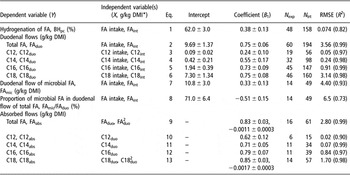
From the whole database, ruminal pH was not affected by FAint or by the source of added lipid. When experiments with SDFAint lower than 3 g/kg DMI were excluded, BHpc tended to increase linearly with FAint according to Equation (1) in Table 4. Compared with the coefficient of control diets (0.38, expressed as the increase in BHpc for an increase of 1 g FA/kg DMI), the coefficient of animal fat (0.10) and especially hydrogenated tallow (0.03), CaSalt of palm oil (0.08) was lower, whereas it was higher for soybean oil (0.58) and linseed oil (0.53) either protected or not. Coefficients for all other physical forms of added lipids were not significantly different from that of control diets. Obviously, low BHpc occurred with fat that was already partly saturated or hydrogenated, whereas a high rate of BH occurred on lipids that contained PUFAs, mainly linolenic acid that has the highest BHpc compared with other unsaturated FA (Glasser et al., 2008).
Prediction of rumen biohydrogenation of total fatty acid (FA), duodenal flows, apparent absorbed flows of total FA and FA with 12, 14, 16 or 18 C units (diets without fish oils or only forage-based diets)

*DMI = dry matter intake; N exp = number of trials included; N trt = number of treatments (observations); RMSE = root mean square error of the model; Eq. = equation.
Values are expressed as mean ± standard error. Presented equations correspond to the fixed part of the model of analysis according to: Y=Intercept+B1X. Significant difference from B1 for a given lipid form (B2(Lipid source × technological treatment) X) is indicated in the text. For total FA and C18 absorbed flows, the model was quadratic and it included FAduo and FA2duo, and C18duo and C182duo, respectively.
The effect of pH on BH was studied in the companion paper (Glasser et al., 2008). Even in trials where effect of dietary treatments on pH was not significant (Ueda et al., Reference Ueda, Ferlay, Chabrot, Loor, Chilliard and Doreau2003), variations in BHpc were observed, thus indicating that BH may be affected by changes in microbial populations or in EMPS without a concomitant change in pH. There is suggestive evidence that BH is more pronounced in experiments where rumen fermentations are less intense (higher pH and higher Acetate-to-propionate ratio) and associated with a lower EMPS due to a higher ruminal supply in apparently fermented OM. This is supported by the positive inter-experiment relationship between BHpc and OM truly digested in the rumen (RDOMt, +0.40 ± 0.25%) for an increase in 1% in OM ruminal digestibility, N trt = 67, RMSE = 6.6) and the negative relationship with EMPS (−0.54 ± 0.30%) for an increase in 1 g N/kg RDOMt, N trt = 97, RMSE = 6.9). High EMPS have been shown to reduce methane production (Preston and Leng, Reference Preston and Leng1987) that may increase availability of H2 in the rumen and BH, though methanogenesis is a more efficient process to dispose excess reducing power, at least in vitro (Joyner et al., Reference Joyner, Winet and Godhout1977). Furthermore, it cannot be ruled out that in these conditions (high EMPS), bacteria may increase their incorporation of long-chain FA (Sasaki et al., Reference Sasaki, Horiguchi and Takahashi2001), which are consequently protected from BH; in our database, BHpc was negatively related to FAmic with a 1.1% (±0.23, N trt = 30, RMSE = 8.7) decrease in BHpc for an increase in 1 g FAmic/kg DMI. The relevance of this relationship remains unclear, since BH is generally considered as a means to decrease the toxicity of PUFA (Kemp et al., Reference Kemp, Lander and Gunstone1984). Changes in bacterial and protozoa populations may also account for changes in ruminal BH. For instance, the absence of rumen protozoa has been shown to affect bacterial population through a reduced diversity of bacterial groups (Yanez-Ruiz et al., Reference Yanez-Ruiz, Williams and Newbold2007). Contribution of protozoa to BH and changes in bacterial populations in response to dietary lipids supplementation have not been extensively studied until now.
EMPS
Mean values of EMPS and RDOMt for the whole database are given in Appendix 1. When experiments with an SDFAint lower than 3 g FAint/kg DMI were excluded, FAint showed no effect on EMPS, except for soybean seeds with +0.19 (N trt = 6) g microbial N/kg RDOMt for an increase of 1 g FAint/kg DMI. It should be emphasized that the increase in EMPS was related to a reduction in RDOMt due to lipid supplementation (Tice et al., Reference Tice, Eastridge and Firkins1994; Howlett et al., Reference Howlett, Vanzant, Anderson, Burris, Fieser and Bapst2003; Scholljegerdes et al., Reference Scholljegerdes, Hess, Moss, Hixon and Rule2004), whereas the daily flows of microbial N to the duodenum were either not affected or slightly increased in these experiments. The lack of effect of lipid addition on EMPS, except when RDOMt was reduced, is in agreement with the review of Doreau and Ferlay (Reference Doreau and Ferlay1995), who studied the effect of lipid addition on ruminal N metabolism. The reduction of RDOMt has been shown to reflect the decrease in ruminal NDF digestion observed in the whole database (data not shown), especially when unsaturated fat was fed (Doreau and Ferlay, Reference Doreau and Ferlay1994). A toxic effect of fat on the protozoa population has been reported (Bock et al., Reference Bock, Harmon DL Brandt and Schneiders1991; Onetti et al., Reference Onetti, Shaver, McGuire and Grummer2001), which may reduce bacteria lysis and predation, and increase EMPS (Ushida et al., Reference Ushida, Jouany, Lassalas and Thivend1984).
Duodenal FA flow and ruminal FA balance
Duodenal flow of total FA
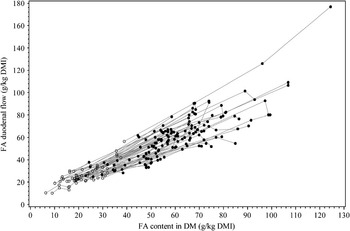
In the whole database, both FAduo (mean value in Appendix 1) and its variability increased with FAint (Figure 2). When experiments reporting a SDFAint lower than 3 g/kg DMI were excluded, the relationship between FAduo and FAint was linear (Equation (2), Table 4). A quadratic model using FAint2 did not improve the AIC of the model. Without selection on SDFAint, the model was also linear and the intercept and the coefficient were 9.13 ± 1.28 and 0.77 ± 0.06, respectively, with RMSE = 3.61 (N exp = 79; N trt = 252; R 2 = 0.98), which shows that coefficients for the inter-experiment and intra-experiment equations were similar. The RMSE of the intra-experiment relation is close to that reported on smaller data sets without considering experiment effects (N trt = 113, Doreau and Ferlay, Reference Doreau and Ferlay1994) or fixed effects for experiments (N trt = 116, Sauvant and Bas, Reference Sauvant and Bas2001). However, in these reviews, intra-experiment and inter-experiment effects might have been confounded since there was no selection of experiments based on their SD for FAint. Interaction between FAint and added lipid was significant: compared with control diets, soybean oil whatever its protection (+0.19), rapeseed raw (0.35) or ground (+0.10), unprotected blends of animal and vegetable fats (+0.10) and yellow grease (+0.12) all had higher coefficients. The coefficients from all other lipid presentations were not different from those of control diets.
Influence of dietary fatty acid (FA) content in dry matter intake (DMI) on the duodenal flow of FA in ruminants fed control (○) or lipid-supplemented diets (●). Each point corresponds to an experimental treatment, and the lines link treatments from the same experiment.

Because of the selection of publications based on their variability for FAint, a sensitivity analysis was performed on the data set of experiments that was excluded from the calculation of Equation (2). We predicted their duodenal flow of FA using Equation (2) and their FAint, and we compared the prediction with the reported value of FAduo: the regression between calculated and reported FAduo had a slope of 0.95 ± 0.12, which was not different from 1 (the unit) and had no significant intercept. This indicated that Equation (2) might be used to predict FAduo without any bias.
For diets containing fish oils, the relationship between FAduo and FAint (N exp = 11; N trt = 24; RMSE = 3.0) had a non-significant intercept (7.28 ± 6.18, P < 0.30) and a slope of 1.10 ± 0.31 (P < 0.05) that was higher than that presented in Table 4 (Equation (2)) for the other fat sources. However, this relationship should be considered with caution due to the low number of data. Protection of the fish oils did not affect the coefficient of the relationship.
For complete forage diets, FAint was not affected by forage species. FAint was lower for hays than for silages or green forages. Forage species did not affect FAduo (17.8 ± 4.5 g/kg DMI, N trt = 25). Compared with hay (FAduo: 11.7 ± 2.6 g/kg DMI, N trt = 4), green forages and silages had higher FAduo, i.e. 17.6 ± 1.9 (N trt = 6) and 20.0 ± 4.2 (N trt = 9) g/kg DMI, respectively.
Based on the whole database, the mean calculated ruminal balance of FA (intake − duodenum, FAbal, g/kg DMI) was −1.6 ± 9.8 g/kg DMI (N trt = 297). The relationship between FAint and FAduo (Equation (2)) indicated that, independent of the source of lipid supplementation, a positive FAbal occurred with a FAint higher than 40 g/kg DMI, which is slightly lower than that previously reported (Doreau and Ferlay, Reference Doreau and Ferlay1994; Sauvant and Bas, Reference Sauvant and Bas2001).
The relationship between FAint and FAduo indicated that 6% to 16% of FAint disappeared between the mouth and the duodenum when FAint varied between 50 and 120 g/kg DMI. Doreau and Ferlay (Reference Doreau and Ferlay1994) suggested that a positive FA balance might stem from absorption through the rumen wall or metabolism (oxidation) in the rumen wall or by microbes. Rumen absorption of medium-chain FA has previously been demonstrated (Hagemeister et al., Reference Hagemeister, Kaufmann and Wiechen1979), and absorption of long-chain FA through diffusion in the rumen wall remains theoretically possible, although this process is probably of minor importance since FA are essentially associated with feed particles (Harfoot and Hazlewood, Reference Harfoot and Hazlewood1997). However, it has been suggested that absorption is possible when there is a high lipid content in the rumen (Doreau and Ferlay, Reference Doreau and Ferlay1994). Theoretically, the lack of oxygen in the rumen would indicate that oxidation of FA by ruminal microbes is probably low, but Doreau and Chilliard (Reference Doreau and Chilliard1997) suggested that microbes adherent to the rumen may derive oxygen from the rumen wall to oxidize FA, and in vitro data indicated that partial oxidation of palmitate in isolated rumen cells or in ruminal epithelium may occur with the production of ketone bodies (Cook et al., Reference Cook, McGilliard and Richard1967; Jesse et al., Reference Jesse, Solomon and Baldwin1992). However, the extent of this process is not known, and it remains to be established whether this phenomenon is related to the quantity of FA in the rumen. Moreover, this phenomenon is probably not sufficient to explain a positive balance with low-lipid or forage diets. Indeed, even forages, which are low in lipids, gave positive ruminal balances particularly with fresh forage or silages (Dewhurst et al., Reference Dewhurst, Evans, Scollan, Moorby, Merry and Wilkins2003; Doreau et al., Reference Doreau, Ueda and Poncet2003; Lee et al., Reference Lee, Harris, Dewhurst, Merry and and Scollan2003 and Reference Lee, Connely, Tweed, Dewhurst, Merry and Scollan2006). Reasons for such positive balance when no fat is added are not known.
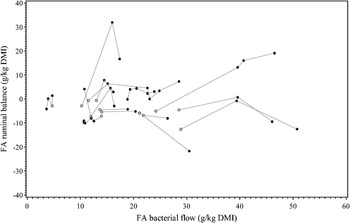
Finally, part of the variation of FAbal could be due to a variable contribution of bacterial lipids to duodenal FA flow. However, this does not explain the positive balances of FA in our database, since negative or positive FAbal values were obtained independent of duodenal flows of bacterial FA (Figure 3). The nature of bacterial lipids flowing to the duodenum is discussed below.
Influence of the bacterial flow of fatty acids (FA) to the duodenum on the ruminal balance of FA in ruminants fed control (○) or lipid-supplemented diets (●). Ruminal balance of FA was calculated as: FA intake − duodenal flow of total FA. Each point corresponds to an experimental treatment, and the lines link treatments from the same experiment.

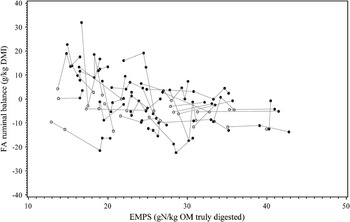
As for FAduo, FAbal increased in response to FAint, partly due to inter-experiment variations. A curvilinear inter-experiment relationship was established between FAbal and EMPS (Figure 4), which was adjusted with the NLIN procedure of SAS (release 8.01, 1999):
Influence of the efficiency of microbial protein synthesis (EMPS, g N/kg organic matter (OM) truly digested) in the rumen on the ruminal balance of fatty acids (FA) in ruminants fed control (○) or lipid-supplemented diets (●). Ruminal balance of FA was calculated as: FA intake − duodenal flow of total FA. Each point corresponds to an experimental treatment, and the lines link treatments from the same experiment.


This model indicates that positive ruminal FA balances occurred at a calculated EMPS below 25 g N/kg RDOMt. It suggests that when ruminal conditions increased EMPS, dietary FA were less catabolized, leading to a negative ruminal FA balance. However, it could be argued that positive FAbal were obtained because of erroneous (underestimated) duodenal FA flows. In this case, OM digested in the rumen and duodenal N flows would also have been equally biased, which would have led to an underestimation or overestimation of EMPS, preventing to obtain any relationship between EMPS and FAbal. Moreover, in most experiments with positive FAbal, duodenal flows of N and OM were in the range of usually reported values, which suggests that the relation between FAbal and EMPS was not due to methodological errors.
Duodenal flows of FA with 12, 14, 16 and 18 C units
Duodenal flows of FA with 12, 14, 16 or 18 C units (mean values in Appendix 1) were studied individually in relation to their corresponding intake (Table 4, Equations (3) to (6)), whereas results on individual duodenal flows of the various FA with 18 C units were reported in the companion paper (Glasser et al., 2008). It should be emphasized that only C18 exhibited an increased variability in duodenal flow in response to increased intake, as observed for total FA (data not shown). All intercepts and coefficients were statistically significant. The analysis of the relationships did not highlight a significant effect of the source of added lipid or the lipid treatment, except for a higher coefficient of soybean oil (free or protected, +0.28) and raw rapeseed (+0.24) for C18int. We observed that the coefficients increased with chain length, which could be due to the synthesis of C16:0 and C18:0 by rumen bacteria, which represented approximately two-thirds of bacterial FA (Sauvant and Bas, Reference Sauvant and Bas2001). It may be suggested that catabolism or absorption of medium-chain FA (see above) may reduce their duodenal flows in comparison to C16 or C18. The significant intercepts in Equations (3) to (6) partially reflect the synthesis of C12 to C18 in the rumen, but they also represent the content of these FA in the control diets, indicating that extrapolation of these relationships to null intake provides gross estimates of true synthesis.
Duodenal flow of bacterial FA and contribution to total FA flow
Bacterial flow of FA to the duodenum
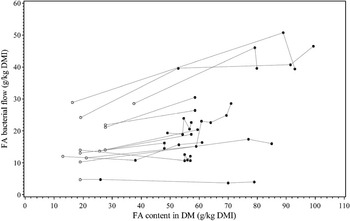
With complete forage diets, data reporting duodenal flow of bacterial FA are scarce; Hogan (Reference Hogan1973) reported a value of 11.7 g FA/kg DMI in sheep fed clover. Data reporting FAmic with fish-oil supplements are equally scarce (N trt = 3; Qiu et al., Reference Qiu, Eastridge and Firkins2004), and the SDFAint reported was low. Consequently, these data were not included in the relationship between FAmic and FAint (Figure 5, and Equation (7) in Table 4). The interaction between FAint and lipid added on FAmic was significant: compared with control diets, coefficients of animal fats and diets containing rice bran or wheat bran (Ieki et al., Reference Ieki, Zhao, Taniguchi and Obitsu1997) were −0.15, −0.35 and −0.42, respectively. For animal fats, the low coefficient was related to a decrease in FAmic in response to increased FAint, because the added fat was hydrogenated (Legay-Carmier, 1989; Elliott et al., Reference Elliott, Drackley, Beaulieu, Aldrich and Merchen1999). The prediction model of FAmic suggested that 10.8 g/kg DMI passing through the duodenum were of bacterial origin, but it must be emphasized that this estimation is a gross value, because coefficient of variation of the slope is high (Equation (7)). However, similar estimations were obtained from the equation predicting FAduo (9.69 g/kg DMI) and from previous reviews, i.e. 9.3 g/kg DMI (Doreau and Ferlay, Reference Doreau and Ferlay1994) and 8.43 g/kg DMI (Sauvant and Bas, Reference Sauvant and Bas2001), which did not provide the s.d. of the slope.
Influence of dietary fatty acid (FA) content in dry matter intake (DMI) on the bacterial flow of FA to the duodenum in ruminants fed control (○) or lipid-supplemented diets (●). Each point corresponds to an experimental treatment, and the lines link treatments from the same experiment.

Distribution of duodenal FA flow between bacterial FA and dietary FA
In the experiments (N trt = 4) that had values slightly higher than 100 for the FAmic-to-FAduo ratio (Legay-Carmier, 1989), this ratio was arbitrarily set to 100: mean value of the FAmic-to-FAduo ratio is presented in Appendix 1. When experiments with SDFAint lower than 3 g/kg DMI were excluded, lipid addition linearly decreased the contribution of bacterial flow to total duodenal FA flow (Equation (8) in Table 4). This equation indicates that for diets poor in FA (less than 20 g/kg DMI), the proportion of bacterial lipids in duodenal FA flow was above 60%, whereas with diets rich in FA (>40 g/kg DMI) the proportion fell below 50%. It is likely that these values were overestimated for the highest values of FAint, because part of the dietary FA was probably directly incorporated into bacteria, as shown by the increase in the ratio of FAmic to duodenal flow of microbial N (Nmic) with increasing FAint:

This relation shows that the FAmic-to-Nmic ratio was close to 1 for diets poor in FA, but greater than 1.4 for diets providing more than 40 g FA/kg DM, which reflects the high ability of bacteria to absorb and store intracellularly or adsorb dietary FA. The increased FA content in bacteria associated with dietary FA may stem from either physical adsorption on the cell surface, incorporation of feed FA or increased lipid synthesis leading to FA being deposited in the cell walls or, more presumably, in intracellular lipid droplets (Bauchart et al., Reference Bauchart, Legay-Carmier, Doreau and Gaillard1990). Quantitatively speaking, since FA could not be removed by washing bacteria cells with hexane or sodium hydroxide (Harfoot et al., Reference Harfoot, Crouchman, Noble and Moore1974), direct incorporation is a potentially highly significant process in microbial lipid metabolism. Moreover, it is generally assumed that de novo synthesis of bacterial lipids decreases when the amount of exogenous lipids increases (Doreau and Ferlay, Reference Doreau and Ferlay1994). Indeed, ruminal bacteria can reduce the de novo synthesis of FA in high-fat diets both in vitro (Demeyer et al., Reference Demeyer, Henderson and Prins1978) and in vivo (Czerkawski et al., Reference Czerkawski, Christie, Breckenbridge and Hunter1975), which suggests a preferential utilization of preformed FA rather than synthesis of FA, which could be considered as an energy-sparing process since direct incorporation of FA demands less energy than synthesis (Demeyer and Van Nevel, Reference Demeyer and Van Nevel1995).
It should also be emphasized that the high variability of FAmic may be explained by inter-experiment differences in the quantification of the bacterial flows to the duodenum. These differences may arise from methodological considerations (microbial marker, digesta flow marker and frequency of duodenal sampling relatively to feed distribution, see Materials and Methods, and Harvatine and Allen (Reference Harvatine and Allen2006) for a discussion of these methodological considerations) and/or biochemical differences in lipid metabolism between bacterial species. First, the values for total FA content in bacteria do not distinguish FA from bacterial synthesis and FA of dietary origin that are adsorbed on the cell wall or included in the cytoplasm. Second, it is well known that there are important differences in metabolic activities and FA composition between LAB and SAB (Bauchart et al., Reference Bauchart, Legay-Carmier, Doreau and Gaillard1990), whose relative proportions in the ruminal samples depend on the sampling procedure used to harvest these two fractions (Legay-Carmier and Bauchart, Reference Legay-Carmier and Bauchart1989). Moreover, it remains to establish whether the separation procedures isolated protozoa from bacteria, because protozoa may also contribute to the duodenal flow of microbial FA. Yanez-Ruiz et al. (Reference Yanez-Ruiz, Scollan, Merry and Newbold2006) reported that the protozoa flow of FA may contribute to approximately 15% of the duodenal flow of total FA, but their contribution may vary between 2% (for C17:0) and 20% for C16:0 and C18:0, respectively. Third, SAB and LAB bacteria may have different responses to dietary manipulation. Legay-Carmier (1989) reported an increase in the total FA content of LAB from ruminal samples of cows fed oilseed, whereas SAB were not affected. Similarly, Vlaeminck et al. (Reference Vlaeminck, Fievez, Demeyer and Dewhurst2006) reported that a decrease in forage-to-concentrate ratio led to a three-fold higher increase in the bacterial concentration of trans-10 C18:1 in LAB compared with SAB. Consequently, the relationship between bacterial synthesis of FA and FAint needs to be assessed in detail, taking into account the specific bacteria species forming the SAB or LAB groups.
Apparent absorption of FA in the small intestine
Absorbed flows of total FA
Flows of apparently absorbed FA (FAabs, g/kg DMI) and FA with 12, 14, 16 and 18 C units (Appendix 1) were studied in trials providing flows of FA measured between the duodenum and terminal ileum. Absorbed flow of each FA was predicted from their respective duodenal flows (Equation (9) to Equation (13) in Table 4), with the constraint of a null intercept in the models because preliminary analysis indicated that intercepts were not significant. Apparent small intestine digestibility (%) of total FA and FA with 12 to 18 C units was calculated as a proportion of their respective duodenal flows (Appendix 1). The data set contained 30 experiments (71 treatments including data with complete forage diets).
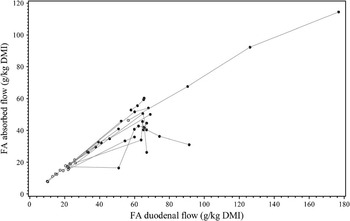
In the whole database, mean ± s.d. FAabs was 33.2 ± 19.0 g/kg DMI and mean ± s.d. apparent small intestine digestibility of FAduo was 74.4 ± 12.9%. When trials with an intra-experiment SD lower than 2.5 (0.75 × SDFAint) for FAduo were excluded, the relationship between FAabs and FAduo was curvilinear (Figure 6 and Table 4), which indicated possible limitation of FA absorption with increasing flows of FAduo. This limitation is probably related to the low intestinal digestibility of C18:0 (see below and Glasser et al., 2008). The interaction between FAduo and added lipid was significant: hydrogenated tallows (−0.23 g FAabs/kg DMI) and rapeseed (−0.21, regardless of technological treatment) had lower coefficients than control diets.
Apparent absorption of fatty acids (FA) in the small intestine as a function of duodenal flow of FA in ruminants fed control (○) or lipid-supplemented diets (●). Each point corresponds to an experimental treatment, and the lines link treatments from the same experiment.

For complete forage diets, mean ± s.d. FAabs was 15.0 ± 1.25 g/kg DMI (N trt = 15) and mean ± s.d. apparent small intestine digestibility was 83.9 ± 1.4%. Although the variation in FAduo (10 to 27 g/kg DMI) was low, the relationship between FAabs and FAduo was significant and linear with a coefficient of 0.86 ± 0.02 (N exp = 5; N trt = 15; RMSE = 0.52). There were no forage type or process effects.
For fish oils, only Scollan et al. (Reference Scollan, Dhanoa, Choi, Maeng, Enser and Wood2001) provided data on FA absorption as determined by ileal measurements, giving a mean ± s.d. FAabs of 56.5 ± 5.27 g/kg DMI (N trt = 2), and a mean ± s.d. apparent small intestine digestibility of 91.5 ± 0.71% (N trt = 2).
Based on experiments that simultaneously determined bacterial flows of FA (FAmic) and intestinal absorption of FA (FAabs), it was possible to estimate apparent intestinal digestibility for FA of bacterial origin and FA of dietary and endogenous origin (FAduo – FAmic). We used a multiple regression model of FAabs with flow of bacterial origin and flow of dietary and endogenous origin as independent variables to obtain estimated absorption coefficients for both groups of FA. The inter-experiment relation was:

This relation had a non-significant intercept, which is logical because endogenous FA and FA of dietary origin were pooled and assigned the same digestibility coefficient. These coefficients suggested a tendency for higher apparent absorption for bacterial FA than dietary or endogenous FA.
Absorbed flows of FA with 12, 14, 16 and 18 C units
The absorbed flows of FA with 12, 14, 16 or 18 C units are presented in Appendix 1. The flows of apparently absorbed FA in relation to their respective duodenal flows are presented in Table 4. All linear coefficients were significant. There was a trend towards a quadratic response of C12abs to C12duo (P < 0.10), due to two data from Scollan et al. (Reference Scollan, Dhanoa, Choi, Maeng, Enser and Wood2001) that gave high C12abs values (0.30 to 0.60 g/kg DMI). When these data were eliminated, the relationship was linear, with no lipid source or lipid treatment effect. The calculated coefficient was very similar to the calculated mean ± s.d. apparent small intestine digestibility of C12duo, i.e. 66.9 ± 11.5%. For C14abs, heated soybean seeds (−0.43) and hydrogenated tallow (−0.15) tended to have a lower coefficient (P < 0.01 and P < 0.12) than control diets; however, the calculated coefficient for C14duo was close to the mean apparent small intestine digestibility of C14duo, i.e. 66.7 ± 17.4%. Also for C16abs, hydrogenated tallow had a significantly lower coefficient (−0.29) than the control diet, and the mean ± s.d. apparent small intestine digestibility of C16duo was 76.7 ± 11.9%. The mean ± s.d. apparent small intestine digestibility of C18duo was 75.4 ± 14.8%. As observed for total FA (see above), the model obtained to predict intestinal absorption of C18 had linear and quadratic coefficients, and the linear coefficients for hydrogenated tallow (−0.32) and rapeseed (−0.31) were significantly lower than that of control diets. This significant quadratic effect indicated a saturation of the intestinal digestibility of C18, which is exclusively due to the limited intestinal absorption of stearic acid (Glasser et al., 2008). Possibly, hydrogenated tallow may have low intestinal digestibility due to incomplete ruminal lipolysis, and low digestibility of FA from rapeseed may be related to their passing intact to the faeces. Moreover, the lower absorption of C14 (a trend), C16 and C18 from hydrogenated tallow was probably due to the increased flow of esterified FA at the ileum, given that these FA are less soluble in micelles (Pantoja et al., Reference Pantoja, Firkins, Eastridge and Hull1996; Elliott et al., Reference Elliott, Drackley, Beaulieu, Aldrich and Merchen1999). Based on the database, mean apparent intestinal digestibility increased with increasing chain length from C12 to C16 and was similar for C16 and C18, although the absorption of C18 was a quadratic function of its duodenal flow.
With fish-oil-containing or complete forage diets, there were insufficient data (fish oils : N trt = 2, Scollan et al., Reference Scollan, Dhanoa, Choi, Maeng, Enser and Wood2001; forage : N trt = 5, Lee et al., Reference Lee, Harris, Dewhurst, Merry and and Scollan2003) to study the intestinal digestibility of individual FAs in relation to duodenal flow.
General discussion
The synthesis of published data through meta-analysis is increasingly common in the area of animal nutrition and has been shown to be a useful tool for obtaining precise predictions of response of a given phenomenon to quantitative or qualitative diet variations (Sauvant et al., Reference Sauvant, Schmidely and Daudin2005). However, one of the main drawbacks of this approach is that the matrix of data is far from complete, which implies that multivariate analysis is not feasible. Ideally, the data should have included different levels of FAint for each source of added lipid and for each technological treatment applied to the different lipid sources. Moreover, some fat supplements are under-represented in the database, and thus their contribution to the patterns of response may be biased or confounded with experiment effects. For example, diets supplemented with vegetable oils were common in the database, whereas complete forage diets or diets with fish oils were rare. This is detrimental to the renewed interest for grazing systems or the potential use of fish oils in ruminant nutrition. Moreover, the choice to include experiments based on their s.d. for the variance–covariance analysis eliminated part of the data, with a subsequent loss of biological variation: e.g. most of the effects of technological treatments are studied with iso-lipidic diets, which were not retained with the criterion we selected. This is probably the reason why few effects of technological treatments were found to be significant beyond the variation they induced through FA levels. Consequently, our results indicate that the first determinant of duodenal or absorbed flows of total FA was the level of FAint. For prediction of total FA flows, intra- and inter-experiment relationships were nearly the same, suggesting that the prediction of these flows was probably not biased. However, it should be emphasized that high FAint increased the variability of the flows, and this could have been taken into account by using logarithmic transformation. We did not use this approach because the obtained coefficients would have lost all biological and practical significance.
Despite the increasing variability in response to digestive flows to increased FAint and the model we used (random effect for experiment), the RMSEs of the models were rather low and the coefficients of the equations generally had low s.d. Due to the hypothesis linked to the mixed models, the variability of the adjusted coefficients is higher than that of coefficients obtained by fixed-effect models (St-Pierre, Reference St-Pierre2001). Despite the potential bias discussed above (see duodenal flows of bacterial FA), these equations may be used to predict bacterial FA (that resulted from FA synthesis, incorporation into bacterial cells or adsorption on the cell wall) and duodenal flow of total FA of dietary origin, for both practical (feed formulation) and scientific purposes, i.e. to estimate FA flows as an input for metabolic models of FA. However, more research is needed to more clearly determine whether the flows of these FA groups differed in terms of intestinal digestibility in order to build a unit system to accurately predict flows of digestible FA in the intestine. More specifically, there is a clear need to obtain more data on microbial FA metabolism, as well as FA flows for complete forage diets and diets including fish oils. Moreover, interactions with other non-lipid components of the diet have to be quantified in more detail as they can determine duodenal flows of specific FA, particularly trans-FA or CLA (Glasser et al., 2008). Finally, before a fully applicable unit system can be obtained, a clear definition of animal needs for specific FA has to be determined.
In conclusion, the approach used in this study has to be completed by other approaches to FA metabolism, such as mechanistic modelling or thermodynamic approaches to ruminal metabolism. More specifically, in numerous parts of this meta-analysis, we pointed out that changes in microbial populations (protozoa v. bacteria) and/or in specific bacterial populations (possibly cellulolytic v. starch degrading species) may account for changes in EMPS, BH and flow of FAduo. Clearly, there is a need to increase knowledge on the relationships between the microbial populations and dietary factors that may alter them, to improve the prediction of absorbed flows of FA.
Other attempts to predict ruminal FA metabolism and FA absorption in dairy cows have been developed using the mechanistic approach of ruminal lipolysis of dietary fats, BH of FA, de novo production of FA in the rumen and intestinal digestion of FA in dairy cows (Moate et al., Reference Moate, Chalupa, Jenkins and Boston2004). Estimation of parameters of this model have been developed on a smaller data set (eight publications) than the current database and validated on eight other publications (36 diets) in the original publication, and further on a higher data set with 63 diets (Moate et al., Reference Moate, Boston, Lean and Chalupa2006). The results show that for a wide range of diets, this mechanistic approach can accurately predict the apparent absorption of dietary total long-chain FA, as well as BH of FA and synthesis of FA by bacteria. Unfortunately, residual variation of the prediction of FAduo from FAint and FAabs from FAduo, respectively, was not provided, which prevents any direct comparison of the accuracy of the two approaches. One of the main assumptions of this model was an inhibition of bacterial FA synthesis in the rumen with increasing FA content, as a result of increased uptake of long-chain FA by microbes, which is consistent with our data. However, some differences with our data are related to the prediction of FA absorption estimated with long-chain FA flows to the duodenum and to the faeces, whereas we selected publications where FA absorption was only estimated on ileal determinations. Despite that difference, they obtained strong linear relationships between the flow of long-chain FA to the duodenum and intestinal absorption, with lower intestinal digestibility for tallow (especially when hydrogenated) and whole soybeans.
Appendix 1
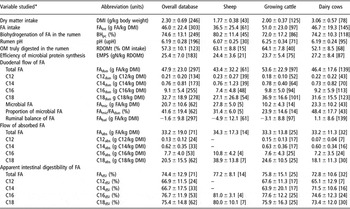
Mean ± s.d. values of variables studied in the whole database, and according to the animal species

Data in brackets are the number of experimental groups.
*FA = fatty acid; DMI = dry matter intake; OM = organic matter; RDOMt = OM truly digested in the rumen; Biohydrogenation of FA in the rumen = intake of double bonds (DB) − duodenal flow of DB expressed as a proportion of the DB intake; Ruminal balance of FA = total FA intake − duodenal flow of total FA; Flow of absorbed FA in the intestine (SI) = duodenal flow of FA − ileal flow of FA; Apparent intestinal digestibility = flow of absorbed FA/duodenal flow of FA × 100.