I Introduction
Food safety ensures that food will not cause harm to consumers when it is prepared and/or eaten according to its intended use.Footnote 1 The World Health Organization (WHO) stipulates food safety as a priority for public health, as every year 1 in 10 people fall ill and 125,000 children under the age of 5 years old die because of unsafe food consumption.Footnote 2 Recent cases of food contamination have called for more effective food safety management systems (FSMS).Footnote 3 In addition, the constant increase in global food trade widens the international penetration of foodborne hazards.Footnote 4 For this reason, solutions for food safety problems increasingly need to be found at the global level rather than at regional or national level.Footnote 5 To be relatively safe to be in compliance with WTO law, there are at least two options for a country to develop its FSMS: complying with international standards (e.g. Codex standards) or providing risk assessment if it deviates from international standards.Footnote 6 Life is certainly simpler for regulators if a country complies with international standards, not only to determine SPS measures, but also when developing an ALOP.Footnote 7 Unfortunately, not all food safety issues are covered by international standards. In such a situation, which this paper covers, developed countries have a comparative advantage over developing countries. Developing and conducting scientifically-rigorous risk assessments, such as the FSO, to implement strict and tailor-made standards for the peoples of a designated country is possible for developed countries because of their access to adequate resources. In contrast, developing countries face difficulties meeting these expectations, particularly in the health sector, as the data required to develop a scientific risk assessment are rarely available or there are insufficient resources to gather data. Developing countries do not need to perceive determining a scientifically robust ALOP as a barrier, but rather as an opportunity to increase food safety for their citizens and for designing food safety standards to be, at the safety level, comparable with developed countries.Footnote 8 Doing this increases not only the life and health of their citizens, but also their chances to participate in the global market, enabling them to trade surpluses, and benefit from comparative advantages.Footnote 9
In this paper, we suggest a solution to the problem of how to develop an ALOP in line with the FSO standards of developed countries, given the constraints faced by developing countries. We propose a differentiated approach for developing countries, which allows them to develop an FSO/ALOP that meets the requirements of WTO law, food safety science and responds to the specific constraints of developing countries:
-
1. To meet WTO legal requirements, developing countries base their ALOP on the concept of FSO.
-
2. Developing countries with an effective food inspection and laboratory system can develop an FSO/ALOP based on data on the frequency of a hazard at the retail level, as an alternative for robust epidemiological data.
-
3. Where an effective food inspection and laboratory system is absent, developing countries may resort to epidemiological data available at international level and extrapolate the data to the population of their own countries.
-
4. Regardless of which FSO/ALOP system is implemented, a lack of resources makes it more effective for developing countries to approve and verify a risk management plan (RMP) of a company, rather than rely only on costly on-site inspection and end-product testing. The RMP defines how risk related to the product is identified, analysed and managed by the food manufacturer, which is the most important actor in ensuring the safety of a product.Footnote 10
We will proceed as follows. As any WTO Member developing an ALOP is framed in the legal context of WTO obligations, we will first map these obligations as determined by WTO law (Section II). Subsequently, we will demonstrate how food safety science has determined the FSO concept to fill the gaps left by WTO law (Section III). We will then proceed to discuss how these concepts can be applied in the specific context of developing countries (Section IV). We will close with the conclusion of the findings (Section V).
II Member’s right to determine its ALOP and the need for quantitative criteria in the SPS Agreement
This section illustrates the WTO legal framework with regard to the law of the Agreement on the Application of Sanitary and Phytosanitary Measures (SPS Agreement)Footnote 11 as a context condition for the development of an FSO-based ALOP for developing countries.Footnote 12 The concept of ALOPFootnote 13 is specified in the Agreement on the Application of Sanitary and Phytosanitary Measures, Annex A, paragraph 5. WTO law and jurisprudence have, meanwhile, put some flesh on the bones of this definition.Footnote 14 As a general rule, WTO members are obliged to determine ALOP ex-ante of subsequent SPS measures.Footnote 15 This ex-ante obligation implies that WTO members have to actively determine an ALOP.Footnote 16 Regarding the content of an ALOP, WTO Members, however, have the right to determine which level is “appropriate” according to their national demands,Footnote 17 reflecting different levels of tolerance for risk.Footnote 18 This ultimately leads to different levels of ALOP in different Member States.Footnote 19 What is “appropriate” may indeed vary around the world according to different socio-economic settings of food trade and consumption, particularly in developing and developed countries; hence the determination of ALOP is indispensable for ensuring local economic growth and the maintenance of national identities and cultures. Robert Howse has termed this the determination of “citizen’s preference about risk” in opposition to risk itself.Footnote 20 As a consequence, Members have a wide margin within which they can set their level of appropriate risk: they can choose zero risk or a level higher than international standards.Footnote 21 This Member’s “right” to develop its own ALOP is framed by WTO rules, which “provide for disciplines that a WTO Member must respect when it selects regulatory measures to fulfil its ALOP”.Footnote 22 As a general principle, according to Article 5.4 of the SPS Agreement, an ALOP needs to be designed to minimise negative trade effects. This means in particular that according to Article 5.5. of the SPS Agreement, a WTO Member must avoid arbitrary or unjustifiable differences in the levels it considers to be appropriate in different situations. This does not mean, however, that an ALOP needs to be expressed in quantitative terms.Footnote 23 Arguably, it might not even have to be based on science. However, “a more explicit and in particular a quantitative expression of a Member’s ALOP would greatly facilitate the consideration of compliance with the SPS Agreement.”Footnote 24
In summary, WTO Members have discretion to determine their ALOP. This “right” is important, as socio-economic differences and differences in the ability to conduct studies require such a differentiated approach. Although the “right” to develop their own ALOP allows WTO Members to adjust food safety standards to their citizens’ needs, developing countries often lack the resources to determine the level of protection that is required by their population. Resources for the collection of epidemiological data at the population level are often limited, and available data are not robust.Footnote 25 Developing countries, hence, cannot realise the right granted by WTO law to develop their own ALOP effectively, nor are they able to present a quantitative ALOP in a meaningful way.Footnote 26 Consequently, the risk exists that developing countries determine an ALOP that is in compliance with WTO law, but neither effectively protects its citizens at the desired level, nor does it enable products to become tradable on the international market.
III Quantifying an ALOP through the FSO in the Food Safety Realm
Research has responded to the WTO Panel’s request for “a more explicit and in particular a quantitative expression of a Member’s ALOP”Footnote 27 by integrating insights from FSMS into ALOP.Footnote 28 While there is no legal obligation under WTO law to base a country’s ALOP on scientific criteria, good practice of food control requires exactly this: “Whilst a country has the sovereign right to decide on the degree of protection it wishes of its citizens, it must provide, if required, the scientific evidence on which this level of protection rests”.Footnote 29 In this context, the International Commission on Microbiological Specifications for Foods (ICMSF) developed the concept of the FSO to link the broad legal ALOP requirement to tangible, science-based criteria that can be applied by actors in the food chain.Footnote 30 ICMSF defines FSO as “the maximum frequency and/or concentration of a hazard in food at the time of consumption that provides or contributes to the appropriate level of protection”.Footnote 31 In other words, FSO is recognised as a level of a hazard in food at the time of consumption that may cause a certain tolerable number of food-borne diseases per population per year.
 $$H\,{\equals}\,Ho{\plus}\mathop{\Sigma}\!I \,{\minus}\,\mathop{\Sigma}\!R \leq FSO,$$
where H is the level of the hazard, Ho is the initial level of the hazard, ΣI is the total (cumulative) increase in the hazard and ΣR is the total (cumulative) reduction in the hazard. FSO, Ho, R and I are expressed in µg kg−1 for mycotoxins and log CFU g−1 for microbial contaminants. In this way, the ICMSF introduced a quantitative ALOP that is relevant to achieve the public health goal, but leaves the exact method of calculation open.
In practice, this may work as follows. Regardless of whether the calculation is based on epidemiological data or food supply chain data, the current state of disease X is 5 cases per 100,000 people per year and if the government agency of the Member State desires to reduce the number of cases to 2.5 cases per 100,000 people per year, then that latter number will serve as the ALOP.
IV Quantifying ALOP through the FSO in developing countries
For developing countries, it will take a longer time frame to comply with SPS measures to meet the ALOP.Footnote 32 Experience has shown, however, that due to a lack of available resources and data, developing countries often do not have the means to design an FSO/ALOP in the same way as developed countries.Footnote 33 Nevertheless, the FSO/ALOP concept remains a useful way for developing countries to design food safety goals tailored to their actual food safety problems and to ensure that the WTO legal requirement on ALOP is applied in a non-arbitrary manner. In order to benefit from applying an FSO/ALOP given the limited resources available, developing countries need to use a workable FSO/ALOP that is fit to their setting.
To design a workable FSO/ALOP we propose that governments of developing countries regulate in three steps. First an FSO/ALOP is determined at government level according to WTO requirements. The FSO/ALOP establishes an effective risk management system that accounts for food safety science and the available resources. Second, in order to ensure enforcement, technical guidelines are created, which contain detailed steps to show food manufacturers how to apply the FSO/ALOP. Finally, governments establish an effective public enforcement system, mainly by evaluating the application of the FSO/ALOP system by food manufacturers. These three steps are explained in detail in the following sections.
1 FSO/ALOP as effective risk assessment system in developing countries
Countries need to design an effective risk assessment system as a prerequisite of both WTO law and FSO/ALOP.Footnote 34 This requires a ranking of possible risks according to the needs of a country to achieve its public health goal.Footnote 35 The ranking of risks as an expression of a country’s public health goal is a political decision, which precedes the (scientific) determination of an FSO.Footnote 36 However, in order to ensure that countries obtain the most benefit from WTO law and design their ALOP effectively, the ALOP should also be informed by a quantifying approach.Footnote 37
Food safety science has developed two approaches to quantify ALOP and FSO: the “top down” and “bottom up” approach. The “top down” approach requires the availability of robust epidemiological data for a country. This approach provides the most accurate formulation for a public health policy goal, because it uses the actual level of the targeted disease in the relevant population. However, the feasibility of this approach relies on a sensitive and effective surveillance system, which is a great challenge in developing countries.Footnote 38 Surveillance data is likely to be limited or even non-existent in developing countries because of a lack of resources.
As a consequence, the “bottom up” approach may be a better alternative to meet the science-based requirement given the limited resources available. In the “bottom up” approach, the ALOP is based on available clinical information (e.g. the number of stool samples that contain a targeted microbial hazard). This information is combined with microbiological surveys, which provide the concentration of certain microbiological hazards in food at the retail level.Footnote 39 In a “bottom up” approach, gathering data relies on inspection and laboratory capacity; this is generally more available in developing countries than an all-encompassing and costly surveillance system. However, although some developing countries have a well-established inspection and laboratory system in place, some do not. For developing countries without the required inspection and laboratory capacity, the ALOP could be determined by extrapolating from available international data, particularly epidemiological data from other countries with similar cultures. However, this approach should be applied with care and only in a temporary fashion, while efforts are made to establish systems to gather original data for the preferred approach. Either way, such data can only form the basis for the political determination of a public health goal. Other factors, such as economic prerequisites and production factors, need to be considered as well.Footnote 40
To be meaningful, the risk ranking performed by governments needs to be translated into parameters that can be assessed by government agencies and used by food manufacturers. This is done by translating the political ALOP into an FSO in the next step. The approach used for this purpose resembles the approach used to quantify the ALOP, however, this time in terms of food safety science.Footnote 41 To ensure that the FSO is accessible to government officials and food manufacturers, it should be an officially published standard or a publicly available regulation. In this way, businesses have flexibility to apply any available food control process in their production or distribution facilities, as long as the concentration of a hazard in their products does not exceed the FSO value.
2 Guideline: who should determine the FSO/ALOP? And how?
The ALOP proposed here should only be established if there is proof of a significant impact on public health. Thus, an effective establishment of FSO/ALOP requires careful consideration of which foods have an impact on public health.Footnote 42 In order to achieve this, an integrated approach in the food supply chain is indispensable. First, extrapolating from the experience with EU food law,Footnote 43 food manufacturers should have prime responsibility to assess the risk in their supply chain, from post-harvesting of the food, through to production, storage, distribution and finally its preparation for consumption. The food manufacturer therefore carries the burden to gather and assess information about any possible risks related to its product and to eliminate or reduce these risks to an acceptable level. This significantly reduces the information burden on the food safety authority and produces a more accurate risk assessment profile, because it is conducted by the actor with the best knowledge of the risks related to a product. The authority’s role in this step is to supervise and verify the risk assessment.
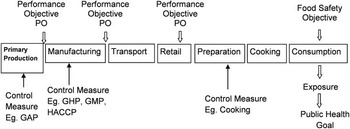
Second, based on the risk assessment from the food manufacturer, ALOP should be determined by the authority responsible for food safety control, in cooperation with an independent scientific advisory body. This ensures that the determination of ALOP is based on science and less influenced by political institutions. For this approach to work in practice, the authority needs to translate the desired ALOP into the language of the FSO. However, because the FSO is a level of a hazard at the point of food consumption, the level is not verifiable because it includes the variability and uncertainty of food handling before consumption. Food manufacturers must establish an intermediate target to apply and verify FSO: the Performance Objective (PO). PO is defined as “the maximum frequency and/or concentration of a hazard in a food at a specific step of the food production chain before the time of consumption that provides or contributes to an FSO or ALOP, as applicable”.Footnote 44 From the point of view of Hazard Analysis and Critical Control Points (HACCP), this PO can be regarded as a critical limit, which contributes directly to the FSO as the acceptable level.Footnote 45 The food manufacturer needs to determine the value of the PO at each Critical Control Point (e.g. receiving raw material from primary production, during the production process and at retail level). In order to meet the PO value, the manufacturer must ensure that primary production follows Good Agricultural Practice (GAP), apply suitable control measures (e.g. Good Hygiene Practice (GHP), Good Manufacturing Practice (GMP) or HACCP) in its production processes and ensure that the retail level applies Good Retail Practice (GRP). By translating the desired ALOP into the FSO, the authority can use the FSO/PO to communicate the ALOP to the food manufacturer. Close cooperation between the authority and food manufacturer is needed to achieve the ALOP.Footnote
3 Effective enforcement of FSO/ALOP regulation
Successful implementation of the proposed FSO/ALOP concept in developing countries requires enforcement. Enforcement is a challenge in developing countries as economic and intellectual resources are often not available. Despite this, food safety controls often rely heavily on on-site inspection of food facilities and end-product testing. These result in a costly inspection system, which in turn often leads to low enforcement of food safety standards. We propose a novel approach to enforcement to overcome this problem. In this novel approach, costly on-site inspection plays only a minor role. Instead, enforcement switches to a co-regulation framework. Food manufacturers are obligated to draw up a RMP that integrates the FSO/ALOP concept within the inspection system. Footnote 47 The RMP contains the following steps:
-
a The food manufacturer registers with the authority to participate in the RMP.
-
b The authority then verifies the eligibility of the food manufacturer based on its history of food safety control system from the authority’s on-site inspection database. If it is eligible, then the food manufacturer must prepare the following RMP documents: current implementation of GMP, HACCP and other food safety control systems in its facilities, and implementation of internal audits. However, if it is not eligible, the authority will inform the food manufacturer to do the Corrective and Preventive Action (CAPA) on the current food safety control system and afterward, the food manufacturer should update its RMP documents.
-
c The authority then makes an on-site inspection to verify the RMP documents of the food manufacturer. Based on this verification, the authority determines the current risk profile and classifies the food manufacturer into a risk zone. The risk zone determines the frequency of future on-site inspections, which are conducted by the authority.
The evaluation of a RMP by the authority can use two different concepts: a benchmark method developed by ICMSF or the margin of safety (MOS) of the accounting tool. The benchmark method developed by the ICMSF is as follows:Footnote 48
 $$H\,{\equals}\,Ho\,{\plus}\mathop{\Sigma}\!I \,{\minus}\mathop{\Sigma}\!R \leq FSO$$
 $$FSO\,{\minus}\,H\geq 0$$
FSO, which is derived from the ALOP, provides an explicit level of a hazard at the point of food consumption and should be regarded as an intermediate objective. The stringency of FSMS, such as HACCP or good practices (GHPs and GMPs), should be based on the PO and Performance Criteria PC set by the food manufacturer.
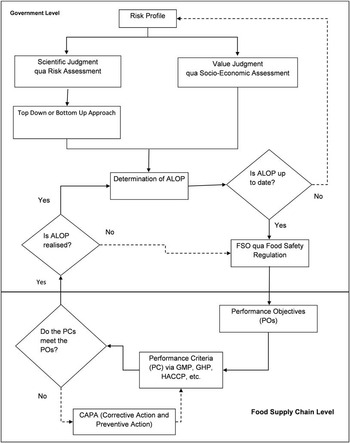
National Government determine an ALOP and translate it to FSO and put it in food safety regulation. Food supply chain actors then determine PO based on regulated FSO. Each of food supply chain actors must arrange food safety control programs, which meet the PCs to further contribute to PO. Government must continuously evaluate ALOP and FSO based on the latest scientific and socio-economic development.
The MOS of the accounting tool is an alternative method to measure whether the manufacturer has sufficiently integrated the FSO/ALOP concept into its RMP.Footnote 49 The government agency may use the MOS equation, which is derived from Equation 2, for the evaluation:
 $$MOS\,{\equals}\,FSO\,{\minus}\,H$$
 $$MOS \ Ratio \ \left( {\rm \%} \right)\,{\equals}\,{{MOS} \over {FSO}}\,\times\,100$$
The MOS must be positive to ensure that the level of hazard (H) as the result of the FSMS complies with the expected level of hazard at the point of consumption (FSO). If the MOS is negative, then the food manufacturer must apply more stringent PO in its production processes. Moreover, a food manufacturer can use the MOS ratio to evaluate the performance of current food safety controls. A low MOS ratio alerts the food manufacturer that it needs to start finding a new combination of food safety controls before the level of hazard exceeds the FSO or PO.
We propose that developing countries change their costly on-site inspections and end-product testing to a more cost-effective RMP approach. In this approach, the authority checks whether a food manufacturer meets the requirement of FSO/ALOP through its RMP document and internal audit, which acts as a baseline for the existing food safety risk management of the food manufacturer. Under the RMP scheme, the manufacturers must periodically carry out an internal audit to measure the current level of food safety risk management. Furthermore, the authority should register the RMP document and internal audit document in a database that records past performance. This allows the authority to black- or whitelist certain manufacturers, which then determines the frequency of on-site inspection and can eventually be used to evaluate the implementation of FSO/ALOP.
As previously mentioned, an ALOP should only be established for foods that have a significant impact on public health. The approach should thus only be applied for high-risk food, such as infant food, canned food and frozen food. This will ensure that the resources of both the authority and food manufacturers are more effectively allocated.
V Conclusion
The position of developing countries in the WTO is special.Footnote 50 However, this special position does not lift the burden of developing countries to implement the obligations enshrined in the WTO legal framework that relate to food safety, the SPS Agreement. Within this agreement, there are two strongly related components in the establishment of food safety standards: ALOP and SPS measures. ALOP acts as the objective and SPS measures are the tool to achieve the objective. Developing countries lack resources to establish appropriate food safety standards that meet the needs of their population. A differentiated approach is urgently needed to fill this gap. We proposed the FSO/ALOP concept to help developing countries establish food safety standards that meet the requirements of WTO law, food safety science and the specific challenges faced by developing countries:
-
1. Given that available resources limit the opportunities to develop a tailor-made FSO/ALOP system, determining ALOP based on FSO may form a preferred option for developing countries.
-
2. FSO/PO system is the key for a government to communicate the ALOP to a food manufacturer.
-
3. Successful implementation of the FSO/ALOP concept in developing countries requires enforcement. An ICT-based program of RMP is one option for developing countries to ensure food manufacturers’ compliance with existing food safety standards and to reduce the cost of inspection and compliance.
The proposed FSO/ALOP concept provides an approach for developing countries that is particularly relevant in two situations: when international standards are absent or when developed countries apply very strict food safety standards to the exports of developing countries.
Model of FSO/PO system in the supply chain.Footnote 46

Management model for the application of FSO/ALOP.